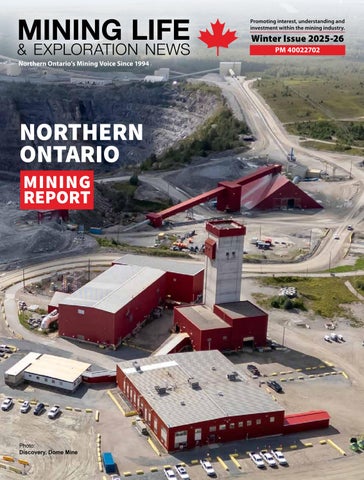
Mining Life & Exploration News - Winter 2025/2026

Page 1


Photo: Discovery, Dome Mine

A new rush, on familiar ground

Northern Ontario is heating up again—and the reason really is that simple: the world needs critical minerals, and the economics for precious metals remain compelling. From gold and silver to the battery and infrastructure metals that underpin electrification, the North is back in the spotlight, and this issue of the Northern Ontario Mining Report captures only a slice of what’s moving right now.

As you flip through these pages, you’ll see the proof in the pace: active juniors advancing projects, producing mines delivering ounces and tonnes, and a supply chain that’s gearing up for what comes next. This

ONE FOCUS: GOLD

“book” we’ve put together isn’t meant to be hype—it’s a snapshot of momentum. The industry is building, financing, drilling, permitting, hiring, and innovating. And in community after community across the North, you can feel that familiar sense of forward motion.

It’s also worth remembering: Northern Ontario has been here before.

More than a century ago, the Porcupine Gold Rush ignited in 1909, drawing prospectors and capital into what would become one of Canada’s legendary mining camps. After the devastating Porcupine Fire of 1911, the camps rebuilt with urgency because the geology— and the opportunity—didn’t disappear. And in 1912, the community that grew out of that boom formally became Timmins, a by-product of the rush that helped shape Northern Ontario’s identity for generations.

That history matters, because today’s moment has the same ingredients: global demand, big discovery potential, and a region that knows how to build mines—again and again.

The difference now is scale and strategy. Critical minerals aren’t just a market cycle; they’re a cornerstone of national supply-chain planning and industrial policy. Add a constructive gold environment, and you get exactly what we’re seeing: renewed exploration, renewed investment, and renewed confidence that Northern Ontario is entering another long runway of development.

We hope this issue helps you connect dots—between projects and people, geology and infrastructure, risk and upside. If you’re an investor, a supplier, a community leader, or simply someone who believes in the North, consider this your reminder: the rush isn’t coming—it’s already underway.

ADVERTISERS INDEX

ACE Mechanical Services 85

Agnico Eagle Mines Limited 17

Bee-Clean Building Maintenance 67

CAB Products Inside Back Cover

Canada Nickel Company 20

Canadian Mining Expo 73

Central Canada Resource Expo 127

Certarus Ltd. 97

CJ Equipment Sales & Service 65

CME Indigenous Forum 23

9 Dumoulin Trucking 15

North Inc. 75

World Inc. 77

Helicopters 119 Exsics Exploration Ltd. 95 Falcon Security Services Inc. 89

109

Mining Gold Corp. 107

NORTHWESTERN ONTARIO

RING OF FIRE

Unlocking the North: Two historic agreements

TIMMINS: How Canada’s Critical Core is Shaping the Future

Locatedat the heart of the Abitibi Greenstone Belt, Timmins, Ontario, Canada is one of the richest mineral-producing areas in the Western Hemisphere, and a place that has what the world wants. Since the discovery of gold in 1909, the Timmins-Porcupine Gold Camp has produced more than 70 million ounces of gold, valued at over $100 billion (CAD). Today, that legacy extends beyond gold, supported by exceptional geological diversity that includes silver, copper, nickel, zinc, platinum group metals, critical minerals and rare earth elements (REEs), placing Timmins at the core of the global minerals transition.

While its history is well established, Timmins is firmly positioned as a modern, innovation-driven mining district. The region supports a dense concentration of operating mines that few jurisdictions can match, complemented by a deeply integrated ecosystem of supply, services, and technology. Major producers including Agnico Eagle, Discovery, IAMGOLD, Glencore, Pan American Silver, McEwen Mining, Alamos Gold, and Magris Talc operate a mix of open-pit and underground mines across the district. These operations are supported by a sophisticated mining supply and services (MS&S) cluster capable of delivering advanced solutions across the full mine life cycle from exploration and development to production, closure, and reclamation. Exploration continues to drive both oppor-

tunity and innovation. In 2024, the district recorded $12.4 million in filed assessment work, maintaining strong activity following record exploration years in 2022 and 2023. While gold remains the dominant focus of active plans and permits, exploration increasingly spans base metals and critical minerals with a growing emphasis on nickel. This diversification reflects global demand for electrification, clean energy, defence, and secure supply chains, reinforcing Timmins’ relevance in an involving mining landscape.

Looking ahead, a strong pipeline of expansions and advanced development projects are shaping the next chapter of Timmins’ mining story. Discovery’s acquisition of Newmont’s Porcupine Complex secures the future of cornerstone assets including Hoyle Pond, Dome, Pamour, and Borden, while introducing fresh capital and renewed exploration potential. With processing infrastructure in place, Discovery is expected to generate more than 285,000 ounces of gold annually through 2046, providing long-term production stability and a platform for continuous operational improvement. Near-term growth is further reinforced by McEwen Mining’s Stock Mine, part of the Fox Complex, while Canada Nickel Company’s Crawford Project represents a transformational opportunity for the region. Recognized federally as a major nation-building project, Crawford is the world’s second-largest nickel reserve and

The Canadian Mining Expo— known worldwide as “Where the World Comes to Explore”— draws more than 400 exhibitors to Timmins each year, underscoring the city’s outsized role in shaping Northern Ontario’s mining ecosystem and Canada’s broader resource industry.

resource, anchoring the emerging Timmins Nickel District with total resources exceeding 18 million tonnes. Beyond scale, Crawford is poised to become one of Canada’s largest carbon capture and storage facilities, positioning Timmins as a global hub for low-carbon mining and a zero-carbon industrial cluster. Innovation also defines Timmins’ path from exploration to production. Galleon Gold’s West Cache Project, now approved for an 86,500-tonne bulk sample, enables test mining, accelerated mine planning, and continued land consolidation, all shortening development timelines and reducing project risk.

Timmins is positioned for growth – where legacy meets next-generation opportunity. With readily available industrial land, world-class infrastructure, reliable power, transportation and digital connectivity, and a highly skilled, mining-experienced workforce, the city offers an ideal environment to build, scale, invest, test and deploy innovative mining solutions. Supporting this momentum, Timmins Economic Development provides a concierge service, helping companies and investors navigate site selection, incentives, and partnerships, ensuring projects move efficiently from concept to operation in one of Canada’s most mining-ready and future focused communities. Contact Timmins Economic Development to learn more.

DISCOVERY ’s Transformation Year:

How a Gold Camp, a Silver Giant, and a 9-Million-Tonne Processing Vision Are ReShaping a North American Producer

Discovery

Silver’s CEO, Tony Makuch, knows how to make an entrance. One of the mining industry’s top executives, Makuch put a pin in the global mining map in 2025 that caught the attention of the entire investment community.

Along with a world-class team of talent, CEO Makuch evaluated, then bought the Porcupine assets of Newmont in early 2025 and the story since then has been nothing short of remarkable – including solid production – exploration upside – and a stock price that has early skeptics wondering why they didn’t buy a ticket to the show. In the short span of a year, the company’s stock vaulted from .88 cents and settled around the $10 mark (as of press time). In fact, the stock was the top-performing stock in the S&P/TSX Composite Index in 2025.

Add to that, an impending decision on one of the world’s largest undeveloped silver reserves located in Mexico, called Cordero, and you have a recipe for long-term success and prosperity.

Discovery spent the past year proving that its bold addition of the Porcupine assets was not just a strategic gamble—it was the opening chapter of a long-term growth story still unfolding across two countries. With

strong operational performance, aggressive districtscale drilling, a strong leadership team, and fresh clarity from Makuch on the company’s expansion ambitions in Timmins and Mexico, Discovery is positioning itself as one of the emerging mid-tier producers to watch. What began as a transformational purchase—the acquisition of Newmont’s Porcupine Complex—has quickly become the foundation for a strategy that blends high-grade exploration, disciplined cost control, and a vision for large-scale processing growth. The message from the company is clear: Discovery intends to build something far bigger than what investors have seen so far.

Borden mine underground
Dome pit mine rescue

A DISTRICT AWAKENS: New Gold Intercepts Across Porcupine

The Porcupine Complex sits in one of Canada’s most productive gold camps, but Discovery’s recent exploration results suggest the district may still hold significant untapped potential.

Between April and October (2025), the company drilled 27,640 metres in 85 holes, delivering standout intercepts across Hoyle Pond, Borden, Pamour, and the emerging regional zone at Owl Creek. Some of the strongest results included:

• Hoyle Pond S Zone:

- 23.95 g/t gold over 7.1 metres

- 86.09 g/t over 2.1 metres

• Borden Main Zone:

- 11.48 g/t over 5.2 metres

- 9.41 g/t over 12.6 metres

• Pamour:

- 104.6 metres grading 1.44 g/t

- 39.8 metres grading 3.40 g/t

• Owl Creek:

- 4.08 g/t over 16.3 metres

- 5.58 g/t over 5.2 metres

Early geological work at Owl Creek suggests the system remains open at depth, while results at Dome and the TVZ Zone are now entering the pipeline for future development work. As Makuch put it, “The drill results announced support our view that substantial gold remains to be identified at Discovery’s assets at Porcupine.”

For a complex that already hosts more than 15 million ounces of resources, the upside story is only strengthening.

Q3 MOMENTUM: Production, Cash Flow, and Cost Improvements

The company’s third quarter underscored the financial engine powering Discovery’s growth strategy. Gold sales surged to 66,200 ounces, driving revenue to $237 million at an average realized gold price of $3,489 per ounce. EBITDA more than doubled to $122.1 million, and operating cash flow reached $153.5 million.

The company closed the quarter with $341.5 million in cash and $224.2 million in working capital, increasing its cash balance by 35% since Q2.

• Operating metrics strengthened as well:

• Cash costs: $1,339/oz

• AISC: $1,734/oz (down sharply from Q2)

• Free cash flow: $86.8 million

Makuch highlighted the importance of this momentum as Discovery continues integrating the Porcupine operation: “A key highlight of the third quarter was cash flow, with net cash from operating activities of $153.5 million and free cash flow totaling $86.8 million.”

Capital spending—$65.2 million during the quarter—was directed toward underground development, tailings expansion, advancing Pamour, and preparing the district for long-term growth.

THE MAKUCH BLUEPRINT: Four Levers of Value

In a recent Kitco interview, Makuch articulated the structural strategy underpinning Discovery’s long-term ambitions. He outlined four drivers of value:

• Operational performance across Hoyle Pond, Borden, and the advancing of the Pamour mine.

• Investment in previously underfunded infrastructure, including ventilation, power, and backfill systems.

• Building new mines, particularly the Dome and TVZ projects.

• Exploration growth, leveraging Discovery’s districtscale land base.

These pillars are aimed at lowering costs, growing output, and building a pipeline that can sustain multidecade production in Timmins.

DOUBLING MILL CAPACITY

One of the most consequential insights from the interview was Makuch’s confirmation that Discovery intends to expand the Dome mill from 4.5 million tonnes to over 9 million tonnes per year. To enable this shift, Discovery is looking at:

• Replacing aging primary, secondary, and tertiary crushers

• Considering a SAG mill with a new coarse stockpile

• Repairing and upgrading tanks and leach circuits

• Expanding tailings capacity

Dome Mill

• The expansion is not merely optional. As Makuch noted, Porcupine is now mill-constrained, and unlocking value at Dome, TVZ, Borden, and Pamour requires more processing headroom.

Makuch emphasized, “A big part of unlocking value in Porcupine right now… is having that processing infrastructure in place that really helps you to grow production.”

This mill strategy is central to Discovery’s goal of more than doubling production within five years.

DOME: A Catalyst Hidden in Plain Sight

Among the company’s 2026 priorities, the Dome project stands out as one of the major potential share-price catalysts. The deposit holds 11 million ounces in an inferred resource, and Discovery is now evaluating:

• A staged development approach

• A smaller initial pit

• Lower upfront capital requirements

• Integration with the existing mill

Makuch stated plainly that Dome alone could generate substantial value, a strong signal that the market has yet to price in its full impact.

MEXICO RE-EMERGING: The Cordero Permit Window

While Porcupine has taken centre stage, Discovery continues to push the Cordero silver project toward a construction decision. Makuch confirmed:

• All technical and legal government reviews of the environmental impact assessment permit application are complete

• Land purchases and local agreements are finalized

• Financing options—debt, equity, offtake, hybrids— are all on the table

Makuch said the company is receiving “a positive view from Mexico and the regulators” and believes a resolution is close.

He also indicated Discovery intends to “hit the ground running” in Mexico once permits are in hand, supported by a updated feasibility study and strong metals prices.

PREPARING FOR ALL MARKET CYCLES

Despite record gold and silver prices, Makuch struck a cautionary note on long-term cost discipline: “We still want to work towards how we survive and prosper at $2,200 gold and $25 silver?”

The company’s investment-driven approach—directing cash flow into higher productivity, better infrastructure, and achieving exploration success—is built around resiliency, not short-term price windfalls.

LOOKING AHEAD TO 2026: A High-Velocity News Cycle

Investors can expect a heavy slate of catalysts in 2026, including:

• Dome engineering and development decisions

• TVZ advancement

• Expanded Porcupine drilling results

• Mill configuration and upgrade plans

• Tailings expansion progress

• Potential movement on permitting in Mexico

• Exploration updates across Hoyle Pond, Borden, Pamour, Dome, TVZ, and regional targets

Makuch summed up Discovery’s posture heading into the new year: “We’re not sitting on our hands… we’re using this as an opportunity to build and really set ourselves up for the future.”

A COMPANY IN ACCELERATION MODE

2025 marked the year Discovery proved it could operate Porcupine profitably. 2026 is shaping up to be the year it demonstrates how big Porcupine—and Cordero—can become. The company that was once viewed as a “silver developer” has now become a cash-flowing gold producer with multi-jurisdictional growth, district-scale exploration, and a blueprint for more than doubling gold production.

Hoyle Pond Shaft
Borden Aerial

LAKE SHORE GOLD, a

subsidiary of Pan American Silver, Announces New Haul Road and Strategic Partnership to Deliver Community and Environmental Benefits

Timmins, Ontario – December 5, 2025 – Lake Shore Gold, a subsidiary of Pan American Silver Corp., a key economic driver in Northern Ontario, announced the construction of a new haul road - a major investment designed to reduce truck traffic in the core of the City of Timmins and minimize environmental impacts across the region. This project was made possible through a valued partnership with Villeneuve Construction Co. Ltd.

The haul road will divert mine-related hauling away from the downtown area, which in turn will help to reduce traffic congestion, prolonging the lifespan of our municipal infrastructure, and most importantly, improve overall safety for our residents. The route was strategically selected to minimize environmental impact and is expected to substantially reduce greenhouse gas emissions by more than 1,000 tonnes of CO2e annually.

“This project reflects our commitments to responsible mining practices and being good neighbors to communities in which we operate,” said Director of Environment, Sus-

From left: Ben St. Amour (Environmental Superintendent, Lake Shore Gold), Steph Palmateer (City Clerk, City of Timmins), Timmins MPP George Pirie, Mario Villeneuve (Vice President, Villeneuve Construction), Sebastien Ukrainetz (Resources Manager, Villeneuve Construction), Marcel Cardinal (Director of Environment, Sustainability & Security, Lake Shore Gold), Bill Shand (Country Manager, Lake Shore Gold), and Angela Tremblay (Director of Human Resources, Lake Shore Gold).

tainability and Security, Marcel Cardinal. “By working closely with local community leaders, government partners, and Villeneuve Construction, we’ve developed a solution that supports our operational needs while safeguarding people and the surrounding ecosystem.”

“We are proud to partner with Lake Shore Gold on this important infrastructure project,” said Mario Vil-

leneuve, V.P. at Villeneuve Construction Co. Ltd. “Our team has deep roots in Northern Ontario, and we understand how critical it is to balance industrial growth with community well-being. By building this haul road, we’re not only supporting the mining sector but also helping to reduce traffic, improve safety, and protect the environment for residents across the region. This collaboration

Map identifying location of the new haul road

demonstrates how local expertise and industry leadership can come together to deliver lasting benefits.”

This initiative is part of Lake Shore Gold’s broader commitment – aligned with Pan American Silver’s values - to sustainable development, responsible resource extraction, and long-term collaboration with our Indigenous and community partners.

Lake Shore Gold is currently hiring for a wide range of positions to support its operations in Timmins. The company offers competitive wages, comprehensive benefits, flexible schedules, sign-on and relocation bonuses for eligible roles, and strong opportunities for training and career growth. Experienced miners and those seeking entry-level opportunities in mining are encouraged to apply. Interested applicants can view openings at panamericansilver. com/careers or submit a resume to HR@ca.panamericansilver.com.

AGNICO EAGLE gets higher throughput at Detour Lake, better grades at Macassa

Agnico Eagle has quietly and systematically become one of the world’s top mining companies. With operations in multiple jurisdictions, Agnico Eagle is unquestionably Canada’s top gold producer. In a recent interview, chairman Sean Boyd put it clearly.

“We just happen to find ourselves in the gold mining business, but our job was really to build a high-quality business that could withstand the ups and downs of the commodity price,” said Boyd. “Agnico Eagle was the only company of any size that never ever sold an ounce of gold forward. We did not financially engineer our business. Our job was to find it and produce it as cheaply as we could. And in doing so, we created this high-quality business that grew over time, to the point where we’re now the third largest gold producer in the world, the largest market cap mining company in Canada, and we did it by focusing on quality.”

Agnico Eagle’s Detour Lake and Macassa mines delivered steady operating performance throughout 2025 in Ontario, anchored by record mill throughput at Detour Lake and stronger-than-expected grades at Macassa.

Detour Lake

At Detour Lake the mill processed 7.351 million tonnes in the quarter— about 79,902 tonnes per day—at an average grade of 0.82 g/t, producing 176,539 ounces. Production costs were reported at $856 per ounce and total cash costs at $831 per ounce for the quarter. The company said the record quarterly throughput at Detour Lake was driven by optimization initiatives and record run-time, supported by the absence of a planned major shutdown during the quarter. Higher throughput offset lower grades, which reflected processing of supplemental ore from the low-

grade stockpile. Open-pit mining rates were constrained by slower progress around historical underground workings, resulting in lower-than-planned run-of-mine ore tonnes, with the grade profile expected to improve in the fourth quarter based on the planned mining sequence.

Macassa

At Macassa, the mill processed 133,000 tonnes in the quarter— about 1,446 tonnes per day—at an average grade of 18.95 g/t, producing 78,832 ounces. Production costs were reported at $617 per ounce and

total cash costs at $659 per ounce for the quarter. Operationally, Agnico Eagle attributed Macassa’s higherthan-anticipated grades to positive grade reconciliation and a change in mine-sequencing. These gains offset lower mill throughput caused by an unplanned secondary mill downtime in August, with the mill returning to normal operating levels by quarterend. A key near-term infrastructure milestone at Macassa is the new paste plant, which the company said is essentially complete. In pipeline work tied to Detour Lake’s longerterm development, the company advanced the Detour Lake underground exploration ramp, reporting 259 metres of advance to a depth of 43 metres as of September 30, 2025. The ramp is being driven toward the West Extension zone, where a bulk sample is planned from Domain 54 at Level 200 in the first half of 2027, alongside ongoing project engineering focused on electrical distribution and key surface and underground infrastructure. Detour Lake exploration drilling totalled 60,000 metres in the quarter (162,500 metres year-to-date), including a supplemental $9.4 million budget approved for an additional 55,000 metres of capitalized drilling. The program continued to infill the high-grade corridor at underground depths in the West Pit zone and the West Extension zone, with the company stating these results further strengthen the mineralization model supporting the underground project west of and under the open pit.

Upper Beaver Project

The upper Beaver Project is Agnico’s advanced exploration project near Kirkland Lake. The project reached a major milestone late last year with the first underground blast, marking the official start of shaft sinking at the site.

The project, located about five kilometres northeast of Dobie, Ontario, entered the advanced exploration phase in July 2024 and is progressing toward a potential production de -

Detour Lake
Macassa

cision that includes an on-site milling option.

The headframe structure is now complete, with work continuing on the maintenance shop and sinker dome. Temporary and advanced exploration hoist systems have been fully commissioned and are operational, supporting ongoing underground development.

Shaft sinking is being carried out by Agnico Eagle’s in-house team. At the same time, development of the exploration ramp continues, reaching approximately 680 metres of lateral advance at a depth of about 70 metres. Construction of a west ventilation raise is expected to begin in mid-January to support deeper underground access and maintain proper airflow.

Construction of the project’s water treatment plant has been completed, with piping to Retention Pond 1 underway. Pre-operational testing has begun as the facility moves toward commissioning. Monitoring of surface water, groundwater, noise, and vibration continues in accordance with advanced exploration permits and to support future productionphase design.

Exploration drilling has also resumed underground, with multiple drills mobilized to test additional deposit targets and provide data for potential mine planning.

Outside the mine site, upgrades to Fork Lake Road and the installation of a new public boat launch were completed before the end of the 2025 construction season. Agnico Eagle said the company will return in the spring to inspect the road, complete minor surface work, and consider additional safety-related amenities at the launch area. The company is encouraging lake users to access Beaverhouse Lake via Fork Lake Road starting in spring 2026 to reduce traffic in areas with active mine operations.

On the regulatory front, Agnico Eagle confirmed that the Impact Assessment Agency of Canada has approved a timeline extension for the Upper Beaver Impact Assessment. Under the revised schedule, the Impact Statement is now expected to be submitted in the third quarter of 2026, with the Impact Statement Phase concluding in March 2027.

Drafting of the Impact Statement has begun, alongside ongoing modelling and assessment studies scheduled to continue through winter and spring. A geotechnical investigation program supporting the design of key infrastructure, including tailings and rock storage facilities, has been completed.

The company has also initiated permitting work required for the production phase and issued a Notice of Commencement in late November for an environmental study related to a proposed 115-kilovolt transmission station and power line needed to supply additional electricity to the site.

Community engagement remained a focus throughout 2025. Agnico Eagle hosted multiple virtual thematic workshops, an open house, barbecue, and site tour during the summer, and continued discussions with communities on housing-related topics tied to potential project growth. The company said engagement activities will continue in 2026, with

consultations planned around the completion of the Impact Statement and the status of additional permits.

O3 Mining Inc.

A year ago, Agnico Eagle Mines Limited quietly crossed a strategic threshold in the Abitibi gold camp by securing overwhelming control of O3 Mining Inc., a move that now reads as an early signal of Agnico’s broader regional consolidation strategy.

STLLR Tailings & Tower Gold Projects

Agnico Eagle Mines also signalled continued confidence in STLLR Gold by committing to a $5 million nonbrokered private placement as part of the company’s broader $30 million financing initiative.

Agnico Eagle purchased approximately 3.9 million common shares brining their ownership in STLLR to roughly 11 per cent, reinforcing its position as a strategic shareholder. The placement ran alongside a $10 million bought-deal financing and a $15 million private placement that included participation from Eric Sprott. Proceeds from Agnico Eagle’s investment will be directed toward general corporate purposes and non-flow-through eligible operating expenses, while flow-through funds will support exploration programs across the company’s Canadian asset portfolio.

Upper Beaver Project

Northern Ontario’s Nickel Moment: Crawford fast-tracked as the Timmins Nickel District scales up

Northern Ontario has long been synonymous with world-class mineral endowment—and in 2026, that reputation is translating into something bigger than exploration headlines. The region is increasingly being positioned as a national strategic asset: a place where Canada can build the next generation of low-carbon, battery and clean-steel-ready metals supply. Few stories capture that momentum as clearly as Canada Nickel’s Crawford Project near Timmins, now advancing with both federal and provincial “fast-track” attention.

Late last year, Crawford was formally referred to the federal Major Projects Office (MPO), a designation reserved for projects the Government of Canada views as nationally significant. The MPO model is meant to streamline and coordinate the federal review process— reducing duplication across departments—while still maintaining environmental oversight and Indigenous consultation obligations.

In Ottawa’s framing, Crawford is not just another mine proposal. Natural Resources Canada described it as an anchor for “clean industrial materials,” pointing to low-carbon nickel for batteries and green steel and citing projected emissions substantially below global averages, with potential for an even lower net footprint.

A RARE ALIGNMENT: federal MPO + Ontario’s “One Project, One Process”

Crawford’s acceleration isn’t only a federal story. In January, the Province of Ontario named Crawford as the second project to move under the province’s new “One Project, One Process” (1P1P) framework—designed to better coordinate permitting, timelines, and information sharing across ministries for major developments. Canada Nickel has emphasized that streamlined coordination is intended to complement—not replace—its ongoing commitments around Indigenous partnership,

Commited to the future A

The Liebherr

The Liebherr Zero Emission Mining Program was established to further develop the roadmap for a decarbonized future. Liebherr strives to provide customers with a range of methods to help meet emission reduction targets as is working to offer products that use alternative

fuels.

environmental stewardship, and regulatory rigor. In practical terms, the signal to markets and communities is that Ontario wants a clearer, more synchronized runway for responsible mine development, especially for critical minerals with downstream supply-chain implications.

Another milestone underscores how advanced the permitting work has become: Canada Nickel notes that Crawford was the first mining project in Canada to submit an Impact Statement under the amended Impact Assessment Act (2019) in November 2024, and that the MPO referral (November 2025) and Ontario’s 1P1P designation (January 2026) create a more defined pathway to accelerate development responsibly.

Building the “critical minerals corridor” around Timmins

Beyond process, the Crawford story is also about infrastructure and regional readiness. The federal government has tied Crawford’s forward motion to electrification and grid connection planning: Natural Resources Canada notes a conditionally approved investment of up to $6.8 million through the Critical Minerals Infrastructure Fund to support transmission planning and electrification studies connecting the project to Ontario’s power grid.

Just as important for Northern Ontario’s long-term success is the way major projects are expected to embed reconciliation and shared prosperity. Federal materials highlight agreements supporting early business and employment opportunities with Mattagami, Matachewan, and Flying Post First Nations, and they also point to a $20 million investment partnership with Taykwa Tagamou Nation structured through convertible notes that could translate into meaningful equity participation.

On the macroeconomic side, the federal announcement that referred Crawford to the MPO explicitly tied the project to a broader nation-building agenda, including critical minerals and infrastructure corridors. In that same announcement, Crawford is positioned as part of a larger slate intended to unlock investment, support jobs, and strengthen Canada’s supply resilience.

The real headline: a district-scale nickel inventory taking shape

Crawford may be the flagship, but what’s drawing sustained attention is the scale forming around it—the Timmins Nickel District is evolving from “one big project” into a pipeline of deposits with published resources.

In mid-January, Canada Nickel reported a major update at its 100%-owned Reid Nickel Sulphide Project

left to right: Kapuskasing-Timmins-Mushkeguwok MP Gaétan Malette, Timmins Mayor Michelle Boileau, Federal Minister of Energy and Natural Resources Tim Hodgson, Canada Nickel CEO Mark Selby, Taykwa-Tagamou Chief Bruce Archibald, and Timmins MPP and Ontario Minister of Northern Economic Development and Growth George Pirie at the federal government’s announcement that referred Canada Nickel to the Major Projects Office.

near Timmins: Measured and Indicated resources increased 46% to 2.1 million tonnes of contained nickel (0.87 billion tonnes at 0.23% Ni), alongside a 47% increase in Inferred resources to 3.2 million tonnes contained nickel (1.45 billion tonnes at 0.22% Ni).

Reid is also noteworthy for what it suggests about district optionality. The company describes Reid as located about 16 kilometres southwest of Crawford and tied to a geophysical target footprint of 3.9 square kilometres—more than twice Crawford’s outline by that metric—with the current resource representing roughly 59% of the target area.

Just as compelling for future mine planning, Canada Nickel also outlined an exploration target at Reid of 0.5 to 1.4 billion tonnes grading 0.21%–0.22% nickel (conceptual in nature, with further drilling required).

And in language that will resonate with operators and investors, CEO Mark Selby highlighted comparative development attributes—pointing to lower strip ratio, less overburden, and higher chromium grades at Reid relative to Crawford, alongside significant unexplored target area and open extensions.

Reid’s growth also updated the district-wide tally: Canada Nickel reported the Timmins Nickel District now totals eight deposits with 10.1 million tonnes of Measured & Indicated contained nickel (4.3 billion tonnes at 0.24% Ni) and 12.5 million tonnes of Inferred contained nickel (5.4 billion tonnes at 0.23% Ni).

Midlothian and Bannockburn: more ounces—more optionality

Late in 2025, Canada Nickel also published initial mineral resource estimates for the Midlothian and Bannockburn projects, expanding the number of resource-stage

Pictured

deposits in the district and reinforcing the “multi-deposit” thesis. Midlothian delivered an Inferred resource of 595 million tonnes grading 0.28% nickel, containing an estimated 1.68 million tonnes of nickel. Bannock burn, meanwhile, outlined an Indicated resource of 63 million tonnes grading 0.28% nickel (0.18 million tonnes contained nickel) and an Inferred resource of 129 million tonnes grading 0.27% nickel (0.34 million tonnes contained nickel).

Aligning the Pathways to Prosperity One

June 10 th 9:00am - 5:00pm

McIntyre Ballroom

In that same release, the company said it expect ed to publish a final resource estimate for its Nesbitt project in the first quarter of 2026—another indicator that the district’s inventory is still expanding on a nearterm cadence.

Aligning

the Pathways to Prosperity:

Perhaps the most telling comparison for Northern Ontario readers: Canada Nickel’s release notes that, for context, the Sudbury Nickel District was estimated to have had a pre-mining resource of 19 million tonnes of contained nickel, underscoring the ambition of what’s being assembled around Timmins.

Why it matters for Northern Ontario

For the Northern Ontario Mining Report, the core takeaway is clear: the region is not only producing metals—it is increasingly hosting the kinds of large, long-life, infrastructure-backed projects that governments want to move from proposal to build. Crawford’s MPO referral and Ontario’s 1P1P designation reflect that shift. And the expanding resource base across Reid, Midlothian, Bannockburn, and additional targets points to something even bigger than one mine: a district-scale development pipeline capable of feeding critical mineral supply chains for decades.

One Window, Many Voices bringing together industry, government, and First Nations leaders to explore how development and cultural values can move forward together. The panel focuses on early alignment, clarity, and trust as the foundations for turning challenges into collaboration and shaping a shared path to prosperity.

Who Should Attend:

The Indigenous Forum is open to participants from industry, government, Indigenous communities, academia, service providers, and the public. It offers a space for open dialogue, shared learning, and practical collaboration in the resource sector. Indigenous and non-Indigenous voices alike are welcome and valued. For more info visit

STLLR Gold exploring Timmins with Sprott and Agnico Eagle backing

Withmoney in the bank and world-class investors, STLLR Gold Inc is well-positioned to become one of Timmins’ next gold producers – the big question is whether that production will come from a traditional mining project – or a more non-traditional path, tailings. It was just over a year ago that STLLR (formerly Moneta) announced it had secured rights to explore and potentially exploit one of Canada’s historic mine waste sites, the Hollinger Tailings. It didn’t take them long to reach a conclusion. There’s a lot of gold in that waste pile.

STLLR Gold released a maiden mineral resource estimate in late 2025 for its Hollinger Tailings Project marking a key technical and permitting milestone for the company’s near-surface redevelopment strategy.

The estimate follows less than a year of site access and characterization work and classifies more than 82% of the mineralization in the Indicated category, providing what the company describes as a high level of confidence in grade continuity and tonnage across the historic tailings facility located in the center of Timmins.

“The maiden Hollinger MRE marks a significant derisking milestone since the genesis of STLLR Gold and a big step toward remediating a 100-year-old site,” said President, Chief Executive Officer and Director Keyvan Salehi. “In under twelve months, we progressed from initial access to delivering a robust tailings MRE, which is the start of mapping out a potential path to cash flow at current gold prices.”

Drilling the Hollinger Tailings Project in Timmins. Drilling has confirmed consistent gold mineralization and metallurgical test results demonstrate 61.3% recovery via cyanidation.

“The City of Timmins’ continued collaboration with STLLR Gold is a powerful example of how modern mining can be a force for sustainable development,” said Michelle Boileau, Mayor of Timmins. “By reprocessing historic mine tailings, the Hollinger Tailings Project has the potential to remediate the environment and unlock new land-use possibilities in the City of Timmins.”

The Hollinger tailings stack occupies a large, nearsurface footprint within the Timmins mining camp and consists of material previously mined and deposited over decades of historic operations. According to the company, drilling results show consistent gold grades across much of the facility, with particular upside potential identified along the northwest and northeast margins that were not fully drilled during the most recent program.

Phase 1 of the deposit contains the higher-grade portion of the resource, averaging 0.41 grams gold per tonne in the Indicated category. STLLR has begun evaluating mining sequences and operating scenarios

Why Mining Companies Choose Us

• Decades of experience serving major mining operations

• Modern, GPS-tracked vehicles with enhanced safety features

• On-time, dependable performance

• Indigenous partnership programs supporting local communities

• Scalable solutions tailored to your project needs – including both onsite and offsite transportation

Reliable. Safe. Proven.

For over 60 years, Tisdale Bus Lines has been a trusted name in transportation across Northeastern Ontario. As a key partner in the mining sector since 1994, we specialize in safely and efficiently transporting workers to job sites throughout the region.

With operations based in Timmins and Sudbury, our modern fleet, experienced drivers, and unwavering commitment to safety make us the premier choice for industrial transportation.

focused on this phase as a potential starting point for any future production plan.

From a development standpoint, the company believes Hollinger benefits from existing regional infrastructure, near-surface geometry and favourable metallurgical characteristics typically associated with tailings material. Metallurgical testing completed to date indicates gold recoveries of 61.3% using conventional cyanide leaching, with higher recoveries achieved through flotation testing.

“Given the surrounding infrastructure and the previously mined nature of the material, we believe Hollinger represents a rare opportunity to unlock value without the long timelines and capital intensity typically associated with greenfield mining projects,” said Salehi.

STLLR has initiated permitting under Ontario’s new Recovery of Minerals Regime, a regulatory framework designed to streamline approvals for the reprocess-

In addition to its economic potential, STLLR emphasized the broader environmental and community benefits associated with reprocessing historic tailings, including site remediation and the creation of future land-use

Tower Gold Project open pit

ALAMOS GOLD ’s

Path to One Million Ounces

Overthe past two decades, Alamos Gold has steadily transformed from a single-asset producer into a diversified company with a clear growth trajectory and a strong foundation in operational discipline. Today, the company stands at a defining moment in its evolution, with a credible and well-articulated pathway to producing one million ounces of gold annually. Anchored by its core Canadian operations and supported by a strong balance sheet, Alamos is executing a strategy built on integration, optimization, and long-term value creation.

A pivotal step in that strategy came in mid-2024 with the acquisition of the Magino Mine in Ontario. By swiftly aligning Magino with the adjacent Island Gold underground operation, Alamos created the foundation for a significantly expanded and more efficient production platform. The integration of these assets has transformed what were once standalone operations into a cohesive district with the scale and flexibility to support long-life, low-cost growth.

At the centre of this transformation is the Phase 3 expansion at Island Gold, which includes the development of a shaft and a paste backfill system. This critical infrastructure will enable higher mining rates, improve productivity, and reduce unit costs, positioning the operation for sustained growth well into the future. Construction continues to advance on schedule, with completion expected in the third quarter of 2026.

In parallel, Alamos is upgrading the Magino processing facility to fully leverage the scale of the combined Island Gold District. While the existing mill was tooled to process ap -

proximately 10,000 tonnes per day, the broader district has the capacity to support substantially higher throughput. Planned expansions will increase processing capacity to 20, 000 tonnes per day, with additional flexibility to treat up to 2800 tonnes per day of high-grade ore from Island Gold. Once fully integrated, the district is expected to produce approximately 500,000 ounces of gold annually, establishing it as a cornerstone of the company’s future growth.

Elsewhere in Ontario, the YoungDavidson mine continues to demonstrate operational consistency and resilience. Since 2020, the operation

Magino Mine open pit

Discover Kirkland Lake - Where Mining Thrives

A town built on mining — and ready for what’s next

Kirkland Lake is a proven mining hub with the infrastructure, workforce, and community support your operation needs to succeed.

World Class Mining Legacy- Home to one of Canada’s most productive gold camps with over a century of success . It’s the ideal Location for:

• Mining & Exploration Companies • Equipment & Service Providers

• Processing & Support Operations • Mining Technology & Innovation Firms

has sustained a throughput rate of 8,000 tonnes per day. While portions of 2025 experienced lower ore grades, the mine continued to deliver strong margins, generating approximately US$200 million in free cash flow. This performance underscores Young-Davidson’s reliability and its leverage to a favourable gold price environment.

In Manitoba, development at the Lynn Lake project was temporarily paused in 2025 due to wildfire activity across the province. With conditions stabilizing, Alamos expects to reaccelerate work in 2026 and remains on track to bring the project into production in 2029.

Laying the Groundwork for the Next Phase of Growth

Having reached annual production of approximately 500,000 ounces, Alamos Gold is now firmly positioned for its next phase of growth. By the end of the decade, the company is targeting one million ounces of an-

nual production, driven primarily by expansion across its Canadian asset base.

This growth is being advanced from a position of financial strength, supported by a favourable gold price environment underpinned by structural demand. That foundation allows capital to be directed toward long-life assets with clear expansion pathways, reinforcing a strategy centered on sustainable, value-accretive growth.

At the Island Gold District, future growth will be driven by the transition from ramp access to shaft mining, alongside continued expansion of Mineral Reserves and Resources. Exploration success has consistently replaced mined ounces, leaving the orebody larger today than when operations began. A similar long-term opportunity exists at Young-Davidson, where ongoing exploration continues to reinforce the asset’s scale, flexibility, and longevity.

Growth is also being advanced

through the continued evolution of the Mulatos District in Mexico. As Alamos’ founding operation and a steady producer since 2005, Mulatos has benefited from decades of exploration-driven mine life extensions. That momentum continues with the development of PDA, a higher-grade underground deposit adjacent to the main Mulatos pit. Following the achievement of a key permitting milestone, PDA is expected to meaningfully extend the life of the district while providing a new source of low-cost, high-return production.

The Lynn Lake Project represents a cornerstone of Alamos Gold’s longterm growth strategy and a generational development opportunity for northern Manitoba. As the first new mine to advance to construction in the province in more than 15 years, Lynn Lake is expected to operate over a 27-year mine life, beginning with two primary gold deposits. Construction is projected to create more than 600 jobs, with approximately 450 long-term operational roles supported by training and hiring commitments focused on northern and Indigenous communities. With strong backing from the Manitoba government, First Nations partners, and the Town of Lynn Lake, the project is well positioned to deliver lasting economic benefits while establishing a new hub for responsible mineral development in the region.

Together, these initiatives mark more than a period of growth—they represent a deliberate shift in scale and ambition for Alamos Gold. With a portfolio anchored by long-life assets, a pipeline of fully funded expansions, and a track record of operational discipline, the company is positioning itself among the next tier of gold producers. As integration advances and new projects come online, Alamos’ path to one million ounces is increasingly defined not by aspiration, but by execution.

Island Gold underground mine

METALS CREEK advances Ogden exploration while securing financing for next-stage work

Metals Creek Resources is deepening its exploration footprint in Timmins as the company builds on a series of surface discoveries at the Ogden Gold Project and secures new capital to sustain its programs into 2025. Recent fieldwork across the Naybob trend – combined with the completion of a year-end financing – reinforces the company’s focus on uncovering new gold potential along one of the most productive structural corridors in the region. Work through the fall delivered a consistent narrative: expanding alteration envelopes, strong structural indicators and new high-grade gold samples that continue to open up the mineralized system along strike. Much of that progress centres on Naybob West, situated near the former Naybob mine and within Metals Creek’s 50/50 joint venture with Discovery Silver. The project covers eight kilometres of the Porcupine–Destor Break, a major regional fault that has been the backbone of Timmins’ century-long mining history.

Expanding the mineralized corridor at Naybob West

In October, the company outlined results from a second phase of prospecting and mapping roughly 400 metres west-northwest of the historic Naybob workings. That program strengthened the definition of a 30-metre-wide corridor of pervasive fuchsite–sericite–silica–iron carbonate alteration with quartz stockwork. Seventeen new samples returned assays ranging from 0.054 grams per tonne to 12.3 g/t gold, confirming both grade variation and the continuity of mineralization within the broader altered package.

Geologists also recognized a structural flexure where the trend rotates from an easterly to a northeasterly orientation. Such northeast-trending structures have long been associated with productive gold systems across the Timmins Camp, giving added weight to Metals Creek’s interpretation that the zone remains open in both directions.

Trenching reveals broader alteration and stronger structural context

Follow-up trenching in November marked a significant step forward in understanding the geometry and scale of the system. Field crews opened a 30-metre-wide corridor of intense alteration and uncovered a discrete zone of quartz flooding with disseminated pyrite, arsenopyrite and local galena. According to the company, primary textures within parts of this zone are largely destroyed – a characteristic often associated with robust hydrothermal fluid flow.

Trenching extended the strike of the altered corridor by approximately 70 metres while mapping confirmed the earlier structural observations: a shift from an eastward strike to a northeast orientation. Metals Creek says this structural setting, combined with the sulphide assemblage and quartz flooding, continues to support the potential for gold mineralization at Naybob West.

The November program collected 60 grab samples, and mineralization remains open. Six soil-sampling lines were also completed along the projected strike extension. Additional trenching was halted by winter conditions, with assay results to be re -

leased following laboratory analysis and compilation.

Financing supports continued Timmins and Newfoundland exploration

In early December, Metals Creek completed the second and final tranche of its private-placement financing and has now filed for final TSX Venture Exchange approval. The company raised a total of $663,500 through a combination of flow-through and non-flowthrough units, issuing 10,025,000 flow-through units and 7,500,000 non-flow-through units across both tranches.

The latest tranche included 1.4 million flow-through units priced at four cents, each consisting of one flow-through share and half a warrant. Full warrants are exercisable at six cents for two years. The nonflow-through units included full fiveyear warrants, also exercisable at six cents. Cash finder’s fees totaled $43,050, and the company issued 1,137,500 non-transferable broker warrants pursuant to TSXV policies. All securities are subject to a fourmonth hold.

Flow-through proceeds will advance exploration in both Ontario and Newfoundland, including prospecting and target generation at Ogden. Metals Creek says it will ensure all qualifying expenditures meet federal Income Tax Act requirements.

Building momentum heading into 2025

Across three months of fieldwork, Metals Creek has extended the altered footprint at Naybob West, confirmed high-grade gold values within the broader structural corridor and identified a consistent northeasttrending geometry that aligns with some of Timmins’ most prolific gold hosts. With new financing secured, the company enters 2025 positioned to continue testing a growing pipeline of targets along the Porcupine–Destor Break.

Precious metals

meaningful investment,

asset you can trust will stand the test of time.

Since its inception in 1954 by the distinguished Master Jeweler Peter S. Vinczer, the Premier Canadian Mint has solidified its position as Canada’s premier choice for the finest precious metals. With an unwavering commitment to excellence, we offer an expansive array of bespoke designs, including coins and premium promotional items, as well as minted watches, elegant belt buckles, sophisticated cufflinks, quality daggers, and breathtaking jewelry masterpieces. Renowned for our impeccable craftsmanship, PCM has earned the trust and satisfaction of a prestigious clientele, including former U.S. President George W. Bush, central banks, the RCMP, diplomats, governments, and dignitaries. PCM has proudly produced over 400 items for the Canadian Military.

Fulcrum Metals Joins Ontario’s New Gold Rush with Plan to Solve “Major” Industry Problem

Fulcrum’s Innovative Approach to Mineral Recovery Improves Efficiency and Increases Mill Capacity

The Ontario Recovery of Minerals Permit, which came into effect July 1, 2025, was designed in part to kick start the mining industry in Ontario and recover low-hanging fruit faster. So far, it’s generated growing interest from several companies.

Fulcrum Metals is one of them, developing two projects in the Kirkland Lake area: its Teck-Hughes Gold Tailings Project and its nearby Sylvanite Gold Tailings Project. Fulcrum’s deposits also show significant po -

tential for critical minerals including gallium and tellurium.

What makes Fulcrum different from other companies though is its innovative approach. Collaborating with Extrakt Process Solutions and its alliance partner, Bechtel, they are pioneering a zero-cyanide, zero-waste technology and process. Fulcrum has exclusive rights to this technology in the Kirkland Lake and Timmins gold camps. “Extrakt’s recovery process could be revolution-

ary,” said Ryan Mee, CEO of Fulcrum Metals PLC. “Results are showing improved processing efficiencies through the cycle to reduce CapEx and OpEx.”

Specifically, the process recovers more minerals in a shorter amount of time. The zero-cyanide, zero-waste approach is also a strong platform for remediating the project sites safely, Mee said. That’s important because remediation is a clear objective of the Ontario Recovery of Minerals Permit.

Fulcrum Brings Extrakt Process Solutions’ Mineral Recovery Process to Canada

Extrakt Process Solutions is a Kentucky-based technology company that developed a versatile, environmentally friendly mineral recovery and separation process for metals, minerals, and even oil deposits. As for “revolutionary” – Mee said he lets Fulcrum’s numbers speak for themselves.

“Recent bench tests at one of our sites show gold and silver recoveries

Ryan Mee, Chief Executive Officer

TURNING WASTE INTO GOLD

Ryan Co-founded Fulcrum Metals and is an experienced serial private investor in the natural resources space turned entrepreneur with extensive knowledge of exploration companies. Ryan has a wealth of knowledge in business and commercial acumen, raising funds, investment, strategic and business planning.

Ryan earned a BA (Hons) degree in Economics and has over 16 years in senior positions for an industry leading audit and consultancy company.

Minetuff™ Series
Multistage Centrifugal Pumps

of over 70% in six hours, compared to previous baseline tests using traditional cyanide-based techniques that recovered about 30% in 48 hours,” Mee said. “And, Extrakt’s process is greener because it’s a cyanide-free technology.”

In short, the process recovers more than twice as much mineral in one-eighth the time – without the use of cyanide.

Remediation is built right into the process, Mee said. A video on the Extrakt website shows how the dewatering process stabilizes the tailings and makes them easier to manage. That along with the cyanide-free technology makes site remediation faster, cleaner, and more efficient.

Another key element that Fulcrum brings to the table is processing capacity and flexibility. There are a limited number of custom mills that could process mine tailings. Traditional processing methods need to be innovated, calibrated, and tested for each source to maximize mineral recovery. In other words, a mill can’t simply flip a switch and process tailings.

“There is one custom mill in the Timmins and Kirkland Lake-Larder Lake area, capable of processing only 1,500 tons of material per day,” Mee said. “That’s a major problem. We have a combination of many legacy tailings sites with millions of tons of tailings and limited processing capacity that will need to be innovated and reconfigured. Estimates put the total material from Fulcrum’s tailings projects in the Kirkland Lake area alone at about 10 million tons. Clearly, one mill won’t be enough.”

Mee said that by using Extrakt’s technology, Fulcrum can increase mill processing capacity for its own projects and possibly other projects in the area. The technology is also easily scalable and transferable.

Of course, new technology often raises eyebrows – but Fulcrum’s approach and the strength of its collab -

orative partners have gained support of local communities including First Nations, Mee said. “The technology is new, but the equipment will be similar to equipment already in use in Canada,” Mee said. “It’s simply a new technique using traditional machinery, which will help with social licence and permitting.”

Fulcrum signed a collaborative working agreement with Apitipi Anicinapek Nation (AAN) last June for its Teck-Hughes and Sylvanite projects.

“It’s refreshing to work with a company that recognizes the importance of environmental responsibility from the outset,” said Lance Black, AAN Director of Negotiations and Contract Management, in a news release. “We are encouraged by this agreement with Fulcrum Metals as it aligns with one of Apitipi Anicinapek Nation’s priorities: to see the legacy of environmental contamination on our lands be fully remediated.”

Map of Fulcrum Metals’ Teck-Hughes and Sylvanite gold tailings projects in the Kirkland Lake area.
Wooden slurry pipes at Fulcrum’s Teck-Hughes Gold Tailings Project site near Kirkland Lake. Fulcrum estimates it has 10 million tons of material at its two sites.

WESDOME ’s Eagle River story: production strength meets a 10-kilometre exploration runway near Wawa

Withgold trading near record territory—spot prices topped roughly US$4,700/oz on January 20, 2026—profitable Canadian producers are leaning into what Northern Ontario does best: convert strong margins into the kind of disciplined drilling and mine optimization that builds long-life operations. For Wesdome Gold Mines, that strategy is coming into sharp focus at Eagle River, its cornerstone high-grade underground mine on the Mishibishu greenstone belt, about 50 kilometres west of Wawa, supported by a sprawling ~400 km² land package.

The company is entering 2026 with two parallel tailwinds: a year of record production and a regional exploration update that effectively redraws the opportunity map around Eagle River. Together, they reinforce a message the Northern Ontario Mining Report has carried for decades—this region doesn’t just host gold; it repeatedly creates new gold stories through infrastructure, expertise, and underexplored ground.

RECORD PRODUCTION AND A

“FILL-THE-MILL”

YEAR AHEAD

Wesdome finished 2025 with 185,575 ounces of total gold production, including 112,767 ounces from Eagle River and 72,808 ounces from Kiena in Québec. Eagle River milled 257,447 tonnes in 2025 at an average head grade of 14.1 g/t, underscoring why the operation is viewed as one of

the higher-grade underground gold anchors in the province.

For 2026, Wesdome guided consolidated production of 180,000 to 205,000 ounces, with Eagle River expected to deliver 105,000 to 115,000 ounces at a planned processed grade of 13.0 to 14.0 g/t— a level the company says is consistent with reserve grades. The focus is steady execution and flexibility—Wesdome’s “fill-the-mill” approach—paired with investment that supports throughput, mine life, and future growth.

That investment is material. Eagle River’s total 2026 capital program is guided at $105 million, including $45 million in growth capital earmarked for camp capacity and surface infrastructure, fixed equipment improvements, additional mobile equipment, and exploration/tailings engineering studies. On the cost side, Wesdome forecast consolidated cash costs of US$1,050–1,150/oz and all-in sustaining costs of US$1,525–1,700/oz.

Just as important for Northern Ontario’s long-term narrative: the company reported a much stronger financial position coming out of 2025, which helps explain why it is prepared to fund one of its largest exploration pushes yet.

THE EXPLORATION

HEADLINE: 10 kilometres of prospective strike length

Late in 2025, Wesdome published

an exploration update that signals a step-change in how it will pursue growth around Eagle River: the company’s regional work has defined approximately 10 kilometres of prospective strike length along the Mishibishu Deformation Zone, driven by a detailed structural mapping program launched in mid-2024.

This isn’t just a mapping milestone—it’s a practical one. By tightening the geological model, Wesdome is prioritizing targets with the best odds of delivering near-surface ounces, depth extensions, and ultimately, the type of resource growth that can extend mine life and smooth production profiles over the long run.

At the historic Mishi and Magnacon areas, Wesdome completed a comprehensive drilling program in 2025, including a 9,600-metre program at Mishi and 3,200 metres at Magnacon to twin historic intercepts, add structural information, and test extensions. At Mishi, the company says drilling is confirming near-surface mineralization extends nearly one kilometre west of the current pit boundary, and highlighted deeper results including 8.3 g/t Au over 4.7 metres (uncapped) in one hole.

The bigger takeaway is structural: detailed mapping along the Mishi–Magnacon trend defined a newly interpreted basin-margin thrust fault separating metasedimentary rocks to the south from metavolcanics to the north—an interpreted boundary

Wesdome Eagle River Mine

Wesdome considers highly prospective given how mineralization is repeatedly located near this contact. The company also reported anomalous grab samples south of the contact, including values up to 51.5 g/t Au, adding weight to the idea that additional high-grade settings may sit outside the historically emphasized corridor.

MULTIPLE TARGETS, MULTIPLE “SHOTS ON GOAL” IN 2026

Beyond Mishi and Magnacon, 2025 work advanced several other targets now feeding into 2026 planning:

• Dorset Zone: more than 14,000 metres drilled in 2025 to support a new resource estimate expected in 2026, with the deposit described as open at depth and along strike.

• Falcon Zone: ongoing highgrade intercepts and an expanded induced polarization survey intended to generate new drill targets for 2026.

• Cameron Lake Iron Formation: broad mineralized intervals including 88.6 metres at 1.0 g/t Au, pointing to bulktonnage potential.

• New priorities for 2026: Eagle River Splay–North Diorite and Abbey Lake, where Wesdome describes a 10-kilometre segment of the Pukaskwa Deformation Zone as largely untested but strategically positioned, with historic grab samples up to 32.0 g/t Au and first-pass drilling planned. To execute on this expanded pipeline, Wesdome set a $55 million exploration budget for 2026 with more than 270,000 metres of planned underground and surface drilling; Eagle River accounts for $25 million and 145,000 metres of that total.

A QUÉBEC FOOTNOTE THAT STILL SUPPORTS THE NORTHERN ONTARIO THESIS

While this report is rooted in North-

Come build your future with us!

Join our Team

Located just 50 km west of Wawa, Ontario, on Paint Lake Road (50 km o Highway 17), Eagle River Mine has been producing gold since 1995. We’re committed to operational excellence while prioritizing the safety, care, and well-being of our people—and the communities where we operate.

Your next opportunity starts here

ern Ontario, Wesdome’s Kiena mine in Val-d’Or remains an important part of the company’s overall production engine, with 2026 guidance of 75,000 to 90,000 ounces and operational improvements expected to lift output, particularly in the second half of the year. The relevance for Northern Ontario readers is simple: a stronger, diversified producer is better positioned to sustain long-cycle exploration and capital investment

at Eagle River—exactly the kind of reinvestment that keeps Ontario camps globally competitive. In a gold market that is rewarding disciplined operators, Wesdome’s Eagle River plan reads like a Northern Ontario blueprint: keep the mill fed, invest in flexibility, and use strong cash generation to fund the drilling and structural work that can turn a producing mine into a district-scale story.

AI tools give Timmins explorers new ways to chase gold discoveries

Timmins’ next generation of gold discoveries may be hidden under tens of metres of overburden, locked in broad intrusion-related systems, or sitting in overlooked volcanic units. To find them, Onyx Gold, GFG Resources and New Break Resources are turning to artificial intelligence and data-driven exploration while they push ahead with new discoveries at their flagship Timmins-area projects. The trio made their comments in late 2025 during an online discussion. Making sense of hidden systems at GFG’s Aljo project.

For GFG Resources, the challenge is simple to describe and hard to solve: much of the company’s 800-square-kilometre Timmins land package has little or no outcrop and is blanketed by 10 to 40 metres of till. “We’re looking for technologies that allow us to see through that cover rock and to vector and find new gold systems within it,” said president and CEO Brian Skanderbeg.

GFG is combining advanced till geochemistry and AI-enabled data synthesis to attack that problem. Modern till sampling and analysis can now provide a clearer “fingerprint” of buried gold systems, producing large datasets that go far beyond traditional geochemical surveys.

“Lots of exploration companies collect realms and realms of data and geologists just... it’s hard to synthesize all that,” said Skanderbeg. “So this synthesis piece is evolving and that’s new technology related to the AI.”

At the Aljo project, GFG has already defined three zones – the HW, Main and FW zones – in a near-surface, high-grade, multi-vein system. Follow-up drilling is targeting infill, step-outs at depth into the footwall environment and strike extensions, with an eye toward growing Aljo to deposit scale.

At the same time, GFG is running a regional sonic till program on wide-spaced grids across the cen-

tral Goldarm block west of Aljo. Historical drilling in that area returned multi-gram showings but left long structural corridors effectively untested. By layering sonic till results, historical drilling, geophysics and mapping into AI-assisted workflows, GFG aims to rank and refine targets along several kilometres of prospective structures and generate the next wave of drill-ready prospects.

New Break’s Moray discovery leans on AI and drones

New Break Resources is advancing its Moray project on a fault that may be related to the Cadillac–Larder Lake system but has seen far less exploration than some of Timmins’ marquee structures. Moray hosts a large syenite intrusion and a broad, medium-grade gold system that New Break compares conceptually to the Young-Davidson mine model.

On the western side of the property, where overburden is minimal, New Break used drone- based magnetic surveys and high-resolution drone mapping to refine its structural interpretation. That work turned a narrow shear-vein showing at surface into a much wider mineralized zone intersected in recent drilling, including broad intervals up to 30 metres. “The mapping work was invaluable and the structural interpretation to getting us to where we are now,” said CEO Bill Love. Love has been personally experimenting with machine learning and AI for mineral exploration since well before today’s hype cycle. He points back to work done almost 20 years ago with Diagnose, a Montreal-based group that used early machine learning techniques to process large exploration datasets and highlight targets.

Now, New Break is revisiting that data-driven approach using modern AI tools. “Before AI became so popular there was machine language work that was done in mineral exploration... even back that far it was able to parse huge volumes of data into

targets,” said Love. “What you can do now with feeding Microsoft Copilot for instance a volume of technical data and have an output that would take an individual or even a group of individuals a huge amount of time to do... it’s so quick.”

Love and a colleague who specializes in AI are feeding Copilot large technical datasets – drill logs, assays, geophysics and historical reports – and querying the system to test ideas and compare Moray’s emerging system with analogues elsewhere in the Abitibi. The goal is not to replace geological judgment but to accelerate the process of sorting, clustering and cross-checking information as New Break tries to understand whether Moray’s gold is primarily intrusion-related, structurally controlled, or a hybrid of both. Beyond Moray, the company has staked and acquired additional ground to the northwest, west and southwest, targeting the interplay between ultramafic belts, intrusives, and felsic–mafic volcanics. AI-assisted analysis of regional data, combined with on-the-ground prospecting and mapping, is expected to guide the prioritization of this enlarged pipeline of targets.

ONYX GOLD: data-rich corridors at MunroCroesus and Golden Mile

Onyx Gold’s flagship Munro-Croesus project sits on the Pipestone fault, a northern splay of the Porcupine–Destor fault zone, in one of the most structurally endowed parts of the Timmins camp. The land package includes the historic Croesus mine, often cited as Ontario’s highestgrade past-producing gold mine, and a new bulk-tonnage discovery at Argus Main and Argus North.

For almost a century, explorers in the area focused on narrow, highgrade orogenic veins like those at Croesus. Onyx’s Argus discovery broke that pattern. The company

intersected broad intervals of disseminated and stringer pyrite mineralization within iron-rich basalts – a style that does not present as obvious quartz veins at surface, yet delivered substantial widths at meaningful grades.

“The opportunity was a little bit lost until basically 2022 when our predecessor company recognized this area as a potential bulk-tonnage discovery,” said president and CEO Brock Herron. Systematic drilling and careful mapping turned that new host rock model into discovery holes measuring more than 100 metres in length. From there, Onyx began to “fingerprint” the favourable basalt sub-horizon geochemically and trace it along eight kilometres of the Pipestone structure, which the company controls between its Argus zones and the nearby Fenn-Gib deposit. That fingerprinting work generates large datasets of multi-element chemistry, alteration patterns and structural measurements – the type of information that lends itself to AIaided analysis as the dataset grows.

Although Herron emphasized that Argus North itself was ultimately found through old-fashioned grid drilling, he acknowledged that the broader Munro-Croesus and Golden Mile properties will increasingly rely on new tools to chase blind targets. Golden Mile, a roughly 200-squarekilometre property about eight kilometres from Discovery’s Hoyle Pond mine, is masked by roughly 40 metres of overburden and even a shallow man-made lake in places.

In such an environment, AI-supported integration of geophysics, till sampling, structural models and scattered historical drilling could be critical to ranking targets and deciding where the next discovery holes should be drilled. As more data is collected across Munro-Croesus and Golden Mile, the same data-driven workflows used by peers in the belt can help Onyx hone in on the most prospective structural corridors.

AI as a force-multiplier, not a replacement

Across all three companies, executives are careful to cast AI as a forcemultiplier for experienced geologists rather than a black-box solution.

“I do think that as your AI systems and software evolves over time, it will become more and more effective and hopefully makes your geologist smarter,” said GFG president and CEO Brian Skanderbeg. “It’s never going to be a request, but if you can make your geologists see another layer, integrating your data layers more efficiently, that’s a big piece for us.” In practice, that means using AI to:

• synthesize multi-decade datasets that would overwhelm a single person or small team;

• spot subtle patterns in till geochemistry, geophysics and drilling that might indicate a buried

• system under cover;

• compare emerging deposits like Moray or Argus against analogues elsewhere in the Abitibi;

• help rank and refine targets across large land packages where capital and metres are finite.

In a camp where many of the obvious outcropping deposits have already been found, Timmins’ next wave of discoveries is likely to come from concealed structural corridors, intrusion-related systems and overlooked host rocks. For Onyx Gold, GFG Resources and New Break Resources, AI is becoming part of the toolkit that will help turn those complex geological puzzles into the district’s next generation of mines.

Try out the table at PDAC booth 6723N logging tables already delivered to: logging tables already delivered to:

Industry Standard

With Palsatech’s logging tables, you gain efficiency, adaptability, and safety in one solution. Our tables are designed to upgrade your workflow and can be delivered as a complete turnkey package.

Fully customizable options include electrically adjustable tables, fixed incline models, and flat tables, with a wide selection of accessories and configurations to support different workflows and working environments.

Visit our website to learn more and get in touch. Let’s advance together.

Fully customizable solutions

Local installation and maintenance

Spare parts with quick delivery

GALLEON GOLD & PAN AMERICAN join forces for West Cache bulk sample

They’ve settled on a dance partner. For years, Galleon Gold has fended off questions about who they might partner with to develop their West Cache gold property. That question was answered in late 2025 and it surprised noone. Galleon and its neighbour, Pan American Silver, which operates the Timmins West Mine just a short distance away from West Cache are now spinning around the dance floor and billionaire mining financier Eric Sprott is paying the DJ.

Galleon completed a year marked by major financing, regulatory progress and early development work, setting the stage for a fully funded bulk sample program in 2026.

In 2025, the company assembled a $91.5 million financing package to advance West Cache through key de-risking and feasibility-level activities. The funding included $15.5 million in convertible debentures, $30 million in equity financings and a $46 million senior secured debt facility.

“With Pan American as a strategic investor and several new long-term institutional investors who supported our financing efforts, we enter 2026 fully funded to execute on strategy and de-risk the development of our West Cache project,” said President and Chief Executive Officer David Russell. “With less than 10% of the project drill tested, we believe there is potential to add additional ounces to the resource.”

In late 2025, a Sprott - controlled entity purchased 5,000,000 shares of Galleon Gold at C$0.60 per unit (each unit one common share plus half a warrant at C$0.75, expiring December 4, 2026), for total proceeds of C$3,000,000 (At the time of this article, Galleon was trading above $1.20).

After this purchase and other share issuances by Galleon, Sprott beneficially owns equity, debentures and warrants representing about 14.9% of the outstanding shares on an undiluted basis and approximately 23.7% on a partially diluted basis.

Galleon’s own news release explicitly noted that Sprott subscribed for C$3,000,000 in the brokered offering that formed part of the oversubscribed C$30 million equity financing. The same release positioned Sprott as a key mining financier alongside Pan American Silver within the financing syndicate backing West Cache.

On other fronts, a central milestone came in April, when Ontario’s Ministry of Energy and Mines accepted Galleon Gold’s Closure Plan for filing, clearing the way for

an advanced exploration program that includes an 86,500-tonne bulk sample. The bulk sample is intended to generate technical data to support future feasibility studies.

Pan American Silver emerged as the cornerstone strategic partner during the year, investing $8 million through unsecured convertible debt and $11.25 million through equity. Pan American also provided access to the $46 million senior secured debt facility and, through its Lake Shore Gold subsidiary, entered into a memorandum of understanding with Galleon Gold for toll milling of mineralized material from the bulk sample.

In August, Galleon entered into an MOU with Pan American for the toll processing of mineralized materials from the company’s planned 86,500-tonne bulk sample from West Cache. The parties are working towards a definitive agreement for the toll processing, which is expected to be completed in the near term. It lays out the haulage and infrastructure link. The proposed arrangement would see material transported to Pan American’s Bell Creek Mill,

approximately 40 km east of West Cache.

Galleon will be responsible for delivery of the bulk sample to the mill, as well as the collection and arrangements for the final product. West Cache is just 7 km northeast of Pan American Silver’s Timmins West Mine and 14 km southwest of the Hollinger Mine.

In January, Galleon initiated surface site development at West Cache, moving the project from permitting into execution. The surface development program is intended to support the extraction of an approved 86,500-tonne bulk sample, which the company described as a milestone in advancing the project toward underground development.

Following a competitive request for proposal process, Galleon awarded the initial phase of construction to Aki-Caron, a joint venture between Caron Equipment Inc. and Mattagami First Nation. The company said contractor selection emphasized safety performance, environmental stewardship, local and First Nations participation, cost discipline, scheduling, and execution capability.

Initial surface work is expected to include construction of the mine area pad, permanent and temporary access and haul roads, overburden boxcut excavation, organics and

overburden stockpiles, and the start of water management infrastructure.

Galleon said the boxcut and portal access are critical-path items required to initiate underground development and extract the approved bulk sample. Certain permanent water management components, including settling and polishing ponds, are planned for a subsequent phase in the spring.

On utilities, the company reported completion of corridor clearing for a 27.6-kilovolt distribution line and retained Timmins-based MCSS Enterprises to complete the high-voltage installation work. Utility poles have been delivered to site, with helicopter-assisted placement completed, and Galleon said the high-voltage line installation is about 60% complete.

The company framed the underground test mining and bulk sampling program as a derisking step designed to generate inputs for future feasibility studies, including mining methods, geotechnical conditions, and metallurgical performance. Galleon said the work, together with recently secured financing and strategic partnerships, advances West Cache toward potential development with reduced technical and execution risk.

The company also strengthened project economics by repurchasing

a 3% net smelter return royalty on West Cache from a Newmont subsidiary. With the royalty extinguished, the principal resource area is now free of net smelter return encumbrances.

With financing and approvals in place, Galleon Gold initiated early site development work in 2025, including tree clearing, road construction, initial hydro line installation and surface planning. These activities are intended to support the awarding of surface construction and underground development contracts in 2026.

In 2026 objectives include completing surface infrastructure such as power supply, access roads, administration facilities, a box cut and water management systems. Underground development is expected to begin with the decline and ramping required to access mineralized material defined in the Closure Plan.

Galleon Gold also plans to launch a targeted drill program combining infill drilling to further define the existing resource with exploration drilling aimed at testing high-priority targets outside the current resource area.

West Cache remains the company’s core asset, with near-term work focused on advancing the bulk sample while continuing to evaluate longer-term development pathways.

LOYALIST EXPLORATION LIMITED

Focused Discovery in Canada’s Prolific Mining Camp

Loyalist Exploration Limited is a Canadian mineral exploration and development company strategically focused on acquiring and advancing high-potential gold and strategic metals projects in one of the world’s most prolific mining jurisdictions — the Timmins Mining Camp of Northern Ontario, Canada. Built on a “Buy Timmins” strategy, Loyalist is assembling a diversified portfolio of gold, silver, nickel, copper, and strategic metals properties within the Abitibi Greenstone Belt. This historic district has produced more than 80 million ounces of gold and continues to deliver world-class discoveries, supported by exceptional infrastructure, skilled workforce, and clear permitting pathways.

A Portfolio Designed for Discovery

Loyalist’s growing property portfolio includes multiple projects with strong geological foundation:

• Tully Gold Project, Acquired –A 100%-owned gold property covering approximately 458 hectares, positioned for near-term production.

• Loveland Project, Acquired – A volcanogenic massive sulphide (VMS) system prospective for nickel, copper, and gold, within a proven mineralized trend.

• Gold Rush Property, Optioned – An exploration project with historical high-grade gold, silver, copper, and nickel results and multiple untested targets.

• DeSantis Property, Acquisition Pending – An asset with historic production along the PorcupineDestor Fault, one of Canada’s most productive gold-bearing structures.

Momentum Built in 2025 — Growth Ahead in 2026

Throughout 2025, Loyalist strengthened its asset base and expanded

its geological and leadership teams. Looking ahead to 2026, the Company is preparing targeted exploration programs, permitting initiatives, and technical work aimed at unlocking near-term production and defining longer-term development pathways.

Why Loyalist Exploration

• Focused exposure to a worldclass mining district

• Diversified metals portfolio across multiple high-impact targets

• Near-term production scenario

• Clear path toward further discovery and growth

Discover the Opportunity

As demand for gold and critical metals continues to rise, Loyalist Exploration is positioning itself at the forefront of discovery in one of Canada’s most trusted mining regions. With quality assets, a focused strategy, and a commitment to responsible exploration, Loyalist invites investors and industry partners to join the journey.

ONYX builds district-scale momentum at Munro–Croesus as Argus system continues to grow

Onyx Gold has emerged as one of the most active discovery-driven explorers in the Timmins gold camp, rapidly redefining the scale potential of its 100%-owned Munro–Croesus property. Through aggressive drilling and a fresh geological model, the company is demonstrating both bulk-tonnage and high-grade upside across kilometres of underexplored structure along the Pipestone Fault. At the centre of that momentum is the Argus gold system, which departs from the narrow, high-grade vein model that defined much of historic Timmins mining. Instead, Onyx has outlined broad zones of disseminated gold hosted in ironrich basalts, where mineralization is associated with pyritic stringers and pervasive alteration rather than obvious quartz veins. “For decades, people were chasing visible highgrade veins,” said president and chief executive officer Brock Colterjohn. “Here, the gold is tied to sulfides in basalt. There’s no obvious vein sticking out of the ground.”

From historic veins to bulk-tonnage discovery Munro–Croesus is anchored by the historic Croesus mine, one of Ontario’s highest-grade past producers. For nearly a century, exploration focused almost exclusively on spectacular but narrow veins, leaving alternative mineralization styles largely untested. Onyx broke that pattern in

late 2022 with drilling at Argus Main, intersecting more than 100 metres of continuous mineralization in altered basalt. Step-out drilling led to the Argus North discovery beneath minimal overburden.

The first Argus North hole, released in April 2025, returned nearly 70 metres grading more than 3 g/t gold. Subsequent drilling outlined a mineralized body approaching 200 metres of strike, 50 to 100 metres in thickness, and extending from surface to 400 metres vertically. Trenching confirmed near-surface continuity, returning 21 metres of 2 g/t gold. “We’ve gone from one hole to confirming this is a very broad system,” Colterjohn said. “It starts at surface and remains open along strike, down-plunge and down-dip.”

Argus West expands the system

In December 2025, Onyx confirmed a new near-surface discovery at Argus West, located 250 metres southwest of Argus North along the Argus Fault. The discovery came from step-out drilling within the company’s ongoing 75,000-metre Phase I–III program. The standout intercept, from hole MC25-213, returned 21.2 metres grading 2.1 g/t gold from just 9.8 metres depth, including 14.0 metres at 3.0 g/t gold and a one-metre interval grading 19.7 g/t gold with visible gold. A second zone in the same hole returned 26.2 metres grading 1.2 g/t gold. Another step-out hole intersected 38.0 metres grading 0.5 g/t gold. Drilling has now outlined gold mineralization over roughly 900 metres of strike from surface to about 400 metres vertically, with all zones remaining open.

High-grade potential resurfaces at the C Zone

While Argus demonstrates scale, Onyx has also confirmed that Munro–Croesus retains strong high-grade vein potential. In January 2026, the company reported its highest-grade surface results to date

from the newly identified C Zone, located three kilometres northeast of the historic Croesus mine. Channel sampling from mechanized trenching returned 39.5 g/t gold over 2.33 metres, including 124 g/t gold over 0.62 metres, from newly exposed quartzcarbonate veins. Additional samples returned grades between 8 and 9 g/t gold over sub-metre widths. The C Zone displays classic Croesus-style mineralization, hosted within a fiveto 15-metre-wide alteration zone in pillowed mafic volcanics. Gold is associated with arsenopyrite, pyrite and chalcopyrite, with visible gold observed locally. The zone remains open along strike, down-dip and at depth, and is slated for drill testing in the coming months. “The C Zone highlights the untapped opportunity that remains across the project,” Colterjohn said. “Historic work never applied modern geological techniques.”

A rare structural position in Timmins

Onyx controls approximately eight kilometres of the Pipestone Fault corridor, which projects southeast toward the Porcupine–Destor Fault Zone. The 109-square-kilometre Munro–Croesus property lies along Highway 101 and within trucking distance of multiple operating mills, significantly lowering development thresholds. Drilling to date across the broader project includes more than 36,000 metres in 100 holes, with gold mineralization outlined across the Argus Main, North and West zones. With roughly $30 million in treasury, Onyx is fully funded to advance its winter 2026 exploration program, focusing on expanding the Argus system while testing high-priority regional targets such as the C Zone. As the new year begins, Onyx is no longer advancing a single discovery. It is executing a district-scale strategy in one of Canada’s most prolific gold camps—combining bulk-tonnage scale, high-grade upside and the capital to pursue both aggressively.

GREY FOX puts Timmins back in the global spotlight

Northern

Ontario’s mineral endowment has never needed hype—only fresh data. This week, McEwen Inc. delivered exactly that, publishing a new yearend 2025 Mineral Resource Estimate for its Grey Fox Project, part of the Fox Complex near Timmins. The update lifts Grey Fox to 1.9 million ounces of Indicated gold and 436,000 ounces of Inferred gold (using a US$3,000/oz gold price), reinforcing why the Timmins camp remains one of the world’s most watched—and repeatedly re-proven—gold districts.

For readers outside Canada, this is the kind of release that explains Northern Ontario’s staying power in a single headline: established infrastructure, deep exploration knowledge, and a geology that continues to convert drilling meters into meaningful ounces. The Timmins-Porcupine gold camp alone has produced more than 70 million ounces of gold over the last century-plus, and it continues to attract major and junior investment because discovery and development here are not theoretical—they’re recurring.

A RESOURCE THAT’S GROWING— AND GETTING MORE PRACTICAL

McEwen’s latest estimate shows a +23% increase in Indicated ounces versus year-end 2024, even as the overall average grade shifts lower due to a broader mine concept that includes both underground and open pit components. In plain language: when gold prices

support it, companies can justify including more material in the model, expanding the mineable envelope and improving optionality—even if the blended grade decreases.

THE NEW GREY FOX TOTALS BREAK DOWN TO:

Indicated: 19.474 million tonnes at 3.02 g/t Au for 1.892 million ounces

Inferred: 5.101 million tonnes at 2.66 g/t Au for 436,000 ounces

Importantly, McEwen is no longer treating Grey Fox as a single-method story. The company says it is balancing underground and open pit mining as part of a phased development plan to be outlined in a Pre-Feasibility Study (PFS) scheduled for Q2 2026. That matters because the PFS will be the document investors, lenders, and industry partners look to for the “how”: sequencing, capital intensity, permitting pathway, operating assumptions, and the economics behind those ounces.

NEAR-TERM UNDERGROUND LEVERAGE: Gibson and Whiskey Jack

Northern Ontario projects often win on execution, and execution improves dramatically when a deposit can leverage existing access and infrastructure. McEwen points to two areas where underground mining could be accelerated:

Gibson Zone sits near existing underground infrastructure (including a ramp and surface portal), and contains 393,000 Indicated ounces plus 297,000 Inferred ounces.

Whiskey Jack, smaller but higher-grade, carries 122,000 Indicated ounces at 5.16 g/t Au, plus a modest Inferred component—positioning it as a potential early “value driver” zone in a staged mine plan.

This is a familiar Northern Ontario advantage: the ability to access high-return ounces earlier, while building out the longer-life production profile that makes a districtscale operation investable over decades.

OPEN PIT OPTIONS—AND THE LAND PACKAGE FACTOR

The upcoming PFS will also evaluate open pit sce narios, with McEwen currently limiting pit designs to the area contained within its mineral claims. The company notes that agreements with adjacent landholders could allow for a larger “layback,” potentially capturing ad ditional ounces in future updates. In mature camps like Timmins, where mineralization doesn’t stop at claim boundaries, land position and cooperation can be as decisive as drill success.

STROUD: the “next lever” beside Grey Fox

One of the strongest signals in the update is what sits immediately south: the Stroud Property, acquired in 2024. It hosts a historical, unpublished estimate of ~270,000 ounces that is not current under NI 43-101, and therefore must be validated. McEwen says it drilled 6,000+ metres at Stroud in 2025 to verify the historical work, and expects to publish a Stroud resource esti mate with the next Fox Complex update. If confirmed and integrated, Stroud could add scale and flexibility to the broader Grey Fox development story.

DRILLING CONTINUES TO DO WHAT NORTHERN ONTARIO DRILLING DOES

Grey Fox also appears far from “drilled out.” McEwen

highlights post-cutoff results including 10.1 g/t Au over 5.8 metres, alongside other high-grade intercepts reported in 2025, and budgets $5–$10 million for drilling at Grey Fox in 2026. That ongoing spend is a vote of confidence in the project’s ability to add ounces, improve confidence categories, and sharpen mine planning ahead of the PFS.

WHY THIS MATTERS BEYOND ONE PROJECT

Grey Fox is a strong example of what the world sometimes underestimates about Northern Ontario: this is not a “frontier” story—it’s a repeatable mineraldevelopment engine. A century of production created the talent base, services ecosystem, and permitting experience that help projects advance from drill result to study, from study to build, and from build to long-life operation.

McEwen frames Grey Fox as a key component in its goal of doubling production by 2030, and whether one follows the company or not, the broader message is clear: Northern Ontario continues to convert geology into inventory—and inventory into development

Breakfast, lunch, dinner, and anything in between - McIntyre Coffee Shop and McIntyre Catering & Events delivers!

The Coffee Shop offers delicious, affordable meals in a nostalgic, family atmosphere! Dine in, take out and delivery

Our catering services are flexible and ideal for simple boardroom lunches to backyard barbecues, corporate parties, and family celebbrations!

NEW BREAK drills 1.57g/t

Au over 70.7 metres and 2.00 g/t over 38 metres –

Moray Gold Project

New Break Resources Ltd. (CSE: NBRK) (“New Break” or the “Company”) is pleased to report results from an additional six drillholes, part of a 2025 maiden drilling program at its 100% owned Moray gold project (“Moray”). In 2025, a total of 2,923.5 metres of diamond drilling was completed which resulted in the initial discovery of the Zavitz gold zone and a significant broadening of the gold mineralization in the second campaign. Moray is located 49 km south of Timmins, Ontario and 32 km northwest of the Young-Davidson gold mine operated by Alamos Gold Inc. Highlights include: Hole NBR-25-09 returned 1.57 grams per tonne gold (“g/t Au”) over 70.7 metres from 95.8 to 166.5 metres, including 3.78 g/t Au over 20.5 metres from 146.0 to 166.5 metres; and 5.74 g/t Au over 10.5 metres from 156.0 to 166.5 metres. Hole NBR-25-10 returned 2.00 g/t Au over 38.0 metres from 68.0 to 106.0 metres, including 19.48 g/t Au over 2.5 metres from 80.5 to 83.0 metres. Results from these two holes, have led New Break to interpret the Zavitz gold zone as significantly broader than originally reported. As a result, the Company has re-examined the previously reported intervals from drillholes NBR-25-04 and NBR-25-05.

Based on a re-assessment of assay data, these intervals have been updated to reflect a wider zone of mineralization as follows: NBR-25-04, restated as 1.04 g/t Au over 86.7 metres from 100.3 to 187.0 metres (an additional 71.9 metres), revised from 3.35 g/t Au over 14.8 metres from 100.3 to 115.1 metres; and NBR-25-05, restated as 3.17 g/t Au over 43.0 metres from 72.0 to 115.0 metres (an additional 11.7 metres), revised from 4.11 g/t Au over 31.3 metres from 83.0 to 114.3 metres. William Love, Chief Executive Officer of New Break commented, “The restatement of interval and grade calculations for NBR-25-04 and NBR-2505, reflects the evident continuity of the Zavitz gold zone between multiple drillholes.

Certain assay results from these holes were not previously included in broader interval calculations, as the continuity of the Zavitz gold zone was not recognized at that time. Management believes it is now evident that the mineralized zone exhibits strong continuity

Moray Property – Drillhole locations from Q3 2025 (NBR-2504 to NBR-25-05) and Q4 2025 (NBR-25-07 to NBR-25-12) drilling in the Zavitz zone

between NBR-25-04, NBR-25-05, NBR-25-09 and NBR-25-10. Future drilling will concentrate on expanding the zone to the north and southeast.” Results of the latest round of drilling include up to 76.50 g/t Au in a section of drillhole NBR-25-10 from 82 to 82.5 metres.

A broader gold system at Moray

Unlike the narrow, high-grade orogenic vein systems that historically defined Timmins, Moray is emerging as a wider, breccia-style gold system closely associated with a large syenite intrusion along the Galer Lake fault. This major structural corridor may represent a western extension of the Cadillac–Larder Lake break but has seen far less systematic exploration than the core Timmins structures.

“We’re right on the margin of this large syenite and it’s extremely early days,” said CEO Bill Love. “We don’t know yet whether there’s a contact metamorphic effect or whether it’s a standalone structure, but it hasn’t been explored to the same degree as other areas around Timmins.”

The geological model suggests potential for scale, with mineralization extending well beyond the narrow shear-hosted veins typical of the camp’s historic mines.

Drone and Surface mapping reshapes the model

On the western side of the property, where overburden is thin, New Break deployed drone-based magnetic surveys and high-resolution drone and surface structural mapping to refine its understanding of the system. That work proved pivotal, transforming what initially appeared to be a narrow shear-vein showing into a much broader mineralized structure at depth.

Follow-up drilling confirmed the reinterpretation, intersecting significantly thicker mineralized zones, including intervals approaching 70 metres in width.

“That mapping work was invaluable and the structural interpretation got us to where we are now,” Love said.

SECURITY HEALTH & SAFETY

INDUSTRIAL AND MINE SITE SECURITY - EVENT SECURITY AND MEDICAL FIRST RESPONDERS - LOSS PREVENTION - CASH IN TRANSIT - MOBILE PATROL STATIC SECURITY GUARDS

INDOOR AIR QUALITY ASSESSMENTS - NOISE ASSESSMENTS - HAZARDOUS MATERIALS TESTING AND MANAGEMENT - RESPIRATOR FIT TESTING MANAGEMENT SYSTEM IMPLEMENTATION AND AUDITING - H&S SUPPORT SERVICES - H&S TRAINING

The eastern side of Moray is covered by overburden, requiring a different approach focused on geophysics, systematic step-outs and blind targeting beneath cover. As drilling and geophysical data accumulate, New Break is integrating multiple datasets to guide deeper and lateral extensions of the system.

Drilling builds on the Zavitz discovery – 2026 Drilling

Drilling will resume on the Moray property in January 2026. This initial phase of 2026 drilling will test the extensions of the newly discovered Zavitz gold zone both to the north into the syenite and to the southsoutheast. Drilling will also test a high priority target approximately three km southeast of the Zavitz zone that is believed to be the NW-SE trending Galer Lake fault. This target area has seen a limited amount of historical drilling that included four holes drilled by Noranda in 1965 and two by Newmont in 1980 with all of the assays redacted, except a reference in the Ontario Mineral Deposits Inventory to an assay of 6.17 g/t Au over 3.66 metres in Noranda drillhole 65-1. This round of drilling will also test an interpreted north-south structure along the eastern contact of the syenite. The target is postulated to represent the remobilization of sulphides in the mafic volcanics along the margins of the syenite.

Infrastructure and execution

Moray lies about 49 kilometres southeast of Timmins and 32 kilometres northwest of Alamos Gold’s YoungDavidson mine, within a well-established mining district supported by existing infrastructure. Drilling is being carried out by Enviro North Exploration of Sturgeon Falls, Ontario, with samples analyzed at Activation Laboratories in Timmins under full QA/QC protocols.

New Break entered Phase 2 with more than $2 million in cash, providing flexibility to pursue systematic step-out drilling without immediate financing pressure. “We’re not at the stage that some of the others are yet,” Love said. “We’ve just made the discovery and now we’re drilling it.”

The company does not yet have a producing partner at Moray, relying instead on a long-term cornerstone investor. Management believes it is still too early to introduce a strategic partner before the geometry, grade distribution and scale of the system are better defined.

Positioning in western Timmins

Beyond Moray, New Break continues to expand its footprint to the northwest, west and southwest, targeting the interaction between ultramafic belts, intrusive bodies and volcanic sequences known to be favourable for gold mineralization in the Abitibi. “There’s a lot of ground in this area that’s primarily held by prospectors and it’s very competitive,” Love said. “Where someone has been quicker than us, we’ve acquired the ground.”

While Timmins is best known for narrow, high-grade veins, Moray represents a different style of opportunity—one that may support broader zones and meaningful tonnage. With a growing land position, encouraging drill results, expanding geophysical footprints and AIassisted interpretation now fully integrated, New Break is working to determine whether Zavitz represents the core of a much larger gold system. Plan view of drillholes NBR-25-04, 05, 07-12 with assay results and lithologies

The Air You Breathe Is Our Business.

“Protect your team. Stay compliant. Grydale delivers complete dust control solutions that reduce harmful par ticulates and safeguard worker health—because safety star ts with clean air.”

Global gold’s 2025 surge reshapes Toronto’s mining market

Gold did not simply rally in 2025— it reasserted itself as a financial force that pulled capital, corporate strategy, and investor psychology into its orbit. By autumn, bullion had crested the US$4,000-per-ounce threshold, printing a string of record highs that turned what began as a “safe haven” trade into a broader repricing of risk, currency confidence, and portfolio construction. By late October, gold had pushed to roughly US$4,118/oz, with an intramonth peak around US$4,356/oz, and was up about 57% year-to-date through October 24—one of the strongest annual advances since the late 1970s, according to multiple market commentaries and institutional outlooks.

The result was a rare alignment: bullion strength fed equity performance, equity performance fed new financings and M&A logic, and the entire complex fed back into a narrative of monetary and geopolitical uncertainty. In Canada—where the Toronto Stock Exchange is a global hub for mining finance—the gold surge functioned less like a commodity cycle and more like a market regime shift.

FROM “FEAR TRADE” TO STRUCTURAL BID

The 2025 move had familiar catalysts: escalating geopolitical tensions, tariff and trade-policy uncertainty, a weakening U.S. dollar, and the market’s growing conviction that monetary easing was coming. Those forces reduced the opportunity cost of holding a non-yielding asset and revived gold’s traditional role as a hedge against macro instability.

Several observers converge on a more important point: the bid for gold broadened and hardened. J.P. Morgan’s research attributes the surge not only to tariff uncertainty and reduced demand for the U.S. dollar, but also to sustained central bank buying—and then projects that the same forces could push gold toward US$5,000/oz by the fourth quarter of 2026. The World Gold Council 2025 review similarly frames the year’s returns as unusually “balanced” across its core drivers—risk and uncertainty, opportunity cost, economic conditions, and momentum—suggesting the rally was not dependent on a single fragile narrative.

The NAI 500 goes even further, arguing that gold’s role is shifting from “last-resort hedge” to “core diversification asset,” with typical allocations migrating higher. J.P. Morgan’s own framing supports that direction: gold’s share of total global financial assets was estimated at roughly 2.8% as of September 2025, up from about 1.5% pre-2022, with the potential to rise toward 4–5% over coming years. This is where 2025 diverged from many prior gold upcycles. The “who” of gold demand mattered as much as the “why.”

CENTRAL BANKS: the quiet anchor

A recurring theme is official-sector demand—central banks buying gold as a reserve asset, motivated by diversification away from U.S.-dollar holdings, sanction-risk insulation, and a less certain global trade order. J.P. Morgan’s outlook anticipates continued elevated buying even if tonnage moderates, in part because higher prices mean fewer tonnes are needed to maintain or increase gold’s share of reserves.

“In the third quarter of 2025, investor (ETFs, futures, bars and coins) and central bank gold demand totalled around 980 tonnes, over 50% higher than the average over the previous four quarters,” said head of Base and Precious Metals Strategy Gregory Shearer. “We believe central bank demand will remain elevated next year and have been encouraged by strong buying in the third quarter of 2025, even with much higher gold prices.”

The World Bank’s October-aligned data blog summary (November 12, 2025) adds an important structural datapoint: central bank purchases since 2022 were described as more than double their 2015–19 average, while the official sector’s share of total demand rose to nearly 25% in 2024 (from 12% in 2015–19). In practical market terms, that kind of “inelastic” buyer can change how

Experience the power of Cannon Mining equipment, engineered for those who demand the best from their tools. Our machines combine robust durability with streamlined technology, ensuring you have the reliability and performance necessary to conquer any underground mining challenge. Designed with user-friendly features, Cannon equipment simplifies operations and maintenance, saving you time and resources. With a commitment to quality and service, Cannon Mining stands by your side, empowering you to achieve exceptional results every time. Discover the difference of equipment that’s as tough as you are.

quickly gold corrects—and how confidently investors chase breakouts.

GOLD AS MOOD, MOMENTUM, AND MYTHOLOGY

No analysis of 2025’s move is complete without confronting gold’s valuation problem. Aswath Damodaran’s framework is blunt: gold is best classified as a collectible—an asset without cash flows—so it cannot be valued using standard discountedcash-flow logic and can only be priced based on supply, demand, mood, and momentum.

That does not make gold irrational; it makes it reflexive. Damodaran’s case is that gold’s “durability” as a collectible is rooted in scarcity, chemical stability, and centuries of desirability. He also offers a disciplined reminder: gold is not a reliable hedge against normal inflation; it behaves more like insurance against extreme or unexpected inflation and against uncommon, potentially catastrophic risk events. When those fears rise—whether because of geopolitics, fiscal concerns, or a perceived weakening of monetary credibility—gold’s “niche market” expands and draws in investors who normally live in stocks and bonds.

Damodaran’s own historical metrics suggested gold looked “overpriced” by late October, yet he simultaneously argued that demand-side changes—more pathways to own gold (ETFs), mistrust of central banks, a shakier U.S.-dollar safehaven status, and policy uncertainty—could be structural rather than cyclical. In other words: gold can look expensive by old yardsticks precisely because the yardsticks are being rewritten.

WHAT IT MEANT FOR MINERS:

margins, discipline, and a new M&A logic

For producers, the headline implication of US$4,000 gold is obvious: revenues swell, the balance sheets

just feel better. The less obvious implication is that costs and expectations swell too. Prudent management teams do not want to bet corporate strategy on spot prices remaining at record levels. “As companies progress through planning, they are not betting on the gold price staying where it is at the moment. Most companies are remaining pragmatic around new investments in gold whilst still enjoying the benefits of rising prices,” said Bain & Company partner Ben Charles.

That tension—record prices versus sober planning—showed up repeatedly in corporate guidance and quarterly results. “Since achieving commercial production at Green stone in Q4 2024, the ramp-up has been slower than planned. Mine pro ductivity and equipment availability, particularly with the primary loading fleet, have fallen short of plan, im pacting mining rates and delaying ac cess to higher-grade ore zones,” said president and CEO Greg Smith in Equinox Gold’s June 11, 2025 guid ance summary. The same update underscored the other side of record gold: even with operational friction, the pro forma 2025 outlook was still substantial—785,000 to 915,000 ounces at AISC of US$1,800 to US$1,900 per ounce—while the ramp-up itself became a value le ver management needed to control.

“As incoming President and Chief Operating Officer of Equinox Gold, I have been working closely on in tegration and to address the opera tional opportunities identified through due diligence and subsequent re views. I believe a reset of expec tations is necessary to establish a foundation for long-term shareholder value creation,” said Calibre Mining president and CEO Darren Hall, in the same Equinox update summary. “With early gains visible in mining performance, I anticipate continued quarter-over-quarter improvement at Greenstone, with stronger production expected in the second half of the year.”

At IAMGOLD, the tone of 2025 was similar: record output and cash generation, paired with a renewed emphasis on cost control in a hot-price environment. “The third quarter of 2025 marks a pivotal moment for IAMGOLD as we continue to deliver on our commitment to operational excellence, financial discipline and re -

change CEO Loui Anastasopoulos. Even within the gold cohort, the point was not simply price leverage—it was execution and discipline. “Rising water raises all ships, so that’s the case in the gold space,” said Lundin

customizable man camp

Designed to keep your team comfortable, connected and ready for tomorrow

ATTRACT AND RETAIN QUALITY EMPLOYEES WITH QUALITY ACCOMMODATIONS

PRIVATE ROOMS, LAUNDRY FACILITIES, FITNESS AREA AND FULL KITCHEN

Gold CEO Ron Hochstein in a TSX 30 summary, while adding that investors still want disciplined operations, cost focus, and a clear path to shareholder value.

THE

EQUITY

EXPLOSION:

TSX winners and the leverage effect

Few statistics capture 2025’s equity torque better than the Toronto market’s standout gainers. Year-to-date moves for several TSX-listed gold names were extreme toward the end of 2025—ranging from roughly +319% to nearly +796%. Those kinds of outcomes reinforce a long-standing truth for mining investors: when bullion rises sharply, equity beta can be violent. But the same data also highlights a nuance: not all leverage is created equal. Producers with clear operational milestones, project financings, or restart narratives can re-rate faster than the metal.

Developers advancing feasibility work can rise on a “construction decision” storyline. Explorers can surge on capital rotation—until they do not.

One regional-development commentator for Northwestern Ontario makes that last point explicit: despite record gold prices, junior explorers were described as “not getting any love,” because equity financing risk remains acute when companies must raise cash and dilution is the cost of survival. Bull markets can be selective: capital flows to nearterm production, credible execution teams, and assets that can be advanced without heroic assumptions.

THE OUTLOOK, HOWEVER, IS NOT ONE-DIRECTIONAL

J.P. Morgan’s team expects gold to push toward US$5,000/oz by late 2026, with longer-term scenarios reaching higher, and includes a direct caution that the path will not be linear. “While this rally in gold has not, and will not, be linear, we believe the trends driving this rebasing higher in gold prices are not exhausted,”

said head of Global Commodities Strategy Natasha Kaneva, in a late 2025 J.P. Morgan summary. “The long-term trend of official reserve and investor diversification into gold has further to run.”

The World Gold Council frames 2026 as a scenario set rather than a single forecast. In a shallow-slip slowdown, gold could add 5–15%. In a more severe “doom loop” slowdown with intensifying geopolitical risk, gold could rise 15–30% with ETFs as a main beneficiary. In a reflation scenario—stronger growth, firmer dollar, higher yields—gold could correct 5–20%. Those ranges are a reminder that after a year of 50-plus record highs, the next regime will likely be defined by volatility and narrative competition rather than a smooth trend.

There are also wildcards that do not fit neatly into rate-cut or dollar narratives. The WGC’s recycling note is particularly underappreciated: muted recycling in 2025 was partly linked to gold jewelry being used as collateral for loans in India. If economic conditions deteriorate and collateral is liquidated, secondary supply could rise and pressure prices. On the demand side, institutional adoption broadening into new buyer categories—such as Asian pensions or corporate/crypto-linked balance sheets—could create incremental price support that traditional models miss.

THE BOTTOM LINE: 2025 made gold “investable” again—at a new price level

The cleanest interpretation of 2025 is not that gold became “more valuable” in a fundamental cash-flow sense, but that it became more necessary in a world where currency confidence, geopolitical stability, and policy predictability were all being questioned at the same time. The year’s most consequential development may be that gold’s market expanded—via ETFs, reserve policy, and institutional portfolio frameworks—at the exact moment momentum delivered proofof-concept.

For mining companies, that expansion created both opportunity and obligation. The opportunity is cash flow, financing optionality, and a stronger bid for credible development pipelines. The obligation is discipline: high prices do not eliminate operating risk, cost inflation, dilution, or execution shortfalls. They merely raise the penalty for failure. For investors, 2025 answered one question and posed another. It answered whether gold can still function as a market “signal” in stressed times. It did. The open question is whether the world that produced US$4,000 gold is a temporary shock—or a durable backdrop that justifies the market’s implied “rebasing” toward the US$4,500–US$5,000 range that several of your summarized sources now treat as plausible for 2026.

CLASS 1 NICKEL confirms extended PGE trend at River Valley project near Sudbury

Class 1 Nickel has confirmed a multi-kilometre platinum group element trend at its River Valley PGE-Cu-Ni project, about 65 kilometres northeast of Sudbury, following a 2025 surface sampling and ground-truthing program.

The company reported that recent prospecting outlined more than three kilometres of prospective PGE mineralization hosted within the River Valley Intrusion, immediately south of the River Valley Palladium project operated by New Age Metals. Sampling returned grades of up to 1.11 grams per tonne combined pal-

ladium, platinum and gold, along with elevated copper and nickel values.

“Results from this surface sampling program, combined with results from the VTEM airborne geophysical survey completed earlier this year, along with what we know from historical exploration and drilling done on the property, give us confidence to continue with additional exploration in the target areas,” said president and chief executive officer David Fitch. “This includes the Crerar PGE Trend, in order to plan and complete a drilling program in the near future.”

A total of 73 rock grab samples were collected across the property, with 11 samples returning between 0.26 and 1.11 grams per tonne combined palladium, platinum and gold. Copper values reached as high as 0.96 per cent, while nickel assays ranged up to 0.17 per cent. The company emphasized that grab samples are selective by nature and are intended to confirm the presence of mineralization rather than represent average grades.

The River Valley project covers approximately 2,916 hectares and hosts contact-style PGE-Cu-Ni sulphide mineralization within Paleoproterozoic gabbroic and anorthositic rocks. Exploration has focused on the Crerar PGE Trend in the southern portion of the intrusion, as well as a newly defined North PGE Trend identified through surface work and airborne geophysics.

Class 1 Nickel completed a helicopter-borne VTEM Plus electromagnetic and magnetic survey over the property earlier in 2025. The survey outlined multiple conductive anomalies that correlate with known mineralized trends and highlighted additional targets requiring ground follow-up.

Historical drilling completed in 2001 by Mustang Minerals intersected PGE mineralization at the Crerar trend, including intervals of up to 2.26 grams per tonne combined palladium, platinum and gold over 1.5 metres. The company said these historical results, combined with new surface data, support further geophysical surveys and drilling.

The company plans to advance ground geophysics over priority targets with the objective of defining drill-ready zones. River Valley provides PGE-focused exploration upside within Class 1 Nickel’s broader portfolio, which also includes the Alexo-Dundonald nickel sulphide project near Timmins and the Somanike project near Val-d’Or.

WHEN SAFETY LEADS, PERFORMANCE FOLLOWS.

At Northern Equipment Services Inc., safety isn’t a checkbox it’s our culture. From mine sites to shutdowns, our crews arrive trained, equipped, and ready to protect what matters most: People, Equipment, and the Environment – NO EXCEPTIONS.

isn’t a it’s From mine sites to arrive trained, and ready to protect what matters most: People, Equipment, and Environment – NO

SAFETY IN EVERY STEP

• Competency-based onboarding and continuous training

• Standardized procedures for high-risk tasks

• Real-time communication and incident reporting

• Preventive maintenance and equipment integrity checks

Field-proven methods shaped by experience and accountability

NESI delivers powerhouse support across:

• Mining operations

High-pressure wash and vac

• Shutdown cleaning

• Spill response Environmental protection

Ontario Fuels the Future: $30 Million Investment Accelerating Hydrogen Economy

The Ontario government is making a major commitment to its low-carbon future. Ontario announced a $30 million investment in late 2025 to launch a new, expanded round of the Hydrogen Innovation Fund (HIF). The funding increase effectively doubles the investment from the previous round, underscoring the province’s commitment to growing the hydrogen sector as part of its long-term energy roadmap it calls: Energy for Generations.

Sovereignty, Jobs, and Resilience

The primary intent behind the investment is multifaceted: to drive economic growth, create good-paying jobs, and strengthen Ontario’s position as a world leader in the clean energy sector. By expanding the HIF, the government views hydrogen as a strategic investment to protect the economy and enhance energy independence, ultimately working toward building a more competitive and resilient economy.

Energy Minister Stephen Lecce highlighted that hydrogen is a “powerful tool” in an ‘all-of-the-above’ strategy to deliver affordable, Canadian-made energy and reduce reliance on foreign sources. A robust hydrogen economy is projected to

be a significant job creator, potentially creating thousands of jobs in Ontario—in areas such as production, infrastructure, storage, and clean technology development— while helping to reduce emissions. According to a province-commissioned study, hydrogen demand is expected to make up three per cent of total final energy demand by 2050, confirming its significant role in Ontario’s energy mix.

Two Streams of Innovation

The expanded Hydrogen Innovation Fund is designed to support the development of hydrogen across Ontario’s key industries through two distinct streams:

• Electricity Grid Integration: Projects focusing on integrating

low-carbon hydrogen directly into Ontario’s electricity system.

• Broader Sector Applications: Projects aimed at accelerating hydrogen use in transportation, manufacturing, and heavy industry.

This second stream explicitly supports the creation of hydrogen hubs, connecting hydrogen producers with end-users, and switching existing hydrogen users to made-in-Ontario hydrogen. This coordinated approach recognizes the crucial cross-sectoral value of hydrogen.

Bridging the Energy Gap

Hydrogen technologies are uniquely strategic because they are well-suited to address gaps in the energy system that would be difficult or costly to solve through electrification alone. Hydrogen is a versatile energy carrier that complements other fuels and technologies. By fully utilizing hydrogen’s potential, Ontario can better manage peak electricity demand, provide longduration energy storage, and reduce emissions in challenging industrial sectors, such as steel, cement, and refining. This support helps fulfill goals outlined in the province’s integrated energy plan, which recognizes hydrogen as a strategic resource for supporting industry, heavy transportation, and reliable energy generation capacity.

The government has also ensured that the criteria for the expanded HIF promote projects developed by Canadian companies, further strengthening Ontario’s economy and energy security. This effort builds upon the foundation of the province’s LowCarbon Hydrogen Strategy released in 2022, which set out a clear vision for a thriving hydrogen economy. There are a number of hydrogen projects underway in northern Ontario particularly in the Timiskaming Region.

Cleaner Air, Safer Mines: Take the First Step with MAMMOTH

Diesel-powered equipment is the back bone of productivity in mines around the world. From loaders and haul trucks to graders and utility vehicles, these machines keep operations moving. Yet, as regulations tighten and awareness of occupational health risks grows, ongoing emissions maintenance is more essential than ever.

The Hidden Costs of Diesel Emissions

Diesel engines emit a complex mix of pollutants including Diesel Particulate Matter (DPM), carbon monoxide (CO), nitrogen oxides (NOx), and hydrocarbons (HC). DPM, classified by the World Health Organization as a Group 1 carcinogen, poses significant health risks to workers. CO is an acute toxic gas, while NOx and HC contribute to respiratory irritation and environmental hazards. For mining operations, these pollutants don’t just threaten compliance, they impact air quality, worker safety, and even operational efficiency. Ventilation challenges, recirculation hazards, and air-quality complaints can disrupt productivity and drive-up costs.

Regulatory Pressure and Aging Fleets

Globally, occupational exposure limits for DPM are tightening, with some regions targeting thresholds as low as 0.05 mg/m³. Complicating matters, many essential Tier 1–3 fleets rely on aging diesel equipment that lacks modern emissions controls. Retrofitting is essential but, for many teams, knowing where to start can be daunting.

The Mammoth Solution

Enter the Mammoth Diesel Emissions Optimization Planner. This new tool has been designed to help mining operations identify high-priority machines, select the right emissions solutions, and build a robust 12-month compliance plan. Most importantly, it will help fleet operators face the number one roadblock when it comes to emissions compliance: knowing where to start.

Direct-Fit, Proven Results. Mammoth’s direct-fit Diesel Particulate Filters (DPFs) deliver up to 98–99% reduction in DPM at the source, dramatically improving visibility, safety, and operator comfort without the need for costly equipment replacement.

Tailored Solutions for Every Machine

The Diesel Emissions Optimization Planner walks you through the selection process and matches your fleet’s unique needs with Mammoth’s proven solutions:

• Passive Wall-Flow DPFs for heavy-duty, high-temperature applications

• Active DPFs for low-load, frequently idling equipment

• Partial Flow Filters for older engines or light-use machines

• Support for DOC, SCR, and OEM systems, including diagnostics and sensor replacements Mammoth’s three-phase approach targets high-impact units first, upgrades moderate-impact machines next, and solves for special cases to ensure complete coverage and compliance. And, with expert support from the Mammoth team, mining operations can protect workers, extend equipment life, and meet regulatory demands with confidence.

Ready to take control of your fleet’s emissions?

Partner with Mammoth and build your custom, actionable 12-month plan today. It’s your first step toward a cleaner, more compliant, and more efficient fleet. Scan the QR code now to download the no-charge Diesel Emissions Optimization Planner.

If you have questions or need personalized support, Mammoth is here to help. Call 1 800 854 8291 to speak directly with a dedicated Emissions Specialist or email sales@mammothequip.ca

Mammoth DPF Installed
DPF cross-section

Your trusted partner in underground emissions safety for over 50 years.

From Tier 1–3 retrofits to Tier 4/Stage V system maintenance and replacements, our direct-fit solutions capture up to 98% of diesel particulates, cut CO and NO₂ emissions, and improve air quality helping your workers breathe easy.

Download our 2026 Diesel Emissions Optimization Planner by scanning the QR code below to get a jumpstart on cutting emissions and achieve compliance today.

GFG advances Aljo toward deposit scale as AI and regional drilling reshape Timmins strategy

Brian

Skanderbeg and his technical team are driving one of the more aggressive and technology-forward exploration programs in the Timmins gold camp as GFG Resources pushes the Aljo gold system toward deposit scale while simultaneously opening up a vast regional pipeline across its Goldarm property using sonic drilling, till geochemistry and artificial intelligence.

At the core of the company’s Timmins strategy is Aljo, a growing, near-surface gold system defined by multiple stacked veins in several geological domains. Recent drilling has expanded mineralization in the hanging wall and main zones and delivered successive footwall discoveries, confirming that Aljo hosts both high-grade veins and broader bulk-tonnage-style mineralization with strong lateral and vertical continuity.

“We have a nice system at Aljo. It’s near surface, it’s high grade, it’s three, four or five different veins in four different domains and we can continue to grow that,” said president and CEO Brian Skanderbeg.

Building Aljo toward a resource

The company’s drill strategy at Aljo is methodical and resource-driven. Programs are structured around three objectives: infill drilling to tighten up existing zones, step-outs at depth into the footwall environment, and strike extensions, particularly to the east where favorable host rocks continue but drilling remains limited.

GFG has identified the footwall as the key growth vector. This structural and lithological domain remains largely untested and is believed to have capacity for meaningful expansion at depth. “Completely open there. We have the right rocks. We have the right system. We’re still at a relatively shallow depth. We really do need to penetrate further into the footwall,” Skanderbeg said. This approach is designed to advance Aljo from discovery-stage success toward the scale and continuity required for a future maiden resource. November 2025 drilling confirms bulk-tonnage potential and accelerates regional expansion. That broader

strategy was reinforced in November 2025 when GFG reported its broadest gold intercept to date at Aljo while simultaneously launching an aggressive regional exploration campaign across Goldarm.

Hole ALJ-25-030 returned 1.05 grams per tonne gold over 71.0 metres beginning just 11.5 metres below surface. Within that interval, the company reported high-grade internal zones including 7.51 g/t gold over 3.0 metres and 6.39 g/t gold over 2.0 metres, with visible gold observed. The results were part of a 12-hole, 2,650-metre Phase 2-2025 drill program targeting extensions of the Main, Hangingwall and Footwall zones.

“The first two holes successfully infilled the Main and Hangingwall zones, extended the FW3 discovery from earlier this year, and confirmed both high-grade veins and broader bulk-tonnage style mineralization within this productive gold system,” said Skanderbeg. “Importantly, hole ALJ-25-029 extended the first three Footwall Zones and delivered a new discovery at depth where no previous drilling existed.”

That second hole returned 1.46 g/t gold over 14.3 metres in the Hangingwall Zone, including a 9.36 g/t gold over 1.0 metre sub-interval with visible gold. It also intersected the known FW3 Zone and defined a newly named FW4 Zone, which returned peak assays of 4.22 g/t gold over 1.5 metres.

Gold mineralization continues to demonstrate strong geological continuity, closely associated with permeable mafic volcanic breccias and pillow breccias near the major Pipestone Fault. Several step-out holes testing eastern extensions of the system remain pending.

Drilling at Aljo is scheduled to resume in the first quarter of 2026. In parallel, GFG launched a 90-hole sonic drilling program across the broader Goldarm Property to collect base-of-till and bedrock samples along a 15-kilometre strike length of the Pipestone Fault corridor. A 2,000-metre regional diamond drill program was also scheduled to begin in December to

test newly generated high-priority anomalies beneath 10 to 50 metres of glacial till.

Goldarm covers more than 200 square kilometres in one of the most structurally fertile yet underexplored portions of the Abitibi Greenstone Belt. The regional targeting strategy integrates proximity to major faults, reactive host rocks, late brittle structures, porphyry intrusions and large magnetic mafic-ultramafic bodies—hallmarks of Timmins-style gold systems.

Beyond Aljo, GFG is embarking on one of the more ambitious district-scale exploration programs currently underway in Timmins. Much of the land package is masked by 20 to 40 metres of glacial till, leaving little outcrop and historically limiting systematic exploration. To overcome this, the company is running wide-spaced sonic drilling and till geochemistry across large portions of Goldarm, particularly west of Aljo where historical work returned multi-gram gold values but saw little meaningful follow-up. “We’re doing a big sonic program on sort of half-kilometre by kilometre spacing further to the west of Aljo,” Skanderbeg said. “There are some showings out there from historical work... five, six, seven grams, and many of them have never been followed up.”

This regional work is not being interpreted in isolation. GFG is layering sonic till results, historical drilling, geophysics and structural interpretation into AI-enabled targeting workflows designed to rapidly synthesize multiple datasets and rank drill targets with greater confidence. Skanderbeg has described AI as the most important technological shift he has seen in mineral exploration in decades—particularly for operations in heavily covered terrain like Timmins.

“Lots of exploration companies collect realms and realms of data and geologists just... it’s hard to synthesize all that,” he said. “So this synthesis piece is evolving and that’s new technology related to the AI.”

A disciplined capital and drilling strategy

GFG is deliberately matching exploration spend to project maturity while limiting shareholder dilution. The company plans approximately $5 million in annual ground expenditures and 10,000 to 15,000 metres of drilling across its Timmins portfolio under its current framework.

“For GFG, the right size of our targets, the right meters in the ground is around 10,000 to 15,000 metres per year,” Skanderbeg said. “If you’re moving something toward a deposit where you can put three rigs on it, then obviously you’re looking at a much bigger program.”

Strategic investors already on the share register— several of them producers active in the district—provide not only capital support but also technical validation as Aljo continues to advance.

Untapped corridors and refractory upside

Beyond individual projects, GFG sees two major districtlevel opportunity sets in Timmins. The first is the network of structurally fertile corridors that remain sparsely drilled despite favourable geology extending for several kilometres. The second is the growing inventory of semi-refractory gold resources in the camp that remain undeveloped due to processing limitations. “Right now there’s probably five, six, seven, eight million ounces to be processed here and there’s not an appropriate mill for it,” Skanderbeg said. “If that changes, it unlocks a whole different avenue for this camp.”

Positioned for the next phase of Timmins growth

With Aljo advancing toward deposit scale, a full-scale regional sonic till and drill program underway at Goldarm, and artificial intelligence now embedded in its targeting workflow, GFG is positioning itself as one of the more technically progressive explorers in the modern Timmins gold camp. As infrastructure, mills and capital remain readily accessible in the district, the company believes discoveries made today can move more rapidly toward development than in past cycles—provided explorers can see through the cover and into the next generation of blind gold systems.

Northern Ontario’s White Gold: Inside the MAGRIS TALC Penhorwood Operation

In the rugged terrain of the Canadian Shield, approximately 65 kilometers southwest of Timmins, lies an operation that is as essential to global manufacturing as it is to the local economy. While gold and base metals often dominate the headlines in the Porcupine Mining Camp, the Penhorwood Mine, operated by Magris Talc, stands as a cornerstone of the North American industrial minerals sector. As we move through 2026, the Penhorwood operation remains a global leader in the production of high-purity talc, proving that Northern Ontario’s mineral wealth extends far beyond precious metals.

From the Pit to the Product

The talc extracted from the Penhorwood open-pit mine is prized for its unique lamellar (platy) structure. This chemical makeup provides the reinforcing and lubricating properties required by high-tech industries. Far from being just “baby powder,” this mineral is a critical ingredient in modern sustainability efforts.

In the automotive sector, Penhorwood talc is used as a reinforcing filler in plastics, allowing manufacturers to reduce vehicle weight—a key factor in increasing the range of electric vehicles and the fuel efficiency of internal combustion engines. Beyond the road, the talc acts as a pigment extender in paints and coatings, an anti-caking agent in agriculture, and a high-purity additive in pharmaceuticals. It is even found in the bitumen roofing and joint compounds that build our homes.

Scalability and Economic Impact

The scale of the operation is significant. In 2023, the mine extracted approximately 352,506 tonnes of ore, yielding over 141,000 tonnes of finished talc. While historical averages typically sat between 80,000 and 100,000 tonnes, recent investments have pushed production higher to meet global demand.

For the Timmins region, Magris is a vital employer. With specialized operator roles commanding wages between $35 and $46 per hour in 2026, the mine provides high-quality careers that sustain local families. The operation’s longevity is equally impressive; after more than 40 years of continuous service, current reserves suggest the mine will remain active for decades to come, with over 5.7 million tonnes of proven reserves still in the ground.

A Model of Integrated Logistics

Magris Talc distinguishes itself through a sophisticated, fully integrated supply chain. The process begins at the Penhorwood concentrator, where raw ore is initially processed. From there, the material is transported to a state-of-the-art micronizing mill in Timmins for final grinding and custom packaging. The final products are then shipped via a dedicated rail loadout near Foleyet, Ontario, reaching markets across the globe.

Leading in Sustainability

In an era of increased environmental scrutiny, Magris Talc has positioned itself as a leader in green mining. The company operates as a net-negative CO2 producer, an achievement reached by drawing 95% of its power from renewable sources and recycling over 80% of its process water. Since the $223 million acquisition by Magris Performance Materials in 2021, the facility has seen renewed vigor. As a flagship of the Timmins, Ontario industrial community, the Penhorwood Mine remains a shining example of how Northern Ontario’s industrial minerals continue to shape the modern world.

CÔTÉ GOLD Sets the Pace for Northern Ontario’s Next Mining Chapter

Northern Ontario has long been defined by scale, resilience, and reinvention. In 2025, that legacy gained a powerful new chapter as IAMGOLD Corporation delivered a breakout year at the Côté Gold Mine—a modern, large-scale operation that is rapidly becoming one of Canada’s most consequential new gold mines.

Located southwest of Timmins, Côté Gold completed its first full year of operations with results that exceeded expectations and confirmed the mine’s role as a cornerstone asset for IAMGOLD and for Ontario’s mining economy. In 2025, Côté produced 279,900 attributable ounces of gold (nearly 400,000 ounces on a 100% basis), landing at the top end of its guidance range and marking one of the strongest first full years ever recorded for a Canadian openpit gold mine.

A Record-Setting Ramp-Up

The mine’s fourth quarter told the story best. Côté delivered 87,200 attributable ounces in Q4 alone—the highest quarterly production since start-up—supported by record mining rates, strong grades, and stable plant performance. Material movement reached 11.1 million tonnes in the quarter, including a record 4.5 million tonnes of ore mined, while the mill processed 2.9 million tonnes at an average grade of 1.44 g/t gold and recoveries of 94%.

Perhaps most notably, Côté achieved nameplate throughput of 36,000 tonnes per day over thirty consecutive days ahead of schedule, a milestone that validates both the plant design and the operational discipline applied during ramp-up. The successful commissioning of a second secondary crusher late in the year further strengthened throughput reliability and eliminated the need for contracted crushing capacity going forward.

For Northern Ontario, these metrics matter. They demonstrate that large-scale, capital-intensive projects can still be built and operated competitively in Canada, delivering long-life production, high-quality jobs, and sustained regional investment.

2026: From Ramp-Up to Optimization

With ramp-up complete, 2026 marks a transition year for Côté Gold—one focused on stabilization, cost improvement, and disciplined preparation for expansion. Attributable production is expected to range between 270,000 and 300,000 ounces, with mill throughput averaging 36,000 tpd and head grades between 1.00 and 1.10 g/t.

Mining plans call for approximately 52 million tonnes of material moved, including a major pit pushback designed to improve mining efficiency and unlock flexibility for future growth. While grades are expected to be lower in the first half of the year, production is weighted toward the second half as the mine sequence advances into highergrade zones.

Cost control is central to the 2026 strategy. Cash costs (excluding royalties) are projected between $900 and $1,050 per ounce, positioning Côté among the lower-cost large open-pit gold operations in the country. All-in sustaining costs are expected to range from $1,775 to $1,925 per ounce, reflecting ongoing investments to enhance long-term reliability and efficiency.

Laying the Groundwork for Expansion

Beyond steady-state operations, Côté’s greatest impact may still lie ahead. In 2026, IAMGOLD plans to invest $85 million (attributable) in expansion capital, accelerating early works to de-risk a larger expansion scenario. These efforts include advancing mill infrastructure, executing strategic pit pushbacks, and prepar-

ing for the installation of an additional Vertimill targeted for early 2027. The expansion study, expected later this year, will outline a vision to increase throughput by mining the Côté and Gosselin zones as a single large pit. With a substantial portion of a 16-million-ounce measured and indicated resource base, the project offers the scale and optionality needed to anchor IAMGOLD’s production profile well into the next decade.

A Northern Ontario Anchor Asset

In an era of rising costs, tightening permitting regimes, and global competition for capital, Côté Gold stands out as a rare success story. It combines size, jurisdictional strength, modern infrastructure, and a long reserve life—attributes increasingly prized by investors and governments alike.

For Northern Ontario, the mine reinforces the region’s reputation as a world-class mining district capable of delivering next-generation projects. For IAMGOLD, it signals a decisive shift into the ranks of strong midtier producers with meaningful cash flow and organic growth potential. As 2026 unfolds, Côté Gold is no longer a start-up story—it is a proving ground for the future of large-scale gold mining in Canada.

Everything You Need, One Place

From equipment and material handling to storage systems, maintenance essentials, and certified training - consider us your complete solution under one roof.

roud to announce that The Moore has been acquired by Equipment his exciting transition ensures the LOCKERBASKET® System remains ds of a trusted, long-time partner nown for excellence and integrity

SUGAR ZONE

Restart possible in 2027?

Ithasn’t been a sweet journey for the Sugar Zone mine, in fact it has been kind of bitter. The gold mine near White River was touted as one of Ontario’s next mid-tier producers just a few a short years ago but things did not go as planned. The mine is now in the hands of Australiabased Vault Minerals. The company is steadily advancing plans to restart the Sugar Zone, positioning the highgrade underground operation as a near-term growth asset within the company’s broader portfolio.

The Sugar Zone Gold Project is approximately 30 kilometres north of White River, midway between Thunder Bay and Sault Ste. Marie. The mine commenced production under previous ownership in late 2018 and was acquired by Vault Minerals in 2022 as part of the company’s strategy to expand its production base beyond Australia.

Following the acquisition, Vault undertook a significant program of capital investment to upgrade Sugar Zone’s mining, processing, and services infrastructure to standards consistent with its Australian operations. These upgrades included the purchase of a new underground mining and loading fleet, expected to deliver improved equipment availability, higher productivity, and lower operating costs when mining activities resume.

To support a comprehensive 93,000-metre drilling program through fiscal 2024, Vault placed mining and processing activities at Sugar Zone on care and mainte -

nance in August 2023. The drilling campaign included the development of three dedicated underground exploration drives, providing improved access to priority target areas and enabling higher drill density to support future mine planning and scheduling.

With an upgraded mine and process plant in place and a substantial mineral inventory, Sugar Zone is emerging as a strong candidate for a production restart. Internal studies are ongoing to evaluate a range of restart scenarios, with contemplated ore throughput rates of approximately 0.30 to 0.35 million tonnes per annum. The existing process plant has an installed capacity of approximately 0.35 million tonnes per annum and a permitted capacity of up to 0.55 million tonnes per annum, offering potential flexibility for future expansion.

The processing flowsheet consists of a two-stage crushing and ball mill comminution circuit, incorporating gravity gold recovery and a sulphide flotation circuit to produce a gold concentrate. Vault has indicated that the upgraded infrastructure positions the operation well for a disciplined and efficient restart once technical and economic evaluations are complete.

Current ore reserves at Sugar Zone total 1.94 million tonnes grading 5.2 grams per tonne gold, con-

taining 325,000 ounces. Mineral resources total 4.83 million tonnes grading 8.2 grams per tonne gold, for a contained 1.28 million ounces, underscoring the high-grade nature of the deposit and its potential to support a sustained underground mining operation.

Exploration remains a key value driver at Sugar Zone. Recent drilling and ore body modelling have focused on improving understanding of the structural controls and spatial distribution of mineralisation, while increasing drill density in areas targeted for early mining. The emerging Sugar South zone, located immediately south of existing underground infrastructure, has been identified as a potential new mining front capable of enhancing future production profiles.

Beyond the immediate mine footprint, Vault continues to view regional exploration across its extensive land package as a longer-term growth opportunity, with the potential to identify additional mineralised zones capable of supporting mine life extensions.

Vault Minerals has indicated that, subject to ongoing technical studies and market conditions, Sugar Zone could be positioned for a production restart as early as 2027, marking the next phase in the evolution of the operation as a cornerstone Canadian asset within the company’s portfolio.

Canadian Mining Expo – Timmins: Where the World Comes to Explore

EveryJune, the northern Ontario city of Timmins transforms into a hub of global mining activity when the Canadian Mining Expo (CME) opens its doors. Hosted annually by Canadian Trade-Ex at the McIntyre Complex, CME offers a unique blend of heavy machinery displays, technical innovations, industry networking, and community engagement — all under one roof (and outdoors).

Since its early days as the “Northern Mines Expo”, CME has grown steadily. By 2025, the event routinely showcases more than 400 companies from across Canada and beyond. This variety spans the full supply chain — from safety gear, ventilation and drilling tools, to heavy equipment, digital solutions, and exploration tech — making it a one-stop shop for mining professionals.

WHAT MAKES CME STAND OUT

• A “boots-on-the-ground” experience. Unlike many trade shows where interaction is limited to brochures and stalls, CME features live demonstrations, outdoor equipment displays and even a traditional jackleg-drilling competition. For procurement managers or engineers evaluating new machinery, there’s no substitute for seeing gear in action.

• Comprehensive programming. Aside from the trade show floor, CME runs a packed schedule of conferences and forums: the “Projects in the Pipeline” sessions, in booth technical talks/demos, and a dedicated

“Indigenous Forum” — reflecting the growing importance of Indigenous engagement, community relations, and socially responsible mining in Northern Ontario.

• Career-building and workforce linkages. Through its Job Fair and “talent attraction” initiatives, CME attracts not only seasoned industry veterans but also new talent — engineers, technicians, young professionals seeking a foothold in mining services. This gives exhibitors an opportunity to connect with potential recruits, and attendees a chance to explore career prospects firsthand.

• Awards Program. Each year, CME

recognizes outstanding companies and projects through its awards program. Categories include Innovation, Sustainability, Safety, and Community Engagement — highlighting achievements that set benchmarks for the mining industry in Canada. These awards reinforce CME’s role not just as a showcase, but as a platform for industry excellence.

• A global audience in a local setting. While Timmins may seem remote to some, CME regularly draws companies and delegates from across Canada and around the world. Exhibitors come to meet not just local mines, but international players exploring the mineral-rich belts of Northern Ontario and Quebec.

THE STRATEGIC EDGE OF TIMMINS & CME

One of the event’s key selling points is its location. Timmins sits in the heart of Canada’s mining heartland — a region often dubbed the “Golden Belt” — home to active and emerging mines for gold, copper, zinc, platinum group metals and industrial minerals. Nearly half of all active or under-development mines in Northern Ontario are tied to this region, making Timmins an ideal crossroads for suppliers, service providers, and mines themselves to meet.

For a supplier or manufacturer, having a booth at CME equates to direct exposure to operations that may otherwise be scattered over vast distances. For a mining company, walking the aisles of CME offers a thorough — and efficient — market scan: new service providers, latest drilling or ventilation technologies, environmental-compliant solutions, and potential partners for tomorrow’s projects.

In the words of those who know the show well, CME isn’t just a trade show — it’s “the Big Event” of Northern Ontario mining, a place where deals are struck, relationships built, and reputations forged.

LOOKING AHEAD — CME 2026

As the mining industry adapts to rising demand for critical minerals and evolving ESG standards, CME continues to evolve. The next edition promises an even stronger lineup of exhibitors, forward-thinking technical sessions, and recognition of companies pushing the industry forward.

Mark your calendars: CME 2026 will take place on June 10–11, 2026, at the McIntyre Complex in Timmins, Ontario. If your business touches the mining ecosystem — from heavy equipment and safety gear to technology services, environmental compliance or workforce training — attending CME is a smart investment. The concentration of decision-makers, the diversity of exhibitors and the rich setting of Timmins make it more than a fair; it’s a hub for opportunity.

Because when the world comes to explore, you want to be where the action happens.

CME 2025 AWARDS

Rising Star - A junior mining company poised to become a future leader and producer in the Abitibi Greenstone Belt.

Legacy Builder - A company with lasting contributions to the mining industry and the community in which it operates, leaving a positive impact on Northeastern Ontario.

Northeastern Innovator - A mine or a mining company that has made an extraordinary effort to apply technology or improve processes in innovative ways, above and beyond mandatory requirements, to improve sustainability, health, and safety.

Indigenous Business - This award honours excellence and focuses on the successes of Indigenous businesses and entrepreneurs serving the Mining Industry.

Project Lead of the Year - A company or an individual that has led a project or mine site to a successful outcome.

TrailBlazer - This award recognizes women in the mining industry and underlines the contributions of inspiring other women to consider a career in the mining industry.

Rising Star Award: GFG Resources
Northeastern Innovators Award: The Bucket Shop
Project Lead of the Year Award: Discovery
Indigenous Business Award: NPLH Drilling
Legacy Builder Award: Dumas
Bursary Sponsor Award: William Day Construction
TrailBlazer Award: Hillary Laughren, Lake Shore Gold

MAGNA advances Sudbury’s next growth chapter as Crean Hill PFS begins and McCreedy West hits stride

NorthernOntario’s Sudbury Basin has long been recognized globally for its rare concentration of nickel, copper, platinum group metals and gold—an endowment tied to the region’s ancient impact geology and the metal-rich systems it created. In 2026, Magna Mining is positioning itself to turn that geological advantage into a multi-asset production story, pairing strong operating momentum at its McCreedy West mine with a major de-risking step at its 100%-owned Crean Hill project.

Magna has now launched a prefeasibility study (PFS) for Crean Hill, engaging Technica Mining to deliver a clearer development plan and updated economics. The study is set to start in January 2026 and is expected to be completed in Q3 2026, building on the project’s 2024 preliminary economic assessment (PEA). For a district like Sudbury—where infrastructure, skills, and processing capacity are already deeply embedded—moving from PEA to PFS is a

meaningful signal: it marks a transition from “concept” toward actionable engineering, cost certainty, and construction-level decision-making.

The earlier 2024 PEA outlined a 13-year underground mine with “modest” pre-production capital and robust projected returns under conservative assumptions, including an after-tax NPV of $194.1 million (8% discount rate) and an IRR of 129%. The updated PFS will incorporate additional work completed since then—most notably the results from a 20,000-tonne bulk sample program executed in the second half of 2024—alongside refreshed mine planning, cost inputs, and infrastructure assumptions.

While Crean Hill was less visible during 2025 as Magna integrated assets acquired from KGHM, the company continued advancing “nutsand-bolts” items that can materially improve project economics and execution risk. Engineering work progressed on a permanent dewatering

system and a grid-power connection, both of which are expected to strengthen the next round of economics and mine design scenarios.

The resource base behind Crean Hill includes both contact-style nickel-copper mineralization and higher-value footwall copper–precious metal zones, with exploration upside remaining where those zones continue down plunge. Management has been clear that the timing is strategic: the Crean Hill PFS is being advanced in parallel with studies on other Sudbury assets, aligning with Magna’s stated goal of becoming a multi-mine producer in the basin over the coming years.

That growth ambition is supported by performance at McCreedy West, where Magna closed 2025 with a strong fourth quarter. In a January 20, 2026 update, the company reported 84,953 tons of ore mined from the 700 Copper Zone, averaging 1.31% copper and 0.23% nickel, plus meaningful precious-metal grades including platinum, palladium, gold, and silver. Underground development totalled 1,688 feet, and diamond drilling reached 29,334 feet, up 91% over Q3—supporting both nearterm mining flexibility and longerterm life-of-mine planning. Magna shipped material to Vale’s Clarabelle mill in Sudbury, underscoring one of Northern Ontario’s key competitive strengths: an existing mining-andprocessing ecosystem that allows companies to scale production without building everything from scratch. Taken together, the Crean Hill PFS kickoff and McCreedy West’s operating momentum highlight what Northern Ontario offers the world: not just exceptional geology, but the infrastructure, technical capacity, and mining culture to convert polymetallic deposits into durable, expandable operations. In Sudbury, the next wave of growth is increasingly about disciplined execution—and Magna is putting the pieces in place to be part of that next chapter.

CONTINENTAL CARBON GROUP CAN CLEAN IT ALL FOR YOU

• Temporary Filtration/Bypass Equipment Rentals, Sales & Service

• Permanent Engineered Systems for Liquid and Vapour Phase • All types of Filtration Media

• Turnkey Media Change-Outs • Dewatering Services • Pilot Testing

SOLUTIONS FOR ODOUR CONTROL

• Engineered Systems • Compact Modular Units • Manhole Inserts

• Vent Stack Adsorbers • Specialty Medias

Specialists in Air and Water Treatment Solutions

Continental Carbon Group (CCG) is a turn-key solutions provider for all your water and wastewater needs within the municipal, industrial, commercial and construction industry. We have the technology, resources and expertise in design, manufacture and implementation of innovative air and water treatment solutions.

Phone: (905) 643-7615

Fax: (905) 643-5403

Email: info@continental-carbon.com

Website: www.continental-carbon.com

VALE and GLENCORE Forge Landmark Copper Venture in Sudbury

Sudbury, Ontario — Two of the world’s biggest mining players are joining forces in the heart of the Sudbury Basin. Vale Base Metals and Glencore Canada have announced plans to jointly develop their adjacent copper deposits, using Glencore’s Nickel Rim South Mine infrastructure to access ore from both companies’ properties. This partnership marks one of Northern Ontario’s most significant mining collaborations in decades — a brownfield development designed to maximize efficiency, minimize environmental impact, and extend the region’s global leadership in base and critical minerals.

Leveraging Existing Strengths

The agreement, unveiled in December 2025, establishes a framework for a 50-50 joint venture to be finalized by 2027. By re-using Glencore’s existing underground network, both miners can reduce costs and timelines while avoiding duplication of shafts and surface facilities. “This project demonstrates what’s possible when neighbours work together,” said Shaun Usmar, CEO of Vale Base Metals. “It’s about unlocking shared value, building smarter, and ensuring the Sudbury Basin continues to power Canada’s transition to a low-carbon economy.”

Economic and Environmental Efficiency

The proposed mine development is expected to deliver approximately 880,000 tonnes of copper over a 21-year life, supported by an investment of US $1.6–2 billion. Additional recoveries will include nickel, cobalt, gold, and platinum-group metals, aligning the project

with federal critical-minerals priorities. The partners emphasize that this is not a new mine from scratch, but a strategic reuse of proven infrastructure — one that will bring new jobs, extend local mine life, and sustain Sudbury’s skilled workforce. Early studies suggest the approach could cut project emissions and surface footprint by up to 40 percent compared with a traditional greenfield build.

Timeline and Community Impact

The partners are currently conducting technical studies and community consultations, with engineering and permitting targeted through 2026. A final investment decision is expected in mid-2027. For Sudbury, the benefits could be far-reaching. The project would reinforce the region’s mining supply chain, sustain hundreds of direct and indirect jobs, and help Canada meet growing North American demand for copper — the essential metal of electrification. “This venture is about collaboration, innovation, and long-term sustainability,” said a spokesperson for Glencore Canada. “Together, we’re proving that Northern Ontario remains at the forefront of global mining ingenuity.”

KEY PROJECT MILESTONES

Year /

2025 (Q4) Vale Base Metals and Glencore Canada sign framework agreement to evaluate Sudbury Basin copper deposits.

2026 (Q1–Q4) Technical studies, environmental assessment, and community consultation phase; engineering designs and cost analysis underway.

2027 (H1) Final investment decision and establishment of 50-50 joint venture company.

2028–2029 Development and construction phase; expansion of Nickel Rim South infrastructure.

2030 (onward) Project commissioning and ramp-up

RIO TINTO and GLENCORE have earlystage talks on a possible all - share merger

Rio Tinto and Glencore have formally confirmed they are in early-stage talks on a possible all-share merger in which Rio Tinto would acquire Glencore, but no firm offer has been made yet.

Official company statements

• Glencore announced on Jan 7, 2026 that it is in preliminary discussions with Rio Tinto about a “possible combination of some or all of their businesses,” with one option being an all-share acquisition of Glencore by Rio Tinto via a courtsanctioned scheme of arrangement.

• Rio Tinto issued its own statement on Jan 8, 2026 under the UK Takeover Code, confirming the talks and stating it has until 5:00 p.m. (London time) on February 5th, 2026 to either announce a firm intention to make an offer for Glencore or formally walk away (the so-called “put up or shut up” deadline).

Status and key terms being discussed

• The discussions are explicitly described as preliminary with no certainty that any transaction will be agreed or completed, including over valuation, structure, or management of a combined group.

• The leading scenario described in multiple reports is an all-share buyout of Glencore by Rio Tinto, potentially creating the world’s largest mining company with a combined market value of roughly USD 200–207 billion.

Authored

by John Mason, D.Sc., P. Geo.,

and backed by the Thunder

Bay Community Economic Development

Commission, this article offers

a

comprehensive overview of mining and exploration activity in Northwestern Ontario for the early winter of 2025.

Northwestern Ontario Mining & Mineral Exploration Update

Carcetti Capital Corp. purchased Hemlo Gold Mines from Barrick Gold for $1.09 B (U.S.). The new ownership name created is called Hemlo Mining Corp. (HMC). Bob Quartermain, an early Hemlo explorer and discoverer, returns as Director of HMC. HMC commenced trading on December 2.

Goldshore Resources Inc. was rebranded as GoldX2. The Moss Gold Project, the flagship of Gold X2 Mining, and located in the Shebandowan Lakes area, is the focus of a 50,000 m. drill program. Shallow shear zones in the Main Zone are one target. The deposit contains an estimated 5.2 M ounces of gold. A new mineral resource and Preliminary Economic Assessment (PEA) will be released in Q4 2025 or Q1 2026. On October 1, Gold X2 Mining acquired Kesselrun Resources Ltd. and its Huronian Gold Project, as well as other privately held claims.

Orla Mining Ltd. announced exploration success at the Musselwhite Mine, confirming a potential two kilometre extension of the PQ Zone, the mine’s down plunge trend. 4.1 metres of 15.1 g/t gold was intersected. In

addition, exploration continues, designed ultimately to permit resource growth. 57,686 ounces of gold were milled in Q3.

West Red Lake Gold Mines announced that 7,055 ounces of gold were poured in Q3 at the Madsen Mine, located west of Red Lake. Ore production has increased by 24%. Sean McCormack is the new Mine GM. New underground equipment is arriving on site. The company previously released a positive PEA for the Rowan Project, located northwest of the Madsen Mine, illustrating a 5 year mine life (LOM), head grades of 8.0 g/t, and annual production of 35,230 ounces of gold. A 5000 m drill program commenced at Rowan.

Kinross Gold at the Great Bear Project focused on regional exploration outside of the known LP, Hinge and Limb Zones. The 2025 budget called for over 50,000 m. of exploration drilling designed to assess surface and underground gold targets, at the Red Lake property. Meanwhile Kinross has commenced an exploration decline that will allow an exploration drill platform(s) to be established underground. This approach will open up a more fulsome view of the gold deposit at depth, prior to any mine construction. CAPEX for the entire mine/mill build is estimated at $1.4B.

Frontier Lithium’s PAK Project located north of Red Lake, has been selected by Ontario for the new “One Project, One Process” framework.

In addition, the company released a socio-economic study illustrating economic and labour impacts, based on the latest Definitive Feasibility Study (DFS) with respect to mine/ mill, and including the Thunder Bay Conversion Facility PreFeasibility Study (PFS).

Clean Air Metals released a Preliminary Economic Assessment (PEA) for the Thunder Bay North Project. The Current and Escape deposits equate to an 11 year mine life producing 2500 tonnes per day of ore. Pre-tax IRR is 39%. The resource has been updated reflecting 14.9 M tonnes of indicated resource grading 2.66 g/t PGEs, 0.4% copper and 0.24% nickel. In addition, Clean Air released positive results of down plunge drilling on the Escape Deposit; 22 metres of 0.84 g/t Pt, 1.12 g/t Pd, 0.41% Cu and 0.21% Ni were intersected.

Alamos Gold continues with expansion at the Island Gold Complex. On September 9th the TSX recognized Alamos as one of the 30 top performing stocks over a three-year period. An ongoing expansion study will be released in Q4 and is anticipated to illustrate an increase in milling rates from 12,400 tonnes per day to 18,000 tonnes per day at Island and Magino. Phase 3 expansion includes shaft development.190,400 ounces of gold were produced in the first 9 months of 2025.

Wesdome Gold Mines Ltd successfully extended the high grade

6 Central Zone 300 metres down plunge. Exploration drilling continues on other zones including: Falcon 311, Falcon 720 and in the 300 zone all specific to discrete mineralized lenses. 80,000 plus metres will equate to a new reserve/resource goal, within a technical report, for 2026.

Coeur Mining announced on November 3rd, that the company had acquired New Gold Inc. for $7B, and the Rainy River and New Afton mines (B.C.). New Gold Inc. previously announced, that based on performance at the Rainy River Mine and the New Afton mines, the company ranked 11th on the TSX list of top performing stocks. At Rainy River drill results have extended the Intrepid Zone and it is deemed open at depth. The Rainy River Mine produced an impressive 100,301 ounces of gold in Q3.

Equinox Gold added Bryan Wilson as VP of Operations on September 3rd, and Roger Souckey as DirectorExternal Relations, to the Greenstone Mine leadership team. Q3 mill grades have improved to 1.34 g/t gold; guidance, for a full production calendar year, will be approximately 220,000 ounces. The company is mining 205,000 tonnes of ore per day.

Dryden Gold have commenced an initial exploration drill program at the Sherridon Project, located 35 km south of the historic Gold Rock Gold Camp and south of Dryden. Drill hilites include 2.55 g/t gold over 9.0 metres, amid a broad 100 metrewide alteration zone. In addition, a new gold discovery was made at the Hyndman Project in a channel sampling program.

Laurion Mineral Exploration Inc. undertook a power-stripping and channel sampling program on the Cyril Knight Property (Twin Falls), located 7 km west of the Sturgeon River Mine. Results include: 1.90 m. grading 32.42 g/t gold and 1.05 m. grading 2.34 g/t gold. In addition,

7700 metres of drilling was completed for the season on M1, M24 and M25 vein systems. Intersections at M25 include: 0.50 m. of 16.9 g/t gold.

Thunder Gold Corp.Tower Mountain

Thunder Gold Corp. commenced the Phase Three drill program at Tower Mountain, on October 1. Focus will be in-fill drilling along a 1.8 km western contact zone of the Tower Mountain Intrusive Complex. Goal is to advance an open mineral resource estimate.

Delta Resources initiated a baseline environmental program at the Delta-1 Gold Property, located 50 km west of Thunder Bay. Groundwater and surface water monitoring, “Species at Risk” assessment, and an archeological assessment are included in the study. In addition, the company completed the third phase of a regional till sampling program focused at the western portion of the property.

Bold Ventures, 111 Zone in outcrop, southwest end of sampling, looking north.

Bold Ventures completed mechanical stripping and sampling at the 111 Gold Zone, and at seven additional areas, on the Burchell Lake Property. VLF-EM has been undertaken on

two zones. In addition, at the Northwest Property, which is interpreted as the strike extension of the main Moss trend of the adjoining GoldX2 Moss Property, soil sampling and VLF-EM surveys were conducted. In the Atikokan area, Bold Ventures, made a new gold discovery on the Wilcorp Property.

Landore Resources will release an updated independent mineral resource estimate in Q4 for the BAM Gold Project, located north of Lake Nipigon. A drill program from mid 2025 will feed the reporting; drilling extended mineralization to the east of BAM.

Goldfinder Resources remain active on four gold exploration projects in the Uchi Subprovince. Soil geochemistry, prospecting, geophysical interpretation, exploration drilling and sampling have been undertaken.

Thunder Bay’s Kane and Associates in association with Fulcrum Metals, have initiated a Northern Ontario assessment of historic mine tailings (and waste rock) that could be reprocessed for recovery. Gold is the main focus. New provincial legislation introduced July 1,2025, encourages clean-up of these legacy mine waste sites, reducing waste and at the same time creating a revenue stream.

Impala Canada announced that the closure of Lac des Iles has been pushed back until 2027, due to rising palladium prices. This decision will allow the company to invest in its facilities, including the tailings management area.

First Mining Gold released an updated Prefeasibility Study (PFS) for the Springpole Lake Gold Project. Capex for the mine/mill build is $1.104B; IRR is 41% after tax.

Seva Mining Corp. have acquired the Cameron Lake Gold Project from First Mining Gold. The project located east of Lake of the Woods, hosts approximately one million ounces of

gold in various categories, grading 2.54-2.62 g/t gold.

Vault Minerals, at the idled Sugar Zone Mine, White River, are working on permitting, a new life of mine (LOM), as well as a lower cost tailings storage facility. Regulatory approval is now the remaining trigger for a restart of operations.

Juno Corp. raised $18M for the Ring of Fire project. The company

is the largest mining claim holder in the Ring of Fire with 5300 sq km of claims held. The company holds $150M in exploration data to date.

Green Technology Metals, have chosen Altris Engineering to optimize and lead the Seymour Definitive Feasibility Study (DFS). Altris has deep experience in mineral processing.

AVALON into 2026 with Lind funding, shifts focus to partnerships and execution

ThunderBay feasibility study advances Avalon’s Lake Superior Lithium project.

Avalon Advanced Materials has launched feasibility study engineering for its Lake Superior Lithium processing project in Thunder Bay, a move the company says is intended to tighten engineering scope, improve cost certainty, and advance execution planning toward construction readiness.

“The Feasibility Study builds on the technical and commercial groundwork established in the PEA as the project advances toward partnership engagement and financing readiness,” said president and chief executive officer Scott Monteith. “With a strong technical foundation, a highly experienced owner’s team and a solid funding position, Avalon is well-positioned to deliver the Feasibility Study in the first half of 2027 and move decisively toward construction readiness.”

The work follows a positive preliminary economic assessment completed in September 2024 and is expected to underpin discussions with strategic partners and potential financiers as Avalon positions Thunder Bay as a domestic midstream link between northwestern Ontario lithium resources and downstream battery supply chains.

Nordmin Engineering has been appointed lead feasibility consultant, responsible for overall coordination and for processing plant and site infrastructure design. The feasibility team also includes Primero Americas, Krech Ojard & Associates, and Metso Corporation, which supported the project during the PEA phase. Avalon said each discipline will be overseen by Qualified Persons under NI 43-101, with continuity between PEA and feasibility work aimed at reducing technical risk.

A key decision point in the feasibility study is the optimal final prod-

uct. Avalon said the work will assess whether battery-grade lithium hydroxide or lithium carbonate best fits market demand, customer qualification requirements, and downstream engagement.

Funding and balance-sheet positioning remain central to the schedule. Avalon closed a brokered financing of approximately C$18.65 million in October 2025, with proceeds earmarked primarily to advance feasibility-level studies across its core development initiatives, including the Thunder Bay lithium refinery and an updated feasibility study for the Nechalacho rare earth elements and zirconium project in the Northwest Territories.

“This financing marks a transformative milestone for Avalon,” said Monteith. “With the C$18.65 million in proceeds, we are poised to significantly accelerate the advancement of our rare-earth and lithium assets, fortify our balance sheet, and position Avalon at the heart of the global shift toward establishing more secure critical minerals supply chains.”

In late 2025, Avalon also concluded its convertible security funding agreement with Lind Global Fund II, closing an eight-year financing relationship that provided more than US$15 million in capital and, the company said, improving flexibility as it moves into a phase focused on partnerships and execution.

Beyond Thunder Bay and Nechalacho, Avalon’s Ontario lithium portfolio includes the Separation Rapids lithium project near Kenora through a joint venture with SCR Sibelco, as well as exploration at the Snowbank and Lilypad lithium-cesium properties. Management said the near-term priority is advancing feasibility work to support strategic engagement and next-stage project decisions.

GREENSTONE MINE

Building Momentum Through Performance, People, and Partnership

As2025 comes to a close, Greenstone Mine continues to demonstrate strong operational momentum while reinforcing its commitment to local employment, community engagement, and responsible development. The fourth quarter marked a period of measurable progress across mining, milling, infrastructure, and regional partnerships.

OPERATIONAL PERFORMANCE: Record Production and Continued Ramp-Up

Q4 delivered new ex-pit tonnage records, reflecting the success of recent operational improvements and strategic fleet investments. New dozers, excavators, loaders, and haulage support equipment increased productivity and flexibility as the mine continued its ramp-up.

Preparations are underway for Open Pit Phase 2, supported by additional haul trucks and enhanced material handling capabilities. Technical Services teams also advanced initiatives to reduce dilution and improve mill feed grades, including the rollout of a new 3D underground void model that strengthens both safety and operational efficiency.

“These results reflect the hard work of our teams and the thoughtful investments made to support longterm performance.”

— Bryan Wilson, Vice President of Operations, Ontario

MILL PERFORMANCE: Infrastructure Upgrades Deliver Measurable Gains

Mill operations showed continued improvement in Q4 following the installation of new stockpiling and re-feed systems. These upgrades increased surge capacity within the crushing and grinding circuits, improving reliability and throughput.

Mill grades improved 13% in Q3 to 1.05 g/t gold, with October averaging 1.34 g/t. Additional work completed during the November shutdown alleviated tailings constraints and supported further performance gains. The focus for early 2026 remains achieving full nameplate throughput.

PEOPLE AND WORKFORCE: Local Hiring and Skills Development

Local recruitment remained a priority throughout the quarter. Greenstone Mine participated in multiple regional job fairs and hiring initiatives, welcoming 36 new local employees since November. The total workforce now stands at approximately 720 employees. Youth outreach and skilled trades engagement continued through school and regional career events, supporting long-term workforce development in the region. “Our people remain central to Greenstone Mine’s success— both today and into the future.”

COMMUNITY ENGAGEMENT: Open Dialogue and Collaboration

Community connection remained central to Greenstone Mine’s approach. Throughout Q4, the mine participated in public presentations, industry events, and community meetings, including sessions in Geraldton and with the Ginoogaming First Nation. These forums provided opportunities to share updates and address questions related to environmental monitoring, blasting protocols, infrastructure, employment, and future planning.

REGIONAL INFRASTRUCTURE: Strengthening Local Systems

Several infrastructure milestones were achieved during the quarter, including the commissioning of the Longlac Transformer Station and 44 kV distribution line, continued construction of the new Greenstone OPP Detachment Station, and completion of key highway and road improvements near Highway 11.

COMMUNITY INVESTMENT: Giving Back Where We Live and Work

Greenstone Mine continued its tradition of community investment through sponsorships and donations supporting healthcare, food security, education, sports, seniors, and cultural programs across the region. Employee fundraising efforts during the 2025 Holiday

Dinner & Dance raised more than $5,000 for local organizations, including Greenstone Victim Services and the Greenstone Harvest Centre. “The pride shown by employees in supporting local organizations truly reflects our values.”

LOOKING AHEAD: Focused on 2026 and Beyond

As the operation looks toward 2026, Greenstone Mine enters the new year with confidence—grounded in strong performance, strengthened community relationships, and a clear vision for continued growth.

Q4 AT A GLANCE

• Record ex-pit tonnage achieved

• Mill grades improved to 1.34 g/t in October

• 36 new local hires since November

• Approximately 720 employees onsite

• Over $5,000 raised for local charities

2026 PRIORITIES

• Open Pit Phase 2 mining

• Increased haulage and material handling capacity

• Achieving full nameplate mill throughput

• Continued focus on local hiring and community engagement

HEMLO MINING CORP. Introduces new logo, brand identity and website

Launch coincides with Company’s first day of trading on the TSX Venture Exchange. Hemlo Mining Corp. recently unveiled its new logo, brand identity and website at the TSX Venture Exchange in Toronto. The launch marks the Company’s first day of trading on the TSXV, highlighted by Hemlo’s directors and management team ringing the opening bell. “With the acquisition of the Hemlo Gold Mine now complete, we are proud to introduce Hemlo Mining Corp. as Canada’s newest mid-tier gold producer,” said John Awde, Executive Chairman. “Our mission is to build a resilient, disciplined and performance-driven mining company that operates with an owner’s mentality—acting with conviction, thinking long-term, and executing with precision.”

Hemlo’s new logo features a seven-box design, each representing one of the Company’s core values: Resilience, Agility, Performance, Value Creation, Owner Mentality, Discipline, and Zero Harm.

A dot pattern within the “H” icon— drawing inspiration from the LED lights of a modern sports scoreboard—reinforces the Company’s new tagline: “Earn Every Ounce.” “Our refreshed brand reflects our commitment to earning every ounce as we generate value for our shareholders, communities and stakeholders,” added Jason Kosec, President & Chief Executive Officer. “Just like a high-performing sports team, our focus is on teamwork, safety, and consistently delivering strong operational results.”

A MINE WITH A PROVEN LEGACY — AND A STRATEGIC OPPORTUNITY

The Hemlo Gold Mine, discovered in the early 1980s, quickly became one of Canada’s most celebrated gold camps. Its discovery sparked a modern gold rush and led to the development of multiple operations across the property. Since production began in 1985, Hemlo has delivered approximately 25 million ounces of gold, establishing a decades-long track record of steady output, strong geological potential, and operational resilience through multiple market cycles. The acquisition represents a compelling opportunity for the newly formed Hemlo Mining Corp. for several key reasons:

A long-life asset with established infrastructure: Hemlo benefits from a fully built and permitted mining complex—including processing facilities, tailings capac -

ity, power infrastructure, and a skilled workforce—dramatically reducing capital requirements compared to a greenfield project.

Significant remaining resource &` exploration upside:

Although the mine has been in operation for nearly four decades, the district remains underexplored at depth and along strike. Brownfields targets and new geological models offer potential for years of additional resource growth.

An asset positioned for renewed focus:

As a non-core asset under previous ownership, Hemlo did not receive the investment and operational attention a dedicated operator can bring. Hemlo Mining Corp. sees an opportunity to unlock value through fit-for-purpose operating plans, disciplined capital allocation, and a locally focused management culture.

A rare producing gold mine acquisition in a Tier-1 jurisdiction: Opportunities to acquire producing gold assets in Canada—one of the most stable, mining-friendly jurisdictions in the world—are increasingly scarce. The transaction provides immediate production, cash flow, and a strong foundation for growth.

BRAND ROLLOUT AND DIGITAL LAUNCH

Hemlo’s updated branding will be deployed across the Hemlo Gold Mine site in Northwestern Ontario in the coming weeks. The Company has also launched its new website at hemlomining.com, along with new LinkedIn, Facebook and X channels to enhance stakeholder communication. Trademark applications for the corporate name and logo have been filed or are in process in Canada and the United States.

• Geophysics

• Prospecting

• Chainsaw, Mulching Operations

• Channel Sampling, Soil Sampling

• Core Cutters, Geo Techs, Geologists

Exsics Exploration www.exsics.com 705-365-0666

FaceCaptureTM Mine Vision Systems

GOLD X2 continuing to advance Moss Gold Project

With an acquisition on the books and new leadership at the top, Gold X2 is poised to be the northwest’s next junior breakthrough. Late last year, Gold X2 completed the buyout of Kesselrun Resources, consolidating a significant land position adjacent to the Moss Gold Project in Ontario. Gold X2 bought the 100-per-cent-owned Huronian Gold Project, which borders the western edge of the Moss project and extends the mineralized trend within the Shebandowan Greenstone Belt.

“With this acquisition, Gold X2 is strategically positioned to unlock the full potential of the Moss Gold Project, providing further exploration and discovery upside along with significant flexibility for mine development infrastructure,” said chief executive officer Michael Henrichsen.

“We plan to begin exploration on the newly acquired property in 2026, with a view to drilling high-potential targets along the Moss trend.”

The acquisition added 293 contiguous unpatented mining claims and four patented cell claims, totaling approximately 5,181 hectares. As a result, the Moss Gold Project’s contiguous land package now covers 28,977 hectares.

Gold X2 also acquired a 100-percent interest in the non-core Bluffpoint Gold Project, located roughly 50 kilometres northeast of the Rainy River Gold Mine. The Bluffpoint property consists of 449 min -

ing claims covering approximately 9,134 hectares across several townships in the Kenora Mining Division.

The Huronian Gold Project covers the southwest strike extension of the geological trend that hosts the Moss Gold Project and is considered to have potential for nearsurface, high-grade mineralization, as well as optionality for mine infrastructure placement. Meanwhile, Gold X2 appointed Michael Kanevsky as chief financial officer as the company advances its capital markets and development strategy for the Moss project.

Kanevsky is a senior mining executive with more than 15 years of experience in financial reporting, regulatory compliance, and capital markets. Most recently, he served as chief financial officer of New Found Gold, where he led the company through a dual listing on the TSX Venture Exchange and the NYSE American.

“We are thrilled to welcome Michael to our leadership team as chief financial officer,” said chief executive officer Michael Henrichsen. “His extensive experience will be a significant asset as we drive growth and expansion, particularly in finan -

cial strategy, regulatory compliance, and stakeholder engagement.”

Henrichsen said Kanevsky’s background aligns with Gold X2’s near-term objectives, including preparations for a potential U.S. dual listing. “Michael’s skill set is a strong fit for our evolving needs and positions us well to achieve our strategic and capital markets objectives,” he said.

Gold X2 is a growth-oriented gold company focused on advancing primary gold assets in tier-one jurisdictions. Its flagship asset is the 100-per-cent-owned Moss Gold Project in Ontario, which hosts a current mineral resource estimate of 1.54 million ounces of indicated gold and 5.20 million ounces of inferred gold, based on the company’s most recent NI 43-101 technical report.

RAINY RIVER Delivers Top-End 2025 Results as New Gold Posts

$532M Free Cash Flow Year

NewGold closed 2025 with a strong operational finish and a clear message: execution at Rainy River is powering the company’s cash-generation story while it advances key growth work across its Canadian portfolio. In its fourth-quarter and full-year operating update for the period ended December 31, 2025, New Gold reported Q4 consolidated production of 107,778 ounces of gold and 11.0 million pounds of copper, and $240 million in quarterly free cash flow. For the full year, the company generated $532 million in free cash flow after investing over $310 million in total capital, including growth capital tied to advancing Rainy River’s underground development and progressing New Afton’s C-Zone ramp-up.

President and CEO Patrick Godin said the Q4 performance allowed New Gold to achieve the strategic goals set out early in the year, highlighting safety improvements and Rainy River’s role in setting new internal benchmarks for free cash flow generation. “Rainy River delivered another standout quarter of free cash flow generation… leading to the Company generating over $532 million in free cash flow.” — Patrick Godin, President & CEO

RAINY RIVER: top-end ounces, stronger operating profile

Rainy River produced 94,423 ounces of gold in Q4 2025, bringing full-year production to 290,236 ounces— achieving the top end of its 265,000–295,000 ounce guidance range. In a year where the company prioritized funding and accelerating growth initiatives, hitting the top end at Rainy River carried weight: it reinforced the mine’s role as a cornerstone asset and a key cash engine in New Gold’s two-mine Canadian platform. Just as important as the annual total was the quality

of the Q4 exit. The quarter’s operating metrics point to a more favourable mining sequence and a stronger processing contribution relative to the prior-year period—an operational shape that typically supports margin resilience and steadier output.

OPEN PIT: more ore, less waste burden

Rainy River’s open pit results showed a material change in the ore/waste balance compared with Q4 2024. In Q4 2025, total tonnes mined per day (ore and waste) averaged 84,512 tonnes, broadly in line with the mine’s high-volume profile. But the composition shifted toward ore:

• Ore tonnes mined per day: 47,181 tpd in Q4 2025 vs 21,774 tpd in Q4 2024

• Total waste tonnes per day: 37,331 tpd in Q4 2025 vs 53,870 tpd in Q4 2024

• Strip ratio (waste:ore): 0.79 in Q4 2025 vs 2.47 in Q4 2024

That lower strip ratio is a standout indicator. A reduced waste burden relative to ore can improve operating efficiency and supports a healthier feed profile into the mill—particularly when paired with stronger grade performance, as Rainy River delivered in Q4.

PROCESSING: higher grade and high recovery underpin Q4 strength

On the processing side, Rainy River delivered a strong throughput-and-grade combination, supporting the quarter’s gold output:

• Tonnes milled per calendar day: 26,480 tpd in Q4 2025 vs 22,656 tpd in Q4 2024

• Gold grade milled: 1.29 g/t in Q4 2025 vs 0.97 g/t in Q4 2024

• Gold recovery: 94% in Q4 2025 vs 93% in Q4 2024

Across the full year, the mine maintained steady mill utilization at 25,294 tpd, while improving feed grade to 1.05 g/t (up from 0.85 g/t in 2024). Gold recovery averaged 93% for 2025 (up from 92% in 2024). In practical terms, this is the kind of operational mix operators aim for: stable tonnage through the plant, improving feed quality, and consistently high recovery.

UNDERGROUND: development

acceleration and improving rates

Rainy River’s underground progress was another key storyline. The company reported that underground development rates improved 45% quarter-over-quarter in Q4, crediting the business improvement initiatives outlined earlier in the year. The quarter’s production and development indicators show that momentum:

• Underground ore tonnes mined per day: 2,170 tpd in Q4 2025 vs 1,068 tpd in Q4 2024

• Lateral development: 2,941 metres in Q4 2025 vs 1,602 metres in Q4 2024

On a full-year basis, Rainy River recorded 8,662 metres of lateral development in 2025 (up from 5,235 metres in 2024). Underground ore tonnes mined per day averaged 1,505 tpd for 2025, compared with 834 tpd in 2024. For mining audiences, those development metres matter. Sustained underground production depends on development pace, access, and operational rhythm. A stronger development profile improves flexibility and strengthens the mine’s ability to maintain consistent ore delivery over time—particularly important for a site that combines open pit and underground operations feeding a large-scale mill.

THE CASH STORY: strong free cash flow while funding growth

New Gold’s cash generation in 2025 was framed explicitly as a year of strong delivery alongside heavy investment. In Q4 alone, the company generated $240 million in free cash flow after investing over $67 million in total capital. For the full year, $532 million in free cash flow was generated after over $310 million in total capital. Cash generated from operations totaled $327 million in Q4 and $898 million for the full year, underscoring the strength of operating performance while growth programs moved forward. Management highlighted Rainy River’s record-setting quarter for free cash flow contribution, pointing to the mine as a major driver of the company’s ability to invest and still deliver substantial cash returns.

SAFETY PERFORMANCE IMPROVES ALONGSIDE PRODUCTION EXECUTION

New Gold also emphasized improved safety performance as part of its 2025 delivery. The company reported a consolidated total recordable injury frequency

Rainy River — 2025 at a Glance

• Production

- Q4 2025 gold: 94,423 oz

- FY 2025 gold: 290,236 oz (top end of 265,000–295,000 oz guidance)

• Open Pit (Q4)

- Ore mined/day: 47,181 tpd (vs 21,774 tpd in Q4 2024)

- Strip ratio: 0.79 (vs 2.47 in Q4 2024)

• Processing (Q4)

- Milled/day: 26,480 tpd (vs 22,656 tpd in Q4 2024)

- Grade: 1.29 g/t (vs 0.97 g/t in Q4 2024)

- Recovery: 94% (vs 93% in Q4 2024)

• Underground (Q4)

- Ore mined/day: 2,170 tpd (vs 1,068 tpd in Q4 2024)

- Lateral development: 2,941 m (vs 1,602 m in Q4 2024)

rate (TRIFR) of 0.65 for the year, a 10% reduction compared to the prior year and the lowest consolidated TRIFR recorded to date.

2026 SETUP: what to watch at Rainy River

With a strong Q4 operating exit, Rainy River enters 2026 with a clearer set of near-term performance indicators to monitor:

• Sustained mill performance at high throughput with consistently strong recovery

• Grade and mine sequencing discipline to maintain the higher feed profile seen in Q4

• Underground development continuity, turning improved development rates into stable, repeatable ore delivery

• Cash generation durability while capital continues to support underground advancement New Gold says its operations are well positioned for another strong year in 2026. For Rainy River, the combination of improved strip ratio, stronger processing performance, and accelerating underground development provides tangible metrics behind that outlook.

ONGOLD outlines high-grade copper-silver discovery at Gold Ridge

ONGold Resources has confirmed the presence of highgrade copper-silver mineralization with associated gold at its Gold Ridge area within the Ti-pi-ha-kaaning project in northern Ontario, following final assay results from a nine-hole, 2,169-metre drill program completed in late 2025.

The most significant copper intersection was returned from drill hole GR-25-012 in the West Discovery Zone, where the company intersected 11.10% copper, 218 grams per tonne silver and 4.45 grams per tonne gold over 0.4 metres, within a broader interval grading 3.06% copper, 60.3 g/t silver and 1.5 g/t gold over 1.5 metres. The zone occurs at a vertical depth of approximately 225 metres below surface and represents the first confirmed massive sulphide intersection identified on the property. “The identification of a massive sulphide zone in the Gold Ridge – West Discovery area containing high-grade copper and silver substantially adds to the previously announced high-grade gold results,” said Chief Executive Officer Kyle Stanfield. “With just a few drill holes, we have now positively identified high-grade gold and highgrade copper-silver-gold mineralization near the head of the Keeley Lake dispersal train.” Additional cop -

per-silver intercepts were reported from hole GR-25-013, drilled 110 metres east of GR-25-012, including 2.95% copper, 42.4 g/t silver and 1.79 g/t gold over 0.3 metres, and a deeper interval grading 0.96% copper, 20.6 g/t silver and 0.97 g/t gold over 0.4 metres. The company said the deeper interval appears to correlate on strike with the massive sulphide intersection encountered in GR-25-012.

The West Discovery copper zone is hosted within altered gabbro and diorite and is characterized by chal -

copyrite-rich veins and disseminations associated with biotite and silica alteration. Oriented core measurements indicate the copper-bearing structure trends west-northwest and dips steeply to the south. In addition to the copper results, ONGold reiterated previously reported highgrade gold results from the Discovery Zone, including an intercept of 19.39 g/t gold over 8.2 metres in near-surface drilling from hole GR25-011. That zone forms part of a broader, structurally controlled gold system that the company has traced

over a 1.4-kilometre strike length. Drilling in holes GR-25-014 and GR-25-015 extended known gold mineralization approximately one kilometre north of the Discovery Zone, within what ONGold interprets as a large, intrusive-hosted orogenic gold system. The company noted that gold, copper and silver mineralization remains open in all directions across both the Discovery and West Discovery zones.

Geologically, the Gold Ridge area lies within the Mameigwess greenstone belt of the Sachigo Superterrane, where mineralization is controlled by multiple generations of shear zones and intrusive contacts. The property hosts two distinct mineralized systems — Gold Ridge and Big Dam — within a broader structural corridor identified through geophysics, mapping and historical till sampling. ONGold said the roughly 1,500-metre gap between the Discovery Zone and the West Discovery Zone remains untested by drilling and represents a priority exploration target. The company believes the spatial association of high-grade gold and copper-silver mineralization across this distance supports the presence of a large, multi-phase mineral system.

To advance exploration in 2026, ONGold plans to complete ground electromagnetic and gravity surveys over the West Discovery Zone to better define potential extensions of the copper-rich sulphide system, along with additional gravity surveying over the Discovery Zone to refine structural interpretation.

Further geological compilation, till sampling, prospecting and follow-up drilling are also planned across the Gold Ridge and Big Dam areas, subject to permitting. The scientific and technical information in the drilling program has been reviewed and ap -

proved by Rodney Barber, president of ONGold and a registered professional geoscientist, who serves as the project’s qualified person. ONGold holds a portfolio of exploration assets across northern Ontario and northern Manitoba, including the Monument Bay, TPK, Domain and October gold projects, and continues to focus on advancing district-scale opportunities in established Canadian mining camps.

West Discovery Copper-Silver-Gold Zone. Chalcopyrite Mineralization and Wallrock; Drill Hole GR-25-012 (318.5m to 320.0 m).

BOLD VENTURES advances Burchell drilling as financing supports near-term exploration

Bold Ventures Inc. has advanced its exploration strategy over the past four months, moving from capital formation into active drilling while reinforcing its longer-term positioning in Ontario’s critical and precious metals districts.

In mid-January, the company commenced a diamond drilling program at its Burchell Base and Precious Metals project, located roughly 100 kilometres west of Thunder Bay. The program represents the project’s first modern drill campaign and is designed to test multiple underexplored gold and base-metal targets across the property.

The Burchell program is expected to exceed 1,000 metres of drilling, with priority targets including the 111 Zone, where previous grab sampling returned values as high as 68 grams gold per tonne. Additional targets include the Moss Trend and the Hermia copper-gold prospect, areas defined by coincident soil anomalies in gold, molybdenum, and copper, along with historical broad copper intersections.

To support ongoing exploration and property maintenance, Bold closed several non-brokered private placements between December and January. In late December, the company announced a financing of up to $1.065 million through a combination of working capital and flow-through units. That financing was followed in January by two closings totaling just under $1 million in gross proceeds, with funds allocated toward drilling, exploration activities, and general working capital.

Alongside near-term exploration at Burchell, Bold continues to emphasize its exposure to battery, critical, and precious metals across its broader Ontario portfolio.

The company has consistently highlighted copper, nickel, chromium, platinum group metals, and gold as core commodities aligned with electrification trends and longer-term supply constraints.

Bold also maintains a strategic footprint in the Ring of Fire region of northern Ontario. During the period, the company referenced progress on infrastructure and access-road agreements involving First Nations and government stakeholders, developments viewed as foundational to unlocking long-term exploration and development potential in the region. Bold holds interests in and around the Ring of Fire discovery area, including its chromite joint venture holdings.

Taken together, recent activity positions Bold Ventures at a transition point. With financing largely completed and drilling underway at Burchell, the company has re-established a near-term news pipeline while continuing to frame its asset base around longer-cycle critical minerals optionality in northern Ontario.

PROVEN IN NICKEL, COPPER, GOLD, PLATINUM,AND PALLADIUM CIRCUITS

MANUFACTURED

WEST RED LAKE looks to expand and extend mine life

Company looks to complete Pre-Feasibility Study on Integration of Rowan with Madsen

Over the last two years West Red Lake Gold (“WRLG”) has been commissioning the Madsen Mine and advancing the environmental baseline studies to support advanced exploration and a mine at the Rowan project. The Madsen Mine now employs over 280 people and is on track to achieve commercial production in early 2026. The Madsen Mine operation currently has a 7-year mine life. Local contracting support and Indigenous business partnerships helped top up the tailings dam, build and operate our 114-person accommodations camp and do all of our assay and mineral lab work right in Red Lake. Exploration efforts highlight multiple targets on the property with potential for future discovery and mining. The combination of potential in, around, and at depth at the mine with these multiple property-wide exploration targets means they expect to develop a healthy mine life at Madsen and to be operating in Red Lake for many years.

Growth at Madsen will come through continuing this exploration drilling. Drilling to add to the resource at Madsen has been successful and we will continue that effort. We are now drilling at Fork, which is adjacent to Madsen and offers unmined mineralization. Then there is the Rowan Project. The Rowan 2025 positive Preliminary Economic Assessment (PEA) illustrates the potential to develop a satellite mine producing 35,000 oz. per year over a 5 year mine life that would employ 140 more

workers at that site. The PEA was based on toll milling the mineralization at a nearby mill. A modest capital requirement of $70 million with a US$1,408/oz all-in sustaining cost (“AISC”) and 41.9% post-tax internal rate of return (“IRR”) all underscore the viability of the Company’s second potential mine in the region.

In 2026, the Company will complete a PreFeasibility Study on integrating Rowan with Madsen, with a goal to expand and extend mine life. WRLG will be advancing the permit-

ting required for the Advanced Exploration at Rowan that will include development of a camp for approximately 70 contractors and employees, plus related infrastructure and the development of a ramp to access the underground for further exploration and test mining. Construction would continue at the site to prepare for operations. Permitting is a priority for 2026: our aim is to finalize applications by Q4, enabling government review and approvals in late 2027 –

early 2028, which would set up for a 2028 mobilization and start of Advanced Exploration in 2029.

Community engagement on the Madsen and the Rowan project illustrates support for WRLG’s continued investment in Red Lake. There is a Project Agreement in place for the Madsen Mine with Lac Seul and Wabauskang First Nations and a plan for these communities’ participation

in the permitting and approvals at Rowan. If other Indigenous communities are identified by the province for consultation, WRLG will seek to accommodate them as well. The Project Agreement speaks to environmental engagement, business

2026 OUTLOOK

Madsen is officially back online, contributing new production and strengthening Red Lake’s position as a leading mining district.

Rowan will play a key role in the years ahead, helping us grow responsibly and sustainably.

We’re committed to Red Lake its people, its history, and its future.

opportunities, capacity support to increase employment, and education opportunities. WRLG will continue to invest in its properties in the Red Lake camp with sights on becoming the newest mid-tier producer in Canada.

SPRINGPOLE GDP impact estimated at $15 Billion

First Mining Gold kicked off 2026 by releasing an updated socio-economic results study for its Springpole gold project in northwestern Ontario, outlining what the company describes as one of the most significant near-term economic development opportunities in the Canadian mining sector.

The updated analysis, completed by WSP Canada and aligned with the company’s recently released pre-feasibility study, estimates that Springpole could generate more than 67,000 person-years of employment over the life of the project.

This includes an average of 3,340 jobs annually during construction and approximately 5,910 jobs per year throughout operations, accounting for direct, indirect and induced employment.

“We are pleased to announce the socio-economic analysis results for Springpole, which demonstrate the potential for the project to be one

of the largest economic drivers of northwestern Ontario for generations to come,” said chief executive officer Dan Wilton. “Springpole is a transformative gold and silver project that will provide unprecedented opportunities and infrastructure improvements for Indigenous and local communities in the area.”

At current gold prices, the project is expected to generate more than $7 billion in government tax revenues and contribute approximately $15 billion to gross domestic product over its operating life. The analysis evaluates impacts across construction, operations and closure, highlighting long-term economic stability for a region that has experienced declining activity in other sectors.

With both provincial and federal environmental assessment processes nearing completion, Springpole is positioned among a limited group of advanced Canadian mining projects capable of delivering near-term

economic growth. First Mining has submitted its final environmental impact statement and environmental assessment and has initiated feasibility work.

The company said it continues to work closely with local and Indigenous communities, as well as provincial and federal governments, to advance the project with a focus on environmental protection and shared economic benefits.

Final Environmental Impact Statement / Environmental Assessment decision expected in 2026

First Mining to Advance Cameron Gold Project Through New Partnership

First Mining Gold Corp. also entered into a definitive agreement to sell its wholly owned subsidiary, Cameron Gold Operations Ltd., to a TSX Venture Exchange-listed company that will be renamed Seva Mining Corp., positioning the Cameron Gold Project in Ontario for focused advancement under a dedicated development vehicle.

Under the terms of the transaction, First Mining will receive total consideration of $27 million, consisting of $5 million in cash, 80 million common shares of the acquiring company valued at $0.25 per share, and a future cash payment of no less than $2 million tied to the processing of a mineralized stockpile at Cameron.

Following completion of the transaction, First Mining is expected to emerge as the largest shareholder of Seva Mining, with an anticipated

ownership position of approximately 48% after a concurrent financing. The company will also have the right to nominate two directors to Seva’s board under an investor rights agreement to be executed at closing.

“We are very excited to enter into this partnership to advance the Cameron Gold Project,” said First Mining president and chief executive officer Daniel Wilton. “This transaction puts in place a dedicated, well-funded team to move the project forward while benefiting local and Indigenous communities around Cameron.”

The transaction is structured as a three-cornered amalgamation under Ontario corporate law. As part of the process, the acquiring company will complete a non-brokered private placement of up to 60 million shares at $0.25 per share for gross proceeds of up to $15 million. Proceeds from the financing are expected to be used to fund exploration and advancement of the Cameron project,

cover transaction costs, and provide general working capital.

Completion of the transaction remains subject to customary regulatory approvals, including approval from the TSX Venture Exchange, and the successful completion of the financing. The companies expect the transaction to close during the first quarter of 2026.

First Mining will retain exposure to the Cameron project through its equity position while sharpening its strategic focus on advancing its two core Canadian development assets: the Springpole Gold Project in northwestern Ontario and the Duparquet Gold Project in Quebec.

First Mining Gold Corp. also announced this year that it was named to the 2026 OTCQX Best 50, an annual ranking of the top-performing companies trading on the OTCQX Best Market. The list is based on a combined assessment of one-year total return and average daily dollarvolume growth during the previous calendar year.

ORLA excited about two-kilometre extension potential at Musselwhite

OrlaMining is headed into 2026 with what could be a transformational extension of the Musselwhite gold mine in northwestern Ontario, reporting highgrade assay results that suggest the mine’s primary gold trend extends at least two kilometres beyond current underground operations. The results point to a significant opportunity to extend mine life and materially grow resources at one of Canada’s longest-operating underground gold mines.

“These exploration results validate our investment thesis for Musselwhite – this is a rare, high-quality asset with the geological continuity to support decades of additional production,” said Orla Senior Vice-President of Exploration Sylvain Guérard. “We’ve confirmed highgrade gold mineralization extends far beyond current resources, positioning us for significant resource growth.”

The Musselwhite mine has produced more than six million ounces of gold over a 28-year operating history and currently hosts approximately 1.5 million ounces of proven and probable reserves. Orla acquired the operation from Newmont in early 2025 and subsequently launched a two-year exploration program aimed, committing $25 million to Exploration in 2025, to replace and expand underground resources, testing the down-plunge extension of the mine trend and testing high-priority near-mine targets.

Deep directional drilling completed in 2025 has returned strong results. Highlights include 4.1 metres grading 15.1 grams gold per tonne , with visible gold observed, confirming the continuation of the mineralized iron formation well beyond historical drilling limits.

Drilling has confirmed that the highly strained banded

iron formation and quartz-pyrrhotite veining associated with Musselwhite’s main ore zones persist at depth. The continuity observed in early mother holes and daughter holes has increased confidence that wider, higher-grade zones typical of Musselwhite may be encountered as drilling progresses down dip along the iron formation.

Orla expects additional assay results from remaining daughter holes to be reported in early 2026. The 2026 program is designed to infill the extension on consistent 200-metre spacing.

In addition to the deep extension drilling, Orla is advancing near-mine surface targets within a 10-kilometre radius of the mill. These satellite prospects are being evaluated for their potential to provide supplemental mill feed, supporting medium-term production flexibility. Underground drilling remains focused on the Redwings, Lynx, West Limb, and PQE zones, where recent results continue to demonstrate strong grade continuity and resource replacement potential. Multiple intercepts returned multi-metre widths at grades well above current reserve grades, reinforcing the long-term production profile of the operation. Highlights include 10.1 metres at 27.2 grams gold per tonne and 15.0 metres at 10.1 grams gold per tonne.

Orla has positioned Musselwhite as a cornerstone asset within its portfolio, with exploration success increasingly highlighting the mine’s potential to support extended production well beyond current mine plans. The company expects continued drilling success to underpin future resource updates and long-term mine planning initiatives.

GOLDEN RAPTURE builds momentum across Dryden’s emerging gold corridor

Golden Rapture Mining Corporation may be one of the newest exploration names in northwestern Ontario, but the company is quickly carving out a strategic foothold across the historic mining belt surrounding Dryden. Over the past year, a series of acquisitions, partnerships, and corporate milestones have strengthened its position in a region that has begun attracting renewed investor attention.

The company, which went public in March 2024, has been steadily expanding its project portfolio and advancing a business model defined by disciplined consolidation and selective partnerships. Its latest move came in December, when Golden Rapture expanded the land position at its Northern Queen Mine property southeast of Dryden, adding seven additional claim units and bringing the footprint to 45 contiguous claims—about 2,000 acres.

The Northern Queen expansion is more than a land grab. The property borders two active exploration fronts: NexGold’s Goliath Gold Deposit to the south and claims held by Dryden Gold Corp. to the east. For a young company, assembling a land package with

neighbours actively drilling is a strategic advantage. And with infrastructure already in place—highways, rail, hydro, and workforce access from Dryden, Wabigoon, and Sioux Lookout—the region offers the type of jurisdictional stability investors favour.

President and CEO Richard Rivet says the increased footprint reinforces the scale potential across Golden Rapture’s early-stage assets. “We are proud to have assembled a strong portfolio of four highgrade projects, encompassing a total of 24 historical under-explored mine shafts, which are also located near gold producers,” he said. “With gold prices hitting record highs this year, we’re excited to explore our highly promising properties in what continues to be a very favourable market environment for gold explorers.”

If the Northern Queen expansion demonstrates the company’s appetite for growth, its Phillips Township deal shows its willingness to innovate around funding. In August, Golden Rapture entered into a multi-million-dollar earn-in and joint-venture agreement granting Mine CA Gold the ability to acquire up to a 75% interest in the Phillips Township Gold Project—home to 18 historic shafts and strong indications of untested potential.

Under the terms of the agreement, Mine CA Gold becomes the operator and can earn its initial 51% interest through a staged series of cash payments, share issuances, and exploration commitments totalling millions over the first two years. A larger share— up to 75%—is contingent on a further $1.5 million in exploration spending and three additional annual payments.

For Golden Rapture, the structure brings funding, drilling, and momentum without issuing new shares at a time when its valuation has been under pressure. “A partnership like this puts cash in our bank account and will significantly accelerate the develop -

ment of the property without Golden Rapture having to raise additional funds or face additional dilution, especially at a time when our share price is at near record lows,” Rivet said.

The agreement also frees up internal capital and bandwidth, allowing Golden Rapture to advance work on its newly acquired high-grade Hutchison and Bully Boy mines—both past-producing assets that fit the company’s strategy of re-evaluating historic districts with modern exploration tools.

With three past-producing mines, the Phillips Town ship earn-in, and the growing Northern Queen land package, Golden Rapture is positioning itself as a next-generation explorer with a mix of heritage, op tionality, and upside. For a company barely two years into its public life, the groundwork is already in place for a much larger regional footprint.

About Golden Rapture Mining Corporation

Golden Rapture Mining is a newly listed exploration company focused on acquiring and advancing highpotential gold projects with strong historical production profiles.

Connectivity for the future of mining

Purpose-built private network and connectivity solutions for the most demanding environments.

turnkeycommunications.ca

DRYDEN GOLD Sets the Stage for a Fully Funded 2026 Exploration Campaign in Ontario

Dryden Gold headed into 2026 with a strengthened balance sheet, an expanded technical team, and a clear exploration strategy following what the company described as a transformative year in the Dryden Gold District of northwestern Ontario.

The company reviewed its 2025 exploration results late last year, outlining progress across its flagship Gold Rock target area and several regional projects while confirming it is fully funded for an ambitious 2026 drill campaign. “It has been a truly transformative year for Dryden Gold,” said chief executive officer Trey Wasser. “I want to thank the entire team as well as our loyal and supportive shareholders for driving Dryden Gold’s success.”

During 2025, Dryden Gold completed approximately 15,000 metres of drilling and reported significant growth at Gold Rock, including expansion of mineralization across the Elora and Big Master systems. Drilling also advanced the company’s geological model through testing of structural repetition, or periodicity, at the deposit scale.

The company reported multiple high-grade intercepts from hanging wall structures at Gold Rock, reinforcing its view that the target area hosts parallel mineralized zones with potential to significantly increase scale. A two-kilometre step-out program at the Mud Lake target further tested the continuity of gold miner-

alization northeast of Gold Rock. Beyond its flagship asset, Dryden Gold advanced two priority regional targets. Work at Hyndman returned high-grade surface channel samples, supporting a positive drill decision that will be incorporated into the 2026 program. At Sherridon, initial drilling intersected broad zones of gold mineralization, marking a new regional discovery and contributing to the development of an emerging deposit model.

In parallel with drilling, the company completed property-wide soiltill sampling and a LiDAR survey, aimed at generating additional regional targets across its dominant land position in the Dryden District. The company also expanded its Dryden, Ontario-based core handling and office facilities and grew its in-house exploration team to ten full-time staff.

From a capital markets perspective, Dryden Gold completed a $7.8 million equity financing during the year, which included a strategic investment from Centerra Gold. Subsequent warrant exercises added more than $4.5 million to the treasury, leaving the company fully funded for its initial 2026 exploration plans.

Centerra Gold exercised its top-up right to maintain its 9.99% ownership interest, while the junior explorer moves ahead with a significantly expanded exploration campaign across its district-scale land package in 2026.

Looking ahead, Dryden Gold plans to focus its 2026 campaign on continued expansion at Gold Rock, follow-up drilling at Mud Lake, initial drill testing at the Hyndman discovery, and further work at Sherridon. Interpretation of the property-wide soil-till data is also expected to feed new targets into the exploration pipeline. “The proceeds from the offering and from the warrant and option exercises will be used to significantly expand Dryden Gold’s 2026 exploration program on its district-scale

property in northwest Ontario,” said chief executive officer Trey Wasser. “We will also be increasing our marketing efforts, focused on the strong U.S. investor base.”

Dryden Gold’s exploration priorities for 2026 were initially outlined late last year and remain unchanged, although management expects a notable increase in scale and intensity. Planned drilling is estimated at between 23,000 and 25,000 metres, with the overall drill budget expected to rise by 75% to 100%.

Exploration efforts will continue to focus on the Gold Rock Camp, where the company plans to extend drilling along strike and test hanging wall structures between the Elora and Big Master areas. Additional drilling is planned at the Mud Lake target area, as well as a newly identified anomaly to the south, as the company evaluates potential structural repetition and mineralized trends.

Dryden Gold is focused on the discovery of high-grade gold mineralization in northwestern Ontario, where its property package includes several historic gold mines that have seen limited modern exploration. The company’s land position covers more than 50 kilometres of prospective strike length along the Manitou-Dinorwic deformation zone and benefits from established infrastructure and proximity to an experienced mining workforce.

FRONTIER LITHIUM selected for Ontario fasttrack permitting framework

Frontier Lithium was selected as Ontario’s first One Project, One Process framework, a provincial initiative designed to accelerate permitting timelines for advanced mineral development projects.

The announcement, made in late October, positions Frontier Lithium Inc. among the first projects chosen under the new framework, which is intended to reduce provincial review timelines by as much as 50 percent through coordinated oversight across ministries and agencies.

Frontier’s flagship PAK Lithium Project, located in northwestern Ontario, was selected based on its advanced stage of development and the company’s longstanding engagement with Indigenous communities and provincial regulators. The project lies within the traditional territory of Deer Lake, Keewaywin, North Spirit Lake and Sandy Lake First Nations.

Ontario’s One Project, One Process framework is a key pillar of the province’s critical minerals strategy, aimed at improving permitting clarity and predictability while maintaining environmental and consultation standards. The initiative promotes early and ongoing collaboration between government, project proponents and Indigenous communities.

“We welcome the opportunity to participate in the 1P1P initiative,” said President and Chief Executive Officer Trevor Walker. “Clarity and predictability in permitting are key to unlocking investment, accelerating project timelines, and delivering on Canada’s critical minerals strategy.”

Frontier said participation in the framework supports its goal of advancing the PAK project responsibly from exploration toward development, while maintaining high standards of environmental stewardship and Indigenous engagement.

The company expects the project to deliver significant economic benefits to Northern Ontario. Preliminary findings from an upcoming socioeconomic study indicate the project could generate up to $1.5 billion in gross domestic product, $124 million in tax revenues, and more than 2,000 full-time jobs during construction. Once operational, the project is projected to contribute $182 million in annual GDP, $11.6 million in annual tax revenues, and support nearly 1,000 long-term jobs.

Frontier is pursuing a vertically integrated development strategy that includes a proposed lithium conversion facility in Thunder Bay, Ontario, aimed at supporting a domestic mine-to-battery supply chain.

The company said its selection under One Project, One Process also aligns with broader provincial infrastructure initiatives in Northern Ontario, including planned investments to strengthen regional power transmission capacity in support of new mining developments.

Frontier Lithium advances integrated Ontario lithium strategy

In the meantime, Frontier Lithium reported continued progress late last year on its PAK lithium project outlining steady advancement across engineering, permitting and government engagement as the company moves toward development of a fully integrated lithium operation.

In results covering mid 2025, Frontier said it remained focused on advancing the PAK project while assessing the viability of constructing and operating a mine, concentrator and downstream lithium conversion facility to supply battery-grade lithium carbonate and lithium hydroxide to the North American market.

At the end of the reporting period, Frontier held $14.9 million in cash and cash equivalents. The company said its liquidity was supported in part by reimbursements from government funding programs and proceeds from the exercise of stock options, positioning it to continue advancing key development and strategic initiatives.

While no drilling has taken place at the PAK project since late 2024, Frontier continues to carry out environmental baseline studies and technical work required to advance permitting. A comprehensive record of drilling completed between 2013 and 2024 is contained in the most recent NI 43-101 technical report filed in mid-2025.

A major milestone was reached late last spring with the release of the mine and mill feasibility study, which outlined a standalone operation producing 200,000 tonnes per year of spodumene concentrate grading 6% lithium oxide. The study reported a post-tax net present value of $932 million at an 8% discount rate and a post-tax internal rate of return of 17.9%, based on a long-term chemical-grade spodumene pricing assumption of US$1,475 per tonne.

The feasibility study outlined a 31-year mine life supported by reserves at both the PAK and Spark deposits and reported competitive operating costs, with a C1 cost of $602 per tonne of concentrate sold. Frontier said the results reinforced the project’s potential to support a long-life lithium operation in Ontario’s emerging battery materials corridor.

Building on this work, the company also initiated a feasibility study for a lithium conversion facility, which is being led by Fluor Canada. Completion of that study is expected in the first half of 2027 and represents a key step in Frontier’s plan to develop an integrated, domestic lithium supply chain.

The company also highlighted the results of an independent socioeconomic impact study completed by Ernst & Young, which assessed the potential regional and national benefits of an integrated mine, mill and conversion facility. According to the study, construction

could generate approximately $1.5 billion in gross domestic product, $124 million in tax revenues and more than 2,100 full-time equivalent jobs over a three-year construction period. Over the life of the operation, the project is expected to contribute $183 million annually to GDP, generate $12 million in annual tax revenues and support approximately 950 full-time equivalent jobs.

Frontier said the findings underscore the project’s alignment with Canada’s critical minerals strategy and its potential role in strengthening a secure North American battery materials supply chain.

The company also reported a management change late last year, with the departure of its vice-president of sustainability and external affairs. Frontier said a transition plan is in place to ensure continuity in sustainability, Indigenous relations and regulatory engagement as the project advances.

Looking ahead, Frontier said it remains focused on advancing engineering, permitting and infrastructure planning while continuing discussions with federal and provincial governments and Indigenous communities regarding road and power access required to support long-term operations.

The update also included the results of Frontier’s annual general meeting, held in late November, at which all matters put forward to shareholders were approved.

Growing Strong Together!
Lynn VaLLey Manufacturing

CLEAN AIR METALS’ Thunder Bay North project sees sharp

valuation lift as metal prices surge

CleanAir Metals is moving to accelerate technical and permitting work at its Thunder Bay North critical minerals project after a sharp improvement in project economics driven by record platinum and copper prices.

Using spot metal prices as of early January, the company said the project now shows a pre-tax net present value of $708 million and a pre-tax internal rate of return of 100%, a substantial increase from the preliminary economic assessment completed late last year, which outlined a pretax NPV of $219.4 million and an IRR of 39%.

“2026 will be a pivotal year for Clean Air Metals building on the tremendous successes achieved in 2025,” said president and chief executive officer Mike Garbutt. “Our primary objective now is to advance the Thunder Bay North project technical studies with urgency, building on the preliminary economic assessment

completed late last year.”

The improved outlook reflects a 70% increase in platinum prices, a 25% rise in copper prices and a 50% increase in palladium prices compared with assumptions used in the study. Management said the strength of the current market has prompted the company to push ahead with several project-advancement initiatives in 2026.

Among the priorities is advancing a stand-alone mill option for Thunder Bay North, which would create a parallel development pathway and position the project as a regional processing hub for copper-PGE material. The company also plans to launch a new metallurgical test program to confirm toll-milling performance and complete early design work for site access roads and power infrastructure, with direct participation from local First Nations.

Clean Air Metals is also continuing environmental baseline studies

in support of permitting and is advancing approvals for a future ramp and bulk sample. A notice of project change was filed last year in anticipation of stronger market conditions.

The company released an updated mineral resource for Thunder Bay North in November, outlining 14.9 million tonnes of indicated resources grading 2.66 grams per tonne platinum plus palladium, 0.40% copper and 0.24% nickel, along with an additional 2.49 million tonnes of inferred resources. On a contained metal basis, the project hosts approximately 1.39 million ounces of platinum and palladium, as well as 67,000 tonnes of copper and 41,000 tonnes of nickel.

Exploration work in 2026 will focus on expanding the Escape deposit down-plunge, following encouraging results from step-out drilling completed last year. The program will include a magnetotelluric survey and follow-up drilling aimed at demonstrating resource growth potential along a 2.5-kilometre strike length.

Garbutt said the strength of platinum, palladium and copper markets has materially increased the potential value of the asset and supports a faster development trajectory.

At a regional level, the company is also pursuing partnerships and funding opportunities tied to Canada’s critical minerals strategy. Clean Air Metals has initiated discussions with federal and provincial agencies, including infrastructure and innovation funding programs, and is seeking strategic partners aligned with long-term demand for platinum group metals and copper.

The Thunder Bay North project hosts the Current and Escape deposits, located approximately 2.5 kilometres apart, and is considered one of the few primary platinum resources outside South Africa. The project benefits from road access, nearby infrastructure and established relationships with local First Nations.

GENERATION MINING targeting 2026 construction decision on Marathon Project

It wasn’t enough. Generation Mining had to increase the size of a $30 million bought-deal financing to $34.5 million, reflecting strong investor demand as the company advances development of its Marathon copper-palladium project in Northwestern Ontario.

The upsized financing will see the company issue 41.67 million units at a price of $0.72 per unit, for gross proceeds of approximately $34.5 million. Stifel Canada is acting as sole bookrunner on behalf of a syndicate of underwriters.

Generation Mining advanced the Marathon CopperPalladium Project through a series of major technical and permitting milestones in 2025, positioning the project for a construction decision early this year.

A definitive feasibility study completed in March 2025 outlined robust project economics, confirming the Marathon Project as a long-life, large-scale critical minerals development. The study outlined a 13-year mine life with average annual production of palladium, copper, platinum, gold and silver, supported by strong operating margins and a rapid payback period. Updated metal prices late in the year materially improved the project’s after-tax net present value and internal rate of return relative to the base-case assumptions used in the feasibility study.

Permitting for the Marathon Project was completed in 2025, with all major federal and provincial approvals secured, allowing the project to advance to a shovelready stage. With permitting complete, Generation

Mining shifted its focus toward construction readiness, financing and execution planning.

The company also expanded its exploration footprint in the Marathon District during the fourth quarter of 2025, acquiring 451 additional mining claims and increasing the total land package by approximately 36%. The newly acquired claims surround the Coldwell Complex and provide additional exploration upside for copper- and palladium-bearing mineralization beyond the current mine plan.

On the financing front, Generation Mining continued to advance a multi-source funding strategy for project construction. A previously announced precious metals stream with Wheaton Precious Metals provided an upfront payment, while discussions progressed with a syndicate of international lenders regarding potential project debt financing. Management has indicated that these efforts are aimed at securing full construction funding in 2026.

Generation Mining said the Marathon Project benefits from strong regional and Indigenous support and is expected to play a role in supplying critical minerals needed for electrification and low-carbon technologies. With feasibility work complete, permits in hand and financing discussions underway, the company is preparing for a final construction decision as the next major milestone.

Net proceeds from the $34.5 million financing are expected to be used to advance exploration and development activities at the Marathon Project, as well as for working capital and general corporate purposes.

Marathon is a large, undeveloped copper-palladium deposit in Northwestern Ontario, covering approximately 26,000 hectares. A feasibility study outlined a 13-year mine life, with expected production of palladium, copper, platinum, gold and silver, supported by strong project economics based on trailing metal prices at the effective date of the study.

Ottawa continues to support AUSbased GREEN TECHNOLOGY METALS for Seymour lithium project

Canada continues to be fertile ground for critical mineral exploration and development and companies like Australia’s Green Technology Metals (GTM) are at the forefront of that interest.

Green Technology Metals received an extension to a previously announced letter of interest from Export Development Canada, maintaining potential financing support of up to C$100 million for the development of its Seymour lithium project in Canada.

The Seymour project is located near the township of Armstrong, approximately 230km north of Thunder Bay. Seymour is rapidly moving from exploration to development.

The company said the extension, originally announced in late 2024, remains valid through December 2026 and provides additional time for Export Development Canada to complete due diligence and internal approval processes related to a potential financing transaction.

“This extension reflects the ongoing engagement between Green Technology Metals and EDC and allows the necessary time to complete the approvals required for a transaction of this scale,” said managing director Cameron Henry.

The company said the extended letter of interest reaffirms EDC’s continued interest in partnering on the Seymour project and anticipates potential co-lending alongside other export credit agencies and commercial lenders.

Henry said improving lithium market conditions continue to reinforce the strategic rationale for advancing the project and described 2026 as a potentially significant year for the company as key development milestones are targeted.

Green Technology Metals also pointed to continued policy momentum in Canada and Ontario aimed at accelerating critical minerals development, including efforts to streamline permitting timelines and reduce regulatory duplication for mining projects.

At the provincial level, Ontario’s One Project One Process framework is intended to consolidate permitting submissions and reduce approval timelines for new mining developments, while federally the establishment of a Critical Minerals Sovereign Fund is expected to provide strategic financial support through equity

investments, loan guarantees and offtake arrangements beginning in the 2026/27 financial year.

The company said these combined policy and funding initiatives signal a shift from planning to implementation and are expected to support the efficient advancement of critical minerals projects such as Seymour.

Green Technology Metals also acknowledged its Indigenous partners, reiterating its commitment to operating within traditional territories based on mutual respect, collaboration and reconciliation.

From CEN-CAN Expo 2025 to 2026: Central Canada’s Resource Hub Comes Alive

Every autumn, the northern Ontario city of Thunder Bay transforms into a bustling gateway to resource development, hosting one of the region’s most dynamic industrial gatherings: the CEN- CAN Expo. Held in September each year at the historic Fort William Gardens, the event brings together over 300 exhibitors spanning mining, energy, infrastructure, forestry, and supply-chain services. Operating mine and junior mine representatives, professionals, investors, and curious observers alike gather to explore innovations, assess equipment, and engage with the fast-evolving world of Canadian resources. Unlike typical trade shows, CEN - CAN blends hands-on experiences, strategic conferences, and community engagement , creating a platform where business meets learning and networking in equal measure.

Thunder Bay itself is a strategic choice for the expo. The city and the surrounding Northwestern Ontario region host dozens of active and planned mining operations, alongside a growing network of service providers, logistics firms, and technology developers. For exhibitors, this means immediate access to decision-makers and project leaders from local and regional operations, while visitors can evaluate technologies and partnerships efficiently, all in one location. The event reflects the broader evolution of Canada’s resource sector: moving from traditional mining into an integrated ecosystem of energy, infrastructure, environmental solutions, and workforce development.

What makes CEN - CAN truly stand out is its interactive approach. Attendees experience machinery in action, observe live demonstrations, and evaluate solutions in real-world contexts. The Jackleg Drilling Competition showcases skill, precision, and innovation, while the “ Projects in the Pipeline” series highlights emerging mineral and energy projects, offering insight into strategic and technological shifts shaping Ontario’s resource future.

Beyond technology and projects, CEN - CAN emphasizes community engagement and workforce development. The Job Fair connects young engineers, technicians, and professionals with companies seeking talent, while forums dedicated to Indigenous-community collaboration foster dialogue around sustainable and inclusive resource development. This focus on people — alongside equipment and projects — distinguishes the expo as a venue where relationships are built as much as deals are made. Attendees leave not just with business contacts but with a deeper understanding of how resource sectors interconnect with communities, policy, and the environment.

The breadth of the expo extends to the future of resources. As global demand grows for critical minerals and energy transition technologies, CEN- CAN positions itself at the forefront by showcasing innovations that go beyond traditional gold, copper, or nickel operations. Battery metals, electrification solutions, renewable energy projects, and sustainable infrastructure initiatives are increasingly prominent on the floor and in conference sessions, making the expo particularly relevant for companies and professionals aiming to align with green and strategic industrial trends

For suppliers and project developers, CEN - CAN provides a rare chance to consolidate market intelligence, identify partners, and preview technology.

Peter Hollings (right) - CIM Thunder Bay Branch, receives a cheque for $10,000, which goes towards student bursaries from Glenn Dredhart - President of Canadian Trade-Ex.

Decision-makers can assess equipment, discuss logistics, and explore solutions efficiently, while emerging companies gain networking opportunities within a collaborative ecosystem.

CEN - CAN also celebrates excellence through its Awards Program, recognizing outstanding contributions across innovation, sustainability, safety, and community engagement. These awards highlight achievements that set benchmarks in Central Canada’s resource industries, giving exhibitors and participants additional visibility and a chance to be acknowledged for their leadership and forward-thinking initiatives.

In essence, the CEN- CAN Expo is not merely a tradeshow; it is a strategic crossroads. It brings together the full spectrum of Canada’s resource industries — from extraction to energy, from infrastructure to community engagement — and allows attendees to see how each piece of the puzzle fits into the bigger picture. For businesses, professionals, and communities invested in the future of Central Canada’s resources, missing this event would mean missing an unparalleled opportunity to observe, connect, and act within a rapidly evolving sector.

Looking ahead, CEN- CAN Expo 2026, scheduled for September 9-10, promises to be even bigger and more dynamic. Mark your calendars and plan to join industry leaders, innovators, and community partners in Thunder Bay next year for another unparalleled opportunity to discover new technologies, connect with key decision-makers, and explore the future of Central Canada’s resource economy. Whether you’re a mining professional, energy provider, supplier, or simply passionate about the evolving landscape of natural resources, the next CEN - CAN Expo is where opportunity meets action — and where you want to be.

Recognition Award - The Town of Red Lake celebrates 100 years of mining.

Legacy Builder - The Legacy Builder award recognizes a company that has made exceptional and lasting contributions to the mining industry and the communities in which they operate. Northwestern Innovator - A mine or a mining company that has made an extraordinary effort to apply technology or improve processes in innovative ways, above and beyond mandatory requirements, to improve sustainability, health, and safety.

Indigenous Business - This award honours excellence and focuses on the successes of Indigenous businesses, organizations and entrepreneurs serving the Mining Industry.

Rising Star - This award recognizes and honours a junior or producing mining company that demonstrates great promise as a future leader and promising producer in Northwestern Ontario. TrailBlazer - This award recognizes women in the mining industry and underlines the contributions of inspiring other women to consider a career in the mining industry.

The Town of Red Lake: Recognition Award
Evolution Mining Legacy Builder Award
Frontier Lithium & Multicrete Contracting Northwestern Innovators Award
Superior Strategies Indigenous Business Award
GoldX2 Rising Star Award
Clara Lauziere / Frontier Lithium TrailBlazer Award

Unlocking the North: Two Historic Agreements Forge Ontario’s

Critical Minerals Corridor

Afternearly two decades of waiting, twin partnerships with Marten Falls and Webequie First Nations pave the way for all-season road construction, accelerating access to the multi-billion dollar Ring of Fire region. Since the vast critical mineral potential of the Ring of Fire was discovered in the early 2000s, and after the Liberal/NDP years of delay, unlocking the remote region of Northern Ontario has been a strategic priority for the Conservative government of Doug Ford. Ontario’s push toward a fully realized critical-minerals corridor reached a pivotal moment with the recent formalization of historic partnership agreements with both Marten Falls First Nation and Webequie First Nation. The deals anchor a broader plan to finally build the necessary road access and signal a decisive shift toward Indigenous-led development in one of Canada’s most strategically important mineral districts. For both communities, the agreements represent more than a road-building initiative; they signal a deep commitment to economic reconciliation and increased autonomy in regional development. The emerging road network is foundational to the province’s Critical Minerals Strategy—an industrial blueprint designed to build a vertically integrated supply chain for electric vehicles, batteries, and advanced technologies entirely within Ontario.

The Road to Marten Falls

The agreement with Marten Falls First Nation accelerates road access through the Marten Falls Community Access Road. This all-season route is expected to finally connect the remote First Nation—currently reliant on air travel and short-lived winter roads—to the provincial highway system. This project represents a generational shift, promising access to health care, education, supplies, local business development, and a

path toward greater autonomy. Ontario will provide up to $39.5 million to Marten Falls to support essential community projects, equipment procurement, local employment, and environmental assessment work. This funding is structured to arrive during crucial milestones, including the current winter road season. Marten Falls expects to complete the final environmental assessment (EA) by February 20, 2026, with construction on the access road potentially beginning

as early as August 2026, pending federal decisions. The agreement also reinforces commitments to advance the Northern Road Link, the connector road that will join Marten Falls, the provincial highway network, the Webequie Supply Road, and, ultimately, the mineral-rich Ring of Fire.

Premier Doug Ford praised the collective effort, stating: “This historic agreement is a landmark moment in our plan to unleash the economic benefits of the Ring of Fire, bringing prosperity to Northern Ontario and creating 70,000 jobs across our province”. Marten Falls Chief Bruce Achneepineskum emphasized the deeper significance of the partnership: “We are very excited for what this agreement represents, because it is not just an agreement that starts to move the Marten Falls Community Access Road towards construction, but it also represents a real and deeper partnership between Marten Falls and Ontario.”

Webequie Pathway to Opportunity

Similarly, the partnership with Webequie First Nation formalizes a joint approach to economic reconciliation and infrastructure investment. The central infrastructure project is the Webequie Supply Road, an allseason corridor that would connect the First Nation directly to the Ring of Fire region.

The partnership provides up to $39.5 million in funding to Webequie First Nation, specifically supporting critical community priorities such as mental-health resources, social supports, and a new indoor multipurpose facility for sports, recreation and cultural gathering. The investment also covers early procurement needs tied to the proposed supply road. Additionally, the agreement ensures that Webequie’s airport—the community’s primary gateway—will be rebuilt and upgraded to function as a regional transportation hub.

For Chief Cornelius Wabasse, the road means much more than logistics. “The Webequie Supply Road is more than a road — it’s a pathway to opportunity, access and growth on our terms,” he said, adding that the agreement is a meaningful step in their work to lead development that supports community well-being, strengthens infrastructure, upholds

their way of life, and creates lasting economic opportunities.

Under the agreement, Webequie First Nation will submit its final Environmental Assessment for the road in early January 2026, with construction expected to begin in June 2026, pending approvals. Premier Ford underscored the urgency of the work: “This historic agreement is a massive milestone in our plan to protect Ontario, achieve economic reconciliation with First Nations and bring prosperity to Northern Ontario and across the province by unlocking the Ring of Fire.” He urged the federal government to streamline approvals so that construction can begin soon.

A New Era of Partnership

These alliances are key steps in the province’s broader goal to build an

end-to-end critical-minerals supply chain, anchored by remote northern communities poised to benefit from new investment.

The agreement with Marten Falls is the fourth such agreement Ontario has signed this year, forming a growing coalition of First Nations participating directly in long-term economic planning.

Greg Rickford, Minister of Indigenous Affairs and First Nations Economic Reconciliation, highlighted the significance of cooperation. Referring to the Marten Falls deal, he said, “This Community Partnership Agreement is a testament to our strong nation-to-nation partnership with Marten Falls First Nation.” Commenting on the Webequie agreement, he noted that the province is “writing the next important chapter of First Nations economic reconciliation by investing in infrastructure, essential services and road access to legacy projects like the Ring of Fire.”

As these partnerships mature, they affirm that the region’s future hinges on more than mineral development. First Nations are asserting a stronger role in shaping land use, environmental stewardship, and economic equity. What remains crucial is the emerging model of cooperation—one that ties infrastructure, community readiness, and prosperity together for the benefit of northern communities for generations to come.

Premier Doug Ford, Marten Falls Chief Bruce Achneepineskum and Indigenous Affairs Greg Rickford sign a Community Partnership Agreement, Nov. 27 in Toronto (CPAC video grab)

Ring of Fire road momentum builds— NEW AGE METALS moves

early with “Northern Shield” PGM–Cu–Ni ground

Momentum around the Ring of Fire is accelerating as long-discussed access-road plans move into a more concrete phase—an inflection point that can reshape exploration economics and, just as importantly, land-position strategy across Northern Ontario’s most watched critical-minerals district.

On Nov. 27, 2025, Ontario signed a community partnership agreement with Marten Falls First Nation, pairing provincial funding with an accelerated schedule to advance work tied to the Marten Falls Community Access Road. Reporting around the agreement cites $39.5 million for community infrastructure and a commitment to complete key work by Feb. 20, 2026, with timelines still subject to approvals and the broader assessment process. Weeks earlier, on Oct. 29, 2025, Ontario signed a similar infrastructure-focused deal with Webequie First Nation, also widely reported as a $39.5 million agreement aimed at advancing the proposed Webequie Supply Road and related community priorities.

For investors and stakeholders, these agreements matter because roads don’t just move supplies—they reduce “friction risk.” Better-defined access pathways can shorten timelines, lower mobilization costs, and increase the strategic value of large, well-positioned claim blocks. That is also why announcements like these often trigger renewed staking activity: juniors and prospect generators want to secure scale before a district’s cost of entry rises.

Against that backdrop, New Age Metals Inc. (TSX.V: NAM | OTCQB: NMTLF) announced on Jan. 21, 2026 that it has acquired—via staking—the Northern Shield Property within the Ring of Fire, describing it as a plati-

num group metals (PGM)–copper–nickel exploration project within the Fishtrap Lake Intrusive Complex. The company says the acquisition is an early step in a broader Ring of Fire strategy and aligns with its “prospect generator” approach—building a portfolio of technically compelling opportunities and advancing them through disciplined, staged exploration.

A LOW-ENTRY, BIG-FOOTPRINT ACQUISITION

New Age emphasizes that Northern Shield is 100% owned, completed through staking with no option payments or earn-in obligations—a structure that preserves flexibility and can be attractive in a fast-moving district where land consolidation can matter. The company reports a land position of approximately 20,000 hectares (about 54,000 acres) covering 939 contiguous claims over a large intrusive complex considered prospective for PGM–Cu–Ni mineralization.

Just as material, the company points to a substantial historical technical foundation: an “extensive historical exploration database” that includes airborne and ground geophysics, soil geochemistry, mapping, and more than 7,000 metres of previous diamond drilling. In an early-stage acquisition, that legacy work can compress the timeline to meaningful catalysts—allowing a program to focus on target refinement and priority drill testing rather than starting from scratch.

WHAT THE HISTORICAL WORK SUGGESTS

New Age states that historical drilling intersected PGMbearing reef-style horizons, net-textured sulphides, and a vanadium-rich magnetite layer—features consistent

with layered mafic–ultramafic intrusive environments that, in other global analogs, can host stratiform-style PGM systems. The release also notes “multiple priority reef-level targets” and prospective stratigraphic positions that remain “largely untested along strike and at depth,” alongside “clearly defined drill targets” identified by previous operators but not followed up.

Importantly, the company says it has already commenced data compilation and is planning grassroots programs to refine targets ahead of drilling.

THE ACCESS-ROAD STORY IS STILL AN ASSESSMENT STORY

The road narrative is advancing—but it remains tightly linked to environmental assessment and impact assessment pathways. The Webequie Supply Road, for example, is described by the federal Impact Assessment Agency of Canada as a proposed 107-kilometre all-season road connecting the Webequie Airport and the McFaulds Lake area, potentially forming part of a future network linking to the provincial highway system. Reporting on the Marten Falls agreement similarly underscores that timelines depend on approvals and the completion of assessment milestones.

For the market, that creates a clear “watch list”: each step that reduces uncertainty around routing, approvals, and timelines can change the investment tone for projects in and around the corridor.

COMPANY CONTEXT: funding and portfolio STRATEGY

New Age also frames Northern Shield as additive to a broader PGM portfolio anchored by its River Valley Palladium Project, and notes a recently completed $4.0 million financing, including a lead order from mining investor Eric Sprott, which the company says strengthens its ability to advance its assets.

NORTHERN SHIELD “AT A GLANCE”

Acquired: staking; 100% owned; no option/earn-in obligations

Scale:

~20,000 ha; 939 claims

Historic work cited: geophysics, soils, mapping, >7,000 m drilling

Reported mineralization indicators: reef-style PGM horizons, net-textured sulphides, vanadium-rich magnetite layer

Near-term plan: compile/reinterpret data + grassroots target refinement ahead of drilling

KEY RISKS & WATCH ITEMS

Assessment & approvals: Road timelines remain tied to EA/IA milestones and regulatory decisions.

Partnership durability:

Progress depends on sustained, credible collaboration with First Nations and alignment on benefits, safeguards, and pace.

Early-stage uncertainty: Northern Shield is at the target-definition stage; outcomes hinge on follow-up work and drilling results.

Historical data caveat:

The company notes its Qualified Person has not completed sufficient work to independently verify all historical information referenced from prior operators.

Market cycle exposure:

PGM and base-metal equities can be highly sensitive to commodity pricing, risk appetite, and financing conditions.

BOTTOM LINE:

The Ring of Fire is entering a phase where infrastructure agreements and assessment milestones can materially shift the urgency and value of strategic land positions. New Age Metals’ Northern Shield staking is a classic early-mover play—secure scale at low entry cost, leverage a meaningful historical dataset, and position for a district where access progress can rapidly change the opportunity set.

EAGLE’s NEST waiting for liftoff

Will 2026 be the year? It would be a year earlier than planned, yet with accelerated federal and provincial permitting regimes, skyrocketing global interest in critical minerals, critical remote roadwork underway, and favourable commodity prices, 2026 could be a breakout year for regions like Ontario’s Ring of Fire and companies like Wyloo Metals.

Wyloo continues to advance the Eagle’s Nest Project with a mine plan designed around a compact surface footprint, underground tailings management, and long-term production of high-grade nickel and copper concentrates.

The current mine plan outlines an initial 12-year operating life, a commitment for $100 million in Indigenous contracts, and the potential to extend operations by a further eight years based on resource expansion at depth. Mining is planned as a 3,000-tonne-per-day underground operation using a blast-hole open stoping method. Access to the orebody will be provided by a twin decline ramp system, with ore transported to surface by conveyor.

The Eagle’s Nest orebody is a near-vertical, pipe-like intrusion extending from near surface to more than 1,600 metres depth and remains open at depth. Annual production is expected to average approximately 15,000 tonnes of nickel and 6,000 tonnes of copper, along

with payable platinum group metals, including palladium and platinum.

A defining feature of the project is its underground tailings strategy. Processed tailings will be converted into cemented paste backfill and returned underground to fill mined stopes, eliminating the need for a conventional surface tailings storage facility. Aggregate generated from underground development and stoping may be used for regional infrastructure construction.

Surface infrastructure has been designed to minimize disturbance, with no open pits, waste rock piles, or surface quarries. The development footprint is expected to cover roughly one square kilometre, with site selection favouring upland areas rather than peatlands. Process water will be recycled on site to reduce overall water usage and discharge requirements.

Wyloo is progressing federal and provincial permitting in parallel with engineering and consultation activities. The company is working with First Nation communities and governments to align permitting timelines with broader regional infrastructure development, including all-season road access.

The project incorporates provisions for future electrification, including the potential use of grid power, electric and hydrogen-powered mining fleets, and renewable energy sources such as solar and biomass.

Marten Falls First Nation and Webequie First Nation have held a joint ceremony to take down a ceremonial teepee they erected last year. The act symbolizes a new phase in their partnership and a shared commitment to an Indigenous-led development process for the Ring of Fire

Wyloo is also evaluating the use of ultramafic waste rock to support carbon capture and sequestration initiatives.

Wyloo has signed memoranda of understanding with Marten Falls First Nation and Webequie First Nation and is working toward partnership agreements intended to support long-term employment, contracting opportunities, and economic participation as the project advances toward construction and operations.

Eagle’s Nest is positioned to become the first mine in the Ring of Fire to enter development, with infrastructure, permitting, and mine design advancing concurrently to support a staged and disciplined path to construction.

JUNO CORP raises $18 million for Ring of Fire

Notwithstanding the often turbulent and unpredictable nature of Ring of Fire development, investors are still showing confidence in the region, including privately-held companies.

Juno Corp. completed a fully allocated, non-brokered private placement in late 2025, totaling $18 million, with participation from Northfield Capital Corporation and a strategic investor, strengthening funding for exploration and corporate initiatives across the company’s Ontario asset base. The financing consists of a combination of non-flow-through common shares priced at $4.00, flow-through common shares priced at $4.50, and premium flow-through common shares priced at $5.60. Proceeds from the non-flow-through component will be used to fund operational expenditures and general corporate purposes.

An amount equal to the gross proceeds raised from the flow-through and premium flow-through shares will be used before the end of 2026 to incur Canadian exploration expenses that qualify as flow-through critical mineral mining expenditures under the Income Tax Act and eligible Ontario critical mineral exploration expenditures under provincial legislation. Juno outlines multiple dis-

coveries and $32M treasury across Ring of Fire assets.

Juno Corp. reported a series of gold and critical-mineral discoveries across its Ring of Fire land position in Ontario, highlighting three new discoveries made during 2024 alongside a strengthened balance sheet and an expanded exploration footprint. According to its January 2025 shareholder presentation, the company completed a multi-phase exploration campaign that resulted in new gold discoveries at the Pluto, North Edge, and North Arm areas, as well as the delineation of a large critical-minerals system known as Vespa. The work builds on a landconsolidation strategy initiated following the formation of Juno, during which the company assembled a large regional land package through acquisitions and staking.

At the North Arm discovery, initial drilling returned high-grade gold intercepts from the first hole, including 3.9 metres grading 60 grams per tonne gold, with a higher-grade interval of 0.6 metres at 370 grams per tonne gold. Drilling at Pluto also intersected visible gold in multiple holes, with all completed holes reported to have encountered mineralization.

Juno reported a 100% hit rate across its initial seven holes drilled

within the emerging North Arm gold district, which the company describes as a previously unrecognized gold system extending more than 150 kilometres in strike length. The North Arm district lies east of Pluto and North Edge and was expanded through staking during 2024, adding approximately 800 square kilometres of new ground.

In parallel with its gold exploration, Juno advanced work at the Vespa intrusive complex, a large titaniumvanadium-iron system with associated scandium mineralization. Metallurgical test work completed during 2024 produced saleable iron-vanadium and titanium concentrates, with scandium enrichment observed in tailings. The Vespa system remains at an early exploration stage, with drilling completed over approximately six kilometres of a trend interpreted to extend for up to 20 kilometres.

The company noted that discussions with the United States Department of Defense began in 2024 regarding the potential role of Vespasourced titanium and vanadium in aerospace supply chains. Planned next steps include generating bulk concentrate samples for further testing, completing a 3D geological model, and pursuing potential government support and strategic partnerships.

The presentation also outlined the company’s exploration approach in the Ring of Fire, including the use of a lightweight, fuel-efficient drill capable of rapid target testing in remote terrain. Juno indicated that the system has already contributed to multiple discoveries and allows for reduced logistical requirements compared with conventional drill rigs.

Juno is a privately held Ontariobased exploration company and the largest mineral claim holder in the Ring of Fire, controlling approximately 5,300 square kilometres of mineral claims. The company is advancing exploration focused on critical minerals and gold through a strategy emphasizing responsible development and collaboration.

The leader in underground cable management

Built for the mining industry, CAB® hooks, hangers, and safety solutions are known for their uncompromising durability and performance. CAB® has been proudly serving the Canadian mining industry since 1985.

Every product is uniquely manufactured at the Cambria County Association for the Blind and Handicapped, where our mission is to provide employment and services for individuals with disabilities. At CAB®, quality is our standard—purpose is our foundation.

Turn static files into dynamic content formats.

Create a flipbook