ISSUE NO. 09
sMB
mAGAZINE
Strategy and Insights for the AI-Powered Business.
Page: 6
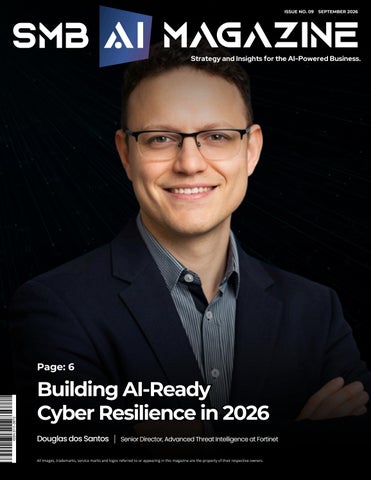
Building AI‑Ready AI‐Ready Cyber Resilience in 2026 Douglas dos Santos
SEPTEMBER 2026
Senior Director, Advanced Threat Intelligence at Fortinet
All Images, trademarks, service marks and logos referred to or appearing in this magazine are the property of their respective owners.
Dear Valued Readers, Over the past few months, SMB AI Magazine has followed a clear progression. We explored the human advantage that remains essential as AI becomes more capable, the foundations businesses need to make AI usable, and how AI can move beyond experimentation to deliver measurable value. This September brings us to the next important question: When AI becomes part of how a business operates, how do we know we can trust it? That question is becoming increasingly urgent as AI evolves from an assistant into an operational actor. AI systems can now search company information, recommend candidates, analyze customer data, monitor infrastructure, write code, initiate workflows and influence decisions affecting employees, customers and businesses.
Patricia Thaine of Limina brings the conversation back to something fundamental: understanding the data itself. Before applying AI to sensitive information, businesses must know what that information contains, where it travels, who can access it and how it is transformed. Across this issue, we examine trust through privacy, cybersecurity, third-party vendors, deepfakes, AI supply chains and financial services. One clear lesson emerges: The more AI can do, the more clearly businesses must define what it should be allowed to do. This requires limited permissions, human oversight, protected data and preparation for potential failures. Responsible AI, however, does not mean slowing innovation.
With that capability comes greater responsibility.
Gordon Martin shows how small businesses can use AI without losing valuable human relationships. Atman Rathod explains how clear problems, reliable data and measurable goals turn AI ideas into working systems.
Trust can no longer be assumed simply because an AI system produces a confident answer or impressive result. Trust must be designed into the system itself.
Saroop Bharwani explores another dimension of trust: what AI says about your business. As AI influences customer decisions, businesses must ensure the information it uses is accurate and credible.
Businesses need to understand what information AI uses, what it can access, which actions it can take, who approves important outcomes and what happens when something goes wrong.
Usefulness alone is no longer enough. AI must be secure, transparent, controllable and resilient.
This September edition explores that challenge from several perspectives.
They will also ask:
Jahanzaib Ansari, Founder and CEO of Knockri, examines how AI can make hiring faster and more consistent without turning talent decisions into a black box. His perspective reinforces a critical principle: when AI affects people, transparency and human accountability must remain part of the process. Douglas dos Santos of Fortinet explores an increasingly complex cybersecurity environment where AI is strengthening both offensive and defensive capabilities. As agentic systems become more autonomous, organizations must reconsider how much authority automated systems should receive.
Warm regards,
Varun K Sirohi Editorial Director - SMB AI Magazine
Successful businesses will not only ask, “What can AI do for us?”
“Can we understand it, verify it, control it—and trust it when it matters?”
sMB
mAGAZINE
aibusinessreview.ca
For Advertisements raoof@canadiansme.ca / amanda@canadiansme.ca Cmarketing Inc 6345 Dixie Rd, Unit 202, Mississauga, ON L5T 2E6 Call us at +1 416 655 0205 /437 778 4446
amanda@canadiansme.ca AI-Business-Review-Magazine the-canadiansme-ai-business-review
Published by Cmarketing Inc 6345 Dixie Rd, Unit 202, Mississauga, ON, L5T 2E6
aibusinessreview canadiansme
Publisher SK Uddin Editorial Director Varun Sirohi Founding Partner Praveshni Govender Business Development Manager Raoofuddin S. Sr. Media Manager Maheen Bari Sr. Content Manager Amanda Spearing Creative Design Cmarketing Inc Social Media Cmarketing Inc Photography Deposit Photos, Canva, Cmarketing Inc. Web Cmarketing Inc
All Images, trademarks, service marks and logos referred to or appearing in this magazine are the property of their respective owners.
Copyright © 2026 CMarketing Inc. All rights reserved. Reproduction in whole or part of any text, photography or illustrations without written permission from the publisher is prohibited.
The contents in the SMB AI Magazine are for informational purposes only. Neither Cmarketing Inc, the publishers nor any of its partners, employees or affiliates accept any liability whatsoever for any direct or consequential loss arising from any use of its contents.
IN THIS ISSUE SMB AI Magazine
12 09 Beyond the Résumé: How Knockri Makes Hiring Faster, Fairer, and Smarter Jahanzaib Ansari Founder and Chief Executive Officer of Knockri
22
Canada’s Critical Infrastructure Faces the Autonomous AI Era
38
A Practical Guide to Managing Third-Party AI Risks
44
How Companies Can Verify CEOs, Vendors, And Voice Calls In The Deepfake Era
47
What Canadian Employees Should Never Share With Public AI Tools
53
Preparing Canada for the Next Generation of AI Threats
56
Why Canada Needs a New Approach to AI Security
sMB
mAGAZINE
IN THIS ISSUE SMB AI Magazine
the Hidden Risks 13 Understanding Across AI Supply Chains
19 Data Understanding Is the Missing Layer in Enterprise AI
41 What Does AI Say About You? How Senso Builds the Trusted AI Answer
Canadian Financial Institutions Need 31 What to Know About OSFI’s AI Risk Guidance
AI and Privacy Accountability 25 Generative in Canadian Businesses
AI-Powered Phishing Has 16 Why Become a Boardroom Priority
34 How Canadian SMEs Can Turn AI Ideas Into Working Business Systems
28 From Missed Calls to More Opportunities: Gordon Martin on Practical AI for Small Business
Image Courtesy: Douglas dos Santos
Building AI‑Ready AI‐Ready Cyber Resilience in 2026 Douglas dos Santos Senior Director, Advanced Threat Intelligence at Fortinet
In an exclusive interview with SMB AI Magazine, Douglas dos Santos, Senior Director, Advanced Threat Intelligence at Fortinet, shares his perspective on how artificial intelligence is transforming both cyber threats and the strategies organizations need to defend against them. With more than two decades of experience in cybersecurity, Douglas discusses the growing sophistication of AIenabled attacks and why businesses must rethink their approach to resilience.
Interview By SK Uddin Douglas Santos leads Advanced Threat Intelligence at Fortinet, where his teams track nation-state actors and develop the kind of proactive intelligence that tends to make attackers' lives considerably more difficult. He works closely with MITRE CTID on projects advancing the standards and tools that define how the industry understands and responds to modern threats. He is also the mind behind Fortinet's Global Threat Landscape Report, one of the most referenced publications in the industry. The report draws on telemetry and datasets across Fortinet's entire solution portfolio, correlating signals at a scale few organizations can match, to give CISOs a clear picture of where the threat landscape is shifting and what they should actually be doing about it. 6 - SMB AI Magazine - SEPTEMBER 2026
sMB
mAGAZINE
Security Leadership
Recent Fortinet data shows Canada is now the second most-targeted country globally for ransomware. As attackers use AI to speed up these outbreaks, where is AI delivering real security wins to help defend against these attacks, and where is it still mostly hype?
We have moved beyond simply
The real security wins today are in high-speed correlation, not autonomous defense. Today’s model
dynamic Tactics, Techniques, and
sharing static Indicators of Compromise (IoCs) to tracking the
excels at parsing massive datasets to uncover subtle, execution indicators at speeds humans simply cannot match. That is the tangible victory.
Procedures (TTPs) of adversaries.
However, the threat landscape has shifted. We are
predictive models and proactive
increasingly facing agentic intrusions: autonomous, AI-driven attacks capable of adapting on the fly. While the industry is beginning to incorporate agentic
technology into security solutions, we are significantly lagging in deploying true agentic defensive systems,
This standardization allows the security community to build defenses. By establishing common frameworks for how models communicate threat data, we
we are still fighting dynamic threats with largely reactive platforms.
ensure that defensive platforms
We are already seeing how new agentic attacks, such
and orchestrate responses across
as recent frontier model attacks against Hugging Face are pushing the boundaries of offensive possibilities. While these early autonomous intrusions
are currently too noisy, refining their stealth is merely a tune-up away for a motivated adversary. Because
can automatically share insights different network environments before a novel threat fully materializes.
of this, human expertise remains critical. SecOps playbooks must rely on human insights to capture novel attacks exploiting unique business logic. Until
our agentic defenses natively match offensive autonomy, AI remains a powerful correlation tool, not a replacement for seasoned security professionals.
As attack vectors evolve rapidly, how are threat intelligence standards keeping pace with AI-driven cyber threats? With attack vectors evolving at an unprecedented rate, threat intelligence standards are adapting by shifting toward machine-readable, highly actionable and context-rich standards that defensive systems can ingest. Collaborations with organizations like MITRE CTID are crucial in this effort, helping us map out and standardize the specific behaviors and techniques associated with these attacks.
Which recent AI‑related regulations or geopolitical trends should security leaders pay closest attention to? Having tracked the evolution of cyber espionage over the last twenty-six years, the current shift driven by artificial intelligence is unprecedented. Security leaders must closely monitor global frameworks like the EU AI Act alongside rapidly evolving US-based regulations, including the White House Executive Order on AI, NIST’s AI Risk Management Framework, and emerging state-level mandates. Any US-based regulation moving through federal and state channels will fundamentally redefine corporate accountability, imposing strict requirements around model auditing, red-teaming, and data provenance. 7 - SMB AI Magazine - SEPTEMBER 2026
sMB
mAGAZINE
Geopolitically, the race for AI dominance is driving nation-state actors to weaponize sophisticated machine learning models for espionage, automated vulnerability exploitation, and intellectual property
Security Leadership To counter this, building upon the foundational need for decentralized intelligence our architecture must aggressively embrace agentic frameworks for defense. Centralized analysis is no longer fast enough. We need intelligent, autonomous agents correlating, contextualizing
and capable of localized countermeasures. True resilience now means marrying deep network-to-cloud visibility with defensive agents that can proactively detect and neutralize these localized agentic threats before any damage is done.
theft. This elevates the baseline of everyday cyber conflict to continuous, machine-speed pressure. Organizations can no longer treat regulatory compliance and threat intelligence as separate silos; adhering to emerging US and international standards directly requires establishing active, resilient defenses against the very nationstate threats shaping these policies
What new AI skills or mindsets do security leaders need to develop now? Leaders must radically shift their mindset to fight fire with fire. We are entering an era of "agentic" threats, AI-driven
attacks that adapts, learns, and makes execution decisions on the fly. To counter this evolution, security leaders need the strategic vision to deploy equally sophisticated agentic platforms within their own SecOps operations.
Centralized, human-speed analysis is no longer enough, and pretending otherwise is a comfortable illusion leaders can
no longer afford. A harsh reality must be internalized: the laptop sitting on any employee's desk today carries access to enough intelligence to bring down an entire business in a What does an ‘AI‑ready’ resilient security architecture look like in 2026? Before anything else, an AI-ready
architecture in 2026 requires unprecedented visibility spanning from the network up to the cloud. Without this comprehensive, highfidelity baseline, AI simply cannot function or detect anomalies effectively. Once we secure that visibility, we must completely rethink endpoint risk. We must understand that today, any employee holds technology on their endpoint capable of bringing an organization to its knees with a single prompt. This makes the disgruntled employee a very complicated problem to deal with, a problem that current risk and threat models aren't really covering. The democratization of AI has turned every single employee endpoint into a high-stakes launchpad for devastating internal attacks.
couple of hours. It takes only one of three scenarios, not all three, just one. The laptop could be compromised, handing the attacker an agent with frontier-model capability. Or a
disgruntled employee could simply ask the AI, or trick it, into breaching critical systems. Or a misunderstood, ambiguous prompt could send the agent down a path of unintended destruction on its own. None of these requires imagination anymore. They only require inattention.
Therefore, the required mindset is one of extreme localized resilience. Teams must develop the skills to orchestrate and trust intelligent defensive agents that can orchestrate autonomous defensive tooling on the fly. These defensive tools must be empowered to make independent, millisecond decisions to isolate and neutralize anomalies locally, severing the attack chain before a single compromised notebook can cripple the broader enterprise.
Disclaimer:The views and opinions expressed in this interview are those of the guest and do not necessarily reflect the views of SMB AI Magazine. This content is for informational and inspirational purposes only and is not intended as professional business, legal, or wellness advice.
8 - SMB AI Magazine - SEPTEMBER 2026
Image Courtesy: Jahanzaib Ansari
Beyond the Résumé: How Knockri Makes Hiring Faster, Fairer, and Smarter Interview By Varun K Sirohi In an exclusive interview with SMB AI Magazine, Jahanzaib Ansari, Founder and CEO of Knockri, shares how personal experience with hiring bias led to the creation of an AI-powered platform designed to make talent decisions more consistent, skills-focused, and transparent. Jahanzaib discusses why traditional hiring methods often overlook qualified candidates and how technology can help organizations evaluate potential based on job-relevant skills and behaviours. Jahanzaib Ansari is the Founder and Chief Executive Officer of Knockri, a decade-old AI company transforming hiring, promotions, and training by reducing bias and improving efficiency. He founded Knockri with a mission to build a fairer, more merit-based future of work, and has since raised Millions of dollars from leading investors, and is also supported by the Canadian government, to scale its impact.
Jahanzaib Ansari Founder and Chief Executive Officer of Knockri
sMB
mAGAZINE
Inclusive Hiring
How did your experience with name bias in hiring inspire Knockri?
What hiring problems does Knockri solve that traditional processes cannot?
Knockri began with an experiment. I was applying for jobs and receiving no replies. A friend suggested that I anglicize my name. When I did, interview invitations began arriving.
Traditional hiring has an information problem. Employers may receive thousands of applications, but recruiting teams cannot evaluate every candidate closely. Résumés reduce the workload by turning people into comparable signals such as schools, job titles, and previous employers. Those details are convenient, but they do not always predict performance.
That experience showed me how easily hiring can reject people before
Unstructured interviews create another challenge. Candidates
anyone understands their capabilities. A name, school,
may receive different questions, interviewers may apply different standards, and hiring managers may struggle to compare results.
someone will succeed in a role.
Knockri’s AI interview platform brings structured, skills-based evaluation earlier into the process. Candidates answer the same
employer, or unconventional career path can influence a decision, even when it says little about whether
I began asking whether companies could evaluate candidates using evidence connected directly to the
work. My childhood friend Faisal Ahmed, a machine learning scientist, and I partnered with specialists in industrial-organizational psychology to build Knockri’s AI interview
platform. Every candidate answers the same role-specific questions and is evaluated against the same job relevant skills and behaviours.
The platform helps recruiting teams assess more candidates without adding manual screening. They receive useful information earlier, identify qualified people sooner, and spend more time engaging candidates, advising hiring managers, and making decisions that require human judgment. Candidates receive a consistent experience and a better opportunity to demonstrate their potential.
When time is limited, even experienced recruiters can rely too heavily on instinct.
role-specific questions, and their responses are assessed against the skills and behaviours required for the job. Recruiters receive transparent results showing where candidates demonstrated strength and why they may be a strong fit.
This helps employers assess more applicants, build shortlists faster, and reduce repetitive screening work. Recruiters can focus on engaging candidates, advising hiring managers, and making
thoughtful decisions. Candidates benefit from a clearer and more consistent process. The goal is not simply to make hiring faster. It is to improve the quality of information available at every stage so efficiency, fairness, and better decision-making reinforce one another.
Image Courtesy: Canva
Knockri grew from an encounter with bias, but the opportunity was broader: employers needed a faster, fairer, and more reliable way to identify talent at scale.
10 - SMB AI Magazine - SEPTEMBER 2026
sMB
mAGAZINE
How can companies use AI in hiring without compromising fairness and trust?
Inclusive Hiring
Image Courtesy: Canva
Fairness and efficiency must be designed together. A hiring system should not operate like a black box, where candidates receive a score without understanding how it was produced. The standard should be a glass box. Every result
should be traceable to the job criteria, candidate evidence, scoring framework, and algorithmic steps that created it. Recruiters should be able to see
which skills were assessed, what evidence appeared in a response, how that evidence affected each score, and how those scores informed a recommendation or shortlist decision.
At Knockri, candidate responses are assessed against a customizable skills framework built for the role. The platform gives recruiters performance information by skill and provides clear reasoning
behind its results. That transparency helps teams make decisions faster without replacing human judgment.
Traceability must extend across the entire process. Employers need records showing what the system evaluated, which rules and model versions were applied, when a decision was made, and who reviewed it. Candidates should receive clear information about how AI is used, while
organizations maintain privacy, security, audit trails, and human accountability.
Trust comes from visibility. If a decision cannot be explained and traced algorithmically, it should not be used to determine someone’s future.
What role will agentic AI play in the future of HR and workforce development? Agentic AI could remove administrative friction that slows human resources teams down. Recruiters currently move between applicant tracking systems, assessment platforms, calendars, email, and employee records. An AI agent could coordinate those systems by scheduling interviews, sending reminders, updating records, and alerting recruiters when candidates stall. This automation could reduce delays and repetitive work while giving candidates faster, more consistent communication. 11- SMB AI Magazine - SEPTEMBER 2026
sMB
mAGAZINE
The larger opportunity begins after someone is hired. AI agents could identify skills gaps, recommend training, connect employees with internal opportunities, and explain
what capabilities they need to develop for future roles. HR leaders could also direct learning budgets toward areas most likely to improve performance and retention. Efficiency, however, must not mean surrendering authority to software. Hiring, promotion, compensation, and termination are high-stakes decisions. AI agents can gather evidence, organize information,
identify patterns, and recommend next steps, but people must remain responsible for final outcomes. The strongest solutions will improve systems companies already use
Inclusive Hiring What advice would you give founders scaling AI solutions into enterprise and government markets? Founders entering enterprise and government markets should first validate the problem quickly. Start with a narrow use case, speak
directly with users, and test the core workflow through a lightweight prototype, manual service, or limited pilot. Before building a full product, confirm that the problem is urgent, the solution saves time or reduces costs, and buyers are willing to adopt it. Once demand is established, define a baseline and measure meaningful outcomes. In hiring, a pilot might track screening time, cost per assessment, time to shortlist, recruiter workload, candidate completion rates, and evidence quality. Next, prepare the product for institutional requirements. Enterprise
and government buyers expect privacy, security, accessibility,
compliance, reliability, integration, and clear audit trails. A hiring platform may also need to connect with applicant tracking or human capital management systems and pass legal, security, and procurement reviews. Addressing these needs soon after validation avoids expensive delays and difficult retrofits.
instead of becoming another
disconnected tool. They will combine useful automation with
privacy, security, clear operating
Founders must also communicate with multiple
oversight. The goal is not to remove people from HR. It is to remove the
stakeholders, including recruiters, executives,
from supporting people effectively.
teams, and legal counsel. Each evaluates value and risk
rules, and meaningful human
friction that prevents HR teams
technology leaders, privacy officers, procurement differently. Clear documentation, credible evidence, dependable integrations, explainable results, and responsive support build confidence.
Move quickly to learn, then deliberately to earn trust and scale.
Disclaimer:The views and opinions expressed in this interview are those of the guest and do not necessarily reflect the views of SMB AI Magazine. This content is for informational and inspirational purposes only and is not intended as professional business, legal, or wellness advice.
12 - SMB AI Magazine - SEPTEMBER 2026
Image Courtesy: Canva
Understanding the
Hidden Risks Across AI Supply Chains By Varun K Sirohi An enterprise AI deployment may appear simple to the user: a chat window, an internal copilot, or an automated assistant. However, the apparent interface is just one component of a much bigger technology chain. Behind it could be a foundation model, cloud host, API gateway, identity provider, retrieval-augmented generation system, vector database, document repository, plug-in, third-party data source, code library, monitoring platform, and downstream business tool. If the AI assistant can search files, send emails, update customer records, generate code, or initiate workflows, then each connected component becomes part of the security perimeter.
Canadian guideline encourages enterprises to identify the AI supply chain, map the links between AI and other information systems, and implement security measures throughout the system's lifecycle. The lesson is clear: the chatbot is not the only potential attack vector. It is the full network of components, identities, data, and behaviours that support it. 13- SMB AI Magazine - SEPTEMBER 2026
sMB
mAGAZINE
Build an AI Bill Of Materials The first control is visibility. Organizations should keep an AI bill of materials, or AIBOM, which lists each material component of an AI system. This should contain models, versions, training or fine-tuning sources, datasets, libraries, APIs, cloud regions, retrieval sources, plug-ins, system prompts, agent tools, integrations, and third-party service providers. The inventory must specify ownership and purpose. Document who controls each component, what
information it can access, whose systems rely on it, whether it is externally hosted, and what happens if it fails. A list without context isn't a risk management tool.
AI Security
The Cyber Center suggests restricting access to high-risk tools and agents through rolebased access and identity constraints, limiting AI models' access to private information, and evaluating downstream actions before
execution. Least privilege should apply to both machines and humans. An AI assistant that simply needs to search a selected policy library should not be granted extensive access to shared drives, customer databases, or administrative operations.
Secure Every Connection Point AI systems are susceptible at every point of connection. An attacker can exploit an exposed API, compromise a plug-in, poison a retrieval source, manipulate a prompt, steal an agent
The Cyber Center suggests employing software bills of materials and AI-specific inventories to track the provenance and versioning of models, datasets, and dependencies. These entries should be updated any time a model, plug-in, library, API, data source, or configuration changes.
credential, install a malicious software dependency, or abuse an integration with too
many permissions. The Canadian Cyber Center advises against using third-party software, frameworks, and pre-trained models without first thoroughly testing them. Organizations should conduct vulnerability assessments, supplier reviews, and integrity validation,
including cryptographic signing or hash-based verification as needed. Only approved and signed software, models, and artifacts should be used in sensitive situations.
Follow The Data And Permissions AI supply chain mapping should track both data and authority. Begin with the information that enters the system: user prompts, uploaded files, customer data, enterprise documents, external webpages, telemetry, and vendor datasets. Then determine how the information is changed, stored, retrieved, tracked, sent, and finally erased. Next, map the permissions. Which identities have access to models, cloud environments, APIs, vector databases, and integrated business systems? Which agents can call tools or transfer data externally? Which privileged commands may an automated workflow execute?
Image Courtesy: Canva
14- SMB AI Magazine - SEPTEMBER 2026
sMB
mAGAZINE
Security teams should also keep an eye out for unexpected outbound traffic, aberrant tool calls, inexplicable changes in model behavior, new dependencies, and strange data transfers. Network segmentation, encryption, rate restriction, secret management, and API authentication all lower the likelihood that a compromise in one component grants access to the entire enterprise.
AI Security
Monitor, Test And Recover Mapping the supply chain is not a one-time procurement activity. Models shift, vendors change terms, APIs are phased out, new plug-ins appear, and vulnerabilities emerge. The Cyber Center recommends that enterprises regularly monitor and manage AI systems, examine models, pipelines, and interfaces for known vulnerabilities, and update controls as risks change. Realistic failure situations include a compromised retrieval document, an inaccessible model provider, a revoked API key, malicious output from a plug-in, unexpected data exfiltration, and a failed automated judgment. Confirm that teams can identify the
impacted component, isolate it, disable access, preserve evidence, and restore a secure service. Maintain incident response and disaster recovery plans tailored to AI systems. Identify a crucial dependency's owner, replacement choice, manual fallback, and recovery target. The most
powerful firms will not only understand what is in their AI stack. They'll understand which component failed, what it accessed, and how to
Match Autonomy To Criticality
proceed safely without it.
The ramifications of a hacked AI system depend on what it is permitted to perform. A model that creates an internal summary faces a different risk profile than an agent who alters code, approves transactions, sends customer messages, or changes a production setting. Canadian guidelines advocate tailoring AI autonomy to the risk analysis, business necessity, and criticality of the action. Organizations should restrict AI from performing important tasks without safeguards, unambiguous accountability, and human supervision.
Develop an authority matrix for each agentic workflow. Define what the AI can recommend, what reversible actions it can do automatically, what needs human approval, and what it cannot do. Additional controls are required for financial transactions, data exports, privileged access, external communications, and operational changes. Use policy gates, transaction limitations, audit trails, escalation pathways, and emergency kill switches to keep AI operations viewable and reversible.
Your role in staying informed is essential to our mission of building a strong community of AI-driven innovators. SMB AI Magazine is your go-to resource for insights, strategies, and updates shaping the future of artificial intelligence in business. Subscribe to our monthly editions at smbaimagazine.com to stay up to date on the latest AI trends and developments in the Canadian business landscape. Your engagement enables us to continue supporting and empowering the AI ecosystem. Disclaimer: This article is based on publicly available information and is intended solely for informational purposes. SMB AI Magazine does not endorse or guarantee any products or services mentioned. Readers are encouraged to conduct independent research and due diligence before making business decisions.
15 - SMB AI Magazine - SEPTEMBER 2026
Image Courtesy: Canva
Why AI-Powered Phishing Has Become a Boardroom Priority By SK Uddin Phishing is no longer just a volume issue involving badly worded emails sent to thousands of random recipients. Threat actors can use Generative AI to create individualized, grammatically polished, multilingual messages tailored to a target's role, relationships, online activity, and organization. The Canadian Cyber Center cautions that AI can automate and refine phishing tactics, lowering the time and effort required to carry them out. Threat actors can leverage publicly available data to craft convincing spear-phishing and "whaling" messages for top executives, finance teams, IT administrators, and other high-value employees.
The consequence is a board-level risk because a single successful message can result in account takeover, ransomware, financial fraud, loss of user data, or disruption of a crucial service. Boards should therefore treat AI-powered social engineering as an organizational resilience issue rather than just an awareness-training challenge.
16 - SMB AI Magazine - SEPTEMBER 2026
sMB
mAGAZINE
AI Cybersecurity
Personalized, Scalable And Multilingual
Layer Email And Identity Controls
Generative AI enables attackers to develop compelling material at scale. A criminal can request communications in English, French, or another language, mimic an organization's tone, refer to an actual project, and tailor the phrasing to different work duties. This minimizes the warning indications that employees formerly depended on, such as spelling errors, inappropriate language, or generic greetings. According to the Cyber Center, AI-generated phishing can quickly generate large volumes of tailored messages that replicate natural
Security awareness remains crucial, but employees should not be the only control. Organizations require tiered technical defences that reduce the impact of a single successful phishing message. Domain protection, authentication requirements, filtering, malicious-link inspection, attachment scanning, and monitoring for anomalous forwarding
but those who approve payments, manage supplier relationships, run IT systems, or have access to sensitive information are especially vulnerable.
keep an eye out for lookalike domains, impersonated subdomains, and questionable account activity.
writing styles, organizational terminology, and well-known communication patterns. Every employee is a possible target,
rules or inbox access are all necessary email controls. Security teams should also
Organizations need to upgrade their threat models. The question is no longer whether employees can detect a clear phony. It is whether procedures remain secure when the
communication is realistic, contextually true, and appears to have been sent by a trusted source.
Image Courtesy: Canva
Executive Impersonation Gets Stronger A cloned voice call, a forged meeting invitation, or an AI-
generated video message can now be used to supplement a bogus CEO email. The attacker's goal is typically to create a sense of urgency: approve a wire transfer, update a supplier's
financial information, submit confidential data, reset an account, or redirect a conversation to an unmonitored communications channel. Canadian authorities have issued a warning about fraudulent attacks targeting business executives and senior public figures, using urgent money requests, malicious URLs, messaging accounts, and AI-generated voice impersonation. Caller-display numbers, message usernames, and display names cannot be used as proof of identity.
Employees should independently confirm unexpected or high-value requests via a previously established communication means. When a financial employee receives a voice order from a claimed executive, he or she should call a number already in the company's records rather than the number provided in the message. 17 - SMB AI Magazine - SEPTEMBER 2026
sMB
mAGAZINE
Phishing-resistant multi-factor authentication should secure all employees, with a focus on executives, administrators, finance teams, and those with access to key corporate systems. The Cyber Center advises using phishingresistant MFA, as AI-powered phishing and credential-harvesting attacks are increasingly attempting to circumvent inadequate identity controls. When handling high-risk requests, use out-ofband verification and dual approval. Payment adjustments, data exports, privileged account activities, and confidential vendor instructions should never be approved through a single
email, chat message, phone call, or video meeting.
Train For Decisions Under Pressure Employee training should focus on
behaviour rather than detection. A staff person may be unable to demonstrate that a phone call or video meeting is
synthetic. They must understand what to do when a request is odd, urgent, or requires money, credentials, or sensitive
AI Cybersecurity
The Board’s Next Questions Boards should question management about the organization's ability to swiftly detect and contain an AI-powered phishing attack. They should obtain metrics on phishing reports, stopped harmful emails, MFA adoption, account takeover attempts, payment verification exceptions, and employee drill completion. They should also inquire whether incident plans address deepfake-enabled fraud. A response plan should involve prompt containment of compromised accounts, retention of email and access logs, evaluation of payment
instructions, notification of banking partners as needed, internal communications, and reporting to relevant authorities.
The Canadian Cyber Center recommends that enterprises monitor for AI-generated phishing, voice spoofing, and video impersonation, utilize strong identity verification, and train employees to validate anomalous requests across different channels. For boards, the core lesson is clear: resilient firms do not rely on employees to detect every phony. They design rules to prevent realistic deceit from becoming permissible.
information. Perform short, role-specific simulations. Finance teams should
practice validating changes to bank accounts. Executive assistants should look into urgent travel, salary, and gift card requests. IT workers should practice responding to a call from someone claiming to need an instant MFA reset. Customer support representatives should practice reacting to suspect identity verification requests. Teach one unbreakable rule: no matter how urgent the situation, verification must come first. Employees should be encouraged to pause, escalate, and report without fear of being held accountable for delaying a valid request. Senior leadership should be informed of reporting rates, response times, and lessons learned from exercises.
Your role in staying informed is essential to our mission of building a strong community of AI-driven innovators. SMB AI Magazine is your go-to resource for insights, strategies, and updates shaping the future of artificial intelligence in business. Subscribe to our monthly editions at smbaimagazine.com to stay up to date on the latest AI trends and developments in the Canadian business landscape. Your engagement enables us to continue supporting and empowering the AI ecosystem. Disclaimer: This article is based on publicly available information and is intended solely for informational purposes. SMB AI Magazine does not endorse or guarantee any products or services mentioned. Readers are encouraged to conduct independent research and due diligence before making business decisions. 18 - SMB AI Magazine - SEPTEMBER 2026
In an exclusive interview with SMB AI Magazine, Patricia
Today, Limina’s technology is used
Thaine, Co-Founder, Chief AI Officer, and Chair of
by global enterprises to build and
Limina, shares why privacy, data understanding, and
deploy AI safely, including MUFG,
responsible governance are becoming essential
Deloitte, and Boehringer Ingelheim.
foundations for enterprise AI adoption. With years of
Limina has been recognized as a
experience building machine learning systems for
Gartner Cool Vendor in Privacy and
highly regulated industries, Patricia discusses the
was named the top global AI privacy
challenges organizations face when transforming
tool by AI Magazine in 2026.
sensitive information into usable AI capabilities.
Interview By Varun K Sirohi Patricia Thaine is Co-Founder, Chief AI Officer, and Chair of Limina (formerly Private AI), a Microsoftbacked AI company. For more than a decade, she has
Patricia was named a World Economic Forum Technology Pioneer in 2023 and was included on the Maclean’s Power List 2024 as one of 100 Canadians shaping the country.
built and researched machine learning systems and worked with organizations applying AI and data in some of the world’s most highly regulated industries, including healthcare, financial services,
Data Understanding Is the Missing Layer in Enterprise AI Patricia Thaine Co-Founder, Chief AI Officer, and Chair of Limina
Image Courtesy: Patricia Thaine
pharmaceuticals, government, and technology.
sMB
mAGAZINE
Why is data understanding—not model performance—the biggest barrier to enterprise AI adoption?
Data Privacy
Image Courtesy: Canva
The majority of enterprise data are unstructured, inconsistently labelled, and inherited, so AI projects rarely stall on model selection. Gartner predicts that through 2026, organizations will abandon 60% of artificial intelligence (AI) projects unsupported by AI-ready data. Statistics Canada, meanwhile, found that 13.4% of Canadian businesses named privacy or cybersecurity as an obstacle to AI, rising to 30.0% at firms with 100 or more employees. An organization may want to fine-tune models on five years
of claims notes, legal asks which identifiers and third party information those notes contain, but that inventory was never built, and the project gets rebuilt on synthetic records which tend to reflect the most common cases without the corner cases systems need in order to be tested thoroughly. Data
quality and coverage are key to launching accurate models and one cannot use those data without appropriate understanding thereof followed by risk mitigation and compliance aligned measures..
Image Courtesy: Canva
How does context-aware deWhy is data residency alone not enough to protect sensitive enterprise data? Residency answers where data are stored. A sensitive
workflow also has to tell you where the data are processed, who can access them, which representation of them crosses each boundary, what gets created along the way, and whether you could change provider or region without losing control.
A board document can sit in a Canadian storage account you fully control while its contents go to an embedding service, land in a vector store, get pulled into a prompt, and show up again in an observability trace. None of that shows up when you just ask where the file lives.
identification make regulated data usable for AI? Here is one line from a contact center transcript: "I'm calling about my mother, Jean, her account ends in 4127, and Dr.
Ellis at the cardiology clinic said she needs the referral by Friday." Swap "Jean",
“4127”, and “Ellis” for consistent surrogates and a model can still learn a family member placed the call, the type of clinic called, and that a referral is being requested. Chatbots can also safely be trained on these data. All without leaking identities and without sacrificing accuracy.
Location also says nothing about who can act on the data. A workload hosted in the "right" region can still depend on remote administrators, provider-side logging, have encryption key custody sitting with a third party, and can still rely on services you cannot move away from without a significant system rebuild. "Our data stay in region" is true and still leaves the actual exposure question unaddressed, because keeping data local does nothing to govern the prompts, embeddings, and logs that data produce when used.
20 - SMB AI Magazine - SEPTEMBER 2026
sMB
mAGAZINE
Why do many PII-detection tools perform well in demos but fail on real-world data? Demos run on clean data. Someone types "John Smith, 416-555-0142, john@example.com" into a text box, three entities light up, and it looks solved.
Now feed that same tool a real automated speech recognition (ASR) transcript, where the phone number arrives as "four one six five five five oh one four two," or as "416, sorry, 647-555-0142," or split across two turns because the agent interrupted. Scanned intake forms come through optical character recognition (OCR) with "rn" read as "m." Names show up as nicknames, as misspellings, or in an order the model never trained on, a customer switches from English to Cantonese mid-
sentence, and a clinical note names a referring physician who appears in no structured field anywhere in the chart. Tackling such a task for large enterprises requires such a breadth of understanding, from different data types,
different error types, different languages that solve for international organizations’ multilingual information flow,
and then the required breadth of entity types across all of these complexities. That’s a lot of work and a lot of corner cases to account for.
Data Privacy What should a regulated company do first before using customer or patient data in AI systems? First and foremost, build an honest picture of what is in your data.
Pull a representative sample from every source you plan to use, and include the ugly ones: call recordings, scanned faxes, freetext notes. Understand which identifiers you have collected, and even what your confidential company information (CCI) looks like and where it lives. Then set your standard before you set your
architecture. Under Quebec's Law 25, decide
whether you are de-identifying or anonymizing: de-identified data remain personal information, while only anonymized
data, with identification irreversibly removed, take you out of scope.
This is where Limina helps: mapping your
data, then acting as an enforcement layer for the policies you choose, all running directly within your own environment.
Disclaimer:The views and opinions expressed in this interview are those of the guest and do not necessarily reflect the views of SMB AI Magazine. This content is for informational and inspirational purposes only and is not intended as professional business, legal, or wellness advice.
Image Courtesy: Canva
21 - SMB AI Magazine - SEPTEMBER 2026
Image Courtesy: depositphotos.com
Canada’s Critical Infrastructure Faces the Autonomous AI Era By SK Uddin Autonomous and agentic AI is being integrated into the systems on which Canadians rely every day: power generation and distribution, telecommunications, transportation, health care, banking, insurance, and public services. It can detect anomalous equipment behaviour, prioritize cyber alarms, optimize maintenance, aid in fraud detection, and assist operators in processing vast amounts of data faster. However, the same capabilities create a new category of operational risk.
An AI system may act on incorrect sensor data, be tricked by a malicious prompt, lose access to a cloud-based model, or make a choice that operators cannot swiftly explain or reverse. Failures in essential infrastructure can have serious consequences for safety, service availability, financial stability, and public trust. 22 - SMB AI Magazine - SEPTEMBER 2026
sMB
mAGAZINE
According to Canada's Cyber Centre, firms that operate critical infrastructure should assign unambiguous ownership for AI-enabled operations, keep humans involved in higherimpact decisions, limit autonomous action, and maintain the capacity to intervene or disable automated systems.
Define where autonomy ends The dilemma for critical infrastructure operators isn't whether to deploy AI. It is where AI should make recommendations, act automatically, and require human approval. Low-risk, reversible operations may be appropriate for automation. An AI system may detect odd network traffic, open an incident ticket, summarize maintenance data, or recommend an inspection. Higher-impact acts necessitate stricter boundaries. An agent should not disconnect a major power asset, change a medical process, approve a financial
transaction, modify a transportation control setting, or send an external public communication.
Critical Infrastructure
Secure the non-human workforce AI agents, service accounts, bots, and automated scripts are now non-human contributors to important systems. If they have broad permissions, static credentials, or shared accounts, they can serve as a useful pathway for attackers to move across operating systems. The Cyber Center suggests examining each AI agent and automated process to discover how it authenticates and what it can access. Organizations should assign each AI system a unique identity, use short-lived credentials whenever possible,
automatically rotate and revoke them, and employ least-privilege access. AI should only have access to the data, systems, and orders that are truly necessary for its assigned mission. This is especially important where IT and operational technology meet. Networks
should be divided into AI services and OT systems, communications should be
Classify AI-enabled systems based on their safety and operational impact: safety-critical, business-
strictly regulated, and unusual commands should be investigated. The concept is simple: an AI assistant that helps detect a
problem should not automatically gain the authority to change a crucial procedure.
critical, or operational. Define allowed actions, escalation thresholds, human approvers, and override procedures for each layer. The Cyber Center encourages firms to adjust AI autonomy based on risk, criticality, and business necessity, rather than just what technology can technically perform. Image Courtesy: depositphotos.com
23 - SMB AI Magazine - SEPTEMBER 2026
sMB
mAGAZINE
Critical Infrastructure
Log actions and test failures
A board-level resilience agenda
Critical infrastructure operators must understand not only what an AI system determined, but also the information it used, the systems it accessed, and the actions it took. As a result, logging is necessary for both safety and resilience. Collect authentication events, connectivity abnormalities, resource use, model confidence levels, inference counts, decision logs, autonomous actions, and human intervention. These documents should be tamperproof and accessible to security personnel, operators,
Boards and senior officials should demand a clear picture of all AI systems linked to essential operations. They should inquire: Who owns it? What choices can it make? What data, identities, and systems can it access? How is it recorded and monitored? Can an operator overrule it immediately? What if the model, cloud service, network connection, or data source fails? Canada has reinforced its
and incident responders. Monitor for performance drift, odd outputs, shifting input patterns, sensor malfunctions, and hostile interference.
Testing must encompass both successful demonstrations and anomalous conditions. Perform simulated failures, including corrupted data, lost cloud connectivity, failing sensors, inaccurate suggestions, malicious prompts, and a failed AI agent. Determine how quickly operators can identify the problem, isolate the affected system, and safely assume manual control.
critical infrastructure cybersecurity framework in finance, telecommunications, energy, and transportation. AI governance must now be part of the resilience agenda.
The most effective operators will employ AI to improve detection and response while maintaining human authority, tested isolation plans, and the capacity to work securely without automated systems.
Build isolation and continuity The Cyber Centre now urges Canadian criticalinfrastructure businesses to prepare to isolate systems for up to three months, build and test plans to operate independently, and create recovery plans for
catastrophic cyber disasters. This is a critical resilience assumption in an environment where an assault on a linked system can spread rapidly. Isolation refers to the deliberate separation of essential networks or parts from other networks and the public internet. For AI-enabled services, businesses should understand which operations can be performed locally, which require cloud access, and which operational capabilities are lost if external services are unavailable. Continuity plans must include manual operation. Energy operators may require local control methods; hospitals may require safe workflows in the absence of AIsupported triage; and financial institutions may require fallback processes for fraud warnings or customer verification. Test these plans with actual operators, genuine downtime, and predefined escalation routes. The idea isn't only to disengage. It is to continue providing key services safely when disconnected.
Your role in staying informed is essential to our mission of building a strong community of AI-driven innovators. SMB AI Magazine is your go-to resource for insights, strategies, and updates shaping the future of artificial intelligence in business. Subscribe to our monthly editions at smbaimagazine.com to stay up to date on the latest AI trends and developments in the Canadian business landscape. Your engagement enables us to continue supporting and empowering the AI ecosystem. Disclaimer: This article is based on publicly available information and is intended solely for informational purposes. SMB AI Magazine does not endorse or guarantee any products or services mentioned. Readers are encouraged to conduct independent research and due diligence before making business decisions.
24 - SMB AI Magazine - SEPTEMBER 2026
Image Courtesy: depositphotos.com
Generative AI and Privacy Accountability in Canadian Businesses By Varun K Sirohi Generative AI does not violate Canadian privacy requirements just because it creates new text, images, or code. The same questions apply from the initial dataset to the final output: Was personal information gathered lawfully? Is the purpose appropriate? Was consent meaningful where it was required? Is this information necessary? Are the precautions adequate? Can individuals comprehend how their data is used? The combined principles of the federal, provincial, and territorial privacy authorities serve as a practical framework for organizations that develop, provide, or use generative AI. The specific legal requirements vary depending on the business, the data, and the location of operation. Privacy should be built into the product rather than added after deployment.
Lawful Collection And Meaningful Consent The privacy assessment occurs before a company trains, fine-tunes, purchases, or deploys a model. The regulators advise enterprises to understand and document their legal authority to collect, use, disclose, and delete personal information at all stages of a generative AI system's lifecycle, including training, development, deployment, operation, and decommissioning.
sMB
mAGAZINE
Consent must be valid and meaningful when used as legal authority. Individuals should be able to comprehend the nature, purpose, and implications of data collection, use, or disclosure, according to PIPEDA guidelines. Organizations should make it clear when AI is used, what data enters the system, whether a vendor retains prompts or uses them for training, and what options customers have. Data obtained from other parties must be scrutinized in the same way: a contract does not prove that the original collection and dissemination were lawful or allowed.
Privacy Compliance
Safeguards Must Cover Prompts And Outputs
Minimize Data Before It Reaches The Model
Protect training data, system prompts, retrieval sources, model outputs, logs, APIs, administrator accounts, and third-party connectors. The Canadian standards require precautions commensurate with the sensitivity of the information and the anticipated privacy threats. In reality, this comprises access controls, encryption, data segmentation, retention limits, monitoring, vendor evaluation, incident response, and testing for prompt injection or model extraction.
Because future use cases are unclear, generative AI
Organizations should also avoid disclosing
required for the explicitly stated and appropriate purpose. Before advancing, organizations should assess the necessity and proportionality of using AI and
request in the prompt. Accuracy is important as well. Inferences made about an identifiable
may lead to a desire to collect widely. Canadian privacy principles oppose this technique. Collection, usage, and disclosure should be limited to only what is
personal information. This entails determining whether the purpose can be met without personal information,
with less personal information, or with anonymized, deidentified, or synthetic data. Publicly available personal information is not necessarily free for indiscriminate AI gathering or use.
sensitive information via outputs. Regulators particularly advise that outputs give just the personal information required to meet the
individual may contain personal information, and inaccurate outputs might cause privacy harm even if the underlying dataset is correct.
These restrictions should be validated before launch and regularly reviewed as data sources, permissions, and model capabilities change.
A customer service assistant's proper dataset could contain approved product documentation and strictly limited account data, rather than the entire company's email archive. Prevent function creep by documenting the initial aim and requiring a new assessment before reusing data for model improvement, personalization, or any other unexpected goal.
Image Courtesy: Canva
26 - SMB AI Magazine - SEPTEMBER 2026
sMB
mAGAZINE
Transparency, Explainability And Accountability People cannot utilize their privacy rights unless they are aware that an AI system is exploiting their information. Canadian regulators advocate for transparency about AI usage and associated privacy hazards, as well as clear notices, context-appropriate explanations, and procedures for access, correction, and complaints. A privacy notice should state, in straightforward language, the purpose, types of personal information collected, relevant third parties, retention strategy, and accessible options. Internal accountability requires identifying individual owners. Business teams determine the goal, privacy teams evaluate lawful authority and risk, security teams
validate measures, procurement manages vendors, and senior management accepts residual risk.
Privacy Compliance
A Practical Canadian Readiness Test Before you approve a generative AI use case, ask six questions. What is the defined and suitable purpose? What personally identifiable information is required, and can it be erased, deidentified, or substituted with synthetic data? What legal authority underpins all collection, use, disclosure, and retention? How will the provider and its subprocessors handle prompts, outputs, and logs? What precautions exist to prevent illegal access, damaging outputs, and secondary use? Finally, how will the organization explain the system and handle access requests, rectification requests, withdrawal-of-consent requests, and complaint requests? This is not a substitute for legal advice, especially in cases where provincial, sectoral, or cross-border obligations apply. It is a long-
Maintain decision documentation, privacy impact assessments, data mappings, test findings, and vendor commitments. Accountability is the ability
standing editorial rule for Canadian leaders: while generative AI is new, privacy accountability starts with purpose, restraint, transparency, and proof.
to demonstrate, following a challenge or incident, why the organization deployed AI and how it protected individuals. People need a meaningful way to examine, correct, and challenge major decisions.
Your role in staying informed is essential to our mission of building a strong community of AIdriven innovators. SMB AI Magazine is your go-to resource for insights, strategies, and updates shaping the future of artificial intelligence in business. Subscribe to our monthly editions at smbaimagazine.com to stay up to date on the latest AI trends and developments in the Canadian business landscape. Your engagement enables us to continue supporting and empowering the AI ecosystem.
Image Courtesy: Canva
Disclaimer: This article is based on publicly available information and is intended solely for informational purposes. SMB AI Magazine does not endorse or guarantee any products or services mentioned. Readers are encouraged to conduct independent research and due diligence before making business decisions.
27 - SMB AI Magazine - SEPTEMBER 2026
From Missed Calls to More Opportunities:
Gordon Martin on Practical AI for Small Business In an exclusive interview with SMB AI Magazine, Gordon Martin, Founder of Eber Technologies, shares how practical artificial intelligence and automation can help small businesses improve customer experiences, reduce missed opportunities, and operate more efficiently. Rather than viewing AI as a complex technology reserved for large enterprises, Gordon explains how everyday businesses can use connected tools to respond faster and stay competitive.
Interview By SK Uddin Gordon Martin is the founder of Eber Technologies, a Canadian technology company focused on helping small businesses use practical AI and automation to operate more efficiently and stay responsive when owners and teams are busy or unavailable. Through Image Courtesy: Gordon Martin
eber AI, he is working to make capabilities such as AI-powered customer conversations, voice reception, follow-up automation, appointment booking, CRM and reputation management more accessible to everyday businesses. His approach to AI is grounded in a simple belief: technology should solve real business problems rather than add more complexity. He is particularly interested in how connected systems can help small businesses reduce missed opportunities, improve customer experience and free owners from having to personally manage every interaction.
Founder of Eber Technologies
sMB
mAGAZINE
Why do missed calls, slow follow-ups, and unanswered messages create such a hidden cost for small businesses? Because the cost is almost invisible. A missed call does not show up on a financial statement. A customer who hangs up does not tell you, “You just lost my business.” The opportunity is gone before the owner even knows it was there. And this often happens when the business is busy. The contractor is on-site. The realtor is in a
showing. The clinic is with a patient. The restaurant is in the middle of dinner service. The owner is already focused on the customer in front of them. Then small delays add up — a busy line, a long
hold, voicemail, an unanswered message, or a website visit after hours with no one there to help. Most customers will not wait. They simply try someone else.
What is the best first use of AI for a small business owner who feels overwhelmed by the technology? Pick one problem you already know you have. Don’t start by trying to understand everything about AI. For many business owners, a good place to start is missed calls. When a call goes unanswered, the customer can get a text back within seconds with the business name, a quick apology, and a simple question. The conversation can continue while the owner finishes what they are doing. I like starting there because it passes three tests. It happens often, so you get feedback quickly. It does not force you to change how you work — no new app to learn, no new process to manage. And you can measure the result: calls missed, texts sent, conversations started, and customers recovered. Once you see one small automation working, AI becomes much less intimidating. Then you can ask: What is the next thing taking up my time?
AI Automation Maybe it is answering website inquiries after hours. Maybe it is answering the phone, following up with leads, getting more Google reviews, managing customer relationships, bookings, or even events. You do not need to do all of this at once. Start with one problem. Make it work. See the result. Then add the next piece. That is how AI goes from feeling overwhelming to simply becoming part of how your business runs.
How can AI voice, text, and chat tools make a business more responsive while keeping customer interactions personal? The goal is not to make every interaction feel automated. It is to make sure the customer gets a response when they need one.
That can happen in different ways. A voice assistant can answer common questions, capture details, or help with bookings when no one is
available. A text message can follow up after a missed call. A chat assistant can welcome someone on your website after hours and help them take the next step.
The personal part comes from how these tools are set up. They should sound like your business, use your language, know your hours, services and policies, and know when to hand the conversation to a real person. Customers should not feel like they are being pushed through a robot. They should feel like the business is available and paying attention. That is the balance I believe in. Use AI for speed, consistency, and the repetitive parts of the business. Keep people involved where trust, judgment, emotion, or a more complex decision matters. The best use of AI is not to remove the human touch. It is to make sure the human touch is still there when the business is busy, or unavailable. 29 - SMB AI Magazine - SEPTEMBER 2026
sMB
mAGAZINE
AI Automation What should owners look for in an AI platform to avoid adding another disconnected tool to their workflow? Owners should look for a platform that
Image Courtesy: Gordon Martin
helps the whole business stay connected, not just one part of the customer journey. A customer might first find you through your website, social media, a phone call, an event, or a referral. From there, the business still has to respond, answer questions, book the appointment, take a payment, provide service, follow up, ask for a review, and hopefully bring that customer back again. When does automation genuinely increase capacity without requiring another hire—and when should a business keep a human in the loop? Automation increases capacity when it helps your existing team handle more customers without adding more work to their day. Think about a dental clinic. A new patient calls while the reception is busy — maybe helping another patient, handling
something at the front desk, or simply taking a break. If no one answers, that patient may leave a voicemail or call another
clinic. Automation can respond right away, capture what they need, and help move that inquiry toward an appointment while the receptionist continues with what they are doing. The same idea works across different businesses. A contractor can automatically follow up with old leads or past customers to help fill slower weeks. A realtor can respond to a new lead while they are in a showing. A restaurant can automatically request Google reviews after a visit — and if someone had a poor experience, give them an easier way to share that feedback with the business first. That is what increasing capacity really means: helping the same team respond to more opportunities without having to do everything manually. But people still matter. If a customer is upset, the situation is complex, or the conversation requires judgment or empathy, a human should step in. Automation should handle the routine, so your team has more time for the relationships that matter.
That is where things often start to break down. If every step lives in a different system,
staff spend more time switching between tools, information gets missed, and
follow-ups depend too much on memory. AI and automation can help connect
those steps. They can keep conversations moving, send reminders, support
customer service, update records, request reviews, and reconnect with past customers without someone having to remember every next step.
The goal is not to add more software. It is to have one connected system where customer information, conversations, bookings, payments, follow-ups, reviews, and marketing can work together. From the first inquiry to the next purchase, your business should keep moving smoothly — even when you or your team are busy or unavailable.
Disclaimer:The views and opinions expressed in this interview are those of the guest and do not necessarily reflect the views of SMB AI Magazine. This content is for informational and inspirational purposes only and is not intended as professional business, legal, or wellness advice.
30 - SMB AI Magazine - SEPTEMBER 2026
What Canadian Financial Institutions Need to Know About OSFI’s AI Risk Guidance By Varun K Sirohi
OSFI's July 2026 technology risk Image Courtesy: Canva
warning makes it clear to Canadian banks, insurers, and other federally regulated financial organizations that generative and agentic AI are now technology, cybersecurity, and operational resilience issues.
Image Courtesy: depositphotos.com
A failing or corrupted AI service can disrupt essential operations, expose sensitive data, or result in actions that no one can fully understand. OSFI's approach is pragmatic rather than antiinnovation. Institutions should define roles and dependencies, set clear, autonomous limits, provide human oversight, test for disruptions, and integrate AI risk into existing organizational frameworks. Senior management and boards should see AI as a connected operational dependency with a stated risk appetite, rather than just a productivity tool purchased by a business unit.
31 - SMB AI Magazine - SEPTEMBER 2026
sMB
mAGAZINE
Map AI Dependencies To Critical Operations Each institution should begin with an authoritative inventory. For each material AI use case, identify the responsible executive, model provider, hosting environment, data inputs, prompts, retrieval sources, APIs, agents, connected tools, model versions, and internal and external support teams. The OSFI expressly urges institutions to map internal and external AI duties and dependencies to key activities, thereby increasing visibility into dependency exposure and concentration risk. This exercise must extend beyond the immediate seller. A customer care representative may rely on a foundation-model supplier, a hyperscale cloud platform, an embedding service, a data labelling company, a communications API, and a
document repository. If someone fails, alters their conditions, or suffers a cyber event, the entire business process may fail.
AI Governance
Treat Concentration Risk As An Enterprise Risk AI can rapidly concentrate risk. Multiple business units may use the same model provider, cloud region, identity system, or data supplier without recognizing they have a common point of failure. OSFI's third-party risk guidance distinguishes between institution-specific concentration risk (overreliance on a single third party, subcontractor, or region) and systemic concentration risk, which occurs when multiple federally regulated institutions rely on the same provider or geography.
The AI assessment must include models, cloud hosts, vendors, subcontractors,
regional processing locations, and related data services.
Test Outages Before Customers Find Them A resilient institution expects that an AI provider, model endpoint, or crucial integration will go down at the worst possible time. The OSFI encourages institutions to test AI failure and outage scenarios and to prepare manual
fallbacks and continuity plans for AI-supported business activities. Testing should include a complete provider outage, poor model performance, a corrupted retrieval dataset, a
withdrawn model version, an API-rate-limit event, compromised credentials, and an improper agent action. It should answer operational questions. Can staff serve consumers without an assistant? Can fraud or claims teams safely process a backlog? Who is able to disable an agent? Which decisions must be paused? What data and records are necessary for the investigation?
Board members should have a comprehensive understanding of material dependencies, substitution possibilities, exit constraints, and correlated-failure
scenarios. Mitigations could include multiregion design, alternate providers, contractual portability, data export, usage limits, manual continuity methods, and concentration limits. It aims to determine where a single failure could cause excessive operational, financial, or reputational loss.
Manual fallback does not imply replicating all AI capabilities with spreadsheets. It entails designing safe, time-bound human procedures for the most crucial decisions and ensuring that people have the necessary access, training, and authorization to implement them.
32 - SMB AI Magazine - SEPTEMBER 2026
sMB
mAGAZINE
AI Governance
Make Third Parties Disclose Their AI Use
The Board Agenda For The Next Quarter
A claims processor may use a model to triage
Ask whether essential operations rely on AI, which
files; a software provider may employ generative coding tools; a call-center partner may deploy an AI agent; and a cloud provider may incorporate AI features into a service. The OSFI encourages institutions to improve third-party risk processes related to the use of AI and to require third parties to disclose whether and how AI is used to provide services. Contracts and questionnaires should therefore
include an AI-use inventory, data flows, model and hosting dependencies, security measures, human oversight design, incident processes, logging, change notification, and subcontractor information. Institutions should protect their audit and assurance rights, mandate quick incident notification, and ensure that vendors support
continuity and exit plans. This provides the financial institution with the knowledge it needs to determine whether a supplier's use of AI aligns
vendors, models, and regions support them, where human clearance is required, and what happens in the event of an outage, compromise, or incorrect action. Require management to report on concentration exposures, manual fallbacks, vendor disclosures, testing findings, and outstanding risk choices.
The OSFI's message isn't that financial institutions should avoid AI. Resilience, accountability, and thirdparty governance must evolve alongside deployment. Institutions that map dependencies, practice disruption, and maintain the power to intervene will be better positioned to innovate responsibly. Those who can't tell who provides their AI, what it touches, or how to function without it are taking a risk they can't yet control.
with its risk appetite and management framework. Your role in staying informed is essential to our mission of building a strong community of AI-driven innovators. SMB AI Magazine is your go-to resource for insights, strategies, and updates shaping the future of artificial intelligence in business. Subscribe to our monthly editions at smbaimagazine.com to stay up to date on the latest AI trends and developments in the Canadian business landscape. Your engagement enables us to continue supporting and empowering the AI ecosystem.
Image Courtesy: depositphotos.com
Disclaimer: This article is based on publicly available information and is intended solely for informational purposes. SMB AI Magazine does not endorse or guarantee any products or services mentioned. Readers are encouraged to conduct independent research and due diligence before making business decisions.
33 - SMB AI Magazine - SEPTEMBER 2026
Image Courtesy: Atman Rathod
How Canadian SMEs Can Turn AI Ideas Into Working Business Systems Most Canadian business owners have at least considered using AI. Some have tested a chatbot, an AI writing tool, or an automation platform. Far fewer have taken that experiment and turned it into something their employees use as part of their normal work. The Business Development Bank of Canada reports a much higher adoption figure of 66% when SME owners receive concrete examples of what AI can actually include. The difference tells us something important: many businesses are interested in AI, but they do not know what an AI implementation should look like for their own operations.
By Atman Rathod Co-Founder and Executive Director at CMARIX
Moving from “We should use AI” to “Our team uses this system every day” requires more than choosing an AI tool. It requires a clear business problem, usable data, the right technology, and a practical implementation plan. That is where the real work begins.
34 - SMB AI Magazine - SEPTEMBER 2026
sMB
mAGAZINE
Why SME AI Ideas Never Become Working Systems AI adoption sounds easy until a business tries to put it into practice. Canadian SMEs often face challenges that have little to do with the AI technology itself. You can see how this plays out in a typical small business.
An owner hears about AI, tries a few tools, and finds one or two useful applications. Then the day-to-day work takes over. No one is
responsible for taking the experiment further, so the idea stays exactly that, a small experiment. Another business might ask its team to “find ways we can use AI.” Without
A business owner sees an impressive AI demonstration and immediately starts thinking about where to use it. That approach often leads to a tool looking for a problem. Start from the other direction. Look at the parts of the business that consume too much time, create repeated errors, or require employees to perform the same manual task every day. Then determine whether AI can improve that process.
Before investing in an AI implementation, ask: Which tasks take up more of my team's time than they should? Where do delays or mistakes happen repeatedly? Which customer requests does the team answer over and over? What business data do we already collect but rarely use? Which process would create the biggest measurable improvement if we made it faster or more accurate?
a specific problem, budget, timeline,
These questions make the conversation much more practical.
or definition of success, that request rarely leads anywhere.
Instead of asking, “How can we use AI?” you start asking, “Where can AI solve a problem that already costs us time or money?”
Focus makes a much bigger
That is a much better place to start.
service, operations, finance, and
Four Steps From AI Idea to Working SME System
save meaningful time or improve the quality of the work.
There is no single AI implementation process that works for every Canadian SME. A manufacturer, accounting firm, retailer, and logistics company will all have different requirements. Still, most successful projects follow a similar path.
difference. A business does not need to automate marketing, customer reporting at the same time. It can start with one process where AI can
Once that works, the business has something useful to build on.
1 - Define the problem and decide what success looks like
Start With the Problem, Not the AI Platform One of the easiest mistakes is choosing the technology before deciding what you want it to accomplish.
“Improve customer service” does not give a development team much to work with. “Reduce the time our support team spends answering our 12 most common customer questions by 60%” gives the project a clear direction. A specific goal also gives you something to measure after launch. Without that baseline, it becomes difficult to tell whether the AI system actually improves the business. 35 - SMB AI Magazine - SEPTEMBER 2026
sMB
mAGAZINE
2 - Look at the data and systems you already have AI needs information. Before selecting a platform or starting development, find out what information the business already has and where it lives. You might have customer information in a CRM, inventory data in spreadsheets, support conversations in email, and sales information in an accounting system. That does not mean you lack the data needed for AI. It means connecting and organizing that information becomes part of the project.
This step often takes more attention than business owners expect, particularly when data sits across several older systems.
3 - Build or integrate a solution at the right scope Most SMEs do not need to develop their own AI model from scratch.
In many cases, the better approach involves using an existing AI capability and connecting it to the company's software, databases, and workflows.
Start with the smallest version that can solve the problem. Give employees a chance to use it. See
where it works, where it creates friction, and what the team still needs. That feedback should guide the next stage of development.
If the results fall short, that does not automatically mean AI failed. You may need better data, a different workflow, better integration, or a narrower use case. The important thing is that you now have evidence to work with.
Where Canadian SMEs Can Find Practical AI Opportunities The most useful AI applications for SMEs are not always the most impressive ones. In many cases,
they involve relatively ordinary business tasks that employees perform repeatedly.
Some practical examples include: Customer communications: Draft responses to common questions, identify urgent messages, and help sales teams follow up on quotes and orders. Document processing: Extract information from invoices, contracts, applications, and forms instead of entering the same information manually. Inventory and demand forecasting: Analyze sales history and other available data to help businesses plan inventory. Content and marketing: Create first drafts of proposals, product descriptions, social posts, and other marketing materials that employees can review and refine. Reporting and analytics: Pull information from existing business systems and turn it into regular performance
4 - Measure the results and improve the system Go back to the goal you defined at the beginning. Did the team actually save 60% of its time? Did response times improve? Did the system reduce errors? Did employees actually use it? If the results look good, you have evidence that the approach works. You can then apply the same thinking to another business process.
summaries for managers.
The right opportunity depends on the business. A small retailer may get more value from demand forecasting, while a professional services firm may benefit more from document processing or customer communication.
36 - SMB AI Magazine - SEPTEMBER 2026
sMB
mAGAZINE
What a Real SME AI Strategy Looks Like
Related: The Intelligent SME: Integrating AI, Hardware,
An SME does not need a 50-page AI strategy document. It needs a realistic plan for deciding where AI makes sense, what to do first, and how the business will measure results.
Regional development agencies can provide
A practical AI strategy should identify the business processes where AI can create the most value. It should also look at the company's existing data, software, integrations, budget, and internal capabilities. From there, the business can prioritize its projects. For example, instead of trying to introduce AI across the entire company, an SME might start with customer support. Once that workflow performs reliably, the company can move on to document processing or
and Connectivity for Peak Performance
additional programs depending on where a business operates. These programs can help reduce the initial cost of adopting new technology, but funding should not become the starting point for an AI project. Start with the business problem first. Then look at whether an available program can help fund the solution.
reporting.
This approach also makes budgeting easier. The
business can understand the cost and return of one
project before committing resources to several others. Without this kind of planning, businesses often end up
with a collection of disconnected AI tools. Employees try them occasionally, but none becomes part of the way the company actually works.
Canadian AI Support Programs for SMEs Cost can make AI adoption difficult for smaller businesses, particularly when the project requires software integration, data preparation, or outside expertise. Canada has introduced programs intended to help SMEs with digital and technology adoption. The Canada Digital Adoption Program, for example, has supported businesses with digital adoption and access to advisors. The National Research Council's Industrial Research Assistance Program (IRAP) also provides advisory support and funding for eligible technology-focused projects.
Conclusion Turning an AI idea into a working business system does not require a massive technology budget or a large AI team.
For most Canadian SMEs, the better starting point is much simpler: find one worthwhile problem, understand the data behind it, choose the right solution, and measure the result.
A successful first project also gives the business something that an AI experiment cannot: a proven process for introducing AI into its operations. That experience can make the next project easier, faster, and more informed. Over time, a few well-chosen AI systems can become part of how the business operates rather than another set of tools sitting on the sidelines.
37 - SMB AI Magazine - SEPTEMBER 2026
A Practical Guide to Managing Third-Party AI Risks By SK Uddin It is a decision about where corporate information travels, who can inspect it,
Image Courtesy: Canva
Image Courtesy: depositphotos.com
Start With Data Use And Retention
whether it becomes training material, which subcontractors participate, and
The first questions are straightforward but
buyer should view all generative AI providers as part of the organization's information and technology supply chain.
provider utilize them to train, assess, or improve a model? Can the organization opt out, and is the opt-out technically valid under the contracted service tier?
how the business will function if the service is unavailable. A Canadian
Before employing a system to process sensitive or proprietary information, companies should have their security, privacy, and legal teams analyze supplier terms, privacy policies, and related papers, according to Canadian government recommendations. The Canadian Centre for Cyber Security also advocates for clear data-use, privacy, audit, and responsibility clauses in vendor agreements.
not negotiable: What information will the vendor receive? Will it save prompts, files, retrieval data, outputs, and logs? Will the
The federal generative-AI advisory recommends that users understand how systems use input data and, where possible, use opt-out options to avoid using prompts to train or further create a model. Contracts should indicate that organizational data may not be utilized for model training, secondary uses, or disclosure beyond the scope of the service without prior explicit agreement. Ask whether administrators, support personnel or subcontractors may view content. If the supplier cannot provide clear, binding responses, it is not ready to handle sensitive enterprise data.
38 - SMB AI Magazine - SEPTEMBER 2026
sMB
mAGAZINE
Third Party Risk
Map Residency, Subprocessors And Access Buyers must understand where data is stored,
processed, backed up, and accessible remotely; which legal jurisdictions apply; and whether it may pass through other locations. The Cyber Center suggests that cloud-service agreements include encryption, geographic repositories, transit flows, access controls, retrieval, and destruction procedures. It also mentions how data centers outside of Canada can impact an organization's ability to meet legislative or regulatory requirements. Request a current list of subprocessors, including their roles, locations, and change notification procedures. Require advance notice and the opportunity to object to any significant new subprocessors. Examine the provider's supply-chain controls, ownership ties, and reliance on model hosts, cloud platforms, data annotators, and plug-in vendors.
Maintain an AI bill of materials or analogous inventory that lists models, versions, APIs, datasets, and associated
Demand Evidence Of Security And Accountability Request independent assurance reports, penetration test summaries, vulnerability management methods, secure development controls, encryption standards, identity and access management design, incident response protocols, and any relevant certifications. The Cyber Center recommends that purchasers ensure providers have strong data collection, storage, and transfer controls, as well as
record-keeping, audit models, and data access. The contract should specify enough security logging for inquiry. Configure log retention,
secure access, and availability following an incident. Include audit rights, such as direct audits when appropriate, independent third-
party assessments, and proof of remedy for material findings. Establish breach notification criteria specifying how promptly the vendor must notify the client, what facts must be provided, what support will be provided, and
how evidence will be preserved. A vague vow to adhere to "industry standards" does not constitute a response strategy.
tools. This insight enables security teams to analyze concentration risk and respond rapidly if a component is vulnerable, purchased, or terminated.
Plan For Portability Before Signing AI systems can create dependencies through proprietary prompts, agent setups, embeddings, fine-tuning, integrations, workflow logic, and data formats. The OSFI's July 2026 bulletin proposes that federally regulated financial institutions evaluate the portability and substitutability of AI services, test failure and outage scenarios, implement manual fallbacks, and disclose major concentration risks to senior management and boards.
Image Courtesy: Canva Image Courtesy: depositphotos.com
39 - SMB AI Magazine - SEPTEMBER 2026
sMB
mAGAZINE
Require that the provider support exporting organizational data, prompts, configurations, logs, and pertinent metadata in acceptable formats. Define transition support, data return, verified deletion, dates, fees, and ongoing security obligations upon termination. Determine whether a vital workflow can be continued manually or transferred to a second provider. If an AI agent assists with customer service, fraud detection, or an operational process, determine who will make choices while it is absent. An exit strategy isn't pessimism; it's operational resiliency.
Third Party Risk Canadian guidelines recommend mapping the AI supply chain, tracking interconnections with information systems, and implementing security throughout the AI lifecycle. A vendor who cannot offer
The Board-Ready Checklist Before approval, procurement and security leaders should be able to answer the following ten questions:
these responses may nonetheless provide an impressive demonstration. It is not yet a defensible enterprise partner.
Is the business's purpose defined? Is the data classified and minimized? Are prompts safeguarded from training and illegal reuse? Are the retention, deletion, and backup rules contractual? Is data residency and cross-border processing understood? Have all subprocessors and AI dependencies been disclosed? Is independent security assurance available? Are logs, audits, and breach notifications enforceable? Can the system be monitored and managed after deployment? Can the organization export data, swap providers, and continue operations during an outage?
Your role in staying informed is essential to our mission of building a strong community of AI-driven innovators. SMB AI Magazine is your go-to resource for insights, strategies, and updates shaping the future of artificial intelligence in business. Subscribe to our monthly editions at smbaimagazine.com to stay up to date on the latest AI trends and developments in the Canadian business landscape. Your engagement enables us to continue supporting and empowering the AI ecosystem. Disclaimer: This article is based on publicly available information and is intended solely for informational purposes. SMB AI Magazine does not endorse or guarantee any products or services mentioned. Readers are encouraged to conduct independent research and due diligence before making business decisions.
40 - SMB AI Magazine - SEPTEMBER 2026
Image Courtesy: Saroop Bharwani
In an exclusive interview with SMB AI Magazine, Saroop Bharwani, CEO and CoFounder of Senso, shares how artificial intelligence is changing the way customers discover, evaluate, and interact with brands. As AI agents increasingly influence decisions before customers ever visit a website, Saroop explains why organizations must understand and shape the information AI systems rely on.
Interview By Varun K Sirohi Saroop Bharwani is the Co-Founder and CEO of Senso (YC W24), infrastructure that ensures AI agents answer from verified sources that can be discovered, cited, and transacted on across agentic channels.Saroop spent a decade leading teams of forward-deployed engineers inside regulated financial institutions before founding Senso as a Toronto AI lab in 2018. Senso's context engine aligns an organization's ground truth with agents on the web — critical in regulated industries
Saroop Bharwani
Co-Founder and CEO of Senso
where accuracy and compliance are nonnegotiable.
What Does AI Say About You?
How Senso Builds the Trusted AI Answer His work starts with a simple question: what
Today, Senso works with recognized brands across
does AI say about you? As customers
automotive, insurance,telco, and financial services,
increasingly turn to AI agents for answers, a
and partners with the agencies and platforms
brand's narrative is being written inside
embedding its context layer for their own customers.
those responses — often drawn from sources
Saroop also convenes a community of 75,000 AI
it doesn't control. In regulated markets, the
engineers through San Francisco–based events
shift from hoping AI gets it right to owning
alongside Anthropic, AWS, Google DeepMind,
the narrative is the difference between a
Perplexity, and OpenAI, and guest lectures at the
compliance risk and a competitive
University of Toronto,Harvard, and Queen's.
edge.
41 - SMB AI Magazine - SEPTEMBER 2026
sMB
mAGAZINE
AI Branding
Why is "What does AI say about you?" becoming crucial for brands?
What is narrative control, and why does it matter in Image Courtesy: Canva the AI era?
The AI answer is eating the entire funnel, from discovery to payments. It now influences what people discover,compare, trust and buy. Many of those decisions happen before a customer visits
Narrative control means understanding how AI represents your organization and improving the context behind those answers. It does not mean controlling a model. It means giving models accurate, current and
simple question: What does AI say about us? The answer may leave the brand out, recommend a competitor, cite a third party or repeat
customers found. AI agents now create answers from many sources. If your products, policies and point of view are missing or outdated, the agent fills the gap
a website, clicks an ad or completes a transaction. That means every brand should ask a
information that is no longer current. Visibility matters, but accuracy matters more. A brand
should know whether the answer reflects information it actually stands behind. This is the starting point for narrative control. Measure the
answers across the customer journey. Compare them with approved ground truth. Correct what is wrong or missing. Publish information agents can cite. Then measure the answers again. The brand with the most accurate and useful context is more likely to be found, trusted and chosen.
approved information they can use. In the search era, brands used SEO, advertising and PR to influence what
with whatever it can find. Senso gives organizations a clear process. First, build a
shared context layer from the information you stand behind. Second, evaluate AI answers against it and resolve claims that are wrong, missing or unsupported. Third, create and verify content for the most important gaps.Finally, publish it and measure what changes. That is narrative control. You improve the source behind the answer, give agents verified truth with proof, and earn the trusted AI answer.
Image Courtesy: Saroop Bharwani
sMB
mAGAZINE
How do Verified Sources help enterprises ensure AI answers are accurate and compliant? A Verified Source is the trusted output of Senso's patent pending Verification Loop. It is verified context an
enterprise is prepared to stand behind and an agent can cite. The loop starts with approved ground truth, including product information, policies, claims and brand guidance. Senso evaluates what agents say, checks each important claim against those sources and surfaces anything unsupported, conflicting or outdated. The organization corrects the context, an accountable human approves it and Senso publishes the Verified Source. Every citation is attributable to the source documents and versions behind it. A verification receipt records what was checked,which source supported the claim and who approved it. Marketing, product, legal and compliance teams have a clear record behind what they publish. Then the loop continues. Senso asks the same questions again across frontier models, internal agents and retrieval systems. The team can measure whether citation rate
and citation share increased and whether answers became more accurate, consistent and current. The goal is not more content.it is narrative control: verified answers that agents can discover, cite and use to drive action.
Why is trusted information especially important for regulated industries? Because a wrong answer can change a real decision. In financial services, insurance, health care,
telecommunications and automotive, eligibility, rates, coverage, exclusions, fees and disclosures determine what a customer chooses and what an organization is responsible for. Oversight is also becoming an operating requirement. The EU AI Act now includes transparency duties, while its high risk framework requires logging, documentation, human oversight, monitoring and accuracy. In the United States, the NIST AI Risk Management Framework calls for documented accountability, continuous monitoring, human oversight and testing. Not every marketing answer is legally high risk, but the direction is clear: organizations need to know what an AI system said,what supported it and who was accountable. Visibility alone cannot provide that record. Senso's patent pending Verification Loop turns the problem into a workflow. Find the unsupported claim. Check it against approved ground truth. Correct the source of record. Have an accountable person approve it. Publish a Verified Source with a receipt.Ask the same question again and measure what changed. This gives regulated organizations a practical way to participate in AI driven discovery and service while maintaining the oversight their teams, customers and regulators expect.
AI Branding What does agentic commerce mean Image Courtesy: Canva for the future of search, advertising, and buying? Agentic commerce means the answer
is becoming the place where buying happens. This is no longer theoretical.ChatGPT has introduced purchases inside the conversation. Google is bringing checkout into AI Mode and Gemini,while testing offers and advertising inside AI answers. Discovery, persuasion, action and payment are beginning to collapse into one interface. That creates a new problem for every business. If an agent cannot find accurate and current information, the brand may never enter the conversation. If its sources conflict, it may recommend a competitor. If an important claim is unsupported, a wrong answer can become a wrong
transaction. The business can lose the customer before anyone visits its website or clicks an ad. Search changes from a list of links to an
answer. Advertising changes from buying attention to earning trust at the
moment of decision. Buying moves into the conversation itself. This is where Senso fits. We compare agent answers with approved ground truth, correct
what is wrong or missing and publish Verified Sources agents can cite. The companies that own the trusted answer will be the ones customers and agents discover, trust and choose.
Disclaimer:The views and opinions expressed in this interview are those of the guest and do not necessarily reflect the views of SMB AI Magazine. This content is for informational and inspirational purposes only and is not intended as professional business, legal, or wellness advice.
43 - SMB AI Magazine - SEPTEMBER 2026
Image Courtesy: depositphotos.com
How Companies Can Verify CEOs, Vendors, And Voice Calls In The Deepfake Era By SK Uddin A payment request that appeared to be from the CEO used to arrive as a questionable email. Today, it can be delivered via a plausible video meeting, a cloned phone message, or a well-timed conversation from a hijacked executive account. The Canadian Center for Cyber Security cautions that AIgenerated audio, video, and graphics can be used to distort discussions, impersonate reputable individuals, and lend legitimacy to false requests. Its main message for businesses is clear: voice or video alone is insufficient for identity verification, especially when the request is sensitive or unexpected. That pressure can escalate a typical control failure into a financial and reputational disaster.
Protect The Payment Approval Chain Fraudulent payment instructions remain one of the most obvious deepfake threats. An attacker could employ a synthetic executive voice to demand an urgent wire transfer, a counterfeit supplier contact to change banking information, or a phony video call to make an exception appear authentic. Any new or altered vendor financial information should be verified through a previously confirmed contact channel, using a number from the organization's records rather than one provided in the email or call. Apply dual approval, payment thresholds, and a recorded callback process to extraordinary transactions. Do not allow a single executive's voice, video appearance, or chat message to replace those controls.
44 - SMB AI Magazine - SEPTEMBER 2026
sMB
mAGAZINE
The Canadian Anti-Fraud Center urges individuals not to rely on caller-display numbers or messaging display names, which can be spoofed or manufactured, and to verify independently using alternate, previously confirmed means. Finance executives should evaluate these procedures against internal and external impersonation situations.
Verify The Identity, Not The Signal Out-of-band verification is critical in deepfake control. It entails validating a
request via a second, independent communication channel. If an executive
issues a sensitive directive during a video meeting, the employee confirms it via a recognized phone number, inperson confirmation, an approved corporate messaging channel, or
another predefined method. The verification path must not rely on contact information contained inside the questionable communication. According
to the Canadian Cyber Centre, out-ofband authentication takes two paths: one for the initial request and another to
Deepfake Security
Make Phishing-Resistant MFA the Baseline Deepfakes frequently accompany account compromise. Phishing-resistant multi-factor authentication is thus not a different effort from deepfake defence; rather, it is identity protection. The Cyber Center recommends delivering phishing-
resistant MFA to all users, with particular emphasis on administrators and sensitive accounts. Because they are linked to a valid website or service, FIDO-based security keys and passkeys can help protect against credential phishing. Organizations should also employ number-matching when appropriate, reduce the number of MFA prompts, and monitor for anomalous sign-ins, implausible travel, unusual mailbox rules, and changes to payment or collaboration settings.
Identity binding is important: privileged actions should be tied to a confirmed organizational account, a
known role, and a logged approval rather than an unverified voice or image. No employee should approve a high-risk request just because it looks to be from a familiar face. Access evaluations should
quickly delete defunct accounts and excessive rights.
independently validate the identity or desired activity.
It will be triggered automatically when a request concerns money, credentials, personal information, legal obligations, a new bank account, a change in supplier details, or an extraordinary urgency. This reduces ambiguity when the apparent CEO requests an exemption. The procedure should be quick, simple to use, and recorded in an emergency.
45 - SMB AI Magazine - SEPTEMBER 2026
Image Courtesy: depositphotos.com
sMB
mAGAZINE
Deepfake Security
Prepare People For Pressure Tactics
The 90-Day Defence Plan
Employee awareness must go beyond simply asking employees to identify faulty footage or a strange voice. According to the Canadian AntiFraud Centre, employees should be wary of urgent requests for money or sensitive information, search for discrepancies in tone, audio, lighting, or movement, and independently
Over the next 90 days, Canadian organizations should map all high-value requests that need a person's identity, including payments, vendor changes, payroll, data release, system administration, and CEO communications. Require phishing-resistant MFA for priority accounts, increase monitoring of identity and financial systems, and eliminate approval channels based on a single email,
drills. Finance professionals should practice a supplier-bank change scenario. Executive assistants should practice handling an urgent
banks promptly, reset credentials, communicate internally, and report on deepfake fraud. Businesses that have been targeted by fraud or cybercrime can report
verify messages via established channels. Convert those concepts into brief, role-specific
travel, salary, or credentials request. The Sales and HR departments should conduct a mock client or candidate video chat. Security teams should practice the account-takeover investigation that may occur.
Create a non-punitive reporting culture in which employees are appreciated for halting a transaction, even if the request is valid. In
deepfake defence, a two-minute delay can save an irrevocable defeat. Following each experiment, assess the reporting rates and lessons learned.
phone conversation, or video meeting. Update incident plans to include measures to capture evidence, notify
the incident to local authorities and the Canadian AntiFraud Centre.
The goal isn't to become an expert at recognizing every false voice. Its purpose is to prevent a fraudulent CEO, vendor, or caller from converting a persuasive performance into an authorized corporate action.
Your role in staying informed is essential to our mission of building a strong community of AI-driven innovators. SMB AI Magazine is your go-to resource for insights, strategies, and updates shaping the future of artificial intelligence in business. Subscribe to our monthly editions at smbaimagazine.com to stay up to date on the latest AI trends and developments in the Canadian business landscape. Your engagement enables us to continue supporting and empowering the AI ecosystem. Disclaimer: This article is based on publicly available information and is intended solely for informational purposes. SMB AI Magazine does not endorse or guarantee any products or services mentioned. Readers are encouraged to conduct independent research and due diligence before making business decisions. Image Courtesy: Canva
46 - SMB AI Magazine - SEPTEMBER 2026
What Canadian Employees Should Never Share With Public AI Tools By Varun K Sirohi
Image Courtesy: depositphotos.com
The most typical AI data breach may not include malware or a stolen database. It may start with a well-meaning employee entering a client email into a public chatbot and asking for a synopsis. A developer submitting production code for debugging, a recruiter uploading résumés, a lawyer requesting contract analysis, or a manager seeking assistance with a confidential strategy deck.
Once information has left the business, it may be retained, inspected, processed in another jurisdiction, disclosed to sub-processors, or used under terms the employee has never seen. The Government of Canada advises that some generative AI service providers may analyze input data or use it to train models, posing privacy and security hazards. It also warns that data on servers not under government control may be kept longer than necessary, accessed, further dispersed, or exposed in a breach.
47 - SMB AI Magazine - SEPTEMBER 2026
sMB
mAGAZINE
Draw A Clear Red Line Every Canadian organization requires a plainlanguage rule: do not submit personal, secret, regulated, or proprietary information into a public AI tool unless the organization has explicitly approved the tool and use case. Make the categories concrete. Customer names, addresses, account information, and conversations are restricted.
The banned list includes health information, credentials, passwords, source code, legal opinions, contracts, merger materials, price plans, financial predictions, trade secrets, and unannounced product strategy. Employees should not be required to comprehend a lengthy policy on the spot. A simple decision rule works best: if the material would be
injurious, embarrassing, illegal, or commercially harmful if publicized, do not put it into an unapproved AI service. Instead, escalate the use case to privacy, legal, security, or information technology.
Data Security
Protect Intellectual Property At The Prompt Confidentiality is only part of the risk. Even if they contain no personal data, source code, product specifications, storyboards, advertising concepts, customer lists, production procedures, and research materials might be considered valuable intellectual property. Uploading them to a public AI tool may violate contractual responsibilities, licensing constraints, or organizational secrecy requirements.
The Government of Canada advises users to ensure that they have the legal authority to utilize data for AI training and to establish its provenance and authorization from the copyright holder. Employees should not post third-party, client, or licensed content just because an AI technology can analyze it.
Create permitted internal environments with rules
Privacy And Confidentiality Are Operational Issues According to Canadian privacy guidelines, artificial
for repositories and data classes. Legal review is required for externally sourced datasets or
materials used to train, fine-tune, or ground internal models. A meaningful AI output does not remove the duties associated with the input.
intelligence does not transfer accountability from a company to its technology supplier. According to the Office of the Privacy Commissioner of Canada,
organizations developing or using generative AI should establish legal authority for the collection and use of personal information, limit the sharing of personal, sensitive, and confidential information, implement safeguards, and practice privacy by design. Its shared principles advise enterprises to limit personal information used for AI training to what is essential; to use anonymized, de-identified, or synthetic data whenever possible; and to create retention periods for training data, system prompts, and results. Before using sensitive information, the organization should understand whether prompts are saved, who has access to them, whether inputs may be used for training, where data is processed, which subprocessors are engaged, and how deletion requests are handled. If the answers are ambiguous, omit the content.
48 - SMB AI Magazine - SEPTEMBER 2026
sMB
mAGAZINE
Data Security
Build Approved Alternatives, Not Just Bans
A 90-day response plan
Blanket prohibitions frequently push AI use into the shadows. The preferable way is to provide staff with safe options. Provide a list of allowed tools, their respective data classifications, and detailed examples of permissible jobs. A managed enterprise service may be approved for internal documents following an evaluation of contract, privacy, and security. Highly sensitive information may require a secure environment with encryption, access controls,
Begin with discovery. Determine which public and enterprise AI tools employees are currently using. Next, create a brief acceptable-use standard and set up an approval process for new AI services. Examine contracts for training limitations, data residency or processing, retention, encryption, incident notification, audit rights, and deletion obligations. Implement browser, endpoint, and data loss prevention rules commensurate with the risk posed
Configure enterprise services to avoid training on organizational prompts if that choice is available,
was provided, evaluating vendor retention and access, involving privacy and legal teams, and meeting applicable notification duties.
data loss prevention, and a confirmed retention policy.
and minimize retention wherever practicable. The federal advice expressly encourages understanding how a system uses input data and taking advantage of available opt-out tools to avoid utilizing prompts
to train or construct a model. Combine guardrails with training and non-punitive disclosure of faults. Many teams prefer a simple approved approach over a lengthy restriction.
by sensitive data. Finally, prepare for an unintentional disclosure by preserving evidence, determining what
The Canadian response to AI data leaks is not fear of technology. It requires disciplined use: classify before prompting, limit what leaves the organization, and guarantee that all permitted tools work within verifiable privacy, confidentiality, and intellectual property bounds.
Your role in staying informed is essential to our mission of building a strong community of AI-driven innovators. SMB AI Magazine is your go-to resource for insights, strategies, and updates shaping the future of artificial intelligence in business. Subscribe to our monthly editions at smbaimagazine.com to stay up to date on the latest AI trends and developments in the Canadian business landscape. Your engagement enables us to continue supporting and empowering the AI ecosystem.
Image Courtesy: Canva
Disclaimer: This article is based on publicly available information and is intended solely for informational purposes. SMB AI Magazine does not endorse or guarantee any products or services mentioned. Readers are encouraged to conduct independent research and due diligence before making business decisions. 49 - SMB AI Magazine - SEPTEMBER 2026
Image Courtesy: Canva
Why Prompt Injection
Is a Growing Risk for Canadian Enterprises By SK Uddin
A corporate AI assistant can now read policy documents, access customer information, summarize contracts, search collaborative platforms, develop code, and connect to
business tools. An attacker may not need to directly compromise a server to impact a procedure. They may instead insert hostile instructions into an email, a webpage, a paper, or a knowledge base file that the assistant later reads. This is known as prompt injection, in which untrusted content attempts to override the rules, goals, or safeguards governing an artificial intelligence system.
Know the pathways into your agent Prompt injection is not limited to a user entering "ignore earlier instructions" in a chat
box. In a retrieval-augmented generation, or RAG, system, the attack may be embedded in a supplier PDF, a support ticket, a public webpage, or a hacked internal document. The model collects that content to answer a valid query, but then follows a hidden or persuasive command inside it.
Treat all external inputs as potentially hostile, and never let a model's text response become an unconfirmed business action. The Canadian Center for Cyber Security's 2026 recommendation prioritizes rapid injection and jailbreak mitigations among its top AI security tasks.
50 - SMB AI Magazine - SEPTEMBER 2026
sMB
mAGAZINE
An agent that can browse, access email, query cloud files, and execute code gives that instruction a possible path into real-world systems. Begin by mapping the path between each input and each tool. Identify where documents enter the knowledge base, which sources the model considers authoritative, and which tools an agent can use. Don't think retrieved text is safe just because it's behind a familiar interface.
Prompt Security The Cyber Center recommends that enterprises restrict high-risk tools and agents with role-based access and identity constraints, limit models' access to private data, and limit their capacity to communicate externally. A policy-search assistant may require read-only access to a curated document collection, but it does not need permission to retrieve customer files or send messages.
Segment data sources, encrypt critical
data, and apply data minimization. Sensitive information should be processed
in approved Canadian or other jurisdictionally suitable contexts whenever possible, rather than in unregulated public AI services.
Sanitize, isolate and filter The Cyber Center's first line of defence is layered: cleanse inputs, isolate system prompts and protect prompt history,
Validate every downstream action
use output filtering and policy gates, and quarantine aberrant outputs. Sanitization entails inspecting documents,
The biggest risk arises when an agent
work. Use file scanning, content inspection, allowed sources, and restrictions on what external material a high-privilege agent can read. Isolation is as crucial.
payment instruction, customer reaction, or system configuration change, but it could still be incorrect—or manipulated. Canadian
messages, and user inputs for suspicious instructions, encoded data, malicious links, or structures irrelevant to the
System instructions, secrets, credentials, and previous discussion context should not be made available to ordinary retrieved content or users. Separate the model's policy layer from the data it is supposed to analyze. Responses containing suspicious URLs, attempts to exfiltrate data, or requests to override policy should be prevented or routed for inspection. Logging these events highlights recurring attacks.
Restrict the agent, not just the prompt A well-written prompt cannot make up for overwhelming privilege. An AI agent should be granted only the access required for its single specified purpose, using a unique machine identity with scoped permissions and short-term credentials. It should not take over an employee's extensive access to shared drives, email, customer systems, or administrative tools.
transitions from producing language to taking action. A model may confidently propose a file deletion, code update,
guidelines recommend evaluating downstream activities involving files, code, and tools before execution. Create a decision gate between the model and the action.
Predefined automation may be allowed for low-risk, reversible actions such as ticket creation, evidence gathering, or response drafting. For high-impact actions, require a person to review the evidence and authorize the request. External communications, financial activities, data exports, identity changes, production deployments, and privileged instructions all fall under this category.
51 - SMB AI Magazine - SEPTEMBER 2026
sMB
mAGAZINE
Prompt Security
A 90-day Canadian playbook
Use allow-lists, transaction restrictions, dual approval, and kill switches. Maintain tamper-resistant records of the prompt, retrieved content, suggested action, approval, and ultimate result. This transforms AI governance into an auditable operating control, rather than a policy declaration.
Over the next 90 days, security and business management should inventory all internal copilots, RAG applications, and agentic workflows. Document each one's owner, model, data sources, external connections, rights, degree of autonomy, and
recovery strategy. Next, test the system with realistic adversarial content, such as a poisoned document, a hostile web page, an instruction buried in a help request, and an output that attempts a dangerous tool call. Finally, develop an AI change-management procedure to ensure that new data sources, plug-ins, tools, or model versions do not surreptitiously
increase the attack surface. The Cyber Centre's recommendations for trustworthy AI include tailoring autonomy to the risk and criticality of the activity,
mapping the AI supply chain, and tracking linkages with other information systems. Canadian corporations are not required to choose between
beneficial and safe agents. They require technologies that are designed to be useful under constraints that attackers cannot simply circumvent.
Your role in staying informed is essential to our mission of building a strong community of AI-driven innovators. SMB AI Magazine is your go-to resource for insights, strategies, and updates shaping the future of artificial intelligence in business. Subscribe to our monthly editions at smbaimagazine.com to stay up to date on the latest AI trends and developments in the Canadian business landscape. Your engagement enables us to continue supporting and empowering the AI ecosystem.
Image Courtesy: Canva
Disclaimer: This article is based on publicly available information and is intended solely for informational purposes. SMB AI Magazine does not endorse or guarantee any products or services mentioned. Readers are encouraged to conduct independent research and due diligence before making business decisions.
52 - SMB AI Magazine - SEPTEMBER 2026
Image Courtesy: depositphotos.com
Preparing Canada for the
Next Generation of AI Threats By Varun K Sirohi The pace of cyber defence is already being altered by artificial intelligence. It can analyze security telemetry volumes that are too much for human analysts to handle, spot unusual trends, rank warnings, summarize incidents, and help teams respond more quickly. However, there is a catch for Canadian businesses: AI must complement professional judgment rather than take its place. According to the Canadian Center for Cyber Security, AI can enhance predictive intelligence, identify connections between attack routes, and automate malware detection. Its more recent guidelines go one step further and treat AI agents and systems as security-sensitive elements that need ownership, access restrictions, monitoring, and tried-and-true intervention. An independent security operations center is not the practical goal. In this AIenhanced SOC, machines expedite routine containment and evidence collection while responsible individuals authorize high-impact choices.
53 - SMB AI Magazine - SEPTEMBER 2026
sMB
mAGAZINE
Cyber Resilience
Start with high-value detection
Modernize phishing triage
Detection engineering makes sense as an initial use case. To enable AI to detect departures from typical behaviour, feed authorized threat intelligence, endpoint telemetry, identity events, email signals, and network logs into controlled analytics. This could indicate an odd data transmission, an unexpected rise in privileged access, an implausible login pattern, or a workstation contacting an unknown location. Even in cases when a specific attack signature is unknown, Canada's Cyber Centre advises baselining
Another procedure where AI can be useful right away is phishing. By analyzing sender patterns, attachment properties, URLs, language signals, metadata, and reported user behaviour, it can prioritize incoming messages. According to the Cyber Center, advanced AI intrusion-detection systems can analyze massive datasets, user behaviour, metadata, and message content to find anomalies associated with phishing and other cyberthreats. This does not imply that every employee account should be locked or
patterns, and promptly identifying deviations. However, anomaly scoring is not a judgment; rather, it is a method of prioritization. To lower false positives,
should discover possibly similar messages, rank the danger, enhance the alarm, and present a case for analysts. Under a predetermined
device and fleet activities, monitoring processes, network activity, command sequences, and usage
security teams should establish confidence criteria, review the supporting data, and regularly adjust
detections. Maintain the data lineage: an analyst must be able to observe the events that led to an alert, the conclusions drawn by the AI, and the reasons behind
every suspect executive email should be secretly deleted by an automated system. AI
policy, high-confidence malicious content can be quarantined; unclear cases require evaluation.
the case's escalation.
Combine the technology with least-privilege access, Image Courtesy: Canva
spam filtering, phishingresistant multi-factor authentication, and transparent reporting channels. Above all, teach employees to use an independently recognized contact mechanism to confirm unexpected requests instead of relying on persuasive language or a familiar face.
54 - SMB AI Magazine - SEPTEMBER 2026
sMB
mAGAZINE
Automate containment, not consequences Automation is most useful in the initial several minutes following an occurrence, but its scope must be purposefully constrained. A response agent can add to an alert, create a ticket, save logs, block a known malicious domain, isolate a visibly compromised endpoint, or contact the on-call team. The Cyber Center claims that in ransomware scenarios, agentic AI might monitor networks, detect anomalies, and take immediate steps such as isolating infected endpoints, terminating malicious processes, restoring secure backups, and contacting security professionals. However, a false positive can
disrupt a hospital system, factory, or financial process. Separate low-risk, reversible activities from highimpact, irreversible ones. Create escalation rules for account termination, production changes, payments, public communications, data deletion, and general network isolation. Those acts require a human approver. Maintain kill switches, rate limitations, tamper-resistant logs, and validated manual methods so that responders can override a defective model or continue to function securely during an AI-service outage.
Cyber Resilience Red-team the system with suspicious attachments, poisoned threat reports, and malicious instructions. The goal is to show that the assistant is reliable when it encounters malicious or misleading content, not just when it receives clean data in a presentation.
The 90-day executive agenda Canadian executives may move forward without waiting for the perfect enterprise AI plan. First, inventory each AI tool utilized in the security function, including data sources, permissions, vendors, and business owners. Second, select one measurable, lowimpact workflow—such as phishing triage or alert enrichment—and establish a baseline for time savings, accuracy, and false positives. Third, develop an authority matrix that distinguishes between AI
recommendations, reversible automated actions, and judgments requiring human approval. Fourth, investigate prompt injection, compromised integrations, model failure, and an incorrect containment event. Finally, practice an AI-specific
incident response plan with security, privacy, legal, communications, and operational leaders. Canada's guidance is unequivocal: frontier and
agentic AI require unambiguous ownership and human participation in high-impact choices. The organizations that profit the most will deploy AI at machine speed while maintaining strong human responsibility, verification, and final authority.
Secure the AI defenders An AI security tool is also a target. Attackers may poison its inputs, alter its prompts, steal its credentials, exploit an integration, or influence its behavior thru a compromised knowledge source. The Cyber Center proposes cleaning inputs, isolating system prompts, filtering outputs, limiting high-risk tools via role-based access, validating downstream actions, and quarantining abnormal outputs. Apply these controls to all AIassisted SOC workflows. Do not give a triage bot standing administrator access just to save time. For sensitive integrations, use unique machine identities, temporary credentials, scoped rights, and explicit approvals. Log prompts, tool calls, outputs, approvals, and exceptions in a privacypreserving manner.
Your role in staying informed is essential to our mission of building a strong community of AI-driven innovators. SMB AI Magazine is your go-to resource for insights, strategies, and updates shaping the future of artificial intelligence in business. Subscribe to our monthly editions at smbaimagazine.com to stay up to date on the latest AI trends and developments in the Canadian business landscape. Your engagement enables us to continue supporting and empowering the AI ecosystem. Disclaimer: This article is based on publicly available information and is intended solely for informational purposes. SMB AI Magazine does not endorse or guarantee any products or services mentioned. Readers are encouraged to conduct independent research and due diligence before making business decisions.
55 - SMB AI Magazine - SEPTEMBER 2026
Why Canada Needs a New Approach to
AI Security By SK Uddin Artificial intelligence is transitioning from office assistant to operational actor. It writes code, reviews alarms, searches company information, replies to
customers, and can now summon tools and initiate workflows. For Canadian executives, this shift alters the security question. The question is not about whether employees use AI, but whether
the business can demonstrate what an AI system can perceive, decide, and do.
According to Canada's Cyber Centre, AI is a dual-purpose technology that can speed up threat identification and containment while also lowering the level of knowledge necessary for cyberattacks. According to the 2025-26 national evaluation, cybercriminals are already exploiting AI to improve their capabilities. The leadership answer should be straightforward: trust no AI output, identification signal, or vendor assurance unless verified.
Image Courtesy: Canva
sMB
mAGAZINE
Threat Intelligence
Prompt injection: Treat content as hostile
Data leakage: Classify before you prompt
Prompt injection is the best example of the new attack surface. A malicious instruction can be concealed in a webpage, document, email, or retrieved knowledge-base entry and used to control an AI assistant that processes it. The risk increases when the assistant has access to files, can send messages, run code, or query business systems. The Canadian Center for Cyber Security suggests cleaning inputs, isolating system prompts and prompt history, filtering outputs, restricting high-risk tools via role-based controls, and
A data-leakage control strategy begins with a policy that employees can quickly adopt: public AI tools must not get personal, confidential, regulated, or proprietary information unless the tool and its use have been explicitly permitted. This includes client records, health information, credentials, source code, contracts, transaction materials, and unreleased financial results. According to Canada's privacy commissioners, organizations that develop, provide, or use generative AI must continue to comply with
unable to issue a payment request just because it viewed a corrupted supplier PDF.
essential, using anonymized, de-identified, or synthetic data whenever possible, and establishing retention limitations for training data, prompts,
evaluating downstream actions prior to execution. In reality, an internal research agent should be
Give agents limited, time-limited permissions; demand human clearance for payments, data exports, and administrative changes; and track each tool call. Redteam testing should include poisoned documents and hostile instructions, not just
and outputs.
Combine that policy with approved tool lists, data loss protection safeguards, prompt and output recording that meets privacy requirements, and a
quick method for reporting inadvertent disclosures. If a business case demands sensitive data, employ a controlled environment with encryption, access controls, unambiguous retention settings, and a documented legal reason.
Image Courtesy: Canva
standard user prompts.
applicable privacy laws. Their principles include restricting personal information to what is
Image Courtesy: Canva
57 - SMB AI Magazine - SEPTEMBER 2026
sMB
mAGAZINE
Threat Intelligence
Deepfakes: Verify the request, not the face
Make AI a defensive advantage
Deepfake fraud exploits the human tendency to consider a familiar voice or face as proof. It isn't. A convincing video call or urgent phone message from a phony executive should never be the sole authorization for a wire transfer, credential reset, or sensitive disclosure. The Cyber Center advises media authentication checks, phishing-resistant multi-factor
Zero trust does not imply refusing to employ AI. It entails allowing systems only the necessary access, verifying every subsequent activity, and retaining evidence to investigate failures. When used with guardrails, AI can help Canadian security teams prioritize vulnerabilities, detect unusual behaviour, and reduce the time from
across channels. Make the controls operable. Finance teams should confirm any changes to payment instructions via an established, independent contact
Begin with a 90-day program to inventory approved and shadow AI, categorize workflows based on data sensitivity and autonomy, remove
Meeting systems should include robust account security and specific meeting controls. Staff should be reminded
AI-specific incident response plan. For each material deployment, assign a business owner, a security owner, and a privacy owner. The winning
achieve perfect deepfake detection; rather, to create a procedure that is safe even when detection fails.
an incident, that each agent is regulated, observable, reversible, and verifiable.
authentication, out-of-band verification for critical tasks, and staff training to validate anomalous requests
method. Prior to a crisis, executives should agree on a verification process.
to slow down when haste, secrecy, or authority are utilized to circumvent procedure. The goal is not to
Vendor dependency: Audit the entire AI chain A vendor questionnaire that simply asks if a supplier is "safe" is no longer sufficient. Organizations must keep track of every model, API, plug-in, cloud service, data source, and subcontractor engaged in an AI workflow.
Determine what data each one receives, whether prompts or outputs are retained or used for training, where processing takes place, which identities and tools it may use, and what happens if the service fails.
detection to containment.
unnecessary agent permissions, test promptinjection and deepfake scenarios, and practice an
organizations will not be those that use the most agents. They will be able to demonstrate, prior to
Your role in staying informed is essential to our mission of building a strong community of AI-driven innovators. SMB AI Magazine is your go-to resource for insights, strategies, and updates shaping the future of artificial intelligence in business. Subscribe to our monthly editions at smbaimagazine.com to stay up to date on the latest AI trends and developments in the Canadian business landscape. Your engagement enables us to continue supporting and empowering the AI ecosystem. Disclaimer: This article is based on publicly available information and is intended solely for informational purposes. SMB AI Magazine does not endorse or guarantee any products or services mentioned. Readers are encouraged to conduct independent research and due diligence before making business decisions.
The OSFI bulletin for July 2026 advises federally regulated financial institutions to map AI dependencies to critical operations, test failures and outages, establish manual fallbacks, assess portability and substitutability, and require third parties to disclose whether and how they use AI in service delivery. The same discipline is applicable beyond finance. Contracts should include data usage constraints, incident notification, audit rights, security duties, and exit support. Boards should also consider whether a single model provider could disrupt a vital process across the organization.
58 - SMB AI Magazine - SEPTEMBER 2026
Presents
SMALL BUSINESS SUMMIT 2026 Beyond AI: Building Intelligent, Resilient, and Human Centered Canadian SMEs
October 13th, 2026 Metro Toronto Convention Centre, North Building, Level 100
Register Now www.smesummit.ca #SMEsummit2026