ISSUE NO. 12
SEPTEMBER 2026
SHE & SUCCESS Inspiring women to lead, grow, and shine
PROUD SHIPPING PARTNER
Page : 14
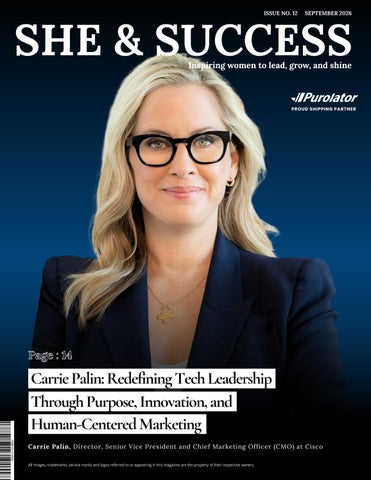
Carrie Palin: Redefining Tech Leadership Through Purpose, Innovation, and Human-Centered Marketing Carrie Palin, Director, Senior Vice President and Chief Marketing Officer (CMO) at Cisco All Images, trademarks, service marks and logos referred to or appearing in this magazine are the property of their respective owners.
September 2026 | The Business of Growth: Systems, Scale, and Smart Operations Growth is exciting, but sustainable growth requires more than ambition. It requires strong systems, smart processes, and the ability to move from simply building a business to building one that can scale with purpose. This September edition of She & Success Business Magazine explores The Business of Growth: Systems, Scale, and Smart Operations. We look at how women entrepreneurs are using automation, operational excellence, and smarter strategies to create businesses built for long term success. We are proud to feature our Business Woman of the Month, Jaime Power, Founder and CEO of Power Wealth. This issue also features conversations with Stefania Blasi of Purolator on leadership through sales and supply chains, Rakhee Dhingra of Mortgage Savvy on building beyond the mortgage, and Marnie Rabinovitch of Thigh Society on turning an entrepreneurial hunch into a $40 million comfort brand. Our Women in Tech feature spotlights Carrie Palin, Senior Vice President and Chief Marketing Officer (CMO) at Cisco and her human centered approach to technology leadership, while our Women in Health and Wellness feature highlights Meghan Raza, Founder of Ascension Living, on founder wellbeing under pressure. We also explore women’s changing relationship with capital and how women founders are building stronger SaaS businesses through systems and strategy. We also look ahead to the She & Success Business Awards 2026, celebrating remarkable women entrepreneurs and leaders across Canada. Learn more at sheandsuccessawards.ca. The next stage of growth is not about doing more of everything. It is about building smarter, creating structure, and making space for both the business and its leader to evolve. Here’s to scaling with clarity, leading with purpose, and building businesses made to last.
Kripa Anand Editor & Founder, She & Success Business Magazine
www.sheandsuccess.ca info@sheandsuccess.ca
For Advertisements info@sheandsuccess.ca The Canadian Global Media Network Inc. 6345 Dixie Rd, Unit 202, Mississauga, ON L5T 2E6
Call us at +1 (437) 829-7116, +1 416 655 0205
sheandsuccessbusinessmagazine @shesuccessmag sheandsuccess_businessmagazine canadiansme
Publisher
SK Editor & Founder
Kripa Anand
Published by The Canadian Global Media Network Inc. 6345 Dixie Rd, Unit 202, Mississauga, ON L5T 2E6
Copyright © 2026 The Canadian Global Media Network Inc. All rights reserved. Reproduction in whole or part of any text, photography or illustrations without written permission from the publisher is prohibited.
Sales Director
Shaik Raoof Uddin Sr. Content Manager
Amanda Spearing Sr. Media Manager
Maheen Bari Creative Design by:
Cmarketing Inc Social Media by:
Cmarketing Inc Photography:
Deposit Photos, Canva, Cmarketing Inc. Web
Cmarketing Inc
All Images, trademarks, service marks and logos referred to or appearing in this magazine are the property of their respective owners.
The contents in She & Success Business Magazine are for informational purposes only. Neither The Canadian Global Media Network Inc., the publishers nor any of its partners, employees or affiliates accept any liability whatsoever for any direct or consequential loss arising from any use of its contents.
PROUD SHIPPING PARTNER
SHE & SUCCESS
BUSINESS AWARDS 2026 CELEBRATING CANADIAN WOMEN DRIVING PROGRESS
Entries for the Awards
are open now
Deadline: 15th September, 2026
APPLY NOW SHEANDSUCCESSAWARDS.CA
#SHEANDSUCCESSAWARDS
CONTENTS
7 Business Woman of the Month
Jaime Power 17
The Global Buyer Is Looking for Her. Canadian Women Founders Need to Be Easier to Find.
21
The Money Is Moving: How Canadian Women Are Redefining Access to Capital
28
Women Founders Building Strong SaaS Businesses Through Systems and Strategy
30
Top 6 Smart Growth Models for Women-Led B2B Tools
39
How Women Entrepreneurs Are Strengthening Tech Businesses
IN THIS ISSUE She & Success Business Magazine
57
46
From One to Fifteen: Growing VOX Mental Health with Integrity and Care
Beyond Compliance: Turning Accessibility Into Strategy, Inclusion and Belonging
36
How Automation Is Helping Canadian Women Consultants Scale Smarter
33 How Women Leaders Are Transforming ERP and CRM Consulting
50
53
Building Better Reproductive Health Tools for Gen Z
Confidence, Wealth, and Women Owning Their Decisions
24 From Hunch to Category Creator: Building Thigh Society into a $40M Comfort Brand
Business Woman of the Month
Jaime Power By Kripa Anand
Jaime Power’s Entrepreneur-First Approach to Building Lasting
For many business owners, financial success creates a new set of questions. The company may be growing, but personal goals, tax planning, risk management and succession decisions can remain disconnected. Jaime Power, founder and CEO of Power Wealth in Guelph, Ontario, has built her advisory practice around closing that gap. Her focus is straightforward: help entrepreneurs view their business, personal finances and long-term family wealth as parts of one plan.
Founder and CEO of Power Wealth
7 - She & Success - September 2026
Image Courtesy: Jaime Power
Wealth
Business Woman of the Month
An Advisory Practice Built Around Entrepreneurs Power Wealth focuses on comprehensive financial planning for business owners. That specialization matters because entrepreneurs rarely make financial decisions in isolation. A choice about compensation can affect household cash flow; an investment decision can influence liquidity; and an exit plan can shape a family’s future for decades.
For entrepreneurs, that planning can include questions such as:
How much capital should remain in the business, and how much should support personal priorities?
Power’s broader work reflects the same entrepreneur-first perspective. More than a decade ago, she founded Power Connects, executive mastermind groups designed to help business owners strengthen their companies from the inside out. The initiative gives entrepreneurs a place to exchange ideas, test strategies, and learn from strong business owners, an approach that complements the individualized planning offered through Power Wealth.
What insurance and contingency plans would protect the company and the family if circumstances changed?
Why Personal and Corporate
What needs to happen before a sale, ownership transition or family succession?
Planning Must Work Together Business owners often spend years building value inside a company while giving less attention to the financial life that exists beyond it. A coordinated plan looks at both sides of the equation. It asks how today’s business decisions support the owner’s family, how risk is managed, and how wealth can eventually move from one generation to the next.
How should investments, retirement goals and major purchases fit with the company’s cash-flow needs?
The value is not a single product or a
Image Courtesy: Jaime Power
one-time recommendation. It is the discipline of making decisions in context. When personal and corporate strategies are aligned, business growth can support greater resilience, more informed choices and a clearer path toward legacy.
Business Woman of the Month
Recognition Rooted in Service
Lessons for Women Entrepreneurs
Power’s work has earned national industry recognition. Wealth Professional named her among its 2025 5-Star Advisors, a list developed from more than 500 nominations and focused on the quality of client service rather than assets under management. She was also included in the publication’s 2025 Top 50 Leading Women in Wealth, which recognizes women making meaningful contributions to Canada’s financial-services industry. Most recently, she is proud to have been a nominee for the 2026 Canadian Advisor of the Year Excellence with Wealth Professionals
Power’s career offers several practical lessons for women building firms in finance and other advisory fields:
Those distinctions are notable, but they are most useful in context. Awards do not replace due diligence or determine whether an advisor is the right fit. They do, however, reflect Power’s growing visibility in an industry where trust, communication and the ability to explain complexity are central to the client relationship.
Leadership Beyond the Office Power’s leadership extends into the Guelph community. She has served as Treasurer for Victim Services and as a board member of the Guelph Community Foundation, where she also chairs the Investment and Finance Committee. Community work may sit outside a formal financial plan, but it speaks to the values behind a practice. Board service requires stewardship, accountability and a long-term view, the same qualities business owners look for when choosing the people who will help them make consequential decisions.
Choose a client group you understand deeply. Specialization can make an advisory business more relevant and easier to distinguish. Solve the whole problem. Clients rarely experience business, family and financial decisions as separate issues. Make complexity understandable. Expertise creates value only when clients can use it to make confident decisions. Build trust beyond transactions. Peer networks, community leadership and consistent service can strengthen a firm’s credibility over time. Build a team that makes everyone stronger. No entrepreneur succeeds alone. Bringing together people with complementary strengths, shared values and a common purpose creates better outcomes for clients and a more resilient business. We go further when we go together.
Building Wealth With Intention Power’s story is ultimately about focus: know whom you serve, understand the decisions that shape their lives and build a practice around helping them connect those decisions. For business owners, the central message is equally clear. A successful company is only one part of a financial legacy; personal priorities, family security and succession deserve the same level of intention. By bringing those conversations together, Power Wealth is positioning financial planning not as a collection of isolated products, but as an ongoing strategy for turning entrepreneurial success into lasting opportunity.
Subscribe to She & Success Business Magazine and visit sheandsuccess.ca for more stories about women building businesses and shaping Canada’s economy. Disclaimer: This article is for informational purposes only. She & Success Business Magazine does not endorse or guarantee any product or service mentioned. Readers should conduct their own research and due diligence before making financial decisions.
9 - She & Success - September 2026
Image Courtesy: Stefania Blasi
In an exclusive interview with She & Success Business Magazine, Stefania Blasi, Vice President of North American Regional Sales at Purolator, shares her journey from a nontraditional academic background to becoming a leader in the logistics and supply chain industry. With decades of experience helping businesses navigate complex challenges, Stefania discusses how curiosity, preparation, and customer-focused thinking shaped her path to leadership.
Interview By Kripa Anand As Vice President of North American Regional Sales, Stefania leads strategic sales initiatives that strengthen customer relationships and support regional growth across the supply chain sector. With extensive experience in logistics, industrial strategy, and sales leadership, Stefania previously served as Senior Director of Industrial Vertical Strategy and Sales at Purolator. This role involved helping industrial customers navigate complex supply chain challenges, improve operational resilience, and identify opportunities for
The Road to Leadership:
sustainable growth.
Stefania’s Journey
Through Sales and Supply Chains Vice President of North American Regional Sales at Purolator
10 - She & Success - September 2026
Supply Chain Strategy You run North American regional
Freight and logistics have traditionally been male-dominated industries. How
sales for a major logistics
do you navigate being one of the few women in the room?
company, but you didn't go to business school. How did your
Early in my career, I recognized that I could not control who was in the room, but I
career path unfold?
could control how I showed up. Preparation became my foundation. Being prepared helped me build experience, develop competence, and ultimately grow
My path was non-traditional. Many
my confidence. There were moments when I noticed I was the only woman in the
people assume that a business
room, and it was natural to wonder what others might be thinking. Over time, I
degree is required to build a career
learned to set that aside and focus on the objective: delivering value for the
in commercial sales, but my studies
customer and representing the company well. That mindset helped me earn my seat
in philosophy, social science, and a
at the table and embrace each opportunity with confidence.
bit of economics gave me skills that proved essential in sales and negotiation. They taught me deductive reasoning, logical thinking, discovery, questioning, and how to get to the root of an issue to solve problems. Along the way, I’ve continued to build on that foundation through executive education in business. The commercial discipline was built in the field; the formal business education sharpened it. I studied at York University in
Through your work with Purolator’s industrial vertical, what have you learned from serving customers with complex supply chain and cross-border needs? Working with industrial customers reinforced the importance of leading with expertise and a commitment to solving real business challenges. In many cases, I was again the only woman in the room, but the focus was always on helping customers address pain points and strengthen their operations. Industrial customers, particularly B2B shippers, have faced significant disruption. During COVID-19, many supply chains were turned upside down, and organizations needed specialists who could help them de-risk their businesses and create more resilient operations.
Toronto before spending three and a half years in Rome, where I continued my education and worked abroad. I returned to Toronto with credentials (or degrees) in hand and international experience to draw on. A recruiter saw potential in me for commercial sales, Purolator gave me that first opportunity, and I began my career in inside sales in the early 2000s. From there, I moved through Field sales, now known as Regional sales, and the Vertical account segment before landing in management. At through the doors that Purolator opened for me, while relying on the critical thinking and problemsolving skills I had developed through my education and experience.
Image Courtesy: Canva
each stage, I continued walking
Image Courtesy: Canva
When you bring meaningful solutions to the table, gender becomes less central to the conversation. The priority is to understand the customer’s business, identify opportunities to remove uncertainty, and help them grow with confidence. Across the many sub-verticals within Purolator’s industrial business, customers shared common goals: building longevity, maintaining resilient supply chains, and working with a trusted partner who could help them navigate changing conditions. Purolator becomes an extension of their business, helping to remove uncertainty and work towards our common goals.
Creating a safe environment is essential. People need to feel supported enough to contribute, take thoughtful risks, and learn from mistakes. This is especially important for women and emerging leaders who may worry about making the wrong move early in their careers. I want my team to feel empowered to be entrepreneurial, knowing they are supported by the organization. Purolator has created that kind of environment, and as a leader, I see it as my responsibility to continue fostering it. Another important part of my role is removing barriers and sharing knowledge. Whether someone wants to advance through the organization or continue growing
You lead a team of 50 people across North America. How
in their current role, I want to help equip them for
would you describe your leadership approach?
success.
My leadership style is rooted in service and stewardship.
For me, effective leadership starts with understanding
Because my team is spread across North America, I believe
people from both an emotional and empathetic
leadership begins with empathy and meeting people where
perspective, then helping create the conditions where
they are.
they can do their best work. 12 - She & Success - September 2026
How does Purolator’s culture support women and
What advice would you offer to women building careers in
under-represented employees in advancing their
logistics, trade, or supply chain roles?
careers? My advice is to stay grounded in your purpose and be clear It's extremely intentional and woven into the fabric of
about what you are working to accomplish. Throughout my
who we are as a company. It is not treated as a
journey, my objective was to serve as an extension of my
checkbox exercise; it is part of who we are and how
customers’ businesses while representing Purolator’s solutions
we operate.
with authenticity and dedication.
The company supports this culture through initiatives
Hard work and preparation matter. You need to be intentional,
such as DEIB groups, the Women in Operations
know your customer, understand the goal, and be ready when
Network (WON), and mentorship programs. These
you come to the table, whether that is for a negotiation, a
resources help create pathways for people to have a
warehouse tour, or a strategic discussion.
seat at the table while keeping the focus on individual competencies, contributions, and opportunities for
It is also important to know your numbers. Numbers do not have
growth. The goal is not to just have representation; we
a gender; they speak for themselves. Understanding the data
also want an inclusive environment where people can
helps build competence, strengthens credibility, and makes you
contribute fully and be recognized for their
relevant in business conversations. Just as importantly, women in
capabilities.
leadership should open doors for others, create space for participation, and support those coming up through the ranks. When you see someone with aspiration, encourage them, support them, and advocate for them even when they are not in the room. Sponsorship and mentorship are powerful ways to help the next generation of leaders succeed.
Image Courtesy: Canva
Disclaimer: The views and opinions expressed in this interview are those of the featured guest and do not necessarily reflect the official policy or position of She & Success Business Magazine. Our mission is to amplify authentic voices, highlight diverse leadership journeys, and share insights that inspire and empower women entrepreneurs and leaders across Canada.
13 - She & Success - September 2026
Women in Tech
Image Courtesy: Carrie Palin
Carrie Palin: Redefining Tech Leadership Through Purpose, Innovation, and HumanCentered Marketing
By Kripa Anand
Senior Vice President and Chief Marketing Officer (CMO) at Cisco
In today's quickly changing technology market, leadership entails far more than technical expertise or financial achievement. The most influential technology executives are those who
Building a Career at the
link innovation and purpose, empower
Intersection of Technology
employees, and create meaningful customer
and Storytelling
experiences. Carrie Palin, Cisco's Senior Vice President and Chief Marketing Officer, exemplifies this modern approach to technology leadership by integrating strategic vision, brand transformation, and customer-focused innovation. Throughout her career at some of the world's most notable technology businesses, Palin has
Palin's path to technological leadership exemplifies the changing importance of marketing in the tech industry. Rather than perceiving marketing as merely a means of promotion, she has worked to position it as a strategic driver that connects businesses with their consumers, partners, and communities.
helped organizations strengthen their market position, increase customer engagement, and translate complex technologies into clear, compelling value. Her leadership exemplifies how technology, marketing, and human-centred strategy can work together to generate business success, build trust, and produce long-term social impact.
14 - She & Success - September 2026
Prior to joining Cisco, Palin had senior marketing leadership positions at Splunk, SendGrid, and Box, as well as contributing to IBM's cloud and analytics efforts. Her expertise at various stages of technological development has given her a unique insight into how brands may adapt, innovate, and stay relevant in changing marketplaces. Palin heads Cisco's global marketing team, which is responsible for improving the company's brand, growing demand for its solutions, and building stronger connections with consumers around the world.
Image Courtesy: Canva
Women in Tech
Here are some of the noteworthy initiatives promoted during her tenure: 1 - Artificial intelligence and generative AI for marketing productivity, personalization, content creation, customer insights, and enhanced customer experiences. 2 - Cisco Webex for collaboration, virtual engagement, events, and customer communications. 3 - Splunk for data analytics, observability, security intelligence, and customer insights. 4 - Cisco Security Cloud and Cisco’s broader cybersecurity portfolio. 5 - Cisco networking and cloud infrastructure
Palin’s Leadership Drives CISCO’S Major Tech Initiatives Her leadership focuses on Cisco's digital marketing, brand, demand generation, events, partner marketing, and AI-enabled customer experiences, rather than specific procurement choices or subscription records. One of the defining characteristics of Palin's leadership style is her view that technology firms must represent more than just products and services. Under her leadership, Cisco's marketing approach has been inextricably linked to the company's overarching goal of creating an inclusive future through technology. This transition is significant for today's technology executives. Customers are increasingly expecting businesses to demonstrate values, responsibility, and real-world results. Palin's strategy demonstrates how marketing can help communicate not simply what a company produces, but also why it matters.
15 - She & Success - September 2026
platforms supporting secure digital experiences. 6 - Cisco AI Hub showcased at Cisco Live as part of the company’s AI innovation portfolio. 7 - Cisco Marketing Velocity for partner education, digital marketing resources, campaign support, and unified partner marketing. 8 - Digital customer-experience platforms used to modernize Cisco’s online presence and buying journey. 9 - Marketing analytics and insights systems supporting measurement, demand generation, and data-led decision-making. 10 - Marketing automation and personalization capabilities used across regional, digital, field, and partner marketing. 11 - Event and experiential technology supporting Cisco Live, Partner Summit, sponsorships, and global events.
Women in Tech
Championing Women in
AI, Customer Experience, and the
Technology Leadership
Future of Marketing
Women continue to play an important role in creating the future of technology, but leadership representation is still an ongoing discussion in the sector. Leaders such as Palin demonstrate the value of incorporating multiple opinions into executive decision-making.
As artificial intelligence continues to impact business, Palin believes that technology leaders should focus on how AI may improve customer outcomes rather than merely implementing new technologies.
Her work exemplifies how women can effectively lead in typically difficult technical areas
Palin recently spoke with Cisco TechBeat on her leadership trajectory, the shifting marketing landscape, the organizational skills required for success, and how AI is impacting customer experiences. AI offers marketing directors the opportunity to better understand customers, personalize experiences, and make more informed decisions. However, Palin's point of view emphasizes the importance of keeping technology tied to human needs.
by combining strategic thinking, business acumen, creativity, and collaboration. Palin's leadership also conveys an essential message to prospective female leaders: technology occupations are not limited to engineering positions. The sector needs leaders in marketing, customer experience, operations, strategy,
Creating a Legacy Beyond Business Results Carrie Palin's impact goes beyond ads, branding, and financial KPIs. Her leadership exemplifies a broader shift in the technology sector, where strong businesses are built by combining innovation, empathy, and purpose. As more women take on key roles in technology, executives like Palin demonstrate how different perspectives can form stronger organizations and more inclusive sectors. The future of technology will be determined not only by the solutions that businesses develop, but also by the leaders who guide them – leaders who see that innovation is ultimately about people.
Image Courtesy: Canva
and innovation.
Subscribe to She & Success Business Magazine and follow us on she&success.ca to stay updated on funding opportunities, entrepreneurial insights, and inspiring stories of women making a difference across Canada. Disclaimer: This article is for informational purposes. She & Success Business Magazine does not endorse or guarantee any products or services mentioned. Readers should conduct their own research and due diligence.
16 - She & Success - September 2026
Image Courtesy: depositphotos.com
Women in Trade
The Global Buyer Is Looking for Her. Canadian Women Founders Need to Be Easier to Find. By SK Uddin
Growing internationally doesn't usually start with a large export contract, a distributor, or a trade exhibition. Sometimes it starts with a single customer looking for exactly what she already produces. International trading still seems like a far-off stage of business to many Canadian women entrepreneurs; it requires years of domestic growth, significant investment, and a team big enough to handle complexity. However, that notion is becoming less and less relevant.
The size of a company does not always matter to the global buyer. They are concerned with its ability to resolve issues, satisfy requirements, deliver consistently, and effectively convey value. Furthermore, visibility has emerged as one of the most crucial trade assets a founder can develop in a world where procurement teams, distributors, retailers, and corporate partners are actively seeking online for specialized Canadian goods and services.
17 - She & Success - September 2026
Global Expansion The Brampton-based company is run by women and offers a unique wellness product. The founder operates a specialist consulting firm in Calgary. An entrepreneur from Toronto is creating software, culinary brands, beauty goods, training programs, and sustainable packaging. She may already be able to export. The concern is whether she can be located by the proper foreign buyer.
Trade Access Is Becoming More Open and Inclusive For many years, penetrating foreign markets was mostly dependent on closed networks, such as trade trips, personal introductions, corporate contacts, and industry groups. Although they are no longer the exclusive path, those channels are nevertheless important. These days, a buyer in London, Dubai, Singapore, or São Paulo might find a Canadian business via LinkedIn, a trade directory, an e-commerce platform, a supplier-diversity database, a virtual pitch event, or an introduction from a Trade Commissioner. Traditional trade networks have not always been designed with women entrepreneurs in mind; therefore, this is important.
The Buyer-Readiness Test A flawless business is not necessary for foreign purchasers. They require self-assurance. A distributor, procurement team, or corporate partner typically looks for proof that a company is prepared to deliver outside of Canada before taking a conversation seriously. This implies that any female entrepreneur with worldwide aspirations must be ready to promptly respond to the following five questions:
What issue do we resolve, and why is it important in this market? Is a consumer, retailer, distributor, business client, or government partner our ideal buyer? Can we provide fulfillment, payment, compliance, and customer service internationally? What distinguishes our product from that of regional or international rivals? What evidence do we have, such as client
Women-owned Canadian SMEs export at rates similar to those of men-owned SMEs,
testimonials, certificates, sales records, media coverage, or product validation?
according to a 2025 study from the Women Entrepreneurship Knowledge Hub. More importantly, women-owned businesses are surpassing men-owned businesses in a number of non-US export markets, such as China, India, Brazil, and the United Kingdom. The chance is no longer hypothetical. Female entrepreneurs are already establishing global clientele. The next step for many is a more direct path to those who can purchase from them rather than authorization to engage in commerce. Image Courtesy: Canva
18 - She & Success - September 2026
Global Expansion Building a polished corporate façade is not the goal here. The goal is to lessen uncertainty. A buyer should be able to quickly learn what a firm sells, who it serves, and why it can be trusted by visiting its website, LinkedIn page, product deck, or online catalog. That is a significant change for a founder. A government checklist is not all that constitutes trade preparedness. It's a visibility tactic.
"Should I join a trade mission?" is not the strategic question. "Which market comprises buyers already aligned with what I sell?" is the question.
Three Ways to Become Easier to Find
01
Make Your Digital Presence Internationally Legible
If a Canadian company's online presence solely appeals to local consumers, it may be outstanding but remain unnoticed by international shoppers. Clear product or service descriptions, uncomplicated contact details, evidence of Canadian operations, buyer-facing case studies, and material that makes sense outside of the founder's local community are all components of an export-ready web presence. For businesses that sell products, this could entail displaying details like minimum orders, ingredients, certifications, delivery options, wholesale information, and specifications. For service providers, this could entail outlining how work is completed remotely, the markets the business serves, the currencies it takes, and the results that clients from other countries can anticipate. The objective is straightforward: an overseas customer shouldn't have to speculate as to whether the company is prepared to collaborate with them when they discover it.
02
Use Trade Missions for Meetings, Not Just Travel
Trade missions are sometimes misinterpreted as networking events or ceremonial excursions exclusive to big businesses. In actuality, the most effective missions produce something much more valuable: organized access to possible partners and buyers. Thru women-focused trade trips, targeted market advice, networking opportunities, and business-to-business matchmaking, Canada's Business Women in International Trade program promotes female entrepreneurs. Additionally, it links export-support initiatives, such as CanExport SMEs, with women-owned and women-led companies. tradecommissioner
In a market where ethical, natural, or high-end personal care items are in high demand, the founder of clean beauty products can find greater success. A purpose centred on artificial intelligence, clean technology, financial services, or health innovation could be advantageous for a startup founder. A focused B2B delegation can be more beneficial to a professional services entrepreneur than a big consumer trade event. A week of qualified talks can replace months of cold outreach with the correct mission.
03
Let the Trade Ecosystem Open Doors
Grants and loans are frequently not the most beneficial forms of export assistance. It's a kind of introduction. For a variety of Canadian exporters, the Trade Commissioner Service offers customized support, finance information, market research, and export advice services. Through its Business Women in International Trade program, women entrepreneurs can find networks, opportunities, and possible international partners. This assistance can alter the beginning of a market-entry discussion for female entrepreneurs. A firm may be offered thru a trade officer who is familiar with the market, the industry, and the demands of the buyer rather than approaching a potential distributor without any prior knowledge. Before investing money, a creator can obtain firsthand knowledge rather than spending months assessing whether a country is a viable possibility. The most successful founders don't use these companies to handle their international strategy. They use them to develop stronger introductions, make better decisions, and stay out of the incorrect market too soon.
Global Expansion
Visibility Is a Form of Power
The New Trade Mindset
Beneath the practical steps comes a bigger problem. Women entrepreneurs are frequently instructed to gain reputation covertly by developing the product, providing customer service, enhancing the company, and waiting for the outcomes to speak for themselves. However, visibility is rewarded by international trade. Purchasers cannot collaborate with companies they are unaware of. Investors cannot support unseen export potential. If founders are not present in the room, in the database, in the discussion, and on the radar, trade groups are unable to propose them for missions, showcases, or delegations.
The businesses that have been shipping globally for decades won't be the only ones creating the next phase of Canadian trade. The female founder, who gets her website ready for a buyer in another nation, will also build it. The business owner who participates in a trade mission targeted at women. Before investing in expansion, the business owner requests market intelligence from the Trade Commissioner Service. The founder who begins to approach worldwide expansion as a useful business function rather than as a far-off goal.
needed. In non-US markets, women-owned firms are already demonstrating their ability to lead. They must now be observed. What she offers might already be sought after by the worldwide buyer. It's her responsibility to ensure they can locate it.
Image Courtesy: depositphotos.com
Becoming performative is not what this entails. It entails becoming discoverable. Being recognized as a Canadian exporter might provide a compounding benefit for female entrepreneurs. Customer interest, partnership opportunities, media attention, funding discussions, supplier contacts, and peer networks are all drawn to it, all of which facilitate the next international step. The entrepreneur may be closer to being an exporter than she thinks if she declares herself to be one before she is completely prepared.
More companies that sell outside of Canada are
20 - She & Success - September 2026
They are not waiting for traditional gatekeepers to say yes. They are learning how to build, back, and circulate capital themselves.
Image Courtesy: Canva
Women in Finance
The Money Is Moving: How Canadian Women Are Redefining Access to Capital
By Kripa Anand
Beyond the Traditional Yes
For many years, women's lack of access, confidence, relationships, representation, and capital has dominated discussions about women and money in Canada. However, that framing is becoming antiquated. Women are altering the financial landscape nationwide—not just by increasing their income or making investments early, but also by actively influencing the future of capital.
For far too long, the only way to get funding was to know the right people, go into the right places, speak the language of institutional finance, and persuade someone in a position of authority that your idea was worth the risk. That path has never been equally accessible for many female founders, particularly those from Black, Indigenous, immigrant, racialized, rural, and newcomer areas.
They are investing in firms, establishing investment communities, joining angel networks, creating revenue-first businesses, and disseminating previously confidential financial knowledge. There is more to the change than just women earning more money. It is about giving women more financial agency. And everything is altered by agency.
Before considering what they are building, the traditional finance mechanism frequently requires entrepreneurs to demonstrate their eligibility. It favors proximity to current riches over the capacity to generate new wealth, warm introductions over lived expertise, and pattern recognition over potential.
21 - She & Success - September 2026
Financial Empowerment In response, women are developing different paths. Before venture funding, they are using client revenue to build businesses. To build traction, they are utilizing crowdfunding, peer investment networks, pre-sales, grants, community loans, and strategic collaborations. They are making money in areas where they don't have to compromise their ideas or change who they are to meet others' expectations. This does not imply that institutional funding is no longer important. Yes, it does. For companies that need to grow, venture capital, bank funding, private equity, and government initiatives are still crucial resources. However, female entrepreneurs are demonstrating that power does not require a single source of funding.
Capital Is Also a Community Money has frequently been viewed as personal information that should be handled discreetly, learned on one's own, and never discussed in public. However, that notion is being rejected by the women who are transforming Canadian finance. To compare grant applications, they are setting up group chats. Workshops on investor preparation are being held. They are sharing the identities of advisors who genuinely pay attention. They are referring each other to potential partners, clients, mentors, attorneys, accountants, and financiers.
The Rise of the Revenue-First Founder The increasing number of female entrepreneurs who prioritize sustainability above scale is one of the most significant shifts in Canadian entrepreneurship. They are posing distinct queries:
Is it possible for this company to turn a profit before raising capital?
Image Courtesy: Canva
Is it possible to develop a devoted clientele before creating a pitch deck? Is it possible for profitability to become leverage? Is it possible for growth to be deliberate as opposed to performative?
This is not a lesser goal. It defines ambition differently.
Image Courtesy: Canva
The founder who prioritizes revenue is aware that while outside funding might speed up a company, it can also put pressure on it to expand at a rate that is detrimental to the founder, the team, or the client. She understands the importance of ownership. She understands that options are created by cash flow. She is also aware that a company that is developed methodically and gradually can nevertheless grow to be very successful. This strategy is fostering a new kind of entrepreneurial confidence for women starting businesses in industries ranging from technology and wellness to real estate, cuisine, consulting, cosmetics, and professional services. Not a loan of confidence from investors. Evidence is the foundation of confidence.
22 - She & Success - September 2026
Financial Empowerment
The Editorial Position of She & Success Pricing, financing, equity, payroll, investing, and the challenging realities of starting a business are all topics of free discussion. Because it transforms financial knowledge into something shared rather than hoarded, this transparency is potent. A founder can negotiate more skillfully if she understands her figures. A woman can ask more insightful questions if she
We believe that access to finance should not be determined by whether a woman inherits the correct network, speaks the right financial language, or embodies the image that investors have always trusted. We feel that women deserve more than just encouragement to be "confident" with money. They demand clear information, responsive financial institutions, equitable investment possibilities, and communities that encourage wealth creation. Because women who are in charge of capital do more than just create businesses. Teams are employed by them. They help families. They invest in ideas that might otherwise go unnoticed. They create opportunities in communities that traditional finance has too often ignored. The funds are flowing. Additionally, Canadian women are ensuring that it moves purposefully.
understands how term sheets operate. An entrepreneur is less likely to view financing rejection as evidence that she
Image Courtesy: Canva
should give up if she hears another woman speak candidly about it. Capital cannot be replaced by community. However, it frequently dictates who gains access to it.
What She & Success Is Watching We are witnessing a generation of women at She & Success transcend the antiquated notion that identity, leadership, and influence are distinct from finance. The largest investment announcements aren't necessarily made by the women creating the most promising financial futures. They are frequently the ones who are aware of their profit margins, safeguard their ownership, diversify their sources of revenue, make long-term financial decisions, and invest in relationships. They are building businesses that support their lives—not businesses that consume them. They are becoming more deliberate about the distinction between value and visibility, between growth and stability, and between generating wealth and raising capital. And increasingly, they are using their success to fund the next woman behind them. An ecology shifts in this way. 23 - She & Success - September 2026
From Hunch to Category Creator: Building Thigh Society into a $40M Comfort Brand Marnie Rabinovitch Founder of Thigh Society In an exclusive interview with She & Success Business Magazine, Marnie Rabinovitch, Founder of Thigh Society, shares how identifying an everyday problem and listening closely to customers helped turn an overlooked need into a new consumer category. Marnie discusses the journey from leaving a secure career to building a global brand, staying bootstrapped, and creating an operating model built around fractional talent and customer-led decisionmaking.
Marnie Rabinovitch founded Thigh Society in 2009 to solve a problem most people had learned to just live with: thigh chafing. Frustrated by shapewear, biker shorts, men’s boxers and messy creams, she designed something better size-inclusive, cooling and sweat-wicking slip shorts that actually worked. No background in retail, manufacturing, or ecommerce. Just a hunch, a pensioned government job she quit, and a willingness to build from scratch.
Image Courtesy: Marnie Rabinovitch
Interview By Kripa Anand
Consumer Innovation Thigh Society has since sold over 3 million pairs worldwide and is recognized as the category creator for chafe prevention, sweat management, and modesty solutions in sizing from XS to 6XL. The brand has been featured on The Today Show, Oprah Daily, and NYT Wirecutter. Marnie was named an EY Entrepreneur Of The Year® 2025 Award winner in Ontario and has been profiled in Forbes, Nasdaq, and Business Insider. Thigh Society ranks as the 4th fastest-growing womenled company in Canada by the Globe & Mail.
You built Thigh Society around a problem most women weren’t openly talking about: thigh chafe and “down there” sweat. How did you know there was a real category here before the market language or demand Image Courtesy: Marnie Rabinovitch
signals existed? I knew because I was the customer. I'd spent years doing what most women do - wearing rubbery bike shorts, ill-fitting men's boxers, or suffocating shapewear under my summer dresses. Or coating my legs with powders and creams that came off on my clothes within an hour. I knew I wasn't the only one. I just couldn't find anyone talking about it openly, because the cultural narrative was that chafing was a weight issue. If your thighs touched, that was something to fix about yourself. That framing kept women silent. What I understood early was that chafing is
You left a stable, pensioned government job with no
friction. Friction doesn't care about your size. A
background in retail, manufacturing, or ecommerce. Looking
size 2 runner chafes. A size 20 woman chafes.
back, what were the most important decisions you made in
Teens, new moms, athletes, women in their 70s
those early years that set Thigh Society up to become a
on vacation. The problem was universal - it just
global comfort base layer brand?
didn't have language yet. The moment I named it publicly and offered a real solution, women
I actually quit two pensioned jobs to build this - first the provincial
responded enormously. They'd been waiting for
government, then the University of Toronto. People thought I was
permission to stop suffering through something
a little crazy, but to me, both were very low risk and both times I
they thought was just theirs to manage privately.
needed to be more focussed on the business. 25 - She & Success - September 2026
Consumer Innovation The most important early decision was to stay close
You’ve intentionally kept Thigh Society bootstrapped and
to the customer and let her tell me what the
run a $40M business as the only full‑time employee,
product needed to be. I didn't have industry
supported by fractional talent and small agencies. What does
assumptions to fall back on, which turned out to be
that operating model look like day‑to‑day-and where does it
an advantage. I wasn't trying to fit Thigh Society
outperform a traditional headcount‑heavy structure?
into an existing category - I was building a new one.
It requires an enormous amount of trust - in the people you bring in, and in yourself to know what you actually need.
The second decision was to stay bootstrapped. Not taking outside investment meant slower growth in
My fractional team covers finance, marketing, operations, and
the early years, but it meant I never had to
design. They perform just as well as full-time hires at a
optimize for anyone other than my customer. Every
comparable cost - and they bring perspective from working across
decision like sizing and quality - was made on my
multiple clients. They're not siloed. They show up to solve
terms, not an investor's timeline.
problems. And they know they're only as good as their last month of work, so the effort is always high. The ones I've built long-term
The third was to take size inclusivity seriously from
relationships with feel just as invested in the brand as any full-time
the beginning, not as a marketing “trend” but as a
hire would.
requirement baked into the brand mission. Yes, that meant more SKUs, more complexity and more
The model also forces a different kind of discipline. When you
cost. But it also meant the product worked for so
can't throw headcount at a problem, you have to pinpoint what the
many people and helped further our goal to dispel
problem actually is - and figure out whether you need a new
myths that chafe and sweat happen because of
resource or just better processes. AI is starting to make that even
size.
easier.
The trade-off is that it can feel isolating. We're fully remote no water cooler, no boardroom table. That's a real cost.
Image Courtesy: Marnie Rabinovitch
But I wouldn't trade it for a traditional org structure, and I think a lot of businesses are moving in this direction.
26 - She & Success - September 2026
Consumer Innovation
Thigh Society offers XS–6XL and talks
A Dragon once told you this would stay a cottage business and
about size inclusivity as non‑negotiable,
that women wouldn’t trade shapewear for long‑leg underwear.
not a campaign. What does true
Now you’ve sold over 3 million pairs and earned accolades from
inclusivity actually demand from a brand
EY, Globe & Mail, and major media. What do you want other
on the product, operations, and financial
founders to take from that experience about whose opinion to
sides-and what do you wish more
prioritize-and how do you personally stay grounded amid all the
founders were honest about here?
external recognition?
True size inclusivity is expensive,
I don't tell that story to be vindictive. I tell it because it's the most
complicated, and in our case, very worth it.
useful thing I know about building something new: experts are experts in what already exists. If you're creating a category, you are by
On the product side, you can't just
definition operating outside the range of what anyone can confidently
mathematically grade a pattern up and down
predict - including people with far more experience than you.
and call it inclusive. A size 2X garment has different fit requirements than a size XS. Our factory sends us samples across our size range, and we also send those samples to real women to wear and give us feedback. That process takes time, but it's what ensures the product actually works for the person wearing it. On the operations side, more sizes means more SKUs, more inventory complexity, and significantly more forecasting risk. When you're running XS through 6XL across
The Dragon wasn't wrong based on what she knew. She just didn't know what I knew - which was that millions of women were quietly managing this problem every day and had never been offered a real solution. My customer validated the idea before any investor did. That's who I listened to.
multiple styles, inseams, and colours, you're managing a much larger inventory puzzle and getting that wrong is costly in both directions, whether you're overstocked or
As for staying grounded amid the recognition - I find it genuinely easier
undersupplied.
than people might expect. The awards and press are so meaningful, and I'm proud of them. But they don't change what Tuesday looks like.
On the financial side, the real cost is in
There's still customers to serve, teams to manage and problems to
minimum order quantities. Our factory
solve. The work keeps you honest in a way that accolades can't touch. I
requires minimums per style, colour, and
think the founders who lose the plot are the ones who start optimizing
size - which means we're committing to
for recognition instead of for the person they're actually building for.
inventory across a wide range before we know exactly what will sell. What I wish founders were honest about is that extending your size range to a 2X or 3X while calling it inclusive isn't the same thing. Inclusive means the product actually works for the person wearing it, at every size you offer. That's a different commitment.
Disclaimer: The views and opinions expressed in this interview are those of the featured guest and do not necessarily reflect the official policy or position of She & Success Business Magazine. Our mission is to amplify authentic voices, highlight diverse leadership journeys, and share insights that inspire and empower women entrepreneurs and leaders across Canada. 27 - She & Success - September 2026
Image Courtesy: depositphotos.com
Women Founders Building Strong SaaS Businesses Through Systems and Strategy By SK Uddin Canadian women in SaaS are migrating from "founder" to "operator" roles, focusing on disciplined, systemsdriven growth rather than product obsession. Womenled SaaS businesses throughout the country are establishing repeatable procedures, playbooks, and data-driven rhythms to promote long-term growth rather than chaotic hustling. This transition is important for Canada's digital environment, as women remain underrepresented in leadership while continuously demonstrating high levels of creativity and resilience.
From Founder Knowledge to Team-Driven Operations
Creating Repeatable Processes for SaaS Success In the early stages of a SaaS firm, growth is frequently dependent on the founder handling everything: sales calls, product choices, onboarding, support, and even payment. That "heroic effort" can yield fast results, but it does not scale. Canadian female founders are increasingly recognizing that the true value resides in creating systems that anyone on the team can run, enhancing consistency and freeing up leadership to focus on strategy. Accelerators and programs developed exclusively for women, such as DMZ's Women Founders initiatives and Fierce Founders in Ontario, reinforce this approach by encouraging participants to translate vision into organized operational models rather than presentation decks and feature roadmaps.
One of the most obvious transitions from founder to operator is found in published playbooks. Women SaaS executives are standardizing sales, onboarding, and customer support processes to avoid reliance on memory or ad hoc judgments. A sales playbook can help define ideal customer profiles, discovery questions, demo flows, and follow-up cadences, making successful deals repeatable for new reps. Onboarding playbooks frequently standardize schedules, training resources, and milestones, lowering churn and support load while improving the customer experience. Teams can maintain a consistent brand voice and quality as traffic grows by following support rules that cover tone, response time expectations, escalation channels, and knowledge base utilization.
28 - She & Success - September 2026
Women in SaaS This emphasis on systems is especially essential in Canada, where female founders confront persistent financial disparities and frequently must expand effectively rather than depending on large capital injections. Women-led enterprises receive a small share of venture funding, highlighting the need for process optimization and automation in boosting profits and runway. As a result, many Canadian women in SaaS start early with workflow tools, connected CRMs, and clear internal documentation to deliver at scale with lean teams. Instead of recruiting to "fix" operational problems, they design the system to reduce it from the start.
Using KPIs and Dashboards
How Community Support Helps Women Founders Scale This progress is being reinforced by community infrastructure throughout Canada. Initiatives such as Startup Women and regional accelerators connect women startups with mentors who have already made the transition from founder to operator. Instead of focusing solely on fundraising or product ideation, these networks prioritize operational topics such as team structure, process change implementation, automation tool selection, and internal governance design. As more women-led SaaS companies expand through these programs, they demonstrate a different route where operational excellence and systems thinking are intrinsic to identity, rather than an afterthought.
to Scale SaaS Businesses Another characteristic of the operator mindset is creating key performance indicators, dashboards, and operating rhythms. Women-led SaaS teams in Canada prioritize metrics such as recurring income, churn, onboarding completion, feature adoption, and support resolution times over vanity metrics. These metrics are then presented in dashboards for leadership and teams to assess regularly—weekly pipeline reviews, monthly customer health checks, and quarterly strategic retros. This rhythm keeps everyone on track and allows issues to be identified while they are still tiny and fixable. In practice, it means that decisions are made based on data rather than intuition, which is critical when the firm reaches a point when gut instinct is no longer sufficient. Transitioning from intuition-led judgments to datadriven operations provides structure to the founder's vision, rather than removing it. Women SaaS founders frequently begin with a profoundly felt problem that they wish to solve, informed by personal experience and empathy for their users. As the company expands, they're learning to back up their intuition with data: usage analytics, customer interviews, cohort analysis, and financial performance reports. This mix of strong story and real facts makes it easier to communicate priorities to the team, secure partners, and make difficult decisions about features, price, or markets.
The Path Forward for Women in SaaS Leadership For She & Success Business Magazine’s readers, the main message is that Canadian women in SaaS are not merely delivering code; they are establishing firms that run on well‑designed systems. The transition from founder to operator necessitates intentionality: setting aside time to document processes, identify KPIs, and establish review cadences even when urgent fires compete for attention. However, those investments pay off in the shape of consistent growth, better teams, and firms that can scale without losing quality or burning out their leaders. In an environment where women must often work smarter to attain the same recognition and resources, systems thinking becomes not only a competitive advantage, but a form of empowerment.
Subscribe to She & Success Business Magazine and follow us on she&success.ca to stay updated on funding opportunities, entrepreneurial insights, and inspiring stories of women making a difference across Canada. Disclaimer: This article is for informational purposes. She & Success Business Magazine does not endorse or guarantee any products or services mentioned. Readers should conduct their own research and due diligence.
29 - She & Success - September 2026
Top 6 Smart Growth Models for Women-Led B2B Tools By Kripa Anand
Image Courtesy: Canva
Canadian female founders building B2B technology tools are rethinking what constitutes sustainable growth. Instead of relying on traditional ways based on rapid development and aggressive expenditure, more businesses are adopting smart growth models that balance capital, market opportunity, operational discipline, and longterm sustainability. While women-led enterprises continue to grow across Canada, problems such as capital availability, market expansion, and resource limits persist. These facts have prompted many founders to pursue solid procedures, clear decision-making, and effective execution. Smart expansion does not mean slowing down; rather, it means building organizations that can scale with confidence and control.
B2B Innovation
01
Building Growth Through Systems-First Scaling
A significant movement among women-led B2B tool companies is the shift to systems-first growth. Rather than rapidly expanding teams or following every possibility, founders prioritize developing strong operational foundations over rising complexity.
This includes: Defining roles and responsibilities across teams Establishing accountability structures
03
Using Support Programs to Strengthen Business Foundations
Canadian initiatives that promote women entrepreneurs provide valuable financing, coaching, and networking opportunities. Programs like the government's Women Entrepreneurship Strategy and women-focused accelerators help founders access the tools they need to succeed. However, external help produces the best outcomes when combined with personal discipline.
Successful women-led B2B enterprises frequently leverage these resources to strengthen:
Developing dashboards and performance scorecards Monitoring critical KPIs, including revenue, margins,
Product dependability
client retention, and acquisition expenses.
Customer success systems Operational processes
When a company has clear protocols in place, teams can make faster choices and prevent operational confusion. This technique enables businesses to grow without adding unneeded complexity.
02
Creating Growth Strategies That Fit Founder Realities
Women entrepreneurs frequently confront specific hurdles when scaling their firms, such as finance constraints, access to networks, and juggling many duties. Smart growth models understand that there is no single road to success.
Effective growth strategies take into account essential aspects such as: Capital access and financial planning Market positioning and client development Leadership and Team Management
Financial Planning Team structures.
Smart growth means leveraging available opportunities to build better foundations rather than focusing solely on expansion.
04
Turning Operational Excellence Into a Competitive Advantage
Access to venture finance remains a hurdle for many female founders. With fewer funding opportunities and smaller investment rounds than male-led enterprises, many female entrepreneurs are looking for other strategies to drive longterm growth.
Operational excellence has become a significant advantage. Women-led B2B tool companies are focusing on:
Personal obligations and founder's capacity
Effective cost management
Support from ecosystems and business networks.
Strategic Product Development
Instead of merely duplicating typical business models, women founders can create tactics that are tailored to their unique circumstances.
Strong customer relationships Reliable revenue models Prioritized market expansion.
31 - She & Success - September 2026
B2B Innovation
This disciplined approach enables companies to build resilient businesses that can adapt to changing market conditions.
05
Balancing Business Management with Business Development
06
Implementing a Structured Roadmap for Sustainable Growth
Many successful women-led B2B tool companies use a disciplined growth approach to turn ideas into concrete results. A realistic roadmap contains: Diagnosis - Data and analysis can help you understand the current difficulties, opportunities, strengths, and limitations.
Smart expansion necessitates equal attention to managing the current business and finding new opportunities. Business management focuses on:
Establishing objectives - Developing clear and quantifiable goals to drive company decisions. Strategic Choices - Choosing the best growth paths, whether they involve new markets, collaborations, products, or client groups.
Daily operations Team performance
Operations Planning - Establishing budgets, schedules,
Service Delivery
responsibilities, and resources required for execution.
Internal processes
KPI Monitoring - Performance is tracked regularly, and
Business growth focuses on:
strategies are adjusted accordingly.
Market expansion Partnerships
This strategy replaces guesswork with informed decision-making.
Customer acquisition Revenue growth Women-led B2B enterprises are increasingly realizing that both areas must collaborate. Strong internal systems allow founders to pursue new opportunities without overwhelming the organization.
Building the Future of WomenLed B2B Innovation The essential message for She & Success readers is that smart growth is intentional rather than gradual. Canadian women-led B2B tool companies demonstrate that excellent processes, disciplined operations, and strategic planning can result in long-term success. Women entrepreneurs create companies that keep control, adapt to change, and continue to make a meaningful contribution in Canada's technological ecosystem by prioritizing structure over improvisation and long-term success over short-term pressures.
Subscribe to She & Success Business Magazine and follow us on she&success.ca to stay updated on funding opportunities, entrepreneurial insights, and inspiring stories of women making a difference across Canada.
Disclaimer: This article is for informational purposes. She & Success Business Magazine does not endorse or guarantee any products or services mentioned. Readers should conduct their own research and due diligence.
Image Courtesy: Canva
How Women Leaders Are Transforming
ERP and CRM Consulting By SK Uddin Canadian women leaders in ERP and CRM consulting firms are leveraging operational excellence to differentiate themselves in the mid-market and enterprise B2B landscapes. These firms help clients transition from fragmented processes to data-driven, scalable operations through rigorous process design, automation, and integrated infrastructure. Women-led consulting teams differentiate themselves by treating deployment as a long-term business transformation, rather than a one-time technological project. 33 - She & Success - September 2026
Operational Excellence
Building Smarter Operations Through Process Mapping End-to-end process mapping is fundamental to operational excellence. Rather than merely installing an ERP or CRM platform and configuring a few modules, Canadian female consultants begin by recording how work moves across the firm, from lead generation to order fulfillment, billing, and customer support. This mapping phase identifies bottlenecks, duplicate data entry, approval delays, and holes in accountability. It also reveals possibilities to standardize procedures and incorporate best practices straight into the system. When ERP and CRM workflows are built around welldefined procedures, users perceive the software as a natural extension of their job rather than an imposed overlay. Once processes are defined, womenled ERP/CRM enterprises focus on workflow automation. Automation aims to eliminate low-value manual processes, allowing teams to focus on analysis, relationship-building, and strategic decisions. Mid-sized firms in Canada may benefit from focused automation due to their small operations teams and substantial administrative workloads. Consultants provide automation for quotation approvals, invoice production, escalation, follow-up reminders, and data synchronization across ERP, CRM, and e-commerce platforms. As these workflows are adopted, firms observe improvements in cycle durations, error rates, and rework—all of which are important indications of operational excellence.
The Foundation of Scalable Digital Operations Women-led enterprises prioritize integrated infrastructure. Instead of approaching ERP, CRM, analytics, and supporting tools as discrete initiatives, they see them as parts of a larger operational fabric. Canadian consulting firms specializing in ERP systems such as NetSuite, Microsoft Dynamics, and Salesforce CRM integrate financials, inventory, customer data, and service history into a unified environment. This connectivity is critical for mid-market and enterprise clients who require real-time visibility across departments to manage growth, cash flow, and customer experience. When the infrastructure is fully connected, executives can rely on a single source of truth rather than trying to piece together spreadsheets and reports from many systems.
Using Analytics to Drive Continuous Operational Improvement Observability tools and analytics layers enhance these systems. Canadian ERP/CRM consultants are increasingly incorporating dashboards, alarms, and performance scorecards into the systems they implement to allow clients to evaluate how operations are performing daily. Based on the industry, these tools may track lead conversion rates, service response times, order accuracy, or project profitability. Women-led organizations prioritize user-friendly visualizations and role-based dashboards, enabling frontline teams and managers to understand what is important without technical skills. Over time, this observability enables businesses to constantly adjust processes rather than treating implementation as a static event.
When competing for B2B implementation contracts, operational excellence emerges as a critical differentiator. Canadian firms purchasing ERP or CRM services are no longer satisfied with basic configuration; they want strategic coaching on how to run more effectively. Women-led enterprises excel at technology and process mastery, demonstrating how workflows, automation, and integration impact business outcomes like revenue growth, cost savings, and customer happiness. This helps them acquire and retain clients. They frequently position themselves as long-term partners, delivering continuing optimization and training services beyond the initial go-live. This helps clients extract more value and avoids the danger of systems becoming inactive.
34 - She & Success - September 2026
Operational Excellence
How Pricing Models Shape
Leading Canada’s Next Wave of
Consulting Partnerships
Systems-Driven Growth
Pricing and engagement models in Canada emphasize the value of excellence. CRM and ERP consulting engagements, particularly for mid-sized and business installations, are big investments, with entire SMB projects and enterprise rollouts often costing six figures. When clients commit to that level, they want substantial gains in efficiency and control, not just a new interface. Consulting teams led by women prioritize defined deliverables, including established processes, workflows, integrated data, training programs, and performance measurements, to ensure objective evaluation of success. That transparency contributes to stronger connections and higher renewal rates.
For She & Success readers, the main takeaway is that operational excellence is more than a buzzword; it is a disciplined method to transforming ERP and CRM consultancy into a strategic development lever. Canadian women at the helm of these companies are establishing reputations for their abilities to design processes, embed automation, and manage integrated infrastructure that works in the messy realities of client operations. As organizations seek partners that understand both technology and business, women-led ERP/CRM enterprises are well-positioned to lead Canada's next wave of smart, systemsdriven growth.
Subscribe to She & Success Business Magazine and follow us on she&success.ca to stay updated on funding opportunities, entrepreneurial insights, and inspiring stories of women making a difference across Canada. Disclaimer: This article is for informational purposes. She & Success Business Magazine does not endorse or guarantee any products or services mentioned. Readers should conduct their own research and due diligence.
Image Courtesy: Canva
35 - She & Success - September 2026
Image Courtesy: Canva
How Automation Is Helping Canadian Women Consultants Scale Smarter By Kripa Anand Canadian women consultants in revenue operations, digital transformation, and AI/automation see automation as a key growth driver for their firms and clients, rather than just a technical add-on. Women-led practices are carving out a position in Canada's rapidly increasing digital transformation sector by combining strategic insight with automation-first products for measurable efficiency and scale. Instead of relying on additional hours or more people, they magnify their influence through tools and workflows.
Building Automation-First Consulting Services This growth approach focuses on creating automation-first service offerings. Canadian women consultants offer services centred on workflow apps, AI assistants, and integrated CRM/ERP stacks, rather than just one-time projects or general consulting. Revenue operations engagements may involve creating automated lead routing systems, follow-up sequences, and pipeline dashboards. Digital transformation and AI services can use chatbots, automated reporting, and predictive analytics to eliminate manual effort and deliver real-time insights. Because these solutions grow without linearly adding workforce, consultants can serve more customers while maintaining quality—and clients benefit from continuous enhancements even after the engagement ends.
36 - She & Success - September 2026
AI Automation
Scaling Expertise Through Productized Services Women-led enterprises succeed at transforming their expertise into productized services. Instead of reinventing the wheel for each engagement, they build explicit packages based on repeatable processes, service-level agreements (SLAs), and operational tooling. A productized automation audit, for example, could comprise a standard discovery framework, a documented workflow map, a prioritized automation backlog, and a pre-designed implementation plan. A "rev ops automation sprint" can include defined dates, deliverables (e.g., CRM workflows, email sequences, dashboards), and agreed-upon performance measures. Productization facilitates consistent marketing, sales, and service delivery, while automation provides long-term value rather than one-time advantages.
Case examples from throughout Canada demonstrate how smart operations support
Automating the Consulting Business Model Automation also alters consultants' businesses. Canadian women consultants may create reliable lead engines and delivery pipelines by leveraging client-deployed tools such as CRM workflows, task automation, AI-assisted content, and analytics. The company automates marketing (newsletters, social posts, webinar funnels), sales (lead scoring, follow-up sequences), and operations (proposal templates, invoicing, project status updates) to reduce administrative time. This allows them to focus on high-value activities such as strategy sessions, ecosystem building, and thought leadership, resulting in better-fit customers and larger engagements.
this strategy. Women consultants working with small and mid-sized firms typically begin by assessing existing workflows to discover repetitive, low-value jobs and
Image Courtesy: Canva
fragmented processes. Automating highvolume tasks like email follow-ups, data entry, reporting, and customer onboarding allows teams to prioritize relationshipbuilding and strategic work. They help companies implement AI-enhanced tools for data processing, forecasting, and personalization, adding intelligence to automation. These consultants do more than build solutions; they also instill operational discipline by establishing review cycles, updating templates regularly, and aligning automations with changing business objectives.
37 - She & Success - September 2026
AI Automation
Personalizing the Automated Experience
Redefining Consulting in the AI Era
Importantly, these consultants do not use technology to eliminate the human element; rather, they combine automation with personalized touches. Women-owned firms should prioritize high-volume, repetitive work, create templates that reflect their authentic voice and values, and review automated materials regularly to ensure they remain relevant.
For She & Success readers, the conclusion is that automation, when driven by female consultants with a strong operational perspective, becomes a tremendous growth driver rather than a danger.
Scheduled emails can contain personalized remarks, automated sequences can encourage genuine interactions, and dashboards can help make more compassionate, educated decisions. This balance enables women consultants to maintain trust and relational depth while using systems to expand their reach.
Canadian women are reimagining consulting in an AI-enabled future with automation-first offers, repeatable services, and smart
Making Technology More Accessible Despite high levels of creativity, women-owned businesses in Canada tend to lag behind male-owned organizations in adopting new technology. Women automation consultants are actively narrowing the gap by demystifying AI and workflow technologies for their clients and framing them as practical tools rather than abstract buzzwords. They advise clients to track truly important KPIs—time saved, lead conversion rates, customer happiness, and revenue growth—rather than vanity metrics like likes or impressions. This emphasis on relevant data strengthens the notion that automation is intended to promote wise decisions and longterm progress, rather than to chase superficial signals.
operations that generate consistent outcomes. Their approach demonstrates that the true opportunity is not to replace humans, but to enable them to perform higher-value work within well-designed, automated systems.
Image Courtesy: Canva
Subscribe to She & Success Business Magazine and follow us on she&success.ca to stay updated on funding opportunities, entrepreneurial insights, and inspiring stories of women making a difference across Canada. Disclaimer: This article is for informational purposes. She & Success Business Magazine does not endorse or guarantee any products or services mentioned. Readers should conduct their own research and due diligence.
38 - She & Success - September 2026
How Women Entrepreneurs
Are Strengthening Tech Businesses By SK Uddin
Creating Stronger Financial Foundations
Image Courtesy: Canva
Designing robust financial systems is a key component of this effort. Women-owned tech SMEs in Canada confront smaller margins and restricted access to flexible finance, requiring effective cashflow management and risk mitigation strategies. Founders construct extensive forecasting models, stress-test scenarios for interest rate changes, and maintain buffers through diverse revenue sources or recurring contracts.
Canadian women who run tech-focused SMEs, including SaaS, B2B platforms, and ERP/CRM boutiques, prioritize designing resilient systems to withstand interest rate swings, supply chain disruptions, and financial constraints. In an environment where macroeconomic instability and structural restrictions continue to define access to finance, these founders are developing financial, operational, and ecosystem strategies that prioritize both stability and growth. Instead of depending on short-term momentum, firms are implementing mechanisms to absorb shocks and maintain value.
They prioritize finance mechanisms that are tailored to their stage and sector, rather than generic offerings. Ecosystem reports recommend flexible, non-matching grant streams, bridging financing between micro-grants and bank debt, and support for first hires as key policies to strengthen the financial backbone of women-led enterprises.
39 - She & Success - September 2026
Women in Tech
Operational Resilience Through Smart Processes Operational systems have an equally vital role in establishing resilience. Techfocused SMEs led by women prioritize defined processes, documented workflows, and appropriate infrastructure to scale without losing control. This could range from standardized deployment playbooks for ERP/CRM projects to automated onboarding routines for SaaS products and repeatable delivery frameworks for B2B platforms. By codifying how the firm operates—from compliance and billing to project management and customer support— founders make operations less sensitive to staff churn, unforeseen demand spikes, and supply chain changes. Right-sized infrastructure, such as shared cloud environments, regional small-batch facilities, or co-managed technical resources, enables women-led SMEs to access capabilities that would be costly to establish alone.
Bridging the Technology
Women founders in IT SMEs are increasingly focusing on process clarity before layering in AI or automation, ensuring that tools enhance existing strengths rather than adding complication. This intentional adoption method enhances resilience by improving visibility, speeding up decisionmaking, and optimizing resource utilization.
Image Courtesy: Canva
Adoption Gap Women-led businesses face both challenges and opportunities when it comes to technology adoption, which is a crucial aspect of resilience. Data from Canadian studies reveal that women-owned enterprises have been less likely than menowned organizations to adopt sophisticated technologies like AI, despite maintaining strong innovation levels. To narrow this gap, implement structured operational improvements including defined data practices, automation-friendly workflows, and solutions that align with genuine business demands. 40 - She & Success - September 2026
Women in Tech
Strengthening Growth
The Path Forward for
Through Community Support
Women-Owned Tech SMEs
Community and ecosystem support comprise the third pillar of resilient systems. Canadian women entrepreneurs benefit from an expanding network of hubs, loan funds, and collaborative efforts aimed at making entrepreneurship more accessible and inclusive. Ecosystem proposals include one-stop compliance and funding portals, regional "navigation desks," and common "how-to" libraries to ease administrative hassles and facilitate access to programs, licenses, and support for women-led SMEs.
For She & Success readers, the lesson is that resilience is more than just surviving difficult times; it is also about establishing processes that make it more difficult to deviate from the path. Canadian women who head tech SMEs achieve this by combining intelligent financial planning, organized operations, cautious technology adoption, and strategic use of ecosystem resources.
When these services are in place, founders may focus on strengthening their core systems and products rather than parsing eligibility criteria or duplicating paperwork. Collaborative infrastructure, including micro-procurement streams, set-asides for women-led firms, and buyer or logistics co-ops, enables smaller tech and service organizations to compete in larger markets without taking on all the risk alone.
Their approach demonstrates that resilience is built in layers: funding models that work, documented processes, tools that serve specific goals, and communities that minimize friction. These solutions provide stability for women-owned Canadian digital enterprises, enabling them to grow, adapt, and lead in an uncertain environment.
Building Inclusivity By Addressing Legitimacy and Access Resilience requires directly addressing legitimacy and access. Canadian policy guidance emphasizes the need to recognize non-traditional company models, such as home-based, carebased, creative, and cooperative, as valid types of entrepreneurship with certain qualifications. Recognizing womenowned IT SMEs that combine software with services, community work, or specialty areas might open up funding and procurement opportunities previously unavailable.
Subscribe to She & Success Business Magazine and follow us on she&success.ca to stay updated on funding opportunities, entrepreneurial insights, and inspiring stories of women making a difference across Canada. Disclaimer: This article is for informational purposes. She & Success Business Magazine does not endorse or guarantee any products or services mentioned. Readers should conduct their own research and due diligence.
Regular "legitimacy audits" of program and contract recipients highlight structural exclusion and inspire redesigns to better incorporate women-led enterprises. As program regulations and infrastructure become more aligned with the realities of women entrepreneurs, their resilience increases: fewer hidden hurdles, more predictable access to support, and clearer pathways to expand.
41 - She & Success - September 2026
Image Courtesy: Rakhee Dhingra
Beyond the Mortgage: Rakhee Dhingra’s Journey Interview By SK Uddin
In an exclusive interview with She & Success Business Magazine, Rakhee Dhingra, Founder of Mortgage Savvy,
Founder of Mortgage Savvy
shares a strategic perspective on how homeownership can become a foundation for financial confidence, flexibility, and long-term wealth. Rather than focusing solely on mortgage rates, Rakhee encourages homeowners to consider how financing decisions fit into broader goals such as entrepreneurship, investment, family security, and future financial freedom.
42 - She & Success - September 2026
Wealth Building Rakhee Dhingra is the founder of Mortgage Savvy, based in the Greater Toronto Area. With 20 years of experience in finance, she has closed over 2,500 mortgages and supported more than 5,000 clients, totaling $1.5 billion in funding. Philosophy and Approach Dhingra challenges the traditional view of mortgages, arguing that most Canadians face a "structure problem" rather than a money problem. Her work is centered on the concept of "Wealth Through Homeownership™," focusing on three core pillars: clarity, stability, and legacy. She helps individuals and families treat their primary residence as a strategic asset to build longterm wealth, rather than just a monthly payment.
Can you walk us through a real example of how you helped a client move beyond focusing on the lowest rate and instead use their mortgage as a long‑term wealth‑building strategy that supported clarity, stability, and legacy?
One client came to me focused almost entirely on securing the lowest possible rate. On paper, it looked like the obvious decision. But after understanding their broader financial picture, it became clear that flexibility would create far more value than a slightly lower payment. They planned to expand their business, purchase an investment property within a few years, and eventually help their children enter the housing market. Choosing the lowest rate would have limited their ability to refinance and access equity without significant
Sue Ann Baksh-Lorray
As a female founder in the financial space, how have you redefined what “wealth through homeownership” means Co-founder of Excel. No Excuses for Canadian families, and why is this perspective so important for women who are building their own financial futures?
For many years, the conversation around homeownership centred on getting approved for a mortgage or finding the lowest interest rate. I believe we've been asking the wrong question. To me, wealth through homeownership is about creating financial confidence. A home isn't simply where you live. It's
penalties. Instead, we selected a mortgage structure that gave them greater flexibility. The monthly payment difference was minimal, but the long-term impact was substantial. They later used their home's equity to purchase an investment property while continuing to grow their business, creating additional income and building long-term family wealth. That's why I encourage clients to think beyond today's payment. A mortgage should support your future, not restrict it.
often the largest financial asset a family will ever own, and when it's structured thoughtfully, it becomes a tool for building long-term security, opportunity, and generational wealth. That perspective is especially meaningful for women. More women are becoming primary income earners, entrepreneurs, investors, and decision-makers within their families. Financial confidence isn't about knowing every answer. It's about understanding your options, asking better questions, and making decisions that align with your long-term goals rather than reacting to short-term market headlines. My role isn't simply to arrange financing. It's to help people understand how today's mortgage decision can influence their financial freedom ten or twenty years from now. When people begin making decisions from a place of strategy instead of
Image Courtesy: Canva
uncertainty, everything changes. 43 - She & Success - September 2026
Wealth Building You often say most Canadians don’t have a money problem, they have a structure problem — what does that mean in practical terms, especially at renewal, and how can women homeowners use structure and strategy to avoid costly mistakes?
When I say people have a structure problem, I mean many financial challenges aren't caused by income alone. They're caused by decisions being made in isolation rather than as part of a broader financial
From your experience, what are the most common confidence gaps women face when making major financial decisions, and what practical steps can they take today to feel more empowered and in control of their mortgage and overall financial strategy?
One of the biggest confidence gaps I see isn't a
strategy.
lack of intelligence. It's a lack of permission.
Renewal is one of the biggest examples. Many homeowners simply sign
Many incredibly capable women hesitate because
the first offer their lender sends because life is busy. Yet circumstances often change over five years. Income changes. Families grow. Businesses evolve. Investment goals shift. The mortgage should evolve with those changes.
they feel they need to understand every detail before making a decision. In reality, confidence comes from asking questions, seeking guidance, and taking informed action.
A renewal should be treated as a financial review, not an administrative task.
My advice is simple.
For women, particularly entrepreneurs and professionals balancing multiple responsibilities, taking time to review financing with a trusted
First, become curious rather than
advisor can uncover opportunities to improve cash flow, reduce
intimidated. Understanding your
unnecessary costs, consolidate debt strategically, or position
mortgage, your equity, and your
themselves for future investments.
long-term financial goals is far
Financial confidence isn't created by reacting every five years. It's built
more valuable than trying to
by intentionally reviewing whether your financial structure still supports
predict every market movement.
the life you're creating.
Second, build a trusted team. Financial decisions shouldn't be Image Courtesy: Canva
made alone. The right advisor should educate you, not pressure you.
Finally, remember that wealth is built through consistent decisions over time, not one perfect decision. Every conversation, every review, and every intentional financial choice increases your confidence because knowledge compounds just like wealth does. 44 - She & Success - September 2026
Wealth Building Your journey of becoming a sole provider after profound personal loss transformed the way you lead Mortgage Savvy — how has that season of rebuilding shaped your approach to resilience, leadership, and serving other women who are growing businesses while navigating life’s biggest challenges?
Image Courtesy: Rakhee Dhingra
One of the greatest lessons I've learned is that resilience isn't about pretending everything is fine. It's about continuing to move forward with purpose, even when life asks more of you than you ever expected. Becoming the sole provider after profound personal loss changed the way I viewed both leadership and financial security. It reminded me that life can change in an instant, which is why our financial decisions should prepare us not only for opportunity but also for uncertainty. That experience also deepened my empathy. Every client has a story behind the numbers. Some are navigating divorce, grief, career transitions, entrepreneurship, or caring for aging parents while trying to make responsible financial decisions. Today, I lead with compassion as much as expertise. I want every client, especially women balancing businesses, families, and significant
Financial confidence isn't about having a perfect life. It's about knowing you have the knowledge, the strategy, and the resilience to keep moving forward, whatever life brings.
life transitions, to feel supported, informed, and confident in the decisions they're making.
45 - She & Success - September 2026
Disclaimer: The views and opinions expressed in this interview are those of the featured guest and do not necessarily reflect the official policy or position of She & Success Business Magazine. Our mission is to amplify authentic voices, highlight diverse leadership journeys, and share insights that inspire and empower women entrepreneurs and leaders across Canada.
Image Courtesy: Pamela Shainhouse
In an exclusive interview with She & Success Business Magazine, Pamela Shainhouse, Founder and President of The Shainhouse Group, shares why accessibility should be viewed as a business strategy rather than simply a compliance requirement. Drawing from decades of experience across entrepreneurship, fashion, fundraising, and inclusion, Pamela discusses how organizations can identify barriers, improve experiences, and create environments where more people can participate and belong. Pamela Ann Shainhouse is an award-winning entrepreneur, accessibility consultant, certified fundraising executive, and recognized fashion, equity and inclusion leader. With over three decades of experience across nonprofit, fashion, and corporate sectors, Pamela brings strategic insight, lived experience, and purpose-driven leadership to every engagement. Pamela is the Founder and President of The Shainhouse Group (a division of Allistyle Inc.), a training and
Pamela Shainhouse, Founder and President of The Shainhouse Group
consulting firm specializing in accessibility, inclusion, diversity, and equity (AIDE) across diverse sectors. Her approach is grounded in compliance and enriched by a deep understanding of industry-specific culture— especially in fashion, where she has championed inclusive design since 2006.
Beyond Compliance:
Turning Accessibility Into Strategy, Inclusion and Belonging Interview By SK Uddin
As the creator of Allistyle Inc., Pamela launched Canada’s first sustainable, size-diverse fashion brand, earning the distinction of being the first inclusive line showcased at Toronto Fashion Week (October 2012). Her work with Allistyle pioneered a national conversation on size diversity long before it became mainstream. Pamela founded PASS Communications earlier in her career, leading fundraising, marketing, and crisis PR campaigns for major Canadian charities. She raised approximately $20 million in charitable funding, including a $2 million campaign in under 60 days that saved the Toronto Symphony Orchestra from bankruptcy. The Toronto Centre for the Arts was another campaign that Pamela orchestrated, raising $7 million out of the 18million-dollar total required. Pamela raised $500,000 for the emergency room in her first year at Etobicoke General Hospital. Pamela entered the professional fundraising arena in 1988, having worked with seven others to develop the policies required for this profession. 46 - She & Success - September 2026
Inclusive Innovation You’ve led campaigns that saved major institutions, founded size‑inclusive fashion, and now advise organizations on accessibility and inclusion. What inspired you to dedicate this chapter of your career to accessibility and AIDE —and how did your journey through fundraising, fashion, and lived experience with disability shape the creation of The Shainhouse Group?
Over time, I began to recognize how frequently organizations
Accessibility has always been personal to me, long
That realization led to the creation of The Shainhouse Group and
before it became the focus of my professional work. I have lived with a disability since childhood, so I know firsthand what it means to navigate a world that was not always designed with people like me in mind. But I have never allowed disability to define the boundaries of what I could accomplish. Instead, it has shaped how I see people, opportunity, business and the barriers that too often prevent people from
genuinely wanted to be inclusive but did not see the barriers they were unintentionally creating—in their physical spaces, websites, events, communications, policies and customer experiences. Accessibility was too often approached as compliance or as an accommodation provided after someone encountered a barrier, rather than being considered from the beginning.
my focus on Accessibility, Inclusion, Diversity and Equity, “AIDE”. I wanted to use both my professional experience and my lived experience to help organizations move beyond checking boxes and toward embedding accessibility into how they do business. Today, when I walk into an organization, attend an event or visit a website, I often notice things that someone without a disability
participating fully.
may never see. But I also bring the perspective of an
My career has taken me through fundraising,
must work operationally, strategically and financially if it is going
entrepreneurship, fashion, advocacy and now accessibility and inclusion, and while those may appear to be very different worlds, there has always been a common thread: identifying what needs to change and bringing people together to make that
entrepreneur and business leader. I understand that accessibility to create lasting change. I often say that when we make something accessible for people with disabilities, we frequently make it better for everyone. That belief is at the heart of The Shainhouse Group. Accessibility is
change happen.
not an add-on or simply a legal obligation. It is good business,
My years in fundraising taught me how to build
everyone has the opportunity to participate and belong.
thoughtful design and, ultimately, about creating a world where
relationships, create partnerships and mobilize people around a shared purpose. I learned that meaningful change requires more than a good idea—it requires strategy, persistence, leadership and the ability to
Image Courtesy: Canva
bring others with you. Fashion taught me another important lesson about inclusion. When I founded Allistyle, size inclusivity was far from mainstream. We designed from XS to 3X because I believed women should not be excluded from fashion because of their size. We challenged traditional thinking about who fashion was designed for and who deserved to be represented. That experience reinforced something I had understood throughout my own life: inclusion is not simply saying that everyone is welcome. It is creating an environment in which people actually can participate and belong. 47 - She & Success - September 2026
Inclusive Innovation Many organizations still view accessibility primarily as a legal checkbox. From your work with businesses, venues, and events, why should leaders see accessibility as a strategic business investment—and what are some of the biggest misconceptions or missed opportunities you encounter when it comes to accessibility, inclusion, and universal design?
One of the biggest misconceptions about accessibility is that meeting legal requirements means an organization is accessible. Compliance is important, but it is the starting point, not the finish line. Accessibility is a strategic business investment because it affects every part of an organization, from customer experience and employee engagement to brand reputation, innovation and market reach. When people encounter barriers in a venue, on a website, at an event or during a purchasing experience, businesses are not simply creating an accessibility issue; they may be turning away customers, employees and their families.
You’ve created the Global Accessible Event Accreditation (GAEA) to set a benchmark for inclusive conferences, festivals, and live experiences. What inspired GAEA, how does it work in practice across the full attendee journey, and how do you envision it transforming the future of accessible events on a global scale?
“GAEA”, Global Accessible Event Accreditation, grew from seeing the same challenge repeatedly: accessibility at events was often addressed in pieces rather than as part of the complete attendee experience. A venue might be physically accessible, but registration, transportation, digital platforms, signage, programming or networking could still create barriers.
Another misconception is that accessibility benefits only people with disabilities. Universal design demonstrates exactly the opposite. Clear signage, intuitive websites, captioning, accessible entrances, flexible seating and easy-to-understand communications can benefit everyone, including older adults, parents with strollers and people experiencing
GAEA looks at accessibility across the entire attendee journey—from the moment someone considers attending an event through registration, travel, arrival, participation and
temporary injuries.
departure. It examines digital accessibility,
The greatest missed opportunity is waiting until someone encounters a
exhibitor practices, staff and volunteer
physical spaces, communications, speaker and
barrier before addressing accessibility. When accessibility is considered from the beginning, organizations can create better experiences while
training, emergency planning, sensory considerations and the overall participant
often avoiding the expense and disruption of retrofitting later.
experience.
I encourage leaders to stop asking, “What are we required to do?” and
The goal is not simply to identify what is
start asking, “Who might we be unintentionally excluding?” That shift can transform accessibility from an obligation into an opportunity.
wrong. GAEA provides organizations with a framework to understand barriers, improve their practices and demonstrate a meaningful commitment to inclusion through an
Image Courtesy: Canva
independent accessibility benchmark. My vision is for GAEA to help establish a global expectation that accessibility is fundamental to a successful event, not an optional enhancement. People with disabilities should not have to ask, “Will I be able to participate?” before attending a conference, festival or live experience. Ultimately, I want that question to become unnecessary because accessibility has been considered from the very beginning. 48 - She & Success - September 2026
Inclusive Innovation Your story includes founding Allistyle Inc., Canada’s first sustainable, size‑diverse fashion brand to walk the runway at Toronto Fashion Week, and co‑founding Alli’s Journey in memory of your daughter. How have these experiences—combining grief, innovation, and advocacy—shaped your belief that accessibility is not just about removing barriers but about creating belonging and dignity?
My daughter Alli profoundly shaped who I am and how I understand belonging. After her passing, once she had co-founded Alli’s Journey ( a charity which supports teens, adolescents and young adults with cancer) and later building Allistyle became ways of turning love, grief and purpose into action. Allistyle challenged an industry that routinely told women, through limited sizing and representation, that they did not belong. Creating a sustainable, size-diverse fashion brand and bringing it to Toronto Fashion Week was about more than clothing. It was about visibility, representation and dignity, giving women the opportunity to see themselves included rather than excluded. Those experiences deeply influence my accessibility work today. I understand what it feels like when the world is not designed with you in mind, both through my own lived experience with disability and through decades of advocacy. Removing a physical or digital barrier is important, but true accessibility goes further. It means creating environments where people do not feel like an afterthought or have to continually ask to
Today you’re recognized as a sustainability and inclusion expert, a certified diverse supplier, and a long‑time entrepreneur and fundraiser. For business leaders who want to build more inclusive organizations but don’t know where to start, what practical first steps would you recommend— and what message would you like to leave them with about the opportunity to lead through accessibility rather than follow the minimum standard?
The first step is to listen. Speak with people with disabilities, include lived experience in decision-making, and examine your organization through their perspective. Then look at accessibility holistically, your physical spaces, digital platforms, employment practices, communications, procurement, events and customer experience. Next, identify the barriers and develop a realistic plan with accountability. Organizations do not have to solve everything overnight, but they do need to begin, establish priorities, measure progress and make accessibility someone’s responsibility. Most importantly, involve people with disabilities throughout the process, not simply after decisions have been made. I also encourage leaders to stop viewing accessibility solely through the lens of compliance. Meeting the minimum standard may satisfy a legal requirement, but it does not necessarily create inclusion. The real opportunity is to lead. Organizations that embed accessibility into their culture can reach more customers, attract and retain talent, strengthen their reputation and create better experiences for everyone. My message to business leaders is simple: do not wait for legislation, a complaint or a barrier to force change. Ask who is missing, who is being excluded and what you can do differently. Accessibility is not simply something an organization must do. It is an opportunity to demonstrate what it values and who belongs.
be accommodated. That is what belonging means to me. It is being considered from the beginning. Whether in fashion, business, events or accessibility, my work has always been about challenging exclusion and creating space for people to participate with choice, independence and dignity.
Disclaimer: The views and opinions expressed in this interview are those of the featured guest and do not necessarily reflect the official policy or position of She & Success Business Magazine. Our mission is to amplify authentic voices, highlight diverse leadership journeys, and share insights that inspire and empower women entrepreneurs and leaders across Canada.
49 - She & Success - September 2026
Image Courtesy: Dallas Barnes
Building Better Reproductive Health Tools for Gen Z In an exclusive interview with She & Success Business Magazine, Dallas Barnes, Founder and CEO of Reya Health, shares how a personal struggle with birth control became the starting point for a technologydriven approach to reproductive health. Dallas discusses the gaps in education, access, and personalized guidance that can leave people navigating repeated medication changes without the information or support they need.
Interview By Kripa Anand Dallas is the Founder & CEO of Reya Health, a birth control matching and tracking app that matches people with ovaries to the right birth control through a personalized, science-backed approach. Reya partners with post-secondary schools and corporations to make reproductive health support accessible, equitable, and actually enjoyable to navigate. Outside of Reya, she works fractionally with startups, helping early-stage companies define how they acquire customers, enter new markets, and build revenue channels that scale. Dallas serves as an advisor to Femtech Canada, supporting innovation in women's health across the
Dallas Barnes Founder and CEO of Reya Health
country, and chairs StartOut Canada, supporting 2SLGBTQIA+ entrepreneurs nationally.
Reproductive Health You’ve said that most people try five or more birth control methods before finding one that works, and many stop altogether because of side effects. What first made you realize this wasn’t a “personal failure” but a system problem—and how did that realization become the spark for creating Reya Health?
When I started digging into the data for my own comfort is when I first realized that I wasn’t alone in this. I was going through my
Reproductive and sexual health education is often inconsistent, uncomfortable, or missing entirely, especially for young people. From what you’ve seen and heard, where are the biggest gaps in education and access, and how are those gaps showing up in real lives through unplanned pregnancies, birth control switching, and frustration with the current system?
own personal journey with birth control, time after time trying ones that made me feel awful. I eventually decided to dive into the
This is a big question with a lot of nuance in the
details and the very first (very rough draft) edition of Reya’s
answers, because some of the gaps are huge and
existing algorithm was born. I made a spreadsheet for myself to
preventable, like our public education systems
help dissect all of the options, how it impacts our bodies, what I
and accessible resources, and some are rooted
personally cared about, and it helped me choose a birth control
in stigma and immeasurable opinions and taboo
that was right for me. I then started sharing it with friends going
around the topic. These gaps show up in
through a similar process, and that was the realization for me —
everyday life, from symptoms that impact how we
so many people asked me to share how I figured it out, and I
show up day to day, to the costs associated with
figured, why not create this for more people?
switching medications over and over again.
Image Courtesy: Dallas Barnes
Reproductive Health
Reya Health matches people with ovaries to birth control
Part of what keeps me in it is the fact that the trial-
options through a personalized, science‑backed approach
and-error process genuinely doesn't work, and I don't
and partners with post‑secondary schools and corporations.
think most people realize how much that costs
What does it actually look like to be a Reya user—from first
individuals in pain, in unplanned pregnancies, in
interaction to ongoing tracking—and what problems are you
mental health, in careers. And part of it is
solving for institutions that want to support their students’
stubbornness. I helped build the HPV Vaccine
or employees’ reproductive health more meaningfully?
Advocacy Coalition before this, and I've learned that the sectors people call "hard to fund" are usually just
It starts with our questionnaire that takes a few minutes, with
underexplained, not actually small or unimportant.
questions about your goals for birth control, whether that's
Every conversation where someone finally gets it
pregnancy prevention, managing your cycle, dealing with
reminds me why we're doing this the hard way
hormonal acne, or something else entirely. From there, Reya
instead of picking an easier problem.
matches you to a personalized birth control option, and you get a suggestion and resources to bring this information into a
You also advise other startups, support Femtech
conversation with a provider, instead of walking into an
innovation, and chair an organization for
appointment blind. You then get curated education on your
2SLGBTQIA+ entrepreneurs. Looking ahead to
specific option, and ongoing support through our symptom
the new school year and Reya’s expanded
tracker, so if something changes or a side effect shows up,
presence on campuses, what exciting
you're not left guessing whether it's normal or if it’s time to try
developments are you working on—and what
something new.
message would you like to leave with readers
For a school or an employer, the problem we're solving is what
about why reproductive health deserves to be
happens before and after that one doctor's appointment. Most
treated as core infrastructure, not a niche
institutions offer access to birth control, but access isn't the
concern?
same as guidance. Students and employees are left to do trial and error on their own. oO average, people try five or more
Heading into this school year, we're expanding our
methods before finding one that works, and half of Gen Z quit
post-secondary partnerships and continuing to build
because of side effects nobody helped them navigate. When a
out our employer and broker relationships, including
school or company partners with Reya, they’re supporting their
our data report on hormonal health at work, which
students with that knowledge and counselling gap. They get a
gave us real Canadian numbers to back up what we'd
tool that finds the right fit faster so they can actually see the
been saying anecdotally for years. I’m also personally
impact of the benefit they're offering.
continuing to grow my advisory and community work, supporting other founders through Femtech Canada,
Building a company in reproductive and hormonal health means operating in a space that is still underfunded and sometimes misunderstood, even though women and people
and through StartOut Canada, making sure 2SLGBTQIA+ entrepreneurs have a seat and support system as they grow.
with uteruses make up more than half the population. What challenges have you faced in building and funding Reya, and what keeps you committed to this sector despite those uphill battles? It's been an uphill climb in ways that still surprise me, even though I expected some of it. Reproductive health touches more than half the population, and yet it's consistently treated by funders as niche, or as "not a big enough market," or (the worst)
Disclaimer: The views and opinions expressed in this interview are those of the featured guest and do not necessarily reflect the official policy or position of She & Success Business Magazine. Our mission is to amplify authentic voices, highlight diverse leadership journeys, and share insights that inspire and empower women entrepreneurs and leaders across Canada.
as too politically sensitive to touch. I've sat in rooms where the numbers spoke for themselves and still had to work twice as hard to get people to see this as core health infrastructure rather than a specialty interest.
52- She & Success - SEPTEMBER 2026
Confidence, Wealth, and Women Owning Matching Their Decisions Birth Control In an exclusive interview with She & Success Business Magazine, Florence Liberski, Director, Investment Management at Manulife Wealth, explores why financial confidence can be just as important as financial knowledge when women are making decisions about their money and long-term wealth. Drawing from more than 16 years across investment management, private banking, wealth management, and pensions, Florence shares how her own journey shaped a deeply human perspective on financial independence.
Interview By SK Uddin Florence Liberski is Director, Investment Management within the Manulife Wealth Investment Office. In her role, she supports the firm's investment platform through investment governance, product strategy, platform enhancements and portfolio oversight. She works across investment, product and business teams to strengthen investment capabilities and support Investment Counsellors in delivering a consistent discretionary wealth management experience for highnet-worth clients. With more than 16 years of experience in financial services, Florence has built a career spanning investment management, private banking, wealth management and pensions. Prior to joining the Investment Office, she led Private Wealth Support, overseeing Client Services and Operations while leading strategic transformation initiatives. Earlier in her career, she managed relationships for ultra-highnet-worth clients at UBS Bank (Canada), led client support at the Ontario Pension Board and served as a Portfolio Advisor at RBC Royal Bank.
Florence Liberski Director, Investment Management at Manulife Wealth Image Courtesy: Florence Liberski
Financial Empowerment Your earliest money memory is standing in a bakery as a child,
You often say that "financial literacy is
realizing there was only enough for one apple turnover. How did
the foundation, but financial
experiences like that, growing up in a humble farming family, shape
confidence is the goal." What do you
the way you think about money today, and your belief that financial
mean by that, and why do you believe
independence is really about choices, dignity, and freedom?
confidence is just as important as knowledge when it comes to women
That moment has stayed with me for decades. I remember looking at the
making investment decisions and
pastries and realizing we could only afford one. As a child, you don't
building long-term wealth on their own
understand economics, but you understand limitation.
terms?
Growing up on a small farm taught me the value of hard work, gratitude,
Knowledge matters, and knowledge alone
and making thoughtful decisions with limited resources. My parents gave
doesn't create change. Having financial
us everything they could, and what we lacked financially was replaced by
knowledge and not using it is a bit like
resilience, love, and an incredible work ethic.
sitting at a table with a seat reserved for you but never pulling out the chair.
Today, I don't define wealth by how much someone owns. I define it by the choices it creates. Financial independence means having the freedom
Many women already understand the basics
to make decisions based on your values rather than your circumstances. It
of investing, budgeting, and retirement
means being able to leave an unhealthy job, support your family, invest in
planning. The challenge is often
your future, or simply sleep better at night.
confidence. They hesitate, second-guess themselves, or believe they need to know
Money is rarely the end goal. It is a tool that creates opportunity, dignity,
everything before making a decision.
and peace of mind. For me, true wealth has always been about having the
Confidence allows people to act before
freedom to choose. That perspective continues to guide both my career
they feel perfectly prepared. It encourages
and my passion for helping women make informed financial decisions and
them to ask questions, seek advice,
build lasting financial security.
negotiate, invest, and recover from mistakes without losing faith in themselves.
Image Courtesy: Canva
Throughout my career, I've seen capable women underestimate their financial abilities while highly confident people with far less knowledge make decisions without hesitation. That is why I believe building confidence deserves just as much attention as building financial knowledge. Financial literacy gives you a seat at the table. Financial confidence helps you take your seat and use your voice. When women build both, they become active participants in their financial future instead of passive observers. That shift creates long-term wealth, stronger families, and stronger communities.
54 - She & Success - September 2026
Financial Empowerment With more than 16 years in
Your career includes a major transition from the hospitality industry
investment management, private
across nine countries into financial services, and you now hold multiple
banking, wealth management, and
designations, an Executive MBA, and a Trailblazer Award for advancing
pensions, and now a leadership
women's financial empowerment. What lessons have you learned about
role in investment governance and
overcoming self-doubt, changing careers, and building a meaningful
product strategy, you've watched
path in an industry where women are still underrepresented in senior
advice evolve. How do you see
investment roles?
wealth management changing over the next decade, especially with
Transitioning from hospitality into financial services taught me that potential
behavioural finance and technology
matters more than a perfect résumé.
reshaping how clients experience advice?
When I entered financial services, I didn't have the traditional background many people expected. I had to learn continuously, earn professional
The future of wealth management will
designations, complete an Executive MBA, and prove myself one opportunity
be more human, not less.
at a time.
Artificial intelligence, automation, and
I’ve learned that even accomplished people experience self-doubt. The
digital platforms will continue
difference is not whether it exists, but whether you allow it to hold you back.
improving efficiency and access. They will help advisors spend less time on administration and more time understanding their clients. At the same time, behavioural finance is becoming increasingly important. Markets don't move because the data changed in a spreadsheet. They move
One lesson I return to often is that growth comes through action. Every difficult conversation, presentation, or new opportunity expands what you believe is possible.
because people make decisions influenced by fear, confidence, bias, and emotion. The advisors who create the most value will combine technical expertise with emotional intelligence. They'll help clients stay disciplined during uncertainty, align financial decisions with life goals, and avoid behavioural mistakes that often have a greater impact than market returns. Technology will continue to change how advice is delivered, and trust, empathy, as well judgment will remain the qualities clients value most. I believe the future belongs to advisors who combine data with deeply human conversations.
Image Courtesy: Canva
55 - She & Success - September 2026
Financial Empowerment
Image Courtesy: Florence Liberski
Receiving the 2025 VersaFi Trailblazer Award for leadership and advocacy in women's financial empowerment was especially meaningful because it reflected something bigger than my own career. It represented the importance of helping more women see themselves as capable of building wealth, making financial decisions, and pursuing opportunities at every stage of their personal and professional journeys.
I hope my path reminds others that your starting
It's also important not to compare your journey to someone else's
point does not determine your destination.
timeline. Careers rarely follow a straight line. Stay focused on building expertise, delivering value, and remaining open to new experiences.
You're passionate about building highperforming teams and mentoring the next generation of leaders in finance, all while exploring the relationship between human behaviour and financial decision-making. For women aspiring to leadership roles in financial services, what practical advice would you offer, and what legacy do you hope to leave through your work and advocacy? My advice is to stay curious, continue learning, and be intentional about your career aspirations. Take time to regularly ask yourself where you want to be in two, five or ten years
Even when it feels like nobody notices your work, someone usually does, and eventually that investment in yourself pays off. The legacy I hope to leave is one where more people, especially women, feel equipped to make financial decisions and pursue opportunities they may once have thought were beyond their reach. I hope to contribute to an industry that is more inclusive, more human, and more focused on helping people build wealth while developing confidence in the decisions that shape their future. If my work helps more women ask one more question, make better financial decision, or believe they belong in rooms where important financial decisions are made, then I'll know I've made a meaningful difference. If more women can build lives defined by possibility rather than limitation, that would be a legacy I'm proud to leave.
and whether the decisions you're making today are helping you get there.
Disclaimer: The views and opinions expressed in this interview are those of the featured guest and do not necessarily reflect the official policy or position of She & Success Business Magazine. Our mission is to amplify authentic voices, highlight diverse leadership journeys, and share insights that inspire and empower women entrepreneurs and leaders across Canada. 56 - She & Success - September 2026
Image Courtesy: Laura Fess
From One to Fifteen:
Growing VOX Mental Health with Integrity and Care In an exclusive interview with She & Success Business Magazine, Laura Fess, MSW, RSW, Founder of VOX Mental Health, shares how ethical leadership and clinical integrity have shaped the growth of her purpose driven practice. From starting as a solo practitioner to building a team of 15, Laura discusses the importance of aligning business decisions with professional values while maintaining high standards of care.
Interview By Kripa Anand Laura Fess, MSW, RSW, is a trauma-informed and attachment-focused therapist with over 15 years of experience working with youth, families, and couples. She holds an advanced diploma in Child and Youth Work, along with
Laura Fess
both an undergraduate and master’s degree in Social Work.
MSW, RSW, Founder of VOX Mental Health 57 - She & Success - September 2026
Ethical Leadership With a deep understanding of how trauma and attachment shape our
Social work and capitalism naturally
experiences, Laura approaches therapy from a systemic lens —considering
create tension. Social work asks us to
each individual within the context of their history, relationships, and lived experiences. She helps clients process the roots of their struggles while
prioritize the wellbeing of people, while
building practical skills for healing and growth.
business often emphasizes growth and
Known for her warmth and compassionate approach, Laura creates a safe, non-judgmental space where individuals, couples, and families can explore their experiences and work toward meaningful transformation.
profitability. I wanted to see if it was possible to build an organization where ethical decision-making wasn't something we defended after the fact, but the foundation every decision was built upon.
As a woman entrepreneur in the mental health space, what inspired you to start VOX Mental Health, and what early challenges did you
That meant developing a practice guided by
face in building it?
our values and the Social Work Code of Ethics, even when those choices resulted in
My inspiration came from working in a group practice where I increasingly
slower growth or more difficult business
felt that business decisions were taking priority over clinical ones. It wasn't
decisions. Looking back, those early
about one specific decision. It was the realization that, in many settings,
challenges shaped the culture of VOX. We
therapy can become secondary to growth, revenue, or efficiency. That
built the organization around the belief that
experience led me to ask a different question: Could a private practice exist
if we consistently prioritize excellent, ethical
in a competitive marketplace while remaining uncompromisingly ethical?
care, sustainable growth will follow.
Image Courtesy: Laura Fess
58 - She & Success - September 2026
Ethical Leadership You’ve grown from a solo practitioner to a team of 15 in just a
Image Courtesy: Laura Fess
few years—what key decisions or strategies helped you scale sustainably while maintaining quality care? We made several decisions early on that continue to guide every stage of our growth. First, we built a brand that reflected who we actually are. Our messaging isn't simply marketing. It represents the clinical experience clients can expect when they walk through our doors. Second, we established our mission and values before we developed our growth strategy. Our goal has never been to become the largest practice. It has always been to provide exceptional, evidence-informed therapy. Third, we hired slowly and intentionally. Every clinician is a Registered Social Worker with a Master of Social Work degree, and we encourage each
Ethical marketing is a major topic you mentioned. How do you balance growing your practice and visibility while staying aligned with your professional code of ethics? For us, marketing is an extension of client care. We follow the Ontario College of Social Workers and Social Service Workers' Code of Ethics, which means our goal is to educate, not persuade. We don't solicit Google reviews from clients, create fear-based marketing, or promise outcomes that psychotherapy cannot ethically guarantee.
therapist to work within their areas of expertise rather than trying to treat everything. If another clinician or organization is better suited to support
Instead, we focus on producing evidence-informed educational content that helps people better understand themselves. Whether
a client, we'll make that referral. We
someone becomes a client or simply learns something valuable
believe the right fit is more important
from a blog or social media post, we've still fulfilled our mission
than retaining every intake (even if we spent a lot of marketing dollars in
(and it’s been cool, some of our blogs average 20,000+ impressions a
generating that referral).
month!).
Finally, we grew without debt. Every expansion, hire, and investment was
The same philosophy applies to SEO. Rather than chasing algorithms or
funded through the business itself.
shortcuts, we've built our online presence slowly through hundreds of articles,
Instead of borrowing to scale quickly,
educational resources, and accurate information that reflects current
we invested consistently in education,
psychological research. That approach takes longer, but it aligns with who we
community involvement, local
are as clinicians.
advertising, and building a trusted reputation. That slower approach
I think people can tell the difference between marketing designed to generate
created sustainable growth rooted in
clicks and communication designed to genuinely help. We've chosen the latter,
relationships rather than rapid
and over time that has built trust, credibility, and sustainable growth.
expansion.
59 - She & Success - September 2026
Ethical Leadership In your experience, how do trauma-informed and attachment-focused
What advice would you give to other
approaches influence not just your clinical work, but also how you
women who want to build purpose-
lead and manage your team as a business owner?
driven businesses—especially in fields that require both emotional integrity
Trauma and attachment-informed care isn't something we switch on in the
and entrepreneurial resilience?
therapy room and leave behind when we manage people. It shapes our leadership philosophy.
Know your values before you know your growth strategy.
Attachment theory teaches us that people perform best when they experience psychological safety, consistency, and trust. That doesn't mean
There will always be opportunities to
lowering expectations. It means creating an environment where clinicians
grow faster, market more aggressively, or
feel supported enough to ask questions, acknowledge uncertainty, and
take shortcuts. Having a clear set of
continue learning. Where policies and procedures are clear, consistent and
values makes those decisions much easier
reliable.
because you already know what you are unwilling to compromise.
As a leader, I try to balance accountability with curiosity. When challenges arise, my first question isn't "Who's at fault?" It's "What happened, and
I also encourage women to think beyond
what support or system might be missing?"
expertise. Being excellent at your profession doesn't automatically prepare
Social work also encourages us to think systemically. Rather than viewing
you to lead a business. Invest in learning
problems as individual failures, we consider organizational processes,
about leadership, operations, finance,
workloads, communication patterns, and context. That perspective has
and systems with the same commitment
helped us build a collaborative culture where clinicians consult with one
you invest in your clinical skills.
another, continue developing their skills, and ultimately provide better care for clients.
Finally, don't underestimate the value of slow, intentional growth. Some of our
The same principles that foster secure therapeutic relationships also foster
proudest decisions have been the ones
healthy workplaces.
that looked less impressive on paper in the short term but protected our culture,
Image Courtesy: Laura Fess
our ethics, and the quality of care we provide. Success isn't measured only by the size of your business. It's measured by whether you've built something that reflects your values, serves people well, and creates a positive impact that extends beyond yourself.
Disclaimer: The views and opinions expressed in this interview are those of the featured guest and do not necessarily reflect the official policy or position of She & Success Business Magazine. Our mission is to amplify authentic voices, highlight diverse leadership journeys, and share insights that inspire and empower women entrepreneurs and leaders across Canada. 60 - She & Success - September 2026
Women in Health and Wellness
Image Courtesy: Meghan Raza
Meghan Raza’s Revolutionary Approach to Founder Wellbeing Under Pressure Founder of Ascension Living in Prince Edward Island
By Kripa Anand For many women starting businesses, pressure does not always resemble a crisis. It may appear to be another late night spent reconsidering a previously made decision. In an important meeting, it may appear to be a gentler response, even if instinct tells you otherwise. It can manifest as hesitancy before a difficult conversation, overthinking before an investment, or continuing to work long after the task is technically complete. That distinction matters because founder health and wellness are inextricably linked to business performance. Mental health can affect decision-making, communication, leadership, relationships, vitality, and the ability to behave productively in uncertain situations. Meghan Raza, founder of Ascension Living in Prince Edward Island, has made the interplay of internal pressure and external performance a key focus of her work. Ascension Living operates on two levels: individual support for business owners and leaders, and organizational psychological health and safety advice. Raza's professional expertise spans employability, recruitment, marketing, and brand and business management. She has also run the full cycle herself, building a business from start-up to sale. The concept is based on a deceptively basic question: what happens when someone knows what to do but performs differently under pressure?
61 - She & Success - September 2026
Canadian entrepreneurs are carrying significant pressure That question is becoming increasingly pertinent to Canadian business owners. The Business Development Bank of Canada's seventh annual survey on entrepreneurs' mental health, published in July 2025, found that 60% of Canadian SME owners felt fatigued, low, or had limited energy at least once a week. Another 43% reported feeling melancholy and accomplishing less than expected, while 36% claimed mental health issues hampered their ability to work at least weekly. The correlation with corporate performance is difficult to deny. BDC characterized mental health issues as having a substantial impact on entrepreneur productivity, especially during times of economic, political, and global uncertainty. Female entrepreneurs confront additional challenges. According to the BDC's 2025 report, 28% of female company owners surveyed were unsatisfied with their overall mental health, compared to 24% of all respondents. In BDC's 2024 study, the figure for women was 32%. At the same time, women-owned enterprises are becoming a more significant component of Canada's economic landscape. According to Statistics Canada, women-owned firms made up 20.6% of the private sector in the first quarter of 2026. Women held an average of 74.8% of senior management positions in these companies, nearly double the 38.8% reported in the private sector as a whole.
Women Wellness
This implies that discussions on women's health and wellness overlap with those about Canadian leadership, employment, and economic performance.
When high performance begins to carry a hidden cost Leadership pressure isn't just a perception. Statistics Canada's first Canadian Survey on Working Conditions gives an insightful perspective. In 2024 and 2025, 50.2% of persons in management positions reported frequently working under tight deadlines. More dramatically, 34.6% of managers performed unpaid work in their spare time at least once a month to meet work needs. Working harder can help meet an immediate deadline. However, working under pressure regularly is a different story.
In 2024, Neurobiology of Stress published a review of research linking chronic stress to alterations in cognitive functioning, including cognitive flexibility, behavioural inhibition, and working memory. According to decisionmaking research, stress can alter how people analyze information and, in certain cases, encourage a move away from goal-directed decision-making and toward more habitual reactions. This provides valuable scientific context for a pattern that many founders intuitively understand. A strategy may make great sense during a quiet planning session. A difficult negotiation, financial danger, staffing challenge, or high-stakes opportunity might all result in a totally different response. The problem is not usually a lack of business expertise. Sometimes the question is whether access to that knowledge is maintained when pressure increases.
Why awareness is only the beginning Self-awareness is typically highly valued in the culture of personal development. Understanding a recurrent pattern is undoubtedly useful. Identifying a trend, however, is not the same as regularly behaving differently. Stress studies explain why. Human decision-making does not happen in an emotional vacuum. Stress has been proven in numerous studies to alter reward appraisal, learning, risk behaviour, and executive processes. The effect varies by person and situation; thus, simplistic statements that stress always results in a single predictable response should be avoided.
The evidence does show that pressure can change the environment in which decisions are made. This is similar to the difficulty Raza discusses in Ascension Living: skilled founders can comprehend a pattern intellectually yet still experience reluctance, overthinking, or psychological discomfort as the stakes mount. Raza's present practice focuses on the pressure-related patterns in leadership and decision-making. This framing also provides a healthier alternative to viewing every moment of hesitation as a character weakness. The more useful inquiries are frequently practical ones. What regularly occurs just before a difficult decision? What happens when the financial or reputational risk increases? Which conversations are repeatedly postponed? Where does perfectionism improve quality, and where does it merely postpone action? What behaviour occurs when energy is depleted? These questions shift wellness away from vague encouragement and toward visible corporate behaviour.
Psychological health and safety belong in leadership strategy Raza's work extends beyond individual entrepreneurs to organizational psychological wellness and safety. This is becoming a more established discipline in Canada. The Canadian National Standard for Psychological Health and Safety in the Workplace, the first of its type, was introduced in 2013. The voluntary framework aims to assist organizations in promoting mental health and preventing psychological harm in the workplace. The standard was confirmed in 2022, and the Mental Health Commission of Canada is presently collaborating with CSA Group on a second edition due in 2026. Psychological health and safety go far beyond wellness benefits. It entails examining how work is structured and managed, including workload, communication, expectations, leadership practices, organizational culture, inclusiveness, recognition, support, and exposure to psychological risks. The Mental Health Commission of Canada has identified 13 psychosocial elements that employers should consider when measuring workplace mental health.
62 - She & Success - September 2026
Women Wellness
In January 2025, the Canadian Center for Occupational Health and Safety reinforced this direction by releasing a national Workplace Mental Health Toolkit to assist owners, managers, and supervisors in identifying risks, developing mental health programs, and creating environments where employees feel safe, respected, and valued.
Image Courtesy: Canva
The Mental Health Commission of Canada acknowledges that psychologically healthy and safe workplaces can support recruitment, retention, productivity, and risk management. Recent research supports the larger principle. A 2025 systematic review of psychological safety in healthcare teams found that psychological safety is a crucial component of effective teamwork, with leadership, teamwork, and supportive settings identified as factors associated with psychologically safe environments. The industrial context is important, and healthcare findings should not be assumed to be universally applicable. The basic concept, however, remains relevant: people work inside systems, and leadership influences those systems.
Ascension Living Redefines Leadership Under Pressure
This topic is especially crucial for small and mediumsized firms since leadership behaviour spreads quickly inside a smaller organization. Uncertain priorities might lead to employee uncertainty. Chronic urgency can result in team weariness. Avoiding talks can result in unresolved conflict. In contrast, clear expectations, courteous communication, and credible support can all help to build trust. Psychological health and safety is thus more than just a human resources activity. It is part of the operating design
Wellbeing and retention are connected Canada is likewise experiencing a workforce situation in which maintaining talented employees is critical. According to Statistics Canada, 31.5% of predominantly woman-owned firms are predicted to have labourrelated challenges in the first quarter of 2026. Mental health is becoming an increasingly important aspect of the retention equation.
Meghan Raza launched Ascension Living in Prince Edward Island to help women company owners and leadership teams understand how behaviour changes under duress. The work focuses on the gap between knowing what to do and acting confidently when faced with tough, unclear, or emotionally challenging decisions. Meghan brings a wide range of experience to leadership and workplace wellbeing, having worked in entrepreneurship, employment counselling, recruitment, sales, and marketing in Canada, the United Kingdom, and the UAE. Meghan spent nine years building and selling a health and fitness firm before founding Ascension Living. Today, Ascension Living provides one-on-one support to women entrepreneurs while also assisting companies in improving psychological health and safety among leadership teams. The technique links personal awareness to practical behaviour, decision-making, communication, and organizational culture. As a WBE Canada-certified company with CMHA-certified competence in psychological health and safety, Ascension Living contributes to an increasingly relevant discussion about sustainable leadership, employee well-being, retention, and healthier workplace performance.
Women Wellness
A more practical definition of founder wellness Founder wellness is often described as a set of activities conducted outside working hours. Sleep is important. Exercise is important. Rest is important. Relationships and professional support are important. However, for entrepreneurs and executives, health and wellbeing are equally important aspects of their business. It could entail developing decision-making methods that eliminate unneeded cognitive load. It can imply determining what truly demands founder engagement. It could imply recognizing when perfectionism has stopped preserving quality. It can imply establishing boundaries around working hours. It can imply organizing leadership gatherings where debate is acceptable. It can also imply seeking certified professional healthcare when mental health symptoms necessitate a clinical evaluation or therapy.
Coaching, leadership development, corporate consulting, and clinical mental health care all serve diverse functions. Knowing which form of support is suitable is part of protecting one's well-being, rather than handling each situation with the same instrument. Perhaps the more important lesson for female entrepreneurs is that well-being should not be considered as something to be repaired only after performance has collapsed. It can become part of a company's structure. The founder can analyze decision patterns before they become bottlenecks. Leadership teams can address psychological risks before turnover becomes a warning indicator. Organizations can measure working conditions rather than making assumptions about culture.
According to BDC data, Canadian entrepreneurs are more likely to undertake the latter. In 2025, 35% of entrepreneurs polled reported seeking professional care for a mental health issue in the previous year. Among business owners who sought expert assistance, 47% reported less anxiety and 40% reported better stress management. That represents a fundamental cultural shift. Strong leadership does not include pretending that pressure has no effect. It is necessary to realize when pressure is affecting performance and respond accordingly.
Building healthier businesses from the inside out Raza's perspective in this talk stems from both business and workplace psychological health and safety. According to a recent LinkedIn profile, WBE Canada accreditation was issued in January 2026, while the Canadian Mental Health Association issued Certified Psychological Health and Safety qualifications in December 2025. The Center for Women in Business also lists Ascension Living as a Prince Edward Island firm that specializes in psychological health and safety for businesses, as well as individual work with established women entrepreneurs. Importantly, Ascension Living notes that coaching and hypnotherapy services are not a substitute for professional psychological counselling or healthcare, and Raza does not market the technique as licensed mental health treatment. That distinction is important in a reasonable conversation about well-being.
Subscribe to She & Success Business Magazine and follow us on she&success.ca to stay updated on funding opportunities, entrepreneurial insights, and inspiring stories of women making a difference across Canada. Disclaimer: This article is for informational purposes. She & Success Business Magazine does not endorse or guarantee any products or services mentioned. Readers should conduct their own research and due diligence.
64 - She & Success - September 2026
Presents
SMALL BUSINESS SUMMIT 2026 Beyond AI: Building Intelligent, Resilient, and Human Centered Canadian SMEs
October 13th, 2026 Metro Toronto Convention Centre, North Building, Level 100
Register Now www.smesummit.ca #SMEsummit2026