ISSUE NO. 10
JULY 2026
SHE & SUCCESS Inspiring women to lead, grow, and shine
PAGE: 14 Leading with Balance: Laurie Weston on Resilience, Well-Being, and Sustainable Success
PROUD SHIPPING PARTNER
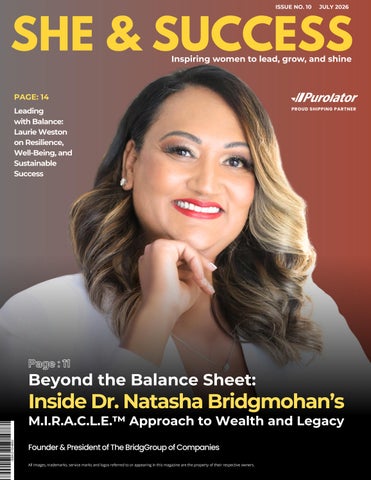
Page : 11
Beyond the Balance Sheet:
Inside Dr. Natasha Bridgmohan’s M.I.R.A.C.L.E.™ Approach to Wealth and Legacy Founder & President of The BridgGroup of Companies All Images, trademarks, service marks and logos referred to or appearing in this magazine are the property of their respective owners.
July 2026 | Women at Work: The AI Era. The Human Shift. Powered by Wellbeing Every generation experiences a defining shift in the way we work. For ours, that shift is artificial intelligence. AI is transforming how we communicate, make decisions, and grow our businesses. Yet, as technology becomes more capable, the qualities that define exceptional leadership remain deeply human— creativity, empathy, resilience, sound judgment, and the ability to inspire others. The future of work isn't about choosing between people and technology; it's about using both to build stronger, more innovative, and more inclusive workplaces. In this July 2026 edition of She & Success Business Magazine, we explore how women leaders are embracing AI while prioritizing wellbeing, purposeful leadership, and sustainable growth. We are proud to feature our Business Woman of the Month, Suzanne Knight, CEO of mBolden, whose leadership reflects innovation, resilience, and impact. This issue also features inspiring conversations with Laurie Weston of Purolator on resilient leadership and workplace wellbeing, Dr. Natasha Bridgmohan, Founder & President of The BridgGroup of Companies on building wealth and legacy through the M.I.R.A.C.L.E.™ approach, and Jennifer Boville, Co-Founder and CEO of Farm Girl, on creating purpose-driven innovation in the food industry. Complementing these interviews are insightful features including How BMO for Women Is Expanding Access for Canada's Women-Led Businesses, How Alison Simpson Turned a 38-Year Career Into a Rewired Success Story, Why Profitability, Not Revenue, Is the Growth Strategy for Canadian Women Entrepreneurs, My Canada, My Story: Why Canada's Small Business Women Are Finally Getting the Spotlight They Deserve, and Asha Wheeldon Brings Afro-Caribbean Flavours, Purpose, and Representation With KULA Foods. As AI continues to reshape the workplace, this edition reminds us that our greatest competitive advantage will always be our humanity. The future belongs to leaders who embrace innovation while empowering people, fostering wellbeing, and leading with purpose. Welcome to the future of work—more intelligent, more intentional, and more human than ever.
Kripa Anand
Editor & Founder, She & Success Business Magazine
SHE
SUCCESS Business Magazine
www.sheandsuccess.ca info@sheandsuccess.ca sheandsuccessbusinessmagazine @shesuccessmag sheandsuccess_businessmagazine canadiansme
Publisher SK Uddin Founder & Editor Kripa Anand Sales Director Shaik Raoof Uddin Sr. Content Manager Amanda Spearing Sr. Media Manager Maheen Bari Creative Design by: Cmarketing Inc Social Media by: Cmarketing Inc Photography: Deposit Photos, Canva, Cmarketing Inc. Web Cmarketing Inc
All Images, trademarks, service marks and logos referred to or appearing in this magazine are the property of their respective owners.
For Advertisements kripa@canadiansme.ca info@sheandsuccess.ca The Canadian Global Media Network Inc. 6345 Dixie Rd, Unit 202, Mississauga, ON L5T 2E6 Call us at +1 (437) 829-7116, +1 437 778 4446 Published by The Canadian Global Media Network Inc. 6345 Dixie Rd, Unit 202, Mississauga, ON L5T 2E6 Copyright © 2026 The Canadian Global Media Network Inc. All rights reserved. Reproduction in whole or part of any text, photography or illustrations without written permission from the publisher is prohibited.
The contents in She & Success Business Magazine are for informational purposes only. Neither The Canadian Global Media Network Inc., the publishers nor any of its partners, employees or affiliates accept any liability whatsoever for any direct or consequential loss arising from any use of its contents.
PROUD SHIPPING PARTNER
SHE & SUCCESS
BUSINESS AWARDS 2026 CELEBRATING CANADIAN WOMEN DRIVING PROGRESS
Entries for the Awards
are open now Deadline: 30th July, 2026
APPLY NOW SHEANDSUCCESSAWARDS.CA
#SHEANDSUCCESS AWARDS
CONTENTS
21 Business Woman of the Month
Suzanne Knight 71
How Canadian Women Are Guiding Human First Leadership in a Fast-Evolving AI Workplace
51
Leading Growth: Culture, Clarity, and Connected Workplaces
42
The $3.8 Trillion Moment: Why Canadian Women Are About to Rewrite the Rules of Wealth
62
From vision to impact: Connecting Canada and Africa
48
Top 5 Strategies for Managing Cash Flow When Business Is Unpredictable
65
Top 7 Ways Canada Is Redefining Productivity Through Sustainable Performance in the AI Era
68
How AI-Powered Wellness Platforms Are Redefining Employee Care in Canada
IN THIS ISSUE WOMEN IN TRADE
36
She Is Already a Global Trader. She Just Hasn't Been Called One.
17 Asha Wheeldon Brings Afro Caribbean Flavours, Purpose, and Representation With KULA Foods
59 The Alma Care Story Turning Invisible Care Into Impact:
33
55 Redefining Breakfast: How Farm Girl Fuels Families
29
Why Representation Matters in Canada’s AI Future
25 How Alison Simpson Turned a 38 Year Career Into a Rewired Success Story
WOMEN IN TECH
14
39
She Built the AI. Now She's Invisible In It.
Leading with Balance: Laurie Weston on Resilience, Well-Being, and Sustainable Success
How BMO for Women Is Expanding Access for Canada’s Women-Led Businesses By Kripa Anand building businesses that are reshaping the economy – creating jobs, driving innovation, and strengthening communities. Despite their growing importance, access to funding, networks and
mentorship remains uneven. That reality has
prompted organizations across the country to rethink how they support women in business.
One of the most established platforms is BMO for Women. This national platform supports women business owners, professionals, and investors, providing access to the financial resources, strategic counsel, and professional connections needed for long-term success. It builds on BMO’s long-standing efforts to improve access to capital and Boldly Grow the Good in business and life. As Canada prioritizes inclusive economic growth, platforms like BMO for Women play a meaningful role in helping women business owners transition from early stages to sustained growth.
Image Courtesy: Canva
Across Canada, women are
Women Entrepreneurship
The State of Women Entrepreneurship in Canada Women-owned enterprises are a growing force in Canada's economy. According to the Women Entrepreneurship Knowledge Hub (WEKH), women own roughly 18% of small and medium-sized businesses with many more serving as co-owners or leading early-stage ventures. Research also reveals that women-led businesses contribute meaningfully to employment creation, innovation, and community development across the country.
This includes collaborations with organizations such as Women Presidents Organization, Women Get On Board, GroYourBiz and Women Business Enterprises Canada Council, alongside initiatives like the BMO Celebrating Women Grant Program, connecting clients to capital, expertise and community.
Despite this development, access to financing remains one of the most commonly cited hurdles. WEKH and the Business Development Bank of Canada have repeatedly shown that women entrepreneurs receive less financing than men and are less likely to seek out traditional loan opportunities. This funding deficit has led to increased demand for more integrated support that combines funding, education, mentorship, and community.
Inside BMO for Women Image Courtesy: Canva
At its core, BMO for Women is designed to support clients across the moments that shape financial outcomes – whether building a business, advancing a career, or growing and managing wealth. Delivered through a national network of specialized advisors called BMO for Women Advocates, the platform brings together integrated financial expertise, access to capital and a broader ecosystem of support, helping women business owners, professionals, and investors move forward with confidence and clarity. In Canada, this approach is coordinated across banking, wealth and advisory services, enabling more connected and personalized support. Clients are backed not only by financial solutions, but by access to leadership development, strategic partnerships and curated networks that extend beyond traditional banking.
The BMO Celebrating Women Grant Program Launched in 2020, the BMO Celebrating Women Grant Program, delivered in collaboration with Deloitte Canada, was created to expand access to capital for women-owned businesses at a time when the COVID-19 pandemic exposed and intensified existing barriers. 8 - She & Success - July 2026
Women Entrepreneurship
Women-owned businesses, often concentrated in heavily affected sectors and operating with few financial buffers, were disproportionately impacted by the pandemic. This period underscored the need for more targeted, integrated support to help businesses recover and build resilience.
The program operates annually,
awarding a total of $100,000 to 10 Canadian women-led businesses each year. Each recipient receives
$10,000, along with access to the BMO for Women Advocate Network and curated networking and leadership opportunities. The program recognizes businesses creating meaningful social and economic impact, including those aligned with the United Nations Sustainable Development Goals. Since its inception, the program has supported businesses across sectors including technology, sustainability, healthcare, professional services, education and consumer goods. To date, the program has provided more than $1 million in funding while connecting recipients to advisory expertise and a broader network of partners and peers.
Meet Layla Darwish, a Leading Voice Behind BMO’s Support
Layla Darwish is one of the driving forces behind BMO's support for women entrepreneurs. Layla, based in Ottawa, is Vice President, Middle Market, in Canadian Commercial Banking and a BMO for Women Advocate. Layla has become a well-known champion for supporting women in business, finance, and growth through speaking engagements, educational events, and hands-on work with entrepreneurs. In recent forums about women and access to finance, Layla highlighted that financing preparedness begins long before a company requests a loan. Maintaining proper financial records, establishing banking relationships early on, and seeking professional advice are all important steps toward securing funding. 9 - She & Success - July 2026
Women Entrepreneurship Layla has also stressed the importance of confidence in financial discussions. Women entrepreneurs often run successful firms and have original ideas, but they may underestimate their readiness when approaching lenders or investors. Her approach emphasizes the need for entrepreneurs to advocate for themselves and understand their financial status. Her practical strategy appeals to entrepreneurs because it emphasizes planning, education, and long-term business health over just acquiring cash.
Beyond Capital: Building Confidence, Connection and Community
Looking Ahead Canada's entrepreneurial landscape is evolving, and women are increasingly defining its future. Supporting women entrepreneurs is not merely about equity; it is also about economic growth, innovation, and community development. Programs like BMO for Women demonstrate how integrated support combining capital with connection and expertise can help close long-standing gaps while creating new opportunities for growth.
For women looking to start or scale a business, the message is clear: capital matters, but
What the data shows with increasing clarity is this: capital alone is not enough. Businesses scale more sustainably when founders have access to trusted advisors, strong networks, and informed perspectives. And confidence matters just as much – the ability to articulate a vision, understand one’s financial position, and make
relationships, knowledge, and confidence are just as critical. As leaders like Layla Darwish and organizations like BMO continue to invest in women, Canada’s business landscape becomes stronger and more inclusive.
decisions with clarity.
Research consistently points in the same direction. Mentorship, peer networks, and access to expert advice materially improve business outcomes. Programs that pair financial support with community tend to produce stronger, more resilient firms. This idea sits at the core of BMO for Women. Through networking, education, grants, and leadership development, the platform is designed to build an ecosystem where women founders can learn, connect, and grow together.
To learn more or get involved Explore BMO for Women Learn more about the BMO Celebrating Women Grant Program
Subscribe to She & Success Business Magazine and follow us on she&success.ca to stay updated on funding opportunities, entrepreneurial insights, and inspiring stories of women making a difference across Canada. Disclaimer: This article is for informational purposes. She & Success Business Magazine does not endorse or guarantee any products or services mentioned. Readers should conduct their own research and due diligence.
10 - She & Success - July 2026
Image Courtesy: Dr. Natasha Bridgmohan
In an exclusive interview with She & Success Business Magazine, Dr. Natasha Bridgmohan, Founder & President of The BridgGroup of Companies, shares her M.I.R.A.C.L.E.™ vision for helping women entrepreneurs and families achieve financial security, wealth creation, and lasting legacy. Drawing on decades of experience in business leadership and financial empowerment, Dr. Bridgmohan explains how her approach integrates multiple industries, knowledgesharing, and practical frameworks to turn complex financial strategies into actionable outcomes. Dr. Natasha Bridgmohan is a celebrated business innovator, philanthropist, real estate icon, nationally recognized financial strategist, and award-winning entrepreneur with over 23 years of experience leading and expanding global multi-million-dollar ventures.
Beyond the Balance Sheet:
Inside Dr. Natasha Bridgmohan’s M.I.R.A.C.L.E.™ Approach to Wealth and Legacy Interview By Kripa Anand
Founder & President of The BridgGroup of Companies
As the Founder & President of The BridgGroup of Companies (TBGOC), she has built one of Canada’s most comprehensive and purpose-driven financial service networks, rooted in her signature M.I.R.A.C.L.E.™ Model: Mortgages, Investments, Real Estate, Aid/Charity, Consulting /Connecting, Legal/Lending, and Entertainment/Education. One of Dr. Bridgmohan’s core mantras is “Knowledge Acquired Must Be Shared, and so Should Wealth!” This philosophy combined with her unmatched financial acumen and creative foresight allows her to promote unique opportunities for her clients including students, young families, business owners and seniors. 11 - She & Success - July 2026
Financial Empowerment What inspired your M.I.R.A.C.L.E.™ vision for building wealth and legacy?
How has your belief in sharing knowledge and wealth shaped your mission and impact?
The M.I.R.A.C.L.E.™ vision was inspired by my desire to bring together the key industries that have the greatest impact on financial security, wealth creation, and long-term legacy. Throughout my career, I saw that individuals, families, and business owners often needed guidance across
My belief that knowledge acquired must be shared, and so should wealth, has shaped every aspect of my mission. Financial success becomes far more meaningful when it creates opportunities for others and helps elevate entire communities.
multiple areas, yet those services were rarely available within one coordinated ecosystem.
I wanted to create a model that
connected expertise, resources, and opportunities under one umbrella while supporting both profit-driven and purpose-driven initiatives. The result was a framework that reflects the
services we provide, the communities we serve, and the values we stand for. The M.I.R.A.C.L.E.™ model also helped create multiple streams of income,
business resilience, and a foundation for sustainable growth. More
importantly, it allows us to help clients build financial freedom, prepare for retirement, protect their assets, and create generational wealth.
My vision has always extended beyond today. I wanted to build something
This philosophy has driven me to become a connector, collaborator, educator, and advocate for financial literacy. It has encouraged me to continually expand my own knowledge so I can provide better guidance, resources, and solutions to the individuals, families, entrepreneurs, and organizations we serve.
By sharing expertise and creating strategic partnerships, we have been able to help people make informed decisions, strengthen their financial foundations, and move closer to long-term security and independence. It has also allowed us to build
meaningful relationships with like-minded professionals who share a commitment to service and impact. As our reach expands nationally and internationally, this belief continues to guide our work. Whether through education,
business, philanthropy, or community initiatives, our goal remains the same, to empower people with the knowledge, tools, and opportunities they need to create better futures for themselves and future generations.
What advice would you give women ready to transform their financial future? Take ownership of your financial future and start today. Regardless of your age, income level, relationship status, or career stage, the most important step is deciding that your financial wellbeing deserves your attention and commitment. Image Courtesy: Canva
that could continue serving people for decades and evolve through future generations, creating lasting impact through collaboration, education, and financial empowerment. 12 - She & Success - July 2026
Financial Empowerment Begin by setting clear, realistic goals and creating a plan to achieve them. Small, consistent actions often create greater long-term results than waiting for the perfect time to start. Seek guidance from qualified professionals who can provide the education, resources, and strategies needed to help you make informed decisions. Financial literacy is one of the most powerful investments you can make in yourself. Understanding how money works gives you greater confidence, independence, and freedom to make choices that align with your goals and values. Women often carry many responsibilities, whether as
professionals, entrepreneurs, caregivers, partners, or community leaders. Building financial security creates options and opportunities that can benefit every area of life. Most importantly, remember that financial success is not reserved for a select few. With the right plan, the right support, and a commitment to learning, meaningful transformation is possible for anyone.
What has leading multiple ventures taught you about leadership, balance, and wellbeing? Leading multiple ventures has taught me that leadership is
ultimately about self-awareness, adaptability, and effective time management. Success requires the ability to make decisions, delegate responsibilities, remain calm under pressure, and stay focused on the bigger vision.
One of the greatest lessons I have learned is that balance looks different for every person. For entrepreneurs and leaders with ambitious goals, there is rarely a perfect separation between work and life. Instead, wellbeing comes from being intentional about how you manage your energy, your time, and your priorities. I have learned the importance of listening to my body, protecting my mindset, and creating daily habits that support long-term health. Simple practices such as rest, hydration, movement, personal reflection, and surrounding yourself with positive influences can have a significant impact. Running multiple companies has also taught me that environment matters. The people you spend time with, the information you consume, and the choices you make each day all contribute to your overall wellbeing and effectiveness. Sustainable success is built by consistently investing in both personal growth and professional excellence.
What is your vision for empowering future generations through financial literacy? My vision for empowering future generations begins with the Canadian Changing Lives Foundation, a charity I created to formalize and expand the community support and giving I had been providing throughout my career. While meeting immediate needs through emergency assistance remains important, I believe lasting change happens when people are given the knowledge, tools, and opportunities to become financially independent.
That is why financial literacy is a core pillar of the Foundation's mission. Through educational programs, workshops,
community partnerships, mentorship, and access to trusted professionals, we aim to help individuals and families build the skills
needed to earn, manage, protect, and grow their wealth. My vision is to make financial education accessible to people from all backgrounds, particularly those who may not otherwise have access to these resources. By
collaborating with educators, industry experts, community organizations, businesses, and government partners, we
can reach more people and create meaningful opportunities for learning and growth.
When individuals understand how money works, they gain confidence, independence, and the ability to create better futures for themselves and their families. That is how we strengthen communities and create generational change that lasts for decades to come.
Disclaimer: The views and opinions expressed in this interview are those of the featured guest and do not necessarily reflect the official policy or position of She & Success Business Magazine. Our mission is to amplify authentic voices, highlight diverse leadership journeys, and share insights that inspire and empower women entrepreneurs and leaders across Canada. 13 - She & Success - July 2026
Image Courtesy: Laurie Weston
Leading with Balance:
Laurie Weston
on Resilience, Well-Being, and Sustainable Success In an exclusive interview with She & Success Business Magazine, Laurie Weston, General Manager of eCommerce at Purolator, shares her perspective on leadership that goes
General Manager of eCommerce at Purolator
beyond performance metrics. Drawing on over three decades of experience in retail, supply chain, and digital transformation, Laurie explores how resilience, self-awareness, and balance are essential for sustainable success in today’s fast-paced business world. In a rapidly changing business landscape, leadership requires more than experience and results—it calls for resilience, self-awareness, and the ability to create sustainable momentum for both people and performance. Laurie Weston, General Manager of eCommerce at Purolator, brings more than three decades of expertise across retail, supply chain, and digital transformation, along with a people-centred perspective on what it means to lead well. In this conversation, Laurie shares her reflections on women’s leadership, well-being, balance, and the habits that help leaders stay grounded while continuing to drive meaningful impact.
Interview By Kripa Anand Laurie Weston brings over 33 years of experience in supply chain, retail strategy, and digital transformation. She leads Purolator’s eCommerce portfolio across enterprise, marketplace, and Rest of World (ROW) solutions, driving growth through innovative, customer-centric strategies. Laurie is known for aligning cross-functional teams, leveraging data to inform decisionmaking, and scaling high-performing operations that enhance both customer experience and network efficiency. Her career spans retail and logistics, where she has consistently delivered results by integrating digital solutions and advancing capabilities in a rapidly evolving marketplace. 14 - She & Success - July 2026
Leadership Wellness What’s one myth about women in leadership roles that you’d like to challenge? One myth I would challenge is the idea that women leaders have to fit into a predefined mold to be effective—that we need to choose between being strong or empathetic, decisive or collaborative.
Over the course of my career, I’ve felt that pressure at times—to lead a certain way to be taken seriously or to meet expectations set by others. But what I’ve learned is that the moments where I’ve
been most effective are when I’ve leaned into a more balanced, authentic style— driving results—while staying deeply connected to people and the customer. That combination isn’t a weakness; it’s a
What habits or mindsets have helped you build long-term resilience as a leader? I’ve learned that resilience isn’t built in big moments, it’s shaped by how you show up every day. Early in my career, in fastmoving retail environments, I found that staying anchored in purpose—focusing on my team, the customer, and long-term impact, helped me stay steady through constant change. I’ve also shifted how I see challenges, choosing to learn from them rather than internalize them. Over time, I’ve become more intentional about protecting space to think, not just react, and I’ve realized that resilience isn’t individual, it comes from strong, trusted teams. Through it all, I try to balance confidence with humility—being decisive while always open to learning and adjusting.
Image Courtesy: Canva
strength, especially in today’s environment where complexity demands both clarity and empathy. For me, leadership isn’t about conforming to a single model—it's
about expanding what strong leadership looks like and having the confidence to 1 lead in a way that’s both true to you and impactful for the business.
Can you share a pivotal moment in your career that tested your resilience—and what you learned from it? One pivotal moment early in my career was working through a challenging leadership experience that pushed me to reflect deeply on the kind of leader I wanted to become. It was an experience that tested my confidence and resilience, but it also pushed me to reflect deeply on my own values. Instead of letting it discourage me, I used it to shape how I lead today—with trust, transparency, humility, and a focus on empowering others. It ultimately defined not just my resilience, but the kind of leader I strive to be. I strongly believe that kindness is a core part of leadership—taking every opportunity to recognize others, speaking up when someone deserves credit, and never letting a kind thought go unspoken.
The idea of “balance” can mean different things to different people—how do you personally define it? I’ve come to see balance less as a perfect split between work and life, and more as a sense of alignment in how I’m using my time and energy. There are seasons when work needs more from me, and others when my personal life takes priority and for me, balance is about being fully present in whichever space I’m in without feeling constantly pulled between the two. It comes down to setting clear priorities, maintaining boundaries, and making sure I’m still investing in what recharges me—whether that’s time with family, my son, quiet moments to reset, or simply stepping away when needed. It’s not about getting it right every day, but about creating a rhythm over time that feels sustainable and aligned with what matters most. 15 - She & Success - July 2026
Leadership Wellness How can women leaders model healthy balance for their teams without compromising results?
What advice would you give women who feel pressure to “do it all” and are nearing exhaustion?
I believe it starts with recognizing that balance isn’t something you talk about— it's something you visibly practice. Over
My advice would be to pause and give yourself permission to step back and reassess. The pressure to “do it all” can be overwhelming, but it’s also unsustainable. I’ve learned the importance of rebalancing priorities, being intentional about
say. When I’m intentional about boundaries, prioritization, and taking time to reset, it gives my team implicit
critical leadership skill. Equally important is making space for the things that genuinely refill your energy, rather than continuing to push through exhaustion. And just as powerful is managing your
time, I’ve learned that the way I show up sets the tone far more than anything I
permission to do the same without feeling like they’re compromising
performance. The key is being clear that balance doesn’t mean lowering the bar, it means focusing on what truly drives impact and being disciplined about where we spend our energy. In my
experience, teams perform at their best when they’re not operating in a constant
what truly matters, and recognizing that not everything requires your direct involvement. Delegation is not a weakness—it's a
internal dialogue—shifting from self-imposed pressure to a more constructive, compassionate mindset. Sustainable success doesn’t come from doing everything; it comes from focusing on what matters most and leading in a way that allows you, and your team, to thrive over the long term. Looking ahead, what does a sustainable, healthy leadership model look like for the next generation of women leaders?
state of depletion. Modelling that balance, while still holding a strong focus
I believe a sustainable, healthy leadership model for the next
bursts.
energy, and building environments where high expectations are paired with realistic, human-centered ways of working. For
on results, creates a culture where people can sustain high performance over the long term—not just in short
How do you recharge personally, and how do you encourage your team to do the same? I recharge by intentionally stepping away and reconnecting with what grounds me. For me, that includes meditation, spending quality time with my family, and taking long walks with my dog, Jessie— those moments bring perspective and help me reset. I also enjoy reading, particularly business and selfdevelopment books, because they give me new ways of thinking and help me continue growing. I encourage my team to find what works for them personally and to treat it as non-negotiable, not something optional or earned after the fact. As leaders, we need to normalize the idea that recharging is part of performance—when people take the time to reset in ways that are meaningful to them, they come back more focused, creative, and resilient.
generation is one where performance and well-being are no longer seen as trade-offs, but as fundamentally connected. It’s about leading with clarity on priorities, being intentional with
women, it means moving away from outdated notions of having to overextend or conform, and instead embracing more
authentic, balanced leadership styles. It also requires organizations to evolve—creating cultures that support flexibility, encourage boundaries, and value outcomes over constant activity. Ultimately, the future of leadership is more inclusive, more sustainable, and more human—where success is defined not just by results, but by the ability to achieve them in a way that is healthy, resilient, and built to last. Laurie’s insights offer a timely reminder that strong leadership is not defined by constant availability or the ability to carry every responsibility alone. Instead, sustainable leadership is built through clarity, confidence, connection, and the courage to lead in a way that honours both results and well-being. For the next generation of women leaders, that means challenging outdated expectations, protecting what fuels them, and creating cultures where people can thrive while delivering meaningful impact.
Disclaimer: The views and opinions expressed in this interview are those of the featured guest and do not necessarily reflect the official policy or position of She & Success. Our mission is to spotlight women leaders, their entrepreneurial journeys, and their impact—providing insights that inspire and empower women entrepreneurs and small business leaders across Canada. 16 - She & Success - July 2026
Asha Wheeldon Brings Afro Caribbean Flavours, Purpose, and Representation With KULA Foods
By Kripa Anand
As a Black-owned, Certified B Corporation, and award-winning food brand, KULA Foods is contributing to the transformation of consumer expectations for plant-based goods while raising awareness of African and Caribbean culinary traditions throughout North America. With ongoing growth throughout Canada and the US, Image Courtesy: Asha Wheeldon
KULA products are currently sold through over 150 retail outlets and several institutional food service partners. However, the company's history starts with something much more straightforward: a yearning for the tastes of home.
CEO and Founder of Kula Foods Few companies have combined cultural authenticity, social impact, sustainability, and commercial success as successfully as KULA Foods in Canada's rapidly expanding plant-based food industry. KULA Foods, founded by CanadianKenyan businesswoman Asha Wheeldon, is more than just a food company. The movement is based on the ideas that food can be a potent catalyst for connection, representation, and community.
Meet the Founder: Asha Wheeldon In Isiolo, Kenya, where Asha Wheeldon was born, food was an integral part of daily life. Food was more than just nourishment when she was a child. It served to foster interpersonal relationships, bolster communities, and preserve cultural customs. Wheeldon moved to Toronto, Canada, when he was eleven years old. New culinary experiences were brought about by exposure to various cultures, especially Caribbean cuisine, whose flavours and cooking methods have strong ties to East African cuisine.
17 - She & Success - July 2026
Work-Life Balance Wheeldon moved to Vancouver years later due to a career opportunity. Finding culturally identifiable African and Caribbean flavours in the expanding plant-based food market proved a barrier during the shift to a plant-based lifestyle. Wheeldon chose to fill the void rather than accept it. Strong consumer demand for culturally diverse prepared meals and a notable dearth of African and Caribbean presence in conventional supermarket
Image Courtesy: KULA Foods
channels were found in research conducted in entrepreneurship classes at the British Columbia Institute of Technology. In the end, KULA Foods would be built on that discovery.
The Birth of KULA Foods The word "KULA" means "eat" in Kiswahili, which is spoken across most of East Africa. The company's overarching goal of uniting people via shared experiences and food is reflected in the name. To
Customers responded right away. Consumers valued the opportunity to sample culinary customs largely
traditions, Wheeldon launched KULA Foods at Vancouver farmers' markets in 2018. Flavourful stews, curries, and prepared meals intended to
small local farmers' market business swiftly developed into a fast-growing food brand. KULA Foods continues
introduce consumers to plant-based meals influenced by East African and Caribbean culinary
offer convenience and cultural authenticity were among the first items.
absent from mainstream grocery shelves, as well as the distinctive flavour characteristics. What began as a
to uphold its cultural heritage while distributing plantbased meats, sauces, and meal solutions across Canada and the US.
Building a Business Around Representation
Image Courtesy: KULA Foods
KULA Foods' dedication to representation is among its most noteworthy features. Statistics Canada reports that Canada's population is becoming increasingly diverse, with visible minority groups making up an increasing share of the country's consumer base. However, grocery retailing and food innovation have frequently trailed behind these demographic changes. Wheeldon acknowledged that many African and Caribbean Canadians had difficulty finding goods that both represented their ethnic identities and met contemporary nutritional needs, such as those aligned with plant-based diets.
18 - She & Success - July 2026
From Farmers Markets to Retail Shelves Across North America
Why KULA Foods Matters in Today’s Market
In 2018, KULA Foods started at farmers' markets, where it made direct connections with consumers seeking tasty, plant-based meals with cultural roots. Since then, KULA has developed into a wellknown food company that works with three major North
Plant-based diets are now considerably more popular than specialized diets. For reasons related to health, the environment, animal welfare, affordability, and gourmet curiosity, more Canadians are investigating plant-based
institutional food service
same time. They desire
American distribution partners. Its products are sold in over 150 stores and through three partners.
meals. Customers are demanding more than generic substitutes at the
In recent years, the company
food that has a personal touch. They're looking for taste. They desire
2023. The company obtained Black Owned Certification, B
culture. KULA Foods has established a significant
has achieved several significant milestones. KULA debuted at Whole Foods in
Corp Certification, and trademark status in 2024. In
addition to starting in Choices Markets, KULA extended to Amazon and California in 2025.
KULA is also on pace to onboard with a sizable national account, according to the company's provided update. These achievements show more than just company expansion. They represent a broader shift in the Canadian food scene, where customers are increasingly seeking goods that align with convenience, sustainability, health, and cultural authenticity.
Image Courtesy: KULA Foods
Work-Life Balance
representation. Instead of just categories, they want brands that comprehend
foothold in this area.
It uses minimal ingredient lists, whole-food ingredients, and non-GMO,
Canadian-made proteins in its products. The brand’s goods are plant-based, gluten-free, prepared without added sugar, and incorporate functional ingredients to enhance nutritional benefit. However, the way KULA introduces Afro-Caribbean food into an area that has frequently lacked ethnic diversity is what really gives it its voice. KULA links plant-based diet to tradition, memory, and community rather than viewing it as a fad.
A Founder Rooted in Culture, Care, and Purpose The kitchen plays a significant role in Asha Wheeldon's story. Asha's early
conception of sustenance was influenced by cultivating food, cooking meals, and sharing food with family and the community. Later, KULA Foods was built
on that lived experience. Asha discovered a clear need for ethnically diverse prepared foods after researching the BC food scene and plant-based food trends at BCIT.
More significantly, Asha observed that the plant-based market lacked representation of African and Caribbean flavours. Asha created a business to close the gap rather than accept it. KULA's path serves as a potent reminder to female entrepreneurs, particularly those starting enterprises based on personal experience: a personal story can be a business advantage. Culture can be a tactic. Scale may be built on community.
19 - She & Success - July 2026
Work-Life Balance
Building a Business with Social and Environmental Intention A key component of KULA Foods' identity is its B Corp designation. B Corps are evaluated on their transparency, accountability, and social and environmental performance. This kind of certification might demonstrate a food company's dedication to a mission that goes beyond financial gain. That goal is evident in the instance of KULA. The company wants to promote positive social and environmental change while increasing access to wholesome, sustainable, and varied food options.
This is important in Canada, where entrepreneurs and small enterprises are encouraged to develop trust through values, openness, and community
impact. Customers are becoming more aware of how goods are manufactured, what ingredients are used, who is represented, and what a brand does beyond the transaction. KULA's strategy explicitly addresses that change.
Lessons for Women Entrepreneurs The experience of KULA Foods provides founders creating companies with a defined purpose with several important lessons: Start with an actual gap: Asha recognized a commercial and personal need: the underrepresentation of African and Caribbean flavours in plant-based cuisine. Built from lived experience: KULA's founder's story, which centers on food, migration, culture, and community, is the source of its authenticity. Let values drive growth: The company's communityfocused mission and B Corp certification help to build trust with partners and customers. Grow without losing identity: KULA has expanded while maintaining cultural authenticity at its core, from farmers' markets to Whole Foods, Amazon, California, and Canadian shops.
The Future of Plant-Based Food Needs More Voices Like KULA Convenience meals and animal substitutes won't be the only factors defining the future of plant-based diets in Canada.
Representation on the Plate Food is never simply food. Stories, migration, memory, family, resiliency, and identity are all carried by it. Seeing well-known flavours on mainstream retail shelves can be incredibly reassuring for many African, Caribbean, and diasporic consumers. Through easily accessible plant-based meals, KULA invites others to discover new culinary traditions. One of the brand's strengths is that balance. KULA does not dilute culture to suit the market. It advances culture and opens up new markets. This is a crucial lesson for Canada's food business. Diversity in food innovation should encompass more than just who is allowed to enter the market. It should also focus on whose communities, histories, and flavours are allowed to take the lead.
Brands that offer more inclusive storytelling, stronger values, and deeper flavour will mould it. That future includes KULA Foods.
Asha Wheeldon has produced more than just a food brand by fusing plant-based innovation with Afro-Caribbean culinary heritage. KULA is a reminder that business may start with something as basic and potent as a shared meal, a celebration of culture, and a reaction to a market gap. Let's KULA Together, as KULA states.
Subscribe to She & Success Business Magazine and follow us on she&success.ca to stay updated on funding opportunities, entrepreneurial insights, and inspiring stories of women making a difference across Canada. Disclaimer: This article is for informational purposes. She & Success Business Magazine does not endorse or guarantee any products or services mentioned. Readers should conduct their own research and due diligence. 20 - She & Success - July 2026
Business Woman of the Month
Suzanne Knight By Kripa Anand
Suzanne Knight Helps Leaders Turn Complexity into Clear, Measurable Results Suzanne Knight, MBA, MA, is the CEO
Canadian executive advisor and global keynote speaker. She has built her career on a deceptively basic idea: in complex, high-stakes contexts, leaders don't need more plans; they need better decisions, clearer objectives, and focused execution. She has led and advised on major transformation initiatives across more than 80 organizations, including Walmart Canada, Philip Morris International Canada, and Deloitte. Today, she is a trusted voice for leaders working to close the gap between ambition and outcomes.
CEO of mBolden 21 - She & Success - July 2026
Image Courtesy: Suzanne Knight
of mBolden, a Toronto-based strategy and transformation consulting firm. She is also a
Business Woman of the Month Suzanne founded mBolden to assist leaders in achieving tangible results in circumstances where speed, scale, regulation, and responsibility are all important. Instead of providing abstract frameworks, she emphasizes practical clarity, leadership alignment, and the rigorous follow-through required to achieve demonstrable results.
Image Courtesy: Suzanne Knight
Her approach resonates with leaders under pressure from
multiple sources, including market disruption, digital change, workforce expectations, and the need to achieve meaningful results when resources are limited and must be dedicated to the highest-priority activities. Suzanne's message is consistent: transformation is not a slogan. It is an intentional system of choices, behaviours, and execution habits.
mBolden: Strategy That Actually Lands From Corporate Leadership to Entrepreneurship Suzanne's career path demonstrates a
deep understanding of how large organizations operate. Before founding mBolden, she oversaw change and transformation programs in major business sectors, including retail, consumer goods, and the public sector. These jobs provided her with firsthand knowledge of the reality that change frequently fails not because the strategy is flawed, but because the execution is misaligned, confusing, or too hard for teams to implement.
Suzanne works with Fortune 500 executives, government
organizations, and high-growth businesses to put strategy into action. The firm's goals are practical: helping teams eliminate friction, improve decision-making, and create measurable value for customers, teams, and stakeholders.
This insight shaped her entrepreneurial approach: leaders don’t need cheerleaders. They need advisors they can trust who bring both breadth of experience and the depth that comes from executive leadership inside complex organizations. 22 - She & Success - July 2026
Image Courtesy: Suzanne Knight
Business Woman of the Month mBolden's advisory services include strategic planning, operating model design, leadership and team development, workforce planning, change enablement, and executive alignment. The company is designed to support organizations operating in regulated or people-intensive contexts, where success depends on both technological proficiency and human collaboration.
Suzanne believes that leaders should not be drowning in complexity. Instead, they should develop processes
that clarify objectives, define ownership, and advance work without adding unnecessary layers. That is why her work frequently focuses on what she calls the gap between aspiration and outcomes—the point at which
many plans stall because people are unsure what to do next, why it matters, and how success will be assessed. Her consulting is especially useful in periods of change,
when firms are tempted to add more complex processes, meetings, and initiatives. Suzanne does the opposite: she helps leaders remove distractions so they can focus on what will genuinely improve performance.
A Voice on AI, Crisis, and Capacity Suzanne is particularly known for her keynote speeches, which are based on the practical realities of modern leadership. Her keynotes focus on delivering real ROI from digital transformation and AI, using crises as catalysts for change, aligning teams around accountability, and creating more capacity without adding complexity. These topics are important because many Canadian firms are attempting to implement new technologies and operational models while still serving customers, controlling costs, and retaining personnel.
Suzanne's work enables executives to think beyond hype and ask the appropriate questions: What are the priorities? How will we measure
success? What decisions need to be made? Who owns key decisions? What needs to be true to deliver on priorities? How do ways of thinking and working need to change to support execution?
One reason her voice
is in high demand is her ability to bring clarity, transparency, and accountability into conversations with leaders and teams in a way that resonates. She meets with executives who are under pressure to move quickly but understand that making decisions without alignment can lead to more turmoil than progress. In busy organizational environments, Suzanne helps translate effort into outcomes.
Image Courtesy: Suzanne Knight
23 - She & Success - July 2026
Business Woman of the Month
Lessons for Leaders and Founders Suzanne Knight's path teaches clear lessons to entrepreneurs and executives: Strategy must be executable. Good ideas fail if teams cannot put them into action.
Image Courtesy: Suzanne Knight
Effort is not enough. If hours do not result in impact, they are not used meaningfully.
Building the Next Generation of Leaders
Clarity outperforms complexity. Fewer, properly defined priorities frequently
Beyond her advisory practice, Suzanne is committed to
outperform broader ambitions that fail to land.
creating access for the next generation of leaders. She founded and hosts the NextGen Future Forum, an mBolden-sponsored event that brings students and
emerging professionals into direct conversation with senior executives from organizations such as Canadian Tire, McKesson Canada, Interac, Manulife, CILAR, and
Leadership is a system. Results are dependent on decision-making, alignment, communication, and follow-through, not just vision or desire.
Gowling WLG.
The forum reflects one of Suzanne’s core beliefs: the generational divide in today’s workforce is a leadership
opportunity, not a generational problem. When young professionals gain access to senior leaders, candid advice, and real conversations about how decisions are made, they build the context and confidence needed to grow. Executives, in turn, gain sharper insight into the people who will shape the future of work.
This commitment to opening doors has also shaped Suzanne’s work advancing women. At Philip Morris International Canada, she held formal responsibility for Diversity and Inclusion in Canada and collaborated with leaders across Canada and Latin America on regional strategy. At Walmart Canada, she served as an executive advisor supporting women in retail. She later co-founded a national women’s organization focused on helping women avoid or navigate career interruptions. For Suzanne, leadership is not only about delivering the results in front of you. It is also about strengthening the pipeline behind you. Her work is grounded in the belief that women and emerging leaders need more than visibility. They need access, sponsorship, practical guidance, and workplaces where they are heard, respected, and positioned to grow.
Her career serves as a reminder that the most effective leaders enable their teams to be successful by proactively breaking down barriers to the flow of work. They also provide people with the focus, direction, and confidence they need to deliver results.
Suzanne Knight has built a career helping leaders turn complex priorities into clear decisions, aligned action, and measurable results, from Fortune 500 transformations to systems for social impact. Through mBolden, she helps Canadian and global organizations move from aspiration to execution. Subscribe to She & Success Business Magazine and follow us on she&success.ca to stay updated on funding opportunities, entrepreneurial insights, and inspiring stories of women making a difference across Canada. Disclaimer: This article is for informational purposes. She & Success Business Magazine does not endorse or guarantee any products or services mentioned. Readers should conduct their own research and due diligence. 24 - She & Success - July 2026
How Alison Simpson
Turned a 38 Year Career Into a Rewired Success Story By Kripa Anand
Alison Simpson, President and CEO of the Canadian Marketing Association Image Courtesy: Alison Simpson
After nearly four decades at the vanguard of Canadian marketing and business leadership,
Alison Simpson is retiring from full-time executive life. However, calling it retirement would completely miss the point. Instead, Simpson refers to the next chapter as a "rewirement"—a deliberate shift toward new opportunities, new adventures, and ongoing impact. It is a term that represents evolution rather than an end. For a leader whose career has been defined by transformation, creativity, and helping others realize their full potential, the phrase feels especially appropriate. As organizations across Canada grapple with rapid technological change, workforce transformation, and shifting leadership expectations, Simpson's experience teaches a significant lesson: success is judged by more than just titles or tenure. It is assessed by the number of individuals influenced, businesses built, obstacles broken, and the legacy that endures.
Building a Career Through Curiosity and Courage Simpson's professional journey began in advertising, where creativity, strategy, and narrative laid the groundwork for a career that would eventually encompass marketing agencies, major organizations, startups, and industry associations. Simpson has consistently accepted tasks that require both business discipline and creative thinking, from agency President roles to executive positions at some of Canada's most recognizable firms. Simpson's leadership roles at Holt Renfrew and TMX Group put her at the center of complex business transformations in which marketing was about driving organizational growth and customer engagement. 25 - She & Success - July 2026
Career Transition Throughout these experiences, a shared philosophy developed. Marketing was never seen as a stand-alone role. Instead, it became an effective tool for resolving corporate issues, growing businesses, improving customer connections, and driving real innovation. That
Image Courtesy: Alison Simpson
approach would eventually define a career characterized by adaptability and ongoing reinvention.
Breaking Barriers in Leadership Women's leadership positions may appear more widespread today, but many of Simpson's opportunities arose in contexts where female representation at the executive level was limited. Among the most notable achievements are serving as the first female President of eJWT and, later, as the first female President and CEO of the Canadian Marketing Association. These successes signified more than just personal achievements. They represented a broader trend
toward increased representation and inclusion in Canada's corporate community. Simpson's tale highlights the necessity of confidently seeking leadership possibilities, especially when there is no clear path to follow. Breaking down boundaries is important for more than just personal success. It raises awareness for future generations and broadens what people believe is attainable for themselves.
Simpson's startup experience exposed
The Value of Taking Unexpected Paths Simpson's willingness to venture outside of standard business surroundings is one of her most significant accomplishments. While many CEOs spent their careers ascending the same ladder, Simpson welcomed opportunities that provided new perspectives and learning experiences. This includes time spent in startup contexts, when speed, experimentation, and adaptability are critical survival skills. Working with young enterprises underscored a crucial lesson, especially important in today's economy: organizations must continually innovate or risk becoming irrelevant.
her to new ways of thinking about creativity, decision-making, and customer interaction. These lessons influenced leadership decisions in larger businesses, demonstrating how diverse experiences often produce stronger leaders. For professionals managing their own careers, the message is obvious. Growth typically occurs outside of one's comfort zone.
26 - She & Success - July 2026
Career Transition Image Courtesy: Alison Simpson
Leadership Is Built Through Challenges Every great career has obstacles, and Simpson freely admits that hers was no exception. Like many senior leaders, there were periods of uncertainty, organizational instability, and
professional disillusionment. Rather than considering these events as failures, Simpson sees them as necessary components of leadership development. The most difficult times are often the ones that build resilience, develop empathy, and improve decisionmaking. This viewpoint is especially relevant for women pursuing leadership roles today. Career advancement rarely occurs in a straight line. The process frequently involves challenges, unanticipated transitions, and difficult decisions. What matters most is how the learning from those experiences is utilized to grow and advance. Adversity provided Simpson with an opportunity to establish an even more human and compassionate leadership style— one that stressed understanding, mentorship, and long-term development.
The Legacy That Matters Most It is easy for leaders to focus on honours, promotions, or monetary outcomes when they consider decades of
accomplishment. Simpson's thoughts suggest something different. The impact on people is the achievement that
surpasses all others. The most fulfilling part of a career spent managing teams and organizations was seeing promise in people and helping them reach potential they often didn’t see in themselves.
Simpson's last chapter with the Canadian Marketing Association, where she led a significant transformation and growth, marked a particularly significant proof point for that concept. Colleagues and peers in the sector honoured the accomplishments of her years of leadership, praising not only the commercial outcomes but also the culture, community, and mentorship established along the way. These incidents serve as a compelling reminder that people, not positions, are what establish long-lasting influence in leadership. 27 - She & Success - July 2026
Image Courtesy: Alison Simpson
Career Transition Simpson sees rewirement as an opportunity to continue adding value while exploring new avenues. It serves as a reminder that careers don't have to end when a chapter ends. They may develop into something just as significant.
Redefining Success for the Next Generation For women at every level of their career, Alison Simpson's experience provides a valuable insight. Achieving success involves more than just getting to the top. It is about always staying curiosity, embracing change, helping others, and having the guts to rethink what contentment means as life changes.
Simpson's most important lesson after 38 years of leadership, innovation, and change may be the most straightforward of all: a career's worth is determined by its impact rather than its longevity. Sometimes the most thrilling chapter starts after the page everyone else believed was the last.
A New Chapter of Possibility The emphasis shifts from executive leadership to broader forms of involvement as Simpson enters this next phase. The horizon now includes growing her public and volunteer board service, writing, travel, and new athletic challenges. The shift is indicative of a growing trend among successful leaders who look for possibilities outside standard corporate careers, driven by purpose. Many seasoned CEOs are opting to train emerging leaders, share insights, and support firms undergoing change rather than completely leaving the corporate world.
Subscribe to She & Success Business Magazine and follow us on she&success.ca to stay updated on funding opportunities, entrepreneurial insights, and inspiring stories of women making a difference across Canada. Disclaimer: This article is for informational purposes. She & Success Business Magazine does not endorse or guarantee any products or services mentioned. Readers should conduct their own research and due diligence.
28 - She & Success - July 2026
Victoria Lennox,
CEO of Women's Enterprise Organizations of Canada (WEOC) Image Courtesy: Victoria Lennox
Why Representation Matters in
Canada’s AI Future By SK Uddin Canada's innovation sector is approaching a watershed point. Artificial intelligence is no longer a futuristic concept exclusive to huge technological companies or research organizations. It is quickly becoming ingrained in how organizations operate, how consumers are contacted, how employment choices are made, and how entrepreneurs scale new concepts. As this shift accelerates, national discussions about inclusion, accessibility, and representation become increasingly critical.
This conversation took center stage at the QueerTech Breakfast in Ottawa, where leaders from government, the entrepreneurial sector, and Canada's innovation ecosystem convened to discuss LGBTQ entrepreneurship and AI readiness. The Honourable Evan Solomon, Canada's Minister of Artificial Intelligence, attended the event, as did ecosystem leaders Victoria Lennox, CEO of Women's Enterprise Organizations of Canada (WEOC), Karla Briones, WEOC Centre of Excellence Lead, Naoufel Testaouni, CEO and Co-Founder of QueerTech, and Darrell Schuurman, CEO of the Canadian Queer Chamber of Comerce. 29 - She & Success - July 2026
AI Representation The Minister's participation highlighted a growing federal realization that inclusivity must be built into Canada's AI strategy from the start, rather than as an afterthought. Victoria Lennox later expressed her thoughts from the event on LinkedIn, highlighting that as AI continues to change how organizations are developed and decisions are made, "who is involved in building that technology matters." That message resonated strongly with the audience and reflects a broader national concern: if minority businesses are excluded from AI adoption and development, economic disparities could increase dramatically in the coming years.
Queer entrepreneurs, women entrepreneurs, immigrant founders, and Indigenous business owners generally operate in environments where access to money and institutional support is already limited. Experts caution that without purposeful policy and ecosystem alignment, AI may unintentionally exacerbate these gaps. This problem has been important to the work of organizations like QueerTech and WEOC.
WEOC’s Expanding National Role The Women's Enterprise Organizations of Canada has emerged as a national leader in advocating for inclusive entrepreneurship and economic engagement. The national group collaborates
AI Growth Cannot Be Separated from Inclusion The QueerTech Breakfast spotlighted a growing reality in Canada's startup and smallcompany sector. While AI offers immense potential for productivity, automation, and
growth, access to these capabilities is still uneven. Entrepreneurs from underserved
communities frequently encounter challenges to capital, mentorship, digital literacy resources, procurement opportunities, and technological infrastructure. These hurdles become increasingly severe as emerging technologies, such as AI, reshape entire industries.
with Women's Enterprise Centres and ecosystem partners across Canada to provide advocacy, access to finance, mentorship, and business support to female entrepreneurs.
WEOC also administers national projects, such as the WEOC National Loan Program, which assists women entrepreneurs in obtaining finance and growth support. The organization's broader purpose is to remove systemic impediments and strengthen Canada's women's entrepreneurship ecosystem.
In 2025, Victoria Lennox, MSM, was appointed Image Courtesy: Canva
Chief Executive Officer, marking a significant milestone for the organization. Lennox is well known in Canada's innovation ecosystem as the co-founder of Startup Canada and a longtime advocate for entrepreneurship, progressive economic policies, and ecosystem growth. Under Lennox's leadership, WEOC has been increasingly focused on placing women entrepreneurs as key players in Canada's digital economy, including AI adoption and innovation readiness. 30 - She & Success - July 2026
AI Representation According to WEOC's official leadership information, Lennox has founded and led various national and worldwide entrepreneurship programs, represented Canada at global summits, and been honoured with the Meritorious Service Medal and the APEC Women Icon Award. Karla Briones, who joined Lennox at the QueerTech Breakfast, is also an important national advocate for inclusive entrepreneurial projects. Briones founded Immigrant Entrepreneur Canada
and provides mentorship, ecosystem-building, and company-planning training to disadvantaged founders.
QueerTech’s Growing Influence in Canada’s Tech Ecosystem QueerTech has emerged as one of Canada's most
visible groups promoting LGBT professionals and entrepreneurs in the technology sector. The organization was founded to provide opportunities,
community, and safer pathways into the technology industry, and it currently runs nationally through programs focusing on leadership, entrepreneurship, mentorship, and workforce development. The group is led by CEO and Co-Founder Naoufel Testaouni, who has long fought for greater inclusiveness in Canada's innovation sector. QueerTech's
programming has expanded dramatically in recent years, with a focus on entrepreneurship and artificial intelligence. In April 2026, QueerTech collaborated with the Canadian Queer Chamber of Commerce to hold discussions about inclusive AI and Canada's innovation economy. The organization also presented research on readiness gaps in responsible AI development, noting that many firms remain unprepared to address inclusivity in AI systems and deployment processes. QueerTech has also made significant investments in entrepreneurial accelerator programs. Its QT Founders Qatalyst Program was established to assist early-stage 2SLGBTQIA+ entrepreneurs, with many participating startups focusing on software and AI-enabled solutions. The organization's reach grows through conferences, accelerator programs, leadership initiatives, and collaborations with important ecosystem groups and corporate benefactors.
Why This Conversation Matters for Women Entrepreneurs For women entrepreneurs throughout Canada, the discourse about artificial intelligence is becoming more personal and urgent. Artificial intelligence is already changing how businesses operate, from marketing and consumer engagement to hiring, operations, financial planning, and decision-making. Women-led firms are adopting these tools to increase efficiency, visibility, and competitiveness in a quickly changing environment. However, as usage grows, so does the need to ensure that female entrepreneurs do not fall behind in terms of access,
education, finance, and implementation support. It's no longer just about technology. It is about economic inclusion and equitable opportunities.
Women entrepreneurs continue to be among the fastest-growing segments of Canada's smallbusiness economy, but many face challenges in
accessing financing, adopting digital tools, and gaining visibility in emerging technological spaces.
As AI becomes more thoroughly integrated into business and society, such disparities may widen if inclusiveness is not prioritized from the start.
Image Courtesy: Canva
31 - She & Success - July 2026
AI Representation Conversations at the QueerTech Breakfast underscored an important point: AI systems are shaped by the people who create them, the data that informs them, and the viewpoints involved in the process. When diverse perspectives are absent, racism and unfairness can inadvertently become part of the
technology. That is why organizations like Women's Enterprise Organizations of Canada, QueerTech, and the Canadian Queer Chamber of Commerce continue to advocate for a more inclusive innovation economy in which women entrepreneurs and underrepresented founders actively shape Canada's AI future rather than simply adapt to it.
Federal Attention Signals a Broader Shift The presence of Minister Evan Solomon at the event demonstrates
how important AI policy has become to Canada's national economic agenda. Federal leaders are now juggling two competing priorities:
improving Canada's competitiveness in AI while ensuring that economic inclusion remains a component of the country's innovation policy. As AI adoption spreads across industries, authorities face increasing pressure to ensure that smaller enterprises and disadvantaged entrepreneurs do not fall behind in the shift. Events like the QueerTech Breakfast show that many ecosystem leaders are advocating for an innovation strategy in which economic growth and inclusion are viewed as interrelated goals rather than competing concerns.
Building an Inclusive Future for Women Entrepreneurs One of the most important lessons from the QueerTech Breakfast was the realization that inclusive economic growth does not happen by accident. It is founded on cooperation, shared leadership, and a determination to ensure that every entrepreneur has a voice in crafting the future. That message is firmly aligned with the objective of groups such as Women's Enterprise groups of Canada, which are working to ensure that women entrepreneurs not only participate in but also lead the innovation economy. Victoria Lennox's post-event thoughts highlighted a key reality for Canada's business community: inclusivity must be consciously included in the structures, tools, and opportunities that will shape the next generation of entrepreneurship.
This conversation is especially important to female entrepreneurs. Artificial intelligence is predicted to have a significant impact on virtually every part of a company in the next few years, from growth
and hiring to consumer engagement, operations, and innovation. As these technologies advance, ensuring that female founders have equal access to AI education, digital tools, funding opportunities, and leadership roles will be critical to determining Canada's economic future. Women entrepreneurs in Canada are already
building exceptional firms, creating jobs, strengthening communities, and driving industry-wide innovation. The next stage is to ensure equal representation across the technologies reshaping the global economy.
The growing collaboration among organizations such as WEOC, QueerTech, and other ecosystem leaders reflects a broader
transformation in Canada's entrepreneurial landscape. More executives understand that the future of innovation is more than just advancing technology. It is about establishing opportunities for people with different backgrounds, experiences, and viewpoints to lead. When women entrepreneurs are actively involved in determining the future of AI and innovation, the result is not only stronger firms but also a more inclusive economy for all.
Subscribe to She & Success Business Magazine and follow us on she&success.ca to stay updated on funding opportunities, entrepreneurial insights, and inspiring stories of women making a difference across Canada. Disclaimer: This article is for informational purposes. She & Success Business Magazine does not endorse or guarantee any products or services mentioned. Readers should conduct their own research and due diligence. 32 - She & Success - July 2026
My Canada, My Story: Why Canada's Small Business Women Are Finally Getting the Spotlight They Deserve By Kripa Anand
Image Courtesy: Huumans
Behind every little business is a story worth telling. When you walk into your favourite neighbourhood café, you may notice a warm smile behind the counter. When you visit a neighbourhood florist, you'll see someone meticulously creating bouquets for life's most important occasions. When you hire a service provider, you are likely working with someone who has dedicated years of determination, sacrifice, and tenacity to creating something important. However, the stories behind these businesses are frequently unheard.
That reality motivated Huumans to start My Canada, My Story, a national initiative to recognize the people who run Canada's more than 1.3 million small enterprises. Rather than focusing on revenue, growth metrics, or business awards, the program highlights the people developing businesses across the country. At a time when artificial intelligence, automation, and digital transformation dominate headlines, the advertisement serves as a timely reminder that entrepreneurship is fundamentally human. 33 - She & Success - July 2026
Business Visibility
The Human Side of Entrepreneurship Canada's small companies are the backbone of the economy. According to Innovation, Science, and Economic Development Canada, small businesses employ millions of Canadians and account for more than 98% of all employers in the country. They provide significant contributions to employment generation, local economic growth, and community resiliency. For women entrepreneurs, the process frequently entails juggling multiple tasks while overcoming challenges related to access to funding, mentorship opportunities, and representation in senior positions.
While significant progress has been made, women remain underrepresented in high-growth businesses and venture-backed companies. This makes visibility initiatives so significant because
representation opens up possibilities. When women encounter stories similar to their own, they feel more empowered to pursue entrepreneurship.
Why Storytelling Matters More Than Ever Research consistently shows that consumers increasingly seek connection and authenticity from the companies they support. People want to know who they're purchasing from. They seek to understand a company's beliefs and purpose. For female entrepreneurs, narrative has emerged as one of the most potent business tools accessible.
A captivating story can help develop trust, attract customers, enhance communities, and provide opportunities that traditional marketing cannot always provide. This is especially crucial in an era where digital material is becoming more automated. As AI-generated material becomes
more common, authentic human experiences become increasingly important. That belief lies at the heart of the Huumans campaign.
"In the age of AI, the humans behind Canada's small businesses have never mattered more,"
A Campaign Built Around Authentic Stories
states Bill Murphy, Chief Executive Officer of Huumans.
Huumans launched My Canada, My Story as part of
its greater aim to encourage Canadian entrepreneurs. The initiative invites business owners from coast to coast to upload a short video describing their entrepreneurial path, what drove them to start, the communities they serve, and what Canada means to them. Participants submit a brief 60-90-second video filmed on their phone. The emphasis is not on professional production quality, but rather authenticity.
Image Courtesy: Canva
As the campaign states, "Real beats polished." Selected tales are broadcast across the country, allowing Canadians to learn about the individuals behind local companies and to vote on the stories that resonate most with them. The campaign provides hefty prizes, including a $10,000 grand prize, a trip to Banff, and a professionally produced corporate storytelling video. However, the greater benefit could be visibility itself.
34 - She & Success - July 2026
Business Visibility
Meet the Visionary Behind the Campaign
A Celebration of Modern Canada
Bill Murphy is the founder and CEO of Huumans, a Canadian platform that aims to simplify company support while putting people at the heart of entrepreneurship. Murphy has previously helped establish successful businesses in Canada's technology and small-company ecosystems and is now an advocate for better human-centred business support.
My Canada, My Story is particularly appealing since it reflects current Canada. The initiative welcomes entrepreneurs from all provinces, industries, and backgrounds, resulting in a mosaic of experiences that reflect the country's variety. From immigrant founders and Indigenous entrepreneurs to family enterprises and first-time startup creators, the campaign highlights the various paths people take when starting a business in Canada. The result is more than just a business competition. It's a
Under Murphy's leadership, Huumans has evolved from a standard business platform into a communityfocused ecosystem that provides educational content, advisory help, AI-powered business analytics, and national storytelling efforts. The My Canada, My Story
campaign represents this broader perspective. Rather than considering entrepreneurs as numbers, customers, or business owners, the campaign sees them as individuals with stories worth honouring.
Why Women Entrepreneurs Should Pay Attention Many female founders struggle to share their personal
tales. There is a propensity to prioritize the business over personal accomplishments and problems. However, some of the most remarkable entrepreneurial journeys begin with profoundly personal motivations:
A mother promoting flexibility in family life. A newcomer is establishing a future in a new country. A professional who has left the corporate world to pursue a purpose-driven goal. A community leader solves a problem that larger groups have missed.
national dialogue about ambition, belonging, resilience, and community.
The Future of Entrepreneurial Visibility As Canada's entrepreneurial ecosystem evolves, initiatives such as My Canada, My Story reflect a growing realization that business success is measured in more than just financial achievement.
Visibility is important. Representation is important. Stories matter. Seeing true journeys highlighted on a national scale, particularly among women entrepreneurs, can help motivate the next generation of founders to take that initial step. Because every successful business has a story. And telling that story can be just as effective as creating the business itself. Subscribe to She & Success Business Magazine and follow us on she&success.ca to stay updated on funding opportunities, entrepreneurial insights, and inspiring stories of women making a difference across Canada.
These stories do more than just inspire. They make relationships. They warn prospective entrepreneurs that success rarely follows a straight path and that resilience often outweighs perfection.
Disclaimer: This article is for informational purposes. She & Success Business Magazine does not endorse or guarantee any products or services mentioned. Readers should conduct their own research and due diligence. 35 - She & Success - July 2026
WOMEN IN TRADE
She Is Already a Global Trader. She Just Hasn't Been Called One. The story of Canadian women in international trade has been hiding in plain sight. It's time to tell it properly. By SK Uddin
There is a word that does not get applied
to Canadian women entrepreneurs often enough, and it is one that changes how funders see you, how governments support you, and how you see yourself. That word is exporter. It carries a certain weight in the Canadian business ecosystem — an image of container ships, industrial capacity,
commodity markets, and the kind of scale that has historically been associated with large, male-led corporations in sectors like energy, manufacturing, and agriculture. It does not, in most people's mental model, call to mind the woman running a wellness brand from Brampton, the first-generation founder building a B2B platform in Montreal, or the immigrant entrepreneur whose skincare line is selling in three countries from her Toronto kitchen. But it should. Because according to the most current national data available, she is exactly who is driving Canada's international trade diversification right now.
Image Courtesy: Canva
37 - She & Success - July 2026
Global Trade
The Data Nobody Is Reading Loudly Enough The Women Entrepreneurship Knowledge Hub's State
of Women's Entrepreneurship in Canada 2025 report found that women-owned firms are exporting at rates comparable to men-owned SMEs — and in non-U.S. markets, women are outpacing men. The United Kingdom, India, Brazil, China — the markets Canada is most urgently trying to develop as it reduces its historic over-dependence on the United States — are markets where women-led Canadian businesses are already leading the charge. This is not a historical footnote. This is happening right now, in the middle of the most significant trade disruption Canada has experienced in a generation. Canada's economy grew 1.7 percent in 2025 despite U.S. tariff pressure, and early signs of export diversification to non-U.S. destinations are rising as Canada works toward doubling its total non-U.S. exports.
Women entrepreneurs are not on the sidelines of this
Evelyne Nyairo of Ellie Bianca All Natural Skin Care initially hoped to build a brand without taking on debt, funding her efforts with personal assets. That approach, she explained, was flawed — and she recommended that women tap into grants and government funding to fuel their businesses. "Are there challenges?" she said. "Yes. Is it worth it? Absolutely." That honest, hard-won perspective is what the
women in trade story needs more of. Not just the celebration of global success, but the real architecture of how you get there — the financing decisions, the regulatory navigation, the cultural adaptation, the moments of doubt and the decisions that resolved them.
story. They are in the lead — and the mainstream trade conversation has not caught up to that reality.
Image Courtesy: Canva
The Founders Already Doing It The women building Canada's global trade story do not always describe themselves as exporters. They describe themselves as founders, as builders, as women solving problems. The export label often comes later — when they realize that the customer in London who found them online counts, that the partnership with a distributor in India is international trade, that the service delivered to a client in the UAE through a Zoom call is a Canadian export. We think of exporting as something you prepare for. For many women entrepreneurs, it is something that happens naturally — through diaspora networks, through online discoverability, through the organic curiosity of international buyers who find Canadian products and services and reach out. The most important shift is recognizing these moments for what they are, and building the infrastructure to support and scale them intentionally. 37 - She & Success - July 2026
Global Trade
The Structural Barrier That Remains None of this erases the structural challenges that women exporters in Canada continue to face. Access to trade financing is not equitable. The networks that connect exporters to international buyers — chambers of commerce, industry associations, trade delegations — remain male-dominated in most sectors. The assumption
The She & Success Position We cover Women in Trade because trade is where women's economic power scales beyond the local. A business that serves customers in multiple countries is harder to destabilize, more valuable to investors and acquirers, more resilient against domestic economic shocks, and more visible to the international partners and corporates that become long-term growth relationships.
The women who are building globally from Canada right now — through cultural intelligence, digital infrastructure, trade support programs, and sheer determination — are not exceptional outliers. They are early movers. And in the trade story Canada is writing right now, early movers define the next chapter.
that "serious" exporters look a certain way — large, established, commodity-based — still shapes how trade support programs are delivered and communicated. Women-owned businesses
contribute $150 billion to the Canadian economy and employ over 1.5 million people — and
advancing women's equality in Canada could add a further $150 billion to GDP. That is not a women's issue number. That is a national economic policy number. And trade — the ability of women-led businesses to sell beyond Canada's borders at scale — is one of the primary levers for realizing it.
The government programs exist. The trade agreements are in place. The infrastructure — EDC, Trade Commissioner Service, CanExport, BDC, WEOC — is there for women who know it exists and how to access it. The gap, increasingly, is visibility. Women founders do not know these programs are for them. Trade feels like someone else's domain.
Image Courtesy: Canva
She is already a global trader. It is time she was called one — and given every resource available to help her grow.
It is not. It never was. 38 - She & Success - July 2026
WOMEN IN TECH
Image Courtesy: Canva
She Built the AI.
Now She's Invisible In It. By Kripa Anand
And yet, women make up just 25 percent of
Canada is a global AI powerhouse. So why are the women who helped build it being written out of the story?
Here is a number worth sitting with: Canada is home to 10 percent of the world's top AI researchers. It houses three of the most important AI research institutes on the planet — the Vector Institute in Toronto, Mila in Montreal, and Amii in Edmonton. Toronto ranks fourth globally as a startup ecosystem. AI captured 30 percent of all Canadian venture capital investment in 2024 — double its share just two years prior.
Canada's tech workforce. Globally, less than 30 percent of AI professionals are women. Only 12 percent of AI researchers worldwide are women. And at the leadership level — CTOs, chief AI officers, managing directors of AI funds — the number shrinks to 15 percent.
Canada built a world-class AI ecosystem. It just forgot to make room for the women inside it.
39 - She & Success - July 2026
Tech Equity
The AI Moment Is Here. The Representation Is Not. As of early 2026, nearly one in five Canadian businesses uses AI in their day-to-day operations. That number is accelerating. AI commanded close to 50 percent of all global startup funding in 2025 — $202.3 billion invested in a single year, a 75 percent increase year over year. Enterprise generative AI spend alone reached $37 billion in 2025, up from $11.5 billion the year before. The AI economy is not a future event. It is the present one.
And the decisions being made right now — which AI systems get built, what data trains them, whose problems they are designed to
solve, how risk and bias are identified and managed — are being made overwhelmingly by
The Women Who Are Already There What the representation statistics miss is the reality of who is already doing the work.
In Canada right now, Glenda Crisp leads the Vector Institute as President and CEO. Valérie Pisano leads Mila — one of the world's most important AI research institutes — as President and CEO. Elissa Strome serves as Executive Director of the Pan-Canadian Artificial Intelligence Strategy at CIFAR. Women are leading the most prestigious AI institutions in the country — and their names are not yet household ones. Backbone Angels — a collective of ten women who held senior roles at Shopify — launched in 2021 to fund women and non-binary tech founders, with a focus on BIPOC-led companies. The51 and StandupVentures are expanding the
teams that do not reflect the diversity of the country using them.
pool of early-stage capital available to women-led tech
This is not just an equity problem. It is a technical problem. When
are structural interventions — and they are working.
development teams lack women, AI-powered hiring tools, medical
diagnostics, and even voice assistants reflect and reinforce harmful stereotypes. The UNESCO AI Ethics report has documented this repeatedly. The financial stakes are equally clear: companies with gender-diverse leadership teams are 25 percent more likely to outperform on profitability. Homogeneous AI teams are not just inequitable. They are a liability.
startups in Canada. These are not symbolic gestures. They
The women building in Canadian AI are not waiting for the
ecosystem to become more equitable. They are building the equity infrastructure themselves, while simultaneously building the technology.
Image Courtesy: Canva
40 - She & Success - July 2026
Tech Equity
The AI Confidence Gap Is Manufactured One of the most misunderstood data points in women and tech is the confidence gap. A 2025 study found an 18 percent gap in AI skills confidence between young women (56 percent confident) and young men (74 percent confident). This gap is consistently cited as evidence that women are "less ready" for the AI economy. What the same data shows, and what rarely gets
reported, is that senior women in technical roles actually lead their male counterparts in AI adoption by 12 to 16 percent. Women in tech at the senior level
are using generative AI tools at higher rates than their male peers. The confidence gap is concentrated at the entry level — where socialization, not capability, drives self-assessment.
The gap is being manufactured early and corrected late. The question is whether we intervene at the
source — in education, in early career mentorship, in how young women are introduced to technology — or continue to fix the problem one senior hire at a time.
What Canada Cannot Afford to Get Wrong AI will define Canada's next decade of economic competitiveness. The decisions made in the next three to five years about AI governance, AI safety, AI infrastructure, and AI equity will shape what the country's technology sector looks like for a generation.
Canada cannot afford to sideline half its talent pool at this moment. Not economically. Not strategically. Not ethically.
The women who are already in AI — the researchers, the founders, the investors, the engineers, the ethicists, the policy makers — are not the diversity quota. They are the
Image Courtesy: Canva
competitive advantage. The institutions, companies, and investors who understand that will define what Canadian AI looks like. The ones who do not will be left behind by those who do.
This article is part of She & Success's Women in Tech section — dedicated to the women building Canada's technological future and the conversations that matter around equity, access, and power in tech.
41 - She & Success - July 2026
Image Courtesy: Canva
Women in Finance
The $3.8 Trillion Moment: Why Canadian Women Are About to Rewrite the Rules of Wealth By SK Uddin
The money is shifting. The question is whether the systems built to manage it will shift fast enough to keep up.
By 2028, Canadian women will control nearly $3.8 trillion in financial assets — more than one third of the country's total wealth. That number, projected by National Bank Investments, represents one of the most significant economic shifts in Canadian history. And yet, if you walked into most Bay Street boardrooms today, you would not know it was coming.
42 - She & Success - July 2026
Tech Equity Here is the tension at the heart of Canadian finance in 2026: women are accumulating wealth at an unprecedented rate, but the systems, institutions, and advisors designed to manage that wealth were not built with them in mind — and many have not yet adapted.
This is not a soft story about empowerment. It is a hard story about money, power, and what happens
The Confidence Gap Is Real — And It Is Costing Women Money In November 2025, the Canadian Investment Regulatory Organization (CIRO) published its inaugural research report on women and investing. The report confirmed that women invest less and feel less confident when it comes to investing compared with men, with the difference especially pronounced among younger women aged 18 to 34, who are more likely to report being unsure where to start if they wanted to invest.
when $3.8 trillion looks for a home.
This is not a knowledge problem. Multiple financial literacy
The Wealth Transfer No One Is Talking About Loudly Enough
portfolios, and demonstrate more consistent risk-adjusted
Three forces are converging
simultaneously to shift financial power toward Canadian women. The first is earned income: the wage gap between men and women for workers aged 20 to 54 has narrowed from 16 percent in 2007 to 12 percent in 2022. Slow progress — but progress. The second is entrepreneurship: in 2024, an average of 19 percent of all businesses, including SMEs, were
majority owned by women in Canada, compared to 18.4 percent in 2023 — and women-owned businesses now generate more than $100 billion annually in Canadian GDP. The third, and perhaps most consequential, is inheritance: as the baby boomer generation moves into retirement and transfers wealth, women — who statistically outlive their male partners — are positioned as the primary recipients of the largest intergenerational wealth transfer in Canadian history.
studies show that when women and men have equivalent financial education, women make stronger long-term investment decisions — they trade less frequently, hold more diversified returns. Research shows that hedge funds managed by women have delivered returns twice as high as the average hedge fund. The gap is not in capability. It is in confidence and access — and
it is being manufactured by an industry that has historically spoken to women as secondary participants in their own financial lives.
First-generation Canadian women report being treated differently by financial advisors than their spouse or partner more often than first-generation Canadian men. That finding alone should be a wakeup call to every financial institution in Canada.
Image Courtesy: Canva
The math is undeniable. The question is whether women are positioned to grow that wealth, or simply to inherit and preserve it. 43 - She & Success - July 2026
Tech Equity
Bay Street's Representation Problem The pipeline starts strong and collapses fast. Women comprise about 52 percent of entry-level positions in finance, but their representation drops significantly as they progress to higher roles. At the senior analyst and managing director level, women are a small minority. In
some of Canada's most watched financial categories — equity research covering major Canadian banks, for example — women are nearly invisible . VersaFi (formerly Women in Capital Markets), Canada's largest network for women in finance, published its 2026 Progress Scorecard in January of this year, noting ongoing gaps in senior representation despite decadelong efforts from major financial institutions. The organization's Return to Bay Street program, which has helped over 106 experienced women relaunch careers in Canadian capital markets since 2010, continues to operate with support from RBC Capital Markets,
The women who are thriving financially in Canada in 2026 share a common thread: they stopped waiting for the existing system to invite them in. They found advisors who listened. They joined communities where financial conversation was normalized. They invested in their own financial literacy as a business decision, not a personal task. And they built wealth not in spite of the system, but often through parallel systems they created themselves.
Scotiabank, CIBC, BMO, TD, Manulife, Ontario Teachers'
Pension Plan, and others — evidence that the will exists at the institutional level, even as structural barriers persist.
The business case for change is not subtle. Banks with at least 25 percent female leadership have reported 12 percent higher returns. Diversity is not charity. It is strategy.
What Women Are Actually Doing With Their Money The most interesting story in Canadian women's finance is not the gap — it is the momentum. Women are not waiting for financial institutions to evolve. They are building their own networks, their own investment vehicles, and their own financial education ecosystems. Women's angel investing networks are expanding. Women's Equity Lab (WEL), backed by federal government funding, has grown to over 130 female investors working collaboratively to invest in women-led companies. Platforms that specifically serve women investors — with communication styles, risk frameworks, and educational content designed for them — are outperforming generic financial services providers in retention and satisfaction.
The $3.8 Trillion Question When $3.8 trillion in financial assets shifts primarily into the hands of Canadian women by 2028, it will not just be a demographic event. It will be a market event. The financial institutions that understand this — that adapt their advisory models, their product offerings, their language, and their representation to reflect who actually holds the wealth — will have an enormous competitive advantage. Those that do not will watch that capital move to institutions, platforms, and advisors who do. The moment is here. The question is who is ready for it.
This article is part of She & Success's Women in Finance section — a dedicated space for the financial stories, strategies, and leadership conversations that matter to women building wealth in Canada.
44 - She & Success - July 2026
How to Work Smarter—Not Longer—in the AI Era By Kripa Anand Women at Work: The AI Era. The Human Shift. Powered by Wellbeing
For generations, professional success was often associated with one thing: working harder.
Longer hours. Packed schedules.
In fact, some emerging research suggests the opposite. Studies examining workplace AI adoption have
found that while AI can increase efficiency, it can also intensify workloads, blur work-life boundaries, and create new forms of cognitive strain when organizations fail to implement it thoughtfully. The future of work is not about doing more. It is about doing what matters most.
Endless meetings. Late-night emails. The assumption was simple—if you wanted better results, you needed to put in more time. But the workplace is changing. As artificial intelligence becomes integrated into everyday work, organizations are beginning to question whether productivity should be measured by hours worked or by value created. At the same time, growing concerns around burnout, digital overload, and employee wellbeing are forcing leaders to rethink what sustainable performance actually looks like. The reality is that working more is no longer necessarily producing more.
Image Courtesy: Canva
45 - She & Success - July 2026
Work-Life Balance
Here are five practical ways professionals can work smarter—not longer—in the AI era.
This is where technology can become a powerful ally.
AI can assist with:
Focus on Outcomes, Not Activity One of the biggest shifts happening in modern workplaces is the move away from measuring effort and toward measuring impact. For decades, productivity was often associated with visible activity. Being busy was viewed as evidence of effectiveness. Today, leaders are increasingly recognizing that activity and achievement are not the same thing. A calendar full of meetings does not necessarily create value. Neither does responding to hundreds of emails. The most effective professionals focus on outcomes.
Drafting communications Summarizing information Creating meeting notes Organizing data Automating repetitive processes The goal is not to replace human contribution. The goal is to create more time for work that requires judgment, creativity, relationship-building, and strategic thinking.
When technology handles routine tasks, people can focus on higher-value contributions.
Instead of asking:
Protect Deep Work
"How much did I get done today?" Ask: "What meaningful result did I create today?":
Modern work is filled with interruptions.
Notifications. The professionals who thrive in the AI era will be those who prioritize impact over busyness.
Messages. Meetings. Emails.
Let Technology Handle Repetition One of the greatest opportunities AI presents is the ability to reduce repetitive work. Research shows that many professionals lose valuable time every week to routine administrative tasks that interrupt focus and momentum. Workers report spending hours managing emails, organizing information, documenting meetings, and completing repetitive workflows.
Constant connectivity often creates the illusion of productivity while reducing our ability to focus on meaningful work. Yet the work that drives the greatest impact typically requires concentration. Whether developing a business strategy, solving a complex challenge, writing a proposal, or leading a team through change, meaningful work rarely happens in fragmented moments. 46 - She & Success - July 2026
Work-Life Balance High-performing professionals increasingly recognize the importance of protecting uninterrupted blocks of focused time. In a world where attention is constantly being competed for, focus has become a competitive advantage. The ability to think deeply may become one of
the most valuable workplace skills of the decade ahead.
Build Recovery Into Your Schedule One of the biggest misconceptions about
productivity is that performance improves indefinitely with more effort.
Human beings do not operate that way. Performance requires recovery. As conversations around burnout continue to grow, organizations are increasingly recognizing that wellbeing and productivity are interconnected. Research examining workplace AI adoption found that employees often experience faster work paces, expanded
responsibilities, and increased mental strain when technology accelerates expectations without creating healthy boundaries.
The highest-performing professionals understand something many people overlook: Rest is not the opposite of productivity. It is part of productivity.
Recovery can take many forms: Taking regular breaks Protecting personal time Prioritizing sleep Setting healthy boundaries Taking vacation time Disconnecting from work when possible Sustainable performance is built through balance, not exhaustion.
Use AI as a Tool—Not a Manager Perhaps the most important lesson emerging from the early stages of AI adoption is that technology works best when it enhances human capability rather than replaces human judgment. While many workers report individual productivity gains from AI, organizations are still learning how to translate those gains into broader business outcomes. Several recent studies suggest that AI often creates new responsibilities related to reviewing, correcting, validating, and supervising outputs. Some researchers have even described this phenomenon as "botsitting"—
the growing amount of time employees spend overseeing AI-generated work.
This highlights an important truth.
AI is a tool.
Not a leader.
Not a strategy.
Not a replacement for critical thinking.
The most successful professionals will use AI to enhance efficiency while continuing to rely on human judgment, creativity, emotional intelligence, and experience when making important decisions.
Final Thoughts The future workplace will not reward exhaustion. It will reward effectiveness. As artificial intelligence reshapes how work gets done, professionals have an opportunity to rethink long-standing assumptions about productivity. Success will no longer be defined by who works the longest. It will be defined by who creates the greatest impact while maintaining the energy, focus, and wellbeing needed to sustain that performance over time. Working smarter is not about doing less. It is about doing what matters most. And in the AI era, that may be the most important productivity strategy of all. 47 - She & Success - July 2026
Top 5 Skills Women Need Most in the AI Economy By SK Uddin
Women at Work: The AI Era. The Human Shift. Powered by Wellbeing The World Economic Forum's Artificial intelligence is changing the workplace faster than any technology in recent memory.
Across industries, AI is automating routine tasks,
accelerating decision-making, generating content, analyzing data, and reshaping how organizations operate. Yet despite headlines predicting widespread disruption, one reality continues to emerge from workforce research around the world: the future of work will depend as much on human skills as technological ones.
Future of Jobs Report 2025 found that nearly 39% of today's core workplace skills are expected to change by 2030. At the same time, employers continue to rank analytical thinking, resilience, leadership, creativity, and lifelong learning among the most
Image Courtesy: Canva
important capabilities for future success. In other words, while technology is transforming work, human-centered skills are becoming even more valuable.
For women leaders, entrepreneurs, and professionals, this moment represents more than a technological shift. It represents an opportunity to lead.
48 - She & Success - July 2026
Skills Development
Here are the five skills that will matter most in the AI economy.
For women navigating leadership, entrepreneurship, or career advancement, the ability to continuously evolve may become one of the strongest competitive advantages available.
Strategic Thinking AI can process information faster than any human. What it cannot do is determine what matters most. As organizations gain access to more data and more automation, leaders will be expected to make sense of increasingly complex information. Strategic thinking—the
ability to evaluate options, identify opportunities, anticipate challenges, and make informed decisions—will remain one of the most valuable skills in the workplace. According to the World Economic Forum, analytical thinking continues to rank as the most sought-after core skill among employers globally. As AI handles more operational tasks, professionals who can connect insights to action will become even more indispensable.
The future workplace will not reward those with the most information. It will reward those who know what to do with it.
Emotional Intelligence As technology becomes more sophisticated, human connection becomes more important. AI can generate responses. It cannot build trust. It cannot inspire confidence. It cannot genuinely understand the emotional complexities of leadership, teamwork, or workplace culture.
Emotional intelligence—the ability to communicate effectively, build
relationships, demonstrate empathy, and navigate interpersonal dynamics—remains one of the most valuable leadership capabilities in any organization.
Research on the future of work increasingly
Adaptability and Lifelong Learning If there is one certainty about the future of work, it is that change will continue. New technologies will emerge. Industries will evolve. Job responsibilities will shift.
points to the growing importance of socialemotional skills, leadership, and humancentered decision-making as organizations navigate technological transformation. Technology may shape the future of work. People will continue to shape the future of leadership.
The professionals who thrive will not necessarily be those with the most experience. They will be those who remain willing to learn. The World Economic Forum reports that nearly two-fifths of existing skill sets are expected to transform by 2030, making adaptability one of the defining competencies of the decade ahead. Employers are increasingly prioritizing resilience, flexibility, curiosity, and continuous learning as essential workplace attributes.
Image Courtesy: Canva
49 - She & Success - July 2026
Skills Development
Creativity and Innovation One of the biggest misconceptions about AI is that it will eliminate the need for creativity. In reality, creativity may become even more important. AI excels at identifying patterns and generating outputs based on existing information. Human beings excel at imagining possibilities, challenging assumptions, and creating something entirely new.
The World Economic Forum identifies creative thinking as one of the fastest-growing workplace skills of the future. As routine tasks become increasingly automated, organizations will place greater value on professionals who can solve
AI Literacy and Digital Confidence While human skills are becoming more valuable, technological fluency remains essential. Professionals do not need to become AI engineers or data scientists. However, they do need to understand how AI works, where it creates value, and where human oversight remains necessary. Recent workforce research shows that AI and big data skills are among the fastest-growing competencies globally. Organizations increasingly expect employees to work alongside intelligent technologies rather than separate from them.
problems creatively, develop new ideas, and drive innovation.
AI literacy is quickly becoming the workplace
Innovation happens when technology and
Those who understand how to effectively use AI tools will be better positioned to improve productivity, make
human imagination work together.
The most successful professionals will understand how to leverage both.
Image Courtesy: Canva
equivalent of digital literacy.
informed decisions, and remain competitive in a rapidly evolving economy.
Final Thoughts The AI economy is not eliminating the human element from work. It is elevating it. As technology takes over repetitive and administrative tasks, the skills that will define professional success are becoming increasingly human: strategic thinking, adaptability, emotional intelligence, creativity, and digital confidence. The future will not belong to those who compete with AI. It will belong to those who learn how to work alongside it. For women across Canada and around the world, that presents an extraordinary opportunity—not simply to adapt to the future of work, but to help lead it.
50 - She & Success - July 2026
Leading Growth: Image Courtesy: Kal K. Sahota
Culture, Clarity, and Connected Workplaces Kal K. Sahota, Chief Growth Officer at Intranet Connections
In an exclusive interview with She & Success Business
Prior to joining Intranet
Magazine, Kal K. Sahota, Chief Growth Officer at Intranet Connections, shares her approach to driving scalable growth while building connected, high-performing teams. Drawing on
Connections, Kal served as President and CEO of HeroX, a global SaaS platform, where she
decades of leadership experience across SaaS, financial services, and organizational transformation, Kal explores how clarity, trust, and accountability create momentum within distributed and fully remote teams.
helped lead the organization to its first period of profitability while strengthening operational alignment and organizational effectiveness across a fully remote workforce. Her career also includes senior leadership roles in financial services, providing her with a unique perspective on the challenges facing regulated and operationally complex organizations.
Interview By SK Uddin Kal K. Sahota is Chief Growth Officer at Intranet Connections, where she leads the company's growth strategy, aligning sales, marketing, partnerships, and operational execution to support scalable and sustainable growth. With more than 3 decades of leadership experience spanning SaaS, financial services, and organizational transformation, Kal has built a reputation for helping organizations translate strategy into disciplined execution. Throughout her career, she has led teams through periods of growth, change, and complexity, building high-performing cultures grounded in trust, accountability, and clear communication.
51 - She & Success - July 2026
Strategic Growth You’ve led in financial services, SaaS, and now as Chief Growth Officer. Which leadership principles have stayed constant for you across all these environments? When I look back across financial services, SaaS, and now my work at IC, the throughline has always been people. The industries couldn't be more different, but what makes a team thrive turns out to be remarkably consistent.
It starts with trust. A team that
genuinely trusts one another shows up differently, people speak up sooner, take the risks worth taking, and tell you the
hard things while there's still time to act on them. I've come
to believe trust isn't something
In your experience, what separates a strategy that stays on paper from one that actually turns into measurable results inside an organization? In my experience, most strategies don't fail because they're wrong. They fall short in the execution. What I've seen make the difference comes down to a few things, and none of them are about the strategy itself. They're about the execution.
The first is clarity. People can't execute what they don't understand. A strategy has to be translated into what it means for each team and each person, in plain language, so everyone knows not just the plan but their part in it. The second is ownership. A plan handed down gets compliance. A plan people help shape gets genuine commitment. When teams have a hand in setting the goals, they carry them differently, because the work becomes theirs.
The third is rhythm. Strategy isn't a launch, it's a cadence, regular checkins where you look honestly at what's working, what isn't, and what needs
to shift. That's also where trust matters, because people have to feel safe naming what's not working without fear of blame.
you can declare. It lives in how you show up in every
And underneath all of it is connection. When people stay connected to each other and to the why behind the work, alignment holds even when
begin with leadership. Lead by
momentum.
conversation, and it has to example.
things get hard. That, in my experience, is what turns strategy into lasting
That connects to how I hold
wins and losses. The wins belong to the team, always. When we fall short, that's mine to carry, and I stand in front. I've found that when people feel that kind of safety, they are at their best. When you lead a team, you need to invest in them, not just expect from them. Here's how I think about that daily: I ask myself the same question every morning, how do I inspire? When you inspire a team to be the best versions of themselves, the momentum and trajectory of that team will be unmatched.
Image Courtesy: Kal K. Sahota
52 - She & Success - July 2026
Strategic Growth You’ve spent more than a decade leading fully remote and distributed teams. How do you intentionally build trust, accountability, and culture when people rarely share the same office? More than a decade of leading distributed teams taught me something I might have missed in an office: connection is a
choice you make every day, not a byproduct of sharing a floor. The foundation, for me, is who you bring on in the first place. When you hire for fit as deliberately as you hire for skill, you're not constantly trying to manufacture culture later, it's already in the room, even when the room is a screen.
From there, trust is built in the unglamorous things. Doing what you said you would. Being steady and consistent, because distance exposes inconsistency fast. Making sure the quieter
voices are actually heard, not just the loudest ones on the call. Accountability follows from that. When people feel genuinely connected to the team and clear on what matters, they hold themselves to it, you're not chasing, you're not hovering. The ownership comes from belonging, not from being watched.
In the end, culture isn't a place you go to. It's something you build, on purpose, in how people show up for one another,
Intranet Connections focuses on connecting people, processes, and information. Why do you believe internal communication and access to information have become true strategic priorities for organizations today? Because the cost of getting it wrong has never been higher. Think about how work actually happens now. Teams are distributed, often across time zones. Information lives in more places than ever. And the pace of
change means people are constantly being asked to make decisions with whatever they can find. When the right information is hard to reach, you don't just lose time. You lose alignment, and misalignment is expensive.
I've come to see internal communication not as a soft function but as
infrastructure. It's what allows strategy to actually reach the people who execute it.
wherever in the world they happen to be.
Image Courtesy: Kal K. Sahota
53 - She & Success - July 2026
Strategic Growth Overall, when governance, policy, and the right information are visible and easy to find, doing the right thing becomes the easy thing. That's not a nice-to-have. It directly shapes culture, consistency, and trust. At its core, this is about connection. When people stay connected to each other, to the information they need, and to the why behind the work, they stay
aligned and engaged. That's what lets an organization move as one.
As technology and AI continue to evolve, which leadership skills do you think will matter most over the next decade— and what advice would you offer to leaders who want to keep their people engaged, aligned, and confident through constant change? I think the next decade will reward the most human leadership skills, not the most technical ones. The technology will keep changing, faster than any of us can fully track. What won't change is that people still need to feel
trusted, heard, and clear on where they're going. If anything, the faster the tools evolve, the more those human anchors matter. Technology can process information. It can't make someone feel that their contribution counts.
So the skills I'd put at the top are judgment, empathy, and the ability to create clarity in the middle of uncertainty. AI can inform a decision, but knowing which decision serves your people and your mission, that's still profoundly human work.
My advice to leaders navigating constant change is simpler than it sounds. Don't lead the change, lead the people through it. Be transparent about what you know and honest about what you don't.
Image Courtesy: Canva
Bring people into the why.
Change is unsettling when people feel they're being pulled along. It's energizing when they feel part of it. The leaders who understand that difference are the ones whose teams stay engaged, aligned, and confident, whatever comes next.
Disclaimer: The views and opinions expressed in this interview are those of the featured guest and do not necessarily reflect the official policy or position of She & Success Business Magazine. Our mission is to amplify authentic voices, highlight diverse leadership journeys, and share insights that inspire and empower women entrepreneurs and leaders across Canada.
54 - She & Success - July 2026
Redefining Breakfast: How Farm Girl Fuels Families Jennifer Boville,
Co-Founder and CEO of Farm Girl In an exclusive interview with She & Success Business Magazine, Jennifer Boville, CoFounder and CEO of Farm Girl, shares how she transformed her vision of healthier, high-protein, no-refined-sugar cereals into a nationally distributed Canadian brand. Drawing on her experience scaling multimillion-dollar businesses across telecom, tech, and CPG, Jennifer explains how Farm and convenience to meet the needs of busy families.
Interview By Kripa Anand Jennifer Boville is the Co-Founder and CEO of Farm Girl, a Canadian food brand disrupting the breakfast aisle with betterfor-you cereals and pantry staples made from simple ingredients and classic flavours. With a background in marketing, sales, and brand strategy, she has scaled businesses across telecom, technology, and CPG sectors to over $100M. A nutritionist, certified spin and TRX instructor, and mom of two, she is passionate about helping families make healthier choices without compromise—an approach that shapes how she builds and leads the Farm Girl brand.
Image Courtesy: Jennifer Boville
Girl combines nutritional integrity, taste,
55 - She & Success - July 2026
Purposeful Business You’ve led brands across telecom, tech, and CPG to over $100M in revenue. How did those experiences shape your decision to start Farm Girl and the way you approach building a food brand from the ground up? My career taught me that the most successful brands solve a real consumer problem and communicate that solution clearly. Across telecom, technology, and consumer goods, I saw firsthand how powerful it is when a company truly understands its customer and consistently delivers on its promise.
When I looked at the breakfast aisle, I saw an opportunity. Consumers were becoming more health-conscious, but many products still forced them to choose between nutrition and
taste. As a nutritionist and a mom, I understood that families wanted healthier options, but they also wanted products that were convenient, familiar, and enjoyable to eat.
That insight became the foundation of Farm Girl. From day one, we’ve focused on creating products that make healthy choices easier. My previous experience also taught me the importance of building a strong brand, investing in relationships, and staying focused on longterm growth rather than short-term wins. Those lessons have been invaluable as we’ve grown from a startup into a National brand.
Image Courtesy: Jennifer Boville
Farm Girl focuses on high‑protein, no refined sugar cereals and pantry staples made with simple, functional ingredients. How do you and your team balance nutritional integrity with taste, convenience, and the realities of what busy families will actually reach for on the shelf? Consumers haven’t stopped caring about nutrition, but they no longer want health to feel like a sacrifice. Families are busy, budgets are tight, and people want products that fit seamlessly into their daily lives.
Every product we develop starts with nutrition as the foundation, but taste is equally important. We spend a significant amount of time refining recipes to ensure they’re both functional and craveable. We also pay close attention to convenience because even the healthiest product won’t succeed if it’s difficult to incorporate into everyday routines.
Image Courtesy: Jennifer Boville
Our goal is to remove the trade-offs. We want parents to feel good about what’s in the bowl, while kids and adults genuinely enjoy eating it. When you can deliver both, that’s where longterm loyalty comes from. 56 - She & Success - July 2026
Purposeful Business Farm Girl has grown from a personal vision into a nationally distributed brand on shelves at Costco, Walmart, Metro, Sobeys, Loblaws, and Longo’s, with a U.S. launch at Sprouts Farmers Market. What were the biggest operational or strategic lessons you learned while expanding so quickly across major retailers and markets? One of the biggest lessons has been that growth needs to be supported by strong operational foundations. It’s exciting to secure new retail listings, but scaling successfully requires supply chain discipline, forecasting, inventory
Image Courtesy: Jennifer Boville
You’ve mentioned the power of authenticity and community in
management, and strong partnerships throughout the
growing Farm Girl. Can you share some specific ways you’ve engaged your customers, and how that feedback loop has influenced your product development, branding, or retail strategy?
We’ve also learned the
One of the things I’m most proud of is the community we’ve built around the brand. From the beginning, I’ve been very open about my own journey
importance of listening. Retailers, consumers, brokers,
and distributors all provide valuable feedback, and being willing to adapt has helped us
make better decisions as we’ve grown. Another key lesson is that brand building doesn’t stop once you’re on the shelf. Distribution creates opportunity, but consumer trust drives repeat purchases. That’s why we’ve continued investing in product quality, customer engagement, and brand awareness as we’ve expanded. Looking back, rapid growth has brought plenty of challenges, but it’s also reinforced the importance of staying focused on the fundamentals and never losing sight of the consumer.
as a mom and entrepreneur, and I think that authenticity has helped us connect with families who are navigating many of the same challenges I have - wanting to feed their families well while balancing busy, real-life schedules.
We often refer to our community as the “Farm Girl Fam” because that’s genuinely how it feels. We regularly share customer stories, recipes, feedback, and everyday moments from families who have made Farm Girl part of their routine. It’s a two-way conversation, and that connection has helped shape the brand as we’ve grown.
Image Courtesy: Jennifer Boville
business.
I think people connect with Farm Girl because of the story and authenticity behind it. It’s not just about having a great product. People want to support brands they trust and feel connected to. 57 - She & Success - July 2026
Purposeful Business That connection has influenced everything from product development and packaging to our messaging and retail strategy. By listening to our community and staying close to our customers, we’ve been able to build a brand that genuinely resonates with the people we serve.
At the end of the day, Farm Girl isn’t just selling cereal. We’re building a community around making healthier choices feel easier, more enjoyable, and more accessible for families.
As a female founder, nutritionist, and mom of two, what message or practical advice would you like to leave with women entrepreneurs who want to build a purpose‑driven brand, stay resilient through uncertainty, and still protect their own health and family life along the way? First, don’t wait until everything is perfect to
start. Many entrepreneurs spend too much time waiting for certainty when the reality is that building a business requires learning as you go.
Finally, remember that success isn’t sustainable if you’re constantly running on empty. As women, we often put everyone else’s needs ahead of our own. I’ve learned that taking care of your health isn’t selfish, but essential. Prioritizing your own well-being allows you to show up as a stronger leader, business owner, partner, and parent. Building a business is a marathon, not a sprint. Give yourself permission to grow alongside your company and celebrate progress along the way.
Image Courtesy: Jennifer Boville
Second, stay connected to your purpose. Entrepreneurship comes with challenges, setbacks, and moments of self-doubt. Having a clear reason for why you’re doing the work helps you stay resilient when things get difficult.
Disclaimer: The views and opinions expressed in this interview are those of the featured guest and do not necessarily reflect the official policy or position of She & Success Business Magazine. Our mission is to amplify authentic voices, highlight diverse leadership journeys, and share insights that inspire and empower women entrepreneurs and leaders across Canada. 58 - She & Success - July 2026
The Alma Care Story Turning Invisible Care Into Impact:
Melissa Gallagher, Co-Founder and CEO of Alma Care In an exclusive interview with She & Success Business Magazine, Melissa Gallagher, Co-Founder and CEO of
Image Courtesy: Melissa Gallagher
Alma Care, shares her mission to transform postpartum support in Canada. Drawing on personal experience and a deep understanding of the challenges families face, Melissa discusses how Alma Care bridges the gap in care, providing accessible, high-quality support for parents while creating sustainable opportunities for caregivers.
Interview By SK Uddin Melissa Gallagher is the Co-Founder and CEO of Alma Care, Canada’s first and only holistic, in-home postnatal care platform. Alma Care supports families in the critical weeks after birth by delivering personalized care through registered nurses, certified doulas, lactation consultants, and maternal health experts — all in the home. 59 - She & Success - July 2026
Health Innovation With more than a decade of experience in health, wellness, and consumer brands, Melissa is also a mother who has lived the postpartum care gap firsthand. After the birth of her first child, she experienced the limitations of Canada’s fragmented, onesize-fits-all postpartum system - and became a customer of Alma Care herself, after the birth of her second. That lived
Care work is often undervalued, even though it sits at the heart of families and communities. How has being a woman shaped the way you design Alma Care, lead your team, and advocate for a more sustainable, dignified model of support?
experience now directly informs how Alma is built, delivered, and continuously improved.
their own. That experience inspired me to build Alma Care.
My first postpartum experience exposed the gap: despite all the focus on pregnancy and birth, parents are often left to navigate recovery and newborn care largely on
My second postpartum experience allowed me to experience our model firsthand. The difference was transformative - mentally and physically - and reinforced What personal or professional experiences led you to co-found Alma Care, and when did you first realize there was a real gap in
my belief that every family deserves access to exceptional postpartum support and the caregivers who make it possible.
how families are supported through carerelated challenges?
That perspective influences everything we do. We obsess
My path to founding Alma Care began with my own experience becoming a mother. I spent months preparing for pregnancy and
feeling cared for can transform a family's experience.
birth, only to discover that once I arrived home with a newborn, the support largely disappeared. The transition into motherhood was far more physically, emotionally, and mentally demanding than I expected.
over the details because we know that a few hours of sleep, reassurance during a feeding challenge, or simply
It has also shaped how we support our care team. Many postpartum professionals, particularly doulas, are highly skilled practitioners who have traditionally had to build careers on their own. We're working to create more sustainable opportunities through fair compensation,
professional development, and greater recognition of the expertise they bring to families.
As I spoke with other parents, healthcare
providers, and postpartum professionals, it became clear this was a systemic gap. Families were being asked to navigate recovery, infant feeding, sleep deprivation, and one of life's biggest transitions with little coordinated support.
Image Courtesy: Melissa Gallagher
That experience sparked a question: why do we invest so much in pregnancy and birth, yet so little in the weeks and months that follow? I founded Alma Care with a simple belief: postpartum care should be an expected part of the parenting journey, not a luxury or something families have to piece together on their own. Our goal is to make high-quality postpartum support accessible to more families across Canada, helping parents recover, build confidence, and thrive during the earliest days of parenthood. 60 - She & Success - July 2026
Health Innovation In a mission-driven company, it can be difficult to balance deep human impact with the realities of building and scaling a business. What have you learned about pricing, boundaries, and operations that allows Alma Care to grow without compromising on quality of care? We've focused on building systems that support both families and care providers. That includes thoughtful matching processes, rigorous vetting standards, ongoing quality
For women who feel called to build businesses that solve real human problems—especially in health, caregiving, or family life—what honest advice would you share about getting started, finding support, and staying committed when the work feels heavy?
assurance, and technology that helps us coordinate care efficiently across multiple communities.
First, be married to the mission, not the product. The way you solve a problem
We've also learned that accessibility doesn't always mean being the lowest-cost option. Instead, it means helping families
may change many times, but the problem itself should be worth dedicating years of your life to. Alma
understand and access benefits coverage, offering flexible care options, and expanding access beyond major urban centres through our in-home model.
Most importantly, we've never compromised on the quality of the care experience. Families are trusting us during one of the most vulnerable periods of their lives. Maintaining high standards of
care, investing in exceptional care providers, and delivering a consistently supportive experience have become foundational to how we scale.
Many of the people you serve are juggling caregiving, careers, and their own wellbeing. As a founder, how do you personally navigate those pressures—and what practices or systems help you protect your energy and stay grounded as you grow Alma Care? Like many of the families we support, I'm balancing the demands of work and raising young children. I've learned that trying to do everything myself isn't sustainable. Building support systems, both personally and professionally, has been essential. One lesson motherhood reinforced for me is that asking for help is a strength, not a weakness. Whether it's relying on family, leaning on my team, or outsourcing tasks that don't require my direct involvement, support creates capacity. I also focus on a few foundational habits that help me stay grounded: regular movement, prioritizing sleep when possible, creating boundaries around my calendar, and protecting time with my family. I'm not perfect at any of them, but I try to be intentional. As a founder, there's always more work to do. I've learned that resilience isn't about constantly pushing harder; it's about building systems that allow you to show up consistently over the long term. That's something we encourage for our clients and something I'm continually practicing myself.
Care has evolved significantly since we started, but our commitment to improving postpartum care has never wavered. Second, never compromise on standards. In healthcare and caregiving, trust is everything. Growth can create pressure to move faster, lower the bar, or accept shortcuts. Resist it. The systems, people, and quality standards you establish early become the foundation of your reputation. Finally, find your ride-or-dies. Building a company is exhilarating, but it can also
be lonely and emotionally demanding. Surround yourself with people who believe in the mission as deeply as you do - advisors, teammates, mentors, investors, and friends who will challenge you, support you, and stay in your corner when things get hard. The work will often feel heavy. That's usually a sign you're solving a problem that truly matters.
Disclaimer: The views and opinions expressed in this interview are those of the featured guest and do not necessarily reflect the official policy or position of She & Success. Our mission is to spotlight women leaders, their entrepreneurial journeys, and their impact—providing insights that inspire and empower women entrepreneurs and small business leaders across Canada. 61 - She & Success - July 2026
From vision to impact: Connecting Canada and Africa In an exclusive interview with She & Success Business Magazine, Asma Razgallah, Founder and President of STRATIN Canada, shares her journey of turning innovative ideas into actionable strategies that drive real impact across continents. Asma discusses how she leverages AI, digital transformation, and structured innovation approaches to help organizations achieve sustainable growth while connecting Canadian and African business ecosystems.
Interview By SK Uddin Dr. Asma Razgallah is the Founder and President of STRATIN Canada, an innovation consulting and training firm dedicated to helping organizations leverage innovation, artificial intelligence, and
Image Courtesy: Asma Razgallah
digital transformation to achieve sustainable growth. Holding a Ph.D. in Information Science and Technology, Asma combines expertise in artificial intelligence, cybersecurity, innovation management, and ecosystem development. Throughout her career, she has supported businesses, institutions, and innovation networks in Canada and internationally through training, strategic advisory services, and collaborative innovation initiatives.
Asma Razgallah, Founder and President of STRATIN Canada
Passionate about connecting people, ideas, and opportunities, she is committed to building bridges between Canada and Africa, fostering partnerships that accelerate technological development, entrepreneurship, and inclusive innovation. Through STRATIN and international initiatives such as INNOV'EVENT, she works to create spaces where organizations can learn, collaborate, and transform ideas into meaningful impact. 62 - She & Success - July 2026
Entrepreneurial Impact You launched STRAT.IN to help organizations move from ideas to concrete innovation strategies. What personal experiences or gaps in the market first made you realize there was a need for a firm like this, especially as an immigrant woman entrepreneur?
A defining moment for you was hearing, “We’ve been thinking about this, but no one is actually doing it,” when you proposed connecting Canada–Africa business ecosystems. What unique opportunities do you see in these cross-continental partnerships, and what are the biggest misconceptions on both sides?
My journey began in academia, where I focused deeply on research. While this fostered innovation, I noticed a "disconnect"
I saw a massive opportunity where others saw a void. Africa is a dynamic, fast-growing hub with a young population and rapid digital adoption. Canada offers world-class expertise in technology and governance.
my PhD, I worked as an advisor for non-profit organizations (ONGs). I noticed a recurring pattern: leaders were motivated to innovate
biggest challenges are misconceptions. In Canada, Africa is often viewed through the lens of risk rather than opportunity. Conversely, African businesses sometimes see
but struggled with the basics. They often asked, "Where do we begin?" or "What does innovation actually look like for us?".There was a clear need for a company that provides structure rather than just inspiration. As an immigrant woman, my experience navigating different systems
sharpened my problem-solving skills and adaptability. I created STRAT.IN to turn that uncertainty into a clear, strategic roadmap for action.
Many companies talk about innovation but struggle to implement it. How do your diagnostics and structured approaches help leaders see clearly where they are today—and what practical steps they need to take to actually improve performance? When a company commits to our diagnostic process, it’s a sign they are truly ready for change. Most organizations don't lack ideas; they lack clarity on their current standing and where to focus their energy. Our diagnostics objectively assess key areas like governance, culture, and technology. However, a diagnosis is only useful if it leads to action. We provide a concrete roadmap tailored to each organization’s specific resources and goals. This approach moves innovation from an abstract concept to an operational reality, aligning the whole team around a shared, measurable vision.
Connecting these two creates powerful opportunities for sustainable development and market expansion.The
the Canadian market as overly complex. Success requires a "bridge"someone with the cultural insight to facilitate trusted, strategic collaborations.
Image Courtesy: Asma Razgallah
between theoretical ideas and the practical needs of the business world.After completing
Entrepreneurial Impact INNOV’EVENT was born to turn intention into execution. How does this series of thematic events (from energy innovation to data and performance) create real collaborations and opportunities—not just conversations —for the leaders and students who participate? INNOV’EVENT was established to bridge the gap between inspiration and action. While many professional events end with motivation but no next steps, our platform focuses on active execution through structured, thematic experiences in areas like energy innovation, data, and performance.
What defines INNOV’EVENT is its integrated ecosystem: For Startups: It acts as a high-visibility showcase, providing live demos and digital platforms to connect with potential partners. For Students: It offers direct immersion into the business world, allowing them to engage with experts and pitch solutions to real industry challenges. For Organizations: It serves as a strategic tool to scout fresh talent, explore new collaborations, and implement practical innovations.
The true difficulty I faced was more about the system itself: it is hard to build a reputation and gain trust when you are a new company with a very bold and futuristic vision. When your goal is to build connections between different continents, you are often working ahead of the way things are currently done. This path requires a great deal of patience, clear thinking, and the skill to convince others to join your cause. However, this path also brings incredible opportunities. My background as an
immigrant is my greatest asset. I find it natural to move between different cultures, I can adjust to new situations quickly, and I
often spot opportunities for connection where other people only see walls or barriers.
My advice to other women is straightforward: do not put a limit on how big your dreams can be. Put your energy into creating something that is wellorganized, significant, and makes a real difference. Make sure to surround
By merging structured networking with cross-generational exchange, INNOV’EVENT moves beyond conversation to deliver tangible, collaborative results.
yourself with a supportive community, keep working hard every day, and do not wait for someone else’s permission before you start providing value. We are
As a woman and immigrant entrepreneur working in strategy and innovation, what unique challenges and opportunities have you faced—and what advice would you offer to other women who want to build businesses that create not just products, but bridges and long-term impact? As a woman and an immigrant entrepreneur working in the fields of strategy and innovation, I have learned that the most difficult obstacles are not always the ones we anticipate. For me, the challenge was never about my gender or doubting my own ability to manage large, international projects. I have always been confident that women are perfectly capable of leading complicated programs, creating business networks, and linking different markets across the world.
doing much more than just starting companies; we are building bridges, and those bridges have the power to create a positive, long-term change in the world.
Disclaimer: The views and opinions expressed in this interview are those of the featured guest and do not necessarily reflect the official policy or position of She & Success. Our mission is to spotlight women leaders, their entrepreneurial journeys, and their impact—providing insights that inspire and empower women entrepreneurs and small business leaders across Canada. 64 - She & Success - July 2026
Top 7 Ways Canada
Is Redefining Productivity Through Sustainable Performance in the AI Era Image Courtesy: Canva
By SK Uddin
For decades, productivity in Canadian workplaces was almost entirely measured in outputs: hours worked, units produced, tickets closed, and transactions signed. Today, that narrow lens is no longer sufficient. A rising number of Canadian firms are embracing a broader, sustainability-driven view of performance, asking the fundamental question: can people, profits, and the planet flourish in the long run under current working conditions? In this new model, sustainable performance is emerging as the primary criterion of success.
65 - She & Success - July 2026
Workplace Wellness
Here are 7 ways Canada is riding into the wave of transformation:
1
Moving Beyond Output-Based Productivity Models
Workplaces in Canada are moving away from traditional productivity metrics such as hours worked, tasks performed, and sales volume. Instead, firms are taking a broader approach, including whether individuals can perform consistently without burnout while still providing long-term value. Productivity is now viewed as long-term capabilities rather than short-term production.
2
Applying Sustainability Thinking to People and Performance
4
Early Detection of Burnout Through Behavioural Signals
AI solutions help organizations discover burnout concerns earlier by studying collaboration patterns, meeting overload, after-hours activity, and communication intensity. Instead of reacting to absenteeism or resignations, businesses can take a proactive approach by changing workloads, rethinking procedures, or offering targeted support before stress becomes chronic.
Inspired by environmental reporting systems, Canadian businesses are applying sustainability ideas to workforce performance. Organizations are starting to track employee wellness, resilience, and workload sustainability in the same way that they track emissions and resource
Image Courtesy: Canva
efficiency over time. The focus is moving to whether systems enable both people and performance to remain strong in the long run. Canadian sustainability frameworks highlight that genuine
development necessitates regular, comparable measures that show whether performance is increasing over time, rather than merely in a single quarter.
3
The Rise of AI-Powered People Analytics
HR and people analytics teams are leveraging AI solutions to go from descriptive reporting to predictive workforce intelligence. These tools can detect patterns in engagement, turnover risk, skill shortages, and workload distribution. Productivity is increasingly being considered as a composite of engagement, inclusivity, health, and innovation, rather than a single measure. AIpowered HR analytics provide a holistic view of productivity, including engagement and retention, beyond production. AI-powered HR systems can forecast flight risks months in advance by detecting subtle trends in behaviour, communication, and engagement. Metrics such as engagement scores, participation in learning programs, and internal mobility are increasingly linked to business results and used as measures of long-term performance. Leaders who recognize the negative impact of disengaged teams on culture, innovation, and customer impact are more likely to redesign work for long-term success. 66 - She & Success - July 2026
Workplace Wellness
5
Linking Engagement, Retention, and Business Outcomes
Canadian businesses are increasingly linking engagement and retention measures to financial and operational results. Predictive HR solutions can detect flight threats and disengagement tendencies months in advance. Metrics, including involvement in learning programs, internal mobility, and engagement scores, are now considered leading indicators of long-term productivity.
Image Courtesy: Canva
6
Embedding Workforce Metrics Into ESG and Sustainability Reporting
Workforce well-being and talent development are increasingly being integrated into broader ESG
frameworks in Canada. Companies are incorporating social indicators such as fair labour standards, inclusivity,
and employee development into their regular performance reports. This supports the notion that people metrics are as strategic as financial and environmental objectives.
7
Designing Productivity Dashboards for Long-Term Performance
Modern Canadian firms are creating dashboards that go beyond financial KPIs. These include engagement trends, psychological safety, collaborative health, learning hours, and promotion rates. AI connects these metrics to outcomes, including creativity and customer satisfaction, enabling executives to invest in well-being and development as key performance drivers.
What This Shift Really Means Canada's developing productivity model
represents a fundamental shift in thinking. Sustainability, health, and long-term organizational strength are now the primary
indicators of performance, rather than intensity or output. With AI-enabled insights, executives are realizing that the most productive environments are not those that extract the most from employees, but those that allow them to perform well over time without failing.
Subscribe to She & Success Business Magazine and follow us on she&success.ca to stay updated on funding opportunities, entrepreneurial insights, and inspiring stories of women making a difference across Canada. Disclaimer: This article is for informational purposes. She & Success Business Magazine does not endorse or guarantee any products or services mentioned. Readers should conduct their own research and due diligence. 67 - She & Success - July 2026
How AI-Powered Wellness Platforms Are Redefining Employee Care in Canada Women founders are driving the shift towards AIpowered wellness innovation in Canada. A new ecosystem of
personalized care using artificial intelligence is emerging, including mental
Image Courtesy: Canva
By Kripa Anand
health apps, virtual clinics, workplace wellness dashboards, and
insurance-integrated
benefits systems. These solutions are more than just "nice-to-have benefits"; they are transforming how employers, insurers, and health systems support individuals' physical and emotional well-being.
Women-led wellness enterprises are increasingly recognized on national stages, signalling a shift in the industry. Oona Wellness Group has been named among Canada's top-growing women-led firms, indicating outstanding commercial performance and growing demand for holistic, women-centred treatment. At the same time, national programs such as Femtech Canada exist only to assist entrepreneurs in women's health innovation by linking them with funders, partners, and policy advocates. Together, these accomplishments demonstrate that wellness innovation in Canada is no longer a fringe specialty, but rather a major business with women playing key roles as creators and leaders.
AI Is Personalizing Wellness Support AI-enabled emotional wellness and mental health platforms are a dynamic aspect of the ecosystem. A Canadian case study of an AI-powered emotional wellness platform demonstrates how businesses employ natural language processing, mood tracking, and personalized content to support users between treatment sessions or when professional care is difficult to acquire. These platforms evaluate user inputs, such as journal entries or check-ins, to detect mood fluctuations and provide personalized workouts, resources, or cues in realtime. The goal is not to replace human therapists, but rather to expand care, making mental health support more continuous, proactive, and culturally responsive. 68 - She & Success - July 2026
Employee Care
Remote Diagnosis And Healthcare Support Women founders are also reinventing what workplace wellness looks like for a new generation. July Health Clinic, launched by a burnt-out dietician to improve virtual hormone care for Gen Z women, exemplifies a growing trend of women creating techenabled businesses to address unmet needs.
While their major customers are physicians and health systems, the long-term consequence is vitally relevant to companies and insurers. This includes healthier populations, fewer preventable crises, and better alignment between medical care and daily well-being.
Many of these businesses combine coaching, community, and
education with AI-driven triage or personalization algorithms, ensuring that customers are recognized as whole people rather
than just data points. Partnering with such platforms allows firms to give inclusive benefits to varied workforces, particularly younger employees who want digital-first, stigma-free support.
Bridging the Gap Between Identification and the Benefits Of Health Data At the enterprise level, digital health benefits platforms in
Canada use artificial intelligence (AI) to assist organizations in designing and managing more intelligent wellbeing programs. These platforms use de-identified health and benefits data to
identify risk patterns, such as increased musculoskeletal difficulties, mental health claims, or chronic disease trends, and recommend targeted actions at the population level.
Canada's AI-in-health infrastructure is supporting this trend. Collaborative projects, such as the Canadian Platform for AI in Health, are creating secure environments for sharing and analyzing health and genomic data, enabling faster innovation in diagnostics, personalized medicine, and digital treatments. These projects bring together researchers,
startups, and industry partners to develop a pipeline of technologies that will eventually be integrated into wellness applications, workplace programs, and
insurance products. For female founders, in particular, this ecosystem provides access to technical resources and collaborations that would be impossible to establish on their own.
mix, recommending which wellness programs to invest in, and tailoring messaging to different employee groups so that support is actually used. This is where the link between technology and human care is most visible: data exposes where individuals are struggling, and human leaders decide how to intervene.
Image Courtesy: Canva
AI algorithms can assist businesses in optimizing their benefits
A Steady Shift Towards Early Detection and Faster Diagnostics Preventive and clinical AI businesses in Canada are also quietly altering the wellness scene, shifting the emphasis from treatment to early detection. HEALWELL AI offers AIpowered clinical decision support for healthcare providers, enabling earlier and more accurate detection of complicated and chronic diseases. By unlocking walled-off health data and transforming it into actionable insights, HEALWELL and similar systems aim to reduce disease progression, eliminate late diagnoses, and promote more proactive care. 69 - She & Success - July 2026
Employee Care
Women-focused incubators and accelerators are a crucial component of the story. The Canadian Medical Association has highlighted new incubators to "supercharge" womenfocused health companies. Despite significant prospects, investment and support have typically lagged.
Organizations like Femtech Canada help to bridge this gap by highlighting firms, fostering connections, and assisting founders in navigating regulatory and financial hurdles. Access to data, technical expertise, and clinical collaborations is crucial for AI-driven companies to successfully reach patients and workers.
Insurance and Workplace Wellness in Canada Behind Restructuring
Future of Wellness Depends On Blending AI and Human Care Looking across this environment, a Canadian trend emerges: wellness technology is being developed with human care rather than in isolation. Women founders, clinicians, and technologists are creating platforms that let AI handle the hard lifting of analysis and customization while humans contribute empathy, judgment, and interaction. AI-powered wellness is becoming a distinguishing aspect of the future workplace in Canada, with employers and insurers integrating these tools to provide proactive, tailored, and human-like care.
Image Courtesy: Canva
Closing the Funding Gap
AI-powered wellness is becoming a costmanagement strategy and value proposition for insurance companies and employers. The worldwide wellness technology industry is
rapidly expanding, with AI-powered applications gaining popularity as enterprises seek scalable and personalized health support options.
AI-enabled wellness solutions can benefit Canadian insurers and employers by reducing long-term claims, increasing member satisfaction, and demonstrating a commitment to mental health and prevention. Successful deployments combine digital tools with human support, such as counsellors, nurses, or coaches, allowing users to effortlessly transition from self-guided to professional care as needed.
Subscribe to She & Success Business Magazine and follow us on she&success.ca to stay updated on funding opportunities, entrepreneurial insights, and inspiring stories of women making a difference across Canada. Disclaimer: This article is for informational purposes. She & Success Business Magazine does not endorse or guarantee any products or services mentioned. Readers should conduct their own research and due diligence.
70 - She & Success - July 2026
Image Courtesy: Canva
How Canadian Women Are Guiding Human First Leadership in a Fast-Evolving AI Workplace By SK Uddin In Canada's AI-enabled workplaces, a new leadership style is emerging that views technology as a tool and prioritizes people as the ultimate source of value. Women entrepreneurs and CHROs are at the vanguard of this transition, integrating empathy, flexibility, and inclusiveness with data-driven and AI-assisted decisionmaking. Their approach involves reframing "good leadership" in hybrid workplaces and establishing a model for how AI may enrich, rather than degrade, human culture at work.
Canadian women in tech and HR are shaping workplaces that prioritize human-centeredness. Research indicates that women-led enterprises in Canada prioritize justice, psychological safety, and genuine care, and achieve high employee satisfaction rates. At the same time, women leaders in AI are advocating for technology that is transparent, ethical, and focused on genuine human needs rather than abstract efficiency measures.
71 - She & Success - July 2026
Future Work
The Role of Empathy-Powered Leadership in AI-Enabled Decision Making
Using AI to Reduce Meeting Overload and Improve Work Design
One distinguishing element of this leadership style is the incorporation of empathy into daily decisions, which is supported by data and AI. Articles and leadership programs on women in AI highlight how women executives view empathy and emotional intelligence as strategic talents that help them build better systems and policies, rather than "soft skills." When AI techniques are used to analyze engagement surveys, cooperation patterns, or performance metrics, these leaders wonder:
AI is increasingly integrated into how these hybrid settings operate, from scheduling and resource allocation to collaborative tools that identify connections and surface insights. Human-centred leaders employ these tools to improve job efficiency, but must be mindful of potential unexpected consequences. For example, they may use AI to identify meeting overload or communication bottlenecks, and
Combining human knowledge and AI-enabled data enables early detection of issues such as burnout risk and exclusion, leading to more tailored solutions.
sense, AI may help redesign work around human energy rather than just human availability.
whose voices are missing, whose workloads are hidden, and where bias may be lurking in the numbers?
Hybrid work models are a key testing ground for humancentred leadership. Women leaders in Canada are
shifting the conversation from "office vs. remote" to more adaptable, trust-based arrangements. According to Great Place to Work data on women in leadership in Canada, many of the country's greatest workplaces for
women have high levels of justice and flexibility, even when organizations implement new tools and workflows.
Women executives often advocate for outcome-based performance measures, flexible scheduling for caregivers, and hybrid meeting norms to involve distant participants
Image Courtesy: Canva
in decision-making.
then restructure team routines to safeguard focus time and reduce digital fatigue. In this
Building Psychological Safety in AI-Driven Workplaces Psychological safety is at the center of this cultural shift. According to Canadian research on the greatest workplaces for women, employees at firms where women thrive report being treated equitably regardless of gender and being able to speak up without fear. Women leaders are using AI-enabled insights to foster a culture of inclusion, belonging, and trust across demographics and identify areas for
intervention. They also highlight how AI systems can harm psychological safety, such as opaque performance-scoring algorithms or surveillancestyle productivity aids. Case studies from Canadian HR and leadership forums show how women CHROs are directly influencing the AI agenda. Women executives from Canada's major corporations are leading sessions on human-machine collaboration and AI adoption at national HR meetings. These discussions illustrate a shift away from standalone AI pilots and toward integrated initiatives that address ethics, workforce effect, and culture from the start. Women leaders in these fields say that HR should not only adopt but also control AI systems, establishing rules for transparency, permission, and fairness in how employee data is collected and used. 72 - She & Success - July 2026
Future Work
Outmost Importance of Human-First Approach and Preserving Authenticity Women founders outside large firms prioritize human-first leadership from the start. Commentaries on women entrepreneurs and leadership indicate how female founders frequently create flexible, empathic work settings that reflect the cultures they wanted for early in their careers. Many of these founders use AI in their products— whether in HR tech, health, or customer experience— while actively prioritizing human dignity and agency
As AI continues to change employment and expectations, its example provides a compelling roadmap: keep people at the center, allow AI to inform but not define decisions, and foster cultures in which every voice—particularly those historically marginalized—can shape the future of the workplace.
in their business strategies. The organization promotes clear communication, personalized growth
plans, and mentorship to empower women and underrepresented groups to take on leadership roles. The concept of sustaining authenticity and human connection in an increasingly automated society has emerged as a recurring theme in discussions of women's leadership and AI. According to thought
articles on women in AI leadership, women are typically unusually sensitive to the concerns of dehumanization because they have faced exclusion or bias in traditional institutions. This perspective causes them to raise various questions while
deploying AI: Are we exacerbating existing inequities? Are we using data to listen better or to control? Are we giving people more or less agency? Their responses influence not only technological decisions but also how work is organized and how success is measured.
Image Courtesy: Canva
The Future of Human First Leadership Canadian workshops and roundtables on women and the future of work emphasize the need for human-first leadership. Panels on AI, leadership, and inclusivity underscore the necessity for leaders who can combine technological expertise with deep humanity—leaders who are comfortable working with algorithms but refuse to delegate moral judgment to them. Canadian female founders and CHROs are already demonstrating this combination of strengths, showing that AI can increase productivity while also emphasizing empathy, adaptability, and inclusivity.
Subscribe to She & Success Business Magazine and follow us on she&success.ca to stay updated on funding opportunities, entrepreneurial insights, and inspiring stories of women making a difference across Canada. Disclaimer: This article is for informational purposes. She & Success Business Magazine does not endorse or guarantee any products or services mentioned. Readers should conduct their own research and due diligence.
73 - She & Success - July 2026
Image Courtesy: Canva
How Women Are Standing At The Forefront Of AI-Driven Workplace Transformation in Canada By Kripa Anand In boardrooms, hospitals, and financial hubs throughout Canada, an increasing number of female executives are demonstrating that artificial intelligence does not have to be a job killer—it can be a job creator. Rather than replacing people with AI, they are restructuring jobs, workflows, and skill sets so that technology can handle monotonous tasks while humans focus on judgment, creativity, and care. This human-centred strategy is quietly transforming how Canadians work and what "career advancement" means in the AI era.
Women at the Helm in Finance and Healthcare Women executives in finance are leading the shift from costcutting to wiser, more inclusive decision-making with AI. Canadian banks and fintechs employ AI for fraud detection, risk modelling, and customer service, but human experts still make high-stakes decisions. Many of these projects are being driven by female leaders who believe that any lending, credit-scoring, or wealth-management model must be open and free of bias. The company is forming cross-functional teams, including data scientists, compliance experts, HR, and front-line personnel, to regularly evaluate AI technologies and ensure employees understand their impact on daily work and customers. 74 - She & Success - July 2026
Human-First AI Women-led healthcare teams use AI to augment care rather than automate it. Hospitals and healthtech businesses in Canada are experimenting with AI-powered triage tools, predictive analytics for patient surges, and clinical decision support to identify risks early. Women founders in digital health are creating platforms where AI sorts information and highlights what is most important, yet the clinician remains in command of diagnosis and treatment. This strategy not only ensures patient safety but also allows nurses, physicians, and other healthcare workers to spend more time in direct human contact with patients, where empathy and communication are critical.
Women Are Designing the Future of Government Work The public sector—one of Canada's top employers—is also experimenting with AI, and female executives are playing an important role in establishing boundaries. According to a recent Canadian study, many publicsector professions are more likely to be aided by AI than fully automated, particularly in areas such as
information analysis, case management, and internal services. Women executives in federal and provincial departments are leveraging these insights to develop reskilling pathways rather than redundancy plans. The company is testing AI tools for document review,
Women leaders are driving a transition towards human-centred AI policy and governance, rather than ad-hoc experiments. The Canadian government is developing best practices for humancentred AI in the workplace, with a focus on openness, accountability, and worker rights. Women in HR, legal, and technology roles are often the ones who translate these principles into concrete workplace guidelines: clear communication when AI is used in hiring or performance management, processes for employees to challenge automated decisions, and safeguards to ensure AI aligns with
human rights and labour standards. This governance effort may not make headlines, but it will determine whether AI exacerbates or alleviates disparities.
At the same time, women entrepreneurs are leveraging AI to create opportunities for others, not just themselves. Canada's Women Entrepreneurship Strategy intends to expand women's economic engagement, including through innovation and
digital usage. Women-led startups in HR tech, financial services, and healthcare are creating AI-
enabled products that prioritize inclusion. Examples include platforms for identifying diverse candidates, tools to identify pay equity gaps, and wellness solutions that cater to diverse cultural and accessibility needs. These entrepreneurs frequently
design with a bias or an awareness of exclusion, making them acutely aware of what might go wrong when algorithms are implemented without diverse voices at the table.
Image Courtesy: Canva
benefits-eligibility triage, and service-delivery analytics. They are also investing in employee training to prepare them for higher-value roles such as policy design, stakeholder engagement, and AI system monitoring.
Shaping Ethical AI and Inclusive Innovation
75 - She & Success - July 2026
Human-First AI
It Is Important To Have Ethical AI and Workforce Reskilling In today's landscape, ethical adoption and reskilling are essential. Studies on AI adoption and worker exposure in Canada show that, while AI can increase productivity, it also has the potential to expand disparities if training and transition support are uneven. Women leaders are challenging the notion that workers must simply "keep up or get left behind."
They urge structured learning pathways, mentorship, and coaching to empower employees, particularly women,
racialized workers, and mid-career professionals, to take up new AI-
enhanced positions confidently. Some
firms are beginning to view digital and AI literacy as a shared responsibility, with investments in internal academies
A Human-First Future for AI in Canada These trends indicate a Canadian, human-first approach to AI in the workplace, with women executives playing a significant role in shaping the norms. In an AI-driven economy, firms can gain a competitive advantage by designing roles, developing people, and distributing authority, rather than relying solely on algorithms.
As AI becomes increasingly prevalent in everyday tasks, forward-thinking Canadian organizations are exploring how technology might enhance human qualities rather than diminish them. The women driving this transition demonstrate that when an AI strategy is founded on human dignity and opportunity, the future of work can be both innovative and deeply inclusive.
Image Courtesy: Canva
and paid learning time.
Embedding Wellbeing in AI Change Management Crucially, many of these leaders regard
wellbeing as an integral part of AI strategy, rather than an afterthought. Surveys of Canadian company leaders indicate a growing recognition that AI change management must address employee trust, mental health, and psychological well-being. Women in leadership roles are promoting techniques like workload monitoring to prevent burnout, co-designing new workflows with frontline staff, and integrating employees early in AI projects to reduce fear and resistance. When employees understand how AI is used and have control over its impact on their jobs, they are more likely to see technology as a collaborator rather than a threat.
Subscribe to She & Success Business Magazine and follow us on she&success.ca to stay updated on funding opportunities, entrepreneurial insights, and inspiring stories of women making a difference across Canada. Disclaimer: This article is for informational purposes. She & Success Business Magazine does not endorse or guarantee any products or services mentioned. Readers should conduct their own research and due diligence.
76 - She & Success - July 2026
How Canadian Companies
Are Shifting From Burnout Culture to Workplace Wellbeing
By Kripa Anand
Image Courtesy: Canva
For years, burnout was viewed as a personal issue in Canadian businesses, to be controlled through resilience seminars and the occasional wellness day. Today, an increasing number of Canadian businesses are viewing burnout as a strategic risk and well-being as a critical business metric. From HR dashboards to boardroom scorecards, mental health, psychological safety, and sustainable workloads are emerging as key performance indicators (KPIs) as important as revenue and customer growth. This trend is influencing how firms develop perks, structure work, and even write laws governing when employees can switch off.
77 - She & Success - July 2026
Sustainable Work
Measuring Wellbeing Through Workplace KPIs Employee well-being has become a must-have, as evidenced by unambiguous facts. A Canadian study on health and wellness programs demonstrates that the most effective initiatives are those integrated into the core of the business rather than treated as side projects. Successful programs engage both leadership and employees, save direct and indirect expenses, and increase quality of life and job satisfaction. Workplace wellbeing studies in Canada show that employees expect businesses to take action on mental health, work-life boundaries, and fair workloads, rather than simply offering slogans and posters.
One key indicator of this transition is how firms use KPIs to track employee well-being. HR and people analytics departments are looking beyond simple utilization metrics for Employee Assistance. Measures include wellness program participation, mental healthrelated disability claims, absenteeism and presenteeism trends, and manager behaviours related to psychological safety. Canadian consulting firms and benefits experts are encouraging employers to directly link these indicators to business objectives such as productivity, retention, and employer brand strength. When CEOs see the negative impact of burnout on performance and trust, they prioritize health as a strategic objective.
The Rise of Digital Health Tools in Canadian Employee Benefits Digital health and benefits technology is hastening this transition. Canadian digital health benefits platforms enable businesses to administer extended health, mental health, and wellness
stipends more flexibly and data-driven. These solutions enable firms to integrate
virtual counselling, mindfulness apps, telemedicine, and preventive health initiatives as core
benefits, rather than as addons. Employees can benefit
from speedier access to care, more tailored support, and less friction while navigating complex benefit systems.
Integrated Digital Wellness Platforms in Canadian Workplaces
Image Courtesy: Canva
Canadian organizations are also collaborating with a new wave of wellness technologies that make health visible and actionable. Corporate wellness providers in Canada offer integrated systems that include mental health assistance, coaching, exercise, financial wellness, and engagement tools all in one place. These platforms frequently include dashboards that enable HR and leadership teams to track participation, engagement trends, and risk indicators while protecting individual privacy. Instead of assuming that wellness efforts are effective, businesses can now determine which programs resonate with their employees and where additional support is needed.
78 - She & Success - July 2026
Sustainable Work
Rethinking Employee Insurance and Benefits Redesigning insurance and benefits is another powerful driver of change. As mental health claims and stress-related absences increase, insurers and employers are reevaluating standard benefits packages. Many Canadian firms are increasing coverage for psychological treatments,
implementing digital mental health tools, and rethinking disability management programs to prioritize early intervention and safe return to work. Employers are experimenting with flexible benefits that allow employees to customize their health, wellness, and financial support based on their life stage, caregiving needs, or cultural preferences.
The Rise of Wellbeing-Driven Workplaces The importance of well-being and trust in high-performing companies is increasingly recognized. Canadian workplace research suggests that high-trust cultures, where employees feel valued, supported, and fairly treated, lead to increased engagement, innovation, and financial success. When leaders take well-being metrics as seriously as financial KPIs, they
convey a clear statement about what is actually important. The alignment of words, metrics, and decisions is important
Ontario Right to Disconnect Law Reshaping Workplace Boundaries
to transitioning from performative wellness to actual, long-term improvement.
Policy changes are encouraging these cultural and strategic
From business HR teams implementing integrated wellness systems to insurers
adjustments, most notably through Ontario's "right to disconnect." The province now requires firms with 25 or more employees to have a documented policy on disconnecting
from work, aimed at shielding employees from constant availability expectations and digital overload. This paradigm requires employees to be able to disconnect from work-related emails, calls, and messages outside of usual hours, with specified exceptions. The law emphasizes the need for work-
life limits as a matter of labour standards and organizational accountability, although it does not mandate specific policies.
Implementing a right-to-disconnect policy in Canadian organizations has prompted discussions
backing revised mental health benefits to Ontario companies formalizing the right to disconnect, Canada is quietly establishing a new work model. This paradigm views wellness as a strategic foundation for long-term performance, rather than just a benefit. As more businesses track and act on wellness as a key performance indicator (KPI), the path from burnout to
balance becomes clearer: it involves data, policy, culture, and, most crucially, a true commitment to treating people as the heart of business.
regarding workload, staffing, and time management. Legal and human resources professionals agree that the policy applies to all employees in eligible firms and must be written, discussed, and maintained over time. Leaders are evaluating expectations for response times, after-hours communication, and meeting agendas to ensure rules are implemented effectively. This procedure frequently raises deeper cultural issues, such as whether employees feel
Subscribe to She & Success Business Magazine and follow us on she&success.ca to stay updated on funding opportunities, entrepreneurial insights, and inspiring stories of women making a difference across Canada. Disclaimer: This article is for informational purposes. She & Success Business Magazine does not endorse or guarantee any products or services mentioned. Readers should conduct their own research and due diligence.
comfortable saying "no" or whether supervisors set good boundaries for themselves. 79 - She & Success - July 2026
Presents
SMALL BUSINESS SUMMIT 2026 Beyond AI: Building Intelligent, Resilient, and Human Centered Canadian SMEs
October 13th, 2026 Metro Toronto Convention Centre, North Building, Level 100
Register Now www.smesummit.ca #SMEsummit2026