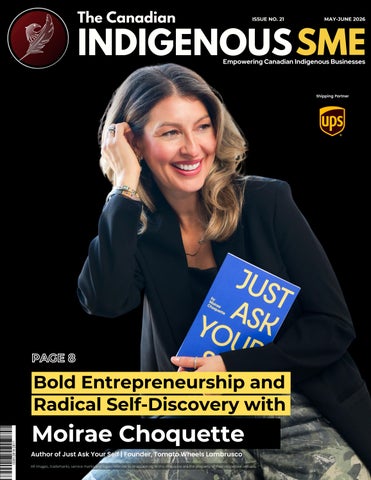
In an exclusive interview with Indigenous-SME Business Magazine, Moirae Choquette, author of Just Ask Your Self and founder of Tomato Wheels Lambrusco, shares a candid perspective on navigating success beyond surface-level achievements. Reflecting on moments where outward success did not match inner alignment, Moirae explores the power of self-awareness, questioning patterns, and building a life and business rooted in authenticity rather than expectation
InterviewBySKUddin
Moirae Choquette is a Canadian Indigenous entrepreneur, author, and speaker recognized for her bold approach to business, creativity, and reinvention.
Her career has been anything but conventional, starting in geology, pivoting into marketing, and eventually leading tech and ecommerce program innovations before launching one of Canada’s fastest-growing independent Lambrusco labels.
She’s the founder of Tomato Wheels Lambrusco, a women-led sparkling red wine label crafted in partnership with a fourthgeneration vineyard in Italy The company has been featured in The Globe and Mail, The Finance Café, and Futurpreneur for shaking up traditional wine culture with authenticity and soul
Between building a nationally distributed wine label, speaking to students across Canada and Mexico, and advocating for industry change in Ottawa, your career has taken on multiple lives. What led you to write Just Ask Your Self and what question were you beginning to ask yourself at the time?
What led me to write Just Ask Your Self wasn’t a single, intentional decision. It evolved.
This also wasn’t my first attempt at a book I had written a manuscript prior, Control Freak, which explored the first time I recognized my own patterns how behaviors I developed in childhood were still shaping my life and decisions 30 years later, and how my need for control was showing up, most destructively, in my romantic relationships
That awareness opened something unexpected It gave me a new way to observe and understand my reality. Moments would slow down, and I could see what was happening beneath the surface both in myself and in others It felt like seeing the same situation from multiple angles at once
Just Ask Your Self came from that space I began reflecting on my life, relationships, and decisions while becoming more present with my thoughts As patterns surfaced, I started writing them down Months into the process, I realized I had written another book one I knew I was meant to share
In some ways, it feels like a second life In others, it’s just an evolution I had to leave my corporate career and build something sustainable to create the freedom to write
And underneath all of it was the question I had first uncovered in Control Freak: how much of my life was still being shaped by patterns I hadn’t yet learned to recognize
In your debut book Just Ask Your Self, you challenge the idea that doing well means feeling well. Why do you think so many people stay committed to lives that look successful but don’t feel aligned?”
I love this question, because it’s one so many of us can relate to
Many of us only know what weve been told what we ’ ve learned from our parents, teachers, peers, and the media And for so long, it’s been the same story: the way to happiness is simple Work harder to make more money, because when we have more money, we can spend more money.
And when we have that financial freedom, we can string enough “happy experiences” together trips, shopping, dinners, parties, vacations, renovations, that it will equate to lasting happiness
We’ve been sold the idea that if we can just keep stacking these experiences, well feel fulfilled. And because of that, we stay. We stay because it’s familiar Because it looks right on paper Because we don’t question it and sometimes because we dont know what else exists beyond it
But the truth is, while those experiences do bring moments of joy, they don’t create inner peace And real fulfillment, real happiness comes from a state of inner peace that can’t be built through experiences What we often call happiness is actually distraction
And the hardest part? We feel it but we can’t always explain it It shows up as a quiet disconnect A low-level dullness A lack of motivation But because there’s nothing concrete to point to, we override it
We say, I just went on a trip why don’t I feel happier?
I just did all of this shouldn’t I feel more rested?
And instead of questioning the system, we question ourselves and keep going
To find something deeper, it comes back to awareness It requires taking an honest look at the life you ’ ve created, where you are today, and how every decision has led you here
Look around Your home, your relationships, your work
And ask yourself, honestly, am I happy in this life I’ve created?
Am I content? Am I at peace?
And if the answer is no… don’t ignore it. Start there.
Can you take us to a specific moment where you realized something in your life looked right —but didn’t feel right? What was happening, and what did you notice in yourself that you couldn’t ignore anymore?
There have been many moments like this for me, but one stands out, because on paper, everything looked great
Tomato Wheels Lambrusco, the company I built, became a nationally distributed wine label within three years A level of success I hadn’t imagined was possible
And when I got there, I didn’t feel the way I thought I would. I felt like something was off and I couldn’t quite explain it.
I was watching other founders online, building personal brands, sharing their success and I told myself, this is what I have to do now So I tried I forced myself into it
And nothing about it felt right It didn’t feel authentic I didn’t enjoy it I didn’t like waking up knowing I had to show up that way.
And that’s when it hit me:
If this is what success requires, why doesn’t it feel good?
That question stopped me I had to ask myself: what am I doing that I don’t actually like? And once I saw it, I couldn’t unsee it I couldn’t keep performing a version of success that wasn’t mine
So I stopped
I let go of what didn’t feel right, even when it looked right and chose something quieter, more aligned, and entirely on my own terms.
In your book “Just Ask Your Self,” you invite readers into deeper self‑inquiry and unapologetic living, drawing on your own journey of reinvention and courage. What questions or practices from the book do you believe are especially powerful for small and medium sized business owners who feel stuck either in their business model or in their own story as leaders ?
So often we try to separate business from our personal lives But when you start your own business, that line disappears And if you don’t know yourself, your business will reflect that
Every time I speak to a group, I see the same thing If I had built my first business from a place of ego, needing validation, acceptance, or approval, I would have failed
Being successful is not only about having a great product, a solid business plan, or strong accounting You can have all of that and still feel off At some point, it takes the courage to get to know yourself And that starts with awareness
We hear that word all the time, awareness, but what does it actually mean and what does it look like in practice? Just Ask Your Self slows real moments down, allowing readers to see what awareness looks like in real time
Because awareness is what allows you to see yourself clearly And when you see yourself clearly, you make better decisions Not from a need for approval, but from a grounded place of certainty That is what makes you unstoppable as a leader
Where can readers find Just Ask Your Self, and where can they experience Tomato Wheels Lambrusco?
Our Lambrusco is available in liquor stores and restaurants across Canada. If anyone needs help locating a bottle in their city, they can shoot us a message on Instagram at @tomatowheels and we will point them in the right direction
You can find out where I will be speaking next via moiraechoquette com
I’m grateful for the national and international distribution we’ve acquired for the book. Just Ask Your Self can be found at Indigo, Barnes & Noble and Amazon as well as some of the wonderfully supportive indie book shops including Banff Trading Post, Pages of Kensington, Kinder Books, Strong Nations, Mosaic Books.
Disclaimer: Indigenous-SME Business Magazine is committed to providing insightful interviews that highlight the successes and challenges faced by small and medium-sized businesses The views expressed in this interview are those of the guest and may not reflect the opinions of the magazine or its affiliates
BusinessWoman oftheMonth ChanaTrudel
BySKUddin
Chana Trudel’s Approach to Simple Marketing and Stronger Indigenous Women in Business
The founder, CEO, and marketing specialist of Truly Creative Marketing is Chana Trudel, a proud Métis businesswoman from Slave Lake, Alberta She is assisting women and Indigenous-owned businesses in increasing their visibility through her "done-for-you" digital marketing service and her work in community economic development She is also organizing creative financial literacy seminars for Indigenous women and Two-Spirit people.
From Small‐Town Roots to Marketing Specialist
Chana has built her career in the small-business ecosystem of northern Alberta, with over 14 years of practical marketing expertise, helping Alberta businesses, organizations, and even municipalities with branding, social media, and digital strategy She is known in the community as the " goto" person for straightforward, transparent, and useful marketing assistance.
Chana, a proud Indigenous Métis entrepreneur, frequently acknowledges that culture and community are the foundation of her career. Her social media accounts and client testimonials demonstrate a strong dedication to assisting women in "gaining the time and flexibility they need to grow their businesses" by relieving them of the burden of marketing and transforming concepts into well-thought-out campaigns This year, TCM will be unveiling a year-long project for the local municipality to increase both tourism in its community and investments from business and industry
Building Truly Creative Marketing
Designed specifically for women entrepreneurs and small businesses, Truly Creative Marketing (TCM) is a Canadian, Indigenous-owned digital marketing company that provides done-for-you marketing services, including social media management, content development, branding, websites, email marketing, digital ads, and digital strategy.
Chana presents herself as CEO and Marketing Specialist, highlighting three fundamental brand values:
‘Your time is valuable ’ TCM is designed to help clients save time by handling day-to-day marketing tasks, so they can focus on managing their staff and providing customer service
The organization is committed to assisting local, rural, and Indigenous economies nationwide and is ‘proud to be Canadian.’
‘Let's make the most of it,’ by prioritizing deliberate, results-driven marketing over sporadic updates or "busy work." TCM will always give all marketing options with transparency and ROI in mind.
Strategy calls, monthly management packages, and the creation of unique content that reflects each customer's voice and values are among the services offered by TCM.
As a digital expert, Chana provides free consultations through the TCM website, where business owners can schedule a conversation and receive customized suggestions to improve their brand online even on a tight budget
Recognition as an Indigenous Entrepreneur and Community Leader
Chana's influence extends beyond her list of clients She has been recognized for her leadership as a company owner and community builder in northern Alberta, having been selected as a finalist for the Alberta Women Entrepreneurs (AWE) Indigenous Entrepreneur Award last year Chana has also been a finalist for the POW WOW PITCH Indigenous Entrepreneur of the Year Award, and is currently a final nominee of the Excellence in Indigenous Business Award 2026 at the Excellence on the Lake Business Awards Gala! She has been highlighted by local media, such as The Lakeside Leader, as a remarkable Slave Lake businesswoman who strikes a balance between agency leadership, community involvement, and family life
Last year, Chana was the secretary of the Slave Lake Métis Local #19 and an interim LSLMD Board Member In addition, Truly Creative Marketing serves as the LSLMD's digital marketing team, handling all social media management, content creation, art creation, promotional materials, and email newsletters Last year, TCM collaborated on layout and artwork for the new Truth & Reconciliation monument named “Petohte Niikinahk - Coming Home,” created by the Lesser Slave Lake Métis District, which now lives at the Town of Slave Lake office
In addition, Chana is the Program Manager for LIFT: Learning Indigenous Financial Teachings, a Community Futures Lesser Slave Lake Region project that aims to improve the financial literacy of Two-Spirit and Indigenous women in the area LIFT provides workshops, circles, and traditional cultural teachings woven in with modern financial education on subjects including decolonizing your money mindset, credit, paying off debt, entrepreneurship, budgeting, and wealth-building for future generations from an Indigenous perspective This is the third year of the successful LIFT Program, and its impact is making large ripples in the northern Alberta communities it serves
In her role as Program Manager, Chana works closely with northern rural communities to organize LIFT Workshops, facilitates them, guides participants through their educational journeys, and assists them in finding further business support and funding options
Her dual roles as manager of a financial literacy program and marketing specialist put her in a unique position to help Indigenous women increase their income and practice sound money management, both of which are essential to the longterm viability of their businesses
Educating and Inspiring Women Entrepreneurs
In addition, Chana teaches and speaks Over the last two years, Chana has become both an Indigenous and Marketing session and Keynote Speaker at Indigenous and business conferences in Alberta, sharing her experiences and digital marketing skills with entrepreneurs looking to improve their business’s digital reach. Since the creation of TCM in 2020, Chana has also facilitated lessons on entrepreneurship, branding, and marketing for students of all ages, including programs such as IndigiTAL, IndigiTECH, Business on the Lake, the Indigenous Entrepreneur Conference, the Hyperdrive Women In Business Conference, and the local high school’s Entrepreneur classes each year She offers advice, behind-the-scenes photos, and support for women who feel overburdened by marketing on her Instagram account, @truly creative marketing Her story as an Indigenous woman in business is further amplified by her personal account, @chana belle, which emphasizes her selection as one of five community members featured in a CBC Gem documentary about the recovery works that took place after the disastrous fire that destroyed 45% of their community in 2011
Disclaimer: This article is based on publicly available information intended only for informational purposes Indigenous-SME Business Magazine does not endorse or guarantee any products or services mentioned Readers are advised to conduct their research and due diligence before making business decisions.
Indigenous culinary tourism is quickly becoming one of the most fascinating ways for tourists to explore history, culture, and the land throughout Canada Indigenous chefs and guides are turning traditional foodways into immersive culinary experiences, from salmon grilled over open flames to multi-course tasting menus and wild mushroom foraging These businesses help re-center Indigenous narratives in the tourism industry, support local livelihoods, and give young people work They also teach guests that each ingredient tells a tale about resilience, language, and the earth.
Indigenous-led culinary experiences are being highlighted by travel media as the best parts of visiting Canada
For instance, an Indigenous-led foodways excursion in Saskatchewan is featured in a Food & Wine piece on Canadian culinary adventures, where visitors may learn about local plants, harvesting practices, and cooking techniques directly from Indigenous knowledge keepers After learning to recognize edible plants and taking a stroll through prairie or woodland landscapes, participants may have a dinner that combines old customs with modern culinary innovation
Indigenous cuisine is also promoted by national tourism partners as an essential component of visiting Canada
Through its Indigenous Culinary Experiences platform, Destination Indigenous showcases food trucks, eateries, caterers, and pop-ups where Indigenous chefs transform the Canadian culinary landscape by utilizing regional products and traditional flavours From easy bison burgers and bannock tacos to elegant tasting menus with game meats, smoked fish, wild berries, and foraged plants, these experiences are varied
Videos created in collaboration with the Indigenous Tourism Association of Canada (ITAC) show tourists preparing and consuming Indigenous cuisine from Nova Scotia to the Prairies, frequently as a part of larger cultural excursions that incorporate music, storytelling, and land-based activities In these contexts, food is more than just a commodity; it serves as a window into Indigenous perspectives and seasonal connections to the natural world
Foraging Tours and Wild Food Adventures
An increasing share of Canada's culinary tourism is led by Indigenous people, and foraging trips have become a major component of this industry Operators across Canada now provide guided treks where participants learn to identify edible plants, seaweeds, berries, and mushrooms, then sample or cook what they find, according to Afar and other travel agencies For instance, Wiikwemkoong Tourism offers foraging experiences on Manitoulin Island, Ontario, where a chef cooks a precontact supper over an open fire after an Anishinaabe guide guides guests into the bush to gather berries and herbs
Similar invitations to "snack on the bounty of the forest" while learning about sustainable harvesting and ecological care are offered by other excursions on Vancouver Island and in the woods of British Columbia Operators stress that foraging requires careful identification, adherence to local regulations, and knowledge of how to collect without endangering ecosystems Indigenous beliefs about taking only what you need and ensuring that plants and animals can regrow are strongly aligned with this philosophy
These tours raise awareness of Indigenous stewardship practices while generating revenue for chefs, guides, and small businesses They assist guests in understanding the labour, expertise, and wisdom inherent in each wild item by offering hands-on experiences rather than passive consumption
Farms, Training Programs, and Culinary Skills
On Indigenous farms and training facilities that combine agriculture, hospitality, and skill development, food tourism is also expanding For example, as part of its Indigenous Skills & Training Program, Mādahòkì Farm near Ottawa has started an Indigenous Foodways training program. Following the effects of COVID-19, the two-month paid culinary program is intended to help Indigenous participants reestablish their tourism industry and provide them with practical skills
Pop-up dinners, cooking lessons, and farmto-table events are examples of foodfocused tourist experiences in urban and rural contexts Restaurants and culinary initiatives in which chefs develop modern menus rooted in their nation's culinary traditions are highlighted on Foodism's list of Indigenous food experiences in Canada
In the meantime, "Canadian Indigenous Experience" lessons are offered by cooking-class providers such as The Chefs Experience, where participants learn about the cultural significance of foods and techniques while cooking with Indigenous chefs and using traditional utensils When combined, these programs create a workforce and clientele for Indigenous food tourism that can expand over time
Culture, Storytelling, and the
Future
of Indigenous Food Tourism
Storytelling is at the core of Indigenous food tourism Food is used by hosts to share stories of displacement, survival, and revival, as well as lessons about reciprocity, respect, and thankfulness, whether gathered around a communal table, at a pop-up supper, or by a fire on the land. Articles on Indigenous chefs frequently highlight how they create dishes that honour the past while catering to modern preferences, drawing on family recipes, community mentors, and local elders
Travellers can support Indigenous self-determination by engaging in Indigenous culinary tourism, according to Destination Indigenous Spending money at Indigenous-owned eateries, farms, and tour companies sustains jobs in the arts, administration, farming, cuisine, and tourism Every meal or tour is part of a larger cultural restoration project because many companies use their profits to fund youth programming, language revitalization, or land-based education
Going forward, the expansion of Indigenous food tourism will rely on ongoing investments in Indigenous-run marketing, infrastructure, and training, as well as courteous collaborations that maintain Indigenous authority If that equilibrium is preserved, tourists will have even more opportunity to sample and learn, and local communities will continue to transform their culinary traditions into robust, prosperous tourism industries
The Indigenous-SME Business Magazine is a great new and seasoned resource for Canada's small Indigenous businesses Visit the website below to view our magazine Click here to follow our X account for news updates. So, what are you waiting for? Join our business-loving community for inspiration, motivation, and growth.
Disclaimer: This article is based on publicly available information intended only for informational purposes Indigenous-SME Small Business Magazine does not endorse or guarantee any products or services mentioned Readers are advised to conduct their research and due diligence before making business decisions
Author,Academic,and IndigenousPolicyExpert
Ken Coates is a non-Indigenous researcher and writer with deep interests in Indigenous business, Indigenous rights, and economic development. Raised in Whitehorse, Yukon, and educated at the University of British Columbia and the University of Manitoba, Ken has worked at universities across Canada and internationally. From his initial studies on the northern Canadian fur trade, Ken has worked on Indigenous economic development corporations, the importance of Indigenouscentric policy development, Indigenous legal rights, the economic impacts of court decisions and new government policies, and the value of Indigenous-controlled financial institutions
You have worked extensively at the intersection of policy, Indigenous rights, and economic development. From your perspective, what do policymakers often misunderstand about Indigenous economies, especially when it comes to small and medium-sized businesses?
As a non-Indigenous observer and ally, I have always admired the tenacity and resilience of Indigenous communities and businesses Canadian policy-makers have difficulty appreciating the contributions of SMEs in general and Indigenous companies in particular
ReimaginingIndigenousProsperity: Dr. Ken Coates Speaks
InterviewByDarianKovacs
In an exclusive interview with Indigenous-SME Business Magazine, Dr. Ken S. Coates, author, academic, and Indigenous policy expert, shares a grounded perspective on the realities shaping Indigenous economic development in Canada. Drawing from decades of research and collaboration, Dr. Coates explores why Indigenous businesses are often misunderstood, the importance of true partnership over consultation, and how aligning policy with community values can unlock stronger, more sustainable growth
The country is committed to “going big,” pouring billions of dollars in subsidies into foreign-owned businesses in hopes of landing a community-saving major investment On the Indigenous side, policy-makers continue to underestimate the strength and determination of Indigenous business.
Indigenous SMEs take a long-term perspective on commercial viability They tend to value employment creation and local capacity development as much as profit They seek to run successful businesses, but they really wish to establish credible Indigenous businesses
Further, one of the key elements in economic development is mobility –moving capital and commercial attention to the most advantageous business location Indigenous businesses are open to remote operations and investments in distant projects, but they prioritize the local economy and look for opportunities proximate to their traditional territories Policy-makers, working in the much less culturally-defined and more formal world of the modern bureaucracy and corporate world, often fail to appreciate the “love of place” that dominates Indigenous approaches to economy-building
Many economic systems still treat Indigenous communities as stakeholders rather than true partners. What does a real partnership-based approach to economic development look like, and how can it better support Indigenous entrepreneurs and community-owned businesses?
Forty years ago, Canada set off on a long journey to figure out how to collaborate with Indigenous communities This was not done willingly and was undertaken only in response to political actions and/or court decisions The process unfolded incrementally: specific business development programs for Indigenous businesses, a slowly expanding commitment to consultation, special arrangements with governments and businesses to provide business capital and, eventually, equity The half-hearted application of the concept of “free, priority and informed consent” moved the bar a little, but much less than hoped A new model of successful engagement – based on seeing Indigenous peoples as real and proper partners Partnerships arise from personal connections and understanding; successful non-Indigenous business people engage with Indigenous peoples as friends and collaborators Real partnerships emerge from these contacts much more effectively than from specific business proposals, government policies, and investment plans In my experience, personal contact and deep professional friendships matter more than simple business-case commercial arrangements
You have highlighted the importance of education and skills development in Indigenous communities. How can universities, training programs, and governments better align with Indigenous economic needs so graduates are prepared to lead in their own communities?
Canada has spent a great deal of money on Indigenous training and education, but sadly, with less impact than expected The focus on graduates is not the most effective approach Indigenous peoples and communities need to emphasize the life circumstances of children aged 0 to 5 years, launching more and more healthy children into the education system Only a small percentage (perhaps as low as 10-20%) of Indigenous students who start school make it through to high school graduation and on to advanced study Furthermore, the completion of technical skills, college diplomas, or university degrees often leads young people to move to cities or southern work sites Many Indigenous communities struggle to hold onto the most talented young people. I believe that the economy-builders (government departments, communities, colleges, universities and businesses) need to expand cooperative education and training programs, combining learning opportunities with Indigenous employment to connect young Indigenous people to the workforce as early as possible.
Ensure that young Indigenous people have a strong and positive start to life, support them through their educational journey and put more effort into the transition to full-time employment
It would be helpful to have a much better sense of what works and does not work in terms of Indigenous career development and employment readiness. A great deal of money and effort is spent in this area, but the results are uneven, at best The preparatory systems are westerncentric, focusing on traditional high school training, college and university programming, and standard Canadian workplace transitional preparation The workplace outcomes suggest that at least a substantial portion of the career development funding is ineffective Few of the programs (mostly those delivered by Indigenous governments) focus on Indigenous cultures and traditional values, and take into account the lived realities of Indigenous communities and remote regions It is time, I believe, to place our trust and confidence where it properly belongs: with Indigenous communities, governments, and Indigenous urban organizations Government agencies and traditional educational and training institutions have had some 40 years of accelerated funding and government support, but the practical results failed to match the government investment and public expectations
Large infrastructure and resource projects are often planned without Indigenous leadership at the centre. What changes would help ensure Indigenous businesses and communities are meaningfully included in procurement, planning, and development opportunities?
Canada may, if Prime Minister Carney’s bold and unproven promises about major infrastructure investments and large development projects come to fruition, go through the largest expansion phase in decades Bill C-5 (the Building Canada Act) promises federal support for “projects of national importance ” The Liberal government proceeded with the Act without consulting Indigenous groups, promising to hold consultations and then completing them after the legislation passed First Nations, Metis and Inuit groups are not amused If this is Indigenous consultation in advance of major project developments, Canada has not learned as much as we thought
The nation’s planning tables are now covered with proposals of road expansion, pipeline development, hydro and transmission line construction, port expansion, and mining activities In some instances – particularly the proposals that were well advanced as of 2025 – there have already been extensive discussions with affected Indigenous communities
Economic Development
Several of the projects, including the major LNG plants in British Columbia and the road and part initiative in the Northwest Territories and western Nunavut, were initiated by or jointly with Indigenous communities
Indigenous peoples cannot assert full leadership of a project unless they are major funders of the activity and have direct authority over the affected lands This is much easier in the territorial North, where modern treaties have given them clear lines of engagement over projects in their areas All the policies and procedures are in place to provide Indigenous communities with access to procurement and contracting opportunities and appropriate engagement in planning processes. Recent history makes it clear that having legislation and policy in place does not ensure compliance or successful outcomes Real commitment and sincere engagement are essential
Moving forward, Canada needs to shift from a consultation-and-regulation mindset to one based on genuine partnerships Where such elements are in place, with many mining projects, LNG projects in Kitimat, several key pipelines, energy transmission lines, and other commercial ventures, there are positive outcomes and sustained benefits for the Indigenous peoples When engagement is grudging, limited and not built into the core operations of the companies involved, outcomes are much more limited and incomplete Canada can do a great deal better, in large part by picking up on the models established through existing collaborations and partnerships
Going forward requires the entrenchment of partnership in the development of projects that require Indigenous participation, affect Indigenous communities, or use Indigenous territories These collaborations must be sincere and require extensive up-front engagement with communities, Indigenous leadership, and Indigenous economic development corporations Indigenous communities require access to investment capital to have substantial influence over project design and execution
Partnership, to state the obvious, requires that both/all partners have the capacity to exercise substantial influence over the execution of the project This requires access to investment capital, managerial capacity, an appropriately trained workforce (or, in developing contexts, access to training programs), and suitable infrastructure (or a detailed plan to build it in a timely manner) In almost all cases in Canada, Indigenous communities are at a distinct disadvantage relative to project proponents Relationships without real equality are out of balance, by design The path forward will be rocky; not all development companies make good partners, and not all Indigenous communities and governments are ready to engage fully with major projects Fortunately, Canada has enough positive examples of productive, mutually beneficial, and long-standing partnerships in infrastructure and resource development.
For young Indigenous professionals, scholars, and entrepreneurs, what advice would you give on building a career in business, policy, or academia while staying connected to their community values and responsibilities?
For much of the last half-century, Young Indigenous professionals were pulled into law (and to a lesser extent, politics) as a means of supporting their Nations In recent years, business engagement has been added to the list The rush of young, energetic and talented Indigenous young people into business has been truly impressive ( Note, by the way, that very few non-Indigenous Canadians try to figure out how they can best help Canada move forward Career planning for non-Indigenous peoples focuses on career advancement and potential income; societal impact drives a subset of people, but I fear it is a much smaller percentage.) This is the Indigenous superpower: a high proportion of Indigenous young adults seek to lift up their peoples and dedicate their lives and careers to supporting their communities
As a non-Indigenous academic who has had the pleasure of working with many talented and highly motivated Indigenous people over the decades, I have found that certain elements stand out First, young people should listen to their community and their elders They carry the wisdom of the Nation and also look to the long view If a young person is fortunate, they will also know their strengths, aspirations and special qualities. They should seek counsel from the people who care deeply about the Nation and their members Find and capitalize on mentors' support These may be teachers, community leaders, regional professionals, business people, and key individuals in the not-for-profit sector Young professionals should find strength in the people around them, particularly those with whom share their vision of the future
Young people – and not just Indigenous folks – often pull away from community and culture in their 20s, as they focus on education, training and family and career development.
During these key years, it is important that young Indigenous people attend ceremonies, pay attention to culture and community affairs, attend regional Indigenous sporting events, and attend relevant conferences, workshops, and meetings Perhaps most importantly, and I am sharing advice I have received from many Indigenous elders, it is vital that young Indigenous professionals spend time on land, engaging in harvesting and cultural activities
Young and aspiring Indigenous professionals have many career options before them The reempowerment of Indigenous people in Canada creates many opportunities and presents numerous challenges First Nations, Inuit, and Métis people need long-term, comprehensive engagement from Indigenous young people if Nations are to thrive in the years ahead Staying connected with the Indigenous community and culture gives careers meaning and strengthens Indigenous peoples across Canada
Disclaimer: Indigenous-SME Business Magazine is committed to providing insightful interviews that highlight the successes and challenges faced by small and medium-sized businesses. The views expressed in this interview are those of the guest and may not reflect the opinions of the magazine or its affiliates.
In an exclusive interview with Indigenous-SME Business Magazine, Rebecca Mackenzie, President and CEO of the Culinary Tourism Alliance, shares how the Taste of Place Summit is bringing food, culture, and tourism together to create deeper connections and stronger local economies By focusing on authenticity, collaboration, and the stories behind every dish, Rebecca highlights how culinary experiences can become powerful drivers of community pride and sustainable growth across Canada.
InterviewBySKUddin
Rebecca Mackenzie is a globally recognized leader in culinary and agritourism, with more than 25 years of experience shaping vibrant, placebased destinations. As President & CEO of the Culinary Tourism Alliance, she has expanded a network of over 150 destinations, championing innovation, sustainability, and meaningful economic growth. A dynamic strategist, educator, and speaker, Rebecca is known for turning bold ideas into impactful action and building strong industry connections Her work influences global best practices and inspires communities to tell their stories through food Learn more about Rebecca and her work: https://www linkedin com/in/rebeccaleheup/
The Taste of Place Summit (TOPS) brings together leaders from food, tourism, and culture. How did you first get involved with TOPS, and what attracted you to the idea of “taste of place”? How have your early experiences shaped your view of food as a way to connect people, culture, and local economies?
In 2023, the Culinary Tourism Alliance partnered with George Brown College to develop the Taste of Place Summit, building on years of experience at the intersection of food, tourism, and economic development It was grounded in a shared belief that food and drink are among the most powerful ways to experience and understand a place and that there was a need to bring these sectors together around that idea
What draws me to “taste of place” is its focus on authenticity and connection Its not just about what’s on the plate, but the people, landscapes, and cultural traditions behind it - what we call a destination’s foodways
Working closely with farmers, chefs, tourism operators, and communities reinforced my view of food as a connector It strengthens local economies while building bridges between people, whether through Indigenous foodways or shared meals across cultures That intersection continues to inspire our work today
Today’s travellers are looking for authentic food experiences that reflect local culture and stories. How do you define “value” for destinations and businesses involved in the Taste of Place Summit? What makes a culinary experience truly memorable and meaningful?
From the Culinary Tourism Alliance’s perspective, “value” goes beyond visitor numbers or shortterm economic impact It’s about the long-term benefits created when agriculture and tourism are meaningfully connected. Strengthening local supply chains, increasing demand for regional products, creating new revenue for businesses, and building community pride The Taste of Place Summit helps destinations think strategically about this kind of value: sustainable, inclusive, and rooted in local identity
For travellers, value is authenticity Experiences that feel real and connected to place. That doesn’t happen by accident; it comes from collaboration between producers, chefs, and tourism operators working together to showcase what’s unique about their region
When an experience reflects its place honestly, it creates value on every level It enhances the visitor experience, supports local economies, and strengthens a destination’s cultural identity.
The food and tourism industries have changed a lot in recent years. What key lessons have you learned from these changes? How have they influenced your approach to planning, partnerships, and the overall direction of the Summit?
The past few years have reinforced just how interconnected and resilient the agriculture and tourism sectors need to be One of the biggest lessons has been the importance of local Local supply chains, local talent, and local stories When global systems were disrupted, destinations that had strong regional connections were better positioned to adapt That has deepened our commitment to supporting place-based development and ensuring that culinary and agritourism is rooted in what’s genuinely local.
Another key lesson is the value of collaboration The challenges facing these industries whether economic, environmental, or social, are too complex for any one organization to address alone We’ve seen the strongest outcomes come from partnerships that bring together producers, chefs, destination organizations, educators, and communities That collaborative mindset is central to how we design the Summit
ImageCourtesy:Canva
These shifts have influenced our approach by making the Summit more intentional and impact-driven We’re focused on practical outcomes, knowledge sharing, and building relationships that extend beyond the event itself There’s also a stronger emphasis on sustainability, inclusivity, and resilience Ensuring that growth in culinary and agritourism benefits communities in meaningful and lasting ways
Ultimately, the direction of the Summit reflects a more thoughtful, connected approach to developing culinary and agritourism - one that prioritizes people, place, and long-term value.
The food and tourism industries have changed a lot in recent years. What key lessons have you learned from these changes? How have they influenced your approach to planning, partnerships, and the overall direction of the Summit?
Strong collaboration starts with a shared purpose For the Taste of Place Summit, that means being clear about our vision: supporting destinations through authentic, place-based culinary and agritourism Ensuring partners see how their goals connect to that bigger picture
What helps build and maintain those relationships is consistency and trust We engage partners early, involve them in shaping the program, and create space for their expertise to be reflected It’s not a one-time transaction, it’s an ongoing dialogue Transparency is also key, particularly around expectations, outcomes, and how success is measured
To keep partners engaged over time, we focus on delivering real value That might be meaningful connections, new business opportunities, or insights they can apply in their own work We also prioritize strong communication before, during, and after the Summit so momentum continues beyond the event itself
Equally important is recognizing that collaboration needs to be mutually beneficial When partners feel heard, see their impact, and understand how their contributions advance the broader goals, alignment happens more naturally
Ultimately, it’s about building a community, not just an event One where partners are invested in the longterm success of the Summit and the growth of culinary and agritourism as a whole
Looking ahead, what is your vision for the future of the Taste of Place Summit and its impact on culinary tourism in Canada? What advice would you give to entrepreneurs who want to create food and tourism experiences rooted in local culture? What is one simple step they can take this year to get started?
Looking ahead, our vision for the Taste of Place Summit is to continue growing it as a national platform that connects leaders across regions and sectors, while driving real impact at the community level. We see it as a catalyst for strengthening Canada’s position as a global leader in culinary and agritourism One that celebrates diverse foodways, supports local economies, and advances sustainable, placebased development
For entrepreneurs, the opportunity lies in leaning into what makes their place unique The most compelling experiences aren’t imported - they’re rooted in local culture, ingredients, and stories. That means building relationships with local producers, understanding the history and traditions of the region, and thinking about how to translate that into an experience that visitors can connect with in a meaningful way
My advice is to start small, but be intentional You don’t need to create something elaborate to begin Its authenticity is what matters most
One simple step entrepreneurs can take this year is to collaborate Partner with a local farmer, artisan, or storyteller to create a small, testable experience Whether it’s a tasting, a tour, or a workshop That kind of collaboration not only strengthens local networks, but also creates richer, more memorable experiences for visitors
https://www.tasteofplace.ca/event/tops/home
Disclaimer:Indigenous-SME Business Magazine is committed to providing insightful interviews that highlight the successes and challenges faced by small and medium-sized businesses. The views expressed in this interview are those of the guest and may not reflect the opinions of the magazine or its affiliates.
In an exclusive interview with Indigenous-SME Business Magazine, Siera Hancharyk, Founder and Creative Director of Inaabiwin Wiigwaas and Founder of the Three Sisters Indigenous Crafts Market, shares how creativity, culture, and community come together in the work behind Inaabiwin Wiigwaas and the Three Sisters Indigenous crafts market. Through hands-on artistry and teaching, Siera is not only preserving traditions but also creating space for Indigenous voices to be seen, respected, and valued in urban settings
InterviewByDarianKovacs
Siera is a First Nations 2-spirit she/they Kwe/Nini from Wiikwemkoong who grew up in Sault Ste. Marie(Baawaating) but now resides in Toronto(Treaty 13, Dish With One Spoon). Siera is Migize indoodem (eagle clan).
Siera is the founder of the Three Sisters Indigenous crafts market; the founding vision is to Indigenize urban spaces with authentic Indigenous representation of resilience and community
Inaabiwin Wiigwaas is deeply connected to culture and creativity. What inspired you to start this journey, and how does your identity and community influence the way you create and run your business?
Indigenous people have been trades people since per contact we had passageways, trade systems working with other nations and tribes so to me running a business has been in my blood since the very start
I believe that making something handmade is much more precious as a gift than something bought from the store So being able to be creative and carry traditions on is something I’m deeply passionate about and have a great honour to be able to continue to do.
ImageCourtesy:SieraHancharyk
Sharing cultural work requires care and respect. How do you share your creations with a wider audience while protecting traditions and knowledge that are important to your community?
I like to teach about cultural appreciation versus appropriation There are certain things that I will not teach, and I will not share as that is something that is sacred, and only meant to be shared within ceremony
But what I’m able to share, I share in a respectful manner and in an open manner because I am a strong believer that in order for somebody to respect your culture they have to understand your culture So I never turned somebody away who is open to learning
Many Indigenous artists and entrepreneurs face challenges with access to markets, funding, and visibility. What challenges have you experienced, and what kind of support would help Indigenous creatives grow and succeed?
As you know, I have been running a successful Indigenous market within Toronto for the last three years, and we operate fully without funding, grants or sponsorship It was a challenge at the beginning, but we have learned to work with organizations and companies to be able to put on these markets and as of now we are the only indigenous run market within Toronto that is consistent Meaning we operate more than once a year we sometimes hold up to eight markets in one year.
I think from my personal experience, Indigenous creatives would grow and succeed if we had proper mentorship and proper access to things such as capital funds and to business incubator spaces
Your work reflects a strong connection to land, materials, and story. Can you share a moment when something you created had a meaningful impact on someone, and what that experience meant to you?
Everything I’ve created has a story and has a history to it because I try to incorporate natural materials into all of my beadwork and creations I believe that handmade items are a luxury item, but I also believe that our people should have access to it without having to decide on spending that money on groceries or being able to look beautiful at the powwow or round dance or an event that they’re going to
Quite recently I actually had a friend say that I make affordable, beautiful work for our people and honestly that touched my heart because that’s at the very core of everything I do
For young Indigenous people who want to start a business rooted in their culture, what advice or encouragement would you give them as they begin their journey?
My advice to somebody looking to start a business rooted in culture is take a look at what fills your cup What makes you happy and what serves our people at the same time.
As human beings we have basic needs, and if we can meet those basic needs and fulfill those basic needs for somebody then I believe that right there should be at the core of your business Look for your mentors and look for people to support you in your journey We're not in competition with each other, but we ’ re working together to create a better future for our people.
Disclaimer:Indigenous-SME Business Magazine is committed to providing insightful interviews that highlight the successes and challenges faced by small and medium-sized businesses. The views expressed in this interview are those of the guest and may not reflect the opinions of the magazine or its affiliates.
A new generation of farmers, hunters, and land stewards in Canada's Indigenous territory is using digital tools to protect the land and food systems in the face of a fast-changing climate. To address Indigenous concerns, such as preserving ecosystems, enhancing communal food security, and asserting sovereignty over data and decisionmaking, drones, remote sensing, artificial intelligence (AI), and data platforms are being adapted These technologies work best when they are integrated into community-driven projects and directed by Indigenous knowledge, not when they replace it Indigenous people are demonstrating that, when digital agriculture is developed on their terms, technology can be both intelligent and culturally sensitive, from prairie croplands to Arctic shores
Drones as Tools for Monitoring, Mapping, and Farming
Indigenous communities in Canada are increasingly using unmanned aerial vehicles, or drones, to access, monitor, and manage challenging and isolated terrain According to a Canadian drone firm, drones can help Indigenous people overcome long distances and dense bush, promoting environmental monitoring and land stewardship in areas that are often difficult to access on foot or by car
Drone high-resolution imaging can show changes in vegetation, erosion, water levels, or industrial damage, supporting land-use planning and Indigenous rights
Through training and employment initiatives targeted at Indigenous people, drones are also making their way into the agricultural sector. In collaboration with the University of Winnipeg, First Peoples Development Inc (FPDI) in Manitoba, initiated a drone project on digital agriculture field data collection The project, supported by the province's Building Sustainable Communities Grants, hires and trains Indigenous youth to use drones to collect field-level data, validate it, and prepare it for image recognition and machine learning applications
ImageCourtesy:Canva
While developing long-term technical skills in Indigenous communities, this activity helps research on crop health, soil conditions, and yield prediction
Initiatives like FPDI's program guarantee that data regarding Indigenous lands is gathered and analyzed by community members, not simply outside consultants, by putting drones in the hands of Indigenous adolescents and farmers This is essential for upholding cultural customs and ensuring that digital agriculture meets regional demands, such as increasing community garden yields, monitoring treaty lands, or organizing new farming endeavours
Blending AI with Indigenous Knowledge for Food and Climate
Although artificial intelligence is frequently depicted as being far from the land, a study in Nunavut demonstrates how, when grounded in Indigenous knowledge, AI can support regional agricultural systems. To investigate the feasibility of commercial inshore fishing and mariculture in Sanikiluaq, an Inuit hamlet on Hudson Bay, PolArctic collaborated with local experts, scientists, and conservation groups To identify potential locations for scallops, clams, and kelp, the group developed an AI model that combined traditional Indigenous knowledge with satellite data, field research, and remote sensing
Digital Agriculture
This was the first AI project of its sort to treat Western science and Indigenous knowledge as equal datasets in the model, according to reports from WWF's Arctic program Satellite imagery and ocean temperature models were combined with data from local hunters and fishermen, including observations of currents, animal behaviour, and seasonal patterns The AI provided the community with a tool to modify their mariculture plans while retaining decision-making authority by mapping existing habitats and forecasting how climate-driven changes could impact future conditions
Crucially, the AI outputs were converted into easily readable formats, including information in both Inuktitut and English, to facilitate conversations and choices at the community level This method shows that when AI is developed with community agreement, co-design, and shared control over data, technology may strengthen Indigenous links to land and water rather than replace them
Similar ideas could underpin AI-driven agricultural tools for First Nations lands, such as crop rotation planning and frost risk prediction using both conventional indicators and climate models
Data Sovereignty and Indigenous‐Led Digital Infrastructure
Questions about who owns and manages the data are becoming more crucial as digital tools become essential to land management and agriculture. Many Indigenous leaders caution that if AI and data-intensive infrastructure are constructed on Indigenous territories without permission or benefit, they may repeat cycles of extraction By constructing digital infrastructure under Indigenous control, Indigenous-led technology initiatives in Canada are attempting to change that narrative
For instance, CyberCloud-AI bills itself as Canada's first Indigenous-led "sovereign AI factory," built in collaboration with First Nations and situated on Indigenous territory Initiatives like these have consequences for agriculture even if they are primarily focused on AI and data centers This is because they can provide computing power and data storage, with Indigenous people deciding the rules around access, privacy, and benefit-sharing Communities can guarantee that farming data from soil maps to drone imagery is used to support their economic and food security objectives, not just those of outside investors, when it is stored and processed under Indigenous sovereignty.
This is in line with larger discussions in Canada over a "Canadian Sovereign AI Compute Strategy," which seeks to develop commercial and public infrastructure that safeguards data sovereignty and encourages Canadian inventors To prevent digital agricultural tools from undermining treaty connections or inherent rights, indigenous-led participation in this strategy is essential
Youth, Innovation, and the Future of Digital Farming
Many Indigenous digital farming activities in Canada are led by young people Programs such as environmental monitoring, drone projects, and coding boot camps offer young people opportunities to apply their skills for the benefit of their communities and lands
Digital Agriculture
The goal of FPDI's drone training project is to guarantee that Indigenous kids can pursue employment in agriculture and related industries by acknowledging the need for qualified drone operators The project makes digital agriculture tangible and relevant by linking technical training with actual field data collection on Indigenous territory
Beyond official initiatives, social media posts and narratives from across the nation demonstrate how Indigenous farmers, photographers, and mappers are using drones to document and preserve their ancestral lands Drone footage is used to communicate the beauty of Indigenous areas, monitor pipeline routes, and demonstrate the effects of wildfires, strengthening community ties to the land and highlighting dangers Meanwhile, by safeguarding forests, wildlife, and carbon-rich landscapes, AI-enhanced fire risk prediction tools such as autonomous drones developed by Canadian researchers to help prevent large-scale fires can indirectly benefit Indigenous people
Looking Ahead
As we look towards the future, we get to understand that challenge and opportunity are to scale these tools without losing what distinguishes them: community governance, respect for Indigenous law, and profound connections to the land Digital tools on traditional territories will be most effective when used by Indigenous communities on their own terms, to defend food, water, and future generations
TheIndigenous-SMEBusinessMagazineisagreatnewand seasonedresourceforCanada'ssmallIndigenous businesses Visitthewebsitebelowtoviewourmagazine Clickheretofollowour Xaccount fornewsupdates So, whatareyouwaitingfor?Joinourbusiness-loving communityforinspiration,motivation,andgrowth
Climbing With Purpose: Tim Taylor’s Guiding Journey
In an exclusive interview with Indigenous-SME Business Magazine, Tim Taylor, Owner and Lead Guide of Girth Hitch Guiding, shares a grounded perspective on what it truly means to lead in the outdoors Moving beyond traditional ideas of achievement, Tim approaches guiding as a responsibility rooted in care, adaptability, and respect for both people and place
InterviewBySKUddin
For two decades, Tim Taylor has focused on delivering safe outdoor experiences while investing in the growth of other outdoor leaders. Earlier in his career, he did not always approach guiding through a clearly articulated, guest-centred, transformational lens
Tim values transformational rather than transactional adventure, a perspective that continues to shape how he guides and mentors today
As principal owner of Girth Hitch Guiding and a proud Métis man, Tim’s connection to the Canadian Rockies is both personal and cultural, grounded in respect for place, people, and shared experience Tim is also the author of Rock Climbing in the David Thompson and a significant contributor to stewardship efforts in the Lake Abraham region
“My first climbing experience taught me that failure can be the gateway to growth. Climbing was the venue, but care, patience, and intentional leadership were the lesson.”
Girth Hitch Guiding offers hands-on mountain and climbing experiences. What inspired you to start this guiding company, and how do your values influence the way you approach risk, responsibility, and your connection to the land?
I think it is a distinct privilege to journey with other humans For me Girth Hitch is an extension of that passion using the mountain environment We strive to walk with others and focus on their growth and betterment Our first priority is your holistic safety. When choosing objectives we look for environments that offer the appropriate level of risk and reward, while at the same time, safely challenging you out of your comfort zone
With that said, there are times in the mountains when environmental or personal conditions unexpectedly change Our commitment to your holistic safety may require that the planned day’s objective alters dynamically to align with those changing conditions Sometimes it may even mean that we don’t hit the summit, regardless of whether it was the stated objective at the beginning of the day We recognize that the appropriate degree of challenge in consideration of the environmental circumstances, is a key factor in nurturing your transformational adventure.
Adventure tourism is often focused on goals like summits and personal achievement. How do you design your experiences to also encourage respect for the land, humility, and learning about the places and histories connected to them?
We believe that mountains are not something to be conquered but rather ancient friends to discover and experience Our years exploring the mountains has taught us that being amidst the giants provides far more than mere fitness and adventure; we have discovered that our time in the mountains nurtures us holistically and spiritually and challenges us to be more than we thought we could be
The outdoor and guiding industry has not always been inclusive. What changes do you think are needed in training, hiring, and leadership opportunities so more Indigenous youth and underrepresented groups can enter this field?
Entry into outdoor leadership, and especially the ACMG standard is very difficult to obtain Even for highly resourced people it is difficult Programs that support individuals by offering mentorship and resources to live and travel in mountain environments would be a good step towards taking down the barriers
Mountain Guiding
Running a guiding business involves balancing safety, environmental care, and seasonal challenges. What are some of the biggest challenges you face, and what support would help small, valuesdriven guiding companies grow and succeed?
I often ask aspiring guides if they want to be a technician or a business owner Invariably they mostly start out wanting to be a technician The hardest part about adapting and evolving as a guide is the transition to running your own business Support networks like Travel Alberta and Indigenous Tourism Alberta are amazing resources for those looking to make that transition
For people who feel drawn to the mountains and want to start a guiding or outdoor business, what advice would you share about building skills, respecting local knowledge, and staying grounded as they grow?
Ask yourself WHY? If you don't have a clear reason in this industry it will eat you alive If your WHY is to spend time outside because you like climbing, go get a high paying job somewhere and climb recreationally Your WHY has to be rooted in the betterment of your people or you will become bitter and disappointed Guiding is a service industry and my work is to care for people, I just happen to do it outdoors
Disclaimer:Indigenous-SME Business Magazine is committed to providing insightful interviews that highlight the successes and challenges faced by small and medium-sized businesses The views expressed in this interview are those of the guest and may not reflect the opinions of the magazine or its affiliates
First Nations farmers and food producers across Canada are redefining what it means to be involved in the agri-food industry Many are creating supply chains that prioritize community food security, equitable returns for producers, and stewardship of the land and rivers that support them over merely fitting into preexisting industrial systems This change is in line with the expanding Indigenous food sovereignty movement, which advocates for food systems controlled by Indigenous peoples, grounded in traditional knowledge, and intended to promote longterm communal well-being.
First Nations farmers are proving that sustainable supply chains can be both commercially feasible and culturally embedded, from small-scale market gardening to regional distribution networks
Reclaiming Food Systems Through Indigenous Food Sovereignty
A potent framework for comprehending how First Nations in Canada regain control over their food systems is Indigenous food sovereignty (IFS)
According to a recent scoping study of Indigenous food sovereignty projects across the nation, reestablishing connections between communities and their natural food ecosystems was mostly dependent on participation through gardening, farming, fishing, hunting, and gathering In addition to providing calories, these activities help people rebuild their ties to the land, language, and ceremonies while reducing their reliance on distant, expensive, and disruption-prone supply lines.
According to the same analysis, local distribution and sales are increasingly linked to community-driven food production and small-scale market gardening In several First Nations, producers collaborate to arrange the planting, processing, and sale of fresh, culturally appropriate foods for delivery to nearby homes, schools, and health facilities In line with national conversations advocating a transition from long, extractive value chains to shorter, localized ones, this strategy shortens supply chains and retains more value within the community In these systems, food is viewed as a source of identity, health, and group resilience in addition to being an economic commodity
Building Inclusive and Sustainable Value Chains
To improve Indigenous food systems and food security, Canada has legally acknowledged the importance of enabling First Nations, Inuit, and Métis to participate in market-based value chains. A healthier, more sustainable national food system requires Indigenous-led and distinction-based initiatives, according to Canada's National Pathways statement for the UN Food Systems Summit It highlights the need to support Indigenous farmers, harvesters, and producers not only as suppliers but also as decision-makers in the planning, management, and funding of value chains
Smallholder and community producers must have equitable access to markets, infrastructure, and funding, according to federal and partner programs on sustainable agri-food value chains National conservation recommendations include investing in local processing and storage, reducing supply chain complexity when necessary, and coordinating trade, agricultural, and climate policies with Indigenous food systems and knowledge The goal is to acknowledge farmers as key players whose expertise may influence standards, sustainability certifications, and innovations rather than treating them as the final link in a chain
In this setting, First Nations farmers are experimenting with economic strategies that include direct-to-consumer sales, cooperative marketing, and community-supported agriculture, frequently combining traditional foods and modern crops. Instead of being penalized by increased costs or logistical obstacles, these approaches help guarantee that sustainable practices are rewarded in the marketplace
Northern and Community‐Led Supply Chains
First Nations are leading the way in community-driven approaches to local production and distribution in northern and rural areas where food is costly and unpredictable due to long, fragile supply chains Community greenhouses and controlled-environment agriculture can improve local supply chains, provide employment, and lessen reliance on imported commodities, according to research on food sustainability in the North These initiatives are frequently overseen by Indigenous groups or community leaders and are created especially to take into account regional dietary and cultural considerations
However, creating sustainable supply chains in these areas presents particular challenges, including severe weather, high energy costs, inadequate infrastructure, and a shortage of skilled workers
Research highlights the necessity of customized training programs and competency frameworks that are culturally appropriate and created in collaboration with Indigenous communities from the beginning
These programs can grow from pilot experiments into reliable, long-term components of regional supply chains with the help of government funding, alliances with academic institutions, and business-sector cooperation.
At the same time, national Indigenous organizations are attempting to close the gaps between mainstream agriculture and the food industry and First Nations farmers To improve food security and sovereignty, for example, the National Coalition of Indigenous Agriculture and Food (NCIAF) works to link Indigenous people with business, government, and knowledge keepers Organizations like NCIAF help ensure that new supply chains are fair and grounded in Indigenous values by fostering these connections
Toward Regenerative, Relationship‐Based Markets
For First Nations farmers in Canada, sustainable supply chains are characterized by the quality of relationships they cultivate with the land, with the community, and along the chain from producer to consumer, rather than by reduced emissions or certifications alone The Prairies' perspectives on sustainable farming emphasize how techniques such as crop rotation, careful fertilizer management, and avoiding grassland conversion can significantly reduce emissions while preserving biodiversity
Even though they aren't typically measured by traditional metrics, many Indigenous producers have long engaged in regenerative agriculture practices that support these objectives
Governments, businesses, NGOs, and financial institutions must collaborate with First Nations to eliminate obstacles and co-design solutions to make these practices feasible at scale. This entails making investments in regional processing centers, digital tools that lessen administrative workloads, and equitable pricing structures that take into account cultural and environmental advantages rather than just volume.
It also entails acknowledging that many Indigenous farmers prefer feeding their local communities and creating regional networks above participating in international export markets First Nations farmers are demonstrating that sustainable supply chains are achievable from the soil to the market when Indigenous rights, knowledge, and leadership are central to decision-making Their work provides a road map for a resilient, equitable, and deeply rooted agrieconomy
ImageCourtesy:Canva
The Indigenous-SME Business Magazine is a great new and seasoned resource for Canada's small Indigenous businesses Visit the website below to view our magazine Click here to follow our X account for news updates So, what are you waiting for? Join our business-loving community for inspiration, motivation, and growth.
Disclaimer: This article is based on publicly available information intended only for informational purposes Indigenous-SME Small Business Magazine does not endorse or guarantee any products or services mentioned. Readers are advised to conduct their research and due diligence before making business decisions
Indigenous nations and businesses throughout Canada are changing the definition of "good business" on the land Guardian programs, land-use consulting firms, Indigenous-led conservation finance, and eco-tourism all prioritize environmental protection and cultural responsibility in their business models They view stewardship as an investment in long-term success for communities, ecosystems, and the Canadian economy, rather than a cost Indigenous-led land stewardship enterprises provide a model for balancing profit and responsibility as climate impacts and pressures on lands and waters increase.
Indigenous Guardians and Stewardship as Economic Infrastructure
Indigenous Guardians and land stewardship programs are prime examples of stewardship-based enterprise growth The Government of Canada's Indigenous environmental leadership initiatives prioritize Indigenous-Led Area-Based Conservation (ILABC) financing and Indigenous Guardians programs to achieve national targets of conserving 30% of lands and waters by 2030 These projects help Indigenous nations lead or co-lead the creation of new protected and conserved areas They also hire Guardians to monitor animals, enforce community laws, collect scientific and Indigenous knowledge, and host tourists on the site
Indigenous leaders and allies emphasize that Guardians are "reconciliation in action," fostering genuine partnerships with governments, industry proponents, and other land users while protecting lands Indigenous-led naturebased solutions (NbS) research demonstrates that these stewardship positions not only benefit the environment but also create jobs, sustain local economies, and anchor larger social enterprises such as eco-tourism, cultural education, and land-based healing programs
Federal investments support this model A recent announcement allocated $19 6 million to 82 Indigenous stewardship programs, including assistance for Guardians and Indigenous-led climate and conservation efforts Each project can provide numerous advantages, including species protection, carbon storage, and local employment, while retaining decision-making power for Indigenous rights holders.
Indigenous Environmental Firms and Consulting Businesses
Indigenous-owned environmental enterprises are an important aspect of the stewardship business landscape ECO Canada and Indigenous Community Engagement (ICE) identified an increasing number of Indigenous environmental and consulting firms operating in industries such as forestry, mining remediation, wildlife rehabilitation, impact assessment, and modular housing These firms incorporate Indigenous viewpoints into environmental decision-making and promote collaborations for a sustainable future
One example is the Lands & Environmental Stewardship Office's support for th A h D Koe First Nation's Traditional Terr works with an Indigenous-focuse firm to promote sustainable land resource management, ensuring decisions align with community v long-term ecological health The include examining industrial plan environmental protections, monit cumulative impacts, and develop governance ability
Non-Indigenous corporations mu Indigenous peoples when doing Canada, in accordance with app and policies Canadian legal exp recommend early engagement, l collaboration, and the inclusion o rights and stewardship in busine management and planning Indig entrepreneurs have a unique pot projects that integrate investmen community-driven environmenta concerns
Indigenous‐Led Nature‐Based Solutions and Conservation Finance
Research suggests that Indigenous-led nature-based solutions (NbS) in Canada are crucial for meeting climate and biodiversity goals A recent case study of Indigenous-led NbS reveals a rapidly emerging set of partnerships that combine conservation, climate mitigation, and economic growth. Indigenous Protected and Conserved Areas (IPCAs), carbon programs, and landscape-scale conservation initiatives provide cash and employment opportunities for communities
The study underscores the importance of recognizing Indigenous peoples as rights holders with specific obligations and responsibilities to maintain their territories, rather than merely as stakeholders in NbS initiatives It warns against colonial institutions that use Indigenous lands as carbon offsets for profit-driven economies Instead, it advocates for frameworks that respect land rights, prioritize decarbonization, and encourage co-management Indigenous-led NbS, when correctly structured, can strengthen socioeconomic resilience, improve ecological connection, and contribute to national net-zero plans
ImageCourtesy:Canva
Recent research on Indigenous-led NbS and net-zero pathways indicates that government support for Indigenous conservation leadership enhances climate and biodiversity outcomes These efforts transform stewardship into community-controlled economic infrastructure by combining public finance, private investment, and Indigenous governance Examples include Guardian programs, ecotourism, and conservation-related services
Toward a Stewardship‐Driven Economy
These examples reflect a shift towards a stewardship-driven economy, as described by Indigenous leaders Making Indigenous-led land management key to Canada's economic recovery can produce sustainable, fair prosperity that builds communities and conserves nature, according to post-pandemic commentary When Guardians and Stewardship offices are present on the land, connections with industry and other partners improve, and projects are more likely to align with community visions
Indigenous land stewardship models stress duties over rights alone One definition of Indigenous stewardship states that it does not seek to reduce the labour of earthwork: caring for the land is how people come into proper relationship with it. Business models that incorporate this ethic, such as environmental consultancy, eco-tourism, or conservation finance, prioritize relationships over profit
The Indigenous-SME Business Magazine is a great new and seasoned resource for Canada's small Indigenous businesses Visit the website below to view our magazine Click here to follow our X account for news updates So, what are you waiting for? Join our businessloving community for inspiration, motivation, and growth.
Disclaimer: This article is based on publicly available information intended only for informational purposes. Indigenous-SME Small Business Magazine does not endorse or guarantee any products or services mentioned. Readers are advised to conduct their research and due diligence before making business decisions
The resurgence of indigenous crops is changing local food systems and commercial models in Indigenous communities across Canada Indigenous entrepreneurs are converting traditional food knowledge into sustainable agribusinesses, from community ranches on the Prairies to Three Sisters fields in Quebec and wild rice lakes in Ontario These endeavours are acts of cultural restoration, environmental stewardship, and economic self-determination rather than merely commercial endeavours Returning to traditional crops offers a potent, locally based answer to the challenges that many communities face due to climate change, food insecurity, and growing costs
Manoomin (Wild Rice) as Economy, Culture, and Climate Solution
For thousands of years, Indigenous peoples in what is now Ontario and the Prairies have gathered wild rice, also known as manoomin, as a sacred food Manoomin is currently being protected from environmental hazards and restored to the center of the local economy through a number of Indigenous-led projects
First Nations in some parts of Ontario are experimenting with cultivating wild rice in clay soils and managed wetlands to adapt the crop to a changing climate
While keeping cultural customs and community leadership at the forefront, these initiatives address the stresses on traditional rice beds caused by shifting water levels, shoreline development, and pollution According to national reporting, these efforts treat manoomin as a relative that ought to be valued and safeguarded rather than just as a commodity
Meanwhile, industry-focused partnerships are striving to improve the wild rice supply chain while giving Indigenous growers priority Myera Inc and the Southeast Resource Development Council (SERDC), with funding from Protein Industries Canada, are working together to determine which wild rice types thrive on the Prairies and to provide training in cultivation, agronomy, and recipe formulation to Indigenous people In Canada's expanding plant-based food industry, the objective is to ensure that Indigenous harvesters are positioned as knowledge holders and business leaders rather than merely raw material suppliers
Smaller Indigenous-owned companies are transforming wild rice into tourism and educational opportunities in addition to large-scale initiatives For instance, the family-run Anishinaabe Wild Rice Experience in Ontario provides cultural education on traditional Ojibwe rice-gathering techniques as well as practical harvesting activities Learn about spiritual teachings, paddle into the rice beds, and observe how a subsistence practice may sustain local income and cultural continuity
Bringing Back the Three Sisters as Modern Business
Indigenous agriculture in what is now southern Quebec and Ontario has historically relied heavily on corn, beans, and squash often referred to as the "Three Sisters " These plants provide a nutritionally balanced food and support one another biologically when grown in carefully planned intercropping systems
The possibility of scaling up this ancestral system to support Indigenous food companies is currently being investigated through recent research and pilot programs in Canada.
To understand the agronomic potential of ancestral varieties and their value as niche food items, Agriculture and Agri-Food Canada (AAFC) launched the Three Sisters initiative in collaboration with Haudenosaunee and Huron-Wendat partners At the L'Acadie Experimental Farm in Quebec, researchers and community partners grew more than 30 traditional varieties of maize, beans, and squash across several seasons, using techniques as close to traditional practice as feasible The project's goal was to produce data that Indigenous communities could use to evaluate larger-scale production on their own lands, rather than to replace community gardens
The project creates opportunities for community-run farms, cooperatives, and commercial businesses to market Three Sisters-based goods rooted in Indigenous knowledge by recording yield, quality, and culinary potential. According to reports, implementing or growing Three Sisters horticulture can enhance soil health, protect biodiversity, and produce value-added goods, including bean mixes, heritage corn flours, and squash products These goods can be purchased locally, through markets and eateries run by Indigenous people, or online, allowing customers to directly support Indigenous agriculture
The cultural aspect is just as significant The Three Sisters are part of origin stories and ceremonial cycles of the Haudenosaunee and other Nations, and planting them together strengthens the bonds among people, land, and plants These lessons are carried into modern economic life rather than being limited to the past, when these crops served as the foundation for local enterprises
Community Farming
Bison and the Rebuilding of Prairie Food Systems
Although the article frequently focuses on plantbased products, many Plains Nations place a high value on bison as an ancestral sustenance As part of larger initiatives to heal land and restore food sovereignty, Indigenous-led ranches and community programs are restoring bison herds throughout the Prairies These businesses frequently integrate local processing and directto-community distribution models with grazing techniques that promote grassland health
Indigenous-owned farms can recover both land management and food production, as demonstrated by media coverage of initiatives such as 4C Farms on the Cowessess First Nation in Saskatchewan Operations like this demonstrate how First Nations are developing diverse agribusinesses that prioritize feeding community members before exporting goods, even though they are not solely focused on bison These companies provide a model for regenerative, community-first agriculture by fusing traditional knowledge of grasslands, animals, and weather with contemporary tools and training.
Looking Beyond the Field at Policy Partnerships and the Future
Ancestral crop regeneration in Canada is aided by a combination of targeted funding, research collaborations, and community effort Indigenous-led initiatives must be at the core of efforts to diversify Canadian agriculture and alleviate food insecurity, as federal and sectoral programs increasingly recognize This involves financing for infrastructure, business planning, and training, as demonstrated by initiatives that link wild rice farmers to markets for plant-based foods or provide technical assistance for cultivating the Three Sisters
Communities stress that these endeavours cannot be reduced to straightforward business opportunities
The long-term viability of bison herds, Three Sisters fields, and wild rice beds depends on access to traditional lands, water conservation, and acknowledgment of Indigenous rights Many leaders have an integrated vision: farms and companies that preserve ecosystems, generate income and jobs, and preserve cultural teachings for future generations
The growing number of Indigenous agribusinesses in Canada provides compelling illustrations of what happens when economic growth is anchored in the land, history, and language Manoomin, bison, and the Three Sisters are more than just goods; they serve as pillars of a revitalized Indigenous presence in the country's food economy, grounded in accountability and sovereignty rather than exploitation
The Indigenous-SME Business Magazine is a great new and seasoned resource for Canada's small Indigenous businesses Visit the website below to view our magazine Click here to follow our X account for news updates So, what are you waiting for? Join our business-loving community for inspiration, motivation, and growth
Disclaimer: This article is based on publicly available information intended only for informational purposes Indigenous-SME Small Business Magazine does not endorse or guarantee any products or services mentioned Readers are advised to conduct their research and due diligence before making business decisions
Over the past decade, Indigenous businesses in Canada have progressively increased their presence in the digital economy Indigenous-owned enterprises are leveraging e-commerce to reach clients worldwide, offering fashion, fine art, wellness items, subscription boxes, and tourism experiences This "Indigenous ecommerce boom" is unique in its integration of online transactions with narrative, language, and land-based values, as well as its rapid expansion These companies demonstrate that global success need not entail abandoning community or culture.
Digital Marketplaces as New Trade Routes
Digital marketplaces have emerged as new trading pathways for Indigenous producers, artists, and craftspeople in Canada
According to a feature on Indigenous artists in Canada, the emergence of digital commerce has revolutionized how Indigenous producers interact with consumers, erasing geographical barriers and allowing artists and artisans to showcase their abilities and customs worldwide
Indigenous brands may now share their tales directly through online stores, social media, and virtual marketplaces, rather than relying on intermediaries who previously controlled pricing, branding, and storytelling
Platforms such as Indigenous Box and Shop First Nations demonstrate how curated Indigenous marketplaces can improve the customer experience while also empowering small enterprises Indigenous Box provides subscription boxes including products from Métis, Inuit, and First Nations entrepreneurs They use ecommerce to deliver dozens of enterprises' products to households across Canada and beyond Shop First Nations is a database of Indigenous-owned businesses searchable by region, product type, or Nation This serves as a discovery tool for consumers looking to "buy Indigenous "
According to a report on Indigenous exporters by Global Affairs Canada and the Canadian Council for Aboriginal Business, ecommerce and virtual sales significantly boost the likelihood of successful exports for Indigenous enterprises Virtual sales were associated with a sixfold increase in the likelihood of exporting, underscoring the importance of online channels for Indigenous firms seeking foreign markets.
ImageCourtesy:Canva
Storytelling as Brand and Business Strategy
For many Indigenous firms, storytelling is more than just a marketing strategy; it is the cornerstone of their operations
An article about Indigenous artists in Canada's modern economy discusses how visual artists and crafters use social media, e-commerce sites, and virtual events to tell the stories behind their work, including the meaning of symbols and their Nations' histories Customers may learn from their purchases through videos, blog entries, and extensive product descriptions
Destination Indigenous, a national Indigenous tourism platform, refers to this as "contemporization of culture," which involves leveraging modern media and digital platforms to carry on traditional storytelling in ways that honour its traditions while adapting to new audiences
Consider using short-form videos to teach, incorporating English-language phrases, or framing product pages as mini-stories about land, family, and community
These tactics can result in increased loyalty and customer value Indigenous brands stand out via authenticity and relationships, leading to repeat purchases and word-ofmouth recommendations. Many entrepreneurs define success as if their internet presence represents their duties to forebears, territories, and future generations, rather than just sales volume
Expanding Globally Through Trade and Digital Access
Indigenous e-commerce enterprises often start locally, but are increasingly exporting to worldwide markets Global Affairs Canada and CCAB's Adàwe report on Indigenous exporters highlights the growing presence of Indigenousowned businesses in cultural, consumer, and service sectors It finds that selling electronically is a critical enabler of exports, helping Indigenous enterprises overcome constraints such as distance, smaller local markets, and fewer physical retail options
At the same time, the Indigenous Prosperity Foundation's paper "Bridging the Digital Divide: Improving Access for Indigenous Entrepreneurs in Canada" emphasizes that digital impediments persist Despite contributing over $30 billion to Canada's GDP, Indigenous-owned firms face disproportionate exclusion from the digital economy
ImageCourtesy:Canva
To fully leverage the promise of e-commerce for Indigenous brands, specific investments in connectivity, training, and Indigenous-led digital infrastructure are necessary.
Building an Inclusive Digital Future
Despite the obstacles, Indigenous businesses and groups are working toward a more inclusive digital future Training programs, accelerators, and peer networks teach founders how to set up online storefronts, manage digital marketing, and handle international logistics and taxes Many businesses use platforms such as Shopify and Etsy to reduce technical overhead while maintaining creative control over their brand message. Indigenous creators use social media, particularly Instagram and TikTok, to grow their following, increase traffic to their e-commerce sites, and connect with customers
The Indigenous Prosperity Foundation advocates investing in Indigenous-led broadband initiatives, culturally relevant digital training, and better integration of Indigenous firms into national digital policies This is consistent with broader calls to treat Indigenous engagement in the digital economy as a national economic priority rather than a specialized issue.
Individual entrepreneurs frequently have goals that go beyond personal profit
Disclaimer: This article is based on publicly available information intended only for informational purposes Indigenous-SME Small Business Magazine does not endorse or guarantee any products or services mentioned Readers are advised to conduct their research and due diligence before making business decisions. Manyonlineplatformsraise awarenessoftopicssuchas landdefence,language revitalization,and communitywellbeing. Earningsarethenreinvested intoyouthprograms,cultural initiatives,orland-based projects.Indigenousecommercefirmsdemonstrate thatglobaldigitalsuccess maybecombinedwithlocal accountabilityandcultural renaissance.
The Indigenous-SME Business Magazine is a great new and seasoned resource for Canada's small Indigenous businesses. Visit the website below to view our magazine. Click here to follow our X account for news updates. So, what are you waiting for? Join our business-loving community for inspiration, motivation, and growth
Indigenous storytelling in Canada has made a significant transition to digital media, altering who controls narratives and who gains economically from them Filmmakers, podcasters, and social media artists use modern platforms to reach a worldwide audience while emphasizing Indigenous languages, histories, and current realities. What started as a movement to "decolonize the airwaves" has grown into a thriving creative economy in which Indigenous stories create jobs, enterprises, and exportable cultural products For many creators, digital storytelling is both a cultural responsibility and a potential income plan
Indigenous Film and Screen Driving Economic Growth
Canada's Indigenous audiovisual sector has developed into a substantial economic force
A federal Indigenous Audiovisual Sector Economic Impact Assessment projected that total Indigenous audiovisual production, including cinema, television, and web content, would be worth approximately 290.6 million dollars in 2021-22 This activity provided approximately 4,120 full-time equivalent employment and $339 8 million in GDP for the Canadian economy The study concluded that investing $1 million in Indigenous screen content created 14 2 full-time jobs and generated approximately $1 16 million in GDP
The research indicates a trend toward Indigenous-led production, with stakeholders underlining the importance of Indigenous-owned and operated projects Indigenous authors, directors, producers, and performers have the right to tell their own tales, retain revenue, and make decisions Organizations such as the Indigenous Screen Office (ISO) and RISE Indigenous provide development funding, training, and networking opportunities for producers, enabling them to reach both domestic and international audiences These resources enable Indigenous filmmakers to develop series, documentaries, web projects, and interactive content that may be distributed globally through streaming platforms, festival circuits, and educational markets As demand for real Indigenous storytelling grows, this industry demonstrates how digital distribution can balance creative sovereignty and commercial gains
Voices Rising Through Indigenous Podcasting
Podcasting has evolved as an effective technique for Indigenous storytellers to bypass traditional gatekeepers and communicate directly with listeners The Indigenous New Media Guide at the University of British Columbia sees Indigenous podcasting as a strategy to "decolonize the airwaves," motivated by Indigenous peoples' desire to share their experiences globally and gain control over how they are depicted These podcasts cover a wide range of topics, including literature and politics, language revival, land defence, and daily life
Some shows are hosted by mainstream broadcasters such as CBC for example, Rosanna Deerchild's work on "Unreserved," which features Indigenous voices and stories on national radio and podcast platforms while many others are independent productions funded by sponsorships, Patreon support, grants, and merchandise Podcasters who establish a dedicated following can turn that audience into cash streams, speaking engagements, book agreements, and collaborations with arts and cultural institutions
Podcasting also benefits the Indigenous publishing and editing communities One podcast mentioned in the UBC handbook focuses on Indigenous people who edit, publish, and write Indigenous stories, establishing a feedback loop in which digital audio content benefits print and hybrid storytelling economies In this approach, podcasts serve as both cultural infrastructure and financial platforms for Indigenous creators in Canada
ImageCourtesy:Canva
New Media Driving Indigenous Visibility and Revenue
Social media and " new media" formats, such as short films, web comics, and interactive projects, have significantly increased the reach and commercial opportunities for Indigenous storytelling According to an article about the emergence of Indigenous voices in publishing and entertainment, Indigenous artists are increasingly gaining national exposure in comic books, films, literature, and digital platforms
Digital media projects such as social video campaigns, interactive web comics, and podcasts help creators build audiences that lead to sales, funding, and institutional alliances
A broader perspective on digital storytelling stresses how Indigenous people use platforms such as Instagram, TikTok, and X (Twitter) to raise community issues, demand justice, and share daily experiences These online presences serve as micro-brands, where individuals sell art, seminars, consulting services, or digital products while educating followers about land rights, language, and cultural practices As audiences grow, creators get access to monetization tools, sponsorships, and collaborations, transforming cultural content into multiple revenue sources.
According to Canada's Digital Technology Supercluster (now DIGITAL), Indigenous peoples account for around 5% of the population and 2 5% of GDP, but only make up about 1% of the digital workforce To address this, programs like Raising Voices teach Indigenous people digital marketing and storytelling skills, including content development and campaign design The goal is to ensure that more Indigenous people can work in and profit from the digital storytelling industry, rather than simply appearing as subjects
ImageCourtesy:Canva
ImageCourtesy:Canva
Training, Infrastructure, and the Future of Indigenous Digital Storytelling
Many digital storytellers' success can be attributed to training programs and labs that integrate creative practice, technical capabilities, and economic strategy The Interreg Aurora project "Indigenous Digital Storytelling with New Media" (with Canadian partners in the Arctic region) seeks to solve educational and training deficiencies in film and digital media by providing personalized programming for Indigenous participants The project aims to maintain Indigenous traditions by assisting individuals in developing skills in cinema and digital media, while also creating job possibilities in the audiovisual industry
DIGITAL highlights initiatives in Canada, including the IM4 Lab, the country's first Indigenous-led virtual production facility in cooperation with Emily Carr University of Art and Design. IM4 Lab teaches Indigenous storytelling through hands-on curriculum in writing, directing, cinematography, editing, visual arts, and technical direction Participants receive valuable skills in virtual production and immersive media, preparing them to work on highbudget projects, start their own studios, or cooperate with top production companies These training and infrastructure expenditures are critical to transforming digital storytelling into a long-term economic power
The Indigenous-SME Business Magazine is a great new and seasoned resource for Canada's small Indigenous businesses Visit the website below to view our magazine Click here to follow our X account for news updates So, what are you waiting for? Join our business-loving community for inspiration, motivation, and growth
Disclaimer: This article is based on publicly available information intended only for informational purposes. Indigenous-SME Small Business Magazine does not endorse or guarantee any products or services mentioned Readers are advised to conduct their research and due diligence before making business decisions
ImageCourtesy:Canva
Indigenous Women ShapingFood Sovereigntyand Wellness
BySKUddin
Women are at the core of a rising "harvest economy " in Canada's Indigenous territories, which includes gardens and greenhouses as well as wild harvesting, livestock, and food processing They establish community gardens, manage small farms, lead food co-ops, and run companies that promote traditional foods in local and urban markets Despite its importance for food security, cultural rebirth, and community health, unpaid labour is often overlooked in traditional economic statistics Indigenous women are quietly reinventing food systems from the ground up, while governments and industry focus on increasing Indigenous engagement in agriculture and agrifood
Guardians of Food Sovereignty and Traditional Food Systems
Indigenous food sovereignty initiatives in Canada demonstrate how women ' s leadership is woven into everyday food practices According to a national scoping assessment on Indigenous food sovereignty, gardening, farming, hunting, fishing, and gathering are important activities that help Indigenous peoples reconnect with their food systems and gain more control over what they eat In many communities, women organize seed exchanges, harvests, and educate young people on how to cook and preserve traditional foods
Indigenous food sovereignty programs in Canada show how women ' s leadership is integrated into daily food practices According to a national scoping review on Indigenous food sovereignty, gardening, farming, hunting, fishing, and gathering are vital activities that help Indigenous peoples reconnect with their food systems and gain greater control over what they eat In many communities, women manage seed exchanges, harvests, and teach children how to cook and preserve traditional foods
Agriculture and Agri-Food Canada's "What We Heard" study on Indigenous agriculture and agrifood recognizes that Indigenous Nations prioritize strengthening food security and sovereignty through community-led programs involving women These include community greenhouses, aquaponics systems, and gardens established to combat rising diabetes rates and reconnect people with healthier traditional meals
ImageCourtesy:Canva
Agri‐Business, Entrepreneurship, and the “Harvest Economy”
Indigenous women are establishing official agri-businesses to produce revenue while upholding community values Indigenous producers are increasingly involved in government consultations for cattle ranching, greenhouse production, traditional foods, non-timber forest products, beekeeping, and food processing Community testimonies and qualitative research show that women play a significant role in areas such as small-scale gardening, traditional food processing, harvesting crafts, and Indigenous-owned food brands, despite the lack of gender-specific statistics
According to a federal report on Indigenous women and impact assessments, the "harvesting economy " in Nunavut alone is worth approximately $40 million per year, with the arts and crafts sector which is largely driven by women contributing approximately $33 million This demonstrates how activities such as berry harvesting, fishing, sewing, and craft-making provide significant economic benefits while also serving as cultural traditions Women use their abilities to start enterprises that sell wild foods, preserves, teas, medications, and value-added products They often invest revenues in family and community needs
According to research on Indigenous women ' s economic stability in Alberta, the Cree word for " economy " (manâcihcikêwin) means "being gentle with or taking great care, " rather than simply making money Indigenous women entrepreneurs promote environmental stewardship, cultural continuity, community wellbeing, and financial sustainability in their agri-businesses.
Climate Resilience, Health, and Community Wellness
Indigenous women are widely regarded as leaders in climate resilience and adaptation, with food playing a significant role in their efforts The Indigenous Climate Hub shows that women across Canada are spearheading transformative initiatives in food sovereignty by rebuilding traditional food systems and developing climate-resilient networks Their efforts involve community gardens, seed sanctuaries, traditional food education, and youth mentorship programs that combine climate awareness, hands-on learning, and cultural lessons
These initiatives actively promote physical, mental, emotional, and spiritual well-being Revitalizing Indigenous diets, which are rich in traditional herbs, wild animals, and locally harvested foods, helps treat chronic illnesses such as diabetes and heart disease while strengthening identity and belonging Women's leadership promotes holistic food programs that include nutrition education, land-based healing, language use, and traditional ceremonies
Academic research on food sovereignty indicators for Indigenous community capacity emphasizes that food sovereignty encompasses more than just production; it also covers governance, land access, knowledge transmission, and cultural practices Indigenous women frequently possess and share this knowledge, making their roles critical in developing community capacity and resilience. Food projects framed as wellness efforts rather than economic endeavours can move policy and financing discussions toward a more complete understanding of health
ImageCourtesy:Canva
Barriers, Opportunities, and the Path Ahead
Indigenous women in agribusiness confront multiple challenges, despite their leadership roles The "What We Heard" report on Indigenous agriculture highlights issues such as restricted access to land, water, electricity, transportation routes, and financing, particularly in areas where communities must prioritize housing above agricultural production Northern greenhouses are expensive to heat and operate, limiting the scale of women-led food ventures
According to reports on Indigenous women ' s economic security, additional barriers include gendered expectations for unpaid care work, insufficient child care, and structural racism within banking and agricultural organizations However, they do highlight opportunities at the nexus of health, Indigenous knowledge, and culture Women's skills can help produce premium Indigenous niche products, including traditional domesticated foods, wild plants, and healthoriented value-added foods.
The Indigenous-SME Business Magazine is a great new and seasoned resource for Canada's small Indigenous businesses. Visit the website below to view our magazine. Click here to follow our X account for news updates So, what are you waiting for? Join our business-loving community for inspiration, motivation, and growth
Disclaimer: This article is based on publicly available information intended only for informational purposes Indigenous-SME Small Business Magazine does not endorse or guarantee any products or services mentioned Readers are advised to conduct their research and due diligence before making business decisions
ImageCourtesy:Canva
IndigenousYouth Driving Change in Northern Economies
ByDarianKovacs
Across Northern Canada, young Indigenous entrepreneurs are driving a quiet but dramatic revolution Youth in remote areas facing high energy costs, food insecurity, and limited local job opportunities are launching companies that provide clean energy, fresh food, and digital markets grounded in Indigenous principles. Their companies are more than just reactions to climate change and economic inequity; they are expressions of a cultural duty to future generations, as well as to the lands and waters on which they live With support from Indigenous-focused training, funding, and mentorship, these young leaders are transforming development in the North on their own terms
Barriers, Opportunities, and the Path Ahead
Indigenous-led clean energy is a rapidly growing sector in Canada, with youth playing a key role in its success Indigenous Clean Energy (ICE), a national social enterprise, has recorded hundreds of Indigenous-led or partnered renewable energy initiatives around the country, with kids serving as planners, project leads, or community energy champions ICE's Generation Power program, for example, is a nationwide Indigenous youth renewable-energy and career-training initiative that teaches participants project management, energy literacy, and climate leadership
ImageCourtesy:Canva
Building on this, ICE established the ImaGENation program, which assists Indigenous youth teams (aged 18-30) across Canada in designing and implementing their own community-based renewable energy initiatives Over 18 months, each team receives culturally grounded mentorship, leadership training, and up to $50,000 in project financing to transform ideas into actual projects Projects include solar installations on community facilities, energy-efficient housing retrofits, and land-based climate education projects.
These programs address a broader trend noted by Indigenous leaders and researchers: renewable energy is viewed as a way for Indigenous communities to be "in the driver's seat," owning and directing infrastructure that decreases emissions while also generating revenue Youth participation aligns the growing energy sector with community objectives, promoting long-term stewardship over short-term extraction
Strengthening Northern Food Systems Through Local Action
Northern and Indigenous communities in Canada experience high food costs and significant food insecurity However, youth-led projects are developing new forms of local production and distribution Young entrepreneurs are experimenting with community greenhouses, hydroponic systems, and small-scale farms to provide fresh vegetables, traditional cuisine, and prepared meals to their neighbours. Many of these projects combine business objectives with stated commitments to food sovereignty, attempting to lessen reliance on imported, highly processed goods flown into distant regions
Federal financing programs are beginning to recognize and encourage these initiatives Environment and Climate Change Canada mentions many Indigenous climate and environmental funding streams, including the Northern Isolated Community Initiatives (NICI) Fund, which works to strengthen Indigenous and northern food systems throughout the territories The NICI Fund provides community-led projects with equipment, infrastructure, and skills training for local and Indigenous food producers, which young entrepreneurs frequently use to begin or develop their businesses
Indigenous climate and youth networks have identified programs that combine land-based learning with digital tools, such as tracking harvests, managing greenhouse conditions, and coordinating community-supported agriculture subscriptions These initiatives not only improve local access to healthy food but also provide job, mentorship, and leadership opportunities for other young people in the neighbourhood Youth-run food companies promote economic and cultural revitalization.
E‐Commerce and the Digital North
E-commerce provides opportunities for Northern Indigenous adolescents to reach markets beyond their local areas Young entrepreneurs are developing online stores that sell anything from traditional foods and wellness products to art, apparel, and digital services, generally with a focus on narrative and cultural education These initiatives allow young people to stay connected to their communities while also reaching out to national and global audiences.
ImageCourtesy:Canva
National and regional initiatives focused on Indigenous entrepreneurship and green technology help kids develop the skills and networks needed to succeed online.
According to an article in Indigenous SME Business Magazine, Indigenous women and their mentored youth are driving climate-tech and digital-platform companies that prioritize environmental responsibility throughout the value chain Many young entrepreneurs benefit from programs like NACCA's Indigenous Women Entrepreneurship Initiative, the Native Women's Association of Canada's "Be The Drum" program, and the Canadian Council for Aboriginal Business' Indigenous Women Entrepreneurship Fund, which provide funding, training, and business development support
Investments in broadband and digital infrastructure are growing options for e-commerce and remote work, but internet access remains uneven in some areas of the North As connectivity improves, youth-run online enterprises are expected to become a more significant element of the northern economy
Climate Leadership, Culture, and the Next Generation
Youth-led innovation in the North emphasizes responsibility for the land, community, and future generations The Indigenous Climate Hub recognizes Indigenous youth as dynamic leaders in the climate movement, combining landbased learning, cultural renaissance, digital media, and green technology Many young entrepreneurs regard their renewable energy, food, or e-commerce companies as extensions of the larger climate justice mission
Case studies show how adolescents incorporate ceremonial, language, and teachings into business decisions This includes integrating traditional governance frameworks in project design and reinvesting revenues in cultural programs or land-based education This approach to entrepreneurship emphasizes balance, reciprocity, and community well-being rather than focusing solely on speedy growth
Supportive ecosystems are critical to maintaining this momentum Indigenous investment firms, clean-energy accelerators, and government funding programs are collaborating more closely with young people to provide mentorship, capital, and technical support
Youth networks and peer-to-peer learning spaces provide opportunities for young founders to exchange tactics, failures, and successes, both online and in-person
The Indigenous-SME Business Magazine is a great new and seasoned resource for Canada's small Indigenous businesses. Visit the website below to view our magazine. Click here to follow our X account for news updates. So, what are you waiting for? Join our business-loving community for inspiration, motivation, and growth.
Disclaimer: This article is based on publicly available information intended only for informational purposes Indigenous-SME Small Business Magazine does not endorse or guarantee any products or services mentioned Readers are advised to conduct their research and due diligence before making business decisions
Indigenous Nations throughout Canada are changing the way tales, languages, and cultural traditions are passed down to future generations Indigenous values guide the digitization and sharing of cassette tapes, reel-to-reel recordings, community radio archives, and family images via apps, websites, and digital repositories These tools do more than merely " save " content; they also exercise control over how Indigenous voices are kept, described, accessed, and exploited As more communities take on their own digital projects, technology becomes a tool for language revival, intergenerational learning, and cultural resurgence, rather than a new form of extraction
Language Apps as Living Classrooms
Indigenous communities in Canada are using mobile and web-based applications to promote language acquisition and documentation Canadian institutions have developed guidelines highlighting apps such as FirstVoices and language-specific tools for Cree, Dene, Nakoda, Blackfoot, and other languages FirstVoices, developed in British Columbia and used by communities across Canada, is a suite of web-based tools to empower Indigenous people in language archiving, teaching, and media production It enables communities to contribute words, phrases, songs, and stories in their native orthographies and dialects, complete with audio and video, and make them available through dictionaries, classes, and games
The Royal Alberta Museum, for example, has featured a variety of Indigenous language apps and digital resources that help students hear perfect pronunciation, practice vocabulary, and connect with cultural teachings embedded in the language
ImageCourtesy:Canva
Many of these apps are intergenerational ventures, with elders providing recordings and instruction and the kids handling technical development and design This method transforms smartphones into "living classrooms," where daily practice on the bus, at home, or out on the land supports larger language revival efforts such as immersion programs and language nests These platforms prioritize community ownership and control over content, allowing for selective sharing and password-protected learning environments
National and Community Archives Going Digital
Beyond applications, big archival institutions in Canada are collaborating with Indigenous partners to expand access to historical recordings of languages and cultural activities Library and Archives Canada (LAC), for example, has large collections of Indigenouslanguage and cultural recordings, including interviews, songs, stories, and instructional programs, collected over decades A resource guide created by a team of Indigenous archivists from across the country helps communities and researchers locate these resources in national, provincial, and territorial archives
LAC's activities to resuscitate First Nations, Inuit, and Métis Nation languages include digitizing fragile audio recordings and collaborating with communities to accurately and respectfully characterize them A blog entry titled "Archives as resources for renewing First Nations languages" notes that these recordings can be effective aids for language learning, but access must be directed by community protocols and context
Community-driven projects are digitizing local collections A project that began in British Columbia, as reported in Canadian media, is helping Indigenous communities convert ancient cassette tapes of Elders' stories into digital formats so that future generations can hear their voices In the North, CBC has established the Indigenous Language Archives initiative, which will digitize radio tales from the 1950s onward in several Indigenous languages The project, which spans ten languages, collects voices, oral histories, and traditional knowledge that have been conveyed on the radio for over seventy years
These digital archives become searchable, streamable resources that communities may revisit, repurpose in courses, and incorporate into new media ventures
Digital Storytelling Platforms and Oral History Tools
Canadian institutions and Indigenous organizations are also developing digital storytelling platforms that will enable communities to record, organize, and distribute oral histories on their own terms The Yukon Council of Archives recommends "Stories Matter," an open-source oral history database tool developed by Concordia University It enables oral historians to archive digital video and audio, annotate, and evaluate materials without relying solely on transcripts This platform values the spoken word as the primary record, preserving tone, emotion, and nonverbal clues that are typically lost in written formats
Canadian researchers' work on Indigenous digital storytelling interfaces shows that community-led platforms now include features such as support for multiple dialects, pronunciation tips, and the ability to layer translations, photos, and maps alongside recordings These interfaces are used to present songs, stories, and teachings in ways that align with community aesthetics and protocols, rather than using generic archive templates At the same time, curated hubs such as the University of Victoria's Indigenous Hub offer guides to oral history and interview resources, including programs like the Indian History Film Project, which documented First Nations Elders viewpoints across Canada These hubs assist communities, students, and scholars in ethically engaging with oral histories by collecting tools, archives, and best practices
Indigenous Growth
Community Control, Ethics, and Digital Futures
Indigenous data sovereignty and community-driven archival practices are becoming increasingly important in these initiatives The Archives Association of British Columbia (AABC) curates information on Indigenous Archives and Record Keeping, emphasizing the necessity of Indigenous control over community records ranging from images and recordings to administrative papers These tools align archival practices with frameworks such as the UN Declaration on the Rights of Indigenous Peoples (UNDRIP), the Truth and Reconciliation Commission of Canada, and Indigenous-specific principles for care, access, and description
Scholars writing about digital technology and Indigenous knowledge warn that digital preservation should not replicate colonial extraction processes, in which items are removed from communities and controlled by foreign institutions Community-led digital preservation strategies highlight Indigenous decision-making in sharing stories, framing them, and determining access This can mean using password protection, cultural sensitivity tags, or tiered access systems, as well as insisting that any reuse of materials be guided by community protocols and benefit agreements
As new apps and platforms emerge, the most promising ones are those that use technology to strengthen relationships between Elders and youth, diasporic members and home communities, and Indigenous Nations and their own histories rather than simply as a means of storage
The Indigenous-SME Business Magazine is a great new and seasoned resource for Canada's small Indigenous businesses. Visit the website below to view our magazine Click here to follow our X account for news updates So, what are you waiting for? Join our business-loving community for inspiration, motivation, and growth
Disclaimer: This article is based on publicly available information intended only for informational purposes Indigenous-SME Small Business Magazine does not endorse or guarantee any products or services mentioned Readers are advised to conduct their research and due diligence before making business decisions