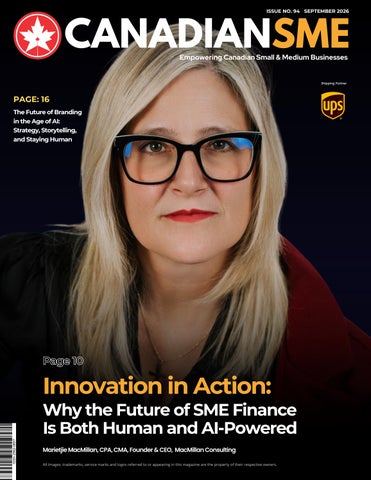
ISSUE NO. 94 SEPTEMBER 2026
CANADIANSME Empowering Canadian Small & Medium Businesses
Shipping Partner
PAGE: 16 The Future of Branding in the Age of AI: Strategy, Storytelling, and Staying Human
Page 10
Innovation in Action:
Why the Future of SME Finance Is Both Human and AI-Powered Marietjie MacMillan, CPA, CMA, Founder & CEO, MacMillan Consulting All Images, trademarks, service marks and logos referred to or appearing in this magazine are the property of their respective owners.
Dear Readers, Welcome to the September 2026 edition of CanadianSME Small Business Magazine, where we explore the theme of Innovation and Technology. As artificial intelligence, automation, and emerging technologies continue to reshape industries, this issue examines how Canadian SMEs can adopt innovation strategically while keeping people, purpose, and trust at the center of growth. We are proud to feature Hilary Borndahl, Founder and CEO of Miix Analytics Inc., as our Business Woman of the Month, celebrating leadership in technology and data-driven innovation. This edition brings together insights from industry leaders, including Renata Reis, Founder and Brand Strategist at Reiscape Design Studio, on the future of branding in the age of AI; Harjoet Mudan, Partner at Reach LLP, on preparing businesses for financial readiness; and Paul Casey, Director of Small Business at Meridian Credit Union, on planning, capital, and sustainable business growth. Our feature articles explore how innovation is transforming industries and creating new opportunities for Canadian businesses. From Innovation in Action and insights on turning waste into opportunity to why the future of SME finance is both human and AI-powered, this issue highlights the impact of purposeful innovation. We also examine how women entrepreneurs are driving technology and growth, along with how smart technology and AI are reshaping retail and sales, providing valuable perspectives for businesses adapting to a rapidly changing landscape. Looking ahead, we invite you to join us at the CanadianSME Summit 2026, presented by Amazon Business, on October 13, 2026, at the Metro Toronto Convention Centre. This gathering will bring together entrepreneurs, innovators, and industry leaders to exchange ideas, build connections, and explore the future of Canadian SMEs. As technology continues to evolve, the businesses that embrace innovation with purpose will be best positioned to grow, adapt, and succeed. We hope this edition inspires you with the knowledge and insights needed to navigate the next era of business transformation.
Warm regards, SK Uddin Publisher CanadianSME Small Business Magazine
All Images, trademarks, service marks and logos referred to or appearing in this magazine are the property of their respective owners.
www.canadiansme.ca info@canadiansme.ca canadiansme canadian_sme canadiansme canadiansme
Editor & Publisher Shaik Khaleeluddin(SK) Sr. Media Manager Maheen Bari Media Manager Kripa Anand Sr. Content Manager Amanda Spearing Creative Design Cmarketing Inc Social Media Cmarketing Inc Events Raoof Uddin Shaik Photography Deposit Photos, Cmarketing Inc. Web Cmarketing Inc
For Advertisements info@canadiansme.ca Cmarketing Inc 6345 Dixie Rd, Unit 202, Mississauga, ON L5T 2E6 Call us at +1 416 655 0205 /647 668 5785
ISSN 2562-0657 (Online)
Published by Cmarketing Inc 6345 Dixie Rd, Unit 202, Mississauga, ON L5T 2E6. Copyright © 2024 CMarketing Inc. All rights reserved. Reproduction in whole or part of any text, photography or illustrations without written permission from the publisher is prohibited.
The contents in CanadianSME Magazine are for informational purposes only. Neither Cmarketing Inc, the publishers nor any of its partners, employees or affiliates accept any liability whatsoever for any direct or consequential loss arising from any use of its contents.
IN THIS ISSUE CanadianSME Small Business Magazine
31 Getting Audit‑Ready Before Your Lender Asks Harjoet Mudan
Partner at Reach LLP
25
Canada’s Women Entrepreneurs Driving Technology and Growth
38
Digital Solutions for Entrepreneurial Health and Productivity
43
AI-Powered Transformation of Canadian Main Street Retail
46
How AI Is Transforming Sales for Canadian SMEs
58
The New Technology Stack Powering Canadian Small Businesses
72
Technology Empowering Indigenous and Diverse Entrepreneurs
IN THIS ISSUE CanadianSME Small Business Magazine
28
AI Cybersecurity Challenges Facing Canadian Small Businesses
61 Turning Exploration Into Innovation: Kyle Bauder’s Zelse Journey
68
AI, Wealthtech and Leadership: Inside d1g1t’s Journey
67 Why 60% of AI Projects Are at Risk and What SMEs Can Do About It
21 Business Woman of the Month:
Hilary Borndahl Founder and CEO of Miix Analytics Inc.,
IN THIS ISSUE CanadianSME Small Business Magazine
55
How Smart Technology Is Reshaping Retail Across Canada
64
Why September Matters for Canadian Work and Justice
49
How Canadian SMEs Are Making AI Deliver Real Impact
58
The Technology Trends Defining Canada’s SMEs to 2030
Getting Your Business Exit-Ready: Selling on Your Own Terms
75
71
The CRA Registration Change That Depends On Whether You Have Filed
Stop Trying to Sound Like a Big Brand!
41
35
Turning waste into opportunity
Image Courtesy: Marietjie MacMillan
Innovation in Action: Why the Future of SME Finance Is Both Human and AI-Powered Why structure — not budget — is the real constraint on growth, and how fractional expertise and AI are putting executive-level finance within reach of small and mid-market businesses.
By Marietjie MacMillan, CPA, CMA Founder & CEO, MacMillan Consulting
Ask most founders what holds their business back,
The human force is access. For years,
Small Business Show this May — I’ve come to believe the real constraint is something else.
needed it most. That’s changing. Fractional executives, on-demand specialists, and project-based advisory
and they’ll point to budget. Spending almost three decades in executive finance — and after sitting on the “Innovation in Action” panel at the CanadianSME
“Companies don’t have a budget problem. They have a structure problem.” Growing companies rarely stall for lack of ambition. They stall because their finance function was built for where the business used to be, not where it’s headed. Bookkeeping keeps the lights on, but no one is turning numbers into decisions. Expansion gets debated in meetings when it should be modelled into forecasts and built into a plan. Sustainable growth ends up a slogan instead of a strategy. Innovation in finance isn’t a new piece of software. It’s a better way of organizing expertise around the decisions that move a business forward. Two forces — one human and one technological — are quietly reshaping what’s possible for small and mid-market companies.
senior financial leadership was priced for large enterprises and out of reach for the founder-led businesses that
now let a $1M company tap the same calibre of CFO, controller, and FP&A expertise a far larger company relies on — at a fraction of the cost, and only when it’s needed. The seat no longer has to be full-time to be world-class. The technological force is AI. Used well, it compresses the time between a question and an answer. Reconciliations that took days take hours. Scenario planning that once waited for quarterend becomes a live conversation. But — and this matters — AI doesn’t replace financial judgment. It amplifies it. A forecast is only as good as the strategist reading it. Numbers exist to serve people, not the other way around. 10- CanadianSME - SEPTEMBER 2026
Fractional Finance
Image Courtesy: Canva
That idea — what I think of as humanized finance — is the thread tying the two forces together. Technology and access only create value when they help a real person make a better decision about a real business. For SMEs planning their next phase, three principles turn that philosophy into action. Build structure before you add headcount. Most growing businesses don’t need more people in finance. They need the right expertise, organized around the right decisions, at the right moment. Define what you need before you hire. Treat strategy as standard, not a luxury. A finance function that only records the past
is a cost. One that shapes the future is an investment. Growth roadmaps, market-entry models, and team architecture shouldn’t wait until you can afford a full executive team.
Let speed be a feature. With distributed
teams working across time zones, strategy set during one business day can be
executed overnight — so founders wake up to work already in motion. In a market that rewards the fast, structure plus technology becomes a real advantage.
The businesses building our economy deserve finance support that matches their ambition. That’s the gap worth closing. Innovation in action isn’t about doing more. It’s about being built right: human judgment at the centre, technology accelerating it, and strong expertise finally within reach of the companies driving growth forward. For Canada’s small and mid-market businesses, that isn’t a luxury anymore. It’s becoming the new standard.
11- CanadianSME - SEPTEMBER 2026
Author - Marietjie MacMillan, CPA, CMA Marietjie MacMillan, CPA, CMA, is the Founder & CEO of MacMillan Consulting, a finance back-officepartner delivering executive-level strategy and execution to founder-led and midmarket businesses across Canada, the United States, and the United Kingdom. With nearly three decades in executive finance, she built MacMillan Consulting to close a longstanding gap in the market: making elitefinance leadership accessible to growing companies without the full-time cost. Through Talent-as-a- Service, Fractional Services, and MMC/MMA Consulting — and an owned talent pool spanning Canada and South Africa via her sister company, MacMillan Mzansi Accountancy, which she owns outright — her team pairs globally credentialled people with AI-enhanced workflows and a 24-hour execution cycle, with strategy included as standard. Marietjie champions “humanized finance”: the belief that numbers exist to serve people, not the other way around.
Image Courtesy: Paul Casey
Building Resilient SMEs:
Paul Casey on Planning, Capital, and Business Growth
Director of Small Business, Meridian Credit Union
In an exclusive interview with CanadianSME Small Business Magazine, Paul Casey, Director of Small Business at Meridian Credit Union, shares his perspective on helping Canadian entrepreneurs build stronger, more adaptable businesses in an evolving economic environment. With extensive experience supporting small and medium-sized businesses, Paul discusses why strategic planning, financial awareness, and trusted advisory relationships are essential for long-term success.
Interview By SK Uddin As Meridian's Director of Small Business, Paul Casey provides strategic leadership for Meridian's province-wide Small Business Division, working closely with teams of specialized Small Business advisors in every corner of Ontario. His focus is on empowering Meridian leaders to deliver exceptional advice and value to Meridian's fast-growing SME business Members, who are important contributors to the economic vitality of communities across Ontario. Before joining Meridian, Paul held several senior leadership positions with BDC, including VP, Financing and Consulting for SW Ontario.
12- CanadianSME - SEPTEMBER 2026
Business Resilience What’s your big picture advice for business owners/operators when it comes to planning in uncertain times? Uncertainty is something every business owner will face. While no one can predict exactly what's around the corner, business owners can put themselves in a stronger position by focusing on what they can control. That starts with understanding the fundamentals of your business, your cash flow, profitability and customer demand—but it also means taking time to think beyond today's challenges. The businesses that tend to navigate uncertainty best are those that balance day-to-day decision-making with a longerterm view of where they want to go. It's also important to seek advice before it's needed.
Whether it's your accountant, lawyer, industry peers or financial partner, having trusted people around you who understand your goals can help you navigate challenges and identify opportunities you might otherwise miss.
2 - Profit Margins In a higher-cost environment, businesses need to understand where their profits are coming from and whether rising expenses are putting pressure on margins. Regularly reviewing pricing, labour costs and operating expenses can uncover opportunities to improve efficiency and profitability.
3 - Working Capital How quickly are receivables being collected? Is inventory moving efficiently? Do you have access to enough liquidity if business conditions change unexpectedly? These metrics provide valuable
insight into how resilient a business is and how prepared it is for growth opportunities or economic shifts. Together, these indicators help tell the full story of a business's health—not just where it is today, but where it may be headed next.
Ultimately, planning isn't about predicting the future. It's about building the confidence and flexibility to adapt as conditions change.
What are the top 3 datapoints or business health indicators business operators should be taking a hard look at? Cash flow is often the clearest indicator of a business's financial health. Revenue can look strong on paper, but understanding what's coming in, what's going out and when those transactions occur is critical to managing day-to-day operations and planning for growth.
1 - Cash Flow Cash flow is often the clearest indicator of a business's financial health. Revenue can look strong on paper, but understanding what's coming in, what's going out and when those transactions occur is critical to managing day-to-day operations and planning for growth.
13- CanadianSME - SEPTEMBER 2026
Business Resilience Talk to me about accessing capital and how to know when is the right time to seek and/or accept financing? One of the most common misconceptions among entrepreneurs is that financing should only be considered when there's an immediate need. In reality, the best financing conversations often happen well before a business requires capital. Whether you're planning to hire staff, purchase equipment, expand operations or pursue a new opportunity, exploring your options early gives you more flexibility and time to make informed decisions. The right time to seek financing is when there's
a clear purpose and a strong understanding of how that investment will help move the business forward. Financing should support a broader strategy, whether that's creating efficiencies, increasing capacity or positioning the business for future growth.
It's also important to remember that every
business has a unique story. While financial performance matters, understanding a
business's goals, opportunities and challenges often leads to a more meaningful conversation about capital and long-term success. What do you wish more business owners/operators would speak with their financial institution about—and why? Their future plans. Many business owners initially approach their financial institution with a specific need, such as financing or day-to-day banking. Yet some of the most productive conversations happen before a transaction is ever needed. Whether it's succession planning, expansion into new markets, managing cash flow, investing in technology or preparing for future opportunities, sharing those plans early allows for more thoughtful advice and better long-term planning.
14- CanadianSME - SEPTEMBER 2026
The more context a business owner is comfortable sharing, the easier it is for their advisors to understand the bigger picture and help identify solutions or opportunities that may not have otherwise been considered. Strong relationships are built through ongoing conversations, not just transactions. What are the biggest challenges most Canadian SMEs face right now? Many small and medium-sized businesses continue to face a combination of pressures rather than a single challenge.
The cost of doing business remains high, with labour,
insurance, utilities and operating expenses continuing to impact margins. At the same time, many businesses are adapting to changing customer expectations and ongoing economic uncertainty.
Talent attraction and retention also remain key concerns. Across many sectors, business owners are looking for ways to attract skilled employees while balancing costs and maintaining growth.
Another challenge is simply finding the time to think
strategically. Many entrepreneurs are managing multiple priorities every day, making it difficult to step back and focus on long-term planning.
Despite these challenges, Canadian business owners continue to demonstrate remarkable resilience, adaptability and innovation—qualities that have always been hallmarks of entrepreneurial success.
Image Courtesy: Canva
Business Resilience Are there any new government initiatives to support SMEs that you feel more business owners should take advantage of—or at least explore with their financial partners?
What are the biggest lessons you've learned from Meridian's SME clients?
One program worth exploring is the BDC Accelerator Loan Program, which is helping expand access to capital for entrepreneurs
The entrepreneurs who thrive over the long term are often those who stay connected—to their customers, employees, communities and trusted advisors. They understand their
Programs like this can provide additional flexibility for businesses looking to invest in growth, manage working capital needs or pursue opportunities that might otherwise
I've also seen that resilience comes in many forms. Some businesses succeed by innovating, others by staying disciplined and focused on their core strengths. What they
and businesses that may not always fit traditional lending models.
be difficult to finance. For newer businesses and entrepreneurs from underrepresented groups, these programs can be especially valuable.
One of the biggest lessons I've learned is that successful businesses are rarely built in isolation.
numbers, but they also understand the importance of relationships and remain open to learning and adapting as circumstances evolve.
all have in common is a willingness to evolve when conditions change.
At Meridian, we're proud to be one of a select group of financial institutions
participating in the program. As the largest credit union in Ontario, Meridian combines the benefits of programs like BDC Accelerator with relationship-based banking, personalized advice, and local
decision-making. This allows us to help business owners access financing solutions that support their unique growth objectives while providing the guidance and expertise needed to navigate today's increasingly complex business environment.
More broadly, I encourage business owners to regularly ask about government-backed financing programs, grants and advisory resources. Many entrepreneurs are focused on running their business and may not realize what support is available. A conversation with a trusted financial partner can often uncover opportunities that align with a business's goals and stage of growth.
Perhaps most importantly, I've been reminded time and again of the role small businesses play in strengthening our communities. They create jobs, support local initiatives, foster innovation and contribute to the economic well-being of the regions they serve. When local businesses succeed, the benefits extend far beyond the business itself.
Disclaimer: The views and opinions expressed in this interview are those of the interviewee and do not necessarily reflect the official policy or position of CanadianSME Small Business Magazine. Our platform is dedicated to fostering dialogue and sharing insights that inspire and empower small and medium-sized businesses across Canada.
15- CanadianSME - SEPTEMBER 2026
The Future of Branding in the Age of AI: Strategy, Storytelling, and Staying Human In an exclusive interview with CanadianSME Small Business Magazine, Renata Reis, Founder and how businesses can build stronger brands in an era where artificial intelligence can create content faster than ever. Drawing from her journey across banking, creative industries, and entrepreneurship, Renata explains why meaningful branding requires more than visual appeal — it requires strategy, authenticity, and a clear understanding of what makes a business unique.
Interview By Kripa Anand Renata Reis is a Brazilian brand strategist, art director, and founder of Reiscape Design Studio,based in Toronto. She helps wellness founders build brands that connect with their audience through strategy,storytelling, and purposeful design. Her path was not a straight line. Renata began her career in banking in Brazil, where she learned the fundamentals of client relationships but never felt she belonged. Pulled toward creative work,she moved to Canada in 2018, graduated from Humber College in Advertising and Graphic Design, and built experience in art direction, marketing, and international education before opening her own studio.
Renata Reis
Founder and Brand Strategist at Reiscape Design Studio
Image Courtesy: Renata Reis
Brand Strategist at Reiscape Design Studio, shares
AI Branding AI is rapidly lowering the barrier to creating “goodlooking” content. In your view, what will separate brands that grow from those that just look polished in an AI-saturated market? For years, looking professional was a real advantage. AI just erased that. Anyone can generate a polished feed in an afternoon now, which means polish is no longer proof of anything. It is the price of entry, not a differentiator. What separates the brands that grow is the thing AI cannot fake: a point of view. Clear positioning, a real reason to exist, and a feeling that belongs only to you. I say it to every client: pretty isn't positioning. A beautiful brand that says nothing is invisible in a feed full of beautiful brands that say nothing. Image Courtesy: Renata Reis
AI can copy your aesthetic in seconds. It cannot copy
your truth, your story, or the specific way your business makes people feel. Those come from strategy and from knowing yourself, not from a tool. So in an AI-saturated market, the winners are not the
ones with the best-looking content. They are the ones with the clearest meaning behind it. Content gets you noticed. Positioning is what makes people choose you, remember you, and stay.
How should small businesses think about balancing AIgenerated efficiency with maintaining a distinct, human brand voice? Efficiency and voice are not the same job, and the mistake is letting the first erase the second. AI is excellent at speed: drafts, outlines, repurposing, first passes. It becomes dangerous the moment you let it decide who you sound like. My rule is that voice is defined by strategy first, then AI works inside those guardrails, never the other way around. Before a business touches a tool, it should know its values, its tone, the words it uses and the words it refuses to use, all the strategy and communication strategy behind this brand and business. Once that is clear, AI becomes an assistant that sounds like you, because you told it who you are, from the strategy that was built. The real risk is sameness. If everyone prompts the same tools with no strategy underneath, everyone starts to sound identical, and identical is forgettable.
17 - CanadianSME - SEPTEMBER 2026
A human voice carries what AI has none of: real experience, a point of view, warmth, even the right imperfections. So use AI to move faster. Just keep a human who has knowledge to make the judgment if what AI is producing is worth or not using, is key.
What are some practical ways you’re currently using AI in your workflow, and where do you intentionally avoid it to preserve quality or authenticity? I use AI every day, and I am open about it. It helps me research a market, organize my thinking, structure a strategy document, and turn one idea into many formats. It lets me take the report templates I have already built for clients and fill them in faster, instead of doing every gap by hand. It also lets me feed in the deep knowledge I have about branding, about specific brands and clients, so I can pull useful information later. It even helps me sharpen my English in writing, since it is my second language.
AI Branding It removes the friction that used to eat my time, so I can spend more of it on the part that matters. Where I stop is the thinking itself. The core of my work is pulling out the truth of a business: its positioning, its story, the feeling inside a space. That comes from real conversations with a founder, from noticing what they do not say. No tool can sit in that room. AI can draft, but the decisions about what is true, what is brave, and what sounds like the client stay with me. I let AI handle the how, never the why. That is the human part, and it is the
Positioning is the opposite job. It is about being different on purpose. Handing it fully to a tool built to find the average is how brands end up sounding competent and identical at the same time. The other risk is quieter. When you outsource the thinking, you slowly lose contact with your own insight, the lived experience and specific truth that only you have. AI gives you a confident answer, and confident feels finished, so you stop digging. But the best positioning usually lives one layer deeper than the first goodsounding sentence. To
With AI agents and automation becoming more capable (from content to customer interaction),
what you actually believe. Then use AI to sharpen and pressure-test that thinking, not to generate it from nothing. Use it as a sparring partner, not an
whole point.
how do you see the role of brand strategy evolving over the next 2–3 years?
stay grounded, do the human work first. Talk to your real customers. Know your own story. Decide
oracle. The insight has to start with you. AI can help you say it better. It cannot help you know it.
II think strategy becomes more valuable, not less. It sounds backwards, but the more execution gets automated, the more the scarce skill is knowing
Your studio, Reiscape, recently repositioned to
generate and automate content, posts, replies, entire campaigns, the market floods with output. In
generate a brand in minutes, why does building from lived experience and human truth matter more than ever?
with a clear direction underneath it all. Brand strategy becomes the operating system that tells every tool and every agent what to say, in what
Because a tool can generate a “brand”, but it cannot live one, and it cannot tell you what is actually good
what to execute and why. When anyone can
that noise, the businesses that win are the ones
voice, to whom, and what to never say. Automation without strategy just produces more forgettable noise, faster. There is a second shift. As AI content becomes everywhere, real human trust becomes
premium. People will gravitate to brands that feel genuinely human, that have a point of view and a story they can believe. That feeling has to be designed on purpose. So over the next few years, I see strategy moving from a nice-to-have to the thing that holds everything together. The tools will keep getting better at doing. Someone still has to decide what is worth doing. That decision is strategy, and it stays human Many founders are now relying on AI for messaging and positioning. What risks do you see in outsourcing too much “thinking” to AI, and how can businesses stay grounded in real insight? The biggest risk is that AI averages. It learns from everything that already exists, so left alone it pulls you toward the middle, toward what everyone in your category already says.
focus fully on wellness, a decision rooted in your own personal story. In an age when AI can
or not. Reiscape exists because wellness spaces pulled me through the hardest chapter of my life.
Choosing to serve wellness businesses was not a market analysis. It was my own story deciding what my work is for. AI could never have handed me that, because it has no lived experience to draw from. That is the whole point in this moment. When anyone can produce a polished- but not strategic brand in minutes, what stands out is the one thing that cannot be generated: a real human truth underneath it. People can feel the difference between a business that knows why it exists and one that assembled a nice looking version of itself. The brands I believe in over the next decade will be built from something true. A founder's story, a real reason to care, a point of view earned through experience. AI can help us say it faster but it cannot give us something worth saying. That still has to be lived and experienced.
AI Branding
IZABELLA ORDONES Personal Brand, Team Brand and Social Media Strategy.
ABOUT IZABELLA Izabella Ordones is a financial leader serving the Brazilian and Portuguesespeaking community in Toronto, working in financial education, life insurance, investments, and career mentorship. We began with branding and a change of positioning. Izabella was known simply as an insurance consultant, a label that made her look smaller than she truly is. We rebuilt her brand and repositioned
her as a leader and an authority in the
Canadian financial market, someone who helps people build financial freedom and forms new leaders, not only someone who sells policies.
From there, we moved into her social
media and content strategy, giving her a
Verified results From September 2025 to the December 2025 and January 2026 reporting period:
• Reach increased by 91%
• Views increased by 120% • Profile visits increased by 43% • Likes increased by 249%
• Comments increased by 365% • Shares increased by 1,600% • Saves increased by 400%
clear editorial direction, a stronger narrative, and a consistent voice across
grown in reach and, most importantly, in credibility and authority. She is now recognized as a reference in her space,
and her communication finally matches the level of results she delivers in person. Our ongoing work includes: • Monthly strategic content planning • Monthly video-production sessions • Creative direction and scripting • Video editing and design • Performance analysis • Testing different topics, hooks, and formats • Identifying which stories and formats create the most connection, authority, and audience response Rather than repeating the same content formula, we continuously analyze performance and refine the strategy based on audience behaviour.
Image Courtesy: Izabella Ordones
her channels. Since then, her brand has
Image Courtesy: Renata Reis
AI Branding
BRS Solutions: Accounting & Docs Brand strategy and visual identity BRS Solutions is an administrative and fiscal consultancy that helps immigrants build a secure new life in Canada, serving the Brazilian and Portuguesespeaking community in Toronto. The heart of our strategy was to separate the business into two clear service lines: Accounting, for fiscal and tax security, and Docs, for document organization.
This structure directly addresses the two biggest challenges immigrants face when starting over, and it gives each service its own clear identity while keeping them united under one trusted brand. We built the full brand end to end, from strategy and visual identity to a new website and a branding photoshoot, all grounded in a simple promise: making paths easier and caring for people. The result is a brand that feels professional and technically strong, but also warm and human, so clients feel understood rather than just processed, from the very first contact.
20 - CanadianSME - SEPTEMBER 2026
By SK Uddin
Proving the Power of Marketing with Miix Analytics Hilary Borndahl, Founder and CEO of Miix Analytics Inc., has created a boutique analytics organization that helps brands in Canada, the United States, and around the world answer one of the most difficult management questions: "Is our marketing truly effective?" With over 20 years of expertise in marketing analytics and market research, she is a recognized specialist in Marketing Mix Modelling (MMM) and ROI, and a vocal advocate for women's growth and community building in Canada's marketing sector.
From Global Analytics Leader to Canadian Founder Hilary has a stellar career in senior analytics roles with global behemoths Nielsen and Kantar before founding Miix Analytics. She led advanced analytics practices, built talent pipelines, and drove accelerated growth in MMM and ROI products at
these organizations, while advising Fortune 500 marketers and insights leaders across industries and countries. She has worked with over 150 brands in Canada, the United States, Europe, and Asia, analyzing media data, brand lift,
sales lift, price and promotion, assortment, and in-store audit modelling tools. She earned a reputation as a trusted advisor and "excellent problem-solver," capable of transforming complex models into effective advice. In 2021, during the
Business Woman of the Month
Hilary Borndahl Founder and CEO of Miix Analytics Inc.
Image Courtesy: Hilary Borndahl
pandemic, Hilary founded Miix Analytics in Toronto's Liberty Village to offer a unique, founder-led approach to MMM programs.
Business Woman of the Month
Founding Miix Analytics For Smart, Fast, and Affordable MMM Miix Analytics is a boutique marketing mix modelling firm located in Liberty Village's historic Toronto Carpet Factory building. The firm aims to be the leading MMM boutique supplier in Canada, providing world-class advice backed by powerful analytics. Miix proposes a fresh approach based on three pillars: Smart, unbiased modelling demonstrates the short- and long-term worth of marketing and helps clients ask the right questions to promote growth. Fast - agile processes and coding dramatically reduce
Core products include Full-service Marketing Mix Modelling to quantify the impact and ROI of various channels, including TV, radio, digital, out-ofhome, in-store, promotions, and more Agile test-and-learn measurement for new campaigns Miix Marketing Research offers sponsorship ROI for sports and content partnerships
modelling time, providing marketers with insights while decisions are still being made.
item/UPC analytics, price elasticity modelling
Affordable - boutique structures and tailored interactions
eCommerce analytics, and marketing research (creative
The staff, which consists entirely of data analysts and data scientists situated in Canada and the Eastern time zone, has
firsthand expertise with customers' media and can collaborate in real time. Miix provides comprehensive assistance for brands'
MMM programs, including planning, data engineering, modelling, dashboards, and C-suite storytelling.
testing, brand and customer satisfaction, staff surveys) Customers characterize Miix as "topshelf," quick, and responsive, with
personalized dashboards and visualizations that simplify performance and improvement options.
Image Courtesy: Hilary Borndahl
make MMM accessible to advertisers beyond the top global brands.
22 - CanadianSME - SEPTEMBER 2026
Business Woman of the Month
Proving the Value of Marketing Budgets
To determine what is going on, why, and what should be done next, Miix's strategy begins with a thorough analysis of past sales and marketing trends. Hilary and
her team then assist clients in responding to important queries, such as How much additional revenue each channel is generating. To achieve our growth goals, where should we reallocate our spending? Which media mix is best for a given market, product, or time of year? She provides CMOs and CFOs with the facts they need
to make confident budget decisions—even in uncertain economic times—by grounding her responses in solid
Image Courtesy: Hilary Borndahl
analytics and 20 years of experience.
Image Courtesy: Hilary Borndahl
Miix's primary purpose is to help brands demonstrate and defend the value of their marketing investments and optimize future strategies to boost return on investment. According to Hilary's explanations in interviews and conference lectures, MMM quantifies the incremental impact of each marketing vehicle on sales and brand KPIs using sophisticated statistical approaches, such as multivariate regression on sales and media time-series data.
Advocate, Community Builder, and Public Speaker Hilary is equally passionate about community, equity, and people. She is a mother of three kids and an ardent supporter of women's advancement and of breaking down glass
ceilings, particularly in executive and datadriven fields where women remain underrepresented. According to her, diversity
is a "major value add" for any firm, regardless of gender, colour, life experience, or educational background.
She puts this dedication into real networks. She was a co-founder of WishList SEO in Southeast Oakville in 2017, a group of local women who organize community events, assist nearby companies, and raise money for charitable causes. Tens of thousands of dollars have been donated to charities such as Food4Kids Halton, Kerr Street Mission, SafetyNet, Home Suite Hope, Red Cross Ukraine, ROCK, and Lighthouse for Grieving Children and Families, thanks to their efforts. Through guest lectures, podcasts, conference keynote addresses, the Insights Association (Toronto Chapter & CEO Summit Squad), and the Canadian Marketing Association (Media Council), Hilary also contributes to the larger marketing and insights ecosystem. 23 - CanadianSME - SEPTEMBER 2026
Lessons for Canadian Small Business and Women Founders Hilary's story offers useful insights for entrepreneurs and small-business leaders. Women/entrepreneurs need to be our own biggest cheerleaders. As leaders, we need to be fearless. Fail fast; get up and
Image Courtesy: Hilary Borndahl
Business Woman of the Month
try again when things you try don’t work out. Stay true to your passion and keep believing in yourself. Own your domain - by focusing on MMM and ROI, she established Miix as the go-to partner for marketers who require proof, not guesswork. Build locally, serve worldwide - retaining talent in Canada while servicing international brands demonstrates how Canadian boutiques can outperform their peers. Lead with both data and emotion - her dual commitment to rigorous analytics and community service (WishList, industry councils) exemplifies a holistic leadership style.
Hilary Borndahl represents the analytical, purpose-driven entrepreneurship highlighted by CanadianSME's Businesswoman of the Month. She transforms complex marketing data into meaningful ROI stories while also encouraging women and communities.
Your role in staying up to date is integral to our shared mission of fostering a community of innovators. CanadianSME Magazine is a valuable treasure trove of entrepreneurial knowledge. Click here to subscribe to our monthly editions for updates on Canadian businesses. Follow our handle, @canadian_sme, on X to stay updated on all business trends and developments. Your support is crucial to our mission. Disclaimer: This article is based on publicly available information and is intended only for informational purposes. CanadianSME Small Business Magazine does not endorse or guarantee any products or services mentioned. Readers are advised to conduct their research and due diligence before making business decisions.
24 - CanadianSME - SEPTEMBER 2026
Image Courtesy: Canva
Canada’s Women Entrepreneurs Driving Technology and Growth By Maheen Bari Across Canada, women founders are leveraging artificial intelligence and emerging technologies to develop durable, high-impact small businesses, despite systemic challenges to finance, networks, and visibility. These entrepreneurs are not merely implementing technologies; they are altering how Canadian SMEs operate and compete, making them an excellent target for a "Business Woman of the Month" highlight that celebrates tech-driven leadership and human-centred innovation.
25- CanadianSME - SEPTEMBER 2026
A Founder at the Intersection of AI and SME Growth A rising number of Canadian women-led firms are incorporating AI into their core operations, whether in retail, professional services, logistics, or digital products. According to research on women-owned businesses, technology use, including advanced and emerging technologies like artificial intelligence, is strongly related to productivity, competitiveness, and growth results. Many founders begin by using AI for practical activities such as automating customer conversations, anticipating demand, improving marketing, and transforming data into actionable insights. These female entrepreneurs frequently define leadership as a journey rather than a destination, emphasizing ongoing learning and a willingness to be uncomfortable when implementing new technologies.
Women Innovation They hire excellent technical talent, foster environments that encourage innovation, and use AI not as a gimmick, but as a means of increasing impact and better serving customers. This makes them powerful role models for other Canadian SMEs studying how to move beyond early-stage AI trials and into sustained, meaningful adoption.
Image Courtesy: Canva
Barriers and Funding Gaps Facing Women Tech Entrepreneurs Despite significant improvements, women entrepreneurs in Canada continue to face unequal access to financing, networks, and specialized support, particularly in technology-intensive industries. Research on women's entrepreneurship reveals persisting funding inequalities, underrepresentation in high-growth tech businesses, and ongoing hurdles in
obtaining venture capital or larger-scale loans. These inequalities are significant because they limit womenled SMEs' capacity to invest in AI infrastructure, hire technical teams, and test novel products.
The government Women's Entrepreneurship Strategy (WES) was developed to address some of these
disparities. Since 2018, WES has helped hundreds of thousands of female entrepreneurs with funding, consulting services, and ecosystem-building efforts. In 2026, the Canadian government renewed WES with a
commitment of over $173 million for loan money, ecosystem support, and a national knowledge hub that analyzes data and outcomes. These investments are aimed at making it easier for female innovators to secure microloans up to $50,000, tap into mentorship, and locate trustworthy advisors who understand both technology and business finance.
Support Networks and Ecosystems Powering Tech-Driven Women SMEs Support networks are essential for women who own tech-driven SMEs. National and regional programs, such as the WES Ecosystem Fund and the Women Entrepreneurship Knowledge Hub (WEKH), offer training, coaching, and research insights specialized to female entrepreneurs. WEKH unites ten regional hubs and more than 250 partner organizations to create a community where creators can exchange experiences, collaborate, and learn from each other's use of technology and AI.
Networking events and programs hosted by media organizations, chambers of commerce, and innovation centers provide forums for women to discuss ways to incorporate AI, manage risk, and develop sustainable, values-based enterprises. These networks frequently give tech-driven SMEs access to legal, financial, and technical knowledge that would be difficult to obtain on their own.
Technology Adoption Trends in Women-Owned Businesses A recent Canadian study that combines surveys of innovation and business strategy with employer-
employee data provides a detailed picture of how women-owned businesses use technology. The findings reveal that women-owned businesses are increasingly experimenting with advanced and emerging technology, but they may still lag behind male-owned businesses in some areas, particularly capital-intensive or highly specialized systems. However, when female entrepreneurs use digital tools and AI, the impact on operational efficiency and growth can be tremendous. These adoption patterns emphasize the significance of targeted training, affordable finance, and personalized advising services. Programs that teach practical AI applications, such as messaging automation, chatbot deployment, and data analysis for customer segmentation, can help women-led SMEs start small and build confidence.
Women Innovation These efforts, together with ecosystem support and increased acknowledgment of women-led companies in national lists and awards, increase the likelihood that female founders will be visible as tech leaders rather than outliers.
Why a “Business Woman of the Month” Spotlight Matters Featuring a Canadian female founder employing AI or emerging tech as your "Business Woman of the Month" is consistent with national priorities and your magazine's existing editorial calendar. Such a profile does more than honour an individual; it demonstrates how AI-enabled innovation may be rooted in values, community, and long-term growth. A strong feature may highlight: How she started her firm and decided to use AI or
By putting her narrative within the larger framework of WES, WEKH, and national studies on women's entrepreneurship, you provide readers with both inspiration and a road map: tangible examples of what is possible, as well as links to
resources for starting or scaling their own tech-driven SMEs.
Your role in staying up to date is integral to our shared mission of fostering a community of innovators. CanadianSME Magazine is a valuable treasure trove of entrepreneurial knowledge. Click here to
sophisticated technology.
subscribe to our monthly editions for updates on Canadian businesses. Follow our handle, @canadian_sme, on X to
Practical outcomes include enhanced customer experience,
stay updated on all business trends and
increased operational efficiency, and new products.
She discussed the challenges she experienced as a female tech startup, as well as how she managed fundraising,
developments. Your support is crucial to our mission. Disclaimer: This article is based on
networks, and regulations.
publicly available information and is intended only for informational
She also highlighted the specific Canadian initiatives, hubs,
purposes. CanadianSME Small Business Magazine does not endorse or guarantee any products or services mentioned. Readers are advised to conduct their research and due diligence before making business decisions.
Image Courtesy: Canva
or knowledge networks that aided her journey.
27 - CanadianSME - SEPTEMBER 2026
The Rise of AI-Enhanced Cyber Threats According to recent Canadian studies, cyber risk is now the number one issue for small firms, with many owners recognizing that AI tools are employed on both sides of the security equation. The Insurance Bureau of Canada (IBC) states that two-thirds of Canadian small and medium-sized business decision-makers are concerned that AI and other technologies would make it more difficult to protect against cyber hazards. At the same time, Canada ranks among the countries most afflicted by ransomware, with
hundreds of victims reported in only one year.
AI is exacerbating traditional Image Courtesy: Canva
risks in a variety of ways. Phishing emails can be auto-
AI Cybersecurity Challenges Facing Canadian Small Businesses
generated and personalized at scale, using language models to impersonate trusted businesses or executives with shocking accuracy. Voice and video deepfakes undercut standard verification methods, while AI-powered tools help attackers identify
By Kripa Anand
vulnerabilities, automate
As artificial intelligence (AI) reshapes company operations, it also alters the cyber threat landscape for Canadian SMEs. AI-enhanced fraud, phishing, and ransomware make attacks faster, more convincing, and easier for less-trained criminals, but Canadian privacy laws require tighter protections for personal information. Small and medium-sized enterprises (SMEs) face a clear challenge: they must improve cyber hygiene and implement effective security policies without enterpriselevel funding or dedicated security teams.
credential stuffing, and tailor social engineering scripts. These changes considerably enhance exposure for Canadian SMEs, who already have limited security resources.
28 - CanadianSME - SEPTEMBER 2026
Cybersecurity Innovation
Regulatory Obligations: PIPEDA and Canadian Privacy Cybersecurity is a technological, legal, and reputational challenge. Canadian enterprises that collect, use, or disclose personal information for commercial purposes are typically subject to the Personal Information Protection and Electronic Documents Act (PIPEDA) or analogous provincial legislation. Under PIPEDA, organizations must secure personal information with precautions commensurate with its sensitivity and notify specific breaches to the Office of the Privacy Commissioner of Canada and impacted persons. For SMEs, inadequate security against AIenhanced threats can result in regulatory investigations, obligatory breach notifications,
and long-term harm to customer trust. Implementing baseline cybersecurity procedures recommended by the Canadian Centre for Cyber Security (CCCS) serves as both a risk
Automatic Updates and Patch Management: Updating operating systems and applications fixes known vulnerabilities that automated scanning tools and AI-assisted attackers commonly exploit. Verified Backups: Regular, tested backups saved separately from primary systems are critical for recovering from ransomware without paying the ransom. Security Awareness Training: Teaching employees how to detect complex phishing efforts, deepfake-based schemes, and suspicious AI-generated messages decreases the possibility of human mistakes. These steps, together with basic network and endpoint protections, provide a solid basis for all Canadian SMEs, regardless of industry. Image Courtesy: Canva
management tool and proof of due care.
Core Cyber Hygiene: The CCCS Baseline Controls The CCCS has developed Baseline Cyber Security Controls, which are specifically designed for small and medium-sized businesses and provide a practical framework that offers the majority of the security benefit with reasonable effort. These controls include incident response planning, patch management, malware protection, secure configuration, strong authentication, security awareness training, data backup, mobile device security, network protection, cloud service security, web application security, access control, and portable media security. Several high-impact policies can be deployed rapidly and directly to reduce AI-enhanced threats: Multi-Factor Authentication (MFA): Enabling MFA on email, cloud services, and essential systems significantly reduces the success rate of credential theft and phishing, particularly when adopting phishing-resistant techniques.
Practical Security Playbook for Canadian SMEs To get from theory to practice, Canadian SMEs can follow a simple, staged roadmap that addresses AIenhanced threats while being realistic about budget and capacity.
29 - CanadianSME - SEPTEMBER 2026
Cybersecurity Innovation Lock down identity and access - Begin by strengthening identification controls: require unique accounts, prohibit sharing login credentials, and align access with the "needto-know" principle. MFA should be made mandatory for all remote access, email, and administrative accounts. Rolebased access control guarantees that employees only view
Conduct annual cyber-risk assessments - AI-driven dangers grow rapidly, necessitating constant assessments. Canadian SMB guidelines suggest doing annual risk assessments, ideally with the
the information they need, minimizing the impact of hacked accounts or insider misuse.
assistance of third-party experts, to identify high-risk areas and prioritize rectification. These assessments should take into account emerging AIrelated vulnerabilities such as deepfake fraud, data poisoning, and the misuse of generative tools, in addition to classic threats.
Put safeguards around AI use - Employees are already utilizing AI tools, sometimes without formal authority. Smart businesses do not ban AI; rather, they define which technologies are permitted and what information can be shared. Clear regulations should prohibit entering sensitive client data, financial information, or confidential documents into consumer-grade AI tools, while encouraging the usage of corporate platforms that provide contractual guarantees for data treatment. Regular awareness training ensures that employees understand the
Core Cyber Hygiene: The CCCS Baseline Controls
difference between safe experimentation and harmful data exposure.
Technical controls are required but
Adopt zero-trust principles - Zero-trust does not require complex software to get started; it begins with a mentality and design. Assume that any device, user, or program could be compromised, and check frequently. Practical procedures for SMEs include network segmentation to separate essential systems, restricting administrative privileges, monitoring access events, and analyzing odd behaviour. This containment strategy prevents the spread of ransomware or unauthorized access in the event of a first breach. Secure Cloud Adoption and Third - Party Relationships Cloud services are becoming essential for Canadian SMEs, yet they function under shared responsibility models. Instead of relying on providers to handle everything automatically, businesses must define access rights, backup settings, and security features. When adopting managed IT services or SaaS platforms, SMEs should assess vendor security standards, ensure MFA is enforced, and understand incident response duties. Consider Cyber Insurance Tailored for SMEs - As AIenhanced threats increase the cost and frequency of catastrophes, cyber insurance has become an important risk transfer mechanism. Small business policies can cover incident response, data recovery, legal costs, and business interruption, but they often require basic security requirements such as multi-factor authentication, backups, and established procedures. Working with insurers can also provide access to security assessments and coaching, allowing SMEs to gradually improve their posture.
insufficient. A resilient Canadian SME culture views cybersecurity and ethical AI use as shared responsibilities, which is reinforced through leadership messages, onboarding, and regular training. Owners who openly discuss concerns, invest in employee education, and encourage early reporting of suspicious conduct convey a clear message that security is an integral part of everyday operations, not an afterthought. By combining robust cyber hygiene, thoughtful AI policies, and practical frameworks like the CCCS Baseline Controls, Canadian SMEs can address the challenge of AI-enhanced risks while remaining compliant with privacy rules and safeguarding the trust that supports their operations.
Your role in staying up to date is integral to our shared mission of fostering a community of innovators. CanadianSME Magazine is a valuable treasure trove of entrepreneurial knowledge. Click here to subscribe to our monthly editions for updates on Canadian businesses. Follow our handle, @canadian_sme, on X to stay updated on all business trends and developments. Your support is crucial to our mission.
Disclaimer: This article is based on publicly available information and is intended only for informational purposes. CanadianSME Small Business Magazine does not endorse or guarantee any products or services mentioned. Readers are advised to conduct their research and due diligence before making business decisions.
Getting Audit‑Ready Before Your Lender Asks In an exclusive interview with CanadianSME Small Business Magazine, Harjoet Mudan, Partner at Reach LLP, shares why strong financial foundations are essential for growing businesses seeking long-term success. With extensive discusses how organized reporting, effective internal controls, and proactive financial practices can help entrepreneurs make informed decisions and build stakeholder confidence.
Interview By SK Uddin Harjoet is a Partner at Reach LLP, an audit and assurance firm, with a strong focus on technical accuracy, practical insight and supporting confident business decision-making. He works closely with business owners and leadership teams to deliver reliable financial insight, meet regulatory requirements and navigate complex reporting needs without unnecessary complexity. Through Reach LLP’s affiliation with Reach Professional, clients can also access accounting, bookkeeping and advisory services. With a background in auditing publicly traded companies, Harjoet brings strong judgment, attention to detail and a business-forward approach to every client relationship..
Harjoet Mudan Partner at Reach LLP
31- CanadianSME - SEPTEMBER 2026
Image Courtesy: Harjoet Mudan
experience in audit and assurance, Harjoet
Audit Readiness You work closely with owners who often only think about assurance when a lender, investor, shareholder, funder or regulator suddenly asks for audited statements. What do you wish more growing businesses did earlier, before anyone formally requests an audit or review engagement? The first thing I’d like business owners and entrepreneurs to understand is that maintaining organized records goes beyond helping you stay ‘auditready’ by allowing you to see the complete picture of the company’s finances, so you can make more informed business decisions.
Below are the first two steps that will create the foundation of building financial statements that are ready for audit or review- while also providing valuable information for companies.
Many leaders hope they can “fix the books” once an audit is already underway, only to find the process stressful and time‑consuming. Why is it so difficult to clean things up at that stage, and what are some of the most common issues you see when businesses wait too long to get their financial reporting and documentation in order?
The first step is to ensure you are maintaining a complete & accurate
Trying to “fix the books” once an audit is underway often
Once the general ledger is complete and accurate, owners should implement a formal month-end process to ensure journal entries are
based on the financial information provided at the outset. If that information is
Having this a part of your regular business process will save valuable time and expense in the long run. One of the most common things I hear from
reassessed as new issues emerge, increasing the scope, time and cost of the
general ledger that is linked to underlying third-party supporting documents.
posted to be able to build financial statements that are compliant (IFRS, ASPE, US GAAP).
clients is, ‘why didn’t I do this sooner?’.
Image Courtesy: Canva
32- CanadianSME - SEPTEMBER 2026
creates more work, not less. Auditors plan their procedures
incomplete or inaccurate, the audit plan may need to be
engagement.
Audit Readiness Common problems include multiple versions of the general ledger, unreconciled accounts, missing supporting documentation, incomplete financial statement schedules and transactions that have not been recorded or classified correctly. Auditors may also identify internal control deficiencies or areas where management cannot clearly explain how balances were calculated. These issues have a ripple effect. Work may need to be repeated, additional samples may be required and areas initially considered lower risk may require greater attention. The completion stage can also take longer because the auditor must assess and communicate any misstatements, control deficiencies or other significant findings to the owners, board or audit committee.
The most efficient audits happen when the books, supporting schedules and documentation are complete, consistent and ready before fieldwork begins.
Reach LLP is focused exclusively on audit and assurance and is affiliated with Reach Professional, which provides accounting, bookkeeping and advisory services. How can proactive bookkeeping and organized financial reporting support financing conversations, investor confidence and stakeholder trust, especially as a business becomes more complex? When a lender, investor or stakeholder requests financial information and receives a clean set of financial statements within days or a couple of weeks, it signals that management is capable and understands the business. Having reliable financial statements readily available also allows businesses to act on
opportunities as they arise. Those that cannot produce accurate financial information in a timely manner risk losing financing, M&A and other opportunities.
Image Courtesy: Canva
33- CanadianSME - SEPTEMBER 2026
Audit Readiness As a business becomes more complex, weaknesses can compound into larger problems that take considerable time for management to resolve. With increased complexity, businesses need the right resources to assess and report the related accounting impact. Complex financial reporting often arises in situations involving convertible debt, private share placements, compound financial instruments, business acquisitions or divestitures. Good business owners know when it is time to seek expert help.
Strong financial statements build stakeholder trust and investor confidence. Conversely, unreliable financial reporting can quickly erode that confidence and may ultimately cause deals to fall through.
Your approach emphasizes practical insight, not just technical compliance. What internal systems, controls, and habits can a growing business put in place now so that an audit or review engagement becomes less disruptive and more valuable for decision‑making when it does arrive? As I mentioned earlier, creating a robust framework early allows
management focus on their business, while knowing they have the financial records to help them make informed decisions. It does not need to be onerous, but it does require the right people at the right time. A simple month-end checklist should be implemented by every business. The best operators I have seen create a waterfall checklist with preparer’s initial, date, along with a separate reviewer’s initial and date. This checklist should include preparation and review of monthly bank and credit card reconciliations, checking completeness and accuracy of accounts payable / accounts receivable aging list, all manual journal entries, such as identifying accruals, depreciation & amortization. Even with a lean team, I would recommend businesses implement sufficient segregation of duties, where the preparer has an independent reviewer sign off on their work. Businesses that do these things consistently find that an audit becomes a validation exercise with key insights & recommendations from their auditor rather than a disruption, and the reporting itself becomes a genuine management tool.
Outside the firm, you mentor through the World Sikh Organization and describe yourself as a perpetual learner with a curiosity for science and emerging technology. How does that mindset shape the way you support clients, and what final piece of advice would you offer Canadian small and mid‑sized business owners who want their financial reporting to support growth instead of slowing them down? Being a perpetual learner is what
keeps me useful to my clients. Technology and business don't slow down, so I stay curious about the tools
and ideas that could help them, whether that's automation in their dayto-day accounting or the way emerging tech is reshaping their industry.
My mentorship role at the World Sikh Organization is one of the ways I give back to the community. It gives me a
sense of fulfillment to help individuals and businesses achieve their goals,
and it frames how I approach client service. Just as I’m in my mentees’ corner as they navigate their personal life & professional career, I’m there to support my clients in their success.
A final piece of advice I would give to Canadian small and mid-sized businesses is to apply a tactical approach to improving your financial reporting. Every business is different; identify your weaknesses and apply the right resources, which can save you substantial time, cost, and create opportunities for strategic decisionmaking.
Disclaimer: The views and opinions expressed in this interview are those of the interviewee and do not necessarily reflect the official policy or position of CanadianSME Small Business Magazine. Our platform is dedicated to fostering dialogue and sharing insights that inspire and empower small and medium-sized businesses across Canada.
34- CanadianSME - SEPTEMBER 2026
Image Courtesy: Canva
How Smart Technology Is Reshaping Retail Across Canada By SK Uddin From Toronto's Queen Street West to Vancouver's Robson Street and Calgary's Stephen Avenue, Canadian shopping areas are ushering in a new era in which technology silently supports every aspect of the retail experience. Retail technology is evolving from isolated gadgets to connected ecosystems, with cashier-less micro-stores, QR-enabled trips, tailored loyalty applications, and in-store analytics all working together to provide seamless, omnichannel experiences for both customers and merchants.
Cashier-Less Micro-Stores and Frictionless Checkout One of the most noticeable changes in Canadian retail is the rise of frictionless checkout, inspired by global pioneers but now better suited to local needs. Cashierless micro-stores utilize computer vision, sensors, and mobile payments to let customers go in, pick up their items, and leave without pausing at a traditional register. In Canada, this technique is being attempted in urban convenience formats, college settings, and transportation hubs, where speed and limited floor area are critical. 35- CanadianSME - SEPTEMBER 2026
Smart Retail These stores often use a combination of AI analytics, smart shelves, and digital receipts sent to consumers' phones or email addresses. Retailers profit from shorter lines, more detailed data on product interactions, and more flexible staffing arrangements. However, experts warn that cashier-less models perform best when combined with clear signs, strict privacy policies, and options for customers who prefer
Image Courtesy: Canva
human assistance or cash payments. Rather than replacing employees, many Canadian retailers are redeploying them to roles that require product expertise, customer involvement, and omnichannel assistance.
QR-Enabled Experiences in Canadian Main Streets QR codes have transitioned from novelty to
infrastructure in Canadian commercial districts, particularly after the pandemic encouraged contactless behaviour. Retailers now utilize QR codes to send product details, reviews, sustainability information, and unique deals to customers at the shelf edge. A shopper perusing a boutique in Toronto or Halifax can quickly scan a code to view online inventory,
request various sizes, or join a loyalty program.
QR-enabled encounters can enable hybrid in-person/digital journeys. Customers may discover a product in-store, scan a code to add it to their wish list, and then finish their purchase online or through click-and-collect. This "phygital" method blurs the distinction between looking and purchasing, allowing shops to collect intent even if a shopper leaves without a bag. Cloud-based QR tools and low-cost landing page builders enable smaller merchants to deploy these experiences without having to design specialized apps.
Personalized Loyalty Apps and Unified Commerce Personalized loyalty has become a critical component
of Canadian retail IT strategy. Loyalty apps and digital programs increasingly go beyond simple point gathering to incorporate personalized offers, dynamic incentives, and cross-channel recognition. Customers are increasingly expecting businesses to remember their preferences across physical stores and online platforms—whether they're buying at a mall, on a brand's website, or on social media.
Canadian businesses use data from POS systems, ecommerce platforms, and mobile apps to create unified customer profiles. AI algorithms help categorize shoppers and offer relevant specials, while push notifications and email marketing encourage timely visits based on behaviour and geography. For small businesses, plug-and-play loyalty solutions linked with cloud POS systems provide an easy road to personalization without the need to establish proprietary data architecture. As omnichannel commerce grows—BOPIS (buy online, pick up instore), curbside pickup, and ship-from-store—loyalty programs serve as the glue that holds customer experiences together across channels. 36 - CanadianSME - SEPTEMBER 2026
Smart Retail
In-Store Analytics and Intelligent Retail Behind the scenes, in-store analytics are changing how Canadian retailers perceive traffic, merchandising, and operations. According to Canadian digital economy academics, intelligent retail is the intentional use of technologies such as sensors, computer vision, and artificial intelligence to optimize store layouts, staffing, and product placement. Analytics tools can indicate when and where
customers spend their time, which displays convert, and how promotions influence store traffic flow. When combined with sales data, this information helps merchants refine planograms, adjust signage, and allocate staff to high-impact areas. Such findings are
especially important to Canadian retailers in compact urban locations where every square foot must be profitable.
A small boutique can use connected SaaS solutions to sync in-store inventory with an online catalogue, accept mobile orders, arrange in-store appointments, and perform targeted promotions. The founders who were interviewed emphasized practicality: start with a core stack (cloud POS, ecommerce, loyalty, and messaging) and build up QR, analytics, and automation only where they bring clear value. The end result is a hybrid approach in which customers may browse in-store, buy online, pick up curbside, and engage through applications or social channels. For Canadian SMEs, the strategic challenge is no longer whether to implement retail technology, but rather how to create a unified, human-centred ecosystem that supports employees, delights consumers, and represents the unique character of each shopping district.
Importantly, many solutions are geared toward small and medium-sized businesses rather than national chains. Cloud-based in-store analytics, which are
frequently integrated with video systems or point-ofsale devices, provide dashboards that shop managers can understand without the need for dedicated data teams. This democratization of intelligence enables independent merchants to compete on experience, even if they lack the scale of big-box stores.
Omnichannel Strategies and Hybrid Online–Offline Experiences Canada's retail future is predominantly multichannel. Analysts predict that by the end of this decade, merged digital and physical commerce will account for a significant portion of overall retail volume, as clickand-collect, ship-from-store, and flexible fulfilment become commonplace. For shopping districts, storefronts are no longer merely sites of sale; they are also discovery hubs, pickup points, and brand experience centers. Canadian retail technology pioneers are developing platforms that combine inventory, orders, and customer data across channels, allowing SMEs to provide enterprise-level experiences.
Image Courtesy: Canva
Your role in staying up to date is integral to our shared mission of fostering a community of innovators. CanadianSME Magazine is a valuable treasure trove of entrepreneurial knowledge. Click here to subscribe to our monthly editions for updates on Canadian businesses. Follow our handle, @canadian_sme, on X to stay updated on all business trends and developments. Your support is crucial to our mission. Disclaimer: This article is based on publicly available information and is intended only for informational purposes. CanadianSME Small Business Magazine does not endorse or guarantee any products or services mentioned. Readers are advised to conduct their research and due diligence before making business decisions. 37 - CanadianSME - SEPTEMBER 2026
Image Courtesy: Canva
Digital Solutions for Entrepreneurial Health and Productivity By Maheen Bari
Canadian entrepreneurs and small and medium-sized business owners are increasingly turning to digital health, mindfulness applications, wearables, and AI-based wellness platforms to manage stress, anxiety, and burnout in a high-pressure workplace. Building on themes like CanadianSME's "Retail & Mental Health Awareness" focus, technology is emerging as both a risk and a solution, altering how entrepreneurs care for their mental health while maintaining productivity.
38 - CanadianSME - SEPTEMBER 2026
The Mental Health Reality for Canadian Entrepreneurs Recent Canadian polls show a considerable
mental health burden among entrepreneurs. According to BDC research, more than onethird of entrepreneurs report that mental health interferes with their ability to work at least once a week, with the rate climbing to 60% among younger founders. Many people describe symptoms of burnout, worry, and despair caused by financial stress, long hours, and a fear of failure.
Despite these hurdles, an increasing number of businesses are seeking assistance. According to BDC, a significant number of people have sought professional help and found it useful in lowering anxiety and improving stress management. Mental health organizations and wellness initiatives are increasingly identifying founders as a separate group with particular concerns, resulting in tailored support and awareness campaigns across Canada.
Digital Wellness
Image Courtesy: Canva
Canadian entrepreneurs and small and mediumsized business owners are increasingly turning to digital health, mindfulness applications, wearables, and AI-based wellness platforms to manage stress, anxiety, and burnout in a highpressure workplace. Building on themes like CanadianSME's "Retail & Mental Health Awareness" focus, technology is emerging as both a risk and a solution, altering how
entrepreneurs care for their mental health while maintaining productivity.
Digital Health and Mindfulness Apps Canada's mental health tech environment is broad, with mindfulness and meditation apps,
teletherapy platforms, AI-powered chatbots, and community-based support networks. Popular
mindfulness applications, such as those that offer guided meditation, breathing exercises, and sleep support, provide entrepreneurs easy-to-use, selfpaced solutions for managing daily stress. Therapeutic platforms and telehealth services enable small business owners to communicate with credentialed professionals without leaving their office or home, thereby overcoming geographic and scheduling constraints.
AI-powered chatbots can provide users with rapid, anonymous conversational support, allowing them to process emotions and access coping skills in between sessions. These technologies are especially useful for entrepreneurs who may be hesitant to seek traditional treatment because of stigma, time constraints, or privacy concerns.
Digital self-tracking apps, which monitor mood, sleep, activity, and other indicators, are part of a larger "self-tracking trend" in Canada. When used wisely—with defined boundaries and attention to data protection—these tools help entrepreneurs see patterns, intervene early, and share organized information with health providers.
Wearables and AI-Based Wellness Platforms Wearable gadgets including smartwatches, fitness
bands, and medical-grade patches are increasingly important in Canadian digital health. They provide real-time monitoring of heart rate, activity, sleep, and
other data, and some devices have advanced capabilities such as heart rhythm analysis and fall detection. Wearables can serve as constant feedback systems for entrepreneurs, urging them toward better routines and alerting them to indicators of overwork. AI-powered wellness solutions combine data from
wearables and apps to generate dashboards that highlight trends and risk factors. These systems can give alarms when indicators point to prolonged stress, poor sleep, or declining activity levels, urging quick adjustments. Corporate wellness solutions, many of which are developed and delivered in Canada, provide teams with aggregated data, confidential support, and targeted programs to improve employee well-being and productivity. Policy talks in Canada emphasize the importance of balancing innovation and privacy, ensuring that strong safeguards and regulatory monitoring protect health data obtained through wearables and applications. Entrepreneurs must consequently select technologies with clear privacy policies, robust security features, and reliable clinical or professional support. 39- CanadianSME - SEPTEMBER 2026
Digital Wellness
Linking Mental Health, Productivity, and Technology Use The link between mental health and productivity is critical for Canadian SMEs. Research on mental health among SME workers reveals high rates of psychological distress and burnout, particularly in areas such as retail. Unmanaged stress can hinder founders' decision-making, creativity, and leadership, impacting firm effectiveness. When utilized
By incorporating digital health, wellness apps, wearables, and AI-based platforms into their daily routines, Canadian SMEs may better manage stress and burnout while maintaining the energy and attention required to drive their enterprises.
correctly, digital wellness tools can help to build this connection. Timeblocking via digital calendars, app-based focus techniques such as the Pomodoro method, and distraction-blocking apps all help entrepreneurs reduce context switching and stay focused. Productivity tools that track time, highlight "time sinks," and restrict access to distracting websites make room for intense work while also encouraging better limits. At the same time, experts warn that excessive use of digital tools can lead to stress, continual connectedness, and information overload. Digital detox days, app audits, and explicit work-life boundaries
(provided by features like "Do Not Disturb" and notification management) help entrepreneurs guarantee that technology supports, rather than hinders, mental health. Image Courtesy: Canva
Practical Steps for Canadian Entrepreneurs Canadian mental health guidelines for entrepreneurs stress using digital tools alongside broader wellness practices and professional support. Practical steps include:
Create a minimal and intentional digital toolkit: Instead of trying everything at once, start with one or two health or mindfulness
applications tailored to specific needs, such as sleep, anxiety, or attention. Integrate wearables carefully: Use gadgets to measure critical metrics, but restrict notifications and avoid obsessing over data points. Use Canadian mental health resources: Access national and provincial programs such as Wellness Together Canada, BDC's mental health reports, and entrepreneur-specific diagnostic tools like Life Support Mental Health. Set digital boundaries and detox procedures. Schedule screen-free times, minimize late-night gadget use, and explicitly convey your availability to clients and colleagues. Create social and professional support networks: Instead of attempting to manage everything on your own, combine digital tools with peer groups, mentors, and mental health professionals.
Your role in staying up to date is integral to our shared mission of fostering a community of innovators. CanadianSME Magazine is a valuable treasure trove of entrepreneurial knowledge. Click here to subscribe to our monthly editions for updates on Canadian businesses. Follow our handle, @canadian_sme, on X to stay updated on all business trends and developments. Your support is crucial to our mission. Disclaimer: This article is based on publicly available information and is intended only for informational purposes. CanadianSME Small Business Magazine does not endorse or guarantee any products or services mentioned. Readers are advised to conduct their research and due diligence before making business decisions.
40- CanadianSME - SEPTEMBER 2026
Turning waste into opportunity By Canada Foundation For Innovation Image Courtesy: Canada Foundation For Innovation
Yulin Hu and postdoc researcher, Mohammad Tourchi Moghadam, prepare to analyze the exhaust gases generated from combusting biofuels
Clean-tech companies partner with an engineering lab at the University of Prince Edward Island to convert common waste into sustainable energy solutions The Atlantic Zero-Emission Energy System Laboratory at the University of Prince Edward Island in Charlottetown is working on turning agricultural, forestry and other organic waste into clean fuels and chemicals, leaning on circular economy principles to help industry and communities move toward a net-zero future. Professor Yulin Hu, the lab’s principal investigator, describes how her research team can help the energy and clean tech sector tackle some of its top R&D challenges, including hydrogen production, energy materials development and environmental remediation solutions.
41- CanadianSME - SEPTEMBER 2026
Circular Economy
At what point in the clean tech process is partnering with your laboratory most valuable?
Tell us about a partnership where a company has used your research infrastructure to advance their goals.
Partnering with our lab is most valuable at the stage of product testing, including testing the properties of solid, liquid and gaseous biofuels, as well as materials testing. We also have the experience and expertise to build and test prototypes. For instance, we have built a firstgeneration pyrolysis reactor for making biochar (a form of charcoal made from biomass waste that improves soil fertility while sequestering carbon)
We have worked with a local company specializing in clean tech since 2022. We worked together on hydrogen production using solar energy, among other projects. Recently, the company asked whether we could develop a solution to recover lithium from seawater. It wants to build and enhance the energy storage capacity of lithium batteries. We applied for a provincial grant to work on this project and are building a prototype to extract lithium from seawater.
and activated carbon. We are currently testing the biochar in fields with the support of local farmers.
We are working together to improve the prototype and bring it to the next level.
The lack of an R&D department is a problem many small and medium-sized enterprises face. Partnering with us provides companies with costeffective access to specialized testing and
prototyping facilities, enabling them to validate performance, refine designs and progress toward commercialization.
How do you set up projects so they’re practical for industry? I set up industry-focused projects by starting with a clear understanding of the partner’s real-world challenges. I typically begin by asking detailed questions about the specific problems they are facing, what outcomes they expect and how they plan to use the results.
Once I understand their expectations, I evaluate the project against the capabilities of our research team and infrastructure: what we can realistically deliver within the timeline, what data we can generate and what level of analysis is feasible. Based on this, I draft a project scope that is technically sound, achievable and aligned with their priorities. This approach ensures that we understand their needs and provides a clear, transparent project plan based on our capacity. This reduces the risk for the client and leads to more effective solutions to their challenges.
For a company using the Research Facilities Navigator to connect with a lab for the first time, what is the easiest way to start a productive conversation with your team? The most effective way for a company to start a productive conversation with our team is to simply
reach out. From there, we can set up a call or meeting to talk through their needs, the challenges they’re facing and what they hope to achieve. Clients typically begin by sharing a high-level
description of their objectives, expected timeline and budget. This information allows us to evaluate feasible approaches and determine whether our facilities and expertise are suitable to the project. This initial conversation provides the company with insight into our technical capabilities and helps them assess alignment before moving forward.
Looking for support with product testing, prototyping or technical challenges? Explore the Navigator to find the right research partner.
42 - CanadianSME - SEPTEMBER 2026
AI-Powered Transformation of Canadian Main Street Retail By Kripa Anand From Toronto's Queen Street West to Halifax's Spring Garden Road, artificial intelligence (AI) is quietly transforming
According to a recent industry estimate, Canada's AI-in-retail market is expected to increase from approximately USD 254 million
scene. AI-driven demand forecasting, dynamic pricing, and hyper-local
inventory and supply-chain decisions. For a boutique in Toronto or a specialty shop in
how independent merchants operate and compete in Canada's changing retail
marketing, which were previously thought to be exclusive to multinational chains, are now available to small firms via cloud platforms, retail applications, and Canadian innovation programs.
Demand Forecasting on a Canadian Scale One of the most difficult tasks for small merchants is
precisely anticipating what customers will buy and when. Seasonal swings, regional preferences, and unpredictable foot traffic in Canadian cities such as Toronto, Vancouver, Calgary, and Halifax exacerbate the problem. AI-powered demand forecasting technologies help merchants manage this complexity by analyzing past sales data, weather trends, promotions, and local events to produce more accurate projections.
43- CanadianSME - SEPTEMBER 2026
in 2024 to more than USD 2.7 billion by 2032, driven mostly by the demand for better
Vancouver, this means less money spent on overstocked items and fewer sales lost due to stockouts. Cloud-based solutions connected
with platforms such as Shopify and point-ofsale (POS) systems enable smaller merchants to deploy forecasting models without the need to hire a whole data science team.
Image Courtesy: Canva
Retail AI In Halifax, digital agencies and technology firms are already helping local businesses experiment with practical AI, such as real-time analytics and data-driven retailing. These collaborations demonstrate how independent merchants may use local expertise to build forecasting solutions tailored to their individual neighbourhoods and client groups.
Dynamic Pricing with Local Context Dynamic pricing—the practice of adjusting prices in response to demand, competition, and other factors—has long been associated with airlines and large e-commerce platforms. Canadian independent shops are already adopting simpler, more realistic forms of dynamic pricing to remain competitive while safeguarding margins.
AI systems can evaluate in-store and online demand, assess
rival pricing, and monitor inventory levels to recommend price changes aligned with corporate objectives. For example, a Calgary specialty store may use AI to cut pricing on slowmoving inventory before a seasonal change. In contrast, a
Vancouver shop may optimize prices for high-demand items before visitor peaks. Because many of these technologies run through familiar e-commerce platforms and cloud services,
merchants may start small by testing AI-generated pricing recommendations on certain product categories before rolling out wider changes. Most importantly, Canadian businesses must strike a balance between dynamic pricing and customer trust and openness.
Aligning pricing tactics with clearly articulated promos and loyalty programs might help guarantee that AI-driven changes feel fair rather than arbitrary. As AI use increases, best practices such as establishing minimum and maximum price thresholds and outlining ethical principles will be crucial for protecting brand reputation.
AI allows retailers to segment customers based on their location, behaviour, and preferences, and then send targeted communications via email, SMS, and social media. A Toronto boutique may offer lunchtime deals to downtown professionals, but a Halifax business promotes weekend events to nearby residents and tourists. AI-enhanced
analytics and recommendation engines can determine which promotions appeal to local audiences, allowing businesses to adapt campaigns in near real time.
Canadian small company owners are also leveraging AI-assisted content generation to create more efficient localized postings, newsletters, and offers. Generative AI automates regular operations such as crafting email
Hyper-Local Marketing in Canadian Neighbourhoods Hyper-local marketing focuses on engaging clients in a specific geographic location, which can be a single street, a downtown district, or an entire city. Independent stores in Toronto, Vancouver, Calgary, and Halifax are increasingly relying on AIpowered hyper-local strategies as consumer expectations change toward personalized, immediate experiences.
subject lines, creating event invitations, and tailoring product descriptions to diverse neighbourhood audiences. By freeing up time and resources, retailers can concentrate on in-store experiences and community engagement while maintaining a consistent online presence. 44 - CanadianSME - SEPTEMBER 2026
Retail AI
Support from Canada’s AI Ecosystem While AI may appear sophisticated and out of reach for many small shops, Canada's AI ecosystem is fast expanding to close that gap. National and provincial programs, such as Ontario's Digital Main Street and regional innovation grants, provide financing and support to help small companies implement digital technologies and artificial intelligence. Organizations like the Vector Institute, MaRS Discovery District, and other AI hubs offer training, tools, and connections that make it easier for merchants to experiment with new technologies without taking too much risk.
As AI advances, independent shops that embrace technology to strengthen rather than replace their relationship to local communities will thrive. Demand forecasting, dynamic pricing, and hyper-local marketing are all useful tools. Still, their true worth resides in allowing Canadian small business owners to serve customers more intelligently, sustainably, and competitively in the neighbourhoods they call home.
A rising number of Canadian small and medium-sized enterprises report adopting AI or intending to increase
their investments, with many focusing on generative AI and automation to improve efficiency and competitiveness. Financial institutions like BDC have developed significant AI-focused programs to
encourage practical adoption among SMEs, stressing business outcomes over technology for its own sake. For independent businesses, the most effective
approach frequently begins with a single, well-defined problem: improving demand projections, lowering
markdowns, or enhancing response rates to local campaigns. By exploring AI solutions in one area— testing results, adjusting processes, and then scaling—
Canadian retailers may gradually build confidence and competence.
Image Courtesy: Canva
A Human-Centered, Community-Driven Future Despite the advanced algorithms that power AI, successful adoption on Canadian main streets is fundamentally human-centred. Retailers must integrate AI tools into their basic beliefs, local communities, and consumer relationships. Many Canadian experts believe that AI projects should be approached as larger business transformations, necessitating strategy, change management, and continual collaboration among employees, partners, and customers.
45 - CanadianSME - SEPTEMBER 2026
Your role in staying up to date is integral to our shared mission of fostering a community of innovators. CanadianSME Magazine is a valuable treasure trove of entrepreneurial knowledge. Click here to subscribe to our monthly editions for updates on Canadian businesses. Follow our handle, @canadian_sme, on X to stay updated on all business trends and developments. Your support is crucial to our mission. Disclaimer: This article is based on publicly available information and is intended only for informational purposes. CanadianSME Small Business Magazine does not endorse or guarantee any products or services mentioned. Readers are advised to conduct their research and due diligence before making business decisions.
Image Courtesy: Canva
How AI Is Transforming Sales for Canadian SMEs By Maheen Bari Canadian SMEs under pressure to consistently expand sales in a market where buyer expectations, competition, and technology are all fastchanging. Predictable revenue— the concept of creating scalable, repeatable sales systems—now relies on merging proven outbound frameworks with AI-powered solutions for lead generation, cold outreach, and pipeline management. For Canadian firms, the opportunity is to employ AI as a practical partner, rather than a buzzword, to achieve consistent results without incurring enterpriselevel costs.
Why AI Matters for Predictable Revenue Classic predictable revenue models place a premium on specialization (separating prospecting, closing, and account maintenance), well-defined processes, and rigorous data discipline. AI strengthens these foundations by automating tedious tasks, enhancing timing and relevance, and collecting insights from sales data that would otherwise be impossible to examine manually. Modern AI-powered sales tools can: Leads are scored based on firmographics, conduct, and engagement, directing reps to the most promising opportunities. Generate and personalize outreach emails and phone scripts at scale, while allowing for human review.
46 - CanadianSME - SEPTEMBER 2026
Sales Automation Summarize calls, identify next steps, and enter data directly into the CRM to save admin work.
3 - These use cases improve top-of-funnel quality, outreach efficiency, and opportunity follow-through, all of which lead to predictable income.
Forecast pipeline and flag agreements at risk, allowing owners to intervene before revenue declines.
For Canadian SMEs, this means more time spent selling rather than manual research, data entry, and repeated drafting—if AI is adopted with clear goals and guardrails.
4 - Run a Structured Pilot (4-12 weeks) A popular recommendation is to start a pilot with a small group of motivated reps, a specific segment, and a limited set of AI features. Key steps include: Defining baseline metrics (response rate, meetings
A Practical AI Sales Playbook for Canadian SMEs Sales professionals are increasingly recommending that small and medium-sized firms take a systematic, staged approach to AI in sales rather than going right into full-scale deployments. A practical playbook can be divided into four main stages:
1 - Audit the sales process and data
scheduled, qualifying pipeline, win rate, cycle time) Establishing specific success criteria and a go/no-go date before the pilot begins. Establishing data rules—what information AI can access, which fields it may edit, and which require human review.
5 - During the trial time, teams compare results to the baseline, collect feedback daily or weekly, and tweak prompts, workflows, and settings as needed.
Before selecting tools, SMEs should map their
current sales process—from lead generation to closing—and detail where reps waste time and where deals frequently stop. This involves tracking
activity levels, conversion rates, and data quality in the CRM. Identifying one or two high-friction stages, such as prospecting or follow-up, gives a solid foundation.
2 - Select high-impact use cases. Experts recommend starting with lowcomplexity, high-impact use cases rather than attempting to automate everything. Common access points are: AI-assisted prospecting, which uses technologies to improve lead data and prioritize targets based on their fit and purpose. Generative outreach involves creating personalized emails and LinkedIn messages for representatives to review and send. Conversation intelligence and call summaries that automatically capture notes, next steps, and significant objections during calls.
6 - Scale based on evidence, not hype. When the pilot shows measurable gains, such as
reduced admin time, improved response rates, cleaner data, or more accurate forecasts, SMEs can gradually increase utilization. This could include
adding more reps, segments, or new workflows (such as pipeline risk rating or renewal outreach) one at a time. Maintaining the CRM as the system of record and leveraging a central analytics layer for reporting aids in data consistency and trustworthiness as it grows.
Cold Outreach, AI Agents, and Voice Bots Cold outreach remains a critical component of predictable revenue, and AI is transforming how Canadian SMEs handle it. Outbound strategy guidance emphasizes that effective outreach is now more about timing, intent, and personalization than volume. AI assists by evaluating prospect data, estimating who is most likely to respond, and customizing messaging for each group or persona. 47 - CanadianSME - SEPTEMBER 2026
Sales Automation AI agents and chatbots can manage initial website, landing page, or messaging channel interactions, as well as lead qualification and meeting scheduling for human salespeople. Voice bots, when coupled with telephony systems, can handle basic outgoing calls, such as appointment reminders or simple qualifying, while directing larger conversations to human representatives. For SMEs, these solutions are often supplied through SaaS platforms that interact with current CRMs, reducing implementation costs. Sales professionals emphasize the significance of viewing AI as a "junior teammate," rather than a replacement for human interactions. Reps are still in charge of judgment, negotiation, and long-term account management, whilst AI handles research, drafting, and data
collection. This approach encourages adoption and aligns with the human-centred principles emphasized by CanadianSME's focus on intelligent, resilient SMEs.
Aligning with CanadianSME’s Mission Platforms such as CanadianSME, which focus on innovation, growth, and marketing for small businesses, are well-positioned to provide practical AI sales playbooks and expert insights. Interviews with Canadian sales automation
practitioners, including AI agents, chatbots, speech bots, and structured pilots, can help SMEs transition from curiosity to implementation. Your September issue's how-to pieces, case studies, metrics, and tool recommendations can help readers build predictable revenue systems grounded in Canadian realities, including data quality, compliance, budget constraints, and human relationships at the heart of SME sales.
Image Courtesy: Canva
Forecasting, Pipeline Management, and Leadership Visibility Predictable income is dependent on accurate
forecasting and disciplined pipeline management— areas where AI can add significant value. AI forecasting tools use historical data, current pipeline
details, and external signals to predict results and highlight deviations, allowing owners and sales executives to anticipate deficits and adapt plans. AIpowered pipeline management solutions rate offers, detect stopped deals, and recommend actions—such as more touchpoints or stakeholder engagement—to keep money flowing. Experts advocate running AI forecasts alongside traditional approaches in the early stages to validate accuracy before making judgments based on them. Leadership teams are encouraged to make AI usage and results transparent, such as sharing analytics, case studies, and time savings, in order to foster trust and wider adoption. When combined with defined financial baselines and frequent reporting, AIenhanced forecasting and pipeline management deliver on the basic promise of predictable revenue: constant, reliable growth based on data rather than guesswork.
Your role in staying up to date is integral to our shared mission of fostering a community of innovators. CanadianSME Magazine is a valuable treasure trove of entrepreneurial knowledge. Click here to subscribe to our monthly editions for updates on Canadian businesses. Follow our handle, @canadian_sme, on X to stay updated on all business trends and developments. Your support is crucial to our mission. Disclaimer: This article is based on publicly available information and is intended only for informational purposes. CanadianSME Small Business Magazine does not endorse or guarantee any products or services mentioned. Readers are advised to conduct their research and due diligence before making business decisions. 48 - CanadianSME - SEPTEMBER 2026
Image Courtesy: Canva
How Canadian SMEs Are Making AI Deliver Real Impact Small and medium-sized businesses (SMEs) throughout Canada are transitioning from experimental AI pilots to practical, results-driven implementations that boost efficiency, lower costs, and improve the customer experience. With the 2026 CanadianSME Small Business Summit in Toronto focusing on the theme "Beyond AI: Building Intelligent, Resilient, and Human-Centered Canadian SMEs," business owners are becoming more concerned with what truly works in dayto-day operations rather than chasing hype or empty promises.
By SK Uddin From Experiments to Everyday Tools Just a few years ago, AI adoption among
Canadian firms was minimal, with only a small minority reporting active usage of AI in production settings. Today, new data demonstrate a watershed moment: about 71% of Canadian SMEs currently employ AI in some form, with the vast majority reporting tangible increases in efficiency and production.
These benefits do not arise from large, custombuilt systems. Instead, they are mostly the result of easily available, cloud-based tools integrated into established workflows, including email suites, collaboration platforms, CRM systems, and website builders. Small merchants and service organizations, for example, are adopting artificial intelligence to filter email inquiries, prepare initial proposal drafts, and summarize meeting notes, reducing timeconsuming administrative activities to brief review steps. Owners describe AI as a tireless junior assistant who performs monotonous tasks while humans manage judgment and relationships.
AI Adoption
Practical Stories of Impact One frequent approach among Canadian SMEs is to begin with a single high-friction task and use AI to simplify it. A professional services firm in Toronto, for example, could use AI-powered transcription and summarization in Microsoft Teams or Google Meet to generate action items from client calls, freeing up staff time to focus on analysis and follow-up. Similarly, an increasing number of small retailers and hotel organizations are using chatbots and virtual assistants to handle
typical consumer inquiries—store hours, booking changes, and basic product questions—via websites and social media. These intelligent assistants provide 24-hour responsiveness without increasing labour costs, while complex or sensitive situations are escalated to human workers. Business owners claim shorter reaction times, fewer missed opportunities, and improved customer satisfaction, all with small subscription payments rather than huge capital investments.
Another useful use case is AI-powered analytics and forecasting.
Canadian SMEs are employing artificial intelligence to discover trends in sales, website traffic, and consumer behaviour, allowing them to make more confident inventory, staffing, and marketing decisions. Real-time dashboards and smart alerts enable owners to change from reactive firefighting to proactive planning, increasing resilience
in the face of economic volatility and shifting consumer expectations.
3 - Measuring ROI with Data Before and after deploying AI, SMEs monitor indicators such as response times, error rates, customer happiness, and revenue per employee. This makes it easier to determine whether AI is having a real impact and where to extend or modify usage. 4 - Improve governance and trust - Canadian SMEs must consider privacy, data security, and transparency, particularly in light of changing rules and public concern about artificial intelligence. Simple internal standards, such as not putting sensitive client data into consumer AI products and using enterprise-grade platforms with clear data agreements, can help to preserve confidence and compliance. 5 - Invest in skill and literacy Many Canadian initiatives, such as free "AI for SMBs" seminars and vendor-led training, aim to address
Accessible Frameworks for Responsible Adoption
the skills gap and provide teams with real experience. SMEs with
To get beyond the hype, Canadian SMEs want clear rules for
higher AI literacy are more likely to identify new use cases, avoid misuse, and integrate AI in ways
implementing AI safely and successfully. Several Canadian and global papers now advocate a staged approach based on five critical steps: identify pain points, select scalable tools, monitor impact, develop governance, and upskill regularly.
that truly support rather than replace employees.
1 - Identify Pain Points - SMEs begin by sketching down their most repetitive, error-prone, or time-consuming tasks, such as billing, lead qualification, social media posting, and HR administration. Focusing on a specific pain point prevents "technology for technology's sake" and ensures AI is directly aligned with business goals. 2 -Choose cloud-based, integrated tools - Rather than creating custom systems, Canadian organizations typically employ AI elements integrated into products they currently use, such as Microsoft 365 Copilot, Google Workspace, CRM platforms like HubSpot, and workflow solutions like Make, n8n, or Power Automate. This strategy keeps expenses under control and reduces integration complexity.
50- CanadianSME - SEPTEMBER 2026
AI Adoption
Human-Centered AI for Canadian SMEs The "human-centred" component of the Canadian SME summit concept is critical. Experts emphasize that AI should complement, not replace, human labour; the goal is more intelligent, resilient firms with greater customer and employee interactions. For many SMEs, this means utilizing AI to remove drudgery— automating paperwork, creating content, cleaning data—so workers can spend more time on strategy, creativity, and customer care.
Image Courtesy: Canva
Building Intelligent, Resilient SMEs on a Budget Crucially, Canadian SMEs do not require big funds to begin constructing intelligent, resilient businesses using AI. Most revolutionary use cases—chatbots, CRM automation, AI sales agents, and forecasting dashboards—are available as subscription-based products that grow with corporate size. The goal is to start small, learn rapidly, then grow where the impact is evident. Canadian SMEs are
demonstrating that "beyond AI hype" is more than a slogan; it is a viable path to long-term success and resilience in a constantly changing environment.
Your role in staying up to date is integral to our shared mission of fostering a community of innovators. CanadianSME Magazine is a valuable treasure trove of entrepreneurial knowledge. Click here to subscribe to our monthly editions for updates on Canadian businesses. Follow our handle, @canadian_sme, on X to stay updated on all business trends and developments. Your support is crucial to our mission.
Canadian think leaders also emphasize the necessity of integrating employees in AI decisions, explaining how tools work, and soliciting feedback on how automation benefits or hinders. This collaborative approach eliminates fear, raises ethical concerns early on, and guarantees that AI deployments mirror the lived experiences of frontline
Disclaimer: This article is based on publicly available information and is intended only for informational purposes. CanadianSME Small Business Magazine does not endorse or guarantee any products or services mentioned. Readers are advised to conduct their research and due diligence before making business decisions.
workers. In practice, human-centred AI resembles a customer service team that employs an AI assistant to recommend responses but keeps final authority, or a sales team that allows AI to assess leads while retaining human judgment about relationship details. 51- CanadianSME - SEPTEMBER 2026
Image Courtesy: Canva
The New Technology Stack Powering Canadian Small Businesses By Kripa Anand
Cloud computing, artificial intelligence (AI), and automation have become the backbones of modern Canadian small and medium-sized firms (SMEs), allowing them to compete in a digital-first economy without enterprise-level resources. As the
In addition to collaboration suites, Canadian SMEs
depends on selecting the right cloud tools and automation stack.
This layer's most popular products are online bookkeeping systems, payroll services, and spending management apps, many of which are
CanadianSME platform underlines, empowering SMEs through innovation, growth, and smart marketing increasingly
Cloud as the Default Backbone By the mid-2020s, cloud-first will be the prevailing approach among Canadian firms, with the vast majority projected to rely on cloud services for fundamental operations. Cloud suites like Microsoft 365 and Google Workspace often serve as the backbone for SMEs, providing secure email, file storage, collaboration, and productivity tools that can be accessed from anywhere. These platforms also include identity management and basic security controls, which reduce the costs involved with maintaining on-premises infrastructure. 52- CanadianSME - SEPTEMBER 2026
are increasingly using cloud-based accounting, payroll, and invoicing tools to simplify tax compliance and interface with banking systems.
specialized to Canadian tax rules and reporting requirements. Major cloud infrastructure providers offer scalable storage and processing for growing enterprises, while Canadian-specific counsel helps businesses securely configure settings.
AI Platforms and Everyday Automation Many Canadian SMEs no longer use artificial intelligence as an experiment; it is now integrated into their daily routines. Businesses utilize artificial intelligence (AI) to analyze data, develop content, triage consumer messages, and support decisionmaking, frequently using familiar tools rather than independent systems. Data analytics, text analytics, and virtual agents or chatbots are common AI applications used by Canadian businesses.
Digital Transformation This translates into practical applications such as: Creating drafts of emails, blog posts, and social media content, which staff subsequently refine. AI-powered chatbots are used to handle common customer questions while routing complicated inquiries to human help. Using AI to extract data from bills, contracts, and forms, hence eliminating manual entry and errors.
Guides for Canadian entrepreneurs emphasize accessible AI tools—such as conversational assistants, contentgeneration platforms, and Canada-specific company planning tools—that can save hours per week without incurring significant upfront fees. These solutions are often sold as subscriptions that scale with consumption, making them ideal for SMEs that require flexibility as they grow.
Automation Solutions Across Accounting, HR, Sales, and Support Automation is often the most direct way for Canadian SMEs to benefit from AI and the cloud. In accounting, rulesbased workflows and AI-assisted reconciliation can help with recurring bills, expense classification, and financial reporting. HR organizations can use automation for onboarding, leave management, and basic policy
communication by combining cloud HR solutions with templated workflows. In Canadian SMEs, automation benefits sales and customer support the most. Cloud-based CRM solutions consolidate leads, contacts, and interactions, while automation rules schedule follow-ups, assign tasks, and send tailored messages. AI-assisted triage via email and chat categorizes inquiries, suggests responses, and escalates urgent concerns to the appropriate professionals. For support staff, this implies fewer delays and a better understanding of customer needs, while owners gain insight regarding pipeline health and service levels.
Building a Scalable Tech Stack Without Enterprise Budgets Canadian SMEs can build a scalable tech stack using a practical approach: begin with core cloud technologies, then layer on AI and automation where they add clear value. Map your pain points and priorities - Owners should start by identifying bottlenecks, such as manual operations, repeated data entry, slow customer response, or scattered information. This guarantees that technology investments solve real-world business needs rather than following trends. Choose a Cloud Core - Adopting a cloud collaboration suite and accounting platform provides a secure, consistent foundation. From there, SMEs can incorporate CRM, HR, and project management systems, preferably selecting solutions that interface natively to decrease configuration complexity. Pilot AI in One or Two Workflows - Instead of wide, unfocused deployments, SMEs can test AI in specialized areas such as content creation, customer questions, and data extraction from documents. Early successes boost confidence and teach teams how to mix automation and human oversight.
Image Courtesy: Canva
Workflow automation tools, such as integration platforms and low-code services, connect different systems, allowing data to flow seamlessly between accounting, CRM, marketing, and support. This minimizes tedious copying and pasting, reduces errors, and enables teams to create bespoke workflows tailored to their operations without having to write heavy code. 53- CanadianSME - SEPTEMBER 2026
Digital Transformation Use Integration and Automation Platforms - Once the main apps are in place, integration tools connect systems and automate triggers, such as sending an invoice when a deal is closed or updating a contact when a service ticket is handled. Many platforms provide templates and visual builders that non-technical workers can use. Utilize Local Tech Partners and Ecosystem Programs - Canadian SMEs do not have to make this journey alone. Local managed service providers, SaaS partners, and regional efforts, such as digital transformation and AI adoption programs, provide assessments, implementation assistance, and training. Some provincial and federal programs fund or subsidize access to digital and AI tools, primarily for rural and underserved firms. The AI Compute Access Fund, for example, provides Canadian businesses with high-performance computing resources required to grow advanced AI workloads.
Cloud, AI, and Automation Aligned with CanadianSME’s Mission CanadianSME's objective to provide small and
medium-sized businesses with professional knowledge and innovation-friendly tools complements this cloud-and-automation narrative. As more Canadian SMEs adopt cloudfirst strategies and integrate AI into their daily operations, the focus changes from whether to modernize to how to do so safely, affordably, and in ways that create long-term success. By highlighting practical stacks, local partners,
and government support programs, your September issue can show readers that building
an intelligent, automated tech backbone is not exclusive to large enterprises—it is increasingly the norm for Canadian SMEs determined to thrive in a rapidly changing digital economy.
Iterate, train, and document - A scalable stack evolves alongside the business. To ensure consistency, SMEs should regularly review usage, expenses, and impact, update employee training, and document workflows and policies. Developing digital literacy and a change-oriented culture is just as crucial as choosing the appropriate tools.
Your role in staying up to date is integral to our shared mission of fostering a community of innovators. CanadianSME Magazine is a valuable treasure trove of entrepreneurial knowledge. Click here to subscribe to our monthly editions for updates on Canadian businesses. Follow our handle, @canadian_sme, on X to stay updated on all business trends and developments. Your support is crucial to our mission. Disclaimer: This article is based on publicly available information and is intended only for informational purposes. CanadianSME Small Business Magazine does not endorse or guarantee any products or services mentioned. Readers are advised to conduct their research and due diligence before making business decisions.
54- CanadianSME - SEPTEMBER 2026
Getting Your Business Exit-Ready:
Selling on Your Own Terms In an exclusive interview with CanadianSME Small Business Magazine, Charlie Kim, Partner, and Matthew McGuigan, Associate, at Robins Appleby LLP, share why business owners should begin preparing for a potential exit long before a buyer enters the conversation. With experience advising companies on mergers and acquisitions, financing, and strategic business transactions, Charlie and Matthew discuss how strong legal foundations can protect value and create smoother transitions.
Image Courtesy: Charlie Kim
Image Courtesy: Matthew McGuigan
Interview By Maheen Bari
Charlie Kim,
Partner at Robins Appleby LLP
Matthew McGuigan, Associate Lawyer at Robins Appleby LLP
Charlie is a partner in our firm’s
Matthew’s detail-oriented approach to the law
Business and Transactions group. He is
provides him with the necessary skillset to tackle
deeply invested in his clients’ success.
his clients’ matters in a comprehensive and effective manner. He enjoys solving complex legal
Charlie employs a straightforward and
issues for his clients, and practically applying
practical approach to transactions
solutions to his clients’ individual business needs.
and the practice of law to meet his clients’ goals and objectives. As a
Matthew is an associate in our Business and
strategic advisor, Charlie is committed
Transactions Group advising clients on mergers
to building long-lasting relationships
and acquisitions, debt financing, private capital
with his clients by understanding their
markets, and shareholder and partnership
businesses and supporting them
arrangements. His practice areas encompass the
across their businesses’ life cycle.
Canadian, cross-border, and international context.
Exit Strategy
Although we do not track a formal percentage, in our experience
Buyers will invariably conduct legal, tax, financial and operational due diligence on the target business. Additionally, sellers may be required to obtain thirdparty consents from landlords, lenders and key suppliers and customers as well as regulatory approvals. Finally, the parties must negotiate the definitive purchase agreement and related
An M&A transaction is not as simple as the parties agreeing on a
elements take time. More particularly, the advisors need sufficient time to
CFIB data suggests that roughly 76% of Canadian business owners plan to exit within the next decade, involving more than $2 trillion in assets. In your experience at Robins Appleby, what percentage of those owners are actually ready to sell when a buyer shows up—and what does “not ready” usually look like on the ground in terms of contracts, records, and expectations?
the vast majority of owner-managers are not “ready” when a buyer enters the picture. Typically, the owner is mentally ready to sell, but the business itself is not transaction-ready. This includes issues such as incomplete minute books, unsigned or outdated customer and supplier contracts and inconsistent financial records. The owner-manager may also not have done the requisite tax planning to optimize their value from the transaction.
Storytelling
purchase price and a closing date. Poor organization can delay due diligence, increase professional fees, lead to larger holdbacks or indemnities, and sometimes reduce the purchase price. Owner-managers should begin preparing for a potential sale well in advance by addressing deficiencies in their legal and financial records.
Furthermore, owners who enter a transaction without adequate
pre-transaction tax planning may face a large tax bill at closing. Some potential tax saving strategies must be implemented well
before the ultimate closing date. Therefore, sellers who have not done adequate tax planning well in advance of a transaction may lose valuable planning opportunities and net far less from the sale than expected.
Many owners assume that a sale will be quick or largely driven by headline price, then discover how complex the process really is. What are the most common misconceptions you see about how long a sale takes and what it involves, particularly around due diligence, consents, and the legal work required to get from intent to closing? Selling a business is an exciting time for owner-managers. For some, it is their retirement plan. For others, it may generate a sum of money they never imagined receiving. When an initial offer arrives, the natural instinct is to close as quickly as possible. The biggest misconception is that signing a letter of intent means the deal is almost finished. In reality, it usually marks the beginning of the most intensive part of the process. Clients often expect to close within weeks. However, depending on the size and complexity of the business, a sale will normally take several months.
documents. The headline price is only one term. The parties must also negotiate deal terms such as workingcapital adjustments, holdbacks, indemnities, representations and warranties, restrictive covenants and other allocations of risk. All of these
adequately protect their clients.
You’ve said assignment restrictions and change‑of‑control clauses in supplier and customer agreements are among the most frequent causes of deal delay. Can you walk us through how one of these clauses can actually slow or derail a transaction, and how early an owner should be reviewing their key agreements to identify and plan around those provisions? Third-party consents are among the few aspects of a transaction outside the parties’ direct control. Often, agreements with landlords, lenders and key suppliers and customers will contain assignment restrictions or change-of-control clauses, requiring consent to the transaction. Depending on the industry, regulatory approvals may also be required. These consents can sometimes take a long time to obtain, delaying the closing of the transaction. To that end, we recommend that owner-managers begin reviewing their material contracts before the business goes to market, or at minimum, before signing a letter of intent. The earlier the requisite thirdparty consents are identified, the more time the seller has to plan. 56- CanadianSME - SEPTEMBER 2026
Exit Strategy
Care should be taken to assess the appropriate time to seek consents. Early identification does not necessarily mean seeking consent immediately. Prospective sellers must balance the desire to obtain consents early with the sensitivity of disclosing that a sale is in the works. A planned approach allows the seller and its advisors to determine which consents are critical, when to approach each third party and whether alternatives are available.
Disorganized, informal, or incomplete financial reporting often hands negotiating leverage to the buyer, including the ability to reprice mid‑negotiation. Without naming specifics, can you describe a situation where weak records or “family‑style” practices forced a change in deal terms—and what practical steps SMEs can take now to avoid that kind of surprise? Owner-managers often rely on informal practices with respect to financial and accounting records. This includes
using inconsistent accounting policies, preparing financial statements on a compilation basis and commingling personal and business expenses. The business may be profitable, but the buyer cannot easily determine which
earnings are recurring and which adjustments are legitimate. Buyers will often focus on revenue and EBITDA. However,
when financial records are disorganized and mismatched, buyers may put less weight into the information they are receiving, thus making the target business less attractive. Consequently, buyers may require more in depth due diligence to appease themselves that the business is worth the price, decreasing the net value received by the ownermanager. Furthermore, poor accounting records and informal practices may be perceived by the buyers as an increase to the risk of a future CRA reassessment. This may reduce the purchase price or cause buyers to increase the amount held back at closing to mitigate that risk. Prospective sellers should work with their advisors early to tighten financial reporting, separate personal and business expenses and ensure consistent accounting policies. Owners should also ask their financial advisors whether reviewed or audited statements or a sell-side quality of earnings report would be worthwhile. Clean records help support valuation.
Many Canadian SMEs rely on oral arrangements with key customers or suppliers that work internally but don’t withstand outside scrutiny. At what point in a sale process do these informal deals become a problem, and what does “exit‑ready” legal preparation actually look like and cost relative to the value and protection it provides over the three‑to‑five‑year window before an owner plans to sell? Oral agreements are common in ownermanaged businesses. Often, key customers and suppliers place trust in the ownermanager and are willing to provide
favourable terms. These arrangements, however, are premised on their relationship with the owner-manager. However, buyers do not have these same pre-existing relationships and may not be able to rely on the same oral arrangements.
In an M&A transaction, a significant portion of the purchase price reflects goodwill. Customers create revenue. Suppliers are relied upon to generate revenue. If a purchaser cannot trust that the same
favourable arrangements will remain in place after closing, the goodwill is inherently less valuable. For sellers, this can either mean a reduction in the purchase price, or an increase in the buyer’s holdback at closing as an attempt to mitigate risk.
“Exit-ready” legal preparation includes identifying and documenting material arrangements. The cost varies with the number and complexity of the issues, but it is generally modest compared with the value at risk. An early, targeted legal review can preserve purchase price, avoid last-minute professional fees and strengthen the seller’s negotiating position. Disclaimer: The views and opinions expressed in this interview are those of the interviewee and do not necessarily reflect the official policy or position of CanadianSME Small Business Magazine. Our platform is dedicated to fostering dialogue and sharing insights that inspire and empower small and medium-sized businesses across Canada.
Image Courtesy: Canva
The Technology Trends Defining Canada’s SMEs to 2030 By Maheen Bari By 2030, Canadian small and medium-sized firms (SMEs) will work in a landscape characterized by edge AI, generative design, robotics, and spatial computing, all built on top of cloud, data, and connectivity. With national talks centred on themes such as "Beyond AI: Building Intelligent, Resilient, Human-Centered Canadian SMEs," the next decade will be about transforming new technologies into practical tools that help ordinary businesses, rather than headlinegrabbing experiments.
58- CanadianSME - SEPTEMBER 2026
Edge AI: Intelligence at the Local Level Edge AI brings processing power and machine learning closer to where data is generated—on shop floors, in vehicles, and on devices—rather than depending entirely on remote cloud servers. In Canada, growth in edge computing and 5G is expected to enable real-time applications in areas such as manufacturing, shipping, retail, and resource industries. Edge AI will benefit SMEs by enabling real-time quality monitoring in small factories, predictive equipment maintenance, smart security cameras, and responsive in-store experiences that run on local hardware. According to market research, Canada's edge computing market will develop significantly by 2031, driven by investments in 5G standalone networks and private edge solutions. The upshot for small enterprises is that they can deploy AI-driven insights without relying on highbandwidth cloud connections, which improves resilience in rural and industrial settings.
Future Technology
Generative Design and Automation in Product and Process Innovation
Spatial Computing: Blending Physical and Digital Experiences
Generative design employs artificial intelligence algorithms to explore hundreds of design choices based on constraints, helping firms develop more efficient products and processes. While frequently associated with major corporations, Canadian SMEs in manufacturing, construction, and digital design are beginning to tap into these capabilities through cloud platforms and specialized software.
Spatial computing integrates digital data with the real world in real time, enabling interactions through augmented reality (AR), virtual reality (VR), and mixed reality. It enables businesses to add information to physical spaces, simulate environments, and create immersive experiences for training, design, marketing, and consumer engagement.
By 2030, generative approaches are expected to affect how small businesses prototype products, plan layouts, and optimize workflows, using simulation and AI to test ideas
before investing in physical changes. When combined with automation and low-code platforms, generative tools can help SMEs iterate quicker, eliminate waste, and respond more rapidly to changing client needs. Access to shared AI compute facilities and research budgets, such as Canada's AI-focused plans, will be critical in ensuring that advanced
generative capabilities are not restricted to huge enterprises.
Robotics and Physical Automation for SMEs Robotics is expanding beyond automotive factories and
massive warehouses to smaller, more flexible installations that are available to small and medium-sized enterprises. Robotics and automation are highlighted in Canadian tech
roadmaps as significant components of digital transformation, particularly in areas where labour shortages, safety restrictions, or repetitive tasks make automation appealing.
Canadian SMEs in retail, tourism, education, and professional services stand to benefit from spatial computing as headsets, smart glasses, and AR-enabled gadgets become more widely available and inexpensive. Examples of applications include virtual product trials, interactive retail layouts, remote site inspections, and immersive
brand storytelling. Small businesses would benefit most from user-friendly systems that integrate with existing content and data, minimizing the need for in-house 3D development expertise. As spatial
interfaces improve, they may become a component of everyday collaboration and consumer engagement, just like video conferencing did in the previous decade.
Collaborative robots ("cobots") can help small manufacturers, logistics operators, and even retail and hospitality firms with chores such as packing, sorting, cleaning, and rudimentary assembly, while humans focus on higher-value jobs. Edge AI and private 5G networks improve these systems by enabling real-time awareness and control while maintaining performance. Over the next decade, Canadian SMEs will likely see more robotics systems designed specifically for smaller footprints, modular deployments, and subscription models, making automation more affordable for mid-sized and small operations.
Future Technology
Innovation Hubs, Universities, and Accelerators Preparing SMEs The Canadian innovation ecosystem, which includes universities, accelerators, and technology hubs, is already investing in research and commercialization channels for these future technologies. University-based accelerators, such as the University of Toronto's entrepreneurial community, MaRS, and other regional hubs, provide support for science and technology firms, many of whom are developing edge, AI, robotics, and spatial computing solutions. National and regional accelerator programs
offer coaching, pilot opportunities, and investor access to early-stage businesses developing tools and services SMEs may use.
Canadian Technology Accelerators (CTA), for example, help businesses explore global digital hubs while keeping innovation grounded in Canadian knowledge. As these enterprises mature, their products enter the
SME market through SaaS offers, hardware solutions, and partnership formats, allowing small businesses to adopt advanced technology without becoming primary developers.
Preparing Canadian SMEs for 2030 For Canadian SMEs, preparing for future tech trends entails developing expertise and partnerships rather than predicting specific goods. Practical steps for the remainder of the decade include: Strengthening digital foundations by implementing cloud-first initiatives, strong cybersecurity, and data policies that promote AI and automation. Experimenting with accessible AI and automation: Begin with small-scale pilots in analytics, content development, and workflow automation to gain experience. Monitoring edge and spatial opportunities: Look for industry-specific solutions that make edge AI, robotics, or spatial computing more accessible. Participating in programmes, events, and collaborations that expose SMEs to innovative technologies and talent. By 2030, the most resilient Canadian SMEs will be those
who view future technology as an expanding toolkit, picking and integrating edge AI, generative design, robotics, and spatial computing where they may directly benefit consumers, employees, and long-term strategy.
Universities and research groups also produce roadmaps and horizonscanning reports to help governments and businesses understand long-term trends and plan accordingly. These findings underline the importance of investing in internet, cloud infrastructure, AI compute, and digital skills to ensure inclusive SME participation in future innovation ecosystems.
Your role in staying up to date is integral to our shared mission of fostering a community of innovators. CanadianSME Magazine is a valuable treasure trove of entrepreneurial knowledge. Click here to subscribe to our monthly editions for updates on Canadian businesses. Follow our handle, @canadian_sme, on X to stay updated on all business trends and developments. Your support is crucial to our mission. Disclaimer: This article is based on publicly available information and is intended only for informational purposes. CanadianSME Small Business Magazine does not endorse or guarantee any products or services mentioned. Readers are advised to conduct their research and due diligence before making business decisions.
60- CanadianSME - SEPTEMBER 2026
Turning Exploration Into Innovation: Image Courtesy: Kyle Bauder
Kyle Bauder’s Zelse Journey Founder and Developer of Zelse
Interview By Maheen Bari My name is Kyle Bauder. I am an app developer who has been working on my app Zelse this year. Zelse is an exploration app that gets people doing missions and earning points out in their city. I have a diverse educational background in education, programming, and
In an exclusive interview with CanadianSME Small Business Magazine, Kyle Bauder, Founder and Developer of Zelse, shares his journey of transforming a simple idea into an app designed to encourage exploration, connection, and community engagement. Combining his background in programming, business, and entrepreneurship, Kyle discusses how Zelse uses missions and rewards to motivate people to discover their surroundings beyond traditional screenbased experiences.
61- CanadianSME - SEPTEMBER 2026
accounting. I am a student at the Northern Alberta Institute of Technology in Edmonton, Alberta, where I have taken many business courses over the last few years. I did an entrepreneurial course called Project Blue Book in January of this year which gave me the skills to develop my own entrepreneurial vision. I am interested in the future of software development, particularly using AI models to streamline and develop applications quickly and effectively.
Tech Entrepreneurship What inspired you to create Zelse, and what was your journey like from developing the idea to building your first business? My first idea for an app was a friendship app, where people could connect with others based on shared interests. As I developed it though, it turned into an idea where people could go out and accomplish things to get them out of the
house. I thought that a “gamified” element would be interesting, as people seem to love apps like Duolingo that allow you to earn points and improve your score. It ended up consolidating into an app where people get rewarded for doing missions in their city, visiting different attractions and locations. Since this was my first business, it required me to research a lot on how to start a business, build a brand, do marketing, etc. Early this year I did an entrepreneurship course at my university, so that was my first taste of learning what it takes to go from creating an idea into putting it out in the
world and building a business around it. It ended up being very fun, and I found a lot of enjoyment in taking a concept and turning it into something tangible.
I like the idea of technology that basically forces people to get outside and interact with others and their community. I think people are craving real human interaction, and wherever there is a need, the market can step in and facilitate that. Just like how tons of corporations can market unhealthy food to people, but other companies can then step in to promote health and fitness. What challenges did you face while developing and launching Zelse, and what lessons have you learned as a first-time entrepreneur? I think the biggest challenge when developing a
concept like Zelse is the uncertainty that comes from taking an untested idea and trying to put it out in the market where people will actually use it. I believe that a lot of aspiring entrepreneurs get scared in taking the
leap from idea into execution. Sometimes interesting ideas end up falling flat in reality because of a lack of
market need, or poor execution. The biggest challenge
is those few weeks where nobody knows what you are working on and you have to rely on your own motivation and discipline in order to develop a product that people can see and use.
A lesson I’ve learned over time is that you have to get to the point where you get feedback from the world.
Zelse encourages people to explore their communities through missions and rewards. How do you see technology helping people reduce screen time and become more engaged with the world around them?
Whether it’s positive or critical, it’s important to keep going until somebody responds to what you are doing.
Praise is awesome, for sure, but it’s equally important to hear things like “you could improve the design of this”
or “this functionality isn’t working”. Hearing nothing from the world is what gets people to abandon their idea.
I think that there is a massive untapped market in terms of technology that actually gets you away from technology. Over the last fifteen years or so, massive corporations have spent a lot of time and money perfecting ways of keeping people addicted to their phones and screens, and I believe that there is a large market for apps and programs that get people to limit this encroachment. I think of different apps like Pushscroll that only unlocks your social media apps after you do a set amount of push-ups. I also take a lot of influence from Pokémon GO. Some people say that the summer of 2016 was the closest that we’ve gotten to world peace, because everyone was outside trying to catch Pokémon.
Image Courtesy: Canva
62- CanadianSME - SEPTEMBER 2026
Tech Entrepreneurship
With AI transforming software development, where do you see the future of app development and how will emerging technologies shape the way entrepreneurs build products? AI has massively opened up software development to nonprogrammers. There are so many options now for people to generate apps relatively easily with AI tools like Cursor. AI is still not perfect, and definitely creates some redundant code, but overall these programs make it so that you need very little programming knowledge to develop your own application. It used to be ten years ago that building an app would require hundreds of hours of intense research and practice.
Already there are programs that can seemingly build an entire app from scratch, but I don’t think we are quite at the level where this is usable for creating something to sell to the market. I do predict that in five years it will be possible to generate entire complicated apps with a single prompt. For now, I would recommend entrepreneurs embrace AI and use it in both the planning and implementation phases.
As a young entrepreneur, what advice, resources, or books would you recommend to others looking to turn their ideas into successful businesses? My biggest piece of advice would be to start reading business books, as this can start to point you in the right direction for your goals. It helps to really get in-depth with another person’s perspective and immerse yourself in their thought process. The
biggest influence on me is a book called The Millionaire Fastlane by MJ Demarco. This book really showed me that not all businesses are created equally, and that you want to try and
create something that can massively scale and impact lots of customers. For marketing I would recommend
Trust Me, I’m Lying by Ryan Holiday as an interesting look at how to use the media to your advantage. Image Courtesy: Canva
As for turning ideas into a successful business, I would say to always be adapting and open to changing
course. A business idea may evolve and change as you get more information from the market and what people want out of your product. It might end up being that you go in a completely different direction with your product because that’s what people respond positively to.
Disclaimer: The views and opinions expressed in this interview are those of the interviewee and do not necessarily reflect the official policy or position of CanadianSME Small Business Magazine. Our platform is dedicated to fostering dialogue and sharing insights that inspire and empower small and medium-sized businesses across Canada.
63 - CanadianSME - SEPTEMBER 2026
Image Courtesy: Canva
Why September Matters for Canadian Work and Justice By SK Uddin Every September, Canada pauses twice in ways that reveal the type of country it aspires to become. Labour Day recognizes the hardships and contributions of the workers who built Canada's economy. Later in the month, the National Day for Truth and Reconciliation encourages Canadians to address the legacy of residential schools and resolve to a more equitable relationship with Indigenous peoples. Taken together, these days encourage corporate leaders, workers, and communities to reflect more thoroughly on what "good work" and "fair opportunity" genuinely mean.
Labour Day: Honouring Work, Rights, and Safety Labour Day, marked on the first Monday in September, originated from the late-19th-century trade union movement, which advocated for fair salaries, an eight-hour workweek, and safe working conditions. Over time, it became a statutory holiday across Canada and an opportunity to honour the essential role of workers—both unionized and non-unionized—in developing the country's success. Labour Day serves as a reminder for small and medium-sized firms (SMEs) to prioritize workers' rights and well-being for long-term business progress. Modern labour standards—which include overtime, vacation, workplace safety, parental leave, and anti-discrimination protections—arose from the same social movements that gave rise to Labour Day. Today, federally and provincially regulated enterprises must follow a variety of standards governing working hours, holiday compensation, and safe work environments. 64 - CanadianSME - SEPTEMBER 2026
Workplace Equity For SMEs, this is more than just a regulatory need; organizations that invest in fair treatment, clear procedures, and secure workplaces tend to have higher retention, stronger engagement, and fewer costly disputes.
National Day for Truth and Reconciliation: Confronting History, Committing to Change On September 30, Canada commemorates National Day for Truth and Reconciliation, a federal statutory holiday established to memorialize First Nations, Inuit, and Métis residential school survivors, their families, and communities. The day is strongly associated with Orange Shirt Day, a grassroots campaign created by Phyllis Webstad to memorialize the children who were separated from their families and the many who never returned home. Public remembrance of the residential school system's devastating and ongoing consequences is regarded as an essential component of the reconciliation process.
This holiday is a direct response to the Truth and Reconciliation
Commission's Call to Action #80, which encouraged the federal
government, in conjunction with Indigenous Peoples, to establish a statutory day to remember survivors and ensure public commemoration. In 2021, Parliament passed legislation establishing September 30 as a federal statutory holiday for government employees and others protected by the Canada Labour Code. Several provinces and territories, including British Columbia, Prince Edward Island, Manitoba, Nunavut, the Northwest Territories, Yukon, and others, have designated the day as a statutory or government holiday, while others leave the decision to employers.
Responsibilities for Employers and Business Leaders Both Labour Day and National Day for Truth and Reconciliation have significant consequences for employers, particularly those in federally regulated industries like banking, telecommunications, transportation, and interprovincial trade. Federal employers must respect
statutory holidays by offering paid time off or appropriate premium pay for employees who work. Employers in several provinces observe local rules on September 30, which has been designated
as a statutory holiday. Aside from legal duties, many businesses choose to close or change operations on September 30 to allow for reflection, learning, and community participation.
Image Courtesy: Canva
Workplace Equity Small firms and SMEs might view these days as strategic opportunities rather than just scheduling issues. On Labour Day, organizations might highlight employee contributions, revisit health‑and‑safety practices, or communicate about benefits and workplace improvements. Employers can commemorate National Day of Truth and Reconciliation by organizing learning sessions, sharing educational resources, supporting Indigenousled projects, or offering paid time off for staff to attend local events. Visible, purposeful action communicates to employees and customers that the company takes labour rights and reconciliation seriously.
For CanadianSME readers, these days might serve as anchors in an annual calendar of responsible leadership. Boards and owners can utilize them to evaluate policies, establish new diversity and reconciliation objectives, or commit to particular measures such as training, collaboration, or support for Indigenous initiatives.
Linking Work, Equity, and Reconciliation While Labour Day and the National Day for Truth and Reconciliation have different histories, they share a focus on
workplace justice, dignity, and voice. Workers demanded a fair share of the value they created as well as better working conditions, which led to the creation of Labour Day. Reconciliation efforts urge Canadians to realize how colonial policies, such as the residential school system, deliberately excluded and disadvantaged Indigenous Peoples, notably in education and employment. Honouring both days entails
understanding how economic opportunity and historical justice are interconnected.
Companies that recognize Labour Day and September 30 as more than just symbolic dates contribute to Canada's economic prosperity, which is based on respect for both workers' and Indigenous rights. In that sense, September represents more than just the end of summer; it is a reminder of the kind of country and workplace that Canadians aspire to create together.
Policy assessments of the National Day for Truth and
Reconciliation emphasize that the celebration is a beginning toward recognizing past injustices, but it must be accompanied by continuous commitments. For SMEs, this could include
reviewing recruiting and procurement procedures, developing links with Indigenous communities and businesses, and providing genuine support to Indigenous staff. In the workplace, it may entail speaking with employees about working conditions, mental health, and inclusiveness, while acknowledging that Indigenous and other oppressed workers frequently encounter additional challenges.
A Call to Reflect and Act Each September As September comes each year, Canadian businesses have the opportunity to plan for more than just operational needs. Labour Day prompts a discussion on how the organization treats its employees—pay, safety, flexibility, and respect. The National Day for Truth and Reconciliation encourages in-depth consideration of whose stories and rights have traditionally been disregarded, as well as how business actions can promote or challenge those patterns.
Your role in staying up to date is integral to our shared mission of fostering a community of innovators. CanadianSME Magazine is a valuable treasure trove of entrepreneurial knowledge. Click here to subscribe to our monthly editions for updates on Canadian businesses. Follow our handle, @canadian_sme, on X to stay updated on all business trends and developments. Your support is crucial to our mission. Disclaimer: This article is based on publicly available information and is intended only for informational purposes. CanadianSME Small Business Magazine does not endorse or guarantee any products or services mentioned. Readers are advised to conduct their research and due diligence before making business decisions. 66 - CanadianSME - SEPTEMBER 2026
Image Courtesy: Damien Van Steenberge
Is Your Data Ready for AI? Before investing in a new AI solution, SME leaders can assess their foundations with three simple questions: Can the necessary data be easily accessed? If answering a business question requires manually combining information from several systems, those systems may need to be connected first.
Why 60% of AI Projects Are at Risk and What SMEs Can Do About It By Damien Van Steenberge, Founder, Codex Consulting Most AI projects do not have a technology problem. They have a data problem. According to Gartner, organizations are expected to abandon 60% of AI projects unsupported by AI-ready data in 2026. The reason is simple: AI can only work with the information it can access, and many businesses are trying to build AI capabilities on fragmented, inconsistent or poorly structured data. For SMEs, that data may be scattered across a CRM, an ERP, spreadsheets, emails and other systems. Different departments may use different definitions, reports may still require manual corrections, and two systems may produce different answers to the same business question. Adding AI on top of that fragmentation does not solve the underlying problem. Putting a smarter faucet on bad plumbing will not give you cleaner water.
An AI agent asked to identify the most profitable product, forecast inventory needs or analyze sales performance still needs reliable information to produce a reliable answer. If the underlying data is incomplete, inconsistent or difficult to access, AI inherits those limitations.
Do different systems produce the same answer? Sales, finance and operations should not have
conflicting figures for the same business metric. Can the data be trusted without manual intervention? Recurring spreadsheet corrections, manual exports and last-minute adjustments are signs that the underlying data processes may not yet be ready for automation.
AI readiness does not require rebuilding an entire
technology ecosystem. A practical starting point is to identify one business question or use case, determine which data is required to support it, and ensure that information is connected, structured and reliable. For SMEs eager to adopt AI, choosing the
technology may be the most visible part of the journey. But it is rarely the most important. Before investing in the AI, make sure it has something reliable to work with.
Author - Damien Van Steenberge Damien Van Steenberge is a seasoned analytics and technology executive with more than 25 years of experience across North America and Europe, recognized for transforming complex data and enterprise systems into strategic assets that drive business growth. With deep expertise in Business Intelligence, data governance, and large-scale system modernization, he has led impactful initiatives across global enterprises, consulting firms, and startups. As a founder, CEO, and academic lecturer, Damien combines technical mastery with pragmatic leadership, helping organizations harness data responsibly while empowering teams, strengthening governance, and enabling smarter, data-driven decision-making.
Image Courtesy: Dr. Dan Rosen
AI, Wealthtech and Leadership: Inside d1g1t’s Journey Dr. Dan Rosen
CEO and Co-Founder of d1g1t
In an exclusive interview with CanadianSME Small Business
You’ve co‑founded multiple Fintech
Magazine, Dr. Dan Rosen, CEO and Co-Founder of d1g1t,
companies, led global risk teams, and still teach mathematical finance
shares how technology, artificial intelligence, and financial engineering are reshaping the future of wealth management. With decades of experience building fintech solutions and solving complex challenges across financial markets, Dan discusses his journey from academia and risk analytics to creating a platform designed to help wealth management firms deliver more personalized and efficient client experiences.
Interview By Kripa Anand An Internationally recognized Quant and Fintech entrepreneur, Dan is also an Adjunct Professor of Mathematical Finance at the University of Toronto and was the first Director of the Center for Financial Institutions at the Fields Institute. He has worked with numerous financial institutions around the world, lectures extensively on risk and portfolio management, financial engineering, and Fintech innovation, and has authored
at the University of Toronto. What first influenced your entrepreneurial journey, and how did you decide to build d1g1t around wealth management advisors rather than another area of finance? Originally, I envisioned a career in academia; however, after obtaining a PhD in chemical engineering and completing a post-doctorate in the application of mathematics to technology management problems, I was approached by a startup called Algorithmics. While at Algorithmics, I developed an appreciation for realworld problems in financial services that were begging for better, technology-enabled solutions.
numerous research publications and several patents. 68 - CanadianSME - SEPTEMBER 2026
WealthTech Innovation When Algorithmics was acquired by IBM, I left with two of my colleagues to start R2 Financial Technologies, where we built a multi-asset portfolio management platform for hedge funds and institutional asset managers. R2 was then acquired by S&P Capital IQ, at which time my two co-founders and I left to start d1g1t as we saw an opportunity for transformation in wealth
What sets us apart is our commitment to listening. We actively engage with advisors, executives and portfolio managers to understand their challenges and rapidly translate their feedback into enhancements in our platform. Our clients drive our innovation cycle, inspiring us to develop features that directly address their pain points and help them deliver exceptional client experiences. This customer-centric approach has enabled us to build a platform that truly serves the evolving needs of the wealth
Intrigued, we met with numerous wealth
We see strong growth continuing, fueled by a steady cadence of platform enhancements. Our bilingual capabilities demonstrate a genuine commitment to the Canadian market and align with Québec's Language Bill 96. Existing clients are also expanding their use of d1g1t for
management. We consistently heard from our hedge fund clients, "Your technology would transform the wealth management space. Family offices and advisory firms desperately need what you've built."
management firms, and a clear pattern emerged: despite managing substantial assets, these firms were operating with
fragmented, outdated technology stacks, a stark contrast to their institutional
management industry.
trading, billing, and document management to streamline their operations. This deeper utilization reflects strong client satisfaction and a growing reliance on our platform for comprehensive portfolio management needs.
counterparts. Critical functions such as reporting, trading, and billing existed in
separate silos, forcing advisors to manually compile information when clients sought insights about their investments.
Image Courtesy: Canva
This technological gap represented not just a business opportunity, but a chance to revolutionize an underserved market.
d1g1t has grown into an enterprise‑grade wealthtech platform, with landmark partnerships such as your engagement with RBC Wealth Management and multiple industry awards. What has been driving that momentum from initial product‑market fit to large‑scale adoption, and how do you see the growth trajectory continuing? Our rapid growth stems from three key factors: solving a genuine market need, leveraging deep industry financial engineering expertise, and maintaining relentless customer focus. We identified real problems facing wealth management firms and financial advisors, then applied our extensive software development experience to create solutions that quickly achieved product-market fit.
Wealth management is deeply relationship‑driven, yet AI is transforming how financial information is processed and communicated. How is d1g1t using AI to enhance advisor productivity and the client experience, and do you ultimately see AI strengthening the advisor‑client bond rather than replacing it? Absolutely. We believe AI’s role is to strengthen the advisorclient relationships by helping advisors surface insights, automate tasks, and personalize experiences at scale. We see AI as an augmentation tool that always keeps the advisor at the center. When a client has an important financial decision, issue, or life opportunity, they want to speak with a real person.
WealthTech Innovation For firms using d1g1t’s wealth management platform, they can leverage our MCP server, a connector built on the open Model Context Protocol (MCP) standard that links our platform directly to AI tools like Anthropic’s Claude, OpenAI’s ChatGPT, and Microsoft’s Copilot to bring AI-powered intelligence directly into advisor workflows. Enabling advisors to generate morning briefings, analyze portfolios, and prepare for client meetings faster using agentic AI.
My advice to any entrepreneur is simple: prioritize your people from day one and never stop investing in them. Look for individuals who are not just skilled but also dedicated to the mission. When you get this right, everything else - innovation, client satisfaction, growth follows naturally.
For example, advisors can ask Claude or ChatGPT in plain language to summarize year-to-date performance, flag mandate breaches, or assemble a client report, and the AI securely retrieves live data from the d1g1t platform and works with it directly.
You’ve spent your career at the intersection of risk analytics, portfolio management, and innovation— from Algorithmics and R² Financial Technologies to d1g1t today. Looking ahead, what do you think will define the next generation of wealth management technology, and what advice would you offer
Advisors will have a live, governed AI agent that
Canadian founders who are trying to scale SaaS platforms from early traction to enterprise
works across every household, eliminating the mechanical work of preparation and reporting so they can spend more time with their clients.
Building institutional‑grade technology in a highly regulated industry demands both trust and talent. What leadership lessons do you wish you had learned earlier as a CEO, and how do you think about finding, retaining, and aligning the right people within d1g1t’s purpose‑driven hybrid work model? The most valuable lesson I've learned is that your people truly are your greatest asset. Early on, I realized that our exceptional team of financial
engineers, business analysts, and software engineers is what enables us to serve top wealth management firms at the highest level. The key insight is that building a great team isn't a one-time effort; it's an ongoing investment that requires intentionality at every stage. Taking the time to thoughtfully recruit, hire, and retain the right people has been fundamental to our success. But it goes beyond just getting talented individuals through the door. What's equally important is creating the right environment for them to thrive. This means developing comprehensive people programs, fostering open communication across all levels of the organization, and maintaining transparency in how we operate. These elements build genuine team spirit and camaraderie that translates directly into better outcomes for our clients.
partnerships? The next generation of wealth management
technology will be defined by personalization at scale. Platforms that leverage APIs, AI, and open architectures to boost operational performance. The
winners won't be the firms with the flashiest AI; they'll be the ones that use technology to make advisors sharper, faster, and more present with clients. My advice to others going from early traction to enterprise partnerships: there are no shortcuts; it takes grit, determination, and strategic thinking. When you're targeting large, multinational enterprises, you’re no longer selling to a single
decision-maker; you're navigating large buying committees, each with their own priorities, timelines, and risk tolerance. Success at that stage isn't transactional; it's about moving deliberately, building and earning trust across every stakeholder. My tip: find your internal champions early. The people who'll advocate for you when you're not in the room and equip them with everything they need to sell your solution on your behalf. One thing that's served us well is the strength of our financial engineering team, with deep expertise across finance, technology, and operations. Leaning into that differentiator early and showcasing the team has been central to our ability to compete at the enterprise level. Disclaimer: The views and opinions expressed in this interview are those of the interviewee and do not necessarily reflect the official policy or position of CanadianSME Small Business Magazine. Our platform is dedicated to fostering dialogue and sharing insights that inspire and empower small and mediumsized businesses across Canada. 70 - CanadianSME - SEPTEMBER 2026
Image Courtesy: Bhumika Kaushik
Stop Trying to Sound Like a Big Brand! By Bhumika Kaushik
Founder of Tribe and Tales There's a moment I secretly love,
and it happens with almost every new small business client we take on at Tribe and Tales. They send us
their website copy, and it reads like a Deloitte press release wrote a love letter to a McKinsey deck. "We deliver end-to-end solutions." "Our synergistic approach." "Cultivating stakeholder ecosystems."
I want to send them a bill for translation costs alone. For over a decade, I've watched small brands try to sound like big ones, and I have never seen it work. Not once. The Canadian coffee
roaster writes like Nestlé. The Toronto boutique writes like Aritzia's understudy. The Brampton salon writes like L'Oréal wrote it in French, ran it through corporate English, and forgot which country it was landing in. Somewhere along the way, we all decided that credibility means sounding like a company that owns a lobby. Here's the truth almost nobody in Canadian small business marketing wants to hear. Your marketing isn't underperforming because of your budget. It's underperforming because of your voice. And you've swapped it, deliberately and expensively, for someone else's.
Big brands don't sound big because they're big. They sound generic because they have to. You can't say anything distinctive when you sell to everyone. That's the tax they pay for scale. You don't have that tax. You have a founder with an opinion, a tiny team
that can reply to a bad Google review in twenty minutes, and a story Nestlé would quietly kill to have and can't buy.
At Tribe and Tales, we spend most of our first client
conversation not writing copy but finding it. It's already there. In the founder's origin story. In the way they answer questions at a market stall. In the reason they started the business in the first place, which is almost always more interesting than what they say on their homepage. The Canadian small business advantage in 2026 isn't your product. It's your permission to sound like a real person. Big
brands gave up that permission decades ago. You still have yours. So, write like you. Speak like you. If your copy could have been written by any of your competitors, you haven't written copy. You've written wallpaper.
Two words, from Tribe and Tales: Bonafide. And brave. Everything that matters follows.
Author: Bhumika Kaushik Bhumika Kaushik is the founder of Tribe and Tales, a Canada-based creative studio helping independent brands build honest, distinctive marketing. She has over a decade of experience in Marketing Communications across global agencies. She now works with Canadian founders across various industries and writes about the small-brand advantage in a market crowded with copycat marketing. She has strong opinions about the phrase 'end-to-end solutions.'
Image Courtesy: Tribe and Tales
That's Why You're Losing.
Technology Empowering Indigenous and Diverse Entrepreneurs By SK Uddin Indigenous, immigrant, and LGBTQ+ entrepreneurs in Canada are leveraging AI, e-commerce, and digital
Indigenous Entrepreneurs Bridging the Digital Divide
tools to create community-based businesses that boost local economies and change the digital landscape. These founders are not just driving development; they are demonstrating how technology can shrink geographic and economic barriers for underrepresented communities when combined with inclusive policies, training, and infrastructure.
Im
a
ge
Co
ur
t
y es
:C
an
va
Indigenous-owned firms contribute tens of billions of dollars to Canada's economy every year, yet they are disproportionately excluded from the
digital economy due to connectivity, skill, and finance hurdles. According to a recent study, Indigenous entrepreneurs face high internet costs, inconsistent bandwidth (particularly in rural and
isolated areas), and limited access to digital training. These limits hinder the use of e-commerce, automation, and AI capabilities that may increase revenue and efficiency.
At the same time, Indigenous entrepreneurship represents a potent combination of traditional knowledge and modern innovation, propelling economic growth and cultural preservation. According to reports on Indigenous entrepreneurship and economic reconciliation, increased digital infrastructure and greater access to technology might dramatically increase Indigenous enterprises' contribution to national GDP.
72 - CanadianSME - SEPTEMBER 2026
Inclusive Innovation Initiatives like Indigenous-owned platforms and procurement programs encourage institutions and consumers to "buy Indigenous," keeping wealth in communities while using digital channels to reach larger audiences.
E‑Commerce and AI as Drivers of Local Indigenous Economies E-commerce enables Indigenous and ethnic enterprises to sell their products and services beyond local limits while maintaining community values and cultural focus. Indigenous-led internet marketplaces and platforms, such as eSupply and other initiatives, help businesses connect with clients across Canada, redirect spending to local enterprises, and retain money within Indigenous economies.
Immigrant and LGBTQ+ Founders Using Tech for Inclusion and Growth Immigrant and LGBTQ+ entrepreneurs play an important part in Canada's tech-enabled SME scene, frequently establishing enterprises that reflect varied identities and address specific community needs. Web platforms, financial systems, social media, and
AI-assisted marketing enable businesses to establish and flourish despite systemic constraints such as prejudice, restricted networks, or unfamiliar regulatory regimes. Inclusive AI projects and community-focused groups emphasize the importance of diversity in digital entrepreneurship for creating innovation environments that benefit all Canadians. QueerTech
and similar networks, for example, promote inclusive AI development and provide LGBTQ+ founders with mentorship, investor contacts, and personalized
Artificial intelligence techniques provide an additional layer of possibilities. AI and Indigenous business analyses suggest that AI can support inventory management, marketing automation, language preservation, and cultural storytelling. Tailored training programs in AI, cybersecurity, and automation are recommended to ensure that Indigenous
resources. Diversity and inclusion calendars and programs emphasize important dates and awareness campaigns, allowing organizations to better connect outreach, celebration, and education with the lived
experiences of 2SLGBTQIA+ communities and other marginalized groups. For immigrant entrepreneurs, digital tools lessen the obstacles to entry by easing cross-border payments, marketing, and logistics, while online groups and incubators provide help on navigating Canada’s
business environment. As a result, technology serves as both a growth engine and a tool for increasing visibility and belonging.
entrepreneurs can properly incorporate these capabilities. At the same time, grants and funding can help with the financial burden of adoption. AI and ecommerce can enable Indigenous firms to develop, export, and compete globally while maintaining their community roots when combined with reliable broadband and culturally suitable digital training.
Image Courtesy: Canva
73 - CanadianSME - SEPTEMBER 2026
Inclusive Innovation
Technology Narrowing Geographic and Economic Gaps The digital divide between Indigenous and non-
Indigenous communities, as well as between wellconnected urban centers and underserved rural areas, is a major issue in Canada. Many Indigenous entrepreneurs complain that unstable broadband and high connectivity prices prevent them from fully participating in the digital economy, limiting their access to cloud platforms, online marketplaces, and AI technologies. Closing these inequalities is an equity and economic imperative. According to research and policy suggestions, investing in Indigenous-led broadband
projects will ensure that communities have reliable, affordable internet access. Providing culturally relevant digital training in e-commerce, cybersecurity, AI, and automation is crucial for entrepreneurs to use technology safely and successfully. Expanding
Highlighting profiles of various tech-enabled entrepreneurs reveals how AI, e‑commerce, and digital technologies translate into realworld impact: new jobs, local procurement, cultural preservation, and community resilience. By combining these experiences with links to research, training programs, and financing projects, your September edition may provide readers with both inspiration and a roadmap for harnessing technology to improve local economies, particularly for traditionally disadvantaged groups.
Image Courtesy: Canva
mentorship networks and business assistance programs assists disadvantaged founders with finance, technological choices, and growth strategies. As more inclusive digital infrastructure and support
systems emerge, technology can help close the geographical and economic gap between isolated areas and big marketplaces. AI-powered tools, online platforms, and digital skills training enable entrepreneurs to launch competitive enterprises from anywhere, as long as connectivity and support are available.
The Role of Platforms Like CanadianSME Media and knowledge platforms devoted to small companies, such as CanadianSME and Indigenous-SME company Magazine, are critical in highlighting the voices and needs of Indigenous, immigrant, and LGBTQ+ entrepreneurs. These platforms help bridge knowledge gaps and connect founders with resources by providing editorial calendars that highlight diversity and inclusion, special issues on Indigenous and LGBTQ+ communities, and podcasts featuring entrepreneurs from across Canada.
74 - CanadianSME - SEPTEMBER 2026
Your role in staying up to date is integral to our shared mission of fostering a community of innovators. CanadianSME Magazine is a valuable treasure trove of entrepreneurial knowledge. Click here to subscribe to our monthly editions for updates on Canadian businesses. Follow our handle, @canadian_sme, on X to stay updated on all business trends and developments. Your support is crucial to our mission. Disclaimer: This article is based on publicly available information and is intended only for informational purposes. CanadianSME Small Business Magazine does not endorse or guarantee any products or services mentioned. Readers are advised to conduct their research and due diligence before making business decisions.
Image Courtesy: Bashar Qawas
The CRA Registration Change That Depends On Whether You Have Filed Business Registration Online now requires a CRA account. If you need to create one, outside Alberta and British Columbia that depends on having a recently assessed personal income tax return.
By Bashar Qawas, Partner at Better Books Canada Since July 14, 2026, Business Registration Online
has only been accessible through a CRA account. That is the service used to get a business number, open payroll, or add a program account to a business number you already have.
For most owners this is a minor change. Sign in,
register, and your accounts are issued immediately. If you already have a CRA account, you carry on using it as before.
The obstacle is for owners who do not yet have one and need to create it. There, the deciding factor is not the age or size of the business. It is
whether the individual owner or director has an assessed personal income tax return from within the last two years.
What the change actually gates You do not use Business Registration Online to incorporate, but where the business number comes from depends on where you incorporate. With federal incorporation, and with incorporation or registration in the eight participating provinces, a business number is assigned as part of that process. If you incorporate in Newfoundland and Labrador, the Northwest Territories, Nunavut, Quebec or Yukon, you obtain the business number from the CRA separately, and that is a step this change now sits in front of. Everywhere else the requirement arrives at the following step, when you open a program account.
Either way, new sole proprietors registering for the
first time and established owners adding payroll or GST/HST for the first time now need a CRA account before they can use BRO. The phone route is gone as well. For routine registrations the CRA now directs everything through BRO, with a small set of published exceptions covered below.
One regional point worth knowing: Business
Registration Online covers GST/HST registration for the rest of the country but not for businesses in Quebec. Those registrations are handled separately.
The eligibility requirement To register for a new CRA account using CRA credentials or a Sign-In Partner, you are asked for figures from your most recent assessed income tax and benefit return, and that return needs to be from within the last two years. A return you filed last week but that has not been assessed yet may not get you through. The CRA directs anyone who has never filed, or has not filed within that window, to a different route entirely. This applies to creating the account, not to using one you already have. That describes more people than it first appears. Newcomers to Canada starting a business in their first year here. Someone returning after several years abroad with no recent Canadian return. Anyone whose last two years produced no filing obligation they acted on. 75 - CanadianSME - SEPTEMBER 2026
Business Registration Alberta and British Columbia are the exception. You may register through a provincial partner even if you have never filed taxes, using an Alberta.ca Account or a BC Services Card, and that route can give immediate access without document verification or a mailed security code.
What to do if you cannot open an account The CRA publishes an answer to this, though it sits at the end of the announcement. Form RC1, Request for a Business Number and
Certain Program Accounts, is the designated route if you have never filed your taxes, if you have not filed in the last two years, or if you cannot otherwise meet the CRA account registration requirements. It is a mail-in form rather than an
online alternative, so build the extra time into your planning rather than treating it as equivalent. It covers a business number and certain program accounts, not every account type, so confirm the specific accounts you need are included.
Other situations the online route does not cover Business Registration Online also cannot be used to reactivate a previously closed program account, register a business owned by another business such as a corporate or partnership partner, register where the owner or director is deceased and an estate needs to file, or register a Canadian business with only non-resident owners. Confirm your situation is a standard registration before assuming the online path applies.
The practical summary If you already have a CRA account, sign in and carry on. If you do not have one and you have an assessed
return from within the last two years, set it up now and use document verification rather than waiting on a mailed code.
If you do not have an account and have no assessed return from the last two years, or have never filed in Canada, do not wait at the online door. In Alberta or British Columbia, a provincial partner sign-in can get you in immediately.
If you can open an account, do it before you need it Registering with CRA credentials or a Sign-In Partner requires verifying your identity, and there are two routes. The document verification service uses a mobile device and gives immediate access. The alternative is a CRA security code, which the CRA mails to the address on file within 10 business days. The CRA recommends the first over the second, and the reason is timing. You will also enrol in two multi-factor authentication options for receiving a one-time passcode. The timing is what catches people out. Set the account up while nothing depends on it. 76 - CanadianSME - SEPTEMBER 2026
Everywhere else, Form RC1 is the route, and because it goes by mail it needs to be started well before the date you need the accounts open.
Author: Bashar Qawas Bashar Qawas is a partner at Better Books Canada, a bookkeeping and tax firm in Ottawa serving small businesses across the country. Before moving into private practice he was an auditor with the Canada Revenue Agency, and he now writes about what actually trips up owner-operators at filing time. He works with clients across restaurants, professional practices, ecommerce and the trades, and can be found at betterbookscanada.ca.
Presents
SMALL BUSINESS SUMMIT 2026 Beyond AI: Building Intelligent, Resilient, and Human Centered Canadian SMEs
October 13th, 2026 Metro Toronto Convention Centre, North Building, Level 100
Register Now www.smesummit.ca #SMEsummit2026