
CANADIANSME
























DearValuedReaders,
WelcometotheMarch2026editionofCanadianSMESmallBusiness Magazine,whereweproudlycelebrateInternationalWomen’sMonth whilehighlightingtheimportantthemeofwomenentrepreneurshipand fraudprevention Thisissuerecognizestheremarkablecontributionsof womenleaderswhocontinuetoshapeCanada’ssmallbusiness ecosystemwithresilience,creativity,anddetermination
AswemarkInternationalWomen’sDay2026anditsglobaltheme,this editionhighlightstheimportanceofsupportingwomeninbusinesswhile strengtheningthesystemsthatallowthemtogrowwithconfidenceand security.
WeareproudtofeatureourBusinessWomanoftheMonth,Hermine Mbondo,FounderandChiefStorytellingOfficerofB4brand,whosework demonstrateshowauthenticstorytellingcanelevatebrandsand connectbusinesseswiththeiraudiences.Thisissuealsoincludes inspiringinsightsfromleaderssuchasAshaleeMohamedofXero,who discussestheemotionaltaxsmallbusinessownersface,andPaulDean ofCEFAEarlyYearsSchools,whoshareshisperspectiveonbuilding purpose-drivenfranchisesinearlylearning.Youwillalsofindthoughtful interviewsondata-drivenstrategywithSamuelMartelofThePhoenix Firm,alongwithinspiringperspectivesonbusinessgrowthfrom Canadianwomenentrepreneurs

Complementingtheseconversationsarepracticalarticlesdesignedto helpbusinessesgrowinachangingenvironment Theseinclude PreparingYourBusinessBudgetfortheYearAhead:PayrollandHR SolutionsDesignedtoHelpYouStayFocusedbyADP,WhySmall BusinessesThrivewithAwardWinningSEObyPagePros,andIntegrated PaymentSystemsforTherapistsinCanadabyWebFX,offeringvaluable insightstostrengthenbusinessstrategyandoperations
Wearealsohonouredtofeaturemessagesfrominfluentialleaders includingTheHonourableRechieValdez,MinisterofWomenandGender EqualityandSecretaryofStateforSmallBusinessandTourism,aswell asJessicaViegasofUPSCanadaandGarimaDhawanofADPCanada, whosharetheirperspectivesonempoweringwomenentrepreneursand buildingastronger,moreinclusiveeconomy
Aswecelebrateleadershipandprogressthismonth,Ialsoinviteyouto joinusattheCanadianSMESmallBusinessShow2026onMay22,2026 attheMetroTorontoConventionCentre Thiseventwillbringtogether entrepreneurs,industryleaders,andinnovatorsforadayofinsights, networking,andopportunitiestogrowyourbusiness

wwwcanadiansmeca
info@canadiansmeca
canadiansme
canadian sme
canadiansme

canadiansme

ISSN2562-0657(Online)
ThankyouforbeingpartoftheCanadianSMEcommunity Wehopethis issueinspiresyoutocontinuebuilding,innovating,andleadingwith confidence.
Warmregards, ShaikKhaleeluddin(SK) Editor-in-Chief,CanadianSMESmallBusinessMagazine


PublishedbyCmarketingInc 6345DixieRd,Unit202, Mississauga,ONL5T2E6
Copyright©2024CMarketingInc Allrightsreserved Reproductioninwholeorpartofanytext, photographyorillustrationswithoutwritten permissionfromthepublisherisprohibited. All Images, trademarks, service marks and logos referred to or appearing in this magazine are the property of their respective owners.
ThecontentsinCanadianSMEMagazinearefor informationalpurposesonly NeitherCmarketingInc,the publishersnoranyofitspartners,employeesoraffiliates acceptanyliabilitywhatsoeverforanydirector consequentiallossarisingfromanyuseofitscontents


How Women-Led SMEs Use Cloud and AI to Strengthen Security
What Women Entrepreneurs Should Know About Scam Investors
Liking – Your Best Ideas Might Be Getting Ignored (And It's Not What You Think)
Tech on a Budget for Woman-Led Small Businesses in 2026







CanadianSME Small Business Magazine




Building Purpose-Led Franchises in Early Learning







Preparingyourbusiness budgetfortheyearahead
Payroll and HR solutions designed to help you stay focused
ArticleByADP
Preparing your business budget for the year ahead can help you set your priorities straight and manage your resources with confidence Budgeting aligns your financial plan with staffing needs, growth goals and ever-changing compliance regulations Below is a step-by-step guide to help you create a budget that supports your people and operations for the year ahead
Why annual budget planning matters for small businesses
Taking the time to create a detailed budget gives small business owners clear insight into the business’s financial health and enables them to make informed decisions that drive growth A well-prepared budget allows small business owners visibility into:
Expectedrevenueandcosts:Getarealisticpictureof whatyoucanexpecttoearnandspendsoyoucanplan accordingly.
Investmentneeds:Identifyareaswhereallocating fundscanleadtogrowthorimprovement,suchas upgradingequipmentorenhancingmarketing efforts.
Cashflowtiming:Understandingyourcashflow throughouttheyearallowsyoutobepreparedfor busyandslowerseasons.
Staffingandcompensationdecisions:Make informeddecisionsabouthiringandpaythat alignwithyourfinancialandbusinessgoals.
Operationalprocessreview:Byreviewingthings likepayrollworkflowsortimetracking,youcan ensureresourcesarebeingusedefficiently
1
Step1:Reviewyourbusiness’s

Begin by gathering financial data from the past 12 months This comprehensive review provides a solid foundation and reveals patterns that can influence your upcoming budget Focus on the following key areas when reviewing the data:
Revenuetrends:Analyzehowincomevariedby monthorquartertoidentifypatterns.
Fixedcosts:Assessconsistentexpenseslike rent,utilitiesandinsurance
Payrollandbenefits:Examineexpensesrelatedto salaries,benefitsandcontractorpayments
Softwareandtools:Reviewcostsassociatedwith subscriptionsandadministrativetools
Seasonalvariations:Takenoteofanyseasonal fluctuationsincost.
Projecting income for the year ahead can be a complex task Consider the following strategies when forecasting revenue:
Conservativebaselinerevenueestimates:Use figuresthatreflectpastperformance,avoiding overlyoptimisticprojections.
Multiplescenarios:Developarangeofforecasts, includingexpected,optimisticandcautious scenariostoprepareforvaryingmarket conditions.
Historicgrowthrates:Adjusthistoricalgrowth ratesbasedoncurrentmarkettrendsand economicindicators
Step3:Forecastoperatingcosts
Estimate your fundamental business costs, such as:
Step5:Considertechnology andprocessimprovement
When budgeting for software, consider exploring opportunities to streamline workflows that support your team This could be:
This step is also a good opportunity to review whether existing tools, including HR and payroll solutions, continue to meet your operational needs as your team expands and workflows become more complex

Step4:Planyourpeoplebudget
ImageCourtesy:Canva
Labour costs encompass more than just employee wages Creating a people budget involves considering:
By planning early, you can effectively assess workforce needs such as filling vacant roles, adjusting compensation or adding part-time or contract support during busy periods Taking a proactive approach to budgeting for your people can help ensure that you have the right resources in place to support business growth and maintain a motivated workforce
Payrollautomation:Simplifypayroll processestoreduceerrorsandsave timeeachpayperiod
Timeandattendancetracking: Implementsystemsthataccurately trackemployeehoursandattendance
DigitalonboardingandHRrecord management:Facilitatesmoother onboardingexperiencesandeffective managementofemployeerecords.
Compliancesupport:Usetechnology thatassistswithcompliance requirements,minimizingrisksand ensuringcompliancewithchanging regulations.
Step6:Buildin contingencyfunds
Unexpected expenses, such as equipment repairs, temporary staffing needs or regulatory updates, can come up at any time. To minimize the impact of these unexpected expenses, businesses allocate a contingency fund By setting aside these funds, you can navigate unexpected challenges without derailing your budget entirely This is a proactive strategy that can provide peace of mind and allows your businesses to adapt swiftly to changing circumstances, providing you with stability
Step7:Planforcomplianceand regulatorycosts Step8:Monitoryourbudgetregularly
Canadian employers are responsible for managing a range of payroll and employment compliance obligations that are subject to annual changes To ensure your budget is robust, account for:
Payrolltaxremittancemanagement
Record-keepingrequirements
Policyupdatesrelatedtoemployment standardschanges
Potentialadvisoryorlegalreviewfor HRdocumentation
Incorporating compliance planning into your budget can help you avoid unexpected administrative costs later in the year By proactively addressing these obligations, you can maintain smooth operations and focus on your business’s growth
Annual budgets should not be treated as static documents To stay on track and adapt to changing circumstances, schedule quarterly reviews to assess actual payroll versus forecasted payroll and HR costs, revenue projections versus actual performance, and staffing adjustments due to turnover or hiring Regular monitoring not only keeps your spending aligned with business priorities but also allows for timely adjustments when necessary
Fromsparktostrategy: Yournextstep
Preparing your business budget for the year ahead requires establishing a clear process grounded in realistic planning and continuous review For Canadian small businesses, integrating payroll, HR, compliance and technology into a cohesive budgeting framework helps foster balanced decision-making that reflects both people needs and financial goals
Tosupporttheseefforts,exploreoursmall businesstoolkit.It’sdesignedwithsmall businessrealitiesinmind,offering:

Strategiestomanageyourcashflow
Practicaltemplatestosimplify scheduling,payrollandonboarding
Checkliststostandardizerepeatabletasks
This guide is intended to serve as a starting point for analyzing budget planning and is not a comprehensive resource of requirements. It offers practical information concerning the subject matter and is provided with the understanding that ADP Canada is not rendering legal or tax advice or other professional services.
WhySmallBusinessesThrive
withAward-WinningSEO
ArticleByPagePros
For small businesses, selecting the best SEO partner is crucial. It might be difficult to distinguish between promises and actual outcomes when so many organizations provide comparable services. Awardwinning SEO firms are distinguished by their effectiveness, creativity, and quantifiable results Page Pros, a reputable SEO company, has won awards for its ability to consistently help companies increase their online presence and authority by leveraging proven ranking techniques that deliver results
When investing in SEO, small businesses often seek reassurance To make steady, long-term gains in their Google rankings, they want trustworthy, expert advice Awards are an indication of competence, performance, and trust qualities that make Page Pros a trustworthy partner Their ability to produce high Google ranking results using RankPRO, a platform created to maximize small business SEO outcomes, is reinforced by their industry recognition
Page Pros’ Expertise in Strengthening Local SEO Strategies
Award-winning recognition is a testament to performance, dependability, and quantifiable accomplishment rather than just a trophy or certificate Working with a reputable company like Page Pros lowers risk and gives small businesses the assurance that their SEO investment is in capable hands
PagePros'award-winningreputation,which offerssmallbusinesseseffective,data-driven solutions,isatestamenttoitsproficiencyin localSEOtactics TheirSEOstrategyisbasedon tried-and-trueframeworkstestedacrossa varietyofindustries,ensuringcompaniesgain fromtacticsproveneffectiveincutthroat markets.Businessesmayrelyonthefollowing whentheycollaboratewithPagePros:
Proven SEO Frameworks: Page Pros employs a tried-and-true structure that incorporates SEO best practices from several industries Their knowledge guarantees that tactics for small firms are effective in both narrow and fiercely competitive areas
Alignment with Google's Ranking Standards: SEO firms must adjust to the frequent changes in Google's algorithm To ensure companies stay in line with Google's constantly evolving ranking criteria and maintain long-term SEO sustainability, Page Pros stays up to date on the latest developments.
Data-Driven Decisions: Page Pros bases its SEO tactics on in-depth data research. They monitor performance indicators to make necessary strategy adjustments, guaranteeing steady growth and visibility over time
Sustained Results: Page Pros offers SEO tactics that offer long-term ranking stability, in contrast to organizations that concentrate on short-term results Instead of relying on brief surges that can damage a company ' s reputation, they focus on maintaining top search engine rankings over time
Professional Excellence: Page Pros' dedication to excellence is reaffirmed by the honours it has garnered Small businesses may rely on a staff that consistently produces high-performing outcomes and is knowledgeable about the intricacies of digital marketing to support their SEO efforts
Small businesses can benefit from a partnership based on dependability and proven outcomes when they work with an award-winning SEO company like Page Pros. The accolades Page Pros has received attest to its standing as an SEO authority that can help small businesses thrive in fiercely competitive online industries
By working with a reputable firm like Page Pros, small businesses seeking to expand their online presence can lower the chance of a bad investment Their dedication to superior, data-driven SEO tactics ensures that every SEO investment delivers results that are both successful and long-lasting
Pleasevisit
Your role in staying updated is integral to our shared mission of fostering a community of innovators. CanadianSME Magazine is a valuable treasure trove of entrepreneurial knowledge. Click here to subscribe to our monthly editions for updates on Canadian businesses. Follow our handle, @canadian_sme, on X to stay updated on all business trends and developments. Your support is crucial to our mission.
Disclaimer: This article is based on publicly available information intended only for informational purposes. CanadianSME Small Business Magazine does not endorse or guarantee any products or services mentioned. Readers are advised to conduct their research and due diligence before making business decisions.

IntegratedPaymentSystems forTherapistsinCanada
ArticleByWebFX
With many people seeking help from professional mental health services, streamlining operations has never been more important. An integrated payment system offers a better client experience, easy financial tracking and greater efficiency.
Methodology for Evaluating Top Platforms
The top payment systems were chosen based on a set of standards that help therapists in their day-to-day practice
Canadian compliance and data security: Where is the company’s data located? Is it compliant with both federal privacy legislation, such as PIPEDA, and provincial legislation, such as PHIPA in Ontario or PIPA in Alberta?
Core practice management features: What tools does the platform have? Does it have robust note-taking, scheduling and client record management capabilities?
Payment and financial features: How seamless is the payment integration, from accepting credit card payments to invoicing and creating financial reports?
Client experience: What features does the platform have to offer ease of use for patients?
Scalability and support: Can the platform grow as your practice grows? How useful is their customer service support?
What Are the Best Integrated Payment Systems for Therapists in Canada?
To aid in your decision-making, here is a vetted list of the best integrated payment systems available for therapists in Canada
Owl Practice

Owl Practice is a perfect choice for a premium, Canadian-built solution designed by a therapist for therapists. It was created with the daily challenges of therapists' payment systems in mind. It is PHIPAcompliant and securely stores all patient data in Canadian servers.
Invoices are automatically generated after each session for easy payment and tracking It is an all-in-one system that handles client portal, messaging, videotherapy and notetaking This robust system helps professionals reduce their mental load
Key Features
PHIPA-compliant
All-in-one ecosystem
Seamless financial workflow
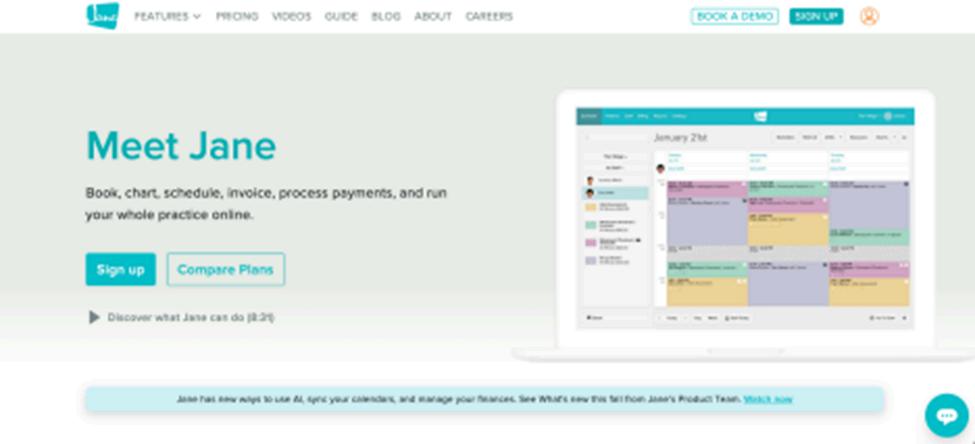
Jane is a widely used platform among health professionals in Canada It is a powerhouse in supporting insurance and direct billing to providers, such as Telus eClaims and Pacific Blue Cross. It offers documentation customization to allow for different therapeutic modalities.
It also has an online scheduler, perfect for managing group practice availability Jane’s payment system handles both direct payments and co-payments, enabling a broader range of clients
Key Features
SimplePractice

SimplePractice is a global leader in practice management. It is known for its accessible user interface and several handy features An example is its reliable telehealth platform and appointment scheduling, which automatically sends clients reminders
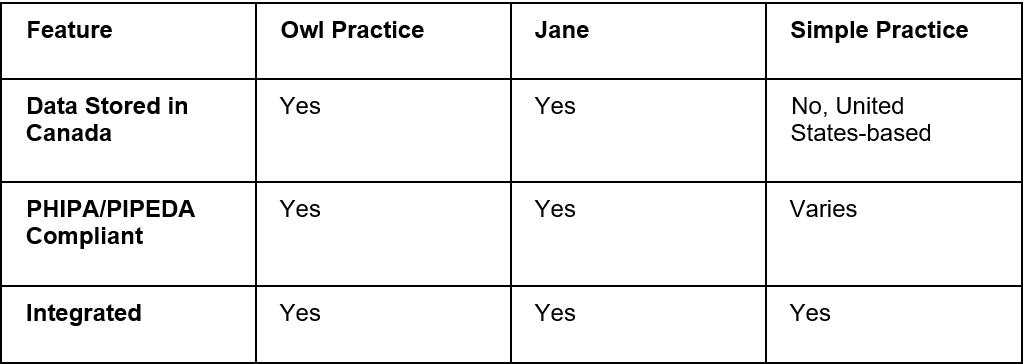
Feature Comparison Table
Here is a quick reference table that directly compares each company alongside several key features of payment systems for therapists
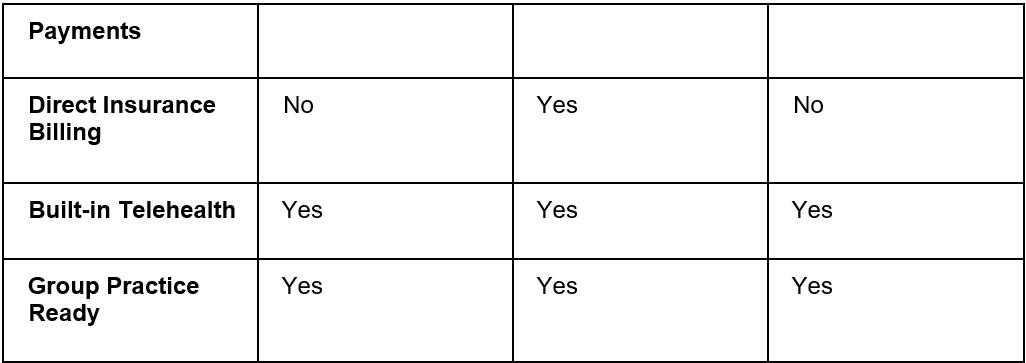
SimplePractice has an AutoPay feature that stores a client’s credit card and automatically bills it after each session, eliminating the need for payment chasing Overall, it simplifies the entire process, from admin work to care
Key Features
Polished client portal
Paperless intakes
Automated reminders
How to Choose the Right System for Your Practice
The right system depends on your needs as a medical professional and the volume of your clients For solo practitioners, your main priority is having an easy-touse platform with a great client portal This allows you to focus on providing excellent patient care
On the other hand, practices with a strong focus on insurance will best align with companies that offer direct billing For therapists with a group practice, search for a platform with team management features such as tiered access levels and scalable pricing
The Foundation for a Thriving Practice
Investing in an integrated payment platform is a great first step in ensuring a hassle-free day-to-day practice as a mental health professional These payment system providers are the gold standard for professionalism, efficiency and security Make sure to take your time and try free trials for these options. That way, you can guarantee you will find a system that makes the whole process easier for you in the long run.
Women’sDay
International Women’s Day 2026 and the Power of Giving for Gender Equality
International Women's Day, celebrated every year on March 8, emphasizes the importance of improving gender equality and creating opportunities for women everywhere. The theme for International Women's Day 2026, Give To Gain, encourages individuals, organizations, and communities to embrace giving and communal assistance as a means of making significant change
Give To Gain embodies the belief that when people help to empower women, the benefits extend long beyond the initial deed Every contribution, whether in the form of knowledge sharing, mentorship, resource provision, education support, or advocacy for equal opportunities, helps to strengthen the foundations for women ' s growth and leadership Giving isn't a loss It is a significant investment that increases impact and creates long-term change
The campaign focuses on teamwork and reciprocity When communities actively promote women ' s growth, new opportunities emerge, and obstacles are overcome. Businesses, institutions, and individuals all play a responsibility in establishing environments in which women may learn, lead, and thrive.
This International Women's Day, Give To Gain urges everyone to help create a more supportive and inclusive world. By providing time, resources, support, and opportunities, we help ensure that when women succeed, communities and civilizations follow suit



TheHonourable RechieValdez Minister of Women and Gender Equality and Secretary of State for Small Business and Tourism

Building a Stronger Canada Through Women’s Success
It is a pleasure to send my warmest greetings to CanadianSME Magazine and to the exceptional entrepreneurs and readers marking International Women’s Day As Minister of Women and Gender Equality and Secretary of State for Small Business and Tourism, this day is deeply connected to my work empowering women to participate fully in Canada’s economy
International Women’s Day is an opportunity to celebrate the progress women have made as leaders, innovators, and decision-makers, while reaffirming Canada’s commitment to build Canada strong, unlocking the full and equal participation of women in the economy
Through the Women Entrepreneurship Strategy, half a million women have already accessed funding, built networks, gained expertise, and expanded into new markets And through the Women Entrepreneurship Loan Fund, women entrepreneurs are accessing micro-loans of up to $50,000 capital that can mean the difference between an idea on paper and a business ready to grow
We also know that economic participation depends on strong social support Canada’s Early Learning and Child Care system is helping make life more affordable for families, delivering high-quality, low-cost care to 900,000 children, saving families up to $16,200 per child each year, and helping parents especially mothers enter and remain in the workforce
In an increasingly divided world, advancing gender equality strengthens our economy and our country. When women succeed, Canada succeeds.
Today, let us celebrate women ’ s contributions across every sector and continue working together to remove barriers so women, in all their diversity, can thrive
Happy International Women’s Day


HeatherNobes Vice President of Marketing at Visa Canada
Heather Nobes is Vice President of Marketing at Visa Canada, where she leads brand, sponsorship, and growth initiatives focused on enabling inclusive economic progress A passionate advocate for women, entrepreneurs and small business, Heather believes that collaboration and access are critical drivers of longterm growth She is committed to ensuring innovation and opportunity reach businesses of all sizes, helping communities and the broader economy thrive together
Celebrating
Give to Gain: Why Supporting Women and Small Business Uplifts Us All
As we mark International Women’s Day, the theme Give to Gain resonates deeply with me because the most meaningful growth happens when we choose to uplift others alongside us
Women entrepreneurs fuel innovation, create jobs, and strengthen communities - yet access to networks, capital, and opportunity is still far from equitable When we intentionally give our time, our advocacy, and access to our platforms we don’t lose momentum; we multiply it
It’s essential to ensure small businesses are part of the future we ’ re shaping because when women-owned small businesses are supported, entire communities strengthen and flourish
Progress is not a zero-sum game Collaboration creates scale. Mentorship creates confidence. Investment creates resilience. And when women succeed, they reinvest in their people, their families, and their communities.
This International Women’s Day let’s reaffirm our commitment to uplifting women entrepreneurs because when they gain access, we accelerate progress

JennJubyInterim CEO, Startup Canada
Jenn Juby is an entrepreneur and executive with decades of leadership experience across the private sector, global organizations, and the startup ecosystem Before joining Startup Canada, she was CEO of the Innovators & Entrepreneurs Foundation, a national charity supporting founders from underrepresented communities Jenn built, scaled, and exited her own retail business during the pandemic, growing it to over $10 million in revenue in sixteen months She brings a unique blend of hands-on entrepreneurial experience and executive leadership to champion inclusive growth for Canada’s founders
IWD 2026: Give to Gain — Fueling Growth Through Women Founders
On International Women’s Day, the theme Give to Gain underscores for me that investing in women entrepreneurs is an investment in Canada’s collective prosperity
Across the country, women founders are building companies, creating jobs, and strengthening communities, yet their full economic potential remains untapped Women-identifying founders currently lead only 19 percent of Canadian businesses, highlighting the urgent need for systems designed to support their growth and achieve true equity
As a founder myself, I know how challenging it is to build a business while navigating systems that were not designed with women in mind At Startup Canada, supporting our nation’s women-identifying founders is central to our mission. Through our Startup Women flagship program and Startup Women podcast, we provide education, mentorship, inspiration, and access to critical resources to ease the way for women founders
Give to women and the nation gains When womenidentifying founders have access to capital, networks, and supports they need, Canada gains innovation and inclusive growth This drives our economy, creates jobs, and builds a stronger, more sustainable future for all Supporting women founders fuels innovation and builds a more prosperous Canada for everyone

JessicaViegasVice President of Sales, UPS Canada
As Vice President of Sales for UPS Canada, Jessica Viegas leads the company’s commercial strategy, empowering teams to deliver meaningful value for businesses navigating today’s rapidly evolving logistics landscape A dynamic, forward-thinking leader, she brings more than 15 years of experience in international trade, transportation, and global supply chain solutions
Empowering Women to Trade Beyond Borders
At UPS, supporting women entrepreneurs isn’t just something we talk about it’s genuinely part of who we are Since 2018, through The UPS Foundation and our global capacity building programs, we ’ ve worked closely with women owned businesses to build strong networks, sharpen essential skills, and confidently expand into international markets
The 2026 International Women’s Day theme, Give To Gain, really resonates with us It reflects what we see every day: women entrepreneurs thrive when they have access to generosity, collaboration, and community When women receive mentorship, resources, and meaningful opportunities, their impact extends far beyond their businesses strengthening families, communities, and local economies. Canadian women entrepreneurs are especially well positioned to reach new global customers thanks to trade agreements like CUSMA, CETA, and the CPTPP
With the importance of trade diversification to global markets, we wanted to offer you a shipping discount designed to help small businesses thrive saving you up to 52%* and more when you open a UPS account
We’re committed to providing the tools, expertise, and pathways that help women compete confidently on an international stage Because when we give our support, networks, and advocacy, we gain a future that’s more inclusive, innovative, and full of opportunity We’re proud to champion women owned small businesses and help their ideas reach customers across Canada and around the world
GarimaDhawan Head of Channel Partner Operations, ADP Canada Small Business Services

Garima Dhawan leads the operations for all channel partners, including accountants and banks She is responsible in building the infrastructure to drive scalable growth and seamless client experience for ADP and its partners In this capacity, she is focused on product and process improvement, in addition to people growth
From Small Business Owners to Accountants, ADP
Canada is Here to Support You!
Ever since my childhood, I’ve benefitted immensely from my family’s support and encouragement to follow my passion and ambition
Did I know what ambition I had? No!
But, the unwavering support from my family let me define that ambition over the course of time and finally brought me to Canada to chase those dreams
Building a life in a new country with no family is never easy It becomes easier with an ecosystem of friends and peer groups that give you the strength and confidence to grow with new opportunities
This newfound support system is what motivated me to try a new industry like payroll and HR with ADP, where I’ve grown in roles from corporate and sales strategy to partner operations and have had the opportunity to develop as leader driving our business forward
These opportunities through ADP with our small business and accountant community have been instrumental in my development as a strategic leader who can connect the needs of our accountant partners to ADP solutions designed for those needs
Celebrating 20
Garima joined ADP in 2022 as Director for the Corporate Strategy team There, she was responsible for annual strategic planning for ADP Canada, including go-to market strategy Prior to joining ADP, she has nearly a decade of strategy and finance experience, five of them in Management Consulting at Deloitte
My advice to our Canadian women small business owners and accountant partners: Find your support system! You don’t have to do it alone
I look forward to seeing the growth and development of our women-led small business community and always know ADP Canada is here for your support!

SherriBebee
Senior Marketing Director, SMB at SAP Concur Canada
Sherri Bebee, Senior Marketing Director, SMB at SAP Concur Canada
Navigating the Path to Purpose
Celebrating
Sherri Bebee is the Senior Marketing Director for SMB Canada and US SMB New Business at SAP Concur, where she leads market strategy, thought leadership, and customer insights to help growing businesses simplify travel, expense, and spend management A proud University of Toronto graduate with post graduate studies in both International Marketing and Integrated Marketing, Sherri is a seasoned marketing leader with experience across diverse industries and deep expertise in integrated marketing She frequently represents SAP Concur in press and industry research, sharing perspectives on business travel, technology trends, and finance operations, all while bringing a people first, empowering leadership style
In the world of business, we are often taught to guard our secrets and protect our territory But the most impactful leaders I’ve encountered understand a different truth: our individual success is only as strong as the community we build around us
International Women’s Day serves as a vital reminder that progress cannot be driven by individual success alone, but by what we give to others along the way True influence isn’t found in the titles we hold but in the doors we open When people come together to offer mentorship, sponsorship, or simply to create a space for diverse voices, we multiply opportunities tenfold By acting as a bridge, we aren't just being helpful; we are actively strengthening the ecosystem we all live in
Advocacy is most powerful when it is quiet and consistent It is the decision to be a sponsor in rooms where others aren't present and to offer the kind of guidance that focuses on long-term growth over short-term wins By investing our time and social capital in the people around us, we create a momentum that eventually lifts everyone When we prioritize this kind of collective progress, we don't just achieve our goals; we build a legacy that outlasts our own individual efforts

Sharing Knowledge, Strengthening Communities
MichelleCalloway
Senior Vice President, Operations at Minto Group
As Senior Vice President of Operations, Michelle oversees the overall operations of Minto Group and Minto Apartment REIT’s multi-residential portfolio She leads a team of over 300, delivering a positive resident experience and managing all day-today property operations Michelle brings 20 years of experience to her role in residential and multi-family property management across Canada and the United States Her expertise in property management practices with high operational standards enables her to drive a culture of service excellence for residents and prospective tenants
In property management, I’ve learned that the true value of any community isn’t in the bricks and mortar It is in the people
To lead effectively, you must be willing to get into the weeds. Whether I’m assisting on-site during an emergency or gauging the pulse of a team, the best insights don't come from a spreadsheet They come from the voices on the ground: the property manager who truly knows her residents or the maintenance tech who sees an inefficiency no one else noticed
This year ’ s Give to Gain theme is a call to action for our industry: stop working in silos We gain the most when we mentor openly and share our operational wins and hurdles When we exchange best practices and advocate for the women coming up behind us, we don't lose our competitive edge We sharpen it
To the women building their paths: don’t just climb the ladder; build a wider one Share your platform and your hard-earned knowledge willingly When we invest in each other and open the doors of communication, we don't just improve a single building. We strengthen the entire industry."
PujaSubrun VP and GM, Canada-LATAM, Intuit

Puja Subrun is the Regional Vice President for Canada/LATAM at Intuit leading a team that is passionate about powering the prosperity of Canadians Puja has 20+ years as an innovative and transformation leader with a proven track record of leading high-performing teams to deliver critical priorities for our customers, employees and business
When Women Gain, Communities Grow
Happy International Women’s Day! This year ’ s theme, “Give to Gain,” is incredibly personal to me As a leader overseeing our Intuit QuickBooks and Mailchimp teams across Canada and Latin America, I see every day how support and reciprocity creates a multiplier effect of success, personally and professionally
At Intuit, we believe that everyone should have the opportunity to prosper, and we never stop working to find new, innovative ways to make that possible. For women with unique financial barriers, innovation can often be the bridge to untapped potential and prosperity This comes in many forms, including one of the most valuable resources of all: time Time to think, time to mentor, time to collaborate, time to rest, and time to reinvest in their community We wake up every day at Intuit to build a platform that solves our customers greatest needs Our commitment to delivering continuous innovation and a seamless and accessible AI-driven platform with done-for-you experiences are just some of the ways we are giving the essential resource of time back to women entrepreneurs
When we empower women, we arent just helping one business; we are powering prosperity for individuals, families and entire communities Generosity isn’t just a nice gesture; it’s a strategy for collective strength By lifting others as you climb, you ensure that when one of us gains, we all move forward. Let’s keep building a future where every woman has the tools to lead and the community to back her up Your success is a win for all of us

SilviaMontefiore Canadian Managing Partner, Chief Operating Officer, KPMG in Canada
Building Equality Through Collective Action
International Women’s Day is a moment to pause but more importantly, to recommit Progress for women in business has never come from a single day or policy It comes from sustained action, from listening, and from choosing to show up for one another in meaningful ways
At KPMG, this commitment shows up every day: through women ’ s networks that foster honest conversation and allyship, mentorship programs that open doors, and benefits which reflect women ’ s realities, from parenthood to health to identity Around International Women’s Day, colleagues across Canada connect through events and learning sessions that encourage reflection and connection, but the real work continues long after the day ends
The theme of Give to Gain resonates deeply When we invest in women, by sharing our time, advocating for equity, or mentoring someone earlier in their journey, we don’t lose ground We expand it Businesses grow stronger Communities become more resilient And leadership becomes more representative of the world around us
We all have a role in advancing gender equality This International Women’s Day, engage in a way that resonates with you – celebrate women, challenge bias, or commit to allyship, mentorship, or sponsorship. Progress happens together, one deliberate choice at a time.
ReetuGuptaCEO of The Gupta Group

Celebrating
Reetu Gupta is a trailblazing entrepreneur, investor, and visionary leader who proudly joins the ownership group of the Toronto Tempo As the CEO of The Gupta Group, she has shattered barriers in the traditionally male-dominated worlds of real estate, hospitality, and investment, all while championing the power of feminine energy in leadership A passionate advocate for women’s empowerment and education, Reetu’s philanthropy through the Gupta Family Foundation and her work on the board of the Princess Margaret Cancer Foundation reflect her lifelong mission to create meaningful impact Known as The Ambassadress, she continues to redefine success through compassion, purpose, and legacy
Generosity as a Leadership Mindset
True generosity is an energy, and it is measured by intention, not funding It is a mindset Give to Gain is a principle I live by in business and in life Generosity is kindness It is being generous with your time Sometimes the greatest gift you can offer another entrepreneur is your presence to truly listen
Thich Nhat Hanh speaks about deep listening. When we listen with the intention to support, not to respond, we create space for understanding When you listen deeply, you begin to understand what someone truly needs From that understanding, meaningful collaboration is born Partnerships rooted in respect and clarity are far more powerful than transactional relationships
I am here today in part because of men and women who championed me, supported me, and put me forward into rooms I deserved to be in They saw my ability and chose to advocate for me with generosity and belief That support deserves reciprocity It deserves recognition and respect
Give to Gain reminds us that equality is sustained through action through mentorship, advocacy, and conscious collaboration Women’s Day is not just one day It is a mindset where every human is treated with equality, love, and respect. When we give generously, we rise together.

LauraWilliams Managing Partner, Williams HR Law LLP
Giving to Build a Better World
As we approach International Womens Day 2026, CanadianSME’s theme, Give to Gain, offers a powerful reminder of the role generosity and collaboration play in advancing women in business It is also an opportunity to pause and reflect on what “giving” truly means
In a time when headlines often highlight exploitation, division, and self-interest, women entrepreneurs have an opportunity to lead differently. Giving should not be understood as a strategy to extract something in return. Rather, it is an act of intention; a commitment to building businesses that uplift others, solve meaningful problems, and contribute something valuable to the world
Many of the most successful women-led ventures share this common thread: they exist not only to generate profit, but to improve lives Whether by filling an unmet need, creating opportunity for others, or reshaping how industries treat people, these businesses are grounded in purpose
When women build with this mindset, the gain is not only economic It is collective Communities become stronger, opportunities expand, and the path becomes clearer for the women who follow
On this International Women’s Day, I applaud CanadianSME for continuing to spotlight women entrepreneurs and for reminding us that when we give with purpose, we create impact that reaches far beyond our own success.

Mona-Lisa
Senior Director - Community Engagement at Futurpreneur
Mona-Lisa is Futurpreneur's Senior Director, Community Engagement She originally joined Futurpreneur in 2021 as founding Director of the Black Entrepreneur Startup Program, leading the team to support 135 Black-led businesses in BESP's inaugural year A lawyer by training with an MBA, MonaLisa brings cross-sector experience in law, entrepreneurship and economic development allowing her to connect the dots that drive entrepreneurial success
Supporting Women Entrepreneurs, Strengthening Canada
As we mark International Women’s Day 2026, the theme Give to Gain reflects what we see every day at Futurpreneur: when we actively support women entrepreneurs, Canada gains.
Over the past 30 years, Futurpreneur has helped more than 20,000 young entrepreneurs launch, buy and build made-in-Canada businesses that fuel inclusive economic prosperity, with over 40% of them led by women more than double the national average
We provide entrepreneurs age 18–39 with mentorship and up to $75,000 in loan financing (with BDC as a co-lending partner), along with access to a national network of experts and peers
We know capital is critical, and connection is transformative That’s why, when we built our Women in Entrepreneurship initiative, presented by TD, we placed community at its core At our workshops and small peer groups, women founders share ideas, build confidence and create supportive networks that last well beyond the program
Give to Gain reminds us that this kind of collaboration drives progress. When women founders come together, they grow their businesses while helping build a stronger, more inclusive and more resilient Canadian economy for all

JenniferMorrison National Channel Sales at Lenovo Canada
Jennifer Morrison is a technology sales leader with more than two decades of experience spanning customer engagement, enterprise growth and channel management Jennifer currently leads National Channel Sales at Lenovo Canada, where she builds high-impact partnerships, aligns cross-functional teams and drives transformative channel programs that elevate partner experiences and customer outcomes
Give Boldly, Grow Together
International Women’s Day is an opportunity to recognize progress and to look ahead at how we can continue driving meaningful change together
This year ’ s theme, Give to Gain, resonates strongly with me because it embodies what I’ve seen firsthand throughout my career at Lenovo Growth happens when we give generously and support each other
Working with women owned small businesses and partners, I’ve learned that success is never achieved alone The women who inspire me most are those who share openly, lift others up, and intentionally create space for more voices at the table In my own journey at Lenovo, allies also play an important role in listening, advocating and helping to remove barriers so that everyone can succeed Together that generosity creates momentum that benefits us all
The spirit of Give to Gain is reflected in Lenovo’s Evolve Small program. This initiative supports small businesses, including many women owned ones, through grants, technology, and mentorship
Over the past four years, Lenovo has supported more than 5,000 businesses, donated $3 6 million, and delivered over 750 hours of mentorship
My hope this International Womens Day is simple: give boldly Share your voice, your experience, and your support When women are supported by women and allies alike, we all gain, and move toward a more inclusive future together
Celebrating 20

KarineMoses
Vice Chair, Québec and Senior Vice President, Sales at Bell
Supporting Canada’s Entrepreneurs: Bell’s Commitment to Growth and Innovation
This International Women’s Day, we ’ re proud to recognize the entrepreneurs shaping Canada’s small business landscape with determination and creativity Women continue to bring fresh perspectives and strong leadership to this progress, helping strengthen communities and industries across the country Like the leaders featured in CanadianSME Small Business Magazine, many business owners are breaking barriers, building impactful companies, and driving innovation in every sector
Celebrating
As Senior Vice President, Sales, Karine leads Bell’s sales, strategy and channel operations for the Consumer and Small Business markets As Vice Chair, Québec, Karine oversees all Bell’s public affairs, community, and other initiatives across the province Starting at Bell in 1997, Karine has held progressively senior leadership roles in Bell Network, Field Services, Finance and Media She holds a finance degree from HEC Montréal and has completed the Harvard Business School’s General Management Program She serves on the boards of the Montréal Canadiens Children’s Foundation, the Montréal Heart Institute Foundation, and more recently the Chamber of Commerce of Metropolitan Montréal
At Bell, we understand the vital role small businesses play in Canada’s economy - and we ’ re committed to supporting their success with technology that keeps operations moving forward. With fast, reliable fibre and 5G connectivity, business grade Internet, and tools like Bell Business Wi Fi for stronger security and smarter insights, we help simplify the day to day so entrepreneurs can stay focused on growth
We continue to expand our ecosystem of trusted partners - including Webware, Perplexity, and Atekoto help business owners strengthen their digital presence, streamline operations, and reach new customers more efficiently We also proudly collaborate with organizations like SME and the Ontario Business Improvement Area Association (OBIAA) to support small businesses and entrepreneurs
As we look ahead, we see meaningful opportunities for small businesses to benefit from AI, stronger connectivity, and integrated solutions As we continue this work, we remain committed to supporting women in leadership and empowering entrepreneurs across Canadas diverse business community

CatalinaLopez
Senior
Vice President, Revenue and Customer Marketing at FreshBooks
Catalina Lopez is the Senior Vice President, Revenue and Customer Marketing at FreshBooks, where she drives revenue across the business through strategic marketing, with a focus on scale and exceptional customer experience She previously served as Vice President & General Manager of the Subscription Business at FreshBooks A seasoned marketing and business leader, she brings 15 years of experience across SaaS, telecom, and CPG, including launching Public Mobile, leading multicultural marketing at TELUS, and holding brand roles at Johnson & Johnson
Small Business, Big Impact Through Support
Running a small business means carrying a lot responsibility, uncertainty, and constant decisions resting on your shoulders In my role at FreshBooks, I work alongside small business owners around the world Many of them are women building service-based businesses And I see firsthand the resilience and creativity it takes to build something of your own
I know that experience personally Earlier in my career, I co-founded a maternity-focused business with friends Ive been the operator, making trade-offs, learning on the fly, and relying on the generosity of mentors That perspective continues to shape how I think about the role of community in building something meaningful
Small business owners aren't just looking for tools. They’re looking for clarity and the gift of time. When technology does its job well, it creates space for people to focus on their craft, their customers, and their growth
To me, Give to Gain lives in the intentional support women offer one another sharing knowledge, opening doors, and mentoring the next generation When we lift each other up, our collective success grows
Celebrating 20
To every woman building something of her own: Keep going And when you can, reach back and support someone else That is how real progress happens

NadineArous Director, SME Segment, Mastercard, Canada
Invest in One Woman, Strengthen the Economy
International Women’s Day arrives at a pivotal moment for Canada’s small business landscape This year ’ s theme, 'Give to Gain, perfectly captures the spirit of the entrepreneurial community In my role at Mastercard, I see daily how the success of womenowned businesses is compounded when we prioritize mentorship, collaboration and the reciprocal sharing of resources When we invest in one woman, we aren't just supporting an individual We are strengthening a network that drives our entire economy forward
Generosity in business isn't just a moral choice It’s a growth strategy By sharing our 'know-how' and networks, we create an ecosystem and community where everyone can thrive At Mastercard, we are putting this philosophy into action through the Mastercard Small Business Fund Now in its fourth year, the fund provides $10,000 grants, tailored mentorship, and critical resources to help women entrepreneurs overcome financing hurdles and scale their impact. This year ’ s fund will launch in March, and I encourage any female small business owner to apply
By giving through these platforms, we gain a more resilient, innovative and equitable business world To the women entrepreneurs leading the way: your hustle fuels our innovation, and we are proud to stand with you as you turn your vision into reality

AprilMarshallVice President, Inside Sales, HP Canada
April Marshall is an accomplished corporate sales professional who currently serves as the VP of Inside Sales for HP Canada, where she leads a dynamic 40-person sales team responsible for delivering against HP’s One HP integrated product and solutions offering to increase market share and revenue targets across a multi-million-dollar portfolio With thirty years’ experience spanning sales, marketing, supply chain and management, April is recognized as a proven leader dedicating the past two decades to guiding and expanding HP teams
Access, Opportunity, and Women’s Advancement
This year ’ s International Women’s Day theme, Give to Gain, inspires us to transform our commitment into meaningful action reinforcing that investing in women is not just the right thing to do, it’s the key to unlocking new possibilities and a brighter future for all
Our latest HP Work Relationship Index revealed that only 15% of Canadian knowledge workers report having a healthy relationship with work. Yet, 85% of the factors that shape our experience at work are within an organization’s control Culture, leadership, resources, and opportunity are key factors that drive change and influence outcomes
To truly close the fulfillment gap, we must be intentional about how we support women across every stage of their careers - through mentorship, sponsorship, skill development and visible pathways to leadership Representation matters, but advancement matters more and I encourage leaders to advocate for a woman ’ s next opportunity When we give access, visibility, and support, we all gain
At HP Canada, we believe performance and people go hand in hand When women are empowered with the right tools, trusted with meaningful responsibility and supported by leaders who listen, innovation accelerates and teams perform at their best. When women rise, workplaces strengthen And when workplaces strengthen, businesses grow
Celebrating 20

SoniaPrasharFounder and President, spPR Inc
Building Workplaces Where Women Lead
Early in my career, I was fortunate to have mentors who opened doors for me, shared their perspective, and pushed me to grow That support stayed with me It built my skills - and more importantly, it built belief and confidence
When I stepped into the shoes of a founder, I carried that with me I knew I wanted to create the same kind of environment for others For me, this is what International Women’s Day and Give to Gain are truly about: lifting others as you climb and creating space for more women to step into their own voice and leadership
Sonia Prashar is an entrepreneur and PR powerhouse with over 20 years of experience in communications across Canada and Asia She founded spPR in 2013 following an already extensive career in PR and marketing communications The agency stands out for its virtual, flexible model, offering clients direct access to senior counsel only An immigrant and award-winning mentor, Sonia brings the dual perspective of founder and PR expert Early in her career, she coordinated Bill Gates’ first trip to India and led high-profile brand launches for Louis Vuitton Moët Hennessy A passionate advocate for better metrics and accountability in PR, she is also recognized for nurturing the next generation of communications professionals
That mindset shaped how I built my own PR firm in 2013 I was intentional about bringing together passionate, curious women who wanted to learn, lead, and achieve great results – while lifting each other up every day. The women I work with are an integral part of my entrepreneurial journey. We are a fully remote, women-led Canadian boutique agency – and we all value our hybrid model that offers immense benefits to our team and our clients I believe in giving them the freedom to explore, experiment, sometimes fail, and ultimately grow stronger and flexibility is essential to that Many of us juggle multiple roles as mothers, caregivers, mentors, or simply individuals trying to make time for the things we love When women can work on our own terms, we show up fully, excel at what we do, and still have room for what we are passionate about
Celebrating 20
So here’s my advice: invest in yourself, seek mentors, and pay it forward whenever you can Lift others as you climb, celebrate their wins, and open doors for those coming behind you That’s how we build workplaces and communities where women thrive When we give generously, we all gain

Women Entrepreneurs at the Center of Canada’s Growth
We are living in a defining moment for our country
As Canada strengthens trade, invests in critical industries, and builds the infrastructure that will shape the next generation, we face a choice Women entrepreneurs can remain at the margins of growth, or they can be fully integrated into it.
VictoriaLennox MSM,,
CEO of the Women's Enterprise Organizations of Canada (WEOC)
Victoria Lennox, MSM, is an executive nonprofit leader and CEO of the Women’s Enterprise Organizations of Canada, Canada’s national centre of excellence for the women’s entrepreneurship ecosystem She leads a coordinated national network and stewards a $30M+ developmental loan fund advancing women entrepreneurs toward economic parity Founder of Startup Canada and cofounder of NACUE (UK), she has built enduring institutions strengthening entrepreneurship globally An Oxfordtrained strategist in Global Governance and Diplomacy, she advises senior governments on inclusive growth, Indigenous economic development, innovation, and governance
Give to Gain reminds us that generosity reshapes systems We give because equity strengthens the whole When we design policies that expand access to capital, procurement, export markets, and leadership opportunities for women, the gains extend far beyond individual businesses
Inequality is a structural choice Parity is one as well Women entrepreneurs continue to navigate financing gaps, supply chains, and decisionmaking tables that were never built with them in mind Addressing these gaps builds a stronger, more competitive Canada
Women stand at the centre of economic strategy We drive innovation, reinvest in communities, and strengthen resilience across sectors That's why 'Stronger Together' means accountability, collaboration, and shared responsibility If we build this next chapter with full participation, we gain more than growth.
Celebrating 20
We gain a resilient nation, built by and for everyone
MariaLocker&GraceMoores
Co-owners, RevolutionHer Inc.

The Ripple Effect of Empowering Women

RevolutionHer™ is a socially driven media company that has supported and welcomed over 60,000 women and youth worldwide, advocating on behalf of global issues facing females, and providing impactful events, programs, and support resources within an inclusive and safe community to uplift, empower and amplify women ' s voices globally Their current project, The RevolutionHer Store, is a one-ofa-kind retail shop that proudly offers products that are By Women For Women Supporting Women The unique curated collection of products spans multiple industries and features over 100 diverse,
Canadian women-led brands.
Co-owners Maria Locker and Grace Moores and their team proudly dedicate themselves to RevolutionHer’s directive, “Together We Rise".
International Women’s Day 2026, themed “Give to Gain,” focuses on the powers of generosity, collaboration, and reciprocity in driving gender equality This year ’ s message highlights that when we support women, everyone benefits
At RevolutionHER we believe that by lifting women up, we create a ripple effect that enhances opportunities not only for individuals but for society as a whole Through showcasing over 100 women-led brands at the RevolutionHER Store, providing community and in store events, we foster collaboration among women across various aspects of entrepreneurship & life, encouraging the exchange of knowledge, skills and leadership
RevolutionHER champions the importance of giving back, urging women and allies to invest time, talent, and resources into supporting each other This reciprocal approach cultivates a culture of mutual respect and collaboration, leading to positive advancements in gender equity
By emphasizing the essence of “Give to Gain,” RevolutionHER illustrates that empowering women doesn’t take away from resources but expands possibilities. Together, we can create an inclusive world where the advancement of women leads to progress for all, making this International Women’s Day the spark for meaningful change Let’s celebrate, support, and uplift each other!
Celebrating 20
Hermine Mbondo
Elevating Brands Through Storytelling
Hermine Mbondo, Founder and Chief Storytelling Officer of B4brand, is a Canadian social-impact entrepreneur who uses storytelling to elevate purpose-driven brands and drive change Based in Toronto, she heads an award-winning, multilingual (English/French) storytelling-driven marketing agency that connects with mission-driven organizations, social businesses, and inclusive brands who want their marketing to do more than just sell they want it to matter
From Cameroon’s Oral Traditions to
Canadian Entrepreneurship
Hermine's branding strategy is deeply rooted in her Bassa ancestry in Cameroon, where oral traditions and storytelling are central to communal life After studying at SKEMA Business School in France and creating a 15year career in marketing and communications across Europe and North America, she noticed a gap: many organizations talked about purpose, but few shared their stories in ways that felt true or inclusive
BusinessWoman oftheMonth HermineMbondo
FounderandChief
In 2017, she established B4brand to combine her strategic marketing knowledge with her passion for storytelling Her purpose was to help brands that are "doing good" those involved in social impact, sustainability, equity, and community development clarify their narrative and communicate it consistently, both online and offline
Building B4brand: A Storytelling‐Driven Agency
B4brand is an award-winning, Blackowned, bilingual marketing agency that tells brand stories across both online and offline channels The agency focuses on three main pillars
Their brand identification and strategy services help organizations define their purpose, values, voice, and visual identity to resonate with their audiences
Create omnichannel digital experiences by developing websites, campaigns, and customer journeys that connect, engage, and convert
Storytelling-driven content marketing involves developing social, video, and written content that highlights a brand's vision and effect
Additionally, B4brand runs a Global Impact Hub, a learning platform and resource hub that provides community and marketing tools to social entrepreneurs and change agents With a "French-first" design strategy for francophone audiences, the team comprising creatives, strategists, and technologists works bilingually in English and French, creating content rather than merely translating it In addition to delivering campaigns for national groups such as Futurpreneur Canada and children's literacy advocates, B4brand has assisted over 200 entrepreneurs and main-street businesses with their digital transformation journeys
Centreing Inclusion, Culture, and Social Impact
B4brand, a Black-owned firm, creates strategies and content that reflect the different perspectives of its audiences Hermine and her team work "at the confluence of brands, storytelling history, and bilingualism," therefore, it is their obligation to guarantee that customers feel seen, heard, and involved in the narratives that businesses communicate.
Her campaigns frequently emphasize social impact themes equity, community building, and sustainability and are guided by the concept that marketing can be a catalyst for cultural change rather than just profit B4brand's consumer-driven strategy has helped businesses develop trust, increase brand recognition, and improve their bottom line, especially when engaging Black, francophone, immigrant, and other traditionally underrepresented communities The agency has received numerous accolades, including honours at the Canadian Global Awards and media coverage in Africa, Europe, and North America
Leadership, Recognition, and Industry Influence
In addition to managing B4brand, Hermine supports women leaders and social entrepreneurs as an impact investor, mentor, advisor, and educator She contributes marketing, cultural, and social impact perspectives to discussions on trade, entrepreneurship, and women in business, while serving on advisory boards for organizations such as the Canadian Women's Chamber of Commerce and as Board Marketing Director for WEDO Canada

In 2020, she was named one of Canada's Top 100 Black Women to Watch for her leadership and influence in branding and social impact. She has judged student entrepreneurial competitions, including those sponsored by CanadianSME partners, and was selected to judge the Business/Brand Impact category at the 2025 Canadian Marketing Association (CMA) Awards Hermineisaspeakerand writer,sharinginsights onstorytelling,inclusive marketing,andpurposedrivencompanies throughplatformssuch aspodcastsandher blog,PizzaFork&Knife.

Lessons for Small Business Owners and Women Entrepreneurs
Canadian women entrepreneurs can learn valuable lessons from Hermine's journey:
Lead with your story When expressed effectively, your life experience can create a potent differentiator

Build with values: B4brand demonstrates that you can grow while staying true to your values by partnering with companies that share its social impact objective.
Design with inclusivity in mind from the start In a diversified market like Canada, bilingual, culturally relevant content and diverse teams are strategic advantages, not extras
Conclusion
Hermine Mbondo has demonstrated how an entrepreneur can use storytelling to enhance social impact and drive company growth Her work demonstrates that when companies take the time to understand their mission, tell varied stories, and communicate with integrity, they can inspire trust, drive change, and prosper in Canada's evolving market
Disclaimer:This article is for informational purposes only Black Business Magazine does not endorse or guarantee any products, services, organizations, or individuals mentioned Readers are encouraged to conduct their own research and due diligence before making any business, financial, or personal decisions.

Her experience spans PR communications, media, travel and tourism, insurance, legal services, private investigations, and investor relations Ashalee’s previous leadership roles at Cision, Adventure Canada, and Investigative Research Group showcased her talent for driving transformative business strategies and fostering growth at scale Beyond her professional expertise, Ashalee is an advocate for small businesses, recognizing their essential role in shaping the Canadian economy She is passionate about helping these businesses succeed by providing the tools, resources, and guidance they need to grow and innovate

Xero’sAshaleeMohamed onSmallBusinessEmotionalTax
In an exclusive interview with CanadianSME
Small Business Magazine, Ashalee Mohamed, Head of Canada for Sales & Go-To-Market at Xero, dives deep into the emotional challenges faced by small business owners. Ashalee discusses Xero’s Emotional Tax Return campaign, which aims to shed light on the hidden costs of entrepreneurship the mental and emotional toll that often goes unrecognized
InterviewBySKUddin
Ashalee Mohamed is a senior business leader with over 18 years of experience driving growth and leading high-performance teams across a variety of industries As the Head of Canada, Sales & Go-To-Market (GTM) at Xero, Ashalee leads the Canadian GTM team, focusing on accelerating revenue growth and delivering operational excellence Throughout her career, Ashalee has demonstrated a unique ability to build cultures of high performance, deliver results, and navigate diverse sectors.
Xero’s Emotional Tax Return campaign looks beyond the balance sheet to measure how business ownership feels. For readers who haven’t seen the report yet, how do you define “emotional tax,” and what were the most striking findings that stood out to you?
The cost of running a small business is often measured in dollars, but our research reveals a different price altogether The “Emotional Tax” is the cumulative stress and mental load required to keep a business afloat in an operating environment that is harder to manage every year It’s the weight of financial uncertainty, the sleepless nights, the strain on personal relationships. These are the invisible costs that don’t show up on a balance sheet but profoundly impact how small business owners live and work
Several findings really stood out to me First, the sheer pervasiveness of this burden: 49% of Canadian small business owners say they cant completely switch off from work, and 78% say this year has been more stressful than previous years Second, the physical toll is staggering Over half of owners report getting less sleep since starting their business, with nearly a quarter losing five or more hours a night Third, stress has become so severe that nearly two in five business owners have considered giving up their business entirely because of how stressed they are about its financial success That’s not just a well-being issue; it’s a signal that we need to do more to support the backbone of our economy
Running a small business in Canada today means juggling cash flow, staffing, customers, and constant change. From the data, what factors are having the greatest impact on small business stress right now, and how is that stress showing up in owners’ day-to-day lives?
The operating environment is having a massive impact on Canadian small business owners ’ stress Our research found that 78% of small businesses report that economic pressures, including rising costs (50%), unpredictable demand (30%), tariffs (30%), and political uncertainty (18%), have made this year more stressful to navigate than previous years. 90% of owners are concerned about the upcoming fiscal year, with 30% very or extremely concerned These are forces largely outside the control of small business owners, yet they bear the full emotional weight of navigating them
Financial management is also a significant pressure point More than three-quarters of Canadian small business owners find managing their finances stressful, and they’re spending an average of 27 hours per month on financial admin The fear of making a mistake or the stress of gathering paperwork causes many owners to avoid financial management altogether, which only compounds the problem
Intermsofhowthisshowsupindailylife,halfof Canadiansmallbusinessownerssaidtheycan’t disconnectfromworkintheirpersonallives.Over halfreportgettinglesssleepsincestartingtheir business.Ownersaregivinguphobbiesandselfcare,likeexercise(32%),travel(30%),andquality timewiththeirpartners(26%).Manyaremissing importantlifeeventslikefamilydinners,birthday parties,andevenweddings,andmanyhavehidden theirbusiness-relatedstressfromapartnerorfamily member,withalargenumberreportingbeingmore short-temperedwithotherswhenstressed.The EmotionalTaxdoesn’tstayattheoffice,itfollows ownershome.

When stress becomes chronic, it doesn’t just affect the owner it affects decision-making, employee morale, and long-term resilience. Based on the research, what are some of the most concerning consequences you see for Canadian small business performance and health?
Stress isn’t just affecting owners ’ wellbeing, it’s directly impacting business performance and survival. Our research shows that Canadian small business owners spend an average of nine hours per week feeling stressed, concerned, or worried about their business, and stress impacts their ability to work for an average of five hours per week That translates to approximately 31 working days of lost productivity per year That’s more than a full month stolen from Canadian small businesses annually.
When youre stressed, you ’ re not at your best Stress affects the very skills owners need to succeed, creating a vicious cycle More than three-quarters of small business owners say stress has negatively impacted their work, resulting in slower decision-making, missed opportunities, reduced creativity, loss of confidence, slower growth, and avoidable mistakes, including financial errors
What concerns me most is the compounding effect Stress leads to avoidance behaviours like procrastinating on financial management or delaying tax filings until the last minute More than half of small business owners have been surprised by a tax outcome, and 28% avoid dealing with taxes altogether This creates a cycle where unmanaged stress leads to poorer financial decisions, which in turn creates more stress When two in five Canadian small business owners have considered giving up their business because of stress, it’s clear this isn’t just a personal challenge; it’s a threat to the resilience of our small business economy
Xero’s platform is built to simplify financial tasks and provide real-time visibility. In practical terms, how can better systems, automation, and collaboration with advisors reduce the emotional tax that comes from not knowing “where the business really stands”?
So much of the Emotional Tax stems from uncertainty When you don’t have clear visibility into your financial position, every decision carries extra mental weight Our research found that a third of owners are stressed by the need to chase paperwork, and 28% fear making mistakes, both of which are solvable problems with the right systems in place.
At Xero, we address stress at multiple levels On the time front, our automation handles repetitive tasks like bank reconciliation, invoice reminders, and expense categorization, giving owners back hours every month On visibility, real-time dashboards show financial position at any moment, reducing the uncertainty and surprise that drive so much anxiety On accuracy, automated reconciliation and checks reduce the fear of mistakes When it comes to tax readiness, year-round organization means no last-minute paperwork scramble. That’s critical when 36% of owners find the end-of-fiscal-year significantly more stressful than the rest of the year
Technologyisonlyonepartoftheequation, however.Ourresearchalsoshowsthatonly10% ofCanadiansmallbusinessownersseekadvice fromanaccountantoradvisorwhentheyfeel financialstress.That’sasignificantgap. Professionaladvicehelpsownersreclaimthe mentalspacerequiredtonavigateeconomic uncertaintieswithconfidence.Xeroenables real-timecollaborationbetweenownersand theiradvisors,sofinancialmanagement becomesanongoingpartnershipratherthana once-a-yearscramble.Thegoalisn’tjustto managenumbers;it’storeducetheemotional burdensoownerscanfocusonwhattheylove abouttheirbusiness.
For Canadian small business owners who are feeling particularly stretched this year, what advice would you share both in terms of mindset and practical steps to manage their emotional load while still moving their business forward?
The economy is tough right now, and the Canadian small business ecosystem has been through a lot in recent years First, I want small business owners to know that what they’re feeling is valid and shared You’re not alone in this. Our research makes it clear that the Emotional Tax is widespread, and it’s a reflection of how challenging the current operating environment is, not a personal failing
In terms of mindset, I’d encourage owners to focus on what’s within their control Economic factors like rising costs and geopolitical uncertainty are largely outside of any one business owner ’ s influence, but how you manage your finances, take care of your health, and build your support network Those are areas where you can take meaningful action Getting enough sleep, prioritizing your mental and physical health, and making time for the relationships and activities that recharge you aren’t luxuries They’re essential to sustaining your business for the long term
On the practical side, I’d offer three things First, don’t go it alone Reach out to peers, family, friends, and professional advisors when you ’ re feeling the pressure. Only 10% of owners seek professional financial advice when stressed, but it’s one of the most effective ways to reduce the mental load Second, lean into digital tools that can take the administrative burden off your plate Automating tasks like bank reconciliation, invoicing, and expense tracking gives you back time and reduces the anxiety that comes with manual processes And third, prioritize year-round financial management over last-minute scrambling Maintaining organized digital records and having clear visibility into your financial position throughout the year means tax season becomes predictable instead of panic-inducing Smallbusinessesarethebackboneofthe
employ5.7millionCanadians.Supporting oursmallbusinessowners’well-beingisn’t justgoodforthem;it’sessentialforthe healthofoureconomy.Weoweittothem tohelplightentheloadwhereverwecan.

Disclaimer:The views and opinions expressed in this interview are those of the interviewee and do not necessarily reflect the official policy or position of CanadianSME Small Business Magazine Our platform is dedicated to fostering dialogue and sharing insights that inspire and empower small and medium-sized businesses across Canada
The Sup
Entr Trus
BySkUddin
Women climate shortage entrepre accelera financing fraud an Entrepre access f how inte
In 2026, as funda mentors, a d s u o s o e ab e e o de e op bo d y e remaining secure and compliant.

National Backbone Supporting Women Entrepreneurs Across Canada
At the national level, the Women Entrepreneurship Strategy serves as the foundation for Canada's support ecosystem WES offers targeted funding, lending programs, and ecosystem investments to improve women ' s access to capital, networks, and knowledge According to a 2025 federal report, WES-supported programs have offered over 25,600 loans to diverse women entrepreneurs, connected them to ecosystem events more than 181,000 times, and supported more than 181,000 women entrepreneurs Over the last five years, the WES Ecosystem Fund has invested $100 million to enhance organizations that support women entrepreneurs and close regional and sectoral service gaps
The Women Entrepreneurship Knowledge Hub (WEKH), which is financed by WES, serves a complementary function by conducting national research, holding thousands of events, and connecting politicians, service providers and entrepreneurs The State of Women's Entrepreneurship in Canada reports present evidencebased initiatives, statistics on hurdles, geographic disparities, and effective interventions For founders, these national initiatives mean more local programs, greater access to information, and clearer access to legitimate funding and training partners all of which are critical to avoiding predatory schemes and disinformation
Regional Networks and Accelerators Where Community Becomes Action
Regional women ' s enterprise organizations provide practical assistance, translating policy into action WeBC, for example, coordinates a women ' s entrepreneurship ecosystem in British Columbia by integrating advisory services, mentoring, and financing with partners like Vancity The WES Ecosystem Fund is supporting the Capital, Community, Capacity (C3) project, which provides women with on-demand skills development, business advice, and network building to enable them scale thoughtfully and sustainably The project runs until 2026 Similar groups operate across Canada as part of the Women's Enterprise groups of Canada (WEOC), providing loans, training, and peer support suited to local needs
Sector-specific accelerators add another degree of community The RBC Women in Cleantech Accelerator at MaRS selects 7-10 female entrepreneurs for a two-year program that provides coaching, market intelligence, and access to investors and corporate partners Elevate's Women+ Entrepreneur Incubator is a five-week virtual program for tech innovators to improve investment readiness, connect with investors, and pitch for up to $100,000 at the Elevate Festival These programs provide founders with trusted advisors and peers who can identify dangerous offers, share due diligence strategies, and recommend reliable funding sources.
Programs Focused On Safety, Fraud Awareness, And Financial Confidence
Community initiatives are increasingly including fraud and risk education in their services The Canadian Federation of Independent Companies offers fraud protection webinars that educate small company owners on common scams, including credit card theft, directory scams, and cyberattacks, and how to respond if they are targeted Banks and payment providers are also interacting directly with female entrepreneurs Initiatives such as The Scotiabank Women Initiative offer workshops on payment modernization, cyber awareness, and basic fraud controls, combining technical support with case studies from larger firms
WES-funded ecosystem projects, headed by WeBC and WEOC, prioritize financial literacy and confidence-building to address psychological barriers to debt and investment, which might leave women vulnerable to predatory offers By normalizing discussions about risk, fraud, and limits, these networks help founders recognize red flags and seek advice from peers and mentors before signing risky contracts or disclosing sensitive information
How Canadian Women Founders Can Plug Into the Right Networks
Founders may navigate Canada's women-entrepreneurship environment like a map, rather than a maze A practical first step is to review the Women Entrepreneurship Strategy webpage and WEKH tools to identify regional partners such as WeBC, WEOC members, or newcomer accelerators who match their stage and industry. FranNet's "10 Resources for Women Entrepreneurs in Canada" summarizes significant programs, including the Women Entrepreneurship Loan Fund and Startup Canada's Startup Women program, which provides year-round webinars and networking opportunities for early-stage founders
Next,founderscanfocuson programsthatcombinethree components:mentorship, education,andcommunity.This combinationprovidesnotonly information,butalso accountabilityandatrustedcircle toassessopportunitiesand dangers.Finally,women entrepreneursshouldseekevents andcohortsthatclearlyaddress digitalsafety,fraudprevention, andethicalfinance,indicatinga commitmenttohelpingmembers growsecurelyratherthanrapidly. Connectingwithrelevant networksisakeyriskmanagementstrategyfor foundersinunpredictable environments.
Your role in staying up to date is integral to our shared mission of fostering a community of innovators CanadianSME Magazine is a valuable treasure trove of entrepreneurial knowledge. Click here to subscribe to our monthly editions for updates on Canadian businesses Follow our handle, @canadian sme, on X to stay updated on all business trends and developments Your support is crucial to our mission.
Disclaimer:This article is based on publicly available information intended only for informational purposes CanadianSME Small Business Magazine does not endorse or guarantee any products or services mentioned Readers are advised to conduct their research and due diligence before making business decisions
MostProblems SolveThemselvesin Small Business
In an exclusive interview with CanadianSME Small Business Magazine, Brad Poulos, a seasoned entrepreneur and educator, shares his expertise on the key elements that help small businesses thrive. With four decades of experience in scaling businesses across telecom, software, and cannabis, Brad’s insights have shaped how companies approach growth, profitability, and sustainability
InterviewByMaheenBari
Brad Poulos is an entrepreneur, educator, and advisor who has spent 40 years building, scaling, and studying small businesses from the inside out Over that time, he's worked in corporate roles, scaled a startup to #8 on the Profit 100 list, taken a company public, and helped launch and grow multiple ventures as a founder, investor, and advisor across the telecom, software, and cannabis industries.
Today, Brad teaches entrepreneurship, small business management, and strategy at Toronto Metropolitan University, where he also created Canada's first university-level cannabis business course. He's known to his students and clients as "Canada's Small Business Professor" a title that reflects his rare combination of real operating experience and the ability to teach it clearly
SeasonedEntrepreneurandEducator
Your new book, Most Problems Solve Themselves, makes a counterintuitive case for “strategic inaction” in a world that celebrates constant hustling. What do you mean by that, and how can small business owners tell the difference between a fire they must fight now and a problem that will actually resolve itself if they don’t overreact?
Hustle culture has convinced owners that constant action equals progress It doesn't It mostly equals exhaustion and half-solved problems
Strategic inaction means recognizing that most things that feel urgent on a Tuesday look completely different by Friday. Intervening too fast often makes a minor problem worse or wastes energy on something already solving itself
BradPoulos
The test is simple: is this problem getting worse fast enough that waiting makes it unsolvable? A cash flow gap three weeks out is a real fire An unhappy customer who hasn't asked for anything yet is probably noise
And here's the underrated benefit when you stop reflexively jumping in, your employees actually step up They solve things They grow Owner intervention is often just employee development in disguise
The discipline isn't passivity. It's learning to sit with discomfort long enough to figure out if the problem actually needs you
You’ve been starting, scaling, and studying small businesses for 40 years, across telecom, software, and cannabis. From that vantage point, how has entrepreneurship changed—and why do you believe it might actually be a better time than ever to start a small business today?
The fundamentals haven't change real problem for someone who can and don't run out of cash That pa eternal
What has changed is the cost of s When I was launching DirecPC (Ca first satellite-based internet produ getting to market meant investing before we served our first custome you can test a business idea for a hundred dollars over a weekend. B barriers cut both ways because it's competitors to start too The adva doesn't come from starting anymo comes from staying and building s hard to replicate Relationships, re deep expertise, and most importan are what creates winners
The other shift is AI. Most transform technologies I've watched favoure players who could afford the infra AI is different A one-person firm c operate with capabilities that wou required a department a decade ago
Pricing is one of the most painful and misunderstood topics for owners, yet it’s central to profitability—the core theme of your work. What are the most common pricing mistakes you see small businesses make, and what simple shifts can immediately improve their margins without alienating customers?
Most business owners are too afraid to raise prices They mistake customer price sensitivity for an immovable constraint when, in reality, customers are rarely as pricesensitive as owners fear
The math works far more in your favour than most owners realize If your margin is 40% and you raise prices 5%, you can afford to lose over 11% of customers and still come out ahead on total margin. You'd likely lose far fewer than that, and the ones you do lose are probably your worst customers anyway
The second big mistake is confusing a sales problem with a pricing problem When customers push back on price, owners assume they're too expensive But more often the real issue is they haven't communicated their value clearly enough Price is a signal When we raised prices on Nortel at mmWave, our sales team panicked Nortel never flinched.

ImageCourtesy:Canva
The simplest fix? Test a price increase on new customers first Add a premium tier Track your daily break-even in dollar terms and watch what actually happens when you hold your price instead of discounting The feared customer exodus almost never materializes and if a few do leave, you’ll survive
In your books and teaching, you often emphasize learning from real-world stories, like the challenges of minority shareholders or the nuance of managing credit differently for different customers. What do those examples teach about judgment, and how can owners get better at making “it depends” decisions instead of relying on one-size-fits-all rules?
Those stories teach one fundamental lesson: context is data Alex at Micro Components always paid late and always paid in full, with the U.S. military as his anchor customer A rule that says "cut off anyone past 60 days" would have destroyed a relationship built on a track record that mattered more than the timing Susanna didn't have that context I did The rule wasn't wrong it was just incomplete without the story behind the number
Same with minority shareholders "Give key employees equity" sounds generous and reasonable until you realize that a 5% stake in a private company with no dividends, no liquidity event, and no real voting power isn't an asset.
The way owners get better at "it depends" decisions is by building judgment through pattern recognition, which only comes from honest post-mortems Good decisions come from experience and experience comes from bad decisions When something blows up, ask what signal you ignored When something works, ask why it worked in this context but might not in another

You’ve just launched Most Problems Solve Themselves and co-authored From Pitch to Payoff: A Founder’s Guide to Finance, which aims to bridge the gap between finance theory and what actually happens in deals. For Canadian small business owners and founders, what key mindset or financial habit would you most like them to adopt so they can build companies that are built to last, not just to pitch?
Stop optimizing for the pitch. Start obsessing over the cash flow statement
Most founders I work with understand the P&L intuitively revenue minus expenses equals profit, easy enough And they'll nod along when you talk about the balance sheet But the Statement of Cash Flows? That's where businesses actually live and die, and it's the one report most owners never truly master until they've already survived a scare.
My finance professor at Ivey, Jim Hatch, used to say "If it doesn't jingle, it doesn't count " He was talking about cash You cannot make payroll with EBITDA You cannot pay a supplier with net income A business can be profitable on paper and broke in the bank simultaneously and growing businesses experience this constantly because of how working capital math actually works.
The mindset shift I want Canadian founders to make is this: fall in love with cash flow forecasting, not storytelling Pitching is about the future you ' re imagining Running a business is about surviving Tuesday The founders who build companies that last are the ones who know their cash position cold, who collect receivables aggressively, and who never confuse profit with liquidity.
Disclaimer:The views and opinions expressed in this interview are those of the interviewee and do not necessarily reflect the official policy or position of CanadianSME Small Business Magazine Our platform is dedicated to fostering dialogue and sharing insights that inspire and empower small and medium-sized businesses across Canada

InterviewBySKUddin
Samuel Martel is the Founder & President of The Phoenix Firm, where he leads with a clear mission: to empower every business regardless of size to unlock the full potential of their data What began as a personal passion for helping organizations see the bigger picture through analytics has grown into a firm dedicated to delivering strategic insights, practical solutions, and measurable results.
With decades of hands-on experience across budgeting, forecasting, supply chain, operations, and finance, Samuel brings a rare combination of analytical expertise and real-world business understanding. He has guided organizations ranging from medical device manufacturers to food distributors and sporting goods companies, tackling challenges across multiple industries with confidence and clarity No matter the vertical, Samuel and his team have likely solved similar problems before and know what it takes to move from data to action
TurningDataIntoDecisionsWith ThePhoenixFirm
In an exclusive interview with CanadianSME
Small Business Magazine, Samuel Martel, Founder & President of The Phoenix Firm, shares how small and mid-sized businesses can transform raw data into practical, profit-driving decisions Drawing on decades of cross-industry experience, Samuel explains why analytics should not feel intimidating or abstract but instead serve as a daily operational tool that sharpens strategy, improves margins, and reduces uncertainty
You founded The Phoenix Firm to help businesses move from “numbers on a page” to real-world decisions. What originally inspired you to start the company, and how do you explain the value of data analytics and literacy to SMB owners who don’t see themselves as “data people”?
I was inspired to start The Phoenix Firm after seeing how companies of all sizes struggled to turn their numbers into meaningful insight Even large organizations with sophisticated systems often lacked clarity about what their data was actually telling them about performance, bottlenecks, and opportunities If well-resourced companies were struggling, I knew SMBs faced an even steeper challenge
When I speak with owners who dont see themselves as “data people,” I explain it this way: databases are like dictionaries, but analytics is the novel It’s valuable to have all the words, but unless theyre structured into a story, they lack context and meaning Data on its own is just information. Analytics turns it into direction.
For SMBs, the value shows up in practical ways cost efficiency, time savings, and process improvements When you understand what drives margin, delays, or customer churn, you make better decisions faster You don’t need to be a data scientist; you need the ability to ask better questions and interpret the story your business is already telling That literacy is what turns “numbers on a page ” into confident action
Many small businesses are interested in selling on Amazon but get overwhelmed by the complexity. From your work with clients, what are the most common mistakes you see—and what data should SMBs actually be watching to turn Amazon from a gamble into a predictable revenue channel?
The most common mistake I see is underestimating the importance of education Amazon provides a tremendous amount of guidance within Seller Central, yet many businesses rush in without fully understanding fees, logistics, advertising mechanics, or compliance requirements Taking the time to research your specific category and cost structure turns guesswork into strategy
Another major misstep is underinvesting in visibility and presentation Amazon is competitive you need to budget for advertising and build professional, conversion-focused listings There’s always a tension between speed to market and perfection, but the goal should be a strong launch with a solid listing that you continuously improve Amazon’s own recommendations, A/B testing tools, and even generative AI can help refine content and positioning over time
To make Amazon predictable rather than a gamble, SMBs should closely track a few core metrics: conversion rate, advertising cost of sale (ACoS), clickthrough rate, contribution margin after fees and ads, and inventory sell-through. When you understand how traffic, conversion, and margin interact, you can forecast performance and scale intentionally
Amazon rewards disciplined operators When you combine education, professional execution, and consistent metric tracking, it becomes a controllable growth channel not a risk
You often talk about dashboards and reports becoming part of a client’s daily routine, shaping conversations and priorities. What does “good” reporting look like for an SMB, and how can leaders ensure their data tools are driving behaviour, not just generating more noise?
In one word: insight
Data becomes noise when it’s unstructured and disconnected from decisions But when it’s organized around clear business priorities, it becomes a powerful guide Many SMB leaders get lost in spreadsheets rows, columns, endless tabs That’s often why analytics feels intimidating. They think the data itself is the outcome, when in reality, data is simply the path to the outcome
Good reporting starts with clarity What decision is this report meant to inform? A strong SMB dashboard should focus on a small number of actionable metrics tied directly to goals margin, cash flow, customer acquisition cost, on-time delivery, or inventory turnover If a number doesn’t influence behaviour, it probably doesn’t belong on the dashboard
Leaders can ensure data tools drive behaviour by embedding them into regular routines: weekly reviews, team meetings, and operational checkins Metrics should spark questions and actions, not just observation
Finally, consistency and accuracy are nonnegotiable. If reporting is unreliable, decisions based on it will be flawed. When reports are trusted, focused, and tied to action, they stop being background noise and start shaping performance

You’ve seen firsthand how tightly connected data and supply chain performance are. For a small or mid-sized business, what are one or two practical supply chain best practices—grounded in data—that can quickly improve margins, reliability, or customer satisfaction?
One of the biggest lessons I’ve learned is that supply chain performance isn’t just about logistics it’s about visibility For small and mid-sized businesses in particular, two data-grounded practices can create fast, measurable impact
First, focus on demand visibility and forecasting discipline
Many SMEs rely on gut feel or simple historical averages to plan purchasing and production. Even a lightweight, data-driven forecasting approach looking at 12–24 months of sales history, seasonality, and recent trends can significantly reduce stockouts and excess inventory When you align purchasing to actual demand patterns instead of intuition, you improve cash flow, reduce write-offs, and increase service levels almost immediately Cost effective tools exist when you know where to look
Second, track a small set of high-impact operational metrics and review them consistently.
You dont need a complex dashboard Start with a few core KPIs: on-time delivery, inventory turnover, order fill rate, and supplier lead-time variability The key is not just measuring them, but reviewing them on a set cadence and using the data to drive decisions whether that’s renegotiating supplier terms, adjusting safety stock, or refining reorder points Small improvements in these areas compound quickly into better margins and more reliable customer experience.

Operational Analytics
You’re hosting a webinar on selling on Amazon and run a weekly podcast on business topics. Based on those conversations, what mindset shift do you think SMB owners most need to make about data and technology if they want to stay competitive over the next few years?
From my conversations with SMB owners through conferences, our Amazon webinar, and weekly podcast the biggest mindset shift they need to make is this: data and technology are revenue drivers, not support tools
Too many small businesses still treat data as something you review after the fact reports for accounting or dashboards you check when something goes wrong The shift is moving from reactive reporting to proactive decision-making. On platforms like Amazon, the sellers who win aren’t just those with great products theyre the ones constantly optimizing pricing, monitoring conversion rates, adjusting ad spend, and managing inventory based on real-time data Data isn’t back-office it directly drives growth and profitability
The second shift is embracing experimentation Technology has made testing faster and more affordable than ever. SMBs dont need perfect information; they need the discipline to run small experiments, measure results, and iterate quickly
Over the next few years, the real divide won’t be between big and small companies it will be between businesses that use data weekly to guide decisions and those that rely mainly on instinct Mindset, more than tools, will determine who stays competitive.
Disclaimer:The views and opinions expressed in this interview are those of the interviewee and do not necessarily reflect the official policy or position of CanadianSME Small Business Magazine Our platform is dedicated to fostering dialogue and sharing insights that inspire and empower small and mediumsized businesses across Canada
GivetoGainandthe GrowthStrategyof CanadianWome Entrepreneurs
ByKripaAnand
International Womens Day 2026 encourages the world to "Give To Gain," emphasizing how generosity and reciprocity promote gender equality and shared progress The campaign highlights that when individuals and organizations contribute time, knowledge, visibility, and resources, opportunities for women and girls increase, not decrease This message comes at a time of economic instability for Canadian women entrepreneurs, yet with unprecedented support from national programs such as the Women Entrepreneurship Strategy and a burgeoning ecosystem of women-focused programs

In this environment, giving is more than philanthropy; it is a strategy for strengthening networks, making enterprises safer, and diversifying markets To foster resilience, trust, and long-term ethical growth, founders could consider proactively providing mentorship, contracts, advocacy, and financing
Giving Knowledge Through Mentorship, Visibility, and Peer Learning
The IWD 2026 theme emphasizes sharing knowledge, mentorship, and visibility as essential types of giving that have a "ripple effect" of influence According to the State of Women's Entrepreneurship reports in Canada, female founders who use networks and mentorship have better access to markets, finance, and problem-solving support, particularly during crises This approach underpins national and provincial programs, ranging from WEKH's knowledge hub to women ' s business centers across the provinces: experienced entrepreneurs share their real-world experiences to help newer founders avoid costly mistakes.
Mentorship combats isolation, a common issue for women living in rural areas or working in male-dominated fields Mentors assist normalize the ups and downs of entrepreneurship by sharing honest tales about failure, risk, and perseverance They also help minimize the stigma associated with seeking help IWD's "Give To Gain" concept encourages Canadian creators to share their knowledge even if their businesses are still small by speaking at local events, participating in peer circles, or providing practical playbooks online. In exchange, they earn new insights, referrals, and a better reputation in their communities
Giving Support Through Capital Contracts and Community Backing
The campaign encourages everyone to "Support the Supporters" by allocating resources to NGOs that help women and girls and incorporating fundraising into IWD festivities. Canadian SMEs can choose women-led suppliers, sponsors, and community partners who provide frontline services, including training, anti-violence support, and financial literacy The Women Entrepreneurship Strategy has already assisted over 400,000 women in obtaining financing and resources, in part by channelling federal funds through ecosystem organizations that understand local and diverse populations When creators donate, collaborate, or volunteer with these intermediaries, they increase the impact of every public dollar invested
Inclusive procurement supports women-owned and equity-deserving firms by providing equal opportunities for contracts and collaborations. According to a Canadian study, increasing women ' s business ownership can raise GDP, indicating that partnering with women-led companies is both socially and economically beneficial Women founders can help others build revenue, credibility, and experience by intentionally providing opportunities such as supplier agreements, co-marketing collaborations, and referrals This also helps them attract trusted partners and more resilient supply chains that align with their beliefs
Giving Advocacy by Challenging Bias and Strengthening Ecosystems
"Give To Gain" also portrays advocacy as a strong kind of giving: calling out stereotypes, confronting prejudice, and questioning bias in everyday life and work Canadian data shows significant disparities in financing approval rates, leadership representation, and exposure to gender-based violence among women entrepreneurs, particularly those who are Indigenous, racialized, newcomers, or living with impairments Founders who speak up about issues such as discriminatory lending, hazardous co-working environments, and exclusionary industry events can help shift norms for those who may not have the same platform
Nationaltoolkitsandpanelsonwomen's leadershipemphasizetheneedforethical, inclusiveenvironmentsinfosteringresilience andinnovation.Womenleadersmayhelp bakefairnessandsafetyintothegame's rulesbyparticipatinginpolicyconsultations, mediainterviews,andboarddiscussions— fromharassmentpoliciestoprocurement criteria.Thegainisahealthierecosystemin whichmorewomencanenter,stay,andgrow inentrepreneurshipwithoutsacrificingtheir well-beingorvalues.
Giving Time and Presence Through Everyday Leadership
International Women's Day underscores that "giving" doesn't have to wait for grand plans or flawless execution; small acts in the community, at work, and at home are important Mentoring, training, resource sharing, inviting organizations to speak at events, and integrating fundraising into IWD activities year-round are among the campaign's recommendations Canadian women entrepreneurs can co-create courses on financial literacy, digital safety, and fraud awareness with local partners, sponsor seats for women at conferences, or hold open office hours for aspiring founders
One obvious way to commit to action is to adopt the "Give To Gain" posture and post it on social media with a personal message However, the more profound commitment is to incorporate generosity into business models through equitable employment, open pricing, and community investment In addition to broader networks and brand loyalty, women founders who regularly give in these ways also develop a sense of purpose that helps them weather the inevitable ups and downs of entrepreneurship.
Your role in staying up to date is integral to our shared mission of fostering a community of innovators CanadianSME Magazine is a valuable treasure trove of entrepreneurial knowledge Click here to subscribe to our monthly editions for updates on Canadian businesses Follow our handle, @canadian sme, on X to stay updated on all business trends and developments. Your support is crucial to our mission
Disclaimer:This article is based on publicly available information intended only for informational purposes. CanadianSME Small Business Magazine does not endorse or guarantee any products or services mentioned Readers are advised to conduct their research and due diligence before making business decisions

InterviewByKripaAnand
Lawal Namadi is the Co-Founder of Pixel Cleaners, a Vancouver-based residential and commercial cleaning company built on structured systems, operational discipline, and trust. With a background in technology and process design, Lawal approaches cleaning as a logistics and quality-control challenge rather than a simple labour service. His focus is on building repeatable systems, training professional technicians, and implementing accountability frameworks that ensure consistent results across homes, restaurants, and commercial spaces Through Pixel Cleaners, he aims to modernize and professionalize a traditionally fragmented industry by combining operational structure with client-first service
LawalNamadi
Co-FounderofPixelCleaners
aCleaningBusinessinVancouver Systematizing
In an exclusive interview with CanadianSME Small Business Magazine, Lawal Namadi, Co-Founder of Pixel Cleaners, shares how he is redefining what professionalism looks like in a traditionally fragmented industry Rather than viewing cleaning as a low-margin labour service, Lawal approaches it as an operational discipline built on process design, accountability, and measurable standards From structured onboarding to quality-control systems and transparent communication, he explains how trust is engineered through consistency
Pixel Cleaners was founded on the belief that cleaning isn’t a commodity but a trust-based service. What did you see in the Vancouver market that inspired you to start the company, and how did your background in technology and operations shape your approach from day one?
When we entered the Vancouver market, what stood out wasn’t a lack of cleaners it was a lack of consistency and accountability Many services operated reactively If something went wrong, there was no structured follow-up or quality control We saw an opportunity to treat cleaning as an operational system rather than a task.
My background in technology and operations heavily influenced our approach Instead of thinking “how do we clean this space, ” we asked, “how do we design a repeatable process that ensures the same result every time?” That meant structured onboarding, standardized workflows, checklists, reporting, and post-service followups
From day one, we positioned Pixel Cleaners as a systems-driven service company Cleaning is deeply personal clients are giving you access to their homes or businesses Trust comes from predictability When people know what to expect and see consistent execution, trust follows naturally
Your team is entering homes, construction sites, and commercial spaces where reliability and security are critical. How do you build and maintain trust with clients who are essentially handing over access to their most important environments?
Trust in our industry is earned through structure, not promises Clients are giving us access to their private or high-value environments, so we remove uncertainty wherever possible First, we ensure all technicians are vetted, trained, and bonded Second, we clearly define scope before starting Third, we implement internal quality-control checks And finally, we offer a satisfaction guarantee that removes risk from the client.
We also communicate proactively If something is unclear, damaged, or outside scope, we don’t improvise, we escalate internally and inform the client That transparency builds long-term confidence
In commercial settings like restaurants, we also align with food-safe standards and clear SOPs When clients see that we operate with systems similar to their own, they understand we ’ re professionals, not just a crew showing up with supplies
Trust compounds over time when expectations are met consistently

You emphasize structured systems, trained technicians, and internal quality-control and reporting. What are one or two key systems you’ve put in place to keep standards consistent as you add new clients, new service types, and new team members?
First is our Scope & Estimation System. Before quoting, we conduct structured assessments and document square footage, service details, equipment needs, and expectations Once we quote a time and headcount, that becomes the client’s fixed cost, even if we take longer We absorb inefficiencies This forces us to continuously improve internally
Second is our SOP & Reporting System Every service type has a defined workflow, especially in commercial kitchens where degreasing, sanitizing, and crosscontamination protocols matter We use checklists and internal documentation to ensure technicians follow consistent procedures
As we scale, systems prevent “personality-based performance ” Results shouldnt depend on which technician shows up They should be standardized
In the early stages of growth—securing recurring contracts, fixing situations where previous providers underperformed—what have been your biggest lessons about pricing, expectations, and staying accountable when something doesn’t go as planned?
Early on, we learned that underpricing is often a symptom of unclear scope. Many service providers compete on price without defining expectations That leads to frustration on both sides
We now focus heavily on clarity before commitment What exactly is included? What is not included? How frequently? What standard are we aligning to?
Another key lesson is accountability If something goes wrong, the fastest way to build credibility is to own it immediately and fix it without defensiveness. Mistakes happen in service businesses The difference is how quickly you respond
Pricing must reflect sustainability If you cannot operate profitably while maintaining standards, you’ll eventually cut corners We price to protect quality, training, and reliability, not just to win contracts
Cleaning is often seen as a traditional, lowdifferentiation industry. How are you thinking about long-term brand building for Pixel Cleaners as a modern, professionally managed service business, and what advice would you share with other Canadian SMEs in “old” industries trying to raise the bar?
Cleaning may be traditional, but professionalism is not optional
Long-term brand building for Pixel Cleaners revolves around three things: structure, reputation, and positioning We want to be seen not as “ a cleaner,” but as a managed service provider with systems, accountability, and measurable standards
Weinvestinbranding, documentation,training,andprocess clarity.Wealsofocusonrecurring contractsratherthanone-off transactions,becausestabilityallows qualitytoimproveovertime.
For other Canadian SMEs in traditional industries, my advice is simple: systematize before you scale Define your standards clearly Remove ambiguity Protect margins so you can invest in training and consistency
Industries don’t become “modern” on their own, operators modernize them
Disclaimer:The views and opinions expressed in this interview are those of the interviewee and do not necessarily reflect the official policy or position of CanadianSME Small Business Magazine Our platform is dedicated to fostering dialogue and sharing insights that inspire and empower small and medium-sized businesses across Canada
LeadingThro Uncertaintya InspiringCan WomeninBus
ByMaheenBari
Women entrepreneurs in Canada are le businesses amid societal change, tech disruption, economic challenges, and c risk Despite ongoing obstacles in finan networks, and institutional bias, data in that women-owned and predominantly womenowned enterprises report high rates of innovation and are recovering from recent shocks.

Although growth is gradual and far from parity, women currently hold around 29% of board seats at TSX-listed firms, up from about 11% ten years ago In light of this, Canadian women executives are redefining risk and growth management by emphasizing inclusive cultures, resilience, and ethical decision-making that strikes a balance between short-term financial returns and longterm outcomes
Risk with Purpose and the Way
Women Leaders Frame Uncertainty
According to studies of Canadian women entrepreneurs, despite being highly sensitive to external factors such as interest rates, tariffs, supply chains, and trade barriers, female founders maintain their optimism and commitment to expansion According to a 2025 BDC study, nearly two-thirds of female entrepreneurs said potential U S tariffs would harm their companies, particularly by raising input costs, yet many still made cautious investments in technology and innovation These executives typically incorporate volatility into their strategy, stress-test cash flow, diversify suppliers, and time expansion rather than disregard it.
Data on corporate leadership reveals a similar pattern According to Grant Thornton's "Women in Business 2025" research, companies report greater long-term performance, more inclusive workplaces, and stronger cultures of fairness when women occupy top roles Instead of making decisions from the top down, women executives frequently encourage open discussion of risks and trade-offs and involve teams in problem-solving. This method lets companies withstand shocks without losing alignment on values or strategy, which is crucial for both SMEs and larger corporations However, it does not eliminate uncertainty entirely
Resilience in Action Through Adaptive Leadership and Strong Support Systems
The concept of resilience is frequently used in Canadian reports on women ' s entrepreneurship to explain how female founders overcome several obstacles Despite a variety of obstacles, including a lack of funding, restricted networks, caregiving obligations, and vulnerability to gender-based violence, many businesses outperform those without female owners in terms of survival and innovation. Adaptability, ongoing learning, and community support are cited by leaders interviewed in academic and business settings as key resilience muscles
Panels like Ivey's Women's Day talks highlight how female CEOs present asking for assistance and being vulnerable as assets rather than flaws One common theme is “controlling what you can control,” meaning focusing on reorienting services, supporting teams, and maintaining customer relationships rather than becoming immobilized by macro-level uncertainty. Toolkits such as ECO Canada's "Women Reclaiming Leadership" emphasize the importance of organizational policy, sponsorship, and mentoring in helping women recover from failures and remain in leadership pipelines over time This type of relational and policy-based resilience might be just as important for many SMEs as financial buffers
Ethical Growth And Esg: From Compliance To Conviction
In Canada, ethical growth has evolved from a niche idea to a strategic necessity influenced by environmental, social, and governance (ESG) demands from investors, customers, and regulators Women leaders are frequently leading this change, promoting fair compensation, inclusive recruiting, and sustainable supply chains as part of performance rather than as stand-alone CSR initiatives. According to Grant Thorntons research, companies that most commonly mention genderequality strategies such as equal remuneration policies and prominent female role models have healthier cultures, with workers treated fairly and higher engagement
Boards are under pressure to account for ethical and long-term risks in decision-making due to increased shareholder activism in Canada on social and climate issues, according to ESG practice guides According to legal analyses of Canadian boards, having more women on them can encourage more in-depth conversations about issues such as term limits, diversity policies, and accountability for social consequences or greenwashing Ethical growth for women-led SMEs often manifests in small but significant ways, such as transparent pricing, honest marketing, equitable supplier contracts, and community collaborations that support the company ' s objectives
Practical Takeaways for SMEs To Lead with Clarity and Conscience
Canadian women leaders in business and entrepreneurship offer a set of useful practices that every small-business owner can follow Instead of treating risk as a catastrophe, incorporate it into routine planning by monitoring a few key indicators, developing basic scenarios, and determining in advance what modifications you would make in an emergency Second, make investments in people and culture as resilience assets
Teams can persevere through challenging times when there are clear expectations, psychological safety, and visible role models Third, incorporate ethical considerations into daily decisions Examine marketing, sourcing, and remuneration from an integrity and inclusiveness perspective rather than merely a financial one
Lastly, to avoid "doing it alone," make use of mentorship, networks, and government programs like the Women Entrepreneurship Strategy. Research indicates that when women CEOs receive visibility and support, they not only build stronger companies but also contribute to a more sustainable and inclusive Canadian economy
Your role in staying up to date is integral to our shared mission of fostering a community of innovators CanadianSME Magazine is a valuable treasure trove of entrepreneurial knowledge Click here to subscribe to our monthly editions for updates on Canadian businesses Follow our handle, @canadian sme, on X to stay updated on all business trends and developments Your support is crucial to our mission
Disclaimer:This article is based on publicly available information intended only for informational purposes CanadianSME Small Business Magazine does not endorse or guarantee any products or services mentioned. Readers are advised to conduct their research and due diligence before making business decisions
BuildingPurpose-Led FranchisesinEarly Learning
In an exclusive interview with CanadianSME
Small Business Magazine, Paul Dean, Vice President of Business Development & Real Estate at CEFA Early Years Schools, shares his insights on scaling a mission-driven franchise system in the highly impactful early childhood education sector With over 25 years of experience, Paul has played a pivotal role in CEFA’s remarkable expansion across Canada and beyond He discusses the blend of highquality education and business development that drives CEFA’s success, offering valuable advice for entrepreneurs looking to build sustainable, purpose-led businesses.
InterviewByMaheenBari
Paul Dean, CFE, is Vice President of Business Development & Real Estate at CEFA Early Years Schools, where he supports the growth of one of Canada’s most respected early-education franchise systems across North America
CEFA is more than 25 years old and now has 50+ schools across Canada, with many more in development. What makes early learning such a scalable franchise opportunity for entrepreneurs, and how does CEFA practically support franchisees from site selection to day-to-day operations?

Early learning is a scalable franchise opportunity because it’s built on consistent, long-term demand Families don’t cycle in and out of needing childcare and early education, and when parents find a high-quality program they trust, they tend to stay At the same time, research continues to reinforce how critical the first six years are to lifelong learning and wellbeing That combination creates a strong and sustainable foundation for growth
What makes CEFA different is that the work was done long before scaling began The curriculum, the operating model, and the standards have been refined over more than 25 years. CEFA’s education-first foundation, supported by a proprietary, research-driven curriculum that balances academics, creativity, mindfulness, and physical development, gives entrepreneurs clarity and confidence as they enter the system That consistency allows franchisees to deliver a premium experience within a proven framework
From a support perspective, we ’ re involved from the very beginning My team works closely with franchisees on site selection and real estate strategy, and that support continues through design, construction licensing, staffing, training, and day-to-day operations Early learning is highly regulated, and having experienced guidance matters Our goal is to remove as much friction as possible so franchise partners can focus on running great schools and supporting their communities
Your career has taken you from banking and franchise finance to Nando’s and now to CEFA. What key lessons from working with global brands and franchise systems shaped the way you approach business development and real estate in the early learning sector today?
My career has given me exposure to franchise systems from multiple angles, and each stage shaped how I think about growth today. Early on, working in banking and franchise finance reinforced the importance of fundamentals - understanding unit economics, managing risk, and making real estate decisions that support longterm sustainability, not just short-term expansion
At Nando’s, I saw how a global brand can scale successfully without losing its identity The strongest systems are disciplined about site selection, clear about their values, and intentional about how they grow. That experience reinforced that growth only works when its supported by strong systems and a clearly defined purpose
Those lessons directly inform how I approach business development and real estate at CEFA I look at growth through both a commercial and a values lens - choosing sites and markets that make sense financially, but also align with the long-term needs of families and communities We’re not just opening locations; we ’ re creating environments where families place an enormous amount of trust That perspective keeps the focus on quality, consistency, and long-term impact - both for franchise partners and for the communities they serve
CEFA’s schools are locally owned but supported by a national system and proprietary curriculum. How do these centres contribute to job creation, support working families, and strengthen local economies in the communities where they operate?
Each CEFA school is locally owned, which means the impact goes far beyond the classroom These schools create meaningful, long-term employment for educators, administrators, and support staff within their communities. Early learning centres are people-driven businesses, and that translates into stable job creation in every market where CEFA operates
The schools also play an important role in supporting working families Access to reliable, high-quality early education allows parents to fully participate in the workforce, knowing their children are in nurturing, well-structured environments And that support has a real economic impact at a local level.
What I find especially powerful is how connected many franchisees are to their communities A number are parents or educators themselves, so there’s a real sense of ownership and accountability Schools often work with local suppliers and organizations, which helps them become part of the neighbourhood fabric It’s a model that combines national support with local commitment in a very real way

ImageCourtesy:Canva
You’ve spoken about the intersection of education, entrepreneurship, and community building. From your perspective, what attracts purpose-driven entrepreneurs to CEFA, and what mindset do they need to succeed in a premium early learning franchise model?
Most people who are drawn to CEFA are looking for more than just a business They want to build something that matterssomething that contributes to their community and has a positive, lasting impact
That said, success in a premium early learning franchise requires the right mindset Franchise partners need to be hands-on, committed to quality, consistency, and longterm thinking This isn’t a short-term investment or a passive model - it’s a people-focused business that demands care, leadership, and engagement
The strongest CEFA franchisees embrace the education-first philosophy and see themselves as stewards of the brand They value strong systems, ongoing learning, and collaboration with the broader network When franchisees align with CEFAs values and are willing to invest in both the business and the community, the results are incredibly rewarding - financially and personally
Looking ahead, as CEFA continues to expand across Canada and beyond, what opportunities do you see for small business owners who want to build a valuesdriven, scalable business—and what advice would you offer someone considering early learning as their next venture?
Early learning continues to be a strong opportunity because its rooted in real need As workforce participation grows and awareness of early childhood development increases, demand for high-quality education will continue For small business owners, the opportunity is to build something stable, values-driven, and scalable CEFAs growth across Canada reflects years of refining both the educational model and the franchise system
CEFA’s continued expansion across Canada and North America creates opportunities for entrepreneurs to enter a mature system with strong brand recognition, refined operations, and decades of educational expertise behind it The opportunity isn’t just to open a school - it’s to build a long-term asset rooted in community trust

Myadvicetoanyoneconsideringthis spaceistogoinwithopeneyes.Makesure youunderstandtheresponsibilitythat comeswithearlylearning,andchoosea brandwhosevaluesalignwithyourown. Passionforeducationandchildrenis essential,butsoisrespectforsystems, standards,andlong-termplanning.When thosepiecescometogether,earlylearning canbeoneofthemostrewarding businessesyoucanbuild.
isclaimer:The views and opinions expressed in this interview re those of the interviewee and do not necessarily reflect the fficial policy or position of CanadianSME Small Business agazine Our platform is dedicated to fostering dialogue and haring insights that inspire and empower small and mediumzed businesses across Canada.
Techona Woman Business
BySkUddin
Canadian women-led s challenges such as ma across channels, adher requirements, and add cloud and SaaS solutio tasks, enhance fraud a provide founders with r incurring the cost of in are now the default for g p y CRM, e-commerce, and collaboration, with reasonable or even free options geared to small enterprises, according to recent Canadian SMEs guidelines For female entrepreneurs juggling family, caregiving, and community responsibilities, a small but well-designed tech stack can be the difference between constant firefighting and sustainable scale

business complexity and future plans. Freelancers and micro-businesses can start with free or low-cost tools such as Wave or FreshBooks, while productheavy or multi-location businesses may benefit from more advanced platforms or entry-level ERP solutions, such as Focus i or Microsoft Dynamics 365 Business Central Whatever technology you choose, integrating bank feeds, recurring invoicing, and automated reminders can greatly improve cash flow and decrease manual errors
Accounting and Finance for Clear Financial Visibility
Accounting is the foundation of any technology stack Canadian pundits identify numerous cloud accounting tools that perform well in this sector Wave, a Toronto-based platform, provides free accounting and invoicing services for small businesses, including support for Canadian sales tax (GST/HST), direct bank connections, and bilingual interfaces This is an excellent starting place for small, service-based businesses
FreshBooks, founded in Canada, offers userfriendly invoicing, time tracking, expenditure management, and robust reporting, as well as interfaces with key payment channels Companies with complex needs may benefit from cloud-based options such as Xero, QuickBooks Online, and Sage 50cloud, which offer advanced inventory, payroll, and project accounting capabilities.
Payments E Commerce and CRM for Stronger Customer Connections
Women-led SMEs rely on timely and safe payment Comparisons of Canadian payment processors routinely identify Helcim, Square, Moneris, Clearly Payments, Stripe, and PayPal as strong options, each with its own pricing structure and strengths Square and Shopify are ideal for very small retailers and food businesses, offering POS hardware, online checkout, and analytics in simple packages, while Moneris and Desjardins appeal to more established businesses that prefer local support and bank relationships The guides emphasize the need to analyze total costs (including interchange, monthly fees, and chargeback policies) and to select processors with clear pricing and robust security measures
Shopify, based in Canada, is a popular ecommerce platform for independent enterprises It provides integrated inventory, shipping, and marketing tools Many accounting software interfaces directly with Shopify and other platforms, which reduces the need for manual reconciliation. CRM solutions in Canada range from Lark to HubSpot and Salesforce, based on sales complexity and budget The idea is to centralize customer data contacts, sales, and support history so owners can segment messages, personalize offers, and track pipelines without managing spreadsheets
Cybersecurity and Fraud Monitoring for Busy Founders
Security tools do not need to be expensive or difficult to use According to cybersecurity guides for Canadian SMEs, 43% of cyberattacks target small enterprises, yet most lack specialized security staff, making managed or integrated solutions especially desirable To secure critical accounts, it's recommended to use a reliable endpoint security suite, a password manager, and multi-factor authentication (MFA) Cybersecurity software reviews for small organizations highlight SentinelOne and other managed detection and response (MDR) systems that continuously monitor endpoints and cloud environments, often billed on a fixed monthly fee
The Canadian Bankers Association recommends implementing built-in security measures, such as multi-factor authentication (MFA) for email, banking, and accounting systems, and cloud services with strong encryption, logging, and backup options Some Canadian ISPs and managed security organizations offer phishing-awareness training, dark web monitoring, and incident response support tailored to SMEs Women-led enterprises without a full-time IT team can reduce fraud and breach risk by partnering with a respected managed security provider and leveraging the provider's security capabilities
Collaboration and Secure Vendor Selection for a Safe Business Stack
Cloud collaboration technologies let distributed teams work together Canadian small-business experts often recommend Microsoft 365 or Google Workspace for email, document sharing, and video conferencing, both of which offer enterprise-grade security. Lightweight project and task management solutions, such as Trello, Asana, and Canadian-built SaaS offerings, can help entrepreneurs assign tasks and track progress without complex deployment The idea is to select a small set of interoperable technologies for communication, information storage, and job management
When considering any cloud vendor, Canadian cybersecurity counsel recommends asking a few essential questions: Where is data stored, and is it encrypted during transit and at rest? Does the tool support MFA and rolebased access? How does the vendor manage backups and incident response? Clear data processing terms, compliance certificates, and public security documents are all positive indicators Women-led SMEs may establish a safe, scalable tech stack that supports growth without surrendering control or peace of mind by beginning with cost-effective solutions that satisfy these standards and gradually incorporating them
Your role in staying up to date is integral to our shared mission of fostering a community of innovators CanadianSME Magazine is a valuable treasure trove of entrepreneurial knowledge Click here to subscribe to our monthly editions for updates on Canadian businesses. Follow our handle, @canadian sme, on X to stay updated on all business trends and developments Your support is crucial to our mission
Disclaimer:This article is based on publicly available information intended only for informational purposes CanadianSME Small Business Magazine does not endorse or guarantee any products or services mentioned Readers are advised to conduct their research and due diligence before making business decisions.
Liking
YourBestIdeasMightBe GettingIgnored(AndIt's NotWhatYouThink)

BenWise&DarrenChiu
Co-FoundersofCaptivate(Authors)

Picture this: You’ve just wrapped a client meeting Your insights were brilliant, your data was bulletproof, and your slide deck was so beautiful it could make a grown CFO weep.

Yet, the deal goes to a competitor who presented half the value at twice the price Their biggest innovation? Using "utilize" instead of " use " throughout their proposal
What gives?
Here's the uncomfortable truth: We like to believe our professional brains are passionless Vulcan supercomputers, methodically analyzing ROI spreadsheets with the emotional detachment of a funeral director But the most influential factor often isn't on any spreadsheet - it's whether the other person actually likes you
AsRobertCialdini,theGodfatherofinfluence, discovered,wearesignificantlymorelikelyto say " yes"tothoseweknowandlike.Liking isn'tjustasocialnicety;it’sacognitive shortcut.It’sthesecretsaucethatlowersour naturalsuspicionandmakesuswanttofind reasonstoagree.
The Three Pillars of Professional Likability
Want to become instantly more persuasive? Master these three psychological triggers:
ImageCourtesy:Canva
Find Your Tribe (The Similarity Effect)
We're wired to trust people who feel like " one of us " Find real common ground - shared ERP implementation nightmares, mutual disdain for "quick connects," or that weird love of pivot tables When you mirror their language, you ' re signaling: "I'm one of you, I too have suffered through quarterly business reviews." Dove’s Real Beauty ads leverage this tactic through their use of everyday women instead of the usual supermodels found in cosmetic commericials
Create "Us vs. The Problem"
Whether in a sales pitch, a marketing campaign or an internal proposal, you need to stop seeing negotiation as a tug-of-war The most effective persuasion happens when you reframe interactions as you and them, side-by-side, tackling a common enemywhether it's aggressive competitors, budget constraints, or impossible deadlines We naturally like people who help us win battles The famous “I’m a Mac” campaign is a masterclass in this technique
Show You Like Them First
People mirror the energy you give them Show genuine interest in their challenges, ask thoughtful questions, and actually listen (revolutionary concept, we know) When you demonstrate that you genuinely like someone, they instinctively return the favour - it's like a psychological boomerang, but with better ROI than your last marketing campaign

Your 30-Day Challenge: The Three-Minute Rapport Rule
Think this all sounds a bit too fluffy? Good Lets put it to the test
For the next 30 days, dedicate the first three minutes of every meeting or call to finding one authentic point of similarity or offering one specific, deserved compliment
Then, watch what happens. Notice if the dynamic shifts from a tense “ me-versus-you ” to a collaborative “ we ” See if your ideas meet less resistance and follow-ups feel less like a chore
Here's the beautiful irony: by taking three minutes to be genuinely human, you ' re not just being friendly - you ' re leveraging a fundamental law of psychology You're ensuring your best ideas get the reception they deserve As a bonus, you’ll start enjoying your meetings much more (wild, right?)
Want to Learn More? Check out these Great Resources:
The foundational text for anyone interested in the psychology of influence, Influence: The Psychology of Persuasion by Robert Cialdini, has an entire section devoted to the principle of Liking
FromSideHustletoSecure ScaleUpforFirst-Time WomenFounders
ByKripaAnand
Despite an increase in interest in entrepreneurship, women today control around 18% of enterprises in Canada, a percentage that has increased only gradually over the past 20 years Before formally establishing and scaling, many women begin as side entrepreneurs, testing ideas on weekends and evenings Risk increases throughout that shift as funding decisions, cybersecurity, taxation, and regulatory requirements become more complex
The Government of Canada's Women Entrepreneurship Strategy and specific grant and loan guidance are just two examples of Canada's growing ecosystem of initiatives, resources, and specialized funding for female entrepreneurs. Firsttime founders can transform a promising side project into a robust, scalable company by following a methodical process that includes establishing formal structures, financial systems, digital security, and compliance from the outset
Formalizing the Business Through Structure Registration and Core Foundations
Selecting the appropriate legal structure is the first step in turning a side project into a business Clarifying your risk tolerance, income projections, and whether you intend to attract outside capital are the first steps, according to Canadian guides for women founders Although operating as a sole proprietorship is easy and inexpensive, your personal assets remain at risk from business obligations and lawsuits Although incorporation entails additional paperwork and compliance requirements, it can establish a distinct legal entity, provide potential tax benefits, and facilitate future additions of partners or investors

After selecting a structure, you must register your company name, obtain a federal Business Number, and use federal and provincial portals to create the necessary tax accounts (e.g., GST and HST). At this point, step-by-step recommendations emphasize developing a basic business plan that addresses your target client, pricing, initial expenses, and revenue forecasts This plan can be improved, and mentors can be found through women-focused resources, including Startup Canada programs and regional womens entrepreneurship centers Establishing these foundations early on communicates professionalism to potential funders, partners, and banks
Separating Personal And Business Finances
Setting a distinct boundary between your personal and business finances is one of the most crucial first steps In addition to making it harder to determine whether the business is actually profitable, Canadian accountants and small-business experts emphasize that combining money can jeopardize your personal assets in the event that your company encounters tax or legal problems Limited liability protections for incorporated businesses may be compromised if finances are not kept separate
Practical procedures include registering your company, establishing a dedicated business checking account, and, preferably, a separate business credit card All sales revenue should be deposited into the business account, and all expenses inventory, software, contractors, marketing should be deducted from it, with you paying yourself via salary or owner draws This discipline streamlines bookkeeping and tax filing while also establishing a strong corporate credit history, which lenders and investors increasingly seek
Keeping clean and structured financial records from the start will increase your chances of receiving grants, loans, and women-specific funding programs in the future, according to Canadian tax and banking resources
Secure Digital Infrastructure Covering Cyber Cloud and Privacy Basics
When you start collecting digital payments, keeping customer data, or using cloud tools, cybersecurity becomes a key business issue rather than an IT concern According to CanadianSME and cybersecurity partners, approximately 43% of cyberattacks target small firms, which frequently lack adequate defences Founders should prioritize device security (antivirus, automated updates, screen locks), account security (unique passwords, multifactor authentication), and data security (encrypted backups, restricted access).
TheCanadianBankersAssociation's SmallBusinessCyberSecurityToolkit andFusionCyber'sSMEguides recommendsimplebuteffective measures,suchasusingcloud-based emailandproductivitysuiteswith built-insecurity,enablingmulti-factor authenticationforbankingand accountingapps,andscheduling regularbackupstosecurecloud storage.Asyoursidehustlegrows, definebasicpoliciesforfileaccess, passwordmanagement,andissue response.Thisnotonlyhelpsprevent fraudanddowntimebutalsoprepares youtomeetCanadianprivacy obligationswhenhandlingclientdata. Thisbecomescrucialasyouscale marketing,e-commerce,orB2B contracts.
Building Compliance And Support From Day One
For first-time founders, compliance involves understanding applicable rules and developing basic, repeatable routines Canadian cybersecurity and legal resources recommend starting with three checklists: taxes and registrations, data privacy and cybersecurity, and industry-specific licenses or insurance Women Entrepreneurship Strategy workshops, as well as grant and loan compilations, can help align your business plan, financials, and ownership details with funders' and regulators' expectations
Buildingasupportsystemisjustas crucial.ResourcessuchasStartup Canada's"blueprint"programs, women 'senterpriseorganizations, andmentorshipnetworkslikeThe Forumprovideaccesstoadvisors whohavesuccessfullyscaledup andformalizedtheirbusinesses. Theycanidentifyfrequent complianceissues,suchasmissed remittancesandinsecurevendor settings.Bycombiningclear financialseparation,securedigital infrastructure,andbasic complianceprocesseswith communitysupport,first-time femalefounderscanscaleswiftly andsafely,positioningthemselves forfundingandcollaborationsto powertheirnextstageofgrowth.

Your role in staying up to date is integral to our shared mission of fostering a community of innovators CanadianSME Magazine is a valuable treasure trove of entrepreneurial knowledge. Click here to subscribe to our monthly editions for updates on Canadian businesses Follow our handle, @canadian sme, on X to stay updated on all business trends and developments Your support is crucial to our mission
Disclaimer:This article is based on publicly available information intended only for informational purposes. CanadianSME Small Business Magazine does not endorse or guarantee any products or services mentioned Readers are advised to conduct their research and due diligence before making business decisions
WhatWomen Entrepreneurs ShouldKnowAboutScamInvestors
BySkUddin
In Canada, one of the largest obstacles for female entrepreneurs is still access to funding. Compared with the norm for all enterprises, more than half of female entrepreneurs report difficulty obtaining financing, and their applications are denied more frequently However, a lot of female entrepreneurs describe psychological obstacles related to debt and investments, such as concerns about losing control and being exploited by more experienced financial actors
Predatory lenders, phony "grant" providers, and scam investors may find the ideal opportunity to take advantage of the combination of genuine structural hurdles and reasonable caution In order to develop confidently in 2026, female entrepreneurs will need both bravery and a playbook: useful tools to identify bad actor early, decline detrimental offers, and still b pursue the correct finance
Spotting Fake Investors And Predatory Loans
High-cost lenders and scam investors freq use charm, secrecy, and hurry Advance-fe loan scams are still prevalent, according to Canadian consumer and anti-fraud author These scams involve organizations advertis easy business funding online and then demanding upfront fees for "insurance," "processing," or "assured approval," after w no loan is ever offered Even though it is ag the law in Ontario for lenders to impose ad fees for loans, victims nonetheless lose thousands of dollars to these scams, partic if they are in dire need of money or have b turned down by established banks.
The trend of predatory lending is more widespread. According to Canadian research on women and predatory lending, problems include lenders pressuring women into taking out highinterest installment loans, adding pricey insurance without getting their express approval, and altering terms or costs in the middle of a loan Payday, installment, rent-to-own, and autotitle lenders are examples of alternative lenders that frequently operate in a regulatory gray area and charge exorbitant effective interest rates and fees that keep borrowers stuck in refinance cycles Very high annual percentage rates, unclear contracts, early repayment penalties, and pressure to sign hastily without independent advice are all warning signs for businesses


ImageCourtesy:Canva
The Free Money Trap and Fake Grant Scams
The lure of "free money " in the form of grants might be particularly alluring to female founders who are balancing obligations to their families and their businesses Scammers create websites that seem like official federal or provincial pages, replete with government flags and insignia, and claim unique access to small-business incentives and loans, Canadian authorities warn These websites frequently charge for "application services" or award lists, or they may even request that business owners open a new bank account in order to get funds This information could be used for money laundering or may never be utilized to provide actual funding
Legitimate government programs typically do not charge fees for access to information, and no commercial organization can promise you government funding, according to a core principle articulated by the Competition Bureau and the Canadian Anti-Fraud Centre Any service that makes claims of guaranteed clearance, uses an official-sounding name, or relies primarily on unconfirmed testimonials should raise suspicion Women entrepreneurs should verify program titles on official federal or provincial websites before making payments, and, if in doubt, contact the appropriate government agency immediately
Smart Due Diligence for Confident Funding Decisions
Due diligence is a two-way street; you should research potential investors as well as your company Checklists for Canadian investments place strong emphasis on understanding who is funding the venture, how they generate revenue, and the level of control they expect in exchange. Rather than relying on anonymous endorsements, entrepreneurs can begin by verifying the investor's legal company, registration, and track record They should look for legitimate portfolio firms, named partners, and independent references Industry groups, professional networking sites, and public databases can all be used to confirm an investor's legitimacy and level of activity
Ideally, with the assistance of a lawyer or other knowledgeable advisor, founders should review issues such as valuation, dilution, board seats, veto rights, personal guarantees, and repayment plans Serious warning flags include high-pressure tactics ("sign this week or we walk"), an unwillingness to put important pledges in writing, or resistance to your getting independent legal counsel. Research indicates that misalignment in these areas can lead to long-term friction and risk, so women entrepreneurs may also wish to evaluate congruence in values, governance, and inclusion An open and honest investor who is prepared to answer challenging questions and review the term sheet in detail is much more likely to become a solid long-term partner
Funding Strategies That Reduce Risk
Despite the hazards, women entrepreneurs in Canada have strong funding options, including dedicated programs under the federal Women Entrepreneurship Strategy and the Women Entrepreneurship Loan Fund, which operate through accredited partners rather than unvetted online brokers. Entrepreneurs and womenfocused networks recommend starting with reliable sources, such as credit unions, large banks, Community Futures groups, women ' s enterprise centers, and verified loan funds, before contemplating higher-cost options
Putting together a strong financial presentation (a clear company model, realistic estimates, and a personal credit plan) increases the likelihood of approval and reduces pressure to accept exploitative terms
Practical measures include never paying upfront to "unlock" a loan or grant, authenticating lenders and investors through official registries, obtaining all terms in writing, and having a lawyer or trusted advisor examine major deals Women founders can safeguard their ownership, avoid predatory traps, and still secure the financing they need to develop boldly and sustainably by viewing fundraising as a strategic decision rather than an emergency fix
Yourroleinstayinguptodateisintegraltooursharedmissionof fosteringacommunityofinnovators CanadianSMEMagazineisa valuabletreasuretroveofentrepreneurialknowledge Clickhereto subscribetoourmonthlyeditionsforupdatesonCanadianbusinesses Followourhandle,@canadian sme,onXtostayupdatedonallbusiness trendsanddevelopments Yoursupportiscrucialtoourmission
Disclaimer:Thisarticleisbasedonpubliclyavailableinformation intendedonlyforinformationalpurposes CanadianSMESmallBusiness Magazinedoesnotendorseorguaranteeanyproductsorservices mentioned Readersareadvisedtoconducttheirresearchanddue diligencebeforemakingbusinessdecisions
HowWomen FoundersAre Redefiningthe
In‐Storeand OnlineExperience
ByMaheenBari
Canadian retail is rapidly approaching a "phygital" future in which consumers seamlessly switch between apps, online, pop-ups, and fullline storefronts, and expect brands to remain relevant wherever they appear Women founders are at the forefront of this change, spearheading companies that experiment with retail media, click-and-collect, smart checkout, and AI-driven personalization while maintaining a strong emphasis on inclusivity and human connection.
However, statistics show that women hold a small share of leadership roles in Canadian retail technology companies, underscoring their power and underrepresentation The most progressive women-led firms in 2026 are demonstrating that technology is about creating smooth, emotionally impactful experiences that convert infrequent buyers into devoted brand ambassadors across all platforms, not simply about efficiency
Designing Smart Checkout And Click And Collect For Seamless Retail
The novelty of smart checkout has given way to expectation Canadian businesses are changing, especially in grocery, convenience, and specialty retail, thanks to self-checkout kiosks, scan-and-go applications, and AI-powered systems that shorten wait times. Self-checkout is preferred by most customers due to its speed, according to global research Canadian retailers are capitalizing on this preference by adding fraud controls and realtime inventory monitoring Because smart checkout reduces staffing requirements, extends hours, and enables quick testing in new neighbourhoods and concepts, women entrepreneurs operating lean retail formats, such as microstores and short-term pop-ups, are particularly drawn to it
Curbside pickup and click-and-collect, which became commonplace during the pandemic, are now completely integrated into Canada's unified commerce revolution Customers sometimes combine errands into a single trip by conducting research on their phones, verifying stock online, and picking up in-store or at designated lockers Click-and-collect is being used by women-led firms specializing in clothing, cosmetics, and lifestyle items to transform stores into minifulfillment centers, reducing delivery times and encouraging add-on purchases upon arrival For SMEs, the lesson is straightforward: make it easy to begin online and complete in-store, or vice versa, and develop technology around that process rather than internal silos
Retail Media And Data-Led Storytelling
In Canadian retail, retail media leveraging owned digital and physical touchpoints as channels for storytelling and advertising is becoming a significant source of engagement and revenue Big companies have demonstrated the potential of inapp placements, sponsored search, and in-store digital screens, but smaller-scale adaptations of these concepts are being made by women-led brands They are showcasing creators and community members who represent their clientele, partnering with complementary brands, and showcasing related products utilizing first-party data from e-commerce sites, loyalty programs, and email lists

These creators curate information on topics such as body positivity, sustainability, and local makers and distribute it in a coordinated manner across websites, social media, and instore displays, rather than relying on generic marketing This strategy aligns with studies showing that relevance and personalization are now standard expectations, rather than extras, in Canadian shopping. The lesson for SMEs is that "retail media" does not have to be a massive ad network; it can begin with a more deliberate use of your own digital property to inform, cross-sell, and tell stories in ways that are beneficial rather than intrusive
Personalization and Omnichannel Strategies for Modern Retail
Retailers are expected by Canadian customers to identify them across channels and adjust their offerings, content, and services accordingly According to studies, most consumers use multiple touchpoints, including mobile research, social media reviews, and instore visits They also favour brands that facilitate these transitions To provide this level of customization without overburdening small teams, female founders of tech-savvy firms are leveraging customer data platforms, AIpowered recommendation engines, and robust loyalty programs.
Examples in the Canadian market include fashion and cosmetics firms that provide postbuy information based on how customers actually use items and use internet browsing history and in-store purchase data to recommend size, shade, or complementary products Customers can view real-time stock, reserve items, and select their preferred fulfillment method ship, in-store pickup, or try-before-you-buy at pop-up stores using unified commerce platforms to help coordinate inventory To ensure identity, preferences, and service standards are consistently maintained, omnichannel marketing for women-led SMEs is less about having every channel imaginable and more about connecting the few that matter most to their audience
Lessons From Women-Led Brands For Canadian Smes
The techniques employed by female founders are crucial at both the macro level and for individual SMEs, as research on women ' s entrepreneurship in Canada indicates that reducing gender disparities in firm ownership could significantly increase national GDP These founders share a few habits across all retail categories that others can follow Instead of chasing every new tool, they begin by developing a thorough understanding of their core client and then build tech stacks smart checkout, click-and-collect, and customization engines around that profile They choose cloud-based, modular solutions that are cost-effective at scale and can scale with the company
Many also rely on networks, accelerators, and AI-focused programs designed for female entrepreneurs to stay up to date with rapidly changing retail technologies without hiring in-house experts Last but not least, they view digital and physical platforms as a single, integrated canvas, leveraging technology to complement rather than replace the human components of community development, storytelling, and customer service that set independent Canadian merchants apart

Your role in staying up to date is integral to our shared mission of fostering a community of innovators CanadianSME Magazine is a valuable treasure trove of entrepreneurial knowledge Click here to subscribe to our monthly editions for updates on Canadian businesses Follow our handle, @canadian sme, on X to stay updated on all business trends and developments Your support is crucial to our mission
Disclaimer:This article is based on publicly available information intended only for informational purposes CanadianSME Small Business Magazine does not endorse or guarantee any products or services mentioned Readers are advised to conduct their research and due diligence before making business decisions.
HowWomen-LedSMEsUseCloud andAItoStrengthenSecurity
ByMaheenBari
Ransomware, corporate email intrusions, and data theft are no longer "big company " issues, according to national evaluations showing that cyber incidents are steadily increasing among small and medium-sized businesses in Canada The conventional on-premise approach to IT servers in back rooms, ad hoc backups, and manual checks is inefficient and unsafe for female entrepreneurs, who frequently manage lean teams and remote or hybrid operations
By providing enterprise-grade protection, ongoing monitoring, and automated backups at small-business pricing, cloud platforms and AI-enabled solutions are changing that equation These technologies are being used by an increasing number of women-led Canadian SMEs to increase consumer trust, scale with confidence in a digital-first economy, and lower fraud and cyber risk
Cloud Accounting and AI Transaction Monitoring for Smart O i ht
The finance and accounti of many women-led SMEs adopt cloud computing. A Canadian advisory firms, accounting systems reduc manipulation and manual providing owners with rea flow insights, automating and integrating directly w payment processors Whe AI-powered transaction m platforms can identify ano such as duplicate invoice changes in vendor inform transactions occurring ou business hours or location monitoring can be integra accounting software or ad specialized tools
Artificial intelligence (AI) systems identify what constitutes "normal" for a given company and flag deviations, such as a supplier payment that is significantly higher than typical or an unexpected increase in refunds or gift card usage In Canada, where small enterprises account for a significant share of the economy and often have small back-office workforces, this ongoing monitoring helps founders identify fraud and errors early, before they lead to significant losses Rolebased permissions and thorough audit trails in cloud finance applications also help women owners by facilitating role separation, enforcing approval workflows, and providing robust controls for lenders or investors

Identity and Access Management for Stronger Business Security
Weak access control, including shared passwords, re-used login credentials, and granting employees and contractors undue powers, is one of the main causes of breaches in Canadian companies Without a dedicated IT department, cloud-based identity and access management (IAM) solutions enable women-led SMEs to centrally control access to files, financial systems, line-of-business apps, and email Founders can minimize the window of opportunity for insider fraud or account takeover by enforcing strong password policies, requiring multi-factor authentication, and promptly revoking access when someone departs or changes roles
According to Canadian toolkits, the "least privilege" approach should be followed: each user should be granted only the access necessary to perform their duties Before fraudsters can transfer funds or steal data, IAM technologies can help identify suspicious activity, such as sign-ins from unusual countries or at unusual hours, by providing comprehensive logs of login attempts, device types, and locations IAM streamlines security for female entrepreneurs with many responsibilities by combining a complex network of unique logins into a single, cohesive access plan
Backups, Resilience, And Shared Responsibility In The Cloud
Cloud migration changes how resilience is developed, but it does not eliminate risk According to Canadian cybersecurity guidelines, small firms should plan for quick recovery and accept that events may occur Cloud platforms reduce downtime after ransomware attacks, hardware failures, or inadvertent deletions by enabling automated encrypted backups, maintaining multiple versions of critical data, and storing copies in other locations. Many women-led SMEs use cloud backup and disaster recovery services to ensure prompt recovery of operational data, client files, and accounting records without paying ransom demands or starting over
The "shared responsibility" paradigm is highlighted in the Government of Canada's cloud security guidelines Customers remain responsible for account setup, access control, and data classification, while cloud providers safeguard the underlying infrastructure Instead of assuming the provider handles everything, founders should leverage built-in security controls, such as encryption at rest, logging, and configurable baselines Periodic recovery testing and documented backup procedures help ensure that, in the event of an emergency, the company can resume operations with minimal impact on clients and cash flow
Lessons From Women-Led Canadian Smes Embracing Cloud & AI
Early adopters of cloud-first, AI-supported security techniques have included Canadian women entrepreneurs in the fintech, cybersecurity, and digital services sectors Their experiences offer several useful takeaways for other SMEs Prioritize cloud migrations that offer productivity and security finance, collaboration, and essential customer systems after conducting a risk assessment in accordance with Canadian privacy and security standards Second, prioritize solutions that automatically integrate IAM controls and AI-driven monitoring, eliminating the need for ongoing maintenance and manual installations
Third, make investments in people as well as tools Conferences like Canadian Women in Cybersecurity demonstrate how diverse leadership and ongoing education lead to better security decisions and more creative fraud-prevention strategies Lastly, view cloud and AI as strategic enablers rather than add-ons that help women-led SMEs remain lean, move fast, and maintain high levels of compliance and trust in a complicated threat landscape
Your role in staying up to date is integral to our shared mission of fostering a community of innovators CanadianSME Magazine is a valuable treasure trove of entrepreneurial knowledge Click here to subscribe to our monthly editions for updates on Canadian businesses Follow our handle, @canadian sme, on X to stay updated on all business trends and developments Your support is crucial to our mission
Disclaimer: This article is based on publicly available information intended only for informational purposes. CanadianSME Small Business Magazine does not endorse or guarantee any products or services mentioned Readers are advised to conduct their research and due diligence before making business decisions
HowToBuildTrustinaDigital FirstRetailWorldWithFraud Prevention
ByKripaAnand
Every online order, click, and tap represents a customer's trust in a Canadian small business As fraudsters increasingly target small brick-and-mortar and e-commerce firms with account takeovers, data theft, and payment scams, that trust is being put under pressure Although Canadian guidelines indicate that smaller enterprises are desirable precisely because they often lack dedicated fraud and cybersecurity teams, many owners still believe they are "too small" to be identified. Investing in safe payments, strong point-of-sale (POS) controls, and intelligent data protection is now essential in a world where technology is king
Hardening the Front Line of Digital Payments
One of the biggest challenges for merchants is payment fraud, particularly in card-not-present online transactions. Canadian payment providers recommend a multi-layered strategy: for higher-risk transactions, use address verification (AVS), card verification value (CVV) checks, and 3D Secure or a comparable step-up authentication By verifying that the individual making the payment has the card and address, these technologies help prevent both outright fraud and costly chargebacks
EMV chip technology, tokenization, contactless payment limits, and real-time payment confirmation are all advantages of debit transactions processed over networks such as Interac for in-store purchases These features work together to reduce the danger of counterfeit cards and insufficient funds Additionally, Interac's "good funds" paradigm eliminates chargebacks on debit cards, a significant benefit for merchants harmed by disputed credit card transactions Interac e-Transfer for Business provides bank-grade verification, near-real-time deposits, and transparent transaction records that make fraud investigations and reconciliation easier for business-tobusiness or larger-ticket transfers.
Working closely with their acquirer or payment service provider is crucial for small businesses to ensure all available fraud-prevention measures are activated and tailored to their typical transaction patterns
Securing POS Inventory and Loyalty Systems
Fraud is not limited to the outside Inadequate inventory management and point-of-sale procedures can lead to opportunities for internal theft, misuse of refunds, and manipulation of loyalty programs The Canadian Bankers Association's cyber toolkit emphasizes the importance of role-based access: system access must be linked to individual user accounts rather than shared logins, and employees should have only the permissions they require This makes it easier to spot unusual behaviour, such as manual overrides, excessive discounts, and returns without receipts

For high-value products, products with frequent shrinkage, or for discrepancies between online and in-store counts, inventory systems should routinely reconcile sales, returns, and stock movements Many popular schemes can be stopped by implementing simple restrictions, such as obtaining manager approval before issuing gift cards, making significant cash refunds, or adjusting loyalty points Although loyalty systems are effective in retaining customers, they can be abused by creating false accounts, stuffing credentials, or falsifying points Retailers can reduce risk by restricting high-value redemptions, monitoring for quick point accumulation, and requiring additional verification for large or unusual redemptions
Clear policies and system controls can make it much more difficult for anyone, inside or outside the company, to steal value.
Protecting Customer Data In A Canadian Context
Customer information can be both a liability and an asset Small businesses need to categorize information (public, internal, and confidential) and create special handling guidelines for sensitive data, such as payment information, addresses, and identification papers, according to Canadian resources In addition to being securely stored and transmitted via encrypted channels such as HTTPS and secure payment APIs, personal and financial information should be accessible only to employees who need it
Toolkits for Canadian business owners include doable actions, such as using multi-factor authentication and strong, one-of-a-kind passwords for cloud accounting, POS, email, and e-commerce; keeping all systems patched and up to date; and scheduling frequent, secure backups Additionally, retailers can benchmark their controls and demonstrate their commitment to security by pursuing CyberSecure Canada certification or other frameworks Crucially, transparent communication after any event and unambiguous privacy notices help preserve confidence; clients are more likely to remain loyal to companies that are proactive and open about how they safeguard and, if required, address risks to personal information
Training Your Team And Responding When Things Go Wrong
If employees are not taught to recognize and prevent fraud, even the best technology will not work Ongoing training on phishing, social engineering, fraudulent bills, and questionable payment demands is emphasized in Canadian guidelines for small enterprises Frequent, brief "fraud drills" such as reviewing a simulated phishing email or explaining how to verify a change to a supplier's banking information keep awareness high without overwhelming staff
Additionally, retailers should have a well-defined written response strategy that outlines how to safeguard systems, communicate with affected customers, and notify the appropriate parties (banks, payment processors, law enforcement, and the Canadian Anti-Fraud Centre) Reducing panic and decision-making delays can be achieved by practicing this method in advance of an emergency Ultimately, one of the most effective defences a small retailer can build is a fraud-aware culture in which employees feel comfortable raising concerns about unusual transactions and promptly reporting errors
Your role in staying up to date is integral to our shared mission of fostering a community of innovators CanadianSME Magazine is a valuable treasure trove of entrepreneurial knowledge Click here to subscribe to our monthly editions for updates on Canadian businesses Follow our handle, @canadian sme, on X to stay updated on all business trends and developments Your support is crucial to our mission
Disclaimer:This article is based on publicly available information intended only for informational purposes CanadianSME Small Business Magazine does not endorse or guarantee any products or services mentioned. Readers are advised to conduct their research and due diligence before making business decisions