
CANADIANSME







DearReaders,
WelcometotheAugust2026editionofCanadianSMESmall BusinessMagazine,wherewefocusonBusinessGrowth, DevelopmentforSMEs,andYoungEntrepreneurship.This issueexploresthestrategies,technologies,andleadership insightshelpingCanadianbusinessesscalewith confidence FromCRMandcloudsolutionstomarketing technologyandexportdevelopment,wehighlightthetools andideasempoweringentrepreneurstobuildstronger, morecompetitivebusinesses
WeareproudtofeatureNouhailaChelkhaoui,Founderand CEOofScaleWithoutBorders,asourBusinessWomanof theMonth,celebratingleadershipfocusedongrowth, innovation,andsupportingentrepreneurialsuccess.This editionincludesconversationswithMarianneMeedWard, MayorofBurlingtonandChairofOntario’sBigCityMayors Caucus,onleadingwithcivilityinbusiness;Alexander Gonçalves,ChiefCommercialOfficeratWagepoint,on simplifyingpayroll;andMarietjieMacMillan,CPA,CMA, FounderandCEOofMacMillanConsulting,onbringingCFO thinkingwithinreachofgrowingbusinesses
OurfeaturearticlesprovidepracticalinsightsforSMEs navigatingtoday’sbusinesschallenges.FromFromCloud ComplexitytoBusinessResults:HelpingCanadianSMEs AdoptAIwithConfidencebyTDSYNNEXandClosingtheAI ActionGap:APracticalStartingPointforSMEsbyRiipen,to BeyondReactiveIT:HowSMEsCanBuildaResilient InformationTechnologyStrategybyTheSyscommGroup andReadytoGrow:WhytheRightLogisticsPartner ChangesEverythingforSmallBusinesses,thisissue highlightstheimportanceoftechnology,strategy,and operationalresilience.
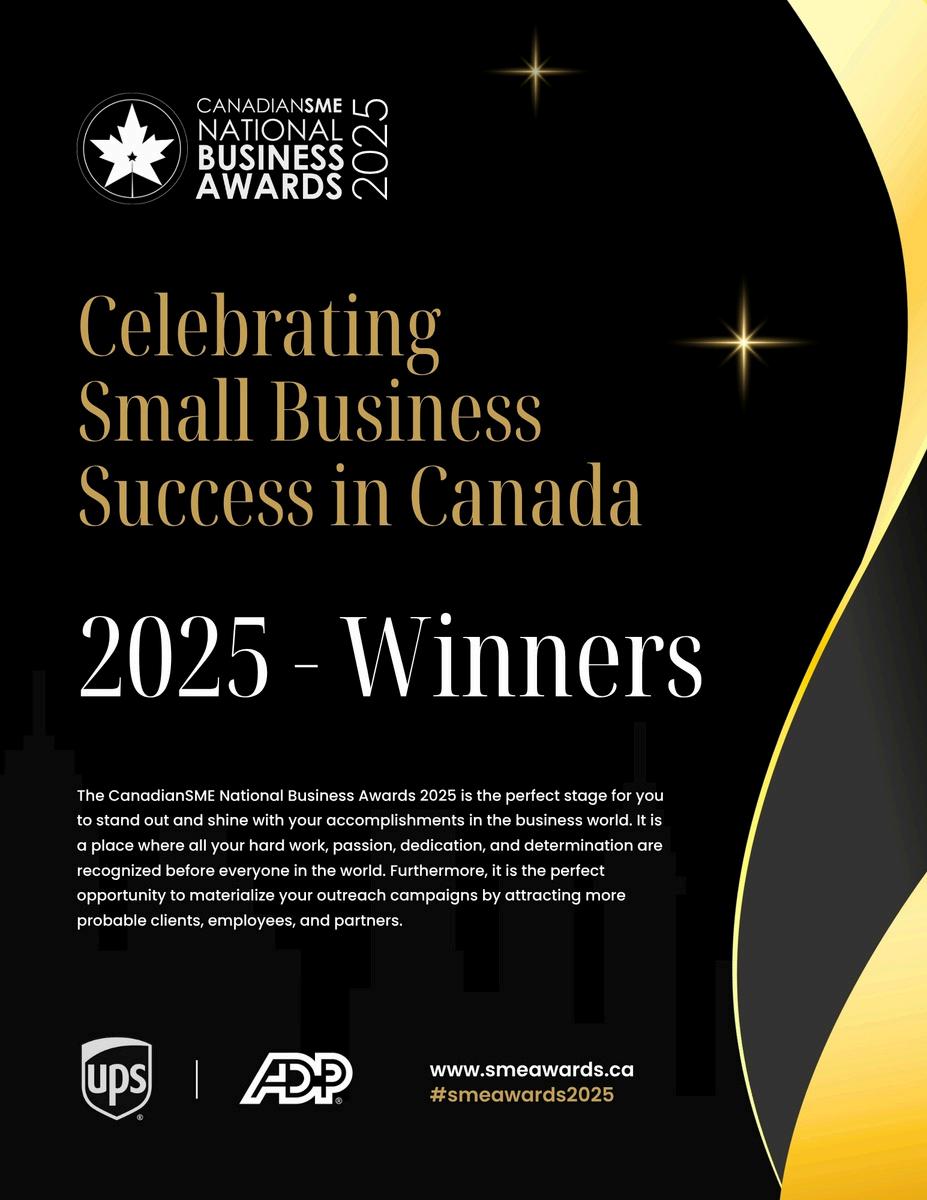
Wearealsoproudtocelebratethewinnersofthe CanadianSMENationalBusinessAwards2025,recognizing theachievementsandcontributionsofbusinessesmaking animpactacrossCanada
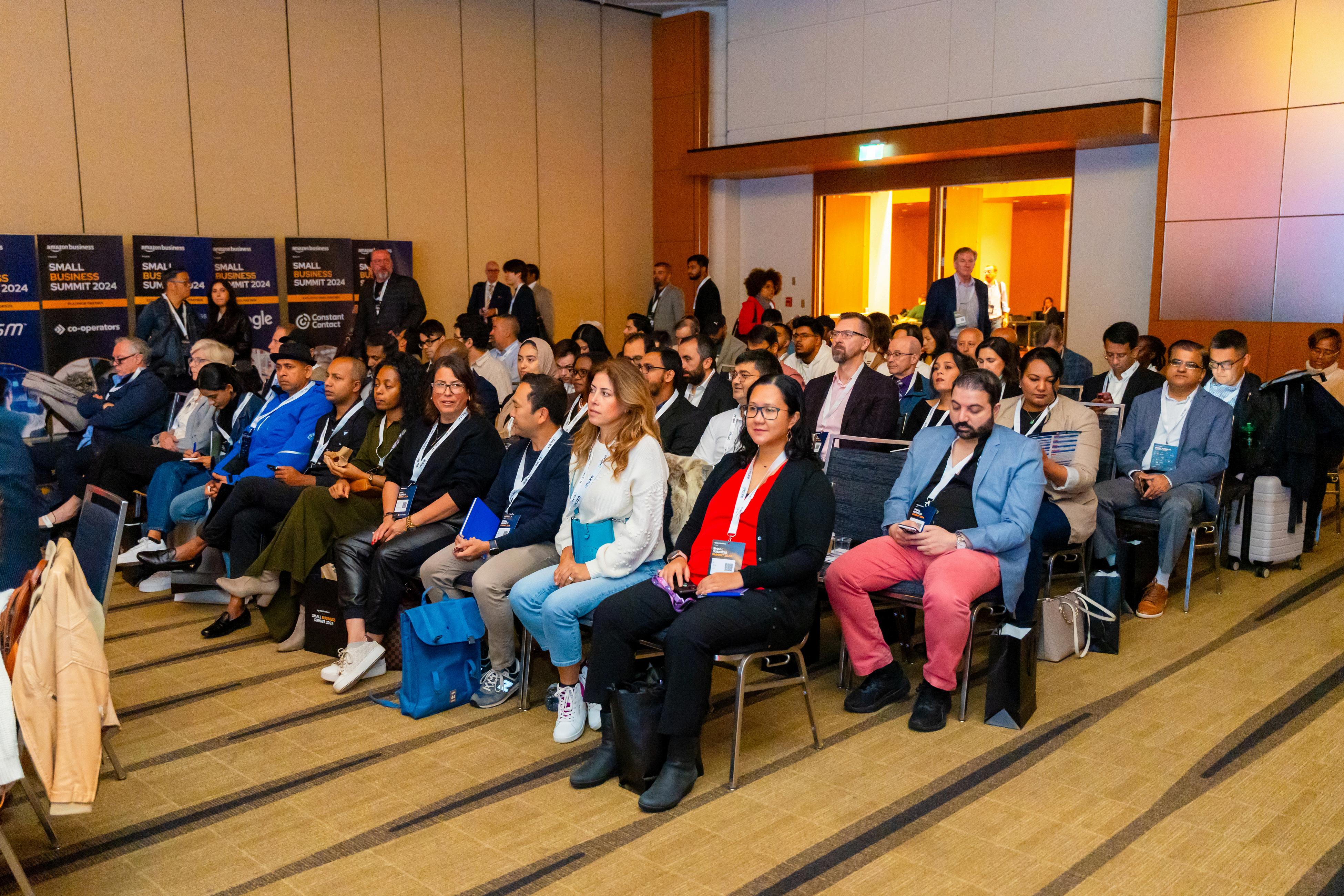
Lookingahead,weinviteyoutojoinusattheCanadianSME SmallBusinessSummit2026,presentedbyAmazon Business,onOctober13,2026,attheMetroToronto ConventionCentre.Thisgatheringwillbringtogether entrepreneurs,innovators,andbusinessleadersto exchangeideas,buildconnections,andexplorethefutureof CanadianSMEs
Warmregards,
SKUddin Publisher CanadianSMESmallBusinessMagazine


wwwcanadiansmeca
info@canadiansmeca
canadiansme
canadian sme
canadiansme

canadiansme


ISSN2562-0657(Online)

PublishedbyCmarketingInc 6345DixieRd,Unit202, Mississauga,ONL5T2E6
Copyright©2024CMarketingInc Allrightsreserved Reproductioninwholeorpartofanytext, photographyorillustrationswithoutwritten permissionfromthepublisherisprohibited. All Images, trademarks, service marks and logos referred to or appearing in this magazine are the property of their respective owners.
ThecontentsinCanadianSMEMagazinearefor informationalpurposesonly NeitherCmarketingInc,the publishersnoranyofitspartners,employeesoraffiliates acceptanyliabilitywhatsoeverforanydirector consequentiallossarisingfromanyuseofitscontents















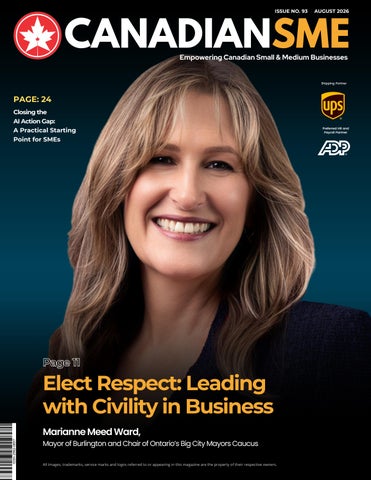
Elect Respect: Leading with Civility in Business
In an exclusive interview with CanadianSME Small Business Magazine, Marianne Meed Ward, Mayor of Burlington and Chair of Ontario’s Big City Mayors Caucus, discusses how she is leading with civility, transparency, and inclusivity in both municipal governance and broader community initiatives With extensive experience in public service, advocacy, and municipal leadership, Marianne shares her approach to fostering respectful workplaces, driving municipal innovation, and creating partnerships that empower local businesses and residents alike
InterviewBySKUddin
Marianne Meed Ward is currently serving her second term as Mayor of Burlington She is the longest-serving female mayor of the city
A passionate advocate for smart, balanced development, Mayor Meed Ward is focused on ensuring Burlington remains a great place to live, work, and play while maintaining its natural beauty. Her leadership is marked by a dedication to listening to residents, fostering collaboration, and prioritizing transparency in municipal decision-making.
A key priority of Mayor Meed Ward is promoting public transit in Burlington, where buses are now free for seniors and children, as well as for youth on the evenings and weekends.
Mayor Meed Ward is the Chair of the Ontario’s Big City Mayors Caucus, which launched the Solve the Crisis campaign calling on the provincial government to act on the homelessness, mental health, and addiction crisis



ImageCourtesy:MarianneMeedWard
She is also a board member of AMO, the Association of Municipalities of Ontario, where she has been active in advocating for a new deal for municipalities with the provincial and federal governments.
Mayor Meed Ward also launched the Elect Respect pledge, a nation-wide campaign to foster respect, inclusivity, and safety in public life. Elect Respect started as a conversation between a small group of women in Halton, founded by Burlington Mayor Marianne Meed Ward called the Halton Elected Representatives (HER), who came together to share their experiences with harassment and abuse in public life and to stand up for a better way forward
In 2025, Mayor Meed Ward was named “Mayor of the Year” by the Municipal World editorial board, in part due to taking a stand for civility in local government through the Elect Respect campaign

Also in 2025, Mayor Meed Ward joined the Great Lakes and St. Lawrence Cities Initiative, growing coalition of more than 325 mayors and top elected local leaders working to advance the socioeconomic and environmental health of communities in the Great Lakes and St. Lawrence River Region. She has also participated in cross-border delegations to address international trade, protect shared resources, and advocate for municipal interests
In 2024, Mayor Meed Ward was awarded the King Charles III Coronation Medal for her collaborative leadership, driven by principles of integrity, transparency and accountability, as well as work on building an inclusive community, advancing Truth and Reconciliation, and her commitment to sustainable growth and climate action
Prior to being Mayor, she served as a Burlington City Councillor from 2010 to 2018. Mayor Meed Ward has a degree in Journalism from Carleton University and worked for more than twenty years in journalism as a writer, editor, and broadcaster.
You’re Burlington’s longest serving female mayor and were named “Mayor of the Year” in 2025. As a woman leading in what is often a male dominated space, how has that experience shaped your view of leadership, and what parallels do you see for women running small and medium‑sized businesses in Canada?
I’m honoured to be Burlington’s longest-serving female mayor and to have been recognized as Mayor of the Year While I’m proud of those milestones, they’re also a reminder that we still have work to do
Across Canada, only one in five mayors are women In business, the numbers are strikingly similar, with women owning just 17 8% of small and mediumsized businesses according to Innovation, Science and Economic Development Canada (ISED)
I’ve never believed leadership is about fitting a particular mold It’s about showing up, listening, building relationships, and making decisions that move your community or your business forward Those are qualities that have nothing to do with gender, but they’re often the qualities women bring to leadership every day

I see a lot of parallels between women in public office and women running businesses, whether that’s creating opportunities, overcoming barriers, or proving that different perspectives make organizations stronger Every woman who steps into a leadership role helps make it a little easier for the next to do the same I look forward to the day when we ’ re no longer talking about how many women are in leadership, whether in business or politics, because it’s simply the norm
You launched the Elect Respect campaign to foster respect, inclusivity, and safety in public life, rooted in very real experiences of harassment, abuse, and even personal safety threats. How did Elect Respect get started, and why do you believe its principles matter just as much for business owners and workplace cultures as they do for politics?
I convene a network of women elected leaders called Halton Elected Representatives (HER Halton) It began as a conversation where each of us shared stories about the challenges we were facing in public office. It quickly became clear that these were not isolated incidents they were part of a broader pattern We realized that if this was happening to all of us, we had a responsibility to address it
One experience I often share is that I was threatened with being set on fire if I attended a city meeting about a proposed development that someone opposed. Attending those meetings isn't optional it's a fundamental part of my role as an elected official No one should have to weigh their personal safety simply for doing the job they were elected to do
While we can’t control the behaviour of others, what is within our power is to model the kind of behaviour we want to see That’s how the Elect Respect pledge was born a commitment to engage in political discourse without bullying, intimidation, or personal attacks
This extends beyond politics Businesses and workplaces face many of the same challenges, which is why so many display signs making it clear that abuse and harassment will not be tolerated This behaviour is not confined to any one profession or sector it has become increasingly embedded in our social culture, particularly since the COVID-19 pandemic It is something that we, as Canadians, should take a principled stand against
I’m grateful to the businesses, BIAs, and Chambers of Commerce that have embraced this pledge, beginning with the Burlington Chamber of Commerce. Today, the movement includes leaders and citizens from British Columbia to Nova Scotia, representing every political stripe That broad support demonstrates not only that this work is necessary, but that it is long overdue
Burlington has become an example of municipal innovation, from assistive AI tools like the eCheck system that simplify development review and building code assessment, to Pipeline to Permit dashboards that bring transparency to how projects move through the city. How do these kinds of innovations reflect your broader philosophy about making government more accessible, efficient, and responsive to residents and local businesses?
Whether you ' re building a home, starting a business, or investing in our community, the process should be clear, predictable, and as straightforward as possible.
That's the thinking behind initiatives like eCheck and Pipeline to Permit eCheck uses assistive AI to help applicants identify potential zoning and building code issues before they submit their plans, helping reduce delays and uncertainty Burlington is proud to be the first municipality anywhere to extend this capability to building code assessment.
At the same time, our Pipeline to Permit committee and public dashboard bring everyone to the same table staff, industry, and the public to identify bottlenecks and make it easier for everyone from residents to builders to see how projects are moving through the system This is another example of the kind of municipal innovation where Burlington is leading the charge
For me, innovation isn't about technology for technology's sake It's about finding better ways to serve people If we can make processes simpler, be more transparent, and give people the information they need upfront, we ' re helping residents, businesses, and builders spend less time navigating bureaucracy and more time doing what they do best
That's good for residents, good for businesses, and good for the local economy That's the kind of local government we ' re working to build in Burlington

You’ve championed smart, balanced development, expanded access to public transit, and taken on roles with Ontario’s Big City Mayors Caucus, AMO, and the Great Lakes and St. Lawrence Cities Initiative. What does “municipal innovation” mean to you in practice, and how can cities better partner with small businesses to tackle challenges like housing, infrastructure, and climate while still supporting local economic growth?
To me, municipal innovation is about being willing to look at old challenges in new ways and working with the people who are closest to those challenges Cities are where residents, businesses, and governments come together every day, so we have a responsibility to find practical solutions that improve people’s quality of life
That means helping enable the conditions to build more housing while protecting the character of our communities, expanding transportation options so people can get where they need to go, and taking action on climate change while supporting economic growth These challenges are connected, and they require collaboration across sectors
Small and medium-sized businesses are essential partners in that work They bring local knowledge, creativity, and a willingness to adapt that can help cities solve problems more effectively Whether it's creating more complete communities, supporting local jobs, or developing new approaches to sustainability, municipalities and businesses are stronger when they work in partnership together.
Through my roles with Ontario’s Big City Mayors Caucus, AMO, and the Great Lakes and St Lawrence Cities Initiative, I’ve seen that cities across Canada are facing many of the same challenges The most successful solutions come when we share ideas, listen to partners, and focus on outcomes, while advocating for our shared interests with a unified voice

Elect Respect, your advocacy on homelessness and mental health, and your recognition with the King Charles III Coronation Medal all point to a leadership style grounded in integrity, transparency, and inclusion. For Canadian entrepreneurs and SMB leaders, what concrete steps would you suggest they take to build more respectful, resilient workplaces—and what message would you most like to leave them with about leading in difficult times?
Building a respectful and resilient workplace starts with recognizing that culture is created every day through our actions. It’s not just about having policies in place it’s about how leaders treat people, how they respond when challenges arise, and whether employees feel heard and valued
For entrepreneurs and small business leaders, I would encourage them to lead with clarity and compassion. Set expectations for respectful behaviour, create an environment where people feel safe sharing ideas and concerns, and don’t underestimate the importance of listening Strong workplaces are built on trust
The challenges we face today from housing affordability and mental health to economic uncertainty created by unjust U S tariffs and growing social division remind us that we need to work together At the same time that businesses are navigating real pressures, we are also seeing a rise in incivility that can affect our workplaces and communities That’s why initiatives like Elect Respect matter
TherecognitionsI’vereceivedare meaningful,butthegreatestmeasureof leadershipisthepositiveimpactwehave onothers.Difficulttimeswillalwaystest us.Whetherinpublicservice,business,or ourcommunities,peopleneedleaders whocanprovidesteadyhandsin unsteadytimes—leaderswhostay groundedintheirvalues,bringpeople together,andrememberthathowwetreat oneanothermatters.

Disclaimer: The views and opinions expressed in this interview are those of the interviewee and do not necessarily reflect the official policy or position of CanadianSME Small Business Magazine Our platform is dedicated to fostering dialogue and sharing insights that inspire and empower small and medium-sized businesses across Canada.
NouhailaChelkhaoui BusinessWoman oftheMonth
BySKUddin
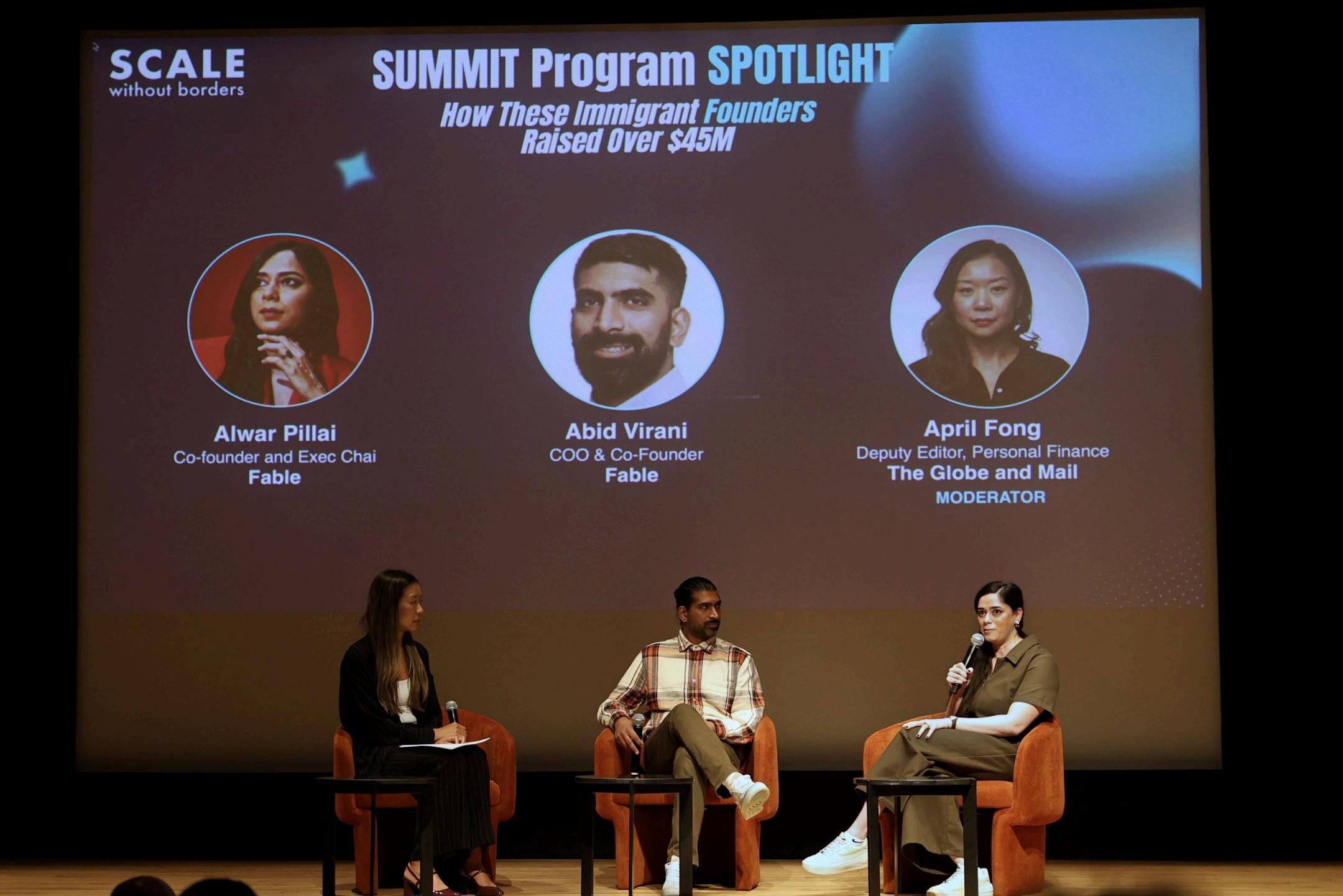
Scaling Opportunity for Immigrant Tech Talent in Canada with Nouhaila Chelkhaoui
Nouhaila Chelkhaoui, who came to Canada alone at the age of 17, soon learned that even a topnotch degree does not guarantee access to opportunities, particularly if you are a newcomer, a person of colour, and pursuing a profession far from home Her life's work was fueled by that encounter As the founder and CEO of Scale Without Borders, she now oversees what has grown into Canada's largest network for immigrant tech talent, connecting thousands of immigrants with the businesses, funding, and community they need to succeed.
From Newcomer Struggle to Systems‐Level Solution
Like many immigration journeys, Nouhaila's narrative begins with a different response After arriving in Canada as a teenager, she had to adjust to a new language and culture before graduating from one of the world's best universities, the University of Toronto Nevertheless, she found it "extremely difficult" to enter the workforce as an immigrant despite having that qualification

All around her, she observed the same pattern: exceptionally talented immigrants with stellar records in engineering, product, data, and leadership positions overseas were abruptly forced into survival jobs or never-ending application cycles Systemic obstacles, such as recruiting procedures that favour "Canadian experience," a lack of networks, and credential bias, were the problem rather than a lack of talent.
Instead of just persevering on her own, Nouhaila chose to create a system that would make things simpler, more transparent, and fairer for those who would follow in her footsteps That system is Scale Without Borders, which is based on firsthand knowledge and a thorough comprehension of both immigration and technology
Building Scale Without Borders
For Canadian immigrant IT talent, Scale Without Borders (SWB) serves as a community, platform, and catalyst Under Nouhaila's direction, it has expanded into the nation's largest network dedicated to tech novices, helping over 6,000 individuals through contacts, events, and programs
SWB offers the following to immigrant tech professionals:
EMPLOYER CONNECTIONS: Private career fairs with employers; get face time with recruiters actively hiring
EXCLUSIVE EVENTS: In-person events like networking events, social nights, brunches, coffee meetups, walks, and runs + access to passes for conferences, including Elevate Festival, Collision, Web Summit, Toronto Tech Week and more
COMMUNITY & NETWORKS: An online community and WhatsApp group to connect, share opportunities, and stay supported. Gain exclusive free/discounted access to top tech events, curated referrals, and warm introductions (e.g., trusted immigration lawyers, founder communities, or connections within our VC and investor networks).
HANDS-ON LEARNING: Monthly hands-on workshops with guest speakers and experts designed to give you a real edge in your career + Access to hundreds of hours of self-paced tech training across cybersecurity, AI, coding, and more in over 10 languages
FLAGSHIP SUMMIT: Access to the annual Immigrants Tech Summit at ROM
The organization also offers a 30-day free trial, during which folks can cancel anytime via the portal
The organization has been featured in publications such as the Toronto Star, the Globe and Mail, Bay Street Bull, and Betakit, and has received accolades including a "Top 100 Companies to Watch" designation and a Women of Influence award These accolades demonstrate that immigrant-led, impact-driven enterprises can compete with typical high-growth ventures SWBservesasabridgeforcompanies, includingbigbanks,fast-growingtech scaleups,government,andnon-profits, toaccessvetted,high-calibretalent outsidetypicalrecruitingapproaches. Thesecollaborationshaveenabled businessestofillcrucialtaskswhilealso establishingmorediverse,globally thinkingteams.

A Career of Championing Founders and
Newcomers
Scale Without Borders is not Nouhaila's first experience developing ecosystems She formerly oversaw Women Founders programs at the DMZ, a leading startup incubator in Canada, before pursuing SWB full-time She assisted hundreds of early-stage and scaling firms, including those led by women and other underrepresented founders, in raising capital, acquiring strategic clients, and building their teams
Her role provided insight into the impact of support systems on a founder's success, including access to investors, mentorship, and peer communities, which can reduce years of trial and error to months. She applied the same principle to SWB, building it not as a job board, but as an ecosystem in which mentorship, community, and opportunity interact
Previously, Nouhaila managed an initiative to help Syrian refugees navigate Canada's convoluted healthcare system, which was reported by TechCrunch, HuffPost, and Metro News She also helped establish a health-tech firm Those experiences honed her grasp of what it means to design for people who are rebuilding their lives despite administrative and cultural obstacles She has lived and worked in Brazil, Turkey, and Morocco, and speaks English, Arabic (Moroccan), French, and conversational Spanish. She offers a truly global perspective to her work in Canadian technology
ImageCourtesy:NouhailaChelkhaoui

Redefining What “Tech Talent” Looks Like
Narrative transformation is a common theme in Nouhaila's works She questions the notion that "tech talent" must appear or sound a certain way or come from a specific set of institutions and companies She emphasizes the importance of global perspectives, multilingual communication, and cross-market experience by focusing on immigrant founders and professionals
SWB'seventsandstorytellingplatformsshowcaseengineerswhobuilt productsformillionsofusersworldwide,productmanagerswhonavigated hypergrowthinemergingmarkets,andfounderswhobootstrapped companiesunderconditionsmorechallengingthanthosefacedbymost Canadianstartups.Indoingso,shereframesnewcomersasacompetitive advantageforCanadianinnovation,ratherthanacharitycase.

Lessons for CanadianSME Readers
Nouhaila's story teaches clear lessons to small business owners and founders:
Design from personal experience: she based SWB on the pain spots she encountered and noticed around her.
Think ecosystem, not just enterprise: by servicing both talent and employers, SWB increases its influence.
Lead with both credibility and vulnerability: she is upfront about her own struggles, making her a true, trustworthy leader for those who follow her

From coming alone to Canada at the age of 17 to running a national platform for immigrant tech talent, Nouhaila Chelkhaoui has transformed personal hurdles into a roadmap for systemic change Her work at Scale Without Borders exemplifies the founder-driven, impact-oriented leadership that CanadianSME is proud to highlight
Your role in staying up to date is integral to our shared mission of fostering a community of innovators CanadianSME Magazine is a valuable treasure trove of entrepreneurial knowledge Click here to subscribe to our monthly editions for updates on Canadian businesses Follow our handle, @canadian sme, on X to stay updated on all business trends and developments. Your support is crucial to our mission.
Disclaimer: This article is based on publicly available information and is intended only for informational purposes. CanadianSME Small Business Magazine does not endorse or guarantee any products or services mentioned Readers are advised to conduct their research and due diligence before making business decisions
FromCloudComplexity toBusinessResults: HelpingCanadianSMEs
AdoptAIwithConfidence
ByTDSYNNEX
Canadian small and medium-sized enterprises are ready to realize the promise of cloud and artificial intelligence: greater agility, stronger productivity, improved resilience, and more responsive customer experiences. The opportunity is clear. The challenge is turning ambition into action with the right strategy, support, and path to measurable results
Cloud gives SMEs the flexible foundation to scale, modernize, and move faster AI builds on that foundation by automating routine work, surfacing insights from data, and helping teams make better decisions with greater speed and confidence
TDSYNNEXhelpsclosethe gapbetweenpossibilityand performancebyequipping AWSPartnerstodeliver secure,scalablecloudandAI solutionsthatconnectSME prioritiestobusinessimpact.
Turn Technology Investment into Business
Value
For SMEs, successful transformation is not about adopting technology for its own sake It is about addressing the operational challenges that limit growth, including:
Reducingmanualprocessesthatslowproductivity
Improvingresponsivenesstocustomers
Gainingclearerinsightintooperationsandperformance
Managingtechnologycostsmorepredictably
Helpingteamsfocusonhigher-valuework
Make Cloud and AI More Accessible with AWS
For many SMEs, cloud and AI can feel out of reach too costly, too complex, or too difficult to manage AWS helps lower those barriers with a flexible, consumptionbased model that allows businesses to start where they are, scale when they are ready, and maintain greater control over cost and performance
For Canadian SMEs, AWS infrastructure in Canada adds local relevance by helping support data residency needs while delivering low-latency experiences for customers and employees
solutionsalignedtobusinessgoals,whileTDSYNNEXhelpssimplify adoption,reduceexecutionrisk,andacceleratethejourneyfrom technologydecisionstomeasurableoutcomes.

WithAWS,SMEscanmovefasterand moreconfidentlybybeingableto:
Payonlyfortheresourcestheyuseandscale asbusinessneedschange
Avoidlargeupfrontinfrastructureinvestments andtestnewcapabilitieswithlowerrisk
Accessmorethan200fullyfeaturedservices acrosscloud,data,security,AI,andmachine learning
UseAWSFreeTieroptionstoexperimentbefore makingabroadercommitment
Explorepurpose-builtAIservicessuchasAmazon BedrockforgenerativeAIandAmazonQBusiness forworkplaceproductivity
ConsiderAWS-designedsilicon,includingAWS TrainiumandAWSInferentia,tohelpimprove performanceandlowerAIworkloadcosts
The TD SYNNEX Advantage
As a global technology distributor and solutions aggregator, TD SYNNEX helps partners turn cloud and AI complexity into repeatable, scalable solutions that SMEs can adopt with confidence
Thatadvantageincludes:
Partnerenablement:Training,technical resources,andTDSYNNEXinitiativessuchas DestinationAIthathelppartnersbuildAIand cloudpractices.
AWSexpertise:SupportforAWS-based migration,modernization,data,security,andAI solutions
Marketplaceandprocurementsupport:Access tocloudmarketplacesandecosystemsolutions thatsimplifypurchasinganddeployment.
Operationalsupport:Assistancewithbilling, provisioning,cloudmanagement,and optimization.
AWSprovidesscalablecloud, data,security,andAIservices.
TDSYNNEXhelpspartnersbring thosecapabilitiestoSME customersthrough enablement,marketplace access,operationalsupport, andoptimizationexpertise— makinginnovationmore practical,repeatable,and outcome-focused.
Costandgovernanceguidance:Supportfor visibility,resourceoptimization,andsecure, sustainablegrowth.
For SMEs, this means access to advanced cloud and AI capabilities through partners who understand their business For partners, it means the backing, tools, and expertise to deliver value faster, differentiate their services, and strengthen customer relationships
Real Outcomes SMEs Can Put to Work
With the right partner and AWS foundation, cloud and AI can move from abstract opportunity to practical gains across industries
A retailer may use Amazon Bedrock to apply foundation models to sales and inventory data, helping improve demand forecasting and personalize customer engagement without managing infrastructure A professional services firm may use Amazon Q Business to find information, gain insight, generate summaries, and take action across enterprise documents and systems, helping reduce manual search and review An SMB focused on service may use Amazon Connect, an easy-to-use cloud contact center, to support AIassisted customer interactions and help teams resolve issues faster
Grow with Confidence
As SMEs expand their use of cloud and AI, cost, security, compliance, and performance matter more than ever Without the right oversight, cloud environments can become harder to manage and AI workloads can increase spending quickly
TD SYNNEX helps partners support SMEs with tools, expertise, and frameworks that improve visibility, strengthen governance, and optimize resources so innovation remains sustainable, secure, and aligned with business priorities.
Start with a Practical Path Forward
For SMEs, the best starting point is not the technology itself It is the business opportunity: where manual tasks slow productivity, customers experience friction, data remains underused, or systems limit growth.
TD SYNNEX-enabled partners help translate these priorities into actionable strategies through cloud readiness assessments, targeted AI pilots, modernization initiatives, and AWS roadmaps Businesses can validate results, scale what works, and continue expanding successful use cases over time
Ready to Turn AI Ambition into Business Results?
Canadian SMEs do not need to become technology experts to benefit from cloud and AI They need the right partners, platforms, and guidance to make these technologies work for their business.
By combining AWS capabilities with TD SYNNEX partner enablement, marketplace access, operational support, and expertise across cloud, data, security, and AI, SMEs can move from uncertainty to action and from action to practical, scalable progress

Closingthe AIActionGap: APracticalStarting PointforSMEs
ByRiipen
But for many small and medium-sized businesses, the challenge is not understanding that AI matters The challenge is figuring out where to start
Many business leaders are asking the same practical questions: Where can AI create real value for our business? Which processes are worth exploring? How do we experiment without creating unnecessary risk? And how do we make progress when our teams are already balancing competing priorities?
These questions do not mean businesses are falling behind They show that employers want to approach AI in a way that makes sense for their teams, customers, and operations
The reality is that AI adoption is moving quickly, but confidence in using AI effectively has not kept pace McKinsey’s 2025 Global AI Survey found that 88% of organizations regularly use AI across at least one business function, yet many companies are still working to move beyond experimentation and achieve meaningful business impact.
For SMEs, that transition can feel even more challenging Without large technology teams or dedicated AI specialists, deciding where to focus time, resources, and attention is not always straightforward
The first step is not having every answer It is finding the right place to begin
Moving from AI interest to AI action
Most businesses understand that AI will play an important role in the future of work The challenge is turning that awareness into practical action.
Riipen’s State of the employer highlights this gap While 76 2% of employers say AI skills are a priority, 42 4% had not yet considered student projects as part of their AI strategy
This is what Riipen refers to as the AI Action Gap: the space between knowing AI matters and having a clear, practical way to begin
For many SMEs, closing this gap does not start with a large technology transformation or a complex AI implementation It starts with identifying one meaningful opportunity
Wanttounderstandwhereyourbusiness standstoday?TakeRiipen’sAIReadiness
Self-AssessmenttoidentifyyourcurrentAI readinessandexplorewhattypeofAIsupportedprojectcouldmakesenseforyour organization.

WherecouldAIhelpreducerepetitivework? Wherecoulditimproveanexistingprocess? Wherecouldabusinesstestanidea,learnfrom theresults,anddecidewhattodonext?
Self-Assessment]
A first AI project does not need to transform an entire organization Often, the most valuable first step is a focused experiment that helps a business understand where AI can support its work, where human expertise remains essential, and what opportunities are worth exploring further.
ImageCourtesy:Canva
AI adoption starts with confidence, not complexity
One of the biggest misconceptions about AI is that businesses need advanced technical expertise to begin exploring its potential In reality, many successful AI journeys start with something much simpler: understanding the business challenge first and identifying where AI could provide support
For an SME, that might mean exploring ways to better understand customer feedback, improve internal processes, streamline repetitive tasks, support marketing efforts, or uncover new opportunities within existing workflows The goal is not to introduce AI everywhere or chase the latest technology It is to identify where AI can create meaningful value for the business and help teams work more effectively.
AsAmandaBetts,
VicePresidentofGrowth
atRiipen,sharedduringarecentdiscussion onAIadoption:
For employers looking to explore this topic further, Riipen’s webinar, The AI Action Gap, explores how businesses can move from uncertainty to action by focusing on practical experimentation, human judgment, and real-world applications of AI
Why starting small can lead to bigger progress
When businesses think about AI, they often picture advanced automation, custom software, or complex technology projects. But for many SMEs, the most valuable first step is much more practical: starting with a focused business challenge, testing an idea, and learning what works before making larger investments
This is where student-supported projects can create meaningful value Students bring emerging skills, curiosity, and familiarity with new technologies, while employers bring the business context, customer understanding, and industry expertise needed to identify where AI can make a difference Together, they create an opportunity to explore AI through real work, build confidence, and better understand where technology can support the business while keeping human judgment at the centre
The result is more than a project deliverable It is a clearer understanding of where AI can create value, what opportunities are worth exploring next, and how businesses can move forward with confidence

Building a human-led approach to AI
The businesses that benefit most from AI will not necessarily be the ones using the most advanced tools They will be the ones who understand where technology can support their work and where human expertise, experience, and judgment remain essential.
A human-led approach to AI adoption starts with the business challenge, not the technology It means identifying where AI could create value, setting clear boundaries around how tools and information are used, and keeping people involved throughout the process AI can help teams explore ideas, improve workflows, and support decision-making, but human judgment remains critical in determining what works, what needs to change, and what should come next
The most effective way to build confidence with AI is through experimentation. Each project provides new insights into where technology can help, where additional support is needed, and how businesses can continue moving forward
AI is not about replacing the expertise already inside a business It is about creating new ways for people, technology, and emerging talent to work together to solve problems and create meaningful progress
Taking the first step toward AI progress
Every SME is at a different stage of its AI journey Some businesses are just beginning to explore what AI could mean for their organization, while others have already started experimenting but are unsure how to turn those early efforts into meaningful progress.
The challenge is that there is no one-size-fits-all approach to AI adoption The right starting point depends on your business, your goals, your processes, and the opportunities where AI can create the most value
Taking the time to understand your current readiness can help you identify where AI makes sense for your organization, where your team may need additional support, and what types of projects can help you move from curiosity to action
Because successful AI adoption is not about doing everything at once It is about finding the right opportunity, learning through experience, and creating a path forward that works for your business Riipen’sAIReadinessSelf-Assessmenthelpsemployersunderstand theircurrentAIreadinessandidentifyopportunitiestoexploreAI throughpractical,human-ledprojects.
The white paper provides practical guidance on how businesses can approach AI without needing to start with complex technology projects It explores how smaller experiments, student-supported projects, and a human-led approach can help employers identify where AI can support their work, build confidence, and make more informed decisions about what comes next

AffordableCloudStrategiesfor CanadianSmallBusiness Transformation
BySKUddin
Moving accounting, HR, collaboration, and line-ofbusiness applications to the cloud is a practical way for Canadian SMEs to reduce costs, increase resilience, and compete with larger competitors, not a futuristic idea Cloud adoption enables Canadian SMEs to access advanced technology on a subscription or pay-per-use basis, avoiding costly upfront investments in servers and software licenses The problem is to update processes without overspending or jeopardizing cybersecurity and privacy
Why Canadian SMEs are turning to the cloud
Cloud computing provides on-demand computing services via the Internet, including servers, storage, databases, networking, software, analytics, and intelligence This strategy provides Canadian SMEs with speedier innovation, more flexible resources, and economies of scale that were previously reserved for larger firms Rather than purchasing and maintaining gear, businesses "rent" access to resources from providers, modifying capacity as needed
SMB and SME guides emphasize that cloud services minimize upfront capital expenditures and shift costs to predictable operating expenses Cloud solutions also enable remote and hybrid work by providing secure access to accounting, human resources, and collaboration platforms from anywhere This flexibility can provide a considerable competitive advantage for Canadian enterprises operating in multiple locations
Moving core functions: accounting, HR, and collaboration
Many Canadian small and medium-sized enterprises (SMEs) begin their cloud journey with everyday tasks like accounting and communication Cloud accounting services enable organizations to manage invoices, expenses, payroll, and reporting in real time and frequently integrate with banking data and tax tools used in Canada Cloud-based HR tools simplify recruitment, onboarding, time tracking, and performance management, minimizing manual paperwork and enhancing accuracy.
Collaboration suites which include email, document sharing, video meetings, and chat are another popular first step Centralizing communication in the cloud helps teams avoid version control issues and gain better insight into ongoing initiatives Small and medium-sized enterprises (SMEs) commonly integrate line-of-business technologies such as inventory systems, point-of-sale systems, and industry-specific applications into a cloud stack to support daily operations

Cost control: pay for what you actually use
Understanding price structures and aligning them with business goals is the first step in " on a budget" cloud operations Most providers offer subscription or payper-use alternatives, with pricing based on the number of users, storage, or processing power consumed This flexibility can significantly minimize waste compared to purchasing a set hardware capacity that may go unused
Before deciding on cloud services, SMEs should consider their business goals and operations. Owners should identify areas where cloud solutions can improve efficiency, including collaboration, data storage, or application hosting, and then compare providers based on cost and value Cheaper choices are not necessarily better if they lack critical features or security; a slightly higher monthly charge can be justified if it avoids downtime, data loss, or compliance difficulties Regularly assessing usage and changing plans helps to avoid "subscription sprawl" and keep budgets under control
Cybersecurity and Canadian privacy considerations
Cybersecurity and privacy are critical considerations for Canadian SMEs implementing cloud technologies
TheOfficeofthePrivacyCommissionerof Canadastatesthat,whilecloudcomputing hasmanyadvantages,organizationsmust understandhowproviderscollect,utilize, disclose,andstorepersonalinformation. SMEsareresponsibleforprotecting customerandemployeedata,evenwhen usingthird-partycloudservices.
To ensure compliance with Canadian privacy laws and regulations, best-practice guidelines recommend selecting trustworthy providers with solid security track records and reviewing their data protection procedures and data sovereignty policies Encrypting data in transit and at rest is crucial SMEs should adopt the shared-responsibility paradigm, in which providers secure the infrastructure and customers manage access controls, password hygiene, and device security Regular backups, multi-factor authentication, and defined incident response strategies improve resilience
Working with Canadian or Canada‐hosted providers
For many SMEs, choosing providers with a strong local presence and Canadian-hosted infrastructure is a critical risk-management step Providers who understand Canadian regulatory and commercial realities can provide more targeted assistance, and local data centers may minimize latency while resolving data sovereignty concerns When evaluating options, SMEs should ask about data storage, crossborder data transfers, and service-level agreements (SLAs) that ensure uptime and support in Canadian time zones
Guides propose reading customer reviews and case studies to learn how other firms have fared with a particular provider Local or Canada-focused vendors may provide value-added services including implementation support, training, and continuous optimization. This can be especially beneficial for smaller teams without in-house IT expertise.
A practical roadmap for Canadian SMEs
Moving to the cloud should be approached as a planned effort rather than a series of ad hoc purchases A viable path for Canadian SMEs comprises assessing business needs and compliance requirements, investigating suppliers with a local presence and strong security measures, planning data migration, training staff, and implementing a staged rollout, starting with non-critical systems This method minimizes disturbance and allows teams to learn and adjust before implementing mission-critical applications
Ascloudusageexpands,SMEscanuseunified managementtoolstogaina"singlepaneofglass"viewof allservices,increasingvisibilityandcontrol.Investingin internalexpertiseorcollaboratingwithmanagedservice


Your role in staying up to date is integral to our shared mission of fostering a community of innovators. CanadianSME Magazine is a valuable treasure trove of entrepreneurial knowledge. Click here to subscribe to our monthly editions for updates on Canadian businesses. Follow our handle, @canadian_sme, on X to stay updated on all business trends and developments. Your support is crucial to our mission.
Disclaimer: This article is based on publicly available information intended only for informational purposes CanadianSME Small Business Magazine does not endorse or guarantee any products or services mentioned Readers are advised to conduct their research and due diligence before making business decisions
AlexanderGonçalves
ChiefCommercialOfficeratWagepoint

In an exclusive interview with CanadianSME Small Business Magazine, Alexander Gonçalves, Chief Commercial Officer at Wagepoint, shares his insights on making payroll simple, practical, and connected for Canada’s small and mid-sized businesses. Drawing on nearly two decades of experience in HR tech and SaaS, Gonçalves discusses how Wagepoint is building an integrated payroll, time, and people management ecosystem that puts the user experience first.
Alexander Gonçalves is Chief Commercial Officer at Wagepoint, where he leads the company ' s sales, marketing, and customer support teams He brings nearly two decades of leadership experience in HR tech and SaaS to the role, most recently as Senior Director and Country Manager for Canada at Rippling He previously held senior commercial roles at Humi, Adlib, and NEOGOV, where he built deep expertise in helping Canadian small and midsized businesses run their workforce operations At Wagepoint, his focus is on scaling the company ' s reach while protecting what has made it the friendliest payroll provider in Canada: simple, reliable software backed by a team that small business owners and their advisors actually like talking to.

InterviewBySKUddin
You’ve spent nearly two decades in HR tech and SaaS, most recently leading Rippling’s Canadian business and holding senior roles at Humi, Adlib, and NEOGOV. Can you tell us a bit about that journey and what your new role as Chief Commercial Officer at Wagepoint will focus on day to day?
My career has mostly been about helping organizations navigate some of their most complex human capital challenges I’ve worked with the systems that employers rely on to hire, onboard, and stay compliant Other experiences taught me a lot about how technology can take the friction out of work most people don't think about until it breaks I’ve gotten a close look at what Canadian small businesses actually need from workforce management and payroll tools, which is something fundamentally different from what enterprise tools are built for. My time at Rippling gave me a global vantage point on where the modern workforce platform is heading
Wagepoint sits at the intersection of all of that, with a sharp Canadian focus and a real love for the small business owner Day to day, I'm responsible for making sure the entire commercial engine is pulling in the same direction That means making the experience even better for our customers and partners, growing our presence in the market, and staying true to what people already love about Wagepoint: payroll that's simple, reliable, and backed by friendly, helpful support
Wagepoint has been helping Canadian small businesses run payroll since 2012, with tens of thousands of businesses, accountants, and bookkeepers using the platform. What resonated most with you about Wagepoint’s mission and values, and how do you see yourself building on that foundation for Canada’s SMB community?
Two things stood out the moment I started getting to know Wagepoint The first is what the team has built over more than a decade: a native Canadian payroll product that small business owners and the bookkeepers serving them actually like using Most payroll software isnt designed with Canadian small businesses in mind Wagepoint has always been
The second is the company ' s commitment to being Canadas friendliest payroll company. It sounds like a soft promise, but it's a hard one to keep, and it shows up in everything from how the product is designed to how our support team talks to customers on a Friday before payday
Building on that foundation is about scaling without losing what makes Wagepoint different Canada has more than a million small businesses, and a huge number of them are still doing payroll the hard way, on spreadsheets or in tools built for larger companies My job is to help Wagepoint reach more of them, support them better when they get here, and keep proving that a small business can have an enterprise-quality payroll experience without the enterprise headaches
Your remit spans sales, marketing, revenue operations, and customer support—essentially the entire go‑to‑market engine. What are you most excited to tackle first as CCO, and how do you plan to bring those teams together to deliver an even better experience for small business owners and their advisors?
WhatI'mmostexcitedtotacklefirstis somethingWagepointalreadydoeswell butcandoevenbetter:meetingthesmall businessownerandtheiraccountantor bookkeeperasoneconnected experience.Inmostcompanies,sales, marketing,andsupporteachseea differentsliceofthecustomer.The customerfeelseveryseambetween thoseteams.Myfirstpriorityistotake thoseseamsout.
What does this mean in practice? It means our messaging speaks to the realities of running a five-person business or a 50-client bookkeeping practice It means our support team has the data and context to solve problems before customers have to repeat themselves. It also means investing more in our accountant and bookkeeper community, because those advisors are often the difference between a small business thriving and one barely staying afloat That's why we just launched WagePro+, a new partner program built around helping firms turn payroll into a meaningful, scalable part of their practice If we get these experiences right, weve done our job well

Payroll is becoming more connected to time tracking, HR, and people insights. How do Wagepoint’s recent updates move you closer to a unified payroll, time, and people management platform, and what major opportunities do you see right now to make life easier for small businesses across Canada?
Payroll used to be a task that happened every two weeks Today, it's becoming the system that connects many of the people processes around it We launched Timesheets so that the hours people actually work flow directly into payroll without a separate system in between, and the My Wagepoint app gives employees self-service access to their own pay information, time off, and pay stubs from their phone
For small business owners, these are more than features They're meaningful time-savers that reduce complexity and make managing payroll feel easier
Looking ahead, the opportunity is to bring these experiences together even more seamlessly. Small businesses don't think in terms of separate HR, time tracking, and payroll systems They simply want to pay their people accurately and on time without spending hours managing the process Our job is to keep closing the gaps between those workflows so that running payroll feels less like operating software and more like getting one important thing off their plate
AI is changing how many back-office tools are built and used. What is your approach to AI at work in the context of payroll and people operations, and what early impacts or trends are you seeing among Canadian small businesses as they adopt more AI‑enabled tools in their day‑to‑day operations?
Payroll is one of the few areas where getting it 99% right still means somebody's pay is wrong That's why our approach to innovation is intentional. We embrace technologies like AI where they can clearly make our customers' lives easier, while maintaining the highest standards of accuracy, compliance, and trust wherever money and people's livelihoods are involved
In practice, that means we ' re focused on reducing the time it takes to get started, surfacing answers to common questions before customers have to ask, and helping the support team resolve issues faster We’re also embedding AI directly within the payroll workflow, so potential anomalies can be flagged earlier, without adding complexity for the business owner That’s how we see AI showing up in our software: practical and inside the work people are already doing
In fact, that's broadly what I'm seeing across Canadian small businesses right now The AI wins are in the practical places: pulling information out of documents, drafting first-pass responses, cleaning up bookkeeping. Most owners I talk to aren't looking for AI for AI's sake. They're looking for tools that help them get through their work faster and get a little time back in their day
Thetrendthatexcitesmemostishowquickly smallbusinessownersandtheiraccountants aregettingcomfortablewiththetechnology. Thegapbetweenenterpriseandsmallbusiness AIadoptionisclosingfast,andthat'sgoodfor everyone. Disclaimer: The views and opinions expressed in this interview are those of the interviewee and do not necessarily reflect the official policy or position of CanadianSME Small Business Magazine. Our platform is dedicated to fostering dialogue and sharing insights that inspire and empower small and medium-sized businesses across Canada.

Building Agile Canadian SMEs foraChangingBusinessLandscape
BySKUddin
Canadian SMEs are at a crossroads as technology, demographics, and evolving work demands affect their ability to expand and thrive SME leaders are rethinking work paradigms, competing for young tech-savvy personnel, and infusing innovation AI, data, and ESG into everyday decisions to prepare for the future
According to CanadianSME materials and broader Canadian research, these shifts are not abstract trends but rather concrete levers that most SMEs can implement
Rethinking work through hybrid models
For many Canadian SMEs, hybrid work, which combines remote and in-office arrangements, is now a long-term strategy rather than an emergency solution In Canada, hybrid work models are most prevalent in knowledgebased sectors like banking, technology, and communications However, they are also gaining popularity in professional services, creative industries, and advanced manufacturing operations Hybrid work can benefit SMEs by lowering real estate expenses, expanding talent pools beyond local commuting distances, and improving worklife balance
According to CanadianSME publications, flexible work arrangements and hybrid models are now essential for talent attraction and retention. To make hybrid work sustainable, SMEs invest in digital collaboration tools, clear communication standards, and manager training that focuses on results rather than physical presence Practical methods include identifying which tasks require on-site work, setting expectations for core hours and availability, and ensuring remote staff have equitable access to information, development opportunities, and recognition
According to policy and innovation assessments, Canada's future innovation depends on developing a diversified, competent workforce in science, engineering, trades, and technology, with SMEs playing an important role in providing practical experience SMEs that attract young people often invest in upskilling current personnel in digital tools and AI, provide earlycareer employees with genuine responsibility and visibility, and connect their firms to broader issues such as sustainability and community impact These approaches make SMEs more appealing than larger, more bureaucratic firms, particularly among entrepreneurial young professionals
ImageCourtesy:Canva

Attracting and developing young tech‐savvy talent
To recruit younger, tech-savvy workers, Canadian SMEs must compete not only on pay but also on culture, learning, and purpose, according to conversations about the future of work CanadianSME emphasizes the importance of talent and well-being for SME competitiveness. Leaders are implementing flexible work arrangements, mental health support, inclusive policies, and clear career paths Younger workers frequently seek positions where they can use current tools, contribute to significant initiatives, and see a route to advancement
Building Smarter SME Strategies With AI,
Data and ESG
In Canada, future-of-work evaluations show that AI and data are revolutionizing corporate operations However, the true opportunity lies in combining technology with human judgment CanadianSME podcast content has focused on how SMEs can gain the "AI advantage" by applying AI to real-world use cases such as forecasting, customer assistance, recruitment, and workflow automation, rather than pursuing grand, abstract transformations Success is dependent on recognizing where AI offers value, establishing boundaries, and educating employees to work effectively with new tools
Innovation reports also highlight the growing role of ESG (environmental, social, and governance) in SME strategy SMEs that incorporate sustainability, diversity, and ethical governance into their operations frequently find improvements in risk management, brand reputation, and access to specific consumers and investors CanadianSME stories have highlighted CEOs who integrate ESG into daily business decisions, such as assessing emissions in their supply chains, implementing equitable employment practices, or enhancing reporting transparency, rather than treating ESG as a stand-alone activity
Well‐being, inclusion, and resilience as competitive advantages
According to CanadianSME's coverage on talent and well-being, resilient SMEs prioritize employee wellness and inclusiveness Small and mediumsized enterprises (SMEs) are experimenting with mental-health and wellness programs, nonmonetary rewards, and work-life balance supports, including extra vacation, flexible scheduling, and well-being stipends. Offering clear restrictions on after-hours communication or peer-support circles can be adapted to varied budgets, sending a strong signal while costing less than an entire corporate wellness program
Canadianfuture-skillsstudyindicatesthatinclusive cultures,equitablecompensation,anddiversityare crucialforcreativity.Teamswithdiversebackgrounds andviewpointsaremoresuitedtoidentifying possibilities,understandingconsumerdemands,and navigatingchange.SMEleadersshouldbeginby examiningpayfairness,reviewingrecruitingand promotionpolicies,andestablishingforumswhere employeescanshareideasonoperationsand innovation.CanadianSMEarticlesfrequentlypromote "littlewins" incrementaladjustmentsthatleadto culturereforms,suchaschangingjobdescriptions, experimentingwithflexiblebenefits,orimplementing regularlisteningsessions.
Practical steps for SME leaders
Canadian research and SME content provide a practical guide for SME leaders to future-proof their business Create a work-model plan that balances business needs with flexibility, including digital tools and management training Invest in young, tech-savvy talent by providing meaningful employment, clear development routes, and a culture that prioritizes wellbeing and inclusion To embed innovation, find highimpact AI and data use cases, and incorporate ESG into daily operations beyond reporting
Finally, leverage Canada's larger digital ecosystem, which includes government initiatives, banking, telecommunications, and innovation hubs, to promote technology adoption and skill development As demonstrated in CanadianSME summits and podcasts, SME leaders who combine smart work patterns, excellent talent practices, and disciplined innovation are better positioned to weather economic downturns and seize opportunities Future-proofing is creating adaptable, people-centred firms capable of learning, experimenting, and growing in Canada's changing economy, rather than forecasting every shift
Your role in staying up to date is integral to our shared mission of fostering a community of innovators CanadianSME Magazine is a valuable treasure trove of entrepreneurial knowledge. Click here to subscribe to our monthly editions for updates on Canadian businesses. Follow our handle, @canadian_sme, on X to stay updated on all business trends and developments Your support is crucial to our mission
Disclaimer: This article is based on publicly available information intended only for informational purposes CanadianSME Small Business Magazine does not endorse or guarantee any products or services mentioned. Readers are advised to conduct their research and due diligence before making business decisions
Humanized Finance Bringing CFOThinking WithinReach
In an exclusive interview with CanadianSME Small Business Magazine, Marietjie MacMillan, CPA, CMA and Founder & CEO of MacMillan Consulting, shares her innovative approach to finance for founder-led and mid-market businesses. With nearly three decades of executive finance experience, MacMillan champions “humanized finance” a model where numbers serve people, not the other way around
InterviewBySKUddin
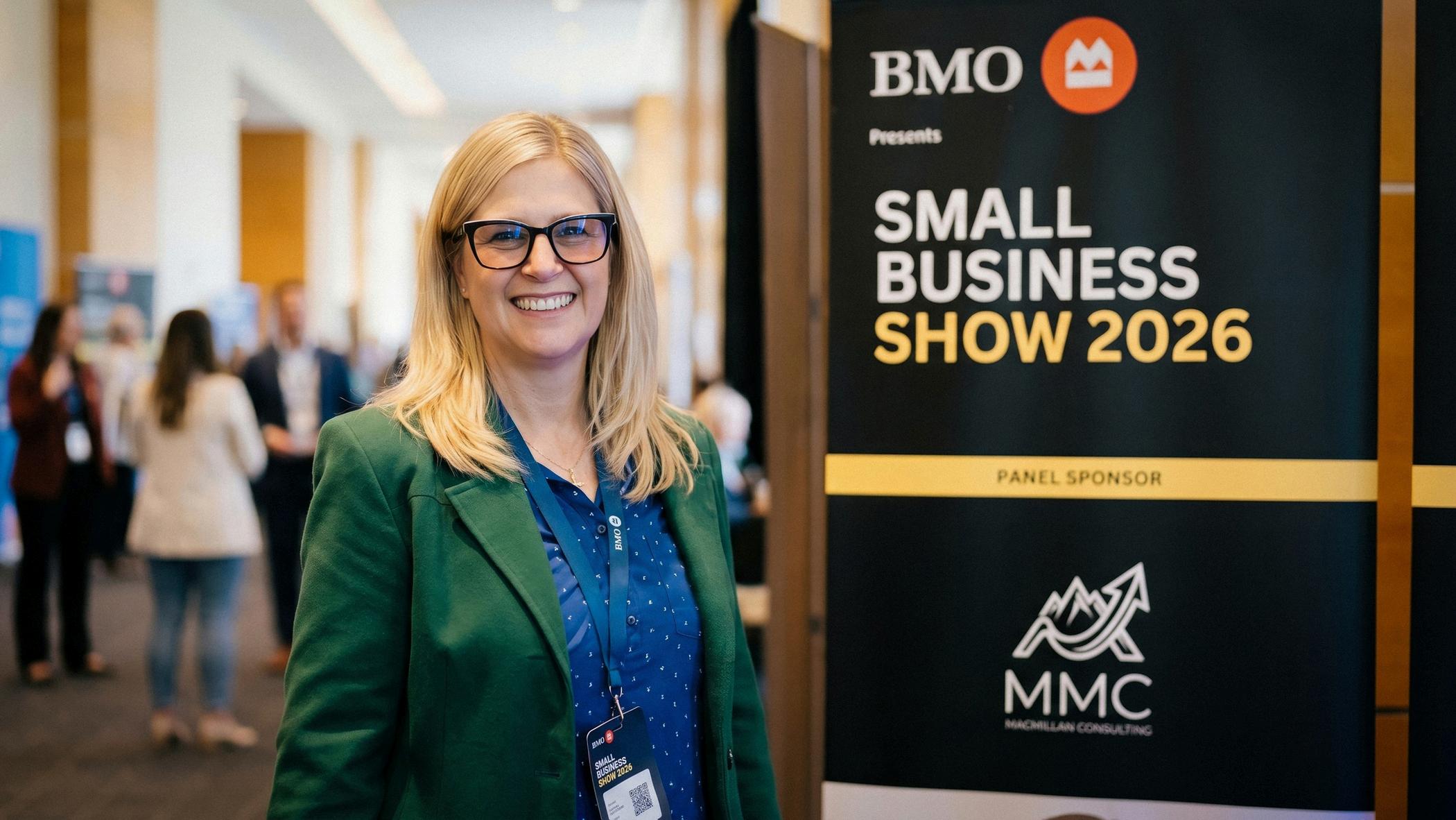
Marietjie MacMillan, CPA, CMA, is the Founder & CEO of MacMillan Consulting, a finance back office partner that gives founder-led and mid-market businesses executive-level finance strategy and execution without the full-time cost. With nearly three decades in executive finance, she champions “humanized finance” the belief that numbers exist to serve people, not the other way around Through fractional leadership, on-demand specialist talent, and AI-enhanced workflows, she helps growing companies build the financial structure to scale with clarity and confidence
You describe MacMillan Consulting as a “finance back-office partner,” not a traditional financial services firm. What gap in the market did you set out to close when you founded the company, and why does that distinction matter for founder-led and mid market businesses?
When I founded MacMillan Consulting, the gap was obvious: world-class finance leadership was priced for large enterprises, and everyone else made do Founderled and mid market businesses were handed bookkeeping and compliance, then left to make their biggest decisions alone. I built MacMillan Consulting to close that gap permanently We call ourselves a finance back-office partner, not a financial services firm, and the distinction matters “Financial services” makes people think of banking, lending, or wealth management products we don’t sell We’re the team behind your numbers: the strategy, the controls, the forecasting, the execution We are your finance function, scaled to what you actually need For a founder, that difference is everything You’re not buying a product; you ’ re gaining a partner who owns the engine while you drive the business. We’re not a staffing agency and not a referral network we own our talent, stay embedded, and are accountable for the outcome That’s what growing businesses have been missing, and exactly what we set out to provide
MarietjieMacMillan,CPA,CMA
You champion the idea of “humanized finance,” where numbers exist to serve people, not the other way around. In practical terms, what does humanized finance look like inside a growing business, and how is it different from the purely transactional bookkeeping or compliance support many SMEs are used to?
Humanized finance starts from a simple belief: numbers exist to serve people, not the other way around Inside a growing business, it means we begin with the founder’s goals where they want the company to go and work backwards into the numbers, instead of handing over a report and walking away Transactional bookkeeping tells you what already happened It’s necessary, but it’s the rearview mirror Humanized finance is the windshield It turns the same data into decisions: Can we afford this hire? What does expansion actually cost? Where is cash really going? In practice it looks like calmer conversations and clearer choices
One client had clean books for years but no one steering Within weeks of bringing in a Fractional CFO, the conversation shifted from “what happened last month” to “where are we headed, and what will it take to get there ” That’s the difference Compliance keeps you safe Humanized finance helps a real person make a better decision about a real business with confidence instead of guesswork
Your model blends Talent-as-a-Service, Fractional CFO support, and fixed-term consulting projects, all backed by a vertically integrated talent pool across Canada and South Africa and a 24hour execution cycle. How does that human-plus-AI, follow-the sun approach change what smaller businesses can afford and what they can realistically achieve?
Most smaller businesses assume top-tier finance is out of reach Our model proves otherwise by combining three things Talent-as-aService gives you a credentialed specialist accountant, controller, FP&A analyst deployed in weeks, not months
Fractional CFO Support puts seasoned C-suite leadership in your business a few days a week, at a fraction of a full-time cost Fixedterm Consulting Projects handle the big lifts: market entry, M&A readiness, operations redesign. What makes it work is how it’s delivered We own our talent across Canada and our sister company, MacMillan Mzansi Accountancy, in South Africa Strategy set during the Canadian day is executed overnight, so clients often wake up to work already in motion a genuine follow-the-sun advantage AI amplifies that: used well, it compresses the time between a question and an answer reconciliations in hours, scenario planning as a live conversation But it never replaces judgment; a forecast is only as good as the strategist reading it Pairing AI with globally credentialed people, trained in IFRS, US GAAP and ASPE, is how a smaller business finally gets speed and senior judgment together.
Many founders feel they “can’t afford” senior finance leadership and end up making big decisions with only historical reports in hand. What do you tell those leaders, and what is one common mistake you see growing SMEs make with their finances when they delay bringing strategic finance into the room?
I tell them they don’t have a budget problem they have a structure problem You don’t need a full-time CFO to get CFO-level thinking With fractional and on-demand models, you bring in exactly the expertise you need, exactly when you need it The seat doesn’t have to be fulltime to be world-class, and your budget shouldn’t define the quality of advice you get The most common mistake I see is hiring for the org chart instead of the decision
ImageCourtesy:MarietjieMacMillan

Afounderaddsajuniorto“dothefinances,”then wonderswhynooneissteeringtheship whilethe biggestcallsonpricing,expansion,hiringandcashget madeongutfeelandlastquarter’sreports.Historical reportstellyouwhereyou’vebeen.Theycan’ttellyou whetherthenextmoveistherightone.Bringstrategic financeintotheroomearly,evenpart-time,andbuild yourfinancefunctionaroundthedecisionsthatmove thebusinessforward.Strategyshouldbestandard fromthestart notaluxuryyoufinallyaffordonce you’vealreadymadethecostlymistakes.
You’re working with clients navigating Canadian and U.S. expansion, M&A readiness, and operations redesign in a very uncertain 2026 environment. What advice would you offer Canadian SMEs on structuring their finance function around decisions rather than headcount—and how can they start using finance as a lever for sustainable growth instead of just a cost centre?
In an uncertain year, the instinct is to cut and wait I’d argue the opposite: get your structure right so you can move with confidence Build your finance function around decisions, not headcount Ask what choices are coming a US expansion, an acquisition, a process overhaul and put the right expertise against each one, even on a fractional or project basis You don’t need a big team; you need the right thinking at the right moment For crossborder growth specifically, model it before you commit
Market-entry economics, tax and regulatory realities, M&A readiness these belong in a forecast and a plan, not in a hopeful conversation That’s where finance stops being a cost centre and becomes a lever: it tells you which opportunities are real, what they cost, and how to fund them Sustainable growth isn’t about doing more It’s about being built right human judgment at the centre, technology accelerating it, and senior expertise finally within reach The businesses that structure for clarity now will be the ones still growing when the uncertainty clears
Disclaimer: The views and opinions expressed in this interview are those of the interviewee and do not necessarily reflect the official policy or position of CanadianSME Small Business Magazine Our platform is dedicated to fostering dialogue and sharing insights that inspire and empower small and medium-sized businesses across Canada.
TheEssentialMartech StarterStackfor CanadianSmallBusinesses
ByMaheenBari

Building a basic marketing technology ("martech") stack can help Canadian SMEs attract, convert, and keep customers more efficiently An entry-level stack, including CRM, email automation, analytics, advertising tools, and social scheduling, can be built for hundreds of dollars per month rather than tens of thousands of dollars Select solutions that connect seamlessly, comply with Canadian privacy and anti-spam regulations, and align with business objectives
What “martech stack” means for a Canadian SME
A martech stack is a set of tools and platforms used to plan, execute, and measure marketing operations across channels such as your website, email, advertising, and social media For the average Canadian SME, the foundational stack typically includes customer data management (CRM), marketing execution (email and social), analytics, and basic advertising technology Rather than purchasing multiple separate apps, the idea is to build a compact, integrated ecosystem that supports your customer's journey from awareness to loyalty
Small business guides emphasize the need for martech to be cost-effective and versatile, with a focus on core functions first. Starting with a "decent" base rather than advanced tools allows you to learn, develop internal skills, and demonstrate a return on investment before scaling up This technique is ideally suited to Canadian SMEs, which frequently work with lean teams and few resources
Core component 1: CRM as your customer hub
An entry-level martech stack relies heavily on a customer relationship management (CRM) solution CRM is a centralized repository for client and customer information, including contact details, interactions, deals, and service history CRM enables Canadian SMEs to handle leads, track follow-ups, and view client relationships holistically.
Practical martech guides for small organizations recommend starting with simple CRM products tailored for SMEs and then integrating marketing activities around that core When email campaigns, internet forms, and social media leads are all fed into the same CRM, teams gain visibility and can respond more quickly to prospects This linked data also aids compliance with privacy regulations by enabling the central tracking of consent status and communication history
Core component 2: Email automation with compliance in mind
Email remains a cornerstone of SME marketing, with an email service provider or basic marketing automation solution as the second pillar of the beginning stack These technologies automate sequences like welcome greetings, abandoned cart reminders, and renewal notices, while also managing contact lists and sending ads They assist Canadian firms with implementing unsubscribe buttons, managing preferences, and logging consent, all of which are essential for complying with CASL
Martechrecommendationsemphasize usingautomationfortimely,relevant communicationratherthanhigh-volume spam.CanadianSMEsshouldsetupemail systemstosendmessagesexclusivelyto contactswhohaveprovidedsufficient consentandtopreservedetailedrecordsof howandwhenthatconsentwasobtained. Listsstructuredbyinterestorbehaviour allowformorefocusedmessagingand lowerunsubscriberates.
Core component 3: Analytics to measure what matters
Analytics tools are the third pillar of the starting stack, providing Canadian SMEs with visibility into website performance, user behaviour, and campaign results Web analytics solutions monitor visits, traffic sources, conversions, and other critical indicators, while dashboards and data-visualization tools provide clear results Basic A/B testing tools can help you optimize pages and emails by comparing multiple versions
Small-business martech checklists suggest starting with core analytics, such as a web analytics platform and simple dashboards, before including advanced attribution or predictive models. For Canadian SMEs, monitoring a few key KPIs (such as lead volume, conversion rate, and cost per acquisition) is more important than pursuing sophisticated models that require large datasets and specialized personnel Data governance and privacy must be considered from the start to ensure that tracking complies with user permissions and regulatory standards
Core component 4: Advertising tools and social scheduling
Entry-level martech stacks often include tools for managing paid marketing and social media scheduling Advertising technology enables SMEs to launch ads across several channels, including search and social, manage budgets, and track performance Social media management solutions enable teams to schedule posts, track interactions, and reply to comments across multiple profiles
Small business guides recommend starting with native platform tools or lightweight management solutions and expanding as needs grow. Combining social scheduling with analytics enables Canadian SMEs to identify which content resonates locally and which promotions generate leads into the CRM Advertising technologies should, when possible, be integrated with analytics and CRM to track the entire journey from the first click to the sale
Canadian privacy, CASL, and data‐governance basics
Compliance with Canadian privacy regulations and CASL is an essential component of developing a martech stack SMEs must use solutions that facilitate consent management, unsubscribe options, data access controls, and secure storage When selecting a martech vendor, its important to ensure compliance with data protection standards and a clear data governance framework Checklists can help with this
For a basic stack, Canadian SMEs can take practical actions such as documenting what customer data is collected and why, ensuring clear privacy disclosures and consent wording, configuring CRM and email platforms to record consent, and limiting access to sensitive data based on role Regular stack audits checking which tools are in use, how they connect, and whether they still fulfill compliance requirements help to avoid problems as the organization grows
Building and evolving your starter stack
Martech specialists recommend a staged approach to stack construction Begin with a modest collection of basic tools CRM, email, analytics, and social and ensure proper integration and adoption by the team Establish fundamental reporting and data hygiene processes to ensure clean, trustworthy information across your systems
Consider adding advanced technologies like marketing automation, customer data platforms, or customization engines An entry-level martech stack can be useful for small firms in Canada without becoming sophisticated By focusing on integration, compliance, and clear business results, SMEs can transform technology from a perplexing cost into a realistic foundation for long-term marketing growth
Your role in staying up to date is integral to our shared mission of fostering a community of innovators CanadianSME Magazine is a valuable treasure trove of entrepreneurial knowledge Clickhere to subscribe to our monthly editions for updates on Canadian businesses. Follow our handle, @canadian_sme, on X to stay updated on all business trends and developments Your support is crucial to our mission
Disclaimer: This article is based on publicly available information intended only for informational purposes CanadianSME Small Business Magazine does not endorse or guarantee any products or services mentioned Readers are advised to conduct their research and due diligence before making business decisions

BuildingExport-Ready CanadianSMEsforGlobalSuccess
ByKripaAnand
Canadian SMEs are expanding outside domestic markets by leveraging export funding, logistical partners, and technology to develop global businesses with local roots While just around 12% of Canadian SMEs presently export, those that do demonstrate that international growth is possible when strategy, support programs, and digital tools work together. Their experiences provide a useful template for other businesses looking to expand into the United States and beyond
The evolving profile of Canadian SME exporters
Global Affairs Canada data show that SME export participation increased from 10 4% in 2011 to 12 1% in 2020, with the United States remaining the leading destination However, the share of SME exports to the United States has decreased slightly as enterprises expand into new markets Exporting SMEs are more productive and innovative, contributing significantly to job creation and income growth compared to non-exporting companies Many successful exporters begin small, focusing on nearby markets such as the United States, before expanding into Europe, Asia, and other regions
SMEexporteranalysesshowthatenterprisesfrequentlydobetterabroad whentheyarewell-establishedathomeandentermaturemarketswith reasonablyfamiliarregulatoryregimes.CanadianSMEsoftenstartwith cross-bordere-commerceordistributionintheUS,thenapplywhat they'velearnedtoexpandintomorechallengingmarkets.
Export financing:
turning ambition into capacity
Access to financing is a major barrier for SMEs transitioning from local to global Exporting often requires greater output, longer payment terms, and marketing and compliance expenses, all of which can strain cash flow Canadian enterprises use a combination of bank funding, government programs, and export credit support to close the gap
Export Development Canada (EDC), Canada's export credit agency, offers trade finance, export credit insurance, bonds, and guarantees, allowing banks to lend more confidently to exporters EDC and trade finance recommendations recommend using working capital loans, receivables insurance, and buyer financing to help SMEs increase production and offer competitive terms to overseas clients Global Affairs Canada also coordinates funding and finance initiatives, such as CanExport SMEs, to help eligible businesses develop their markets, travel, and promote themselves internationally.
Logistics partners: building reliable global delivery
Customs, documentation, tariffs, and service requirements all add to the complexity of international logistics when compared to domestic shipment Canadian SME exporters often work with logistics firms that understand cross-border movements and can provide guidance on packing, Incoterms, and delivery alternatives For companies selling into the United States, competent transporters and customs brokers can help reduce border delays and simplify returns or repairs
Export-readiness materials emphasize the necessity of planning logistics, funding, and market strategy SMEs are encouraged to plan how goods will be transported, who bears the risk at each stage, and how shipment information will be managed and shared Digital solutions such as linked shipping systems and ERP modules provide a real-time view of orders, inventory, and deliveries.
Tradefinanceprofessionals adviseSMEstoevaluate marketpotentialand financialneeds,engagewith banksandexportfinance specialistsearly,and developcashandcapital budgetplansalignedwith exporttimeframes.This proactiveplanningreduces theriskofoverextensionand helpsalignfinancewith realisticdevelopment projections.

Technology is the backbone of global growth
Technology typically decides whether export operations are sustainable or chaotic E-commerce platforms provide Canadian SMEs with direct access to international consumers and corporate customers, allowing them to test demand in new regions without establishing a physical presence CRM systems track leads and buyers globally, assess pipeline health, and manage after-sales support ERP and inventory tools integrate order, manufacturing, and logistics processes to minimize stockouts and overproduction
The Canada Digital Adoption Program (CDAP) encourages SMEs to use e-commerce, CRM, and automation to support exports Marketing automation solutions enable organizations to run targeted campaigns by country or region, tailoring language, offering, and timing to local audiences Integrating ecommerce with CRM, ERP, and analytics provides SMEs with data-driven insights into the most profitable markets and goods.
Examples of export‐ready pathways
Practical export stories provided by Canadian trade organizations demonstrate numerous routes from local to global One popular method is for a Canadian business to first establish a solid domestic base before using EDC financing and insurance to support larger orders from US customers The firm gradually improves its export revenue by integrating CRM for relationship management, ERP for production and inventory coordination, and logistics partnerships for cross-border delivery
A common scenario involves a Canadian consumer goods SME that starts with domestic internet sales before expanding into international markets with CanExport funding Marketing automation and analytics solutions can identify top-performing countries and guide investment in local partners or markets Over time, the corporation may establish regional fulfillment centers, integrate local payment methods, and tailor products and packaging to regional preferences, all supported by integrated technological systems
A third approach involves service-based SMEs, such as creative, consulting, or software enterprises, that export skills instead of physical goods. They frequently use digital platforms for delivery, CRM to manage clients across time zones, and secure collaboration tools to ensure quality and compliance The financing and logistics may differ here, but the concepts of risk management, relationship-building, and technological integration remain the same
Building an export‐ready playbook
Canadian trade and export finance guidance recommends that SMEs create an export-ready playbook centred on four pillars: market intelligence, financing, logistics, and technology Resources for market intelligence include the Trade Commissioner Service, FITTskills training, and government data websites Banks, EDCs, and focused initiatives such as CanExport SMEs all provide financing Logistics depends on professional carriers, brokers, and ERP or shipping platforms Technology integrates e-commerce, CRM, ERP, analytics, and automation
For Canadian SMEs, the transition from local to global is difficult but increasingly possible Small enterprises may leverage export funding, trusted logistics partners, and digital tools to establish export-ready operations and expand Canadian innovation into global markets.
Your role in staying up to date is integral to our shared mission of fostering a community of innovators CanadianSME Magazine is a valuable treasure trove of entrepreneurial knowledge. Clickhere to subscribe to our monthly editions for updates on Canadian businesses Follow our handle, @canadian_sme, on X to stay updated on all business trends and developments Your support is crucial to our mission
Disclaimer: This article is based on publicly available information intended only for informational purposes CanadianSME Small Business Magazine does not endorse or guarantee any products or services mentioned Readers are advised to conduct their research and due diligence before making business decisions

Top10Young Business Leaders Transforming Canada’s
Across Canada, a new generation of founders under 40 is developing tech-enabled, impact-driven small enterprises, demonstrating the future of the SME sector Entrepreneurs in several areas, including SaaS, ecommerce, green tech, and creator-driven services, use cloud tools, CRM systems, and data-driven tactics to achieve rapid growth while maintaining their mission Their stories provide useful lessons for other young Canadians and existing SMEs looking to modernize.
Youth entrepreneurship in Canada in 2026
BySKUddin
In 2026, Canada's young entrepreneurship scene will be shaped by accessible funding, strong ecosystems, and a shifting employment market Futurpreneur offers up to $75,000 in financing and two-year coaching programs for creators aged 18-39, assisting thousands in starting and growing firms across all provinces Startup Canada and other networks provide a community, events, and learning opportunities that connect early-stage creators with peers, mentors, and investors
Young entrepreneurs can start specialist, techenabled enterprises by capitalizing on emerging economic trends in the digital and service industries Lists of "entrepreneurs to watch" compiled by Canadian innovation hubs and business executives include a mix of product and service companies, many of which began as side projects and have grown through digital means This setting supports young, rapidly rising founders.
Criteria for “fast‐growing”
This section highlights "fast-growing" young entrepreneurs who have had significant growth in income, team size, market reach, export activities, or digital user base in a short period In reality, this can entail year-over-year revenue growth significantly above industry standards, transitioning from a single founder to a multi-disciplinary team, or expanding the customer base across regions or countries For digital products and platforms, user growth and engagement may be more important than traditional revenue indicators
The quality of growth is also important: long-term business strategies, robust customer relationships, and appropriate use of technology. Many of the young entrepreneurs highlighted by Canadian tech hubs and business journals stand out not only for their speed but also for their ability to combine innovation with social or environmental impact This balance makes their stories particularly beneficial for SMEs
Ten founders to watch
Fast-growing young entrepreneurs in Canada include tech innovators, brand builders, and impact-driven service providers Innovation hubs have featured founders who transform scientific findings into commercial solutions, such as the recycling of crucial minerals or health technology, demonstrating how deep tech can transition from lab to market Other lists highlight digital-first entrepreneurs that leverage cloud platforms and CRM tools to create recurring-revenue SaaS enterprises for SMEs
Young founders in consumer- and creator-driven spaces create direct-to-consumer brands and online education or content businesses, expanding through e-commerce, social media, and subscriptions. Their martech stacks typically contain integrated ecommerce systems, CRM, email automation, and social scheduling tools, enabling them to manage thousands of customer interactions with a tiny staff These entrepreneurs demonstrate how digital infrastructure may replace enormous physical footprints
Entrepreneurs focused on green technology and impact are particularly noteworthy Many organizations assist SMEs in reducing emissions, managing energy, and embracing circular economy practices, leveraging cloud analytics and AI to provide actionable insights Some organizations prioritize social impact, such as aiding underrepresented populations, reskilling workers, or enhancing access to services, while maintaining clear growth and sustainability objectives
How they use cloud, CRM, and digital tools
Young entrepreneurs in several areas rely on cloud and CRM platforms to manage their growth They centralize customer and prospect data in CRM systems, manage pipeline and support interactions, and employ automation to ensure consistent followup Cloud platforms handle everything from collaboration and project management to accounting and analytics, allowing teams to function and scale with minimal infrastructure.

Marketing technology stacks, including CRM, email automation, analytics, ad platforms, and social scheduling, help founders conduct focused campaigns and assess effectiveness on a restricted budget E-commerce and subscription platforms offer real-time insights about sales, churn, and customer behaviour, guiding product decisions This careful use of digital tools is often a driving force behind their growth
Lessons for other young entrepreneurs and SMEs
Young Canadian entrepreneurs provide valuable lessons for established SMEs. First, many companies begin lean and iterate quickly, testing concepts with pilots, early customers, or side projects before committing significant resources
Second, they prioritize digital technologies as key infrastructure, investing early in cloud, CRM, and analytics to maintain control as they grow Third, aligning their enterprises with impact whether environmental, social, or community-focused helps attract talent, partners, and customers who value more than transactional ties Established SMEs can benefit from this by defining their mission and incorporating ESG issues into their strategy Finally, these entrepreneurs prioritize learning: they seek out mentors, accelerators, and peer networks, and they view losses as data rather than irrevocable failures
Resources and visibility for young founders
Numerous resources are available to CanadianSME readers, particularly young or prospective founders, to help them along their journey Futurpreneur offers finance, mentorship, and community exclusively for entrepreneurs aged 18 to 39 Startup Canada connects early-stage founders with programs, events, and advocacy nationwide Sector-specific accelerators and incubators, such as MaRS, Communitech, DMZ, and regional hubs, provide structured support for technology-enabled and impact-driven companies

Visibility is also important Awards and lists, such as "entrepreneurs to watch" features, 30 Under 30, and other recognitions, help young founders build credibility with customers, partners, and investors CanadianSME's platforms, events, and special issues provide opportunities for young entrepreneurs to share their experiences and insights with the broader SME community Connecting with these ecosystems enables Canadas young entrepreneurs to have access to necessary tools, resources, and audiences for long-term success
Your role in staying up to date is integral to our shared mission of fostering a community of innovators. CanadianSME Magazine is a valuable treasure trove of entrepreneurial knowledge. Click here to subscribe to our monthly editions for updates on Canadian businesses. Follow our handle, @canadian_sme, on X to stay updated on all business trends and developments. Your support is crucial to our mission.
Disclaimer: This article is based on publicly available information intended only for informational purposes CanadianSME Small Business Magazine does not endorse or guarantee any products or services mentioned Readers are advised to conduct their research and due diligence before making business decisions
RaisingtheBar forCanada’s Bookkeeping Profession
In an exclusive interview with CanadianSME Small Business Magazine, Rick Johal, CEO of the Certified Professional Bookkeepers of Canada, highlights why bookkeeping is far more than transactional work Drawing on 15 years of experience in association management and public affairs, Rick shares how certified bookkeepers transform financial data into actionable insights, helping Canadian small and mid-sized businesses make informed decisions, maintain compliance, and secure long-term sustainability
InterviewByMaheenBari
Rick is a strategic executive with 15 years of leadership experience in association management and public affairs. He specializes in transforming vision into measurable outcomes for members, constituents, and communities Rick thrives at the intersection of policy, people, and purpose, driving innovation, shaping narratives, and fostering collaboration across organizations and teams
With a mindset rooted in continuous growth, Rick is a lifelong learner who embraces adaptability, builds momentum through challenges, and leads with empathy and intention
His background as a collegiate athlete instilled in him a relentless drive and refined discipline qualities he brings to every leadership role
Outside of work, Rick is a devoted husband and proud father of two incredible daughters. He stays energized by coaching competitive youth volleyball, training at a Muay Thai boxing gym, and volunteering in his community.


You lead the Certified Professional Bookkeepers of Canada, the largest professional association for bookkeepers in the country. For small and medium-sized business owners who may still see bookkeeping as “just data entry,” how do you explain the real value a qualified, certified professional bookkeeper brings to their business?
Data entry is a starting point, but it is not the destination A Certified Professional Bookkeeper is someone who can transform financial data or raw numbers into a clear roadmap of a business's financial health This clarity allows entrepreneurs to build smarter and make more informed decisions every single day
Consider what is truly at stake for businesses A CPB ensures that records are accurate and year-end is done properly, helping you maintain compliance and avoid costly mistakes
ImageCourtesy:RickJohal
Small Business Finance

With stewardship in mind, they help you manage cash flow, flag potential issues before they escalate, and provide real-time insights to inform critical decisions
In research conducted by PwC, we found that nearly 69% of bookkeeping professionals saw their clients save on costs or grow revenue as a direct result of their expertise. So this isn't just data entry; it is a strategic investment in financial security and peace of mind. For most business owners, time is the scarcest resource A CPB gives that time back, allowing them to focus on their core strengths while a trusted professional manages the finances
Nearly 20 years ago, CPB Canada was created to set standards in an unregulated field, and you’ll mark your 20th anniversary in 2027. How has the bookkeeping profession evolved over those two decades, and why do you think it has become such a women-led industry and professional community?
When CPB Canada was founded in 2007, bookkeeping was an unregulated field (both formally and voluntarily), with the industry lacking any national standards We set out to bridge that gap Nearly 20 years later, the profession and the technology surrounding it have undergone a significant transformation
Technology has reshaped the landscape. Automation and AI are now robust tools that can handle many routine tasks, elevating the bookkeeper to an informed and strategic partner
Today's CPBs are advisors and technology specialists who guide clients through tech stacks, transitions, and periods of growth or decline. They act as a vital support system, where needed. Nothing better exemplifies this than during the pandemic, when bookkeepers were thrust into frontline support to help their clients secure support from the range of government programs
What remains constant is the need for rigorous standards
The CPB designation represents verified experience, demonstrated competence, and a commitment to ongoing ethics development and continuous learning Our community of over 2,500 members is proudly women-led, reflecting the profession's core strengths: precision, trust, and a genuine commitment to client success This leadership has shaped our direction, offering a path for meaningful, flexible, and independent careers
Many entrepreneurs assume that as long as someone can “do the books” and file basic reports, they’re covered. What are some of the biggest risks you see when SMEs rely on non-certified or underqualified financial professionals, and how do professional standards and credentials help protect both the business and its long-term sustainability?
The risks of relying on uncredentialed financial support are real and serious. When someone manages your books without proper training, small errors can compound quickly Much like ignoring maintenance on a company vehicle, that initial hesitation to hire a professional can come at a heavy price, including CRA penalties, legal challenges, and reputational damage
There is also the critical risk of fraud Proper bookkeeping creates a transparent trail of every transaction, and association with CPB Canada binds your bookkeeper to a Code of Ethics.

This structure provides recourse against unprofessional behaviour and can prevent issues from becoming a crisis.
This is why credentials are essential. The CPB designation confirms that a professional has met a verified national standard It is to give the client confidence that the person handling their finances is qualified and will be held accountable to agreed-upon standards Choosing a CPB is one of the smartest investments a business owner can make to safeguard their long-term sustainability
You often describe bookkeeping as a value-added practice that goes far beyond day-to-day reporting and compliance. In practical terms, how can a certified professional bookkeeper become a strategic partner in areas like cash flow, forecasting, and decision-making and what mindset shift do business owners need to make to fully tap into that partnership?
A CPB becomes a strategic partner the moment you stop viewing them as a year-end necessity and start involving them as a yearround advisor This is the mindset shift we at CPB Canada wish business owners would adopt to help them achieve their potential
In practical terms, this partnership provides a significant advantage By maintaining current records, a CPB can identify trends in income and expenses to build realistic cash flow forecasts. When you are weighing a major decision, such as expansion, talking to lenders, or pursuing new hires, a CPB provides the context to make informed and sometimes difficult decisions
To put it simply, CPBs can act as translators Many business owners are not "numbers people," and they don’t have to be A skilled CPB translates often complex or underlying financial data into actionable insights Move from asking "Are my books done?" to asking "What are my books telling me?" Bringing a bookkeeper into planning conversations early allows them to better manage risk and enable clients to better allocate resources with confidence
This September, CPB Canada will host the IGNITE Conference in downtown Montreal, your flagship annual gathering for bookkeeping and accounting professionals. How do events like IGNITE help keep the profession relevant in rapidly changing times, and what message would you most like to leave Canadian small business owners with about the role of professional bookkeepers in their success?
This September, we are bringing the CPB Canada IGNITE Conference to Montreal to ensure our profession remains at the forefront of learning for our industry The accounting technology landscape changes rapidly, and events like IGNITE are vital for staying sharp

Hundreds of accounting professionals come together to share knowledge through learning sessions and explore emerging tools via a large trade show, ultimately building the professional capacity of our community
My message to small business owners is clear: your bookkeeper should be a vital partner in your success A Certified Professional Bookkeeper does far more than keep records; they ensure compliance and provide real-time insight into how a business is performing financially Bookkeeping professionals in Canada support over 200,000 jobs and contribute around $16B to Canada's GDP
Behind those statistics are countless businesses that thrive because they have a committed professional who manages their finances with skill and competence Choose a CPB and gain a dedicated partner committed to ensuring stability and long-term success for their small business clients.
Disclaimer: The views and opinions expressed in this interview are those of the interviewee and do not necessarily reflect the official policy or position of CanadianSME Small Business Magazine. Our platform is dedicated to fostering dialogue and sharing insights that inspire and empower small and medium-sized businesses across Canada

HowCanadianSmall BusinessesCanChoose theRightCRMSolution
ByKripaAnand
Choosing the correct customer relationship management (CRM) solution is crucial for Canadian SMEs to achieve a predictable, scalable sales pipeline and avoid dispersed client data Many business owners are confused by the options and unfamiliar with Canadian-specific issues such as privacy legislation, data residency, a bilingual workforce, and integration with local banking and accounting software A practical, Canada-focused strategy simplifies CRM selection and use
Start with your Canadian SME’s real needs
Before evaluating certain CRM packages, Canadian SMEs should identify what they need the system to achieve Priorities include organizing contacts, tracking leads and possibilities, managing followups, automating email/SMS marketing, and providing owners with a clear perspective of the sales pipeline A basic process, such as stating your top five customer and revenue concerns, might help keep the search focused on reality rather than features.

Experts advocating CRM software for Canadian small businesses note that the "best" CRM depends on team size, sales process, and technology stack For a lone consultant or small team, a lightweight, user-friendly system may be more helpful than an elaborate platform with complex customization Scalability and reporting are crucial for the development of B2B enterprises and multi-location shops Starting with needs minimizes overbuying and reduces the likelihood that workers will abandon the system due to its perceived complexity
Check compliance with Canadian privacy and anti‐spam laws
Canadian SMEs should ensure CRM compliance with privacy and marketing regulations, such as PIPEDA (Personal Information Protection and Electronic Documents Act) and CASL (Canadian Anti-Spam Legislation) CRM companies should be transparent about how they handle and preserve personal data, what security measures they use, and how their systems support consent management and unsubscribe procedures.
Check your CRM's ability to handle opt-in records, honour unsubscribe requests, and maintain marketing lists in compliance with CASL rules, according to guides designed for Canadian firms Review vendor privacy rules and update your own website and internal documentation to ensure customers understand how their data is used and maintained For SMEs operating across borders, it is particularly important to understand how the CRM handles data transfers across jurisdictions
Consider data residency and local support
For Canadian SMEs in regulated sectors or working with public-sector clients, data residency, or the actual placement of consumer data, is becoming increasingly significant Some CRM solutions host data primarily in Canada or operate Canadian data centers, while others store data in the United States, Europe, or other regions Owners should ask vendors directly where data will be stored and whether Canadian hosting is accessible
Local hosting may simplify compliance and comfort clients who wish to keep data within national boundaries, according to CRM vendors and implementation partners in Canada Local support and time zone alignment are also important: if the majority of your helpdesk interactions occur during North American business hours, onboarding and troubleshooting will proceed more smoothly Practical aspects are often more important in daily use than complex features
Evaluate integration with banking and accounting platforms
For many Canadian SMEs, a CRM is only truly valuable when it integrates seamlessly with existing systems such as accounting software, payment tools, and everyday productivity suites QuickBooks, Xero, Sage, and other Canadian accounting platforms are commonly integrated, along with Google Workspace, Microsoft 365, and e-commerce systems Tight connectivity reduces the need for manual data entry, lowers the risk of errors, and provides owners with a clearer view of cash flow and the sales pipeline
CRM guides for small businesses emphasize the advantages of cloud-based solutions that can scale with your company, adding users and modules as needed When CRM and accounting systems communicate, invoices may be created faster, payments reconciled more simply, and financial reporting linked with customer behaviour When working with Canadian banks or payment providers, SMEs should look for native integrations or reputable third-party connections
Don’t Forget Bilingual And Multi‐region Teams
Canadas linguistic and geographic diversity adds another layer to CRM selection SMEs that operate in both English and French or serve various provinces should assess whether their CRM provides bilingual interfaces, templates, and messaging Using languagespecific pipelines or tagging can help companies customize messaging and track performance across markets
CanadianCRMexpertspointoutthatintelligent configurationcanaccommodatebilingualteamseven whenthebasicprogramisnotfullylocalized.SMEscan constructdistinctpipelinesforQuebecandtherestof Canada,developFrench-languageemailtemplates, andtagcontactsbyregion.Theideaistocreatea systemthataccuratelyreflectshowyourteamsells andservesconsumersacrossthecountry.

A simple implementation roadmap for Canadian SMEs Customer
Implementation is often more important than the specific CRM brand Practical Canadian recommendations advocate the following steps: establish your core requirements (lead management, sales tracking, marketing automation), shortlist 2 or 3 CRM systems, and test them with free trials During trials, import a sample contact list, create basic pipelines, and simulate your process to observe how the system responds to real data
Next, train your staff and develop clear usage guidelines so that everyone knows how to track interactions, change deal stages, and keep data clean Examine vendor privacy policies, document how you handle consent, and ensure your CRM supports compliance initiatives Monitor critical metrics such as follow-up speed, conversion rates, and average deal size to ensure efficient relationship management in the CRM If it is, you may gradually roll out more advanced capabilities such as automation and reporting
For Canadian small enterprises, the "perfect" CRM meets their goals, complies with local laws and data regulations, supports bilingual and multi-region operations, and integrates seamlessly with their existing technologies With a disciplined approach and a focus on Canadian characteristics, SMEs can transform CRM from a vague concept into a viable growth engine
Your role in staying up to date is integral to our shared mission of fostering a community of innovators CanadianSME Magazine is a valuable treasure trove of entrepreneurial knowledge Clickhere to subscribe to our monthly editions for updates on Canadian businesses Follow our handle, @canadian sme, on X to stay updated on all business trends and developments Your support is crucial to our mission
Disclaimer: This article is based on publicly available information intended only for informational purposes. CanadianSME Small Business Magazine does not endorse or guarantee any products or services mentioned Readers are advised to conduct their research and due diligence before making business decisions
BuildingCanada’s CircularBattery Economywith MapleviewEnergy
InterviewByKripaAnand
In an exclusive interview with CanadianSME Small Business Magazine, Nick Nesbitt, Founder and CEO of Mapleview Energy, shares his vision for transforming Canada’s EV and energy sectors through intelligent circular battery solutions With a focus on repurposing electric vehicle batteries for commercial, agricultural, and industrial applications, Nesbitt is advancing a practical, homegrown battery circular economy that combines diagnostics, AIenabled battery management, and energy optimization
Nick Nesbitt is the Founder and CEO of Mapleview Energy, a Toronto-based cleantech company developing intelligent circular energy storage solutions using repurposed electric vehicle batteries He founded the company in 2024 after identifying a significant opportunity to extend the life of EV batteries through advanced energy storage applications that reduce costs, lower emissions, and strengthen the circular economy.
Nick has spent nearly a decade working across cleantech, circular economy, renewable energy, and waste-to-value businesses. Prior to founding Mapleview Energy, he served as Senior Business Development Manager at Generate Upcycle, the waste-to-value platform of Generate Capital, one of North America's leading sustainable infrastructure investment firms There, he developed food waste and renewable natural gas (RNG) commercialization strategies, secured long-term agreements with municipalities, utilities, and industrial customers, supported more than $18 million in annual recurring revenue, contributed to a $120 million long-term infrastructure agreement, and led carbon credit strategies under Canada's Clean Fuel Regulations

NickNesbitt FounderandCEO ofMapleviewEnergy
Prior to Generate Upcycle, Nick served as Operations & Contracts Manager at ORCA Digesters, where he helped scale the company ' s clean technology manufacturing operations and commercial service offerings Earlier, he worked as a Business Analyst with Minus Global, supporting market research, technology commercialization, and growth initiatives that contributed to securing $4 5 million in growth capital while evaluating emerging opportunities in waste technology, sustainability, and battery repurposing
At Mapleview Energy, Nick leads corporate strategy, fundraising, commercialization, and partnership development across the battery supply chain. He works closely with automotive OEMs, battery recyclers, research institutions, fleet operators, utilities, and commercial and industrial energy users to accelerate the adoption of second-life battery energy storage systems.
Under his leadership, Mapleview Energy has secured more than $1 million in combined investment and non-dilutive funding and is advancing pilot deployments alongside industry and academic partners, including Ontario Tech University
Nick holds degrees in Political Science and Environmental Science from Rochester Institute of Technology, as well as a Master of Science in Sustainability and an LLM in International Law from Durham University
Canada has invested billions in EV and battery manufacturing, yet most conversations stop at getting vehicles on the road. From your vantage point, are we paying enough attention to what happens to those batteries once they leave the road, and what first drew you personally to that “second life” part of the story?
We are not yet giving enough attention to what happens after an EV battery’s first life in a vehicle Public discussions largely focus on adoption, charging, and manufacturing, which are important However, most people rarely consider what happens to materials once a product reaches the end of its use, whether it is a vehicle, tire, or battery
What first drew me to this space was studying at Rochester Institute of Technology, where one of my professors spoke a lot about the business opportunities that can be created from waste streams and end-offirst-life materials That really stuck with me It led me to pursue graduate studies in sustainability, with a focus on emerging perspectives and technologies in waste management While I was at Durham University in the UK, one of my professors pushed me to look more closely at electric vehicles and battery reuse At the time, in 2019 and 2020, the conversation around reuse, repurposing, and recycling was much less developed than it is today That is where the idea really started
For readers who may not know what happens behind the scenes, what typically happens to an EV battery after it’s removed from a vehicle, and what environmental and economic benefits can be unlocked by extending its life in stationary energy storage before it ever reaches a recycler?
Today, the pathway for an EV battery after removal from a vehicle remains unclear and less standardized than it needs to be In Ontario, I often receive calls from auto recyclers, fleets, and businesses asking what to do with damaged, overstocked, excess, or idle batteries Some packs come from accidents, but others may simply be stranded inventory, warranty returns, development packs, or batteries that no longer fit their original use case.
That is where I think there is a real service opportunity OEMs, recyclers, dealers, and industrial users need trusted partners who can assess batteries safely and determine the best next step From a technical perspective, removal from a vehicle, or never making it into one, does not automatically mean that a battery has no value Many battery packs still have useful capacity, but they require proper testing, diagnostics, safety review, battery management, and sometimes cell reconditioning through controlled protocols
The environmental benefit is that we can extend the useful life of materials that are energyintensive to mine, process, and manufacture The economic benefit is lower-cost storage, local energy resilience, and new value before the battery ultimately reaches a recycler

Electrification, AI infrastructure, and data centres are all pushing electricity demand higher at the same time as grids are under strain. How can second‑life EV batteries help address this growing demand—whether for commercial and industrial operations, fleet depots, or making Canada’s electricity grid more resilient and affordable?
Second-life EV batteries can help by creating an opportunity to add energy storage closer to where electricity is actually used As electricity demand grows from electrification, AI infrastructure, data centres, fleets, and industrial operations, the grid will need more flexibility Storage can help reduce peak demand, shift energy use to lower-cost periods, provide backup power, and support sites that want to integrate more renewable energy.
I think one area that deserves more attention is agriculture and rural energy infrastructure Much of the discussion around electrification focuses on cities, data centres, and large industrial loads, but farms, rural businesses, medium-sized commercial properties, and remote operations also need reliable and affordable power Many of these sites have land, solar potential, large equipment loads, and resilience needs, but they are often overlooked.
Second-life batteries can be part of that solution They can support microgrids, farm energy systems, commercial and industrial operations, fleet depots, and community-scale resilience projects The opportunity is not only to store electricity but to make the grid more flexible, local, and affordable
You’ve described Mapleview Energy as building “intelligent circular energy storage solutions” at the intersection of battery diagnostics, management systems, AI, and energy optimization. Why is battery circularity becoming increasingly important to Canada’s clean energy transition, and how can the country position itself as a global leader in lifecycle management and circular economy innovation?
Battery circularity is becoming increasingly important because Canada is not just trying to electrify transportation We are also trying to build a more resilient, affordable, and secure clean energy system Batteries sit at the centre of that transition, but if we only focus on manufacturing and vehicle deployment, we miss a huge part of the opportunity
For Mapleview Energy, circularity means understanding the battery across its full lifecycle That includes diagnostics, safety assessment, battery management systems, AI-supported monitoring, energy optimization, second-life deployment, and eventual recycling The goal is not to treat recycling as the only solution. The goal is to recover as much useful value as possible before recycling becomes the final step
Canada has the automotive base, clean technology talent, electricity expertise, mining sector, and research capacity to lead in this space But to do that, we need to build the full lifecycle infrastructure here If batteries and critical materials simply leave the country, and other markets build the reuse, repurposing, and lifecycle-management systems around them, Canada risks missing the next major phase of the battery economy
The opportunity is to make Canada a leader not only in producing batteries, but in managing them intelligently from first use to second life to final recovery

Mapleview has already secured over $1 million in funding and is advancing pilot deployments with partners like Ontario Tech University, while working across the battery supply chain from automakers to recyclers and industrial users. Looking ahead five to ten years, what does success look like for Canada’s battery ecosystem, and what opportunities do you see this creating for Canadian businesses, communities, and investors?
In the next five to ten years, success will mean Canada has established a complete battery ecosystem, extending beyond manufacturing This includes designing, using, recovering, testing, repurposing, redeploying, and responsibly recycling batteries through defined pathways

AtMapleviewEnergy,successmeanscontributingto Ontario’sbatteryinfrastructure.Weoperateacrossthe valuechain,frombatterysupplyanddiagnosticsto energystoragedeployment,monitoring,maintenance, andrecycling.Wehavesecuredover$1millionthrough grants,R&Dpartnerships,andequityinvestment,andare advancingpilotprojectswithpartnerssuchasOntario TechUniversity,OntarioVehicleInnovationNetwork, OntarioCentreofInnovationandCASPRI.Ourgoalisto demonstratehowsecond-lifebatteriescanmeet commercialandindustrialenergyneeds.
Looking ahead, I see a major opportunity for Ontario and Canada to create companies, jobs, and technical expertise around some of the hardest problems of the future: clean energy, critical minerals, grid resilience, and circularity If we build this sector properly, we can retain talent here, create skilled jobs, support local communities, and provide investors with a practical market at the intersection of energy storage, waste reduction, and grid modernization
Mylonger-termvisionis forCanadatobecomea leaderinbatterylifecycle management.
Disclaimer: The views and opinions expressed in this interview are those of the interviewee and do not necessarily reflect the official policy or position of CanadianSME Small Business Magazine Our platform is dedicated to fostering dialogue and sharing insights that inspire and empower small and medium-sized businesses across Canada
ImageCourtesy:Canva

YoungEntrepreneursAccelerating Canada’sTech-DrivenSMEGrowth
BySKUddin
A new generation of young founders in Canada is redefining the small business landscape by developing tech-enabled SMEs that integrate SaaS, e-commerce, green tech, and the creator economy These entrepreneurs are not only creating jobs and driving innovation, but also demonstrating how technology can help small businesses become more resilient, inclusive, and globally competitive Their stories provide practical lessons for other young individuals exploring entrepreneurship, as well as established SMEs wishing to modernize
A Supportive But Competitive Ecosystem
Over the past decade, Canada has strengthened its support system for young entrepreneurs through federal programs, ecosystem partners, and private-sector efforts Organizations like Futurpreneur offer up to $75,000 in accessible finance, coaching, and tools tailored exclusively for founders aged 18-39, eliminating the obstacles to establishing and running a firm Meanwhile, focused programs like the Women Entrepreneurship Strategy and investments in diverse and Black entrepreneurship have pumped billions of dollars into innovators who previously faced more challenges
At the same time, the rivalry is fierce Digital tools have made it easier to start an online business, but they have also exposed Canadian SMEs to global competition from the outset Young innovators face financial challenges, team-building issues, and market differentiation while balancing school, early-career jobs, or family responsibilities Successful businesses use restrictions as design parameters, creating lean, technology-driven models from the start.
Saas Founders Building Tools For Other Smes
Young Canadian entrepreneurs are introducing SaaS products to address specific pain points for small enterprises Founders typically leverage their experience in retail, hospitality, or professional services to create cloud-based applications for scheduling, invoicing, inventory management, and customer engagement Because they are close to the problem, they can iterate quickly with early consumers and adjust features in response to feedback
Angel investors and early-stage funds prefer SaaS firms with recurring subscription revenue and solid client relationships. However, founders commonly face funding gaps between initial traction and larger rounds Young SaaS innovators might benefit from mentorship and access to finance through programs such as youth-focused loan schemes and accelerator cohorts, enabling them to enhance their products
E‐commerce And The New Generation Of Digital Retailers
Young Canadian founders are driving e-commerce by creating direct-to-consumer companies and niche marketplaces that thrive on social media and creator platforms Many begin with modest resources, using existing platforms for shops and payments, then expand into marketing automation, analytics, and fulfillment partnerships as they grow Businesses often combine online and offline sales channels, such as websites, pop-ups, and local markets, to foster community and trust
These entrepreneurs' funding options differ greatly Some entrepreneurs start with personal savings and early earnings, while others use small-company loans, micro-grants, or revenuebased financing tailored to e-commerce cash flows Failures are widespread, especially in inventory management, advertising spend, and international logistics. Founders who succeed over time often learn to rigorously monitor unit economics, test campaigns before scaling, and establish strong supply networks to serve clients across Canada and, increasingly, beyond
Green‐tech Innovators Aligning Profit And Impact
Another set of young founders to keep an eye on is working at the nexus of climate change, sustainability, and tech Entrepreneurs employ data, sensors, and AI to develop solutions that help SMEs reduce emissions, manage energy use, and implement circular economy principles Their enterprises adapt to both market demand and regulatory signals, as Canadian governments and large corporations want more environmentally friendly supply chains
Greentechfoundersfacebothopportunities andchallengeswhenitcomestoaccessing finance.Impact-drivenfunding,climatefocusedinitiatives,andinnovationgrants areavailable.However,thepathto commercializationmaybelongerfor hardware-heavyorregulatory-sensitive items.Youngfounderswhocombine excellenttechnicalexpertisewithclear businessmodels suchassubscription analyticsorservicebundles—aremore likelytowincontractsfromSMEsseekingto balancesustainabilitygoalswithcost reductions.
Creator‐economy Entrepreneurs
Turning Audiences Into SMEs
The growth of the creator economy has created opportunities for young Canadians to start businesses in content creation, education, and digital communities These founders often start as individual producers and grow into small businesses offering courses, memberships, digital products, and brand collaborations Technology is critical: they use systems for video hosting, email marketing, CRM, and payment processing to manage thousands of audience relationships
Their fundraising strategies are typically unusual. Instead of traditional equity rounds, many creator-founders are growing through reinvested revenue, partnerships, and revenue-share relationships Failures can occur abruptly a change in a platform algorithm or a misaligned sponsorship might have a significant impact on income Successful creator-entrepreneurs diversify their platforms, retain audience data through CRMs and email lists, and approach content as a product with defined value propositions
Lessons For Aspiring Young Founders And SMEs
Several similar lessons emerge from these sectors for ambitious young Canadian entrepreneurs For starters, focusing a startup on a real problem ideally one the founder has firsthand experience with helps create solutions people actually need Second, combining technology with rigorous business fundamentals is critical: monitoring cash flow, understanding financing options, and developing resilient procedures are often more important than the latest app Third, failure is a necessary part of the path; many of the most compelling founders have closed or pivoted previous enterprises before identifying a viable strategy
Youngentrepreneursofferinsightintothefutureof Canada'ssmall-businessecosystem,particularly forcurrentSMEswitholderfounders.Their familiaritywithcloudtools,AI,anddigitalchannels cansupplementthesectorexperienceand relationshipsthatestablishedorganizationsalready possess.CollaborationbetweenconventionalSMEs andyoungtech-enabledcompaniescanleadtoa moreinnovativeandcompetitiveCanadian economythroughpartnerships,acquisitions,and cooperativeprojects.

ImageCourtesy:Canva
Your role in staying up to date is integral to our shared mission of fostering a community of innovators. CanadianSME Magazine is a valuable treasure trove of entrepreneurial knowledge Clickhere to subscribe to our monthly editions for updates on Canadian businesses Follow our handle, @canadian_sme, on X to stay updated on all business trends and developments. Your support is crucial to our mission
Disclaimer: This article is based on publicly available information intended only for informational purposes CanadianSME Small Business Magazine does not endorse or guarantee any products or services mentioned Readers are advised to conduct their research and due diligence before making business decisions
RightLogisticsPartner ReadytoGrowWhythe ChangesEverythingforSmallBusinesses

Growth is exciting but for many small businesses, it’s also where things begin to strain Orders increase, customer expectations rise, and suddenly the systems that once worked seamlessly start to show cracks Shipping delays, customs complexities, and operational bottlenecks can quickly slow momentum The truth is, scaling a business isn’t just about selling more it’s about building the infrastructure to support what comes next
That’s why today, more small businesses are rethinking how they approach logistics and supply chain management Instead of treating it as a back-end function, they’re recognizing it as a strategic lever for growth
At the center of this shift is a simple but powerful idea: you don’t have to scale alone
Were looking for business owners ready to grow owners with stories, goals, and big ambitions. The kind of leaders who see opportunity not as a distant goal, but as something within reach. But ambition needs the right support system to turn vision into reality And that’s where the right logistics partner makes all the difference
Beyond Services: Becoming an Extension of Your Brand
Too often, logistics providers are viewed as transactional vendors companies that simply move goods from point A to point B But for businesses looking to grow, that model falls short Growth demands more than execution; it demands alignment, responsiveness, and shared accountability
Connect Logistics and Orbit Brokers operate differently
Rather than offering standalone services, they position themselves as an extension of your brand That means understanding your business at a deeper level your customers, your timelines, your standards and ensuring that every shipment, every clearance, and every delivery reflects your reputation
When your logistics partner is truly integrated, the benefits are immediate. Communication becomes seamless. Problems are resolved faster. And your business gains the agility needed to adapt in real time whether that means entering a new market, managing seasonal surges, or navigating unexpected disruptions
Moving Faster Without Losing Control
Speed is critical in today’s competitive landscape. Customers expect quick delivery, transparent tracking, and consistent reliability But moving faster shouldn’t mean sacrificing control or quality
With the right partner, speed and precision go hand in hand
Connect Logistics and Orbit Brokers help businesses streamline processes, reduce delays, and anticipate challenges before they happen From customs clearance expertise to coordinated freight solutions, they remove friction from your operations so you can focus on what you do best serving your customers and growing your business
For small businesses, this kind of support isn’t just convenient it’s transformative It levels the playing field, allowing you to compete with larger organizations that have dedicated internal logistics teams
Scaling Smarter, Not Harder
Growth often brings complexity More orders, more markets, more variables to manage Without the right systems and support, that complexity can quickly become overwhelming
Scaling smarter means building a foundation that grows with you
By partnering with Connect Logistics and Orbit Brokers, businesses gain access to expertise, infrastructure, and strategic insight that would otherwise take years to develop internally Whether you ’ re expanding across borders or optimizing domestic operations, you ’ re not starting from scratch you ’ re building on a proven framework designed for growth
The result? Fewer growing pains, stronger performance, and a business that’s built to last
Let’s Talk About What’s Next
Every business has a story Maybe yours started with a single product, a bold idea, or a gap in the market you knew you could fill Now, you ’ re ready for the next chapter
The question is: do you have the right partner to help you get there?
Connect Logistics and Orbit Brokers partner with business owners who are ready to take that step owners who are serious about growth and willing to invest in doing it right Not just faster, but smarter Not just bigger, but better
Because when logistics stops being a challenge and starts being a strength, there’s no limit to what your business can achieve.
Check out our offerings at www connectlogistics com and let’s talk about whats next
Author:Clayton Castelino
Clayton Castelino is a seasoned customs broker and logistics professional with over two decades of experience in the global trade and supply chain industry Since beginning his career in 2004, he has developed deep expertise in customs compliance, cross-border operations, and international logistics strategy
Licensed by the Canada Border Services Agency, Clayton brings a strong regulatory foundation combined with a practical, resultsdriven approach to navigating complex trade environments He is recognized as a strategic leader with a demonstrated history of driving business growth, optimizing operations, and building high-performing teams
Clayton’s core competencies include Operations Management, Sales, Leadership, and Strategic Planning His ability to align operational excellence with business development objectives has made him a trusted advisor and innovative thinker within the logistics and customs brokerage space
HowCricket BuildsBelon OntarioScho
In an exclusive interview with CanadianSME Small Business Magazine, Ranil Mendis, Director of the Ontario Schools Cricket Association (OSCA), shares his decades-long journey of using cricket as a tool for youth development, community building, and cultural connection From launching the CIMA Mayor’s Trophy to leading programs that bring students to iconic cricket grounds in England, Ranil has consistently championed initiatives that combine sport, leadership, and inclusion
InterviewByKripaAnand
Ranil Mendis is a Chartered Professional Accountant and long-time champion of youth development through sport. As a volunteer board member of the Ontario Schools Cricket Association (OSCA), he leads school outreach programming that has introduced cricket into the physical education classes of students province-wide partnering with school boards across Ontario
Ranil's passion for using cricket as a vehicle for community building spans over two decades Serving on the CIMA Canada Board, he was the lead visionary behind the CIMA Mayor's Trophy launched in 2005 as a landmark youth cricket initiative in partnership with the City of Toronto



You’ve spent more than two decades using cricket as a tool for youth development, from the CIMA Mayor’s Trophy to Cricket Across the Pond. What gap did you see in schools and communities that led to the creation of the Ontario Schools Cricket Association?
What I saw in schools was a clear systemic gap Cricket was very popular in many newcomer and underserved communities, but it was not a sanctioned school sport in Ontario in the same way as many established sports As a result, cricket often lacked access to resources, equipment, training, and support School athletic budgets were already limited, and principals naturally had to prioritize sanctioned sports and programs already familiar to the system
The second barrier was capacity. Many physical education teachers had grown up in Canada playing and teaching traditional Canadian sports, and they were not always familiar or comfortable delivering cricket in a PE class Even when there was student interest, schools often did not have the confidence, equipment, or trained staff to introduce the sport properly
That is the gap CIMA and then OSCA stepped in to fill. We focused on teacher training, equipment support, school-based delivery, and building system capacity so cricket could become accessible, inclusive, and sustainable within schools OSCA was created to remove those barriers and use cricket as a platform for student engagement, leadership, healthy active living, and belonging
OSCA now partners with school boards, community groups, funders, and government to bring cricket into gyms and fields across Ontario, including northern and Indigenous communities. Why do you believe cricket is such a powerful vehicle for inclusion, belonging, wellness, and youth leadership —even for students who have never held a bat before?
Cricket is powerful because it is often described as the world’s second most popular sport after soccer, and for many communities it is a common thread that connects people across cultures, generations, and borders For some students, especially newcomers and children of immigrants, cricket is familiar It connects them to family, culture, and identity For others, it is completely new, which creates a shared learning experience where no one feels behind
That is what makes cricket such an effective tool for inclusion A student who has never held a bat can still participate within minutes They can run, throw, catch, cheer, lead, and contribute In a school gym or community field, cricket quickly becomes more than a sport it becomes a space where students build confidence, make friends, and feel that they belong
We have seen this across Ontario, including in northern and Indigenous communities, where all students we worked with were introduced to cricket for the first time The response was immediate: curiosity, laughter, teamwork, and engagement
This connects directly to OSCA’s vision of “empowering school children with a lifelong love for healthy living through cricket, fostering community, and breaking barriers for a diverse and inclusive Ontario ” At its core, our work is about promoting healthy active lifestyles, physical and mental well-being, leadership, respect, and connection
One of your hallmark initiatives is Cricket Across the Pond, which has given Ontario students the chance to visit iconic grounds in England. What is the vision behind relaunching the program with the 2026 girls’ leadership tour, and what makes this milestone especially meaningful for you and for OSCA?
The vision behind relaunching Cricket Across the Pond in 2026 is to modernize a proven youth development model and bring it back in a way that is school-aligned, inclusive, and focused on leadership CAP was never just about travelling to England or playing cricket at iconic grounds It was about giving young people exposure, confidence, life skills, and a sense of possibility
The 2026 girls’ leadership tour is especially meaningful because it brings that vision into a new chapter. The team is anchored by Stephen Lewis Secondary School, whose girls’ cricket team has become a powerful example of what school cricket can do for student leadership and belonging This tour gives young women the opportunity to represent their schools, communities, and Ontario while developing communication skills, cultural awareness, teamwork, and ambassadorial responsibility
For OSCA, this milestone is also about equity of access International experiential learning opportunities are often out of reach for many students CAP creates a pathway where participation is based on merit, leadership, and community involvement, not a family’s ability to fundraise. It positions cricket as a platform for youth development, well-being, and long-term community impact
You’ve seen firsthand how a single experience can echo across years—for example, a former student traveller returning as a teacher and coach to lead a new generation of girls to England. What does that “full-circle” story say about the long-term impact of programs like OSCA’s on youth, schools, and communities?
The full-circle story says everything about the long-term impact of programs like Cricket Across the Pond Rohit Malhotra first experienced CAP as a student from Stephen Lewis Secondary School when he travelled to England more than a decade ago Years later, he returned to the same school as a teacher and cricket coach, now leading the three-time Premier’s Cup girls champions and mentoring the next generation.
That journey shows that the impact of youth programs cannot always be measured only at the moment they happen Sometimes the real impact appears years later, when a young participant becomes the adult mentor, teacher, coach, or community leader who opens the same door for others
For OSCA, that is the deeper purpose of cricket. We are not only trying to create better players We are trying to create confident young people who understand leadership, service, respect, and responsibility When a former student traveller returns to guide a new generation of girls to England, it shows that these experiences can echo across schools and communities for decades
That is the story of OSCA That is the power of cricket.
This year you’re also expanding school outreach, launching a free summer cricket program in Scarborough’s Malvern community, and deepening work in northern regions. For Canadian small and midsized organizations that want to drive real social impact, what lessons would you share about building partnerships, sustaining volunteer leadership, and using sport as a bridge to opportunity?
The biggest lesson is that real social impact does not happen alone it takes a village OSCA’s work has always depended on schools, volunteers, community leaders, funders, government, and corporate partners each bringing something different to the table
For small and mid-sized organizations, I would say start with a clear purpose and build partnerships around shared values, not just transactions. A good example is Marcatus QED, a company connected to the CIMA community, which supported many newcomer CIMA professionals through mentoring and employment pathways Today, that same spirit of mentorship and opportunity continues as Marcatus QED joins OSCA as a lead corporate sponsor of Cricket Across the Pond
The partnership is also closely aligned with the company ’ s DNA supporting nutrition, wellness, and opportunities for girls, women, and children in sport. Through CAP, that commitment now extends to empowering the next generation of young women leaders through cricket
Volunteer leadership is sustained when people can see the impact of their time Whether it is a coach in a school gym, a parent helping at a community program, or a sponsor opening doors, people stay committed when they know they are changing lives
Sport is a powerful bridge because it brings people together quickly Through cricket, we can promote wellness, belonging, leadership, and opportunity in a way that feels joyful, practical, and deeply human
Disclaimer: The views and opinions expressed in this interview are those of the interviewee and do not necessarily reflect the official policy or position of CanadianSME Small Business Magazine Our platform is dedicated to fostering dialogue and sharing insights that inspire and empower small and medium-sized businesses across Canada

BeyondReactiveITHowSMEsCan
ByTheSyscommGroupInc.
Small and mid-sized businesses do not need enterprise complexity but they do need a clear path to stronger security, more predictable support, and technology that helps the business scale The framework below shows a practical modernization journey from reactive support to a strategic managed services mode

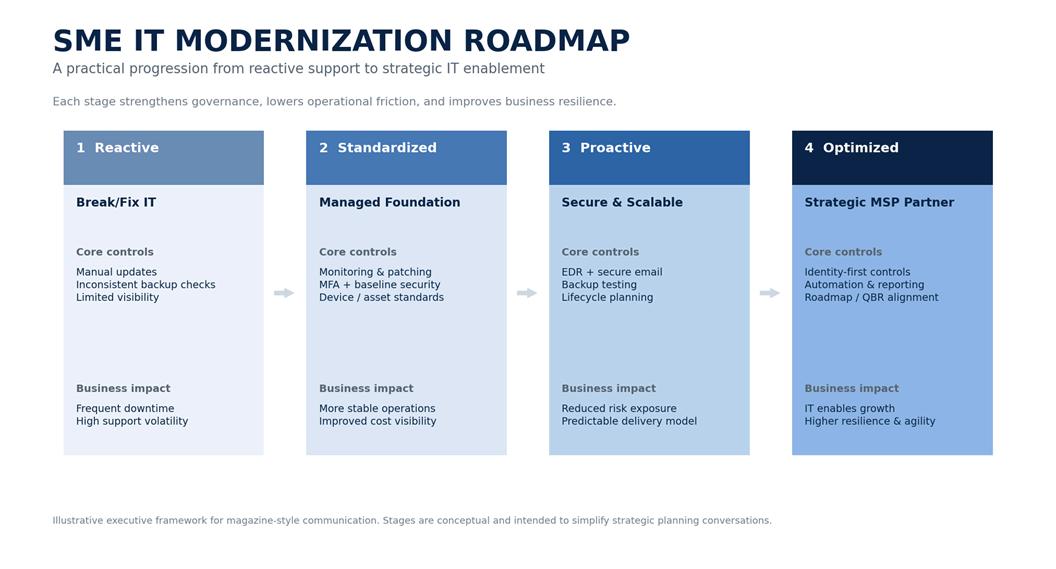
Why reactive IT is no longer sustainable
For many small and medium-sized businesses (SMBs/SMEs), IT is still treated as a reactive function - something addressed only when issues arise. In today’s landscape of constant cyber threats, hybrid workforces, and increasing reliance on cloud platforms, that approach creates real operational risk A modern Managed Services Provider (MSP) strategy shifts IT from a support function into a strategic growth enabler Instead of waiting for disruptions, organizations gain a framework for prevention, standardization, and more consistent service delivery
Distributed environments need centralized governance
SMEs now operate across distributed environments that include Microsoft 365, cloud infrastructure, endpoint devices, collaboration platforms, and SaaS applications Without centralized visibility and governance, those environments can quickly become fragmented, exposing organizations to security vulnerabilities, performance issues, and inconsistent user experiences MSPs provide structured management through proactive monitoring, automated patching, lifecycle management, and documented standards The result is a more stable foundation that reduces technical debt while giving leadership better insight into how the environment is performing.
Predictable spend and better business outcomes
One of the most compelling advantages of an MSP model is financial predictability Instead of reacting to unexpected outages, rushed hardware purchases, or ad hoc consulting costs, businesses move toward a more consistent operational expense model That allows leadership teams to budget more effectively while gaining access to enterprise-grade tooling, cybersecurity frameworks, and technical expertise that might otherwise be out of reach When service delivery is standardized, the business also benefits from better reporting, clearer accountability, and a stronger connection between technology decisions and profitable business growth priorities
“Modernizationbecomespracticalwhen leaderscanseetheircurrentstage,define thenextstep,andsequenceinvestments logically.”
Cybersecurity is now foundational
Cybersecurity is no longer optional - it is foundational. SMEs are increasingly targeted because internal controls are often uneven and internal teams are stretched A mature MSP framework introduces layered protection that can include endpoint detection and response, secure email filtering, identity protection through platforms such as Entra ID, and backup practices aligned to the 3-2-1-1 rule Those controls reduce risk exposure and improve resilience against ransomware, business email compromise, and data loss events More importantly, they give leadership greater confidence that operational continuity is supported by practical safeguards rather than assumptions
Productivity matters as much as protection
Beyond security, MSPs also improve day-to-day productivity Standardized device deployments, secure remote access, and performance optimization help employees work more efficiently whether they are in the office, at home, or on the road. That reduces downtime, simplifies support, and creates a more consistent user experience Faster onboarding, fewer recurring incidents, and better endpoint performance all contribute to a stronger operating rhythm For SMEs, that matters because technology should remove friction not create it
A roadmap makes modernization practical
The four-stage roadmap above helps translate modernization into a sequence that leadership can understand Organizations can assess where they are today, identify the next logical step, and build a plan that strengthens resilience over time The goal is not simply outsourcing IT The goal is to create a managed, standards-based operating model where technology actively supports growth, improves decision-making, and gives the business more confidence in its ability to scale
What leaders should do next
The practical next step is to benchmark the current environment against the four stages shown in the roadmap. If basic monitoring, backup validation, device standards, and identity controls are inconsistent, that is usually a sign the business is still operating between reactive and standardized maturity From there, leadership can prioritize the next set of controls, define ownership, and create a roadmap that is realistic for budget, staffing, and growth plans That turns modernization from a vague aspiration into an actionable business initiative
For executive discussions on modernization priorities, cybersecurity maturity, and managed services planning, The Syscomm Group Inc can tailor this framework to your organization’s current environment and growth goals Syscomm can also conduct a complimentary IT Infrastructure and Cybersecurity assessment that generates a report highlighting opportunities for operational improvements, cost savings and prioritized security exposures that should be addressed
For additional information contact Sales@syscomm.ca or visit our website at www.syscomm.ca
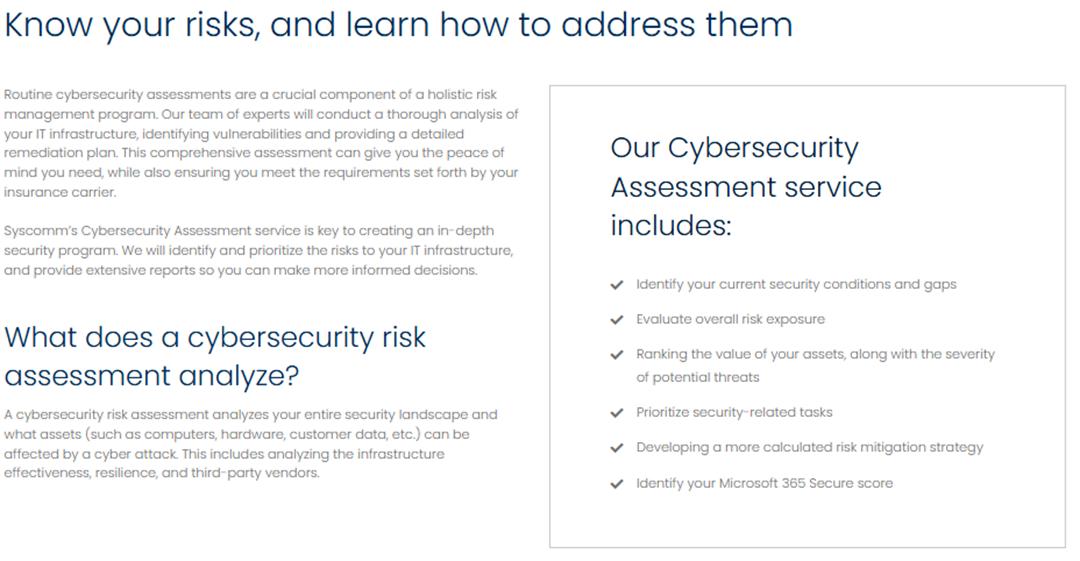
Author: Brian Mikulin
Brian Mikulin Senior Business Development Executive at The Syscomm Group responsible for IT MSP Sales & Solution development, new business pursuit, multi-channel market strategies, RFPs, and Partner engagement for Managed Hosting & Cloud Services, Service Desk, Networking, Cybersecurity, End User computing, PS and HW/SW product offerings in Government, Commercial, Healthcare & Non-Profit sectors More than 20 years of IT Services and Solutions Sales and Solutions Engineering experience Results oriented individual, proactive, innovative and makes IT Solution & Service Providers proactive partners with customers and stakeholders in realizing business goals of revenue growth, cost reduction and customer satisfaction.
What Businesses ShouldLook forinEnergy Management Software
Making energy data more useful for operational decision making

A decade ago, energy management software was mostly used by utilities, industrial facilities, and large organizations with dedicated energy teams Today, it is more accessible to businesses of all sizes thanks to connected devices, better software platforms, and automated reporting tools
As more options enter the market, choosing the right solution has become more complicated Many vendors lead with features such as dashboards, integrations, and realtime monitoring Those capabilities matter, but they do not always determine whether a platform will be useful long after implementation
The better question is whether the software helps people make decisions Business owners and operations teams already manage a constant flow of information Adding another system only creates value if it answers practical questions: Where is energy being consumed? Have usage patterns changed? Is a facility or piece of equipment behaving differently than expected? Are there opportunities to reduce waste without disrupting operations?
That is especially important as energy remains a significant operating cost. Many businesses are moving away from periodic reviews and toward continuous monitoring so they can catch issues earlier, instead of waiting for a monthly bill or quarterly report
For example, if energy consumption suddenly increases at a facility, teams should be able to identify where the change occurred, when it started, and whether it points to an operational issue that requires attention The value comes from being able to investigate and respond quickly, rather than simply knowing that overall usage has increased
Astrongplatformshoulddomore thanjustcollectdata.Itshould helpteamsconnectinformation acrosssites,assets,andtime periodssotheycanunderstand trends,compareperformance, andidentifyissuesbeforethey becomecostlyproblems.


Clean Technology
When evaluating a solution, businesses should look for benchmarking tools, useful reporting, real-time and historical data views, and the ability to flag anomalies early. Organizations may also benefit from solutions that can consolidate information from multiple systems, making it easier to compare performance across facilities and identify patterns that would otherwise be difficult to detect Ultimately, the value of any energy management platform comes down to whether it actually helps people make better decisions and save on energy costs, and whether they can do so with a definite level of ease and consistency
Author:Le Hong Son
Le Hong Son is an entrepreneur and business leader with more than 20 years of experience in manufacturing, international trade, and technology As Chief Executive Officer of Flutter Energy, a Canadian start-up founded in 2024, he leads the development of AI-powered solutions that help industrial organizations optimize energy consumption, improve operational efficiency, and support sustainability goals
Before founding Flutter Energy, Son established and led several successful businesses in Vietnam. He is the Founder and Managing Director of Anh Dao Exim Trading Production Co., Ltd. and served as a shareholder and Sales Director of Gia Hoa Trading Producing Import-Export Co., Ltd., the exclusive Vietnamese distributor of Kiswire Korea steel wire products. Earlier in his career, he helped establish GLS & ASC Securities Joint Stock Company
Son holds an MBA from the University of Houston–Clear Lake and a bachelor's degree in Business Administration from Van Lang University He continues to focus on advancing practical AI solutions for industrial energy management

In an exclusive interview with CanadianSME Small Business Magazine, Alex Deluce, founder and lead voice behind Gold Telegraph, shares his journey from launching a niche independent publication to building one of North America’s most-followed platforms for gold, macroeconomics, and monetary analysis Deluce discusses the evolution of Gold Telegraph, the lessons learned from nearly a decade of audience growth, and how understanding debt cycles, monetary history, and the role of gold can inform long-term decisionmaking for investors and entrepreneurs alike

InterviewByKripaAnand
Alex Deluce is the founder and lead voice behind Gold Telegraph, one of North America's fastest-growing platforms focused on gold, global macroeconomics, and the evolving monetary system He launched the platform nearly a decade ago with a singular mission: to challenge conventional narratives and uncover the structural realities shaping the global economy
What began as a small, independent publication reaching a few hundred readers has grown into a widely followed media platform with over 430,000 followers on X, attracting a global audience of investors, executives, and policymakers. Through a distinctive blend of macro analysis, commodity insights, and sharp editorial commentary, Mr Deluce has built a trusted voice in the gold, economics and natural resources space
For readers who may be discovering you for the first time, what inspired you to launch Gold Telegraph nearly a decade ago, and what gap did you feel was missing in how mainstream outlets were covering gold and the global monetary system?
What inspired me to launch Independent Media Platform, “Gold Telegraph”, was that I kept seeing a conversation that wasn't happening Many treated gold as a relic, a hedge for pessimists, a footnote in a portfolio Upon launch back in 2018, I believed it was one of the most misunderstood stories in modern finance Today, I’m confident that The Gold Telegraph has played a significant role in course correcting offering unbiased, and in-depth commentary to an audience reaching nearly 450K+ across North America
Gold has withstood the test of time, including every monetary experiment ever attempted, and my curiosity and conviction have always been the engine behind the work
I wanted to build something that could speak to the seasoned investor who already understood monetary history, while also introducing a first-time reader to why the architecture of the global financial system actually matters to their everyday life
Nearly a decade in, these themes feel less contrarian and more inevitable. Central banks are accumulating gold at record levels. The dollar's reserve-currency status is being openly debated in rooms that would have dismissed such a conversation ten years ago Gold Telegraph was built for exactly this moment
Gold Telegraph has grown from a small publication to a platform followed by hundreds of thousands of investors, executives, and policymakers. What do you attribute that growth to, and how did you go about building such a loyal audience around what can be very complex topics?
I'm genuinely humbled by the audience this platform has attracted, from investors and executives to policymakers and curious minds from walks of life, worldwide, that I had never anticipated reaching when we started
If I had to distill the growth down to one factor it would be consistency We’ve been consistent in our mission to deliver unbiased and in-depth commentary on gold and macroeconomics We’ve been consistent in staying informed, ahead of the market We’ve been consistent in ensuring our coverage opens up access And we ’ ve been consistent in always being several steps ahead, anticipating where coverage is going and how to ensure our audience gets either a deeper dive or a fresh perspective that accompanies mainstream media coverage.
Macroeconomics and monetary history are deeply complex and also deeply personal. They explain the price of your groceries, the value of your savings, the decisions governments make that ripple into your everyday life My goal has always been to close that gap, to translate ideas that feel academic into language that feels relevant
I also listen more than I broadcast I'm constantly learning, constantly asking questions, and consistently turning to my audience to understand what they want to make sense of
That feedback loop has shaped Gold Telegraph as much as anything I've written
When people feel seen in the content, when it explains something they've been living but couldn't articulate, that's when loyalty is built

Building an independent media brand is never easy, especially in a crowded information landscape. What were some of the biggest challenges you faced in the early days of Gold Telegraph, and how did you develop a distinct voice and identity that stood out?
To be honest, the earliest challenge was standing out in a world already drowning in content We didn’t want to be seen as a new player in the space contributing additional noise ’ For that reason, we had to get really strategic without losing sight of what we were working towards which was delivering one core message
The ethos of Gold Telegraph has been consistent from the beginning, and I think audiences recognize that kind of discipline over time
There's also something that only time can validate Many of the ideas we were writing about years ago like dollar credibility, central bank gold accumulation, and the fragility of the debt-based monetary system felt fringe to some at the time Today they're being debated at the highest levels of global finance. That kind of vindication builds a different quality of trust with an audience, over the long term
Your work focuses heavily on monetary history, debt cycles, and the role of gold and commodities in an increasingly fragmented financial system. Why do you think these conversations resonate so strongly right now, and what key macro trends are you personally watching most closely?
I think these conversations resonate so strongly right now because the world is so visibly struggling to hold its shape and people are sensing it What we ’ re all looking for at the end of the day is clarity, certainty, stability. When it becomes clear that these things are lacking it produces a sense of anxiety From a monetary point of view, in these moments, people and governments, especially default to relying on gold because it withstands uncertainty and disorder
The macro trends I'm watching most closely all connect to one central theme: the fracturing of the post-war financial order The rise of BRICS as a genuine geopolitical counterweight.
The deliberate moves by major economies to settle trade outside the dollar system. The accelerating accumulation of gold by central banks who understand, better than most, what a transition looks like before it's named.
We are moving from a unipolar financial world into something more contested and more complex That shift doesn't happen overnight, but it does happen And when it does, the assets with no counterparty risk and five thousand years of monetary credibility tend to matter most
Through the Gold Telegraph Show, you’ve spoken with influential voices across economics, geopolitics, and the resource sector. What are some of the most memorable insights you’ve taken away from those conversations, and what lessons do you think Canadian entrepreneurs in particular can draw about resilience, long term thinking, and navigating uncertainty?
I've been fortunate to sit across from some genuinely remarkable thinkers, people who have navigated financial crises, built resource empires, shaped policy, and called major macro turns before the consensus caught up Each and every one of them brings something new to the table They have their own, well-informed convictions and tend to arrive at independent conclusions They don't outsource their thinking to consensus
That's the advicen I'd offer to Canadian entrepreneurs, to stay grounded in your conviction but ensure it is one that is well-informed
Canada is an extraordinary place to build something We have world-class talent, extraordinary natural resources, and a culture that quietly produces more resilience than it gets credit for But resilience has to be cultivated deliberately
It comes from doing the intellectual work, understanding the forces shaping the world around your business, not just the forces shaping your industry.
The entrepreneurs I admire most, many of whom I've had the privilege of interviewing, treat uncertainty not as a threat but as the environment in which real opportunity is found
Disclaimer:The views and opinions expressed in this interview are those of the interviewee and do not necessarily reflect the official policy or position of CanadianSME Small Business Magazine Our platform is dedicated to fostering dialogue and sharing insights that inspire and empower small and medium-sized businesses across Canada

Theroleofnewtechnologiesinsupporting morereliableproduceinspections
By Vuong Le, CEO at Fresh Pick
Maintaining consistent quality standards has long been one of the hardest parts of working with fresh produce Quality checks often need to happen quickly, large volumes move through facilities every day, and the results can affect inventory, waste, and customer satisfaction
Because fresh food deteriorates quickly during the different production stages; harvesting, storage, and transportation, fast and reliable inspection matters across the supply chain
For many organizations, consistency and lack of automation can be as big of a challenge as speed.
Two inspectors reviewing the same product may not always reach the same conclusion Assessments can vary between facilities, shifts, or even different times of day
Technology is increasingly becoming part of that solution
Recent research on fresh-food inspection describes computer vision and other intelligent detection systems as fast, non-destructive, and precise tools for monitoring quality deterioration
Modern quality assessment platforms can help organizations review produce more consistently, track inspection results over time, and identify patterns that may otherwise go unnoticed Instead of relying solely on individual observations, businesses can combine human expertise with objective data to support decision-making That kind of standardization can also make it easier to compare results across batches and spot recurring issues earlier
The benefits extend beyond quality control Better visibility into product quality can help organizations identify recurring issues, improve inventory management, and reduce unnecessary waste Retail and supply-chain research also points to better measurement and tracking as useful tools for reducing food waste For organizations handling large volumes of produce, even small improvements in quality assessment can have a meaningful impact on operational efficiency and product loss
Across the industry, digital quality assessment tools are increasingly being used to support inspection teams, document results, and create more consistent evaluation processes The future with these technologies can go to even greater heights, for instance, actually automating food processing decisions based on the data rather than just reporting it
The same principle applies beyond commercial facilities. Recently, we have found ourselves in more and more conversations with restaurant owners and kitchen managers about the need for better ease of visibility into their food supplies Beyond that, consumers we have spoken to also must make daily decisions about food freshness, storage, and disposal, and access to clearer information can help reduce unnecessary household food waste
Whether produce is being evaluated in a processing facility or a family kitchen, the most crucial needs remain the same: having reliable information available when decisions need to be made, better ease of access into this information, and a clear sense of what the decisions should be
Author-VuongLe
VuongLeistheChiefTechnologyOfficeratFreshPick,whereheleadsthedevelopmentofAIpoweredsolutionsforproducequalityassessmentandfoodsupplychaininnovation Withmore than15yearsofexperienceinsoftwarearchitecture,artificialintelligence,anddigital transformation,hehasheldtechnologyleadershiprolesacrossconsulting,banking,andenterprise IT VuongholdsaMastersdegreeinComputerSciencefromtheUniversityofInformation TechnologyandispassionateaboutapplyingAI computervision anddata-driventechnologiesto improveoperationalefficiency,reducefoodwaste,andsupportmoresustainablefoodsystems

CamiloRodriguez
FounderandCEOofMortgagesLab
In an exclusive interview with CanadianSME Small Business Magazine, Camilo Rodriguez, Founder and CEO of MortgagesLab, shares his journey of transforming how Canadians approach home financing With over two decades of experience in mortgage lending, Rodriguez challenges conventional wisdom, teaching that the lowest interest rate doesn’t always equate to the lowest cost of borrowing.
Camilo Rodriguez is the Founder and CEO of MortgagesLab, a Canadian mortgage company serving clients across Canada. With more than 23 years of experience in mortgage lending and financing, he has helped thousands of Canadians from first-time homebuyers to business owners, real estate investors, and high-net-worth families make smarter borrowing decisions and build lasting wealth
Mortgage From DebttoZero RethinkingYour
InterviewByMaheenBari
Originally trained as an electrical engineer, Camilo moved into the mortgage industry after discovering a passion for helping families navigate financial challenges He began his mortgage career at TD Canada Trust and later co-founded MortgagesLab alongside his wife and business partner, Ana Sanchez Today, he is known for combining technical rigor, strategic thinking, and practical education to help clients reduce the mortgage cost of borrowing
Camilo is a Past President of the Canadian Mortgage Brokers Association – BC, where he played a central role in advancing professionalism and education across the industry. He has trained and mentored more than 100 mortgage professionals nationwide and is widely respected for his commitment to ethics, client advocacy, and continuous learning.
His philosophy challenges one of the most persistent assumptions in personal finance: that securing the lowest mortgage rate is the most important decision a borrower can make Camilo teaches instead that the total cost of borrowing over the life of a mortgage is what truly matters This framework anchors his educational content, speaking engagements, and client advisory work
In 2026, Camilo published the Amazon bestselling book From Debt to Zero, offering Canadians practical strategies to reduce interest costs, pay off their mortgage faster, and build intergenerational wealth Through his writing, speaking, videos, and newsletter, he continues to educate Canadians on mortgages, financial literacy, debt reduction, and wealth creation.
You say the lowest rate is not always the cheapest mortgage. In simple terms,what do Canadians misunderstand most about the true cost of borrowing?
What many people do not understand is that the lowest mortgage rate does not necessarily mean the lowest cost of borrowing
A good example is what we see today with electric vehicles An electric car may cost more upfront, but when you factor in fuel, oil changes, filter replacements, maintenance, and other operating expenses, it can end up being less expensive over a period of five to ten years
The same principle applies to a mortgage. When you take into account factors such as amortization, other debts the family may have, lender penalties, taxes, and access to liquidity, it becomes much clearer what the true cost of borrowing really is
That is one of the main reasons I wrote this book From Debt to Zero I explain these concepts in detail and provide real-life examples to help readers understand what is truly the less expensive option.
You’ve helped thousands of Canadians with their mortgages over 23 years. What was the hardest part of starting MortgagesLab, and how did you push through those early challenges?
In my journey, the hardest obstacle was my analytical mind
When I wanted to start Mortgages Lab, I spent countless hours building Excel spreadsheets and running different scenarios. Every model I created showed red ink The numbers suggested I would need to borrow money from friends, family, banks, and even use my home equity Even then, success was far from guaranteed
When I added up the costs of compliance, hiring, licensing, insurance, office expenses, and everything else required to run a business, it felt overwhelming I could not sleep for three months.
On one hand, I wanted to start my own business On the other hand, all the data pointed to failure There also seemed to be more tasks than hours in the day
Learning from others has always been a key part of my success. Around that time, I read The Slight Edge by Jeff Olson. The book taught me to focus on my vision and take one small step forward every day
I also realized that people often regret the things they never tried I knew I would regret not moving forward, so I took a leap of faith and started Mortgages Lab
Looking back, it was one of the best decisions I have ever made Follow your gut and have faith

Your book From Debt to Zero keeps hitting Amazon’s #1 bestseller badge. What core idea in the book do you wish every Canadian homeowner understood before signing a mortgage?
What I want every homeowner to understand is that if they want to save a significant amount of money, they need to change the way they think about mortgages
Right now, about 90% of Canadians focus almost entirely on the mortgage rate. Banks know this. Brokers know this The entire industry knows this As a result, many people end up paying more than they need to, even when they secure a low rate It sounds counterintuitive, but it happens every day
The good news is that math does not lie When you analyze the numbers correctly for your specific situation, you can clearly see how many real dollars are leaving your family pocket and going to the bank
That is the number you need to minimize It is called the cost of credit
In my analysis, I use what I call the M A P (Mortgage Analysis Plan) to identify the strategy that minimizes your total borrowing cost. I also use what I call the L.A.B. number, or Lifetime.
Amortized Borrowing Cost The L A B number represents the minimum amount of interest you should pay over the life of your borrowing based on your unique situation
Many people assume that the lowest mortgage rate automatically means the lowest interest cost That is not always true
The goal is simple: stop focusing on the lowest mortgage rate and start focusing on the lowest cost of borrowing
You’re now launching the Mortgage Free movement. What does “being mortgage free” really mean to you, beyond just having a zero balance on a home loan?
I love this question, Amanda In today's world, everything seems stressful and complicated For many people, life feels harder than it should My son Pablo often makes fun of me because I am always saying that we need to simplify things
That is what the Mortgage-Free Movement is all about: simplicity
For me, it comes down to two feelings that I want every homeowner to experience When I became mortgage-free, I felt both of them, and the difference was incredible The first feeling is freedom Without a mortgage payment, there is no longer a massive expense taking up a large portion of your monthly budget You gain flexibility, choices, and peace of mind
The second feeling is safety. We live in an uncertain world, and unexpected challenges can happen at any time Knowing that I have no mortgage balance and access to a line of credit secured against my home, with a zero balance and substantial available credit, gives me confidence that I can handle whatever life throws at my family financially
My goal is simple: I would love to see as many Canadians as possible experience the same freedom and safety that I have experienced
As a founder, mentor, and past president of CMBA‑BC, how do you personally define a man’s success—and what advice would you give new entrepreneurs who are trying to build both wealth and a meaningful life?
Amanda, I am an engineer at heart, so I spent a lot of time reflecting on this question
As men, we are often measured by what we produce, especially in terms of income and assets
The more money a man earns, the higher his status is perceived to be in society However, this way of thinking creates serious problems
We see men who are financially successful but neglect their families. Others accumulate wealth but become self-centered and stop helping those around them Some have no spiritual foundation, while others become so focused on success that they ignore the ethical consequences of their actions
Thatledmetocreateasimpleformula: SuccessfulMan=20%Money+20%Spiritual+ 20%Family+20%HelpingOthers+20% CaringforSelfandEnvironment
WhenIapplythisformulatomyownlife,Ifeel fulfilled.Inolongerfeelpressuredtomeasure myworthonlybymoneyorassets,associety oftenencouragesustodo.
This formula brings me back to my center It gives me peace while reminding me that there is always room to grow in every area of life I would encourage every man and entrepreneur to use this formula
Disclaimer: The views and opinions expressed in this interview are those of the interviewee and do not necessarily reflect the official policy or position of CanadianSME Small Business Magazine. Our platform is dedicated to fostering dialogue and sharing insights that inspire and empower small and medium-sized businesses across Canada



TheCanadianSMENationalBusinessAwards2025istheperfectstageforyou tostandoutandshinewithyouraccomplishmentsinthebusinessworld.Itis aplacewhereallyourhardwork,passion,dedication,anddeterminationare recognizedbeforeeveryoneintheworld.Furthermore,itistheperfect opportunitytomaterializeyouroutreachcampaignsbyattractingmore probableclients,employees,andpartners.





Indigenous Entrepreneur of the Year 2025

SEANRAYLAND-BOUBAR

Winning the CanadianSME National Business Award is meaningful because it recognizes more than business growth It recognizes the people, purpose and community behind Red Rebel Armour. Our journey has included setbacks, hard lessons and moments when giving up would have been easier. This award reminds me that our stories, ideas and leadership belong in every business space. It also gives us a platform to show what Indigenous entrepreneurship can look like when culture, creativity and social impact work together. I am grateful to our team, customers, family and community for believing in the vision and helping us keep moving forward

My advice to small business owners is to stay close to the reason you started Revenue matters, but purpose will carry you through seasons when progress feels slow. Do not be afraid to change the plan, ask for help or admit what is not working. Learn your numbers, listen to customers and protect your energy. Most importantly, do not let setbacks convince you that you do not belong. Some of the hardest moments in my journey became the lessons that helped me lead better. Keep showing up, keep learning and build something that creates value beyond yourself and your success
Thoughts on winning the CanadianSME National Business Award
A special message or advice to small business owners
CEO&FounderofRedRebelArmourInc
2SLGBTQI+ Inclusive Excellence Award 2025



ORIGAMI CUSTOMS

Rae Hill FounderofOrigamiCustoms

Thoughts on winning the CanadianSME National Business Award
In a time when trans rights are under attack, to spotlight a trans-led business is rare- and we are so grateful for the consideration
We are committed to leading with integrity We value our community over profits, because each staff member is also a member of the same global community, which we’ve connected through our community programs We make choices that benefit the greater good- from sustainable manufacturing to healthcare for all- which makes it much harder to keep operating That’s why it’s so rewarding when these choices lead us to validation, as they did with this award.
A special message or advice to small business owners
For me, it’s about seeing myself, my staff, my customers, my retailers and my community partners as points in the same web When we value the interconnectedness of our community, we can see the specific gifts that each person brings to the table We are all working for the same goal, and when I stop seeing each piece of the network as a standalone, I create lasting relationships that strengthen our web at every point This is truly the only way I see small businesses withstanding the many storms headed our way
Black Entrepreneur of the Year 2025


Winning the CanadianSME National Business Award is an incredible honour and a meaningful milestone for our entire team at Swift Hockey. When I started the company, the goal was simple: make hockey more accessible by providing high-performance equipment at a fair price To have that mission recognized by CanadianSME is incredibly rewarding This award represents the hard work of our team, the trust of our customers, and the support of everyone who has believed in our vision We're proud of how far we ' ve come, but even more excited about what lies ahead as we continue to grow and create a lasting impact
Don't be afraid to challenge an industry that's always done things the same way. Some of the best opportunities come from questioning the status quo and solving problems that people have simply accepted. Building a business isn't easy, and there will be setbacks, but consistency, resilience, and a willingness to learn will carry you further than perfection ever will Stay close to your customers, surround yourself with great people, and keep your mission at the center of every decision If you genuinely create value, the growth and recognition will follow
YOUNG ENTREPRENEUR
SOPHIERENNIE
BusinessOwneratSweet&SassieBakeShop


Sophie Rennie is the owner and founder of Sweet & Sassie Bake Shop, a small business she launched in 2020 at just 16 years old. What began as baking from her family’s kitchen during the pandemic has since grown into a beloved local bake shop known for its creative desserts, custom treats, and community spirit Based in Barrie, Ontario, Sophie has expanded her dream into both a storefront and a dessert trailer, making her sweets even more accessible to her community At only 21, she continues to grow her brand while staying true to her mission of spreading joy through baking and making life a little sweeter, one treat at a time
Best in Retail Award 2025

SANTORINIDES


Khadijeh Ahmed & Hanna FounderofSantoriniDesign

Santorini Design is a female-owned and operated jewelry brand based out of Saskatoon, Saskatchewan, Canada As a Canadian brand, the company engages with its communities across Canada through junior and varsity sports teams, as well as annual donations to Cancer patients and elderly persons. Santorini Design is a key player in its community, and remembers where it comes from as the company grows.
Santorini Design carries products for everyone - and was female founded by Khadijeh who is now joined by her daughter, Hanna The two design major product lines for the company and travel the world bringing international fashion to Canada.
In 2025, Santorini Design celebrated a decade of operations. 2025 was a major milestone for the company as they underwent a relocation within Midtown Mall - celebrated with a grand re-opening of their Saskatoon store. The company also made waves in their national expansion plans by opening their first out of province store in Edmonton, Alberta at the West Edmonton Mall
Tech Business of the Year 2025
AVAINDUSTRIES


Mike Forseth , MD CCFP CEO,DirectoratAvaIndustries
Ava Industries is a Canadian healthcare technology company that develops electronic medical record (EMR) and digital healthcare solutions for medical clinics and healthcare providers The company is based in Calgary, Alberta and was founded by physicians Dr Mike Forseth and Dr Matt Henschke
Ava’s goal is to make healthcare administration easier by creating software that helps doctors spend less time managing paperwork and more time with patients. Its platform is designed mainly for primary care and community healthcare practices.
Ava Industries positions itself as a physician built EMR company focused on creating a simpler, more intuitive healthcare experience Its platform is used by healthcare professionals and clinics across Western Canada
In simple terms, Ava Industries is like a digital operating system for medical clinics, helping doctors manage patient information, appointments, documentation, and administrative tasks more efficiently.
Small Business of the Year 2025
Best Professional Services of the Year 2025


Winning both the Best Professional Services Award and the Small Business up to 50 Employees Award at the CanadianSME National Business Awards 2025 is an extraordinary honour for me and the Sober Immigration team. These recognitions validate our commitment to ethical guidance, professional excellence, client care, and responsible growth. Every achievement reflects the dedication of our team, the trust of our clients, and the support of our community. The awards inspire us to raise our standards, embrace innovation, and continue making a meaningful difference in people’s lives We are sincerely grateful to CanadianSME for this prestigious recognition and memorable celebration
Jasveet Singh Mehta FounderandChiefExecutiveOfficer ofSoberImmigration


To every small business owner: remain focused on the purpose behind your business, especially during difficult periods. Sustainable success is built through integrity, consistency, strong systems, and care for customers and employees. Do not be afraid to begin small, learn from mistakes, seek advice, and adapt as your market changes. Build a dependable team, listen to feedback, and protect the reputation you are creating. Growth should never come at the expense of quality or values Celebrate progress, stay humble, and continue improving Most importantly, believe in your vision and remain patient Meaningful businesses are built one trusted relationship at a time
Thoughts on winning the CanadianSME National Business Award
A special message or advice to small business owners
Upto 50 Employees
Entrepreneur of the Year 2025

IZABELAKVESIC CEO&FounderofBlue WaterPerformanceLtd.

Thoughts on winning the CanadianSME National Business Award
Winning the CanadianSME National Business Award is an incredible honour and a humble reminder of how far this journey has come. I am deeply grateful to my family, clients, community, and everyone who has supported and believed in me and the work I do. This recognition is a celebration of the power of perseverance, purpose, taking inspired actions, and creating meaningful impact It inspires me to continue helping others grow, lead with confidence, and believe in what is possible

A special message or advice to small business owners
Building a small business takes courage, patience, and the willingness to keep learning and growing. My advice is to be like water: stay grounded in your purpose, but remain flexible and adaptable as circumstances change. Do not wait for everything to be perfect before taking action. Confidence grows by showing up, learning, and putting in the reps. Surround yourself with people who challenge you, support you, and genuinely want to see you succeed Ask for help sooner, protect your energy, and celebrate your progress Keep moving, keep adjusting, and trust that every experience is shaping you into a stronger leader and business owner And as I always say, You got this!!
The Sustainable Business Award 2025

Thoughts on winning the CanadianSME National Business Award
Winning the CanadianSME Sustainable Business Award is a tremendous honour As North America’s leading Fairtrade banana importer and a certified B Corp and women-owned business, we’ve built Equifruit on the principle that doing good and doing well are not mutually exclusive This award validates our commitment to fair pay for banana farmers and workers through 100% Fairtrade sourcing For two decades now, we’ve been proving that sustainable practices create lasting value, for banana farmers, for our business and for the planet We’re proud to demonstrate what’s possible when purpose and profit align. Thank you CanadianSME for recognizing our mission.

Jennie Coleman PresidentandCo-ownerofEquifruit:
A special message or advice to small business owners
To fellow business owners: authenticity is your greatest asset In our years reimagining the banana trade, we’ve learned that customers, employees and partners support businesses with genuine values Don’t just pursue profit, build something meaningful Get certified, be transparent about your supply chain and hold yourself accountable Sustainability and social responsibility aren’t expenses, they’re investments in customer loyalty and team pride Start where you are, commit to continuous improvement and remember that small businesses can move markets Your values aren’t a limitation, they’re your competitive edge.
The Diversity and Inclusion Award 2025

Wildpier Beauty is a Canadian skincare and body care company that focuses on plant-based exfoliation tools and minimalist skincare products, especially for people with sensitive or textured skin The brand was founded in 2020 by Mallory, who says she created the company after struggling with eczema, psoriasis, and autoimmunerelated skin issues


Mallory Leblanc CEO&FounderofWildpierBeauty
I've struggled with my skin for as long as I can remember. Eczema, psoriasis, autoimmune reactions - my skin has always been the first thing people see, and for most of my life, that made me feel embarrassed and defeated
After years of trying prescription and nonprescription remedies to relieve my skin conditions, I decided to explore the different versions of exfoliation techniques practiced by various cultures around the world
Being unable to find plant-based exfoliating options that I felt safe enough to use on my sensitive skin, I created Wildpier Beauty in 2020 to share these solutions with others who felt as frustrated and defeated as I once did
Technopreneur of the Year Award 2025


Winning the CanadianSME National Business Award is an incredible honour and a meaningful milestone for our entire team at Swift Hockey. When I started the company, the goal was simple: make hockey more accessible by providing high-performance equipment at a fair price To have that mission recognized by CanadianSME is incredibly rewarding This award represents the hard work of our team, the trust of our customers, and the support of everyone who has believed in our vision We're proud of how far we ' ve come, but even more excited about what lies ahead as we continue to grow and create a lasting impact
Don't be afraid to challenge an industry that's always done things the same way. Some of the best opportunities come from questioning the status quo and solving problems that people have simply accepted. Building a business isn't easy, and there will be setbacks, but consistency, resilience, and a willingness to learn will carry you further than perfection ever will Stay close to your customers, surround yourself with great people, and keep your mission at the center of every decision If you genuinely create value, the growth and recognition will follow
Small Business of the Year 2025 Top 1



Ombe FounderandDirectorofAgenceChristelle
Winning the CanadianSME National Business Award is a tremendous honour and a meaningful recognition of the work we have built at Agence Christelle. It reflects our team’s dedication, our clients’ trust, and our commitment to supporting organizations that create positive change. More importantly, this award inspires us to go further. We want to collaborate on more purpose-driven campaigns and help community-minded businesses and organizations gain the visibility they deserve By expanding their reach and connecting them with wider audiences, we can help amplify their impact and ensure that the important work they do is seen, understood, and supported across Canada

My advice to small business owners is to stay focused on your purpose while remaining open to change. Growth rarely follows a straight line, so do not be discouraged by setbacks or compare your journey to others. Build meaningful relationships, listen to your clients, and recognize the value of your work. Most importantly, make your business visible: share your story, communicate your impact, and give people a reason to support your mission You do not need to have everything figured out before moving forward Start with what you have, learn from every experience, and continue building with confidence and intention
Diana
(Up to 10 employees)
Small Bus of the Yea Top 2

DWEEPSARA


Established in 2021, DWEEP SARA is born deep-rooted love for South Asian fashion and a desire to make ethnic wear more accessible across Canada. The Brand name carries a special meaning it represents two little sisters, whose bond and beauty inspired the essence of our collections.
on pause, a dream took shape With a 3-month-old baby in one hand and a vision in the other, I set out to create an online platform that would bring the richness and affordable Indian ethnic wear to women in North America With a manufacturing partnership and warehouse in India, DWEEP SARA ensures that every piece is crafted with care, love, and cultural pride
When you think of ethnic fashion in Canada, think DWEEP SARA. From high-quality fabrics to intricate craftsmanship, each design reflects sophistication, freshness, and timeless style. We work closely with talented artisans to create pieces that blend traditional charm with a modern edge.
Small Business of the Year 2025
(Up to 10 employees)
Top 3


SIMPLY SMILESTUDIO

Suji Kang FounderofSimplySmileStudio
Thoughts on winning the CanadianSME National Business Award
I was with my husband when I found out And the first thing that came back to me was the memory of opening Simply Smile, passionate about building a clinic where everybody could feel included.
This award belongs to my team, who give every patient their full attention. It belongs to our partners at AutismBC and Mom2Mom. And it belongs to our patients, especially the ones who had not seen a hygienist in years and trusted us anyway
Five years ago, this was just a belief Today it is a clinic There is still so much work ahead
A special message or advice to small business owners
Keep pushing yourself Do not be afraid of trying and learning new technology or skills. Adapt them to your practice in your own way, to improve productivity and your relationships with the people you serve.
Many people thought my business would not survive because of the limited patient production from a one-patient model. But I was inspired by fellow hygienists who dedicated their careers to serving neurodivergent communities at BC Children's Hospital Listening to them describe how little access this population still has given me the courage to reach out to AutismBC
Fastest Growing Company Award 2025
TAMBAYANCAFÉ

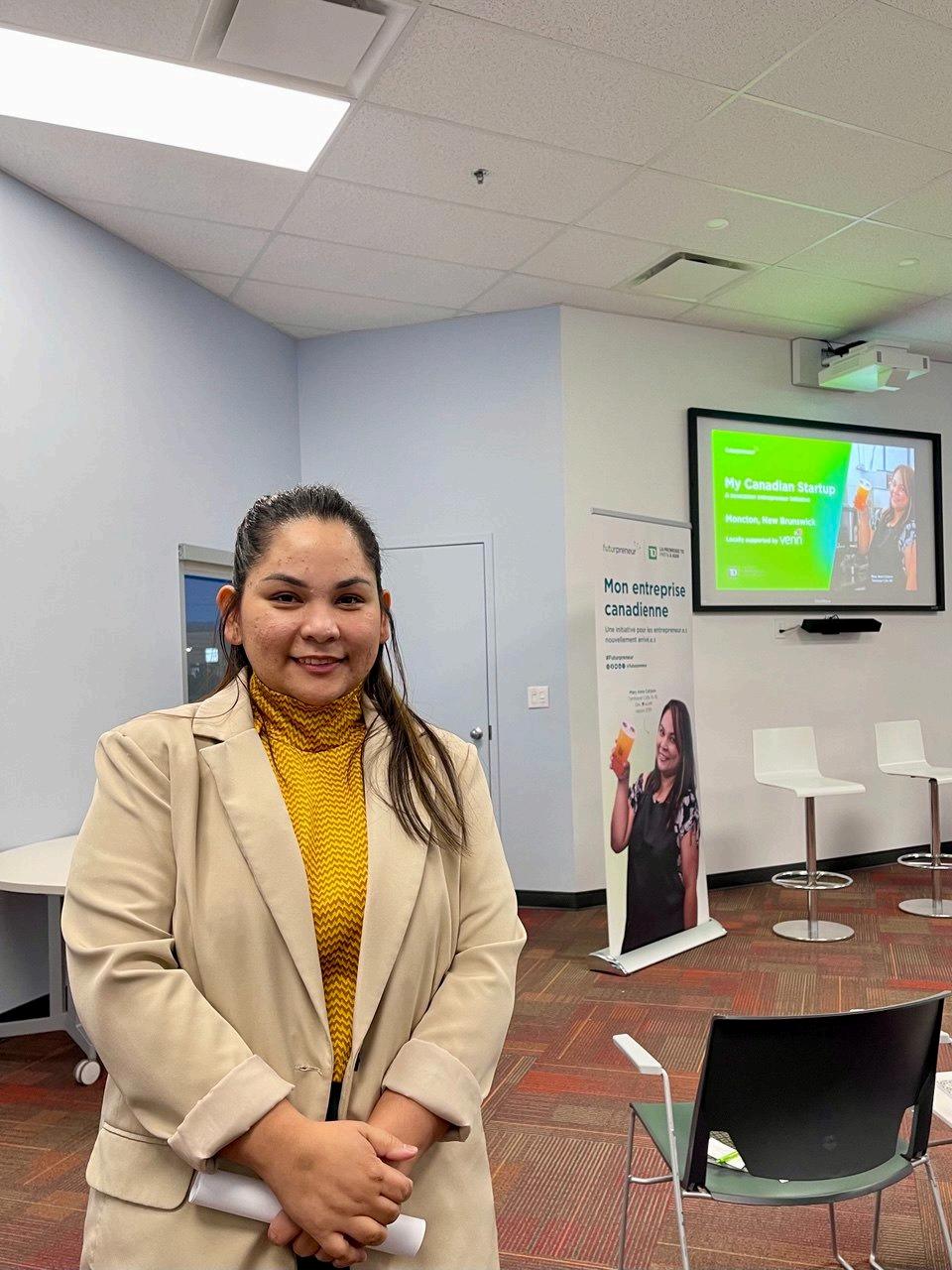
Mary Anne C. Catipon CEOandFounderofTambayanCafé
Tambayan Café can refer to different cafés, but the name itself comes from the Filipino (Tagalog) word “tambayan,” which means a hangout place, gathering spot, or a place where people spend time together.
One well-known Tambayan Café is a neighbourhood café in Riverview and Sackville, New Brunswick, Canada. It focuses on creating a community space where people can relax while enjoying handcrafted coffee, bubble tea, croffles, and snacks The brand positions itself as a welcoming place to “sip, savor, belong,” reflecting the social meaning behind the word Tambayan
The idea behind the name is more than just a coffee shop. In Filipino culture, a tambayan is a familiar place where friends, family, and communities gather to talk, connect, and spend time together.
If you mean a specific Tambayan Café (for example, one in a particular city or a business you heard about), share the location and I can give you the exact details
Startup Business of the Year 2025


Chris June FounderandCEOofIntelliSyncSolutions
To small business owners: begin with the real problem, not the newest technology. Listen closely to customers, document what you learn, and build systems that make good decisions easier to repeat. Progress rarely follows a straight line, so protect your purpose while remaining willing to adjust the path. Ask for help, value the people who challenge your assumptions, and celebrate steady improvements along the way When using AI, start with one practical workflow, keep people accountable for important decisions, and measure the result You do not need to have everything figured out; you need the courage to learn and continue Thoughts on winning the CanadianSME National Business Award A special message or advice to small business owners
Winning the 2025 CanadianSME New Business of the Year Award is an honour for our team at IntelliSync Solutions. We are grateful to CanadianSME and the judging panel for recognizing the purpose behind our work: helping organizations use AI with greater structure, clarity, and confidence. This recognition belongs not only to our team, but also to the clients, partners, mentors, and Canadian small business community who have trusted, challenged, and supported us Building a new business requires resilience, humility, and constant learning Receiving this award encourages us to keep creating practical, responsible technology that strengthens decisions and produces meaningful outcomes
Inspirational Leader of the Year 2025

Winning the CanadianSME Inspirational Leader of the Year Award is deeply meaningful to me. For nearly a decade, I have shared my journey openly – the lessons, failures, pivots, challenges, and breakthroughs – while continuing to learn and evolve. I never began sharing because I had everything figured out; I shared while figuring it out, hoping my experiences could help someone else grow As someone who grew an audience on social media in a language that is not my first, this recognition is especially powerful It reminds me that our background, accent, or starting point does not limit the reach or impact of our voice

To every small business owner: do not wait until you feel completely ready, because growth rarely begins with certainty. Start with what you know, stay close to the people you serve, and let feedback shape your next move. Your mistakes are not proof that you are failing; they are information – the kind that makes you sharper, stronger, and more resilient Keep learning, adapting, and sharing your story even while it is still unfolding Progress may look slow, but consistent, courageous action compounds Protect your energy, remember why you began, and trust that small steps can create opportunities you cannot yet imagine
Thoughts on winning the CanadianSME National Business Award
A special message or advice to small business owners
LIZASPIRIT FounderofLizaSpirit
Immigrant Entrepreneur of the Year 2025

MILLYFELIZ
CEO&FounderofTheWiseSelf PsychotherapyClinic


Thoughts on winning the CanadianSME National Business Award
Winning this award feels like a meaningful acknowledgment of a journey that began with a simple goal: to make quality mental health care more accessible in our community
Building The Wise Self from the ground up has meant countless hours of learning, adapting, and leaning on an incredible team of therapists who share that same commitment This recognition isn't just about the business milestones we ' ve hit; it's a reminder of the incredible resilience many immigrants develop through this journey I'm deeply grateful to the CanadianSME team, and to everyone who has supported the clinic's growth along the way.
A special message or advice to small business owners
Growth rarely follows a straight line, and that's okay When I started The Wise Self, I didn't have every system or process figured out; I learned by doing, and by staying close to the people, both clients and staff, that the business exists to serve My advice is to invest early in the right people around you, stay curious about your own gaps in knowledge, and don't be afraid to make mistakes Small business ownership can feel isolating, but building a strong network of mentors, peers, and advisors makes the hard decisions easier and the wins more meaningful.
Digital Business of the Year 2025

Blima Ehrentreu FounderandCEOofTheDesignersGroup

Thoughts on winning the CanadianSME National Business Award

A special message or advice to small business owners
Winning this award is a true honor, and I am incredibly grateful. When I founded The Designers Group, it started with a simple vision and a lot of hard work. To be recognized on a national stage is both humbling and incredibly meaningful
This recognition is not just mine It belongs to my team, our clients, and everyone who has been part of our journey Building The Designers Group has always been a collaborative effort, and I am grateful to everyone who has contributed along the way
For me, design has always been about people It is about creating environments that bring people together and make a lasting impact. I am proud of how far we have come and even more excited about what we will continue to build together.
My advice is simple. Don't wait for the perfect moment to get started. It rarely exists. Take the first step, learn as you go, and keep moving forward.
Building a business is a journey, and there will be challenges along the way Every obstacle teaches you something and helps you grow as a leader Stay true to your vision, be willing to adapt, and don't be afraid to make mistakes They are often your greatest teachers
Most importantly, surround yourself with good people Your team, your clients, and your community are the foundation of your success Invest in those relationships and keep showing up every day. The small steps you take over time are what lead to lasting success.
Customer Service Excellence Award 2025

Nida Saeed FounderandCEO ofMakeupByNida&Team
Thoughts on winning the CanadianSME National Business Award
Winning the CanadianSME National Business Award was a very meaningful moment for me. It felt like years of hard work and dedication to customer service had truly been recognized. Customer service is something I take very seriously because it's at the heart of how we serve every client. The award also made me reflect on the early years of my career, where I received incredible training that shaped my approach to serving people. Looking back, I can see how every experience has led me to this purpose It was a reminder to appreciate the journey and continue raising our standard of care

A special message or advice to small business owners
My advice to every small business owner is to never underestimate the power of great customer service. It's easy to deliver a great experience when everything goes according to plan. The real test is how you respond when things don't. Over the years, I've developed a simple principle that guides our team: AAO Apologize, Acknowledge, and Offer a Solution. It's an approach I coined to help us stay focused on what matters most when resolving customer concerns Mistakes are inevitable in business, but responding with empathy, accountability, and a solution is what builds trust, loyalty, and a lasting reputation
Business Woman of the Year 2025

MISSYMACKINTOSH

Thoughts on winning the CanadianSME National Business Award
Winning Business Woman of the Year means so much to me

My first nomination came in 2023, only days before I unexpectedly lost my dad, who was one of my biggest supporters Every nomination since has felt like a glimmer of him cheering me on To now receive this recognition is both humbling and emotional I built MisMacK in my basement in Canoe, British Columbia, believing clean cosmetics could perform differently Today, we are building a national brand and creating Sports Colour Cosmetics™ This award belongs to my family, team, investors and every MisMacker who believed in this dream.
A special message or advice to small business owners
Do not let your dreams be defined by your postal code Big ideas do not belong only in cities They can begin in a basement, a small town, or during any season of your life Building a business will test you You will make mistakes, face setbacks and question everything Keep going anyway There is massive power in a pivot Trust your gut, but remember, if you build it, they will come is not a strategy You must help people find you, understand you and believe in what you are building Keep learning, use AI and tools, and never stop adapting.
Business of the Year 2025 (50+
Employees)

Robert Gauvreau FounderandCEOofGauvreau AccountingTaxLawAdvisory
Winning the CanadianSME Business of the Year Award (50+ Employees) is an incredible honour and a reflection of the people who make our firm what it is. This recognition celebrates the dedication of our team, the trust of our clients, and our commitment to helping Canadian entrepreneurs build stronger businesses. We are grateful to CanadianSME for this recognition and proud to stand alongside so many organizations making a meaningful impact across the country

Building a successful business starts with building a strong foundation Know your numbers, invest in your people, and make decisions with a long-term perspective. Growth isn't about doing more. It's about doing the right things consistently. Stay focused on your purpose, embrace continuous learning, and don't be afraid to ask for expert guidance. The strongest businesses are built with intention, resilience, and a willingness to adapt.
Thoughts on winning the CanadianSME National Business Award
A special message or advice to small business owners
Best in Manufacturing Award 2025


Julia Kirouac, CNP FounderandCEOofNUDFUDInc.
Thoughts on winning the CanadianSME National Business Award
Winning the CanadianSME National Business Award for Manufacturer of the Year is an incredible honour and a meaningful milestone in our journey. Building a manufacturing company as a woman in Canada comes with significant challenges, but it also creates opportunities to innovate, create jobs, and raise the standard for products made here. This recognition reflects the dedication of everyone who has supported our mission, from our partners and customers to our growing team It motivates us to continue pushing boundaries, investing in Canadian manufacturing, and proving that purpose-driven businesses can compete on a global stage while making a positive impact on families
A special message or advice to small business owners
Building a business is rarely a straight path. There will be setbacks, unexpected challenges, and moments when progress feels painfully slow. The key is to stay focused on the problem you’re solving and the value you’re creating for your customers. Don’t be afraid to ask for help, surround yourself with people who challenge your thinking, and treat every obstacle as an opportunity to learn Success is rarely about one breakthrough, it’s about consistently showing up, improving every day, and staying committed to your vision even when others don’t yet see what you’re building
Best in AI & Automation Award

Mahshid Yassaei CEOatTaliAI
CTPOatTaliAI
Tali AI was founded in 2020 by healthcare tech experts Mahshid Yassaei (CEO) and Hesam Dadafarin (CTPO)
Mahshid and Hesam have dedicated their careers to advancing healthcare technology and the healthcare experience, not only for patients, but clinicians, providers, and administrators

We’re on a mission at Tali AI to empower the healthcare system and have fun while doing it Tali AI offers employees an opportunity to solve complex problems and work toward eradicating barriers faced by our healthcare system
Hesam Dadafarin
E-commerce Business of the Year 2025
SNUGGLE BUGZ


Ben & Tanya Burmaster
Co-foundersofSnuggleBugz
Snuggle Bugz is a Canadian specialty retailer that focuses on baby products, nursery essentials, and parenting gear
The company helps new and expecting parents find products for pregnancy, newborns, infants, and toddlers.

The store offers a wide range of items, including:
Strollers and car seats
Baby carriers and travel gear
Nursery furniture and décor
Feeding and breastfeeding products
Diapering essentials
Toys, clothing, and sleep products
In simple terms, Snuggle Bugz is like a Canadian one-stop baby store where parents can shop for everything needed from pregnancy through early childhood.
Best Business Innovation 2025


Brad Liski FounderofTruEarth
Thoughts on winning the CanadianSME National Business Award
Winning the CanadianSME National Business Award for Best Business Innovation is an incredible honour for the entire Tru Earth team. This recognition reflects our commitment to challenging convention and creating products that deliver meaningful impact for consumers and the planet. As the creator of the laundry detergent sheet category, we ' ve always believed that innovation should solve real problems while making everyday life easier This award belongs to our employees, partners, retailers, and customers who have supported our journey We are proud to represent Canadian innovation on a global stage and remain committed to finding better ways to drive positive change through business
A special message or advice to small business owners
Stay focused on the problem you are trying to solve and let purpose guide your decisions. Some of the most successful businesses are built by challenging traditional ways of thinking and finding better solutions for customers. Growth rarely happens overnight, and setbacks are often the moments that teach the most valuable lessons Remain adaptable, listen to feedback, and be willing to evolve as your business grows Surround yourself with people who share your values and vision Most importantly, build something that creates lasting value for your customers, your team, your community, and the future you want to help shape