ISSUE NO. 07
AUGUST 2026
BLACK BUSINESS Empowering Canadian Black-Owned Businesses
Magazine
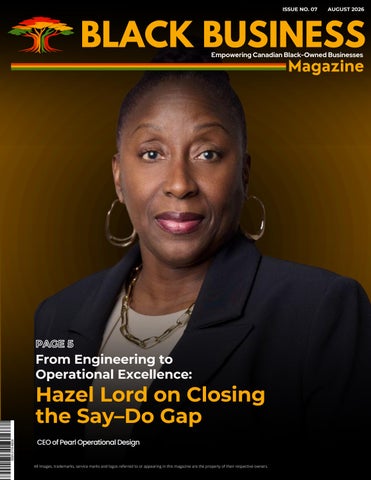
PAGE 5
From Engineering to Operational Excellence:
Hazel Lord on Closing the Say–Do Gap CEO of Pearl Operational Design All Images, trademarks, service marks and logos referred to or appearing in this magazine are the property of their respective owners.
A Note from the Editor To our community of Black entrepreneurs, leaders, and changemakers, Welcome to the August 2026 edition of Black Business Magazine. This issue explores the future of technology and entrepreneurship, highlighting how Black innovators, founders, and leaders are shaping Canada’s evolving innovation ecosystem through AI, SaaS, fintech, deep tech, and science-driven ventures. As technology continues to transform industries, access to innovation ecosystems, commercialization opportunities, and strategic support remains essential for building highgrowth companies. This edition highlights the entrepreneurs and organizations creating solutions, advancing inclusion, and contributing to Canada’s technology landscape. We are proud to feature our Business Woman of the Month, Nik-Keisha Moodie, Founder and CEO of NMCD Inc., whose entrepreneurial journey reflects leadership, innovation, and impact. This issue also brings inspiring conversations with Hazel Lord, CEO of Pearl Operational Design, on operational excellence and closing the say-do gap, Maurice Davis, Founder and CEO of Ideas Period by Davis Copeland Inc., on building memorable brands through strategy, and Micheline Khan, CEO and Founder of Althea Therapy, on culturally responsive care and collective healing. Through our featured articles, we explore where Black tech founders can build and scale in Canada’s innovation ecosystem, the rise of Black Canadian fintech innovators driving financial inclusion, and the groundbreaking work of Black innovators advancing AI, space, climate, and quantum technologies.
blackbusinessmagazine.ca amanda@canadiansme.ca Black-Business-Magazine-Canada canadiansme-black-business-magazine blackbusinessmagazinecanada canadiansme
Publisher & Editor Shaik Khaleeluddin(SK) Founding Partner - Strategic Alliance Dwania McLarty-Peele Business Development Manager Raoofuddin S. Sr. Content Manager Amanda Spearing Sr. Media Manager Maheen Bari Media Manager Kripa Anand Creative Design Cmarketing Inc Social Media Cmarketing Inc Photography Deposit Photos, Cmarketing Inc. Web Cmarketing Inc
For Advertisements raoof@canadiansme.ca / amanda@canadiansme.ca Cmarketing Inc 6345 Dixie Rd, Unit 202, Mississauga, ON L5T 2E6 Call us at +1 416 655 0205 /437 778 4446
This edition celebrates the creativity, resilience, and vision of entrepreneurs who are building the next generation of businesses. We hope these stories inspire founders, innovators, and leaders to embrace opportunities, strengthen connections, and continue shaping the future of technology and entrepreneurship. — Black Business Magazine
ISSN 3110 - 9829 (Online)
Published by Cmarketing Inc 6345 Dixie Rd, Unit 202, Mississauga, ON, L5T 2E6 Copyright © 2026 CMarketing Inc. All rights reserved. Reproduction in whole or part of any text, photography or illustrations without written permission from the publisher is prohibited.
All Images, trademarks, service marks and logos referred to or appearing in this magazine are the property of their respective owners.
The contents in the Black Business Magazine are for informational purposes only. Neither Cmarketing Inc, the publishers nor any of its partners, employees or affiliates accept any liability whatsoever for any direct or consequential loss arising from any use of its contents.
IN THIS ISSUE Black Business Magazine
36 19 13 26
22 Culturally Responsive Care and Collective Healing at Althea Therapy Micheline Khan,
CEO and Founder of Althea Therapy
29 39
Where Black Tech Founders Can Build and Scale in Canada’s Innovation Ecosystem The Rise of Black Canadian Founders in the SaaS Economy How Black Tech Founders Are Protecting AI SaaS Fintech and Deep Tech Innovations Powering Canada’s Next Generation of Black Tech Entrepreneurs Finding the Right Investors for Black-Led AI, SaaS, Fintech, and Deep Tech Startups The Rise of Black Canadian Fintech Innovators Driving Financial Inclusion
Founder of Milton Fashion Week
IN THIS ISSUE Black Business Magazine
32 Building a Travelpreneurs™ Ecosystem: Inside Tourifique
47 Black Canadian Innovators Building the Next Generation of AI, Space, Climate and Quantum Technologies
09 16 Hospitality As Strategy: Maurice Davis On Building Brands People Remember
Business Woman of the Month
Nik-Keisha Moodie
From Engineering to Operational Excellence:
Hazel Lord on Closing the Say–Do Gap In an exclusive interview with Black Business Magazine, Hazel Lord, Founder and CEO of Pearl Operational Design, shares how she helps organizations move beyond reactive solutions and build intentional systems that support longterm growth. With more than 30 years of experience in operational design, process improvement, and organizational transformation, Hazel discusses the importance of aligning business impact.
Interview By SK Uddin Hazel Lord is an executive management professional with a passion for everything system, process, design, data, and improvement. Her speciality is analyzing, designing, and planning for change that transforms cross-functional processes and operation ecosystems to align with the organizational culture, and strategic goals. In 2014, she started her own consulting practice in which she brings more than 30 years of success in helping organizations achieve operational excellence. With design principles rooted in respect, discipline, commitment and a continuous search for perfection, she brings an expansive breadth of experience in many industries.
Hazel Lord CEO of Pearl Operational Design
Image Courtesy: Hazel Lord
strategy, people, and processes to create lasting
Process Innovation As a perpetual learner, Hazel seeks out opportunities to learn and apply different approaches to problem solving at the intersection of customer experience and operational excellence. She is always excited to bring people on this “education” journey. One of her major objectives is to improve the skills and knowledge of her clients so they can be efficient and effective in achieving their business goals.
A strong believer in community partnership, Hazel was a volunteer maths and english tutor at Tropicana Community Services for 7 years, was a board member of the Ontario Alliance of Black School Educators and a STEAM instructor for the Jean Augustine Centre for young women’s empowerment. Rounding out Hazel’s expertise and credentials: She holds an honours degree in chemical engineering from Queen’s University, Kingston, Ontario, a master’s in business administration from the Rotman School of
I went back to my training as a chemical engineer, designing and scaling systems. Something in the system was blocking strategy, what an organization says it wants to do, from translating into desired outcomes. So, I started studying it to satisfy my own curiosity. What I found was that organizations evolve constantly, with little intentionality behind how their design keeps pace. It was not a problem with structure, skills gap, or technology. Structure shifts reactively, driven by whoever is leading, rather than being designed deliberately in service of strategic execution. That was the moment I knew where my firm needed to play. We were going to help organizations design their operations on
purpose, instead of drifting and reshaping by accident.
Management at University on Toronto and is a Lean Six Sigma Black Belt from the University of Michigan. For four years she lectured on quality management to second year MBA students at the Rotman School of Management at University of Toronto.
You’ve spent more than 30 years designing systems and processes across sectors, and in 2014 you founded Pearl Operational Design as a boutique consultancy. What first convinced you that you needed your own firm to help organizations “design their operations on purpose” rather than just fix problems as they appear?
Image Courtesy: Canva
I made that decision when I was completing my MBA at Rotman and working full-time. My workplace was going through frequent leadership changes, and each one brought a change in organizational structure. Why were they restructuring so often? Why were they not giving any structure time to reach the execution level before changing it again?
6 - Black Business Magazine - September 2026
Process Innovation Pearl Operational Design focuses on co‑creating processes, systems, and culture transformations—especially in community healthcare—to increase revenue and reduce waste. In simple terms, what does it look like when an organization truly “short‑circuits the say–do gap” between what leaders promise and what customers Image Courtesy: Canva
experience? Organizations often come to us with what they believe is the problem, such as needing project management or a new
process, but that is rarely the real issue. Our first job is to identify the underlying system preventing the organization from
consistently delivering on its promised value. Stephen Megitt at EY described this
as helping organizations "short-circuit the say-do gap," and I think that is exactly what we do.
The biggest impact is felt by both leaders and frontline staff. In many organizations, leaders are deeply embedded in day-today operations, creating bottlenecks that slow decisions and contribute to their
burnout. By redesigning systems and clarifying accountability, we build the organization's capacity and lift the leader out of the day-to-day operations.
Frontline staff also benefit because they spend less time navigating inefficient processes and more time serving clients. They can clearly see how their work contributes to the organization's strategy, which strengthens engagement and ownership. When people trust the systems around them, work moves faster, service improves, and clients experience the difference. Over time, organizations build credibility because they consistently do what they say they will do. One client was given more funding because they demonstrated they could reliably deliver on their commitments, creating greater confidence among their funders.
You often describe entrepreneurship as a journey of self‑understanding rather than something that can be fully taught. How has knowing your own strengths and gaps shaped the way you’ve built PoD’s team, chosen clients, and navigated growth as a Black woman founder in Canada —now recognized as Black Entrepreneur of the Year and part of EY’s Entrepreneurs Access Network? Entrepreneurship has taught me that self-awareness is one of the most important leadership skills. Building a business has required me to understand not only my strengths, but also my blind spots. That self-awareness has shaped every major decision I have made at PoD.
It starts with culture. Our culture reflects our collective beliefs, so we intentionally hire people whose values align with ours. Collaboration is one of our core values, which means a "sink or swim" mentality simply does not belong at PoD. We want people who are willing to learn, support one another, and hold themselves accountable for living our values every day. Knowing my own strengths and gaps has also influenced how I have built the team. As a founder, you are expected to wear every hat, but sustainable growth comes from recognizing where others are stronger. Building trust and surrounding myself with people whose expertise complements my own has allowed PoD to grow without compromising who we are. The same principle guides the clients and partners we choose. Especially as a Black woman founder, I have learned that growth should never come at the expense of your values. Success is not only about winning work, it is about building an organization where the lived experience of our team consistently reflects our values. 7 - Black Business Magazine - September 2026
Process Innovation With an engineering degree, an MBA, and a Lean Six Sigma Black Belt, you’ve blended technical rigor with customer‑centric thinking, even lecturing on quality management at Rotman. How do system and critical thinking help founders and leaders move beyond “Band‑Aid fixes” to build operations that can actually scale? One of the biggest misconceptions I see is that growth solves problems. We have found that it does not. It amplifies them. If operations are inefficient today, adding more customers, people, or funding simply makes those inefficiencies more expensive.
For mission‑driven organizations—especially in healthcare and community sectors—that feel stuck in inefficient processes and misaligned cultures, what is one practical first step you’d recommend they take to begin redesigning their operations without overwhelming their teams? There is not a single first step that works for every organization because every system is different. But there is one question I encourage every leader to ask before launching another initiative: What is your system telling you? In healthcare and community organizations, the
immediate assumption is often that there is not enough funding. While funding pressures are very real, I have
That is where systems and critical thinking
found that organizations are often surprised by what
technology, governance, and culture interact,
opportunities to invest in stronger systems instead of
better questions before jumping to solutions.
The goal is not to spend more; it is to spend more
they are responding to what is urgent (or
inefficiencies create hidden costs that contribute to
become so important. Systems thinking helps leaders move beyond treating symptoms to understanding how people, processes,
they discover when they examine how their existing resources are being used. Looking at spending patterns, particularly toward the end of the fiscal year, can reveal
and how well feedback informs decision making. Critical thinking challenges us to ask
repeatedly funding workarounds.
Too often, we see organizations implement Band-Aid (mostly technology) fixes because
intentionally. Before redesigning processes, understand where time, money, and effort are being lost. Those
heard at the latest conference) rather than
staff frustration, burnout, and inconsistent client
understanding the root of the problem.
experiences.
At Pearl Operational Design, we start with the
Once leaders understand where the greatest constraints
"why" before the "how." We help leaders identify the constraints in their system, the few things that, if addressed, will have the greatest impact across the organization. Sometimes the issue is not a lack of resources; it is unclear decision-making, competing priorities, or processes that have not evolved with the organization. Scalable organizations are not built by adding more workarounds. They are built by designing systems that can consistently deliver results as the organization grows. When leaders understand how their organization functions as an interconnected system, they make better decisions, their teams spend less time fighting fires, and they create the capacity to innovate instead of simply keeping up.
exist, they can prioritize one meaningful improvement instead of launching multiple competing initiatives. That approach builds momentum without overwhelming teams. Operational excellence is not about asking people to work harder. It is about creating systems that allow people to do their best work with the resources they already have while positioning the organization to grow sustainably. Or they can call Pearl Operational Design to help!
Disclaimer: The views and opinions expressed in this interview are those of the guest and do not necessarily reflect the official policy or position of Black Business Magazine or its affiliates. The magazine is committed to supporting Black entrepreneurs and fostering conversations that promote inclusion and economic empowerment.
8 - Black Business Magazine - September 2026
Business Woman of the Month
Nik-Keisha Moodie By SK Uddin Nik-Keisha Moodie helps Black entrepreneurs in Canada transition from hustle to structure by improving their business models, financial systems, and
based in Canada, she provides strategic business planning, financial counsel, and founder preparedness frameworks to
early-stage and growth-stage companies. Her approach focuses on transforming
vision into execution and then into revenue, ensuring that Black-led enterprises are lucrative, scalable, and positioned for long-term success rather than merely short-term gains. Nik-Keisha's experience, according to Black Business Magazine, exemplifies how a Black woman entrepreneur can establish a consulting firm that helps other Black founders access funding, increase sales, and build sustainable businesses across Canada.
Founder and CEO of NMCD Inc.
9 - Black Business Magazine - September 2026
Image Courtesy: Nik-Keisha Moodie
growth plans. As the Founder and CEO of NMCD Inc., a strategic consultancy firm
Business Woman of the Month
The Gap in Financial Clarity for Black Entrepreneurs Nik-Keisha's work is based on a crucial reality: running a business is more than just having a great concept. It requires financial clarity, operational structure, and strategic discipline to grow sustainably and access capital when opportunities arise. In Canada, Black female entrepreneurs face enormous systemic barriers to funding, mentorship, and growth opportunities. According to Canada's largest study of Black female entrepreneurs, many Black-owned businesses face limited access to funding, networks, and strategic support, resulting in slower growth and reduced scalability. Nik-Keisha noticed this gap and founded NMCD Inc. to help entrepreneurs, founders, and CEOs transition from hustle to structure by improving their business models, financial processes, and growth strategies. Her methodology combines real-world operating knowledge with investor-
focused strategy, helping companies understand their figures, tighten their operations, and make confident, well-
informed decisions. Her approach is especially pertinent for Black entrepreneurs who are committed to developing successful, scalable firms that are positioned for long-term success rather than just short-term gains.
NMCD Inc.: Strategic Business Planning for Early-Stage and Growth-Stage Businesses NMCD Inc. is a strategic consultancy that helps early-stage and growing enterprises with strategic business planning, financial advice, and founder-preparedness frameworks. The firm's work includes:
Business model and growth strategy development - assisting entrepreneurs in improving their value proposition, revenue sources, and market positioning. Financial clarity, cash flow, and planning - helping founders understand their finances, manage cash flow, and plan for long-term growth. Founder preparation and capacity building entail preparing founders for growth by improving their operational systems, governance, and decisionmaking. Program design, facilitation, and ecosystem alliances - developing programs to assist Black entrepreneurs with mentorship, training, and access to financing.
Image Courtesy: Canva
10 - Black Business Magazine - September 2026
Business Woman of the Month Nik-Keisha's approach is investor-focused. She assists customers in understanding their figures, streamlining their operations, and making confident, well-informed decisions—skills that are essential for securing funding and scaling sustainably. Her approach is especially
pertinent for Black entrepreneurs who are committed to developing successful, scalable firms that are positioned for long-term success rather than just short-term gains. NMCD Inc.'s services embody Nik-Keisha's vision: to assist Black-led businesses in transitioning from hustle to structure, ensuring they have the financial clarity, operational discipline, and strategic growth plans required to scale and access finance.
Founder Readiness and Ecosystem Partnerships Nik-Keisha's work goes beyond individual clients. She also works on program design, facilitation, and ecosystem alliances, creating programs that help Black entrepreneurs with mentorship, training, and access to funding. This ecosystem strategy is crucial because Black entrepreneurs frequently face challenges in accessing not only capital but also networks, mentorship, and growth opportunities. Nik-Keisha is contributing to the creation of an ecosystem that allows Black entrepreneurs to succeed by developing initiatives and collaborations.
Black Women Entrepreneurs in Canada: Barriers and Opportunities Nik-Keisha's work is especially important given the presence of Black women entrepreneurs in Canada.
According to Canada's largest study of Black female entrepreneurs, many encounter structural impediments to funding, mentorship, and growth prospects. Despite these hurdles, Black women entrepreneurs in Canada are
resilient and hopeful, with many focusing on value-added modifications such as improved customer service and response times, as well as better product and service
Her work also represents a bigger trend: Black female entrepreneurs are increasingly focused on creating firms that are not only profitable but also sustainable, scalable, and poised for long-term success. Nik-Keisha's emphasis on founder preparation and capacity building guarantees that Black entrepreneurs are not
only establishing firms but also developing the operational procedures, governance, and decision-making skills required to scale and access finance.
customization for their clients.
Nik-Keisha's work addresses these constraints by providing the strategic and financial support that Black entrepreneurs require to expand sustainably and access finance. Her emphasis on financial transparency, operational structure, and strategic discipline is vital for Black-owned firms seeking to grow and compete in Canada's economy. Her work also represents a bigger trend: Black female entrepreneurs are increasingly focused on creating firms that are not only profitable but also sustainable, scalable, and poised for long-term success. Image Courtesy: Canva
11 - Black Business Magazine - September 2026
Business Woman of the Month
Lessons for Black Entrepreneurs Nik-Keisha Moodie's story provides various lessons for Black Business Magazine readers:
Transition from hustle to structure. Financial clarity, operational discipline, and strategic expansion strategies are all necessary for scaling. Understand your numbers. Founders who understand their cash flow, revenue, and margins are better positioned to raise funding and expand.
Her narrative demonstrates how a Black woman entrepreneur can start a consulting firm that helps other Black founders build sustainable, scalable enterprises across Canada.
Conclusion From hustle to structure, Nik-Keisha Moodie helps Black entrepreneurs in Canada develop lucrative, scalable, and sustainable businesses through strategic business planning, financial coaching, and founder readiness frameworks. Her work at NMCD Inc. ensures that Black-led
firms have the financial clarity, operational discipline, and strategic growth plans they require to scale and access finance across Canada.
Prepare for long-term success. Black entrepreneurs should prioritize establishing firms that are profitable, scalable, and well-positioned for longterm success over short-term gains. Utilize ecosystem partnerships. Programs, mentorship, and access to financing are crucial for Black
Disclaimer: This article is for informational purposes only. Black Business Magazine does not endorse or guarantee any products, services, organizations, or individuals mentioned. Readers are encouraged to conduct their own research and due diligence before making any business, financial, or personal decisions.
entrepreneurs to grow and compete in
Image Courtesy: Canva
the Canadian market.
Image Courtesy: Canva
12 - Black Business Magazine - September 2026
Image Courtesy: Canva
How Black Tech Founders Are Protecting AI SaaS Fintech and Deep Tech Innovations By SK Uddin Canada's artificial intelligence and software sectors have
evolved into sophisticated innovation engines, with a rapidly expanding SaaS environment and fierce worldwide rivalry for data-driven solutions. As AI-native SaaS, fintech platforms, and deep tech businesses expand, intellectual property (patents, trademarks, copyrights, and trade secrets) has evolved from a legal afterthought to a critical strategic asset. Building in Canada's congested markets requires Black tech startups to secure their algorithms, platforms, and data pipelines early on, allowing them to confidently negotiate with investors, partners, and acquirers.
According to industry analysts, Canada's SaaS ecosystem is developing through venture funding, AI research, and global client acquisition skills, with robust growth expected into the 2030s. A similar trend can be seen in AI and deep tech, where IP-backed startups receive higher-quality finance and more international expansion opportunities. This post focuses on practical IP 101 for Black startups in AI, SaaS, fintech, and deep tech, emphasizing Canadian success examples and resources (such as IP clinics and financing programs) that can help protect and commercialize innovation.
IP 101 in Canada – What, When, and How For Canadian tech founders, intellectual property is often divided into four categories: patents for technical inventions, trademarks for brands and logos, copyright for original code and creative works, and trade secrets for proprietary know-how, data, and processes. Patents are most useful for unique algorithms, technical structures, hardware designs, and deep technology systems, as they provide a limited-time exclusivity in exchange for public disclosure. Trademarks protect names, logos, and taglines that differentiate items in the market, whereas copyright automatically covers original program code and documentation.
13 - Black Business Magazine - September 2026
IP Strategy
patents and trade secrets are crucial complements. Black entrepreneurs can begin with an IP audit, which identifies what is actually distinctive, what competitors could imitate, and which protection strategy best supports long-term objectives.
IP-Backed Canadian Success Stories: Why Portfolios Matter Canadian case studies continually show that robust intellectual property portfolios help businesses secure funding rounds, strategic alliances, and international expansion. Deep tech and AI startups
frequently rely on patents and protected know-how to persuade investors that their technology cannot be easily replicated, whereas SaaS and finance firms utilize trademarks and proprietary data pipelines to defend market positions. According to industry
comments, IP strategy reassures investors that their capital is safe and demonstrates that the business has important, defensible assets. Canadian IP Voices and legal analyses provide examples of SMEs that used patents to license technology abroad and secure joint ventures, as well as SaaS platforms that employed trademark-backed brand equity to support acquisition discussions. In fast-growing industries like AI-native SaaS, innovators that link IP filings with product milestones can schedule announcements surrounding patents granted or trademarks registered to boost their fundraising narratives.
Funding and Clinics – Making IP Accessible for Black Founders Cost is a significant hurdle for early-stage startups, particularly for Black entrepreneurs. Canada has begun to address this through intellectual property funding initiatives and legal clinics. Initiatives such as ElevateIP and NRC's IP Assist provide funding to help SMEs develop IP strategies, covering a significant percentage of patentability evaluations, freedom-to-operate opinions, and trademark searches. Some programs provide up to tens of thousands of dollars in IP-related
financing per year, with lifetime restrictions to assist portfolio growth. In contrast, IP legal clinics—often headquartered in law schools and funded by federal grants— provide free or low-cost IP services to entrepreneurs, such as patent and trademark
advice, contract evaluations, and education. Regional clinics and technology law centers in Atlantic Canada, Ontario, and other provinces address technology, privacy, and
commercialization issues for small businesses. Black founders might actively seek out these
clinics and programs, employing them to develop an early intellectual property strategy before joining large businesses.
By combining grant-funded intellectual property work, clinic support, and targeted paid legal help, Black tech entrepreneurs can reduce the cost of preserving innovation while maintaining highquality strategies.
Image Courtesy: Canva
Timing is key. Before reviewing patentability with an IP practitioner, founders should avoid publicly exposing critical technical facts, such as through conference lectures, open-source releases, or pitch decks. In many circumstances, a combination of protection measures is best: patenting core innovation, preserving training data and specific implementation details as trade secrets, and registering trademarks to establish market presence. For AI models and SaaS systems, copyright protects code but not ideas or algorithms themselves, thus
For Black tech founders, treating IP as part of the fundamental company narrative—rather than merely a legal checkbox—can substantially influence talks with venture capital, banks, and corporate partners.
14 - Black Business Magazine - September 2026
IP Strategy
Practical IP Steps for Black AI, SaaS, Fintech, and Deep Tech Founders A practical intellectual property roadmap can help Black creators translate abstract ideas into concrete protection. First, create your internal IP inventory by listing your algorithms, data pipelines, UX advances,
brand aspects, and private processes, then categorize what may be patentable, trademarkable, or better kept as trade secrets. Second, prioritize filings based on business effect and investor expectations, typically beginning with one or two foundational patents and key trademarks for your principal product and company
Image Courtesy: depositphotos.com
name.
Third, incorporate IP milestones into your
fundraising and partner strategy, such as seeking to submit provisional patents before a seed round or utilizing clinic support to refine IP agreements with cofounders and collaborators. Fourth,
establish internal policies for handling code, data, and documentation, such as NDAs and access controls, to ensure trade
secrets are secured. Finally, review your intellectual property strategy annually as your product, markets, and team evolve.
For Black tech founders working in
Disclaimer: This article is for informational purposes only. Black Business Magazine does not endorse or guarantee any products, services, organizations, or individuals mentioned. Readers are encouraged to conduct their own research and due diligence before making any business, financial, or personal decisions.
Canada's AI, SaaS, fintech, and deep tech industries, this disciplined strategy may ensure that innovation not only ships—but is owned and used by the communities that developed it.
15 - Black Business Magazine - September 2026
Hospitality As Strategy:
Maurice Davis
On Building Brands People Remember In an exclusive interview with Black Business Magazine, Maurice Davis, Founder and CEO of Ideas Period by Davis Copeland Inc., shares how hospitality, creativity, and collaboration can become powerful drivers of business growth. Drawing from decades of
Image Courtesy: Maurice Davis
experience across hospitality, retail, tourism, and brand strategy, Maurice explores how businesses can turn customer experiences into lasting relationships and measurable outcomes.
Interview By SK Uddin Maurice Davis is the Founder & CEO of Ideas Period by Davis Copeland Inc., a boutique strategic brand advisory that helps organizations unlock unrealized potential through hospitality, creativity, and collaboration. He is also the creator and host of The Thought Process, a platform dedicated to conversations about business, branding, leadership, customer experience, creativity, and the
Founder and CEO of Ideas Period by Davis Copeland Inc.
mindset behind meaningful success.
Strategic Creativity Born in Clarendon, Jamaica, and raised in Toronto, Maurice has spent decades at the intersection of hospitality, culture, and brand strategy. His creative journey began in fashion and design, including work with the iconic 100 Miles Clothing Company, where one of his signature script designs gained international recognition after being worn by Tupac Shakur in the film Above the Rim. Today, Maurice is known for helping brands close the gap between who they aspire to be and how they are actually experienced. His work spans hospitality, retail, automotive, real estate, tourism, and lifestyle brands, with a focus on customer experience, strategic positioning, partnership development, and growth-oriented creative thinking. Rather than competing with
In one sentence, what problem does Ideas Period solve for brands? The main problem most businesses face is that they struggle to consistently communicate and deliver their value in a way that creates trust, loyalty, and sustainable growth. Ideas Period transforms disconnected business experiences into trusted, memorable brands through hospitality-rooted strategy, creativity, and collaboration.
agencies or in-house teams, he positions Ideas Period as a strategic ingredient that enhances existing talent and helps brands achieve measurable business outcomes.
How did your journey from Clarendon to Toronto shape you as a Black entrepreneur and brand strategist? Growing up in Clarendon, Jamaica taught me resourcefulness, community, and the importance of human connection. Immigrating to Toronto in 1978 exposed me to new cultures,
opportunities, and challenges that forced me to adapt quickly and think differently. I learned that relationships open doors, but value keeps them open.
Image Courtesy: Canva
My early experiences in hospitality also shaped me deeply. Jamaica has a unique brand of hospitality—it is not just service, it is a feeling you experience the moment you arrive. That understanding stayed with me and became one of the cornerstone pillars of what I am building today. Hospitality, to me, is about making people feel seen, welcomed, respected, and valued. That journey from Clarendon to Toronto gave me a multicultural perspective and a people-first mindset. It is the reason I approach brand strategy through the lens of hospitality, creativity, and collaboration, helping businesses create experiences that build trust, loyalty, and lasting relationships.
17 - Black Business Magazine - September 2026
Strategic Creativity How do hospitality, creativity, and collaboration come together in your work with clients? Hospitality is the foundation of how I engage with clients—it starts with listening, understanding, and making people feel valued. Creativity allows us to see possibilities beyond the obvious, while collaboration ensures the best ideas are shaped collectively rather than in isolation. When those three elements work together, clients don’t just receive a marketing idea; they gain a strategic partner who helps create experiences, relationships, and growth opportunities.
You say brands don’t buy ideas, they buy outcomes—what does that mean in practice for Black and diverse-led businesses? For Black and diverse-led businesses, it means the conversation must move beyond “this is a good idea” to “this idea creates growth, visibility, partnerships, revenue, or influence.” Many founders are hardworking and highly
skilled in their craft, but they are not naturally creative, and they often struggle to see opportunities beyond their daily operations. That is where strategic creativity becomes a business advantage.
In practice, I help founders identify overlooked
opportunities, clarify their positioning, improve the guest experience, strengthen partnerships, and create strategies that lead to measurable business results. A campaign is not successful because it looks good; it is successful if it attracts the right customers, increases revenue, opens new doors, or builds lasting loyalty. I believe Black founders should not have to rely solely on passion or hustle. They deserve strategic thinking, creative support, ownership of their intellectual property, and fair compensation for the value they bring. My role is to help transform talent and hard work into trusted brands that create economic value, cultural value, and long-term influence.
What is your long-term vision for Ideas Period and The Thought Process, and how do you hope they impact future Black entrepreneurs? My long-term vision for Ideas Period is to become one of the world’s most trusted hospitality-rooted brand advisory platforms, while The Thought Process becomes a respected space for ideas, strategy, and entrepreneurial education. I want both platforms to help Black entrepreneurs build businesses that are not only culturally relevant, but financially strong, sustainable, and generational.
I believe our community must become more fiscally
responsible, own its unique social intellectual property, and be appropriately compensated for the value it brings to brands, audiences, and culture. Too often, creativity is celebrated while ownership is overlooked. I want entrepreneurs to think beyond visibility and focus on equity, assets, partnerships, and long-term wealth creation.
Equally important, I want our brands to rise above the status quo of mediocrity. Hospitality is not just an industry; it is a standard of care. Whether someone runs a restaurant, retail store, media platform, or service business, the goal should be to deliver the best possible guest experience every single time. If Ideas Period can help create businesses that are profitable, respected, memorable, and rooted in excellence, that is the legacy I hope to leave for future Black entrepreneurs.
Disclaimer: The views and opinions expressed in this interview are those of the guest and do not necessarily reflect the official policy or position of Black Business Magazine or its affiliates. The magazine is committed to supporting Black entrepreneurs and fostering conversations that promote inclusion and economic empowerment.
18 - Black Business Magazine - September 2026
Image Courtesy: Canva
The Rise of Black Canadian Founders in the SaaS Economy By SK Uddin
Over the last decade, Canada has quietly grown into a software-as-a-service powerhouse, with hundreds of
cloud companies providing subscription goods to consumers all over the world. Many of these companies
are "born global," providing AI-enabled, data-driven solutions from the start and using Canada's strong talent pools in locations such as Toronto, Montreal, Vancouver, Calgary, and Waterloo. As cloud infrastructure has evolved and remote work has become more prevalent, Canadian SaaS startups have found it easier than ever to serve international clients while remaining located in Canada. This export-driven SaaS ecosystem provides a unique opportunity for Black and minority founders to establish specialized vertical platforms in Canadian cities and sell them globally from the start. Whether the focus is logistics, cosmetics, professional services, or small business backoffice automation, the concept is the same: create a subscription product that solves a specific need and expand it using repeatable, data-driven processes. The task now is to ensure that Black founders can fully participate and benefit from this transition.
Canada’s SaaS Landscape – From Shopify to the Next Wave Canada's reputation in SaaS was solidified by flagship companies like Shopify, Hootsuite, and FreshBooks, which demonstrated that Canadian-made cloud technologies could dominate worldwide marketplaces. These companies demonstrated that subscription revenue, recurring payments, and constant product iteration could support large-scale, worldwide businesses on Canadian soil.
19 - Black Business Magazine - September 2026
AI SaaS Building on that foundation, more than 600 SaaS companies today provide services ranging from e-commerce operations and marketing automation to legal practice administration and freight transportation. What separates Canada's present SaaS environment is the enormous breadth of vertical services. Rather than attempting to serve every consumer, many Canadian founders specialize in limited niches—such as trucker dispatch, salon management, or professional services workflows—and develop significant expertise in those areas. Artificial intelligence and data are increasingly being integrated into these platforms, enabling large-scale predictive analytics, automated decision-making,
and tailored experiences. Subscription-based pricing provides founders with consistent revenue, encouraging them to reinvest in product development and customer success. For Black startups, this landscape offers two benefits: established playbooks for building subscription businesses and a proven market for highly specialized technologies that solve unique, often overlooked challenges.
Building and Scaling from Canadian Cities Canadian locations provide particular benefits for SaaS startups seeking to develop and scale vertically focused products. Toronto, Montreal, and Vancouver have access to vast pools of software engineers, data scientists, designers, and growth specialists, as well as diversified consumer bases for early testing. Smaller hubs, such as Calgary, Halifax, and Winnipeg, have close ties to industries like energy, logistics, agriculture, and regional
services, making them perfect testing grounds for vertical SaaS offerings. Cloud infrastructure allows you to service worldwide clients without leaving Canada. Founders may deploy on global platforms, integrate cross-border
Why Vertical SaaS Is a Natural Fit for Black Canadian Founders Vertical SaaS—cloud software designed for a single sector or
closely defined segment—is an excellent fit for Black Canadian entrepreneurs. Many Black entrepreneurs currently operate in, or closely monitor, markets that are underserved by generic tools.
Black-owned logistics companies managing cross-border trade, beauty businesses catering to diverse clientele, professional services for immigrant communities, and local accounting and compliance support for micro-enterprises.
payment gateways, and enable multicurrency charging while maintaining
their core personnel in Canadian time zones. Export programs, trade missions, and digital commerce efforts enable SaaS businesses to expand into the United States, Europe, Africa, and the
Caribbean while navigating legal and tax difficulties.
By converting this domain knowledge into a vertical SaaS product, founders may codify their expertise into workflows, templates, and automation that clients would pay for regularly. Because the product caters to a certain demographic, marketing and sales may be highly targeted, cutting acquisition costs and making it easier to reach worldwide clients via internet channels and partner networks. Embedding AI increases the power of these solutions, whether through intelligent scheduling, demand forecasting, fraud detection, or targeted suggestions. Crucially, vertical SaaS enables Black founders to create products that address the real needs of local communities, rather than pushing them to adapt to one-size-fits-all software developed elsewhere
20 - Black Business Magazine - September 2026
AI SaaS Building from Canadian cities requires Black innovators to tap into local networks of Black professionals, community groups, and diaspora markets. These ties can serve as early customer pipelines, advisory circles, and sources of real-world input to help products
By adopting this blueprint, Black Canadian innovators can create global SaaS firms based on community needs yet scalable using worldclass cloud methods.
improve before they are scaled globally.
Image Courtesy: Canva
A Practical Playbook for Black and Minority SaaS Founders To fully capitalize on Canada's SaaS-as-a-service advantage, Black and minority founders can use a practical playbook. First, select a vertical in which you already have expertise—whether from personal experience, a professional background, or community involvement—and map the workflows that most upset customers. Second, create a minimum viable product
that tackles one or two of those pain areas and has clear, measurable results, such as hours saved, errors prevented, or revenue generated.
Third, choose a straightforward subscription model that is easy to Image Courtesy: depositphotos.com
comprehend and grows with client value, such as per-seat pricing, tiered plans, or usage-based pricing. This assures ongoing revenue and consistent financial flow. Fourth, provide analytics and, when possible, AI-powered capabilities that set your platform apart from manual or generic alternatives. Finally, leverage Canada's support structures— accelerators, export programs, and diversified founder networks—to fine-tune your go-to-market strategy, gain early clients, and plan for worldwide development.
Disclaimer: This article is for informational purposes only. Black Business Magazine does not endorse or guarantee any products, services, organizations, or individuals mentioned. Readers are encouraged to conduct their own research and due diligence before making any business, financial, or personal decisions.
21 - Black Business Magazine - September 2026
Image Courtesy: Micheline Khan
Culturally Responsive Care and Collective Healing at Althea Therapy Interview By SK Uddin Micheline Khan is a mental health advocate, scientist, and CEO and Founder of Althea Therapy.Honoured in the DMZ Women of the Year Award for Women in Technology, her mission is tounlock access to culturally responsive mental health support for underrepresented groupsthrough technology and community.
Micheline Khan CEO and Founder of Althea Therapy In an exclusive interview with Black Business Magazine, Micheline Khan, Founder and CEO of Althea Therapy, shares how she is transforming mental health access through culturally responsive care and community-centered support. With a background in science, climate, and human-centered innovation, Micheline discusses her journey from research to entrepreneurship and the experiences that inspired her to build a platform addressing gaps faced by underserved communities.
Micheline has spent over a decade in the scientific field at the intersection of climate change,nature and people. In 2020, after witnessing the disproportionate effects of the pandemic onhistorically marginalized communities, Micheline moved into the technology space to address a growing challenge in access to culturally responsive mental health support. Combining her scientific background with her strategic insight, she founded Althea Therapy, an app to help people across Canada get access to culturally responsive mental health and wellness support. She is building the next solution transforming access to culturally responsive care for a diverse world.
22 - Black Business Magazine - September 2026
Wellness Innovation Althea Therapy connects people with culturally responsive therapists, therapist‑led group programs like Reclaim, and self‑paced mental health memberships, with a mission to reduce racial mental health disparities. How do you define “culturally responsive care” in practice, and what difference does it make for the communities you serve? For Althea Therapy, ‘culturally responsive care’ is our core Image Courtesy: Micheline Khan
principle that touches everything we do. It starts with the therapists themselves and how they respond to and create space for a clients cultural context, which shapes their distress and overall life
You spent over a decade working at the intersection of climate, nature, and people before founding Althea Therapy in 2020. What gap in the mental health landscape did you see—especially during the pandemic and rising anti‑Black and anti‑Asian racism—that made this platform feel urgently necessary? My path to founding Althea Therapy started out as a side project and turned into a necessary community tool. What I kept seeing regardless of the context I was working in, was that the people most affected by systemic harm were the least served by the systems meant to support them. When the pandemic hit and anti-Black and anti-Asian racism escalated so visibly and so violently in 2020, something shifted. The gap I'd always known existed became impossible for anyone to ignore. People were grieving publicly, processing collective trauma in real time, and the mental health system's response was: go find a therapist. As if finding a therapist who actually understood your experience wasn't already one of the hardest things to do, especially for communities who had generations of reasons to distrust healthcare systems. And the language being used, even in well-meaning spaces, kept centering a kind of universal human experience that wasn’t actually universal at all. Althea Therapy came out of the belief that people deserve to be met where they are.
experiences. Every therapist who joins our community brings lived experience alongside clinical training. The kind of understanding that doesn't only come from a cultural competency training module. It comes from living it.
But it goes beyond representation. Culturally responsive care means the therapeutic relationship doesn't require a client to justify their reality before the work begins. It means a program like the Reclaim Program can hold a conversation about boundarysetting that acknowledges how different that looks when you come from a collectivist family culture, where setting a boundary with a parent might feel like a betrayal of your entire community, not just a personal decision.
23 - Black Business Magazine - September 2026
Wellness Innovation It means we don't pathologise responses to systemic harm. Anxiety that comes from living in a body that is perceived as threatening, or grief that comes from watching your community targeted again and again — those aren't disorders. They're responses to real conditions.
You’ve spoken about the importance of collective care, and you’ve seen people like “Amara” feel truly seen for the first time in a group they just met. How does community‑based support sit alongside individual therapy in Althea’s model—and why did you decide that both had to be core to the platform? Individual therapy is profound and it's
necessary. But there’s a specific kind of healing that can only happen in the presence of other people who share your Image Courtesy: Micheline Khan
experience.
What we’ve seen in the Reclaim Program (our five-week therapist-led group
program) is that something particular happens when people are in a space where they don't have to explain themselves. Where someone else names an experience and ten other people in the room exhale because they've felt it too and didn't have words for it until that moment. That's not something we can always replicate in a one-on-one session. It's a different kind of medicine.
And honestly, collective care isn't a new idea. It's one that many of the communities Althea Therapy serves have always known. The idea that healing happens in relationship, in community, in circle — that's deeply rooted in African, Indigenous, and many diasporic traditions. What mainstream mental health is slowly catching up to, these communities have practised for generations. Althea Therapy is in some ways just building infrastructure around what people already know to be true: that we do not heal alone.
Many people feel torn between staying informed about difficult news and protecting their nervous systems. As a scientist and mental health advocate, how do you personally navigate the tension between civic engagement and emotional self‑protection—and what guidance do you offer Althea users facing the same struggle? The honest answer is that I haven't perfectly solved it. What I’ve come to understand is that what's happening in our bodies when we're doomscrolling is a nervous system problem. Your body is responding to genuine danger (racism, political violence, climate collapse, economic precarity) and it doesn't distinguish between a threat that's happening to you right now and a threat you're watching on a screen at midnight.
24 - Black Business Magazine - September 2026
Wellness Innovation So, the exhaustion is real, the hypervigilance is real, and telling yourself to just log off and do some deep breathing doesn't actually address what's happening physiologically.
Asking for help doesn't mean trusting a system. It can mean finding one person, one practitioner, one community, one space, who earns your trust.
But disengaging from the news is a form of privilege that not everyone can access equally. When the
When Althea Therapy was recognized as “Apps We Love” on the App Store and awarded Best Culturally‑Responsive Mental Health Service in
off isn't a wellness strategy. So the guidance I try to offer isn't 'protect yourself by looking away.' It's about finding ways to stay connected to what
been looking for something just like this. That response told me everything about how long the gap had existed and how little people had been
legislation being debated directly affects your rights, your safety, or your community's survival; switching
matters without letting the algorithm decide how much of it you consume and when.
Althea Therapy has been recognized among “Apps We Love” on the App Store and awarded Best Culturally‑Responsive Mental Health Service in Canada, yet asking for help is still deeply stigmatized in many communities. What do you wish someone had told you—or told the communities you serve—about seeking support long before you built this platform?
Canada, what struck me was the messages we received afterward from people saying that they’d
told they deserved something that actually fit.
Disclaimer: The views and opinions expressed in this interview are those of the guest and do not necessarily reflect the official policy or position of Black Business Magazine or its affiliates. The magazine is committed to supporting Black entrepreneurs and fostering conversations that promote inclusion and economic empowerment.
What I wish someone had told me was that the resistance you feel to seeking support is just information. It's telling you something true about the history between your community and the systems that were supposed to care for you.
For so many Black, Indigenous, and racialized communities, not trusting healthcare systems is a rational response to real historical harm like medical experimentation, pathologisation of cultural difference, institutions that have consistently failed to see the full humanity of the people walking through their doors. The distrust makes sense. And any platform or practitioner that doesn't start from that acknowledgement isn't actually ready to help.
25 - Black Business Magazine - September 2026
By SK Uddin International Youth Day is an excellent opportunity to highlight Canada's young entrepreneurs, particularly Black tech founders aged 18 to 39 who are pioneering the next wave of AI, SaaS, fintech, and digital companies. Canada now provides a growing suite of youthfocused initiatives that combine finance, coaching, and business-planning support, allowing young people to get from idea to launch without inherited riches or typical bank credit.
At the heart of this ecosystem are national players such as BDC and Futurpreneur, as well as Black-focused
programs conducted in collaboration with major banks and community organizations. This article examines major financing and mentorship paths, youth grants and prizes, and ecosystem
Image Courtesy: depositphotos.com
resources, focusing on how they uniquely benefit young Black founders. The idea is to show readers that Canada's youth entrepreneurship infrastructure is more than just abstract policy—it is a physical set of doors that young Black innovators can pass through today.
Powering Canada’s Next Generation of Black Tech Entrepreneurs National Youth Capital – BDC and Futurpreneur For young founders, BDC and Futurpreneur are the foundation of Canada's youth investment ladder. BDC provides startup and small business loans, with online applications granting up to $350,000 for enterprises in various stages. It has made significant investments to promote entrepreneurship in rural and remote communities, matching money with Community Futures organizations to increase access. These loans can be used by young entrepreneurs to fund early infrastructural, hiring, and expansion initiatives.
26 - Black Business Magazine - September 2026
Youth Entrepreneurship Futurpreneur provides budding entrepreneurs aged 18-39 with readily available capital (typically up to $60,000 in collateral-free loans), structured business development assistance, and mentorship. The Futurpreneur-BDC partnership program is one of Canada's most popular options for young entrepreneurs, combining dual loans with long-term coaching. Futurpreneur's Black Entrepreneur Startup Program (BESP) provides
Black entrepreneurs with up to $75,000 in financing, as well as culturally sensitive mentorship and credit standards that account for historical barriers. Together, these entities are transforming access to finance for young Black
tech founders, replacing opaque bank processes with step-by-step approaches grounded in education and community.
Black-Focused Youth Programs – BESP and National Supports The Futurpreneur Black Entrepreneur Startup Program stands out as a major national effort for
Image Courtesy: depositphotos.com
young Black entrepreneurs aged 18 to 39. It offers up to $75,000 in finance, mentor matching, and culturally relevant support, as well as continual intake and credit criteria that are updated to
account for systemic barriers. Before facing any official committee decisions, applicants are given instruction on how to create company strategies, cash flow estimates, and loan packages. Beyond BESP, the government Black Entrepreneurship Program and Black Entrepreneurship Loan Fund provide loans of up to $250,000 to Black business owners, especially young innovators looking to expand beyond microfinance. Bank-led initiatives, such as RBC's Black Entrepreneur Program, and youth-oriented assistance provide funding, advice, and mentoring to Black entrepreneurs aged 18 to 39. Regional networks and angel organizations also point young Black startups to these programs and other ecosystem resources.For young Black digital entrepreneurs, these initiatives serve as a continuum, from initial beginning loans and mentorship to greater expansion finance as their businesses achieve traction.
Youth Grants, Awards, and Regional Ecosystem Supports Grants and awards, in addition to loans, play an important role in supporting young entrepreneurs. The BDC Young Entrepreneur Award is one of Canada's most significant annual prizes for young business owners, with a $100,000 non-repayable top prize. Youth-focused grant directories offer numerous national and regional programs that provide seed cash without equity or return commitments, allowing young entrepreneurs to experiment.
27 - Black Business Magazine - September 2026
Youth Entrepreneurship Regional and ecosystem resources for Black entrepreneurs provide further depth. Startup Canada and other platforms' guides list over two dozen initiatives, such as ANZA's Black youth business strategy in Alberta, the Atlantic Canada Black Entrepreneurship Ecosystem Program, LiftOff's Black Entrepreneurship Program, and youth-focused bootcamps and pitch challenges. Angel Investors Ontario promotes Black entrepreneur resources in the province, such as youth-focused loan financing and mentorship. For young Black tech founders, combining grants, awards, and ecosystem initiatives with national loan funds can significantly lower the financial risk of starting an AI, SaaS, fintech, or digital firm.
Youth Tech 10 – Young Founders and How to Plug In Youth-focused events and prizes illustrate that young Canadians are already launching significant technology companies. The Young Entrepreneur of the Year Awards recognize excellent youth-led businesses and include categories like Black Young Entrepreneur of the Year and Tech & AI Young Entrepreneur, emphasizing the value of diversity
and innovation. FedDev Ontario and other agencies provide youth entrepreneurship guides to help prospective founders grasp the fundamentals of business, access programs, and formalize their businesses.
A "Youth Tech 10" list for Black Business Magazine readers can highlight young founders developing AI tools, SaaS platforms, fintech solutions, and creative-tech businesses, many of whom have benefited from Futurpreneur, BDC, or Black-focused programs. The message for young Black entrepreneurs is clear: peers are already on this route, and there are several entrance channels into the ecosystem. Readers may take action by encouraging young Black innovators to apply for these programs, mentoring them along the way, and investing time, wealth, or skills to guarantee Canada's
Image Courtesy: Canva
next tech generation is truly inclusive.
Disclaimer: This article is for informational purposes only. Black Business Magazine does not endorse or guarantee any products, services, organizations, or individuals mentioned. Readers are encouraged to conduct their own research and due diligence before making any business, financial, or personal decisions.
28 - Black Business Magazine - September 2026
Finding the Right Investors for Black-Led AI, SaaS, Fintech, and Deep Tech Startups By SK Uddin
Canada's digital funding landscape has advanced considerably, with AI, SaaS, fintech, and deep tech businesses
Who Is Funding AI, SaaS, Fintech, and Deep Tech?
receiving multibillion-dollar valuations in recent years. AI businesses alone earned
Canada's venture ecosystem includes both
wealth platforms. Data-centric
and deep tech ventures. According to Visible.vc's assessment, the country's most active early- and growth-stage firms include BDC Ventures, Golden
more than $2.6 billion in 2024, while fintech ventures earned approximately $2 billion across payments, lending, and enterprises are actively supported by venture capital firms such as BDC Capital, Golden Ventures, Inovia,
Georgian, and ArcTern, as well as industry specialists in SaaS and fintech. Pre-seed and seed-focused funds, such
as First Fund and the HardTech Investor Network, provide additional resources for very early-stage and deep tech
generalist and specialist investors. BDC Capital's Seed Venture Fund invests in innovative software and hardware firms at the seed stage, including AI
Ventures, Inovia Capital, ArcTern Ventures, and Georgian. OpenVC's Canada list has top-funded
firms such as Cohere (generative AI), Clio (legal SaaS), and Dapper Labs (Web3), demonstrating the kind of AI, SaaS, and fintech business models that Canadian investors embrace.
entrepreneurs.
Despite this growth, Black founders continue to earn only a small percentage of venture financing, even though they start businesses at a higher rate. Understanding who funds what, how rounds are organized, and what inclusive capital programs are available can help Black Canadian businesses position themselves for success. This post maps out prominent investors, typical seed and Series A terms, inclusion-focused funds, and practical strategies to create data rooms and analytics that appeal to Canadian VCs. Image Courtesy: depositphotos.com
29 - Black Business Magazine - September 2026
Investment Networks According to fintech research, Portage, Information Venture Partners, and other funds with a clear focus on financial innovation stand out. SaaS-focused guides feature 15 Canadian venture capital firms that value subscription software, recurring revenue, and scalable B2B models. Deep tech founders can benefit from networks such as VentureLab's HardTech Investor Network, which curates pre-seed and seed investments in science-driven startups. This investor map helps Black founders focus on funds
with demonstrated interest in AI, SaaS, fintech, or deep tech, rather than pursuing generic money that isn't matched to their industries.
Typical Seed and Series A Terms for Canadian Tech While particular offers vary, worldwide and Canadian
guides serve as valuable standards. Seed rounds are typically between $500,000 and $2 million, with valuations ranging from $3 to $6 million and equity
shares of 10 to 25 percent for investors. Series A rounds typically range from $2 million to $15 million, with valuations of $10-15 million and investors purchasing
approximately 15-25 percent ownership. Canadian data on early-stage funding indicates comparable dilution
Inclusive Capital – Funds and Programs for Black Founders Inclusive finance initiatives are transforming the funding market for Black innovators. BKR Capital, a Canadian venture fund focusing solely on Black-led technology firms, recently launched a second fund worth CA$20 million to support Black creators at the seed and Series A stages.The Google for Entrepreneurs Black Founders Fund offers non-dilutive funding, mentorship, and community to Black-led
businesses, including Canadian entrepreneurs in AI, SaaS, and fintech. University-based programs, such as the Black Founders Network at the University of Toronto, provide organized support to Black entrepreneurs as they create, fund, and scale their businesses.
Analyses of Black startup funding in Canada
highlight both financial gaps and the economic benefits of providing more robust support for Black founders. When combined with resources for Black founders in Ontario and other places, these programs provide onramps into mainstream venture networks.
ranges, with an emphasis on complementary government instruments such as SR&ED tax credits, IRAP grants, and innovation superclusters.AI and SaaS investors frequently look for convincing proof of product-market fit in Series A, including recurring income, cohort retention, client pipeline, and unit economics such as customer acquisition cost and lifetime value.
Fintech and deep tech may require additional regulatory or technological milestones, but their equity ranges are equivalent. Knowing these standards enables Black entrepreneurs to plan how much capital to raise, anticipate dilution, and negotiate with confidence, rather than accepting terms that drastically reduce their long-term ownership. Image Courtesy: depositphotos.com
30 - Black Business Magazine - September 2026
Investment Networks Starting with inclusive funds and programs can empower Black tech innovators with early validation, warm investor connections, and a community that understands their unique obstacles.
Image Courtesy: depositphotos.com
Navigating Investor Networks – Data Rooms, Metrics, and Strategy Canadian investors in AI, SaaS,
fintech, and deep tech are typically metrics-driven and relationshipfocused. A solid data room should have financial statements and predictions, detailed customer and revenue metrics, unit economics, a cap table, legal documents, and clear product and technical
documentation, particularly for AI and deep tech. Additional resources, such as model performance measurements, IP filings, and compute cost plans,
Leveraging inclusive programs like Black Founders Network, BKR Capital, and Google’s fund can generate warm introductions to mainstream VCs. Regular investor updates—
help investors assess scalability and defensibility.
concise emails highlighting key metrics, milestones, and
Black founders can increase their
investors interested. Fundraising should be structured as a
prospects by combining prepared data rooms with targeted relationship-building.
requests—build confidence over time and keep potential targeted sprint, with a clear target raise, value range, and list of aligned investors, to avoid dispersed outreach. When Black AI, SaaS, fintech, and deep tech innovators approach Canadian investors with sharp data, clear IP, and compelling stories about inclusion and market opportunity, they are better positioned to secure the cash they require to scale.
Disclaimer: This article is for informational purposes only. Black Business Magazine does not endorse or guarantee any products, services, organizations, or individuals mentioned. Readers are encouraged to conduct their own research and due diligence before making any business, financial, or personal decisions.
31 - Black Business Magazine - September 2026
Building a Travelpreneurs™ Ecosystem:
Inside Tourifique In an exclusive interview with Black Business Magazine, Charles Shima, Founder and CEO of Tourifique, shares how he is reshaping the travel industry through storytelling, technology, and creator-driven entrepreneurship. Drawing from his journey of resilience, reinvention, and global entrepreneurship, Charles discusses how Tourifique is creating new opportunities for local operators and creators through its Travelpreneur™ model.
Interview By SK Uddin Charles Shima is a prominent RwandanCanadian entrepreneur, travel tech innovator, and keynote speaker™ who is best known as the founder and CEO of Tourifique, a travel marketplaceto discover and book things to do with short-form video. Tourifique connects travelers with Travelpreneurs™—creators earning real commission on every booking they drive
Charles Shima Founder and CEO of Tourifique
32 - Black Business Magazine - September 2026
Image Courtesy: Charles Shima
through authentic, bite-sized video content
Image Courtesy: Charles Shima
Tourism Innovation
You went from being orphaned and displaced during the
You describe yourself as a Chief Storyteller
Genocide Against the Tutsi to becoming a Rwandan‑Canadian founder building a global travel tech platform. How has that early experience of loss and
rooted in African oral tradition, and Tourifique is built around short‑form video and Travelpreneurs™ who earn commission
resilience shaped the way you lead Tourifique and your commitment to creating dignified opportunities for
on every booking they drive. How do you use storytelling as a leadership tool—and why is
African youth?
it so central to how travelers and creators experience your platform?
Losing my family and being displaced during the
Genocide Against the Tutsi taught me early that dignity is not something you inherit, it's something you rebuild, often from nothing. That experience shapes how I lead every day. I don't romanticize resilience; I know its cost. So at Tourifique I try to build the kind of opportunity I once needed: real, structured, and dignified, not charity.
That's why the Travelpreneur™ model matters to me. It isn't about giving the youth an exposure or "a platform"- it's about giving them ownership of a branded storefront and a genuine commission on every booking they drive. Income, not applause. Loss also made me patient with people and impatient with systems. I lead by removing obstacles, because I remember what it felt like to have none removed for me. And I hold a long view: the child who was displaced could not have imagined building a global company, so I refuse to underestimate what the next displaced kid might build if someone simply hands them the tools and gets out of their way.
In African oral tradition, the storyteller carries the memory and the moral of the communitystories are how value gets transmitted. I lead the same way. Numbers tell you what happened; stories tell people why it mattered and why they should act. When I onboard a supplier or pitch a partner, I'm not leading with a feature list, I'm placing them inside a narrative they want to belong to.
That's also why storytelling is the architecture of the product, not decoration. Tourifique is video-first—"TikTok meets Booking.com"— because a short reel does what a listing never can: it makes you feel a place before you book it. A Travelpreneur™ isn't reciting facts; they're telling you what it's like to walk Harlem or Manhattan with them, and that felt authenticity is what converts curiosity into a booking.
33 - Black Business Magazine - September 2026
Tourism Innovation
aligned. A shared story travels further than a
The blind spot is that "authenticity" is treated as marketing copy rather than as labor that deserves fair economics.
directive. When a creator in Toronto and a supplier
I also learned that discovery is broken.
in New York both understand the same "why," they coordinate without me in the room. That's the real leadership tool: a story does the managing so I don't have to.
Before Tourifique, you built ZaNiheza, an Afrocentric experiential marketplace connecting travelers with immersive local tours in Rwanda and beyond. What did running a ground‑level tour operation teach you about the travel industry’s blind spots—and how did those lessons shape your pivot to a tech‑first, creator‑driven model? Running ground-level tours taught me that the travel industry systematically undervalues the people closest to the experience. Local operators do the hardest, most authentic work and capture the least margin, while intermediaries who never set foot on the ground take the largest cut.
Extraordinary local experiences stay invisible because they can't win a search-ranking or ad-spend war against large incumbents. A great product with no distribution simply dies quietly. Those two lessons drove the pivot. A tech-first, creator-driven model fixes the distribution problem—short-form
video lets a local experience be discovered on its own merits, through a person telling its story, not through an ad budget. And the Travelpreneur™
commission structure fixes the economics: 80% goes to the supplier, 16% to the creator who drove the
booking, and only 4% to the platform. I built the model I wished had existed when I was the operator being squeezed—one where the people
creating the value actually keep it.
Image Courtesy: Charles Shima
Internally, storytelling keeps a distributed team
34 - Black Business Magazine - September 2026
Tourism Innovation Tourifique’s go‑to‑market strategy is Balkans‑first, targeting overlooked destinations like Skopje and Tirana instead of starting in Africa or New York. What did your competitive analysis reveal about emerging markets, and why do you believe building for these regions first is the smartest path for a video‑driven travel marketplace? Balkans-first was the plan on paper. I spent two months on
The Travelpreneur™ model offers creators around the world a 16% commission on bookings they generate, turning travel content into real income rather than just likes. How does this approach to creator economics differ from traditional platforms—and what long‑term impact do you hope it will have on African youth and the wider creator economy?
the ground between Skopje and Tirana exploring it, and the thesis was appealing: overlooked markets are underserved, not low-value—hungry local operators,
Traditional creator platforms monetize attention: you earn from views, likes, and ad revenue, which means the platform captures the value
But time on the ground changed my read before we ever launched there. We realized Skopje wasn't the right place
commission on every actual booking they drive through their own branded storefront, so they're paid for outcomes, not impressions. Content
early analysis assumed. That was the real lesson: a market can look ideal in a competitive analysis and still be the
That distinction matters most to youth. Likes don't pay rent, and "exposure" has never fed a
So we launched in New York instead, and it's proven to be the right call. New York gives us suppliers who genuinely
exceptionally well—into durable income and genuine ownership rather than dependence on an algorithm's mood.
authentic experiences, and almost no video-first infrastructure telling their story to the world.
to start—the market conditions, the supplier readiness, and the fit with our mission simply weren't there in the way our
wrong first move once you're actually there. Exploring the Balkans was what told us not to plant our flag there.
want to work with us and a market that embraces the Afrocentric experiences at the heart of what we're building. The real takeaway is that the smartest starting market isn't just the most overlooked one, it's the one where product, partners, and mission actually align. For us, that's New York, and our goal is to make Tourifique the platform Canadians choose.
and hands creators a sliver. The Travelpreneur™ model inverts that. A creator earns 16%
becomes a business asset, not a vanity metric.
family. A commission on real bookings does. It turns storytelling—something African creators do
Long term, I want to normalize the idea that a
young person in Vancouver can build a legitimate travel business from their phone, with a storefront they own and economics that respect their work.
Image Courtesy: Charles Shima
If the wider creator economy has trained a generation to chase attention, I want Tourifique to help train the next one to build equity. The impact I care about isn't more content—it's more owners. Disclaimer: The views and opinions expressed in this interview are those of the guest and do not necessarily reflect the official policy or position of Black Business Magazine or its affiliates. The magazine is committed to supporting Black entrepreneurs and fostering conversations that promote inclusion and economic empowerment.
35 - Black Business Magazine - September 2026
Image Courtesy: depositphotos.com
Where Black Tech Founders Can Build and Scale in Canada’s Innovation Ecosystem By SK Uddin Canada's startup ecosystem is currently among the world's top five, with roughly 10,000 startups and robust financing growth in major locations. Toronto, Montreal, Vancouver, Calgary, Halifax, and Ottawa all have specific sector strengths, ranging from AI and finance to ocean technology and energy, which are supported by accelerators, innovation hubs, and university-based programs. At the same time, national initiatives centred on artificial intelligence and innovation clusters are attracting cash and expertise to these locations, making them appealing launchpads for new technology businesses.
For Black founders, the question is not if Canada offers opportunities; rather, it is where to land and which ecosystem best suits their sector, stage, and support requirements. Emerging programs, ranging from Black entrepreneurship loan funds and accelerators to city-specific Black business associations, demonstrate how geography may dramatically influence access to financing, mentorship, and community. This article maps important ecosystems and provides a practical checklist for determining the optimal location for AI, SaaS, fintech, and other technology firms. 36 - Black Business Magazine - September 2026
Black Tech
Toronto – Canada’s Global Tech Capital Toronto has routinely ranked as the world's #4 startup ecosystem, after only Silicon Valley, New York, and London. The city is a hub for AI, finance, SaaS, and consumer technology, with backing from major institutions, the Vector Institute, and industry-led clusters. Founders can take advantage of facilities such as Toronto Metropolitan University's DMZ, MaRS Discovery District, and various sector-specific accelerators and venture funds.
Toronto provides exceptionally strong targeted support to Black tech founders. Programs such as the Black Entrepreneurship Loan Fund, Futurpreneur's Black Entrepreneur Startup Program, and major bank
Meanwhile, Vancouver provides a worldwide environment with strengths in SaaS, gaming, clean tech, and digital media. Its proximity to West Coast markets, substantial immigrant communities, and active angel networks make it appealing to companies seeking US and Asia Pacific consumers. Organizations such as the Black Business Association of British Columbia and the Black Opportunity Fund assist Black
entrepreneurs with training, access to financing, and advocacy. Montreal is ideal for Black founders working in AI, deep tech, and industrial solutions, whereas
Vancouver is ideal for SaaS, consumer platforms, and creative-tech startups seeking rapid international expansion.
initiatives (RBC, BMO, TD, Scotiabank) offer finance and advisory services to Black-owned firms. The DMZ's Black Innovation Programs and Black
Innovation Summit provide specialized channels to high-quality mentorship and investor networks. Community organizations, such as the Black Business
and Professional Association and the Canadian Black Image Courtesy: Canva
Chamber of Commerce, provide advocacy, training, and visibility. Toronto is an excellent location for Black founders developing AI-native SaaS, financial platforms, and enterprise solutions that require extensive funding
networks, corporate clients, and worldwide visibility.
Montreal and Vancouver – AI, Deep Tech, and Global Reach Montreal is a prominent AI and deep tech hotspot, including world-class research, the MILA institute, and the Scale AI Global Innovation Cluster, which specializes in AI-powered supply chains. The city excels in machine learning, generative models, and deep tech applications for logistics and manufacturing. For Black creators, Montreal combines AI expertise with expanding inclusiveinnovation programs, including national resources such as BKR Capital (a VC fund that invests only in Black-led digital startups and has offices in Toronto and Montreal).
Calgary, Halifax, and Ottawa – Sector Niches and Community Strength Calgary's ecosystem has expanded beyond energy to include finance, logistics, and B2B SaaS, thanks to accelerators and community groups like the Calgary Black Chambers and ANZA's Black Entrepreneur Ecosystem Program. The city's advantages include access to industrial partners, lower operating expenses, and new programs aimed at Black youth and digital entrepreneurs. For innovators developing logistics software, industrial AI, or energy-related platforms, Calgary provides direct access to sector customers. Halifax and the Atlantic area offer opportunities in maritime technology, digital services, and inclusive entrepreneurship.
38 - Black Business Magazine - September 2026
Black Tech Tribe Network, the Black Business Initiative, and the Atlantic Canada Black
How Black Founders Should Choose Their Base
Entrepreneurship Ecosystem Program provide targeted support to racialized and Black founders. These ecosystems are great for tiny, high-trust communities, where founders may co-create solutions with local institutions and export globally based on strong relationships. Ottawa brings together government-
Choosing where to land in Canada should be a strategic decision based on industry, stage, and support requirements. Founders can utilize this simple checklist: Talent and research - Does the city provide the AI laboratories, engineering talent, or specific expertise that your product requires? Toronto, Montreal, and Vancouver are strong in AI and software, while Ottawa and Calgary offer policy and industrial depth.
related technology, cybersecurity, and
Capital and accelerators - Are there funds, angel
corporate software with proximity to
networks, and incubators that are appropriate for your stage and sector? Toronto and Montreal have the biggest tech capital density, but Calgary, Halifax, and
federal institutions and national policy talks. Here, black founders can engage with national advocacy organizations and take advantage of federal programs and procurement opportunities as early consumers.
Vancouver are providing growing specialist support. Which city has the most appropriate initiatives for Black founders—loan funds, Which city has the most appropriate initiatives for Black founders—loan funds,Black-focused accelerators, and business associations? Export channels: How readily can you reach target markets (the United States, Europe, Africa, and the
Image Courtesy: depositphotos.com
Caribbean) from that base? When Black founders combine this checklist with personal networks and lived experience in specific areas, they may choose ecosystems that not only technically support their businesses, but also validate their identities and longterm ownership goals.
Disclaimer: This article is for informational purposes only. Black Business Magazine does not endorse or guarantee any products, services, organizations, or individuals mentioned. Readers are encouraged to conduct their own research and due diligence before making any business, financial, or personal decisions.
38 - Black Business Magazine - September 2026
The Rise of Black Canadian Fintech Innovators Driving Financial Inclusion By SK Uddin Fintech firms throughout Canada are altering how people save, borrow, pay, and plan, with a new breed of initiatives targeting underbanked communities and
For Black Canadian founders, fintech 2.0 is more than simply a technological story; it is an opportunity to create financial systems that will finally benefit their communities. Between
such as equal access to credit, affordable emergency loans, transparent fees, and
environment is ripe for BIPOC-led fintech solutions to develop and scale. The challenge
small businesses. These companies are addressing issues that traditional financial institutions have struggled to address,
cross-border payments that reflect realworld migration and trade trends. At the
same time, AI-driven risk models, open banking, and embedded finance technologies are enabling more inclusive
national discussions about financial inclusion, evidence of pervasive underbanking, and new support programs for Black entrepreneurs, the
now is to translate lived experience and community expertise into regulated, trustworthy platforms capable of moving real money and generating long-term value.
Image Courtesy: depositphotos.com
product design from the bottom up.
Fintech Leadership
The Inclusion Gap – Why Fintech 2.0 Matters
Image Courtesy: depositphotos.com
Despite Canada's reputation for a solid financial system, millions of people are either unbanked or underbanked, relying on high-cost alternative financial services and experiencing impediments to basic credit and savings options. Underbanked Canadians may have accounts, but their access to mainstream banking is limited due to cost structures, minimum balance requirements, credit history barriers, and targeted marketing that ignores low-income or marginalized populations. Research and advocacy organizations have shown how these situations drive people to seek payday loans, check-cashing services, and other expensive
services, weakening household financial security.
Fintech 2.0 firms attempt to close these gaps by providing digital-first solutions such as low-fee accounts, small-dollar loans, automated savings, and mobile-first budgeting tools for previously excluded consumers. AI-powered underwriting can incorporate alternative data and minimize prejudice in credit judgments, whereas open banking frameworks offer more secure data sharing across institutions and apps. For Black communities that are disproportionately affected by exclusion, inclusive fintech may become an engine of financial empowerment rather than adding another layer of difficulty.
Black-Led Fintech Solutions and Community Wealth Black Canadian startups are starting to create finance products specifically for BIPOC communities, realizing that trust and cultural competence are just as crucial as technology. One example featured in recent news is Kingsley Madu's BIPOC-focused fintech platform, which provides financial solutions, education, and tools geared to Black and other racialized
communities, helping users understand their options and navigate complex institutions. These businesses integrate digital interfaces with community outreach, collaborating with grassroots organizations, churches, and co-ops to develop credibility and reach people who may be wary of conventional institutions. At the ecosystem level, several programs currently assist Black entrepreneurs working in technology and finance, including venture funds such as BKR Capital, bank-led credit access programs, and national loan funds. By combining inclusive fintech solutions with supportive finance and mentorship, Black founders can establish platforms that do more than move money—they can enable savings circles, business investment clubs, and community-owned lending institutions to keep wealth circulating locally.
40 - Black Business Magazine - September 2026
Fintech Leadership
Regulatory Roadmap for New Fintech Founders
Collaboration Between Black Financial Co-ops and Fintechs
Building fintech in Canada necessitates navigating a complex regulatory environment that includes federal and provincial legislation, payment standards, and security requirements. New entrepreneurs must first evaluate whether their solution involves regulated activities such as deposit-taking, lending, money transfer, or investment advice, and then devise a suitable licensing and
A significant opportunity for inclusive finance in Canada exists at the junction of Black-led financial co-ops, community groups, and modern fintech platforms. Co-ops and Black business associations have long provided informal financing, savings clubs, and mutual support systems; combining these models with digital resources can significantly increase their reach. For example, a fintech app can digitize community lending circles, automate contribution
collaborate with regulated institutions, while others seek registration under existing frameworks for money services businesses or
decision-making.
partnering approach. Many early-stage fintechs operate as technology suppliers that
alternative lenders.
Expert recommendations stress the need to understand anti-money laundering
regulations, data protection duties, and consumer protection rules from the start. Collaboration with banks or credit unions can provide regulatory infrastructure, freeing up fintechs to focus on product creation and
customer experience. For Black founders, partnering with legal counsel who understand both fintech law and equity-focused business models is vital, especially when creating products for vulnerable populations or crossborder remittance routes.
monitoring, and provide transparent reporting while adhering to cooperative governance and local
Partnerships with Black business networks, such as chambers of commerce, entrepreneurship alliances, and regional Black business initiatives, allow fintech founders to test features with real customers, collaborate on financial education content, and match products with community goals. These collaborations also help to solve trust issues, as users may be more ready to accept new apps if they see familiar businesses involved in their development and management. Black-led fintech platforms can help Canadian Black communities generate communal wealth and individual financial health by integrating cooperative principles, embedded finance, and AIdriven analytics.
Disclaimer: This article is for informational purposes only. Black Business Magazine does not endorse or guarantee any products, services, organizations, or individuals mentioned. Readers are encouraged to conduct their own research and due diligence before making any business, financial, or personal decisions. Image Courtesy: depositphotos.com
41 - Black Business Magazine - September 2026
The 2026 Canadian Startup Watchlist for Black Entrepreneurs By SK Uddin
Canada's innovation landscape is entering a new era, with AI, fintech,
SaaS, and deep tech businesses changing fields ranging from law and Image Courtesy: depositphotos.com
finance to climate and health. Across various "startups to watch" lists and
award programs, Canadian businesses are gaining global prominence for integrating innovative technology with practical solutions. AI startups now account for around one-third of total national startup financing, with fintech and healthtech accounting for
significant portions of the remainder. At the same time, inclusive-innovation initiatives and Black-focused programs are beginning to impact which founders are chosen to construct the next generation of platforms. This watchlist highlights 15 exceptional Canadian firms in AI, SaaS, fintech, and deep tech that Black entrepreneurs should be aware of before investing, partnering, or joining as workers, consultants, or co-founders. Each profile discusses what the company does, its traction, and why it is important for Black communities and inclusive wealth creation.
AI and Deep Tech Leaders – Intelligence, Space, and Climate Canadian AI and deep-tech leaders work on generative AI, legaltech, space, and climate. Clio, a British Columbia-based legaltech firm, provides cloud-based practice management with AI-assisted workflows and has risen to become the global category leader. Cohere, a Toronto-based generative AI business, creates large language models and enterprise AI systems that are used worldwide. GHGSat (emissions intelligence) and WeavAir (climate and air-quality technology) use AI and satellite or sensor data to assess and manage environmental effects.
42 - Black Business Magazine - September 2026
Startup Leadership MDA Space is at the crossroads of robotics, satellites, and AI-powered space operations, demonstrating Canada's expertise in deep technology and industrial intelligence. These companies demonstrate how AI and deep tech can produce revenue and impact, ranging from improved legal access to climate accountability and secure communications. For Black entrepreneurs, these leaders are important as possible collaborators, clients, and talent hubs. They demonstrate how defensible intellectual property, patient capital, and mission-driven technology can build huge, enduring
businesses—models that Black innovators can follow in industries essential to their communities.
Fintech and Inclusive Finance – Wealthsimple and Beyond Wealthsimple stands out as a flagship
Canadian digital investing and financial services platform, valued at multiple billions of dollars and providing clients with easy-to-
use tools for saving, investing, and paying taxes. Other fintechs mentioned on watchlists include infrastructure and payments businesses, lending platforms, and financial planning tools aimed at making money
management more transparent and automated. Inclusive financing is also gaining traction. Black Canadian founders and programs such as the Nobellum Innovator Program seek to establish dozens of Blackowned technology companies, including fintech solutions for credit access and community wealth. These enterprises, combined with bank-led and VC-backed projects, show that Canadian fintech can be successful while also focusing on equity. For Black entrepreneurs, fintech watchlist firms are important as partners for embedded financing, co-branded goods, and APIs that may power community-focused apps. Joining or partnering with these platforms will help to speed the development of inclusive wealth vehicles and financial tools for Black communities in Canada and around the world.
Vertical SaaS and Healthtech – Niche Platforms with Global Potential Multiple 2026 watchlists feature Canadian startups developing vertical SaaS and healthtech platforms. Several "top ten promising startups" lists focus on patient engagement technologies, virtual care tools, and AIenhanced health systems. Companies like Qidni Labs (medtech) and WeavAir (climate and health air-quality monitoring) connect deep technology with real-world
hospital and infrastructure applications. Other vertical SaaS businesses focus on certain professional workflows, such as board management and revenue intelligence, and offer subscription products customized to small yet worldwide markets.
For Black founders, these specialized SaaS and healthtech
firms show how focused solutions may scale globally while remaining rooted in Canadian communities. They also provide opportunity for collaboration on culturally
appropriate health solutions, wellness platforms, and backoffice software for Black-owned businesses. Working with or building on these firms' APIs, data, or distribution networks might help expedite Black-led ventures that understand complex community needs but require strong technical infrastructure.
Trends and Call to Action for Black Entrepreneurs A number of trends emerge from these lists. AI-native fintech is growing as a significant category, integrating automated investing, alternative credit scoring, and tailored financial advice. Vertical SaaS continues to expand, with Canadian firms developing subscription services for the legal, health, logistics, and governance industries. Climatefocused deep technology, from emissions monitoring to airquality management, is transforming sophisticated sensing and AI into commercial products that address global concerns. For Black entrepreneurs, 2026 represents an opportunity to transition from observer to participant. This can include investing through angel networks or syndicates, collaborating to co-create community-focused offerings, or working for these companies as executives, engineers, or product leaders. Programs such as Futurpreneur's Black Entrepreneur Startup Program, Nobellum, and equityfocused accelerators like DMZ's diversity programs offer formal entry points into the ecosystem. 43 - Black Business Magazine - September 2026
Image Courtesy: depositphotos.com
Black Founders and AI Innovators Transforming Canada’s Economy By SK Uddin Canada has quietly emerged as one of the world's most dynamic artificial
intelligence hubs, with activity centred on the Toronto-Waterloo area, Montreal, and Edmonton. These places bring together top-tier universities, research
institutes, and rapidly rising startups to form dense AI clusters that attract worldwide money and talent. The
Waterloo Region alone is home to approximately 135 AI startups, Canada's largest robotics and automation hub, and more than 150 research facilities.At the national level, Canada's AI ecosystem today consists of hundreds of AI-focused enterprises and tens of thousands of jobs, all supported by significant public and private investment.
For Black entrepreneurs, these AI powerhouses are a once-in-ageneration opportunity. New initiatives, ranging from Black founder networks on campus to national programs for AIpowered supply chains, are capitalizing on this success. The problem is no longer whether AI will matter; it is whether Black founders will fully participate in this new innovation economy.
Inside Canada’s AI Clusters Each of Canada's key AI clusters has a unique set of skills and support mechanisms for entrepreneurs. The Toronto-Waterloo region unites substantial technical research, startup density, and business partners eager to test AI solutions. Waterloo's AI Institute works with a wide range of organizations, from multinational enterprises to start-ups, providing founders with access to expert academics, datasets, and industry initiatives.
44 - Black Business Magazine - September 2026
AI Ecosystem Toronto combines this academic basis with a strong finance industry and a developing ecosystem of accelerators geared toward AI and data-driven enterprises. Montreal's AI ecosystem is supported by world-class academic institutes and clusters dedicated to language models, reinforcement learning, and applied machine learning. Scale AI, Canada's AI-powered supply chain cluster headquartered in Montreal, directs federal supercluster funding toward projects that use AI to improve logistics, retail, healthcare, and manufacturing. Edmonton adds
more depth through its focus on core
Emerging Black AI Founders and Networks Despite institutional impediments, Black founders are becoming more visible in Canada's technology and AI ecosystem. Recent coverage on Black-owned tech firms highlights companies like AirMatrix, a Toronto-based drone software venture co-founded by Bashir Khan and Alexandra McCalla that develops sophisticated
routing and traffic management systems for urban air mobility. Black female innovators are also transforming Canada's venture future with firms such as Protexxa, a cyber resiliency platform founded by Cynthia Ene and a team of co-founders that raised its first big round in 2023.
Institutional networks are starting to support this progress. The Black Founders Network at the University of Toronto was established to recognize Black entrepreneurship and provide
reinforcement learning research and linkages to health and public-sector applications.
focused mentorship, financial connections, and community for
For Black founders, selecting the
that Black-led ventures are underrepresented in Canada's
language-based AI, and Edmonton for research-intensive and publicsector innovation.
digital technologies. Such initiatives help to address the fact startup sector. For Black AI founders, combining local community networks with national programs and supercluster resources is emerging as a realistic way to develop globally competitive enterprises on Canadian soil.
Image Courtesy: depositphotos.com
correct hub is strategic: TorontoWaterloo for fintech and B2B SaaS, Montreal for supply-chain and
Black-led firms across a variety of industries, including AI and
45 - Black Business Magazine - September 2026
AI Ecosystem
From Lab to Accelerator to Scale-Up
How Black AI Founders Can Plug In
Canada's expertise in AI research is matched by
Canada's AI funding ecosystem is increasingly
Many AI startups begin with graduate research or
sized firms with a significant portion of the cloud compute expenditures required to train and expand
an expanding network of programs that help ideas go from the lab to the marketplace. NEXT AI, a national venture-building program administered in Toronto and Montreal, assists Canadianincorporated teams with technical training, mentorship, and access to financing for AI startups. Waterloo.AI and similar institutes work directly with industry, providing collaborative initiatives to assist founders verify use cases and enhance their solutions.
corporate testing before moving on to specialized accelerators and national platforms such as Scale AI's Acceleration Program. Scale AI helps startups working on AI-powered supply chains by providing investment, strategic counsel, and connections to industrial partners. Regional AI initiatives established by Canada's development agencies strive to ensure that SMEs across the country have access to AI knowledge and financing customized to their specific economic realities. Black
innovators who tap into this lab-to-market pipeline earn more than just funding; they also get validation, customers, and aligned partners early
Image Courtesy: depositphotos.com
in their growth journey.
centred on grants, tax incentives, and dedicated AI initiatives, all of which can be effective tools for Black entrepreneurs. National directories now combine AIrelated funds for development, adoption, and commercialization, making it easier for startups to find relevant programs. The Strategic Innovation Fund and specialized AI programs are two major federal funds that assist projects from early research and development to commercialization. The AI Compute Access Fund, for example, assists small and medium-
advanced models.
Along with grants, the Scientific Research and
Experimental Research tax credit enables Canadian businesses to recoup a considerable portion of their
experimental research costs, which is very important for AI and deep-tech startups. When paired with supercluster programs, accelerators, and community networks, these technologies can significantly lower the cost and risk of launching an AI firm. For Black
founders, the immediate potential is to strategically identify these resources, apply early, and use them as a springboard to private finance.
Disclaimer: This article is for informational purposes only. Black Business Magazine does not endorse or guarantee any products, services, organizations, or individuals mentioned. Readers are encouraged to conduct their own research and due diligence before making any business, financial, or personal decisions.
46 - Black Business Magazine - September 2026
Black Canadian Innovators Building the Next Generation of AI, Space, Climate and Quantum Technologies By SK Uddin Canada's deep tech ecosystem is gradually
Deep tech represents more than a frontier for Black engineers, scientists, and innovators; it is an opportunity to transition from
its innovation economy, encompassing generative
deep tech-focused funds, Canada provides several opportunities for Black talent to contribute via spinouts,
becoming one of the most important components of
AI, quantum technologies, space robots, climate technology, and advanced computers. Unlike traditional software startups, deep tech
advanced technology users to its owners and architects. With new quantum tactics, increased space investments, and rising
corporate alliances, and specialized funding. The goal is to grasp what distinguishes deep tech and how to manage the longer, more complex road from lab to market.
ventures are founded on
research and testing before achieving market scale. Canadian enterprises like GHGSat (emissions intelligence from satellites), Moonvalley (generative video and media tools), and MDA Space (space operations and robotics) show that Canadian science-driven ventures can succeed globally.
47 - Black Business Magazine - September 2026
Image Courtesy: depositphotos.com
important scientific or engineering breakthroughs that often need years of
Frontier Technology
Deep technology, often known as "hard tech," refers to advancements based on significant scientific or engineering advances, such as novel algorithms, quantum devices, advanced materials, robotics systems, and climatesensing satellites. These enterprises are often marked by considerable technical uncertainty, extended development times, and
significant regulatory or deployment obstacles, distinguishing them from rapidly
reproducible consumer software. Because deep tech businesses frequently require years of R&D and infrastructure before generating significant income, they rely on patient capital: investors prepared to support
extended time frames and staged milestones. Analysts of Canadian deep tech observe that dedicated
investment for this type of initiative has typically trailed behind areas such as the EU, although the situation is shifting. New deep tech funds and collaborations, such as Boreal Ventures in Quebec, are forming to support pre-seed and seedstage enterprises with scientific underpinnings. For Black founders, this provides an opportunity to develop enterprises based on defensible technology rather than market positioning. It also emphasizes the significance of working with investors that understand deep tech risk and deadlines from the beginning.
Canadian Deep Tech Success Stories – Space, Climate, and Data Canada's deep technology breakthroughs extend across several fields.
MDA Space has established itself as a space industry leader, delivering robots for the International Space Station, satellite systems, and mission-critical capabilities that have earned it a reputation as one of the world's most inventive organizations. Recent contracts to build software-defined satellites for worldwide operators, as well as new satellites for Canada's RADARSAT Constellation Mission, demonstrate how Canadian space technology supports global communications and Earth observation.
In climate tech, GHGSat uses satellite-based sensors to quantify greenhouse gas emissions at high precision, providing data that allows industry and governments to more precisely target reductions. On the data and AI front, Rubikloud and Cinchy have demonstrated how extensive technical development in retail AI and data networks can lead to acquisitions and significant financing. These experiences show how Canadian deep tech startups may progress from lab research to commercial traction, global contracts, and big exits. They also provide real models for Black founders by combining technical competence, strong intellectual property, and innovative public-private partnerships.
Image Courtesy: Canva
Image Courtesy: depositphotos.com
What Counts as Deep Tech—and Why It Needs Patient Capital
48 - Black Business Magazine - September 2026
Frontier Technology
IP Strategy and Commercialization – The Core of Deep Tech Deep tech firms rely heavily on their scientific and engineering capabilities; thus, a robust intellectual property strategy is critical. Patent portfolios, trade secrets, and properly crafted license agreements reassure investors that their wealth is safe from rapid followers and competitors. Expert advice underlines that IP strategy in deep tech is not a legal afterthought; it is a vital business function that influences product roadmaps, partnerships, and even finance.
Canadian reports on deep tech commercialization
highlight problems such as inadequate specialized funding, fragmented support structures, and the
complexities of translating university research into market-ready solutions. They do, however, propose practical alternatives, such as specialized deep technology funds, stronger technology transfer offices, and clearer methods for spinning out
University-based innovation centers and accelerators are critical launchpads, assisting academics in transitioning from prototypes to spinouts with institutional support. Black engineers and scientists can get involved by pursuing spinouts from Canadian institutions, joining deep tech accelerators, or co-founding businesses with academics and industry partners. Specialized funds and corporate programs focusing on deep tech and inclusive innovation provide cash and mentorship to support longer development cycles. Partnerships with organizations such as MDA Space, GHGSat, and quantum labs can help Black entrepreneurs create specialist products such as analytics tools, mission software, or sector-specific solutions on top of existing platforms. With intentional participation, Black talent may
advance from the periphery of deep tech to hold crucial infrastructure and intellectual property that will define Canada's next decade of innovation.
enterprises with shared equity between inventors and universities. Engaging with intellectual
property professionals early on—before publishing specific results or widely distributing prototypes— can help Black engineers and scientists obtain ownership stakes and negotiation leverage when collaborating with firms, government agencies, or international consumers.
Pathways for Black Engineers and Scientists – Spinouts, Partnerships, and Funds The Canadian legislative and financing landscape is increasingly supportive of deep technology disciplines such as quantum, advanced computing, and space, paving the door for science-driven companies. The National Quantum Strategy, for example, specifies significant investments in quantum sensors, communications, and computing, establishing Canada as a global leader and encouraging innovators to build products on top of this infrastructure.
Image Courtesy: depositphotos.com
Disclaimer: This article is for informational purposes only. Black Business Magazine does not endorse or guarantee any products, services, organizations, or individuals mentioned. Readers are encouraged to conduct their own research and due diligence before making any business, financial, or personal decisions.
49 - Black Business Magazine - September 2026
By SK Uddin Canada is home to some of the world's most powerful AI research clusters, which are backed by national initiatives, dedicated institutes, and global innovation
programs. However, transferring that scientific advantage into entrepreneurs that start—and stay— in Canada remains a major ecosystem challenge. The second phase of the Pan-Canadian Artificial Intelligence Strategy is deliberately designed to connect world-class talent and research capacity with commercialization programs,
investing hundreds of millions of dollars in projects such as Global Innovation Clusters. These clusters encourage collaboration between
Image Courtesy: depositphotos.com
startups, SMEs, researchers, and industry to advance AI products and services.
For Black academics, graduate students, and technical workers, this
From Lab to Venture: How Black Researchers Are Building AI Startups in Canada
climate presents both opportunities and risks. The opportunity is to turn papers, prototypes, and lab discoveries into venture-backed businesses; the danger is navigating complex intellectual property restrictions, university policies, and investor expectations while maintaining control over their ideas. Understanding the AI lab-to-market pipeline in Canada is critical for creating impactful firms while retaining ownership and equity for Black founders.
50 - Black Business Magazine - September 2026
Research Ventures
Canada’s AI Lab-to-Market Landscape Canada's AI ecosystem consists of academic research hubs, government AI institutes, and industry-led clusters that aim to translate discoveries into market applications. The PanCanadian AI Strategy sponsors institutes such as CIFAR-affiliated centers and contributes $275 million to Global Innovation Clusters to boost AI commercialization in supply chains, digital technologies, and advanced manufacturing
initiatives. These clusters collaborate with industry partners, resulting in non-dilutive funding options for businesses that correspond with national goals. R&D collaborations between corporations and
universities are critical to the lab-to-market process, which converts basic and applied science into commercial goods. University-affiliated incubators, entrepreneurship centers, and accelerators assist researchers in testing ideas, connecting with mentors, and obtaining startup finance. At the same time, corporate innovation
programs look for partnerships with academic labs to build proof-of-concept and pilots. Participating in these frameworks can give Black AI researchers with access to infrastructure, compute resources, and networks that would be impossible to build on their own—provided they approach them with a clear strategy for intellectual property, equity, and long-term commercialization.
Typical Commercialization Routes – IP Offices, Incubators, and Corporate Partnerships In Canada, university-generated intellectual property typically begins with official disclosure to a technology transfer or IP office. At universities like the University of Alberta, the commercialization pathway entails reporting an idea, assessing its potential, filing patents, enlisting partners, and then developing products and operations, which may include spinout companies. Canadian colleges frequently start talks with the assumption that they own the intellectual property generated under their supervision, while industry partners or startups obtain licenses or equity-based agreements.
Commercialization approaches often take three paths. The first step is to license an idea directly to current firms so that it can be included into their products. Second, establish a spinoff firm that licenses the university's intellectual property and establishes a new venture around it. Third, start collaborative R&D projects with business partners and cluster programs to co-develop technology. Incubators and entrepreneurial centers offer mentoring and
Image Courtesy: depositphotos.com
introductions to investors, whereas Global Innovation Clusters and AI commercialization programs provide co-funding and industry linkages. For Black founders, taking the right path entails balancing speed, control, and access to important partners.
51 - Black Business Magazine - September 2026
Research Ventures
Protecting Your Innovation – A Practical IP Guide for Black Founders Negotiating IP and equity is frequently where Black founders are most vulnerable. Canadian standards underline that IP negotiations take time—three months is typical—and that researchers must grasp appropriate expectations before engaging into
conversations. In practice, some universities offer significant equity or royalty holdings in spinout enterprises, making it necessary for founders to seek independent legal guidance and peer feedback. Typical systems may involve tiered royalty sharing among inventors, departments, and institutions, as well as equity shares based on university support.
A practical approach for Black AI pioneers involves multiple steps. First, clearly document your contribution
Next, founders could take use of programs linked with Global Innovation Clusters and AI institutes, which offer co-investment, pilot projects, and exposure to industry partners. These collaborations have the potential to develop early-stage prototypes into solutions that can be tested in real-world scenarios. Along the way, Black founders must deliberately create diverse teams,
documentary data rooms, and governance structures that instill investor trust. By combining strong intellectual property foundations, cluster support, and community-based networks, Black AI
researchers can transform Canadian lab work into long-term firms headquartered in Canada while servicing worldwide markets.
to the idea and specify whether the work was done while university employment, external collaboration, or personal leisure. Second, consult technology transfer
offices early to learn about their typical regulations and where flexibility exists, particularly for diversity-led initiatives. Third, use external standards and the
backing of professional consultants or entrepreneur Image Courtesy: depositphotos.com
networks to negotiate equitable equity and explicit
license conditions. Finally, link IP strategy with longterm goals, ensuring that patents and know-how are
organized to facilitate future funding and collaborations rather than limiting them.
From Papers to Venture-Backed Companies – Steps for Black AI Researchers Moving from papers and prototypes to venture-backed enterprises involves more than just technical expertise; it also necessitates active interaction with Canada's commercialization infrastructure. Black AI researchers can begin by finding challenges in finance, health, logistics, or the creative industries where their research might provide distinctive benefits, and then validate these problems with possible customers. Joining university incubators, national founder networks, and AI-focused accelerators allows you to strengthen your business model and interact with mentors that understand technology and market dynamics.
Disclaimer: This article is for informational purposes only. Black Business Magazine does not endorse or guarantee any products, services, organizations, or individuals mentioned. Readers are encouraged to conduct their own research and due diligence before making any business, financial, or personal decisions.
52 - Black Business Magazine - September 2026
Image Courtesy: depositphotos.com
How Black Founders Can Build the Next Generation of AI SaaS Businesses By SK Uddin Canada's SaaS ecosystem has evolved into a sophisticated innovation engine, propelled by robust AI research, cloud infrastructure, and global consumer reach. According to a recent industry study, Canadian SaaS is experiencing tremendous growth, driven by data-driven and AI-enabled products that serve foreign markets from Canadian hubs. Many new SaaS companies are AI-native by design, including machine learning in workflow automation, predictive analytics, and specialty sector solutions from the first product revisions.
This move opens up significant opportunities for Black founders. Instead of adding AI to existing products, they can build platforms from the ground up with intelligent features that solve real-world challenges in logistics, beauty, professional services, health, finance, and other areas. At the same time, they must navigate responsible AI considerations— bias, privacy, and legal trends—while designing sustainable subscription models. This article covers essential steps, including data strategy and model selection, pricing and product frameworks, responsible AI practices, and examples of Canadian AI-powered SaaS firms serving niche markets.
53 - Black Business Magazine - September 2026
AI Solutions
Architecting AI-Native SaaS – Data, Models, and Product
Responsible AI – Bias, Privacy, and Regulation
An AI-native SaaS product begins with a defined problem and a datadriven design. Guides for developing AI-powered SaaS stress identifying a fundamental customer problem, connecting AI to concrete value, and getting high-quality data while ensuring regulatory compliance. For Black founders, this often means identifying pain
AI-native SaaS owners must incorporate appropriate AI practices into their companies from the beginning. Practical instructions emphasize the
points in communities and industries they understand well—such as underserved small companies, service providers, or diaspora markets— and building workflows that AI can significantly enhance. Model selection should be based on the problem, not trend hype. Practical roadmaps suggest using machine learning for prediction and
importance of carefully sourcing and preparing data, adhering to privacy rules, and recognizing how training data may create bias. Regulatory requirements for Canadian financial and health
document analysis, and computer vision for picture or video applications. Founders must create scalable architectures with cloud infrastructure, API interface, and robust databases to enable expansion,
terms of fairness, openness, and data protection. This is especially important for Black
pattern identification, natural language processing for chatbots and
as well as plan for continuing model training and monitoring. Canadian AI directories and startup lists highlight scores of AI-powered SaaS platforms implementing precisely this type of stack for sectors such as construction, retail, and healthcare.
goods are extremely stringent in
founders, whose businesses frequently benefit communities already disadvantaged by prejudiced systems.
SaaS Product Frameworks – Subscription, Usage-Based Pricing, and Freemium High-growth SaaS in Canada is frequently built around flexible pricing models. According to an industry analysis of SaaS trends, subscription
models, usage-based pricing, and freemium strategies are the most common ways. Subscription tiers (such as basic, pro, and enterprise) provide predictable recurring revenue, whereas usage-based models correlate cost with value supplied, especially for API-heavy or dataintensive companies. Freemium models—limited free tiers with premium upgrades—allow AI SaaS companies to recruit customers and convert them once they see value swiftly.
Black founders' pricing models should reflect client reality. Serving cash-strapped local enterprises or communities may necessitate low-cost subscriptions with demonstrable ROI. Still, enterprise customers in Canada, the United States, or Europe may choose usage-based plans and SLAs. Successful AI-native SaaS products frequently mix tiers with add-ons such as AI-powered analytics, automation packs, or compliance modules. Testing price with early clients and iterating based on feedback is crucial; static pricing might impede growth and overlook the changing economics of AI compute costs.
54 - Black Business Magazine - September 2026
AI Solutions Responsible AI in SaaS involves procedures such as checking models for disparate impact, providing humanin-the-loop assessment for sensitive decisions, documenting predictions and explanations, and providing unambiguous user consent and opt-out mechanisms. Founders should keep an eye on regulatory developments in Canada and important export countries, as frameworks for AI accountability and data rights grow. When marketing to corporations, governments, or institutions looking for trustworthy AI partners, incorporating ethics into product design can serve as a differentiator.
These examples demonstrate how Canadian AI SaaS companies focus on specialized verticals —construction, health, and logistics—and develop deep expertise rather than broad tools. Black founders can find opportunities in industries closely tied to community needs, such as inclusive financial planning, supply chains for Black-owned enterprises, culturally competent health and wellness, and crossborder services for diaspora groups. By combining vertical insight with AI-native designs, creators can build defensible businesses and compelling stories for
Canadian AI SaaS Startups – Niche Markets and Black Founder Opportunities Canada has a growing database of AI firms and SaaS
investors. When funding finds Black AI SaaS startups, it expands businesses, generates jobs, and broadens Canada's innovation ecosystem. Designing AI-native SaaS from Canada for global markets puts Black entrepreneurs at the forefront of this shift.
platforms that target specific industries. Examples include BuildersMeet, an AI-powered SaaS platform that accelerates digital transformation in the building industry,
and League, a Toronto-based AI SaaS studio that provides data-driven insights on health and benefits. Calgary's Cloudstech offers AI SaaS product development services,
Image Courtesy: depositphotos.com
demonstrating how regional hubs are developing AInative solutions and assisting other businesses.
Disclaimer: This article is for informational purposes only. Black Business Magazine does not endorse or guarantee any products, services, organizations, or individuals mentioned. Readers are encouraged to conduct their own research and due diligence before making any business, financial, or personal decisions.
55 - Black Business Magazine - September 2026
Presents
SMALL BUSINESS SUMMIT 2026 Beyond AI: Building Intelligent, Resilient, and Human Centered Canadian SMEs
October 13th, 2026 Metro Toronto Convention Centre, North Building, Level 100
Register Now www.smesummit.ca #SMEsummit2026