Covrena is Rewriting the Rules of Business Creation in Canada
Breaking the Trade Deadlock: Empowering Atlantic Canadian SMEs Through AI
Agentic AI Platforms Battleground in Canada
Cyber Risk in Automated AI Environments in Canada
Designing AI Agents for Highly Regulated Canadian Sectors
From Auto‐Pointing Satellite Antennas to Smart Phased Arrays
Where Canadian Firms Start with Back Office Automation
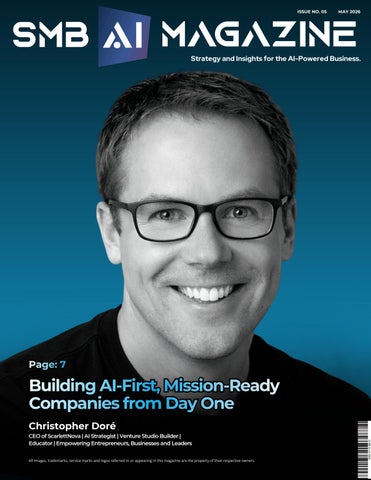
Building AI‐First, Mission‐ReadyCompanies fromDayOne
In an exclusive interview with The CanadianSME SMB AI Magazine Magazine, Christopher Doré, CEO of ScarlettNova and Founder of Rogue Ventures, shares a clear and practical perspective on what it really takes to build in the age of artificial intelligence Rather than treating AI as an add-on, Christopher focuses on designing businesses where intelligence shapes every layer, from product to operations
Interview By Varun K Sirohi
These days, when I am not coordinating and teaching in the renowned Business Management and Entrepreneurship (BME) program at Algonquin College, I focus on making the world a better place as the CEO of ScarlettNova (www.scarlettnova.com), a forward-thinking AI company dedicated to empowering businesses to adopt and maximize value through artificial intelligence, and as the Founder of Rogue Ventures, a AI empowered venture studio with a focus on dual usage technologies Also a Perplexity Business Fellow and founder of the Ottawa Chapter of the AI Collective (https://www aicollective com)
ChristopherDoré
At Rogue Ventures, you design AI first companies instead of “adding AI later.” In simple terms, what makes an AI native business model different from a traditional startup that just uses AI as a feature?
An AI-native business is built around intelligence as the operating core, not as a feature added to an existing workflow A traditional startup might use AI to improve support, marketing, or analytics An AInative company designs its product, economics, team structure, and customer experience assuming AI is central from day one
That changes everything The product improves through usage and feedback loops, not just through manual feature releases The cost structure can scale differently because software, decisions, and service delivery become partially automated The team can stay leaner because AI expands what each person can do. Most importantly, the value proposition is often based on speed, personalization, prediction, or autonomous execution that would be difficult to deliver with a conventional model
In simple terms, traditional companies use AI to enhance work AI-native companies use AI to redefine how work is done, how value is created, and how the business scales That is the difference between bolting intelligence on later and designing around it from the start
You’re working at the intersection of commercial markets and regulated or mission driven customers. What do you look for in AI ideas that can succeed in both worlds?
We look for AI ideas that solve a painful, repeatable problem in a way that creates measurable value in both environments In commercial markets, that usually means speed, cost reduction, revenue lift, or better customer experience In regulated or missiondriven settings, it also has to support accountability, transparency, reliability, and human oversight
The strongest ideas work in both worlds because they address universal operational friction, things like triage, compliance-heavy workflows, knowledge retrieval, decision support, document handling, or resource allocation
If a solution can produce strong outcomes while respecting privacy, auditability, and governance, it becomes much more transferable
I also pay close attention to data readiness and adoption friction A good idea is not enough if the data is inaccessible, poor quality, or too sensitive to use responsibly Finally, I look for trust architecture early: explainability where needed, role-based controls, clear escalation paths, and the ability to keep humans in the loop If an AI product can win on performance and trust, it has a much stronger chance of succeeding across both commercial and regulated markets
Venture studios promise better odds than “garage built” startups. What have you learned about taking AI ideas from zero to pilot quickly, without cutting corners on governance and safety?
The biggest lesson is that speed and discipline are not opposites You can move from zero to pilot quickly if you narrow the problem, define the decision the AI is supporting, and prove value in a contained system before trying to scale
We focus on a few things early First, pick a use case with clear pain, accessible data, and an obvious buyer Second, build around a minimum viable workflow, not a minimum viable model Customers do not buy a model, they buy a usable outcome
Third, put governance into the operating design from the beginning, including data boundaries, human review, logging, evaluation criteria, and failure handling
That approach actually accelerates pilots because it reduces rework and builds trust with customers sooner In AI, corners cut early usually become expensive later, especially around data rights, security, and model behavior What works best is rapid validation with strong guardrails: small scope, fast iteration, clear metrics, and documented controls That is how you move quickly without creating hidden risk that slows the company down later
Where do you see Canadian founders still getting AI strategy wrong especially around problem selection, data, and how they talk to early customers and investors?
Many Canadian founders still start with the technology instead of the problem They get excited about the model before validating whether the customer has a painful enough workflow, budget, and urgency to adopt a new solution That leads to impressive demos without a real buying motion
The second mistake is underestimating data Founders often assume the data will be available, clean, and usable, when in reality it is fragmented, sensitive, poorly labeled, or locked inside legacy systems In AI, the data strategy is often more important than the model choice
The third issue is messaging. Early customers and investors do not just want to hear that something is AIpowered, what isn’t these days. Customers want to know what outcome improves, how risk is managed, and how fast they can see value Investors want to know why the wedge is defensible, whether the data advantage compounds, and whether the company can scale beyond services
Too many founders still pitch AI as novelty The better approach is to frame it as a durable business system, a close looped system with a clear problem, usable data, trusted delivery, measurable ROI, and a path to defensibility
What practical advice would you give to Canadian SMB leaders who want to partner with or learn from AI native startups, rather than just buying off the shelf tools?
My advice to Canadian SMB leaders is to treat AInative startups as strategic learning partners, not just software vendors The value is not only in the tool, it is in the new operating model they can expose your team to
Start with one high-friction workflow where speed, quality, or capacity clearly matter Bring the startup into that problem with a shared success metric, a defined pilot scope, and access to the people who actually do the work That creates much better results than buying a tool and hoping adoption happens on its own
Also ask tougher questions than you would in a normal software purchase. How do they handle data security, model evaluation, human oversight, and failure cases? What assumptions are they making about your processes and data? What needs to change internally for the pilot to succeed?
ImageCourtesy:Canva
In Canada, starting a business is frequently portrayed as a courageous step toward independence In practice, it is often a complicated tangle of permits, restrictions, and scattered systems that discourages rather than empowers Covrena positions itself as a straight solution to that problem Covrena is not your typical compliance tool It aims to significantly redefine how entrepreneurship begins in Canada by transforming regulatory complexities into a clear, structured, and accessible path
ovrenais ewriting heRules Business reationin anada
By SK Uddin
Canada is routinely ranked among the best countries in the world for starting a business. However, behind that reputation is a structural challenge. Business regulations are divided into three levels: federal, provincial, and municipal, which sometimes require entrepreneurs to negotiate various systems at once According to the World Bank's historical ease-of-doing-business methodology, regulatory complexity remains a major barrier to small firm formation worldwide For entrepreneurs and business owners, one of the greatest challenges is often not ambition, but clarity
As Harvard Business Review points out, “complex systems without clear guidance tend to advantage insiders and exclude new entrants ” This observation is closely related to the Canadian startup experience, in which access to legal expertise often determines how quickly and successfully a business launches Covrena was created to bridge just this gap
WhatCovrenaActuallyDoes
Covrena is a compliance and business setup platform that helps entrepreneurs move from idea to execution Rather than providing users with general information, the platform generates individualized, step-by-step compliance roadmaps based on business type, location, and industry requirements. It helps identify:
Required permits, registrations, and licensing obligations
Compliance and regulatory steps organized in the proper order
Expected timelines, processing durations, and associated costs
Applicable funding opportunities, incentives, and support programs
Grants, financing options, and available business resources
Business structure options aligned with the business model, industry, and operational requirements
This strategy converts weeks of fragmented research into a planned execution plan The organization operates in the broader management consulting and compliance arena, delivering services such as permit assistance, funding programs, tax credits, and business registration assistance
FromInformationtoExecution
What distinguishes Covrena is its transition from simply distributing information to providing practical, actionable guidance Most compliance solutions provide access to regulations and requirements Covrena focuses on turning those requirements into practical real world applications This is a key differentiator.
According to a Deloitte analysis of small-company ecosystems published in 2023, more than 60% of entrepreneurs struggle to understand what is relevant to their position rather than with access to information Covrena answers this by saying:
Filtering away irrelevant requirements
Clearly separating necessary and optional steps.
Integrating funding discovery directly into the compliance process
The end result is a system that minimizes uncertainty and decision fatigue
DemocratizingBusinessCreation
Covrena's bigger objective extends beyond operational efficiency It is based on a larger idea: democratizing entrepreneurship Access to legal and compliance knowledge has long been inconsistent Hiring expert consultants can be prohibitively expensive for early-stage startups, freelancers, and novices Immigrants face additional challenges due to unfamiliar legal systems, language barriers, and limited professional networks
The application of AI to regulatory navigation is part of a broader shift across industries According to McKinsey, AI-driven decision tools are increasingly being utilized to simplify complicated administrative systems, especially in banking, healthcare, and government services Covrena uses this approach to business formation
The technology effectively serves as a "compliance operating system" for entrepreneurs, transforming opaque regulatory frameworks into plain-language procedures This is consistent with an increasing trend in which software not only stores information but actively influences decision-making
The greater influence of platforms like Covrena goes beyond individual enterprises Each obstacle removed from the beginning process has a compounding effect More enterprises equals more jobs, greater innovation, and better local economies Canada's future economic resilience depends not only on large firms but also on how easily entrepreneurship develops at the grassroots level Covrena is pitching itself as an infrastructure for such a transition
Entrepreneurship should not be based solely on access to lawyers, insider information, or the ability to traverse complex processes Covrena is striving toward a model in which starting a firm is no longer a luxury but a practical, achievable step.
One of the most ignored issues in Canadian entrepreneurship is unused finance. Canada provides hundreds of grants, tax credits, and assistance programs However, many entrepreneurs never use them owing to a lack of awareness or time
Innovation, Science, and Economic Development Canada has often stated that small enterprises frequently miss out on financing opportunities simply because research is dispersed Covrena incorporates financing discovery directly into its roadmap, ensuring that financial support is not an afterthought, but rather an essential component of the startup process Covrena's importance grows as enterprises expand Compliance isn't a one-time activity It evolves in response to hiring, expansion, and regulatory changes Platforms that prioritize continuous compliance over initial setup are becoming increasingly relevant Peter Drucker, a management thinker, famously observed, "Efficiency is doing things properly; effectiveness is doing the right things." Covrena aims to address both by ensuring that firms comply strategically and sustainably.
Your role in staying informed is essential to our mission of building a strong community of AIdriven innovators The CanadianSME SMB AI Magazine Magazine is your go-to resource for insights, strategies, and updates shaping the future of artificial intelligence in business
Subscribe to our monthly editions at aibusinessreview.ca to stay up to date on the latest AI trends and developments in the Canadian business landscape. Your engagement enables us to continue supporting and empowering the AI ecosystem.
Disclaimer: This article is based on publicly available information and is intended solely for informational purposes. The CanadianSME SMB AI Magazine Magazine does not endorse or guarantee any products or services mentioned. Readers are encouraged to conduct independent research and due diligence before making business decisions
Dr.RonDembo
Insidethe ClimateEarth DigitalTwin Platform
Interview By SK Uddin
Over a career spanning more than 25 years, Ron has founded multiple companies, including Algorithmics, where as CEO he built the world’s largest enterprise financial risk management software provider. He also founded Zerofootprint, an innovator in offsetting and cleantech. His current mission at riskthinking.AI is to address the pressing data challenges facing global industries by delivering science-based stochastic systems that enable organizations to quantify and mitigate physical climate risks effectively
In an exclusive interview with The CanadianSME SMB AI Magazine Magazine, Dr. Ron Dembo, Founder and CEO of RiskThinking.AI, breaks down how advanced AI models are transforming the way organizations understand climate risk Moving beyond static reports and historical averages, Dr Dembo introduces a forward-looking approach where businesses can simulate real-world climate scenarios and see their financial impact at the asset level
As the Founder and CEO of riskthinking AI, Ron leads the development of cuttingedge AI-driven solutions to measure and address risk in an increasingly uncertain world. With expertise in mathematical modelling, climate change impacts, and energy management, his work focuses on equipping institutions with tools to navigate systemic risks and make informed decisions CEO & Founder, RiskThinking.ai
RiskThinking.AI built a Climate Earth Digital Twin™ that simulates climate risk across millions of assets. In simple terms, how do you explain what this twin does for a bank or insurer executive?
Think of it as Google Earth, but instead of showing you what the world looks like today, it shows you what it could look like in our uncertain climate future, asset by asset, scenario by scenario, decade by decade.
A bank has a mortgage book with hundreds of thousands of properties An insurer has policies across every province Neither of them can look at a spreadsheet and understand what happens to that portfolio when a category-4 hurricane makes landfall, or when a river floods three years in a row, or when wildfire risk makes a region uninsurable
The Climate Earth Digital Twin™ runs those scenarios, physically, not statistically
It models the actual climate mechanisms driving each hazard, translates them into financial outcomes, such as asset value impairment, probability of default, and insurability thresholds It is done at the level of individual assets, not just at the sector or regional average
What executives tell us is that for the first time, they can see their exposure Not a risk score Not a colour on a heat map Real numbers, tied to real assets, under real climate futures
You’ve argued that climate risk is radically uncertain and lives in the “tails,” not the averages. How does your AI‑driven approach change the way organizations think about worst‑case scenarios and insurability?
The standard approach to risk management is built around averages and medians, the most likely outcome Climate risk doesn’t live there It lives in the tails: the once-in-fiftyyear flood that’s now happening every eight years, the compound event nobody modelled because they only looked at a few possible futures. We look at thousands. Balance sheets are broken by the extreme events in the tail, not the averages
Our approach forces organizations to confront the full distribution That changes the conversation from “what’s our expected loss?” to “what’s an extreme, credible loss, and can we survive it?”
It also fundamentally shifts the conversation about insurability Insurance works when losses are predictable enough to price When the tail expands when the 1-in-100 event becomes a 1-in-20 the actuarial math breaks down Our platform produces forward-looking insurability thresholds: the point at which, under each warming trajectory, specific asset classes or geographies fall outside the insurable range That’s information banks and insurers need years in advance, not after the fact
Canadian regulators selected RiskThinking. AI to power national flood‑risk analysis for the financial sector. What did that work reveal about how exposed parts of our economy already are to physical climate risk?
The OSFI and AMF stress test was a landmark exercise, and its conclusions were sobering Despite years of regulatory signalling, Canadian financial institutions remained inadequately prepared for the financial impacts of physical climate risk.
The institutions understood the direction of travel, but the tools and data they used weren’t sophisticated enough to translate climate science into credible balance-sheet impacts
What the flood-risk work revealed was the degree of concentration Certain corridors river floodplains, coastal zones, and areas with ageing stormwater infrastructure hold disproportionate concentrations of mortgage and commercial lending exposure. When you model those under realistic near-term scenarios, not just 2050 pathways, the numbers are uncomfortable
The deeper finding concerned visibility gaps Institutions often didn’t know what they didn’t know They had broad sector-level exposure estimates but lacked asset-level granularity A bank might know it has significant Alberta exposure, but not which specific properties are in the highest-risk flood zones, or how that exposure changes under a 1 5°C versus a 2°C trajectory That’s precisely the gap we were built to close
How do you ensure the underlying climate science, data, and AI models in your platform remain transparent and decision useful for non scientists in finance and government?
This is something we think about constantly, because a model that can’t be explained can’t be trusted A result that can’t be acted on is just expensive noise
Every output from our platform comes with an explainability layer: which climate mechanism drove it, which scenario pathway, which model vintage, and what the uncertainty range looks like A CFO or chief risk officer shouldn’t have to take our word for it They should be able to trace the result back to its inputs
We also deliberately output in the language of finance, not climate science We don’t hand someone a flood hazard score and ask them to figure out what it means for their loan book. We give them probability-of-default uplift, loss-givendefault adjustments, and asset-value impairment curves the metrics that slot directly into existing risk frameworks and regulatory reporting templates
Transparency without usability is just compliance theatre Our goal is outputs that a risk committee can debate, a regulator can audit, and a board can act on
Climate Intelligence
What practical first steps would you recommend to Canadian SMBs and mid market companies that want to start understanding their own climate‑related financial risk, but don’t know where to begin?
The most important first step is to get physical Most companies have mapped their carbon footprint but far fewer have seriously assessed their physical exposure which facilities, supply chain nodes, or key customers sit in flood zones, wildfire-prone areas, or regions facing chronic heat stress Start there
Next, stress-test your insurance Ask your broker directly: are my assets still insurable at viable premiums in five years? That conversation alone will be revealing
For companies ready to go deeper, sophisticated climate risk analysis is no longer the exclusive domain of large institutions The same engine that powers analysis for a multinational bank can be accessed by a small business through a conversational AI interface or a simple programming API and you pay only for what you use Institutional-grade physical risk analysis, at SMB-friendly cost Visit riskthinking ai to get started
Disclaimer: The views and opinions expressed in this interview are those of the guest and do not necessarily reflect the views of The CanadianSME SMB AI Magazine Magazine This content is for informational and inspirational purposes only and is not intended as professional business, legal, or wellness advice
BreakingtheTradeDeadlock:
By Darian Kovacs
Without integrating new technology, Canadian SMEs would need a massive increase in headcount, an expense that is not affordable in today’s trade climate By adopting AI, businesses gain what the United Nations calls a ‘transformative force’ that allows small teams to automate complex logistics and market research, giving local businesses the agility to handle high-volume international trade. This shift is now a national priority, supported by the federal government’s recent $80 million Regional Tariff Response Initiative, which aims to help Atlantic Canadian SMEs modernize Even with capital in hand, business owners must first master how to strategically apply AI to their specific trade challenges before they can see an increase in growth
To bridge this gap, Digital Nova Scotia has teamed with St Francis Xavier University and Jelly Academy to launch the AI for Export Bootcamp This exclusive, 6-week microcredential program is specifically designed to help 20 Atlantic Canadian SMEs integrate AI into their business models, giving them the tools they need to compete in the global market.
We are at a turning point where traditional, theory-based education is no longer enough In a landscape where technology and trade rules can change overnight, textbooks and previous education can’t keep up This bootcamp replaces “oldschool” theory with practical, hands-on training, providing the modern skills businesses need to survive and thrive in today’s unpredictable market
Having kicked off on April 30th, 2026, this first-of-its-kind initiative will turn 20 Atlantic Canadian SMEs into tech-forward exporters Rather than just studying the trade war, these businesses will be equipped to actively build a toolkit to thrive in it
Through the program, these businesses will move beyond the “strategic deadlock” by using AI to:
Identify high-potential international buyers with precision.
Generate localized, export-ready marketing content in a fraction of the time.
Execute sophisticated outreach strategies that previously required much larger teams.
Darian Kovacs is a Métis entrepreneur and the founder of Jelly Digital Marketing & PR, a Vancouver-based agency specializing in PR, digital advertising, and SEO, as well as its sister company, Jelly Academy, a leading digital marketing school He hosts the Métis Speaker Series podcast, frequently leads workshops, and serves on the boards of the Digital Marketing Sector Council and NPower Canada Darian is also the editor of IndigenousSME and contributes to publications including BCBusiness, Future Economy, The Globe and Mail, Forbes, and Entrepreneur magazine
CanadianAIBoutiques vsGlobalGiants
By SK Uddin
Canada's AI ecosystem is at a tipping point On one side are multinational cloud and consulting behemoths integrating agentic AI into major transformation efforts, and on the other are Canadian-born specialists like Integrate.AI, AltaML, MindBridge, Coveo, Borealis AI, and others who are pitching themselves as the pragmatic, locally relevant solution for enterprise automation The battleground is not just about technological skill, but also about who can deliver reliable, production-grade automation faster, with greater alignment with Canadian data, regulations, and personnel
Canadian AI firms have spent the last decade developing deep competence in applied AI, long before the term "agenttic AI" became fashionable Integrate ai, for example, has received recognition for its work in privacy-preserving AI and federated learning approaches that allow businesses to collaborate on models without sharing raw data, directly addressing Canadian privacy concerns
AltaML, based in Western Canada, has established a reputation as an "AI factory" that collaborates with corporations and publicsector organizations to develop practical solutions, particularly in the energy, finance, and government sectors
MindBridge, an Ottawabased firm, specializes in AIpowered risk and anomaly detection for finance and audit, employing AI agents to identify unexpected transactions and patterns in huge financial databases
Coveo, based in Quebec, has long specialized in AI-powered search, recommendations, and personalization, and is now integrating generative and agentic capabilities into enterprise search and customer experience platforms
Borealis AI, an RBC-backed research institution, integrates cutting-edge research in fields such as reinforcement learning and language models to real-world applications in financial services and beyond While their technical specialties differ, these boutiques share key characteristics, including strong ties to Canadian universities and talent hubs, expertise in regulated industries, and a track record of delivering measurable operational advantages rather than AI for its own sake.
Global behemoths Microsoft, Google, AWS, ServiceNow (which acquired Montreal's Element AI), and consultancies like Accenture and Deloitte enter Canadian markets with strong advantages: brand recognition, established business partnerships, and extensive platform ecosystems Their agentic services are often tightly connected with cloud infrastructure, productivity suites, and workflow tools, making them ideal for large, multi-year automation projects involving multiple departments
Domain and regulatory depth: Integrate ai, MindBridge, and AltaML create solutions tailored to Canadian privacy law, sectorspecific rules, and risk appetites, making them appealing to banks, insurers, healthcare providers, and government agencies
Co-creation and speed - Instead of selling generic platforms, boutiques typically collaborate with client teams to create particular agents and workflows, going from ideation to pilot in weeks rather than quarters
Independence - Many companies advertise themselves as cloud-agnostic or "multi-cloud," allowing clients to avoid lock-in and select the best underlying infrastructure for each task
In effect, global behemoths promote a vision of standardized, platform-led agentic capabilities, whereas Canadian specialists provide customized automation with built-in local context Enterprises are increasingly combining the two, deploying fundamental AI services from major cloud providers while relying on boutiques for vertical solutions, orchestration, and last-mile integration.
The agentic AI story in Canadian stores is swiftly evolving Early offerings focused on narrow tasks: anomaly detection in audits (MindBridge), predictive maintenance or risk scoring (AltaML), personalization and search experiences (Coveo) Many are already combining these capabilities into larger, multi-agent workflows that resemble full-fledged hyper-automation
An AltaML-style deployment could include agents that collect data from operational systems, run predictive models, produce alarms, and recommend actions for frontline staff
MindBridge's agents employ both unsupervised and supervised learning to scan whole ledgers, identify anomalies, and feed results into auditor workflows, effectively serving as relentless digital colleagues
Coveo's generative and conversational experiences are increasingly acting like agents, able to search, synthesize, and act inside knowledge bases and assist workflows rather than simply delivering ranked results.
Compared to worldwide platforms, these services are more opinionated and domain-specific, but they also have a pre-built understanding of Canadian data, language, and regulations
PricingAndEngagementModels
According to reports on leading Canadian AI development and automation organizations, boutiques often adopt phased, outcome-oriented engagement approaches
Discovery and use-case shaping, frequently through a fixed-fee method or "lab" participation
A pilot or MVP agent is designed to automate a specific workflow (for example, fraud triage, underwriting support, or internal knowledge assistant)
Scale-up, where successful pilots are hardened, integrated more deeply, and rolled out across business units
Pricing reflects the structure According to Canadian AI development company guides, pilot projects from prominent boutiques typically cost between CAD 100,000 and CAD 300,000, with larger programs scaling up based on integration complexity and regulatory needs Global giants, on the other hand, may bundle platform consumption, enterprise licenses, and advising into multimillion-dollar transformation plans that appeal to extremely large businesses but are sometimes out of reach or unsuitable for mid-market firms.
Boutiques take advantage of this disparity, offering themselves as a method to "achieve actual agentic successes within this fiscal year " without committing to a comprehensive, multi-year transformation
Industry rankings and analyst-style roundups of Canadian AI businesses indicate that a natural division is occurring
The issue is quite specialized (for example, audit analytics, sectoral personalization, privacy-preserving data collaboration)
Local nuance is vital for Canadian regulation, multilingual obligations, and public perception
The client prefers close engagement with builders and rapid iteration over a predefined global plan
The mandate is vast, encompassing enterprise-wide ERP, CRM, and HR transformation
The customer has already standardized on a huge cloud platform and would like to enhance it with native AI agents.
There is a demand for huge, multi-year projects with substantial change management and worldwide templates
According to thought leadership on agentic AI for enterprises, successful organizations frequently combine the two approaches: use hyperscaler platforms and global frameworks for core capabilities and governance, then collaborate with niche specialists to create high-impact, domain-specific agents that actually improve operations
Looking ahead, the question is whether Canadian AI boutiques can sustain their strategic distinction as global platforms commodify more agentic capabilities Many bet on three moves:
Owning high-trust, high-risk use cases where clients expect local knowledge and direct accountability (e g , audit, healthcare decision assistance, vital infrastructure)
Creating reusable agent frameworks and IP that sit on top of large clouds but are tailored to Canadian industries and regulatory realities
Rather than competing head-on, we are partnering with cloud and software titans in Canada to become preferred implementation and innovation partners
For Canadian businesses, the rising mix of global and domestic options is excellent news It means that agentic AI and automation initiatives no longer have to be "all or nothing" bets on one vendor Instead, leaders can put together the right mix of platforms and boutiques balancing global scale with local knowledge to create autonomous systems that operate in the Canadian context
Your role in staying informed is essential to our mission of building a strong community of AI-driven innovators The CanadianSME SMB AI Magazine Magazine is your go-to resource for insights, strategies, and updates shaping the future of artificial intelligence in business
Subscribe to our monthly editions at aibusinessreview.ca to stay up to date on the latest AI trends and developments in the Canadian business landscape. Your engagement enables us to continue supporting and empowering the AI ecosystem.
Disclaimer: This article is based on publicly available information and is intended solely for informational purposes. The CanadianSME SMB AI Magazine Magazine does not endorse or guarantee any products or services mentioned Readers are encouraged to conduct independent research and due diligence before making business decisions
Buildinga NativeAI Platformfor Canadian Innovation Funding
In an exclusive interview with The CanadianSME SMB AI Magazine Magazine, Sepehr S, Co-Founder and CEO of Shyftbase and the driving force behind GrantOps ai, breaks down how artificial intelligence is reshaping the way Canadian businesses access funding Moving beyond outdated, manual processes, Sepehr shares a clear vision of a future where grant discovery, compliance, and audit readiness happen continuously in the background.
InterviewBySKUddin
SepehrS
Co-Founder and CEO of Shyftbase
Sepehr is an entrepreneur and technologist operating at the intersection of artificial intelligence and business strategy. With over a decade of experience applying technology to solve complex operational and strategic challenges, he blends deep technical insight with business foresight to build scalable, human-centric systems.
As the Co-Founder and CEO of Shyftbase, Sepehr leads innovation, operational efficiency, and strategic growth, positioning the company as a key player in the supply chain intelligence space
He also directs the technological and business vision behind GrantOps ai, a platform redefining how organizations create and audit grants through AIdriven automation In addition, he serves as the strategist for Aidols group helping organizations integrate advanced AI solutions into core business functions and their digital adoption
GrantOps describes itself as an AI-powered grant and SR&ED automation platform. In simple terms, how do you explain what that means to a CFO or founder who's only ever worked with traditional SR&ED consultants?
Traditional SR&ED consultants run a months-long manual process interviews, document chasing, narrative drafting, then a flat 15–25% success fee GrantOps flips that model
You connect the tools your team already lives in GitHub, GitLab, Jira, Linear, Slack and our AI continuously reads the signal that's already there: code commits, tickets, technical discussions, project documentation From that, it identifies eligible R&D activities, drafts CRA-ready T661 forms and technical narratives, and assembles an audit trail that traces every claim back to its source.
For a CFO, the practical translation is this: claim preparation drops from months to hours, your team's time commitment drops from weeks to minutes, and the success fee drops from 15–25% to 2 5% And because we monitor 5,500+ programs across Canada IRAP, CanExport, provincial credits you stop leaving capital on the table for funding you didn't even know you qualified for It's the difference between hiring a consultant once a year and having an always-on system working in the background
GrantOps automates everything from R&D activity detection to T661 generation and audit documentation. Where have you seen AI deliver the biggest immediate cost or time savings so far?
The single biggest win is technical narrative generation For most claimants, this is the most painful part of SR&ED engineers being pulled into long interviews, then consultants writing prose that engineers have to review and correct, often weeks later when the technical context is already stale. By the time a narrative is finalized, you ' ve burned 40–80 hours of senior engineering time per claim
When the AI ingests commits, pull request discussions, and ticket threads in real time, that whole cycle collapses We see roughly an 85% reduction in claim preparation time, and the narrative actually reflects what the team did because it's drawn from what they wrote while they were doing it, not reconstructed from memory months later
Many Canadian SMBs are still preparing SR&ED claims with spreadsheets, end-of-year scrambles, and email threads. What first steps do you recommend to help them move toward AI-powered, evidence-based claim preparation?
Start with one habit: capture R&D evidence as it happens, not at year-end The single biggest reason claims get reduced or audited is thin contemporaneous documentation and the irony is that most teams already produce excellent evidence inside their dev tools Commits, PR descriptions, Jira tickets, design docs in Notion, debugging threads in Slack. It's all there. It just never makes it into the claim.
So step one is connecting those tools to something that can read them even a basic integration that pulls R&Dtagged tickets into a structured log is a leap forward from a year-end Excel sheet Step two is shifting your engineering culture slightly: encourage clear commit messages and ticket descriptions that name the technical uncertainty being resolved That alone changes audit defensibility
Step three is moving from one-time claims to continuous monitoring SR&ED is the well-known program, but there are 5,500+ federal, provincial, and sector grants in Canada You can't track those manually The minute you have your R&D evidence flowing into a system, matching it to programs becomes the easy part
How do you design GrantOps so AI automates SR&ED and grant workflows without turning the system into a "black box" that finance teams and CRA reviewers can't trust?
Auditability is non-negotiable in this category A black-box claim is a worthless claim if you can't defend it, you don't get the money So we built GrantOps with full traceability from source to submission as a core architectural principle, not a feature
Every claim line on the T661 traces back to specific commits, tickets, or documents Every sentence in a technical narrative has source evidence attached If a CRA reviewer asks, "Why did you classify this work as experimental development?" the answer isn't "the AI said so, " it's a linked set of artifacts the engineers themselves produced
Funding Innovation
We also keep humans in the loop at the right moments Our Professional and Expert tiers include real SR&ED specialists who review claims before submission, so the AI handles scale and consistency while experts handle judgment calls And we operate to SOC 2 standards with end-to-end encryption because the moment you ask companies to plug their source code and project management into your platform, trust becomes the entire product
What advice would you offer Canadian SMBs that want to start recovering R&D capital and grants in 2026 but can't afford a big consulting engagement or a full transformation?
Three pieces of advice. First, don't conflate " we ' re too small" with " we don't qualify." SR&ED is open to CCPCs of every size, and the refundable portion is genuinely refundable — you don't need to be profitable to receive it. Most early-stage software, manufacturing, cleantech, and biotech work in Canada has eligible activity inside it. The real risk isn't claiming wrong; it's not claiming at all.
Second, start small and start now You don't need a consulting engagement to begin A free trial, a calculator, even a single connected repo gives you a baseline estimate of what you ' re leaving on the table. We deliberately built a $99/month starter tier and a 2 5% success fee precisely so a five-person startup can access the same automation a Series C company gets
Third, think beyond SR&ED CanExport, IRAP, provincial innovation credits these stack The companies that win in 2026 won't be the ones doing one big-bang transformation; they'll be the ones who set up continuous capital recovery in the background and let it compound quarter after quarter
Canada has become a battleground for agentic AI platforms, with global hyperscalers, major consultancies, and Canadian-born boutiques all competing to power the next generation of autonomous business systems Canadian businesses today assess these services based not only on raw AI capacity, but also on three hard criteria: data residency, depth of integration into current systems, and pricing and delivery models that meet local budgets and risk appetites
Microsoft has aggressively anchored its agentic AI story in Canada by leveraging Azure's AI stack, the Azure AI Agent Service, and the broader Copilot ecosystem. Canadian customers can deploy AI agents on top of Microsoft 365, Dynamics 365, and Power Platform, providing a relatively clear path from existing productivity and business tools to autonomous workflows For many businesses, this reduces integration friction because identity, security, and key data are already in the Microsoft ecosystem
Data residency is a key differentiator Microsoft operates various Canadian data center regions, allowing many workloads to keep data at rest in Canada to comply with PIPEDA, sectoral regulations, and Quebec's Law 25 While specific configurations vary by service and architecture, Microsoft's Canadian footprint is a major reason many large banks, insurers, and public-sector groups consider it a preferred AI partner
Microsoft has aggressively anchored its agentic AI story in Canada by leveraging Azure's AI stack, the Azure AI Agent Service, and the broader Copilot ecosystem Canadian customers can deploy AI agents on top of Microsoft 365, Dynamics 365, and Power Platform, providing a relatively clear path from existing productivity and business tools to autonomous workflows For many businesses, this reduces integration friction because identity, security, and key data are already in the Microsoft ecosystem
Data residency is a key differentiator Microsoft operates various Canadian data center regions, allowing many workloads to keep data at rest in Canada to comply with PIPEDA, sectoral regulations, and Quebec's Law 25 While specific configurations vary by service and architecture, Microsofts Canadian footprint is a major reason many large banks, insurers, and public-sector groups consider it a preferred AI partner Pricing is often based on common cloud patterns pay-asyou-go for consumption (tokens, computing), plus enterprise license for Copilot and related services making it easy for CIOs and CFOs to align agentic AI spend to existing budget models
Along with hyperscalers, multinational consulting firms such as Accenture, IBM, and Deloitte have strong AI and automation expertise in Canada, frequently developing multi-agent solutions built on cloud infrastructure These firms typically specialize in large, complex transformation programs covering several functions customer service, operations, finance, and risk in which governance and change management are just as important as the underlying models Their pricing typically reflects multi-month contracts that include strategy, implementation, and managed services.
In parallel, a new wave of Canadian-centric boutiques is almost entirely focused on agentic AI systems and automation Firms such as JADA (described expressly as a "purpose-built" agentic AI deployment specialist), as well as smaller shops based in Toronto, Montreal, and Vancouver, pitch themselves as more agile options that understand Canadian regulatory and data-protection issues from the start They frequently bundle products as scoped projects for example, a single-agent deployment for a specific process with initial construction costs in the low- to mid-six-figure range, plus separate monthly monitoring and operations costs
WhyDataResidencyMattersinCanada
Because Canada's privacy law and upcoming AI rules (including Quebec's Law 25 and the proposed Artificial Intelligence and Data Act) impose stringent obligations on enterprises, data residency is no longer a "nice-to-have" feature Enterprise buyers frequently ask:
Can the platform keep sensitive data at rest in Canadian regions?
How are cross-border data transfers handled?
Which logging, audit, and access controls are available to regulators and internal compliance teams?
Hyperscalers highlight their Canadian regions, certifications, and fine-grained security controls, whereas boutiques stand apart by designing architectures that eliminate unnecessary data transit and incorporate compliance-by-design into agent activities To address local concerns, several multinational suppliers are opening Canadian data centres or regional endpoints; Moveworks, for example, has announced plans to establish a Canadian data centre in response to Canadian clients' need for data privacy and residency
For Canadian businesses, the practical question is not "How intelligent are your agents?" but "How well do they integrate with what we already do?" Agentic AI platforms are rapidly competing to integrate with SaaS tools, legacy systems, and industry-specific applications
Cloud-native corporate platforms, such as Azure and other major agentic stacks, include connectors for Salesforce, ServiceNow, and major ERPs, as well as APIs and SDKs for further integration
Integration-focused platforms (such as Composio, which is covered in the 2026 integration guidelines) position themselves as the "glue" layer, allowing AI agents to communicate with hundreds or thousands of third-party apps using standardized connectors
Canadian boutiques frequently succeed by being system integrators at heart: they understand how to connect AI agents to home-grown line-of-business systems, provincial government platforms, and specialist tools used in industries such as natural resources and healthcare For many mid-sized Canadian firms, local systems knowledge can be more important than having the most advanced base model
HowPricingShiftsfromPlatformstoProjects
Pricing is another much-debated topic According to a 2026 pricing estimate for agentic AI installations, in-house builds for complex systems can soon exceed six or seven figures in development costs, with significant annual maintenance required to keep interconnections secure and compliant A Canadafocused examination of agentic AI consultancy reveals that even somewhat targeted, single-agent installations often start between CAD 150,000 and 450,000 for the first build, with continuous managed operations provided as a separate monthly service Larger multi-agent programs with deep integration and comprehensive compliance design are evaluated individually
Platform vendors often pursue a hybrid model:
Base platform fees or cloud consumption (compute, storage, API calls)
Per-user or per-seat pricing for Copilot-like assistants or agent consoles
Optional add-ons for advanced security, monitoring (“AgentOps”), and premium connectors
Canadian buyers are becoming skeptical of offerings that appear "too cheap," as low-cost projects can compromise security, observability, and change management
What’sWinningSoFarInCanada?
Early evidence indicates that no single platform has " won " the Canadian market; rather, patterns are emerging For governanceheavy applications, large corporations and public-sector entities commonly turn to hyperscalers (particularly Microsoft, given its Canadian data centres and footprint in productivity and business apps), as well as significant consultancies
Mid-sized businesses and agile teams frequently prefer more concentrated agentic platforms or Canadian boutiques that can supply verticalized solutions quickly, with transparent pricing and hands-on integration support.
Comparison lists of the "top agentic AI platforms in Canada" now commonly include global brands as well as niche companies that provide autonomous IT agents, sales and marketing agents, or back-office automation as a service These rankings prioritize pricing clarity, integration quality, and assistance, which are closely aligned with Canadian purchasers' objectives
Over the next few years, the platforms and partners that combine three attributes are likely to win in Canada's agentic AI battleground: they respect and enable Canadian data residency and compliance requirements, they integrate deeply into the messy reality of enterprise systems, and they provide pricing structures that make long-term autonomy economically sustainable rather than a one-time experiment.
Your role in staying informed is essential to our mission of building a strong community of AIdriven innovators. TheCanadianSMESMBAI MagazineMagazine is your go-to resource for insights, strategies, and updates shaping the future of artificial intelligence in business
Subscribe to our monthly editions at aibusinessreview.ca to stay up to date on the latest AI trends and developments in the Canadian business landscape. Your engagement enables us to continue supporting and empowering the AI ecosystem
Disclaimer: This article is based on publicly available information and is intended solely for informational purposes The CanadianSME SMB AI Magazine Magazine does not endorse or guarantee any products or services mentioned Readers are encouraged to conduct independent research and due diligence before making business decisions
As Canadian firms transition from rare AI pilots to fleets of autonomous agents in production, the difficult question is no longer, "Can we construct an agent?" But, "Can we run numerous agents in a safe, consistent, and compliant manner?" AgentOps, or the operational paradigm for AI agent deployment, monitoring, governance, and continuous assessment, is emerging as the missing layer in Canadian AI stacks Canadian organizations must prioritize a safe AgentOps stack to meet local privacy, industry, and cybersecurity standards
WhatAgentopsMeansInPractice
According to global guides, AgentOps is the control plane for AI agents: it defines what agents may do, how quality and safety are monitored, how costs and latency are managed, and how modifications are deployed without disrupting production
A Teradata handbook describes AgentOps as a lifecycle that includes planning, building, evaluating, deploying, monitoring, and improving, along with observability, safety, and governance tools
In Canada, this lifecycle must adhere to domestic privacy and AI-risk guidelines The government Implementation Guide for Managers of Artificial Intelligence Systems provides a framework for small and medium-sized enterprises to identify and manage AI risks, align their systems with Canadian and international standards, and integrate AI risk management into existing governance When combined with Canadian AI governance playbooks and privacy rules, this elevates AgentOps from "nice-to-have technical discipline" to "compliance-critical competence "
A safe AgentOps stack for Canadian businesses typically consists of four pillars:
Observability and telemetry - AgentOps references emphasize the importance of detailed traces for each agent step and tool call, including timing, success or error codes, token usage, and cost per task. Replay capabilities the ability to reconstruct what an agent performed and why are critical for both debugging and auditing.
Safety, governance, and access controlsAgentOps frameworks advocate using leastprivilege role- or attribute-based access control (RBAC/ABAC) on tools and data, storing short-lived credentials in safe vaults, implementing refusal rules, and obtaining clearance for high-impact operations Full audit trails document who (or which agent) performed what, when, and under what policy
Workflows for evaluations and promotionsMature AgentOps use "golden tasks" and regression suites to validate quality, safety, latency, and cost before implementing changes Shadow runs, canary deployments, and sign-offs make releases more defensible judgments rather than gut calls
Incident response and resilience - The guides emphasize clear rollback paths, "freeze" switches for misbehaving agents, secret rotation, and runbooks for handling prompt injection, data leaks, or illegal actions.
For Canadian organizations, these capabilities must align with PIPEDA, provincial privacy legislation (including Quebec's Loi 25), and sector-specific standards for logging, explainability, and record retention.
A practical Canadian plan combines global AgentOps patterns with local restrictions A good method to organize it:
1.Platformanddataresidencyoptions
Canadian stack recommendations propose beginning with infrastructure that meets Canadian privacy standards, such as using providers with strong security certifications (ISO 27001, SOC 2) and, when possible, hosting data in Canadian jurisdictions to simplify compliance with PIPEDA and provincial regulations For AgentOps, this means:
Choosing observability and logging tools that can store traces and logs in Canada or under comparable safeguards
Ensure that vector stores, prompt logs, and replay data do not unintentionally move personal or sensitive data outside of compliance environments.
Secure deployment guidelines stress treating agents as first-class identities in the stack This includes:
Always manage agent credentials through secure vaults (e g , cloud key vaults), never hardcoding secrets
Using standard IAM (Azure AD, Okta, etc.) ensures that agents' rights are scoped, auditable, and aligned with the principle of least privilege
Differentiating identities for planner, worker, and reviewer agents in multi-agent patterns allows for distinct access and monitoring of actions
This also helps Canadian organizations meet legal requirements for access control and accountability in key systems
3.Monitoring,Metrics,andSLOs
Before installing agents, AgentOps advocates specifying quantifiable outcomes such as accuracy, policy compliance, QA pass rate, p95 latency, and cost per job For Canadian businesses, extra KPIs sometimes include:
Violations of privacy and data handling, such as accessing data outside the scope
Compliance measures include adhering to denial guidelines for sensitive requests
Systems should continuously monitor and alert on these metrics, feeding them into existing SOC/SIEM technologies to detect AI abnormalities alongside traditional security signals
Canadian AI governance discussion emphasizes the importance of integrating AgentOps into broader corporate governance rather than maintaining technical isolation EY and other consultants suggest that agentic AI systems require improved governance frameworks that address planning, oversight, accountability, and risk reduction
Red teaming and testing AgentOps and security webinars on autonomous agents emphasize the importance of testing for novel attack vectors such as quick injection, tool abuse, data exfiltration, and agent-to-agent manipulation The Canadian teams are urged to:
Conduct systematic red-team activities against agents, utilizing social-engineering techniques and hostile prompts.
Test how agents react when tools return unexpected problems, untrustworthy data, or expired credentials
Check that the refuse and approval rules hold up under stress.
Risk management in accordance with Canadian guidelines: The government implementation guide for AI systems provides methods for managers to identify, analyze, and mitigate risks throughout the AI lifecycle, including recommendations for integrating with business risk frameworks and documenting mitigations for each identified risk AgentOps stacks should catch this as follows:
Risk registers are linked to certain workflows and agents.
Use policy-as-code to integrate constraints and approvals into orchestration logic.
Canada's evolving AI governance policies call for review boards or committees to approve high-impact deployments
RollingOutinPhasesfromSandboxtoCanary
AgentOps literature regularly advises a progressive rollout: sandbox, shadow, canary, and ultimately wider exposure Secure-stack webinars emphasize the importance of validation before agents can ship code, modify infrastructure, or handle sensitive data
AgradualCanadianlaunchcouldlooklikethis:
Sandbox: Agents validate behaviour and metrics using generated or historical Canadian data, with no real-world negative consequences.
Shadow mode: Agents watch or imitate operations alongside human workflows but do not take action; any inconsistencies are recorded and analyzed.
Canary deployment involves agents handling a limited, carefully selected cohort of consumers or transactions while adhering to strict rate limitations and approvals.
Progressive expansion: Exposure grows only when metrics remain within set service-level targets and no new material hazards develop
Organizations have rollback and freeze methods ready at all times, with configuration toggles, traffic routing, and secret rotation plans verified regularly
Without AgentOps, adding a new agent adds operational and regulatory risk.
AgentOps enables fleets of agents to be introduced, monitored, and managed in a manner that is acceptable to regulators, boards, and consumers
As Canadian organizations expand their use of AI agents in support, finance, operations, and IT, those who prioritize AgentOps as a first-class discipline will be better equipped to use autonomy without sacrificing control
Your role in staying informed is essential to our mission of building a strong community of AI-driven innovators The CanadianSME SMB AI Magazine Magazine is your go-to resource for insights, strategies, and updates shaping the future of artificial intelligence in business
Subscribe to our monthly editions at aibusinessreview.ca to stay up to date on the latest AI trends and developments in the Canadian business landscape. Your engagement enables us to continue supporting and empowering the AI ecosystem.
Disclaimer: This article is based on publicly available information and is intended solely for informational purposes The CanadianSME SMB AI Magazine Magazine does not endorse or guarantee any products or services mentioned Readers are encouraged to conduct independent research and due diligence before making business decisions
For almost a decade, Canadian firms have employed robotic process automation (RPA) to automate screen scraping, data movement, and back-office tasks Now a new phase has begun Agentic AI, cloud computing, and sophisticated analytics are transforming businesses from task-level bots to cognitive, multi-agent systems capable of orchestrating complex, cross-departmental activities Canada is developing as a leader in this transformation, with extensive experimentation and a growing number of production deployments
WhyclassicRPAhititslimits
Traditional RPA was designed for structured, repetitive activities like copying fields from one system to another, creating simple reports, and managing routine transactions It performed well when processes were consistent and interfaces changed seldom, but it struggled with unstructured data, exceptions, and rapidly changing digital ecosystems When websites or forms changed, bots broke; when human judgment was required, RPA simply returned work to humans
According to a Canadian hyper-automation industry report, RPA is still widely used in back-office operations such as invoicing, claims processing, and data input in insurance and healthcare According to reports, corporations today seek systems that can analyze documents, make context-aware decisions, and coordinate operations across many applications and teams, rather than simply written macros
CanadianenterprisesleanintoagenticAI
A KPMG poll of 252 business leaders in Canada reveals how swiftly Canadian organizations are adopting agentic AI systems that can act autonomously to perform tasks According to the survey:
27% of firms have already used agentic AI in at least one area.
64% are investigating use cases, experimenting, or launching pilots
57% intend to invest in or implement agentic AI within six months, and 34% within a year
According to a separate Intel/IDC research quoted by Canadian SME and industry sites, 16 3% of Canadian firms are experimenting with agentic AI, the highest proportion in the Americas, and nearly half regard it as transformative for their business Canadian respondents indicate performance improvements of up to 49% in specified activities where agentic AI was used
Canadian organizations are integrating RPA, AI, and analytics into unified systems (Hyper-automation 2 0) rather than using them separately These systems can read, reason, and act across processes rather than just within one application
FromTaskBotsToMulti‐agentSystems
From scripts to cognitive actors - Instead of simply replicating clicks, agents employ language models and machine learning to read documents, comprehend emails, and interpret unstructured data They can classify situations, extract essential information, and determine which workflow to initiate next, even when the inputs differ
From individual bots to organized agents, multi-agent systems enable specialized agents (document input, risk assessment, customer communication, and reconciliation) to work together on a larger process An orchestration layer coordinates them by transferring tasks and context along the chain
From compartmentalized automation to cross-departmental trips Canadian companies are automating whole journeys, such as quote-to-cash, claims-toresolution, or hire-to-onboard, rather than just individual steps (e g invoice entry) This necessitates a connection with CRM, ERP, HRIS, and industry-specific systems
Customer support and IT operations - According to surveys, Canadian organizations prioritize customer assistance and IT operations as the top use cases for agentic AI, followed by security Agents handle a significant portion of routine tickets, triage problems, and trigger automations in ITSM solutions, frequently on top of existing RPA operations.
Finance and back-office: Canadian firms are using agents to read invoices and contracts, reconcile transactions, and prepare draft reports These agents sit above RPA bots that continue to handle structured system interactions, adding cognitive layers to legacy automation
Cloud-native hyper-automation platforms
According to open government grant documents, Canadian enterprises are developing hyperautomation platforms that use AI, machine learning, and data science to provide self-service and AI concierges at scale These platforms aspire for "production-grade" orchestration, ensuring agents can work consistently and safely in customer-facing situations
Instead of removing RPA, Canadian teams are replacing it with AI agents and orchestration technologies that provide flexibility and intelligence an evolution rather than a reset
Alayeredautomationstack.-
RPA and workflow engines are at the core, managing deterministic tasks
AI services (NLP, OCR, and machine learning models) for perception and prediction.
Agentic orchestration involves coordinating tasks and agents utilizing solutions such as Azure, low-code platforms, or custom frameworks
Event-driven design - Processes react to events an email arrives, a form is submitted, a sensor reading exceeds a threshold triggering agents rather than depending merely on scheduled jobs
Centralized monitoring and governance
Dashboards monitor agent activities, success rates, exceptions, and compliance indicators to meet both operational and audit requirements
Canadian analysts emphasize the need for observability as automation becomes more autonomous Leaders seek to understand not just what was automated, but also how and why
Cost and efficiency pressures - Canadian businesses face global competition and domestic labour constraints; automating complex operations is seen as critical to reducing operational costs and increasing throughput
Cloud and SaaS maturity - Cloud platforms and Software-asa-Service automation technologies now enable enterprisegrade hyper-automation for SMEs, not just large companies
AI maturity and pragmatics - According to studies, Canadian organizations have a relatively high level of AI maturity and pragmatism, actively experimenting while focusing on use cases that deliver demonstrable practical benefits Agentic AI is considered a technique to "close the loop" on long-standing automation programs, rather than a fresh concept.
Hyper-automation 2 0 in Canada does not aim to replace humans with totally autonomous systems Rather, it is about integrating humans, RPA bots, and AI agents into a unified, robust workflow Canadian experts emphasize that successful systems prioritize human oversight for high-risk decisions and delegate repetitive, low-value tasks to agents and bots
As Canadian firms transition from isolated scripts to networked agents, the competitive gap between organizations that treat automation as a one-time effort and those that treat it as a strategic, ever-changing capability will grow. Hyperautomation 2.0, based on agentic AI, is soon becoming a defining element of the second group
Your role in staying informed is essential to our mission of building a strong community of AI-driven innovators The CanadianSME SMB AI Magazine Magazine is your go-to resource for insights, strategies, and updates shaping the future of artificial intelligence in business
Subscribe to our monthly editions at aibusinessreview.ca to stay up to date on the latest AI trends and developments in the Canadian business landscape. Your engagement enables us to continue supporting and empowering the AI ecosystem.
Disclaimer: This article is based on publicly available information and is intended solely for informational purposes. The CanadianSME SMB AI Magazine Magazine does not endorse or guarantee any products or services mentioned Readers are encouraged to conduct independent research and due diligence before making business decisions
From Resumes to Real Conversations with AI
Interview By Varun K Sirohi
Zebian's career is marked by significant contributions to technology leadership and client development within the HR technology sector. As CEO of Intervu, they are instrumental in advancing AI-driven assessment technology to enhance the interviewing process, aiming to foster diversity and elevate hiring standards Prior to this role, Zebian served as Chief Technology Officer at TrenData, a company specializing in AI-driven people analytics that empowers organizations to optimize workforce performance through robust HR metrics and predictive modeling Their tenure at TrenData involved leveraging data intelligence to inform critical business and people decisions
In an exclusive interview with The CanadianSME SMB AI Magazine Magazine, Shadi Zebian, Founder of intervu.ai, shares a sharp perspective on how artificial intelligence is reshaping the way companies hire and scale talent. Moving beyond outdated screening methods and resume-driven decisions, Shadi explains how AI is enabling faster, more structured, and more objective hiring processes without losing the human element
What made you leave the traditional path and commit fully to building intervu.ai?
I experienced firsthand how broken and inefficient recruitment can be Companies are constantly forced to choose between speed and confidence: hire quickly and risk making the wrong decision, or slow the process down to increase certainty That tradeoff never made sense to me
As businesses grow, hiring becomes one of the biggest bottlenecks Delayed hiring slows innovation, impacts productivity, and puts pressure on existing teams At the same time, rushed hiring decisions can be extremely costly I believed there had to be a better way
That’s what led to the creation of intervu ai We built a platform that uses AI to conduct intelligent, structured interviews at scale while maintaining the quality and depth companies need to make confident hiring decisions The goal was never to remove the human element from hiring, but to enhance it by eliminating inefficiencies and helping organizations move faster without sacrificing standards.
Ultimately, intervu ai was born from a simple belief: companies should not have to choose between speed and confidence when hiring
What’s the real cost for companies that refuse to introduce AI to their operations?
The cost is both immediate and long-term
The direct cost is reduced productivity and slower execution AI enables teams to automate repetitive tasks, analyze information faster, and achieve results more efficiently Companies that ignore AI are essentially choosing slower processes in a market that increasingly rewards speed and adaptability It’s similar to choosing back roads while competitors are driving on a highway
There’s also a misconception that AI exists to replace employees In reality, the most successful companies use AI to amplify human productivity, not eliminate it. The same teams can accomplish significantly more when equipped with the right AI tools
The indirect cost is even more serious: competitiveness and survival Businesses that delay AI adoption risk falling far behind competitors who are already integrating it into operations, decision-making, and customer experiences Markets are evolving quickly, and companies that fail to adapt may eventually struggle to remain relevant
AI is no longer a futuristic advantage or a luxury investment It has become a core requirement for companies that want to remain efficient, competitive, and sustainable in the years ahead
What does the future of hiring look like in the next 5 years?
Over the next five years, AI will become deeply integrated into nearly every stage of the hiring process, particularly the repetitive and administrative parts that consume enormous amounts of time today.
Tasks such as sourcing, screening, scheduling, and conducting initial interviews will increasingly be handled by AI systems This will allow recruiters and hiring managers to focus their energy on the more strategic and human aspects of hiring, such as evaluating cultural alignment, leadership potential, and long-term fit within a company
I don’t believe AI will replace recruiters or hiring teams Instead, it will significantly increase their effectiveness and productivity The smartest organizations will use AI to remove operational friction while allowing humans to concentrate on relationship-building and decisionmaking
The hiring experience itself will also evolve Candidates will interact with AI naturally throughout the recruitment journey, and that will become the norm rather than the exception In fact, within a few years, it may feel unusual for a candidate to go through an entire hiring process without any AI involvement at all.
What advice would you give companies still relying heavily on manual screening?
Companies that rely heavily on manual screening often underestimate how much human psychology influences hiring decisions
One major issue is the “halo effect,” where a single positive trait causes us to assume someone is strong in other areas as well For example, a charismatic or highly articulate candidate may create the impression of competence even when their actual skills have not been thoroughly validated
Another challenge is unconscious bias. As humans, we naturally gravitate toward people who communicate, behave, or think similarly to us While this tendency is deeply rooted in human psychology, it can unintentionally limit diversity of thought and lead companies to overlook highly qualified candidates
Manual screening also creates scalability problems As application volumes grow, recruiters become overwhelmed, which increases inconsistency and the likelihood of missing strong talent
AI can help introduce more structure, consistency, and objectivity into the early stages of hiring It allows companies to evaluate candidates based on measurable competencies rather than first impressions alone
The goal is not to remove humans from the process, but to help humans make better and more informed hiring decisions
What have been your biggest lessons from raising capital and scaling a startup?
One of the biggest lessons I’ve learned is that solving a real problem is not enough You also need to solve it in a way the market actually wants
A founder can be deeply convinced that their solution is innovative or valuable, but ultimately the market is the real judge Customers decide whether a product deserves attention, adoption, and investment. That’s why early validation is critical. In fact, I believe entrepreneurs should validate their assumptions repeatedly throughout the journey, not just once
Another important lesson is that scaling too early can be dangerous Startups often feel pressure to grow fast, raise capital quickly, and expand aggressively But if the productmarket fit is not truly there, scaling simply magnifies existing problems
Raising capital also taught me that investors are not only evaluating the product They are evaluating the founder’s clarity, resilience, and ability to adapt Markets change constantly, and founders must be willing to listen, iterate, and evolve without losing sight of the core mission
At the end of the day, startups succeed when they stay closely aligned with real customer needs rather than assumptions.
Disclaimer: The views and opinions expressed in this interview are those of the guest and do not necessarily reflect the views of The CanadianSME SMB AI Magazine Magazine This content is for informational and inspirational purposes only and is not intended as professional business, legal, or wellness advice
yberRisk AutomatedAI vironmentsin nada
By SK Uddin
Autonomous AI and hyper-automation are altering how Canadian firms work, but they are also broadening the threat surface in ways that security teams are still learning to manage According to recent Canadian research, AI-enabled social engineering, credential compromise, and data breaches are not theoretical dangers; they are already increasing incident costs and exposing gaps in how AI systems and workflows are secured from start to finish.
Canadian threat assessments routinely warn that attackers are now leveraging AI to scale and refine social engineering. According to the CSE's 2025 updates, foreign and criminal actors are using generative AI to create more persuasive phishing content, synthetic personas, and disinformation at a low cost, with the intention of targeting Canadian institutions, critical infrastructure, and democratic processes The developing toolbox includes deepfake audio and video, AI-written spearphishing, and "botnets" that impersonate genuine users
According to Canadian business media, AI-driven phishing and ransomware are becoming more prevalent in financial services, healthcare, retail, and manufacturing industries These assaults take advantage of the same AI capabilities that businesses are attempting to leverage internally: huge language models for convincing text, voice models for CEO fraud, and automated scanning tools that adjust in real time to countermeasures
One of the most obvious warning flags for Canadian businesses is the growth of "shadow AI" unapproved or poorly controlled AI products utilized by employees or incorporated in processes without sufficient oversight According to IBM's 2025 Cost of a Data Breach research, in Canada, one-third of breached firms lacked access controls for AI systems, making them " easy, high-value targets " Breaches utilizing shadow AI cost an average of CA$308,000 and frequently resulted in the disclosure of sensitive personal information
ImageCourtesy:Canva
According to CAN-specific analysis, 63% of affected firms lacked AI governance policies. Additionally, events using shadow AI took longer to discover and contain than other breaches. Shadow AI can spread across public cloud, private servers, and on-premises deployments, making it difficult to detect and allowing attackers to exploit misconfigurations, weak credentials, and unmonitored data flows
In highly automated setups, where agents can access numerous systems, perform operations, and move data, these flaws can compound A compromised credential or API key used by an AI agent can easily escalate into a multi-system issue, especially if there are no safeguards in place or clear logs of the agent's actions
Canadian cyber officials have warned that artificial intelligence is making social engineering more scalable and tailored Attackers can use generative AI to craft emails and communications based on publicly available and stolen data about Canadian CEOs, employees, and residents, raising the possibility that someone will click, share credentials, or approve strange requests. CSE's democratic process threat update highlights the use of AI-generated content and social botnets to affect information environments These approaches can also be employed against corporate targets
Once attackers acquire a foothold often through compromised credentials they might transition to automated procedures
Using an AI agent's identity to extract data from CRM or ERP systems
Injecting malicious instructions into prompts or data sources causes an agent to perform unlawful actions (such as sending sensitive reports externally).
Using compromised service accounts in orchestration tools to migrate laterally through linked systems
In hyper-automated settings, the speed and autonomy of agents increase the damage an attacker may cause in a short period, especially if no human is monitoring the "final mile" of actions.
LessonsFromCanadianBreachData
According to Canadian breach statistics, phishing and social engineering remain the most common initial attack vectors and are becoming more costly in the age of artificial intelligence According to IBM's Canadian research, phishing-related breaches cost firms an average of CA$7 91 million per incident, a 24% rise from the previous year According to reports on the state of cybersecurity in Canada, ransomware and data breaches have affected essential infrastructure, hospitals, and small enterprises, compromising the personal data of millions of Canadians
Canadian observers attribute these occurrences to shortcomings in both traditional security measures (e g , patching, multi-factor authentication, network segmentation) and AI-specific governance When AI systems are implemented without clear policies, access controls, and monitoring, they not only become targets but also facilitate attackers movement once inside Regulators are responding
The Office of the Superintendent of Financial Institutions (OSFI) has warned that the adoption of generative AI in finance is amplifying cybersecurity and third-party risks. Concentration in a few large third-party providers may cause systemic outages or compromises across multiple institutions The OSFI will analyze institutions' ability to manage AI-related technologies and third-party risk, indicating heightened monitoring of AI-enabled surroundings
Canadian advice on AI and cybersecurity underscores that defending in this new environment requires integrating AI security into core cybersecurity programs rather than treating it as a separate issue. Practical advice includes:
Establish specified governance and security for AI systems Create AI use and governance policies, use approved tools and procedures to prevent shadow AI, and ensure privacy and security requirements are built into the project from the start rather than added later
Increase agent identity and access security Treat AI agents as high-value service accounts by enforcing least privilege, rotating and vaulting credentials, requiring strong authentication for administrative tasks, and segmenting which systems they can access
Log and monitor agent actions - Implement extensive logging of agent inputs, outputs, and downstream actions, then feed those logs into existing SIEM and detection systems to identify anomalies
Defend against prompt and data injection: validate and sanitize inputs from untrusted sources, limit agents' access to tools and functions, and conduct security testing (including red-teaming) of AI processes
Invest in AI-based defences Canadian cyber specialists emphasize that defenders must match attackers' speed by using AI to detect anomalous behaviour, correlate signals, and automate containment as needed
Canadian firms embracing au hyper-automation should prio rather than slowing it down B signals demonstrate that unm particularly in production pro financial, legal, and reputatio
Your role in staying informed is essential to our mission of building a strong community of AIdriven innovators. The CanadianSME SMB AI Magazine Magazine is your go-to resource for insights, strategies, and updates shaping the future of artificial intelligence in business.
Subscribe to our monthly editions at aibusinessreview.ca to stay up to date on the latest AI trends and developments in the Canadian business landscape Your engagement enables us to continue supporting and empowering the AI ecosystem
Disclaimer: This article is based on publicly available information and is intended solely for informational purposes The CanadianSME SMB AI Magazine Magazine does not endorse or guarantee any products or services mentioned Readers are encouraged to conduct independent research and due diligence before making business decisions
Although Canadian businesses in the public sector, banking, insurance, and healthcare are under pressure to automate, they operate in regulatory environments where errors can lead to penalties, legal action, and a decline in confidence Rather than freely experimenting with " move fast" AI agents, they are discreetly building infrastructures that balance autonomy, explainability, auditability, and human-in-theloop controls The end product is an agentic AI model that is uniquely Canadian: strong yet constrained
SecuringAutonomousAIWorkflowsEnd‐to‐end
In Canada, financial organizations are among the first to use AI agents, but they are also among the most limited Customer support, fraud detection, loan processing, and customer onboarding are the top use cases for AI agents, according to a 2026 cloud and AI analysis on banking and insurance Although banks and insurers view agents as a means of increasing accuracy and reducing response times, they are well aware that any automated error could have regulatory repercussions
The survey states that three out of five banks and insurers use cloud-native AI agents primarily for client onboarding and Know Your Customer (KYC), with a sizable portion also using them for fraud triage and claims processing
Simultaneously, numerous organizations are establishing new positions to oversee AI agents, underscoring that autonomy does not imply a lack of human oversight Beyond data sovereignty, Canadianfocused overviews highlight that the most important compliance step for finance is ensuring that agents' choices are auditable and explainable to authorities such as OSFI and IIROC.
In terms of architecture, this translates into layered systems: human review queues for high-risk decisions (such as large credit approvals or suspicious transactions), policy engines that enforce business and regulatory rules, logging services that document every step, and orchestration layers that assign tasks to agents
Within a confined sandbox, agents are permitted to "act," but anything outside of it prompts human intervention
The goal of agentic AI in Canadian healthcare is not to replace medical judgment, but rather to free up time for physicians and staff by automating administrative tasks According to a McKinsey report, incorporating AI into Canadian healthcare could enhance system management, streamline administrative processes, and increase patient and staff satisfaction Global case studies, on the other hand, demonstrate how healthcare companies are utilizing agentic AI to automate document processing, prior authorization workflows, and scheduling with an emphasis on minimizing delays and burnout
Canadian healthcare institutions prioritize rigorous data governance and privacy-by-design due to the sensitive nature of patient information Architects often store protected health information in provincial or Canadian clouds, employ robust de-identification for model training, and separate clinical decision support from administrative agents Agents responsible for activities such as referral triage or discharge summaries are typically designed as "helper" systems that write documents or arrange information, leaving final choices and revisions to doctors. Audit logs show which proposals were accepted or rejected, aiding both quality improvement and accountability
Canada's federal government has said unequivocally that AI deployments, particularly agentic systems, must be transparent, equitable, and accountable The AI Strategy for the Federal Public Service 2025-2027 establishes a framework for responsible AI use, based on the Directive on Automated Decision-Making and mandating algorithmic impact evaluations for higher-risk applications A roadmap for Canadian regulators outlines the use of AI and machine learning for risk-based regulation, process automation, and enhanced policy design It emphasizes the importance of auditability and human oversight.
Users are clearly informed that they are interacting with artificial intelligence
Easy access to human assistance
Limits on what information the assistant can access and display
Strong tools for recording encounters and handling concerns
Architecture examples from federal and provincial initiatives reveal AI agents being implemented in carefully defined areas, such as answering typical program inquiries or assisting staff in finding internal policy documents, rather than making binding eligibility judgments on their own To align with Canada's risk-based approach to AI, all automated recommendations that may have a major impact on individuals undergo human assessment
In regulated areas, AI agents must be created with compliance in mind from the start, according to Canada-focused overviews Practical advice for Canadian businesses suggests:
Data sovereignty and residency are by design Check agent data flows against PIPEDA, Quebec's Law 25, sector norms, and impending AIDA requirements to ensure sensitive data remains in Canadian or sector-approved settings as needed
Explainability and audit trail Agents must log inputs, intermediate reasoning (where possible), decisions, and downstream actions so that auditors and regulators can understand what happened
Risk-based segmentation Create distinct tiers for low-risk automation (e g , document formatting) and high-impact decisions (e g , credit approvals, eligibility), with tougher controls, model validation, and human oversight at the latter
Change management and model governance. Agents should be treated as evolving systems, complete with versioning, approval protocols, performance monitoring, and rollback plans, rather than static software deployments
According to a Canada-focused agentic AI deployment guide, retrofitting governance onto a live agent is "orders of magnitude harder" than embedding audit trails, oversight models, and compliance mappings from day one In regulated businesses, anything less is irresponsible
A consistent trend is emerging in Canada's banking, insurance, healthcare, and public sectors: agents perform the busywork, while people handle the judgment In financial services, agents may gather data, pre-fill forms, perform checks, and recommend choices, but final approval remains with certified professionals in high-risk scenarios In healthcare, agents summarize records and prepare notes, while doctors make diagnoses and treatments In government, agents provide information and support internal workflows, whereas public officials are responsible for decisions that affect individuals' rights or benefits
Human review queues for transactions that exceed specified thresholds or have highlighted risk scores
Dual-control techniques allow agents to propose activities but require human intervention to perform them
Policy engines enforce non-negotiable norms (e g , preventing behaviours that exceed regulatory restrictions)
For highly regulated Canadian sectors, the message from both the technology and policy communities is clear: true innovation in agentic AI is not about removing humans, but about designing systems that allow humans and agents to do what they do best within a governance framework that can withstand regulatory scrutiny
Your role in staying informed is essential to our mission of building a strong community of AI-driven innovators The CanadianSME SMB AI Magazine Magazine is your go-to resource for insights, strategies, and updates shaping the future of artificial intelligence in business
Subscribe to our monthly editions at aibusinessreview ca to stay up to date on the latest AI trends and developments in the Canadian business landscape. Your engagement enables us to continue supporting and empowering the AI ecosystem
Disclaimer: This article is based on publicly available information and is intended solely for informational purposes. The CanadianSME SMB AI Magazine Magazine does not endorse or guarantee any products or services mentioned Readers are encouraged to conduct independent research and due diligence before making business decisions
FromAuto‐Pointing SatelliteAntennasto
Smart Phased Arrays
In an exclusive interview with The CanadianSME SMB AI Magazine Magazine, Leslie Klein, Founder of C-COM Satellite Systems Inc , shares how decades of innovation in satellite communications are evolving into a new era driven by intelligent systems and advanced antenna technologies
Interview By Varun K Sirohi
From enabling connectivity in the most remote and mission-critical environments to shaping the future of multi-orbit satellite networks, Leslie offers a practical look at how AI is accelerating development, improving reliability, and redefining global access to high-speed communication.
Leslie Klein is the founder of C-COM Satellite Systems Inc., which was established in 1997 with the intent of designing and developing a system capable of delivering high speed Internet over satellite into vehicles and transportable structures With the rapidly growing demand for Internet services worldwide, and with no technology available to make it transportable, C-COM designs, develops, manufactures and sells its proprietary iNetVu® Mobile Satellite Antenna Systems which make it possible to deliver high speed Internet services, voice over IP and video over satellite into locations where no terrestrial infrastructure exists. The company has over 11000 of its antenna products deployed in more than 100 countries around the world.
Leslie Klein is an Electrical (Professional) Engineer (BASc, MBA, Ph.D.). Dr. Klein was employed by such notable corporations as Hewlett Packard (NYSE: HPQ), Digital Equipment Corporation, IBM (NYSE: IBM), Control Data Corporation, and Bell Northern Research (part of Nortel Networks) He has been involved in the high-technology business over many decades and has been a founder of several successful technology companies
C COM pioneered auto acquisition antennas that point to a satellite with the press of a button. How are software and AI driven control systems evolving that experience today?
We have deployed AI to accelerate development in the areas of embedded software development and debugging WeI use AI to explore and refine control and optimization algorithms for beam management and tracking, to generate and evaluate test scenarios for validation of firmware, and to support debugging and analysis of embedded software behavior It is also helpful for rapidly prototyping ideas for tracing and monitoring system behaviour
While these uses are currently focused on development and engineering support rather than runtime deployment, they directly contribute to better system design decisions and faster iteration cycles
You’re developing an electronically steerable Ka band phased array for multi orbit constellations. Where do you see the biggest role for AI in managing beam steering, handoffs, and network optimization across LEO, MEO, and GEO?
As mentioned above AI is presently utilized mainly in the development process in optimizing beam steering and during software debugging as well as in the optimization of the calibration process AI is also used in the RF design process to speed up antenna design development
Your systems are used in remote, mission critical environments, from emergency response to oil and gas. What does “reliability” mean when you start adding more automation and intelligence into the antenna itself?
Reliability of our antennas is absolutely critical due to the way they are used In emergency situations it has to work reliably all the time as often many lives depend on its ability to communicate without fail In commercial environments reliability is just as critical since most of our antennas operate in very remote and harsh environments (oil and gas exploration for example), they need to be able to communicate as time is money and any time lost due to down time amounts to significant revenue loss for the company using our products The antennas are designed to be deployed by anyone able to press a button and are fully automated to find a satellite in minutes that would take a satellite engineer hours to do They have also built in remote diagnostic capabilities which we use to diagnose the system regardless where it has been deployed
As satellite internet becomes part of global digital infrastructure, how can smarter ground systems help close connectivity gaps for rural and underserved communities?
Advanced smart satellite ground terminals equipped with electronically steered phased array antennas (PAAs) and AI-based resource management are helping to close rural connectivity gaps by delivering fast, reliable, and low-latency internet in areas where traditional infrastructure is not feasible These compact, easy-to-install systems support critical applications such as precision agriculture, telemedicine, and disaster-response communications in remote and underserved regions.
A key component of these systems is the electronically steered antenna (ESA), which offers major advantages over traditional mechanically steered dishes ESAs can track multiple satellites simultaneously without moving parts, improving reliability and reducing maintenance needs A single multi-beam ESA can replace an entire conventional dish system, while software-defined control enables instant beam switching across LEO, MEO, and GEO satellite networks
Cost efficiency is another major benefit By reducing infrastructure requirements and eliminating mechanical components, ESAs lower both capital and operational expenses Their modular and upgradable design also allows for long-term scalability without full system replacement
Overall, ESA-enabled terminals provide a scalable foundation for expanding rural connectivity and enabling next-generation digital services
What advice would you give Canadian innovators who want to work at the intersection of AI, space, and communications but are just starting their journey?
The advice I would give them is to look at niche opportunities that have not yet been developed where communication could provide the solution and create a new market There are many new communication related opportunities waiting to be monetised by combining the need to provide connectivity with applications that will open up new markets for creative individuals looking to start new businesses
Disclaimer: The views and opinions expressed in this interview are those of the guest and do not necessarily reflect the views of The CanadianSME SMB AI Magazine Magazine. This content is for informational and inspirational purposes only and is not intended as professional business, legal, or wellness advice. Modernsatelliteconstellationsrequire groundsystemscapableofkeepingpace withfast-movingsatellites.ESAsenable instantbeamsteering,multi-beam operation,andseamlesshandovers, ensuringuninterruptedconnectivity.They alsosupportintegrationwithfiberand5G networksthroughdynamicroutingandload balancing.
ImageCourtesy:Canva
HowAutonomousAIIs ReshapingtheCanadian Workforce
By Varun K Sirohi
Autonomous AI agents and hyper-automation are transforming employment in Canada, but it's not just about replacing humans Executives perceive agentic AI as a growth engine and productivity driver, while employees are generally willing to collaborate with AI, albeit leery of being governed by it. The decisions that Canadian firms make today about jobs, skills, and organizational design will determine whether this shift seems like an upgrade or an upheaval
IBM's 2026 "Canada's AI Moment" research demonstrates how quickly agentic AI is entering the mainstream It discovers that:
86% of Canadian CEOs report that they are already adopting agentic AI to improve decision speed and quality
68% predict AI agents will work independently in their businesses by the end of 2026
By 2030, 75% of Canadian C-suite executives expect AI to significantly contribute to revenue, with investment projected to increase 147% in four years.
However, Canadian employees are not against AI According to the same survey, 57% believe AI is transforming business culture, and 54% feel comfortable cooperating with AI at work However, only 36% are willing to be controlled by AI, which is far lower than the global average, indicating a strong preference for human leadership even as AI takes on new tasks.
Other Canadian studies paint a cautious picture of acceleration According to a KPMG poll of 252 corporate leaders, 27% have already used agentic AI, 64% are testing or piloting it, and 57% plan to invest over the next six months
Leaders see AI as a tool to save costs, fill talent gaps, and free up capacity, but full integration into fundamental workflows remains a work in progress
Commentary on "AI trajectories" in Canadian organizations contends that the rise of agentic back offices is the true inflection point Instead of humans handling dozens of disparate technologies, AI agents coordinate operations across HR, finance, risk, and IT, streamlining procedures and unlocking new potential This transition enables new "generalist" roles that oversee AI-enabled operations, manage exceptions, and connect the dots across functions
According to research on hyper-automation trends, combining agentic AI with process intelligence enables teams to automate high-impact procedures while maintaining human oversight for critical choices In practice, this means that Canadian workers spend less time cutting and pasting or manually shepherding approvals and more time on judgment, relationshipbuilding, and creative problem-solving The most significant shift in mentality is from "automation will take my work" to "automation will change my job" provided firms deliberately restructure roles rather than letting change occur by chance
Global workforce studies updated for agentic AI demonstrate that, across occupations, exposure to AI i e , the share of jobs that could be affected is about 30% higher than previously predicted The current data reveals that decision-making roles, such as managers and supervisors, are becoming increasingly exposed as agentic AI progresses from analysis to implementation.
AI agents may now partially orchestrate tasks such as resource allocation, project status monitoring, and workflow triage that were previously reserved for managers
For Canada, IBM's analysis emphasizes an impending skills reset: 59% of Canadian CEOs predict that many employees' current abilities will become obsolete by 2030, and 76% believe that mindset will be more important than specific talents This translates to three broad shifts:
Work ranges from transactional to judgment-heavyAutomation is becoming more common for repetitive operations such as data entry, reporting, and scheduling, while demand for problem-solving, stakeholder management, and cross-functional coordination is growing
From tool users to AI orchestrators - Employees are expected to do more than just use tools; they must also direct AI bots, understand their outputs, and determine whether to override or escalate
From static credentials to flexible talents - According to a staffing trends analysis, by 2030, many essential skills will become obsolete As a result, businesses are focusing on skills-based hiring and ongoing training
A workforce analysis of agentic AI identifies emerging roles, including AI operations leads, prompt and policy designers, human-in-the-loop reviewers, and agentic process owners These professions require technical literacy, domain experience, and interpersonal skills.
According to Canadian-focused commentary, firms that actively combine agentic automation with role redesign and reskilling would outperform those that merely reduce manpower Practical strategies include:
Map tasks, not occupations Break roles into component tasks, identify what can be automated, and design new task mixes that elevate remaining human work (e g , less reporting, more client strategy)
Workforce Transformation
Develop AI-enhanced career routes
Redesign positions to make AI-assisted workflows a clear path to progression, rather than a danger, such as educating claims handlers or service representatives to monitor them
Make a wide AI fluency investment
Reports on Canadian AI trajectories advise democratizing AI literacy so that everyone in the company, not just engineers, is aware of its potential, constraints, and risks
Set aside time to experiment and learn Employers are more likely to find productivity gains and foster trust when they give staff members time and assistance to experiment with AI tools and agents
The most crucial indicator for many Canadian workers is whether their employer provides a viable way for them to remain relevant as automation advances According to surveys, job seekers are increasingly judging organizations not only on salary and rank but also on AI ambition and culture.
Canadian organizations are reconsidering not only roles but also structures and governance as agentic AI becomes more integrated By the end of the decade, analysts anticipate a clear trend toward "AI-first operational models," in which AI is integrated into operations, client interaction, and decision-making. That suggests a few design decisions:
The core of operational models is AI Use cases, ethics, risk, and workforce implications are being coordinated by increasingly prevalent cross-functional "AI councils" or offices of AI stewardship
Design that is process-centric rather than departmentcentric Instead of compartmentalized departmental optimization, hyper-automation promotes end-to-end process ownership (e g , order-to-cash or hire-to-retire)
The structural principle of human-in-the-loop Some organizations provide clear checkpoints and escalation pathways within workflows to ensure people are held accountable for high-impact decisions, rather than delegating oversight to individual managers
Leaders are urged by Canada-specific AI deployment guidelines to incorporate AI risk management into mainstream governance, bringing workforce planning, training, and ethics into the same discussions as data and technology
According to data from Canada, the workforce is more prepared to collaborate with AI than many had anticipated, but considerably less prepared to be controlled by it This presents an opportunity: instead of viewing autonomous agents as opaque supervisors, businesses may portray them as potent collaborators that eliminate tedium and enhance human judgment.
Your role in staying informed is essential to our mission of building a strong community of AI-driven innovators. The CanadianSME SMB AI Magazine Magazine is your go-to resource for insights, strategies, and updates shaping the future of artificial intelligence in business.
Subscribe to our monthly editions at aibusinessreview.ca to stay up to date on the latest AI trends and developments in the Canadian business landscape. Your engagement enables us to continue supporting and empowering the AI ecosystem
Disclaimer: This article is based on publicly available information and is intended solely for informational purposes. The CanadianSME SMB AI Magazine Magazine does not endorse or guarantee any products or services mentioned. Readers are encouraged to conduct independent research and due diligence before making business decisions.
Mapping Canada’s AgenticAI Adoption Curve
By Varun K Sirohi
Agentic AI and hyper-automation are no longer just buzzwords in Canadian boardrooms They are showing up in live processes, budgets, and employment plans, particularly as leaders seek leverage in a high-cost, skill-constrained market The end result is a rapid but uneven transition from pilots to production, with distinct frontrunner sectors and a growing ecosystem of Canadian suppliers ready to help firms scale
Recent Canadian surveys of business leaders demonstrate that agentic AI has progressed beyond the testing stage In a national survey of 252 company leaders, nearly a quarter reported using agentic AI in at least one function, while over two-thirds were either experimenting or conducting pilot projects Just as crucial, the majority said they wanted to invest in or deploy agentic AI within the next 6 to 18 months, indicating that the adoption curve will steepen between 2025 and 2026
Canadian organizations are using AI, machine learning, robotics, and cloud platforms to improve operations and reduce costs, aligning with global hyper-automation trends Technologies such as chatbots and RPA scripts are evolving into autonomous, taskorchestrating systems that require minimal human participation For many Canadian businesses, the question is no longer whether to deploy AI agents, but how to do so safely and at scale
Telecommunications, financial services, and retail are among the world's fastest adopters of agentic AI, and Canadian players are following suit AI agents are employed in telecom and digital services to automate high-volume, ruleheavy operations such as customer assistance, network event triage, and billing inquiries
In retail and consumer products, agents assist with order management, personalization, and inventory queries, frequently integrated into e-commerce and contact center platforms
Canadian industrial, logistics, and healthcare industries use hyper-automation in different ways RPA is generally used first, followed by AI for unstructured data Examples include automating invoice processing in manufacturing, claims processing in insurance, and administrative procedures in hospitals and clinics. Government agencies and publicsector enterprises are also under pressure to modernize, and Canada's federal digital and AI initiatives focus on responsible automation to improve service delivery while retaining strong control
WhyCanadianleadersarebettingonagenticAI
Cost savings and increased efficiency remain the major drivers Canadian firms are under enormous pressure to improve profits while vying for scarce digital talent, particularly outside major hubs such as Toronto, Vancouver, and Montreal By automating repetitive, rules-based operations such as data entry, report production, and document authoring, agency systems allow human teams to focus on relationship management, complicated decision-making, and creativity.
Competing in global value chains requires data-driven, AIenabled operations Hyper-automation powered by AI agents enables Canadian organizations to respond faster to market signals, connect more deeply with partners, and provide always-on digital services that customers expect Cloud-based automation solutions make it easier for small and mid-sized businesses to access features previously available only to large corporations with significant IT expenditures
Alongside global cloud providers, a group of specialized enterprises is developing to assist Canadian organizations in implementing agentic AI These organizations provide a wide range of services, including custom AI agent development and workflow orchestration, as well as interface with existing CRM, ERP, and document systems Many people value domain expertise in regulated areas such as financial services, healthcare, and the public sector, where understanding compliance, privacy, and audit regulations is just as vital as constructing models
This industry is also influenced by Canada's larger AI ecosystem, which is centred on academic hubs in Montreal, Toronto, Edmonton, and Vancouver Access to local research talent, public financing schemes, and sovereign computer initiatives enables domestic enterprises to compete on innovation while also meeting Canadian data sovereignty and governance demands Enterprises select partners for long-term automation roadmaps based on their local context and sophisticated technical capacity
Enterprise journeys in Canada typically follow a similar pattern. The initial step often involves a low-risk pilot in a specific department, such as customer service, finance, or HR, that focuses on a welldocumented procedure, such as processing common questions or generating routine paperwork These pilots are intended to test productivity gains, integration complexity, and user approval before a larger rollout
The second phase is consolidation and scaling, in which enterprises adopt one or two platforms and begin orchestrating multiple agents across workflows Hyper-automation now focuses on end-to-end journeys like quote-to-cash, claims-to-resolution, and hire-to-onboard, rather than just "point fixes " Metrics evolve as well: instead of simply tracking time saved per task, executives consider cycle time reduction, error rates, customer satisfaction, and risk indicators
Governance,risk,andtheCanadiancontext
As autonomy grows, so does the value of governance Canadian enterprises must adhere to federal and provincial privacy laws, industry-specific rules, and evolving AI governance frameworks This includes documenting agent decision-making, managing access to sensitive data, and implementing humanin-the-loop checkpoints for high-impact actions Security is another issue, especially as AI agents acquire access to internal systems and external data sources
Misconfigured agents can reveal passwords, leak critical data, or be manipulated through prompt injection and malicious inputs Canadian businesses are responding by incorporating AI security evaluations into their overall cyber programs and by implementing "AgentOps" processes, which involve monitoring, logging, and testing agents as they would for traditional software applications
According to global research, most firms intend to increase their usage of AI agents by 2026 Additionally, hyper-automation markets are expected to rise quickly over the next decade Given the country's AI talent pool, continued government investment in digital infrastructure, and the competitive push on businesses to do more with less, Canada is well-positioned to track and even outpace these trends in critical areas
The adoption curve, however, will not be consistent Early investments in strong data foundations, clear governance, and pragmatic use-case selection can lead to long-term advantages Delayed adoption of agentic AI and hyper-automation may make catching up more challenging than anticipated
ImageCourtesy:Canva
Your role in staying informed is essential to our mission of building a strong community of AIdriven innovators The CanadianSME SMB AI Magazine Magazine is your go-to resource for insights, strategies, and updates shaping the future of artificial intelligence in business
Subscribe to our monthly editions at aibusinessreview.ca to stay up to date on the latest AI trends and developments in the Canadian business landscape Your engagement enables us to continue supporting and empowering the AI ecosystem
Disclaimer: This article is based on publicly available information and is intended solely for informational purposes The CanadianSME SMB AI Magazine Magazine does not endorse or guarantee any products or services mentioned Readers are encouraged to conduct independent research and due diligence before making business decisions
Regulating Autonomous AgentsinCanada
By Varun K Sirohi
Canada is developing a compliance framework for autonomous AI agents that differs markedly from those in many other jurisdictions Instead of a single, comprehensive AI law already in place, Canadian businesses must navigate a layered landscape of federal and provincial privacy rules, Quebec's Loi 25, industry regulations, and upcoming AIspecific statutes such as the Artificial Intelligence and Data Act This patchwork is establishing the guardrails for how autonomous systems are created, monitored, and managed in enterprises employing hyper-automation and agentic artificial intelligence
Canadas present AI monitoring is mostly based on privacy legislation and existing regulatory tools At the federal level, most private-sector uses of personal information are subject to privacy obligations under the Personal Information Protection and Electronic Documents Act (PIPEDA), while sector regulators (such as financial or health authorities) already have tools in place to address safety, fraud, discrimination, and consumer protection
ImageCourtesy:Canva
AIDA, proposed as part of Bill C-27, aims to regulate "high-impact" AI systems by imposing obligations on developers and deployers in terms of risk management, transparency, and oversight; while the exact text and timing remain unknown in 2026, organizations are advised to architect systems as if AIDA-style requirements will be implemented The federal government's AI Strategy for the Federal Public Service 2025-2027 and the Directive on Automated Decision-Making provide an operational roadmap: conduct algorithmic impact assessments, classify system risk, document decisions, and ensure meaningful human oversight for major decisions.
HowLoi25ShapesAutomatedDecisionsinQuebec
Although Loi 25 is a privacy regulation rather than an AI law, it has become one of the most tangible drivers of AI compliance in Canada Loi 25 modernizes Quebec's privacy framework by expressly addressing decisions made entirely through automated processing, which includes many AI-driven and agentic systems
Loi 25 and its implementing guidance require entities that use personal information to make choices exclusively based on automated processing to:
Inform folks when a decision is made only through automated means
Provide the right to have the decision explained and, in many situations, to challenge it
Conduct privacy impact assessments (PIAs) before installing systems that will substantially affect individuals, such as many AI tools
For businesses employing agentic AI and hyper-automation, these criteria translate into concrete design restrictions Canadian governance playbooks emphasize the importance of treating AI systems as controlled processing activities from the start, rather than as experimental side projects.
Legal grounds and purpose limitation Organizations must be prepared to explain which data agents use, for what purposes, and with what legal authorization, particularly when processing customer or employee data
Transparency and attention. Individuals should be notified if an AI system significantly influences or completely determines a result that impacts them, such as credit judgments, hiring, or service eligibility
High-impact decisions benefit from human intervention Governance structures, inspired by the federal ADM Directive, encourage people to participate in or review decisions that significantly affect rights or access
Canadian privacy authorities have also set rules for generative AI, emphasizing transparency, fairness, and privacy-by-design rules that are directly applicable to autonomous AI agents that generate content, recommendations, or judgments
By 2026, several Canadian and Canada-focused playbooks will have agreed on a common approach to AI governance A regulatory handbook titled "AI in Compliance Canada" depicts AI as both a tool for automating compliance processes and an object of regulation, particularly under AIDA-like frameworks
Another governance guide for Canadian SMBs provides a 90-day plan to establish AI governance that is "regulatory-aware, not regulatory-paralyzed," focusing on practical initiatives rather than waiting for complete clarification
Create an ongoing inventory of AI systems.
Maintain a record of all automated and semiautonomous systems, including their purpose, data sources, models, and risk levels
Classify risk and impact Using an impact assessment framework (influenced by the federal ADM Directive), classify systems as low-, medium-, or high-impact based on their effects on people and operations
Implement privacy and security by design
Conduct PIAs for new or significantly altered systems, with a focus on cross-border data transfers, data minimization, and retention rules
Implement lifecycle governance Track models and agents from experimentation to deployment and retirement, with explicit approval gates and continuous monitoring for drift, bias, and security risks
Document decisions and offer options Make sure there are logs, explanations, and mechanisms to oppose or review automated decisions that harm persons
An AI regulation framework for CIOs and CTOs emphasizes the importance of visibility and evidence: firms must be able to demonstrate to regulators how they manage AI systems, rather than simply claiming to be "responsible "
Canadian regulators are not only supervising AI, but also experimenting with it themselves A government "AI & ML for Canadian Regulators" guide explains how agencies can employ machine learning for policy forecasting, compliance monitoring, and better analysis of regulatory filings while adhering to accountability and transparency requirements. Canadian regulators are particularly sensitive to the challenges of explainability, documentation, and public trust, given their dual role as both AI users and overseers
Other sector-specific playbooks, published by professional groups like marketing and human resources associations, provide templates and matrices for managing AI risks while adhering to brand and legal guidelines HR-focused guides, for example, urge that AI in hiring and workforce management be aligned with privacy rules, human rights safeguards, and labour standards particularly where algorithmic screening or performance monitoring is involved
Hyper-automation and autonomous agents expand both the scope of processing and the complexity of oversight As a result, Canada-focused governance resources emphasize incorporating guardrails into the design This includes:
Access and permission restrictions that restrict what systems agents can access in accordance with privacy and security regulations
Logging and observability enable organizations to reconstruct what an agent performed, when, and with which inputs
Kill switches and escalation channels ensure that aberrant or non-compliant behaviour is discovered and stopped swiftly
Policy-as-code, in which some aspects of privacy and compliance standards are encoded in the agent orchestration layer, decreasing the need for manual review
In short, Canada's new compliance rulebook for autonomous agents aims to harness innovation through accountable, auditable systems rather than stifle it Organizations that adopt these safeguards early will not only be better prepared for future legislation, such as AIDA and strengthened provincial requirements, but also be in a better position to gain and sustain trust when agentic AI becomes a standard part of daily business operations
Your role in staying informed is essential to our mission of building a strong community of AI-driven innovators The CanadianSME SMB AI Magazine Magazine is your go-to resource for insights, strategies, and updates shaping the future of artificial intelligence in business.
Subscribe to our monthly editions at aibusinessreview.ca to stay up to date on the latest AI trends and developments in the Canadian business landscape Your engagement enables us to continue supporting and empowering the AI ecosystem.
Disclaimer: This article is based on publicly available information and is intended solely for informational purposes The CanadianSME SMB AI Magazine Magazine does not endorse or guarantee any products or services mentioned Readers are encouraged to conduct independent research and due diligence before making business decisions.
ImageCourtesy:Canva
WhereCanadianFirms StartwithBackOffice Automation
By Varun K Sirohi
Canadian firms are gradually transforming their back offices into self-sufficient, always-on engines fueled by AI agents According to recent surveys of Canadian company leaders, an increasing number have already implemented agentic AI, while the vast majority intend to make near-term investments to alter operations, decrease costs, and address skill shortages This is most obvious in knowledge-based routines such as customer service, document processing, and finance pro
In a 2025 KPMG in Canada st 252 corporate leaders, 27% s they had already implement agentic AI, while 64% were ac exploring use cases or condu pilots More than half planne invest in the technology with months, with many expecting profit increases and equivale savings This change reflects broader trend: AI in Canadia businesses is shifting from te operationalization, particular repetitive, rule-based operat slow knowledge workers
According to StatCan, the most popular applications of AI in Canadian enterprises are text analytics and virtual agents (chatbots) These capabilities are especially wellsuited to back-office workloads that involve reading, classifying, and responding to documents, emails, and tickets at scale According to Microsoft, AI is already integrated into fundamental business processes for small and medium-sized organizations, including customer care chatbots, automatic document translation, and task automation
ImageCourtesy:Canva
Customer service is frequently the first domain where Canadian businesses implement AI agents, in part because the ROI is visible and immediate. AI chatbots and virtual agents can handle large volumes of routine queries order status, password resets, and basic account changes around the clock, lowering wait times and relieving frontline workers For more complex difficulties, these technologies triage tickets, synthesize context, and route cases to the appropriate human specialists, therefore increasing both productivity and customer satisfaction
Financial services and insurance provide an example of how this works on a larger scale A Capgemini analysis on financial institutions (including Canadian banks and insurers) identifies customer support, fraud detection, loan processing, and onboarding as key areas for cloud-native AI agents In reality, this means chatbots that walk clients through application stages, AI systems that detect and escalate suspicious transactions, and agents that pre-fill applications with current data to speed up human review. For Canadian leaders, customer assistance serves as a testbed for broader organizational hyper-automation.
The Canadian back office still relies on documents PDF bills, contracts, emails, and forms so documentcentric operations are an early target for automation AI systems can now extract data from invoices, purchase orders, and contracts using optical character recognition (OCR) and language models, validate the data against business rules, and automatically populate ERP or CRM fields This reduces manual data entry, lowers error rates, and shortens cycle times across everything from procurement to HR onboarding
Canadian SMEs and mid-market enterprises are also automating email-intensive procedures AI agents categorize incoming emails (support, orders, and partner requests), summarize lengthy message threads, and provide draft responses for regular scenarios Over time, these machines learn patterns such as which issues lead to refunds or escalations and can identify anomalies or high-risk encounters for human intervention For knowledge workers, the transition is from manually triaging and typing to supervising and polishing the agents' suggestions
Finance operations are becoming one of the most revolutionary fields for agentic AI in Canada Global guidelines for Canadian teams claim that agentic AI will transform finance by fully automating expenditure management, reconciliation, and forecasting AI can categorize transactions, check them against policies, and report anomalies before the end of the month, transforming reactive batch work into near-realtime monitoring
Not all back-office tasks are suitable for first-wave autonomy Canadian executives often emphasize tasks that are high-volume, rule-based, and lowrisk, with clearly measurable outcomes Examples include:
Handling regular client inquiries and FAQs.
Extracting and verifying information from invoices and receipts
Organizing and dispatching support tickets and internal requests
Creating drafts for routine emails, reports, and summaries
Performing reconciliations in accordance with well-defined business standards
According to surveys, Canadian firms consider AI a means to increase competitiveness, speed up decision-making, and improve access to information This influences their selection criteria: executives prioritize "time-thief" activities that devour talented people's time without providing substantial strategic value They also assess data quality and system integration readiness, as agentic AI works best when it can integrate with existing CRMs, ERPs, and collaboration platforms.
GuardrailsAndTheCanadianContext
As autonomy grows, Canadian enterprises must balance regulatory, privacy, and security requirements Government initiatives on intelligent automation in the federal public service emphasize using RPA and AI to handle repetitive tasks such as data entry and research, while maintaining strong oversight and accountability. This echoes worries in the corporate sector regarding data protection, cybersecurity, and explainability when AI agents interact with internal systems and sensitive information
To mitigate these risks, Canadian companies are beginning to treat AI agents like any other essential application: they specify access permissions, log actions, monitor performance, and keep humans informed about high-impact choices. In effect, they are instilling an "AgentOps" ethos in their back-office tasks, favouring safe, observable automation above unfettered autonomy
What emerges is a uniquely Canadian approach to back-office hyper-automation: pragmatic, compliance-conscious, and centred on releasing people from repetitious work so they can focus on higher-value jobs As AI agents grow more sophisticated, the first firms that grasp this balance will very certainly set the pattern for how autonomous back offices run across the country
Your role in staying informed is essential to our mission of building a strong community of AI-driven innovators The CanadianSME SMB AI Magazine Magazine is your go-to resource for insights, strategies, and updates shaping the future of artificial intelligence in business
Subscribe to our monthly editions at aibusinessreview.ca to stay up to date on the latest AI trends and developments in the Canadian business landscape Your engagement enables us to continue supporting and empowering the AI ecosystem
Disclaimer: This article is based on publicly available information and is intended solely for informational purposes The CanadianSME SMB AI Magazine Magazine does not endorse or guarantee any products or services mentioned Readers are encouraged to conduct independent research and due diligence before making business decisions