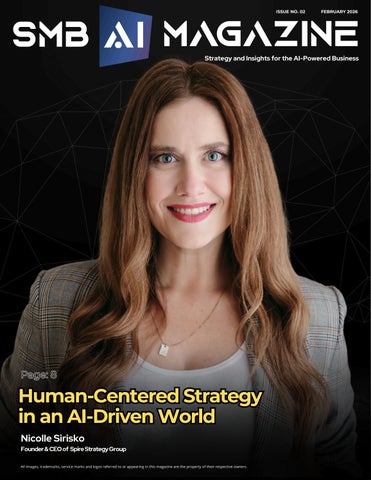
In an exclusive interview with The CanadianSME SMB AI Magazine, Nicolle Sirisko, Founder & CEO of Spire Strategy Group, shares her perspective on leading organizations through an era where artificial intelligence is reshaping how businesses operate, scale, and serve their people With her background as a COO overseeing multi-million-dollar functions and as a long-time advocate for inclusive leadership, Nicolle brings a rare dual lens to the conversation: strategic precision paired with deeply human insight.
Nicolle Sirisko, Founder & CEO of Spire Strategy Group, is a seasoned executive and consultant who has built her career on the belief that strong leadership is rooted in humanity, empathy, and strategy
Nicolle has served as Chief Operating Officer in professional services and marketing firms, overseeing large crossfunctional teams, managing multi-milliondollar portfolios, and designing frameworks that drive profitability, efficiency, and longterm growth Her leadership has spanned client service, strategy, business development, branding/marketing, and operations, giving her a full and unique perspective on what it takes to scale organizations sustainably.
NicolleSirisko, Founder&CEO ofSpireStrategyGroup
Spire Strategy Group positions itself at the intersection of human insight and intelligent systems. How do you define the right balance between people and AI when developing strategies for clients?
The balance between people and AI starts with a simple principle: strategy is human, AI is an accelerator At Spire, our work is grounded in understanding people first and how their motivations, behaviours, limitations, and ambitions should shape the strategy. That context is embedded in every recommendation we make.
AI strengthens but never replaces the human element Intelligent systems help uncover patterns faster, stress-test assumptions, and analyze scenarios with a level of precision and scale that would take teams weeks to replicate But the judgment, nuance, and real-world applicability come from lived experience, critical thinking, and the ability to translate insights into decisions that people can actually execute
The balance is intentional and well defined: we use AI and an enabler to enhance the quality, speed, and clarity of strategic work; and we rely on human insight to interpret what the data means, anticipate complexities of change, and design thoughtful and intelligent solutions The best strategies come alive when they are both analytically sound and deeply human. That intersection is how Spire delivers measurable results for our clients
As AI integrates deeper into operations, leadership expectations are evolving. How do you see AI reshaping what it means to be an effective modern leader?
AI is reshaping leadership in meaningful ways, but it can’t replace the fundamentals If anything, it’s raising the bar on what it means to lead well Modern leaders have to be able to navigate complexity with clarity, make decisions with greater speed and precision, and create environments where people feel empowered rather than threatened by technology.
The biggest shift is that leaders can no longer rely solely on experience or intuition AI gives us access to deeper insight, faster pattern recognition, and more sophisticated scenario analysis, which means the expectation now is to use that intelligence wisely Effective leaders will pair data-driven thinking with emotional intelligence, sound judgment, and the ability to translate insight into action
It also changes how leaders show up With AI streamlining workflows and reducing operational friction, leaders are expected to spend more time on vision, alignment, and supporting their teams through change The human element of leadership becomes even more important.
Given your background in DEI and advocacy, how can business leaders ensure that algorithmic decisionmaking supports inclusion rather than reinforces bias?
Leaders need to be intentional and structured with AI decision-making rather than relying on hope or good intention But this can’t be done in a vacuum Leaders must engage diverse voices: team members or consultants with different lived experiences, backgrounds, and perspectives to pressure-test assumptions and highlight blind spots that homogeneous teams might miss
One of the most effective methods we use at Spire and with clients is a formal AI Ethics and Inclusivity committee The goal is to conduct reviews before models are adopted, examine sources and quality of data, identify where bias may appear, and outline how decisions will be monitored Reviews include risk analysis, mitigation strategies, and when and how human judgement is prioritized
Many startups chase rapid growth but struggle to scale sustainably. How can AIdriven systems help growing businesses find efficiencies without compromising their culture or purpose?
When used well, AI-driven systems can analyze gaps and bottlenecks, streamline processes, reduce manual effort, and surface insights that leaders may not otherwise see AI gives us the tools for the utmost efficiency What’s important (and this is one of the things we do really well at Spire) is to bridge strategy and execution with smart systems that centre a company ’ s purpose We don’t want to automate the heart out of the organization, so we give startups the space to focus on what matters: mission, people, and customer experience We us AI intentionally to create efficiency without forcing a trade-off on culture or purpose.
But whether or not AI is used, the foundation of effective system design is a grounding in values and purpose When that’s done, culture is strengthened because teams feel supported and the output value is higher The smartest systems (AI-designed or not) allow businesses to scale with intention and grow with purpose, stability, and confidence
Internal processes also need to be developed so teams are trained to identify and question bias and be given the tools and pathways to address it
Inclusivity and bias reviews should be built into every workflow so they become standard practice and an expectation of everyone in the organization
Inclusion and ethics in AI need to be a priority Not just because it’s the right thing to do, but because it also affects business When inclusion and ethics are ignored, the result is lost revenue, higher risk/cost, and erosion of trust, all of which compromise sustainable growth In fact, according to a survey of technology leaders, 62% of organizations experiencing algorithmic bias reported lost revenue and 61% reported lost customers as a direct consequence (Source: DataRobot/World Economic Forum)
When leaders take action and are accountable for inclusivity, AI can strengthen equity, surface di iti d t b tt d i i ki ll
What advice would you give to Canadian small business owners on using AI responsibly to drive growth while keeping humanity at the heart of their organizations?
My advice is to start with intention AI can absolutely accelerate growth for small businesses, but it needs to be anchored in purpose and supported by thoughtful practices Start with the problem you ’ re trying to solve (e g , capacity, efficiency, decision making, or customer experience), then choose AI tools that support your goals Before adoption, evaluation criteria should include a clear link to the strategy, values, and culture If AI doesn’t support these, it’s likely to cause more harm that good
I also advise leaders to speak to their teams for insight, suggestions, and use-cases Employees are likely already using AI in their day-to-day roles, but without any governance or oversight (this is known as Shadow AI) By integrating team input, leaders ill i d d ti b i d tive and
n this interview flect the views ent is for nd is not ness advice.
RestoringTrustwithAI Naeem Komeilipoor:
intelligent agents for blind and low-vision users, cognitive testing tools for clinicians, and a voicebased mental health coach. The company additionally provides enterprise-grade solutions for secure document intelligence and workflow automation.
Dr Komeilipoor previously founded AAVAA, an award-winning brain-computer interface company enabling people with disabilities to communicate and interact through natural biosignals such as gaze, blinks, and subtle facial expressions He also leads VidaMedicals, where next-generation AI is applied to medical imaging to support faster and more accurate diagnosis
FounderandCEOofFindoraAI
In an exclusive interview with The CanadianSME SMB AI Magazine, Dr Naeem Komeilipoor, Founder and CEO of Findora AI, shares the vision driving one of Canada’s most ambitious privacy-first AI ecosystems Known for blending neuroscience, biomedical engineering, and advanced artificial intelligence, Dr Komeilipoor has built technologies that challenge the status quo of search, accessibility, and content authenticity
Dr Naeem Komeilipoor is a scientist, entrepreneur, and inventor whose work bridges neuroscience, biomedical engineering, and artificial intelligence. He is the Founder and CEO of Findora AI, Canada’s first privacy-first AI search engine. Findora AI also powers ARTA, an advanced deepfake detection platform, and DANA, an accessibility and wellbeing suite offering
Findora positions itself as Canada’s first humancentered, AI-powered search engine—how do you ensure transparency and privacy in the age of deepfakes and digital misinformation?
We ensure transparency by grounding every answer in verifiable evidence Findora AI does not speculate or invent information If something cannot be confirmed through trusted sources, the system simply does not generate it This eliminates hallucinations at the search layer and gives users complete visibility into the origin of every statement
Our approach is strong enough to detect hallucinations produced by the best performing large models, including the latest GPT, Gemini, and others. Once detected, Findora AI corrects them by providing accurate, fully sourced information drawn from verified datasets This ensures organizations can rely on AI even when external models fall short
Privacy is a core principle Findora AI does not collect, store, or sell user data For enterprises, all models run locally inside the institution’s own Canadian infrastructure, ensuring that no sensitive information leaves their environment or crosses borders Users maintain full control over their data at all times
To counter misinformation, our ARTA engine identifies manipulated audio, video, and images with high accuracy, helping institutions verify content before it spreads
Can you share a real-world case where Findora’s AI solutions (like ARTA or DANA) have made a measurable impact on mental health, accessibility, or information trust for users or organizations?
Findora AI has already shown measurable real-world impact across education, media integrity, mental health, accessibility, and enterprise automation Findora Search (search findora ai) has processed a substantial number of queries from users worldwide, including students, researchers, professionals, and the general public Many rely on it for trusted, hallucination-free answers and appreciate that every response is fully verifiable
In media integrity, ARTA (arta findora ai) has authenticated a large volume of images, audio, and video, helping organizations identify manipulated content early Interest from major players in the technology and media ecosystem highlights the growing need for dependable deepfake detection and the recognition of ARTA’s strengths
Our mental health coach, DANA, is already used by beta testers in daily life, offering emotional support and practical techniques that help users feel more grounded and capable We are also validating DANA’s accessibility agent for blind and lowvision users, which has attracted strong interest from leaders in the accessibility field for its secure and intuitive hands-free interaction model
At the enterprise level, our document processing and workflow automation technology has been validated and conditionally qualified by the federal government of Canada, and is now moving toward implementation within departments and several hospitals.
Together, these early deployments show how Findora AI can strengthen trust, wellbeing, accessibility, and operational efficiency across communities and institutions
Your background spans neuroscience, biomedical engineering, and AI how does this multidisciplinary expertise shape your approach to building innovative AI products?
I have always believed that the most impactful innovations come from the boundary between disciplines I try to live at that intersection Neuroscience gave me a practical understanding of how the human brain processes information, reacts to technology, and forms perception Biomedical engineering taught me how to build systems that are reliable, precise, and able to operate in real conditions rather than just in theory AI, as a field that can absorb and integrate insights from every other discipline, showed me how to scale these ideas into products that can help millions
This mix shapes a very pragmatic way of thinking I focus on how people will actually use the technology, how their minds handle complexity, and how to design systems that support them instead of overwhelming them At the same time, I always keep the hardware reality in mind If a model cannot run efficiently on the devices people already have, or if it produces hallucinations, it will not create real impact Small footprint models, edge deployment, and high accuracy are essential
This combination of engineering, human behaviour, and AI guides everything we build at Findora AI It helps us design products that are scientifically informed, technically practical, and genuinely ready for real-world deployment
With AI tools increasingly deployed in sensitive environments, how do you help Canadian institutions balance rapid adoption, data compliance, and inclusivity?
We help Canadian institutions adopt AI quickly by giving them systems that are private, reliable, and easy to integrate into real workflows Findora AI runs entirely inside their Canadian infrastructure, so sensitive data never leaves their environment This allows rapid adoption without compromising compliance or security
Reliability is central Our verified search, strong hallucination detection, and deepfake analysis ensure that information is accurate, traceable, and safe to use in high-stakes environments. Institutions can depend on the output rather than worry about errors or fabricated content.
We also make the technology inclusive Our agents support bilingual access, reduce cognitive load, and offer voice-based interaction for people who rely on hands-free interfaces The same agents can automate workflows, summarize documents, and handle tasks with consistency and precision
By combining strict privacy, high reliability, voice accessibility, and dependable automation, we help institutions adopt modern AI confidently while keeping accuracy, safety, and inclusivity at the core
For small and medium Canadian businesses looking to responsibly leverage AI, what practical advice or steps do you recommend to start their journey and stay ahead in this fastmoving landscape?
For small and medium businesses, the first step is to understand both the strengths and the real limitations of AI Even the most advanced models, including ChatGPT, can be manipulated through prompt injection, fooled by misleading inputs, or produce confident misinformation Strong guardrails, verification layers, and human oversight are essential from the very beginning
Cybersecurity should be treated as a core part of any AI strategy AI agents and automated workflows introduce new vectors for attacks, so businesses must be careful about what data is sent to external servers This is why edge and locally deployed models are becoming increasingly valuable, especially for organizations that handle sensitive information
Start with one focused workflow where AI can reliably reduce workload or improve accuracy Keep your data clean, choose transparent tools, and remain realistic about what AI can and cannot do today
Disclaimer:The views and opinions expressed in this interview are those of the guest and do not necessarily reflect the views of The CanadianSME SMB AI Magazine This content is for informational and inspirational purposes only and is not intended as professional business, legal, or wellness advice.
HowAIIs Revolutionizing
Bankingand Investment InCanada
AI is rapidly altering Canada's financial sector, including banking, investment, and risk management systems
Leading institutions are now using machine learning, predictive analytics, and conversational AI to customize services, optimize operations, and improve decisionmaking As usage grows, Canadian banks and investment businesses are redefining competitiveness and customer experience for the digital age
Canadian banks use AI-powered recommendation engines and chatbots to provide personalized banking experiences Data-driven analysis of consumer interactions enables customized product offers and consulting services tailored to individual needs For example, AI platforms can detect spending behaviours and provide appropriate savings, investment, or lending recommendations. Conversational AI is transforming customer service by processing queries 24/7 and freeing up workers for more difficult inquiries
AI-powered solutions now protect Canada's banking sector from fraud and risk with unprecedented speed and scale Machine learning models examine millions of transactions in real time, identifying anomalies and lowering reaction times to seconds These technologies analyze credit risk more accurately, using diverse data to make fairer decisions and increase access to financial goods
Predictive analytics enables proactive market volatility modelling, enabling banks and investment managers to quickly adjust strategies in changing market conditions RBC, TD Bank, and BMO use powerful AI technologies to ensure compliance, monitor transactions, and detect fraud As AI advances, its collaboration with human skills strengthens resilience against ever-changing threats such as deepfakes and cyberattacks.
AI-PoweredInvestmentStrategies
Major Canadian financial organizations use AI for investment analysis, portfolio optimization, and algorithmic trading Machine learning algorithms sift through massive databases to forecast market trends, identify undervalued assets, and si investment scenarios RBC's Boreal facility is a frontrunner in developin trading platforms and risk assessm
OperationalEfficiency andCostSavings
AI automates mundane financial activities such as data input, compliance, and customer support, saving Canadian banks millions of dollars each year Efficiencies exist throughout the firm, from front-line employees to back-office systems Algorithmic trading automates order execution, reducing human workload while increasing speed Integrated artificial intelligence models have cut trading expenses by up to 30% while improving credit scoring accuracy
Banks that invest in machine learning technology claim stronger market positions and enhanced client satisfaction rates The hybrid strategy, which combines human intuition with data-driven analytics, is increasingly vital to the industry's long-term growth and operational agility
ChallengesandResponsibleInnovation
As AI transforms Canadian finance, new concerns arise in governance, cybersecurity, and ethics. Regulators prioritize accountability and transparency in AI implementation, especially as decision-making becomes more automated. Deepfake dangers and data privacy concerns have led to robust frameworks for responsible innovation that balance technological growth with customer safety
AI is transforming Canada's banking and investment sectors through personalization, efficiency, and better decision-making Responsible innovation ensures that confidence and growth continue as Canadian finance embraces AI's promise to add value for both institutions and clients.
Your role in staying informed is essential to our mission of building a strong community of AI-driven innovators. The CanadianSME SMB AI Magazine is your go-to resource for insights, strategies, and updates shaping the future of artificial intelligence in business
Subscribe to our monthly editions at aibusinessreview.ca to stay up to date on the latest AI trends and developments in the Canadian business landscape Your engagement enables us to continue supporting and empowering the AI ecosystem
Disclaimer: This article is based on publicly available information and is intended solely for informational purposes The CanadianSME SMB AI Magazine does not endorse or guarantee any products or services mentioned Readers are encouraged to conduct independent research and due diligence before making business decisions
In an exclusive interview with The CanadianSME SMB AI Magazine, Junior Williams, consultant, enterprise architect, and AI researcher, breaks down the emerging cybersecurity threats that small and medium-sized businesses can no longer afford to ignore. With his work spanning human-AI teaming, secure digital transformation, and modern enterprise architecture, Junior brings a rare, practical clarity to a field crowded with hype and fear
Junior Williams is a consultant, enterprise architect, and AI researcher focused on the intersection of cybersecurity and artificial intelligence As principal of Junior Williams Consulting Inc and Senior Solutions Architect for Security and AI at MOBIA, he helps organizations align modern architectures and agentic AI workflows with real business outcomes Junior contributes to the Standards Council of Canada mirror committees on AI and cybersecurity, is the author of Williams' Law (a framework on algorithmic innovation), and speaks regularly on secure digital transformation and human-AI teaming. He has a background in software development, has taught cybersecurity, mentors emerging practitioners, and publishes the AI Cybersecurity Update newsletter on LinkedIn.
AI-assisted and AI-powered threats like adaptive malware and deepfakes are escalating rapidly—how do you help organizations defend against these new security risks in 2025?
The core problem is "algorithmic asymmetry": attackers use AI to adapt faster than human teams can respond For SMBs, the practical defence is to "buy, not build "
Select managed services or cloud platforms like Microsoft 365 Business Premium or Google Workspace that already embed AI-driven detection. These tools use machine learning to flag anomalies in email and endpoints automatically, putting AI-speed defences in place without requiring a dedicated security analyst
What breakthroughs have you seen in using agentic or generative AI to detect, respond to, and mitigate cyberattacks before they escalate?
The critical shift is from copilots to agents While a copilot waits for instructions, an agent works toward an objective In security, agents can correlate signals that individually look like noise, a strange login, a privilege change, a data spike, and stitch them into a single attack narrative
For SMBs, this upgrades what generalist IT staff can handle Agentic systems translate technical alerts into plain language recommendations, meaning your IT lead does not need to be a threat analyst to make the right call
Vendors like Microsoft (Defender for Business) and Google (Threat Intelligence) are already embedding these capabilities If evaluating vendors, ask if their platform can take autonomous containment actions, like blocking a device, and how those actions are logged and can be reversed The ability to act at machine speed with human oversight is the real differentiator
With shadow AI and unsanctioned AI models posing increasing risks, what governance and compliance strategies should businesses prioritize to protect sensitive data?
Shadow AI is not a governance failure; it is a signal that employees need faster tools The goal is not to stop them, but to prevent data exposure
For SMBs, formal certification is often overkill Focus on three practical steps. First, know where your data lives. If you cannot list your sensitive data locations today, start there.
Second, provide clear guidance Explicitly state which data categories (e g , PII, client confidentiality) must never enter a public AI tool Make this part of onboarding
Third, provide a sanctioned option A business-tier ChatGPT or Copilot account offers enterprise data protection for a low cost, removing the excuse for using personal accounts
Larger SMBs with regulated clients may eventually need ISO/IEC 42001 certification, but for now, practical risk reduction beats paper compliance
As quantum computing advances, how is TrustCyber preparing clients for future encryption challenges and the transition to quantum-safe security?
Quantum computing poses a "harvest now, decrypt later" risk: adversaries capture encrypted data today to break it later If you hold long-life data like health records or legal files, this matters
Practical preparation is less dramatic than the headlines. First, understand your dependency. Most SMBs rely on vendors for cryptography. When renewing contracts, ask cloud providers and SaaS vendors about their post-quantum roadmaps Major platforms are already integrating NISTapproved algorithms
Second, avoid legacy lock-in Ensure new software or hardware purchased today can update its encryption standards, a concept called "crypto agility "
Third, do not panic-buy The market is full of urgency, but mainstream adoption will take years For most SMBs, the best strategy is keeping systems current and choosing vendors with credible security practices, rather than running a complex migration project yourself
For startups and SMEs aiming to build trustworthy AI-driven systems, what security frameworks and best practices do you recommend for balancing speed, innovation, and protection?
Complexity is the enemy of security for small teams Focus on ROI, not checkbox compliance
Start with the NIST AI Risk Management Framework to identify where AI is used and what risks you can tolerate. If selling to enterprise, keep ISO/IEC 42001 in mind as a future differentiator
Technically, I use a framework called MVAI (Model, View, Agent, Interface) to secure agentic systems:
Model: Governs data and core capabilities.
View: Presents info to users
Agent: Handles reasoning and tools
Interface: Connects to external systems
Securing each layer separately prevents cascading failures Fortunately, cloud platforms like AWS and Azure provide existing controls for these layers, use them rather than building from scratch Startups have a unique advantage: you can design security in from day one Baking in logging and access controls before you have legacy debt is your competitive edge
Disclaimer: This article is based on publicly available information and is intended solely for informational purposes The CanadianSME SMB AI Magazine does not endorse or guarantee any products or services mentioned. Readers are encouraged to conduct independent research and due diligence before making business decisions
AI is transforming the Canadian retail landscape, altering everything from inventory management to consumer engagement Retailers are using predictive analytics, virtual assistants, and advanced data techniques to deliver seamless, personalized experiences across digital and physical storefronts, responding to rapidly changing consumer preferences and competitive pressures
AI-powered predictive analytics helps Canadian shops forecast demand and tailor product recommendations Sophisticated models leverage purchasing behaviour, regional trends, and social emotions to inform merchandising, marketing, and inventory decisions Retailers such as Canadian Tire employ AI to manage enormous SKU numbers and optimize store layouts based on local customer trends
AI identifies trends in website interactions and transaction histories, enabling firms to predict consumer demand, avoid out-ofstock situations, and reduce markdowns These advancements lead to more efficient inventory management, more innovative promotions, and a shopping experience that feels exceptionally tailored and relevant
VirtualAssistantsand AutomatedService
The use of AI-powered virtual assistants is improving customer service in Canadian retail Interactive voice response (IVR) systems, chatbots, and digital agents offer clients immediate assistance and specialized solutions Rather than replacing human agents, AI solutions increase staff efficiency by providing real-time responses based on website and customer data
Automated systems cut phone wait times, swiftly resolve common questions, and provide multilingual support, making shopping more accessible and pleasurable The combination of AI and traditional customer service yields a hybrid model that boosts productivity while maintaining the human touch for complex inquiries
OmnichannelShoppingand SeamlessEngagement
AI helps Canadian retailers to develop actual omnichannel shopping experiences Advanced analytics combine online and offline data sources to better understand the consumer journey and to optimize recommendations, promotions, and loyalty programs across touchpoints AI solutions ensure that inventory information is consistently correct across all platforms, minimizing friction and increasing customer happiness
AI use has led to demonstrable increases in Canadian retail efficiency, profitability, and adaptability Over 80% of merchants already utilize AI for inventory optimization, and dynamic pricing solutions react to market conditions in real time Business intelligence dashboards powered by AI monitor sales, costs, and customer engagement, providing management with clear insights for strategy and resource allocation
While AI has great promise, Canadian retailers continue to encounter skills, integration, and ethical difficulties Data silos, old IT systems, and regulatory requirements all impede implementation Effective change requires thoughtful strategy, consultation, and worker training, particularly as privacy regulations shift
Not every AI experiment succeeds during rapid technological change, but disciplined planning and strong governance can help maximize advantages while minimizing mistakes The next wave of innovation will prioritize sustainable practices, combining the best of automation and human empathy to meet increasingly diverse consumer demands.
AI is revolutionizing Canadian retail by improving predictive skills, automating service delivery, and creating adaptive omnichannel platforms Leaders who combine technological precision with genuine empathy will set new benchmarks for customer engagement As innovation continues, successful retailers will prioritize actionable insights and personalized experiences, fostering loyalty, efficiency, and growth in a digital-first society
Your role in staying informed is essential to our mission of building a strong community of AI-driven innovators. The CanadianSME SMB AI Magazine is your go-to resource for insights, strategies, and updates shaping the future of artificial intelligence in business
Subscribe to our monthly editions at aibusinessreview.ca to stay up to date on the latest AI trends and developments in the Canadian business landscape Your engagement enables us to continue supporting and empowering the AI ecosystem.
Disclaimer: This article is based on publicly available information and is intended solely for informational purposes The CanadianSME SMB AI Magazine does not endorse or guarantee any products or services mentioned Readers are encouraged to conduct independent research and due diligence before making business decisions
Algorithmic bias occurs when AI systems produce unfair or discriminatory results, typically due to skewed training data or incorrect model design Biased algorithms can reinforce prejudices and limit possibilities for marginalized groups, as evidenced by high-profile incidents in healthcare and jobs in Canada Audits reveal that unrepresentative statistics and biased categorization, such as neglecting Indigenous communities or gender minorities, contribute to systemic unfairness.
These challenges affect individual autonomy, consent, and dignity, particularly when automated algorithms make decisions in areas such as employment, lending, or clinical treatment
RegulatoryandEthicalFrameworks inCanada
Canadian regulators are increasingly demanding transparency, justice, and accountability in algorithmic decision-making. Frameworks prioritize representativeness in training data, algorithmic audits, and user agency, including the right to explanation for automated judgments Organizations are encouraged to provide information about the design and performance of their AI systems so that affected individuals can analyze and oppose biased outcomes
The federal government, provinces, and advocacy groups strive for inclusiveness, rigour, and ethical monitoring when adopting new guidelines for AI in employment and healthcare Ongoing reforms, such as the Artificial Intelligence and Data Act, aim to institutionalize these principles and establish avenues for recourse where bias or discrimination occurs
StrategiesforMitigatingBias
Ethical AI requires multifaceted approaches to reduce prejudice, beginning with diverse, representative training datasets Developers must actively detect sources of bias, conduct algorithmic audits, and employ debiasing strategies throughout the lifetime of the system The key approaches include:
Designing models that remove protected traits (e.g., race and gender) unless warranted by context.
Training data on diverse populations to eliminate imbalance
Continuous bias testing and performance parity reviews across demographic groups
Model results are transparent and interpretable
Inclusive development teams and stakeholder involvement guarantee that AI reflects a variety of values and perspectives Organizations must establish accountability systems to monitor AIs impact and provide avenues for users to challenge choices Canadian corporations and agencies are increasingly requiring ethics training for their employees to foster a culture of fairness alongside technological innovation
Ensuring fairness in Canadian AI systems entails prioritizing justice, equity, and openness. Policymakers advocate for "algorithmic fairness," which involves regular audits and defined standards for equitable treatment Agencies set requirements for explainable AI, which requires tools to expose how algorithmic decisions are made so that consumers may understand and question them Ethical frameworks promote user agency and harm prevention, allowing people affected by decisions to seek recourse
More firms are reporting fairness indicators, tracking performance gaps, and consulting affected groups as part of their AI implementation Canadian reforms are informed by international best practices, such as EU and US guidelines, which place fairness and bias protection at the heart of responsible AI deployment
Ethical AI in Canada is a collaborative effort that requires diligence in design, data gathering, and oversight By aggressively combating bias and improving fairness, Canadian innovators and regulators protect digital justice and trust as AI becomes more commonplace
Your role in staying informed is essential to our mission of building a strong community of AI-driven innovators The CanadianSMESMBAIMagazineis your go-to resource for insights, strategies, and updates shaping the future of artificial intelligence in business
Subscribe to our monthly editions at aibusinessreview.ca to stay up to date on the latest AI trends and developments in the Canadian business landscape Your engagement enables us to continue supporting and empowering the AI ecosystem
Disclaimer:This article is based on publicly available information and is intended solely for informational purposes The CanadianSME SMB AI Magazine does not endorse or guarantee any products or services mentioned Readers are encouraged to conduct independent research and due diligence before making business decisions
Andrew serves as President of the Human AI Association and is Head of Marketing at Teknicor, a global leader in data center infrastructure, cybersecurity, and cloud technologies. He is proud to serve on the Ethics Committee of the Board of Directors of St. Joseph’s Hospital in London, Ontario. His research and leadership aim to bridge the gap between AI and human intelligence, empowering individuals, businesses, and governments to make better, more ethical decisions.
Andrew holds an advanced degree in Economics from Western University and an MBA from the Ivey School of Business He is the author of the best-selling book ‘Decisive: How to Make Breakthrough Decisions,’ which applies his causal economic decision theory to business and life Andrew is a sought-after keynote speaker and commentator on topics including AI, decision science, AI ethics, and human-AI collaboration
Human AI: Transforming Decisionsand BusinessOutcomes
In an exclusive interview with The CanadianSME SMB AI Magazine, Andrew Horton, globally recognized AI authority and pioneer of Causal Economic Machine Learning, offers a compelling look into how businesses can make smarter, more ethical, and more effective decisions in an increasingly complex world Bringing together his expertise in economics, decision science, and advanced machine learning, Andrew breaks down why traditional analytics are no longer enough for leaders navigating high-stakes environments.
Andrew Horton is an AI authority, award-winning technology executive and leading economist. He is recognized globally for pioneering Causal Economic Machine Learning AI and Causal Economic Decision Theory, bridging human and artificial intelligence to improve real-world decision making.
Your work in causal decision theory and causal machine learning is pioneering. What are the biggest opportunities for businesses as they move from traditional analytics to causal AI-driven decision-making?
The biggest opportunities are better predictions and better interventions in high-stakes scenarios that matter to real people Causality on its own is still an emerging element in statistics, but it’s coming of age The 2021 Nobel Prize in Economics was awarded for progress in this area When it comes to important interventions, in healthcare, economic policy, business etc , causality matters Many things correlate, but without establishing causality expensive mistakes can be made by drawing conclusions based on spurious correlations that involve confounding variables and the illusion of a direct relationship Just as important as teasing out an understanding of causation, is an explicit recognition of the constraints of decision making–that in our time and resource constrained world costs precede anticipated benefits. Ignoring this reality undermines the utility of predictions and the effectiveness of interventions
AndrewHorton,President oftheHumanAIAssociation
As CEO of the Human AI Association, how do you define ‘Human AI,’ and why is it critical for organizations adopting AI at scale to keep people at the center of their innovations?
Human AI puts humans first Its algorithms bring together advances in causal machine learning and causal behavioral science More specifically, Human AI is built on two Pillars First, AI must serve Humans, not the other way around Second, Human AI Algorithms must explicitly build in realistic human decision making, leveraging insight from the science of human intelligence–behavioral economics, psychology etc Causal Economic Machine Learning is a primary approach to achieving Human AI. It is critical to keep Human AI top of mind, because advances in AI are moving at lightning speed and without an explicit focus on keeping humans front and central, human well-being can be an afterthought This can have negative impacts for people in real life, whether customers, employees, patients or other stakeholders The concern is real because much of machine learning today sees human intelligence as a benchmark to meet or beat, rather than as something to supplement
down the road Nothing is free This time-based causality combined with the science of behavioral economics–causal economics specifically–is what makes CEML uniquely relevant to real world decision making When decisions are made on data correlations without this causal time structure, predictions aren’t realistic because time, effort and investment are always required to produce results In many ways, traditional, non-CEML approaches treat information and resources as though they are free. Companies don’t have that luxury and that’s why CEML is a great fit for business d i i k
How can causal economics and CE by companies to improve forecast and create more value from their d
Casual Machine Learning, known as leveraged by companies to improve reduce bias and increase ROI on da connects the dots between artificia human intelligence Unlike standard where the focus is on correlations in explicitly takes into account the rea which decisions are made. Decision cost and effort, in pursuit of anticip
Where do you see the most transformative impact for causal AI approaches—whether in infrastructure, cybersecurity, cloud, or beyond—in the next five years?
CEML will absolutely have the most transformative impact in any situations where humans and technology interact with high impact–where human behavior is important Some of the most powerful examples include cybersecurity, digital marketing, personalized health and economic policy interventions. In each case, relying on traditional AI and machine learning will ignore the reality of cause and effect over time It will also overlook the natural human emotional biases that are part of decision making–effects proven out in behavioral economics and psychology In cybersecurity it’s vital to understand how people will act and react in various scenarios, as these tendencies can improve predictive power and better address vulnerabilities These contextual realities of human interaction are critical to effective modelling The same issues are front and centre when optimizing digital marketing campaigns and maximizing purchase conversion When CEML is not used, traditional machine learning is in many ways reduced to regular correlation-based statistics Correlations can be insightful, but they can also be spurious, meaning that they appear to represent a relationship, but in fact are the result of deeper underlying variables that aren’t being measured in the model. This can result in dangerously incorrect outcomes when applied in policy interventions
What advice would you share with Canadian SMBs looking to harness causal AI or humancentered AI to drive more responsible, impactful growth in their industries?
I suggest that Canadian SMES get in the habit of using AI every time they are seeking information and need to make decisions We used to only have search engines available, which presented us with endless links of information But now chatbot AI does that as well as consolidating the results and providing insights If you ’ re not using it in daily decision making, you really need to establish the habit Mainstream tools generally dont automatically incorporate CEML, so in order to incorporate it, you need to ask the AI to include causal cost/benefit information in your prompts For example, you would explicitly ask the tool to take into account typical upfront costs (certain and uncertain) and to also anticipate possible resulting benefits It is also good practice to ask the tool to use Causal Economic Machine Learning in forming its answer It is also a good idea to ask for it to take into account Human AI and ensure that its thinking is consistent with human intelligence, behavior science and Human AI Alignment.
Disclaimer:The views and opinions expressed in this interview are those of the guest and do not necessarily reflect the views of The CanadianSME SMB AI Magazine. This content is for informational and inspirational purposes only and is not intended as professional business, legal, or wellness advice
AIforClarity: SimplifyingAccountingwith SalRezai
In an exclusive interview with The CanadianSME SMB AI Magazine, Sal Rezai, founder of Accounting By Sal Corp. and Bookkeeping Academy, shares how artificial intelligence is reshaping cloud accounting for Canadian entrepreneurs Known for bringing warmth, simplicity, and mentorship into a traditionally complex field, Sal breaks down what AI can actually do for small businesses right now and why human expertise remains at the core of every financial transformation
Sal is widely recognized as a leading authority in bookkeeping and accounting, and an educationally dynamic professional whose work blends technical mastery with a heart-centred approach As the Founder of Accounting By Sal Corp. (est. 2008) and Bookkeeping Academy (est. 2023), she has redefined what it means to support entrepreneurs, professionals, and future accountants in their money management skills and personal growth. Sal is more than an accountant; she is a mentor, speaker, coach, podcaster, and trusted partner who empowers others to transform financial stress into clarity, confidence, and lasting success
How do you see artificial intelligence transforming cloud accounting for Canadian small businesses in 2025, and what are the most promising tools or features available today?
AI is really transforming how small businesses manage finances, especially in cloud accounting The biggest shift I’m seeing is AI taking over repetitive, low-value tasks – things like transaction allocations, payroll, GST/HST prep, and even month-end reconciliations.
At Accounting by Sal Corp, AI frees up our bookkeepers to focus on meaningful mentorship and advisory work For example, recently I prepared a Financial Summary & Break-Even Analysis (YTD 2025) for one client and an Overhead Summary Report for another Instead of spending hours on manual bookkeeping, our team can step in as guides and advisors, helping clients understand their numbers and make wise decisions
Most cloud accounting platforms already have built-in AI features QuickBooks and Xero, for instance, include smart categorization, and Dext continues to improve automation – even QuickBooks Advanced added Smart Bank Reconciliation, which saves significant time
Can you share a real example of how AI has helped one of your clients achieve greater clarity or efficiency in their accounting processes?
One of our clients – a business coach – was constantly behind at monthend Her transactions were coded inconsistently, which led to backand-forth emails and extra-long cleanups that sometimes took us two weeks
After a couple of Zoom calls to understand her frustrations, we introduced her to QuickBooks’ AIassisted features. My assigned bookkeeper guided her in enabling automated categorization and anomaly detection, and the system began flagging unusual transactions immediately, reducing her month-end cleanup from 2 weeks to 3 days
Recently, she turned on Smart Bank Reconciliation, and now her assigned bookkeeper simply reviews the work instead of doing it all manually Her monthly numbers are clean and accurate for the first time, and we can now prepare meaningful financial reports for her management team instead of just fixing errors
The change has been incredible! Not only is her workflow efficient, but she feels confident, in control, and more empowered to make decisions based on accurate financial insights. AI, paired with mentorship, has completely transformed the way she manages her business finances
What are the biggest misconceptions small business owners have about using AI in accounting, and how do you address those concerns when advising your clients?
Some of the biggest concerns I hear all the time from clients and accountants alike are:
“AI is way too expensive.
“I need to be more tech-savvy to use it.”
“I don’t know which platform to choose.”
“AI isn’t safe for finances.”
These fears are understandable, especially the idea that AI might feel impersonal One client worried that implementing AI would “lose the human connection” and make bookkeeping cold and distant
I always explain that AI doesn’t replace the relationship – it enhances it The human connection, guidance, and mentorship remain intact AI handles the repetitive tasks, freeing up time for us to provide insights, create reports, and mentor clients in real time
Once clients understand AI as a supportive tool rather than a replacement, everything shifts! They become more confident, organized, and in control. What used to feel stressful now feels manageable, and they can focus on sustainable growth instead of keeping up with bookkeeping chaos
When our clients understand that AI is a tool – not a human replacement – their whole mindset shifts! They become way more confident, organized, stressfree, and more in control of their numbers – it's incredible to witness!
As privacy and data security remain key issues, what best practices do you recommend when implementing AI-powered accounting solutions?
Security is always one of the first things we talk about I only recommend tools that use bank-level encryption and strong internal security standards To reduce any risk, we also keep integrations very simple because the more integrated layers you connect, the more potential vulnerabilities you create.
Multi-factor authentication is also a must, and we always ask our clients to enable it not just on their accounting software but also on their email and mobile devices, because those can often be the entry points for breaches We also encourage clients to limit user access, use strong passwords, and avoid connecting any unnecessary third-party apps
AI can definitely be a safe and secure option when implemented intentionally With the right guidance, systems and habits, small businesses can take full advantage of AI without compromising their financial health and data.
What advice would you give entrepreneurs who want to upskill themselves or their teams to make the most of AI tools in accounting and business management?
Start small, get support, and learn by doing – that’s my biggest advice
At Accounting by Sal Corp, we don’t just turn on AI tools for clients and walk away; we guide them step by step We meet on Zoom, demonstrate how features work, and provide hands-on training at their own pace. This makes AI much less intimidating and builds real confidence in reviewing AI-generated entries and using insights to make smart decisions.
Entrepreneurs don’t need to master everything all at once Start with one workflow, see the results, and expand gradually
The goal with AI isn’t to replace human judgment –but to strengthen it With guidance and real-world experience, business owners can leverage AI to gain clarity, save time, and solidify decision-making AI then becomes a helpful partner – not a replacement – in building financial confidence and growing a business
Disclaimer:The views and opinions expressed in this interview are those of the guest and do not necessarily reflect the views of The CanadianSME SMB AI Magazine This content is for informational and inspirational purposes only and is not intended as professional business, legal, or wellness advice
Entrepreneurs The Rise of Canadian AI
HealingwithAI
AI is being used by Canadian businesses such as Deep Genomics and BenchSci to accelerate drug discovery and personalize medical care By analyzing large biological datasets, their platforms forecast the best treatments and minimize trialand-error medication selection
Canadas entrepreneurial ecosystem is prospering, thanks to the rapid growth of AI-powered firms affecting healthcare, banking, retail, and other industries Strategic investments, advanced research institutes, and government support have helped Canada become a global leader in artificial intelligence, with hundreds of innovative firms setting new norms in technology and business
Swift Medical uses computer vision to deliver precise wound care, improving outcomes and reducing hospital costs Dialogue and Aifred Health make primary care and mental health care more accessible by leveraging AIpowered virtual care and decisionsupport tools These businesses promote Canada as a center of AIpowered health innovation by exporting their innovations worldwide
SmarterMoney ManagementWithAI
Fintech entrepreneurs are moving Canada's financial sector forward by developing AI-powered tools for fraud detection, risk assessment, and personal finance Wealthsimple and Koho use artificial intelligence in their robo-advisory systems, allowing Canadians to create bespoke investment portfolios. Cohere, a natural language processing industry leader, assists financial institutions in improving compliance, client communications, and risk management
These firms usher in a new era of financial inclusion in which AI assesses non-traditional credit variables, broadens lending, and provides personalized banking experiences
Canadian fintech is becoming increasingly well-known worldwide for its innovation and effective data management practices
RetailInnovation: AI-PoweredCustomer Experience
Startups like Shopify are using AI to transform Canadian retail by improving automation, personalization, and marketing AI-powered engines provide dynamic recommendations, improve pricing, and simplify supply chain management for both large and small businesses
Coveo's AI search solutions are transforming digital commerce by enabling more intelligent search and personalization across leading Canadian e-commerce platforms These firms help small retailers compete globally by providing personalized experiences, forecasting demand, and automating repetitive back-end chores.
AutonomousSystemsand EmergingTechnologies
Canada's AI innovation also includes autonomous vehicles, drones, and robotics Waabi and BlackBerry QNX are global leaders in self-driving car technology and security. Startups in Vancouver and Toronto are testing robotic delivery and logistics solutions to accelerate and improve the safety of urban fulfillment
These technologies promote sustainable transportation and attract foreign investment to Canada, bolstering the country's position as a launchpad for future mobility solutions
Talent,Capital,andVision
World-class academic institutes (Vector Institute, Mila, Amii), broad government support, and robust venture capital networks are driving Canada's AI startup boom Funding and international entrepreneurs are drawn to the federal Startup Visa Program and AI strategy. Cities in Canada have developed into hubs for AI research, attracting global talent and fostering a collaborative atmosphere
Canadian AI startups are leading the way in technological disruption, exporting innovation and transforming industries worldwide Canada is well-positioned to continue leading in entrepreneurial AI improving lives, increasing competitiveness, and influencing the global direction of technology thanks to its extensive talent pools, substantial funding, and collaborative ecosystem
Your role in staying informed is essential to our mission of building a strong community of AI-driven innovators The CanadianSME SMB AI Magazine is your go-to resource for insights, strategies, and updates shaping the future of artificial intelligence in business
Subscribe to our monthly editions at aibusinessreview.ca to stay up to date on the latest AI trends and developments in the Canadian business landscape Your engagement enables us to continue supporting and empowering the AI ecosystem.
Disclaimer: This article is based on publicly available information and is intended solely for informational purposes The CanadianSME SMB AI Magazine does not endorse or guarantee any products or services mentioned Readers are encouraged to conduct independent research and due diligence before making business decisions
In an exclusive interview with The CanadianSME SMB AI Magazine, Steve Mast, Co-founder and Managing Partner at Twenty44, breaks down what it truly takes for organizations to unlock meaningful growth in an AI-first world With three decades of experience building, scaling, and advising companies across global markets, Steve has seen firsthand that AI transformation isn’t a technology race it’s a leadership and culture shift.
Steve Mast is the Co-founder and Managing Partner at Twenty44, an advisory firm helping organizations prepare for the shift to an AI-first world. With over 30 years of experience in innovation, digital transformation, and product development, Steve has built, scaled and sold multiple companies, including serving as President & Chief Innovation Officer at Delvinia and Chief Product Officer at Sago
A serial entrepreneur and advisor, he works with mid-sized organizations and startups across Canada, the U S , and Australia to accelerate AI adoption, strengthen go-to-market strategy, and build leadership capability for the next decade Steve’s core belief: AI isn’t a technology challenge it’s a people challenge, and organizations win by preparing their teams, culture, and governance as much as their tech
Twenty44’s mission centers on finding “where generative AI can make the biggest impact”—what have you learned about the best opportunities for Canadian businesses to unlock real growth using AI in 2025?
The reality is despite all the hype, only 12% of Canadian businesses are using AI in their operations AI's impact is varied across businesses, for productivity gains and cost savings, though its effect on jobs is still evolving While some businesses see significant benefits, others are still struggling to achieve impact Everyone's talking about it Almost nobody's doing it
The problem isn't the technology, it's that AI adoption is a change management challenge, not a tech implementation problem, but rather a people and leadership challenge
We've worked with hundreds of companies, and the pattern is clear: the tools work What fails is getting people to actually use them on a daily bases Teams fall back to old habits They don't trust the outputs They skip the AI step because the traitional way feels easier
The businesses breaking through aren't the ones with the best AI tools they're the ones treating adoption like organizational change They pick specific practical problems: automating proposal processes, scope of work preparation, building a knowledge lookup for frontline staff, or surfacing insights from existing data Leadership invests in training the organization and providing guidelines for safe usage. They build confidence. Show it works. AI adoption natually scales across the company.
Can you describe a breakthrough case where AI adoption led to measurable innovation or cultural transformation for a client?
One of our favorite examples is a mid-sized commercial real estate management company drowning in tenant inquiries Their property managers were spending over 90 minutes daily digging through 5080 page lease documents to answer basic questions, things like "Can I sublet?" or "What are the parking rules?"
We built them an "Instant Lease Lookup" tool Property managers could ask questions in plain English, and AI would find and scan the relevant lease and return accurate answers in seconds instead of an hour Simple concept, massive impact: they saved 1,820 hours per year across just seven property managers
But here's where the cultural shift happened Before this, AI felt intimidating and theoretical to them After seeing something this practical work so well, they started spotting AI opportunities everywhere "Could we use this for maintenance requests?" "What about tenant onboarding?" The floodgates opened
That's the breakthrough we see repeatedly: it's not about the technology being revolutionary It's about proving AI can solve a real problem Once teams experience that first win, the intimidation disappears. They stop asking "Should we use AI?" and start asking "Where else can this help us?" That mindset shift unlocks everything else.
What challenges do executives face when moving from experimentation to full-scale AI integration, and what strategies help overcome the ‘wow-wait’ cycle?
The “ wow wait” cycle isn’t a technology problem
Executives get excited by impressive demos, clever pilots, and proof-of-concepts that make the boardroom say “ wow ” And then nothing Momentum stalls, decisions drift, and the organization quietly slips into “wait” mode Why?
Because no one truly owns it and is not a ‘top 5’ strategic business priority
AI sits in an awkward power vacuum. Is it IT’s job? HRs? Operations? Strategy? When responsibility is spread across departments, accountability disappears Everyone supports it in theory, but no one is authorized to make it real The result is a widening gap between leadership enthusiasm and actual operational change
We consistently see senior teams endorsing AI experimentation while failing to give it structure, authority, or clear direction They want innovation, but stop short of reshaping roles, investing in process redesign, or appointing someone with the mandate to drive adoption across the organization So pilots become theatre Impressive, shared in the board room and quietly abandoned due to other pressing business priorities
Organizations that break the cycle do something remarkably simple: they assign ownership at a leadership level and back it with authority Not a task force Not a committee A clear steward with permission to redesign workflows, remove blockers, and hold people accountable The profile of this person is as follows: Business Savvy, Strong Communicator, Understands AI’s Capabilities / Limitations, Change Agent Mindset and Ethical Awareness
As AI redefines productivity and the workplace, what skills will employees need most to adapt and thrive?
As AI reshapes the way work gets done, the most valuable skills aren’t about mastering the AI tools themselves The people who will truly thrive in this new AI-era are the ones who make critical thinking, communication, and collaboration core to who they are
Critical thinking is about judgement AI can generate answers fast, but it doesn’t understand your business, your client, or the real-world consequences of getting something wrong Real human value comes from questioning what AI gives you, spotting what feels off, applying context, and knowing when to trust the output, and when not to
Communication is about interpretation AI can generate content, but it can’t own the message Employees need to turn outputs into clear ideas, relevant insights, and meaningful narratives That means shaping the story, explaining the “why,” and translating complexity into something colleagues and clients can understand and can act on.
Collaboration is about coordination Work is no longer just humans working together it’s humans and machines working in tandem That requires teams to rethink how they share responsibilities, redesign workflows, and learn collectively as processes evolve Orchestrating people and AI will is key leadership skill
What ethical considerations guide your approach to designing and implementing AI products, and how do you help clients establish responsible guidelines?
Ethics, for us, isn’t a checklist or a legal safety net It’s a philosophy about power, responsibility, and intent AI reshapes how decisions are made, who makes them, and who bears the consequences when they go wrong Our role is to help organizations step back from the temptation of speed and ask a more fundamental question: just because we can automate something, should we?
We view AI as an amplifier It doesn’t create values, it reflects and accelerates the ones already in place at an organization That means ethical design starts long before any model is deployed It begins with clarity around what the business stands for, how it treats people, and where it draws lines that technology should not cross
We help clients to see AI not as an authority, but as a lens, one that must remain interpretable, challengeable, and overall governed by human judgment. Transparency, explainability, and accountability are not just technical requirements; they are signals of respect for the people that will be impacted by AI-driven decisions
Instead of reactive compliance, we help organizations build a quiet confidence, knowing not just how their systems work, but why they exist and who they serve
The goal? Scale AI with confidence, not caution When ethics are treated as design constraints rather than compliance paperwork, companies move faster because they're not second-guessing every decision
Disclaimer:The views and opinions expressed in this interview are those of the guest and do not necessarily reflect the views of The CanadianSME SMB AI Magazine This content is for informational and inspirational purposes only and is not intended as professional business, legal, or wellness advice
Canada’sNextPhase intheFutureof AIRegulation
A crucial stage of AI regulation is about to begin in Canada. Government, business, and consumer organizations are evaluating the best ways to control risks, encourage innovation, and implement new safety, accountability, and transparency standards While companies are ready for a rapidly changing legal landscape, Canadian MPs are expanding legislative efforts as international frameworks gain hold
The Artificial Intelligence a Act (AIDA), introduced as the main component of Ca planned regulatory framew goal of this historic law is the development and impl of AI systems nationwide A a risk-based approach, fo "high-impact" systems tha affect people's rights, safe finances It also demands explainability, risk reductio transparent accountability
Canadian legislators are investigating interoperability with international norms, such as the EU's AI Act, while balancing innovation and protection. Parliament is thinking about:
Classifications of AI systems based on the potential for harm
Required recordkeeping and risk evaluations
Human supervision of automated decision-making
Penalties for the careless or prejudiced use of AI deployment
Commissioners with more authority to examine, audit, and guarantee compliance
Before finalizing regulations, they also intend to hold extensive consultations with business, academia, civic society, and provincial governments PIPEDA, the Human Rights Act, and competition law already have active enforcement; future AI-focused laws will further define the obligations and liabilities of developers and consumers
IndustryResponseand VoluntaryCodes
The Canadian government has created a Voluntary Code of Conduct that emphasizes values such as responsibility, openness, human oversight, and bias reduction for creators and users of advanced generative AI Prominent companies and trade associations have embraced the initial recommendations, seeing them as an adaptable path to compliance while formal legislation is still pending Numerous companies already conduct impact analyses, maintain audit trails, and disclose AI logic to clients Standards specific to industries such as banking, healthcare, and transportation are evolving concurrently as businesses adapt to global demands
Canadian companies should adopt a proactive approach to AI governance, incorporating compliance readiness into operations and products. Necessary actions consist of:
Creating internal frameworks for transparency and explainability
Educating employees about security, privacy, and prejudice
Maintaining thorough system logs and risk evaluations
Participating in industry working groups and public consultations
Keeping an eye on worldwide developments to update harmonized regulations
Canada's path to a comprehensive AI regulatory regime reveals contradictions between economic progress and social responsibility Lawmakers face numerous hurdles, including rapid technological change, interprovincial differences, and the necessity for continual consultation The regulatory "next phase" will most likely prioritize adaptive frameworks, ongoing review, and open interaction Canadian authorities want to emulate the world's best models in balancing innovation, safety, and rights in a digital-first economy Businesses that participate now will define the future and earn a competitive advantage in the era of responsible AI.
Conclusion
Canada is one of the world's digital leaders because of its efforts to enact strong AI regulations Businesses must ensure compliance and competitiveness as AI transforms Canada's economy by preparing through responsible design, transparency, and ongoing learning as legal frameworks change
Your role in staying informed is essential to our mission of building a strong community of AI-driven innovators The CanadianSME SMB AI Magazine is your go-to resource for insights, strategies, and updates shaping the future of artificial intelligence in business
Subscribe to our monthly editions at aibusinessreview.ca to stay up to date on the latest AI trends and developments in the Canadian business landscape. Your engagement enables us to continue supporting and empowering the AI ecosystem.
Disclaimer: This article is based on publicly available information and is intended solely for informational purposes The CanadianSME SMB AI Magazine does not endorse or guarantee any products or services mentioned Readers are encouraged to conduct independent research and due diligence before making business decisions
AI-PoweredClimate SolutionsinCanada
By leveraging cutting-edge technologies across energy, agriculture, and urban infrastructure, Canada is at the forefront of using artificial intelligence to combat global warming Canadian experts are developing AI technologies in research laboratories and startups that can predict, mitigate, and respond to climate hazards at previously unheard-of speed and accuracy
SmartBuildingsandEnergyEfficiency Agricultureand
Buildings account for nearly one-fifth of Canada's emissions, but Montreal-based BrainBox AI is pioneering innovative HVAC systems that use real-time AI analytics to optimize energy use These solutions have reduced energy use and emissions across commercial infrastructure while increasing equipment lifespan Widespread adoption enables provinces and cities to meet ambitious climate targets at a minimal cost
Local governments and building owners are increasingly using predictive analytics to control demand, balance grids, and integrate renewable energy AI models consider weather, occupancy, and historical data to dynamically adjust heating and cooling, helping Canada's electricity sector meet variable demand while reducing reliance on fossil fuels
Researchers at the University of Prince Edward Island use artificial intelligence modelling to alert farmers to agricultural hazards caused by erratic weather, thereby enhancing climate change resilience Croptimistic Technology in Winnipeg has developed AIpowered precision agriculture tools that improve irrigation and fertilizer application These technologies eliminate waste, maximize yields, and conserve resources by monitoring soil, water, and crop health, even under uncertain settings
Canadian businesses and academic organizations employ machine intelligence and satellite imagery to map deforestation, wildfire risk, and pollution in real time Montreal's Scale AI collaborates with merchants to improve supply chains and reduce food waste Advanced sensor networks powered by AI provide early notice of forest fires, floods, and air quality concerns, allowing communities to respond fast These technologies are critical for a country with extensive and diverse landscapes, enabling rapid, data-driven climate adaptation and disaster preparedness
Canadian climate measures prioritize public awareness and education about AI's role in sustainability Interactive campaigns and openaccess data platforms promote environmental awareness, empowering citizens to take an active role in climate change. As cities implement smart building and transit systems, outreach campaigns demystify AI and highlight its real benefits in energy saving and emissions reduction This public engagement is crucial for widespread adoption, as it prepares Canadians to support and advocate for environmentally responsible technologies
Conclusion GovernmentStrategyandPolicySupport
Canada's federal and provincial governments aggressively promote AI for climate change through grants, regulatory frameworks, and public awareness initiatives The AI Compute Access Fund and the Canadian Artificial Intelligence Safety Institute support innovations that improve the environment and ensure that initiatives adhere to ethical standards Regulatory incentives promote energy-efficient solutions and the adoption of clean technologies in buildings, transportation, and utilities.
Canadian AI breakthroughs are critical to fighting climate change by reducing energy consumption, promoting resilient agriculture, and providing real-time environmental protection Success depends on cross-sector collaboration, ethical governance, and widespread public participation With continued backing, Canada's AI-powered climate innovations will pave the way for a sustainable, low-carbon future inspiring worldwide action to combat climate change
Your role in staying informed is essential to our mission of building a strong community of AI-driven innovators. The CanadianSME SMB AI Magazine is your go-to resource for insights, strategies, and updates shaping the future of artificial intelligence in business
Subscribe to our monthly editions at aibusinessreview.ca to stay up to date on the latest AI trends and developments in the Canadian business landscape. Your engagement enables us to continue supporting and empowering the AI ecosystem
Disclaimer: This article is based on publicly available information and is intended solely for informational purposes. The CanadianSME SMB AI Magazine does not endorse or guarantee any products or services mentioned Readers are encouraged to conduct independent research and due diligence before making business decisions
Artificial intelligence is revolutionizing Canada's agricultural sector, allowing farmers to achieve unprecedented levels of productivity and sustainability Canadian farmers are increasing yields while reducing environmental effects by implementing innovations such as crop prediction, autonomous equipment, and precision management.
PrecisionFarmingIsAtTheHeartofAIInnovation
Canada's AI-driven agriculture revolution revolves around precision farming Farmers may obtain precise information about soil health, moisture levels, and pest outbreaks down to the square meter using satellite photography, drones, and Internet of Things devices This fine-grained data reduces waste and environmental damage by enabling the precise administration of herbicides, fertilizers, and water As a result, farmers become better stewards of natural resources, yields can rise by 10–20%, and expenses can drop
By automating numerous labour-intensive jobs, these technologies help mitigate labour shortages and the impacts of climate variability in the Prairies and other regions. Timely interventions are enabled by real-time feedback, which minimizes excess input use and prevents disease or pest outbreaks before losses occur
The effects of AI are quantifiable, with yield gains of up to 20%, water savings of 20–30%, and reductions in chemical consumption of 30–50% in certain activities Machine learning-powered early detection models identify insect threats and nutritional deficiencies, enabling prompt actions and reducing crop losses To increase resistance to droughts and other harsh weather, farmers use predictive weather analytics to schedule planting and harvesting with less risk
Gains in sustainability are significant; localized actions increase farmworker safety, reduce chemical leakage into waterways, and support biodiversity By monitoring soil, water, and carbon footprints, AI tools help producers comply with international food safety and climate rules, strengthening Canada's commitment to environmental stewardship
AI-DrivenPestManagementand CropPrediction
AI systems use big data to predict pest outbreaks and crop yields, enabling farmers to make more sophisticated decisions Machine learning detects minor changes in plant health and predicts where diseases or pests will spread, allowing treatments to be applied more effectively and efficiently Crop forecasting combines historical and real-time data, enabling Canadian farmers to accurately estimate yields and make proactive adjustments, reducing risk and ensuring a steady market supply
AutonomousEquipmentand SmartSupplyChains
On Canadian farms, autonomous tractors, robotic harvesters, and AI-powered drones are becoming more prevalent These technologies improve field operations efficiency while addressing persistent labour shortages By reducing needless field passes and maximizing energy utilization, automation promotes sustainable practices Beyond agricultural production, AI is strengthening supply chain resilience by optimizing distribution, shipping, and storage while reducing waste and energy use through predictive analytics
Canadian agricultural exports provide buyers and consumers with increased transparency and confidence thanks to blockchain-enabled traceability. As Canadian farmers meet growing demands for sustainability and product quality, these advancements help them remain competitive in both domestic and international markets
EnvironmentalandClimateImpact
Artificial intelligence allows Canadian agriculture to address environmental and climate problems Soil health monitoring and carbon footprinting are now standard practices, supporting sustainable agricultural methods unique to Canada's vast regions. Precision conservation, cover cropping, and regenerative agriculture all benefit from realtime data streams and predictive actions
AI is transforming Canadian agriculture by promoting sustainability, resilience, and productivity on farms and in supply systems. With the help of smart technologies, Canadian farmers can prosper amid changing challenges and set new standards for ethical food production worldwide
Your role in staying informed is essential to our mission of building a strong community of AI-driven innovators. The CanadianSMESMBAIMagazine is your go-to resource for insights, strategies, and updates shaping the future of artificial intelligence in business
Subscribe to our monthly editions at aibusinessreview.ca to stay up to date on the latest AI trends and developments in the Canadian business landscape Your engagement enables us to continue supporting and empowering the AI ecosystem
Disclaimer: This article is based on publicly available information and is intended solely for informational purposes The CanadianSME SMB AI Magazine does not endorse or guarantee any products or services mentioned Readers are encouraged to conduct independent research and due diligence before making business decisions
onCanadianSMEs: OpportunitiesandChallenges The Impact of AI
Small and medium-sized businesses (SMEs) are the foundation of Canada's economy, accounting for more than 99% of all corporations and employing two-thirds of Canadians The fast adoption of artificial intelligence (AI) among SMEs is transforming how small businesses operate, innovate, and compete despite ongoing obstacles By 2025, 71% of Canadian SMEs will be using AI, a figure that will only increase as digital transformation accelerates
WhySMEsTurntoAI
SMEs in Canada have adopted AI for a variety of pragmatic reasons, including the need for agility, narrow profit margins, and challenges in recruiting specialist personnel Artificial intelligence (AI) solutions, such as automatic translation and generative content production, facilitate daily operations, lessen manual labour, and increase productivity 90% of "digital-native" SMEs currently rely on AIenabled technologies, and 75% intend to increase AI investments, according to a national poll conducted by Microsoft
These developments, according to Canadian Chamber of Commerce leaders, help reduce the productivity gap between smaller and larger companies Adoption is further accelerated via grants, public-private partnerships, and government backing
Real-WorldApplicationsandSuccessStories
Through chatbots, predictive analytics, and precision marketing, AI is revolutionizing the consumer experience for Canadian SMEs These days, companies use generative AI to automate document processing, personalize communications, and create marketing materials Many SMEs use AI for supply chain management, inventory optimization, and expedited shipping
Remarkably, 97% of companies using AI report tangible benefits, including reduced costs, increased revenue, and more accurate forecasting AI helps SMEs respond swiftly to market changes and deliver a better customer experience across industries such as retail, accounting, and service delivery
Even wider adoption is anticipated in the future, as generative AI is expected to significantly boost industry growth Experts in the field anticipate continued assistance and private-public collaborations to help resolve persistent issues and guarantee success for companies of all sizes
Conclusion
Significant obstacles still exist for Canadian SMEs despite tremendous progress. One of the biggest obstacles to using AI is its cost, especially for startups and businesses in non-tech industries Skill shortages are widespread, with many small businesses lacking internal expertise or struggling to train employees, particularly in cybersecurity, data management, and AI literacy
Concerns about data privacy and AI ethics are still raised by regulatory ambiguity, which is further exacerbated by standards that often change About 27% of SMEs cite governance and privacy concerns as limiting factors
Adoption is also slowed by technical complexity: integrating new systems requires costly, time-consuming digital infrastructure and iterative planning Infrastructure deficiencies exacerbate the adoption gap in rural and nonurban markets
AI is now essential to the competitiveness of SMEs Businesses that use AI report significant gains in productivity, performance, and policy compliance SMEs are catching up to larger enterprises as government incentives increase and AI solutions become more widely available 58% of Canadian SME decision-makers have put in place governance guidelines for the ethical and responsible application of AI, and over 86% of them had a favourable experience with the technology
To innovate, automate, and maintain competitiveness, Canadian SMEs are undergoing an AI-driven revolution In addition to continuing to adapt and invest, success will depend on resolving skill gaps, financial obstacles, and regulatory issues SMEs will be even more important in Canada's digital future if governments and corporate networks continue to assist them
Your role in staying informed is essential to our mission of building a strong community of AI-driven innovators TheCanadianSMESMBAIMagazine is your go-to resource for insights, strategies, and updates shaping the future of artificial intelligence in business
Subscribe to our monthly editions at aibusinessreview.ca to stay up to date on the latest AI trends and developments in the Canadian business landscape. Your engagement enables us to continue supporting and empowering the AI ecosystem
Disclaimer: This article is based on publicly available information and is intended solely for informational purposes. The CanadianSME SMB AI Magazine does not endorse or guarantee any products or services mentioned Readers are encouraged to conduct independent research and due diligence before making business decisions
ReinventingITSupportwith Secure,Self-HealingAI
In this exclusive interview with The CanadianSME SMB AI Magazine, Shweta Mishra, Founder of NetZen AI, shares how her experience in IT service management and customer analytics shaped a new approach to AI-native support. She discusses eliminating repetitive ticket work, protecting sensitive data, and why secure, diagnostic-driven AI is redefining how IT teams deliver faster, more reliable support without losing the human touch
I am a customer focused leader with a background in IT service management and customer analytics, and the founder of NetZen AI At Tangam Systems, I served as Senior Account Manager supporting major casino operators including MGM and Seminole I led application support and delivered analytics and reporting that helped customers improve operations and drive measurable business outcomes, while building strong long term relationships.
Earlier in my career at Kennametal, I worked in IT support and used ticketing data to identify repeat issues, improve SLA performance, and increase first call resolution by creating issue logs and knowledge base content. That experience showed me how often support teams get trapped in repetitive work, and how rarely hard earned learnings make their way back into the system
When practical AI became available, I saw an opportunity to change that. I built NetZen AI to shift work left by helping end users resolve common issues through real time guidance and diagnostics, and by giving IT teams better context when human support is needed. Our goal is simple: let AI handle the repetitive work so IT teams can focus on the projects and problems that matter most.
ShwetaMishra, FounderofNetZenAI
You’ve seen firsthand how support teams get stuck fixing the same issues over and over. How does NetZen AI’s “AI-native support desk” rethink ticket handling so that AI takes on repetitive work while humans focus on higher-value problems?
NetZen AI treats every request like a problem to diagnose, not just a ticket to route Traditional service desks often rely on static knowledge articles and manual back and forth, so teams end up fixing the same issues repeatedly NetZen flips that model by running guided, real-time checks on the user ’ s environment, then using those signals plus your knowledge base to resolve the most common problems quickly, with the users consent
When the issue is straightforward, the AI can walk the user through a fix or take the next step automatically where appropriate When the problem is complex, NetZen still improves the outcome by escalating with a full diagnostic package attached
NetZen AI positions itself as a “virtual field technician” that can diagnose and fix issues automatically on end-user devices. What kinds of real-world outcomes are you seeing —such as ticket reduction, faster resolution times, or cost savings—and how do they change how leaders think about staffing and service quality?
NetZen AI transforms ticket handling from a slow back-andforth into a streamlined process Instead of junior staff chasing down users for info over hours or days, the AI collects diagnostics instantly when issues arise Around 30-40% of tickets are solved through self-serve When escalated, junior staff now leverage a ticket copilot, cutting another 30-40% of senior-level escalations In the end, senior staff focus on only 5-10% of complex cases The result: faster resolutions, significant cost savings, and senior teams free to innovate and elevate service quality
For IT Support leaders the impact is clear: deliver better service and handle more endpoints without adding headcount, while improving consistency and customer experience
Your career has focused on keeping customers confident and support teams effective. When you design AI workflows for NetZen, how do you ensure the technology augments agents instead of overwhelming them, and what guardrails do you consider essential for responsible AI in IT operations?
Many ITSM tools pile on complexity, so it can take months of training before agents are fully effective Then traditional tools add AI as yet another layer, with more buttons, menus, and workflows to learn NetZen flips that model by putting AI at the center from day one It is always present in the background, and it kicks in the moment an issue is reported, collecting the right signals and resolving what it can without waiting for someone to trigger it. When a ticket needs escalation, support agents do not have to hunt through menus or build complex workflows They collaborate conversationally with a ticket copilot that surfaces the data already collected and guides the next best steps The goal is simple: AI should remove friction and solve problems, not create more tasks That keeps support agents confident, fast, and focused
Essential guardrails for responsible AI in IT operations include role-based access and least privilege, strong tenant separation for MSPs, masking of sensitive data, full audit logs of AI actions and reasoning, and human approval for high-risk steps like access changes or system modifications
For IT leaders and MSPs who know they need AI but worry about disruption, data leakage, or loss of human touch, what first steps would you recommend they take in 2026 to adopt AI in a way that is safe, customer-centric, and sustainable?
The NetZen AI team offers a free program to guide IT leaders It starts with a 30minute group session where we outline outcomes If relevant, leaders can join one on one workshops tailored to their goals We assess readiness, explore what is possible, and ensure they aim high Our experts, who specialize in real world IT support, provide both insights and a demo of NetZen AI’s system. No strings attached. These sessions run weekly, and leaders can email support@netzenai.com or fill the intake form below to get started
Disclaimer: The views and opinions expressed in this interview are those of the guest and do not necessarily reflect the views of The CanadianSME SMB AI Magazine. This content is for informational and inspirational purposes only and is not intended as professional business, legal, or wellness advice
Canada is at the crossroads of innovation and privacy, attempting to reconcile economic growth with the need to secure residents' personal information The rapid adoption of AI technologies has revealed flaws and opportunities in privacy regulations, spurring legislative revisions such as Bill C-27, which seeks to modernize the country's regulatory structure for the digital age
PIPEDA:ThePrivacyBackbone
For decades, Canada's private sector companies have been governed by the Personal Information Protection and Electronic Documents Act (PIPEDA), which established fair information principles, including accountability, openness, and meaningful consent The law requires companies to obtain express or implied consent before collecting or processing personal data, and it specifies safeguards to ensure accuracy and security
Canada tabled Bill C-27 to update privacy law for the digital era after identifying inadequacies in PIPEDA regarding AI The Artificial Intelligence and Data Act (AIDA), the Personal Information and Data Protection Tribunal Act (PIDPTA), and the Consumer Privacy Protection Act (CPPA) are all included in the bill. PIPEDA would be replaced by the CPPA, which would improve enforcement, consent, and transparency
While AIDA establishes regulations for "high-impact" AI systems and data-driven products, PIDPTA establishes independent oversight of privacy complaints AIDA would require organizations to evaluate and reduce the risks of prejudice and damage in AI applications Notably, Bill C27 ensures that Canadian companies remain competitive and support international market access by harmonizing Canadian regulations with the EU's General Data Protection Regulation (GDPR)
ProvincialTrendsandQuébec’sLaw25
Now regarded as Canada's most progressive privacy law, Quebec's Law 25 was revised in 2021 It emphasizes individual control over data and calls for automated decision-making systems to be transparent and easily explained With its criteria for risk assessment and the right to explanation, Law 25 could serve as a model for other provinces seeking to address the issues raised by AI
Other provinces, such as Alberta and Saskatchewan, are still developing ideas and rules to guide the proper development and application of AI In the end, this patchwork might yield a stronger, more cohesive federal standard that aligns with international standards
DataBias,Consent,andEnforcement
Complex privacy problems associated with AI systems in Canada include re-identification, bias, and insufficient permission Developers must evaluate how AI applications affect human rights and address systemic and individual harms, including skewed results from commercial AI, under Bill C-27's AIDA The Privacy Commissioner of Canada and specialized tribunals can examine systems and impose fines through enforcement procedures
The necessity to safeguard people while promoting an innovative economy is reflected in Canadas changing privacy legislation In the era of AI, strong consent, accountability, and transparency are becoming increasingly critical in federal, provincial, and international settings Maintaining security and trust without impeding progress will be difficult as Bill C-27 advances; this balance will probably influence Canadian society for years to come
Your role in staying informed is essential to our mission of building a strong community of AI-driven innovators. TheCanadianSMESMBAIMagazine is your go-to resource for insights, strategies, and updates shaping the future of artificial intelligence in business
Subscribe to our monthly editions at aibusinessreview.ca to stay up to date on the latest AI trends and developments in the Canadian business landscape Your engagement enables us to continue supporting and empowering the AI ecosystem
Disclaimer: This article is based on publicly available information and is intended solely for informational purposes The CanadianSME SMB AI Magazine does not endorse or guarantee any products or services mentioned Readers are encouraged to conduct independent research and due diligence before making business decisions
AIAndThe Canadian Workforce Navigating TheJob Market
Artificial intelligence is propelling a revolutionary wave across Canada's workforce, offering both promise and anxiety While generative AI-powered automation transforms how work is done, Canadian employees and politicians must weigh the risks of job displacement against the possibility of new, tech-enabled careers
WhichJobRolesAreatRisk?
Approximately 45% of Canadian workers, or 9.2 million people, work in industries heavily reliant on AI-driven automation, indicating a significant opportunity for job change Roles involving repetitive work, such as data entry, basic bookkeeping, and some administrative functions, have already been automated using AI methods
For example, AI-powered chatbots are accelerating customer service in finance and retail, prompting personnel changes However, the impact is uneven: manufacturing, logistics, and some service jobs are more likely to be displaced Importantly, data show that high-skilled occupations involving creativity, critical thinking, and social empathy are less susceptible to fast replacement
NewOpportunitiesEmerge SectorsSeeingMajorChange
While displacement is true, AI also creates considerable job opportunities in Canada, notably in technology, data science, and AI system development Cybersecurity, machine learning engineering, cloud computing, and digital health are all growing fields, driven by increased AI deployment According to recent OECD data, data scientists, statisticians, and software developers make almost 20% of the AI skill requirement
Furthermore, Canada's investment in green technology and autonomous systems is creating career opportunities that did not exist a decade ago Local startups and established businesses require not only technical expertise, but also specialists in compliance, ethics, and AI policy, extending the job market
Upskilling&WorkforceAdaptation
A successful adaptation to AI-driven disruption requires significant upskilling and workforce reskilling Automation is expected to have the least impact on social, leadership, and digital literacy abilities. Canadian institutions, provincial governments, and private companies increasingly provide training programs that focus on technical and digital capabilities, as well as "soft" skills such as communication and flexibility
Retraining projects aim to transition individuals from at-risk occupations to new jobs, with a focus on data analysis, AI ethics, and digital project management Flexible academic courses and collaboration between companies and schools are intended to prevent skill shortages as AI adoption increases Workforce preparation is crucial; studies urge the government to invest in education, ongoing learning, and regulations that promote lifelong skill development
The professional, scientific, and technological services industries account for about 30% of AIrelated hiring, demonstrating Canada's status as an innovation leader The financial services, manufacturing, chemical, and pharmaceutical industries are increasingly incorporating artificial intelligence for analytics, quality control, and medication discovery Publishing and technology manufacturing are among the most AI-dependent industries, with up to 3% of job ads focused on AIrelated roles
The health, education, and energy industries are resilient because they require human expertise, suggesting that AI augments rather than replaces jobs Regional differences exist, with some provinces investing more in worker retraining and infrastructure, hastening economic transformation in their respective areas.
Your role in staying informed is essential to our mission of building a strong community of AI-driven innovators The CanadianSMESMBAIMagazine is your go-to resource for insights, strategies, and updates shaping the future of artificial intelligence in business
Subscribe to our monthly editions at aibusinessreview.ca to stay up to date on the latest AI trends and developments in the Canadian business landscape Your engagement enables us to continue supporting and empowering the AI ecosystem
Disclaimer: This article is based on publicly available information and is intended solely for informational purposes TheCanadianSMESMBAIMagazine does not endorse or guarantee any products or services mentioned Readers are encouraged to conduct independent research and due diligence before making business decisions
Canada'sRoleinthe GlobalAILandscape
Canada is rapidly recognized as a worldwide AI powerhouse, setting standards for research, innovation, and AI-driven enterprise As global digital change accelerates, Canada's comprehensive ecosystem which includes great academic institutions, innovative startups, robust tech hubs, and savvy policies solidifies its position in the international contest for AI leadership
StartupsAreDrivingInnovation
Canada has around 800 AI businesses, with Ontario, Quebec, British Columbia, and Alberta leading the way Major AI hubs Toronto, Montreal, Vancouver, and Calgary attract firms such as Waabi, Layer 6 AI, and Korbit Technologies, which have made global advancements in autonomous driving, finance, and personalized learning tools These firms benefit from extensive venture capital networks, incubators, and government funding, assuring a strong growth trajectory
Canada is ranked fourth in the Global AI Index for innovation and investment, placing it close to the top of the global AI competitiveness rankings Government initiatives, such a Artificial Intelligence Strategy, domestic and foreign AI busin a favourable climate and rece Between 2015 and 2018, Canad most AI patents per capita am and China, thanks to innovativ
Canada is a global leader in c research, with institutions such Institute in Toronto, Mila in Mon Edmonton attracting top talen world These institutes foster in collaborate with industry leade into commercially viable solut Canadian research continues improvements in deep learnin learning, and neural networks, contributions from AI pioneers Bengio and Geoffrey Hinton
Tech companies like Google, Facebook, and Microsoft have set up research facilities close to local colleges in Canadian towns, creating thriving AI ecosystems The Vector Institute and a steady stream of talent can be found in Toronto's "Silicon Valley of the North " Vancouver is a leader in blockchain innovation, whereas Montreal is a leader in machine learning and language technologies In the meantime, smaller hubs like Calgary and Halifax are spearheading academic collaborations and clean energy initiatives that support local startups.
Canada was first to implement a national AI strategy, investing $125 million to boost research, innovation, and ethical leadership Continued investment is intended to ensure broad societal benefit and responsible AI development Current hurdles include scaling commercialization and filling talent gaps for widespread deployment, although continuous government and private sector engagement is critical.
Conclusion
Canada's vibrant innovation ecosystem, strong academic infrastructure, and proactive regulations are shaping the future of AI worldwide By solving problems and capitalizing on its core strengths, Canada can maintain its lead in the AI race and generate the next wave of global advances.
Your role in staying informed is essential to our mission of building a strong community of AI-driven innovators. The CanadianSME SMB AI Magazine is your go-to resource for insights, strategies, and updates shaping the future of artificial intelligence in business
Subscribe to our monthly editions at aibusinessreview.ca to stay up to date on the latest AI trends and developments in the Canadian business landscape. Your engagement enables us to continue supporting and empowering the AI ecosystem
Disclaimer: This article is based on publicly available information and is intended solely for informational purposes The CanadianSME SMB AI Magazine does not endorse or guarantee any products or services mentioned. Readers are encouraged to conduct independent research and due diligence before making business decisions
In an exclusive interview with The CanadianSME The CanadianSME SMB AI Magazine, Daniel J Escott, CEO of Formic AI, shares how Canadian organizations can move beyond AI experimentation by building systems grounded in trust, explainability, and data sovereignty without compromising performance or compliance
Daniel J Escott is a lawyer, legal researcher, and CEO of Formic AI Daniel specializes in the intersection of law, technology, and artificial intelligence He is a Research Fellow at the Artificial Intelligence Risk and Regulation Lab and the Access to Justice Centre for Excellence. Daniel is also a PhD Candidate at Osgoode Hall Law School, and previously clerked at the Federal Court of Canada, where he contributed to the Court’s Notice and Interim Principles on the Use of AI, Canada’s first judicial regulations on the use of AI.
DanielJEscott CEOofFormicAI
Formic AI’s Boreal architecture solves this by functioning less like a writer and more like a rigorous auditor Boreal is a proprietary system to create an explainable language model designed to deliver answers that users can verify and validate end-to-end. Instead of generating answers from thin air, our engine organizes your unstructured data into a verifiable structure called a knowledge graph
Many Canadian business leaders are stuck in the experimentation phase with AI because they cannot afford hallucinations in client-facing or regulatory environments. How does Formic AI’s Boreal architecture fundamentally solve this “trust gap,” and what types of use cases are now safe to move from pilots into production?
Canadian business leaders are right to be cautious; you simply cannot deploy “black box” systems that invent facts into high-stakes environments like law, finance, or government The current “trust gap ” exists because standard AI models operate like mathematical writers; they statistically guess the next word based on probability, not truth
This enables “Intuitive Referencing,” where a non-generative, sentence-level citation accompanies every single output and links back to the source documents Because Boreal retrieves facts rather than calculating them, it cannot hallucinate; if the answer isn’t in your data, Boreal won’t say it We finally have an AI system that will tell you when it can’t find the right answer This architectural guarantee enables executives to transition AI from experimental pilots to production for critical workflows, such as drafting legal documents, verifying financial earnings, or examining safety logs, where an audit trail is non-negotiable
With cross-border data transfer, cloud jurisdiction, and emerging AI regulation top of mind, why is a made-in-Canada, sovereign AI platform more than just a compliance checkbox, and how can it become a core business continuity and risk-management asset for Canadian enterprises in 2025 and beyond?
For Canadian executives, “sovereignty” isn’t just patriotic branding; it is a critical defensive moat for your business operations Relying on American “Big Tech” and their APIs means your proprietary data constantly crosses borders, exposing your data to foreign surveillance laws like the US CLOUD Act, and creating a dependency on external infrastructure you cannot control If regulations shift or those foreign services go down, your business continuity is immediately compromised
Boreal offers sentence-level citations and non-generative audit logs that “show the work” behind every response. For leaders in law, finance, and other regulated industries, what does true explainability look like in practice, and how does it change how boards, regulators, and clients evaluate AI-derived decisions?
For regulated industries, true explainability means replacing “blind trust” with “ answer verification.” In practice, Boreal operates less like an opaque oracle and more like a diligent digital librarian who shows their work When a lawyer or financial analyst asks our system for information, they receive not just a generated summary but also a verifiable “receipt” for every claim that identifies and helps them navigate to the actual source material
For a Board or regulator, this transforms the evaluation process Instead of asking, “Did the AI hallucinate?”, they can audit the specific path the system took through their data. For example, in a legal memo or financial report, every sentence is accompanied by a non-generative citation that links directly back to the original source documents for seamless human verification This allows stakeholders to evaluate AI-supported decisions exactly as they would evaluate human work: by cross-referencing the sources, without the need to reverse-engineer the response By creating an AIpowered engine that can “show its work,” we effectively shift the paradigm from managing the unpredictable risk of “black box” errors to managing the familiar, auditable risk of data verification
Enterprise-grade AI has traditionally required large budgets, GPUs, and specialized infrastructure. How is the Formic Engine’s efficiency—operating without GPUs and at dramatically lower compute cost changing the economics of AI for mid-market firms and SMEs that need enterprise-grade performance without enterprise-level spend?
Traditionally, enterprise AI has been a luxury good because standard models are computationally wasteful; they require massive, energy-hungry supercomputers (GPUs) just to function This effectively locked out SMEs Formic fundamentally alters this economic equation Because our Boreal architecture ingests and organizes knowledge once into a structured graph rather than guessing it each time, we are approximately 1,000,000 times more compute-efficient at retrieval tasks than “traditional” AI systems For clients, that can translate into predictable pricing without token limits or unexpectedly huge compute costs
This efficiency means we do not need expensive, specialized hardware We can deploy valuable AI systems on standard, consumer-grade servers that you may already rent or own For SMEs, this converts AI from a volatile, high-cost rental service into a predictable, affordable asset. It democratizes access, allowing SMEs to deploy the same level of analytical rigour as a global bank without needing a global bank’s infrastructure budget
For Canadian SMB and mid-market leaders who see the promise of AI but are wary of legal, reputational, and technical risks, what first steps would you recommend they take in 2025 to move from AI “experiments” to trustworthy, ROI-positive deployments?
To move beyond experimental pilots in 2026, Canadian executives must reject the industry’s prevailing false trade-off between capability and compliance Leaders should pivot their procurement strategy from “generative capabilities” to “verifiable trust,” mandating systems that offer “explainability by design ” Through market pressure and client demand, this requires service providers and developers to adopt architectures that provide deterministic, sentence-level citations for every output, rather than relying on probabilistic “black box” models that inherently hallucinate and create liability By demanding neuro-symbolic systems that ground analysis in a verifiable knowledge graph, businesses can secure the efficiency of AI without compromising accuracy or security Furthermore, executives should insist on deployment models that guarantee AI & data sovereignty, ensuring sensitive information remains behind their firewall or is fully domiciled in Canada, so that professional obligations and client confidentiality are never sacrificed for innovation
Disclaimer:The views and opinions expressed in this interview are those of the guest and do not necessarily reflect the views of The CanadianSME SMB AI Magazine. This content is for informational and inspirational purposes only and is not intended as professional business, legal, or wellness advice
AIinHealthcare andtheFutureof PatientCareinCanada
Artificial intelligence (AI) is rapidly altering Canadian healthcare, improving diagnosis accuracy and system efficiency By harnessing massive databases and advanced algorithms, healthcare professionals can better anticipate, tailor, and manage patient outcomes, ushering in a new era of care Artificial intelligence is leading the way in transforming patient care, clinical operations, and system efficiency
With the Canadian AI in healthcare market expected to surge from around USD 1.13 billion in 2023 to more than USD 10.7 billion by 2030 (a compound annual growth rate of roughly 37.9%), and with national guidelines emphasizing that AI must be adopted in an equitable, transparent, and patient-centered manner, health-leaders across the provinces are increasingly looking to machine-learning-enabled diagnostics, virtual care assistants, and data-driven operations to manage Canada spent about CAD 330 billion in 2022, representing 12 2 % of GDP
As this change accelerates, the ability to minimize administrative load, streamline clinical workflows, and more accurately personalize therapy heralds a new era one in which AI becomes an intrinsic component of patient care rather than a supplementary tool
Canada is seeing a surge in AI usage in hospitals, clinics, and even home care, thanks to greater investment and collaboration between the public and commercial sectors
Amii, Mila, and the Vector Institute are examples of national AI institutes that help translate cutting-edge research into real-world applications From April 2021 to March 2022, venture capital investment in Ontario AI ventures increased by 206%, demonstrating the country's commitment to healthcare technological innovation
ChallengesandConsiderations
AI has potential, but there are obstacles to its application in Canadian healthcare There are still issues with human oversight, legal frameworks, and data stewardship To manage AI's iterative nature securely, especially in medical devices, Health Canada is developing new standards To maximize innovation and ensure patient safety, ethical considerations are essential
Clinicians can better allocate resources and forecast health deteriorations thanks to AI-powered predictive analytics
Remote monitoring devices, for instance, can continuously monitor vital signs and notify medical personnel of problems before they become serious. These techniques can reduce hospital admissions and free up 5% of bed capacity, particularly for chronic conditions, according to pilot trials in Quebec AI developments enable genuinely individualized healthcare To develop customized medicines with higher success rates and fewer adverse effects, algorithms examine patient demographics, genetics, health status, and treatment history AI and computer vision are used by businesses like Swift Medical to plan wound care, which lowers hospitalization rates and health system expenses
AI has the potential to completely transform patient care in Canada by improving the efficiency, predictability, and personalization of healthcare Canada can spearhead the global AI-healthcare revolution, which will benefit both patients and providers, with prudent investment and strong governance
AI not only improves results but also streamlines processes and lowers costs The healthcare system may save between CA $5 billion and $9 billion annually by automating administrative procedures such as resource allocation and documentation AI's ability to handle data more quickly and accurately reduces needless treatments and maximizes resource use
Your role in staying informed is essential to our mission of building a strong community of AI-driven innovators The CanadianSMESMBAIMagazine is your go-to resource for insights, strategies, and updates shaping the future of artificial intelligence in business
Subscribe to our monthly editions at aibusinessreview.ca to stay up to date on the latest AI trends and developments in the Canadian business landscape Your engagement enables us to continue supporting and empowering the AI ecosystem
Disclaimer: This article is based on publicly available information and is intended solely for informational purposes The CanadianSME SMB AI Magazine does not endorse or guarantee any products or services mentioned Readers are encouraged to conduct independent research and due diligence before making business decisions