Final Report

in collaboration with

About IYR
As a national Indigenous youth-led organization, Indigenous Youth Roots (IYR, formerly Canadian Roots Exchange or CRE) collaborates with communities to provide programs, grants and opportunities that are grounded in Indigenous ways of knowing and being and designed to strengthen and amplify the voices of Indigenous youth. IYR is a registered charity that provides Indigenous-based leadership, learning, and experiences to every youth that participates in our programs. We envision a future where Indigenous youth are empowered and connected as dynamic leaders in vibrant and thriving communities.
Centering Indigenous youth perspectives, we have 7 deeply held principles that guide our work and guide the way we relate to each other:
Reciprocity
Innovation
Advocacy
Reclamation
Resurgence
Solidarity
Accountability
Together, we build the resources and capacity to respond to the needs of Indigenous youth and their communities.
The Centre for Indigenous Policy and Research
The Centre for Indigenous Policy and Research (CIPR) prioritizes youth policy development and research to support Indigenous youth in advancing their visions of meaningful reconciliation. Through a wide range of programs and initiatives, we create spaces for Indigenous youth leadership and provide tools and resources to empower youth to create impactful change.
The policy stream within the Centre hosts programs such as the Indigenous Youth Policy School, Policy Hackathons, the Indigenous Youth Advocacy Week and works to create more spaces for Indigenous youth to lead policy conversations on issues that impact them and their communities.
Our research stream publishes research connecting today’s policy conversations to the lived realities of Indigenous youth and their communities. We also undertake innovative youth-based research through our large-scale research projects.
Indigenous Youth Advocacy Week (IYAW) is a collaboration between IYR and Deloitte’s Future of Canada Centre, and the first edition of the program launched in April 2022. The goal of IYAW is to give Indigenous youth first-hand experience with sharing their insights, wisdom, and passion with elected leaders and senior policymakers. We recognize the powerful and long-term impact created by providing culturally sensitive spaces for Indigenous youth to learn how to guide the policy decisions that will impact them, their families, and future generations. IYAW provides space for Indigenous youth to not only meet with government officials, but to do so confidently and well-equipped with the lessons and tools they learn from the skill-building sessions, mentorship, and networking opportunities they engage in throughout the program
During recruitment, youth participants were asked to identify the topics they would most like to discuss with an Indigenous leader or parliamentarian during their meetings. CIPR staff began to schedule meetings with federal politicians (MPs, Ministers, Parliamentary Secretaries, and Senators), and leadership from National Indigenous Organizations holding portfolios related to a wide range of issues affecting Indigenous youth. In building the list of invited parliamentarians and Indigenous political representatives, CIPR staff reached out to sitting MPs of each political party and worked to include a wide diversity of regional, provincial, and territorial representation. Youth were assigned to meetings with guests based on schedule availability as well as by area of interest and expertise. These areas of interest fall broadly into these categories:
Health (mental & physical)
Environment & climate change
Gender equity & MMIWG2S+
Crown - Indigenous Relations (nation-to-nation relationships, including treaty & self-government agreements)
Indigenous Services Canada (federal provision of services like education, healthcare, housing, child & family services)
Northern & Arctic Affairs
Public safety & the justice system
Skill-Building Sessions
The skill-building sessions are an integral part of the program that ensures youth have space to learn about different aspects of advocacy and that they feel emboldened and empowered to bring their unique perspectives to the meetings. In the weeks leading up to the advocacy meetings, participants were required to attend five capacity-building sessions covering these themes:
Session 1: Introduction to IYAW & Welcome
with guest speaker Blake Desjarlais
Session 2: Research Tools for Advocacy
hosted by CIPR staff
Session 3: Storytelling as Advocacy
hosted by Deloitte’s Future of Canada Centre
Session 4: Creating an Advocacy Ask working session with IYAW 2024 Alumni
Session 5: Leading from Within
with guest speaker Carrington Christmas
Participants were also provided with an Advocacy Week welcome package that provided introductory information relating to Indigenous rights and policy in Canada and provided a foundation on what advocating to government can look like. Throughout the sessions, CIPR staff provided additional context on what youth can expect in their meetings and how to show up confidently in that space. All participating guest policymakers were also provided with an information package outlining guidelines and expectations for engaging with youth, as well as information about how the meetings are typically structured.

Participant Demographics
Between November 18 and 27, youth participants attended a total of 19 meetings with parliamentarians and Indigenous leaders. Each meeting was 30-45 minutes long and included between 2-6 Indigenous youth, as well as two IYR staff to support with facilitation, note-taking, and to document any commitments or followup needed after the meeting.
Provincial Distribution of Participants
31 youth were accepted into the 2025 cohort of Indigenous Youth Advocacy Week and 29 of them completed the program. This cohort was very geographically diverse and for the first time, there was at least 1 participant from each of the Canadian provinces & territories. The provinces with the highest proportion of representation were Ontario (19.4%), British Columbia (16.1%), and Alberta (16.1%), with all other provinces and territories having 3.2% or 6.5% representation within the cohort.
Distinctions-Based Representation
The majority of the participants self-identified as First Nation (74.2%), while 25.8% selfidentified as Métis and 12.9% as Inuit- these percentages include participants who identify with more than 1 distinctions-based group. 12.9% of participants indicated that they belonged to another racialized group (Black or Person of Colour), in addition to their FNMI identity.
Community Type of Participants
61.3% of youth participants reported that they live in an urban area, with the rest living in rural (22.6%), remote (6.5%), and on-reserve communities (9.7%).
FirstNation
Gender Identity
Selecting all that apply from a list, 54.8% of participants identified as cisgender women, while 9 6% identified as cisgender men Of all participants, 35 4% selected 2-spirit as one of their gender markers, and 12.9% indicated that they identify as non-binary.
Age of Participants
The majority of participants were between the ages of 22-25 when the program began (51.6%), with the average age of all participants being 23.8 years old.
As a national Indigenous youth-led organization, our goal is to obtain proportional representation from all of the diverse regions, community types, and lived experiences of Indigenous youth across the country. Over the past few years, IYR has worked towards building our network to better connect with and reach youth in areas where we have traditionally had less participation, including in the Atlantic and Northe the IYAW c there is stil network to inclusion in participant across gen
Gues
Youth parti political rep Organizatio

statistical information broken down here represents meetings that occurred, though others were scheduled that had to be cancelled for various reasons.
ProvincialDistributionofGuests
The highest proportion of participating government officials and Indigenous leaders were from Ontario (26.3%), with the remaining guests being spread evenly throughout the other regions of Canada.

The majority of sitting MPs were members of the Liberal Party, with two members of the Conservative Party also participating. While we also reached out to members of the NDP, Green, and Bloc Québécois parties, none were available to meet. Out of the 4 participating Senators, 2 were members of the Government Representatives Office, 1 was a member of the Independent Senators Group, and another was a member of the Progressive Senators Group
Affiliation (Party or Organization)
Overview of Meetings
Across all 19 meetings with policymakers, participants advocated by sharing their lived experiences and knowledge, giving voice to Indigenous youth realities and calling on their guests to carry these stories into decision making. These stories are testimonies of strength, survival, and overcoming. Participants inspired policymakers to meet them with authenticity, accountability, and commitments to take action based on these conversations. This section highlights the most prominent themes that participants brought forward in their meetings, reflecting their collective vision and experiences with:
Indigenous Services Canada
Child and Family Services
Northern Affairs
Relationship
to the Land
Health and Wellbeing
MMIWG2S+
and Gender Equality
Indigenous Services Canada
The advocacy meetings took place in the weeks after the 2025 federal budget was released, and the youth repeatedly raised concerns about funding cuts to Indigenous Services Canada which provides essential programs and services to Indigenous youth. One youth highlighted a 2% reduction to Indigenous services funding (over $2 billion) and noted that remaining funding is tied to large infrastructure projects rather than core community services The youth also emphasized uncertainty around continued funding for Jordan’s Principle beyond March 2026, framing this as a rollback on reconciliation commitments. IYAW guest MP AlSoud shared that he had also experienced frequent denials when seeking funding from Indigenous Services Canada (ISC) and Crown-Indigenous Relations and Northern Affairs Canada (CIRNAC) for community initiatives, including a healing centre in his riding, reinforcing youth concerns about gaps in federal service provision.
Child and family services emerged as one of the strongest ISC-related themes. Youth repeatedly cited the overrepresentation of Indigenous children in foster care and the failure of federal systems to provide safe, culturally grounded care and support for the transition into adulthood. Calls for specific action included full implementation and funding of an Act
Respecting First Nations, Inuit and Métis Children, Youth and Families (Bill C-92), reform of kinship care and adoption systems, and the creation of federally supported transition programs for youth aging out of care—core areas where ISC funding and oversight are critical.
Access to healthcare, particularly mental health services for Indigenous youth, women, incarcerated people, and Northern and rural communities was raised across several meetings. Youth described inadequate access to culturally appropriate care, barriers to accessing health services promised in treaty agreements, and failures within federally and provincially delivered systems that disproportionately harm Indigenous people. One youth expressed worry for their community as there is only one access road during the winter when the nearby municipality neglects to maintain and clear other roads. This creates significant hurdles for community members to access services including in emergency situations – for instance, the youth mentioned that it is “often faster to meet the ambulance at the highway rather than waiting at home.”
Housing insecurity was repeatedly framed as a failure of federal infrastructure, particularly for Indigenous youth, women, seniors, and those transitioning out of care. Youth described homelessness among former foster care youth, Indigenous kin who were murdered while unhoused, and the lack of targeted federal housing supports. In response the MPs and Senators acknowledged the need for federally driven housing solutions, often referencing coordination with ISC, Ministers, and Indigenous-led delivery models as important aspects of the way forward.
Education supports another ISC mandate were raised in relation to post-secondary access, Indigenous student centers, transition programs, and Jordan’s Principle funding. Youth highlighted gaps in educational equity, especially for Northern students, and criticized abrupt funding changes that removed supports like breakfast programs in schools and other food security initiatives. These concerns were explicitly tied to federal responsibility for ensuring equitable access to education and wraparound supports for Indigenous children and youth.
Child and Family Services
Across meetings, youth returned again and again to a painful truth: systems meant to protect Indigenous children too often become pathways to houselessness, mental health struggles, incarceration, and death Youth shared deeply personal stories of being apprehended, aging out of care (sometimes into homelessness), losing siblings to violence, wrongful deaths in custody, and being treated as threats when in crisis.
One youth spoke about being a ward of the government for over 15 years, aging out of care, and then suddenly having little to no support It took unimaginable strength to stay afloat during those times. They spoke of the grave toll it took on their mental health, and on their ability to find both employment and secure, stable housing. It was through their own volunteer work with the unhoused population that this youth realized many individuals facing houselessness are former foster care children. This is not coincidental, but a pattern perpetuated by a faulty system.
Another participant asked parliamentarians to imagine their own children being expected to survive on roughly $1,000 a a month after leaving government care. They emphasized that without stable housing, a young person ’ s mental health often declines, personal connections are severed, and criminalization becomes more likely.
“Everyone deserves a safe home to live in.”
-Youth Participant, 2025
One of the participants spoke powerfully about growing up at the intersection of multiple systems that are intended to offer protection, yet routinely deliver harm. Descended from survivors of Residential Schools and the Sixties Scoop, they themselves spent time in government care. They shared how one of their siblings was killed by police, and another was arrested, held in custody, and later died their death ruled an accident. The youth did not frame these losses as isolated tragedies, but as part of a broader pattern they have watched unfold again and again in Indigenous families
“These experiences are not anomalies. They are patterns. They are pipelines — from child welfare, to policing, to incarceration, and sometimes, tragically, to death.”
-Youth Participant, 2025
They closed by asking decision-makers to carry their story forward — not as a statistic, but as a responsibility: “I ask you to remember my brothers. Remember my story.”
The youths’ advocacy asks were clear: prevention over apprehension, a kin-first approach when placement is needed, restructuring of jurisdictional lines to allow for actual transparency and accountability, sufficiently funded transition programs including a national standard for youth aging out of care, and more access to safe, affordable, and long-term housing.
Guests acknowledged the systemic nature of these harms Senator Kim Pate affirmed that incarceration does not create safety and shared examples of youth-designed housing
models, while MPs committed to raising these issues with Ministers, inviting written submissions, and continuing dialogue emphasizing that preventing children from entering care in the first place should be where the most energy is focused.
Northern Affairs
For Indigenous youth living in Northern, rural, and remote communities, distance is a significant part of daily life, not only distance to services, but to the decision-making tables that determine their futures. In their meetings, Northern youth spoke about mental health crises intensified by isolation, limited access to care, the high cost of living, and food insecurity. In many Northern communities, accessing basic necessities can require leaving home entirely, such as travelling long distances for healthcare, education, or crisis support. One youth shared that in the North, “mental health isn’t just underfunded, it’s hard to reach at all,” noting that lack of providers and the absence of culturally grounded services often leave young people without support when they need it most.
Food security was a recurring priority across conversations. Youth and guests alike described how systems designed in Parliament fail to reflect Northern realities. Budget cuts limit what local food programs can accomplish, traditional food systems are disrupted by climate change, and ultra-processed foods are often the only shelf-stable items in stores As one youth explained, communities routinely fly south to buy groceries; meanwhile, policymakers are cutting funds for school breakfast programs and food supports in general have disappeared altogether. While these challenges may be abstract to those in Ottawa, they are felt daily in Northern households.
Concerns about mental health supports were also identified as a critical priority. One youth shared that through their work with a not-for-profit it was dramatically apparent that “there is a mental health crisis in the North”. Another youth who lives in the North shared a personal story in which they sought mental health support in a hospital, only to be talked down to and disregarded, made to wait several hours, and sent home without help.
Together, these stories call on government and partners to move beyond one-size-fits-all solutions, and instead invest in Northern, Indigenous-led approaches that honour place, culture, and lived reality, ensuring that Northern youth are able to access all the services they need closer to home. Government leaders acknowledged supply-chain challenges in the North and jurisdictional barriers, while affirming that Indigenous peoples understand mental health in holistic ways.
“Systems weren’t made for us to get help and survive.”
-Youth Participant, 2025
Several committed to advocating for increased Northern funding, continued work on culturally safe care, and increasing their own awareness of Northern realities.
Relationship to the Land
Throughout all of these varying conversations, the youth emphasized that environmental stewardship and relationship to land is not a duty or obligation, but an organic and reciprocal relationship. They spoke of land as a teacher, a healer, and a provider, referencing both remote territories and urban green spaces as places they feel connection with. Examples of successful Indigenous co-governance, such as Indigenous Protected and Conserved Areas (IPCAs) and co-monitoring with federal departments, were highlighted as living proof that Indigenous leadership in environmental stewardship works.
Youth expressed that ‘nature’ is not only found in the wilderness, but that it exists in cities, in rivers, and in community gathering spaces. One youth described how land-based, community-centered programming during a period of hardship became a source of survival and reconnection. It was the walks they took along the river that became their safety.
At the same time, youth are carrying extraordinary responsibility. During climate disasters, they are often the first responders who help Elders evacuate, monitor land and water, support emergency response efforts, and hold communities together in moments of crisis. One youth emphasized that “we are hit first and hardest — and we are already doing the work,” yet this leadership is rarely acknowledged with sustained funding or long-term support.
“Sometimes I say culture is what gives me the most — and the land is all I have.”
-Youth Participant, 2025
“Youth are leaders of today…not tomorrow…but of today. They are taking up the torch on this.” -MP Wade Grant
Another youth described their work in environmental protection, sharing about issues they’ve noticed within the provincial and federal government’s management of protected natural areas (both marine and land). Far too often, agencies like Parks Canada, Fisheries and Oceans Canada (DFO), the Department of Natural Resources, and other organizations responsible for monitoring these areas fail to include Indigenous knowledge and
perspectives, or even collaborate with Indigenous communities at all. The youth spoke of working alongside a local natural resource organization that has been working to establish Indigenous protected conservation areas. The organization has collaborated with DFO and has been successful at centering local Indigenous governance and knowledge. They noted that having Indigenous communities partake in governance and monitoring has been helpful for the community, by promoting harvesting, protecting the land, and the creation of jobs for community members.
Youth called on policymakers to advocate for land-based programming and healing initiatives, investments that recognize land as medicine to Indigenous peoples. Youth asked to be seen not only as future leaders, but as the leaders of today, particularly through support in establishing youth-led climate resiliency initiatives rooted in their own territories. They asked for mandated requirements for departments and agencies (such as Fisheries and Oceans Canada) to work with Indigenous entities and organizations by including them in monitoring plans and governance meetings and to promote and encourage the establishment of Indigenous Protected Conservation Areas.
“I strongly encourage you to do everything in your power as Secretary of State for Nature to promote Indigenous led partnerships when it comes to the protection and conservation of lands at both the federal and provincial level.”
-Youth Participant to Nathalie Provost,
2025
Health and Wellbeing
Across meetings, Indigenous youth described healthcare not as something simply underfunded, but as something that is often physically or bureaucratically inaccessible or culturally unsafe. Youth spoke about long travel to access care, limited numbers of providers, and systems that force people to leave their territories to survive.
Youth consistently described how mental health crises are too often met with force rather than care Several shared experiences of being treated as threats by police hospitals, or child welfare systems instead of human beings in crisis.
“I
know how quickly lives can be lost when care is replaced by force.”
-Youth Participant, 2025
Others described being dismissed or sent home from hospitals despite explicitly stating they were not okay and needed help.
Many youth reframed healthcare to include land, culture, language, and community, elements often excluded from Western systems but essential to Indigenous wellness. Youth who had participated in land-based programming, including during rehabilitation or crisis periods, described these experiences as life-saving. Others emphasized that land-based healing is not limited to remote areas; for urban Indigenous youth, access to green spaces, rivers, and culturally-led programs can be the closest available medicine. Senators and MPs echoed this understanding. Senator Michèle Audette reflected that what saved her during a difficult period was “going back to the land,” while emphasizing that for urban Indigenous people, even finding “ a bit of grass to reconnect” can matter. Youth called for healthcare systems to formally recognize traditional knowledge, land-based programs, and Indigenousled healing as legitimate and necessary forms of care.
Youth also made clear that healthcare cannot be separated from stable housing and income that meets the rising costs of living. Youth who have aged out of care described losing access to mental health supports at the same time they lose housing and income security, dramatically increasing health risks. Parliamentarians acknowledged these realities. MP Fares Al-Soud stated, “Housing is a right,” and noted the need for solutions tailored to specific groups, including youth. MP Wade Grant emphasized that supports for youth leaving care must be culturally appropriate and integrated, noting that he would not want his own child to face those conditions.
Across discussions, youth advanced clear and consistent healthcare advocacy asks, including:
increased and sustained funding for Indigenous-led mental health services and culturally grounded, land-based healing programs improved access to care in Northern and remote communities recognition of traditional knowledge within healthcare systems prevention-focused responses to mental health crises and integrated supports that address housing, income, and health together, particularly for youth aging out of care.
Parliamentarians and Senators largely affirmed these concerns MP Al-Soud acknowledged systemic racism and committed to raising youth asks with Ministers, emphasizing prevention and healing. Senator Audette pointed to mandatory Indigenous cultural training in Quebec healthcare following Joyce Echaquan’s death, while noting ongoing jurisdictional barriers. While leaders were candid about fiscal and structural constraints, many offered continued engagement, underscoring that Indigenous youth are not asking to be consulted after decisions are made, but to be partners in building systems that keep their communities alive.
“We need to make sure that young Indigenous people have access to the resources they need.”
MMIWG2s+ and Gender Equality
Across various meetings, youth had raised alarm about the ongoing crisis of Missing and Murdered Indigenous Women, Girls, and Two-Spirits emphasizing that despite years of advocacy, the issue remains inadequately addressed at the federal level. Youth highlighted that the 2025 federal budget contained no explicit mention of MMIWG2S+ programming, reinforcing concern that commitments to the National Inquiry’s Calls for Justice are being sidelined or treated as symbolic rather than actionable. This absence was interpreted not as an oversight, but as part of a broader pattern of neglect and a lack of political prioritization of Indigenous women’s safety, despite the well-documented scale and urgency of the crisis.
Youth participants further connected MMIWG2S+ to systemic gender inequality embedded within colonial institutions, particularly child welfare, policing, and the criminal justice system. One participant recounted participating in a non-violent rally, showing support for fellow Indigenous communities in crises. Their right to protest was met with force by police and they were detained overnight. This story illustrates how Indigenous women and girls are disproportionately subjected to criminalization and state violence, compared to their nonIndigenous counterparts, creating what one youth described as a “pipeline” from child welfare involvement to incarceration. These experiences were not framed as isolated tragedies but as predictable outcomes of systems that treat Indigenous and Afro-Indigenous women as threats when they speak up for themselves and their community.
Gender inequality was also highlighted through stark data points and lived experience, illustrating how Indigenous women are overrepresented in incarceration and under- 17
protected by social systems Senator Kim Pate reinforced youth concerns by noting that Indigenous women account for more than half of federally incarcerated women, many of whom have histories of foster care involvement, trauma, and unmet health needs. Youth emphasized that incarceration does not create safety for women or communities; instead, the lack of preventative, culturally grounded supports perpetuates cycles of violence, disappearance, and criminalization.
“No matter how hard Itried,itwasn’tenough toescape the systemic issues happening to my family.”
-Youth Participant, 2025
In meetings with Senator Michèle Audette and Regional Chief Wendell Labobe, youth directly challenged the federal government’s failure to meaningfully implement the National Inquiry into MMIWG Calls for Justice, particularly those centered on Indigenous women’s leadership, healing, and community-based safety. Senator Audette and Chief Labobe echoed these concerns, stating that while governments frequently reference the Inquiry, tangible progress is slow and inconsistent, and MMIWG2S+ priorities were notably absent from recent federal budgets. Youth stressed that without sustained funding and accountability by Indigenous groups, commitments remain performative rather than transformative.
“All we can do is advocate forchangeand to get seats at the table when wedon'talready have one.”
-Regional Chief Wendell Labobe
Finally, youth framed MMIWG2S+ and gender inequality as intergenerational human rights issues tied to housing insecurity, mental health crises, addictions, and the erosion of cultural connection. Stories shared, like mothers being murdered while unhoused, and families navigating grief without adequate support, underscored the profound gendered impacts of systemic failure. Youth asserted that true safety for Indigenous women, girls, and Two Spirited people requires shifting resources away from punitive systems and toward Indigenous-led healing, housing, prevention, and culturally grounded care so that Indigenous women and girls are not only remembered after harm occurs, but protected, valued, and supported to live full lives.
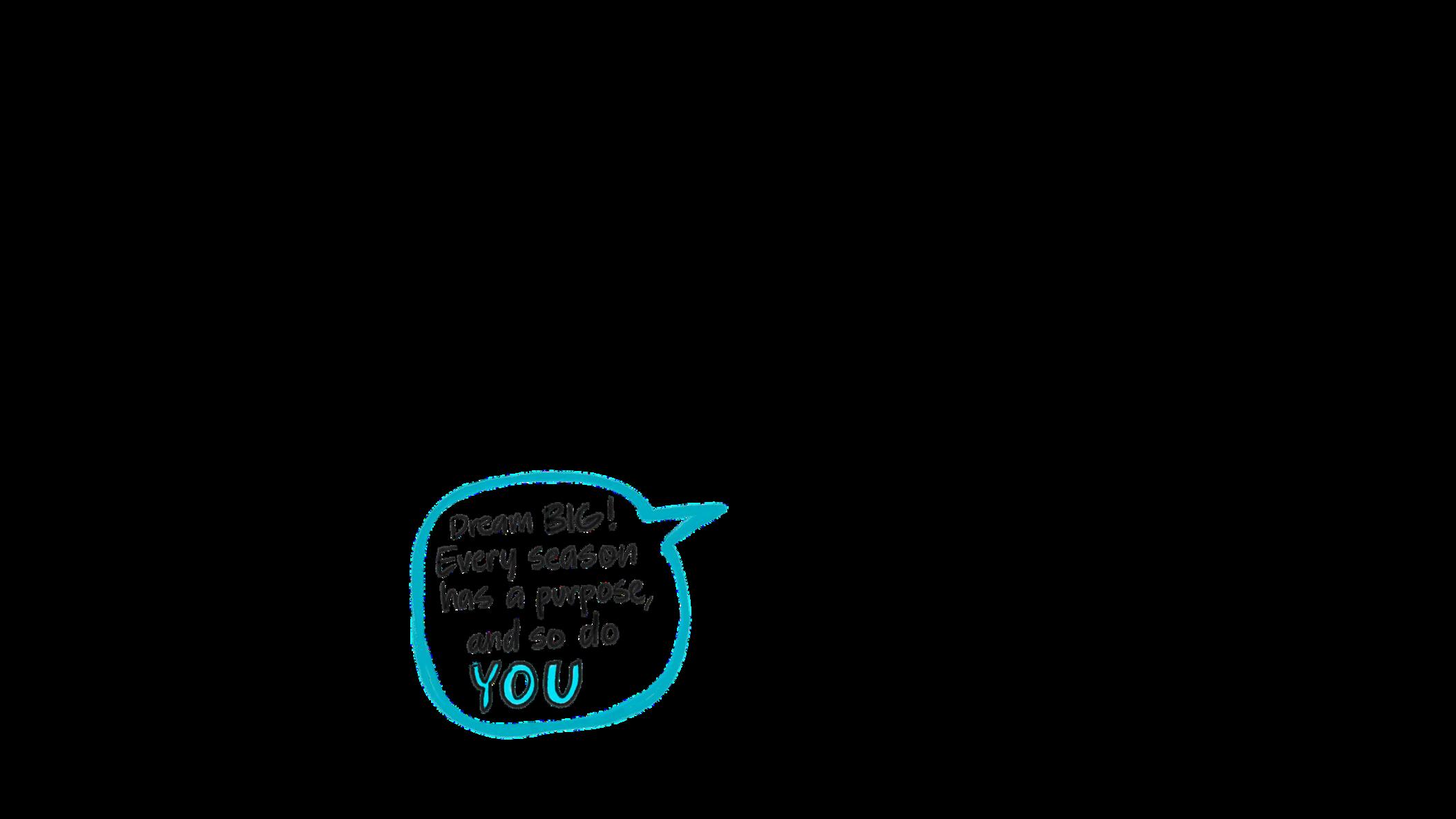
When applying for the program, participants expressed their goals of gaining experience doing advocacy work and their hopes to foster connections with other Indigenous youth leaders The closing engagement and the post-program survey both captured participants’ feedback immediately after the program ended and indicated that IYAW was effective in meeting these goals and that the youth are hoping to access further opportunities to expand on concrete policy and advocacy skills while networking and building community.
According to their feedback, participation in Indigenous Youth Advocacy Week left them feeling a sense of empowerment, belonging, and motivation to continue the important work of policy and advocacy When asked why advocacy is so important, one youth commented that “it gives voices to individuals and communities that don’t [often] have their stories shared” (Youth Participant). Indigenous youth have always had a voice – and a powerful one at that –and IYR aims to support in providing meaningful platforms in which youth can be heard, and listened to, by these decision-makers.
Skill-Building Sessions
For the 2025 edition of IYAW, one of the ways that we responded to feedback provided by the 2024 cohort was through updating the structure and pacing of the skill-building sessions. The schedule was condensed, with the five skill-building sessions taking place in the 3 weeks before the advocacy meetings, and an additional session was added with the goal of giving more space for the youth participants to connect with each other and work together to build their “asks” in advance of the advocacy meetings. At each session, we were joined by Grandma Isabelle, who is a member of Serpent River First Nation and a beloved Elder at IYR.
During our first session together, youth were introduced to the basic structure of the program and had the opportunity to connect with former MP Blake Desjarlais. Desjarlais had previously participated in IYAW as a guest and was able to share his approach to advocating for Indigenous peoples from within Parliament. The second session was a CIPR staff-led workshop that covered essential topics such as finding information on the House of Commons and Senate websites, conducting research, and preparing effectively for meetings. This session was identified as one of the most impactful by the youth as they learned about concrete tools that were applicable both to IYAW and to future advocacy opportunities. A portion of this session also focused on self-care strategies for dealing with the anxiety that public speaking can bring. Hosted by Deloitte’s Future of Canada Centre, the third skill-building session focused on storytelling as a tool to empower participants to articulate their experiences and messages
with clarity and impact. One youth reflected on how that particular session was for them, saying:
“Hearing about how impactful storytelling can be as advocacy helped reframe things in my mind. It really helped me see how impactful sharing your personal stories can be. When you hear other people tell their stories, it makes you think of your own and how you can relate to that as well. I will be using storytelling a lot more now.”
-Youth Participant, 2025
This year, we added an alumni-focused skill-building session, where past IYAW participants shared their experiences in the program and facilitated breakout sessions where the youth could use all of their learnings so far to begin crafting their advocacy “ask”. Feedback on this new session was extremely positive, as the youth appreciated having more time to connect with each other before the advocacy meetings, and were grateful for the Advocacy Toolkit resource that was shared. For our last skill-building session, Carrington Christmas returned to facilitateLeading from Within: Indigenous Youth Leadership Workshop,which focused on fostering confidence and leadership skills rooted in Indigenous perspectives. Participants commented that this session was a great one to end on, bringing a boost of inspiration and empowerment before the meetings.
When reflecting on the skill-building sessions overall, youth highlighted the flow of the session topics, the tools that helped them feel prepared, and the grounding presence of Grandma Isabelle throughout the program as some of their favorite elements. While the feedback was largely positive, youth also offered thoughtful suggestions for enhancing next year ’ s pre-meeting sessions. Several people mentioned how hard it can be to stay focused during online presentations and suggested the addition of more interactive elements like breakout discussions or polls throughout the sessions. They also commented that they would like to have more time to connect with other youth participants, particularly if these could be determined by topics of interest or distinctions-based categories. One participant shared that they “feel like there is so much pressure as Indigenous people to know all Indigenous issues... and that can get so tiring so fast” (Youth Participant). They suggested that this could be mitigated by adding session content that supports participants in identifying their capacity and boundaries within the advocacy context. All of this feedback will be incredibly helpful to revisit as we begin to design the sessions for IYAW 2026. 21
Support and Logistics
Recognizing that the topics discussed during the advocacy meetings tend to be extremely personal and can bring up difficult emotions for the participants, we decided to offer some optional pathways for support during the meeting weeks Grandma Isabelle led a guided meditation and sharing circle after the first week of meetings, offering participants an opportunity to recentre themselves through engaging with the Seven Grandfathers teaching. Participants were also able to book 1-on-1 sessions with Black mental health professional Gary Newman, which were offered during both meeting weeks. Each of these optional resources were utilized by about 1/5 of the participants, with several others mentioning that they were interested but were unable to attend due to scheduling conflicts. When asked about general support, structure, and logistics related to their Indigenous Youth Advocacy Week experience, many of the youth expressed that in general they felt well supported by IYR staff throughout the entirety of the program. One of the main forms of communication between staff and youth during the program is Slack, which allows for groups to connect prior to meetings and for important updates to be shared in a timely manner. A few participants mentioned that they would prefer a different method of communication.
Advocacy Week Meetings
The meetings between the youth, parliamentarians, and national Indigenous leaders were profoundly impactful. Participants emphasized that they valued having the rare opportunity to access face-to-face meetings with so many decision-makers, which they would not be able to organize on their own For those who were able to attend multiple meetings, it was helpful to be able to refine and adjust their contributions between meetings, and it was interesting to see how the different guests responded to the topics brought forward by the youth. While many of the guests left the youth feeling heard, connected, and inspired, they expressed concern that the discussions would not be translated into action and concrete change. For many, these meetings symbolized hope for future generations, as youth recognized the importance of setting an example for others to follow.
Many parliamentarians were forthcoming in continuing to form connections with the youth participants after the meetings, with many offering to exchange contact information for the youth to follow-up with them or other relevant policymakers in the future. Additionally, many were receptive to taking actionable steps forward with youth by following up and looking into the issues youth were advocating for in the meetings. For example, Métis National
Council President Victoria Pruden requested contact information of the youth that she met, stating that her team would like to invite them to participate in future youth engagement opportunities. Additionally, Senator Michèle Audette shared her phone number with youth in her meeting, offering support based on the personal stories shared during the session.
“I am grateful for spaces like [Indigenous Youth] Advocacy Week that recognize Indigenous Youth as rights holders and leaders, not only participants.”
-Youth Participant, 2025
During the closing engagement, the youth had a lot to share about why advocacy is so important to themselves and their communities. They shared their gratitude for previous generations of Indigenous advocates who are responsible for their rights and freedoms. They spoke about advocacy as an important educational tool, valuing the responsibility to provide perspective on Indigenous realities to government officials or others who haven't heard these stories before due to gaps in school curricula and media portrayals of Indigenous peoples.
“When I first started I didn’t have the best knowledge on what advocacy means and how it does change. But [what] I love about it is that what you have lived through and believe, will become taking b
The meetings a skills and insigh more confident future Youth ex the tools they g
Conclusion
While participants spoke candidly about the challenges they face, their contributions were equally grounded in strength, cultural knowledge, lived experience, and a clear understanding of what works. Youth consistently articulated solutions that center prevention, care, and community-led approaches, highlighting that when Indigenous peoples are trusted to lead, systems become more responsive and effective. These conversations affirmed that Indigenous youth are defined by resilience, innovation, and a sense of responsibility to future generations.
Throughout the discussions, youth positioned themselves as active partners in change, offering policymakers practical pathways forward across areas such as federal services, Northern affairs, child and family services, land stewardship, health, and gender equality. Their insights reflected a worldview that understands health, safety, education, land, and culture as interconnected. For many participants, the program solidified their commitment to ongoing advocacy and policy work Youth left the meetings inspired and motivated to build on their advocacy skills, with one participant noting, “I’m experienced with advocacy so I felt very prepared coming in – but somehow I felt more prepared afterward”! The program not only validated the experiences and knowledge of Indigenous youth but also empowered them to take ownership of their advocacy journeys.
For guest policymakers, IYAW provided a rare opportunity for direct connection with Indigenous youth, and to build trust and accountability through engaging with the personal stories and thoughtful ideas brought forward by participants. Policymakers acknowledged youth leadership and expressed openness to continued engagement, signaling important opportunities for collaboration moving forward.
Through these meetings, participants gained a stronger sense of their ability to influence change, creating momentum for a new generation of leaders committed to justice, equity, and reconciliation. Collectively, these meetings created space for meaningful dialogue grounded in respect, accountability, and hope. As this section demonstrates, Indigenous youth are already leading transformative work: protecting land, supporting one another, and envisioning systems rooted in dignity and care. With committed partnership and investment in Indigenous leadership and self-determination, a future exists where Indigenous youth thrive.
Appendix A: Graphic Recording

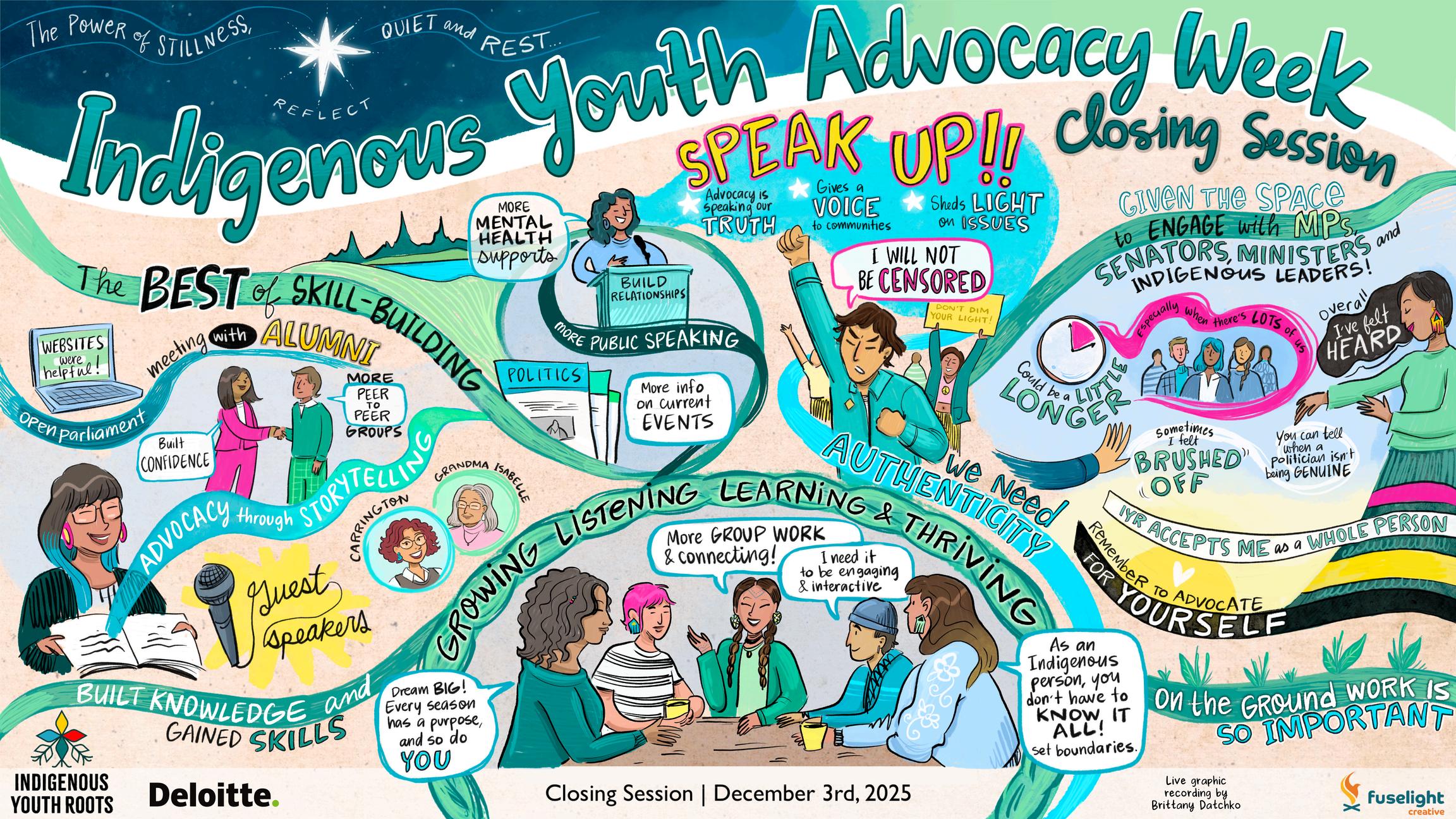
Graphic recording created by Fuselight during closing engagement
Appendix B: Questions Asked by Youth
Questions asked to MPs:
How does the budget plan on addressing our growing concerns of missing people in our communities?
What does meaningful collaboration between youth and leaders look like to you?
Have you effectively planted the seed for community members to lead?
How do you balance safety, culture, and work being on the front lines?
What is the government doing to better support Indigenous youth experiencing mental health crises?
Since Canada is working towards 30 by 30 and nature protection directly involves Indigenous territories, what steps is your office taking to ensure that Indigenous communities are involved and included in these conversations and implementation? What can we expect from you going forward to ensure young people do not miss out on these opportunities to access land and culture in and outside of cities?
How do you balance economic development with environmental protection?
What supports you are advocating for, in your position, for community members who are still navigating issues of substance abuse and trying to access healthcare to deal with a lot of the trauma (that is usually a root of engaging in substance abuse)?
How can we help prevent people from getting addicted to substance abuse in the first place?
How are we going to increase and maintain funding for support for Indigenous postsecondary students?
How do you see Indigenous groups being properly supported to be a part of that sector [agriculture] and be more self-sufficient in food security and how can the federal government help with that?
How can they make sure that Indigenous businesses are included in large [infrastructure] investments?
How can a federal expansion help Canada meet the TRC calls 62/64 on Indigenous education?
Is there a better way for youth transitioning out of care to be provided with a stable housing supplement?
Could we address housing income insecurity and mental health challenges in one coordinated step?
Can any young person [aging out of care] reasonably be expected to thrive, let alone survive on approximately $1,000 a month? If this were your child, what level of support would you want them to have as they transition into adulthood?
Could the MP encourage the department to explore the feasibility of this project [climate resiliency program]?
Could the MP connect them with Indigenous climate policy team or program staff who work on adaptation and resilience as an Indigenous youth from a community that has gone through enormous climate loss?
How do you see your ministry handling the link that is prominent in communities between climate adaptation and addressing climate change and economic development?
How can we make sure the development projects are sustainable for the land and communities they take place in? How could we go about negotiations with these projects and ensure that they're sustainable, not only for the land, but also benefiting the communities that are on that land?
What is your advice for going about these projects and including Indigenous employees and youth in those projects?
How are you going to help set up youth for success and stability amidst climate change and how will you help support them?
What are you going to do to advocate for your constituents who are substance users? How will you continue to support ITK (Inuit Tapiriit Kanatami) as they create a new replacement policy for ICFI (Inuit Child First Initiative)?
Can you advocate for a clear and transparent timeline for review of Nutrition North How will you support language revitalization
Will you advocate for renewed funding for Inuit Child Initiative beyond 2026? Will you support ITK partners to ensure a new policy will stay Inuit-led?
Could you share more about what is going on with Bill S-2?

Questions asked to Senators:
What wrap around supports would prevent Indigenous women and youth from entering the criminal justice system in the first place?
(Regarding Bill 48 in Manitoba, introduced by Wab Kinew – which would mandate that intoxicated people are detained for 24 to 48 hours): Do you think that’s helpful? How could the rest of Canada adopt that?
What do you think you can do in your professional and personal life, to support Inuit and Northern Indigenous youth being represented in the federal bodies? How can you push for our rights in these conversations?
What is the federal government doing to ensure the calls for justice from the National Inquiry are implemented in a way that centers Indigenous women's leadership, healing and safety, not just in policy, but in practice?
What sparked your interest in leadership and public service?
Are you are aware of the status of the TRC Calls to Action and how the calls 23 and 24 are being implemented, or if they're currently moving?
Is there any room for policy on recognizing traditional knowledge within the healthcare system and to provide traditional tools and courses for the larger healthcare system?
Are there any bills or other projects that you have been working on, that could use the support and awareness of the public?
Questions asked to Ministers:
How does the budget ensure that Indigenous people in the childcare system have transparency regarding their culture and heritage, and how does it help reconnect families that have been taken across borders?
What are the implications of modern treaty agreements when treaties are made outside of Canada’s jurisdiction, especially when there is a history of negotiation and their territory span the international border?
How does the budget help ensure that Indigenous people in the child care system have transparency? How does it help people reconnect after being taken across international borders?
What environmental, social issues do youth face today?
What is the federal governments place within the funding of food security within the Yukon?
Based on your experience in the Yukon, what do you believe are the most important steps Canada must take to support Indigenous nations as they move towards greater self-government and the implementation of their rights
Given how many Indigenous youth move from their communities, do you think that federal funding should follow the person rather than the locations and what would it take to make that possible?
How can you advance the call for Inuit-specific and culturally grounded policy development?
Can there be a similar program [to post-Majority Support Program] for Indigenous seniors and disabled Indigenous people
Is there anything that the Senator was working on with youth, and if there is anything we can support with?
Questions asked to National Indigenous Leaders:
Do you have a plan to reunify the Métis Nation?
How do you see the role of the MNC in allowing Indigenous and Métis businesses specifically to play a role in federal procurement and major projects?
What are your thoughts on Bill C-5 and the impacts of it on the Métis Nation and Métis economy?
What do you see as the most important steps we can take to create strong pathways for young people to enter leadership roles and feel supported as they grow?
From your perspective, what do communities need most right now to create safer environments for youth leaders hel Can you designat Can you support initiative? What a the national level?

Appendix C: Guests
Minister Gary Anandasangaree
Minister Rebecca Alty
Minister Rebecca Chartrand
Minister Rechie Valdez
MP Billy Morin
MP Brendan Hanley
MP Ellis Ross
MP Fares Al Soud
MP Ginette Lavack
MP Jaime Battiste
MP Maggie Chi
MP Nathalie Provost
MP Wade Grant
President Victoria Pruden
Regional Chief Wendell LaBobe
Senator Kim Pate
Senator Michèle Audette
Senator Pat Duncan
Senator Patti Laboucane-Benson
MA’NA

MA’NA
HIY HIY
NAQUMIKMANDAANG
QUIJANAQQUTIT
MASI CHOK
MARSI NAKUMIK