THE BEEF, PORK & POULTRY INDUSTRY DIGITAL MAGAZINE
September 2026
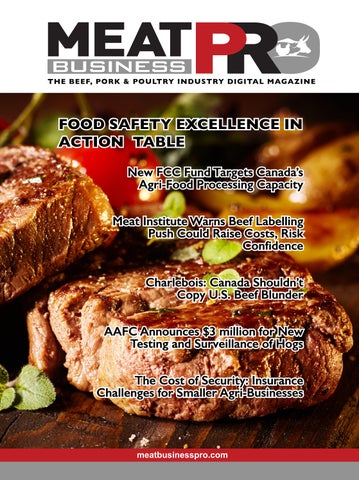
FOOD SAFETY EXCELLENCE IN ACTION TABLE New FCC Fund Targets Canada’s Agri-Food Processing Capacity Meat Institute Warns Beef Labelling Push Could Raise Costs, Risk Confidence Charlebois: Canada Shouldn’t Copy U.S. Beef Blunder AAFC Announces $3 million for New Testing and Surveillance of Hogs The Cost of Security: Insurance Challenges for Smaller Agri-Businesses
meatbusinesspro.com
2
MEATBUSINESSPRO September 20264
meatbusinesspro.com
September 2026
5 6 10 14
Canada’s Pork Sector Launches the Pork Research Hub
CUSMA Uncertainty Puts North American Meat Trade Back on the Negotiating Table k How Expert Guidance Can Strengthen Your Food Safety Program
Federal AgriMarketing Investment Positions Canadian Beef for Global Growth
CMC Raises Concerns Over Proposed Changes to Federal Food Safety Regulations
18 21 24
USDA Announces $500 Million Program to Support Regional Beef Processing
Ottawa is Gambling with our Most Critical Trade Relationship
Back to the Basics: AgriBusinesses' Policy Priorities During Market Upheaval
4
MEATBUSINESSPRO September 20264
meatbusinesspro.com https://www.reiser.com
THE BEEF, PORK & POULTRY INDUSTRY DIGITAL MAGAZINE
September 2026 Volume 27 Number 9 PUBLISHER Ray Blumenfeld ray@meatbusinesspro.com CO-PUBLISHER Deb Wilson deborah@meatbusinesspro.com VP SALES & MARKETING Murray Hill murray@meatbusinesspro.com DIGITAL MEDIA EDITOR Cam Patterson cam@meatbusinesspro.com CREATIVE DIRECTOR Patrick Cairns
CMC RAISES CONCERNS OVER PROPOSED CHANGES TO FEDERAL FOOD SAFETY REGULATIONS The Canadian Meat Council (CMC) is raising serious concerns about proposed amendments to the Safe Food for Canadians Regulations (SFCR) that would allow certain provincially inspected meat products to enter interprovincial trade. CMC and its members strongly support reducing interprovincial trade barriers. However, the proposed four-year exemption risks creating a regulatory loophole that could weaken Canada’s food safety framework, undermine confidence in the federal inspection system and put international market access at risk.
CONTRIBUTING WRITERS Moira Wilson, Sylvain Charlebois, Jack Roberts, Cam Patterson Meat Business Pro is published 12 times a year by We Communications West Inc.
“Most meat processed in Canada already moves across provincial borders. We support efforts to expand that trade, but not by creating different inspection standards for products entering the same market,” said Kyle Larkin, President & CEO of the Canadian Meat Council. “The potential damage to consumer and international confidence in Canada’s food safety system far outweighs the limited benefit of this proposal.” Federal and provincial meat inspection systems serve different purposes and markets. Federally licensed facilities operate under continuous, on-site inspection by the Canadian Food Inspection Agency (CFIA) and must meet federal requirements that underpin Canada’s reputation and access as a trusted meat exporter.
COMMUNICATIONS WEST INC.
We Communications West Inc. 106-530 Kenaston Boulevard Winnipeg, MB, Canada R3N 1Z4 Phone: 204.985.9516 Fax: 204.582.9800 E-mail: publishing@meatbusinesspro.com Website: www.meatbusinesspro.com ©2025 We Communications West Inc. All rights reserved. The contents of this publication may not be reproduced by any means in whole or in part, without prior written consent from the publisher.
“Canada needs one federal food safety standard that is applied consistently across the country,” said Larkin. “We should be raising standards and expanding access to the federal system, not creating exemptions that blur the line between federal and provincial inspection.” Approximately 95% of meat processed in Canada comes from federally licensed facilities. CMC estimates that only about 0.5% of the overall industry could benefit from the proposed changes. “Our federally licensed members invest heavily every year to meet Canada’s rigorous food safety requirements and maintain access to markets around the world,” said Dr. Sylvain Fournaise, Chair of the Canadian Meat Council. “Allowing products produced under different inspection standards into interprovincial trade risks undermining that investment and the reputation Canada has built as a trusted supplier of safe, highquality meat.” “This is a solvable problem,” added Fournaise. “Instead of lowering the bar, we should help more provincially inspected facilities achieve federal certification. That would expand interprovincial trade while protecting the integrity of Canada’s food safety system.” CMC has submitted its concerns through the CFIA’s public consultation process and is urging the Government of Canada to work with industry and provinces on solutions that reduce trade barriers without compromising Canada’s food safety standards or international market access.
meatbusinesspro.com
September 2026 MEATBUSINESSPRO
5
FOOD SAFETY EXCELLENCE IN ACTION Practical Support to Enhance Food Safety Systems For Ontario meat processors, food safety is more than a regulatory requirement. It is a foundation for customer confidence, market access, operational discipline and long-term growth. Yet for many businesses, especially those balancing daily production demands with limited internal resources, the path toward a stronger food safety system can feel complex, time-consuming or intimidating.
One of FSE’s most accessible entry points is its SelfAssessment Tool. The tool is a quick, anonymous questionnaire that asks processors to consider their current food safety system and business goals. In just four minutes, it helps identify the recommended next step for the operation. For busy plant owners and managers, that ease of use matters. It removes uncertainty, gives structure to the process and helps turn a broad objective, “improve food safety”, into a more manageable starting point. That is where the Food Safety Excellence (FSE) Program can make a practical difference. Designed to help provincially licensed meat plants assess, build and strengthen their food safety systems, FSE brings together simple evaluation tools, free learning opportunities, ready-to-use resources and expert guidance. The result is a program that can support processors at different stages of development, whether they are just beginning to formalize procedures, looking to close specific gaps, or working toward a more advanced system such as HACCP. 6
MEATBUSINESSPRO September 20264
The program also recognizes that food safety improvement is not a one-time exercise. Processors need practical information they can return to as their operations evolve. Through FSE, businesses can build knowledge at their own pace using free learning modules, webinars and a library of resources such as templates, checklists and reference documents. These materials are designed to be applied in real operating environments, helping teams translate food safety concepts into daily practices. meatbusinesspro.com
For Patenaude, the timing was right to explore FSE because the business had a clear idea of where it wanted to go. “We have a vision of where we want to take the company,” he says. The program helped him understand what would be required to move in that direction. His experience with the Self-Assessment Tool was straightforward; it was easy to use, took about five minutes, and helped confirm that the program was a good fit for Henderson’s goals.
Just as important, FSE is not only a digital resource library. The program connects processors with expert guidance that can make the next step more personal and actionable. CMIT Food Safety Specialist Baljit Kaur Kheeva can help businesses interpret their needs, review existing systems, identify gaps and point them toward tools and resources that fit their situation. For processors that know they need to strengthen their systems but are unsure where to begin, that guidance can help build confidence and momentum.
From there, Henderson’s used FSE resources to build knowledge and support its food safety journey. Patenaude participated in free webinars, which helped him better understand what would be needed to pursue HACCP certification and meet Canadian standards. As the work progressed, the business recognized that additional guidance would be useful. At the time Henderson’s participated, eligible provincially licensed meat plants could access Implementation Support, which Henderson’s used to hire a food safety consultant to guide the team through the HACCP process. Implementation Support has has since been fully allocated and is no longer part of the current FSE offering, but the example shows how the program helped connect a processor with the knowledge and support needed to take action.
Henderson’s Meats & Abattoir in Chesterville offers a useful example of what can happen when a business combines a clear vision for growth with FSE’s selfassessment, learning resources and support. Owner Eric Patenaude describes Henderson’s as a business rooted in local agriculture and community service. “We control the whole chain from the ground to the grocery store,” he says, describing the operation’s role in supporting local farmers and customers who value local meat processing.
meatbusinesspro.com
September 2026 MEATBUSINESSPRO
7
In a sector where expectations continue to rise, practical support can be the difference between uncertainty and progress. The Food Safety Excellence Program gives Ontario meat processors a clear, accessible way to assess where they are, learn what they need and move forward with confidence. For businesses ready to strengthen their systems, the message is simple: reaching food safety goals may be less daunting than it seems, and help is available.
The changes at Henderson’s were significant. The team moved from paper-based records to a digital platform for tracking day-to-day processes. Traceability became more efficient, with documentation flowing from the kill floor through to product leaving the facility. Staff training also became an important part of the process. Patenaude says employees gained a better understanding of food safety and took pride in the achievement of HACCP certification. For other processors, the lesson is not that every business will follow the same path. Rather, Henderson’s experience illustrates the value of taking a first step and using available support to make food safety improvement more manageable. Patenaude says what surprised him most was the amount of help available: “They were really working with you to help you reach your goals.” That message is at the heart of FSE. Strengthening a food safety system does not have to begin with a complete overhaul or a fully defined end point. It can begin with a four-minute self-assessment, a webinar, a template, a checklist or a conversation with a food safety specialist. Each step helps processors better understand their current system, identify priorities and build a stronger foundation for the future.
Find out your next step by completing the quick and anonymous FSE Self-Assessment Tool today: https:// lvvr10axwba.typeform.com/to/Buo0V5OV?typeformsource=www.cmit.ca Food Safety Excellence tools and resources have been developed through funding provided by the Sustainable Canadian Agricultural Partnership (Sustainable CAP), a five-year, federal-provincial-territorial initiative.
8
MEATBUSINESSPRO September 20264
meatbusinesspro.com
NEW FCC FUND TARGETS CANADA’S AGRI-FOOD PROCESSING CAPACITY A $1 billion project finance fund, paired with a $150 million investment in Velocity Agri-Capital Partners, aims to close financing gaps, expand value-added food production, and strengthen Canada’s food supply chain.
Canada’s food processing sector is being asked to do more than ever. Global trade shifts, climate pressures and changing customer expectations are putting new demands on domestic supply chains. For processors, the challenge is not only efficiency inside the plant, but also access to capital, resilient infrastructure, export readiness and the ability to commercialize innovation at scale.
For meat, poultry, seafood, prepared foods and other value-added processors, the announcement matters because growth projects are capital-intensive and often difficult to finance through traditional channels alone. New processing lines, cold storage, automation, packaging systems, waste-reduction technologies and traceability platforms can require significant upfront investment before revenue growth is realized. FCC’s fund is intended to support mid-market infrastructure projects that increase domestic capacity and strengthen Canada’s ability to process more of what it produces. The fund is a key commitment under the National Food Security Strategy, backed by more than $3 billion over 10 years. Its focus is not simply production, but the infrastructure and technology needed to build a more resilient food system. In practical terms, that means helping businesses invest in facilities and equipment that add value in Canada and create stronger links between producers, processors and export markets.
The Government of Canada is responding with a major financing push for the agriculture and food economy. Agriculture and Agri-Food Minister Heath MacDonald announced Farm Credit Canada’s (FCC) new $1 billion Agri-food Project Finance Fund, along with a $150 million investment in Velocity Agri-Capital Partners through FCC Capital’s broader $2 billion commitment. The initiatives are designed to move agri-food projects from concept to construction, while helping companies expand processing capacity and compete in highervalue markets. Continued on page 10 meatbusinesspro.com
September 2026 MEATBUSINESSPRO
9
Minister MacDonald framed the investment as part of a broader effort to ensure Canadians have access to highquality, affordable food. FCC president and CEO Justine Hendricks described project finance as a critical tool for unlocking the infrastructure and processing capacity Canada needs to build a stronger, more self-reliant food system. For processors, the message is clear: food security depends not only on farms, but also on plants, logistics networks, technologies and capital structures.
The separate $150 million commitment to Velocity Agri-Capital Partners adds another dimension. Velocity will focus on agri-food and agri-tech opportunities across the value chain, emphasizing companies that strengthen Canada’s food system. Led by Arlene Dickinson, Velocity Capital has teams in Canada and Singapore and is focused on helping high-potential companies scale in North America while building export pathways into Southeast Asia. Velocity is also in discussions with investors regarding additional capital commitments of up to $350 million. That international lens is important for food processors. Canada is widely recognized as a reliable supplier of commodities, ingredients and safe food products. The next opportunity is to capture more value through further processing, branded products, advanced manufacturing and export-ready formats that support stronger margins and more stable markets.
10
MEATBUSINESSPRO September 20264
The timing is notable. FCC announced in May 2025 that it would commit $2 billion by 2030 to drive innovation across Canada’s agriculture and food industry. In February 2026, it said more than 20 investment organizations were prepared to deploy up to $5 billion into agriculture and food innovation by 2030. The new fund and Velocity investment build on that momentum by targeting projects that sit between conventional lending and private equity: large enough to transform capacity, but complex enough to require specialized financing.
meatbusinesspro.com
The larger significance is that Canada is placing food processing closer to the centre of its economic and food security agenda. By supporting capitalintensive infrastructure, commercialization and export development, the government and FCC are signalling that value-added processing is essential to resilience. If deployed effectively, the funding could help processors modernize operations, scale production, diversify markets and keep more economic value at home.
For meat and food processors, the opportunity will depend on readiness. Projects that demonstrate clear demand, sound technical planning, strong management, realistic timelines and measurable benefits to Canada’s supply chain may be better positioned to attract support. Businesses considering expansion should be prepared to show how their plans increase capacity, improve productivity, strengthen domestic supply, create jobs or open new export channels.
VEMAG
REPLACEMENT PARTS
meatbusinesspro.com
https://www.dhenryandsons.com
September 2026 MEATBUSINESSPRO
11
TARIFF RELIEF FUELS DRAKE MEATS’ NEXT GROWTH STAGE Federal investment in Saskatchewan’s meatprocessing capacity highlights automation, resilience and the push to build more value inside Canada.
Drake Meat Processors is receiving $3.2 million across two projects - $2.2 million to purchase equipment to expand and automate a sausage and beef production line in Saskatoon, and $1 million to purchase equipment to expand and automate a cured pork production line. The funding arrives as the company is in the final stages of constructing a new federally inspected plant in Saskatoon, scheduled to open in December 2026. For processors navigating labour constraints, inputcost volatility and shifting market access, the focus on automation is especially relevant.
Canada’s latest tariff response package is not only a political answer to renewed trade pressure from the United States. For the meat industry, it is also a signal that governments and processors are placing a higher value on domestic capacity, automation and market diversification. At the centre of the Saskatchewan announcement is Drake Meat Processors Inc., a long-established Saskatchewan meat company now preparing for a major step into federally inspected production from a new facility in Saskatoon. Prairies Economic Development Canada announced $11.6 million for 10 projects led by eight Saskatoonbased organizations through the Regional Tariff Response Initiative, a program designed to help manufacturers manage rising costs, supply chain disruption and uncertainty created by U.S. tariffs. While the funding envelope covers a range of manufacturers, from trailer production to brewing and steel fabrication, the Drake Meats investment stands out for food and meat-sector readers because it directly supports additional Canadian processing capacity.
12
MEATBUSINESSPRO September 20264
The new facility is expected to significantly expand Drake Meats’ ability to serve customers beyond Saskatchewan. The company has built its reputation on sausage, bacon, jerky and other pork and beef products, with roots dating back to 1949 in the village of Drake. Its existing provincially inspected operations remain an important part of the business, but a federally inspected Saskatoon plant will allow the company to produce for broader Canadian distribution and respond to larger retail and foodservice opportunities.
meatbusinesspro.com
Automation is central to that growth strategy. In meat processing, automated lines can support consistency, throughput, food safety and labour efficiency while reducing bottlenecks in repetitive or physically demanding operations. The federal support for Drake’s sausage, beef and cured pork lines is therefore more than a capital contribution. It is an investment in scaling production while helping a Saskatchewan processor compete in a national market where buyers expect reliable supply, consistent specifications and the ability to respond quickly to demand.
For Canada’s meat sector, the project reflects a wider trend as processors are looking for ways to reduce exposure to cross-border disruptions by keeping more production, value-added activity and supplychain capability at home. U.S. tariffs have increased uncertainty for Canadian manufacturers, but the pressure is felt differently across the meat value chain. Equipment costs, packaging, ingredients, transportation, market access and customer confidence can all be affected before a tariff even appears on a balance sheet. Caileigh Beckman, Drake Meat Processors’ director of operations, described those pressures in practical terms, noting that fast-moving trade changes show up in input costs, equipment costs and the market access customers depend on. For a mid-sized processor, she said, these are not abstract policy issues but decisions that affect employee shifts and business planning. Drake currently employs about 140 people and expects to grow past 300 once the new Saskatoon facility is running in early 2027, according to reporting on the announcement.
The broader RTRI announcement also positions manufacturing competitiveness as a supply-chain resilience issue. Federal officials said the projects are intended to help companies improve productivity, strengthen domestic supply chains and reach new markets. In total, the 10 Saskatoon-region projects are expected to support more than 137 jobs. Saskatchewan’s manufacturing sector employed 30,400 workers in June 2026, about four percent of the provincial workforce, underscoring the importance of value-added manufacturing to the Prairie economy.
Continued on page 14
meatbusinesspro.com
September 2026 MEATBUSINESSPRO
13
That does not eliminate uncertainty. Capital projects in meat processing remain complex, requiring skilled labour, regulatory readiness, capital discipline and customer commitments. But the direction is clear, Canadian processors are being encouraged to modernize and scale, and governments are framing that modernization as part of a national response to tariff pressure. For a sector built on thin margins and long supply chains, that framing matters.
For livestock producers and meat buyers, additional federally inspected processing capacity in Saskatchewan could provide more options within Canada. Drake’s Saskatoon plant is expected to increase production capacity and deliver Canadian-produced products to consumers across the country. Previous reporting on the expansion noted that the facility is designed to increase output substantially and help the company grow outside its provincial base while maintaining its rural Saskatchewan operations.
In Saskatchewan, Drake Meat Processors’ expansion offers a concrete example of what that response looks like on the plant floor: more automated lines, more federally inspected production, more market reach and more Canadian value added to Canadian meat. Tariffs may be the trigger, but the competitive answer lies in productivity, capacity and resilience. Processors that can invest through uncertainty will be better positioned when markets shift again.
The investment also arrives at a time when Canadian processors are reassessing risk. Trade disputes, global conflicts and inflationary pressures have pushed companies to examine where they source equipment, how they structure production and how quickly they can pivot to new customers. For companies like Drake, federal inspection, automation and expanded line capacity create a platform for growth that is less dependent on a single market or distribution channel. 14
MEATBUSINESSPRO September 20264
meatbusinesspro.com
meatbusinesspro.com
September 2026 MEATBUSINESSPRO
15
MEAT INSTITUTE WARNS BEEF LABELLING PUSH COULD RAISE COSTS, RISK CONFIDENCE As Washington reviews mandatory country-of-origin labelling and expanded processing access for ranchers, the Meat Institute is warning that food safety and supply-chain costs must remain central to the debate. The Trump administration’s latest cattle-sector orders have reopened two long-running arguments in the U.S. meat industry - whether beef should again be subject to mandatory country-of-origin labelling, and how far policymakers should go in expanding market access for ranchers who want to process and sell their own meat.
WASHINGTON REOPENS THE MCOOL QUESTION Under one executive order, U.S. Agriculture Secretary Brooke Rollins has been directed to review, within 90 days, the statutory and regulatory authority that could support mandatory country-of-origin labelling for beef products. The review is to be conducted with U.S. Trade Representative Jamieson Greer and include an updated economic analysis that reflects current market conditions. Depending on the findings, USDA could pursue regulatory changes if it determines existing law allows them, or work with the White House to develop legislative recommendations for Congress. The order itself does not immediately reinstate mandatory labelling, but it puts the issue back on the policy timetable.
For livestock producers, packers, processors, retailers and foodservice buyers, the orders signal a renewed federal focus on beef supply, processor competition and consumer transparency at a time when cattle inventories remain historically tight and retail beef prices are under intense scrutiny. Continued on page 18
16
MEATBUSINESSPRO September 20264
meatbusinesspro.com
meatbusinesspro.com
September 2026 MEATBUSINESSPRO
17
Meat Institute president and CEO Julie Anna Potts has said mandatory labelling would raise meat prices at a time when shoppers are already sensitive to grocery inflation. The organization also points to the new voluntary “Product of USA” label, which can be used for meat from animals born, raised and processed in the United States, as a market-based alternative for consumers who want origin information. PROCESSING ACCESS RAISES FOOD-SAFETY QUESTIONS
The debate carries particular weight for the North American beef industry. Previous mandatory countryof-origin labelling requirements for beef and pork were repealed after trade challenges from Canada and Mexico, and any new approach would need to address both domestic political pressure and the realities of integrated livestock and meat supply chains.
A second order seeks to expand opportunities for ranchers and smaller processors by directing USDA to make greater use of existing authorities that allow eligible meat products to move in interstate commerce. Measures identified in the order include increasing participation in state-federal inspection programs, providing technical help to small processors, streamlining compliance and establishing a guaranteed loan program for small and regional beef processors.
MEAT INSTITUTE WARNS OF ADDED COSTS The Meat Institute has been clear in its opposition to reinstating mandatory country-of-origin labelling for beef and pork. In July, the association pointed to an economic analysis by Decision Innovation Solutions estimating that a return to 2013-style mCOOL requirements would impose approximately $1.02 billion in first-year costs across the beef and pork value chains, including about $721 million for beef and $296 million for pork. The institute argues those costs would be driven by tracking, recordkeeping, segregation, verification and labelling requirements throughout the chain. It has also warned that much of the burden would ultimately flow through to consumers in the form of higher retail meat prices.
The Meat Institute’s response to the processing announcement was cautious and centred on inspection. The association said U.S. farmers and ranchers already have several routes to process and market their livestock, including custom-exempt processing, building state or federally inspected facilities, or working with thousands of small and very small inspected establishments. Its central warning was that allowing uninspected or inadequately inspected meat into commercial channels would be the wrong response to high beef prices. The institute said inspection requirements exist to ensure meat sold to consumers is safe, wholesome and properly labelled, and that lowering food-safety standards would risk consumer confidence and tradingpartner trust.
18
MEATBUSINESSPRO September 20264
meatbusinesspro.com
WHAT’S ON THE HORIZON The next 90 days will be critical as processors, retailers and foodservice suppliers should monitor whether USDA identifies a legal pathway to mandatory beef origin labelling, how any cost-benefit analysis treats compliance expenses, and whether congressional action is deemed necessary.
SUPPLY, NOT STANDARDS, IS THE INDUSTRY FAULT LINE The policy push comes as the U.S. cattle herd sits near its lowest level in decades, while beef demand remains resilient. That gap between constrained supply and strong demand has kept pressure on prices and intensified scrutiny of the beef supply chain, including the role of the largest packers. For the Meat Institute, however, the answer is not to relax inspection rules. In its statement, the group said the route to lower beef prices is to expand the cattle supply. “America needs more cattle,” it argued, adding that rebuilding the herd and increasing beef availability would do more to lower prices while preserving trust in the safety of the meat supply.
That message is likely to resonate with packers and processors that view federal and state inspection as foundational to domestic and export market confidence. At the same time, rancher groups pressing for more local processing capacity and clearer origin labelling are likely to see the orders as a lever for more competition and differentiation in the marketplace. meatbusinesspro.com
Companies should also track how USDA defines expanded processing access in practice. The distinction between creating more inspected capacity and allowing uninspected product into commerce will determine whether the order becomes a capacity-building initiative, a regulatory flashpoint, or both.
The orders do not settle the country-of-origin or processing debates. Instead, they move both issues into a formal review process at a moment when beef prices, cattle supplies, processor competition and consumer trust are all under the microscope. September 2026 MEATBUSINESSPRO
19
CHARLEBOIS: CANADA SHOULDN’T COPY U.S. BEEF BLUNDER By Sylvain Charlebois “Imports may slow beef inflation, but they cannot Trump also announced that his administration would manufacture affordability.” make it easier for ranchers to process and sell their own meat. President Donald Trump knows how to provoke and move markets. But when it comes to beef prices, he The objective is clear: increase supply and bring down may have missed a few briefings on cattle economics. prices. But it will not work as advertised. Beef prices are elevated because the United States has too few cattle while Americans continue buying beef. The U.S. herd is near a 75-year low following years of drought, wildfires, high feed costs and restrictions on cattle imports from Mexico. Beef production is expected to fall by about 4 per cent this year. This is not a problem that can be solved in 90 days. Trump recently authorized an additional 300,000 metric tonnes of lean beef trimmings to enter the United States at the lower, within-quota tariff rate. Beginning Sept. 1, the measure permits up to 100,000 tonnes a month for 90 days. The imported trimmings will be blended with American beef to produce ground beef. The White House is encouraging suppliers to offer it at a 25 per cent discount.
20
MEATBUSINESSPRO September 20264
Cattle are not widgets. Rebuilding a herd takes years. Ranchers must retain heifers instead of sending them to slaughter, which initially reduces the beef supply even further. Biology—not politics—sets the production schedule.
meatbusinesspro.com
Canada should pay close attention. Our beef market is also being reshaped by a K-shaped economy. Higher-income Canadians can continue buying beef despite rising prices. Many struggling households are buying less, choosing cheaper cuts or switching to chicken, pork and other proteins. According to Statistics Canada, ground beef prices have risen 8.1 per cent since January. NielsenIQ data indicate that Canadian beef sales declined about 4 per cent by volume during the last quarter. Canadians are not abandoning beef, but many are rationing it. The additional imports may lower the wholesale cost of lean trimmings, but a 25 per cent discount on one ingredient will not produce a 25 per cent discount at the grocery store. Retail prices also include domestic beef, labour, processing, inspection, transportation, refrigeration, packaging and retail margins. Some savings may reach consumers. A dramatic or lasting price decline is highly unlikely. Allowing ranchers to process their own meat could eventually increase competition. But meat processing requires costly facilities, skilled workers, inspection and reliable cold-chain infrastructure. Removing regulations does not create more cattle, and food-safety oversight cannot be weakened simply to produce cheaper hamburgers. There is also a longer-term risk. If producers believe that every increase in cattle prices will trigger government-sponsored imports, they may become less willing to invest in rebuilding their herds. A policy designed to address today’s shortage could therefore prolong tomorrow’s shortage.
Meanwhile, Ottawa is accelerating trade negotiations with Mercosur, which includes Brazil, Argentina, Uruguay and Paraguay. These countries can generally produce beef at a lower cost than Canada. Allowing more South American beef into Canada is not necessarily bad policy. Carefully managed imports could supplement domestic supplies and limit further price increases. But Ottawa should not pretend that imports will restore the prices Canadians remember from a few years ago. Too much imported beef could also weaken Canadian producers at precisely the moment they need incentives to expand. Any Mercosur agreement must include reciprocity, credible inspection and traceability standards, and safeguards against sudden import surges. Trump may give American consumers some temporary relief, but he cannot import his way out of a structural cattle shortage. Canada should learn from his mistake before making the same one.
Sylvain Charlebois is director of the Agri-Food Analytics Lab at Dalhousie University, co-host of The Food Professor Podcast. Continued on page 22 meatbusinesspro.com
September 2026 MEATBUSINESSPRO
21
AAFC ANNOUNCES $3 MILLION FOR NEW TESTING AND SURVEILLANCE OF HOGS Canada's pork industry is an economic powerhouse. Recognizing that infectious disease is one of the major risks to swine production, the Government of Canada is helping industry further develop the tools needed to safeguard animal health, strengthen sector resilience, and support future growth.
Heath MacDonald, Minister of Agriculture and AgriFood, recently announced up to $3,111,486 for the Canadian Pork Council through the AgriAssurance Program – National Industry Association Component to advance the scope and quality of swine health surveillance in Canada.
Rene Roy, Chair, Canadian Pork Council stated, "Early swine health detection is one of our strongest defences in protecting our herd and maintaining affordable and high-quality Canadian pork products. This $3.1 million investment will improve the speed, accuracy, and coordination of swine health surveillance by advancing innovative diagnostic tools, nationally consistent testing, and secure data systems. The Canadian Pork Council is pleased to collaborate with the Atlantic Veterinary College and partners across veterinary medicine, laboratories, industry and government to turn better surveillance into faster action and stronger protection for Canadian pork producers."
This funding will support the development, validation, and upgrading of multiplex assay technologies, which are comprehensive lab tests that can screen for multiple domestic swine viruses from a single sample. The project also includes implementing a targeted national proficiency program to support consistent testing across veterinary labs in Canada and establishing a secure surveillance database to track swine viruses.
22
MEATBUSINESSPRO September 20264
meatbusinesspro.com
QUICK FACTS • The Canadian pork sector is vital to Canada's economy and rural communities, contributing an estimated 100,000 direct and indirect jobs, and generating over $24 billion per year. This investment will increase the availability of costeffective, specific, and sensitive diagnostic testing for rapid detection of swine intestinal and respiratory viruses. The project is based at the Atlantic Veterinary College and involves collaboration with veterinary practitioners, veterinary laboratories, and industry.
• The Canadian Pork Council is a federation of nine provincial pork industry associations representing more than 7,000 hog producers. Its mission is to advance, promote and protect the excellence of Canadian pork production through effective advocacy, programs and communication. • The Sustainable Canadian Agricultural Partnership (Sustainable CAP) is a $3.5-billion, five-year agreement (2023 to 2028), between the federal, provincial and territorial governments to strengthen the competitiveness, innovation, and resiliency of the agriculture, agri‐food, and agri‐based products sector. • The AgriAssurance Program – National Industry Association Component funds projects, at the national level, to help industry develop, verify and integrate assurance systems to address market and regulatory requirements and enable industry to make credible, meaningful and verifiable claims about the health, safety, and quality of Canadian agriculture products.
Disease outbreak can have major impacts on animal welfare, food supply, productivity, producer mental health, and can result in significant economic losses. Animal health surveillance is key to early detection, preventing spread and helping to mitigate the effects that disease can have. The Government of Canada is committed to supporting resilience of the swine industry by investing in innovative solutions that enhance animal health, improve productivity and strengthen Canada's reputation as a trusted producer of high-quality pork.
meatbusinesspro.com
September 2026 MEATBUSINESSPRO
23
THE COST OF SECURITY: INSURANCE CHALLENGES FOR SMALLER AGRI-BUSINESSES A single storm, equipment breakdown, or liability claim can be enough to throw an agri-business off course. That is why insurance matters. When margins are tight, the right coverage can mean the difference between recovering from a setback and facing a major financial hit.
Insurance availability often depends on where a business gets its coverage. Most agri-businesses (71%) purchase insurance through brokers, who offer products from multiple companies and can help business owners shop around. However, the remainder (29%) rely on agents who only sell from a single insurer, limiting the range of options available. Even with a broker, choices can be scarce. According to CFIB's 2024 Insurance Survey, just two companies serve as the primary insurer for more than half of small agri-businesses: Intact (33%) and Cooperators (20%). In some regions, options are even more limited. Providers such as Promutuel and Saskatchewan Government Insurance (SGI) do not operate in all provinces and territories, leaving some businesses with even fewer alternatives.
Unfortunately, finding affordable insurance is becoming harder for many farmers and agricultural entrepreneurs. In 2024, the Canadian Federation of Independent Business (CFIB) conducted a special survey on insurance, finding that most agri-business owners were dissatisfied with the insurance options available to them (54%) and nearly three-quarters (74%) were unhappy with the cost of premiums and fees. By the time CFIB followed up in its 2026 Agriculture Survey, business owners reported that insurance had only become more expensive and difficult to obtain. Insurers have grown more cautious as the value of farm equipment has increased, extreme weather events have become more frequent, and claims have risen. The result is fewer providers, fewer policy options, and growing gaps in coverage. For some agri-businesses, insurance is becoming too expensive, and for others, it is becoming unavailable altogether. 24
MEATBUSINESSPRO September 20264
Top Insurance Providers for Agri-Businesses Other (13%)
SGI (6%)
Intact (33%)
Definity / Economical (7%)
Promutuel (10%)
Wawanesa (11%)
Cooperators (20%)
Source: CFIB, Special Survey on Insurance, Mar. 18 - May 9, 2024, n=82. Question: "Which of the following is your business's primary insurance provider?" (Excludes multiple choices, choice of "Don't Know/Unsure")
When insurance options dry up, the consequences do not end at higher costs. Some entrepreneurs may think twice about expanding into higher-risk activities or entering the industry altogether. Others may choose to operate without coverage, exposing themselves to major financial and legal risks if something goes wrong. meatbusinesspro.com
Insurance is supposed to help businesses manage risk. Instead, as costs rise, business owners are forced to delay investments, scale back activities, or absorb yet another hit to their bottom line.
For those who can secure insurance, affordability is often the next challenge. As premiums continue to rise, more business owners are being forced to absorb higher costs or scale back investments elsewhere in their operation. On the 2026 Agriculture Survey, nearly three-quarters of business owners reported that their premiums had increased over the previous year. More than onethird (37%) saw costs rise by 3-9%, while another 37% reported increases of 10% or more. These costs add up quickly. Based on average 2024 rates for commercial liability, auto, and property insurance, a typical agri-business could pay roughly $1,300 to $4,500 more each year on insurance premiums. Insurance costs have continued to climb since then, with trade disruptions, extreme weather, and rising costs making it harder for businesses to absorb the added expense.
Agriculture will always involve risk, and insurers will continue to approach the sector cautiously. That makes it even more important for governments to address the barriers driving-up costs and limiting coverage options. CFIB is calling for targeted action to reduce insurance costs, strengthen public insurance programs, and increase competition in the sector. With the right reforms, more agri-businesses can access affordable coverage and focus on growing their operations instead of worrying whether they can insure them.
Business owners say these higher premiums are affecting how they operate. Rising insurance costs have led many agri-businesses to change their day-to-day operations and rethink long-term plans. Insurance is also regularly identified as a major cost concern in CFIB's monthly Business Barometer®, highlighting the pressure it places on profitability and business confidence. Common Impacts of Increased Insurance Costs for Agri-Businesses Reduced cash flow
58%
Increased cost to keep similar coverage
42%
Delayed investment in our business
26%
Reduced overall insurance coverage on assets/activities Reduced staffing levels and/or hours No impact
19%
8%
13%
Source: CFIB, Agriculture Survey, Feb. 19 - Apr. 17, 2026, n=191. Question: "What impact have increases in insurance premium costs had on your business? (Select all that apply)"
meatbusinesspro.com
Moira Wilson is a Public Policy and Advocacy Intern for the Canadian Federation of Independent Business (CFIB). CFIB is Canada’s largest association of small and medium-sized businesses with 103,000 members (6,000 agri-business members) across every industry and region. CFIB is dedicated to increasing business owners’ chances of success by driving policy change at all levels of government, providing expert advice and tools, and negotiating exclusive savings. Learn more about CFIB and its work to support agri-businesses at Get Growing.
September 2026 MEATBUSINESSPRO
25
26
MEATBUSINESSPRO September 20264
https://www.cfib.ca meatbusinesspro.com