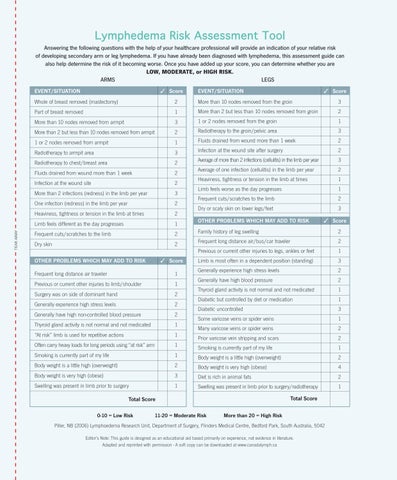
Lymphedema Risk Assessment Tool
Answering the following questions with the help of your healthcare professional will provide an indication of your relative risk of developing secondary arm or leg lymphedema. If you have already been diagnosed with lymphedema, this assessment guide can also help determine the risk of it becoming worse. Once you have added up your score, you can determine whether you are LOW, MODERATE, or HIGH RISK. ARMS LEGS
TEAR AWAY
EVENT/SITUATION
3 Score
EVENT/SITUATION
3 Score
Whole of breast removed (mastectomy)
2
More than 10 nodes removed from the groin
3
Part of breast removed
1
More than 2 but less than 10 nodes removed from groin
2
More than 10 nodes removed from armpit
3
1 or 2 nodes removed from the groin
1
More than 2 but less than 10 nodes removed from armpit
2
Radiotherapy to the groin/pelvic area
3
1 or 2 nodes removed from armpit
1
Fluids drained from wound more than 1 week
2
Radiotherapy to armpit area
3
Infection at the wound site after surgery
2
Radiotherapy to chest/breast area
2
Average of more than 2 infections (cellulitis) in the limb per year
3
Fluids drained from wound more than 1 week
2
Average of one infection (cellulitis) in the limb per year
2
Infection at the wound site
2
Heaviness, tightness or tension in the limb at times
1
More than 2 infections (redness) in the limb per year
3
Limb feels worse as the day progresses
1
One infection (redness) in the limb per year
2
Frequent cuts/scratches to the limb
2
Heaviness, tightness or tension in the limb at times
2
Dry or scaly skin on lower legs/feet
3
Limb feels different as the day progresses
1
Frequent cuts/scratches to the limb
2
Dry skin
2
OTHER PROBLEMS WHICH MAY ADD TO RISK
3 Score
OTHER PROBLEMS WHICH MAY ADD TO RISK
3 Score
Family history of leg swelling
2
Frequent long distance air/bus/car traveler
2
Previous or current other injuries to legs, ankles or feet
1
Limb is most often in a dependent position (standing)
3
Generally experience high stress levels
2
Generally have high blood pressure
2
Thyroid gland activity is not normal and not medicated
1
Diabetic but controlled by diet or medication
1
Diabetic uncontrolled
3
Some varicose veins or spider veins
1
Many varicose veins or spider veins
2
Frequent long distance air traveler
1
Previous or current other injuries to limb/shoulder
1
Surgery was on side of dominant hand
2
Generally experience high stress levels
2
Generally have high non-controlled blood pressure
2
Thyroid gland activity is not normal and not medicated
1
“At risk” limb is used for repetitive actions
1
Prior varicose vein stripping and scars
2
Often carry heavy loads for long periods using “at risk” arm
1
Smoking is currently part of my life
1
Smoking is currently part of my life
1
Body weight is a little high (overweight)
2
Body weight is a little high (overweight)
2
Body weight is very high (obese)
4
Body weight is very high (obese)
3
Diet is rich in animal fats
2
Swelling was present in limb prior to surgery
1
Swelling was present in limb prior to surgery/radiotherapy
1
Total Score
Total Score 0-10 = Low Risk
11-20 = Moderate Risk
More than 20 = High Risk
Piller, NB (2006) Lymphoedema Research Unit, Department of Surgery, Flinders Medical Centre, Bedford Park, South Australia, 5042 Editor’s Note: This guide is designed as an educational aid based primarily on experience, not evidence in literature. Adapted and reprinted with permission - A soft copy can be downloaded at www.canadalymph.ca Fa l l 2 0 1 4
B425 Pathways_Fall_2014_REV.indd 13
L y m p h e d e m a p a t h w a y s . c a 13
8/28/14 4:12 PM