Clinical Perspective
Healthier lives through self-compassion
Dealing with the negative feelings that come with managing a chronic health challenge By Céline Koryzma
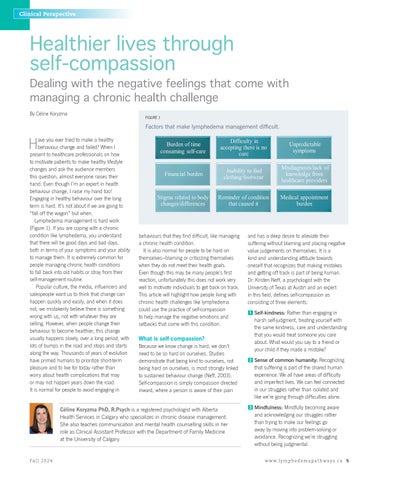
FIGURE 1
Factors that make lymphedema management difficult.
H
ave you ever tried to make a healthy behaviour change and failed? When I present to healthcare professionals on how to motivate patients to make healthy lifestyle changes and ask the audience members this question, almost everyone raises their hand. Even though I’m an expert in health behaviour change, I raise my hand too! Engaging in healthy behaviour over the long term is hard. It’s not about if we are going to “fall off the wagon” but when. Lymphedema management is hard work (Figure 1). If you are coping with a chronic condition like lymphedema, you understand that there will be good days and bad days, both in terms of your symptoms and your ability to manage them. It is extremely common for people managing chronic health conditions to fall back into old habits or stray from their self-management routine. Popular culture, the media, influencers and salespeople want us to think that change can happen quickly and easily, and when it does not, we mistakenly believe there is something wrong with us, not with whatever they are selling. However, when people change their behaviour to become healthier, this change usually happens slowly, over a long period, with lots of bumps in the road and stops and starts along the way. Thousands of years of evolution have primed humans to prioritize short-term pleasure and to live for today rather than worry about health complications that may or may not happen years down the road. It is normal for people to avoid engaging in
behaviours that they find difficult, like managing a chronic health condition. It is also normal for people to be hard on themselves—blaming or criticizing themselves when they do not meet their health goals. Even though this may be many people’s first reaction, unfortunately this does not work very well to motivate individuals to get back on track. This article will highlight how people living with chronic health challenges like lymphedema could use the practice of self-compassion to help manage the negative emotions and setbacks that come with this condition. What is self-compassion?
Because we know change is hard, we don’t need to be so hard on ourselves. Studies demonstrate that being kind to ourselves, not being hard on ourselves, is most strongly linked to sustained behaviour change (Neff, 2003). Self-compassion is simply compassion directed inward, where a person is aware of their pain
Céline Koryzma PhD, R.Psych is a registered psychologist with Alberta
Health Services in Calgary who specializes in chronic disease management. She also teaches communication and mental health counselling skills in her role as Clinical Assistant Professor with the Department of Family Medicine at the University of Calgary.
Fa l l 2 0 2 4
and has a deep desire to alleviate their suffering without blaming and placing negative value judgements on themselves. It is a kind and understanding attitude towards oneself that recognizes that making mistakes and getting off track is part of being human. Dr. Kristen Neff, a psychologist with the University of Texas at Austin and an expert in this field, defines self-compassion as consisting of three elements: 1S elf-kindness: Rather than engaging in
harsh self-judgment, treating yourself with the same kindness, care and understanding that you would treat someone you care about. What would you say to a friend or your child if they made a mistake? 2 Sense of common humanity: Recognizing
that suffering is part of the shared human experience. We all have areas of difficulty and imperfect lives. We can feel connected in our struggles rather than isolated and like we’re going through difficulties alone. 3M indfulness: Mindfully becoming aware
and acknowledging our struggles rather than trying to make our feelings go away by moving into problem-solving or avoidance. Recognizing we’re struggling without being judgmental. w w w. l y m p h e d e m a p a t h w a y s . c a 5
Self-compassionate people are more likely to face their health challenges headon. This means that they behave in ways to maintain or improve health.
Sometimes, people think being selfcompassionate means avoiding or ignoring difficult situations or letting oneself off the hook and doing whatever feels good at the moment, but self-compassion is something quite different. With self-compassion, we mindfully accept that the moment is painful and embrace
ourselves with kindness and care in response, remembering that imperfection is part of the shared human experience. Self-compassion is very different from self-indulgence. Many people say they are reluctant to be selfcompassionate because they are afraid they would let themselves get away with anything: “I’m stressed out today, so I’m going to stay in bed all day and not wear my compression garments.” This, however, is self-indulgence rather than self-compassion. Remember that being compassionate to oneself means that you want to be happy and healthy in the long term. In this case, showing yourself compassion may mean being understanding with yourself if you have stayed in bed longer than usual on a rough day, but also taking responsibility for your health and deciding to go for a short walk so you do not feel even worse later on. A growing body of research has demonstrated the benefits of self-compassion across a wide range of domains. People who are more selfcompassionate tend to have lower levels of depression and anxiety and higher levels of life satisfaction (Neff, 2003). Self-compassion has also been associated with positive outcomes and coping skills in people living with chronic disease (Semenchuk et al., 2022). When coping with a chronic condition like lymphedema, it is crucial for individuals to see themselves with some degree of kindness and compassion. Self-compassion can help individuals living with a chronic disease in several specific ways: Self-compassion helps people deal with the negative feelings that come with managing a chronic health challenge. Many chronic physical health conditions, especially those that require a lot of selfmanagement, have an impact on a person’s
mental health. Living with lymphedema can be emotionally frustrating. Challenging feelings like disappointment, sadness, anger and anxiety can understandably arise from the burden of time-consuming self-care, the unpredictability of the disease, and the impact of the condition on day-to-day activities, among other obstacles. Self-compassionate people show greater emotional resilience, which is the ability to adapt to stressful situations and cope with adversity (Semenchuk et al., 2022.) They tend to respond to challenges with more calmness and composure, which allows them to direct their attention towards healthier behaviours and coping strategies. In other words, they are able to respond thoughtfully to challenges rather than react hastily in ways that are not helpful in the long run. Practicing self-compassion helps people become more aware and mindful of their feelings and, therefore, less likely to become overwhelmed by them. Feeling better emotionally makes you more likely to engage in healthy behaviours. Self-compassionate individuals take a more proactive approach to their health. Self-compassion is a proactive coping strategy that helps people approach, rather than avoid, the difficult feelings, thoughts and actions that come with adverse life events like facing a chronic health condition. While it is normal to want to avoid thinking about and acting on a difficult challenge, avoidance often only makes the problem worse. Self-compassionate people are more likely to face their health challenges head-on. This means that they behave in ways to maintain or improve health, seek out medical attention more quickly, and are more likely to follow their healthcare provider’s recommendations (Terry, Leary, Mehta, & Henderson, 2013).
Look for the CLT-LANA credential because it matters! For more information, visit www.CLT-LANA.org
6 w w w. l y m p h e d e m a p a t h w a y s . c a
Fa l l 2 0 2 4
Practicing self-compassion helps people re-engage in healthy behaviours when they’ve encountered a setback. Providing comfort and validation to oneself is motivating and helps people move forward. Self-compassionate people are less likely to allow health setbacks to derail them entirely. They can better acknowledge and accept mistakes without dwelling on them (Zhang & Chen, 2015). Self-compassionate people may also feel less embarrassed or ashamed about their health condition because they keep in mind that many people suffer from chronic conditions and struggle to meet their health-related goals. The kindness and understanding they show themselves help them take responsibility for their missteps and be more honest with themselves and their healthcare providers about what needs to change to help get them back on track. How to practice self-compassion
Although some individuals may be naturally more self-compassionate, it is a skill that can be learned. Like any new skill, becoming more compassionate with yourself can seem strange or be difficult at first. If you’re used to beating yourself up when you don’t accomplish your health-relat-
ed goals, it may feel uncomfortable or even silly to show yourself kindness and understanding. As a health psychologist, patients often share with me the harsh and self-critical thoughts they have when they get off track. The point is not that you will never be self-critical again. Those “I’m not good enough” or “I got off track this time; I guess I’m a lazy person” thoughts might always be with you. The idea is to mindfully acknowledge them, “Wow, I’m being really hard on myself; I would never talk to a friend the way I talk to myself!” and to offer yourself compassion instead, “I know I didn’t incorporate as much movement as I planned to this week. I had a lot going on. It is hard balancing all my roles while also managing a chronic disease. A lot of people struggle with the same things that I do.” It may take some time to engage in compassionate self-talk in a way that feels authentic to you. There are guided practices you can find on Dr. Neff’s website that you may find helpful (www.self-compassion.org). Below are some basic steps for practicing self-compassion. – E xplore which words and phrases feel right for you.
Specialist Clinic for Lymphology
Because we know change is hard, we don’t need to be so hard on ourselves. Self-compassion helps us get back on track faster. This is a photo of my son when he was about 18 months old. He grabbed the maple syrup without me noticing, and safe to say he overdid it!
– Mindfully notice what you’re saying to yourself and if it’s unkind. – Try not to judge yourself for having these thoughts; we are all hard on ourselves. – Remind yourself that you are not alone and that many people experience health challenges. – Generate compassionate images and phrases by picturing what you would say to a dear friend or a child if they made a mistake or did not follow through.
Picturesque Black Forest mountain range in close proximity to Switzerland and France
European Center for Lymphology Strassburg
GERMANY
FRANCE
Do you suffer from lymphedema?
Freiburg
The Foeldi Clinic, European Center for Lymphology, in the Black Forest, Germany offers a special treatment.
SWITZERLAND
Basel
What we offer: 4 WEEKS
of intensive lymphological decongestive therapy includes: • Specialist medical care by experienced MD‘s • Daily decongestive therapy by our specialised lymphedema therapists (expert manual lymph drainage and bandaging) and many different decongestive movement therapies as part of group therapy • Wound treatment if necessary by our certified wound experts and psychological support if necessary by our psychotherapists • Accommodation and meals at the Foeldi Clinic
www.foeldiklinik.de/en/ Fa l l 2 0 2 4
Zürich
Price for a 4-week treatment: $15,000 USD (with accompanying person in the same room $20,000 USD)
Price for a 4-week outpatient treatment: $13,000 USD
Contact:
Dr. Tobias Bertsch Senior Consultant
tobias.bertsch@foeldiklinik.de
Transfer to and from Zurich or Frankfurt airport to the Foeldi Clinic
w w w. l y m p h e d e m a p a t h w a y s . c a 7
to accept yourself, build inner strength, and thrive—the Guilford Press. • L ee-Baggley, D. (2019). Healthy habits suck: How to get off the couch and live a healthy life…even if you don’t want to. New Harbinger Publications. LP
Some examples of selfcompassionate phrases include:
“I am having a hard time because this is hard, not because something is wrong with me. There will be good days and bad days.”
References
“If I’ve gotten off track, I can begin again. I forgive myself for my mistakes while I take responsibility for moving forward.” “I am having a difficult time accepting these changes in my body. I know other people with lymphedema are also struggling with this.” Self-compassion is a skill that can be started today and honed over time with practice that can help you keep up healthy habits that positively impact your lymphedema. Along with the self-compassion.org website, I recommend the following two resources for learning more about self-compassion and healthy behaviour change: • Neff, K., & Germer, C. (2018). The mindful self-compassion workbook: A proven way
•B reines, J.G., & Chen, S. (2012). Selfcompassion increases self-improvement motivation. Personality and Social Psychology Bulletin, 38(9), 1133-1143. https://doi.org /10.1177/0146167212445599. • F u, M.R., Ridner, S.H., Hu, S.H., Stewart, B.R., Cormier, J.N., & Armer, J.M. (2013). Psychosocial impact of lymphedema: A systematic review of literature from 20042011. Psychooncology, 22(7), 1466-1484. https://doi.org/10.1002/pon.3201. •G ilbert, P. (2009). Introducing compassionfocused therapy. Advances in Psychiatric Treatment, 15(3), 199-208. https://doi. org/10.1192/apt.bp.107.005264. •N eff, K.D. (2003). Self-compassion: An alternative conceptualization of a healthy attitude toward oneself. Self and Identity,
2(2), 85-101. https://doi.org/10.1080/ 15298860309032. •N eff, K., & Germer, C. (2018). The mindful self-compassion workbook: A proven way to accept yourself, build inner strength, and thrive. The Guilford Press. • S emenchuk, B.N., Kullman, S.M., Neilson, C.J., Ceccarelli, L., Boreskie, K., Kehler, D.S., Tutkaluke, T., Duhamel, T.A., & Strachan, S.M. (2022). Self-compassion, health behaviors, self-regulation, and affective states among individuals at risk of or diagnosed with a chronic disease: A scoping review. Mindfulness, 13, 1085-1111. https: //doi. org/10.1007/s12671-021-01821-3. • T erry, M.L., Leary, M. R., Mehta, S., & Henderson, K. (2013). Self-compassionate reactions to health threats. Personality and Social Psychology Bulletin, 39(7), 911-926. https://doi.org/10.1177/0146167213488213 • Z hang, J.W. & Chen, S. (2015). Selfcompassion promotes personal improvement from regret experiences via acceptance. Personality and Social Psychology Bulletin, 42(2), 244-258. https://doi. org/10.1177/014616721562327.
Tribute Wrap Bra NEW Off-the-shelf foam gradient compression garment. ®
Dr. Vodder School
TM
I N T E R N A T I O N A L M ember of Dr. Vodder Academy I nter national
Lymphedema management
Train in Canada
ONLINE Level 1 Theory Available
Visit our website for classes:
~ Evidence-based
with certified instructors Calgary Halifax London Montreal Ottawa Saskatoon Toronto Vancouver Winnipeg
~ Easy learning modules with small class sizes
SCAN TO LEARN MORE
~ Interactive, live classroom instruction with physicians ~ Learn precise manual skills with expert, accredited instructors ~ ISO 29990: 2010 certified training ~ CE credit available
www.vodderschool.com AND COMBINED DECONGESTIVE THERAPY
8 w w w. l y m p h e d e m a p a t h w a y s . c a
www.Lohmann-Rauscher.ca
1-888-836-6726 · inquiries@ca.LRmed.com
3001
info@vodderschool.com | 800-522-9862
PROFESSIONAL TRAINING IN MANUAL LYMPH DRAINAGE
Fa l l 2 0 2 4