Quiet strength: My life with chronic illness
By Helen Klassen
Iwasborn with Klippel-Trenaunay Syndrome, a rare vascular condition that causes abnormal blood vessels, tissue changes, and distinctive birthmarks, usually affecting a limb. In my case, birthmarks covered much of my lower body, my hands, and parts of my arms. For many years, no one could fully explain what was happening in my body. What I did know growing up was that I looked different. Those visible differences shaped much of my childhood and young adulthood. I became deeply self-conscious, doing everything I could to hide my birthmarks. I worried people would notice, worried about questions, worried about standing out. That quiet fear made me shy and hesitant, and it followed me for decades. Looking back, I spent so much energy managing how others might perceive me that I had very little left to simply live.
It wasn’t until my 30s that I first heard the words KlippelTrenaunay Syndrome. That moment began a long journey of understanding my own body. Learning the condition was not genetic brought tremendous relief when I thought about having a child. But it also raised difficult questions. I sometimes wondered whether knowing earlier might have helped me manage my health differently or slow some of the
changes already underway. There is a particular kind of grief that comes with a late diagnosis: mourning the years spent searching, the treatments never tried, the understanding that arrived too late to change certain things. Still, having answers for the first time gave me something I had never had before, a starting point.
As the years passed, my body changed in ways that became impossible to ignore. Pain increased. Swelling worsened. My legs felt heavy and achy, and fatigue became a constant companion. What had once seemed manageable began to demand much more of my time, energy, and attention.
A turning point came during an appointment with a compression stocking fitter, where I learned I had been wearing the wrong garments for years. Around that same time, I was introduced to the concept of lymphedema — and so much finally made sense. Eventually, a physician helped connect the remaining pieces: I was living with both a form of primary lymphedema as well as phlebolymphedema, a chronic condition in which both the venous and lymphatic systems are unable to move fluid effectively, causing persistent swelling and progressive tissue changes.
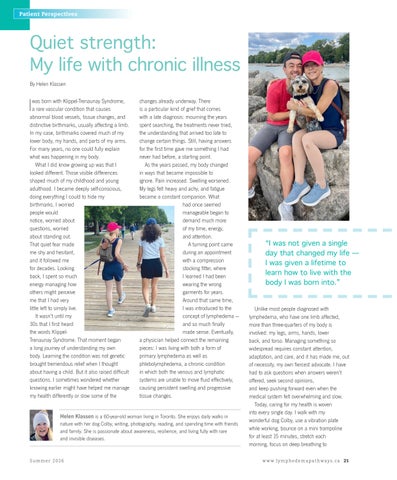
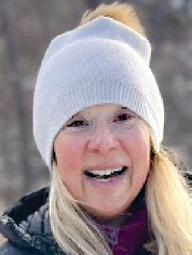
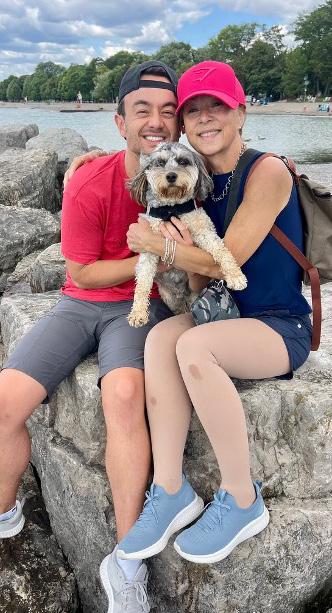
Helen Klassen is a 60-year-old woman living in Toronto. She enjoys daily walks in nature with her dog Colby, writing, photography, reading, and spending time with friends and family. She is passionate about awareness, resilience, and living fully with rare and invisible diseases.
“I was not given a single day that changed my life — I was given a lifetime to learn how to live with the body I was born into.”
Unlike most people diagnosed with lymphedema, who have one limb affected, more than three-quarters of my body is involved: my legs, arms, hands, lower back, and torso. Managing something so widespread requires constant attention, adaptation, and care, and it has made me, out of necessity, my own fiercest advocate. I have had to ask questions when answers weren’t offered, seek second opinions, and keep pushing forward even when the medical system felt overwhelming and slow.
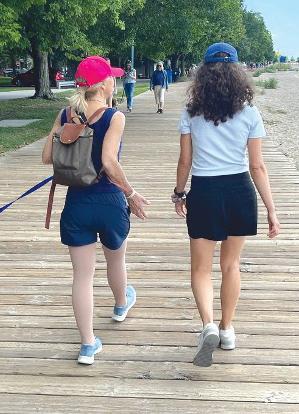
Today, caring for my health is woven into every single day. I walk with my wonderful dog Colby, use a vibration plate while working, bounce on a mini trampoline for at least 15 minutes, stretch each morning, focus on deep breathing to
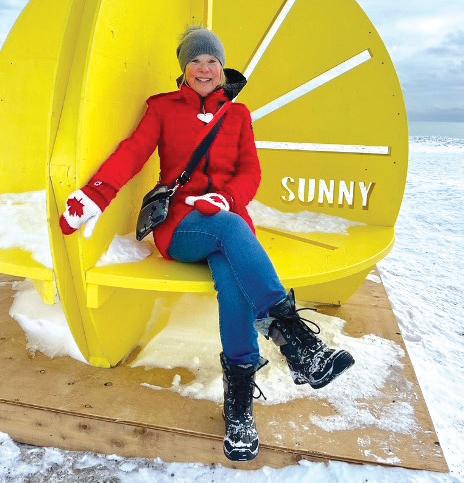
Looking back, I spent so much energy managing how others might perceive me that I had very little left to simply live.
support lymphatic flow, and attend regular lymphatic drainage appointments. When I can, I go cold-water swimming. For me, none of these are optional extras. They are the foundation my body depends on. It sometimes feels like I’ve been signed up for an Ironman Competition without my consent, one that never ends. Whether I like it or not, I keep going.
Unlike a sudden health crisis that may eventually pass, chronic illness doesn’t offer a return to “before.” Instead, it asks us to build a new normal, one that includes pain, limitations, and uncertainty, but also reveals a resilience we didn’t know we had. The
goalposts shift. What counts as a good day changes. And slowly, you learn to find wins in places you never thought to look.
There are days when that reality feels heavy. I cancel plans, rest more than I’d like, and accept that my body sometimes needs something different than what my mind had hoped for. Learning to listen to those signals, without guilt, without frustration, has been one of the hardest lessons of my life. Chronic illness asks a great deal of patience, and most days I am still learning how to offer that patience to myself.
But I have also discovered how much small moments matter. Walking outside with my dog, feeling the sun on my face, breathing deeply, letting my mind go quiet for a little while, these things bring a surprising, gentle peace. They remind me that even within the constraints of chronic illness, life still offers something worth pausing for.
And beyond my health, life brings its other challenges too: caring for an aging parent, navigating divorce, and all the upheaval that comes with it. Chronic illness has taught me
to loosen my grip on what I can’t control. Because my body is fragile and unpredictable, I’ve had to accept that if things don’t go perfectly, I cannot beat myself up over it. Sometimes “good enough” truly is enough. Showing myself grace has become just as essential as any treatment I follow.
For many years I hid my body because I felt different. Now I try to live more openly. My condition is part of who I am, but it is not the whole story. I am still a mother, a friend, a daughter, a sister, an aunt, and someone who finds deep joy in nature, laughter, and connection. I want to keep spending real, quality time with my adult son. I want to keep noticing the small, ordinary moments that make life feel full and meaningful.
Living with rare and invisible diseases can feel profoundly isolating, as though the rest of the world simply cannot understand what your daily life costs you. That’s exactly why sharing our stories matters. When I read about someone else’s journey, how they cope, how they adapt, how they keep going on the hard days, it reminds me I am not alone. I hope that reading this does the same for someone else. We may not have chosen these lives, but we are not living them alone.
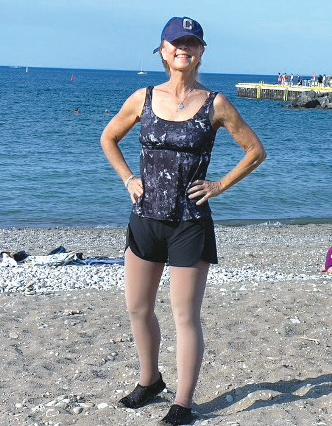
I did not choose this journey. But it has taught me patience, resilience, and a way of caring for myself I never expected to need and never expected to value so deeply. Each day, I remind myself: even a life shaped by chronic illness can still be lived with hope, gratitude, and quiet strength. LP