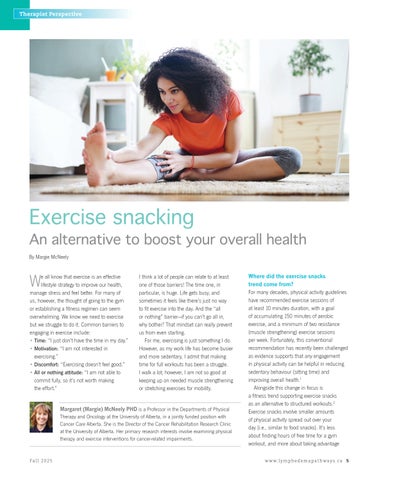

Exercise snacking
An alternative to boost your overall health
By Margie McNeely
Weall know that exercise is an effective lifestyle strategy to improve our health, manage stress and feel better. For many of us, however, the thought of going to the gym or establishing a fitness regimen can seem overwhelming. We know we need to exercise but we struggle to do it. Common barriers to engaging in exercise include:
• Time: “I just don’t have the time in my day.”
• Motivation: “I am not interested in exercising.”
• Discomfort: “Exercising doesn’t feel good.”
• All or nothing attitude: “I am not able to commit fully, so it’s not worth making the effort.”

I think a lot of people can relate to at least one of those barriers! The time one, in particular, is huge. Life gets busy, and sometimes it feels like there’s just no way to fit exercise into the day. And the “all or nothing” barrier—if you can’t go all in, why bother? That mindset can really prevent us from even starting.
For me, exercising is just something I do. However, as my work life has become busier and more sedentary, I admit that making time for full workouts has been a struggle. I walk a lot; however, I am not so good at keeping up on needed muscle strengthening or stretching exercises for mobility.
Margaret (Margie) McNeely PHD is a Professor in the Departments of Physical Therapy and Oncology at the University of Alberta, in a jointly funded position with Cancer Care Alberta. She is the Director of the Cancer Rehabilitation Research Clinic at the University of Alberta. Her primary research interests involve examining physical therapy and exercise interventions for cancer-related impairments.
Where did the exercise snacks trend come from?
For many decades, physical activity guidelines have recommended exercise sessions of at least 10 minutes duration, with a goal of accumulating 150 minutes of aerobic exercise, and a minimum of two resistance (muscle strengthening) exercise sessions per week. Fortunately, this conventional recommendation has recently been challenged as evidence supports that any engagement in physical activity can be helpful in reducing sedentary behaviour (sitting time) and improving overall health.1
Alongside this change in focus is a fitness trend supporting exercise snacks as an alternative to structured workouts.2 Exercise snacks involve smaller amounts of physical activity spread out over your day (i.e., similar to food snacks). It’s less about finding hours of free time for a gym workout, and more about taking advantage
of those little moments throughout the day. Exercise snacks were originally proposed in 2007, almost 20 years ago, as a strategy to encourage sedentary individuals to increase their overall physical activity.2 In 2014, research studies started investigating exercise snacks as a means to control blood glucose levels (sugar levels) in individuals at risk of diabetes.2
What exactly is an exercise snack?
An exercise snack is a short burst of physical activity, typically lasting between 20 seconds to one minute.3,4 The idea is to integrate short bouts of exercise into your daily routine, making it easier for you to stay active, especially if you have a busy schedule. An exercise snack can be extended to even a 10-minute bout, as a mini workout. My preference, however, is for the shorter time options which are convenient, don’t require any special equipment, and can be done anywhere. You can use your own body weight, household items (i.e., soup cans, broom stick) and everyday surroundings for exercises (i.e., support of a wall or counter). Exercise snacks feel easy compared to longer workouts. As such, they do not feel like a burden and can help address barriers of motivation and discomfort.3
Do exercise snacks work?
Research evidence suggests that exercise snacks are well tolerated and can help offset the harmful effects of prolonged sitting on health.4-5 Notably, studies have found that even brief, high-intensity exercises can yield benefits comparable to longer sessions when performed consistently. Moreover, benefits have been shown for both cardiovascular (i.e., heart and lungs) and metabolic health (i.e., maintaining optimal levels of blood sugar, blood pressure, and cholesterol levels) through both laboratorybased trials and more practical lifestyle studies involving activities such as stair climbing.2,6-7 More recent evidence highlights the benefits of various forms of exercise snacks, such as resistance exercise snacks, which have been shown to improve muscular strength and mobility as well as movement capacity in older adults.8,9 Exercise snacks have also been used as a therapeutic strategy to reduce pain in individuals with neck and shoulder issues.3-4
Is there evidence for lymphedema?
While no studies have specifically examined the impact of exercise snacks on lymphedema, it is well established that exercise is beneficial for lymphedema.10 In principle, any form of movement can help stimulate the lymphatic system, and incorporating more frequent, short exercise sessions may offer therapeutic benefits for individuals with lymphedema.
How do I add exercise snacks to my day?
While the evidence is still emerging, here are some ideas for starting:
1 Check with your health professional if you want to do higher intensity activity If you are not currently active, it is important to first check with your health professional about what is safe and appropriate for you to do. If you can’t easily see your health professional, you can start by simply taking a few walks scattered throughout the day or adding some laps in the office hallway. Once your healthcare provider gives you the go ahead for higher intensity activity, incorporate focused exercise sessions to increase your heart rate, build muscle, and/or support your lymphatic system!
2 Decide the specific health benefit you want to target I suggest you pick a specific target to start, as you will more likely see benefit sooner. Examples include:
a) Improve your cardiovascular (aerobic) health: Short, intense activities such as marching on the spot, climbing stairs, and dancing can improve heart health and blood circulation.
b) Improve your muscle strength and endurance: Repeated exercises that target different muscle groups such as arm curls, sit-to-stands, and leg extensions, can improve overall strength and endurance. Start by picking exercises that you can do, ones that do not cause increased muscle or joint pain or discomfort.
•Improve your lymphatic system function: Exercises such as repeated shoulder shrugs, deep diaphragmatic breathing, arm curls (arm lymphedema) or heel and toe raises, leg extensions and calf muscle pumps (leg lymphedema) are simple exercises that can help stimulate the lymphatic system.
Editor’s Note:
Refer to previous Pathways practical exercise articles on exercises:
• Upper extremity lymphedema.
https://issuu.com/ canadianlymphedema framework/docs/remedial_exercises_ for_upper_extremity_lymphedema
• Lower extremity lymphedema. https://issuu.com/ canadianlymphedema framework/docs/remedial_exercises_ for_lower_leg_lymphedema._m._ib
Decide on the time for each session
a) If you are choosing an aerobic activity, such as marching, you may want to start with a shorter duration of 20-30 seconds. Make sure you are not out-of-breath and can continue to talk when exercising.
b) If you are doing a strengthening exercise, such as a chair sit-to-stand or squat exercise, start with around 30-40 seconds, and pace yourself.
c) If you prefer to complete therapeutic exercise for your lymphedema, you may want to consider a longer session of 40-60 seconds. Ensure the movement is controlled, as you both contract and slowly relax the muscle.
3 Decide on the frequency of your exercise snacks
The frequency of exercise snacks is higher compared with more traditional workout approaches. The key here is to do repeated sessions frequently throughout the day. A great starting point is to schedule three sessions a day for the first few weeks. Build to five sessions, and then eventually a goal of 8-10 if possible!
4 Set reminders
As with any strategy, you will likely need a cue or reminder to remember to perform your exercise snack sessions. You can program your smart watch, phone or computer calendar to send reminders at key times during the day (there are also apps that can be used). If you do not use technology, place notes in key places in your home or office as cues to exercise. Alternatively, you can simply
incorporate your exercise snack alongside regular activities such as bathroom or food breaks during your day.
In summary, rather than seeing exercise as an obligation or a chore, you can reframe exercise as a means to feel better. Keep it simple by working exercise snacks into your daily routine. The best part is that you don’t have to turn your whole life upside down. Instead, you can take small steps to start living a healthier lifestyle. LP
References
1. Piercy, K.L., et al., The Physical Activity Guidelines for Americans. Jama, 2018. 320(19): p. 2020-2028.
2. Islam, H., M.J. Gibala, and J.P. Little, Exercise Snacks: A Novel Strategy to Improve Cardiometabolic Health. Exerc Sport Sci Rev, 2022. 50(1): p. 31-37.
3. Du, Y., et al., Perceptions and Experiences of Exercise Snacks Among Middle-Aged and Older Adults: A Systematic Review and
Meta-Synthesis. Public Health Nurs, 2025. 42(2): p. 1031-1046.
4. Wang, T., I. Laher, and S. Li, Exercise snacks and physical fitness in sedentary populations. Sports Med Health Sci, 2025. 7(1): p. 1-7.
5. Wu, J., et al., Associations of exercise snacks with cognitive function among older adults in NHANES 2011-2014. Gen Hosp Psychiatry, 2025. 94: p. 167-173.
6. Jenkins, D.G., et al., Benefits beyond cardiometabolic health: the potential of frequent high intensity ‘exercise snacks’ to improve outcomes for those living with and beyond cancer. J Physiol, 2023. 601(21): p. 4691-4697.
7. Jenkins, E.M., et al., Do stair climbing exercise “snacks” improve cardiorespiratory fitness? Appl Physiol Nutr Metab, 2019. 44(6): p. 681-684.
8. Nuzzo, J.L., et al., Resistance Exercise Minimal Dose Strategies for Increasing
Research evidence suggests that exercise snacks are well tolerated and can help offset the harmful effects of prolonged sitting on health.4-5
Muscle Strength in the General Population: an Overview. Sports Med, 2024. 54(5): p. 1139-1162.
9. Brown, N.I., et al., Health-Related Benefits and Adherence for Multiple Short Bouts of Aerobic Physical Activity Among Adults. Am J Lifestyle Med, 2025. 19(1): p. 58-72.
10. Hayes, S.C., et al., The Effect of Exercise for the Prevention and Treatment of CancerRelated Lymphedema: A Systematic Review with Meta-analysis. Med Sci Sports Exerc, 2022. 54(8): p. 1389-1399.
How to cite: McNeely M. Exercise snacking. An alternative to boost your overall health. Pathways. 2025;14(4): 5-7. DOI:https://doi.org/ 10.70472/RCOZ7006


Practitioners, How Confident Are You in Evaluating and Treating Lymphedema or Lymphatic Dysfunction During Pregnancy or the Post-Partum Period?
The training for lymphedema associated with cancer, venous disease, and primary dysfunctions is fairly standard across programs. The amount and type of training for pregnancy and post-partum concerns are not as consistent. Please consider volunteering to take part in a short international survey to help us gain insight into the training, confidence levels, and educational needs of health care practitioners to provide safe and effective treatment for these two subsets! The survey is available in 10 languages. The hope is that the information gained from this study will help shape future lymphedema training for practitioners!




www.surveymonkey.com/r/88YMD3M IRB Protocol #H24-047X | This is a paid advertisement