FALL 2026
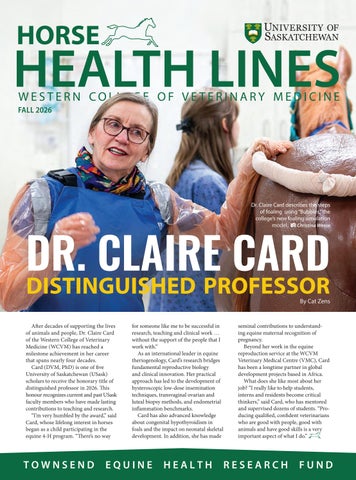
Dr. Claire Card describes the steps of foaling using “Bubbles,” the college’s new foaling simulation model. Christina Weese
DR. CLAIRE CARD DISTINGUISHED PROFESSOR
By Cat Zens
After decades of supporting the lives of animals and people, Dr. Claire Card of the Western College of Veterinary Medicine (WCVM) has reached a milestone achievement in her career that spans nearly four decades. Card (DVM, PhD) is one of five University of Saskatchewan (USask) scholars to receive the honorary title of distinguished professor in 2026. This honour recognizes current and past USask faculty members who have made lasting contributions to teaching and research. “I’m very humbled by the award,” said Card, whose lifelong interest in horses began as a child participating in the equine 4-H program. “There’s no way
for someone like me to be successful in research, teaching and clinical work … without the support of the people that I work with.” As an international leader in equine theriogenology, Card’s research bridges fundamental reproductive biology and clinical innovation. Her practical approach has led to the development of hysteroscopic low-dose insemination techniques, transvaginal ovarian and luteal biopsy methods, and endometrial inflammation benchmarks. Card has also advanced knowledge about congenital hypothyroidism in foals and the impact on neonatal skeletal development. In addition, she has made
seminal contributions to understanding equine maternal recognition of pregnancy. Beyond her work in the equine reproduction service at the WCVM Veterinary Medical Centre (VMC), Card has been a longtime partner in global development projects based in Africa. What does she like most about her job? “I really like to help students, interns and residents become critical thinkers,” said Card, who has mentored and supervised dozens of students. “Producing qualified, confident veterinarians who are good with people, good with animals and have good skills is a very important aspect of what I do.”
NURTURING HORSE HEALTH Myrna MacDonald
Horse Health Lines is the news publication for the Western College of Veterinary Medicine’s Townsend Equine Health Research Fund (TEHRF). Visit tehrf.ca for more information. Send comments and article reprint requests to: Myrna MacDonald, Editor Horse Health Lines WCVM, University of Saskatchewan 52 Campus Drive, Saskatoon, SK S7N 5B4 horse.health@usask.ca Horse Health Lines design and layout: Priddy Design 2
HORSE HEALTH LINES
|
Fall 2026
Horse health-focused scientists and graduate students at the Western College of Veterinary Medicine (WCVM) will receive more than $177,400 to support the college’s research projects and specialized training over the next 12 months.
Of those funds, more than $106,540 supports five equine health research projects led by WCVM faculty members. The remaining funds — nearly $71,000 — are allocated to a summer research student position as well as tuition awards for seven graduate students who are conducting equine health investigations at the veterinary college. Most of the funding comes from the WCVM’s longtime Townsend Equine Health Research Fund (TEHRF), which receives donations from a wide range of people and organizations across Western Canada. An additional funding source is the estate of Kathleen Stinson, which supports an annual $20,000 award for the college’s top equine-focused graduate student.
Put your horse health knowledge to the test!
RESEARCH PROJECTS How does endurance racing affect the release of cardiac troponin I in horses from Saskatchewan? Dr. Vanessa Cowan and Jon Morton, WCVM
WCVM researchers aim to implement a stall-side analyzer that rapidly detects elevated levels of a protein called cardiac troponin I, a sensitive indicator of heart disease.
How does iodine affect the skeletal development of foals? Dr. Sally Sukut, WCVM
This study will help veterinarians develop a better understanding of how the presence and levels of iodine affect the development of foals’ skeletal systems so they can recognize disorders more quickly.
How can a new in vitro model help veterinarians better understand equine pregnancy? Dr. Claire Card, WCVM
WCVM scientists are working to develop a cost-effective in vitro model for studying the earliest stages of equine pregnancy that will help identify the factors contributing to increased reproductive success.
Can a new AI tool keep veterinarians safe from ergonomic strain and injury? Drs. James Carmalt and Monique Mayer, WCVM
WCVM researchers plan to use artificial intelligence (AI) tools to identify the ergonomic risks associated with lameness examinations — information that will help to improve veterinarians’ safety. Read more on page 4.
Is there a better way to diagnose tapeworm infection in horses? Drs. Emily Jenkins, Michelle Husulak, Muhammad Asjad and Tasha Epp, WCVM
WCVM scientists will use molecular diagnostic techniques to develop a more accurate fecal test for detecting tapeworms, which cause poor health and potential colic in affected horses.
Read over the following statements and decide: fact or fiction? Check out the answers on page 7 (inside back cover).
“It’s okay to leave the hose in my horse’s water bucket. Water cleans everything!”
“My horse looks healthy, but he still could be infected.”
“Horse diseases can only be transmitted through direct horse-to-horse contact.”
“My horse reacts to vaccines, so it’s better for his health not to be vaccinated.”
STUDENT AWARDS Summer research award Johanna Brochhagen of Nelson, B.C. (WCVM Class of 2029). Research mentor: Dr. Claire Card. Brochhagen helped to investigate the equine placenta’s role in iodine storage and regulation during a mare’s pregnancy. The study is part of an overall research initiative targeting congenital hypothyroidism in foals.
Graduate tuition awards Dr. Josefina Ghersa of Argentina is completing a combined Master of Science (MSc)-equine theriogenology residency program under the supervision of Dr. Claire Card. Research focus: maternal recognition of pregnancy. Dr. Carolina Emparanza of Chile is enrolled in a combined MSc-equine theriogenology residency program, supervised by Drs. Claire Card and Sally Sukut. Research focus: congenital hypothyroidism in foals. Dr. Mónica Arévalo Naranjo of Ecuador is completing a combined MSc-large animal medicine residency program
under the supervision of Dr. Fabienne Uehlinger. Research focus: antimicrobial resistance in horses. Dr. Daniel Lopez Mauriello of Venezuela is completing a combined MSc-large animal surgical residency program under the supervision of Dr. James Carmalt. Research focus: orthopedic surgery in horses. Dr. Muhammad Asjad is completing a combined MSc-equine field service residency program under the supervision of Dr. Michelle Husulak. Research focus: parasite management in horses.
Kathleen Stinson Research Fellowship Dr. Alannah Friedlund of Fiske, Sask., has received the $20,000 scholarship in support of her research focusing on the efficacy of fish skin grafts for treating lower-limb wounds in horses. Friedlund is a MSc student and large animal surgical resident supervised by Dr. Keri Thomas in the WCVM Department of Large Animal Clinical Sciences. Fall 2026
|
HORSE HEALTH LINES
3
By Lucas Horsman
Veterinarians put themselves at risk for injury when conducting diagnostic procedures like the flexion test. Christina Weese
An artificial intelligence (AI) tool designed to assess ergonomic risks may help large animal veterinarians stay healthy — and longer — on the job. The dangers of poor posture aren’t typically included in veterinary students’ training, but Dr. James Carmalt (VetMB, PhD) knows from experience that the risk for ergonomic injury is high for him and other large animal veterinarians. “Physical injury or wear and tear is the cause of a substantial portion of large animal vets leaving the profession early,” said Carmalt, a professor of large animal surgery at the Western College of Veterinary Medicine (WCVM). “Rotator cuff and back injuries are extremely common in large animal medicine.” Carmalt and his WCVM colleague, Dr. Monique Mayer (DVM), have partnered with Drs. Niels Koehncke (MD) and
Visit tehrf.ca to read full story. 4
HORSE HEALTH LINES
|
Fall 2026
Angelica Lang (PhD) from the University of Saskatchewan’s College of Medicine to examine a potential solution: an AI program called TuMeke Ergonomics. Supported by the WCVM Townsend Equine Health Research Fund, this study is among the first to examine the merits of ergonomics AI in equine medicine. The program’s potential intrigues Carmalt who knows how often large animal veterinarians place themselves in harm’s way. “You try and do the job but also give yourself room to escape,” he said. “[When] I go to pick up the hind leg, I know my posture is poor but that’s only because I’m trying to protect myself if the animal kicks out. You’re making a compromise between getting the job done and your body posture.” Carmalt and Mayer’s study focuses on equine lameness exams due to the abnormally high ergonomic risk of this diagnostic procedure. During a lameness exam, the veterinarian first evaluates the
animal’s gait at a distance and looks for signs of lameness. The veterinarian then performs flexion tests, picking up each of the horse’s limbs and placing additional pressure on particular joints to isolate painful areas. The flexion test is the step that is most concerning to Carmalt and others. Pain can cause the animal to behave erratically or shift its weight unexpectedly. “The horse may hold its own leg up ... then without warning, they’ll shift their weight and you get an extra 20 kilograms [of weight] ... the unpredictability is the biggest risk factor,” said Carmalt. In this WCVM study, researchers will upload videos of veterinarians performing lameness exams to TuMeke’s three-dimensional ergonomics assessment program (Risk Suite). The program analyzes each video, then places a small visualization of the veterinarian’s skeletal system over top of their body, with separate parts representing arms, back and legs. If the program detects poor posture, the colour of affected body parts change. Carmalt and Mayer hope their study’s findings will help to protect current and future veterinarians from ergonomic strain. “We’re hoping to come up with suggestions about the body positions that clinicians can assume during flexion tests,” Carmalt said. “We want to say, ‘If you are going to do a flexion test of the horse’s carpus, this is the most ergonomic position.’” Mayer hopes that studies like this one will validate the need for targeted ergonomic training in veterinary curriculums. “Here we’re going to identify it, quantify it and hopefully raise awareness,” she said.
inspired by love of animals By Jessica Colby
Dr. June Donaldson’s (MBA, EdD) relationship with the Western College of Veterinary Medicine (WCVM) began in 2024 when she gave a special gift for the BJ Hughes Centre for Clinical Learning. After touring the veterinary college and its simulation centre in October 2024, Donaldson worked with the WCVM to develop a full-size mare and foal simulation model that she was invited to name as part of her donation. Donaldson chose the name Bubbles for the mare and Biscuit for her foal. “It is one of the most gratifying actions of my life,” said Donaldson, whose models were delivered as a surprise Christmas gift to the college later that year. The mare’s namesake was a horse from Donaldson’s childhood, while the foal’s name celebrates the great racehorse Seabiscuit, whose nickname was Biscuit. “I want veterinary students to enter their careers self-assured that they know how to safely deliver a foal while protecting the mare, no matter the circumstances they face in the field and on the ground,” said Donaldson. “It makes me happy to know students can learn in a no-stress, supportive and kind learning environment.” Donaldson loved her experience of giving to the college so much that she decided to set up a planned gift to the WCVM through her will. “It became crystal clear that first, I wanted my assets to create goodness, and second, to live on,” said Donaldson, who was inspired to give to the veterinary college because of all the pets she’s had in her life.
Donor Dr. June Donaldson (right) with “Bubbles” and Melissa Marshall Mann, WCVM’s director of development. Christina Weese
Ever since she was a little girl, Donaldson has had a great love for horses, which she describes as “bound into her DNA.” When she initially reached out to the University of Saskatchewan to donate, Donaldson met Melissa Marshall Mann, the WCVM’s director of development. “When someone chooses to leave a legacy gift to the WCVM, they are helping us to ensure that the future of animal health and our ability to train veterinarians stays bright,” said Marshall Mann. Planned gift donations can support many different areas of the veterinary college including equipment purchases, student awards and specific programs. “The process of WCVM giving was made easy and fun by the compassion and proficiency of all staff. At my request, they even provided the gifting narrative for my lawyer and will, thus ensuring my wishes are clear, concise, specific and actionable,” said Donaldson.
“Everyone involved wanted to ensure my previous gifts, and now my future gifts are and will be treated in a similar manner that is gratifying to me as a donor and helpful to the college and their students not only for today, but for generations to come.” In addition to leaving a gift to the WCVM in a will, donors can arrange for a legacy gift through life insurance, a tax-free savings account (TFSA) or a registered education savings plan (RESP). Donaldson knows what she is doing for the WCVM is the right choice for her. “I can sleep at night knowing what I have done will provide goodness in the form of learning by thousands of veterinary students who attend the WCVM,” said Donaldson. “And I’m not done yet!” Interested in leaving a planned gift to the WCVM? Contact the WCVM development team (wcvm.supportus@usask.ca) for more information.
Visit tehrf.ca to read full story. Fall 2026
|
HORSE HEALTH LINES
5
ON THE EQUINE VET TRACK
RESEARCH IN PRINT A round up of WCVM-related equine research articles that were recently published in peer-reviewed journals. Ghersa J, Itogawa L, Gesy KM, Emparanza C, MacPhee DJ, Card CE. “Estradiol and extracellular vesicle secretion by equine trophoblastic vesicles.” Journal of Equine Veterinary Science. Sept. 2026. doi: 10.1016/j.jevs.2026.105975. Lopez DE, Carmalt JL. “Ultrasound guidance aids in determining the success of equine temporomandibular joint arthrocentesis.” Frontiers of Veterinary Science. May 2026. doi: 10.3389/fvets. Kellerer L, Conn KL. “Nucleolar proteins nucleolin and nucleophosmin 1 differentially relocalize during equid alphaherpesvirus 1 (EHV1) infection.” Veterinary Research Communications. March 2026. doi: 10.1007/s11259-026-11187-3. Viviani P, Ragno VM, Parker S, Montgomery JB. “Assessment of baseline adrenocorticotropic hormone and insulin concentrations in healthy horses in Saskatchewan over a one-year period.” Journal of Veterinary Internal Medicine. Jan. 2026. doi: 10.1093/jvimsj/aalaf056. Schmitz M, Neugebauer E, Full F, Conn KL. “Cross-species analysis of transcriptomic response to alpha-herpesvirus infection in human, bovine and equine cells.” International Journal of Molecular Science. Jan. 2026. doi: 10.3390/ ijms27031261.
Visit tehrf.ca for more news updates. 6
HORSE HEALTH LINES
|
Fall 2026
Seven new WCVM graduates are gaining valuable horse health experience by completing one-year clinical internships at equinefocused veterinary practices across Western Canada and the United States. As well, WCVM graduate Dr. Jessica Kotelnikoff is a new veterinarian at Rhythm Equine Veterinary Services in Saskatoon, Sask. • Dr. Lauren Bailey, Victoria, B.C.: clinical intern, Idaho Equine Hospital, Nampa, Idaho. • Dr. Emma Boroditsky, Winnipeg, Man.: clinical intern, Montana Equine Medical and Surgical Center, Three Forks, Mont. • Dr. Francisco Gomez Cruz, Caguas, Puerto Rico: clinical intern, Rood and Riddle Equine Hospital, Wellington, Fla. • Dr. Georgia Hurry, Summerland, B.C.: clinical intern, Elders Equine, Winnipeg, Man. • Dr. Marilyn Mullan-Fraser, Courtenay, B.C.: clinical intern, Paton and Martin Veterinary Service, Langley, B.C. • Dr. Katrina Van Woudenberg, Aldergrove, B.C.: clinical intern, Burwash Equine Services, Cochrane, Alta. • Dr. Brianna Whatley, Abbotsford, B.C.: clinical intern, Palm Beach Equine Clinic, Wellington, Fla.
NEW OVC DEAN Dr. Julia Montgomery, an adjunct professor in the WCVM’s Department of Large Animal Clinical Sciences, began her new role as dean of the Ontario Veterinary College on June 15. Montgomery moved to the University of Guelph after serving two years as professor and department head of veterinary Dr. Julia Montgomery clinical sciences at Oklahoma State University. Before moving south of the border, Montgomery spent more than a decade as a WCVM faculty member and made many contributions to the college’s academic, research and clinical programs. A specialist in large animal internal medicine, Montgomery’s equine research projects focused on asthma, metabolic syndrome, laminitis and rehabilitation. Several of her projects also focus on innovative technologies to advance both animal and human health.
EQUINE AWARDS Dr. Lauren Bailey of Victoria, B.C., was the 2026 recipient of the Saskatchewan Speed Horses Association (SSHA) Award during the WCVM’s spring awards program on June 3. The annual award recognizes a veterinary graduate who demonstrates exceptional patient advocacy and compassionate care during their Dr. Lauren Bailey final-year equine clinical rotations. Bailey received the $3,635 scholarship from Ken McFarlane, a past member of the quarter horse racing organization that ceased activity in 2010. Dr. Josefina Ghersa, who is completing a combined MScresidency program at the WCVM, received the $2,000 Clinical Teaching Award during the college’s spring awards program. Originally from Argentina, Ghersa is an equine theriogenology resident whose work is supervised by Dr. Claire Card, professor and researcher in the WCVM’s Department of Large Animal Clinical Sciences. Ghersa received Dr. Josefina Ghersa her master’s degree at the 2026 USask Spring Convocation after successfully defending her thesis that focused on the role and use of extracellular vesicles in equine pregnancy recognition. Dr. James Carmalt, professor of large animal surgery in the WCVM’s Department of Large Animal Clinical Sciences, was the 2026 recipient of the Stan Olson Clinical Professor of the Year award — the college’s most prestigious honour for faculty members. Recipients of this annual award are chosen by a majority vote of the WCVM’s fourth-year class. Carmalt, who has been part of the college’s faculty since 2007, Dr. James Carmalt is leaving at the end of August. His next move is to Germany where he and his wife, Dr. Nathalie Reisbig, will operate Equi-CaRe, a mobile equine veterinary specialty practice. While the college and Western Canada’s horse community will miss Carmalt and his equine expertise, he will remain connected to the WCVM as a professor emeritus and research collaborator on future research projects.
ANSWERS “It’s okay to leave the hose in my horse’s water bucket. Water cleans everything!” When you fill your horse’s water buckets, do not leave a shared water hose or nozzle in your bucket. Shared water hoses and nozzles can be a major culprit in the spread of infectious diseases among horses. If you can’t directly fill your bucket from the faucet, wipe the hose end with a disinfectant wipe, hold the hose above the water bucket, and then fill your bucket. If you don’t have a disinfectant wipe, holding the hose above the bucket will still help protect your horse.
“Horse diseases can only be transmitted through direct horse-to-horse contact.” Horse diseases can also be transmitted through contaminated tools such as brushes and tack, stable surfaces, feed, water and humans. How can you prevent infection? Make sure that your horse has its own feed and water buckets, tack and grooming equipment. Plus, label all equipment (including pitchforks and manure buckets) to prevent shared equipment use between horses.
“My horse looks healthy, but he still could be infected.” A horse that looks “healthy” on the outside isn’t always disease-free. Some diseases or conditions can exist without showing obvious clinical signs or symptoms. Certain diseases can cause what’s called subclinical infections in horses. Although they appear healthy, these infected horses can incubate and shed the disease agent into the environment through their nasal secretions, respiratory droplets and feces.
“My horse reacts to vaccines, so it’s better for his health not to be vaccinated.” Vaccines are very important for protecting the health of your horse and the health of other horses around you. Consult your veterinarian to develop a vaccination plan that’s tailored to your horse’s health history, how often your horse travels, the types of events you attend, and your location. Stay up to date on all vaccinations and ask your veterinarian about options that will help to reduce your horse’s reaction to vaccines. Fall 2026
|
HORSE HEALTH LINES
7
HONOUR THEIR LIVES
WITH THE GIFT OF EQUINE HEALTH
“Our practice (Paton & Martin Veterinary Services) began to make contributions to the fund on behalf of clients when their horses passed away. We have found this to be a gratifying contribution and have been humbled by the responses that we have received from many of our clients. I think that it is very helpful for them to know that their horses have been honoured in such a fashion. The fund gives horse owners the additional opportunity to contribute to this very worthwhile cause: supporting vital research in the areas of equine health.” Dr. David Paton (DVM’78) WCVM alumnus and TEHRF donor
Pay tribute to the lives of your patients, clients and loved ones by making a donation to the Townsend Equine Health Research Fund (TEHRF) through its memorial program. Each time you give to the fund, we will send a letter to the client or loved one’s family acknowledging your gift to the equine health fund.
Questions?
wcvm.supportus@usask.ca | 306-966-7268
Check out Horse Health Lines online at tehrf.ca PUBLICATIONS MAIL AGREEMENT NO. 40112792 RETURN UNDELIVERABLE CANADIAN ADDRESSES TO: University of Saskatchewan 52 Campus Drive Saskatoon, SK S7N 5B4 horse.health@usask.ca
tehrf.ca