SEARCHING FOR
SABLE ISLAND'S Wild Horses
b IN THIS ISSUE
AUTUMN/WINTER 2026
60 SPECIAL FEATURES 44 Who Does What?
Navigating Canada’s provincial and national equestrian organizations.
50 Canadian Sport Horse Association Celebrates 100 Years
CSHA marks its centennial with a gallery of sport horse stars and a clinic with Olympian Amy Millar.
60 Searching for the Wild Horses of Sable Island
About 500 horses roam freely here, with no human intervention, resilient in an unforgiving environment.
4
www.HORSE Journals.com
::
AUTUMN/WINTER 2026
68 Horses in Ritual, Ceremony, and Celebration Horses bring beauty, excitement, and a sense of ceremony to parades and celebrations, reflecting their ancient significance as powerful and even divine beings.
76 Making Knighthood More Inclusive
Knight School offers medieval mounted games clinics where riders can bond with their noble steed, gain confidence, and learn tournament games from real-life knights.
84 Teaching Moments with Steffen Peters
At a two-day clinic in Ontario, acclaimed dressage rider Steffen Peters taught riders how clear aids, timely corrections, and attention to detail improve responsiveness and self-carriage.
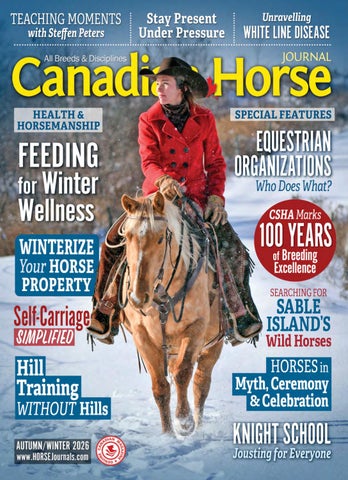
ON THE COVER Karats in the Snow A winter walk on Karats (Shesa Peppy Boons) was the winner in the Registered Quarter Horse Division of our 2025 Celebration of Horses Photo Contest. Photo: Kaitlin Knox of St. Andrews, NS
PHOTOS
50
50 COURTESY OF CSHA | 60 COURTESY OF KATTUK EXPEDITIONS | 68 ALAMY/BAVARIA IMAGES
68
b IN THIS ISSUE
AUTUMN/WINTER 2026
34
PHOTOS
22 ISTOCK/RISMAN PHOTOGRAPHY | 34 CLIX PHOTOGRAPHY | 76 PAUL GREGORY
76
22 HEALTH & HORSEKEEPING
TRAINING & HORSEMANSHIP
DEPARTMENTS
10 Feeding Horses for Winter Wellness
28 Self-Carriage, Simplified
8 Editorial
The right feeding strategy will help your horse maintain weight and reduce the risk of health problems.
Learn the secrets of keeping a horse within the borderlines of your relaxed aids.
16 Understanding White Line Disease
34 Hill Training Without Hills
How to treat and prevent this disease, which can affect horses of any breed, age or gender, barefoot or shod, and can occur in one or more feet.
22 Winterize Your Horse Barn and Property
Prepare your barn and property before winter arrives to keep horses comfortable, chores manageable, and everyone safe.
6
www.HORSE Journals.com
::
AUTUMN/WINTER 2026
Finding alternatives for conditioning goals when hills are not available.
38 Pressure Without Panic How riders can manage pressure to feel more present and in control.
2, 37 To Subscribe 90 Horse Council BC News 92 Canadian Therapeutic Riding Association News
93 The Hoofbeat 94 Meet Our Contributors 95 Index to Advertisers 96 Book Review:
Stable Recovery, How Horses Transform Homeless Men into Horsemen
PROPERTY MANAGEMENT
WINTERIZE
Your Horse Barn & Property
A safer, healthier plan for horses, people and facilities By Kathy Smith
Winter can transform a barn and property almost overnight. A little advance preparation will help keep horses comfortable, daily chores manageable, and everyone safer when severe weather arrives. Use the quieter days before winter to inspect your setup, complete necessary repairs, and make sure essential systems are ready for the season ahead. 22
www.HORSE Journals.com
::
AUTUMN/WINTER 2026
Frozen water, deep snow, ice, mud and power failures can turn ordinary horse care into a winter emergency. Before the first hard freeze, concentrate on five essentials: reliable water, safe electrical equipment, adequate ventilation, secure footing, and a tested emergency plan. A relaxed walk-through to make a checklist can reveal problems that are easy to miss during daily chores. It helps to note what needs attention, as well as who will handle it and when. Because climate, soil, and regulatory requirements vary across Canada, some decisions will also benefit from site-specific advice.
Start With the Barn and Surrounding Areas
A floor-to-roof inspection is a useful place to begin. Rotting boards, protruding fasteners, damaged latches, loose hinges, and broken windows are often
straightforward fall projects. Check that every exit will remain visible and usable in snow, then extend the walk-through to fencing, gates, and run-in sheds. From the ground, look for roof leaks, sagging, displaced roofing, and structural members that are cracked, twisted, or bowed. Clean gutters and downspouts that will carry water away from foundations, manure storage, lanes and high-traffic areas. Locate design snow-load records if available. If capacity is unknown, loading appears significant, or distress is visible, arrange an assessment by a professional engineer. Ontario workplace guidance similarly recommends assessment when snow may be significant or a building shows twisting, bending, or cracking. In these situations, keep horses and people out until the appropriate professional or authority has cleared the building for occupancy. Do not casually climb onto a
PHOTO: PAM MACKENZIE PHOTO: ISTOCK/BALLYCROY
Plan snow-storage areas before winter, keeping piles clear of buildings, gates, drainage routes, septic systems, manure storage, and emergency access. Thoughtful placement maintains sightlines and helps prevent spring runoff from flooding the barn or creating ice and mud. Snow removal carries a fall risk and may redistribute loads or damage the structure. If snow accumulation is significant, the roof’s capacity is unknown, or twisting, bending or cracking is visible, keep horses and people out of the building and arrange an assessment by a professional engineer.
snowy or icy roof, as snow removal can involve a risk of falling and can redistribute loads or damage the structure. Frost heave, erosion, and repeated freeze-thaw cycles can shift foundations, posts, and slabs. New cracks, displacement, binding doors, or changes in the roofline are good reasons to seek a professional opinion. Permit and design requirements vary, and many farmbuilding projects require a licensed architect or professional engineer. Water is the most important thing to consider for horses during winter. Most 450-kilogram (1,000-pound) adult horses need at least 38 to 45 litres (10 to 12 US gallons) of water daily, and larger draft breeds require 55 to 75 litres (15 to 20 gallons); work, lactation, illness, and other conditions can increase that requirement.
PHOTO: ISTOCK/RYERSON CLARK
Keep the Water Flowing
AUTUMN/WINTER 2026
::
CANADIAN HORSE JOURNAL
23
HEALTH
Feeding Horses
Canadian winters can be challenging for horse owners. Bitter cold, fluctuating temperatures, and heavy snowfall all affect a horse’s nutritional needs. Adopting the right feeding strategy for winter months can help your horse maintain a healthy weight and reduce the risk of health problems such as impaction colic.
Through a
Canadian Winter
PHOTO: PAM MACKENZIE
By Madeline Boast, MSc Equine Nutrition, PAS
10
www.HORSE Journals.com
::
AUTUMN/WINTER 2026
Before deciding when to begin making nutritional changes for your horse, there are a few key terms to understand, starting with the thermoneutral zone. The thermoneutral zone is the environmental temperature range in which a horse does not have to expend additional energy to maintain their body temperature. The lower end of this range is referred to as the “lower critical temperature” (LCT). Once the temperature falls below the LCT, a horse will begin using additional energy above maintenance requirements to stay warm. However, not all horses have the same LCT. Breed differences and individual variables, such as age and body condition, will impact a horse’s LCT, so every horse should be treated as an individual. Most healthy, mature horses that are accustomed to living in Canada have a LCT around minus 15 degrees C (5 degrees F). Once the temperatures drop to this level, the digestible energy (DE), or calorie, requirement of the horse will increase by about 2.5 percent for every degree below the LCT. For example, a 500 kg horse that is consuming 2 percent of its bodyweight daily of average quality hay (DE = 2 megacalories per kilogram [Mcal/kg] on a dry matter basis1) has a calorie intake of 20 Mcal/day. If the horse’s LCT is minus 15 degrees C, and the temperature outside today is minus 20 degrees C, the horse requires about 12.5 percent more digestible energy than their maintenance level. This means that to meet this requirement, the horse would need to consume an additional 1.5 kg of hay to maintain their body condition. Clipping horses, blanketing, compromised dentition impacting forage 1. Calculation based on Balanced Bay Inc. ‘Ontario Horse Hay Data’
PHOTO: PAM MACKENZIE
Understanding the Lower Critical Temperature
Equine Adaptations Remember that horses are naturally adapted to living outdoors and have several ways to stay warm as temperatures fall. Just because you feel cold doesn’t necessarily mean your horse does. When daylight hours shorten, the diminishing light triggers the horse’s body to increase the production of melatonin, which is the hormone that signals the growth of the winter coat. The timing varies by geographic location, but the process begins weeks, if not months, before temperatures drop significantly. Another adaptation is vasoconstriction, which is when the
without a blanket in the winter, this adaptation is visible. When choosing to blanket your horse, it’s important to consider that you might be negatively impacting some of these adaptations, most notably piloerection. A blanket inhibits the horse’s ability to use piloerection to stay warm; however, as long as the blanket has adequate insulation, it will provide warmth through the same mechanism of trapping air. A common mistake is using a rain sheet — or any uninsulated blanket — simply to keep a horse dry in the hope that it will
During cold weather, horses raise their haircoat to trap warm air close to the body. This is called piloerection, which is the scientific term for goosebumps, and happens when tiny muscles under the skin make body hairs stand up straight.
PHOTO: PAM MACKENZIE
Annual hay testing reveals changes in quality and calorie content, helping you adjust your horse’s winter feeding program to meet their nutritional needs. Placing hay in several areas of their winter environment also encourages natural movement.
blood vessels narrow to restrict blood flow. This is done to reduce blood flow in the horse’s extremities, and in turn, reduce heat loss. One adaptation that is directly related to nutrition is the horse’s “internal furnace.” Horses are hindgut fermenters, and the process of fermentation, which produces heat, is critical to their ability to maintain body temperature in the winter months. Lastly, horses use piloerection to raise their hairs. This allows for air to be trapped closer to the skin, which provides insulation. If horses are kept outside
PHOTO: ISTOCK/KLAUS RADETZKI
consumption, and shelter access are some of the variables that will influence a horse’s LCT. Younger horses will also have a narrower thermoneutral zone. In addition to temperature, windchill and precipitation should be factored in. Always consider your horse’s individual circumstances when making decisions about supplementing additional calories in the cold weather.
AUTUMN/WINTER 2026
::
CANADIAN HORSE JOURNAL
11
HEALTH
UNDERSTANDING
PHOTO: DEAN SINCLAIR CJF, FE, DIPWCF
White Line Disease
By Dean Sinclair CJF, Fe, DipWCF
White line disease can affect
Stratum externum Distal phalanx (Pd)
horses of any breed, age, or
Stratum medium
gender. It can occur in one or more feet, although it seems to
Stratum internum
be more common in front feet. Both barefoot and shod horses can be affected. The term “white line disease” is a bit of a
Frog
Sole
Collateral sulcus Transverse (horizontal) cross-section of the equine hoof with the toe at the top and the heels at the bottom. The thin stratum externum protects the outer wall; the thick stratum medium provides structural strength; and the innermost stratum internum interlocks with the dermal laminae to help attach and suspend the distal phalanx (coffin bone) within the hoof capsule. 16
www.HORSE Journals.com
::
AUTUMN/WINTER 2026
ILLUSTRATION: HORSE COMMUNITY JOURNALS
misnomer since the white line is not affected. In white line disease, the stratum medium and stratum internum layers of the hoof wall are destroyed by anaerobic bacteria and fungus. Donkeys seem to be particularly susceptible to white line disease because their hooves evolved in, and adapted to, dry, semi-arid environments. In cooler and wetter conditions, the hoof horn
PHOTO: DEAN SINCLAIR CJF, FE, DIPWCF
absorbs moisture and becomes softer and more easily damaged, allowing opportunistic bacteria and fungi to invade the defects. Donkey hoof horn differs structurally and mechanically from horse hoof horn, although the exact reasons for the species difference are not fully established. White line disease affects the nonpigmented horn at the junction of the stratum medium and stratum internum. Damage or separation of the hoof wall can allow anaerobic bacteria and fungi to enter, and these microorganisms produce enzymes that destroy keratin, the main structural protein in the hoof wall, causing the horn to weaken and deteriorate. If left untreated, this bacterial infection can lead to further destruction and separation of the hoof wall. The
PHOTO: DEAN SINCLAIR CJF, FE, DIPWCF
White line disease affects the nonpigmented horn at the junction of the stratum medium and stratum internum. Damage or separation allows horn-digesting bacteria and fungi to invade, weakening the keratin and allowing the separation to progress upward toward the coronary band. Affected cavities often contain firm, powdery white or gray debris composed of deteriorated hoof horn.
infection can continue upwards toward the coronary band. In many cases, the hoof wall separation is filled with a white or gray firm, powder-like material. This material is digested stratum medium, which is produced by the bacteria. Other common names for white line
disease are hollow foot, seedy toe, and onychomycosis. However, the term onychomycosis specifically refers to fungal infections of the skin and nail bed, which is not where fungal infections occur in horses that have white line disease.
Whit horn and allow inva the s coro firm, of de
AUTUMN/WINTER 2026
::
CANADIAN HORSE JOURNAL
17
HORSEMANSHIP
PHOTO COURTESY OF LINDSAY GRICE
Self Carriage,
SIMPLIFIED By Lindsay Grice, Equestrian Canada coach and judge
I tend to think of self-carriage like cruise control. A horse in self-carriage remains on the path, in the gait, in the tempo, and the frame his rider requested, for several strides without being held there. PICTURE THIS: Your horse is attentive and yet relaxed. His ears are forward yet checking back to you with each aid you deliver. He’s light to your signals, responding readily. Communication feels conversational rather than a lecture. And the ride feels buoyant. That’s self-carriage. 28
www.HORSE Journals.com
::
AUTUMN/WINTER 2026
PICTURE THIS: A dressage competitor rides with an elastic arm and only a neutral feel of her horse’s lips. A reining competitor lopes a fast circle, her horse “looking through the bridle,” his head and neck aligned within the corridor of her reins, his shoulders and haunches following the arc of the circle. That’s self-carriage.
PICTURE THIS: While lunged, a horse trots at a consistent distance from his handler with no cutting in or bulging out, and the lunge line relaxed. No whip cracking is needed to maintain the tempo. By simply noting an elevated whip and hearing a quiet kiss, the horse lifts into a balanced canter. That’s self-carriage. Like a self-propelled lawnmower or an airport moving walkway, riding a horse in self-carriage takes less effort.
The Box Principle Self-carriage develops as a horse discovers, by trial and error, the box that
Developing self-carriage in your horse begins on the ground. I’m defining the boundaries on the mat with a light whip tap on the neck or chest.
defines his rider’s limits for the line of travel, speed, and shape at each moment in the ride. So, when a horse I’m riding deviates from the line, speed, or shape I have in mind, he’ll find the boundaries of my aids. I’ll simply reset him and carry on. For example, if he accelerates, he’ll find rein contact. If he cuts to the inside of a corner, he’ll find my inside leg. If his rhythm becomes flat, he’ll feel my leg pressure sending him forward again. Most importantly, my horse will reliably find release within the borders of my box. It’s my responsibility to make the box a place the horse wants to be. Negative reinforcement is an important concept in training horses. We take away the pressure (negative) to reward (reinforce) the desired response.
BALANCE: This is a term frequently seen on dressage score sheets. What is “balanced”? When your horse has his weight equally distributed on his outside and inside limbs, whether traveling straight or curved, he’s balanced laterally. Longitudinally, when your horse shifts balance from his forehand to his hind end, he’s “lighter.” A horse moves, jumps, stops, and makes transitions better when balanced. A horse holding its own balance without support is in better mental balance. Horses fare better when not held in place. Realistically, some horses, depending on their conformation, need more adjustments to hold themselves in balance — just as I must accept that, despite excellent instruction, I simply don’t have the conformation to be a ballet dancer! DEFINE YOUR BOX: Have a clear picture of what you expect in each section of your ride or each segment of your pattern, course, or Help your horse want to stay while mounting. This rider mounts smoothly and with soft reins, not holding her horse in place.
PHOTOS COURTESY OF LINDSAY GRICE
SUPPORT: I’ve never been a fan of the term “support” when referring to our riding aids. Horses don’t learn from being held in place. For example, in a canter transition, preventing your horse from drifting in by supporting with your inside leg or “holding his shoulder up” with an indirect rein will not inspire him to carry his own balance. Instead, make a timely course correction on his first wayward step, then leave him alone.
AUTUMN/WINTER 2026
::
CANADIAN HORSE JOURNAL
29
HORSEMANSHIP
No Hills? NO PROBLEM
Finding Alternatives for the Conditioning Goal Many riders worry that their lack of access to hills means their horses will miss important conditioning benefits. But before charging up hills, or fretting about their absence, riders should first consider the specific gains they were hoping to make. A horse recovering from injury, for instance, will use and benefit from hills differently than a moderately fit horse aiming to improve stamina or performance. After specific goals are identified, relevant substitutions can be explored. Whether you need hills depends on what you hope to achieve. Hills are a highly praised fitness tool because they influence numerous conditioning adaptations, including increased strength and cardiovascular fitness. All hills, however, are not the same, nor do they guarantee beneficial outcomes. The steepness, exercise duration, and speed of travel all determine which gains are made. As a partial list, hill work is commonly prescribed to: • Increase force production of hindquarter muscles • Improve postural stability, core function, and movement patterns • Enhance coordination and limb control • Build aerobic fitness and resilience • Improve muscular endurance • Restore balance and movement quality after injury 34
www.HORSE Journals.com
::
AUTUMN/WINTER 2026
PHOTO: CLIX PHOTOGRAPHY
PHOTO: CLIX PHOTOGRAPHY
By Jec A. Ballou
As evidenced by this list, the advice to train your horse on hills is often too broad. Using hills for postural stability, for instance, will differ significantly from using them to boost aerobic fitness. A rider first needs to understand which of the above outcomes should be targeted. Hills might be a gold standard, but in many cases, there is a decent substitute.
Horses in Rehab Veterinarians and rehab professionals often recommend hills to retrain movement after sustained layups or in cases of horses needing to improve coordination and body control. Unlevel terrain such as gentle — not steep — hills demands trunk stabilization, coordinated limb placement, and heightened proprioception. This stimulus is most effective when dosed in short but frequent sessions of just a few minutes at a time. The most useful tasks in these cases do not require marching straight up and down slopes. Instead, a very small section of the slope is used to perform, for example, small circles or zigzags. The goal is to not overtax the horse or create soreness. In this case, handlers and riders also want to avoid hills that are so steep or long that they create poor postural habits or excessive tension to navigate them. Rolling, easily managed terrain is ideal. Most equestrians have access to a suitable area without
PHOTO: CLIX PHOTOGRAPHY
PHOTO: CLIX PHOTOGRAPHY
If your stable area is flat, create surfaces that differ from the smooth, predictable ground the horse is familiar with.
realizing it. When targeting coordination, core control, and stability, there are numerous solutions that exist around most barns. A small area from 20 to 40 square metres will suffice. Driveways, berms, drainage ditches, and unlevel paddocks work just fine. I have also seen many riders create their own swale by dumping and packing a pile of dirt adjacent to their arena. This provides them a slope — albeit small — to practice weight shifts, backing, transitions, and other rehab manoeuvres. If, however, your stable exists on totally flat ground in every direction, you will need to be creative. Remember that the goal is less about being on a hill and more about providing the horse with opportunities to improve coordination and body control. The main priority is to find, or make, surfaces that differ from the smooth and predictable ground the horse is familiar with. This might include creating areas where the ground is rough or constantly changing (gravel, grass, hardpacked dirt) or requires the horse to step up or over objects like rocks and logs. Or it might include constructing obstacles like a pedestal or small bridge. When used consistently, these can create good results.
Horses Building Strength Beyond rehab, many riders use hills to develop strength in the propulsive muscles of the hindquarters. Specific benefits depend on speed and duration, but brisk uphill riding generally increases force production from the extensor chain while downhill riding demands flexion and stamina of the pelvic muscles. Hills can improve the mechanics of hind limb flexion and extension while also inducing strength gains in the large force-generating muscles. When lacking hills and keeping these goals in mind, the AUTUMN/WINTER 2026
::
CANADIAN HORSE JOURNAL
35
PSYCHOLOGY
Pressure without PANIC How Riders Can Feel More Present and in Control
PHOTO: CLIX PHOTOGRAPHY
By Annika McGivern, MSc, Sport and Exercise Psychology
38
www.HORSE Journals.com
::
AUTUMN/WINTER 2026
Growing up as a three-day eventer, I spent many minutes waiting to enter the ring or the start box. At times, the nerves felt almost unbearable while waiting to compete. I would find myself thinking about all the money and time I’d invested to get there and how much I wanted to succeed. The thought of making a significant mistake, or failing, made me feel panicked. With hindsight, I can now see how the experience of pressure was distracting me and pulling my attention away from the task at hand. Ironically, this loss of focus sometimes contributed to the very mistakes I feared making. I sometimes think about what I would say to my younger self if I could go back and stand beside her in the warmup ring, armed with everything I’ve learned as a mental performance consultant. I’d love to be able to teach her how to change her relationship to pressure, so that she could feel more present, in control, and even begin to enjoy the highly pressured but also deeply special moments she was experiencing. Here’s what I’ve learned: Pressure becomes more manageable — and often even enjoyable — when you view nerves as an asset; trust that your skills are equal to the challenge; make room for uncomfortable thoughts and feelings rather than resisting them; focus on what you want to create instead of what you fear; and repeatedly prove to yourself that you
can perform effectively under pressure. These are all learnable skills. In this article, we will explore each one and how you can use them to ride with greater presence and enjoyment under pressure. The goal isn’t to get rid of pressure; it’s to become the rider who can perform, learn, and even enjoy themselves when pressure is present.
Pressure is not dangerous When we are under pressure, our nervous system becomes activated, and many riders unconsciously interpret this activated feeling as danger. You experience a racing heart, tight muscles, butterflies, and a busy mind, and you assume that you are losing control, likely to ride badly, have no confidence, or that you are not ready. But your body’s pressure response is designed to prepare you for action. Increased heart rate, alertness, and extra energy are not automatically harmful. It’s the meaning you attach to these sensations that changes everything. Research shows that athletes perform better when they interpret these sensations as neutral or positive, instead of as evidence of impending disaster. Athletes who do this well use self-talk to
Have you ever thought that
reframe the sensation of nerves as a sign that their body is preparing them for this important moment. Feeling nervous becomes a good sign, indicating you are ready to perform.
if you could only be calm and confident, you would enjoy competing much more?
Pressure isn’t the problem; it’s how we interpret it.
the demands of the situation. Next time you’re preparing for a highpressure moment, do a resource check by asking yourself:
When under pressure, the brain focuses on two questions: 1.) What is being asked of me? 2.) Do I have what I need to handle it? When the task seems to demand more of you than you are capable of, pressure feels threatening. This is characterized by thoughts such as “This course is difficult, and one mistake could ruin everything.” Or “My horse is fresh, and I won’t be able to manage it.” However, when riders can recognize their preparation, skills, options, and support, the same situation is more likely to feel like a positive challenge. In this case, thinking shifts to “This course will test me, but we are ready, and I have a plan.” Or “My horse is fresh, but I can trust myself to manage it. I know what to do.” Interestingly, research shows us that athletes perform more effectively when they believe they have the skill and resources they need to meet
q What preparation can I trust in? q What skills can I trust in? q What can I control? q How can I respond to a mistake or unexpected event?
q Who is supporting me today? Let the nerves come with you
Have you ever thought that if you could only be calm and confident, you would enjoy competing much more? Many riders fight against their nerves, thinking they must banish them to be successful. The problem is that this rarely works and instead you become increasingly anxious about being anxious. This is also potentially
Discover our premium, maintenance-free equipment Performance, durability and efficiency, backed by unmatched warranties and service — so you can focus on what matters most: getting in the saddle, training with purpose and pursuing your dreams.
• Customizable jumps and courses
• Equipment for
every discipline
• Fast shipping on
in-stock products
• Canada-wide delivery Proudly Canadian-owned & operated
INFO@COPPERPONY.CA • 236-655-7676
WWW.COPPERPONY.CA COPPERPONYPOLES AUTUMN/WINTER 2026
@COPPERPONYPOLES ::
CANADIAN HORSE JOURNAL
39
HORSE INDUSTRY
Who Does What?
PHOTO: CLIX PHOTOGRAPHY
Navigating provincial and national equestrian organizations
No single organization supports all things “horse” across Canada.
Equestrian Canada’s Role
Coaches, trainers, riders, drivers, owners, breeders, and the horses
“We’re looking at things from a national perspective,” says Meg Krueger, Executive Director of EC. “The advocacy work that we do for the whole sector benefits people and organizations, even if they’re not directly linked to E or a PTSO.” In Canada, sport has both federal and provincial oversight. As a national sport organization (NSO) that receives funding from the federal government, just like Tennis Canada or Rugby Canada, EC supports athletes (riders, drivers, and vaulters) advancing from provincial level to Olympic level in select equestrian sports. There are approximately 15,000 equestrian athletes who have sport licences with EC, which allow them to compete at ECsupported competitions.
themselves are represented by myriad organizations. Equestrian Canada (EC) and Provincial and Territorial Sport Organizations (PTSOs) play special roles; however, their mandates are limited. It can be difficult to discern how the national and provincial organizations differ, who they represent or don’t represent, and how they support the greater horse industry. “I didn’t have an AEF membership until a few years ago,” says Kelsey Noland, who is the Chair of Alberta Equestrian Federation’s (AEF) volunteer Recreation Task Force and has been trail riding in the Kananaskis area of Canada’s Rocky Mountains since 2014. “I had never heard of the AEF until I was approached to be part of the Task Force.” Noland is not unusual. A 2023 report on Canada’s equine sector found that over 44
www.HORSE Journals.com
::
AUTUMN/WINTER 2026
two-thirds of survey respondents were recreational participants. Many of them do not participate in organized activities and don’t feel the need to support their provincial or national sport organizations, or even know they exist. “As your average recreational rider, I don’t know who Equestrian Canada is or how they benefit me,” says Noland. It’s a challenge that plays out across the country.
PHOTOS: CLIX PHOTOGRAPHY
By Tania Millen, BSc, MJ
PHOTO: CLIX PHOTOGRAPHY
The focus of EC is on producing highperformance athletes. It is responsible for fielding Canada’s World Championship and Olympic teams for sports recognized by the International Federation for Equestrian Sports (FEI), such as Canada’s show jumping, dressage, para dressage, and vaulting teams, as well as three-dayeventing individual riders for the World Championships in Aachen, Germany in August 2026. Importantly, EC also develops learn-toride programs, has a rulebook for select equestrian competitions, and supports coaches, competitors, event organizers, and officials. However, EC doesn’t support every equestrian sport. “Equestrian sport is really diverse, and some disciplines and activities have other national and provincial organizations that they work with,” says Krueger. Reining, cutting, cow horse, breakaway roping, working equitation, barrel racing, breed events, Standardbred and Thoroughbred racing, polo, and many other horse sports have their own competition rules and are not associated with EC. That means riders, horses, and owners competing in those sports are
bound by the rules of the organizations that govern them, not EC or their PTSO. It’s why some horse sports may be selecting “Canadian Team riders” to compete at international championships without any involvement from EC. “When organizations decide to work with Equestrian Canada in a more formal way, it’s a long process,” says Krueger. “But through collaboration, we can make a stronger sector and a stronger sport for all equestrian participation.”
What Provincial and Territorial Sport Organizations Do
“Ontario Equestrian is recognized by the Province of Ontario as the equestrian sport governing body in the province, as are all the other equestrian PTSOs across Canada,” says Tracey McCague-McElrea, Executive Director of Ontario Equestrian (OE). There are 11 PTSOs across the country with approximately 88,000 total members. Horse Council of British Columbia, Alberta Equestrian Federation, Ontario Equestrian, and Cheval Quebec have the largest memberships. PTSOs receive funding from
Qualified coaches help young riders develop the skills and understanding to become active participants in training their horses. EC establishes national coaching standards, while the PTSOs help deliver programs that support safe, professional instruction and a strong athlete pathway.
PHOTOS: CLIX PHOTOGRAPHY
EC focuses on producing high-performance athletes in the disciplines of show jumping, dressage, three-day eventing, para dressage, and vaulting. Shown is Canada’s Jessica Phoenix on A Little Romance competing at the international CCI4* Rolex Kentucky Three-Day Event in 2015.
their provincial governments to support equestrian sport in their province, just like any other provincial sport body. “We’re basically trying to provide a safe, fun playing field for anyone who’s involved in equestrian sport,” says McCague-McElrea. “The NSO [EC] creates the programs and the PTSOs deliver them.” For example, the Learn to Ride and Rookie Rider programs are designed by EC; the PTSOs deliver them. To financially support this combined effort, a small portion of every PTSO membership goes to EC. The PTSOs also create their own programs to serve their specific equestrian communities. For example, OE created the GRIT (Great Rider Intensive Training) program, which identifies upcoming athletes with “podium potential” in dressage, show jumping, and three-day eventing. Meanwhile, to support recreational riders, AEF has become the official Trail Manager for the nonmotorized trail network in the Panther Corners and Dormer/Sheep
AUTUMN/WINTER 2026
::
CANADIAN HORSE JOURNAL
45
SPECIAL FEATURE
Breeding
By Tania Millen, BSc, MJ
By Tania Millen, BSc, MJ The 1947 Canadian Sport Horse Cilroy, ridden by John Rumble at the 1956 Olympic Games, helped Canada secure the bronze medal in three-day eventing.
Canadian Sport Horse Association celebrates 100 years 50
PHOTO COURTESY OF CSHA www.HORSE Journals.com
::
AUTUMN/WINTER 2026
PHOTO: WILLIAM JAMES, PAUL HIGGINS COLLECTION
Excellence
“The Canadian Sport Horse Association is the oldest performance horse registry in North America,” says Lisa Murphy, the Canadian Sport Horse Association (CSHA) Vice President who has volunteered for almost 30 years with the organization. “We’re older than some of the stud books in Europe and we
Jumping Team, agreed to teach the clinic because she feels it’s important to give back to a sport that has given her so much. “I’ve spent my whole life in this world, and it’s been a great life. It is a great life. I want to see Canadians breeding top-level horses and I want to see a pipeline for young riders, so they understand how to get from where they are to the top of the sport,” says Millar. Teaching a clinic to riders on CSHAregistered horses was a natural fit. But developing horses that can compete at the top of today’s horse sports has been a long road. After Canada shipped over 130,000 horses to Europe for World War I, the Canadian horse population was decimated. “The Canadian government imported Thoroughbred stallions to help reestablish lighter riding horses and carriage horses in Canada,” says Kim Berlie, who has been a CSHA member for over 35 years and bred CSHA horses for 24 years near High River, Alberta. The Canadian Hunter and Light Horse Improvement Society was formed to
PHOTO: WILLIAM JAMES, PAUL HIGGINS COLLECTION
need to celebrate that.”
The CSHA started as the Canadian Hunter and Light Horse Improvement Society in 1926 to encourage breeders to produce rideable horses after a dramatic decline in Canada’s horse population due to World War I. “I think it’s really important to embrace and celebrate a stud book that has lasted for 100 years,” says Murphy. “We want to honour all of the remarkable breeders, owners, riders, and volunteers that have shaped where we are today,” says Michael Ward, CSHA’s President. In anticipation of the milestone, Murphy and the CSHA Alberta Chapter have been hosting Countdown to a Century Symposium Series Masterclasses. Clinicians have included Americans Beezie and John Madden teaching the Madden Method (2022), Canada’s Tiffany Foster (2023), and Ireland’s Andrew Bourns (2024). This year’s 100-year celebrations included a clinic by Amy Millar at Rocky Mountain Show Jumping facility in De Winton, Alberta on June 8, 2026. Millar, who has represented Canada at the Olympics as part of the Canadian Show
George Beardmore, an early-20th-century Master of Fox Hounds of the Toronto Hunt, was among the original officers who incorporated the Canadian Hunter and Light Horse Improvement Society as a non-profit under the Companies Act. Here, he rides a solid field hunter over a timber fence in North York, Ontario. It was at this time that the Society began encouraging the breeding of lighter, more athletic horses for the hunt field. AUTUMN/WINTER 2026
::
CANADIAN HORSE JOURNAL
51
SPECIAL FEATURE
SEARCHING for the
Wild Horses of
Sable Island
PHOTO COURTESY OF KATTUK EXPEDITIONS
By James Ross
60
www.HORSE Journals.com
::
AUTUMN/WINTER 2026
G
one feral from the days of the Acadian deportations in the mid-1700s, some 500 horses
roam freely here, with no human intervention,
PHOTO COURTESY OF KATTUK EXPEDITIONS
resilient in an unforgiving environment. Since I first heard about Sable Island, the remote and isolated spit of sand has found a home in my imagination and was a place I knew I had to visit. The crescent-shaped sweep of land 290 kilometres southeast of Halifax, Nova Scotia, is wrapped in sea lore and shipwrecks, and stands as one of Canada’s most unique and fragile landscapes. Perhaps the island’s most enduring legend is its herd of wild horses, descendants of 18th-century arrivals, that now roam freely amongst the dunes to impart a near-mythical quality to this distant sandbar. When our eight-seat helicopter lifted off in Halifax and beat its way over the Atlantic, the journey felt like I was crossing into a myth. Roughly 42 kilometres long and rarely more than a kilometre wide, at our first sighting Sable Island appeared almost ethereal, an isolated ribbon of pale sand shaped like a horse’s back, rising and falling in long sandy ridges, surrounded entirely by the vast, restless Atlantic Ocean. Seen from above, the island appears wild and extreme, but also beautiful and gentle. Despite its isolation, or perhaps because of it, Sable Island sustains an unexpectedly diverse ecosystem. As our helicopter skirted over North Beach towards our landing pad at Main Station, we could see the world’s largest colony of grey seals sunning themselves on the sand and bobbing in the surf. Our guide for the day, Fred Stillman of Kattuk Expeditions, tells us that the island is also a refuge for several rare bird colonies and endangered species. On our trek through the dunes, we
would see Ipswich Sparrows darting about, small birds that nest only here. There were Roseate Terns, feigning broken wings to lead us from their nest, and giant Black-backed Gulls squawking overhead. Look closely in the lowlying brush for the tiny Sable Island Sweat Bee, which is the size of a small ant, also endemic to this place. Still, for me, as an equine lover and horse owner, it is the island’s fabled wild horses that have drawn me to this distant place. The 500 or so horses roam wild here, resilient in an unforgiving, windscoured environment that shapes every aspect of their physical condition. Our small group set off into the dunes in reverent silence, walking towards the island’s northern tip. Our trek took us inland along a well-trodden path that led us up and down the rolling dunes. We followed hoof prints in the sand, stepping nimbly around large mounds of horse droppings. According to Stillman, the stallions create these heaps of manure, known
Roughly 42 kilometres long and a kilometre wide, the island is a ribbon of pale sand surrounded entirely by the vast, restless Atlantic Ocean. The remote, crescent-shaped sweep of land is some 290 kilometres southeast of Halifax.
PHOTO: © PARKS CANADA/ DOUG HARVEY
AUTUMN/WINTER 2026
::
CANADIAN HORSE JOURNAL
61
A Place of Honour
PHOTO: ISTOCK/OKTOBERFEST/NIKADA
SPECIAL FEATURE
Horses in Ritual, Ceremony, and Celebration By Li Robbins
Everybody loves a parade — the floats, the marching bands, the random tossing of candy. For a parade to feel truly complete you need one more element though: horses. The tell-tale clip-clopping of hooves on pavement and the sight of gussied-up horses and riders is a thrill. Credit goes first and foremost to the beauty of horses for having this impact, but it’s also possible that as humans we have an innate sense of equine significance that dates to ancient times. Horses were sometimes seen as having a spirit more mysterious and greater than our own, and in some cultures, they were viewed as divine, an idea woven into the oldest myths of Indo-European traditions. 68
www.HORSE Journals.com
::
AUTUMN/WINTER 2026
For the ancient Greeks, mythical horses played a part in the ceremony of daily life — for instance the rising of the sun, which was believed to be dependent upon horses who drew a sun-laden chariot across the heavens, treating the sun-God Helios to an exhilarating ride. Supernatural horses appeared in ancient Norse mythology as well, with horses carrying both humans and gods around and between worlds. Horses were worshiped by horse cults in the preChristian religions of Anglo-Saxon
When England’s Queen Elizabeth II died in 2022, her funeral procession included dozens of horses, notably four beautiful RCMP horses who guided the coffin in the early part of the procession. Horses, as the Queen well knew, can elevate everything from coronations to final departures, creating a unique sense of pomp and pageantry. When the funeral procession turned onto the Long Walk, the 4.2-kilometre pin-straight road towards Windsor Castle, some 97,000 people lined the way, solemnly bearing witness. They might not have seen the moment that touched the hearts of viewers around the world though, as the TV cameras zoomed in on one lone black pony. She stood by the flower beds that lined the way, tacked up and impeccably turned out, her black mane and tail flowing. Hushed TV commentators explained to viewers that she was the Queen’s own Fell pony, Carltonlima Emma. As if the sight of riderless Emma wasn’t enough of a tug on the heartstrings, there was another achingly poignant detail — the Queen’s signature riding headscarf draped across the empty saddle. The common refrain on social media as viewers took that in was, “Well, that got me going.” For anyone who’d seen photos of the Queen riding, that headscarf in the empty saddle underscored the sadness of a rider who would ride no more. There was sadness for the pony too, knowing that Emma would never understand where her person had gone. At that moment the little mare seemed a symbol of the connection
Helios was the ancient Greek god that personified the sun itself. Each day, he was believed to drive a golden chariot drawn by four fiery horses across the sky from east to west, returning by night to begin the journey again. Pictured is “Helios on the sun chariot,” painted circa 1777 by Andreas Brugger (1737-1812).
between human and horse. Emma is far from the only riderless horse to have played a moving role in a funeral procession. Some military traditions feature a single, riderless horse following the casket, sometimes with boots facing backwards in the stirrups.
It’s a symbol of the rider’s final journey, as though the fallen soldier could look back and say goodbye to family and friends. Famously, a Morgan-Quarter Horse cross named Black Jack graced the funerals of thousands of fallen soldiers and three U.S. presidents, including John F. In Norse mythology, Odin rides Sleipnir, his magical eight-legged horse, between the worlds of gods, humans, and the dead. Together, they symbolize speed, power, wisdom, and the ability to cross the boundaries between life, death, and the supernatural.
Depiction of Sleipnir in a detail on the Tjängvide image stone, a Viking Age image stone (circa 700-900 CE).
PHOTO: WIKI/CRISTER ÅHLIN, SHM
PHOTO: ISTOCK/OKTOBERFEST/NIKADA
Majestic Solemnity
ILLUSTRATION: SHUTTERSTOCK/APATRIMONIO
England and elsewhere, although that worship might involve (trigger warning!) equine sacrifice or the consumption of horse flesh. Today, horses are integrated into human ceremonies in a much more benign albeit still powerful way, even though there is no one definitive explanation for why that is so.
PHOTO: ALAMY/INTERFOTO
(FACING PAGE) First held in 1810 to celebrate a royal wedding, Munich’s Oktoberfest began with a horse race. More than 200 years later, horses remain central to its pageantry, carrying riders and pulling elaborately decorated brewery wagons in the festival’s opening parades, such as this floral-adorned beer wagon guided through city streets by drivers in traditional Bavarian dress.
AUTUMN/WINTER 2026
::
CANADIAN HORSE JOURNAL
69
Making Knighthood More Inclusive
By Caelan Beard
At these medieval mounted games clinics, you can bond with your noble steed, gain confidence, and learn tournament games from real-life knights. 76
www.HORSE Journals.com
::
AUTUMN/WINTER 2026
Where can I learn to joust? At Knight School, of course! Knight School is a new organization that’s teaching horse-and-rider teams the skills of medieval sport. Since 2023, Knight School has run mobile medieval mounted games clinics at barns across Ontario. Riders of all disciplines, ages, and levels of experience can participate, learning historical tournament games and getting to be knights for a day. It’s also an opportunity for participants to
improve their horsemanship, build confidence, and bond with their equine partners. After all, it’s a lot easier to charge a warhorse into “battle” when the horseand-rider team trust each other. Knight School was founded by Jaclyn Ziemniak and Joshua Knowles, who are both international full-contact jousters. They offer a range of programs for just about every demographic and clientele from seniors’ fitness classes to children’s camps, to corporate team building, all of which draw on the historical battlefield. On the equestrian side, Ziemniak and
PHOTOS: MICHAEL ROLANDS/RECORD-HERALD
International full-contact jousters Jaclyn Ziemniak and Joshua Knowles.
PHOTO: EXPERIENCE MILTON
SPECIAL FEATURE
PHOTO: EXPERIENCE MILTON
PHOTOS: MICHAEL ROLANDS/RECORD-HERALD
“You say I can’t? Well, let me show you.” — Jaclyn Ziemniak.
Knowles have designed a mobile program that “takes any horse-and-rider combination and teaches them how to do the same games historically [that] modern knights would use to train themselves and horses for tournament and battle,” Ziemniak says. “That’s a pretty exciting program.” The introductory session is a threehour mounted clinic open to intermediate-level riders of all disciplines, from Western pleasure to dressage and more. Ziemniak and Knowles travel to barns to deliver it. Over three hours, students can learn how to throw a lance, catch rings, and throw a spear. Participants start with padded weapons at a walk, progressing gradually until they can throw a spear into a target at a canter. Much of the clinic is about working on the bond between a horse and rider. “Josh and I both know, when we got
“It’s the opposite of stunts. It’s for real.” — Joshua Knowles
the opportunity to joust a horse that we really bonded with, [we] had a significantly better hit and a better match,” Ziemniak says. “What we do is a lot of gaining the horse’s trust.” They also offer advanced medieval mounted games clinics for those who have completed the introductory clinic. Advanced sessions might include anything from light armour jousting to something called a “head chop” to refining skills. Their focus is on working at the speed of the horse-and-rider pairs, moving forward safely, and primarily empowering participants.
History of Knight School Ziemniak and Knowles share a passion for inclusion in jousting and knighthood, but they came to the sport in very different ways. Knowles, who is six feet four inches
tall, with a full beard, was living in Myrtle Beach, SC and working out at a local gym when he was approached by someone who worked for Medieval Times, an American dinner theatre featuring staged medieval-style games, sword-fighting, and jousting. He said: “You have a good look, and you should come check it out.” Six months later, Knowles was in the show. He got paid to train to become a knight — from jousting to stunts — and stayed at Medieval Times for eight years. “I just fell in love with it. It was like… all these doors are open for me.” His work with Medieval Times led to another opportunity, this time to be on a History Channel show called Full Metal Jousting, which aired in 2012. It was his first time competing in full-contact jousting, in which riders wear full suits of armour and genuinely try to unhorse one another — nothing is choreographed. AUTUMN/WINTER 2026
::
CANADIAN HORSE JOURNAL
77
SPECIAL FEATURE
Olivia Wentworth-Stanley on NFK Nique.
Teaching Moments with Steffen Peters
SIMPLICITY, UNDERSTANDING, & CONNECTION
Article and photos by Shawn Hamilton, Clix Photography
After witnessing acclaimed US dressage rider Steffen Peters perform award-winning tests at competitions around the world, I had no hesitation when asked to cover his clinic in June 2026 at High Wyck Farms in Meaford, Ontario. The quality and precision of his teaching matched the excellence of his competition performances. 84
www.HORSE Journals.com
::
AUTUMN/WINTER 2026
Peters has a long list of achievements. A key member of the United States Dressage Team, he has earned multiple team medals at Olympic and Pan American Games, and individual gold at the 2015 Pan American Games in Toronto. Riding his longtime mount Ravel, a KWPN gelding owned by Akiko
Steffen Peters with Olivia Wentworth-Stanley, who owns High Wyck Farms with her husband, Andy Ormsby.
Yamazaki, Peters won the 2009 FEI Dressage World Cup Final in Las Vegas, and individual bronze at the 2010 World Equestrian Games in Lexington. Named United States Equestrian Federation Equestrian of the Year in 2008, 2009, and 2011, he arrived at High Wyck Farms with a remarkable résumé.
Olivia Stanley and High Wyck Farms
What brought this German-born, highly successful American dressage rider to the small town of Meaford just outside Collingwood? The answer is Olivia Wentworth-Stanley, who, with her husband, Andy Ormsby, owns High Wyck Farms, a lovely 97-acre dressage training and boarding facility perched on a hill in the Blue Mountains. Stanley began training with Peters in San Diego, California in 2010, when she purchased her grand prix horse, Zeldzaam, from him. Plans to bring Peters to Ontario for clinics were thwarted by the COVID-19 pandemic. Stanley reconnected with Peters in Florida in 2020 and renewed their training relationship, this time with her eightyear-old Dutch Warmblood, NFK Nique. Stanley’s dream of hosting Peters at High Wyck Farms has finally come to fruition. No doubt, all the participants hope the clinic will become a regular event. The 12 riding spots — six per day over two days — filled quickly, and the bleachers were full of auditors.
Olivia Wentworth-Stanley on NFK Nique.
Keeping It Simple
From the moment the first horse entered the large indoor arena, Peters broke the training process down into basic concepts: understanding, respect, connection, and precision. His goal was to make each horse and rider comfortable and ensure they were working from the same page. Simple things we often do without thinking, such as praising our horses, can have a significant influence on their training. When petting their horses, Peters encouraged riders to add their voices and make the praise loud enough to be heard. “They need to hear it as well as feel it,” he announced. “When a horse does what you want, make sure you tell them, Yes, that is exactly what I was looking for.” Beginning with the warm-up, Peters highlighted the importance of coming down the centreline and halting squarely on all four feet to make a good first impression on the judges. “I always use walk-halt transitions in my warm-ups,” Peters explained. AUTUMN/WINTER 2026
::
CANADIAN HORSE JOURNAL
85
PHOTO: CLIX PHOTOGRAPHY