Horse Pasture Management During
DROUGHT
By Paul Sharpe, Ph.D.
Some weather experts consider drought to be any time in which precipitation falls by 25 percent below average. On a horse farm with seasonal hay and pasture production, this requires attention to the amount of snowfall prior to the growing season and to the rain that falls prior to and during the growing season.
Less snowmelt water and rain contribute to low soil moisture levels. Higher-thanaverage temperatures contribute to faster evaporation of soil moisture and directly affects plants, including decreasing their ability to make and store carbohydrates.
Drought is inevitable, which should not be surprising considering the variability in weather and, in recent decades, the warming of many climates. If we notice extended or more frequent periods of warming and drying, horse owners should be motivated to ensure they can still grow adequate amounts of the feed their animals need.
Horse managers can learn a lot from neighbours who manage cattle, sheep, or other grazing animals. Some will have a grazing plan, which could have basic components of supply and demand, and be constantly measuring the supply of forages and calculating demand. This amount of awareness of feed supply and demand should make a manager curious enough to recognize an emerging drought. A reasonable manager then needs a plan to respond
to the drought. Managers of large herds of grazing animals typically shift the demand for feed during a drought by destocking or selling off animals. Deciding which animals to sell is often driven by a desire to keep the best animals for breeding, so the least valuable animals are sold first. Horse operations tend to have fewer animals than beef or sheep farms and may not depend on their own breeding programs to supply replacements. As a
result, on horse farms it is appropriate to place more emphasis on finding alternate sources of feed and less emphasis on reducing the demand for feed by selling animals.
Horse farm managers who are already using recommended pasture management tasks will find drought management easier than those who just graze areas until they run out of grass, then start feeding whatever hay they have or can buy.
What are these recommended pasture management tasks? For simplicity, I modified four rules presented by Victor Shelton1, a cattle grazer who frequently writes for The Stockman Grass Farmer
1 Try to have animals grazing immature, growing, leafy forage plants with no seed heads. If you have horses that are susceptible to equine metabolic syndrome, this needs modification. The idea is to
1
Victor Shelton. Four Rules for Summer Grazing. The Stockman Grass Farmer. Volume 22, #7. July, 2022. https://stockmangrassfarmer.com.
present forages of high quality with levels of protein, minerals, and digestible energy that are optimum for desired health, growth, and performance.
2 Never graze more than seven continuous days on a pasture. This rule is frequently ignored where the approach is to board a lot of horses, have one pasture, and have all or most of the horses on that pasture nearly every day, ignoring principles and benefits of rotational grazing. This magazine has previously published many excellent articles on pasture management for horse farms. There should be several relatively small pastures, which are grazed for short periods in rotation, so that forages have the opportunity to recover from grazing and then regrow, producing another crop of leaves and storing carbohydrates in their roots or crowns before their next grazing period. Forage quality can be higher with shorter grazing periods, such as three or four days. Some of my colleagues in horse grazing research at US universities have difficulty convincing clients to use grazing periods less than seven days, perhaps because there are so many competing priorities on horse farms.
3 Never graze closer than 3 inches (8 cm). Following this rule helps one to follow rules 1 and 2, although some flexibility is practical. As grass plants are cut or grazed progressively lower, their roots shrink proportionately. Shorter roots extract lower quantities of water and nutrients from the soil each day, so overgrazed plants lose productivity. Leaving more residual grass post-grazing, perhaps 4-6 inches (10-15 cm), is reasonable during drought. In the diagram of tufts of grass (FIGURE 1), three grazing scenarios are modelled: removal by grazing of 50 percent, 70 percent, and 90 percent of the grass. When only 50 percent of the grass height was removed, roots continued to grow and are shown 17 days later. When 70 percent of the grass height was removed, 50 percent of the roots stopped growing for 17 days. When 90 percent of the grass height was removed, all of the root mass stopped growing.
4 Never return to a pasture in less than about 30 days. This timeframe can vary significantly depending on factors such as climate, season, rainfall, and plant growth rates. The goal is to allow plants to rest and recover from the loss of photosynthetic tissue and to regrow to a reasonable size and strength before they
are grazed or cut again. Most people remember to rest their horses after use but sometimes they don’t understand that plants need to recover too.
Levels of soil moisture, acidity, and nutrient concentrations have significant effects on the rate of growth of forages. However, the goals of these four rules are simple and practical. A manager who attempts to achieve them and keeps records of what they have done, along with records of forage production, will gradually learn their value.
Have you heard that you can’t manage something that you don’t measure? In the textbook, Horse Pasture Management Second Edition by Paul H. Sharpe2, there are chapters on determining how much feed to provide to horses each day and on measuring the amount of forage produced at intervals during a grazing season. Fortunately, estimating the yield of forage dry matter per unit of pasture area can be done. There are a few tools available for measuring forage yield. The most practical
2 Paul Sharpe, Editor. Horse Pasture Management, second edition. Elsevier Publishing. Academic Press. 2025. https://shop.elsevier.com/books/horsepasture-management/sharpe/978-0-323-95084-8.
1
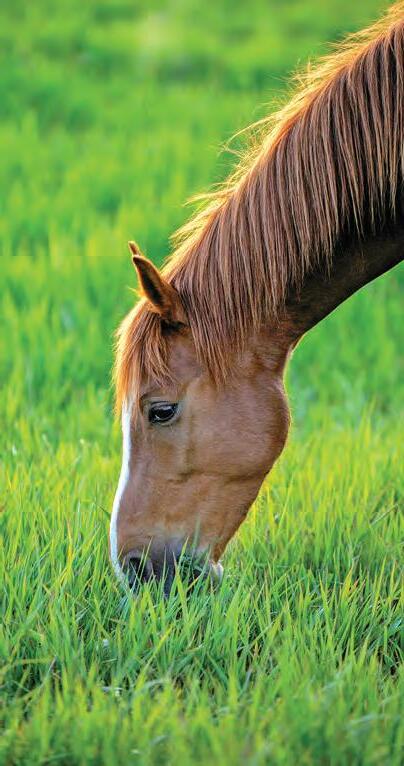
Try to have animals graze growing, leafy forage without seed heads.
Root Development in Relation to Top Removal
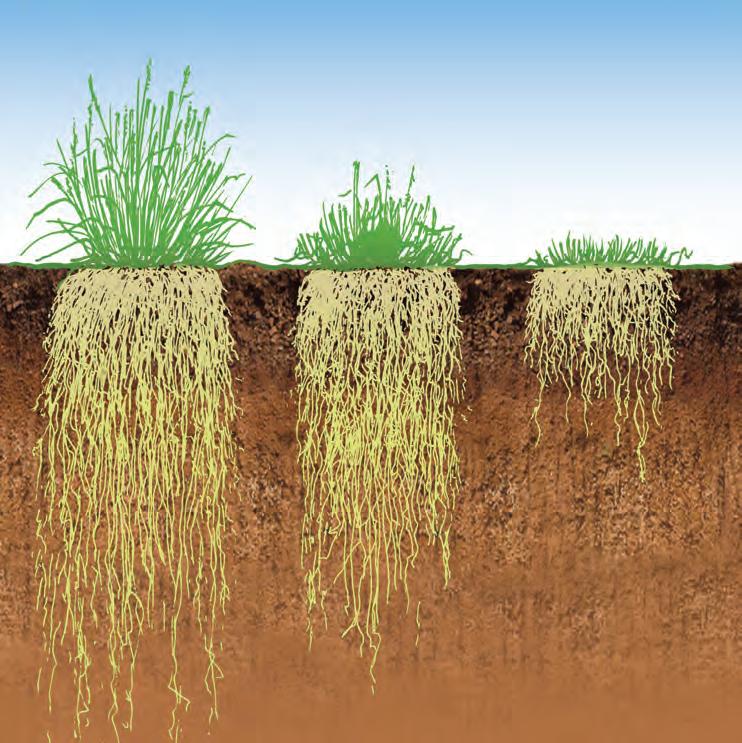
50% of roots stopped growing for 17 days No roots stopped growing Roots stopped growing for 17 days
FIGURE
PHOTO: CLIX PHOTOGRAPHY
Regenerative Land Management Practices
My partner, Patrick, and I — along with our herd of four horses — have spent the past year settling into our five-acre property in the Cowichan Valley on Vancouver Island. It’s been a whirlwind of learning and experimentation, from creating a healthier, more natural habitat for our horses to exploring food production, biodiversity, and regenerative land design.
If you’ve read my previous articles, you’ll know I’m passionate about horse track systems and paddock paradise setups. What you may not know is that I’m also an avid gardener. Before moving here, I spent several years caring for a native habitat garden, deepening my understanding of native plants, food growing, permaculture principles, and regenerative landscape design.
At the same time, I’m aware we live in an increasingly uncertain world when it comes to food security and resources. I
strongly believe in becoming as selfsufficient, skilled, and communityconnected as possible.
When we moved to our farm, my goal was to improve the quality of life for every being that calls this place home — including the land itself. That has meant learning how each part of an ecosystem supports another, and how to cultivate harmony rather than impose control. Horse people are in a unique position: many of us steward large pieces of land rich with life and potential. In this article, I’ll share some of the permaculture and regenerative agriculture practices I’m experimenting with at Raven Moon Farm, what’s worked, what hasn’t, and how you can apply some of these ideas on your own property.
Bill Mollison and David Holmgren introduced the term “permaculture” in the mid-1970s to describe “an integrated, evolving system of perennial or selfperpetuating plant and animal species
useful to mankind.” It can also be described as consciously designed landscapes that mimic natural patterns and relationships while producing food, fibre, and energy for local needs.
Here in the Cowichan Valley, I’ve absorbed many permaculture ideas over the years, and they’ve naturally influenced my horsekeeping, though I’m far from an expert. I’m simply a horse girl with curiosity, composted manure, old hay, and space. The good news is that anyone can implement one or many of these ideas.
Permaculture is built around 12 main principles (see Sidebar). The first is “observe and interact,” and for horse owners, that means watching how horses use the land before making permanent changes and noticing where plants naturally thrive.
After our first full year with the herd at home, we’ve already learned a lot: where water flows during heavy rains, where the

horses prefer to hang out, and how winter sun exposure affects the track system (we need to build a new track loop so the horses can get a little sun in winter months). Observing can give us so much information about microclimates, soil quality, and where the horses like to hang out. We discovered the garden location we originally doubted turned out to be the most productive, while manure management still needs improvement. Observation revealed valuable information about microclimates, soil quality, drainage, and how horses feel safest and most comfortable.
Another principle is “catch and store energy.” In winter, our property has a seasonal creek and ponds, but by summer much of that water disappears. Looking ahead to hotter, drier seasons, we need better water resilience. So far, we’ve installed rain barrels and water tanks near major garden zones and plan to add micro-irrigation. Future projects include
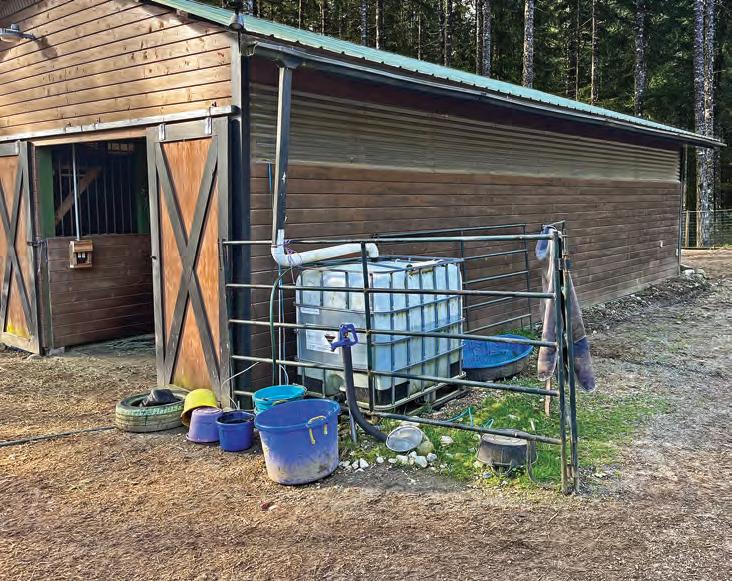
An example of a water catchment system from the gutters of the barn.
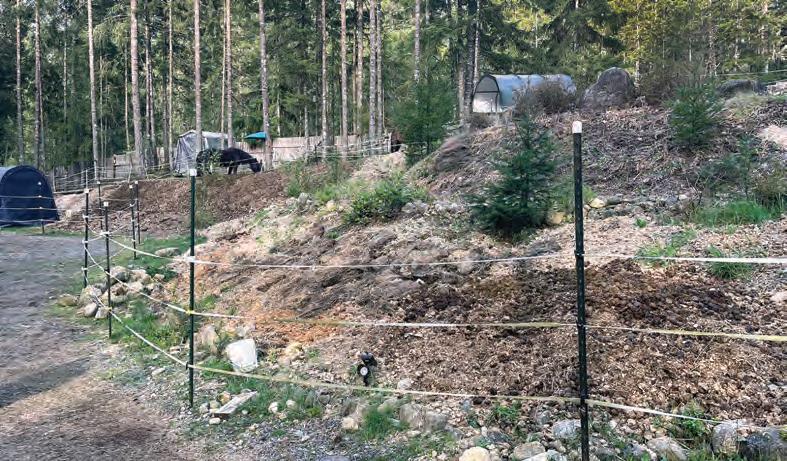
Here the terraced hill is covered with manure, hay, and shavings to create topsoil, improve water retention, and grow plants and trees.
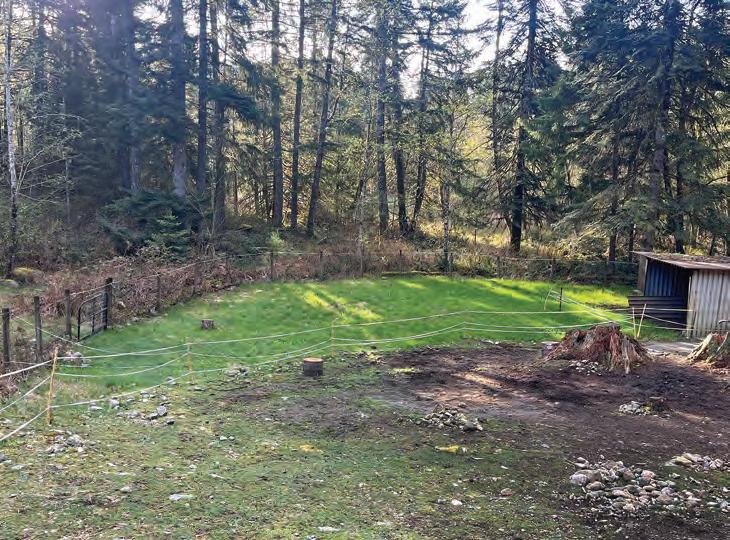
Our tiny grazing zone currently being amended with old hay and composted manure and overseeded with seed from our hay to help produce more grass and reduce weeds like buttercup.
PHOTOS: ALEXA LINTON
PHOTO: PAM MACKENZIE
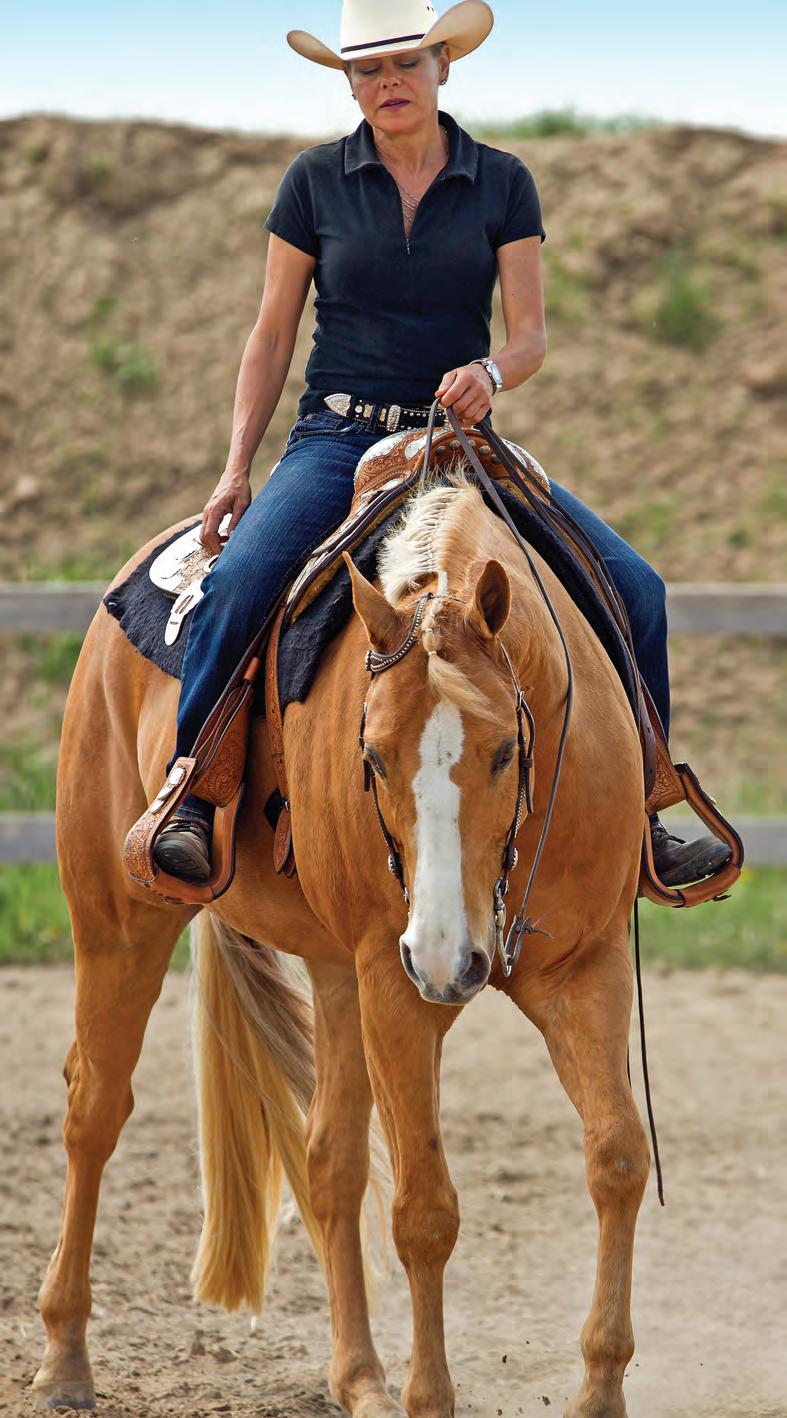
Yielding to Pressure
The Wisdom and the Timing
By Lindsay Grice, Equestrian Canada coach and judge
One could say that to work with horses is to work under pressure: the physical pressure we employ in communicating to our horses, time pressure, and even peer pressure. A wise horseperson has a sense of timing and knows when it’s fitting to yield or resist.
Our goal is resistance-free horse training. A light horse is a joy to be around. He’s attentive and responsive to the most subtle pressures applied on the ground or from the saddle, whether pressure on the halter, pressure through the reins, or pressure on his side with your hand from the ground or with your leg from the saddle.
The Language of Pressure
We use several types of pressure in working with horses: body language, phycical contact, and voice. With each method, we’re influencing the horse to make some desired change.
1 Body language. Horses are fluent in the language of yielding to pressure in navigating their social group. We’ve all observed the equine dance as we lean over the paddock fence; one horse uses
pressure to move a herdmate away from the gate or the round bale. The herdmate steps back, deferring their space, and peace returns. Horses learn to avoid arguments by recognizing even the smallest warning signs from a more assertive horse.
When lunging, I use pressure through body language: elevating my whip arm to extend my horse’s stride and lowering it when he does so. And I’ll shape the size of the circle with pressure, adjusting my body position at or behind the horse’s shoulder.
In teaching a horse to back for showmanship, I turn toward the rear of the horse, stepping into his “personal space.” As he steps back, I withdraw my body pressure to resume setup or park position.
Some horse trainers will shake the lead shank to back the horse away, which is another form of pressure.
Other horsemen will describe body language as energy — lifting their energy up to move a horse, and lowering it to slow or calm him. In both cases, the horse is perceiving and responding to even the most subtle postural changes.
If horses are masterful at reading the most miniscule horse and human body movements, it makes sense to be conscious of the messages we’re sending on the ground before we even swing into the saddle. Are you readable as you tack up, lead a horse through the paddock gate, or dismount to move ground poles? How does the horse know to follow or where to stand?
2 Physical contact is a language your horse learns, with its range of meanings according to:
• Location of aid such as pressure applied to the mouth, poll, sides, or haunches;
• Type of aid including pressure delivered via rider’s leg, rein, or whip tap;
• Technique used, steady, pulsing, or tapping.
At the basic level, pressure is applied through the reins to decelerate and legs to accelerate. The same rein pressure, delivered in a squeezing vs. steady technique, may come to mean flexing at the poll. For some Western trainers, a steady hold with the leg slows their horse and a light pulsing motion moves them forward. Pressure on different locations on the horse’s body will come to represent
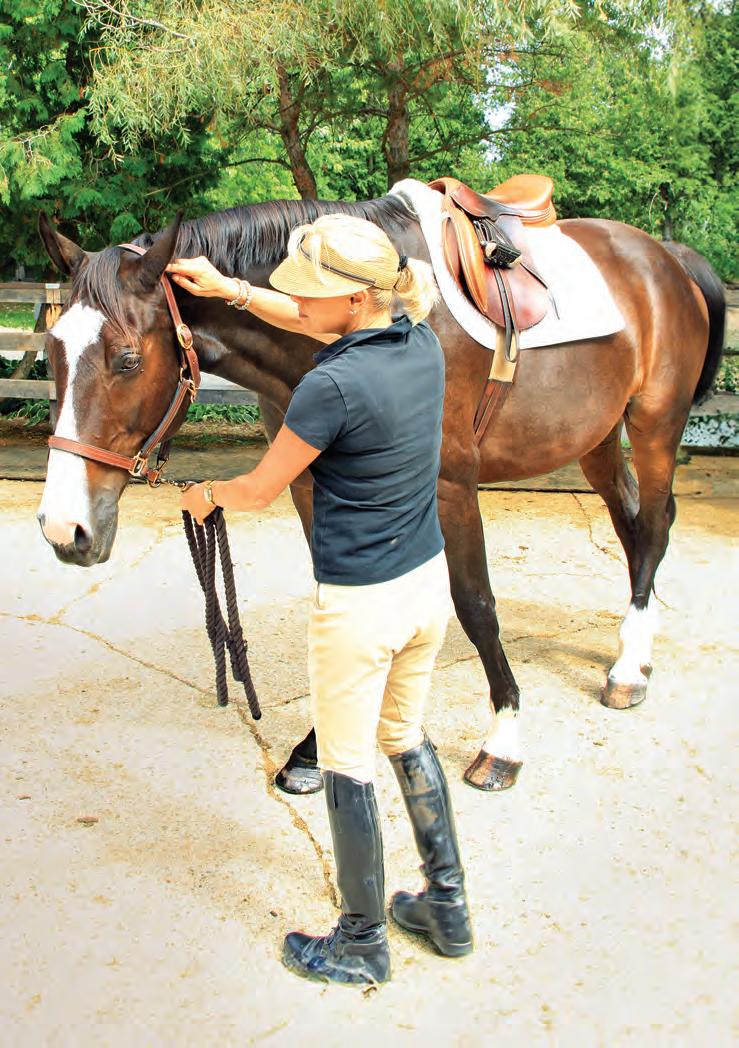
The prerequisite to leading, loading, and tying is responsiveness to pressure here.
moving different body parts. A horse learns to bend away from neck rein contact and move his haunches away from leg pressure located behind the girth. As the horse’s training advances, trainers can expand the vocabulary to include directional shifts in rein and seat pressure.
3 Voice pressure works as I use a unique vocal sound to represent the precise response I have in mind and silence my voice as the horse responds.
I quit clucking, for example, when the horse accelerates. I quit my long, low
waaaalk command as soon as he transitions downwards. Voice commands, taught from the ground or while lunging, are wonderful bridges to understanding aids from the saddle.
I’m a believer in starting the conversation of pressure and release from the ground. When a horse learns the language of pressure, the concept spills into other areas of training. Say yes to your horse. Horses learn from the release versus the application of pressure. Timing is key. By relaxing my body, voice, or contact at the onset of my
PHOTO COURTESY OF LINDSAY GRICE
Riding RooElla
The Ultimate Dressage Schooling Horse
Article and photos by Shawn Hamilton, Clix Photography
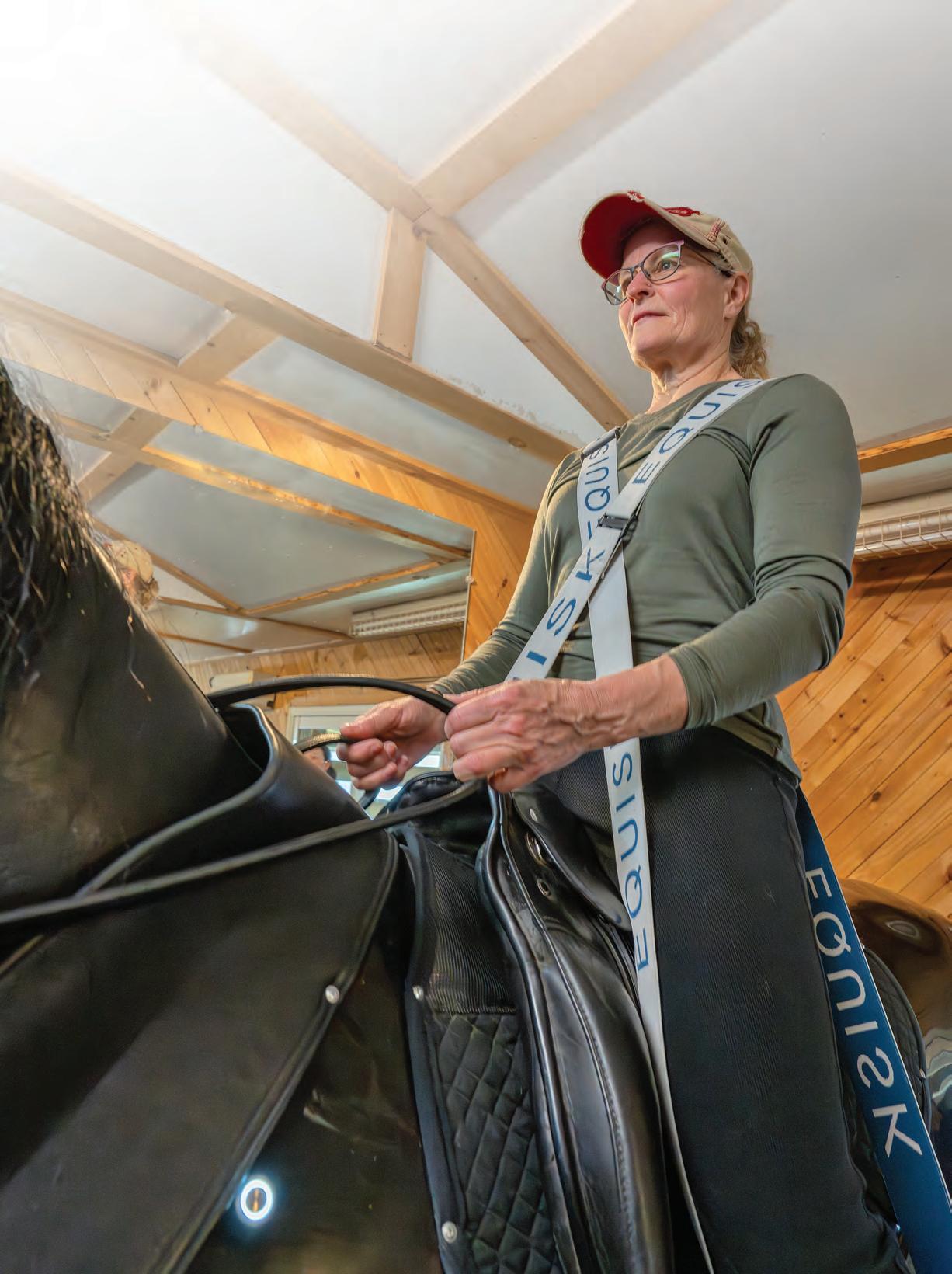
RooElla, the interactive horse simulator owned by Susan Cruickshank of Oakwood, Ontario, is a perfectly schooled mechanical dressage horse that is highly sensitive to its riders’ aids. During a session with Cruickshank and RooElla, riders gain instant feedback about leg pressure, seat position, and rein contact. It is the ultimate tool for helping riders be the best they can be for their horses.
Fifteen years ago, while obtaining her certification as an equine psychotherapist, Cruickshank purchased Canada’s first Racewood equestrian simulator, which she named Tuppy.
“I became an Advanced F.E.E.L. (Facilitated Equine Experiential Learning) practitioner and bought Tuppy to assist with the therapeutic process,” she tells me.
“I changed my focus to riders when it became evident that the simulator was an amazing learning tool for equestrians of all disciplines. There was a lot of resistance at the start — no one seemed to understand how it would help them in the saddle.”
After diving deep into biomechanics through various methodologies including the Mary Wanless method, Sally Swift’s Centered Riding, and certification training with Jane Savoie in the US, Cruickshank still felt something was missing. It wasn’t until she discovered Alysen Starko-Bowes’ Train Your Seat (TYS) program that things started to gain momentum.
“The TYS training philosophy transformed the way I rode and taught,” she recalls.
Last year, Tuppy was sold to a good home in Ottawa and Cruickshank acquired RooElla, the first state-of-the-art Dressage Pro Simulator in North America.
After applying her knowledge as a
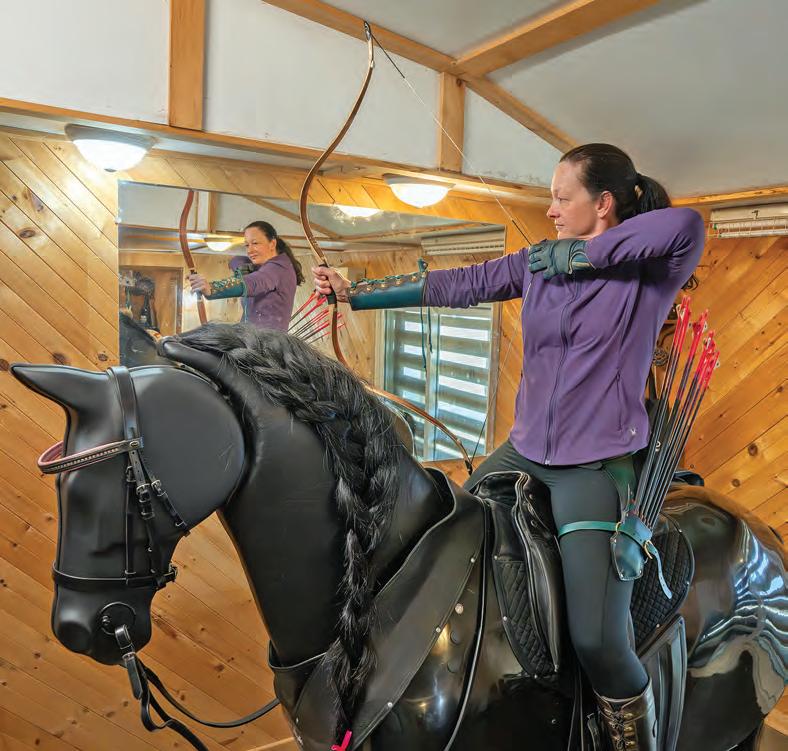
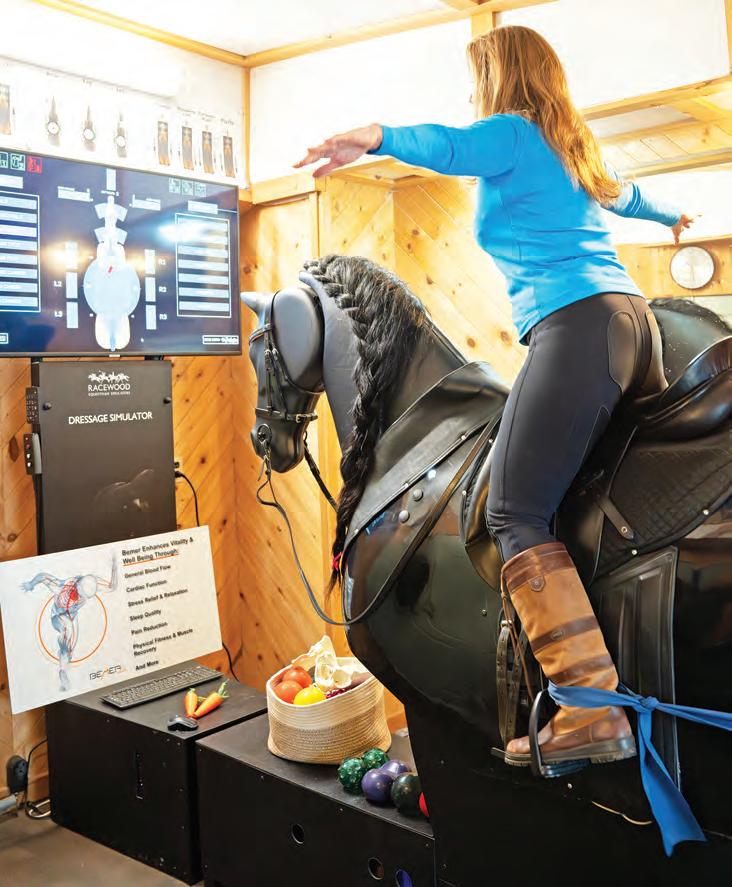
Anne Vavra uses her sessions on RooElla to improve her seat and balance for mounted archery.
Jodie Goldhart working on two-point for balance and to build confidence in the saddle.
The HIDDEN STRESS of Moving Horses
Keys to a Successful Move
When it comes to stressors, moving house is right up there with other major life changes. For horses, moving to a new home may be just as stressful, if not more so. After all, a horse has no context for the move and no advance warning. One day she may be grazing with friends, and the next she’s expected to live with strangers.
Trainer Gaylene Diedericks, one of the horsewomen behind The Whole Horse Journey, has written extensively about the impact of moving a horse. She notes that people often underestimate just how big a deal a move can be — not just physically, but emotionally, socially, and neurologically.
“A move is not just a change of location,” says Diedericks. “It’s a complete disruption of everything that feels familiar and safe to them.”
Horses are very sensitive to things like routine, herd dynamics, and their environment, says Diedericks, so a move means having to “rebuild their sense of
By Li Robbins
safety from the ground up.” It’s not just the fact of suddenly living in a strange place; it’s also about navigating new social hierarchies, different human management styles, and altered daily routines.
Making the Decision
Deciding to move a horse may not come down to choice. You may have to relocate for a new job, or your current boarding barn will be closing. Often though, people choose to move horses for reasons that could be considered optional. Maybe you want a shorter drive to the barn, or better access to trails, or to ride with people pursuing a similar
discipline. It can be challenging to balance equine and human needs, but in Diedericks’ view it’s crucial to put the horse first and to focus on “emotional safety, social stability, and the quality of the environment.” After all, if your horse is unhappy, you will be, too.
There are practical considerations when looking at a prospective new facility, whether that means choosing a place with an indoor arena (if you train through winter in snowy Canada) or for improved safety features, such as fencing. It’s crucial to consider the herd setup (e.g., mares or geldings only or mixed) and evaluate how that will work for your horse. Additionally, the amount of pasture space, turnout time for indoor horses, and feeding practices are all important questions. A less tangible but essential consideration is to spend enough time at the new place to get a real sense of the vibe.
“Is it calm, consistent, and predictable?” asks Diedericks. “Or is it chaotic and high pressure? I also consider how horses are handled and understood by the people managing them. Are they in alignment with my values? This is crucial to me as a conscious horse owner.”
New Home Syndrome
Horse trainer and coach Shelley Appleton coined the term “New Home Syndrome” in an attempt to raise awareness of the impact that moving a horse can have. To better understand New Home Syndrome, she suggested thinking about how you feel when you get home after a busy day. A comfortable, familiar home helps people to relax and feel safe. It does this for horses, too.
A horse experiencing New Home Syndrome, on the other hand, may be unsettled, anxious, and present challenging behaviour, wrote Appleton in a blog post. Given that, it’s helpful (and respectful of what the horse is going through) to remember that for a horse, a new situation may be scary in a way that isn’t scary at all for a human. Horses don’t generalise their experiences the way people do — after all, even in a familiar home small changes can seem new and startling to a horse. To get through New Home Syndrome a horse needs to trust their
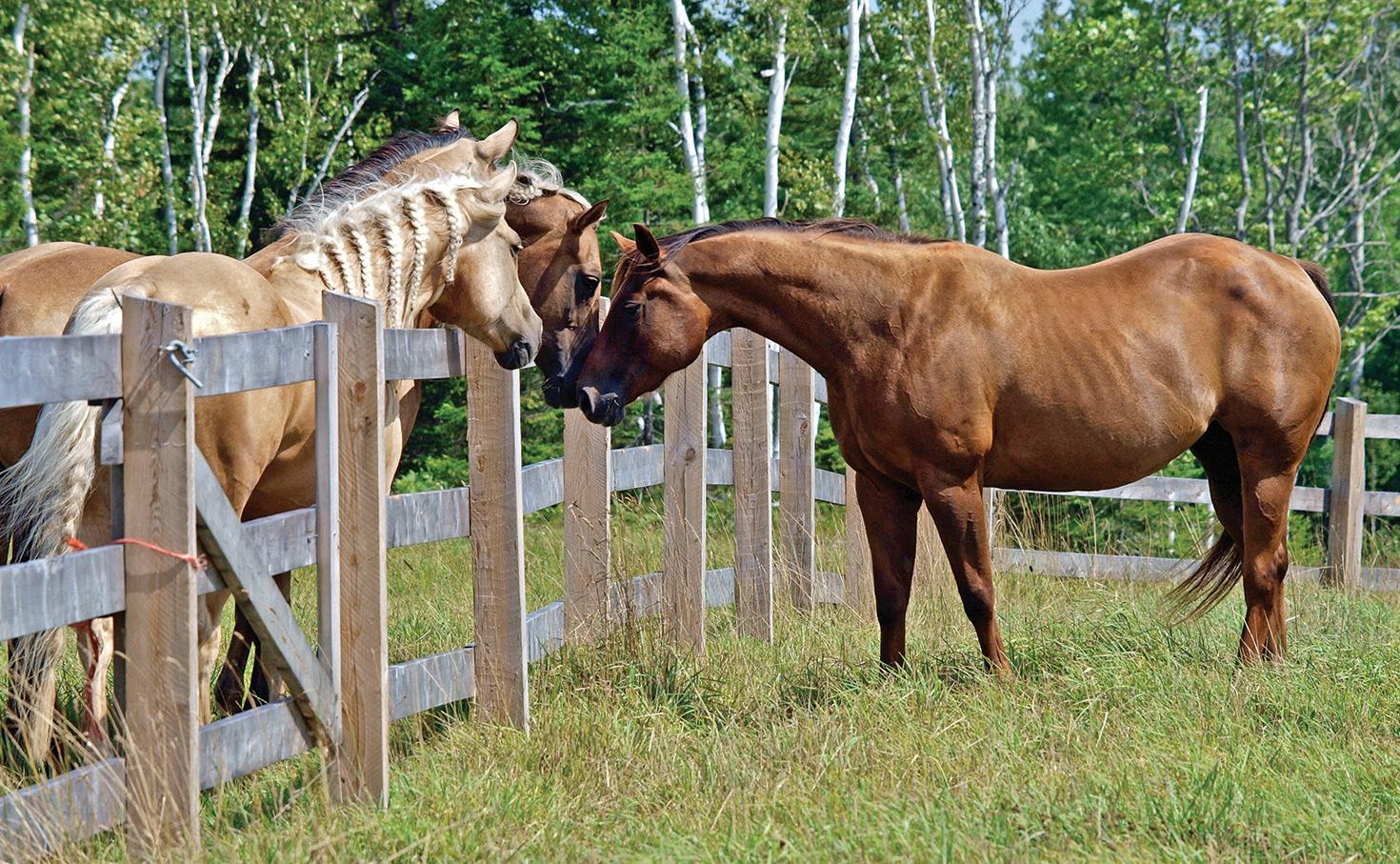
When considering the move, think about your horse’s sense of security in the new home. Ask about turnout time, pasture space, feeding practices, and the makeup of the herd (whether mares, geldings, or mixed). Find out how new horses are integrated into the resident herd. Some barns prefer the gradual approach of introducing horses across a safe fenceline, while others simply turn the new horse in with the others and hope for the best.
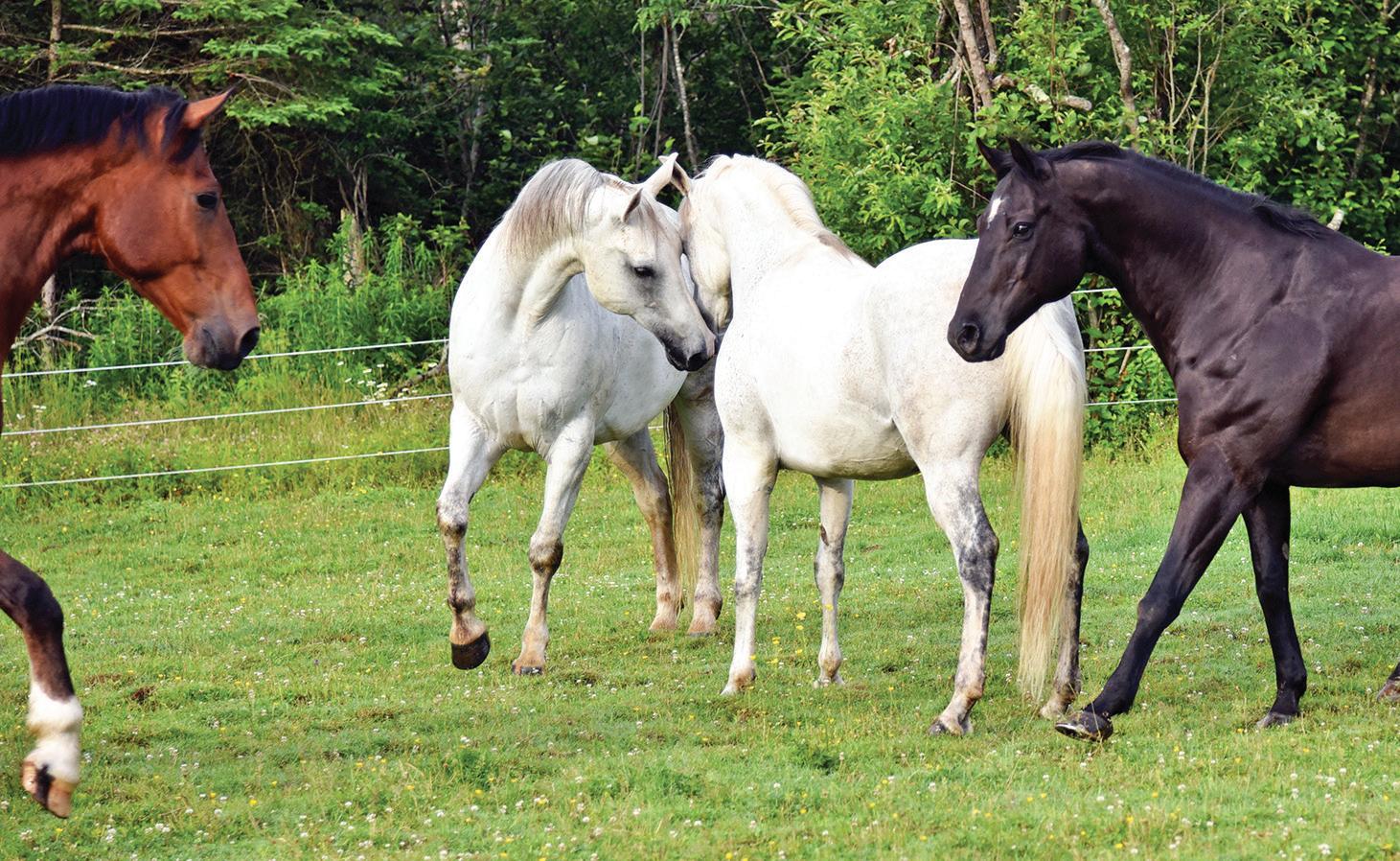
environment and the humans and horses within it.
“With strategic and understanding approaches, this may take weeks, and their nervous systems will start downgrading their high alert status,” wrote Appleton. “However, for some horses, it can take a couple of years to fully feel at ease in their new home.”
How You Can Help
Thankfully, it may be possible to mitigate some of the moving stress. A consultation with the horse’s veterinarian, for example, can help you to strategize in advance about potential
moving-related health concerns, such as stress-triggered ulcers. A plan to gradually acclimatize the horse to their new home, including incremental feeding changes, can also help smooth the transition. Familiar comforts, such as grooming routines, customary treats, etc. may also be a part of achieving that goal. Probably the biggest support a human can give a horse after a move is summed up in one word: time.
Some believe that it’s best for horses that live outside to have as little human involvement as possible in the early weeks in a new herd. Gaylene Diedericks thinks it’s a good idea to have “minimal
PHOTOS: PAM MACKENZIE
The Horse Who Stopped Trying Rethinking Horse Behaviour
By Joanna Lepiarczyk
Borys was a black Warmblood with excellent movement and rare athletic potential — the kind of horse people notice, the kind trainers pin their hopes on. By the time Borys came to our barn, he was more than 10 years old, and his story was already heavy with effort and disappointment. He had spent most of his life in one of the city’s top sports stables, which was a competitive, professional place built for results. It had great trainers, indoor and outdoor arenas, and serious riders. But there was no pasture, no turnout, and no herd. It wasn’t harsh; it was just focused. Horses there had a job to do, and everything was designed to support that.
Borys’s job was to become great. Trainers worked hard to shape his potential into performance. He was put through many years of schooling. Different riders tried their hand and methods. His tack was adjusted. Feeding, schedules, and supplements were optimized. The problem wasn’t effort; it was that Borys didn’t cooperate. Under saddle, he became explosive. He reared, bucked, and bolted. He was powerful and unpredictable — impossible to relax on and impossible to
control. But a horse with that kind of talent couldn’t be lost to “behavioural problems,” so they tried harder until eventually, they gave up. One day, Borys was dropped off at our barn. He wasn’t sold or retired. In a quiet, uneventful way, he was just left here. He was unrideable and no longer wanted. That’s how I met this beautiful, difficult horse.
Instead of trying to “fix” him, my dad gave him something he hadn’t had in years: space. For months, Borys was left
alone, with no arena, no expectations, and no work. Just pasture, sunshine, a herd to move with, and the freedom to say yes or no to people. We watched him nap in the sun, graze with our other horses, play, and communicate. With time, his eyes changed, his body softened, and he began coming toward us on his own. One day months later, my dad quietly mounted him. No drama, no breakthrough moment. Borys carried him as if they’d always known each other.
We were told Borys was dangerous. He wasn’t. He was overwhelmed, shut down, and above all, misunderstood. His story reminds me of something we often forget: Horse behaviour cannot be explained through just one perspective, because it is never just about obedience or disobedience. It’s about the whole horse — what he has lived, what he has felt, and what he is still holding inside.
When a horse shows “bad behaviour,” we tend to look for a single cause and a single solution.
PHOTO: PAM MACKENZIE
Training problem? Fix it with a better technique.
Pain issue? Call the vet.
Not enough respect? Get stronger with your aids.
But horse behaviour doesn’t come from one source — it’s never that simple. Horse behaviour is a reflection of deeper processes, not personality quirks or disobedience. As Daniel Mills and Sue McDonnell point out in The Domestic Horse: The Origins, Development and Management of its Behaviour, equine behaviour is best understood by considering the horse’s evolutionary design, his current environment, and his past experiences. To understand why a horse behaves the way he does, we need to look through many lenses.
Evolutionary Design The horse’s nervous system is built for survival. His reactions — bolting, freezing, and spooking — are fast responses from a body designed to stay alive. It’s about reacting early and fast. That’s how horses made it this far.
Sensory Environment Horses perceive the world through their acute senses. Environments like flashy arenas and busy barns often bring in sights, sounds, and smells that don’t fit what their system was built for. Some horses adjust, but others stay on edge. It’s not always a training issue — sometimes it’s just too much input, too often.
Social Structure and Upbringing In natural herds, horses grow up with steady contact, clear and dynamic roles, and constant feedback from others. When that’s missing, whether through isolation, rushed handling, or too much change early on, it can shape how a horse relates to others later. Big reactions or separation struggles often trace back to those early days.
Ethological Needs Movement, grazing, rest, and social time are all basic needs. When horses can’t meet those needs, we often see signs such as weaving, cribbing, frustration under saddle, and shutting down. They’re signs of a system trying to cope with what’s missing.
Memory and Emotional Learning Horses remember not just events, but how those events felt. A horse that resists something today may be responding to something that happened a long time ago, especially if pain or fear was involved. They don’t forget easily, and that sensitivity is part of what makes them who they are.
Domestic horses living in environments that conflict with their natural biology experience significant mental strain. This overload of the
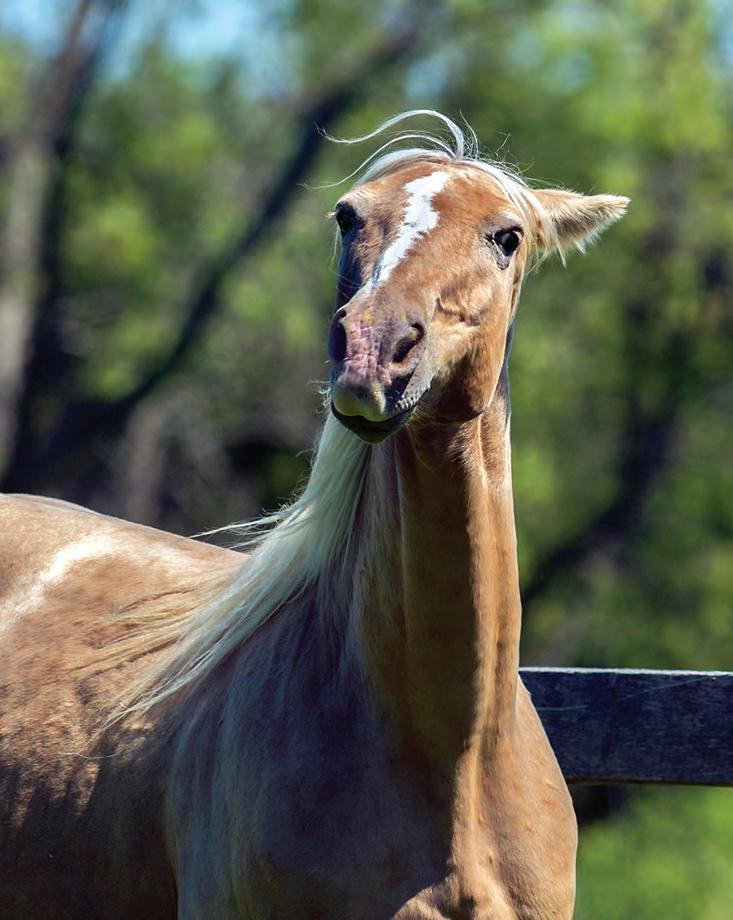
Stress, trauma, or internal conflict may manifest as behaviours labelled “difficult” or “disobedient,” reminding us to look deeper before judging the horse in front of us.
nervous system affects not only their well-being, but also their behaviour, our interactions with them, and their ability to learn and train effectively. Changes in behaviour — especially behaviours perceived as difficult or challenging — are often signs of internal conflict rather than disobedience. Without understanding underlying factors, we risk mislabeling signs of stress, trauma, or confusion as “bad behaviour.”
If we want to look deeper, we can also consider breed predispositions, constitutional type, emotional regulation, hormone cycles, neurobiology, and individual temperament traits. These layers help us understand the why behind behaviour. They shift our focus away from “How do I fix this?” and toward “What is this horse trying to cope with?”
Take Borys for example. His behaviour appeared rebellious on the surface, but what if it was actually a survival response? What Borys needed was not a firmer hand, but a different approach —
one that allowed his nervous system, body, and brain the opportunity to reset and feel safe again.
Behaviour is never just behaviour. Each reaction, whether subtle or intense, reflects how that horse is processing his world. When horses are exposed to prolonged stress — whether through environmental deprivation, conflicting training signals, social isolation, or overstimulation — their entire system tries to adapt. But many times, adaptation is impossible. Not all stress results in a case of hyperactivity. Just as often, it results in withdrawal — a reduced responsiveness to the world, which is sometimes mistaken for calmness or “a quiet personality.” This can manifest as:
• Lack of curiosity or engagement
• A flat, vacant expression
• Low energy, slow responses
• Avoidance of contact
• A general sense of emotional disconnection
PHOTO: CLIX PHOTOGRAPHY
The Heart & Heritage of the Newfoundland Pony
By Jacqueline Louie
Strong, willing, versatile, brave. Even-tempered, friendly, hard working. And critically endangered. This is the Newfoundland Pony, a conservation breed and one of three horse breeds that have evolved in Canada.¹
The Newfoundland Pony is a unique type of pony that developed in Newfoundland from a variety of Moorland and Mountain ponies brought in by settlers from the British Isles starting in the early 17th century. Dartmoor, Exmoor, New Forest, Welsh, Galloway, and Highland, as well as
1 The other breeds that have evolved in Canada are the Canadian Horse, descended from horses sent over by France’s King Louis XIV in the mid-17th century; and the Ojibwe Spirit Horse, also known as the Lac La Croix Indigenous Pony.
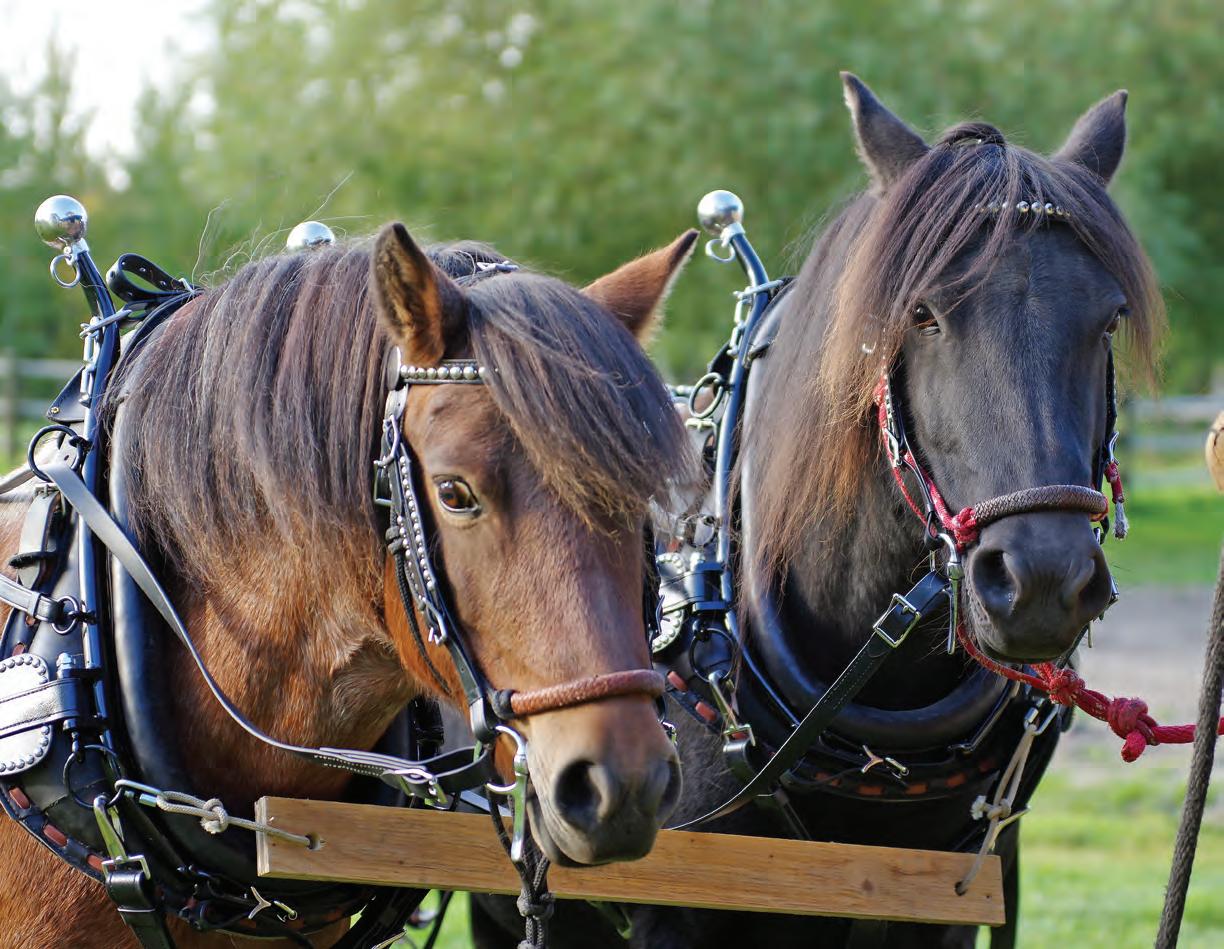
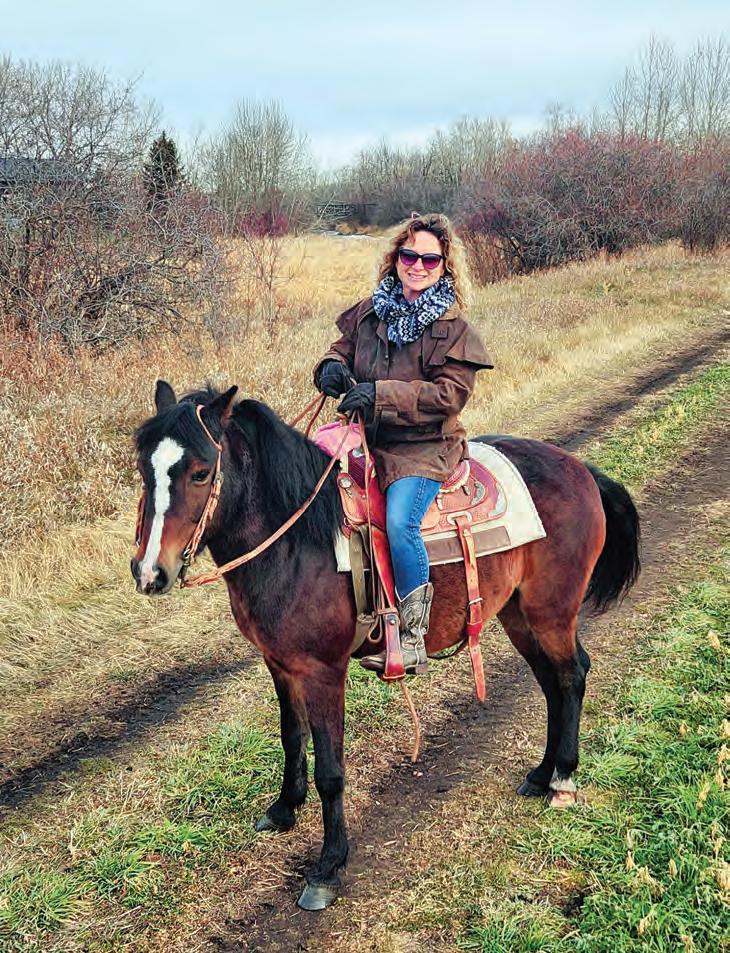
Newfoundland Ponies and half-sisters Charm and Diamond are an enjoyable driving team (Osceola’s Pure Country Charm and Osceola’s Sweet Diamond).
PHOTO BAR LAZY M7 RANCH
Cari McDonnell with the mare, Highland Creek’s Limited Edition (Lily), at the Bar Lazy M7 Ranch in Alberta.
Connemara ponies from Ireland, all influenced the development of the Newfoundland Pony. When not in use, these ponies roamed, fended and foraged for themselves, often for months at a time, in herds that roamed the headlands of Newfoundland and bred at large.
Newfoundland ponies were an integral part of the European settlement of the province affectionately known as “The Rock,” and allowed the fishermen and other settlers of rural Newfoundland to survive in the harsh climate. People used ponies for transportation, farming, and fisheries, hauling fishing nets and bringing codfish to market. Ponies hauled wood from the forests for building houses, flakes for drying fish, stages (outbuildings) and wharfs, and firewood to heat homes through the winter. Ponies worked in the mines and brought kelp from the ocean to be used as fertilizer for the fields.
“They were the virtual engine of outport life for hundreds of years… People’s survival depended on having these ponies,” says Newfoundland Pony Society president, Jack Harris.
Over the centuries, a pony with special characteristics developed, which is now recognized as a distinct breed.
Newfoundland ponies typically stand anywhere from 11 to 14.2 hands high and weigh approximately 226 – 385 kilos (500 – 850 pounds). Their short furry ears serve as protection from black flies. To protect them from the elements they sport a compact, low-set tail; double mane and furry fetlocks; and long shaggy coats in winter.
“The Newfoundland Pony is a very versatile animal known for its strength and its very fine temperament,” Harris says. “It’s a wonderful animal and a great part of our heritage. The Newfoundland
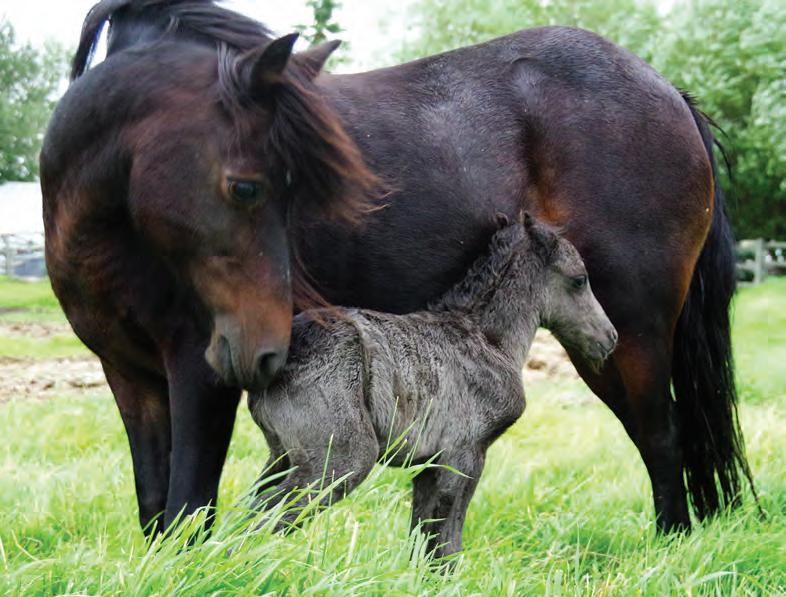
Beothic’s Nutmeg with her newborn colt, M7 Ghost Pepper.
Hooves Across a
Global Crossroads
By Tania Millen, BSc, MJ
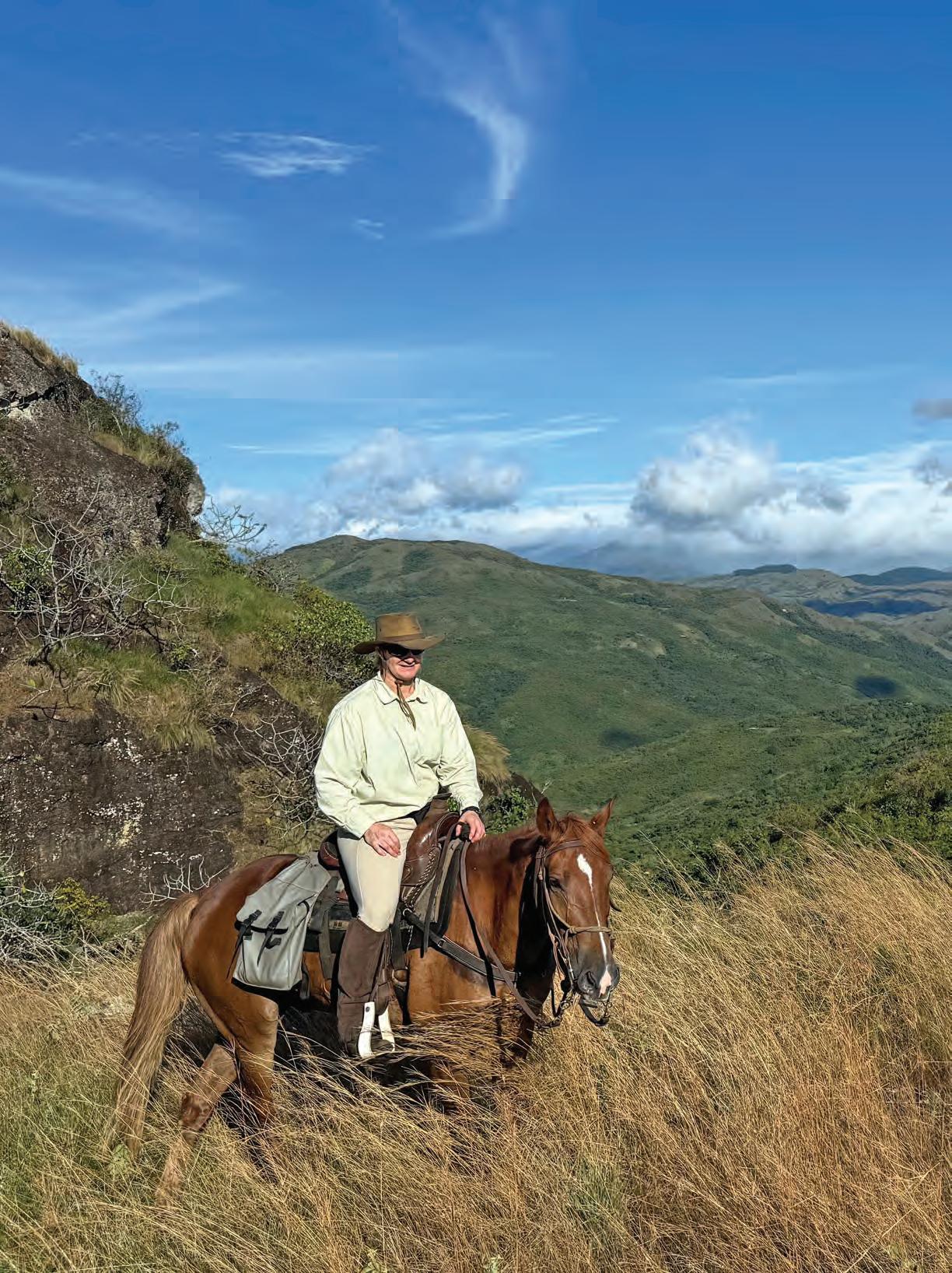
PHOTO: CHRISTIANE SKIEPKO
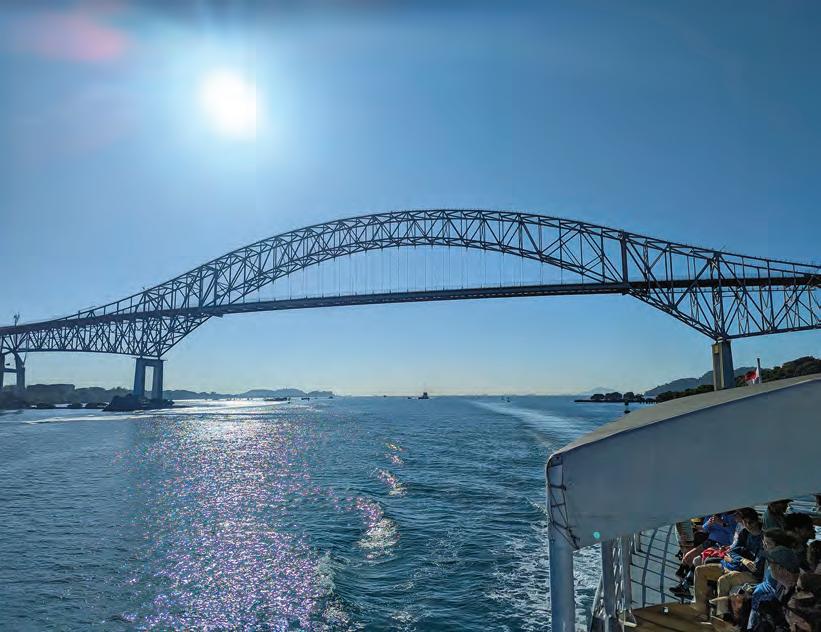
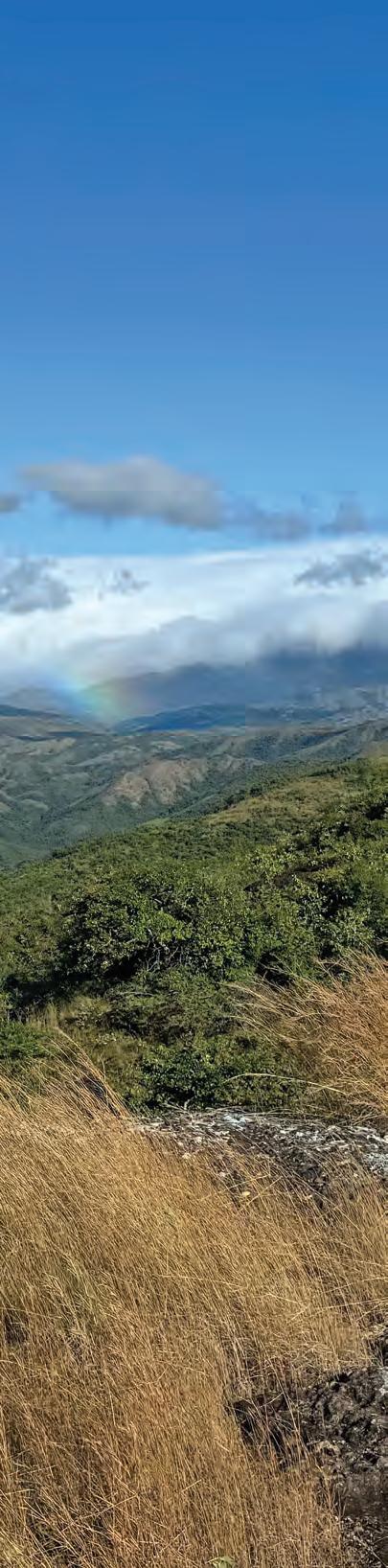
The Bridge of the Americas spans the Pacific entrance to the Panama Canal, linking North and South America across the narrow Isthmus of Panama (in this photo, South America is on the left). Opened in 1962, the steel arch bridge became an important symbol of connection and trade, carrying thousands of vehicles each day high above passing ships.
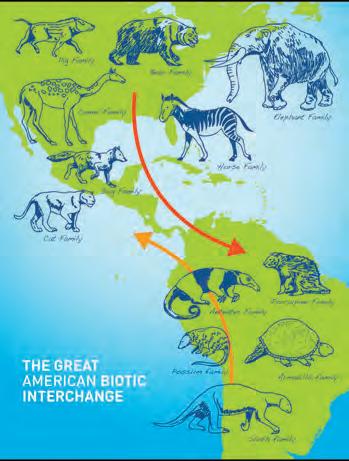
About three million years ago, volcanic islands rose between North and South America to form the Isthmus of Panama, reshaping ocean currents and helping trigger Northern Hemisphere ice ages. The new land bridge also allowed animals to migrate between the continents, with horses, bears, and big cats moving south, while porcupines and opossums travelled north.
“Do you want to run?” Chrissy asked. “Sure,” I said, as her spunky little grey gelding shot off up the road. El Capitan — the lanky, gaited part-Peruvian Paso gelding I was riding — followed. As we clattered up the hard-packed dirt road, I stood in the Western stirrups and gave him his head. I was on a two-week vacation in Panama and this was my second day riding with Horseback Panama near Santa Fe, 300 kilometres west of Panama City.
I’ve been fascinated by Panama and its globally important canal for years. So, when I was looking for a winter break from Canada’s snowy north, riding local horses in Panama fit the bill. The trip was a purposeful escape from the freneticism that permeates North American culture; however, immediate immersion in 29 degrees Celsius, 80 percent humidity, and a new language was challenging. Panama is a slim isthmus connecting North and South America, sandwiched between Costa Rica and Colombia. I stayed in Casco Viejo, the original 1600s port built by Spaniards when plundering
South America’s gold. It’s now situated at the Pacific end of the 80-km-long Panama Canal. However, my five-day riding adventure started in a burgeoning tourist town in the foothills of the Continental Divide.
To get there, I took an air-conditioned coach five hours west on the PanAmerican Highway toward Costa Rica. If the bus continued another 7,700 km, it would reach Vancouver, BC. I hopped off at bustling Santiago, then rode a smaller local bus 57 km north to Santa Fe. The bus was a microcosm of local life. Accordion music played at ear-splitting levels while
PHOTOS: TANIA
MILLEN
My Argentinean Odyssey
Article and photos by Shawn Hamilton, Clix Photography
Horseback with the Gauchos
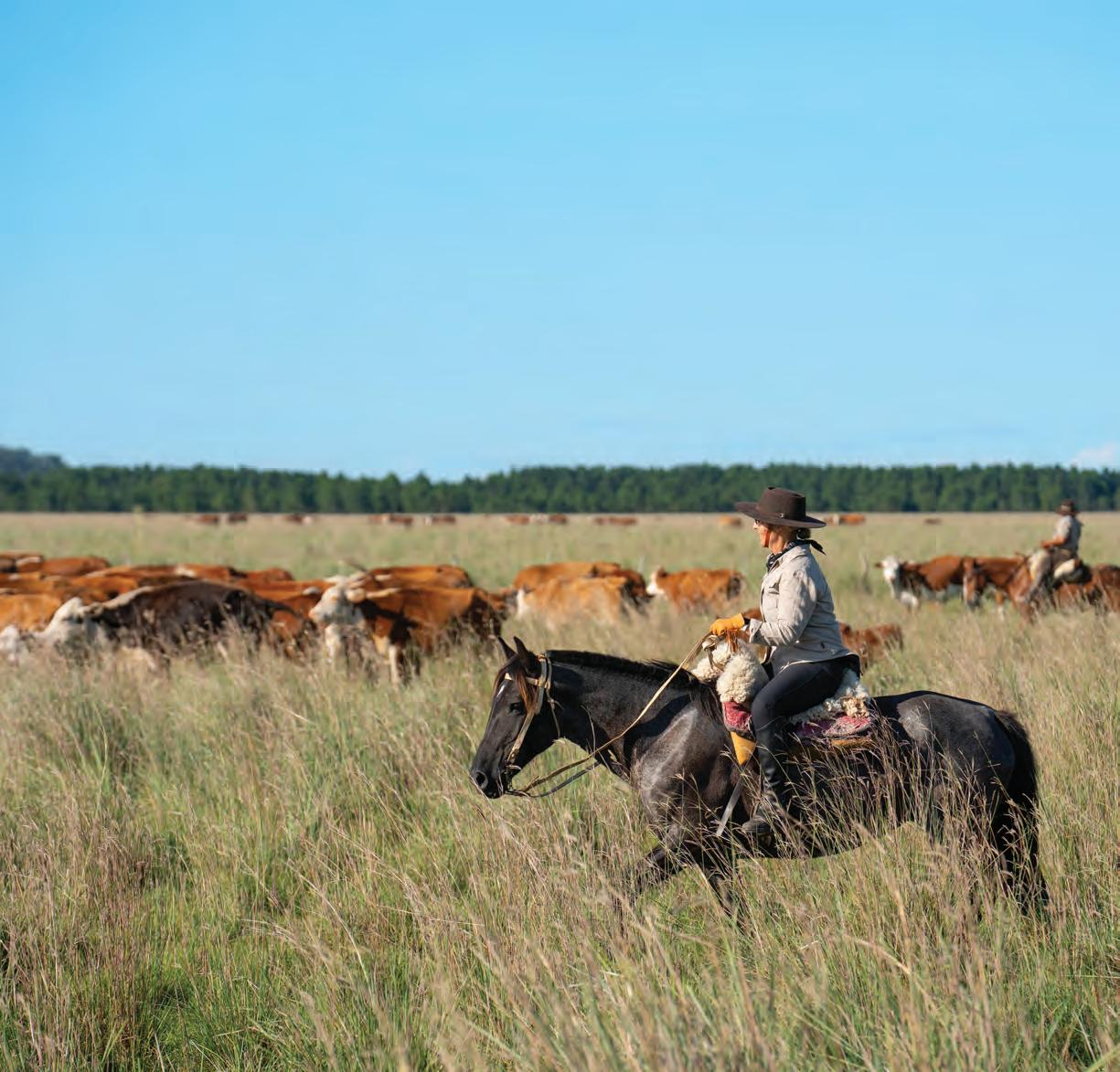
There are magical moments that necessitate a pause, moments to recognize and to be grateful for. As I sit on a blanket in the sand of the banks of the Rio Corrientes in Argentina looking up at the Southern Cross in the night sky, fireflies floating around the horses who stand quietly tied to a large piece of driftwood, I stop to take it all in. Ranch owner Klaus Liebig tosses another log on the bonfire at the beach as his wife Gloria arranges a picnic spread of charcuterie meats, cheeses, and olives. This was the last full-day ride of an incredible week at the 1,315-hectare Estancia Buena Vista, just outside the small town of Esquina in the Corrientes province of Argentina.
The evening’s ride, led by the setting sun, finished on a sandy trail visible only by the light of the full moon. Night birds weaved in and out of the herd as strange sounds resembling a wailing cat came from frogs in the wet marshy ditches. The day began with swimming with the horses in the lagoon and finished with a quiet moonlit lope as we neared the ranch for our last night’s meal of five kinds of homemade pizza cooked on the coals. Klaus and Gloria not only welcomed us into their home but shared some of their favourite horse experiences with us, creating magical moments to be cherished.
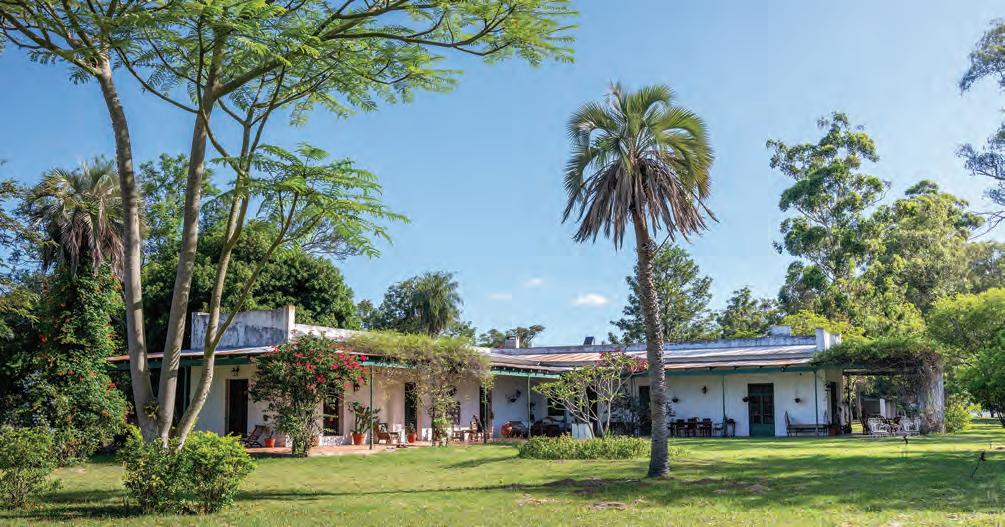
Estancia Buena Vista
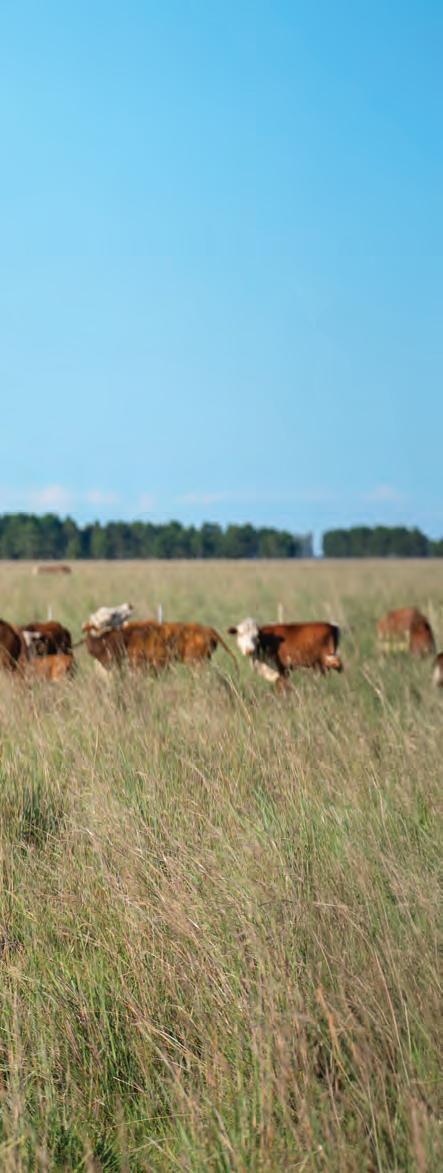
Our arrival at the Argentina Gauchos, Cattle and Trails ride with Unicorn Trails started in the dark. After an overnight bus ride from Buenos Aires, my travelling companion, Carrie, and I crawled into our beds in the guest house to catch a few hours of sleep before the morning sun shone through the window. The view from our screen door reminded me of a safari — the vastness filled with cattle, horses, sheep, and goats.
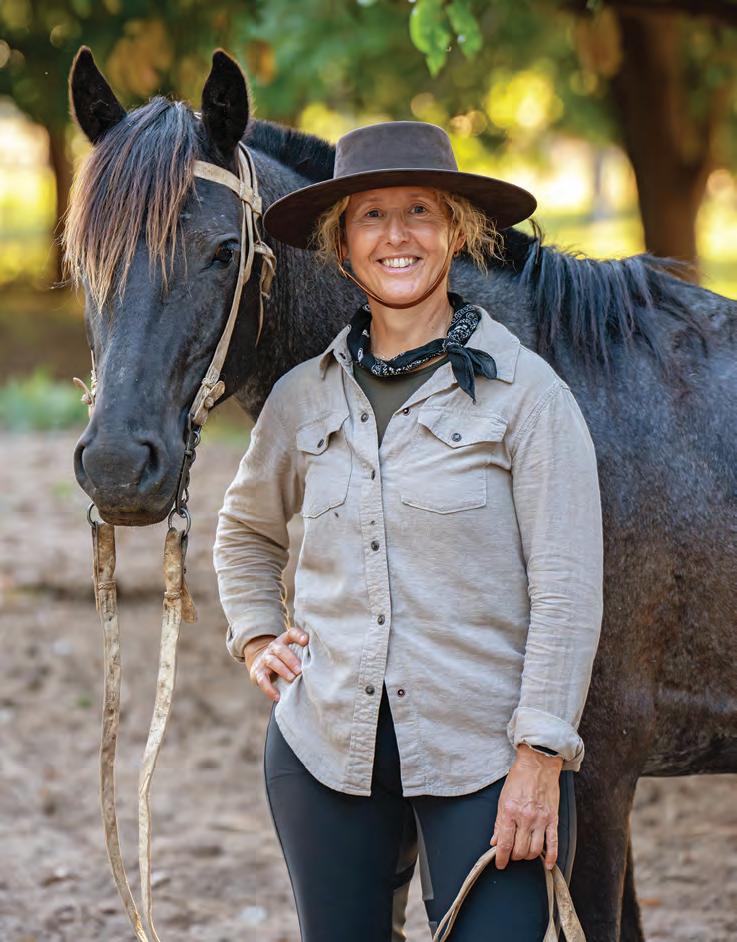
Carrie poses with her horse in the afternoon light after a ride.
The main house at the Estancia Buena Vista was built in 1880.