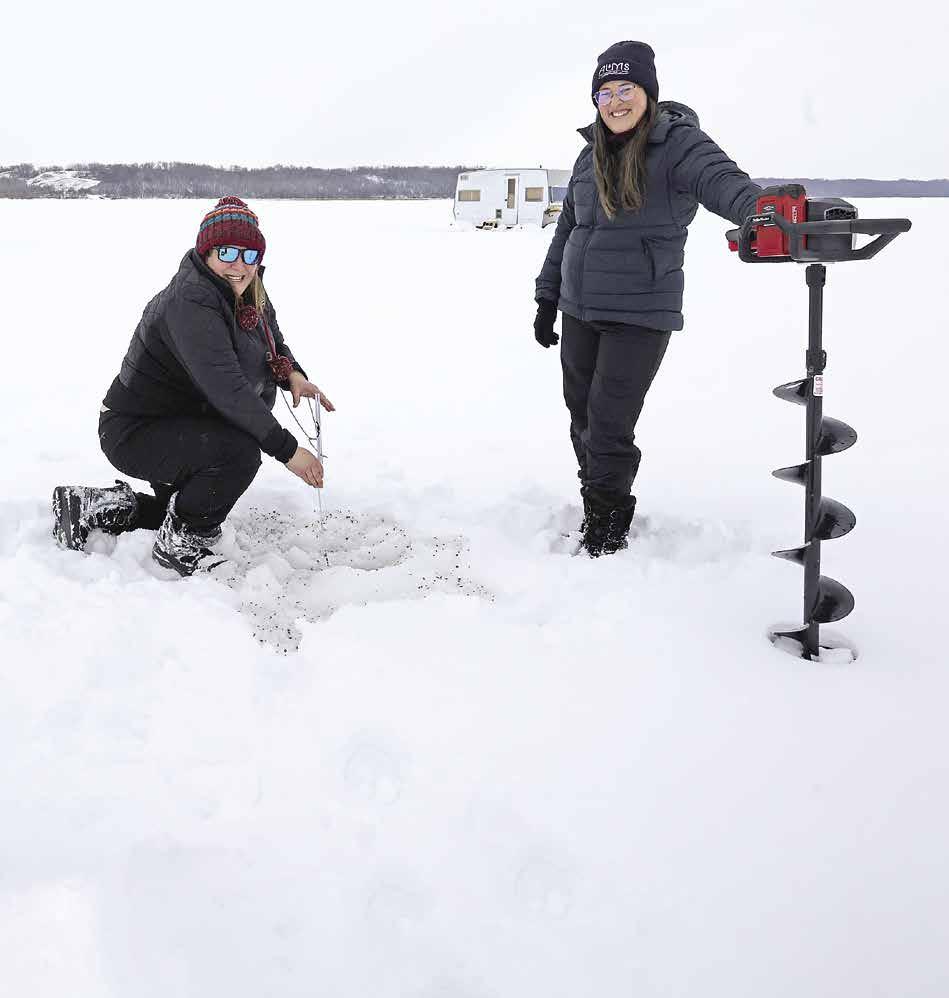
Stewardship coordinator Susanna Bruneau, left, and watershed programs coordinator Sarah Skinner test the water in Driedmeat Lake on a cold winter day.
by
World Water Day will be observed globally on March 22, shining a light on the importance of clean and sustainable water sources in communities. In Camrose County, this message is reflected in the ongoing work of Battle River Watershed Alliance (BRWA).
On a recent winter day, Susanna Bruneau and Sarah Skinner of the BRWA walked onto the frozen Driedmeat Lake, Camrose’s main source of water. They drilled a hole to test the water conditions, by measuring the thickness of the ice sheet and collecting samples from below the surface. The BRWA represents residents and stakeholders throughout the Battle River and Sounding Creek watersheds, working to protect water quality across the region. This year, UNICEF and UN Women have chosen the theme “where water flows, equality grows”, emphasizing how access to safe water supports the health and wellbeing of women and girls worldwide. World Water Day is an opportunity to acknowledge the efforts of all those who protect our water systems through advocacy, consistent monitoring and care. Through their dedication, safe drinking water remains available in communities around the Battle River region.
Photo
Adan
Shaikh
Join us in the afternoon for ne tworking oppor tuni ties and a variety of demonstrations addressing key disease issues
• Learn about f indings from Provincial Crop Disease Surveys and ongoing research.
• Receive an update on the status of Alberta Crop Diseases, including Aphanomyces, Stripe Rust , Cereal Leaf Spots, Fusarium Head Blight and more.
• Learn about new clubroot and blackleg variants and how these diseases are changing.
2026 Scholarship
SCHOL AR SHIP AMOUNT
Eligibility Requirements:
■ Students must be in Grade 10, 11, or 12,
■ Must be a resident of Camrose County
■ Previous Camrose Count y scholarship award winners are ineligible ,
■ Essay should be 1,000 to 1,500 words in length OR video presentation should be 3 to 4 minutes in length.
Selected Topics :
Please select from ONE of the following:
1. With less people growing up on a farm, agriculture can be seen as a di icult industr y to enter. What are all the di erent ways to be involved and employed in agriculture in addition to running a farm operation?
2. Develop a new school curriculum around agriculture education for elementar y to high school students. What would this look like in your community school ?
Please reference people interviewed or research material used for your essay or video presentation. (No Power Point presentations will be accepted this year).
Submit entries to: Camrose County Essay Contest 4238-37 Street , Camrose, AB T4V 5B2 OR by email to: asb@county camrose .ab .ca
Please include the following as part of your submission:
Full Name, Mailing Address, Phone Number, High School being attended and Legal Land Description or Hamlet Address
Deadline: April 24, 2026 @ 4:30 p.m.
For further information contact: Corey Stuber 780-672-4765
The winner w ill be photographed for press release s, and the essay or video presentation will be posted on the Camrose C ounty website.
WORKSHOP
guest speaker Toso
from ATTS
CE
Thursday, April 9, 5:3 0 to 8:30 p.m. , Bawl f Communit y Hall Join us as Toso shares his extensive knowledge about E VERY THING T REES:
• How and Where to Plant • Tree Care and Maintenance
• Pest and Diseases • Pruning Basic s RSVP by April 2 to 780 -672-4765 or asb@county.camrose .ab.ca Food will be provided
Camrose County updates speed limits bylaw
By Nadine Leming
Camrose County proactively evaluates traffic, road conditions and safety data to ensure speed limits are reflective of current roadway usage and population growth keeping in line with the safety priorities. Administration will periodically update speed regulations across various hamlets, subdivisions, and key rural roadways if and when deemed appropriate as part of the ongoing transportation management process.
This review upholds consistent standards, modernizing speed limits based on current safety data and streamlines outdated bylaws. Bylaw 1523 is fully sanctioned under Section 108 of Alberta’s Traffic Safety Act, which allows municipalities to recommend maximum
speed limits on highways under their control, subject to the placement of appropriate signage.
The bylaw reflects the County’s lawful authority to tailor local speed limits while remaining compliant with Alberta regulations. Rail crossings involving national railways fall under federal jurisdiction, not provincial or municipal. Municipalities (as “road authorities”) and any changes, improvements, or closures require prior approval and partnership, ensuring safety and compliances.
Many may be aware of the recent incident of a train/vehicle event that occurred on December 18 at the Rge. Rd. 200 and Alliance Spur Mile 4.48 (Twp. 462) railway crossing. Camrose County Administration and CN Rail were in dis-
cussions to evaluate this location for possible additional control measures.
In discussions with CN, it has been determined that the Stopping Sight Distance (SSD) in the NW quadrant of the crossing meets the minimum requirements. As a result of these discussions, a speed reduction is recommended to properly consider the available sightlines.
It has been recommended to reduce the speed in all directions from the railway intersection on Rge. Rd. 200 from 80 km/h to 50 km/h. Reducing the speed limit to 50 km/h ensures compliance with all agencies involved, which includes sightline conditions and the Grade Crossing Regulations. The current Speed Limit Bylaw has
Silver Creek funding model review
By Nadine Leming
At the Silver Creek Water Management Area annual meeting back in November, there was a request from a few area landowners that the County evaluate transitioning the fee structure to a flat rate instead of the current basis of benefiting acres based on assessment.
At the February 10 meeting, administration informed the council that in order to make that change would mean a repeal of Bylaw 730, which was enacted in February 1986. At that time, Bylaw 730 saw the formation of the Silver Creek Water Management Area project that defined the control of water through the Silver Creek drainage basin.
The bylaw sanctioned the County of Camrose No. 22 (official municipality name in 1986) to institute an assessment to each parcel to fund the
County cost of the drainage project, which was roughly $78,347.57.
In addition to construction costs, the bylaw allowed the County to levy the maintenance costs to benefiting parcels that has continued annually since 1986. The figure was determined in the bylaw as Schedule B and applied to benefiting land.
The assessment of the property is to determine the annual taxation for each parcel of land affected by the drainage project. There is a separate bylaw that sets the amount of the levy that has changed over the years as needed for maintenance.
The Water Act and Municipal Government Act (MGA) have changed over the years and currently there is no framework in legislation to establish a water management group or levy for a ditch system in a new
bylaw. A comprehensive regional water study was utilized towards the initial benefiting acreage prior to establishing the bylaw.
In order to change the levy, the application wouldn’t be supported by an official study and could be prone to resistance. County administration sought legal counsel regarding the request and the response they received was there is no method of changing the calculation method or re-establishing a water management area in a new bylaw.
Councilor Jordon Banack made the motion that was carried, that Camrose County Council respectfully deny the request to adjust the calculation method of the Silver Creek Water Management Area, established inBylaw 730, Schedule B.
County reviews Ferintosh lagoon system
By Nadine Leming
The Hamlet of Ferintosh operates in a two cell lagoon system that was built in 1988.
There was a comprehensive wastewater system assessment completed in 2025 by ISL Engineering and they found that the lagoon is experiencing critical structural degradation and is in need of major rehabilitation.
Extensive vegetation infringement around the lagoon system has added to the issue and hinders performance and increases the likelihood of further deterioration.
The study also documented excessive sludge buildup reducing the efficiency of the lagoon, though overall capacity remains sufficient to meet
the projected community wastewater flows until approximately 2040. Despite the lagoon’s speculative storage capacity being considered adequate, due to the lack of infrastructure integrity, it presents a risk of failure if not addressed. ISL Engineering provided several potential solutions and after comparing capital and operating costs, regulation requirements and environmental impacts among other considerations. ISL determined rehabilitation of the existing lagoon to be the best course of action being the most cost effective and least disruptive option for the County. This upgrade restores the lagoon’s infrastructure, ensures lasting treatment
reliability, and aligns with provincial standards resulting in a reliable wastewater treatment for the Hamlet.
Carlene Wetthuhn made the motion that Council approve an allocation of $500,000 in the 2026 Capital Budget to fund the engineering and design phase of the Ferintosh wastewater lagoon rehabilitation at the existing site.
The funds would come from the Infrastructure Reserve and recommended Council to direct Administration to apply for an Alberta Municipal Water and Wastewater Program grant for the construction phase of the project in 2027. The motion was carried.
been amended to reflect the reduced speed limits.
The proposed 50 km/h speed zone will include the following:
• 250 metres west of Rge. Rd. 200 on Twp. 462
• 250 metres east of Rge. Rd. 200 on Twp. 462
• 250 metres south of the railway track on Rge. Rd. 200
• 250 metres north of the railway track on Rge. Rd. 200. Zach Mazure, public works manager, and Mike Kuzio, protective services manager, presented the proposed change to the Speed Limit Bylaw. Council proceeded with first, second, third and final readings of the updated bylaw which was carried.
New Community Calendar Bylaw
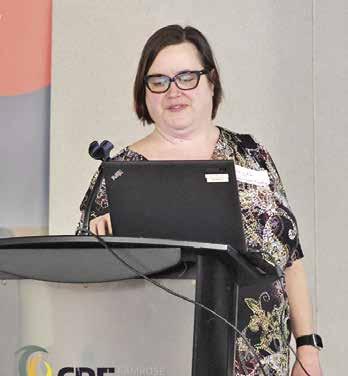
Adan Shaikh, Camrose Booster Anjah Howard, manager of planning and development for Camrose County presented the information to community partners and groups at the Collaboration Summit held on March 3, regarding the new changes to the community calendar.
By Nadine Leming
Over the last few years, the community calendar has become very popular which has led to the development of a new Community Calendar Bylaw.
This new bylaw is aimed to establish well defined criteria for what is allowed to be posted on the site and when administration can remove posts that do not comply with the County’s community standards.
Events that are encouraged to be posted must be pertinent to Camrose County in support of local community initiatives while conforming to legal standards.
Items posted on the calendar should also encourage a sense of welcoming and inclusivity in the communities that fall within the County boundaries, both rural and urban.
Things that aren’t for the calendar include events from outside the region, garage sales, political events of any type or regularly scheduled faith services.
This platform is also not meant to be used as a form of advertising for, for-profit businesses or events of a commercial nature.
Though event organizers can post on the community calendar through a user-friendly portal on the Camrose County website, the County may at any time review submissions and have the right to refuse items not in compliance with the guidelines.
This is a brief summary of what the bylaw includes. For more information or questions about posting on the calendar, reach out to county @county.camrose.ab.ca
ALL signs MOU with Fogo Group
Submitted by Cathie Bartlett
A windswept island off the coast of Newfoundland might seem an unlikely place to discuss how to grow the economy in Battle River Region and other communities across Canada, yet that happened recently at a place called Fogo Island.
Charissa Scott and Nathalie Olson, both of Camrose County, represented ALL (Association for Life-wide Living) and Battle River region at a four-day event, held at the Fogo Island Inn. The series of intensive workshops, dedicated to exploring place-based economic practices, was run by the Shorefast Institute, a nonprofit organization that founded the social enterprise Shorenet.
The venue itself was a model of the purpose of the conference. The success of the 29-room luxury Fogo Island Inn has boosted the economy for the entire island, while showing what focusing on local can do. People are staying and or returning to the area because living opportunities have improved.
“They look at what can be gathered on Fogo Island,” Scott says. “The next step is what can we get from Newfoundland and then from the rest of Canada and from there, the rest of the world.”
Accordingly, the menu at the inn’s dining room includes vegetables from greenhouses, various moose and fish dishes, homemade jams and spreads. Much of the furniture in the rooms and all the quilts on the beds were handmade by islanders. The arts in their many forms, have been, and are, pivotal in the economic turnaround.
A boutique at the front of the inn features paintings, cushions, shawls and other items made locally. The prices may seem steep, but they show the islanders value what they make.
Submitted
As well, the inn’s employees are paid a living wage.
The inn, which opened more than a decade ago, is the first venture of the institute, which was founded by Zita Cobb, a native of the island who returned home from the corporate world with the aim of creating Canadian countrywide net: namely Shorenet.
ALL Battle River was one of eight invited communities participating in the inaugural session. One workshop, held at the island’s old Masonic Hall, restored by Shorefast, looked at contributors to one’s local economy. Scott and Olson shared the Battle River Circle, which demonstrates Flagstaff Crafted, Food Artisans of Camrose County and Battle River Railway as examples of intentional collaboration that adds to our regional economy.
Another workshop explored building the connective tissue of Canada. All the delegates used lengths of yarn in what Scott and Olson called a fun activity that “gave a lot of possible connections while highlighting the strengths
and specific areas of expertise of each person that was there.
“This would be a great activity to do with multiple economic players within Battle River Region.”
Delegates also received an extensive list of books and resources pertaining to economic and community development.
Jane Ross of Association for Life-wide Living (ALL) asked Scott and Olson how being from a small, rural area went over at the conference. Olson replied that their contributions mattered, even though they were among delegates from larger communities such as Vancouver, B.C. and New Market, Ontario.
Takeaways created by Shorefast from a compilation of the discussions and activities throughout the conference – “a wish list of things we’d like to get working on” as Olson said – include:
• Improve regional transportation
• Increase access to community-level data for planning and economic stewardship
• Strengthen local procurement through tools like Shorefast’s Economic Nutrition Certification Mark (showing where money goes and what it pays for)
• Enable investment capital to flow into placebased communities
• Motivate place-based entrepreneurship via accessibility to investment capital, mentorship and policies that reward businesses rooted, supported by and accountable to local communities.
This story along with the invitation by and visit to Fogo Island, demonstrates the power of ideas as well as the power of relationships and lasting networks. This story actually began in Camrose some 40 years ago when Camrosians Jane Ross and Vangie Bergum hosted the International Ethnography of Childhood Conference here.
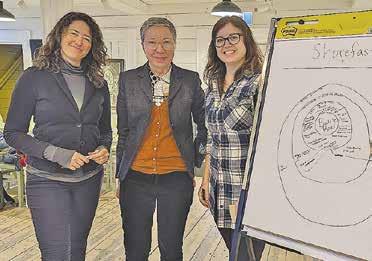
From left, Nathalie Olson, representing ALL; Zita Cobb, Shorefast Founder, Fogo Island, NFLD; and Charissa Scott, representing ALL.
ION TW EN TY THREE (23), TOWNSH IP FORTY THREE (43) RA NGE TW EN TY ON E (21), WEST OF TH E FOURTH MERI DI AN, CONTAINI NG 64.7 HECTAR ES (160 ACRES) MORE OR LESS, EXCEPTING THER EOUT:
A) 2. 83 HECTAR ES (7 ACRES) MORE OR LESS FOR RIGH T OF WAY OF TH E GR AN D TRUN K PACI FIC BR ANCH LI NES RAILWAY AS SHOW N ON RAILWAY PLAN 3978Z
EXCEPTING THER EOUT ALL MINES AN D MINERALS
PA RCEL 3: ALL TH AT PORT ION OF TH E NORT H EAST QUARTER OF SE CT ION TW EN TY THREE (23), TOWNSH IP FORTY THREE (43), RA NGE TW EN TY ON E (21), WEST OF TH E
FOURTH MERI DI AN, WH ICH LI ES NORT H AN D EAST OF TH E NORT H EAST ER LY LIMI T OF RAILWAY
EXCEPTING THER EOUT ALL MINES AN D MINERALS
Tenders will be entertained for sale on ly for pa rcel 1. Tenders will be entertained for sale or lease for pa rcel 2 and pa rcel 3, with such lease commencing in 2026 The Vendor has received County approval to subdivide the northern 80 acres of Pa rcel 3. Tenders for Pa rcel 3 must be either for the lease of the sout hern 77 acres of Pa rcel 3, or for the pu rchase of the sout hern 77 acres of Pa rcel 3. The Vendor currently receives an an nual gas well su rface lease payment of approximately $410 0 for Pa rcel 2. The Vendor ma kes no representation as to whet her these payments will continue Tenders will be entertained for one or more pa rcels. Tenders will not be opened in public. Conditiona l tenders will not be accepted The highest or any tender will not necessar ily be accepted The owner reserves the right to reject any and all tenders. Tenders are to be subm itted in sealed envelopes ma rked “LENTZ TENDER”, to Andreassen Borth. Tenders for lease do not require a deposit. Tenders for sale shall include the tenderer’s GST number, wh ich pa rcel is being bid on, and shall be accompanied by a cheque made payable to “A nd reassen Borth” for 3% of tender pr ice and must be delivered before 12:0 0 noon on Ma rch, 27, 2026, to Andreassen Borth, Ba rr isters and Solicitors, #200, 4870 -51 St reet, Camrose, Alberta T4V 1S1, At tention: Ki rk Laird.
The tender pr ice does not include GST; the successf ul tenderer must pay GST to the Vendor based on the entire pu rchase price or provide GST number and GST Indemnity on or before the closing date
On a completed sale, ta xes will be adjusted as of noon on the closing date The Vendor currently receives surface lease payments for Pa rcel 2. The Vendor ma kes no representation as to whet her such payments shall continue. Please contact the Vendor for more information about these su rface lease payments
On a completed sale, the ba la nce of the pu rchase price shall be paid to Andreassen Borth on or before April 17, 2026, with the exception of the sale of Pa rcel 3, wh ich shall be completed 4 weeks after regist ration of the subdivision of Pa rcel 3 by the Vendor Tenders are ir revocable and shall remain open until dealt with by the offices of Andreassen Borth. If a successf ul tenderer do es not complete the pu rchase after acceptance of that tender, thei r deposit shall be forfeited. Deposits received from unsuccessf ul tenderer s will be returned to them by mail
For further information about the la nd, please call Rodney Lentz at 1-780-988-9133. For questions regarding the tender process, call Ki rk Laird at Andreassen Borth 780- 672-3181
Budget 2026
By Jackie Lovely, MLA Camrose Constituency
Albertans are known for stepping up when times are tough, and Budget 2026 reflects that same spirit.
United Conservatives have returned to the Legislature for the spring session with a budget built around a clear theme of focusing on what matters, responding to global uncertainty, rising costs, and rapid population growth with a steady, practical plan. It protects the services Albertans rely on, supports workers and families, and keeps our province strong through challenging economic conditions – including Camrose and surrounding communities.
Budget 2026 invests in what matters most, including major improvements to healthcare. It expands capacity with more hospital beds, more healthcare professionals, and better access to services. The budget makes a record $7.7 billion investment in physicians – a 22 per cent increase – to support recruitment, training, and compensation, including $7.3 billion for physician services and $450 million for recruitment and education. These investments strengthen primary care, support specialists and surgeons, and help manage growing patient needs in communities large and small, including those served by healthcare teams in the Camrose area. Additional funding in surgical capacity, mental health and addiction care, continuing care, and diagnostic technology further improves access and supports frontline teams.
In education, our government is making the largest education investment in Alberta’s history to respond to rapid growth and rising classroom complexity. It provides $10.8 billion in operating funding – about $54 million per day – including support to hire 1,600 teachers and 800 support staff next year. Over three years, funding will grow to $11.5 billion, supporting more than 5,000 new staff. The budget also invests $1.8 billion for students with specialized learning needs, $560 million for enrolment growth, and $355 million to manage class size and complexity. Additional supports include early literacy and numeracy funding, student transportation, and curriculum renewal to help classrooms keep pace with Alberta’s fast-growing student population.
To keep Alberta’s economy moving, Budget 2026 invests in skills training, workforce development, infrastructure, and industries that create longterm opportunity. Funding supports entrepreneurs, innovation, regional economic development, and growth in key sectors. A three year, $28.3 billion capital plan strengthens roads, transit, hospitals, postsecondary facilities, and other critical infrastructure, supporting tens of thousands of jobs across the province.
Even as Alberta projects a $9.4 billion deficit – driven largely by global volatility and rapid population growth – the province remains in the strongest fiscal position in Canada. Alberta continues to have the lowest overall tax burden, the strongest GDP per capita, and some of the highest weekly earnings in the country. The budget takes a disciplined, responsible approach by focusing on priorities and controlling costs at a time when families, farms, and businesses in regions like Camrose are also navigating economic pressure.
Budget 2026 also continues Alberta’s long-term commitment to the Alberta Heritage Savings Trust Fund. United Conservatives have been steadily paying into the fund and maintaining a plan to grow it to $250 billion by 2050. The fund is expected to reach about $34 billion by the end of 2026-27, up from $31.5 billion the year before. By protecting and growing this fund, Alberta is setting aside wealth today so future generations – including young people growing up in Camrose and across rural Alberta – can benefit from long-term financial stability.
Budget 2026 is designed to help Alberta weather today’s challenges while building a stronger future. By staying focused on what matters – better healthcare, stronger schools, good jobs, and the infrastructure that keeps communities growing – United Conservatives are taking steady, responsible steps forward. With careful fiscal management and a long-term plan for stability, Alberta is positioning itself to remain one of the strongest and most resilient places in Canada to live, work, and raise a family.
Contact my office if you require my assistance. A reminder that I am a commissioner of oaths and a notary public and provide the service free for constituents.
You can contact Jackie Lovely, Camrose MLA, at Constituency Office, 104, 4870-51 Street, Camrose, AB T4V 1S1. Tel: 780-672-0000, camrose@assembly.ab.ca or at Legislature Office, 6th Floor, 9820-107 Street, Edmonton, AB T5K 1E7.
UNRESERVED AUCTION
2-DAY
Getting our immigration system under control
By the Hon. Pierre Poilievre, MP for Battle River-Crowfoot and Leader of the Conservative Party of Canada
Here in Battle RiverCrowfoot, you already know how the Liberals’ reckless open borders policies have let more people into our country than we had homes and opportunities for. This has left Canadians with disjointed job and housing markets, and hundreds of thousands of temporary residents with no long-term prospects. Now – with no credible plan to ensure these visa holders leave when their permits expire – Canadians can see how the government’s policies fail to undo the damage, and how new problems arise in turn.
In Ottawa this week, the Liberals voted down a Conservative motion that would have ended the unacceptable practice of rejected asylum claimants getting better taxpayer-funded health care than Canadian citizens.
Some background information: our recent efforts have shed light on the money wasted on deluxe benefits for fake refugees. We now know that the Interim Federal Health Program (IFHP) will cost Canadians over $1.5 billion annually by 2030, due to sheer mismanagement and the expansion of the program to include supplementary benefits not typically covered by public health plans. This includes services like vision care, physical therapy, and home care, that even those of us who have paid into the system our entire lives don’t even receive.
Among the IFHP’s users are asylum claimants who had their claims rejected, taking advantage of the current 44-month backlog at the Immigration and Refugee Board of Canada and a lenient system that only cuts these benefits when the claimant has exhausted all avenues of appeal—typically many months later.
Last year, IFHP usage was up an astounding 377 per cent from 2016, all while 6 million Canadians cannot find a family doctor and are stuck waiting an average of 30 weeks to see a specialist. In rural communities these problems can be bad, with doctors already scarce and patients travelling long distances to receive care.
Prime Minister Mark Carney’s recent IFHP announcement means that Canadian taxpayers are still footing the rest of the bill for 70 per cent of asylum seekers’ “supplemental health benefits” – including those appealing rejected claims. Another case of this government’s half-measures that fail to deliver results.
To make matters worse, Canadians recently learned that nearly 25,000 refugees were accepted by Canada’s immigration bureaucrats without ever meeting an official face-to-face, reaching an astounding 80 per cent acceptance rate that far exceeds that of many other countries. This is not compassion; this is system failure.
It’s simple: rejected “refugees” who had their claims denied should not get better healthcare than Canadians.
That’s why our Conservative motion called on the government to: Review federal benefits provided to asylum claimants into order to find savings for taxpayers; Restrict federal benefits received by rejected asylum claimants to emergency lifesaving healthcare only; Provide transparency on federal spending on the IFHP by providing an annual report to Parliament, particularly regarding supplemental benefits which Canadian citizens do not have access to; and Pass policies to immediately expel foreign nationals convicted of serious crime in Canada.
Years of bad policy motivated by extreme agendas has left our immigration system ripe for abuse. Yet, when the government had the chance to join with Conservatives to close just some of these unacceptable and costly loopholes, the Prime Minister chose instead to defend the status quo - saying the Liberals “have the immigration system under control”.
In Battle River-Crowfoot, and across the country, Canadians know that is far from the truth. That’s why, as your Member of Parliament and Conservative leader, I’ll continue fighting for immigration policies that are truly responsible and fair.
If you have any questions or concerns regarding this column, or if you require assistance regarding a Federal Government program, you are encouraged to send an email to pierre.poilievre@parl.gc.ca or call 1-800-665-4358.
BRQG present Quilts of Valour
putting
quilter Louise
Adan Shaikh, Camrose Booster
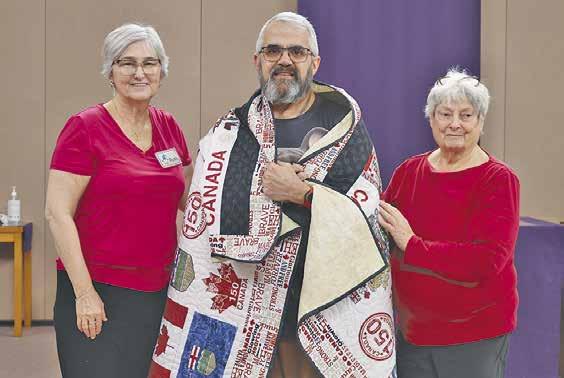
Battle River Quilters’ Guild presented three Quilts of Valour to soldiers who have spent years
their lives on the line, to defend Canadian families. Pictured, from left, are
Paull, veteran George Forbes and Quilts of Valour Alberta and NWT coordinator Diana Cole. Forbes retired from the Army as Captain after serving in the Canadian Armed Forces for 40 years. Forbes continues to serve his community through his work at the Royal Canadian Legion Branch No. 57.
Adan Shaikh, Camrose Booster
From left, quilter Ruth Goodall, veteran Bruce Bagley and Diana Cole. Bagley served in the Royal Canadian Navy for 28 years. His family joined him to watch him be honoured by the Battle River Quilters’ Guild.
Adan Shaikh, Camrose Booster
Diana Cole (right) presented a Quilt of Valour to Matt Nilson (left), who is still serving in the Canadian Armed Forces, currently in recruitment. The Quilts of Valour are presented to soldiers who have served overseas. Nilson has completed five tours during his career, including time in Afghanistan, Bosnia and Eastern Europe.
RCMP launch Illicit Tobacco Campaign
Submitted
In February, Alberta RCMP launched their new Illicit Tobacco Campaign.
The focus of their new campaign is to help curb the sales of illegal tobacco in communities across Alberta. While it may not seem like a particularly harmful crime, the sale of illicit tobacco affects communities in ways that may not be immediately apparent. The illegal cigarettes may not follow health and safety standards, they harm local businesses that are operating legitimately, and the funds received from illegal sales of tobacco may go towards other, more harmful, illegal activities.
In 2021, only 12 charg es were laid in relation to the possession or dis tribution of illicit tobacco. Since then, the Alberta RCMP has seen a dramatic increase in these crimes. In 2025, there was an over 1000 per cent increase in the number of charges related to illicit tobacco with close to 150 charges being laid.
“People might think that it isn’t that big of a deal, that it’s just a few cheap cigarettes here or there, that it doesn’t hurt anyone,” said Chief Superintendent Gary Graham, Officer in Charge of Alberta RCMP Community and Safety and Well-being. “What they don’t realize is that these products are frequently part of larger operations. The money that comes from the sale of these illegal cigarettes goes directly to the pockets of large-scale organized criminal enterprises who use that money to fund their other crimes.”
“Illicit tobacco is often misunderstood as a lowlevel issue, but it is frequently linked to organized crime and broader community harm,” said Vivianna Botticelli Interim Board Chair of Alberta Crime Stoppers, “This campaign is about helping Albertans understand that the price tag isn’t the real cost – and reminding the public that Crime Stoppers provides a safe, anonymous way to report suspicious activity they may see in their communities.”
BRCF awards grant to Lending Place
From left, Carol Rollheiser, vice chair of the Battle River Community Foundation board, presents the cheque to Julie
Lending Place Society treasurer.
Submitted by Laura Young
The Battle River Community Foundation awarded a $15,000 grant to the Battle River Lending Place Society.
The Battle River Lending Place Society operates on the principle that, through the charitable lending of equipment for
those experiencing issues of health and wellness, the life of the individual, the community, and the wider world is made better. According to Executive Director Julie Girard, “With the support of outstanding partners like the Battle River Community Foundation, we are moving forward with confidence,
ensuring dignity and independence remain accessible to all.”
All products that come into the Lending Place are attentively cleaned and repaired by a devoted team of volunteers, who make sure each product is safe for the next user. Product can then move onto the showroom floor where various aids, from canes to motorized wheelchairs, are available for lending. There is even a small bathroomlike space to learn about aids such as shower stools. Once the correct aid has been identified, volunteers ensure through detailed instructions, and even some hands-on demonstration, that the person taking home the equipment knows exactly how to operate it.
“Under One Roof” is a capital campaign of the Battle River Lending Place Society and the initiative to which the grant from the Battle River Community Foundation is directed. The vision is to construct a larger and more accessible facility at the current location. The space is much needed by the Lending Place, which currently operates out of a modified residential loca-
tion with everything extra packed into sheds on the property.
With the new facility will come adequate storage space, enhanced space to clean and repair products, and a larger showroom where volunteers will be better able to move around and assist patrons with dignity and respect.
The grant for the Battle River Lending Place Society is provided by the Camrose and District Family Thrift Shop Fund, Kurt and Helen Pilger Fund, Si and Lucille Siwak Family Fund, Robert and Ruby Moro Fund as well as the Battle River Community Foundation Community Fund.
The Battle River Community Foundation exists to support organizations in east central Alberta that benefit the local communities and positively impact the future.
Since it was founded in 1995, the Battle River Community Foundation has granted over $10,469,392 to support charitable activities in the Battle River Region.
Blain Fowler, Camrose Booster
Girard, executive director of the Battle River Lending Place, and Leona Calhoun, Battle River
4-H Public Speaking Competition
By Adan Shaikh
4-H Alberta held a Communications Event on February 28 at the Kingman Hall. The event brought together 4-H members, community members and supporters from across the district to watch participants compete in a public speaking competition. The event highlighted the skills they have developed through their clubs.
Public speaking is an important part of 4-H clubs. It foster confidence in the young members and prepares them for leadership.
The competition was emceed by senior 4-H member Denver Scarff, who welcomed guests and introduced each speaker along with their chosen topic.
Participants received constructive feedback from a panel of six judges: Anita Olson, a community leader who has made many contributions to the youth in her community; Bella Sweet, 4-H alumna and recipient of this year’s Premier’s Award; Trenly Calhoon, dedicated teacher at Our Lady of
Mount Pleasant Catholic School; Raelynn Pederson, professional agrologist; Rebecca Purc-Stephenson, professor of psychology at University of Alberta Augustana Campus and Adan Shaikh from the Camrose Booster.
Put together by the Camrose Beef Club and Hay Lakes Multi-Club, the district level competition featured impromptu speeches, prepared speeches and presentations. Junior, intermediate and senior members were evaluated according to their respective age categories and experience levels.
Topics ranged from the importance of 4-H clubs to how artificial intelligence is shaping the world and influencing the future. During the presentations, members shared their topics through visual aids and live demonstrations, showcasing their knowledge and passion for the subject.
For impromtu speeches, students had to choose their topic quickly with only a few minutes to prepare what they would
say. Judges marked each speaker based on use of language, eye contact and the quality of information shared in the speeches. All the members exuded confidence and excitement about their topics, even surprising the judges with their impressive knowledge and keen sense of humour.
Awards were presented to the top speakers in each category at the end of the event and the senior-level winners from this competition will move on to compete at regionals. Participation certificates were also given to all members who took part, recognizing their effort and commitment to developing leadership and communication skills.
Adan Shaikh, Camrose Booster
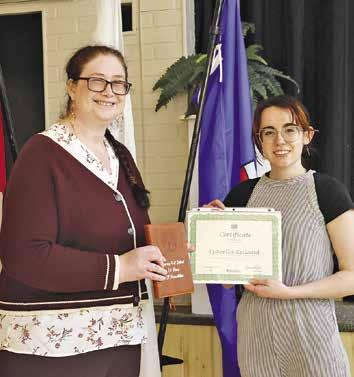
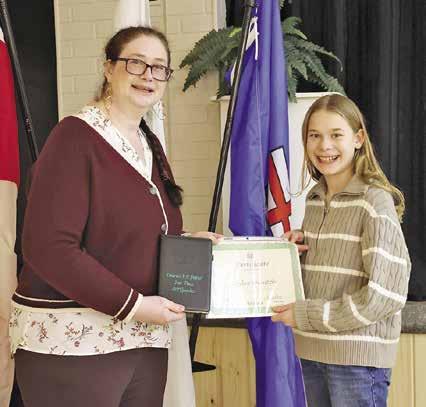
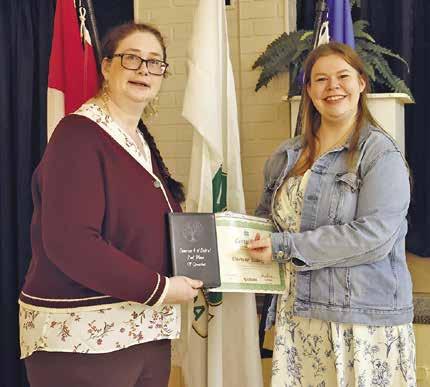
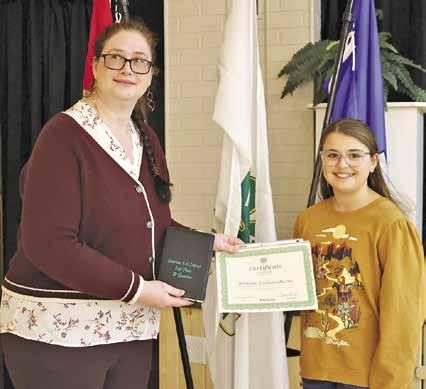
Tanya Reist, key leader of Camrose district, left, presented the awards to each member. Izabella Kelland won first place for senior presentation. Kelland did a live oil painting and shared her process with the guests.
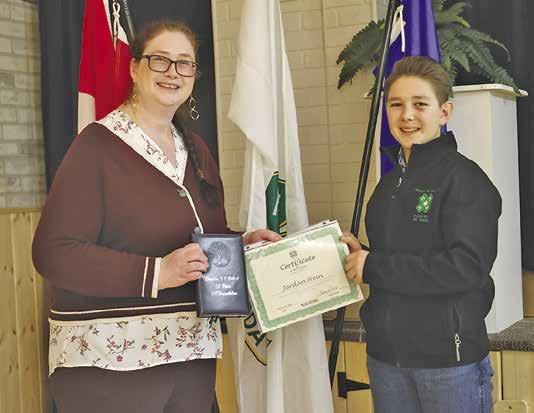
Adan Shaikh, Camrose Booster Reist presented Jordan Hein his award for earning first place in intermediate presentation. Hein’s topic was “Log Dovetail Joinery System” that he has recently learned about to help his family build a log cabin.
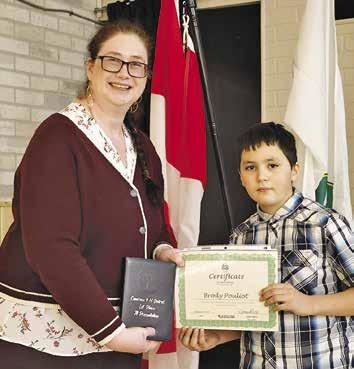
Adan Shaikh, Camrose Booster Brody Pouliot received won first place for junior level presentation. Pouliot shared his passion for animal trapping. He presented the audience with the furs and skins of animals he recently skinned himself. Pouliot shared that he currently has several traps set around his home.
Adan Shaikh, Camrose Booster
From left back row, Erik Gaasbeek, Jaidan Burnstad, Natasha Ross, Denver Scarff, Jordan Hein, Izabella and Alixandra Kelland. Middle row, from left, Branson Babcock, Jesse Feitsma, Brody Pouliot, Madison Hansen, Breck Gibson, Ethan Solverson and Isabel Wold. Front row, from left, Elyse Harder, Rowyn Stefanishion, Haylee Wenstob, Rylee Szott and Daxton Rathwell.
Adan Shaikh, Camrose Booster Denver Scarff received second place for senior speech. Her topic for prepared speech was “A Reintroduction to Balance”.
Adan Shaikh, Camrose Booster
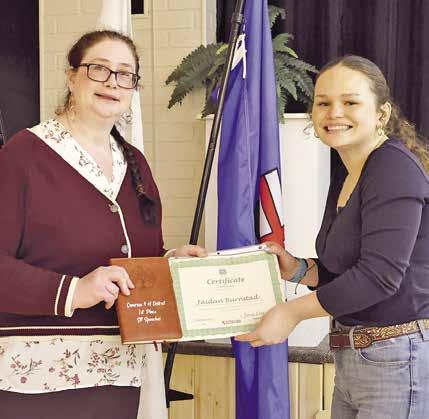
Jaidan Burnstad won first place for senior level speech. She explored the topic of loss, and reflected on the resilience her late brother Beckett Burnstad embodied.
Adan Shaikh, Camrose Booster
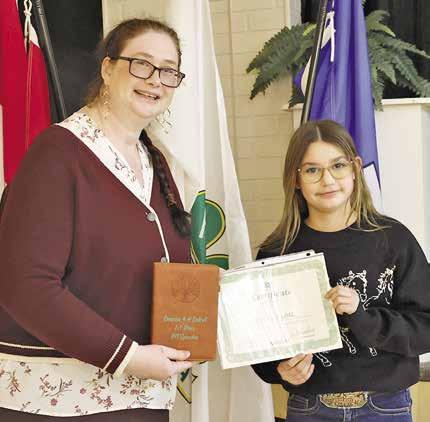
Rylee Szott earned the first place spot for intermediate speech with her topic “ Soft Paws – Big Impact”.
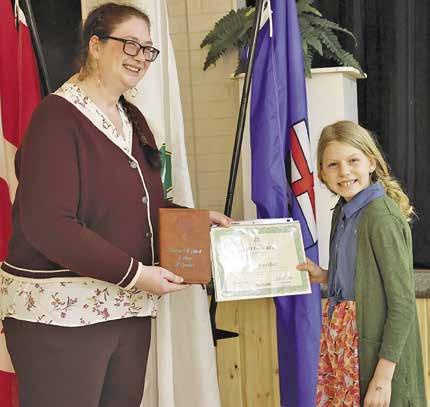
Adan Shaikh, Camrose Booster Elyse Harder won first place for junior level speech. Through her topic “Your Guide to Summer Fun”, Harder shared many helpful tips with the guests and judges.
Adan Shaikh, Camrose Booster
Haylee Wenstob earned second place in intermediate speech. Her topic “What 100 Years Can Hide” had the guests on the edge of their seats.
Adan Shaikh, Camrose Booster
Rowyn Stefanishion won second place in junior level speech. Her topic for her prepared speech was “Dore Lake”.
Managing a multi-generational workforce
By Adan Shaikh
Walk into almost any workplace today and you will find five generations working side by side – each one raised in a completely different era, carrying their own set of values, expectations and ideas about what work should look like. Today, the Canadian workforce is made up mainly of Baby Boomers, Gen X, Millennials and Gen Z, however, two per cent is still made up of Traditionalists (born between 1925 and 1945). Statistics Canada shows that nearly half of Canadian workers now fall under the Millennial and Gen Z categories and, while Baby Boomers are slowly retiring, they still make up a large portion of leadership and senior roles.
Everyone is shaped by their social environments. The world one grows up in influences how they communicate, how they handle authority, what motivates them, and how they define success. Each generation is different and when their differences collide in the workplace, it can either cause friction or fuel growth. The difference often comes down to leadership.
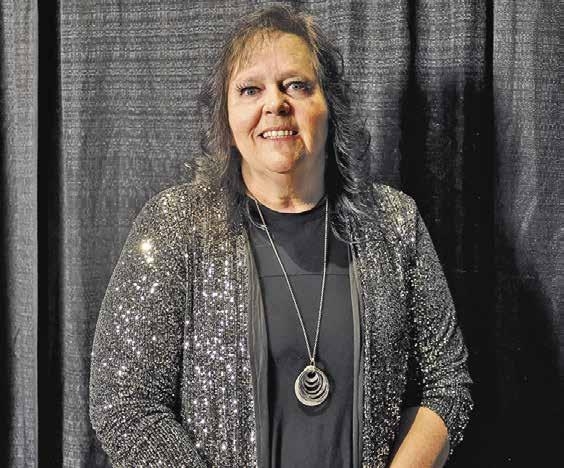
“Each generation brings their own unique values, work styles and ethics that can be both a challenge as well as present great opportunities,” said Darrelynn Fair, vice-president of Camrose and District Chamber of Commerce and communications and events lead at McDonald’s. Fair has spent years in leadership roles across hospitality and corporate environments, and has seen these generations intersect firsthand.
She noted some key differences and influences in each generation: Traditionalists
This generation saw World War II and the Great Depression, two major life events that highly influenced their work ethic and environments. “They are now leaving the workforce, but many people, nowadays, are staying in the workforce past the age of 70,” shared Fair. “Our traditionalists are dependable, straightforward, tactful and loyal,” she added. This generation is motivated by respect and recognition and prefers to provide long-term value to the organizations. Their communications styles are based on personal touches, and they value obedience over individualism.
Baby Boomers
Born between 1946-64, this generation is hardworking and competitive. “They value face-to-face communication. Achievement to them comes from paying your dues and they are willing to make sacrifices for success,” said Fair. She explained that Baby Boomers are motivated
by promotions and recognition. They value loyalty and teamwork, very much like the traditionalists. This generation has also grown up to adapt to technology, value job security and benefited from the post-war economic growth.
Generation X
Gen X is often called the bridge generation. They grew up during economic uncertainty, corporate restructuring, and shifting family dynamics, which shaped their independence and adaptability. This generation witnessed the world before and after digitization. They value efficiency, honesty, and work-life balance, often seeking auton-
omy rather than constant oversight.
“Born between 196580, Generation X is very independent, resourceful, skeptical of authority, resistant to change if it affects their personal lives, and they are quick to move on if an employer doesn’t meet their needs,” commented Fair. Gen X tends to thrive in leadership roles that require problem-solving, flexibility, and emotional steadiness. They are typically self-starters who can manage pressure without much external validation.
Millennials
Born between 1981-96, Millennials entered the workforce during a time
of rising education costs, economic instability, and rapidly changing technology. They often seek purpose, growth and meaning in their work, valuing collaboration, feedback and flexibility. Canadian studies show that Millennials prioritize mental health, work-life balance, and alignment with personal values more than the previous generations.
“Collaborative, purpose-driven and techsavvy, seeking challenge, growth and development. Likely to leave if they don’t like change,” stated Fair. Millennials thrive in diverse, inclusive and flexible work environments and
are motivated by meaningful work, feedback and the quality of their direct manager. “This is the first generation that looks to their direct manager as to whether that is where they want to stay,” added Fair. This generation quickly adapts to new technology and is one of the most highly educated generation, with many continuing education and skill development throughout their careers.
Generation Z
Gen Z is the first generation to grow up fully immersed in digital life. They have never known a world without smartphones, social media, and instant access to information. Shaped by global uncertainty, climate anxiety, and economic instability, they tend to value authenticity, inclusion, flexibility, and mental health awareness.
“Born between 1997 and 2012, this is the generation I work with the most,” said Fair. “They are entrepreneurial, pragmatic, socially conscious, they expect digital integration and instant communication,” she added.
Managing a workforce made up of such diverse generations requires balanced leadership. One-size-fitsall management no longer works. Team leads today must adapt communication styles, leadership approaches, and motivation strategies to meet different needs. That might mean offering structure and respect for experience to Baby Boomers, autonomy to Gen X, growth opportunities to Millennials, and flexibility and feedback for Gen Z.
Creating space for mutual understanding is essential. When older generations feel dismissed or rushed aside, resentment builds. When younger workers feel unheard or undervalued, disengagement follows. The healthiest workplaces are those where learning flows both ways, where experience is honoured and innovation is welcomed, and systems are implemented with each generation in mind. One example Fair shared was of workplace training. Where Traditionalists, Baby Boomers and Gen X may prefer a paper document or book for their training, Millennials and Gen Z may expect videos or interactive games instead.
Managing a multi-generational workforce is about empathy and recognizing that everyone is shaped by different pressures, expectations, and experiences. When team leaders create environments built upon understanding of the needs of their teams, differences become a strong foundation for a positively healthy workplace.
Adan Shaikh, Camrose Booster
Darrelynn Fair is the vice-president of Camrose and District Chamber of Commerce and shared her vast experience of managing a multi-generational workforce at the Thrive Forward Business Symposium held in October of last year.
Metro Photo
Each generation brings their own set of abilities and expertise, based off of the environment they were raised in. Circumstances economical, technological or social have shaped each generation uniquely.
CHEQUES!
Continued from page 9
“In the past five years, Alberta has seen a rise in contraband tobacco activities, and, during that same time, we’ve experienced a drop of more than $500 million in tobacco tax revenue,” Dave Berry executive vice president, public nngagement and chief regulatory officer of Alberta Gaming, Liquor and Cannabis. “AGLC is proud to work in collaboration with the Alberta government, with law enforcement partners and with the ongoing support of the legitimate tobacco industry to investigate and pursue those involved in the contraband tobacco industry in the province.”
RCMP launch Illicit Tobacco Campaign
These anonymous tips are a vital source of information to the Alberta RCMP helping them reduce crime across the province. The tips that are provided by Alberta Crime Stoppers have led to hundreds of charges and helped recover millions of dollars worth of property.
For more information about Crime Stoppers, the programs they offer, and how to become a crime stopper community, please visit www.crimestoppers. ab.ca/
As community partners, Crime Stoppers are a valuable part of ensuring the safety of Albertans. They work with the Alberta RCMP helping to report crimes that are occurring in communities across the province. When people may wish to remain anonymous, they can report crimes they witness to Alberta Crime Stoppers knowing that their personal information will be kept confidential, but that law enforcement will be informed.
Amazon, Costco, Temu and Wayfair will surely sur vive if you back off your current spending
Redirecting some of your discretionary spending back into businesses right here in Camrose, or back into local businesses in east central Alberta towns and villages, will be a difference-making investment into the future of the community you call home.
The struggle for many “local businesses” is very real. Plenty have never fully recovered from the Covid shutdown period. Tariffs to the degree never seen before are having an impact on margins and increasing unemployment. Online patronage of international businesses is a death plaque for countless others.
If you are an adult from ages 25 to 44, statistics suggest you probably gravitate to online shopping…
Your logic is valid: online purchases can be quick, as well as convenient. Paying with a credit card or today’s alternative technology can give you the options that you prefer. Many online purchases are the result of the many hours people in this age group spend scrolling social media during their non-class or non-working hours. Statistics provide data revealing that women are likely to gravitate to online shopping instead of spending in person and spending at local businesses.
In this world of data availability, we learn that clothing, cosmetics and shoe purchases are among the items most frequently purchased online.
If you chat with friends about their new purchases, the simple observation of noting how many branded delivery vehicles are visible daily on streets around the community, or studying the double or triple digit online sales numbers for this era’s most popular publicly traded online retailers or business connectors (Facebook, Google, X, etc.), it proves that there is virtually no stopping the online shopping epidemic.
What does this mean and why does it or why should it matter?
Loss
of local businesses will impact cost of living in other ways, too.
Jobs of the future will likely be hard to come by, especially in small communities like Camrose and the towns and villages of east central Alberta. Artif icial intelligence, the go-to choice for online businesses as a tool to cut operating costs, increase delivery speeds and identify individual buying preferences, has already impacted employment and increase market share. Watch for more collateral damage ahead in terms of employment.
Less businesses will eventually contribute to a more muted tax base, therefore, expect higher taxes. Loss of support for community causes, local school initiatives and youth sports teams and other activities has already been felt and will only increase in the years ahead.
Watch for the demise of service clubs as the local business scene continues to gravitate further away from “mom and pop” businesses. If widespread passion continues for the online world as it originates from Asia and the USA, watch for an increase in business closures.
Be conscious that artif icial intelligence is going to have more control of your life and the lives of your family members.
The solution
The Pandora’s box has already been opened, and much damage already done. However, have conversations at home about how spending can work for or against the community attributes and offerings you currently enjoy. Be aware of the negative impact technology advancements can have on your life, as well as the many positives technology offers. Whether you are a local businessperson or a consumer, try hard to buy at home. A little difference can make a big impact.
It’s a dog’s life
By Nadine Leming
Canine Love Dog Rescue Society, based out of Daysland, opened back in 2001. Over the years they’ve rescued over 800 dogs. It’s not only a rescue, but a shelter as well.
They are willing to go the extra mile for people that adopt from them. If someone finds themselves in a tight financial position after adopting a dog, they will assist that family for a while.
They will also help families of the dogs they adopt from them by taking care of that dog for up to a week in case of some sort of personal emergency like a hospital stay or illness.
This rescue is one of the few places that do not charge a surrender fee for any dog.
The pens that are at Canine Love Dog Rescue are created with Phoenix Fence panels throughout the shelter and outdoor pens. They are expensive, but worth the expense to keep the dogs safe.
Rescue owner Debbie Reynolds’ passion and love for dogs is why she has taken on a large project like this. It is a lot of hard work to make this all happen for the dogs she cares for.
Debbie has always had a love for dogs and gives the credit to her father who lovingly raised and trained an awardwinning retriever. With a background in marketing, she puts those skills to good use planning and executing fundraisers to fund her passion for the rescue.
Re-homing a dog is a task that requires someone to be safe, nonjudgemental. Oftentimes, it’s tough enough for people to make the decision to surrender a pet, and Debbie doesn’t want to make it any harder than it already is for people.
She feels matching the right family to the right dog is an important aspect of her work. Debbie screens potential families adopting dogs, wanting to make sure that each dog finds their forever home.
Though she has good support at the rescue, Debbie is always looking for good foster homes –the right people to adopt the animals and people to help out at the rescue.
To keep adoption fees affordable, they need to do a lot of fundraising to buy dog food, maintain the rescue and pay for vet bills.
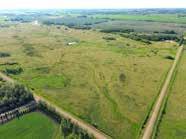
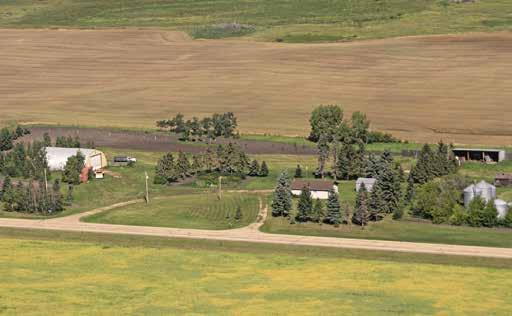
If this is your f arm,
The farm appearing in this photograph is located in the Camrose trading area. If you recognize it as yours, come to the Camrose Booster, 4925-48 Street, Camrose. You will be presented with a free 8” x 10” colour enlargement of the photo.
17, 2026
Debbie commented, “If you see me fundraising all the time, it’s because I can’t just ask for money. I work hard trying to come up with fundraisers.”
Debbie uses 100 per cent of the proceeds from her fundraising efforts to support the shelter.
She will be hosting an Easter Market in March that will have a variety of vendors selling everything from Ukrainian food to Easter treats and will include some artists.
Debbie will be advertising on Facebook
beginning two weeks before the market. Watch out for the variety of vendors who will give you a peek at what they offer along with pictures.
Like any animal shelter, help is always welcome. The community can support this rescue by sharing her posts on social media, participating in her fundraising efforts, and being a foster home.
For more information on the rescue and how to help, follow them on Facebook at Canine Love Dog Rescue Society or by email at canineluvflagstaff@ gmail.com