Volume 75, Issue 3
Single copy free - additional copies 50 cents
Wednesday, september 27, 2017
www.elaccampusnews.com
CN/KEVIN GONZALEZ
CN/KEVIN GONZALEZ
CN/KEVIN GONZALEZ
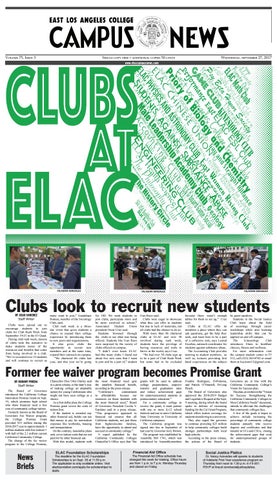
Clubs look to recruit new students BY JULIO SANCHEZ Staff Writer Clubs were spread out to encourage students to join clubs for Club Rush Week from September 19-21 in the E3 Quad. During club rush week, dozens of clubs took the initiative to make students aware of the resources and benefits that come from being involved in a club. “We’ve recruited over 15 students and will continue to recruit as
many want to join,” Guadalupe Roman, member of the Sociology Club, said. Club rush week is a threeday event that gives students a chance to expand their college experience by introducing them to new peers and organizations. It also gives clubs the opportunity to recruit new members and at the same time, expand their outreach on campus. “We chartered 86 clubs last year, and this year we’re going
for 100. We want students to join clubs, participate more and be more involved in school,” Associated Student Union president Oscar Cruz said. Students browsed through the clubs to see what was being offered. Students like Ivan Razo were surprised by the variety of clubs offered on campus. “I didn’t even know ELAC had this many clubs. I found out about five new ones that I want to join and be a part of,” student
Ivan Razo said. Clubs were eager to showcase what they can offer to students but due to lack of materials, not all clubs had the chance to do so. With more than 86 chartered clubs at ELAC and over 50 involved during rush week, students have the privilege of having resources and tools to thrive in the world, says Cruz. “We had over 50 clubs sign up to be a part of Club Rush Week but some had to be excluded
because there wasn’t enough tables for them to set up,” Cruz said. Clubs at ELAC offer its members a place where they can ask questions, get the help they seek, and learn how to be a part of a collective unit, says Leonal Escobar, outreach coordinator for students against substance abuse. The Accounting Club provides tutoring to student members, as well as, lectures providing first hand experiences on the subject
by guest speakers. Students in the Social Justice Club learn about the field of sociology through career workshops while also learning leadership skills that can be applied on and off campus. The Kinesiology Club introduces Elans to healthier choices, fitness and wellness. For more information visit the campus student center in F5 212, call (323) 265-8742 or email them at lua.moni13@gmail.com.
Chancellor Eloy Ortiz Oakley said in a press release, is the state’s way of making college an attainable option for young Californians who might not have seen college as a choice. As a first dollar plan, the College Promise grant covers the costs of tuition first. If the student is awarded any other financial aid, he/she can use that money to pay for non-tuition expenses like textbooks, housing and transportation. On the contrary, last-dollar plans only cover tuition costs that are not paid for by other financial aid. With this model, students with
the most financial need gets the smallest financial benefit, according to the press release. “California’s commitment to affordability focuses our resources on those students with the most financial need,” Board of Governors President Cecilia V. Estolano said in a press release. “This progressive approach to financial aid ensures that all California students, not just those from higher-income families, have the opportunity to attend and succeed in community college.” A report published by the California Community Colleges Chancellor’s Office says that “the
grants will be used to address college preparedness, improve transfer and graduation rates and reduce achievement gaps for underrepresented students in postsecondary education.” For a community college to receive the grant, it must partner with one or more K-12 school districts and one or more California State University or University of California campuses. The California program was signed into law in September of last year by Governor Jerry Brown. The program was established by Assembly Bill 1741, which was introduced by Assemblymembers
Freddie Rodriguez, D-Pomona, and Patrick O’Donnell, D-Long Beach. The Board of Governors also approved the 2018-2019 Budget and Legislative Request at the Sept. 9 meeting, during which the board spoke in defense of increasing funding for the Cal Grant Program, which offers tuition coverage for students transferring to a university. They also urged the governor to continue providing $25 million to help community colleges build stronger partnerships with local high schools. According to the press release, the actions of the Board of
Governors are in line with the California Community College’s Vision for Success plan. The plan, as written in the “Vision for Success: Strengthening the California Community Colleges to Meet California Needs” document, intends to alleviate the challenges that community colleges face. A few of the goals it hopes to achieve include increasing the percentage of community college students annually who receive degrees and certificates and that transfer to UCs and CSUs; closing the achievement gaps that exist for underrepresented groups of students.
Former fee waiver program becomes Promise Grant BY DORANY PINEDA Staff Writer The Board of Governors introduced the California College Innovation Promise Grant on Sept. 19, which promises high school who show financial need a free year of community college tuition. Formerly known as the Board of Governors Fee Waiver program, the College Promise Grant provided $15 million during the 2016-2017 year to approximately 1 million students with free tuition–– with half of the 2.1 million current California Community College The change of the fee waiver program to the College Promise,
News Briefs
ELAC Foundation Scholarships
The deadline for the ELAC Foundation Scholarships is on Sept. 30 at 11:59 p.m. The application is only available online. Visit elacfoundation.com/apply-for-scholarships/ to apply.
Financial Aid Office
The Financial Aid Office schedule has changed this week for training. Office hours are from 1 p.m. to 7 p.m. Monday-Thursday and closed on Friday.
Social Justice Platica
Dr. Nancy Acevedas will speake to students of Adelante First-Year experience program on Thursday from noon to 1:30 p.m. in F5-201. RSVP at tinyurl.com/socialjusticeplatica.
2
Opinion
EAST LOS ANGELES COLLEGE CAMPUS NEWS WEDNESDAY, SEPTEMBER 27, 2017
Film proposes better storytelling over television BY GUSTAVO BUENROSTRO Staff Writer Film is still one of the best ways to tell stories and explore characters. In issue two of the Campus News paper, an opinion was written that television is the best way to tell stories for the consumer. While television is a great way to tell stories, and in recent years television has become better, it is still not the best way to consume that medium. Film can tell riveting stories and can explore layered characters in the span of 2 hours and they have been doing it for a lot longer than television has. Great films like “Double Indemnity” and “Taxi Driver” have a great story and interesting characters. I n “ D o u b l e I n d e m n i t y, ” a salesman falls in love with a married woman and conspires to kill her husband in order to cash in on his life insurance and runaway together. As the story unfolds, the audience finds out both the wife and the salesman are what they seem. A story like this can only work in film format. If this story was attempted to be put on TV, it wouldn’t work because the story is finite; the characters would become boring after a few seasons. The characters and the story can only exist in a snapshot. What makes this film great is that Billy Wilder, the director, used certain techniques and props to give more character background without saying it. Film uses everything they have to tell a better story. The films can use lighting to tell something about a character or to further advance the story or to even foreshadow the future events. In “Double Indemnity,” the director used the lighting in the
blinds to show that the salesman is guilty of his crime. When he is getting questioned about the death of his client, the blinds create shadow stripes across his face and his body to signify that he is guilty and he knows it. This is not to say that television
does not use what they have at their disposal to tell a better story. The Netflix show “Daredevil” used a one-shot take of Daredevil fighting in a hallway, following him around as he beats up some bad guys. However, most shows rarely use
these techniques because they don’t have the time. Film’s production time is much longer and has the advantage over TV. It was argued in the opinion,”Television programs threaten films’ future” that, “The
death of a character, while still impactful, fails to pack the same punch as losing a character with hours of connection,” Francisco Portillo, the writer of the opinion. While it is true the more time you spend with a character, the more invested you become and the more impactful it is when a character dies. However, a film death can be just as impactful. In the film “The Green Mile,” a convict named John Coffey, played by Michael Clarke Duncan, is sentenced to death for the murder of two women. He is big and looks intimidating, but as the film goes on, the audience learns that he is a sweet, kind man who was wrongly convicted of his crime. Yet, despite knowing the truth, the character is still executed as planned. The impact of his death was strong because Coffey was a good man, he helped others and was innocent. While the film was three hours, it’s still a lot shorter than a television show, where the audience has to grow to care for the character in a much slower pace. Film is more concise than television. Even the best shows like “Game of Thrones” have filler episodes, where the writers have to come up with something for the characters to do so they can fill their quota of episodes for the season. This is even more apparent in prime-time shows, where each season has up to 22 episodes. In film, there are scenes that don’t do anything for the story, but they are few and far between and it is rare that films have those kind of scenes. While both mediums have strengths and weaknesses, film is a better way to get the story’s lesson and theme across. In a show, the theme could be muddled by everything that is happening. In film, the audience would simply have to reflect on it and would know what the film was trying to say.
Ban on books decreases learning experience Staff Writer
ONLINE EDITORS Melody Ortiz Kevin Camargo ART DIRECTOR Julie Santiago FRONT EDITOR Gustavo Buenrostro
OPINION EDITOR Giselle Palomera NEWS EDITOR Frank Portillo FEATURE EDITOR Julio Sanchez ARTS EDITOR Steven Adamo SPORTS EDITORS Joe Dargan Michael Dominguez PHOTO EDITOR Eddie Garcia COPY EDITORS Russell Zazueta Anastasia Landeros CARTOONIST Jorge Vazquez STAFF WRITERS Noe Ortega STAFF PHOTOGRAPHERS Jorge Aldaco Kevin Camargo Kevin Gonzalez ADVERTISING Stefanie Arocha
ADVISERS Jean Stapleton Sylvia Rico-Sanchez
reading graphic images and bad language and paying for cable to see shows with the same thing? Why can't people read a book with the same ideas in the classroom? Young people will have many questions after reading a book like “The Adventures of Huckleberry Finn” or “Catcher in the Rye,”
but parents should explain the information in the book so that they’re not shocked by the language or graphic scenes. Books are also a way to learn about topics like men’s and women’s sexuality and their bodies. This was the case with the book “Our Bodies, Ourselves: Boston Women’s Health
Book Collective,” which was banned for using the word vagina. “Sexual Behavior in the Human Male” was also banned for asking men and women to talk about their sex lives. People should have the freedom to read anything they want. Why are there a total of 5,099 challenged
books since 2009, and more every year as books are released? Parents, schools and public libraries should stop being scared to talk about uncomfortable topics. Everything we read is for a reason, and that reason is to learn from people’s past and not repeat the same mistakes.
Letter to the Editor:
ELAC Bookstore neglects “Milestone Magazine”
Milestone, the literary arts journal for East Los Angeles College since 1950, has been virtually disregarded by the ELAC Bookstore for nearly a decade. I was first introduced to Milestone back in the fall of 2011 by English professor Susan Suntree, and was elated to discover a creative arts scene on ELAC’s campus. But when I visited the ELAC Bookstore
MANAGING EDITOR Stephanie Guevara
DISTRIBUTION Stephanie Guevara Anastasia Landeros Dorany Pineda
BY MICHAEL DOMINGUEZ Books should not be banned from public places because of its nature or be banned from being read. Students who understand the concept of these books learn from them and gain knowledge on the topic. Such topics include racism and gender roles. Books should not be banned from those wanting to gain knowledge on something. One of the most banned books is “The Adventures of Huckleberry Finn” by Mark Twain. The book was banned because it uses the “N” word multiple times, indicating racism. Regardless of this, the book should still be allowed because racism today still exists and the book could give readers a better understanding on how the world is and how people treat others based on the color of their skin. “The Catcher in the Rye” is another banned book because it features bad language and graphic scenes. This is not a reason for a book to be banned. This type of language is seen and heard all over our televisions and in music. What's the difference between
EDITOR IN CHIEF Dorany Pineda
to purchase my own copy, there were no Milestone copies on display. I asked the sales clerk and found that she was clueless to Milestone’s existence. I pressed further, and copies of Milestone, published earlier that Spring, were eventually found in a back storage room. Curious, I asked when the last copy of Milestone 2011 had been sold: the store records indicated it had been
seven months.Years went by after this initial purchase, but the relationship between Milestone and the ELAC Bookstore never changed. With each successive annual Milestone release, copies remained in boxes hidden behind the register counter. Over time, as my involvement with Milestone cultivated, I pleaded with the ELAC Bookstore to prominently display the magazine- But to no avail.
Spring 2016: The grand opening of the new ELAC College Store (formerly Bookstore) came and went— and with it any hope that the store would finally support Milestone. The latest edition, Milestone 2015: Real Stories of East L.A. remained hidden from view behind register counters, or on lower-level textbook shelves. Fall 2017: Milestone visibility is all but non-existent in the
www.ELACCampusNews.com
College Store. Frustrated, I grab twenty copies from a bottom textbook shelf and proceed to defiantly display Milestone 2015 in key areas of the store, including the “school spirit” rack, and at the head of the register line, where I cleared a shelf of candy. The next week, my displays were dismantled.
Joshua Castro Student
Campus News encourages letters to the editor relating to campus issues. Letters must be typed and double spaced. Submitted material becomes the proper ty of Campus News and cannot be returned. Letters should be limited to 250 words or less. Campus News reserves the right to edit letters for grammatical errors or libelous content. A n o ny m o u s l e t te r s w i l l n o t be printed. Writer s must sign submissions and print their names and a phone number where they can be reached. Letters should be addressed to the editor of Campus News. Submissions can be made at the mailroom in building E1 or the Journalism department office in the Technology Center in E7-303. East Los Angeles College Campus News 1301 Avenida Cesar Chavez E7-303 Monterey Park, CA 91754 (323) 265-8819, Ads (323) 265-8821 Fax (323) 415-4910 The East Los Angeles College Campus News is published as a learning experience, of fered under the East Los Angeles College Journalism program. The editorial and advertising materials are free from prior restraint by virtue of the First Amendment to the United States Constitution. The opinions expressed are exclusively those of the writer. Accordingly, materials published herein, including any opinions expressed, should not be interpreted as the position of the Los Angeles Community College District, East Los Angeles College, or any officer or employee thereof. PRINTING BY NEWS PUBLISHERS PRESS
News
EAST LOS ANGELES COLLEGE CAMPUS NEWS WEDNESDAY, SEPTEMBER 27, 2017
3
Universitytutor.com Scholarship “The Contest” • Grand prize $100
• New contest begins the on 1 of each month • Submit 300-word essay
• Deadline is 11:59 p.m. on last day of each month. CN/NOE ORTEGA
PREACHING EQUALITY—Student Services Assistant Elizandro Umana discusses the benefits of Safe Zone to faculty and
student workers at a training session Friday in G1-301.
Safe Zone pushes for tolerance BY NOE ORTEGA Staff Writer Student workers and faculty came together for the Safe Zone Coalition training for undocumented students and the LGBT. According to the website, Safe Zone is a sanctuary for LGBT and undocumented students, faculty and the community. It’s a place where members can share stories about their unique experiences and be in a place where they can feel at peace. It’s also a place where student workers and faculty gather to interact with the activities provided for them. An example of the activities at the trainings is first impressions, where students can speak about the first time meeting someone of the LGBT community and experienced them being treated differently. Other examples of activities include the first time one person felt love for another and matching vocabulary words with their definition with words like heterosexism, queer and gender expression.
Safe Zone handed out fliers with responses for someone of the LGBT Community coming out such as “I don’t have a problem with it,” “It’s only a phase,” and to not pretend like you know more than you do. The training is run by Dream Resource Center staff and faculty from the English and Health departments. Safe Zone adopted the Las Vegas motto of “what happens in Vegas, stays in vegas” in their trainings. The training consists of scenarios in which instructors have to deal with students or administrators offending members of the LGBT community. The scenarios were played out from the point of view of an instructor, administrator or a staff member who had to deal with a student who is being disrespectful and offensive towards members of the LGBT community. Safe Zone provided statistics from Kognito Training, which according to its website, is a health simulation company that believes in the power of conversation to inspire and inform, impact how people
think and act, evoke empathy and change lives. According to a study conducted by Human Rights Campain, four in 10 LGBT youth (42%) say the community in which they live is not accepting of LGBT people. According to “Paying the Unfair Price: The Financial Penalty for LGBT People of Color in America,” a third of the LGBT Americans are people of color who are more likely to be harassed at school and have a lower college completion rate. At the trainings, Safe Zone clarifies terms like sex, gender and sexual orientation. Participants are made anonymous if they wish. Pamphlets containing anonymous testimonials were handed out to those in attendance. “As an LGBTQ male, I would like to express my interest in having an on-campus gay-straight alliance... I feel it would be beneficial to us students because it could be a place where we could gather our thoughts, being that it is a safe zone,” said an anonymous ELAC student. Safe Zone welcomes all staff to come to the training to interact with
Do you think you have conjunctivitis (pink eye)? You and/or your child may be able to participate if you (or they):
members of the LGBT Community. “I’m currently taking (a class at ELAC) and a topic we are suppose to learn about was gender and sexuality, but instead of actually going through the material, my teacher just skimmed through it and barely even talked about it. “He argued that he didn’t want to make people feel uncomfortable, but instead he made me feel uncomfortable not wanting to talk about the topic,” said an anonymous student. Safe Zone gives tips on how people of the LGBT community can avoid being harassed when attending LGBT events, challenge homophobia and transphobia, stay up-to-date on issues and resources and pledging to be an ELAC Safe Zone ally. “The training is going very well. We had over 100 staff, faculty and student workers complete the training, and we plan to roll out a 2.0 training where it would be training for students attending ELAC,” said Student Services Assistant of Outreach Lynn Wood.
Staff Writer
irritation) in at least one eye for no more than the past 3 days • are interested in taking part in a research study for up to 13 days • are willing to travel to the study center for appointments. Qualified participants may receive the non-antibiotic investigational drug and study-related procedures and visits at no cost. Health insurance is not required to participate.
To find out more, and to see if you qualify, call:
1-877-223-2304
[www.PinkEyeResearchStudy.com]
CTM_Alt Patient Color Print Ad [V01 USA]
• New prompt question every month • Must be current college student
Osher Initiative for California Community College Students • Two semester award, $500 per semester
• 24 or more degree applicable semester units • Must be enrolled full-time at ELAC (12 units per applicable semester) • Minimum 3.0 GPA
• Must be recipient of Board of Governer’s Fee Waiver • Submissions due September 30, 11:59 a.m.
ELAC Honors Program Scholarship • Recipients will receive $500 per semester for four semesters. Totaling $2,000 in tuition
• Must be enrolled in ELAC Honors Program • Minimum 3.25 GPA
• Must be planning on transferring to four-year college or university
• Must have completed a minimum of two honors courses at ELAC with a minimum grade of B in each • Submissions due October 7, 11:59 pm
Text service offers salvation BY JOE DARGAN
• have had pink eye symptoms (e.g. redness, watering/ discharge, or
• 16 years of age or older
The national organization Crisis Text Line began a partnership in June with the foundation of Community College Students and the California Community College Chancellor’s Office to provide students with a 24-hour text hotline. Crisis Text Line’s website says that a crisis is typically a moment of extreme emotional pain that gets in the way of living an everyday life. By texting “connect” or “courage” to 741741, students can gain access to more than 3,000 crisis counselors who are specially trained to help with emotional emergencies that they may not be able discuss with friends or family. Since this is a free program funded by grants and donations, the crisis counselors are all volunteers from various parts of the country. According to its website, Crisis
www.ELACCampusNews.com
Text Line has been helping people across America for the last four years and has facilitated more than 43 million text conversations to date. “We want to be where you are. We want to make it as easy as possible for people who are in pain to get help,” said Crisis Text Line’s CEO, Nancy Lublin. “Crisis Text Line was born from the rib of DoSomething.org, the largest organization for young people and social change.” Dozens of members of Dosomething.org were regularly texting in to ask for help with personal issues. The inquiries prompted Lublin to launch Crisis Text Line as part of its services in August of 2013. After four months, all 295 area codes in the U.S were using the text line. Due to the success of the service, Crisis Text Line became its own entity two years later and Lublin went with it.
Lubmin was CEO of Dosomething.org from 2003 until 2015. The organization says that homelessness and finances are the top issues discussed by California Community College students, though most people generally associate a crisis hotline with individuals dealing with issues related to suicide. “Some kids look to their family members and friends and often times they aren’t there for them. It’s nice to see an organization moving in the right direction to offer some support, but I’d be interested to see if the long-term data shows a reduction in youth suicides as a result of the service ” said East Los Angeles College psychology Professor Randy Ludwig. According to student and counseling staff member Jean Cal, students have been picking up the pamphlets and other materials related to the Crisis Text Line from ELAC’s counseling office.
4
Feature
EAST LOS ANGELES COLLEGE CAMPUS NEWS WEDNESDAY, SEPTEMBER 27, 2017
New Pride Club plans ahead for the future BY ANASTASIA LANDEROS Staff Writer The newly formed Husky Pride Club already has a motto: “Come as you are.” Founded by student Mark Alvarez, as a student led, based and run LGBT+ student club, the Husky Pride Club has not been officially chartered yet, but that hasn’t stopped the executive board from making big plans for the future. “All of our ideas are just swarming right now,” said theater and music student Brieanna Lee, the club’s vice president. Some of the activities that the group has planned for the future are movie screenings made by and starring LGBT+ actors and filmmakers, a talent show, makeup lessons, fundraisers and more. “Some other stuff that we have planned is workshops, specifically geared toward LGBT (youth), such as HIV awareness (and) dealing with homophobia. A lot of that stuff doesn’t really get talked about,” said Alvarez. Although they want to address
issues like misogyny within the LGBT+ community, internalized homophobia, domestic abuse and other taboo topics circling the LGBT+ community, they also want members to have fun and create a community of openness. “We don’t want it to be just like a serious pride club where we’re just gonna talk about coming out, HIV and things like that. We also want to teach history as well,” said Lee. Some of the history elements that they want to educate young LGBT+ community members on are aspects like musical and pop culture influences, and the New York City drag balls of the 1960s and 1970s. “We just want to get people to understand that— ok you guys are all into RuPaul… but do you know the history? Do you know where you’re coming from?” said Lee. The Husky Pride Club’s own history is, although recent, developing quickly. Its first meeting alone filled all but one vacant position that Alvarez was looking for. Lee became vice president and student Oscar Rodriguez became treasurer. Lee said that as soon as she saw the
CN/ANASTASIA LANDEROS
PRIDE MEETING—Pride Club founder and President
Mark Alvarez talks to attendees at the club’s first meeting yesterday
posters that Alvarez made, she knew it was going to be a fun experience, so she invited Rodriguez, who she’s known since they were 13 years old,
and attended the club’s first meeting. Lee’s own coming-out story plays a large part in her eagerness to take the club beyond just the
confines of campus. The day of our interview, Lee told her mother she was gay, who didn’t take the news as well as she’d hoped. “My mother, she’s very cool... we’re very tight. She just wants me to achieve my goals. But when I told her what I was doing, she’s like ‘Why? You’re not gay are you?’” Lee said that the rest of the conversation put her in a bad mood until she realized that she doesn’t want others to deal with the same situation alone. “For me, I’m an only child, so it’s... hard. I don’t have the support that I want from somebody that I really want it from, so it’s nice to get together… with a bunch of people that I, we, have at least something in common with,” said Lee. Alvarez said of Lee and treasurer Oscar Rodriguez’s eagerness to join the executive board, “I went [all over school] trying to get a sponsor, I created the poster… I literally hand-made everything, so it’s really nice to see.” “Everything just kind of meshed… it was great. Everything kinda flowed right away,” said Lee. Because of Lee’s and Rodriguez’s
connections outside of campus, the trio plans on expanding their reach, going so far as to collaborate with another LGBT club at Los Angeles City College. “We’re trying to just gather our community and really bring that sense of pride and unity, not just at school but outside also,” said Rodriguez. “This is your safe space,” said Lee. “We’re trying to make the best of it… what we deal with,” said Alvarez. To help with building their community, Rodriguez said he came up with a unifying way to end each meeting. “At the end of the session, we’ll end it with a handshake, high-five or a hug to really build up on the trust between each other and… to include everybody so nobody feels left out and alienated in their own community,” said Rodriguez. The Husky Pride Club meets every Tuesday in E3 317 from 12:10 p.m. to 1:30 p.m. For more information, text @ huskypr to 81010 or email the club at huskypride@gmail.com.
ELAC to offer AA for Women and Gender Studies BY KEVIN CAMARGO Staff Writer After eight years of work, East Los Angeles College announces it will be offering an Associates in Arts for Women and Gender Studies. It all started when three students wanted to transfer to UCLA as
women’s studies majors, but ELAC did not offer any women’s studies courses. After that, director of the Honor’s Program Susanne Spangler, professor of sociology Dr. Rin Kahla, and Articulation Officer Counselor Cathleen Rozadilla got together to start the Women’s Studies program. “When I first came to the campus, I was looking at different sociology
courses that we had and didn’t have,” said Kahla. “We have a large woman’s population of women on campus and we had nothing that addressed women's issues.” Kahla started teaching the first sociology of women class. Over the years, faculty developed 14 different courses, including Anthropology 109: Gender, Sex, and Culture; Chicano Studies 50:
Gender and Sexuality in Chicano/ Latino Communities; English 239: Women In Literature; Kin Maj 109: Women In Sport. “My role was to provide research about existing programs and courses in the state to aid in the development of new courses and ultimately the degree at ELAC,” said Rozadilla. According to Rozadilla, the committee first had to develop new courses, along with the degree itself. Once those were developed, they had to be approved by the campus Curriculum Committee, the Academic Senate, the board of trustees and the State Chancellor’s Office. The major was originally only going to be a Women’s Studies major, but faculty eventually decided to add gender studies courses to the program. This past summer, the state decided to approve the AA in Women and Gender Studies. “We wanted to give students a
well-rounded experience in the areas of women and gender studies and wanted to make sure that all the classes transferred (to a university). All of our classes fulfill IGETC (Intersegmental General Education Tr a n s f e r C u r r i c u l u m ) , C S U (California State University) and GE (General Education) categories,” said Kahla. As of now, faculty is still working to make the degree transferrable to a CSU with students completing their required classes as women and gender studies majors. Kahla is proud of the many years of hard work and thinks that students can have the foundation of their studies begin here at ELAC. She also believes this program can build a bridge to Universities of California and CSUs so that schools know that ELAC provides the foundation for women and gender studies. “I stress in my class the importance of men and women talking about
women and gender issues so that no one feels isolated,” said Kahla. Kahla hopes the major does not discourage anyone from taking the courses. She wants men to be welcome in the courses because the courses were not made just for women. “Issues regarding women and gender have become more visible given the political discussions regarding civil rights, equality and healthcare in our country,” said Rozadilla. “I think it serves our students and the community to be better informed about the historical roots of these issues.” Since Kahla, Spangler and Rozadilla founded the women and gender studies program, faculty from other disciplines began to take interest in supporting it. “Our faculty stepped up and showed [their] support for the program. I can’t believe, after all these years, we finally did it,” said Kahla.
FreedomPop aims to disrupt major phone companies BY JOE DARGAN Staff Writer
Members of CSUDH’s Male Success Alliance are inspiring the next generation of college students.
We’ve found our community. And our calling.
Founded in 2011, FreedomPop is disrupting the mobile phone industry by becoming the first international service provider to offer a 100 percent free mobile service plan. Plans start at zero dollars a month, including 500 text messages, 200 minutes of international talk time, 500 megabytes of internet service and 8 million free internet hotspots nationwide. A variety of refurbished phones can be purchased on the company’s website. Service packages that provide more minutes, messages and megabytes are available for a price. An unlimited plan will cost
Learn how CSUDH Toros inspire greatness. CSUDH.EDU/Community
(310) 243-3696 1000 E. Victoria Street | Carson, CA 90747
www.ELACCampusNews.com
customers around $20 a month, half the price of the cheapest major carrier according to Freedompop’s website. Mobile hotspots are also available at a discounted rate for people on the go with multiple Wi-Fi-enabled devices. FreedomPop’s prices are made possible by accepting a lower margin of profits, keeping a small staff of around 100 employees and maintaining little equipment. Wi-Fi and cellular service is provided to 2 million customers, half of which receive 100 percent free service by using the cell phone towers of AT&T and Sprint. While other major carriers bring in a profit of around $45 a month per customer, FreedomPop makes about $15 a month per customer,
according to the company’s CEO and cofounder Steven Stokols. For all of the great benefits that come with FreedomPop, there are some pitfalls. Customers have complained about dropped calls, spotty internet service and occasionally being booted from Wi-Fi connections. Stokols, along with the company’s entire staff, are also part of FreedomPop’s customer base. “You have to be eating your own dog food,” said Stokols in an interview with the Los Angeles Times. “Even though other service providers may have better coverage, the great deal customers receive from FreedomPop is worth the occasional issues. We want to get to where communications is a free utility everywhere,” said Stokols.
Arts
EAST LOS ANGELES COLLEGE CAMPUS NEWS WEDNESDAY, SEPTEMBER 27, 2017
5
ANASTASIA LANDEROS & GUSTAVO BUENROSTRO Staff Writers
PHOTOS BY JULIE SANTIAGO / GRAPHIC BY STEVEN ADAMO
ANCIENT ENERGIES — Rescued fragments from “Filling Up on Ancient Energies,” a mural that was painted and recovered by David Botello at Roosevelt High School.
Murals reveal history RUSSELL ZAZUETA Staff Writer For decades, Chicana/o artists have colored Los Angeles’ public buildings and walls with large murals that call attention to Mexican-American culture. On Saturday, the California Historical Society and La Plaza De Cultura Y Artes presented “Murales Rebeldes! L.A. Chicana/o Murals Under Siege,” where people can learn about the history and stories behind Chicana/o artwork that was censored, whitewashed or destroyed during the latter half of the twentieth century. According to La Plaza’s CEO John Echeveste, Chicana/o artists had very limited opportunities for expression in the museums and galleries, so they used the city, even their homes, as a canvas to paint murals depicting heritage pride or in protest of racial mistreatment. The more murals that popped up, the stronger the voice of the community, and it opened the door for a new generation of artists. Today, he said, there are artists who work to restore the remaining murals of the past, and that the urban artwork continues to be a staple of L.A. culture. Echeveste gave the opening speech at the reception, saying that the central message of the exhibit and its public programming “is that when a mural is destroyed, when a mural is whitewashed, when a mural is demolished or censored, our voice is silenced.” He goes on to say that the murals have given the community power and meaning at a time when it needed it the most, and maybe the lesson learned from it is we need more murals today. He encourages all Chicana/o artists to continue the community’s
art legacy, noting that it has given the community a voice, along with social and political power. Many of these artists attended and represented their artwork inside the exhibit hall, answering people’s questions about the art on display, while other artists were asked by appreciative fans to join in on selfies.
“When a mural is destroyed, when a mural is whitewashed, when a mural is demolished or censored, our voice is silenced.” JOHN ECHEVESTE CEO, La Plaza
With three rooms of exhibits, walls filled with historical value, cultural pride, and images displaying the stark truth of that time. Much of the artwork has endured a lack of recognition by institutions because of its controversial history depicted. There is an exhibit that shows sequential photographs of a muralpainted wall standing, being demolished and in rubble ruin. There are paper sketches of classic cars, education themes, dinosaurs, Mayan deities, oil refineries and cacti encased in glass, and film footage on the history of murals in L.A. Somebody actually salvaged stone pieces over 20 years ago from one of the walls razed, and is on display with each stone containing a piece of the mural. Chicana artist Barbara Carrasco was there to represent her extraordinary and long, horizontal mural called “L.A. History / A
Mexican Perspective.” Woven in the lady’s hair are 51 images detailing the history of Los Angeles. Some of the depictions that it comprises: the site of the 1871 lynching of Chinese miners;The L.A. Times reporter Ruben Salazar who died during the August 29, 1970 Chicano Moratorium march; The urban redevelopment projects such as Dodger Stadium and Bunker Hill. The mural was created in 1981 and hasn’t been displayed to the public in over 25 years until now – the last time being in the booking room at Union Station in 1990. In a couple of weeks, for the second time in its history, her mural will be displayed at Union Station in the central corridor. Another present Chicano artist, Willie F. Herron III, played a role in lifting the ban on murals in 2002, and he currently works with the Mural Conservancy of Los Angeles in restoring the 1984 Olympic murals sprawled over the walls of the Hollywood Freeway and the Harbor Freeway. One of his best works, “The Wall That Cracked Open,” is displayed at La Plaza. The mural was a response to a violent gang attack his brother encountered. But it got whitewashed years later. Since then he has restored it, and continues his quest to help restore the giant Olympic murals that were painted over by the city. La Plaza will host “Murales Rebeldes! L.A. Chicana/o Murals Under Siege” until February. On MuralesRebeldes.org, a picture of Carrasco’s artwork “languishes” in storage, including L.A. History / A Mexican Perspective, because of censorship. Don’t miss out on this rare opportunity to catch a glimpse of her mural and what many officials called Chicana/o art controversial.
Cinema: Revisited is a weekly film critique by film podcasters Anastasia Landeros and Gustavo Buenrostro. It’s not, however, just any weekly film critique. Landeros and Buenrostro are reviewing classic films that are critically acclaimed, but haven’t been examined in recent years. Each time stamp throughout this commentary is a look inside the reviewers’ critique and will conclude in a final award of popcorn. Five out of five popcorn means the duo loved the film. Zero popcorn out of 5 means it didn’t hold up to other great films in its genre. The first film the duo will explore is Stanley Kubrick’s “The Shining.” Ranked #39 on The Hollywood Reporter’s list of “Top 100 Movies of All Time,” “The Shining” is a psychological thriller adapted from Stephen King’s novel of the same name. 14:03- Gustavo: The delivery of the lines between the mom, son and nurse seem like they’re waiting for each other’s lines. Anastasia: I noticed that too. The delivery in this scene just didn’t seem natural or real. 19:37- Gustavo: Great Shot of the mountains in the background. Anastasia: What a beautiful location. Kubrick is a visual guy, so no surprise that everything looks good. But Jack Nicholson seems uncomfortable here, like he doesn’t know who these people are or that they’re his family.
CN/ WARNER BROS.
36:10- Anastasia: Shelley Duvall is just not convincing enough in this role. She started out fair, but the more the film goes on, the less I pay attention to her. Is that intentional? Gustavo: Nicholson and Duvall have little to no chemistry at all. 1:46:30- Anastasia: Now it’s starting to get good. Why did they wait an hour and 46 minutes in to start acting? But is he possessed or crazy? I’m confused. Gustavo: Nicholson’s acting is really intimidating. Duvall seems genuinely scared. But I also don’t get whether he is crazy or possessed. It seems even Kubrick doesn’t know. 2:04:19- Anastasia: The famous “Here’s Johnny” scene. Now I know why everyone’s so scared of this
movie. Nicholson scares the living daylights out of me. Gustavo: Now we are getting into the good stuff. Wait, there’s only 18 minutes left? Well, better late than never. Final Popcorn Count: While the last 30 to 40 minutes of the film picked up and is deserving of praise, the bad acting and the slow pacing in the beginning make it hard for the viewer to get invested. Fantastic cinematography and the suspense-building techniques Kubrick used are a major plus to the film. Kubrick’s lack of focus, however, makes the Shining a confusing and irritating watch. Two and a half popcorn out of five.
‘Gemini’ lingers in nostalgia ANASTASIA LANDEROS Staff Writer
A reflective Macklemore attempts to find his new groove without Ryan Lewis on “Gemini,” his first solo album in 12 years. But Macklemore isn’t entirely alone. All but one song features a cameo from another recording artist. The reflective “Ten Million” is the only true solo track on the album and offers listeners a dreamy, slightly electronic look into the rappers struggles as an artist, a constant theme throughout the album. Nostalgia also plays a major role in most of the tracks as well, a motif that has been a constant throughout his entire music catalogue, mostly notable in his 2002 hit “Thrift Shop,” which he co-wrote with producer-partner Ryan Lewis. In the song “Levitate,” featuring soul/hip-hop singer Otieno Terry, Macklemore makes some throwback references to a jerry-curled Mario Lopez, Prince in ‘Purple Rain’ and
two-stepping, all over funk-style trumpets. The track “Corner Store,” featuring electronic-rap/hip-hop artist Dave B and fellow Seattle rapper Travis Thomas, has listeners following Macklemore on a night out with his friends, pre-stardom, to a 90s, slow-rap beat. His most surprising track on the album, “Firebreather,” seems a bit out of place among the softer direction he takes in “Gemini.” Featuring Reignwolf, Seattle Indie/blues rock one-manband headed by Jordan Cook, “Firebreather” stars distorted, hardrock guitar riffs and the raspy vocal chorus of Jordan Cook--- a sound reminiscent of The Black Keys. It’s this play on his usual musical style that allows for any listener to find a new favorite song. For those looking for a smooth and sultry dysfunctional-relationship track, try “Over It,” featuring neopop artist Donna Missal. Late ‘90s, early 2000s R&B fans will enjoy the song “Zara,” featuring Moroccan R&B singer Abir, for its retro feel and lovin-my-girl lyrics. Not all songs on the 16-track
“Gemini” show off Macklemore’s well-roundedness. The song “Ain’t Gonna Die Tonight,” featuring previous collaborator Eric Nally, starts this album off too aggressive. Eric Nally’s screaming vocals could turn listeners off if this album is their first introduction to Macklemore. Unfocused lyrics, a post-chorus of sneezing and the seemingly random addition of the pungi flute, or snake charmer flute, on “How To Play The Flute,” featuring singer/songwriter/ rapper King Draino, is too abstract for the flow of the record and lacks a clear direction. “Church” featuring alternative hip-hop artist Xperience could have also been left off this album. It’s a sweet tribute to all the good things in his life, but it’s too musically similar to his 2013 samesex marriage anthem “Same Love” to add anything musically different to the album. Although clunky at times, “Gemini” offers a song for almost all listeners as Macklemore flexes his musical muscles and proves his worth as a solo artist.
Kingsman plot holes dull ‘The Golden Circle’ FRANK PORTILLO Staff Writer While as entertaining and actionpacked as the first, “Kingsman: The Golden Circle” contains too many plot holes and becomes too predictable to be a great film. Based on the popular comics by Mark Millar and Dave Gibbons, the sequel to the 2014 hit follows Eggsy, played by Taron Egerton, who is now following in his deceased father’s footsteps as a member of the Kingsman secret service agency. Right from the get-go, the sequel makes callbacks to the previous installment and does so throughout the movie. Audience members who haven’t seen the original are in for some confusion as to the relationships of the characters involved. While walking to his car, Eggsy is approached by his nemesis Charlie, who surprisingly survived the events of the first film and now sports a metal arm. Still angry about his failure to become a Kingsman, Charlie works for a
villainous organization and attempts to steal intel regarding the secret organization. After the destruction of the Kingsman headquarters and agents, Eggsy teams up with Merlin, who is played wonderfully by Mark Strong, to get revenge and rebuild the organization. They are led to Kentucky, which serves as the headquarters for the American spy agency known as the Statesmen. There, they meet agent Tequila, played by Channing Tatum. In the few scenes that he’s in, Tatum fits the universe and develops an interesting dynamic with his British counterparts. A lot of the major players from the first film are brought back including Colin Firth’s badass mentor figure Harry Hart, Eggsy’s dog JB (who was named after “24’s”Jack Bauer of all agents) and Princess Tilde from the conclusion of the original. Vaughn made a very bold decision to bring back Firth’s character from the dead. This decision will leave fans with mixed reactions as
the relationship between Hart and Eggsy is the best aspect of the film, but it takes away so much emotional weight from his death in the first. The death of Hart in the original film was completely unexpected, and the fact that the writers brought him back weakens that aspect of the original. The chemistry between Egerton and Firth are fantastic as Hart acts as a father figure for Eggsy. Firth’s inclusion may also be the reason that some of the younger characters were pushed into the background. It would’ve been more interesting and emotional to make Eggsy not only grow up without a father, but to watch him navigate his new world without him trainer and mentor. While this movie spends time reviving characters that were thought to be dead, it also gives some of the better characters a dim spotlight. Sophie Cookson, who plays Roxy, is barely in the movie. As one of the standout characters of the first film, the producers make a questionable choice with
CN/ 20TH CENTURY FOX
TAKING AIM —Statesman Tequilla, played by Channing Tatum, aims down the sights for his next target. her character and have so many missed opportunities of having a girl joining the action. Halle Berry, who plays the techgenius Ginger, is also given the short end of the stick as she spends the entirety of the film delivering exposition lines. It would’ve been
www.ELACCampusNews.com
great to see the character show off her physical abilities given her want to become a field-agent within the Statesman organization. Overall, the film is entertaining but contains too many logical plot holes and is way too predictable to be considered close to the first
in terms of quality. Regardless, the movie was a fun time and the 141 minutes doesn’t require any effort to stay engaged. “Kingsman: The Golden Circle” is rated R for sequences of strong violence, drug content, language throughout and some sexual material.
6
SPORTS
EAST LOS ANGELES COLLEGE CAMPUS NEWS
WEDNESDAY, SEPTEMBER 27 2017
Huskies’ win spoils San Diego Mesa’s homecoming BY JOE DARGAN Staff Writer The football team scored three unanswered touchdowns to come back and beat San Diego Mesa College 20-13 in their homecoming game on Saturday in San Diego. As a show of confidence in the team’s defense, the Huskies won the toss, but chose to give the opening possession of the game to 3-0 Mesa College. Within the first four plays of the game, East Los Angeles College was charged with four penalties, including multiple encroachment violations and a pass interference. Despite the lack of execution on the first few defensive plays, the Huskies were able to force Mesa College to punt on its first drive. Although freshman quarterback Philip Tran was able to complete his first pass to senior running back Lavell Thompson for 19 yards at the start of an 8:20 drive, ELAC was unable to score the football and was forced to punt. Two plays into Mesa College’s ensuing drive, sophomore defensive back Aubrey Mosley-Laughlin was able to come up with an interception and get the ball back for the Huskies. The second quarter played out like the first, where inconsistency plagued ELAC offensively, leaving them scoreless. The Huskies’ defense held strong as they shutout Mesa College through two quarters. One defensive stand included back to back sacks of Mesa College’s sophomore quarterback Jeremiah Henderson. With Tran at quarterback, ELAC started the second half with two successful running plays totaling 18 yards. The offensive success was immediately negated by a personal
foul penalty that cost the team 15 yards. After two completions for short gains and a sack, the Huskies were forced to punt once again. A 36-yard punt by kicker Kevin Bravo was returned by Mesa College’s sophomore wide receiver Artie Henry for 18 yards, putting them on ELAC’s 49 yard line. Mesa College produced a 2-minute drive, including three penalties by ELAC that resulted in a 2-yard rushing touchdown from Mesa College’s freshman running back Mi’kel Jackson. The score was 7-0 after a successful punt. Following Mesa College’s scoring drive, head coach Bobby Godinez made a change at quarterback. Freshman quarterback Paul Herrera was inserted in the game. “Tran is starting today and I wish him luck, but if coach Godinez calls my number I’ll be ready,” said Herrera before the start of the first quarter. Herrera began with two successful passes for 36 yards. He turned the ball over on downs on his first possession. Although ELAC’s defense was called for three penalties during M e s a C o l l e g e ’s p o s s e s s i o n , sophomore defensive back Qua’D Cheatham nullified the mistakes with an interception of Henderson and a 38-yard return. The Huskies’ defense remained consistent, producing another round of back-to-back sacks by sophomore defensive lineman Seone Vea and a combination of sophomore defensive lineman Trestan Kueneman and sophomore linebacker Daniel Belton. The offense could not capitalize on the defensive play. Herrera attempted a lateral pass that was deflected, resulting in a fumble that was recovered by Mesa
CN/JOE DARGAN
JUMP BALL— Sophomore wide receiver Kenny Allen soars over San Diego Mesa College’s Defender for the game winning touchdown, giving ELAC a 19-13 lead before the extra point.
College on ELAC’s one yard line. Henderson rushed in for the one-yard touchdown on the next play, but Mesa College’s field goal attempt was blocked by Cheatham, resulting in a 13-0 score. With 1:28 seconds left in the third quarter, Herrera started the 80-yard drive that lead to ELAC’s first score. After a successful 19-yard run by Herrera to end the third quarter, the Huskies began the fourth quarter with a first and goal. Seven seconds into the quarter, Herrera threw an 8-yard touchdown
pass to sophomore wide receiver Dontavious Hall, making the score 6-13 after a missed field goal. ELAC’s defense was able to contain Mesa College’s offense to a 1-minute possession that ended in a punt. Herrera led the offense on a 50-yard drive that resulted in a 22-yard touchdown pass to sophomore wide receiver Antoise Fields. After a successful field goal, the score was tied at 13-13. Mesa College failed to score on its next
two possessions, where ELAC’s defense remained strong. With 5:50 to go, Herrera connected with sophomore wide receiver Kenny Allen for a 13-yard passing touchdown to end the drive. Freshman kicker Hector Gomez scored a field-goal and ELAC held the lead at 20-13. The Huskies’ defense held Mesa College scoreless for the remainder of the game. Defense provided two interceptions and 11 sacks, including two sacks on Mesa College’s
last drive. “Phil (Tran) is a good quarterback, but with the confidence Paul (Herrera) showed last week, it was time for us to switch some things up,” coach Godinez said. “I’m not selfish. As long as we win, that’s all that matters,” Tran said. Despite being called for 19 penalties, costing ELAC 199 yards, compared to five penalties caled against Mesa College, the Huskies now have an even record at 2-2 and they will be in action at home on Saturday against Santa Ana College.
Lack of defense ruins men’s soccer undefeated record BY STEPHANIE GUEVARA Staff Writer Two defensive mistakes cost men’s soccer to lost 2-1 against Mount San Antonio College and end their undefeated record yesterday at Weingart Stadium. East Los Angeles College came from a strong defensive first half, but in minute 47 sophomore fullback Jorge Mejia committed a foul in the keeper's area that awarded Mt.SAC a penalty kick. Husky goalkeeper Joshua Moreno nearly blocked Mt.SAC forward Sam Ponting’s penalty kick. “I thought the PK (penalty kick) was a lazy part on the defender. We had two defensive mistakes and we paid the price,” head coach Eddie Flores said. The beginning of the second half reflected a different Husky team than the one of first half. In minute 58 of the game, ELAC defender Edwin Vazquez committed a defensive error that Mt.SAC forward Andres Gamboa took advantage of and scored on a oneon-one encounter with Moreno. “We had a lack of communication and we weren’t there mentally. Communication is always the key to success. “Things happen out of nowhere and they can throw you off,” Moreno said.
Sports Briefs
CN/STEVEN ADAMO
ONE ON ONE—ELAC freshman forward Kevin Rodriguez slides through to win the battle for the ball against the Mount San Antonio College defender. In minute 33 Mt.Sac had three consecutive shots on goal, but ELAC’s defense blocked them all. Although the Huskies came out weak in the first minutes of the second half, the offense awoke in
the last minutes of the game. “It was a very hard fought game on both sides. “We knew they (ELAC) were undefeated and we knew they had great talent.
Our mindset was to come in here and focus on what we can control. They (ELAC) have more leaders than what they had last season and they are a good side,” Mt.SAC Head Coach Juan Sanchez said.
In minute 80, Husky sophomore forward Edward Robles scored a free-kick goal that boosted ELAC’s morale, but left them wanting more in the end. “In the whole game I wanted to
score. It was good that we scored. Unfortunately we couldn’t get more. It feels nice (to score), but it wasn’t enough,” Robles said. ELAC had a total of 6 shots on goal in the last ten minutes of the game. According to Assistant Coach Ricardo Raygoza, the Huskies lost the sense of winning the game. “I think the main thing here is that our sense of urgency wasn’t there. Bottom line, if you want something, you have to go for it. We didn’t do that,” Raygoza said. ELAC had a couple of alarming moments in the second half. Moreno and sophomore midfielder Martinez collided with each other in the goalkeeper’s area to stop Mt. SAC from scoring a third goal, but they didn’t suffer any injuries. The Huskies said they took the loss as motivation to regain their winning desire. “It’s not good that we had this loss, but it helps us to wake up so we can pick it up for the rest of the season,” Robles said. “We were coming in super confident, which feels good, but at the same time we can’t get so high up in our head. We just have to stay humble,” Moreno said. The Husky’s next game is at home against Rio Hondo College on Friday at 2 p.m.
WATER POLO
VOLLEYBALL
WOMEN’S SOCCER
Water polo won its game against LA Trade Tech 19-2 to go 2-6 overall this season in eight games played overall. Freshmen Caitlyn Woo scored 4 of the team’s 19 goals scored that day. Woo also got help from sophomore Sophia Gonzalez who not only scored three goals but also had five assists and seven steals in the game. The water polo team will be back in action October 2 at Cerritos College at 3 p.m.
ELAC won against Cerritos College 3-1 on Friday at Cerritos. On Saturday ELAC played both Mira Coast College and Glendale College at Glendale. Against Mira Coast , ELAC lost 3-0. Against Glendale, ELAC won 3-1, giving the team a record of seven and four in 11 matches played this season. Women’s volleyball is back this Wednesday at El Camino College at 6 p.m.
Women’s soccer won its Friday game at LA Harbor 3-2 with goals by sophomore Marilyn Castanon The team lost its opening conference game to Mount San Antonio College and is now 3-4 this season. Their next game is at home on Friday 4 p.m. against Rio Hondo.
www.ELACCampusNews.com