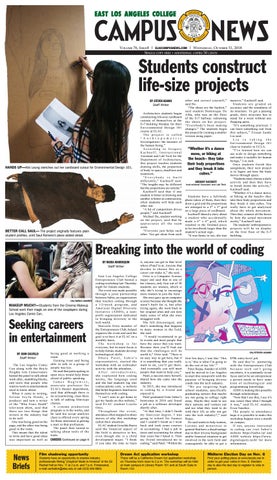
Volume 76, Issue8 | elaccampusnews.com | Wednesday, October 31, 2018 Single copy free - additional copies 50 cents
Students construct life-size projects BY STEVEN ADAMO Staff Writer
HANDS UP—Kiki Leung sketches out her cardboard cutout for Environmental Design 101.
BETTER CALL SAUL— The project originally features plain student profiles, until Saul Romero’s piece added detail.
Architecture students began constructing life-size cardboard cutouts of themselves at the E-7 building Monday for their Environmental Design 101 course at ELAC. The project is called “ A n t h r o p o m e t r i c Investigation-- the measure of the human being.” According to Gregory Kachoeff, Instructional Assistant and Lab Tech for the Department of Architecture, this project teaches students drawing skills, the proportion of body to space, deadlines and teamwork. “Everybody is built d i ff e r e n t l y, ” K a c h o e ff s a i d . “The lengths may be different but the proportions are similar.” K a c h o e ff s a i d t h a t i f o n e student is better at drawing and another is better at construction, often students will help each other out. “A bit of competition drives people,” said Kachoeff. Michael Ho, student working on the project, s aid that he appreciates all the team work. “Everyone just helps each other. You get ideas from each
other and correct yourself,” said Ho. “The shoes are the hardest,” said student Dominique De Alba, who was on the floor of the E-7 hallway redrawing the shoes on her project. “ E v e r y b o d y ’s b e e n m a k i n g changes.” The students begin the project by creating a smaller version using paper.
“Whether it’s a dance move, or biking at the beach-- they take their body proportions and they break it into cubes.” GREGORY KACHOEFF
instructional Assistant and Lab Tech
Students have a full-body photo taken of them, then they draw a grid and the proportions are enlarged to a 3” x 3” grid on a large piece of cardboard. Kachoeff shared a story about a student who accidentally made a 6” x 6” grid, which resulted in the finished piece to be two-thirds larger than the student’s actual sign. “It was funny to see, she was
massive,” Kachoeff said. Students are graded on accuracy and the soundness of its structure. To get a passing grade, their structure has to stand for a week without any flopping parts. “It’s something practical. I can learn something real from this subject,” Zixuan Sandy Liu said. Liu is taking the Environmental Design 101 class to transfer to UCLA. “I’ve learned how we can use scale to design something and make it suitable for human beings,” Liu said. Once students finish thie assignment, their next project is to figure out how the body moves through space. “Students must choose a daily activity and then they have to break down the activity,” Kachoeff said. “Whether it’s a dance move, or biking at the beach-- they take their body proportions and they break it into cubes. You really have to get analytical about the whole movement. Then they connect all the boxes by how the actual movement works,” Kachoeff said. The students’ anthropometric projects will be on display on the first floor of the E-7 building.
Breaking into the world of coding BY MARIA MARROQUIN Staff Writer
CN/DIEGO LINARES
MAKEUP MUCH?—Students from the Cinema Makeup School work their magic on one of the cosplayers during Los Angeles Comic Con.
Seeking careers in entertainment BY JUAN CALVILLO Staff Writer The Los Angeles Comic Con along with the Boyle Heights Arts Conservatory hosted the panel to talk about work ethic, stumbling blocks, and tools that people who want to work in entertainment need to know about. When it came to writing, Selene Seyfu Hinds, a producer and now a writer of the “Who Fears Death” television show, said that there are two things that writers in the industry had to do well. One was being good on the page, and the other was being good in the room. This means that the talent to write and have good ideas was important as well as
News Briefs
being good at working a room. Gaining trust and being able to talk to a group of people was key. He said that participating in open mics would help those afraid of public speaking. James Buglewicz, associate professor for ELACs theater department, said that although there is no screenwriting class there is talk of adding film-type classes. A cinema production program is in the works, and he said his script analysis class is offered every spring for those interested in getting a start in that profession. The panel then turned to talking about tools of the trade.
CAREERS Continued on page 6
Film shadowing opportunity
East Los A ngeles College Entrepreneurs Club hosted a coding workshop last Thursday night for female students. The event was made possible through a joint partnership between Sabio, an organization that teaches coding through a 12-week program, and American Digital Diversity Initiative (ADDI), a nonprofit organization dedicated to bringing diversity to the tech world. Maricela Ortiz member of the Entrepreneurs Club, helped organize the event and said the goal is to have it at ELAC on a monthly basis. The workshop is for everyone, but its main focus is to help female students develop technological skills. D h a r a P a t e l , S a b i o ’s representative, started the workshop with an icebreaker activity with the attendees. After introductions, she explained how coding works, the language used and she had students log into codeacademy.com, a website that helps beginners familiarize themselves with coding. “I can’t wait to get home to get my hands on this website,” said ELAC student Lisette Ortiz. Throughout the event, attendees often stopped to share stories of why this workshop called their attention. ELAC student Griselda Ibarra said the financial aspect of the field is attractive to her, even though she is a child development major. “I think if you take the time to learn
Students have an opportunity to shadow industry professionals filming “¡Gaytino! Made in America” at the S2 Recital Hall on Nov. 11 at 2 p.m. and 7 p.m. If interested, e-mail vanhalkm@elac.edu or call (323)-265-8663.
it, anyone can get to that level where (Patel’s) at. Anyone that decides to choose this as a career can make it,” she said. Ortiz is a Computer Science major and said that in one of her classes, only four out of 30 students are women, which is why she’s trying to encourage more women to join the field. She once gave up on computer science because she thought she wasn’t built for it, but after trying again, she went back to her original plan and can now make sense of what she once struggled with She felt discouraged, and that’s something that happens to many women in the field, she said. “I would recommend to go to events and meet people that have the career that you want. Because then you’ll find out that the challenges will be worth it,” Ortiz said. “There is no easy way to get here, but if it is something that you really want to do, you’ll get there. And eventually you will meet people that want to help you.” Patel, a success story herself, shared how she came into the industry. In 2015, she was introduced to coding by a friend and enjoyed it. Patel graduated from Sabio’s bootcamp in 2016 and found a job as a software developer shortly after. “At that time, I didn’t finish m y f o u r- y e a r d e g r e e . I w a s going to school for finance and I couldn’t finish so I went back and took some courses in accounting. I had a job in taxes and accounting for about four years but I hated it. Then my friend introduced me to coding,” said Patel. “Within the
Dream Act application workshop
CN/STEVEN ADAMO
first few days, I was like ‘This is it;’ this is what I’m going to do the rest of my life’.” Peter Rojas, founder of ADDI said he moved to Los Angeles to start this non-profit with the purpose of bringing diverse youth into the tech industry. “ We a r e t a r g e t i n g h i g h school students, specifically graduating seniors that maybe are not going to college right away. Maybe they want to see their options and venture out and see what they want to do with their life so why not get into the tech industry?,” said Rojas. He said wants to help women, Latinos and minorities in general that have a disadvantage due to their diverse background and/or financial situation to get involved in the tech field and consequently be able to get a
There will be a California Dream Act application workshop on Thursday from noon to 2 p.m. The workshop will be held at main campus in Library Room 101 and at South Gate in Room 123.
$70k entry-level job. He said they’re partnering with the Entrepreneurs Club because tech isn’t going anywhere, it is constantly in our faces and to be an entrepreneur a person needs to have some kind of technological and programming knowledge. ADDI is making this possible through scholarships. “Now that I see this, I see it’s way easier than what I thought it was,” said ELAC student, Erica Sanchez. The people in attendance hope it is possible to make this workshop happen once a month on campus. If not, anyone interested i n c o d i n g c a n v i s i t S a b i o ’s website https://sabio.la/ and A D D I w e b s i t e h t t p s : / / w w w. d i g i t a l e q u i t y. t e c h / f o r m o r e information.
Midterm Election Day on Nov. 6 Find your polling place at www.lavote.net in order to get your votes in Nov. 6. Election day is also the last day to register to vote in person.
2
OPINION
EAST LOS ANGELES COLLEGE CAMPUS NEWS WEDNESDAY, OCTOBER 31, 2018
Dialysis patients deserve better care BY MIGUEL BARRAGAN Staff Writer Vote yes on Prop. 8 for more staffing in dialysis clinics and better treatment for patients. Prop. 8 would limit the revenue of dialysis clinics to 115 percent of whatever is spent on direct patient care and quality improvement costs. If costs exceed this set limit, clinics will have to pay rebates to payers, primarily private insurers. If clinics disagree with the limit and think they need more revenue they will have the option to go to court. It would require clinics to report annual costs to the state to determine the rate of rebates. The initiative is supported by Service Employees International Union-United Healthcare Workers West. The union funded $18 million for support so far. Proponents of the initiative believe it would incentivize clinics to spend more on direct patient care service costs and healthcare quality improvement costs. The Legislative Analyst’s Office said, “Increasing allowable costs would raise the revenue cap, reduce the amount of rebates owed, and potentially leave [Chronic Dialysis Clinics] owner/operators better off than if they were to leave allowable costs at current levels.” The allowable costs are direct patient care service costs and healthcare quality improvement
costs which include: staff wages and benefits, staff training and development, pharmaceuticals, medical supplies, patient counseling and costs associated with renting and maintaining facilities. Opponents point out that managerial positions would not fall under these costs. They argue that this would cause clinics to close because they won’t have enough revenue to cover costs. They cite a Berkeley Research Group study that says more than 80 percent of clinics would suffer from a loss in revenue which might cause some clinics to shut down. The study is questionable, however, because No on Prop. 8 paid about $150,000 to Berkeley Research Group for “campaign consultants” earlier this year according to a Recipient Campaign Committee Statement from No on Prop. 8. Opponents say clinics closing would result in more dialysis patients ending up in the emergency room because they have no dialysis facility to go to. However, according to KCRA’s website, Wesley Hussey, an associate professor of political science at California State University of Sacramento, said, “I don’t think most dialysis patients would end up in the ER, but they might end up in other outpatient facilities.” Marianne Gutierrez, a former ELAC student and a registered nurse from dialysis clinic East LA Plaza Davita, said, “There is
always more that can be done to improve patient education, patient outcomes, and most importantly, access to care.” That’s why voters should vote yes on the initiative because patients deserve to get better care than they have received in previous years. According to the California Department of Public Health Annual Fee Report for Fiscal Year 201819, there were 1,417 deficiencies documented at chronic dialysis clinics during inspections. The Centers for Medicare and Medicaid Services reported more than 4,400 dialysis patients dying from infections within the past five years. Dialysis is a process by which patients with kidney failure are hooked up to machines to remove their blood to be cleaned and put back inside. This process can last three to four hours and may occur three or so times throughout the week. Without this treatment, patients are at a high risk of death. Vote yes on prop. 8.
Government threatens Lifeline Program’s communication services BY ANTHONY AGUILAR Staff Writer The Federal Communications Commission is trying to dismantle the Lifeline Program from lowincome families, people with disabilities, veterans, etc. The Lifeline Program, according to the FCC, is a “program that has provided a discount on phone service for qualifying low-income consumers.” This program gives Americans opportunities that phone services bring from applying for jobs, emergency services, and up-to-date information such as news. If the FCC takes away the Lifeline Program, people who are looking for jobs, especially lowincome families that are trying to find work, will have a hard time. Since most job applications must be submitted online, this will affect people who don’t have access to the internet.
Low-income families looking into jobs would like to know a background of the job. This would involve research. However, in the case of the Lifeline Program limiting or stopping access to services, people won’t be able to research information online. Many companies have phone numbers and emails, however, to find that one has to physically go to the company to get in touch. Many people with disabilities or low income don’t have the funds or means for travel and are not able to reach the company. Those are the types of people that depend on this lifeline program that gives them access to the internet and telephone services. Without this, they are missing out on opportunities. The FCC is also trying to limit people’s use in the Lifeline program. According to the article “Tell the FCC: Leave Lifetime Alone,” it says, “[Chairman of FCC Ajit] Pai is also floating the possibility of a
lifetime benefits cap that would cut off funding for the most vulnerable users, like elderly people and people with disabilities, by limiting the amount of time an individual can use the program.” This limiter will only get the people on the program to miss out on crucial information that changes rapidly, such as news and technology. In a society where the internet is part of our daily lives, a limiter like this will only hold us back from learning new information that. The FCC must be stopped from doing any adjustment to this program. The only adjustment they should be able to do is make any beneficial adjustments for anyone in this program, instead of taking it away from them completely. For your voice to be heard, especially if you are in this program, please visit https://act.freepress.net/ sign/internet_lifeline_fcc/ and leave why it shouldn’t be taken away.
Prop. 1 and 2 offer housing for Californians erans assistance with loans to purchase homes, farms, mobile Staff Writer homes, and units in cooperative developments. Vote yes on Proposition 1 and It’s estimated to provide 3,000 2 on Nov. 6 for an improvement veterans with loans. in housing in California for lowCalVet has helped veterans for income residents and veterans. many years now since its incepProp. 1 would authorize four tion. billion dollars in funds to the state Mark Carreon, a U.S. veteran for general obligation bonds for who is a second-year student at housing-related programs, grants East Los Angeles College, said, and loans. “Veterans may have a hard time The annual state cost to repay transitioning from the military bonds for Prop. 1 would be an back into the civilian world.” average of about $170 million He says that this could cause over 35 years, according to the veterans to fall behind on findLegislative Analyst’s Office. ing a steady income, home, This amounts to about one- and healthcare. Carreon says tenth of 1 percent of the state’s that community is important to current General Fund. veterans, so ELAC’s Veterans The bonds would go toward Resource Center is critical for stueight different programs. $1.5 bil- dents who are veterans that need lion would go to the Multifamily help from others going through House Program. the same process of transitioning This program offers loans for from military life to civilian life. the rehabilitation, construction The remainder of the $4 billion and preservation of rental housing from Prop. 1 would go to proand apartments grams such as the for people with Transit-Oriented incomes of 60 Development percent or below Implementation “Veterans may the area’s median have a hard time Fund, which aims income. to offer grants This would be transitioning from and loans to local good for those the military back governments and who are having developers for into the civilian building housing trouble surviving in California with near transit staworld.” such high prices. tions. Opponents This would help of Prop. 1 say it MARK CARREON those who have a VETERAN, ELAC STUDENT would cost the hard time travelstate too much ing due to a lack money. of transportation. However, the total of $5.95 bilProp. 2 would also help allevilion that it will cost the state pales ate the affordable housing crisis. in comparison to the spending the The initiative would take the state does each year. 1 percent tax on millionaires The California Spending Plan created by Prop. 63 and allocate says General Fund spending for funds of $2 billion toward the fiscal year 2018-19 was $138.7 state’s Mental Health Services billion. Act. The money would be used Assemblyman David Chiu, to build housing for people with D-San Francisco, said in an SF severe mental illnesses who are Chronicle article, “The failure homeless or at risk of becoming of the state to fund this type of homeless. housing has really made this Vote yes on Props 1 and 2. necessary.” For more information on the $1 billion of the bonds would Veterans Resource Center and go to CalVet Home Loan Pro- CalVet, call (323)415-5052 or gram, a program that offers vet- visit D7 on campus.
BY MIGUEL BARRAGAN
Hairlines torment the conscience of the balding BY STEVEN ADAMO Staff Writer
CN/STEVEN ADAMO
www.ELACCampusNews.com
If the president truly loves this country, he would try a new hair cut and let love in. Maybe then he will show compassion for people and communities other than his own. According to the first statistic to pop up after an internet search, two-thirds of men experience hair loss by the age of 35, and 85% of men by the age of 50. People live with baldness in different ways: some shave their heads, others wear their baldness proudly while others choose to wear hats. The most extreme, however, wear the “comb-over.” UrbanDictionary.com defines a comb-over as “a rearrangement of surrounding hair to cover a bald spot as completely as possible.” My own personal experience with male-pattern-baldness began early, in middle school. While running through the sprinklers during class time, fellow students saw my wet hair and
told me-- through a series of gutwrenching laughing-fits-- that mine was disappearing. Later in life, in a brief marathon of self-induced solitude, information sent and received was limited to websites like Reddit and Facebook. Based on unverified information, assumptions about people I didn’t know increased with every lost follicle. Combined with a strict fastfood diet, I became self-absorbed, jealous and mean. I began to see people as punchlines instead of individuals. Even worse, I argued that my poorly-written comedy was “freedom of speech” while ignoring actual cases of speech being stolen from entire communities. In other words: I became an “internet troll.” It was in that moment of extremeentitlement that I decided to take the hat off and reveal a clever ploy: “a rearrangement of surrounding hair to cover a bald spot as completely as possible.”
Now on the receiving end of internet trolling, I converted people’s laughter into wordy rebuttals filled with excuses and lies. I used foul language as an excuse to retaliate with even fouler language. I m i s t o o k o t h e r p e o p l e ’s compassion as judgement or elitism. Ultimately, I was wrong and am still embarrassed by this behavior. This embarrassment led to chronic hat-wearing. Top hats, berets, pork pies, beanies and the all-time classic: the baseball hat; but never a fedora. Family, friends and people I didn’t even ask grew concerned over my obsession with hats; informing me that frequent-hat wearing causes further hair loss. At a true low-point, I sought the advice of a professional hair stylist. I received a respectable hair cut and eventually learned to love myself. In time, others. The hat was covering up the truth and the combover was fake news.
EDITOR IN CHIEF Steven Adamo MANAGING EDITOR Gustavo Buenrostro ONLINE EDITORS Kevin Camargo Joe Dargan Noe Ortega FRONT EDITOR Andrew Ayala OPINION EDITORS Miguel Barragan Maria Marroquin NEWS EDITORS Kaleen Luu Alex Avila FEATURE EDITORS Melody Ortiz Julie Santiago ARTS EDITORS Juan Calvillo Luis Castilla SPORTS EDITOR Stephanie Guevara COPY EDITORS Gustavo Buenrostro Anastasia Landeros Diego Linares STAFF WRITERS Anthony Aguilar Jerry Flores Miguel Dominguez Giselle Palomera ADVERTISING Stefanie Arocha DISTRIBUTION Anastasia Landeros Gustavo Buenrostro ADVISERS Jean Stapleton Sylvia Rico-Sanchez
Campus News encourages letters to the editor relating to campus issues. Letters must be typed and double spaced. Submitted material becomes the property of Campus News and cannot be returned. Letters should be limited to 300 words or less. Campus News reserves the right to edit letters for grammatical errors or libelous content. A no nymo us lette r s wi ll not be printed. Writers must sign submissions and print their names and a phone number where they can be reached. Letters should be addressed to the editor of Campus News. Submissions can be made at the mailroom in building E1 or the Journalism department office in the Technology Center in E7-303. East Los Angeles College Campus News 1301 Avenida Cesar Chavez E7-303 Monterey Park, CA 91754 (323) 265-8819, Ads (323) 265-8821 Fax (323) 415-4910 The East Los Angeles College Campus News is published as a learning experience, offered under the East Los Angeles College Journalism program. The editorial and advertising materials are free from prior restraint by virtue of the First Amendment to the United States Constitution. The opinions expressed are exclusively those of the writer. Accordingly, materials published herein, including any opinions expressed, should not be interpreted as the position of the Los Angeles Community College District, East Los Angeles College, or any officer or employee thereof. PRINTING BY NEWS PUBLISHERS PRESS
NEWS
EAST LOS ANGELES COLLEGE CAMPUS NEWS WEDNESDAY, OCTOBER 31, 2018
3
MESA has altar for Dia de los Muertos BY ALEX AVILA Staff Writer The Math Engineering Science Achivement Center will have an altar for the first annual Dia de los Muertos altar from Monday to Friday at the MESA Center at E7-210 to commemorate the dead. “Everyone knows about Dia de los Muertos but not everyone knows how important it really can be.” MESA members Citalli Martinez and Omar Rangel said. Martinez said the duo created the altar for the first time in the MESA Center to celebrate the significance of Dia de los Muertos. The pair began working on the altar as a place to memorialize and celebrate loved ones. They encourage students who have lost someone important to contribute to the altar and bring anything they wish to remember their loved ones. Martinez said her inspiration for the altar came as an idea after seeing the movie “Coco.” She was moved by the story and realized the importance of remembering people she’s loved. “We shouldn’t forget our loved ones that have passed and I wouldn’t
want to be forgotten either,” Martinez said, stressing that it was crucial to think of all the good things about them.
“We shouldn’t forget our loved ones that have passed and I know I wouldn’t want to be forgotten either.” CITALLI MARTINEZ MESA Member
The purpose of the altar and the Dia de los Muertos celebration, according to Martinez, is to “let people celebrate and keep the good memories alive. Dia de los Muertos isn’t about the suffering of death.” Rangel wants as many people as possible to participate and celebrate with them. Those interested can visit the MESA center and leave items that remind them of their loved ones. “Not every household may celebrate Dia de los Muertos so
they may come and celebrate it here,” Rangel said. The items that students wish to leave should not be too valuable, Rangel specified, “but it should hold value to you [...] something that can help you remember who they were and what they loved, such as a baseball, if they were a huge baseball fan.” Martinez and Rangel want to strengthen the celebration of Dia de los Muertos with the altar and honor those who have passed, for a longer period rather than just for a week as normally. The two wish to keep the celebration going even after Dia de los Muertos, wanting to keep the memory of people passed fresh in their mind. With the altar, they aim to welcome people from all backgrounds to celebrate, so that everyone can feel welcome to participate. Martinez and Rangel are currently brainstorming more ideas for future events and are accepting ideas from anybody who may have contributions. For more information or to visit the altar, visit the MESA Center on the second level of the E-7 building.
‘Taka Talk!’ teaches students Japanese with weekly workshops BY JUAN CALVILLO Staff Writer
COURTESY OF WWW.ARTWITHIMPACT.ORG
Art with Impact uses film to discuss mental health BY LUIS CASTILLA Staff Writer Art With Impact is raising awareness of mental health with “Movies for Mental Health” at ELAC. Art with Impact is a non-profit organization that aims to eliminate the stigma that surrounds talking about mental health so that it can be an open topic. They have produced over 200 workshops on campuses across the United States and Canada. Founder of Art with Impact, Cary McQueen, said, “Art with Impact is a nonprofit organization that is using short films to change conversations and create dialogue around issues of mental health.” “Movies for Mental Health” is two-hour long workshop that includes short film screenings, an interactive group discussion and a panel of speakers that will provide mental health resources. The stress that comes with being a college student, on top of having a mental illness, can be overwhelming. This is why Art With Impact targets young adults. Jennifer Whitney, a licensed marriage and family therapist and “Movies for Mental Health” panelist, said that the target audience of Art with Impact is people between the ages of 16 and 25. They are what
is referred to as “transitional age youth.” Brian Canning of Free Your Mind Projects said, “The college years are when something they call ‘the first break’ might happen.” According to data from the Substance Abuse and Mental Health Services Administration, in 2016, 22.1 percent of young adults living in the U.S. between the ages of 18 and 25 had a mental illness, but only 35.1 percent of them received treatment. Art with Impact intends on being a solution to this problem. According to Art with Impact’s 2017-2018 evaluation data, “71 percent of participants reported an increased intent to reach out for a mental health issue if/when necessary.” Art with Impact film competition winner, Elizabeth Ayiku, writer and director of “Little Elizabeth,” described her film as being about ”love, compassion and what it really takes, as an adult, to heal yourself when you’re the survivor of childhood trauma.” Art with Impact’s website contains a number of testimonials from students who participated in “Movies for Mental Health.” They describe the workshop to be helpful in allowing them to talk about mental health in a safe space and in recognizing how prevalent mental illness really is.
“Taka Talk!” is a weekly language workshop for students wanting to prepare for the ever-expanding, interconnected world that people live and work in daily. The intent of the workshop is to help those who attend learn choice phrases, cultural information and social aspects of communicating with Japanese speakers. Taka Talk! is the brainchild of Yangok Chu, an instructional assistant in the Modern Languages department and Takahito Kikuchi, an East Los Angeles College Japanese tutor. Chu had the idea of creating the “Taka Talk!” workshop with the idea of globalization as one of the main focuses. Kikuchi later came onto the workshop team with various ideas of how it could reach students, each combining their efforts to find ways to attract all types of students. This is a workshop that is inclusive to those who don’t speak Japanese, are fluent and everyone in between. Being an instructional assistant in the Modern Languages lab, Chu wants to make sure that students understand the benefits of this workshop. “I want students to understand the advantages of speaking a second or third language, not only for the sake of their future marketability, but also for the personal enrichment and cognitive health benefits that only seeing the world through a new language can offer,” Chu said. She also said that with more students than before getting higher degrees, it is important for students to set themselves apart from the pack. “You want to have something else that separates you from the rest of the college graduates. Of course
language and a global outlook are going to be two of those defining/ dividing factors,” Chu said. Kikuchi is a Japanese tutor at ELAC and has aspirations of one day becoming a professor. He was given the chance to run “Taka Talk!” with the idea that simply talking about the language wasn’t enough. By talking about the language and the culture combined, the workshop would be able to give those in attendance the perspective of a Japanese person. The flow of meetings comes from the collaborative efforts of Chu and Kikuchi. When it came to themes or ideas for meetings, Kikuchi would bring up a point and Chu would have suggestions or, at times, add to it. “She gave me a lot of freedom to do what I want,’ said Kikuchi. Both put time into figuring out what the workshop would end up being. In the beginning, Kikuchi said that it seemed that he would be talking the entire meeting. He didn’t think that was the best approach, especially not with the students. “What’s more important than understanding or learning about a culture is to question it or be able to discuss about it. Like to say what your opinions are,” said Kikuchi. In an effort to create an atmosphere of interactivity Kikuchi integrated the app “Kahoot!.” “Kahoot!” is used as a learning tool that combines a learnable subject with fun games. The app was used in the first meeting to great effect, giving everyone present a chance to learn about culturally significant things and participate in activities as a group. Kikuchi took the time between answers to give information about the topic at hand. One question focused on the differences between American
CN/STEVEN ADAMO
KIKUCHI-SAN—Takahito Kikuchi explains using “san” in Japanese at “Taka Talk! Japanese Conversation for Beginners. schools and Japanese schools. Kikuchi took a moment to explain how grade levels were separated in Japan as opposed to how they are broken up in the United States. Kikuchi reiterated that this approach allowed different people the chance to learn something new. “If you’re talking about globalization, if that’s what we’re going for, then what we need to do is have room for discussion,” Kikuchi said, “Have time for all of us to talk
about what we think.” Each meeting will have topics that students would be interested in, but there is no set schedule and topics can be influenced by current events. “We want to keep it flexible and appropriate for the time,” Kikuchi said. “Taka Talk!” holds its meetings every Monday from 11:30 a.m. to 12:00 p.m. in Modern Languages lab, E7-107.
BY KEVIN CAMARGO Staff Writer The City of South Gate hosted local schools and organizations at “Family Day in the Park” in South Gate Park on Saturday, as they presented the new city brand. “A brand is our logo that tells a story. The story is South Gate is that we are a community-based city. We depend heavily on volunteerism,” said South Gate Mayor María Belén Bernal. Bernal said that residents are the reason why the city does these events because they make up the social fabric of South Gate.
“A lot of times the mass community is not always involved, so now we’re going to start to the get that reaction and how the community reacts to this logo, and we’ll go forward,” said Al Rios, South Gate council member and ELAC’s Dean of Performing Arts and Design for the Division of Continuing Education and Workforce Development. Prizes were given through raffles, and schools and organizations in attendance had their own booths with activities and information. Schools included South East High School, South Gate middle School, San Miguel Elementary School, and
many more. Some organizations included the Police Department, Walmart and the LA84 Foundation. “The goal (was) to bring resources to community members about programs at our schools, at our healthcare centers through different nonprofits that are operating here and for the community to get to know who their elected officials are,” Bernal said. The event also showcased performers and speakers such as California Assembly Speaker Anthony Rendon and the mariachi band from South East High School. Rios said that these events were started about 23 years ago by the
police department to bring the police closer to the community; but also brings residents together. “It’s important that we have a community college (in South Gate) because not all of our students go straight to a university. A lot of them have to stop at the community college, and (South Gate) is a perfect place to have a campus,” Rios said.
CN/GUSTAVO BUENROSTRO
City of South Gate gathers community, introduces brand
REBRANDING—South Gate Mayor María Belén introduces the new South Gate logo to the community at “Family Day in the Park.” www.ELACCampusNews.com
4
SPORTS
EAST LOS ANGELES COLLEGE CAMPUS NEWS WEDNESDAY, OCTOBER 31, 2018
Defensive skills help women’s soccer in tie doing it,” said freshman forward Claudia Ceja. Five minutes into the game, freshman forward Zharria Ramirez took the ball to the left side of the field and was fouled, but played the advantage. Ramirez crossed the ball to freshman forward Danielle Moore, who touched the ball in the back of the net and gave Rio Hondo an early lead. In the second half, players and coaches from ELAC and Rio Hondo protested against calls made by the referee. Ten minutes before the game ended, Rio Hondo was given another penalty off of a controversial handball that was committed by ELAC’s defense. Head coach Tessa Troglia, Ramirez and ELAC players tried to explain to the referee that it wasn’t a handball, but the penalty was given. “Very questionable. I’ll give him the first half penalty kick, but the second one, he called a handball when it hit her on her shoulder. Then he called another foul outside the (penalty) box, so I think it was more of him feeling pressure,” said Ramirez. Rio Hondo didn’t take advantage of the second opportunity they had to score and missed the penalty to keep the score even. The Huskies’ next game will be an away game against Chaffey College Friday at 2 p.m.
CN/NOE ORTEGA
score a one-on-one. “We played very disciplined Staff Writer defensively and we tried to get them Defensive tactics allowed on a counter. Defensively, we were women’s soccer to tie 1-1 away good, but we didn’t create a lot of against an offensive Rio Hondo chances and got the tie,” said ELAC assistant coach Luis Ramirez. College on Friday. T h e H u s k i e s c o u l d n ’t g e t The Huskies are now 5-6-4 overall, and 1-3-1 in the South possession of the ball for most of the game, and with 15 minutes left Coast Conference-North. Rio Hondo dominated most of in the first half, Rio Hondo freshman the game with its midfielders giving defender Jacqueline Torres Espinoza one-two passes constantly in the was taken down in the penalty box. The referee midfield, possession marked the of the ball on the p e n a l t y, b u t right and left wing, Sophomore and overlapping its “We played goalkeeper fullbacks to go on very disciplined. Adriana Huerta the attack. guessed where East Los Angeles Defensively, we the shot was College was beaten were good, but going to go and in the midfield, but we didn’t create blocked the made up by winning penalty kick. aerial passes and a lot of chances Rio Hondo consistency in the and got the tie.” had a chance defensive line. to score the ELAC freshman rebound, but forward Perla Huerta made Navarro scored the LUIS RAMIREZ a courageous ELAC Assistant Coach Huskies’ only goal double save to to tie the game five keep the score minutes before the at 1-0. first half ended. “We were communicating more, She had the ball in the midfield and flicked the ball over a Rio we played better in the second Hondo player to take the ball to the half to keep the score at 1-1. It was hard for us to get back right side of the field. Navarro had a player in front and on attack (in the second half), that’s behind her, but she cut inside and why we played more defensively was able to clear both of them to and I think we did a good job of
BY NOE ORTEGA
JENNIFER CHAVARRIA
CN/NOE ORTEGA
MY BALL—East Los Angeles College freshman midfielder Alexis Arroyo is taken down by Rio Hondo College frehsman forward Daniel Rincon in an away game on Friday’s 3-1 loss.
Men’s soccer continues to lack defensive presence BY STEPHANIE GUEVARA Staff Writer
In a game where men’s soccer’s defense was unable to stop Rio Hondo College’s offense, East Los Angeles College lost 3-1 on Friday. A n u n o rg a n i z e d E a s t L o s Angeles College was seen early on in the game, resulting in a goal in minute six. Rio Hondo freshman forward Tobias Garcia Mendez ran through E L A C ’s d e f e n s e , i n c l u d i n g freshman goalkeeper Horacio Aguirre, which allowed him to score in an unguarded net. After the first goal was scored, Rio Hondo dominated. The Huskies’ midfield was unable to produce offensive plays to attack Rio Hondo. ELAC’s defensive inconsistency continued through the first half. However, toward the end of the half, Huskies’ offense awoke. The Huskies made substitutions that helped the offense. After sophomore midfielder Jerson Maravilla entered the game, ELAC’s midfield produced many
plays for strikes to score. In a moment where Rio Hondo had a defensive lapse, ELAC freshman midfielder Paulo Macedo took the ball in the goalkeeper area and shot for a goal, but freshman goalkeeper Jesus Rendon barely tapped the ball for a corner kick. When ELAC attacked the most in the first half, Rio Hondo scored off of a counter attack. Sophomore midfielder Abel Machuca took the ball in the right wing and passed it to freshman defender Adrian Flores to score. ELAC’s defense was again take ndown. “I think we attacked in numbers more than we have in the past couple of games. We defended more disciplined than we have. Overall, we were more organized, defensively and offensively,” ELAC sophomore midfielder Joward Abraham said. ELAC responded seven minutes later with a goal from Macedo. Maravilla gained possession of the ball and sent a pass to freshman forward Andres Aceves in the right wing, where he assisted Macedo. Macedo hit the side of his face
www.ELACCampusNews.com
against the goal post when he scored. “We received two goals and I think it’s because we didn’t adjust fast enough. We were being attacked on the wing and we didn’t adjust and that’s what hurt us. Once we adjusted in the wings and changed some players around, it made things better and it gave us a chance to go forward knowing things were secured in the back,” ELAC assistant coach Ricardo Raygoza said. ELAC continued to pressure Rio Hondo’s defense in the second half. Husky freshman midfielder Tulio Pinheiro regained possession of the ball in the midfield and took a shot toward the goal that barely missed the net. Maravilla pressured the defense and it took two, sometimes three, players at a time to take the ball away. In minute 54, Maravilla took down all of Rio Hondo’s defense and shot toward goal, but the goal deviated away from the net. “I want to say we had a great game because the score doesn’t
justify the way we played. We made some adjustments for this game. Coach Ramon did a good job adjusting the group. Unfortunately, we’re still being scored on set pieces, which is something we need to work on,” Raygoza said. Rio Hondo offense began to attack ELAC again and scored their third goal. Rio Hondo freshman forward Phuc Nguyen scored off a corner kick where ELAC defenders left him alone to score. After Rio Hondo’s final goal, the Husky offense stopped attacking. “The last two season we’ve had a hard time beating them (ELAC). This is our first victory in two years… In comparing hearts, today (Rio Hondo) showed heart, but I always felt ELAC players had more heart,” Rio Hondo head coach Orlando Brenes said. E L A C n o w s t a n d s 4 - 11 - 2 overall and 1-4 in conference with three games left in the season. The Huskies’ next game is on Friday at Chaffey College at 4 p.m.
Features
EAST LOS ANGELES COLLEGE CAMPUS NEWS WEDNESDAY, OCTOBER 31, 2018
5
CN/STEPHANIE GUEVARA
MUMMY MANIFESTATION—Teaching assistant Gloria Westcott (third from right) introduces tourists to the mummified body of Ta-Senet-net-hor at the Vincent Price Art Museum in an exhibit on loan from the Los Angeles County Museum of Art.
Historic artwork honors Egyptian death, afterlife BY MELODY ORTIZ Staff Writer The Los Angeles County Museum of Art has loaned the Vincent Price Art Museum Egyptian artwork to display, including funerary tools and a real mummy. “Passing through the Underworld” the exhibition, introduces “Egyptian art with a focus on myth and funerary practice.” LACMA is eager to get more people through the door for the historic experience before the displays leave VPAM. “A large number of people that live in this community don’t know that Vincent Price exists,” said Marvella Muro, LACMA’s community engagement manager. Muro said she was able to get people to come to VPAM by mentioning it at libraries and museums where she held events. During VPAM’s Family Day on Saturday, visitors were taken on tours and participated in workshops. During the tour, everyone was in awe by the mummified body of a woman and her coffin. Engraved in the coffin are inscriptions from the Book of the Dead.
“This is not about the soul and After the tour, attendees tried its relation to God,” said teaching dishes that pharaohs used to eat. assistant, Gloria Westcott, who Artist assistant, Gabriel Rojas lead the tour of the exhibit. “This a s s i s t e d v i s i t o r s d u r i n g t h e is about the journey of the soul in workshop, where they decorated relationship to its human being.” little sarcophagi. Westcott said this about the “We pretty much do that same pictures on the methodology of side of the coffin, looking at artwork, showing the journey talking about it, and “ of death. then doing a project Westcott showed afterwards, which visitors a piece we do at (LACMA) used to hold the eye but we’re doing it makeup Egyptians here,” said Rojas. used, a mummified Rojas said they pet falcon, and do workshops some small statues based on the items .” of Egyptian gods. on display for the V i s i t o r s current exhibit. learned about the In previous GLORIA WESTCOTT significance of food workshops, visitors LACMA teaching assisstant and drinks during were able to make ancient Egyptian Egyptian necklaces, times from Maite masks and crowns. Gomez-Rejon. Last year, Rejon has a company called LACMA held an exhibit on chinese ArtBites that combines art history ceramics. This year is the Egyptian with culinary arts. She explained exhibit as well as a photography what foods were used for funerary exhibit by Mariana Yampolsky, services and rituals. Visitors were displayed in the foyer. also shown tools Egyptians made Supported by a grant through to help grind food. the James Irvine Foundation,
This is about the journey of the soul in relationship to its human being
LACMA has been able to hold these exhibitions and other programs for the public. LACMA will have another on-site workshop at the East Los Angeles Library where visitors will use papyrus as a canvas for a bookmaking project. Another workshop will be at the Bruggemeyer Library in Monterey Park, where visitors will be able to make their own amulets. LACMA also has on-site events going on in Compton and North Hollywood. “Passing through the Underworld” will be on display until Dec. 8. Entry is free and open to the public. VPAM is open Tuesday-Saturday from noon to 4 p.m. and stays open until 7 p.m. on Thursdays. LACMA is open everyday except Wednesday. From Monday-Friday, it’s open from 11 a.m. until 5 p.m. (8 p.m. on Fridays). On weekends it’s open from 10 a.m.-7 p.m. For L.A. County residents, admission is free on weekdays after 3 p.m. Regular admission is $20 for adults and $16 for seniors and students with an ID. For more information, visit lacma. org/on-site.
CN/STEPHANIE GUEVARA
SARCOPHAGUS CRAFT—Kids and adults alike decorate mini sarcophagi during a workshop on Saturday. www.ELACCampusNews.com
6
Arts
EAST LOS ANGELES COLLEGE CAMPUS NEWS WEDNESDAY, OCTOBER 31, 2018
Latino comic artists share perspectives on diversity BY ANDREW AYALA Staff Writer The Latino Comics Panel gave the audience a chance to understand why it is important to embrace culture when creating art and comics. Panel writers and artists included moderator Javier Hernandez, Eric Esquivel, Melina Chavarria, Rafael Navarro and Jules Rivera. They gave brief introductions and highlighted their struggles and paths, starting from their roots to their current situations. All were from different parts of the United States but shared similar interests, goals and passions. “You better believe diversity is on the agenda. That is how I plan on making my mark. Part of making my world a better place is by inspiring people and getting the people up top to start seeing us in ways that are not just ‘oh go clean the floors,’” said Rivera.
Panelists said there aren’t enough people of color that are heroes or protagonists in comics and proved how they are making their mark in the industry. “I’m sure we all have the same pride and the same reason. They wanted to see characters reflective of some part of their culture in a comic,” said Hernandez, who was born in East Los Angeles. The panelists were different ages, and had their own experiences being Latino or Latina. They said there was a difference between being prideful and trying to seem pitiful through writing and art. “Never give up. You must always be proud of who you are and where you come from. I still try to do this to this day with any project that I work on. When I work with other companies, I bring my vision from where I come from and hope it gets interpreted properly,” said Navarro.
Pride was something that all panelists gave their thoughts on. They told the audience to always let their roots be known and make sure interpretations are accurate. Although all were from Latin descent, their different upbringings proved to be influences in their works. Some artists created comics based on good memories and nostalgic moments, while others were focused on the future and making sure Latinos and Latinas get the lives and credit they deserve. In a confrontation with a reporter when he first started out, Hernandez said she asked him what are the struggles he’s faced as a MexicanAmerican creating a comic book. “Money, trying to get on the bookshelf and in the market. The only struggle I find with selfpublishing is having to find the time to make the book since I have
a day job. There is no like klansman protesting me. I don’t have any of those issues since I don’t do much work on politics,” said Hernandez. They all had a common message, that although they are Latino or Latina, that doesn’t need to be the main focus when writing or drawing comic books. Arguments about the lack of Latino involvement in mainstream media were made. Esquivel said that the success of Marvel studios and D.C. comics, with no popular Latin characters, and the youth not learning about Cesar Chavez as much as Martin Luther King Jr. or Malcolm X was a problem. “Our youth, I feel, need to read things that help empower them and show them how to navigate this landscape right now. I’m not afraid to share stories like that because it needs to be heard,” said Chavarria.
Comic professionals impart wisdom CAREERS Continued from page 1 Most writers in the room used Final Draft, a script writing program, as their main writing tool.But each had extras that helped them keep their ideas safe from forgetfulness. Teresa Huang, an actress and staff writer on “Seal Team,” and Hinds discussed using Final Draft as well as notes and other tools on their phones.
David Scott, an associate theater professor at East Los Angeles College, said that Final Draft can be used when writing scripts but that using Microsoft Word and later adapting the writing to Final Draft is also possible. Scott said that using index cards when collecting ideas or using them for guidance in script writing gives the writer the chance to see the basic outline.
They ended the panel by going through some do’s and don’ts of the entertainment world. The panel agreed that meeting deadlines was very important. Megan Shirk, an inker for comics like “KickAss,” said that when she was late inking a page, it threw everyone off. Huang said that artists should use social media to promote their work, especially by using hashtags like
#inktober. Shirk said that one thing to avoid is pestering your editor. Checking in is fine, but when it crosses the line, it can become problematic. Huang said that some people get hung up on the mistakes they make, but she said not to beat yourself up over them. The entire panel then jokingly added that the industry will do that for you.
Developing culturally significant characters BY ANDREW AYALA Staff Writer Speakers of the Cartoon Character 101 panel at L.A. Comic Con explained how voice actors and cartoonists give characters personalities to fit whatever standards are needed. The panel was led by Kiff VandenHeuvel and included guests Adam McArthur, Brandee Stillwell, Jennifer Muro and Doug Bensimon, who all gave their personal inputs and anecdotes. “I never think about mistakes.
Really just try and be true to whatever information, you are presented with. Based on the information you must formulate a character almost instantly,” said McArthur, voice of Marco Diaz on “Star vs. The Forces of Evil.” Panelists made sure to emphasize that improv, on-the-spot acting and ideas are extremely important for many reasons. “Speak and fight like you’re right, but listen like you’re wrong. Sometimes you need to step into the world to see how others see things because the audience doesn’t have the same perspective that you do,” said Bensimon, manager of a current
series at Disney TV animation. Believing that just because a person thinks that the voice or character they are creating sounds good isn’t always enough. “Obviously there’s techniques, you need to understand the psychology of the character, what the character is like and how they will react to certain situations,” said Rosa Farre, Assistant Professor of Animation at East Los Angeles College. “When designing, you want to make sure that it isn’t just pretty, but does it fulfill the needs of the storytelling process. This is when you can see the difference between just designing a pretty
character and one that people can relate to.” Bensimon said that like in many other aspects of life, both sides must be seen in order to make sure justice is done to the character. “You never know who is going to be standing in front of you at Starbucks. Finish your script even if you have to walk away from it. I don’t know how many times people asked me what I have and I would have to say I’m working on this but it isn’t finished,” said Brandee Stillwell, creator of “Sasquatch Detective.” “Have your files ready on your smartphone and always be prepared.”
PHOTOS BY DIEGO LINARES. PHOTO ILLUSTRATION BY STEVEN ADAMO.
2018 COSPLAY CHAMP—Angie Viper, (above) as Disney’s Elsa from “Frozen,” won the big prize at last weekend’s L.A. Comic Con. Viper’s advice to prospective cosplayers was to “Buy a costume, make a costume, thrift store a costume together, it doesn’t matter. Just put a costume on your body and go to a convention. And I promise you’ll love it.” www.ELACCampusNews.com