Volume 75, Issue 7
Single copy free - additional copies 50 cents
Wednesday, october 25, 2017
www.elaccampusnews.com
GRAPHIC BY STEVEN ADAMO
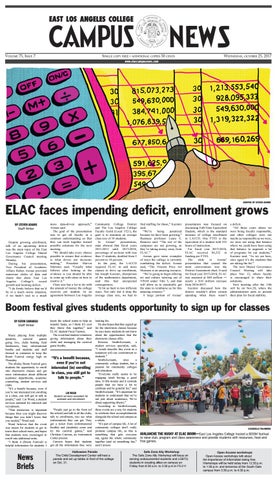
ELAC faces impending deficit, enrollment grows BY STEVEN ADAMO Staff Writer
Despite growing enrollment, talk of an upcoming deficit was the main topic of the East Los Angeles College Shared Governance Council meeting Monday. During his presentation, Vice President of Academic Affairs Ruben Arenas provided numerous slides of data and charts that show East Los Angeles College’s record growth and looming deficit. “I do firmly believe that we’d be in a much worse situation, if we hadn’t tied to a much
more data-driven approach,” Arenas said. The goal of the presentation was to get all faculty at a common understanding so that they can work together toward possible solutions for the next meeting. “We should take every chance possible to ensure that evidence is what drives our decisionmaking,” President Marvin Martinez said. “Usually what follows after looking at the evidence is you should be able to come up with ideas on how to resolve it.” Class size has a lot to do with the amount of money the college receives per student. In an agreement between Los Angeles
Community College District and The Los Angeles College Faculty Guild (Local 1521), the goal is to maintain an average class size of 34 students. In Arenas’ presentation, stats showed that fiscal years 2011-2012 until 2017-2018, percentage of sections with less than 15 students, doubled from 5 percent to 10 percent. In the past, the LACCD required ELAC to add more classes to drive up enrollment, but Joseph Kazimir, chairperson of the mathematics department, said this had unexpected consequences. “It hit us hard in two different ways. Not only did it drop the average class size, we had to
find staffing for those,” Kazimir said. “We’re being penalized because we have been growing,” Business professor Laura E. Ramirez said. “The rest of the campuses are not growing, so they’re taking money away from ELAC.” Arenas gave some examples of ways the college is currently combatting the deficit. Arenas said, “The Vincent Price Art Museum is an amazing resource. “We’re going to begin offering art and culture tutoring out of VPAM under Title 5, and that will allow us to essentially get the state to reimburse us for this amazing resource.” A large portion of Arenas’
presentation was focused on discussing Full-Time Equivalent Student, which is the standard measure of college enrollment in LACCD. One FTES is the equivalent of a student with 525 hours of instruction. For fiscal year 2017-2018, ELAC received $4,332 in funding per FTES. The slide in Arenas’ presentation that caused the most conversation was the District Assessment chart. It said for fiscal year 2017-2018, ELAC was assessed at $40 million — nearly a $10 million increase from 2016-2017. Kazimir discussed how the district wouldn’t allow certain spending when there wasn’t
a deficit. “All those years where we were being fiscally responsible, and other colleges were not maybe as responsible as we were, we were not using that balance where we could have been using that balance to augment a lot of programs for our students,” Kazimir said. “As we see here, once again it’s the students that are taking the hit.” The next Shared Governance Council Meeting will take place Nov 13, where faculty is encouraged to share their solutions. Next meeting after the 13th will be on Nov.20, where the administration aims to present their plan for fiscal stability.
Boom festival gives students opportunity to sign up for classes BY KEVIN CAMARGO Staff Writer Music playing from multiple speakers, carnival games going live, clubs hosting food fundraisers, busy informational booths and students and staff dressed in costumes to keep the Boom Festival energy high on Thursday. The all-day Boom Festival gave students the opportunity to enroll into short-term classes and get more information about different academic departments, academic counseling, student services and clubs. “It’s a benefit because, even if you’re not interested (in) enrolling in a class, you still get to talk to people,” said Lin Wood, a student services assistant for outreach and recruitment. “That interaction is important because then you might discover things that you didn’t know that you needed,” Wood said. Wood believes that the event was meant for students to get to know their school more, and hopes that students were encouraged to enroll into additional units. “I think it (Boom Festival) is helpful information for students. I
News Briefs
know the school wants to help us transfer faster, so I think it’s cool they threw this together,” said ELAC student Oscar Fuentes. The event had student volunteers giving information about their clubs and managing the carnival game booths.
“It’s a benefit because, even if you’re not interested (in) enrolling in class, you still get to talk to people.”
LIN WOOD
Student services assisitant for outreach and recruitment
“People just go to the front (of the school) and talk to all the clubs, talk to enrollment, (to) see what (information) they can get. They get a ticket from (informational booths) and (students) come and try the carnival games,” said Christian Carreon, an Assessment Center proctor. Carreon hopes that students got all the information they were
looking for. He also hopes that they signed up for the short-term classes because he says many students do not know about the opportunities that the short-term classes offer. Rowena Smith-Kersaint, a student services specialist, said, “I would describe this event as a testament (of) our commitment to students.” Smith-Kersaint, once a community college student, has a passion for community colleges and education. “Everyone really seems to be engaging (and) having a good time. It lifts morale and it reminds people that we have a lot to celebrate and be grateful for,” said Smith-Kersaint. “It’s important for students to understand that we’re not just about academics. We’re about supporting (them).” According to Smith-Kersaint, these events are a way for students to celebrate their accomplishments alongside the school and campus as a whole. “It’s part of campus life. A lot of community colleges don’t really promote campus life, so this is something that gets everyone out, (gets) the whole community together (and is) something fun,” said Carreon.
Halloween Parade The Child Development Center will host a parade and set up tables in front of the college on Oct. 31.
CN/GISELLE PALOMERA
AVALANCHE THE HUSKY AT ELAC BOOM—East Los Angeles College hosted a BOOM festival to raise club, program and class awareness and provide students with resources, food and free games.
Safe Zone Ally Workshop The Safe Zone Ally Workshop will focus on serving undocumented students and LGBTQ students in creating allies on campus on Friday from 8:30 a.m. to 3:30 p.m in F5-211
Open Access workshops Open Access workshops talk about the importance of information being free. Workshops will be held today from 12:30 p.m. to 1:30 p.m. and tomorrow at the South Gate campus from 3:30 p.m. to 4:30 p.m.
2
Opinion
EAST LOS ANGELES COLLEGE CAMPUS NEWS WEDNESDAY, OCTOBER 25, 2017
Students lack media literacy skills BY ANASTASIA LANDEROS Staff Writer Media Literacy should be a required course throughout the United States’ education system so students can critically sort through all the information available to them. Media literacy is knowing how to access, evaluate, analyze and create different forms of communication. The decline of media literacy has caused a massive drop in empathy and has hindered society’s ability to grow. The term “media” has been distorted in the past few years to become a blanket term for the news we see on television and read about in newspapers and magazines. Media, in fact, includes everything from video games to email to social networking sites. The news industry is part of media but media, is not exclusively news. Any avenue used to communicate a message to someone else is considered media. In today’s tech-savvy world, the majority of the population has no problem creating or accessing media. Creating and accessing this media without evaluating and analyzing it, however, has caused people to misinterpret messages and spread false information. The most recent incident of misinterpreted messages and circulating false information happened just after the mass shooting in Las Vegas, Nevada.
Facebook and Twitter were rife with information about the man they thought was the shooter, even after it was confirmed to be another man. Facebook, specifically, was filled with stories that reported multiple shooters across the strip, multiple shooters in the room with the actual shooter, connecting the attack to the 9/11 attacks and other unconfirmed theories and accounts. Educators have the power to slow or even stop this negative social behavior by including media literacy in their curricula. Mediasmarts.ca, Canada’s online Center for Digital and Media Literacy, says that the key to media literacy is asking thoughtful questions about the information being accessed. Mediasmarts.ca suggests asking “Who is the media geared toward and why?” and “Whose point of view is the story being told from and how could different audiences interpret that same message?” According to Mediasmarts. ca, these are important questions because “Media literacy – with critical thinking, reflection and ethical behavior at its core – is a key part of what it means to be educated in today’s world.” Dr. Guo-Ming Chen, professor of Communication Studies at the University of Rhode Island, gives multiple reasons for the importance of media literacy education in his article “Media (Literacy) Education in the United States.” Chen said that the media’s strong influence on shaping perceptions, beliefs and attitudes, its growing role in the spread of information,
EDITOR IN CHIEF Dorany Pineda MANAGING EDITOR Stephanie Guevara ONLINE EDITORS Melody Ortiz Kevin Camargo ART DIRECTOR Julie Santiago FRONT EDITOR Gustavo Buenrostro
OPINION EDITOR Giselle Palomera NEWS EDITOR Frank Portillo FEATURE EDITOR Julio Sanchez
its impact on democratic processes, and the public’s constant media use are the most obvious reasons for media literacy education in the U.S. With Facebook and Twitter as the most common news sources for teens and young adults, they should be taught how to recognize good sources from bad ones. This skill will keep them from living within a digital echo chamber where they only learn about their preferred side of any story. Teachers are the best choice
for pointing students in the right direction while navigating the hundreds of sources available to them. In the article “Making a Case for Media Literacy in the Classroom,” media literacy educator Neil Andersen said that because teachers play a key role in creating productive adults, media education has become just as much a part of learning as math and history. “Just as we now know about the importance of nutrition and the
need to preserve the environment–– also matters whose awareness has developed recently––we have recognized that the media is not just a source of entertainment and information, but an experience that defines our lives.” Requiring media literacy education in the classroom now will help combat the spread of misinformation, promote healthy curiosity and define our lives meaningfully in today’s techcentered world.
Spanish speakers prompt change BY STEPHANIE GUEVARA Staff Writer People should stop assuming all Hispanics are Mexican just because we speak Spanish. 21 countries have Spanish as the official language. Therefore, not all Spanish speakers come from Mexico. Why are we quick to assume all Spanish speakers come from Mexico? I am a Salvadoran who grew up in Huntington Park, where the majority of its population is Mexican. Because of that, everyone in school assumed I was Mexican. I purposely spoke Spanish with a Salvadoran accent so everyone could distinguish me. However, I was still asked what
part of Mexico I was from. When I told teachers and students I was Salvadoran, they wouldn’t believe me, like it was something out of the ordinary. Since Spanish speaking immigrants arrived to the United States, certain nationalities were labeled. One of the most popular labels was the term Hispanic. Hispanics refers to those who speak Spanish or are of Spanish descent. However, not everyone who speaks spanish is of Spanish descent. Most people don’t know that in Equatorial Guinea Spanish is the official language. Equatorial Guinea is an African country located in the western part of Africa. According to the definition of
Hispanic, the Equatoguinean are also Hispanic. A survey done by Pew Research
“I am a Salvadoran who grew up in Huntington Park, where the majority of its population is Mexican. Because of that, everyone in school assumed I was Mexican.”
STEPHANIE GUEVARA STAFF WRITER
Center says 51 percent of the Hispanic population in the U.S.
would rather be identified as their parent’s country of origin. Instead of being called Hispanics, they preferred to be called Cuban, Colombian, Peruvian or any other nationality they choose to identify as. People need to be more educated on this matter to stop ignorant comments that might offend others. P r e s i d e n t D o n a l d Tr u m p has referred to undocumented immigrants as Mexicans who must be stopped from entering the U.S. This statement is false because not all undocumented immigrants are Mexican, and he is assuming that all Hispanic immigrants are Mexican. We don’t want to fall into the same ignorance as the President, therefore we must educate ourselves. We must not ignore the other 20
countries’ that are rich in culture. It is true that all these countries connect through the language, but they are also different in tradition and custom. In most of the Latin American countries, there is an urban legend of a woman who appears to men by the riverbed. In Mexico, that woman is known as La Llorona. But in Central America, she is known as La Siguanaba. According to Salvadoran legends, La Siguanaba’s shape-changing spirit that takes the form of an attractive, long-haired woman who is seen from behind. She appears to men at night by the riverbed, jumps from tree to tree and laughs devilishly. By assuming all Hispanics come from Mexico, we neglect the rest of the 20 spanish speaking countries.
Food on campus not worth the price BY MICHAEL DOMINGUEZ Staff Writer
Food should be fresh, taste delicious and have a nutritional value so that students can have energy throughout the day at school or work. Food that is being reused and reheated from the day before should not be sold at full price. Chances are, that food is going to go bad in a day or two anyway. “Budget meeting focuses on campus food prices” by Steven Adamo focused on food on campus, stating that Tim Dow of Pacific Dining Food Management Service is in charge of the Husky Cafe. “If it’s held at the right temperature and we have the food safety of it still intact, we can go ahead and repurpose it in something within the next couple of days,” Dow said. So if food is being reheated and sold again, the consumer should not have to pay full price.
Who knows how long it has been sitting out for and what time it was cooked and what time did it get put away? Most people eat leftovers because they don't want to cook or spend money again for lunch. There are low-income students who cannot eat everyday and have very little money to afford food on
a daily basis. In the meeting, there was also a suggestion to add the reheated food to a dollar menu at the Husky Cafe. Supermarkets use a method where the food that is about to expire is labeled at a sale price. School cafeterias should use that same method to minimize food waste and more students will be able
to afford the food. Senator Gary Garcia of the Associated Student Union at East Los Angeles College said that he was dealing with a lot of students that aren't eating and are homeless. This should not only apply to the student cafeteria, but it should also apply to the student store because it also sells packaged foods,bottled
To the anonymous sender of the Letter to the Editor dated Oct. 2017: Campus News would like to publish your letter, but can’t do so if it is anonymous. Please consider resending it with your name and number printed on it. You can also send it to elaccampusnews@gmail.com. www.ELACCampusNews.com
coffee and smoothies. The school should reduce the prices on items that are going to be taken off the shelf to make room for the fresh food. These sale price foods should have a special section in the store. Some of these prices are high compared to a convinience store. Some items at the student store can cost a dollar or two more than a convenience store. Sometimes students aren’t getting what they are paying for or sometimes not a big enough portion for the price it's sold at. Students are paying higher prices for smaller portions. So if reheated food or food that is packaged and is going to go bad, it should be sold at a lower price so that the low-income students can enjoy it and not go without eating throughout the day. If the cafeteria had more reasonable prices, students could afford the food they need to perform at their full potential in school.
ARTS EDITOR Steven Adamo SPORTS EDITOR Joe Dargan Michael Dominguez PHOTO EDITOR Eddie Garcia COPY EDITORS Russell Zazueta Anastasia Landeros CARTOONISTS Jorge Vazquez Giselle Palomera STAFF WRITERS Noe Ortega Jorge Aldaco STAFF PHOTOGRAPHERS Kevin Gonzalez ADVERTISING Stefanie Arocha DISTRIBUTION Stephanie Guevara Anastasia Landeros Dorany Pineda ADVISERS Jean Stapleton Sylvia Rico-Sanchez
Campus News encourages letters to the editor relating to campus issues. Letters must be typed and double spaced. Submitted material becomes the proper ty of Campus News and cannot be returned. Letters should be limited to 250 words or less. Campus News reserves the right to edit letters for grammatical errors or libelous content. A n o ny m o u s l e t te r s w i l l n o t be printed. Writer s must sign submissions and print their names and a phone number where they can be reached. Letters should be addressed to the editor of Campus News. Submissions can be made at the mailroom in building E1 or the Journalism department office in the Technology Center in E7-303. East Los Angeles College Campus News 1301 Avenida Cesar Chavez E7-303 Monterey Park, CA 91754 (323) 265-8819, Ads (323) 265-8821 Fax (323) 415-4910 The East Los Angeles College Campus News is published as a learning experience, of fered under the East Los Angeles College Journalism program. The editorial and advertising materials are free from prior restraint by virtue of the First Amendment to the United States Constitution. The opinions expressed are exclusively those of the writer. Accordingly, materials published herein, including any opinions expressed, should not be interpreted as the position of the Los Angeles Community College District, East Los Angeles College, or any officer or employee thereof. PRINTING BY NEWS PUBLISHERS PRESS
News
EAST LOS ANGELES COLLEGE CAMPUS NEWS WEDNESDAY, OCTOBER 25, 2017
3
Latest budget cuts affect student resources on campus Meeting focuses on budget restoration Learning Assistance Center takes hit BY GUSTAVO BUENROSTRO Staff Writer Restoring the budget for the computer labs was a topic of discussion at the meeting for student funds held Monday in the G1 administration building. Early in the semester, budget cuts affected labs and other student services, prompting Vice President of Academic Affairs Ruben Arenas to call a meeting to discuss the funding for the labs. Arenas said there may be money in the general or Basic Skills Initiative fund. BSIs are funds that the state provides for developmental programs like Math and English. He said his primary concern is to set up a minimal lab fund from the unrestricted general fund, which can be spent on anything on campus. His reasoning for this is so tutoring isn’t the last resource to get funded. With unrestricted funds, there needs to be a minimum level of funding so that the labs can always rely on them, said Arenas. The
difficulty comes, however, from the distribution of the restricted funds. Restricted funds are part of the general fund that the school receives, but they can only be used for a specific purpose. Arenas said that if the money comes from the general fund, it becomes easier to justify the expenses and they qualify to get money back from the state. If labs get money from other sources like BSIs, however, it becomes harder to get the money back. He also said setting up the minimum funding for labs and tieing it to utilization is the best course of action moving forward. Amanda Ryan-Romo, director of the Learning Assistance Center, said that because the center’s budget was cut, they had to let go of several of the student workers this semester. “Last semester, we had to turn away around 72 students in the lab. This semester, from September to today, we had to turn away 79 students,” said Ryan-Romo. She said that having student workers
makes a difference in the lab. Arenas said there is money in either the general fund or BSI and that department chairs can put together proposals for the supplies fund by December 20. “As a college and constituents, we need to know what our priorities are. From the chair's council, we know there needs to be cuts and sacrifices but student services cannot be one of them. We need to be reasonable about looking at our budgets and seeing what we can cut,” said Sherrie Davey, department chair of Psychology. The Reading and Writing Center is one of the labs that received funding from not only the general fund, but also from other sources like the BSI. Arenas said the Reading and Writing Center student worker budget was cut, but not their tutoring budget, which is perhaps larger than it has been before. He also said that the budget in the math lab from the unrestricted general fund is bigger than it has ever been.
BY JORGE VASQUEZ Staff Writer The Learning Assistance Center in E3-280 had its budget cut at the start of the year. The center is now struggling to hire tutors said Learning Assistance Center and Language Lab Director Amanda Ryan-Romo. The center helps students become independent learners through oneon-one or group tutoring sessions and offers sessions for multiple subjects such as Math, English, Life Science and other college-level courses. Romo said that the center relies heavily on tutors to help students with studies, but the budget that was cut goes directly to paying those tutors. She said the center received $59,000 this fall as opposed to the $68,000 funded last spring. She also said that last pring, there were 29 paid tutors and four volunteers on staff. Now there are only 21 paid tutors
and seven volunteer tutors. Economics is a subject no longer offered at the center because of the inability to keep the tutor. RyanRomo said that the center was booked most of last spring and had to turn away students, but now because of the lack of tutors, the center has to turn away even more students. According to Ryan-Romo, during
“The center was booked most of last spring and had to turn students away, but now because of the lack of tutors, the center has to turn away even more students” weekdays the LAC turns away three to four students a day. On Fridays, the number jumps to 11 to 12 students. She said that the
center tries to accommodate all the students that walk in, but can’t because they’re understaffed. “Once students are turned away, they are discouraged to go back for the assistance they need,” said Ryan-Romo. “It’s hard for students to ask for help just to be turned away.” The LAC is open Monday through Thursday 9 a.m. to 8 p.m., Fridays 9 a.m. to 5 p.m., and Saturdays 10 a.m. to 4 p.m. The Language Lab, however, did not receive a budget cut. The budget was, in fact, increased, which allowed the Language Lab to hire an additional Spanish tutor said RyanRomo. During the spring semester, the Language Lab had eight tutors. This fall, they have nine. The Lab offers tutoring for all modern language courses including ASL and ESL courses. Students can make appointments for one-onone or group sessions, but walk-in tutoring is not guaranteed. The Language Lab is open Monday through Thursday from 8 a.m. to 8 p.m. and Fridays from 8 a.m. to 2 p.m. in E3-170.
Security report reveals most common crimes on campus BY DORANY PINEDA Staff Writer East Los Angeles College has seen a slight increase in crime on and off campus according to the 2017 Annual Security Report published by the Los Angeles County Sheriff’s Department. The report shows crime statistics from 2014 to 2016 and is divided into three categories: on campus, non-campus and off campus. The report found that there was a slight growth in sexual assault cases on campus in 2016. In 2016, hree cases of fondling were reported, whereas in 2015 there were two. The year before, only one. Campus crimes reported last year were four instances of domestic violence, three arrests for carrying or possession of a weapon, one case of robbery, four burglaries, eight motor vehicle thefts, and two drug abuse violations that lead to arrests. Motor vehicle thefts accounted for the majority of crimes on campus and in public property.
Deputy Morales said the best thing students and staff can do to prevent vehicle thefts is to park in well-lit areas with high traffic and always lock their cars. “Don’t leave any valuables visible like purses, cell phones, wallets,” Morales said. There were no reported offenses in the non-campus category for 2016, but three were reported the year prior and one in 2014. In 2015, one automobile theft and two burglaries were reported, and one vehicle theft was reported at a non-campus location in 2014. A non-campus location is defined as “any building or property owned or controlled by the institution that is used in direct support of, or in relation to, the institution’s educational purposes, is frequently used by students, and not within the same reasonably contiguous geographic area of the institution.” There was one reported hate crime of vandalism on campus in 2015, but none in 2014 or 2016. According to Morales, ELAC’s Sheriff’s Department is working
with the Monterey Park police in response to the slight increase in crimes reported. “They have a special team that deals with all the homelessness,” Morales said. “We’re in conjunction with them to try and minimize the homeless in the area and try to identify who is who and where they are in case some crimes happen. At least we can identify who did it.” Morales said that although not all crimes are committed by homeless people, some are. “A lot of the crimes (committed) are just criminal opportunity. People walking by and see an open purse or cell phone on the table and they just grab it... but some of (the crimes) are due to the increase in homeless, we think.” Though the number of deputies and cadets has remained the same, Morales said they are increasing patrols. “We try to drive around the areas that we believe there are entrances and where the most crimes are.” The information compiled in the
report complies with the federal Jeanne Clery Disclosure of Campus Security Police and the Crime Statistics Act, or Clery Act. Colleges and universities that receive federal funding are obligated to be transparent with its crime statistics by publishing an annual security report every October. Anyone who wants to report a crime can contact the ELAC Sheriff’s Station at (323) 265-8800. Blue light emergency telephones located throughout campus can also be used to get in contact with the station. Individuals are encouraged to report crimes promptly and accurately, and to register their cell phones and email addresses to the Emergency Text Notification System to be alerted of warnings and other important notices. To enroll, visit http://www.elac.edu/ currentstudents/studentresources/ emergencyalert/index.htm. The 2017 Annual Security Report can be found at: https://www.elac. edu/adminservices/sheriff/doc/ AnnualSecurityReport-2017.pdf.
Open educational resources offers cheaper supply options to students BY STEVEN ADAMO Staff Writer
The high-cost of textbooks is one of many topics of discussion during Open Access Week, with workshops held today and Thursday at the Helen Miller Bailey library. During the workshops, librarian Cynthia Mari Orozco will discuss Open Educational Resources (OER). “OER are openly licensed materials that are free to use,” Orozco said. These materials are syllabi, assignments, tests, projects and
free, or low-cost, textbooks. A 2014 study by the Student Public Interest Research Group revealed that students base their course decisions on cost of materials and avoid taking classes that require expensive course materials. One student, who asked to remain anonymous, said that they take photos of the homework assignments from the book and print them out in the library in order to save money. “The math book alone is $170,” the student said. Most OER textbooks are free with print options commonly available, usually between $29 to $65. Two years ago, the California
College Textbook Affordability Act was passed. The law provides incentives for campuses to adopt open educational resources, though few professors at ELAC are using OER textbooks in their curriculum. “From a student perspective, it might sound pretty easy for faculty to immediately adopt an open textbook, but there are a lot of obstacles, such as completely redesigning a course’s curriculum, technological hurdles, and understanding how licenses work,” Orozco said. Dr. Eileen Ie, associate professor of Sociology, is one of the teachers on campus that have adopted OER into their curriculum.
“The reason I adopted (OER) was the quality of its content,” Ie said. “Its also very critical and more nuanced than a general Introduction to Sociology textbook.” The new OER textbook is free and available on the first day of class, whereas the previous Sociology textbook costs approximately $150. Some colleges have gone beyond using OER materials in classes and are creating entire degrees around them. A “zero-textbook-cost degree,” or “Z-degree,” is a degree obtained through Open Educational Resources. When Tidewater Community College in Virginia implemented
www.ELACCampusNews.com
their first two-year Z-Degree for business, students saved nearly $3,700 in textbook fees. Groups like Open Oregon and Maricopa Millions educate students and colleges alike on the benefits of OER. On Twitter, Maricopa Millions encourages students to share their stories about how they will spend the money they save from increasing textbook costs. Groups like the Organization for Economic Co-Operation and Development help governments of 30 democracies address economic, social and environmental issues with the use of OER. The Organization for Economic
Co-Operation and Development website says that they “provide a setting where governments can compare policy experiences, seek answers to common problems, identify good practice and work to co-ordinate domestic and international policies.” Upcoming Open Access Week workshops will be held today from 12:30 p.m. to 1:30 p.m. in the ELAC library and tomorrow from 3:30 p.m. to 4:30 p.m. at the South Gate campus library. For more information on Open Educational Resources, visit http://researchguides.elac.edu/oer or #GoOpen on Twitter.
4
Feature
EAST LOS ANGELES COLLEGE CAMPUS NEWS WEDNESDAY, OCTOBER 25, 2017
Illustration by Julie Santiago
The Avalanche heard ‘round ELAC Campus BY JULIE SANTIAGO Staff Writer For most college students, becoming the school's mascot is not their first choice for an extracurricular activity. For Melissa Ann Sawyer though, it was. At 5 feet 3 inches, the yellowhaired Sawyer had no problem picturing herself in a large, gray fluffy suit. East Los Angeles College’s newest official mascot has appeared at more football and school events since becoming Avalanche, the Husky mascot, last semester. “They (faculty and staff) are happy to see the mascot out more. I have so much fun with the students, the faculty and staff,” Sawyer said. Sawyer's good friend Joseph Michael Kunkle was not surprised when he first heard Sawyer was the official mascot. “I knew she was going to be the mascot,” Kunkle said. Kunkle and Sawyer have previously served as mascots for Club Rush and Associated Student Union events. Kunkle and Sawyer both played the role Avalanche before Sawyer became its official user. Kunkle said being the mascot suits Sawyer’s spirited and driven personality. Sawyer challenges him to do
better, Kunkle said. “When I'm on social media, she’ll ask me if I should be doing my homework,” Kunkle said. He also said that she’ll joke and tell him he’s grounded. But Sawyer wants to motivate more people than just one. In the spring of 2010, Sawyer started taking classes at ELAC. She decided on a child development major because she wants to work
Melissa Ann Sawyer with children with special needs. “I've dealt with special education. I would like to motivate children, let them know they could pass their classes,” Sawyer said. Sawyer feels her background as a student with special needs can motivate others with similar struggles to do better in school. If
CN/JULIE SANTIAGO
she can do it, they can, too, she said. Sawyer wasn't always so spirited, however. “[High school was] rough, I didn't like school when I was younger,” Sawyer said. Sawyer recalled a time when Alhambra High School’s district relocated from where she lived, and as a result, Sawyer had to attend San Gabriel High School, being her new district. “Both those high schools were rivals. I got jumped and they transferred me back to Alhambra,” Sawyer said.“They told me if I didn't know how to block my head or ribs I could have been in a coma. But I knew how to block because of my cousins.” Sawyer, an only child, credits her cousins for toughening her up. She grew up in Alhambra and currently lives with her maternal grandmother, cousin, uncle and aunt. But Sawyer also has a second place she calls home. “ELAC is my home. In the beginning here, when I first started ELAC, I was having a lot of medical issues. I was in and out of the hospital. “I was up and down but I am doing better now,” Sawyer said. Despite her struggles, Sawyer has done well, according to her child development professor Brigette
CN/JULIE SANTIAGO
BEHIND THE MASK—Melissa Ann Sawyer talks about her experience as Avalanche in the Student Services building. Michelle Thompson. Thompson considers Sawyer to be a consistent, determined and very conscientious student. “It takes a special person to choose to be a mascot,” Thompson said. A few years before being Avalanche, Sawyer worked at
www.ELACCampusNews.com
Universal Studios as a character and at a Little Caesar’s as the pizza mascot Caesar. Sawyer continued her mini career as mascot naturally. Sawyer also worked as a vendor for Staples Center, where she got the chance to work at the Grammy and MTV awards.
“I used to work as a vendor at Staples Center for two years,” Sawyer said. That's where she met Hell’s Kitchen star Gordon Ramsay. “He’s a sweetheart,” Sawyer said. In her free time, Sawyer likes to watch “Family Guy” and “Hell's Kitchen” on Hulu.
Arts 5 Student talents showcased in S2
EAST LOS ANGELES COLLEGE CAMPUS NEWS WEDNESDAY, OCTOBER 25, 2017
STEVEN ADAMO Staff Writer
C/N STEPHANIE GUEVARA
MARRIAGE OBJECTION— Leonardo, played by Michael Moretta, angrily spectates during the first dance between The Bride (performed by Miriam Menendez) and The Bridegroom (performed by Christopher Magallanes) on their wedding night.
Love misguided in ‘Blood Wedding’ FRANK PORTILLO Staff Writer
“Blood Wedding” could have been a great way to spend the holiday season, but the play fails to overcome mediocrity due to weak performances and a lackluster ending. The latest Theater Department production follows two characters that are in love with each other but are being pulled apart by society. Leonardo is married with a child but still lusts over the character known only as The Bride. When he learns that The Bride is being married off to another man, he makes one last attempt at winning her affection. On the night of her wedding, the two run away and are chased by the townspeople, who want to murder Leonardo. “Blood Wedding” has an ominous tone, which is perfectly fitting for the Halloween season. The main character, Leonardo, spends a lot of time riding a horse in the play. The costume design for the horse is one of the creepiest things ever created and looks like something out of a nightmare. In the costume is Armando Torres, whose horse noises didn’t help ease the creep factor. Torres is certainly dialed in as the horse. There is a great deal of foreshadowing throughout this production. Before the play commences, the stage is backlit blue, giving the audience members a hint at the sadness of the story or at least what the audience should feel like as a result of the play. In a story that demands emotion from all the actors involved, it becomes obvious when they fail to elicit any emotional reactions. At the top of the play, actors rush from behind the audience members in the stand wearing masks that cover the top half of their faces. The masks
are worn by every character besides the two leads and take some getting used to, as they initially resembled the masks used by the murderers in the 2008 film, “The Strangers.” Leonardo is played by Michael Moretta, who has appeared in previous productions on campus. Moretta is always entertaining on stage and this performance is no different. The anger that the character feels while watching his love interest be married off to someone else is perfectly conveyed to the audience in his subtle body language. His character walks the line between protagonist and antagonist as he is the main focus of the story, but ends up being his own obstacle. His love interest, The Bride, is played by Miriam Menendez. The success of the play, for the most part, lies on the shoulders of the two main performers. Moretta delivers, but Menendez seems to have trouble with inflecting the anguish that she’s experiencing. In the moments that demand raw emotion, she holds back on her performance as she is unable to evoke any emotion from the audience during her crucial scenes. During the conclusion, The Bride fails to deliver a monologue that is meant to contain a great amount of emotional weight. “Blood Wedding,” coming in at 90 minutes, does an excellent job of establishing the vast cast of characters. Characters become so well established, that it’s disappointing when the conclusion unfolds. By the time the plot is revealed and all the pieces are put into place, the narrative takes a dramatic turn. Throughout the play, flamenco dancers are brought to life by Edward Navarrete and Jasia Alyezza Topete. The dancers use choreography to set up the plot of the play. The passion of the dancers as they come together, then driven apart is whats
demanded by the roles of the two lead characters. The play closes with a powerful, loud scream of anguish by the female dancer, who represents The Bride’s emotions. “Blood Wedding” features very poetic dialogue that gets lost in some of the actors’ deliveries. It feels as though some of the actors didn’t understand the content. Not understanding the content resulted in some of the actors not delivering their lines in a natural way. The ones who did, however, excelled in their performances. The best performer-of-the-night award goes to Rachel Peralta, who plays the sexual Maid. Her performance and line delivery fit perfectly within the play and will have audiences laughing in each of her scenes.
While the plot was a great idea, it wasn’t executed successfully. Instead of having a system in place, actors were getting tired and the clapping went from adding to the experience to being distracting. The clapping was no longer timed perfectly or loud enough for the entire audience to hear. “Blood Wedding” runs through the weekend from Thursday to Sunday, with matinee showings on Friday and Sunday. Evening showtimes begin at 8 p.m. and matinee begins at 2 p.m. Tickets are available at the East Los Angeles College website under the “events” tab or in P2-101A for ten dollars, or $12 at the door. Four dollar discounts are available for members of the Associated Students Union.
Some of East Los Angeles College’s finest vocalists and pianists were on display at the Fall Student Recital, presented by the Music Department on Wednesday. A cell phone ring didn’t disrupt Daniel Lopez’ piano performance of “Danza de la moza donosa” by Argentinian composer Alberto Ginastera. Lopez gestured softly as he began, which quickly stormed into a fury of uneasiness as oddsounding chords were sprinkled throughout each dramatic build up. His was the most memorable performance of the afternoon The audience in the S2 Recital Hall provided an energized applause as Juan Carlos Gamez walked toward the piano. Gamez performed “Ballade No.3 in A-flat Major” by Frédéric Chopin. While the previous performance of Bach’s “French Suite No.5” (Allemande) by John Solano was
happy in tone and rhythm, Gamez’s Chopin piece was performed with loud, dramatic blasts surrounded by soft, jiggly outbursts. These musical interactions between two conflicting energies blended fluidly with one another. Light, sporadic notes were played, separated by flurries of patterns every few steps. The ongoing highs and lows made this performance consistently enjoyable. The vocal performances by Roman Guerra and Eugene Lopez were accompanied by pianist Mimi Chun. Chun specifically shined during Eugene Lopez’s vocal performance as she skillfully moved through Johannesburg Brahms’ “Von emigre Liebe, Op.43, No.1.” A trio-- consisting of Ivan Romero Bautista on tenor saxophone, Gilbert Chinn on electric guitar and Stephen Alvarez on piano -- finished the recital with “Blue Bossa,” a jazz standard that was originally composed by Kenny Dorham and was featured on the 1963 album Page One.
C/N NOE ORTEGA
STRINGING ALONG— Jennifer Peterson performs “Waltz in B Minor, Op.69, No.2” by Frédéric Chopin during Wednesday’s Student Recital.
‘The Snowman’ gives cold shoulder JORGE ALDACO Staff Writer
“The Snowman” failed to present itself as a crime thriller film with an edge of horror. The trailers are misleading, building up tension that doesn’t exist in the movie. The film takes place in Oslo, Norway, where Harry Hole, played by Michael Fassbender, is a special unit detective in the city’s police department. Heavily revered, he runs into Katrine Bratt, played by Rebecca Ferguson, who had seen cases done by Fassbender’s character. Prior to the winter season which is fast approaching in Norway, a missing mother and a grisly murder come up and both Hole and Bratt must find out who is behind them and why they are happening. The murderer’s calling card is a
snowman, which is present at each filmography background. Director crime scene. Tomas Alfredson has a small list The film is set within the cold of films that, regardless of number, city of Oslo, a perfect location for have been acclaimed positively. crimes. The location was a great Such as “Let the Right One In” opportunity and “Tinker to build an Ta i l o r atmosphere Soldier of bleakness Spy.” and even With an horror. experienced The cold cast and environment a good o ff e r s t h e director, it killer to is upsetting use to his to realize advantage, that the film but the lacked so lack of much and PHOTO COURTESY OF UNIVERSAL PICTURES direction in the did poorly in filmmaking did storytelling. not take the opportunity. The weakest aspect of the film The lead cast, especially were the back-stories and subplots. Fassbender, have an extensive The film takes the audience in
many directions and gets incredibly difficult to follow at times. Side plots, such as Hole’s relationship with his ex-girlfriend, her boyfriend, and their son seemed forced and unnecessary. The backstory and flashbacks of the killer’s origins are drawn out, and the audience ends up not fearing him and his psychotic ways. The film touched on aspects of horror but did not get anywhere near it. A creepy snowman as a symbol of murders, a snowy city, an investigator that’s an insomniac and alcoholic all are good elements for a horror crime film. The movie never got close to it and the audience will wish for it to happen. Past the first-hour mark, all hope is lost. “The Snowman” is rated R for grisly images, violence, some language, sexuality,and brief nudity.
Psychological horror returns in ‘The Evil Within 2’ RUSSELL ZAZUETA Staff Writer
Like preparing to watch a good horror flick, turn off the lights, close the door to your room and take a ride into the terrifying world of the video game The Evil Within 2. The nightmare continues with the return of Sebastian Castellanos, the now-retired detective, three years after the incident at Beacon hospital, where an unsolved mysterious mass murder took place. Castellanos’ former partner Juli Kidman finds Castellanos drunk and in a pitfall of despair. He blames himself for the death of his daughter, who he couldn’t save from a fire that killed her. Much like the original game released in 2014, part two is bent on psychological horror. It belongs to a genre called “survival horror,” meaning gun ammunition and firstaid kits are scarce to find, forcing
players to use items sparingly in their encounters with monsters. Sometimes, it’s impossible to ration the ammunition because of so many encounters. The only options left are to wield a melee weapon that will not do much damage, or to run like hell and hide. This bonechilling experience reigns supreme in “The Evil Within 2.” Master of the genre, Shinju Mikami, who was involved in the making of “The Evil Within” 1 and 2, is the same director and producer who gave us the classic games “Resident Evil” (1996) and “Dino Crisis” (1999). For “The Evil Within 2,” Mikami and his team used a similar idea from the film “The Matrix,” and built on a story where people plug into a device that transports them to an artificial world called STEM. The shadow corporation Mobius recruits volunteers to permanently live in a virtual town called Union,
During the mess, Kidman where they are promised a happy life exempt of pain and suffering. explains to Castellanos that his Everything inside STEM looks and daughter is still alive and missing inside STEM. Castellanos’ evil feels like reality. The experimental project, adventure to rescue her begins here. With a new however, goes voice actor wrong. Union in place, begins to fall Castellanos’ apart and most acting improves of its citizens from the transform into original, adding grotesque, rabid more emotion creatures because to the dialogue of a malfunction and showing caused by the more depth in disappearance his character. of the system’s Players can core. The few now enjoy an that survive are open world map, ripped to shreds like “Silent Hill: by these creatures PHOTO COURTESY OF TANGO GAMEWORKS D o w n p o u r, ” and Mobius can’t help them because the corporation where players can explore freely is shut out of the system. It’s in in the game instead of being forced this state of chaos, that the game to follow a set path on the map. The game developers also added introduces STEM to us. www.ELACCampusNews.com
workbenches, where players can now create ammunition from materials found throughout the game. Like most of Mikami’s games, the character perspective is in third-person – an outer-body view of the character – and gives players beautifully detailed and deranged environments to explore. There are many survivors along the journey that aid the players’ character. Many cinematic scenes immerse players further into the story. These elements are well executed, and the game itself is a melting pot of other great survival horror games such as the “Silent Hill” series, “the Resident Evil” series, “The Last of Us” and “Alan Wake.” Plenty of hideous creatures lurk in the town of Union, created by villains who learn to manipulate everything inside STEM. Stefano Valentini is a villain in STEM who runs wild with
imagination, giving players a creepy, 10-foot creature composed of multiple heads, mutilated remains for a body, a circular saw for an arm and a chilling giggle that will curve players’ spine. This creation is just one of the morbid things that will keep players running around town. The musical score contains a lot of the fear-invoking suspense players will experience. It complements the grim environment with subtle, ominous tones that will keep players afraid of the dark. When you run away from monsters here, the music runs with you. With the story being more about Castellanos’ personal life, players will understand Castellanos’ reason for enduring the horrors in Union. By the end of the game, players will know why he should be dad of the year. “The Evil Within 2” is rated M and is available on Xbox One, Playstation 4 and PC.
6
SPORTS
EAST LOS ANGELES COLLEGE CAMPUS NEWS
WEDNESDAY, OCTOBER 25, 2017
Disallowed goal contributes to loss BY NOE ORTEGA Staff Writer A disallowed goal by the referee and men’s soccer’s lack of offensive presence, resulted in an away loss, 2-1, to El Camino College on Friday. “We played horrible. This is the worst we’ve ever played out of seven games,” sophomore midfielder William Morse said. In minute 76, the Huskies had a goal disallowed after a corner kick from Morse was crossed into the penalty box, that sophomore attacker Valentin Mercado scored. According to the linesman, the ball went out of the field and then went back in before Mercado’s goal. Morse said the ball never went outside of the line and if it would’ve gone out, he would’ve owned up to his actions and accepted the referee’s call. ELAC was down by two goals and furious after the referee disallowed its goal. In minute 83 El Camino sophomore goalkeeper Cesar Amezcua committed an error after kicking the ball outside of the penalty box too late, which resulted in an indirect free kick for ELAC. Freshman midfielder Jerson Maravilla stepped up and scored the Huskies first goal of the game by beating El Camino’s defensive wall with a low shot to the bottom right corner. ELA C f r es hman d ef end er
Looking Ahead
CN/NOE ORTEGA
LIFT OFF—Sophomore Andres Martinez (2) shows off his vertical ability as he out-leaps El Camino defenders attempting a header during Friday‘s game. Salvador Alvarez came off of the field in minute 80 so that sophomore midfielder Gustavo Silva can come back on the field. As he walked off the field, Alvarez was given a red
Today
card for “abusive language” toward El Camino players. The Huskies had 19 shots in total. Out of the 19, five were on target. Maravilla had three of them.
Today
Women’s water polo at Chafey 3 p.m.
El Camino scored its first goal in minute 25 off of a corner kick where freshman midfielder Abraham Younis and sophomore defender Zachary Franco headed the ball
Friday
Women’s volleyball at Long Beach 6 p.m.
Women’s volleyball home against L.A. Harbor 6 p.m.
toward each other. Franco left space for sophomore attacker Jason Santana to score. ELAC sophomore goalkeeper Joshua Moreno had a good start.
Friday Men’s and women’s cross country at SCC Conference Championships
After El Camino was awarded a penalty in minute eight, Moreno made a save with his feet and kept the score 0-0. Before the first half could end, in minute 44, Moreno had the ball and tried to give a short pass to freshman defender Yahir Olea. The ball was intercepted by El Camino sophomore attacker Yushi Kato and scored to make it 2-0. “It’s a lack of concentration from my part. I could've capitalized better, but mistakes happen. It’s soccer and things happen,” said Moreno. ELAC made substitutions in the second half by switching out sophomore defender Agustin Barros, Mercado, and Moreno. The Huskies brought on Silva, sophomore attacker Andy Benitez, and freshman goalkeeper Luis Angel Alvarez to reinforce the midfield for a more offensive team. “Some players just didn’t want to play, we’ve been down more than 2-0, we’ve been down 3-0 and we’ve came back. Today I thought it was going to be different, but some players just didn’t want to play. Our heads were down and that was pretty much it,” said Morse. ELAC won its eighth game of the season yesterday against Long Beach City College 2-0 with two late goals from sophomore forward Edward Robles and freshman forward Kevin Rodriguez. The Huskies next game is on Friday against SCC-North competitors at Mount San Antonio College at 6 p.m.
Saturday
October 28 Football home against West L.A. at 6
Women’s soccer comeback falls short against El Camino BY NOE ORTEGA Staff Writer Women’s soccer fell short to El Camino College after a second half comeback attempt ended in a loss on Friday. “Today was kind of a setback because we’ve been building on momentum in the past couple of games and in this one I think it was just the first goal that we were so caught up surprised that we just put our heads down, there was no fire in today's game,” said East Los Angeles College freshman defender Ashley Lopez. The Huskies had a breath of fresh air in minute 50 after freshman attacker Breanna Sandoval received a ball from Lopez in the midfield to set up sophomore attacker Stephanie Galvan. Galvan took a shot from outside the penalty box and scored ELACs first goal of the game and her fifth of the season. “I thought we started playing stronger, (after a Husky goal) but then they scored the second goal, that’s when everyone gave up,” said freshman goalkeeper Adriana Huerta.
Sports Briefs
“A lot of us put our heads down and some of us kept going.” Two minutes after scoring, Sandoval had a one-on-one that could’ve given ELAC the lead but was denied by El Camino sophomore goalkeeper Isabel Rojas. Sandoval finished with five shots, three on goal and an assist. ELAC players put their heads down just two minutes into the
“I thought we started playing stronger, but when they scored the second goal, that’s when we gave up.” ADRIANA HUERTA
Freshman goalkeeper
game when El Camino sophomore forward Jodie Brennan assisted freshman forward Maddy Simones with a through ball that went past ELACs defense for Simones to score in the top left corner. El
Camino had a total of 17 shots. Eight of them were in the first half when they were up by a goal and had more control of the game. Fifteen minutes after the Huskies tied the game, freshman forwards Monica Bernardino and Robbin Riggs touched the ball on the left wing of the field to give Riggs space to center the ball so that freshman midfielder Carolyn Medina can swoop in and tap the ball in to give make it 2-1. “I thought we were going to build off that momentum (after ELACs goal) because I saw everyone lift up their shoulders,” said Lopez. “I just honestly thought we were going to build off of that, but what happened happened and there’s nothing that we can do now.” El Camino had the chance to go up by two goals in minute 67, but a double-save by Huerta denied them their third goal. The Huskies are now on a twogame losing streak after Friday’s loss and sit in last place in the South Coast Conference-North with three losses and a draw. ELAC’s next game will be away this Friday against Mount San Antonio College in another SCC-North match at 4 p.m.
Volleyball
Volleyball improved to 10-8 overall, after beating Chaffey College 3-1 in sets played. This was thier second win in a row.
CN/NOE ORTEGA
ON THE ATTACK— Freshman Breanna Sandoval (20) looks to beat El Camino College Freshman Erika Aanderud (99) midway through the game.
Water Polo
Water Polo won 14-13 on the road against Rio Hondo Wednesday, to go 6-10 overall on the season. Freshman Amy Cervantes contributed 6 points in the victory.
www.ELACCampusNews.com
Cross Country
Grecia Estrada placed in the top 10 among community college women and men’s cross country finished in seventh place at the California State Fullerton Titan Invitational.