Volume 76, Issue 4 • Wednesday, October 3, 2018
Single copy free - additional copies 50 cents
NOT FORGOTTEN— PHOTO ILLUSTRATION BY STEVEN ADAMO
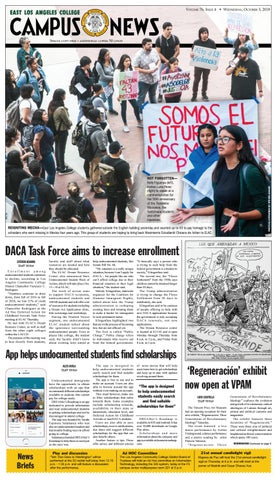
Kelly Figueroa (left), invites Luna Perez (right) to speak at a commemoration for the 50th anniversary of the Tlatelolco Massacre, the Ayotzinapa students and other injustices.
REIGNITING MECHA—East Los Angeles College students gathered outside the English building yesterday and counted up to 43 to pay homage to the schoolars who went missing in Mexico four years ago. This group of students are hoping to bring back Movimiento Estudiantil Chicano de Aztlan to ELAC.
DACA Task Force aims to increase enrollment STEVEN ADAMO Staff Writer Enrollment among undocumented students continues to decline, according to Los Angeles Community College District Chancellor Francisco C. Rodriguez. “Numbers continue to draw down, from fall of 2016 to fall of 2018, we lost 21% of credit undocumented students,” said Chancellor Rodriguez at the Ad Hoc Deferred Action for Childhood Arrivals Task Force meeting at ELAC Thursday. He met with ELAC’s Dream Resource Center, as well as staff from the other eight colleges within the LACCD. The purpose of the meeting was to hear directly from students,
faculty and staff about what resources are needed and how they should be allocated. The ELAC Dream Resource Center also announced their Undocumented Student Week of Action, which will take place Oct. 15 - 18 at ELAC. The week of action aims to support DACA recipients, undocumented students and AB540 students and will offer a lot of resources for students including a Dream Act Application clinic, film screenings and workshops. During the Student Voices segment, one undocumented ELAC student talked about the ignorance surrounding undocumented people. Even in places like college, the student said, the faculty didn’t know about existing laws aimed at
help undocumented students, like Senate Bill No. 68. “My situation is a really unique situation, because I can’t apply for DACA… for people like me who can’t afford college due to their financial situation or their legal situation,” the student said. Melody Klingenfuss, statewide organizer for the Coalition for Humane Immigrant Rights, talked about how the Trump administration is reshaping existing laws and twisting them to make it harder for immigrants to seek permanent status. Klingenfuss highlighted two that are in the process of becoming law, but are not official yet. The first is called “Public Charge.” Public charge refers to individuals who receive aid from the federal government.
“It basically says a person who is trying to seek help from the federal government is a burden to society,” Klingenfuss said. The second law, the “Flores Settlement” from the 1990s says children cannot be detained longer than 20 days. The Trump administration is trying to change the Flores Settlement from 20 days to indefinitely, she said. Klingenfuss said to be cautious of people offering to help with new DACA applications because the government is only accepting DACA renewals, not new applications. The Dream Resource center is located at E1-142 and is open Monday through Thursday from 8 a.m. to 5 p.m., and Friday from 8 a.m. to 2 p.m.
App helps undocumented students find scholarships ALEX AVILA Staff Writer Undocumented immigrants have the opportunity to obtain scholarships with an app that recommends different scholarships available to students who cannot pay for college easily. DREAMer’s Roadmap is an app dedicated to provide information and lead undocumented students to getting scholarships and not be discouraged to attend college. The app was founded by Sarahi Espinoza Salamanca who was also an undocumented student and had trouble finding ways to afford going to college. Salamanca founded DREAMer’s Roadmap to help those in need just as she once was.
News Briefs
Play and discussion
The app is designed to help undocumented students easily search and find suitable scholarships for them. The app is free to use and to make an account. Users are also able to browse around the app without even making an account. They must however, make one to filter scholarships that tailor towards them. Some examples include scholarship rewards, availability in their state or nationwide, education level, and Deferred Action for Childhood Arrivals or non-DACA students. Users are also able to save scholarships, receive notifications, due dates and suggest different scholarships for the app that can also benefit others. Another feature is tips. These offer advice and different articles
“Tam Tran Goes to Washington” will be performed at the S2 recital hall today from 12:10 p.m. - 1:35 p.m. and will feature a discussion after the performance.
of news stories that will help users learn how to get scholarships and keep up to date with updates revolving around them.
“The app is designed to help undocumented students easily search and find suitable scholarships for them” D R E A M e r ’s R o a d m a p i s available on IOS and Android. It has over 10,000 downloads on Google Play alone. Scholarships and more information about the company and app is available at dreamersroadmap. com.
Ad HOC Committee
‘Regeneración’ exhibit now open at VPAM LUIS CASTILLA Staff Writer The Vincent Price Art Museum had an opening reception for their new exhibit, “Regeneración: Three Generations of Revolutionary Ideology” Saturday. The event featured a live music performance by Aztlan Underground, a dance performance and a poetry reading by artist Patricia Valencia. “Regeneración: Three
The Los Angeles Community College District Board of Trustees will hold an Ad Hoc committee on Information Technology, including the SIS system, today at the F5 campus center multipurpose room 201 at 5 p.m.
Generations of Revolutionary Ideology” explores the evolution and growth of revolutionary radical ideologies of Latinos through art, protest and political cartoons and magazines. The exhibit features three iterations of “Regeneración.” These were three eras of political and cultural enlightenment and heightened political consciousness which spans 100 years. REGENERACION Continued on page 5
21st annual candlelight vigil Mujeres de Paz will host the 21st annual candlelight vigil on Thursday at 6 p.m. and will meet at the corner of Mednik and Cesar Chavez Ave.
2
OPINION
EAST LOS ANGELES COLLEGE CAMPUS NEWS WEDNESDAY, OCTOBER 3, 2018
Mental health services offer help to students BY MIGUEL BARRAGAN Staff Writer Mental health services are more important than ever, after new international survey revealed one third of college freshman suffer from mental health symptoms. The World Health Organization’s World Mental Health International College Student Initiative, published in the Journal of Abnormal Psychology on Sept. 13, had over 13,000 students from nineteen colleges in eight countries, including Mexico and the U.S., participate. Researchers found 35 percent of students reported symptoms aligning with at least one mental health disorder as defined by the Diagnostic and Statistic Manual of Mental Disorders, 4th edition,
according to American Psychology Association. This is a troublesome state of affairs for the mental health of students across the world. The survey asked questions to assess mental health through identifying symptoms for mental health disorders such as mania, depression, generalized anxiety disorder, panic disorder, alcohol use disorder, substance use disorder, etc. The findings revealed major depressive disorder is the most common disorder among students. Anxiety disorder is the second most common. Suffering from a mental health disorder, can cripple your ability to function as a student or person in general. Getting outside help from services, such as the mental health
services provided on campus, can be critical for an individual. Dr. Joyce Green, East Los Angeles College therapist, says that when you receive help from professionals, “Not only are you taking steps to be healthy, physically, and mentally, you are taking steps to better reach your educational goals.” She says many students fall behind in school because of the amount of pressure they’re dealing with outside of school. Some students may not even have a steady income to pay for a roof over their heads, which can lead to severe depression and even suicidal thoughts. Green says, “The first step is acknowledging that you could benefit from some help and then reaching out to people on campus such as counselors, deans, professor
who can point you to resources on campus.” However, many students at ELAC don’t even know they can sign up to meet with a trained mental health professional, who can help identify solutions to problems that are troubling them. With a paid fee, all students have access to four to six individual confidential counseling sessions a year and can also participate in a variety of counseling groups at the health center. If needed, students will be referred to mental health providers in the community, after reaching the limit on one-on-one counseling sessions. “Sometimes people feel embarrassed to get help, but I like to tell people to think about the health center as a place to educate yourself about how to stay healthy in your
mind, body and relationships,” Green said. Students should take advantage of the mental health services offered, because it can help an individual’s mental and physical being. To use the services offered at the Health Center, students must pay the current Health Fee of $11 for Fall or Spring semester and or $8 for Winter or Summer Session at the Fiscal Office (G1-107) or online. To book an appointment for counseling, call 323-265-8651 or stop by the Student Health Center F5-302. Student Health Center says, “You must complete intake forms prior to your appointment. Please arrive 30 minutes early to fill out the forms or request them ahead of time at the front desk and bring the completed forms to your appointment.”
Voters should defeat permanent daylight savings time BY KALEEN LUU Staff Writer Voters at the California general election on Nov. 6 should vote no to Proposition 7 and say yes to keeping daylight saving time as it is. If the measure passes, it would mean permanently putting the state out of sync with the rest of the country. True, there would no longer be a need to change our clocks every other season, but really, the minor inconvenience twice a year is small in comparison to the headache that would ensue from establishing permanent daylight saving time. California Assembly Kansen Chu originally proposed to keep standard time and get rid of daylight saving time completely, but many opposed the idea on the stance that the afternoon sun was important. Despite this, the change to permanent daylight saving time was met with more positive responses and Governor Jerry Brown signed the new bill as Proposition 7. That kind of positive feedback is unfounded; people need to consider the real life consequences. In theory, it sounds great. We would get more sunlight in the afternoon and never have to worry about changing our clocks. However, if Prop. 7 passes, serious considerations must be made. The idea is that changing our clocks twice a year increases our
use of electricity, but no conclusive studies have been made to prove that. Permanent daylight saving time means that California’s time would be off from other states. Aside from Hawaii and Arizona, states follow daylight saving time changes in different regions. This would mean contact with family or friends from out of state may get confusing. Travel plans and the schedule for television programs that run across the nation would be complicated. It would open up doors to a multitude of problems. With Prop. 7, people will find themselves waking up to darkness. It would feel like getting ready for the day in the middle of the night and without the sun in the morning, accidents may occur more frequently. It’s also important to remember that children would be vulnerable walking to school or the bus stop in the morning, as the sun would not rise until 7:55 a.m. The concept of permanent daylight saving time is nothing new. In 1974, President Nixon declared an emergency daylight saving time full-time due to an energy crisis. It was supposed to last sixteen months, but the duration was cut short, after only ten months, because people hated getting up in the dark. The sun rose too late in the day. It’s important to remember
Staff Writer The Trump administration proposed a plan that would make automobile manufacturers not required to make cars and trucks more fuel efficient every year, starting 2020. The administration’s proposal says, “Automakers would only have to produce cars that achieve a realworld average of about 29 miles a gallon from 2021 to 2025.” This will take the standard that we have now, which is 43 miles a gallon, and lower it by fourteen miles a gallon. The change of miles per gallon will make an impact on the Earth’s atmosphere. The air pollution that comes out of the car gets trapped in the atmosphere and begins to collect heat. Another negative effect this will have on people is increasing respiratory problems, such as asthma. It’s an issue for humankind that would cause deaths that are preventable. There was a time the Bush administration did something similar to rolling back the minimum miles per gallon in automobiles, but there was a problem during that time.
The article “Trump’s FuelEfficiency Rollback Breaks With 50 Years of Precedent” says “Bush did it too, for a time, until a spike in gas prices and a Democratic-controlled Congress forced him to act in 2007.” The rise of gas prices is still an issue. The Trump administration rolling back car and truck manufacturers to 29 miles per gallon will cause people to pay more for refueling on gas. A rise in gas prices would affect people that travel long distances.
“The rollback would end one of California’s programs that helps decrease smog causing pollutants, as well as greenhouse gas emissions.” The rollback would also impact the Zero Emission Vehicle program. According to the California Air Resources Board’s website, the program is “developing programs designed to reduce emissions from mobile sources.”
MANAGING EDITOR Gustavo Buenrostro ART DIRECTOR Giselle Palomera ONLINE EDITORS Kevin Camargo Joe Dargan Noe Ortega FRONT EDITORS Andrew Ayala Maria Marroquin OPINION EDITOR Miguel Barragan NEWS EDITORS Kaleen Luu Alex Avila FEATURE EDITORS Melody Ortiz Julie Santiago ARTS EDITORS Juan Calvillo Luis Castilla SPORTS EDITOR Stephanie Guevara COPY EDITORS Gustavo Buenrostro Anastasia Landeros Diego Linares STAFF WRITERS Anthony Aguilar Jerry Flores
that while daylight saving time is beneficial when we’re springing forward and falling back, it isn’t a magical method of creating more sunlight. It simply changes when those hours would be in effect; we follow daylight saving time the way it is now, because it is the most beneficial to us as it is. In the spring, we go forward in
accordance to the daylight saving time so that we still have light once we’re home from work. Likewise, we follow standard time in the winter, so it’s brighter in the morning. Another reason to vote no on Prop. 7 is the monumental amount that it will cost us. In 2005, when Congress decided to extend daylight saving time,
the Air Transport Association said that it would cost $147 million monthly to keep U.S. flights lined up with international travel schedules. Avoidance of time adjustments is not the answer. Yes, Prop. 7 would make it convenient for us twice a year. But it isn’t worth the headache that would last half the year. Vote no on Prop. 7.
Proposal threatens environmental Financial aid not regulations on automobiles providing on time BY ANTHONY AGUILAR
EDITOR IN CHIEF Steven Adamo
“Mobile sources account for well over half of the emissions which contribute to ozone and particulate matter and nearly 40 percent of the greenhouse gas emissions in California,” says CARB about air polution. The rollback would end one of California’s programs that helps decrease smog causing pollutants, as well as greenhouse gas emissions. Despite the proposal of rolling back the standard to 29 mpg, many people would like a higher rate of mpg, especially in Los Angeles. With the type of traffic people encounter daily on their drive to work and home, the higher mpg would help save more gas than the proposed 29 mpg. The higher mpg would save so much gas for drivers and would still be able to travel far distances. The lower 29 mpg would be a drop in the capacity of the gasoline tank in automobiles. It would require frequent refueling. California and other states will be taken back a step from having a cleaner, non polluted environment. This proposal would reverse years of environmental activism. The 29 mpg standard will harm the earth. We will see its negative effects in the rise of extremely hot weather and smoggy, hard-to-breath areas. People will physically suffer from the consequences of the proposal.
BY JULIE SANTIAGO Staff Writer It’s been six weeks and some students still have not received financial aid and may have to wait until the week of Halloween to see even a penny. Administration isn’t doing much to help either and financial aid technicians seem to be overwhelmed with the issues that have come from the new SIS system all of which prevent many students from getting their money. Financial aid is supposed to help students who are going to school and yet, it seems to be doing none of the financial or the aiding. Receiving those funds halfway through the semester would be a little too late and yet, that is where many students are finding themselves. In the fall of 2016, East Los Angeles College had 28,797 students enrolled. According to the financial aid office, we have about 10,000 students receiving federal aid and 20,000 getting the BOG fee waiver. More than half of the students attending ELAC receive some type of aid. Most students just receive the fee waiver, however, many students receive both.
www.ELACCampusNews.com
That means that a few thousand students currently attending could be in a state of financial aid limbo. According to the financial aid office, the transition to the new SIS system has caused much of the mess we are seeing today, even a semester later. It is very likely that these issues will keep on occurring even semesters after. The new SIS system unleashed more mess since it began. Students know it, professors know it, the helpless financial aid technicians know it, your counselors know it and even the janitor knows it- I’m sure. Starting a new job this semester, I’ve personally been affected by not receiving my financial aid disbursement. I found myself thinking about whether I should pay for gas to get to work or pay for the books I needed. Had I received the financial aid sooner it wouldn’t have been such an inconvenience however, I am fortunate that I began working. I can’t say the same for other students who are full-time and rely solely on financial aid because they have no other option. For the full version of the story go to elaccampusnews. com.
ADVERTISING Stefanie Arocha DISTRIBUTION Anastasia Landeros Gustavo Buenrostro ADVISERS Jean Stapleton Sylvia Rico-Sanchez
Campus News encourages letters to the editor relating to campus issues. Letters must be typed and double spaced. Submitted material becomes the proper ty of Campus News and cannot be returned. Letters should be limited to 250 words or less. Campus News reserves the right to edit letters for grammatical errors or libelous content. A n o ny m o u s l e t te r s w i l l n o t be printed. Writer s must sign submissions and print their names and a phone number where they can be reached. Letters should be addressed to the editor of Campus News. Submissions can be made at the mailroom in building E1 or the Journalism department office in the Technology Center in E7-303. East Los Angeles College Campus News 1301 Avenida Cesar Chavez E7-303 Monterey Park, CA 91754 (323) 265-8819, Ads (323) 265-8821 Fax (323) 415-4910 The East Los Angeles College Campus News is published as a learning experience, of fered under the East Los Angeles College Journalism program. The editorial and advertising materials are free from prior restraint by virtue of the First Amendment to the United States Constitution. The opinions expressed are exclusively those of the writer. Accordingly, materials published herein, including any opinions expressed, should not be interpreted as the position of the Los Angeles Community College District, East Los Angeles College, or any officer or employee thereof. PRINTING BY NEWS PUBLISHERS PRESS
News
EAST LOS ANGELES COLLEGE CAMPUS NEWS WEDNESDAY, OCTOBER 3, 2018
3
Guided Pathways launches event grouping majors BY MIGUEL BARRAGON Staff Writer Redesigning East Los Angeles College is hosting a series of events where groups will get to participate in an activity that will help determine how students find majors in the future. Redesigning ELAC is a part of the Guided Pathways Plan, a multi-year integration idea funded by the state Chancellor’s Office. Its purpose is to help students succeed in choosing the best courses suited for their academic goals. These group activities will occur during events known as the Meta
Major Card Sorting Days. The goal of the activity is to create ten or less clusters of cards by grouping together majors and programs that are similar in study or vocation. Each card represents a different Associate's Degree, Associates for Transfers Degree, Certificate of Achievement, or Skills Certificate offered at ELAC. This activity by Redesigning ELAC is part of a larger initiative by Guided Pathways to create a new category, known as meta majors, for organizing majors and programs that are closely related.
Redesigning ELAC says that time,” Hansen said. “A lot of the meta majors would provide a more time, students will not know what focused way of classes to take, so introducing majors meta majors would to students. help students figure Jessica Hansen, out what interests a facilitator of them in an easier the Meta Major way.” Sorting Card Day At the MMCSD on on Friday, said that Friday, three groups meta majors would worked separately JESSICA HANSEN eventually be part of on their meta major Facilitator of Meta Major Sorting Card Day the ELAC Catalog, clusters. the ELAC website, One group looked and academic at a blue card that counseling. said physics and decided it should “The goal is for students to save go in a specific cluster of cards
“The goal is for students to save time.”
Another group saw a pink card that said accounting assistant and decided it should go in a cluster with related cards. The groups named each cluster at the end. One group named one meta major cluster “business” and another “technology.” Each group is made up of members of ELAC in various roles. All members of ELAC, including students, faculty, staff, and administrators are invited to participate. Facilitators encourage each department at ELAC to represent themselves in the group activity.
“It opened my eyes to what’s available,” second-year student Kevin Sandoval said. Sandoval said this is his first semester taking school seriously and that the event made it easier to understand all the different options available. “This made me realize there are a lot of programs to look into,” Sandoval said. Tickets are available for the next Meta Major Card Sorting Day on Oct 9 wat: https://www.eventbrite. com/e/meta-major-card-sortingdays-tickets-50154530551
ELAC Ranks #2 of 100 colleges for Hispanics BY MARIA MARROQUIN Staff Writer The Hispanic Outlook on Education magazine ranked East Los Angeles College #2 nationally out of 100 colleges and universities for Hispanics in their August issue. HO is a monthly magazine founded in 1990 by Jose Lopez-Isa and it focuses on promoting higher education for Hispanics. It is well-known for its annual publication of the Top 100 colleges and universities awarding degrees to Hispanic students. ELAC surpassed other California colleges such as, Mount San Antonio College, placed at #5, Cerritos College, placed at #8 and Long Beach City College, placed at #10. ELAC lost the number-one spot to Lone Star College Systems, a set of college campuses in Texas made up of five colleges: LSCKingwood, LSC-Montgomery, LSC-North Harris LSC-CyFair and LSC-Tomball. These five colleges collectively have a number of 27,160 Hispanic students, while ELAC campus alone has 26,072 students. The magazine’s ranking is based
on headcount rather than percentage. The comparison comes from data imputed by colleges into a system called Managing Information System. They compare the data from colleges nationwide and with a specific set of criteria they are able to determine the placement of each college. “We continue to try to improve the quality, from the way the campus looks, the construction we’ve had the last few years to the programs we offer and as a result, people choose to stay here,” ELAC President Marvin Martinez said. Martinez also talked about how the ranking seemed unfair due to the fact that Lone Star College Systems is made out of a number of college campuses and ELAC is just one campus. “We try to keep the campus clean and that has a lot of impact in the way the campus looks and feels. Number two is not bad,” Martinez said. “Everyone wants to go to a campus that has state-of-the-art facilities, that are modern and meet the technological needs students have.” Over the years, ELAC has created
new programs to motivate students to transfer such as the University of California, Los Angeles summer program. In this program, students get to live on the UCLA campus during the summer and take classes which helps students get a first-hand experience on what college life can be after ELAC. As a result, transfer rates doubled due to students talking about it and more people wanting to experience the same thing. ELAC continues to increase relationships with different universities in an effort to help students achieve greater success. Another example is the Wa s h i n g t o n , D . C G a t e w a y Internship Program. This program offers two to four ELAC students to go to Washington, D.C. during the summer and participate in the legislative, political and administrative process. The program includes free travel, room and board, and stipend. ELAC’s success comes from students and faculty collectively and actively promoting the college outside of campus. Getting the community interested in what the campus has to offer is
important for students to feel more inclined to be involved in school. “We can’t rely on one recruitment method alone, so we work closely with our high schools [by] offering ELAC courses and field trips. We market the campus [and] we do orientations; that gets students talking about it,” Martinez said. “ We ’ v e b e e n d o i n g t h a t extensively and in a substantial fashion. As a result, a high amount of our enrollment comes from what we do at the high schools.” All of these efforts contribute to a higher ranking, which helps the college when applying for grants. “It is also important to consider the student life here on campus. We have about 80 student clubs on campus [and] sports are a big thing. It makes a big difference,” Martinez said. “There’s a lot of ways for students to be involved and make friends, whether from this part of town or another part of the world. Research shows that the more students are involved, the more likely they are to succeed.” Martinez also said that future plans are in the horizon for the next five years to continue to improve ELAC.
Health fair promotes end to violence BY JOE DARGAN Staff Writer A Domestic Violence resource and health fair will be held on Oct. 16, from 10 a.m. until 2 p.m., in the quad area, at East Los Angeles College. The fair is one of many events organized by the Sexual Assault Awareness Violence Education team, or S.A.A.V.E., in honor of Domestic Violence Awareness
AUSTIN ZAVALA
ELAC student dies after attack BY GUSTAVO BUENROSTRO Staff Writer East Los Angeles College student Austin Zavala died on June 8, succumbing to his injuries. Zavala was 22 years old. He had been attacked on the Montebello bus line on April 9. According to the Los Angeles County Sheriff’s Department, the assailant fled after stabbing the victim multiple times in the head and chest area. The police apprehended 27 year old Manuel Ortiz Jr. on April 12th on suspicion of the assault. Ortiz Jr. was charged with attempted murder. The charge was later upgraded to first-degree murder after Zavala’s death. According to the Los Angeles
County Sheriff Inmate Records, Ortiz Jr.’s bail was set at $2.4 million, but after Zavala’s death, Ortiz Jr. was set with no bail. Ortiz Jr. has a court date later this month on October 24 and then has another court date on December 13. The L.A. County Sheriff ’s Department still haven’t found a motive for the attackstabbing and are continuing to investigate into the case. At the time of the incident, a video was released of the stabbing, showing the assailant lunging toward the victim. If there is anyone who would like to speak about Zavala and his life, email elaccampusnews@gmail. com.
Month, observed in October. Promoting health and wellness, a number of booths represented by local business will be featured. “Everyone from faculty, staff, students and the community, is invited to the event,” Andrea Owens, S.A.A.V.E. co-chairwoman and kinesiology instructor, said. “We do this to raise awareness about domestic violence in order to end the cycle.” Owens, who shares leadership of S.A.A.V.E. with sociology
March and vigil to honor survivors BY KALEEN LUU Staff Writer The Sexual Assault Awareness Violence Education Team is holding the 21st Annual Mujeres de Paz Candlelight March and Vigil in honor of Domestic Violence Awareness Month. The group is welcoming all ages to come show their support by walking in union with friends, family and survivors in memory to make a stand against domestic violence. The march is held annually and is observed during October, which they recognize as the Domestic Violence Awareness month. The event will feature speeches from local dignitaries and staff from the East Los Angeles Women’s Center, as well as Eas Los Angeles College administration.
For attendees, Native American Dancers will be present for healing and the event will culminate with survivors sharing their stories. “Did you know that one in four women experience domestic violence in her lifetime? Every year we walk to honor survivors and victims, their families and friends,” Andrea Owens, S.A.A.V.E. co-chair said. “Men also experience domestic violence and they are very welcomed at the event.” The vigil will assemble at the Mural of the La Virgen De Guadalupe on the corner of Mednik and Cesar Chavez Avenue. The march will then begin at Belvedere Park and continue down Avenida Cesar Chavez. It will conclude at the ELAC Performing Arts courtyard, P2-S2. This year ’s Mujeres de Paz Candlelight March and Vigil will take place on Thursday from 6 p.m. to 8:30 p.m.
www.ELACCampusNews.com
professor Eileen Le, said this particular event is the brainchild of health center coordinator, Cecilia Cruz and Calworks’ Maria Rosales. Other events the organization is responsible for this month included y e s t e r d a y ’s r i b b o n - m a k i n g workshop, tomorrow’s Mujeres De Paz event, which will includes a march from Belvedere Park to ELAC’s campus, Disrupting Masculinity, an event Owens specifically suggested that men should attend, and Trauma and
Interpersonal Relationships in the LGBT Population, occurring later in the month. S.A.A.V.E., formerly known as the Violence Intervention Team, was created over a decade ago by physical education professor Marilyn Ladd, to shed light on domestic violence and help those affected by it, according to Owens. The name was changed by Owens and Le in 2013 to better reflect the organization’s values.
4
FEATURE
EAST LOS ANGELES COLLEGE CAMPUS NEWS WEDNESDAY, OCTOBER 3, 2018
ALL PHOTOS COURTESY OF LA FERIA DE LOS MOLES
MOLE MOLE MOLE—A festive table at a past fair displays various moles.
ALL PHOTOS COURTESY OF LA FERIA DE LOS MOLES
PRETTY IN PINK—A group of mole makers are ready to serve fairgoers.
Mole makes its way to downtown L.A. BY JUAN CALVILLO Staff Writer Downtown Los Angeles will spotlight traditional Mexican food Oct. 7, as La Feria de los Moles celebrates 11 years of bringing gastronomic excellence to local communities. The fair introduces locals to, and shows off, the achievements in mole from cooks across Mexico. The goal of the fair is to bring families from near and far closer together by combining the elements of music, food and culture into one day. Pedro Ramos and Lourdes Juarez are the founders of La Feria de los Moles. Ramos, a native of Mexico, established the “Unión de Poblanos en el Exterior.” The group seeks to help communities in various ways. From much of what Ramos and Juarez said, the fair is about bringing families together over a meal, allowing for customs and cultural ideas to pass from generation to generation. Ramos said that the idea behind creating the fair dates back to his past with mole. His grandmother, Kailita Cortez, was often sought after for her delicious mole in
Pubela, Mexico. Ramos said if he ever had the chance to show off his grandmother’s excellent mole, he would take it. The chance, however, did not come until he arrived in Los Angeles. The conversation between Ramos, who said that mole Pubelano was the better mole, and the people from Oaxaca, was at first, seen as a joke. Ramos, on the other hand, took it seriously. The conversation and Ramos’ idea to showcase his grandmother’s food, were the seeds that created La Feria de los Moles. La Feria de los Moles will present moles of various types at the event. There will be more than 13 different types of moles on display, ranging from the more classic mole Poblano and mole Oaxaqueno, to others that challenge the more common tastes of mole. “There are different types of mole... some (chefs) cook it with chicken, others with pork, and others with turkey,“ said Ramos in Spanish. He said that his travels in search of mole have taken him from Puebla, to Oaxaca, to Veracruz in Mexico. Finding and having access to so many different types
of mole isn’t as simple as it may sound. “I dedicate myself to sample mole in the Mexican Republic,” Ramos said. La Feria de los Moles won’t just be about the food. “This year we are going to have a museum,” Juarez said. The museum will showcase the eras of mole from the pre-hispanic, to the baroque, to the more modern era of mole. Despite mole being traditionally associated with Mexico, its history is hard to decipher. “There are many books and legends that say mole was born in Puebla, with the nuns of the Ex Convento de la Santa Rosa. That was in the 1700’s, when a lot of ingredients from Europe where already in the Americas. Mole became a product of this cultural mash-up,” Juarez said. For many cultures, the dinner table is where stories like these are passed on. Ramos, Juarez, and the whole of the Feria de los Moles will be giving families the chance to share, talk and pass on stories of their own. The Feria de los Moles is being held at Grand Park, 200 North Grand Ave, in Los Angeles. The event will be from 10 a.m. to 6 p.m.
ALL PHOTOS COURTESY OF LA FERIA DE LOS MOLES
ALL SMILES—This happy cook stirs enough moles for festivalgoers.
ALL PHOTOS COURTESY OF LA FERIA DE LOS MOLES
MOLE MANIA—Plenty of people explore the different moles.
“Debe ser muy buena porque la contratan mucho para hacer el mole, ¿no? Entonces, praticamente era la molera del pueblo. Y yo dije, ha de ser tan buena que algun dia la voy a meter a un concurso, para ver si gana.” In the statement above, Pedro Ramos insists the townspeople would not have hired his grandmother if her mole was no good. He even wanted to enter her mole in competitions to see if she would win.
MOTHER OF MOLE—Pedro Ramos poses with his grandmother, Kailita Cortez, who, he insists makes the best mole.
www.ELACCampusNews.com
Arts
EAST LOS ANGELES COLLEGE CAMPUS NEWS WEDNESDAY, OCTOBER 3, 2018
5
VPAM showcases 100 years of revolutionary ideologies VPAM Continued on page 1 Curatorial and research assistant, Javier Arellano Vences, said the exhibit is thematically split and not necessarily in any chronological order. This way, visitors can better understand the unifying themes each “Regeneración” fought to protect like equality, freedom and art “This exhibition is intergenerational, intersectional, and transnational in approach,” said Vincent Price Art Museum director Pilar Tompkins Rivas. The first began with the Mexican brothers, Flores Magón, Ricardo and Enrique, who founded the Los Angeles based newspaper, “Regeneración” (1900-1918). This was the official publication of the Partido Liberal Mexicano. The newspaper’s motto was, “Escrito por trabajadores y para los trabajadores,” meaning “Written by workers, for workers.” Its focus was on the anarchist struggle of Mexico. It included political cartoons, caricatures and artwork by anarchist artists like Fermín Sagristá, Ludovico Caminita,
Nicolás Reveles and Luis Villegas Jr. The covers for the “Regeneración” newspaper are on display in the exhibit. It is evident throughout the entire exhibit, that women and feminism were not only important, but crucial in all versions of “Regeneración.” After the arrests of men in the PLM, women obtained greater leadership roles. In 1915, an allwomen branch of the PLM, “Luz y Vida,” was formed in Los Angeles. The next “Regeneración” (19701975) came in the form of a cultural and political journal.It was founded by Chicana activist Francisca Flores. She was the first editor for the “Carta Editorial, an East Los Angeles community newsletter.that reported Civil Rights-era events. This newsletter would become the second “Regeneración.” The journal was named in homage to the newspaper and emphasized the same ideologies that its predecessor had. This “Regeneración” featured news, essays, photojournalism and poetry. The art collective Asco first began while creating artwork, political cartoons and articles for
the journal. The exhibit explains that the heightened police presence in communities of color after the Los Angeles riots of 1992 created an atmosphere of fear and oppression. This caused the state to institute policies and initiatives aimed at California’s Latino populations. This was the incubator in which the third and last iteration, “Regeneración/Popular Resource Center” (1993-1999) was born. It was a political, communityfocused art space in Highland Park. Its co-founders were Zack de la Rocha, lead singer of Rage Against the Machine, and Rudy Ramirez of Aztlan Underground. The space saw highly experimental forms of multimedia and multidisciplinary art performances. It was at “Regeneración/Popular Resource Center” that “Radio Clandestina” first operated. “Radio Clandestina”(1996-2001) was born from the micro-radio movement. The station aimed to “bring voice to under-represented, Chicano channels of news, music, and culture.” Its mission statement is on display in the exhibit, reading,
“Radio Clandestina believes that there must be an open exchange of ideas and freedom of cultural experiences for all people, regardless of their wealth, ethnicity, gender, or where they live.” Throughout its three forms, the people behind “Regeneración” were persecuted and vilified by law enforcement. The Flores Magón brothers and members of the PLM were often imprisoned for organizing resistance brigades on the border. Photographs of the Flores Magón brothers in prison, along with their booking photos, can be found in the exhibit. At the end of the night, Mark Torres of radio KPFK’s Travel Tips for Aztlan, musician and artists Lysa Flores and Valencia talked about their experiences in the “Regeneración” scenes and urged the next generation of revolutionaries to follow in their footsteps. “Regeneración: Three Generations of Revolutionary Ideology” will be on display at VPAM until Feb. 16. VPAM is open Tuesday to Saturday from noon to 4 p.m. and Thursday from noon to 7 p.m.
COURTESY OF VPAM
REGENERACION—The Flores Magon brothers illustrated on the cover of the original “Regeneracion“ newspaper.
Lil Wayne’s ‘Tha Carter V’ mixes old and new styles
COURTESY OF YOUTUBE.COM
SETTING THE RECORD STRAIGHT—Lil Wayne addresses his fans to reassure them that “Tha Carter V” would be released on his birthday amidst rumors of a different release date. BY ANDREW AYALA Staff Writer
Hip-hop heavyweight Lil Wayne triumphs once more with the release of his highly anticipated veteran album “Tha Carter V.” Surpassing 100,000,000 streams in two days on Spotify alone, this album is destined to be one for the record books. It’s been four years since fans have received a “Tha Carter” album. This living legend does more than
succeed this time around, and does so by revisiting past styles while treading uncharted waters. The album begins with “I Love You Dwayne,” a profound message from Wayne’s mother, Jacida Carter, to her son. As the album continues, “Don’t Cry,” which features the late Xxxtentacion, has a modern sound pattern to complement the lyricism of Wayne and the chorus cries of Xxx.
“Dedicate” has the flow and complexity that many fans love and appreciate from Wayne. Here, he elaborates and justifies how deep in the hip-hop game he truly is. He even includes a section of a speech where former president Barack Obama praises him and puts his name next to LeBron James. Listeners will be taken back to the early 2000’s as soon as the beat for “Uproar” drops due to its nostalgic sound and Wayne’s word play. It is
rare for today’s artists to take their sound back to before mumble rap and trap beats ruled today’s hip-hop, but Wayne succeeds flawlessly. For those who enjoy the contemporary raps and sounds of today, “Let It Fly” is the hit for them. It features Travis Scott, one of today’s most influential artists. His auto-tuned voice along with modern-day flow and adlibs complement Wayne’s genius. Nowadays, adlibs, which are the
background vocals and sounds, add effects to the music and are heavily focused on. Not many rappers can use one word multiple times and make it flow perfectly, but Wayne does that with the words “mind” and “line,” and doesn’t make them sound overused during the track. “Mona Lisa” features one of today’s most renowned lyricists, Kendrick Lamar, and much like it’s namesake, paints listeners a masterpiece between two of the greatest artists of our generation. It tells a tale of two sides in which both artists talk about one another in the same situation under different circumstances. “Problems” is Wayne’s take on the trap sound of today. The adlibs and lyrics of this track in particular seem to have the style of the hype rappers of today. “Hittas” and “Open Letter” have similar sounds to Wayne’s older installments of “Tha Carter” series. Listeners and fans of his previous projects will understand the progress and growth he has made as an artist. Although dawning from Hollygrove, New Orleans, Wayne pays homage to the sound of the west-coast with tracks like “Dope N****z” and “Open Safe.” Snoop Dogg does his duty by spitting a flow on “Dope N****z” a remixed beat by Dr. Dre to the cult classic “Xxplosive.” Dj Mustard produces the beat for “Open Safe,” and, although not his typical style, Wayne manages to
create an upbeat West-coast banger in true “Carter” fashion. In most of his songs, Wayne manages to stay on rhythm and accommodates his flow to the beat he raps over. In “Demon,” however, Wayne starts off with a flow that seems too fast for the track itself. Midway through, Wayne slows the flow and makes it work perfectly. The last few tracks do the album justice by working as the missing pieces of the puzzle. All are great pieces of work, but one in particular adds the same emotional impact that the first track had, if not more. “Let It All Work Out,” includes an unforgettable sample from British-Sierra Leonean soul singer Sampha. In possibly one of the most emotional and retrospective tracks of the 23-song album, he allows listeners into a dark period of his life. He elaborates on what was previously known as an accidental shooting, and confesses that it was actually a suicide attempt. Throughout this album, Wayne reaches into his arsenal of similes and metaphors, and once again, proves how he paved the way for today’s hip-hip artists. From the eye-catching album artwork, which includes a picture of a young Wayne with face tattoos alongside his mother, to the brilliant music, “Tha Carter V” proves that Lil Wayne is a hip-hop titan who is here to stay.
‘Bad Times at the El Royale’ is a good time BY JUAN CALVILLO Staff Writer
“Bad Times at the El Royale” starts off slowly, then ratchets the intensity into overdrive, telling a violent story of perception and truth. Each of the characters staying at the El Royale, a hotel with a ‘60s feel, have something that has made them wary of others in Drew Goddard’s wild ride of a movie. Goddard has cut his teeth writing and producing amazing action and story heavy projects like Netflix’s “Daredevil” and “The Martian.” His step behind the camera with “Bad Times at the El Royale” is awe inspiring, and shows a very stylistic approach to filmmaking. Music choices from the ‘60s era
seem right at home in the film. The music almost becomes a secondary character, being used not only as part of the soundtrack, but also as a bridge into the world of the El Royale. The movie’s story is full of twists and turns. The trailer sets up the crux of the movie by showing various characters staying at the famous El Royale. The building is split in two with half sitting in Nevada and half sitting in California. As the story progresses, the more sinister reality of the hotel begins to surface. The revelation of what actually goes on in the hotel is what kicks the story into high gear. From there, it feels like there is a constant push forward, almost like a line of dominoes falling
one after the other, leading to violent interactions and revelatory character moments. It is in these quiet moments where the story really deepens and connects the audience with the characters. The star-studded cast is lead by Jeff Bridges as Father Daniel Flynn, an oddity in a place like the El Royale. Cynthia Erivo plays a lounge singer named Darlene, Jon Hamm plays Laramie Seymour Sullivan, and Dakota Johnson plays Emily. Chris Hemsworth stars as Billy Lee. Each of the characters has an interesting arc. Bridges, Flynn and Erivos Darlene are the most interesting. Through flashbacks, the audience is shown what each character has endured up to the point of arriving
COURTESY OF 20TH CENTURY FOX
THE EL ROYALE—The El Royale hotel sits on both Nevade and California. at the “El Royale.” At times, the perception of each character is changed by the hotel itself and the truth of each character is revealed. Knowing more about their motivations and who the characters
www.ELACCampusNews.com
really are make the events of the finale all the more impactful. The violence and intensity of most of the film almost becomes a cleansing fire that burns all the shadows back. Like the characters, the movie
ends up showing itself as being more than just another Shoot-’em up and delivers a very interesting look at how truth really can be freeing. “Bad Times at the El Royale” is rated R for strong violence, language, some drug content.
EAST LOS ANGELES COLLEGE CAMPUS NEWS WEDNESDAY, OCTOBER 3, 2018
CHARGING IN—Jennifer Chavarria (right) looks to gain control of the ball during a 3-0 ELAC win over Pasadena on Friday. BY NOE ORTEGA Staff Writer With a hat-trick from East Los Angeles College freshman forward Perla Navarro, women’s soccer defeated Pasadena City College 3-0 on Friday at Robinson Stadium. By this, the Huskies win their first game in the South Coast Conference-North and
improved their record to 2-3-3 overall and 1-1 in conference. Navarro completed her hat-trick in minute 72, with a through-ball pass that came from freshman midfielder Crystal Gonzalez. She shot the ball and PCC goalkeeper Samantha Martinez deflected it, but it still managed to roll in. “It feels good. We’ve had some tough games, but this one was way better. I’ve scored them before
(hat-tricks), but never in college level. It makes me really happy,” said Navarro. The Huskies dominated the first half with possession of the ball and shots. Navarro’s first goal came four minutes before the first half ended. Gonzalez made a pass from behind the midfield line that left Navarro in a one-on-one against PCC goalkeeper Martinez to score and make it 1-0.
“They never stopped working. That’s something that’s been good for us. We were able to find the space, which was in behind their (PCC) defense . They play a little flat and we had a lot of speed uptop so we took advantage of that,” said ELAC head coach Tessa Troglia. Three minutes later, PCC lost possession of the ball in the midfield and Gonzalez lobbed the ball over PCC’s defence so that Navarro could have a one-on-one
CN/DIEGO LINARES
PHOTO ILLUSTRATION BY STEVEN ADAMO
and score the second goal of the game. “We’re really pleased with her (Navarro). She’s someone that we count on when we use her in the midfield. We’ve been pushing her high now, because she’s so versatile. But I’m very happy with her,” said Troglia. The Huskies finished the game with 17 shots, 11 from the first half and six from the second half. ELAC dominated PCC with
shots throughout the entire game, but PCC freshman forward Katy Coats was its most dangerous player. Coats finished with eight shots, four of which were saved by ELAC sophomore goalkeeper Adriana Huerta. Women’s soccer ’s next game will be away against Mount San Antonio College at 4 p.m. in another SCC-North match.
Offensive lapse results in men’s soccer loss BY NOE ORTEGA Staff Writer
CN/ DIEGO LINARES
A lack of scoring from men’s soccer attackers in key moments of the game resulted in an away loss to Pasadena City College win 3-2 on Friday. The Huskies lost their first game of the South Coast ConferenceNorth and now stand 3-5-2 overall and 1-1 in conference. In an intense back-and-forth game, PCC came back twice and won the match in the last minutes of the game. Even though the Huskies went up in score twice, East Los Angeles College head coach Eddie Flores said he didn’t believe his team played well. “We played 20 minutes of soccer and, at the end of the game, we had 13 shots on goal. We did not convert. They (PCC) had what they had and they converted. That’s the way the game is. We could’ve put them away, but we decided to let them get back in the game. We defensively gave up two goals and
JUAN ADONA
paid the price,“ said Flores. ELAC ended the game with 18 shots, 13 of them came in the second half , and four were saved by PCC freshman goalkeeper Steven Sandoval. “It’s pretty pathetic on the part of our forwards. I think the coaches did the best that we can do, but at the end of the day, they have got to produce and if they don’t produce, then this is the result that we get,” said Flores. With four minutes left in the game, PCC sophomore defender Bryce Watson made a long throw-in pass through ELAC’s defense, where freshman midfielder Santana Nunez was left wide open to score and the game winner. “We played exceptionally well. We created the opportunities. We executed what we practiced, but our shots just didn’t go in. We got unlucky today, but overall as a unit we played our system,” said ELAC freshman midfielder Juan Adona. The Huskies took an early lead five minutes into the game, after a free kick was given to ELAC from the midfield line. Freshman midfielder
Paulo Macedo Nahashique kicked the ball deep into PCC’s penalty box area and sophomore midfielder Sergio Chaidez shot the ball in the bottom left corner and scored. PCC responded five minutes later with a free kick that was a similar distance to ELAC’s first goal. PCC sophomore forward Anthony Jimenez kicked the ball into ELAC’s penalty box and freshman defender Jonathan Mariona out-jumped ELAC’s defense, leaving freshman midfielder Alexis Guzman alone to score and tie the game. Nine minutes into the second half, freshman defender Vicente Herencia had possession of the ball on the right side of the field and curved the ball just outside of the penalty box. ELAC freshman forward Denilson Rivera was able to capitalize off of a miscommunication between PCC sophomore midfielder Joshua Moran and Sandoval by outjumping both of them and scoring a header to go ahead 2-1. The Huskies next game will be on Tuesday in another SCC-North game as they visit Mount San Antonio College at 6 p.m.
Football has losing record after controversial loss BY DIEGO LINARES Staff Writer The officiating and Southwestern special teams unit put the football team out of contention for a win during the 38-17 loss at Weingart Stadium. Both teams had issues with the officiating crew, as 29 penalties were called and 302 yards were distributed. East Los Angeles College head coach Bobby Godinez was ejected from the game with 5:49 left in the third quarter after disputing a call. The ELAC team was rushed into
the locker after the game and were unable to be reached for comments. The third quarter was the most eventful period. ELAC was attempting to make a comeback, being down 17-0 in the first half, but were stalled after their head coach headed into the locker room. After an ELAC rushing touchdown opened the second half, two kickoffs were returned for scores by each team. The ELAC offense managed to gain more total yards during the game than their opponent, amassing 194 to Southwestern’s 151, but came up short. The three ELAC quarterbacks
completed 18-33 passes for 135 yards and one interception. S o u t h w e s t e r n ’s m o b i l e quarterback gave the ELAC defense a few issues. The shotgun and pistol formations were used for run-pass options to keep the defense honest. Demonte Morris managed to score a touchdown on the ground and through the air for the Southwestern offense. Two touchdowns were scored on special teams by Southwestern. One came off a blocked punt in the first half, which was returned for a score, and the second came on the returned kickoff.
CN/DIEGO LINARES
PLEADING CASE—Football team head coach Bobby Godinez pleads his case after being ejected from ELAC’s loss on Saturday to Southwestern College.
www.ELACCampusNews.com