For the first time in nearly seventy issues, this month’s editorial presents an interview with a distinguished foreign political figure. To keep you guessing, we will only reveal his name after the final answer; for now, the only clue we will give you is that he is a non-European leader.
What is your view of current international affairs?
In my opinion, we are living in an era of intensified rivalry among the great powers, and this is shaking the international order we have known until now, an order
based on rules, yet also on the freedom of stronger states to assert themselves over weaker ones. In this context, the clear prevailing collective tendency is to adapt to the new situation, seeking compromises that avoid conflict and placing trust in the stability offered by an attitude of uncritical conformity.
Does this phenomenon you describe, which could be summed up as a ‘search for a new order’, represent a transitional phase, destined to eventually restore the old system, or something deeper and more serious?
of Trentini in the World
Olympic Truce between myth
service at Archivio Disarmo
As I mentioned, from the end of World War II until today, that is, for 80 years, international order based on compliance has prevailed. We have all engaged with its institutions, praised its principles, and benefited from its predictability. We have done so although we know that, at least to some extent, it was a precarious balancing act: the “strong” states would inevitably step away when they judged the system no longer convenient. Consequently, even in recent decades, international law has, in fact, been applied unevenly, depending on the identity of the perpetrator and the victim.
We have long participated in certain rituals, avoiding exposing the discrepancies that exist between rhetorical statements and the reality of facts. At this point we must recognise that the system has stopped working and that, to answer your question frankly, we are facing a real rupture and not just a transitional phase.
Let us return to the attitude of the big powers. How has this changed, and what are the major factors driving this shift?
The big powers have begun to weaponise economic integration, wield tariffs as leverage, use financial infrastructure as coercion, and see supply chains as vulnerabilities to be exploited.
Multilateral institutions, such as the United Nations, the World Trade Organization or the Conference of the Parties on Climate Change, are under threat of obso -
lescence, and many members of the international community are now tempted to solve their problems by pursuing greater national strategic autonomy.
Yet a world of isolated fortresses would be poorer, weaker, and less sustainable. Collective investments are not only more effective and resilient, they are also far cheaper than individual ones. Synergies always lead to gains for all parties involved.
What has become of the “values” on which we had built our system of international relations from the end of the Second World War until, we must now admit, just yesterday? In the face of the dramatically changing situation we are observing, who has an interest in defending them and sustaining their relevance for the future too?
I assume you are referring to such principles as national sovereignty, territorial integrity, prohibition of the use of force (except in limited cases where the UN Charter makes it possible), and respect for human rights. In short, what I call “value-based realism”. Personally, I believe it is crucial for, above all, the “middle powers” to remain loyal to these principles, maintaining a strong network of cooperation across economic and financial spheres, in trade, culture, and — of course — when addressing the major dossiers of current international affairs. If these states acted in isolation, perhaps driven by a misplaced sense of sovereignty, they would risk
finding themselves totally subordinate to the big powers, who are more than capable of acting alone, outside any coordinated framework. By acting together, however, the combined power of legitimacy, integrity, and respect for rights, the supremacy of the rules will remain strong and also able to defend itself from external threats.
What, then, could be the priorities to navigate this tunnel of uncertainty and look to the future with more optimism?
Some possible directions might include: No longer invoking an international order based on outdated rules. beginning to apply the same standards to allies and rivals to protect our credibility. Showing creativity when establishing agreements and institutions, by focusing on formulas that can work in practice. Not regretting the “old order,” both because it is doomed never to be restored anyway and because nostalgia for the past has never been an effective alternative strategy. Recognising that it is precisely from a “rupture” — as I defined at the beginning of this discussion — that a better, even stronger and fairer system can emerge. At this point we can reveal the author of these reflections: Canadian Prime Minister Mark Carney, who has been leading the
government in Ottawa for under a year. Of course, this is not an actual interview — although your columnist would have been very flattered...) Instead it is a faithful, though abbreviated and adapted, reproduction of the question and answer session he participated in at the World Economic Forum in Davos in early February. The address drew wide attention and near-universal praise from governments and public opinion, particularly in Europe, for delivering a message that was markedly different, and in many ways antithetical, to those emerging, in parallel, from another North American capital. The positivity of Carney’s message is not lost on us either, which is the reason why we have in a certain sense “taken hold” of it here. In short, it highlights the quest to balance the “old and the new world”, the role the middle powers can play while upholding the rule of law, and finally, the need for them to confront contemporary authoritarian and anti-democratic trends through strengthened cooperative mechanisms.
The operational mandate thus outlined for Europe and other like-minded countries is, on closer inspection, both a call to remain vigilant and a source of optimism — qualities that are not only welcome but essential in today’s historical context.
Reggente Marco Marsilli, Foundation President
The voice of Maria Dolens
A 2026 full of initiatives
Our collaboration with the Associazione Trentini nel Mondo, founded in 1957 to promote social solidarity and serve as a hub of support for Trentino migrants and their descendants, has often brought us into contact with stories of families whose origins have profoundly shaped and influenced their lives. In this case, at the beginning of the year, we asked Maurizio Tomasi, editor of the magazine “Trentini nel Mondo,” to give us a preview of the initiatives planned for the coming months.
Astory like so many others, yet one that speaks to a world both distant and near, bridging past and present, and highlighting the enduring bond with the homeland of our ancestors.
“2026 will be a year full of significant appointments,” wrote Maria Carla Failo, president of Trentini nel Mondo, opening her editorial published in the first 2026 issue of the association’s periodical. In fact, three significant anniversaries occur this year: the 150th anniversary of emigration to Argentina, the 75th anniversary of emigration to Chile, and the 70th anniversary of the Marcinelle tragedy in Belgium. Trentini nel Mondo will dedicate initiatives to each of these milestones.
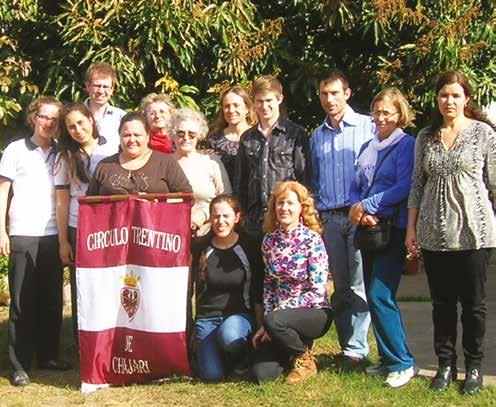
For the 150th anniversary of emigration to Argentina, two events are already on the drawing board for South America: one in April at the Chajarí Circle in the province of Entre Ríos, landing place of the first Trentino emigrants in 1876, and another one in October, marking the official date of the start of emigration to the country. But the Association will also commemorate this important chapter of local emigration history back in Trentino.
The event we are already working on, to be held on 9 May at the Vezzano theatre in Valle dei Laghi,
is a concert of chamamé, the traditional music of northeastern Argentina, and will feature two internationally renowned guitarists: the Argentinean Facundo Rodriguez (a descendant of Trentino emigrants from Levico) and the Brazilian Yamandu Costa. For this event, Trentini nel Mondo will collaborate with the ArteLaghi Association. In addition to these anniversaries, many other events are planned, such as the Hittona Convention scheduled from 8 to 12 October in Denver, Colorado (USA), the biennial event that brings together
the Trentino Circles of the United States and Canada, now in its 26th edition. Additionally, from 1 to 3 October, as part of its events scheduke, Trentini nel Mondo will organise the international conference “Generazione futuro” (Generation Future) in Lavis, sponsored by Eza (Europäische Zentrum für Arbeitnehmerfragen) and Unaie (Unione Nazionale Associazioni di Immigrazione ed Emigrazione). This traditional autumn event provides an opportunity to reflect on current challenges in the world of work.
The focus this year will be on Generation Z, exploring ways to strengthen the role of younger generations within workers’ organisations.
Two initiatives stand out in particular for their significance to the Association. The first is the three-week “Residential Italian Course in Trentino,” from 2 to 20 March. The twelve participants, all descendants of Trentino emigrants living abroad, were selected through a special application process. The course includes 60 hours of language instruction, two one-day excursions to Trentino, two in-depth workshops per week, and opportunities to participate in professional training activities. Organised in collaboration with Ufte (Union of Trentino Families Abroad), the course is funded by the Autonomous Province of Trento through the Territorial Cohesion, Housing Policies, Enhancement of Trentino’s social capital abroad service.
The second initiative is a training meeting for the eighteen Coordinators of the Association’s Circles, representing Argentina, Australia, the Benelux countries, Brazil, Canada, Chile, Germany, Mexico, Paraguay, the United States, and Uruguay. They will be in Trentino from 6 to 11 July. The role of Coordinator was introduced in the Statute of the Trentini nel Mondo Association during the 2012 annual assembly. It was conceived to facilitate and promote relationships and communication between members, Circles, and the Association, serving as a kind of “antenna” for Trentini nel Mondo in the territories where it operates, capable of receiving and relaying signals from the various social, cultural, and economic conditions of each country.
The busy agenda for 2026 is a continuation of that of the year just past, which was equally “full of
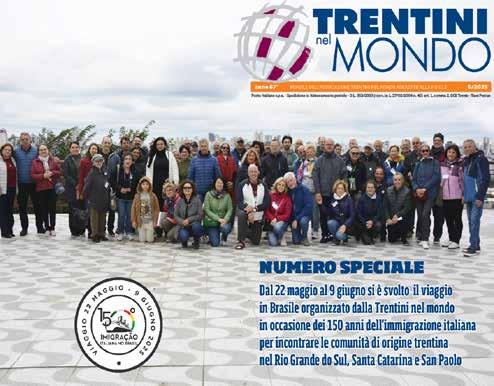
significant appointments”. These began with the 150th anniversary of the great emigration to Brazil, which provided the impetus for Trentini nel Mondo to organise a trip from 22 May to 9 June.
More than thirty participants visited nineteen Trentino Circles in three different states of Brazil (Rio Grande do Sul, Santa Catarina and São Paulo), home to many thriving communities of Trentino descent. The group thus had the opportunity to experience firsthand the enthusiasm and warmth with which descendants of Trentino in Brazil welcome visitors from their ancestral homeland, making them feel instantly among friends — and truly at home.
As reported in the special issue of the Association’s magazine devoted to the trip, the three adjectives most often used by participants to describe it were “exciting, interesting and engaging”. Opinions were collected through a questionnaire, from which thirty-three different adjectives emerged, all positive.
“Exciting” was the top response. Other recurring adjectives were
“instructive, cultural, unforgettable, surprising, formative, educational”. Some deemed it “beautiful, fantastic, intense, spectacular and stunning”. For others it was “fascinating, adventurous, warm, moving, enlightening, informative, memorable, reminiscent, revealing, meaningful”. The meetings with the Circles undoubtedly prompted the choice of adjectives such as “cheerful, friendly, shared, nostalgic, supportive”.
The questionnaire also asked respondents to indicate the most exciting moment or event. The answer that summarises all those offered was: “every encounter with people in every single place”. Some participants highlighted particular moments: the planting of the Root Forest on 10 June in Nova Trento; the flag-raising ceremony on 2 June in Blumenau; the performance by Italian folk groups in Florianópolis; and “the “Emigrant’s Hymn” beautifully sung by the Stella Alpina Choir in the church of St Olympia, whose chorus recalled the lost dream of one day returning to Romagnano.
The voice of Maria Dolens
THE OLYMPIC TRUCE BETWEEN MYTH AND REALITY
An unheeded appeal
The Olympics are rooted in an interweaving of religion, myth and cultural identity that goes back to ancient Greece. Originating in Olympia in 776 B.C., the athletic contests were not only sporting competitions but solemn rites dedicated to Zeus, the ruler of the gods. In the Peloponnesian sanctuary, at the foot of the great temple that housed the celebrated statue sculpted by Phidias, athletes and spectators gathered in a spirit of shared devotion. The link with Olympus, the mountain believed to be the abode of the gods, was not geographical but symbolic. The Games paid homage to the Olympic deities and embodied the idea
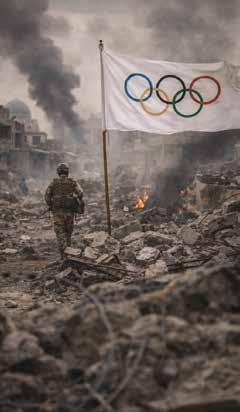
that human athletic excellence was exercised under the watchful gaze of the divine, poised between rivalry and the sacred. This alone would be enough to mark the distance between the Greeks’ idea of competition and that of our time. Of course the Olympics are not the Champions League or the NBA where sport has largely become entertainment and competition allows no room for sacredness. Yet even under the banner of the five-ringed flag, the intertwining of religion, myth, and identity no longer seems to hold sway. However, it would be a mistake to indulge in nostalgia for the “good old days” by repeating that wars were suspended to allow the Games to take place, for that, in fact, never happened.
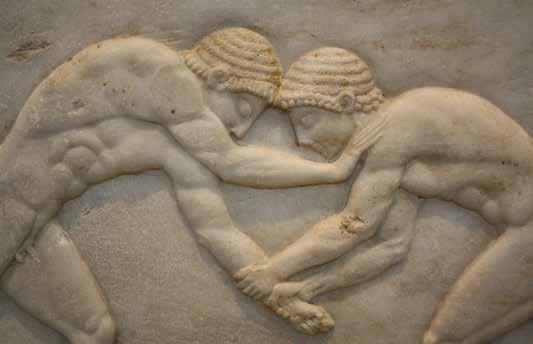
The Olympic Truce certainly existed, an ancient principle that has spanned the centuries to become a symbolic instrument of Peace in international relations. But it has never led to the cessation of large-scale conflicts. The tradition of ekecheiria was closely linked to the holding of the Games of Olympia. The truce was proclaimed before and during the competition to guarantee the safety of the athletes, spectators, and travellers attending the event and then returning to their cities. It never led to the complete cessation of all wars throughout Greece, as is often idealised, but rather to a period during which all public and private enmities had to cease, at least to protect the passage of athletes and fans.
Various sources point out that its actual implementation depended on the goodwill of the city-states. Although it was a recognised principle, there was no strong central power capable of strictly enforcing it, and in at least one case there is historical evidence that it was not observed. It was therefore primarily a religious and civil pass. Sacred heralds would travel to announce the imminence of the Games and, during this period, hostilities were to be suspended to ensure an environment of relative Peace. The truce protected the territory where the competitions were held and safeguarded athletes and their families from attack during their journeys. Its duration varied, both in practice and in time, depending on the logistical requirements needed to allow participants to reach Olympia and return safely to their home cities.
With the revival of the Olympic Games in 1896, the ideal of unity among peoples was rekindled, but the truce was not immediately reinstated as an international practice.
The voice of Maria Dolens
It was only in the 20th century that the ancient concept was formally revived, now with the modern purpose of promoting Peace. In 1992, the International Olympic Committee (IOC) officially invited the states of the world to observe the truce at the Games, reviving the tradition ekecheiria. A key step in this direction was the United Nations General Assembly Resolution 48/11 of October 25, 1993, which formally called on member states to observe the truce from the seventh day before the start of the Olympic Games until the seventh day after the close of the Paralympics. Since then, every two years the General Assembly has reaffirmed the ideal of the truce, often with broad consensus and widespread endorsements, though, as in ancient times, without any means to enforce it.
In subsequent years, institutional initiatives coordinated by the IOC and the UN were launched to give substance to the concept of truce. In 1998, for example, the IOC began displaying the United Nations flag at all Olympic competition sites, and structures were established to promote the suspension of conflict, such as the International Olympic Truce Foundation and the International Olympic Truce Centre.
In the modern world, the significance of the Olympic Truce lies not in imposing a legally binding ceasefire — which a UN resolution cannot achieve — but in conveying a powerful symbolic message of Peace, dialogue, and international cooperation. The goal, as stated by the IOC and the “Glass Palace,” is to mobilise young people in particular around the values of friendship, respect, and solidarity; to use sport as a vehicle for dialogue between conflicting communities; and to create opportunities for reconciliation.
Over the past decades, the Olympic Truce has been repeatedly reaffirmed in international fora, often with broad participation of member states. For instance, in November 2025, the UN General Assembly adopted a resolution on truces ahead of the Milan-Cortina 2026 Winter Games, supported by more than 165 countries. This resolution, consistent with previous appeals, calls for a stop to hostilities during a period of about seven weeks around the Games, urging states to ensure security and unimpeded access to the competitions.
Despite this formal and symbolic consensus, in practice, calls for a truce have not always been respected. For example, during the 2024 Summer Olympics in Paris significant diplomatic campaigns called for compliance with the principle, but certain armed conflicts around the world continued unabated. Similarly, in the 2022 edition, calls for a truce failed to prevent the escalation of the war in Ukraine; indeed, the continued violence was one of the factors that led to the exclusion of Russian and Belarusian athletes from some subsequent competitions.
It is thus clear that while the Olympic Truce is endowed with strong symbolic significance and international support, it remains limited in its effectiveness as a practical instrument for enforcing ceasefires in active conflict zones. Rather, it remains a moral and political appeal that draws attention to the potential of sport as a factor of human cohesion. This appeal, however, appears to clash not only with political interests and military strategies that cannot be oriented by moral exhortation alone.
The Olympic Truce embodies one of the oldest utopias, envisioning sport as a vehicle for ideals of fairness and sportsmanship. Yet nowadays, this vision appears to have been lost, particularly in disciplines where bending or breaking the rules without penalty is sometimes even regarded as a mark of talent. The fact remains that from its modest logistical role played in ancient Greece to its international revival in the 20th century, the Olympic Truce has endured as a symbol of humanity’s aspirations for peace and dialogue among peoples A kind of memento that has too often gone unheeded, even in antiquity.
Those who had chosen to do their civil service at Archivio Disarmo, the Disarmament Archive, did so guided by a deep and conscious idealism. We saw Peace as a clear horizon, almost a moral vision: a means of dialogue, reconciliation, the rejection of war. Yet on the very first day, specialist journals landed in my hands, dense with discussions of weapons systems, technical specifications, production costs and military budgets. Detailed dossiers explained how certain armaments were built, how heavily they burdened public finances, which industries produced them and how those same factories could be converted back to civilian use. It was an unexpected rejection. Not a betrayal of the ideal, but its first test.
In those Roman rooms of the institute founded in 1982, Peace was not evoked as a consoling word. It was approached as a field of study. Understanding the dynamics of conflict, analysing the economics of defence, learning about the arms trade: this was where we needed to begin. Idealism thus met realism — not to diminish it, but to strengthen it, to give it weight and credibility. It was not enough to say “no” to war; we had to know what we were talking about.
One of the figures who left a lasting mark on that experience was Senator Luigi Anderlini, one of the founders of Archivio Disarmo. Elegant in manner, amused by the naive enthusiasm of young volunteers yet with unwavering methodological rigour, Anderlini insisted on one thing: knowledge is an indispensable condition for Peace. Not a slogan, but an operational criterion. Under his guidance, the institute began building a specialised library, developed the Tabular Information System -- later known as the “IRIAD Review” -- and produced research reports that would go on to nourish public debate.
Days were spent analysing military expenditure, studying international missions, and examining arms control policies. It soon became clear that behind every conflict lie economic dynamics, strategic interests, and complex geopolitical balances. And that speaking of industrial reconversion was not an abstract utopia, but a concrete challenge.
Peace was not just a feeling, but an analytical and operational category. It required expertise. It called for dialogue with universities and institutions. It demanded international comparison. Over the years, Archivio Disar-
mo has collaborated with research centres in Italy and abroad, offering studies also used by public agencies, helping to train generations of students and young researchers through internships, placements and Universal Civil Service.
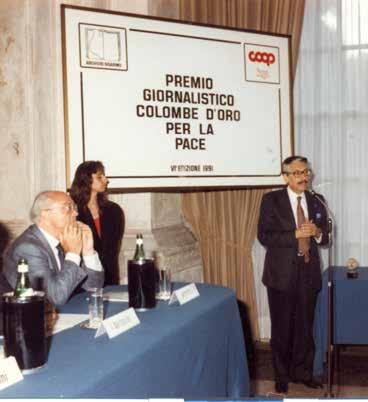
An essential chapter of its activity has been and is the Golden Doves for Peace journalism award, established in 1986. On those occasions, the link between information and civil responsibility became tangible. When, in 1991, Igor Man, columnists of La Stampa, received the award, it became clear that narrating conflict with competence was already a step towards freeing it from distortion.
Years later, the memory of that first impact with technical journals retains a symbolic strength. The idealist who had entered imagining Peace as an almost disembodied idea, left with the realisation that every ideal, in order to endure, must accept the test of reality. Peace, then, becomes a cultural project, a civic responsibility, a daily exercise in knowledge. A path where ideals are not abandoned, but upheld sustained by the rigour of reality. The very spirit embodied by the Campana dei Caduti.