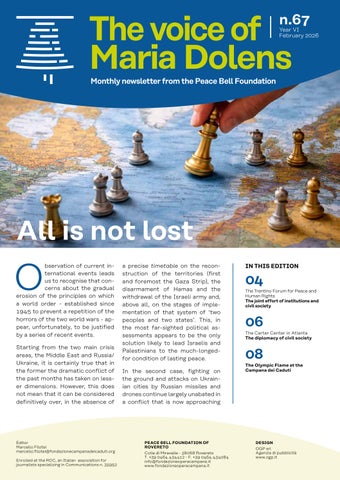
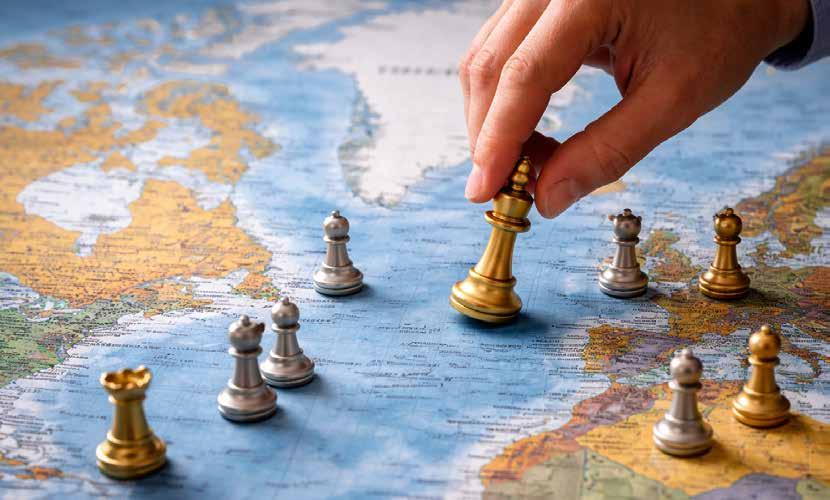
Observation of current international events leads us to recognise that concerns about the gradual erosion of the principles on which a world order - established since 1945 to prevent a repetition of the horrors of the two world wars - appear, unfortunately, to be justified by a series of recent events.
Starting from the two main crisis areas, the Middle East and Russia/ Ukraine, it is certainly true that in the former the dramatic conflict of the past months has taken on lesser dimensions. However, this does not mean that it can be considered definitively over, in the absence of
a precise timetable on the reconstruction of the territories (first and foremost the Gaza Strip), the disarmament of Hamas and the withdrawal of the Israeli army and, above all, on the stages of implementation of that system of ‘two peoples and two states’. This, in the most far-sighted political assessments appears to be the only solution likely to lead Israelis and Palestinians to the much-longedfor condition of lasting peace.
In the second case, fighting on the ground and attacks on Ukrainian cities by Russian missiles and drones continue largely unabated in a conflict that is now approaching
The Trentino Forum for Peace and Human Rights
joint effort of
The Carter Center in Atlanta
diplomacy of civil society
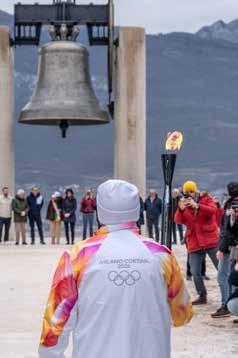
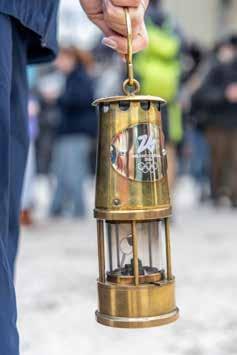
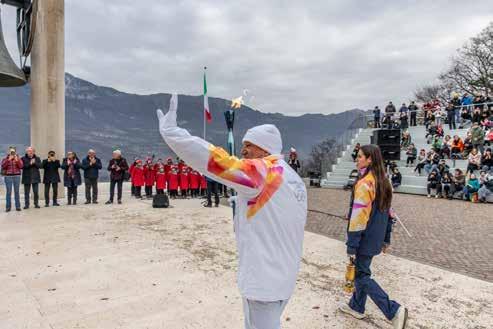
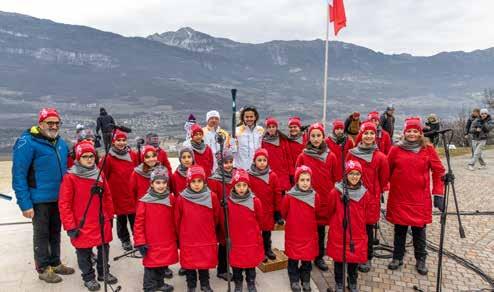
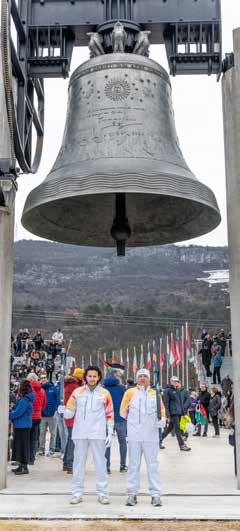
The Olympic Flame at the Campana dei Caduti
its fifth year—a period longer, by way of comparison, than the war between Nazi Germany and the then Soviet Union, which lasted from 1941 to 1945.
The efforts of the international community, with the active (though often discordant) participation of the United States and the European countries, united in the so-called “coalition of the willing,” are particularly focused on addressing what are likely the two most challenging aspects of the post-conflict architecture. These issues concern, on the one hand, the identification of Ukrainian “regions” that might be assigned to the Russian Federation under a future negotiated arrangement and, on the other, the security guarantees to be extended to Kyiv in order to prevent future territorial or other claims by Moscow against its neighbour. Although the channels of dialogue between President Putin’s negotiators and their ‘Western’ counterparts remain open - a factor, the latter, certainly positive and important - the road ahead still appears long and strewn with obstacles.
By further broadening the scope of analysis, many of those conflicts that could be described as “regional in nature” remain unresolved. These have been included by the relevant United Nations agencies in a long list comprising around fifty distinct crisis areas. For some of them (such as, for example, the China-Pakistan dispute), any “local” label is in fact far too restrictive, giv-
en the obviously much broader geopolitical implications involved. The list would, of course, be incomplete without Iran, where the situation resembles a powder keg ready to explode, underscoring the severity of the ongoing clashes between anti-government protesters and the Ayatollah regime’s repressive police forces. If, as some sources suggest, “external actors” were compelled to intervene in turn, we would be confronted with an escalation that would be difficult to contain.
For some weeks now, following the U.S. military intervention, Venezuela has also become one of the most acute crisis cases. The events of 3 January, culminating in what some have described as the “kidnapping” of President Maduro and his forcible transfer to Washington to face narco -terrorism charges in a US court, have been interpreted in widely varying (and, inevitably, highly contested) ways by governments, political analysts and the global media. From our perspective, in commenting briefly on the Stars and Stripes military “blitz,” we express deep concern over the persistent erosion of core inter-state principles (sovereignty, inviolable borders, and non-interference in internal affairs), upheld since the Second World War.
In fact, the inevitable corollary of such arbitrary power - the dominance of the strongest - appears destined, unfortunately, to solidify in international relations: the explicit triumph of arms over diplomacy, a
scenario the founders of the United Nations sought to prevent at all costs through the creation of a multilateral system centred on the “Glass Palace”. Aligned with the United States, their withdrawal during President Trump’s second term from 66 international organisations - including half linked to the United Nations - stands out as particularly emblematic.
I am, however, of the opinion that the discouraging analysis conducted so far should not prevent us from recognising the emergence (or confirmation of the existence) of some ‘light’ on the international scene, demonstrating that democracies, when grounded in solid principles of credibility and cooperation, can generate effective “antibodies” against the rise of illiberal and anti-democratic threats.
In this spirit, I would like to briefly highlight the ‘virtuous behaviour’ in which some members of the community of states distinguished themselves during 2025, deliberately excluding from this ranking the members of the European Union.
I would certainly include Canada in this list, given its success in resisting the various pressures exerted by its powerful southern neighbour, without resorting to provocations or populist responses, thanks in part to the efforts of its new Prime Minister, Mark Carney. I would also highlight Moldova, whose citizens have rejected the enticements of more nationalist political forces, opting in recent elections for a path of closer
alignment with Europe. A special mention also goes to South Korea. One year ago it was threatened by an authoritarian president with repressive measures such as the imposition of martial law and the closure of parliament, and now, thanks to the massive mobilisation of its population, it is fully back on the democratic path. South America offers the example of Brazil, a country that has in turn been able to ensure respect for the results of the ballot box, distancing itself from attempts to subvert the established order, and also implementing an effective policy to defend the Amazon forest. Still on the same continent and limited to the economic realm, Argentina merits recognition for sharply reducing inflation (211% → 30%), cutting poverty by 21 points in 2024, and advancing a well-established path of economic liberalisation.
The hope, which I believe is widely shared, is that over the course of 2026 additional countries, including those from regions with higher risk profiles, may justifiably aspire to be added to this list. According to qualified observers, Syria could be a potential new entrant. Following the removal of Bashar al-Assad, it has demonstrated over the past year tangible signs of cooperation with the United States, Europe, and its regional neighbours. An approach that will hopefully set a positive precedent for others.
Reggente Marco Marsilli, Foundation President
THE TRENTINO FORUM FOR PEACE AND HUMAN RIGHTS
The joint effort of institutions and civil society
In this issue, we begin a collaboration with the Trentino Forum for Peace and Human Rights, an organisation dedicated to defending and promoting the same values represented by Maria Dolens. For this first article, we asked the president, Antonio Trombetta, to introduce us to the Forum’s activities.
The Trentino Forum for Peace and Human Rights (more simply ‘ForumPace’) is a body of the Provincial Council, established by Provincial Law No. 11 of 1991, named: “Promotion and dissemination of the culture of Peace’.
With this law, the Autonomous Province of Trento - in keeping with the constitutional principles that sanction the repudiation of war as a means of settling international disputes, the promotion of human rights, democratic freedoms and international cooperation - recognises Peace as a fundamental right of human beings and peoples and decides to commit itself to it.
It is a unique institution in Italy, distinguished by its effort to bring civil society and the Province’s political institutions together, fostering dialogue and collaboration between them. The assembly of ForumPace, the organisation’s key governing body, is composed of associations engaged in local initiatives related to human rights, international cooperation and development, non-violent civil defence, Peace, disarmament, and civil service. Joining them are the highest institutional officials: the Presidents of the Province and Provincial Council, along with three provincial councillors. Municipalities and research and training institutions are also represented (the Trentino Historical Museum Founda-
tion, the Italian War History Museum, the University of Trento) . A prominent place among these is held by the Campana dei Caduti Foundation from Rovereto.
This collaboration between civil society and institutional body is reflected in several of the Forum’s legally assigned objectives, including: formulating proposals and providing advice to the Council on promoting or participating in peace initiatives; encouraging the inclusion of peace and human rights studies in school curricula and supporting the creation of teaching and audiovisual materials on these topics for all levels of education; and promoting the establishment of scholarships for research conducted by students from schools of all levels and from the University of Trento on issues related to Peace and human rights. Finally, ForumPace can make proposals to the Provincial Council in relation to planning instruments.
The assembly elects the Peace and Human Rights Council, which supports the president in the planning and management of activities, such as the realisation of initiatives and events of particular interest for the culture of Peace, solidarity between peoples and human rights.
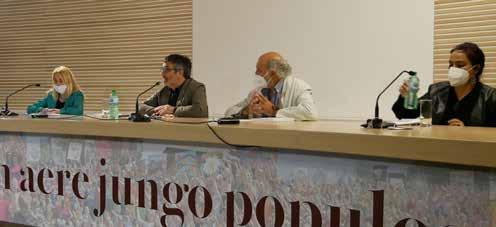
From left to right: Barbara Gallo, specialised journalist and collaborator of IRIAD - Archivio Disarmo, Massimiliano Pilati, former president of the Trentino Forum for Peace and Human Rights, Emanuele Giordana, journalist, president of Afgana and editorial director of the portal atlanteguerre. it, and Tehseen Nisar, collaborator of the South Asian Democratic Forum during the event entitled “Twenty years later, twenty years back?” held on 11 September 2021 at Campana dei Caduti
The operational structure provided by ForumPace is very simple: it consists of a coordinator/trainer and an administrative employee. It currently relies on the support of a communications volunteer, along with several young people taking part in civil service and university placement programmes.
The small staff and limited budget made available for activities are not a significant obstacle, as ForumPace’s role is not to act independently, but to stimulate, support, and accompany the efforts of those already engaged in Peace and human rights initiatives. It could be described as an enabler of potential and resources, aiming to build on existing efforts and to foster synergies and collaboration.
This is not to say that ForumPace is not mainly committed on two fronts: communication and promotion and training and awareness-raising. It performs countless interventions in schools of all levels: from primary to high school. It should be noted that awareness and engagement within schools are high, and the Forum’s presence is increasingly in demand.
Regarding communication, the official website (https://forumPace. consiglio.provincia.tn.it) is regularly updated and the Forum has a constant presence on social media, es-
pecially Instagram. As a house organ, a monthly newsletter is produced for member entities.
Awareness is also being raised among the wider public through newspaper articles. Young people are clearly at the forefront of ForumPace’s attention, with many meetings dedicated to them, primarily held in the province’s suburban areas. The focus on the more peripheral areas of the province remains particularly strong.
An important initiative that began following last year’s municipal elections is the creation of a network to foster connections and the exchange of best practices with local administrators. Some 30 municipalities are being assisted to carry out awareness-raising actions in their territories. Since the start of the 2023 legislature, whose
composition is completely renewed each time the Provincial Council changes, a decision was made to involve the various associations directly through 6 thematic areas: the culture of Peace, with a special focus on language, rights and discrimination (working for substantive equality), new citizenships (addressing the needs of migrants and other emerging communities), Peace and disarmament (exploring ways to manage and resolve conflicts non-violently from the perspective of international cooperation), participation, school and community (focused on building inclusive and collaborative communities), sustainability and climate justice (tackling climate change through an equity-focused approach).
At the national level, ForumPace is a member of the Italian Peace and Disarmament Network and from time to time supports the campaigns launched on the relevant issues.
The times we are living in are certainly not favourable to Peace, perhaps even less so than when it was founded 35 years ago. This is the challenge that ForumPace embraces every day, seeking to serve as a unifying force for its member associations and for the institutions. The Campana dei Caduti Foundation itself is a privileged interlocutor for dialogue and action in favour of Peace.
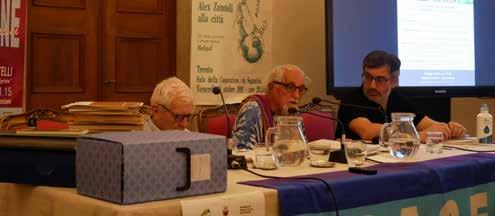
From left to right Don Mario Costalunga, co-founder of “Blessed are the builders of peace”, Father Alex Zanotelli and Massimiliano Pilati, former president of the Trentino Forum for Peace and Human Rights, during the meeting “Like so many signposts: through the archives of key figures, the historical journey of the pacifist ideal and commitment”, held on 13/7/2023
THE CARTER CENTER IN ATLANTA
The diplomacy of civil society
At times, searching the web for organisations that work based on the same principles that inspire the Campana dei Caduti Foundation leads to fruitful discoveries. There are in fact realities in the world that organise their activities on the basis of a principle that is still not very popular, that of understanding Peace not as an abstract declaration, but as a daily, measurable, verifiable practice.
When former US President Jimmy Carter founded the Carter Center with his wife Rosalynn in Atlanta in 1982, they did so guided by this conviction. James Earl Carter Jr., known as Jimmy, had just lost the election for a second term in the White House to Ronald Reagan and, as those who have held high office often do, he set to work with more freedom of movement, and less power, on principles that were close to his heart. Regardless of our political view of his performance as president, today it is interesting to examine the structure and results of the Peace Programs initiated by the Carter Center, which, as documented on the organisation’s official website, provide a comprehensive example of non-governmental intervention in conflict prevention and political stabilisation. The centre’s action is based on a clear premise that is constantly reiterated in its documents: lasting peace can-
not exist without rights, political participation and the rule of law. Thus, since its inception, the Carter Center has chosen to work in contexts marked by fragile transitions, institutional crises or unresolved conflicts, developing programmes that weave together election observation, promotion of civil liberties, access to justice and mediation. According to its official materials, the organisation has worked in more than 75 countries, with a significant presence in Africa, the Middle East, Latin America and Asia, adapting its tools to profoundly different political, cultural and social contexts.
One of the historical pillars of the Carter Center’s work is international election observation. Since the 1980s, the organisation has helped to define standards that are now widely accepted, monitoring presidential and parliamentary elections and referendums in countries with political tensions or incomplete democratisation processes. This activity, extensively documented on the centre’s website and in the reports published over the years, goes beyond the technical verification of voting procedures to include assessments of fair access to political competition, media freedom, and citizens’ ability to express themselves without intimidation. More recently, the Carter Center has extended this work to electronic and digital voting systems, working with
the United Nations and other international bodies to develop observation methodologies adapted to new technologies.
Alongside the elections, the centre has increasingly invested in programmes on the rule of law and access to information. The available documentation shows that the Carter Center considers transparency an essential element of conflict prevention: where citizens can access public documents, learn about the decisions of institutions and hold governments to account, the conditions that fuel violence and instability decrease. In several countries, the organisation has supported legislative reforms, trained civil servants and supported civil society organisations committed to defending the right to information.
Another key area of activity focuses on the promotion of human rights, particularly for groups most vulnerable to violence and exclusion.
The Peace Programs include initiatives dedicated to protecting human rights defenders, who are often the
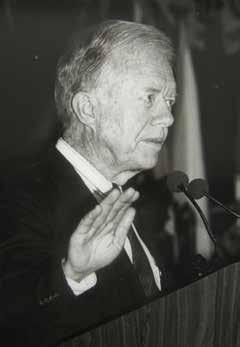
Jimmy Carter during the 1992 Carter Center convention in Las Vegas
target of intimidation or repression, and other aimed at strengthening the role of women and girls in political and social processes. The strategy documents published by the centre emphasise that gender inclusion is not only a matter of equity, but a necessary condition for the stability of post-conflict societies. Inequalities, if ignored, tend to reproduce and re-emerge in the form of new tensions.
In recent years, the Carter Center has openly recognised that the global context in which it operates has changed. The strategic plan of the Peace Programs highlights the increasing prevalence of authoritarian practices, the crisis of confidence in democratic institutions and the impact of disinformation, especially online, on political processes. To meet these challenges, the organisation has forged collaborations with universities and research centres, developing tools for analysing the digital environment and promoting initiatives to counter information manipulation and online hatred, which are considered risk factors for Peace.
A distinguishing feature of the Carter Center, repeatedly referred to in its official materials, is its choice to operate as an independent actor, not tied to governments or specific geopolitical interests. This position allows the organisation to intervene in situations where state diplomacy encounters obvious limitations, offering spaces for informal dialogue or facilitating contacts between conflicting parties. The history of the centre, also reconstructed through encyclopaedic sources and public reports, shows how this ‘civil society diplomacy’ has made it possible to keep channels open even at times of great international tension.
Another consistent feature of the Carter Center’s approach is collaboration with local partners. The strategic documents insist on the need to strengthen competencies and capacities already present in the countries
where the Center operates, avoiding top-down interventions. The stated objective is to build sustainable processes that endure beyond the conclusion of international missions, equipping communities with practical tools to manage conflicts, monitor institutions, and defend their rights.
All in all, the activity of the Carter Center’s Peace Programs paints a picture of an organisation that has deliberately stepped out of the spotlight, prioritising continuity and the careful assessment of results. In the vision conveyed by the official documents, Peace is neither a spectacular event nor a one-off agreement, but a gradual process built on rules, participation, and trust. In an international system marked by recurring crises and growing scepticism towards multilateral institutions, the Carter Center continues to propose a practice of Peace based on data, observation and rights, claiming the role of civil society as a political actor in its own right. Just as on the Colle di Miravalle (Miravalle Hill), work is being done every day to ensure that nothing is taken for granted in the construction of a peaceful, or at least less conflictual, future.
La Voce di Maria Dolens
The Olympic Flame at the Campana dei Caduti
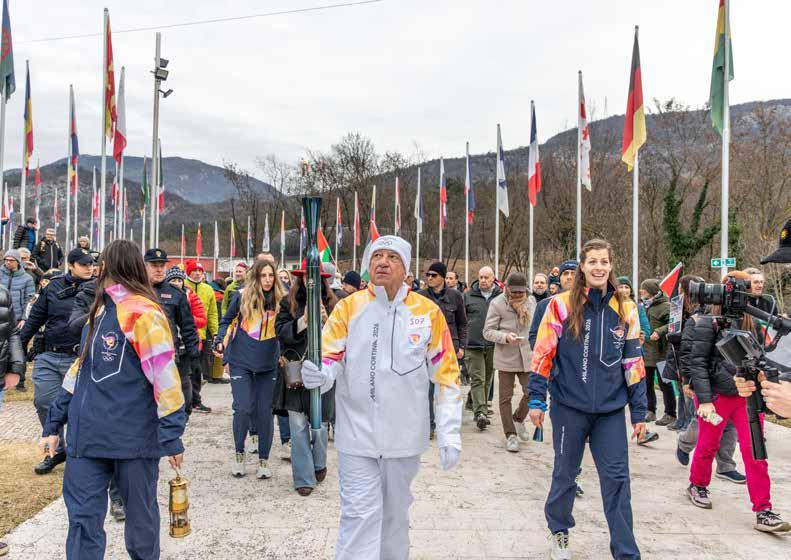
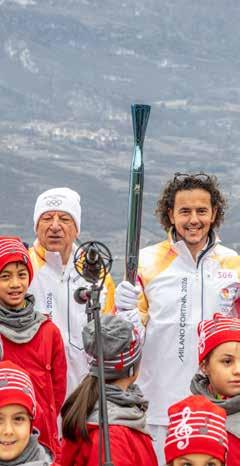
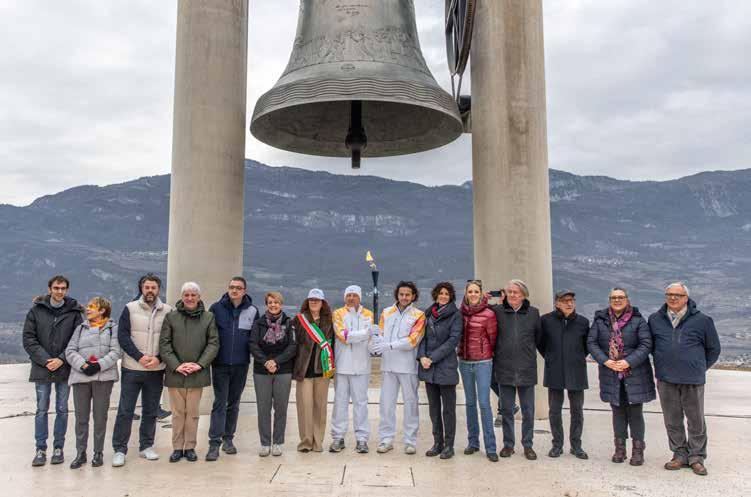
On 18 January, the Olympic Flame reached a place that is a symbol of Peace: the Campana dei Caduti in Rovereto, which has been calling the world to respect the values of reconciliation and solidarity between peoples for over a century.
The President of the Foundation, Marco Marsilli, in the role of torchbearer, crossed the Viale delle Bandiere with the torch to symbolise the need for Peace and respect for Human Rights of all peoples of the world. On his arrival in the Amphitheatre that hosts Maria Dolens, he was met by the President of the Autonomous Prov-
ince of Trento Maurizio Fugatti, the President of the Provincial Council Claudio Soini, the Councillor for Education, Culture, Youth and Equal Opportunities Francesca Gerosa, and the Mayor of Rovereto Giulia Robol, together with civil and military authorities and a crowd of citizens eager to witness an unprecedented event on the Colle di Miravalle (Miravalle Hill).
The arrival of the Flame was accompanied by the voices of the Rovereto Minicoro, who performed the Olympic anthem before over a thousand people in the packed stands of the Amphitheatre.