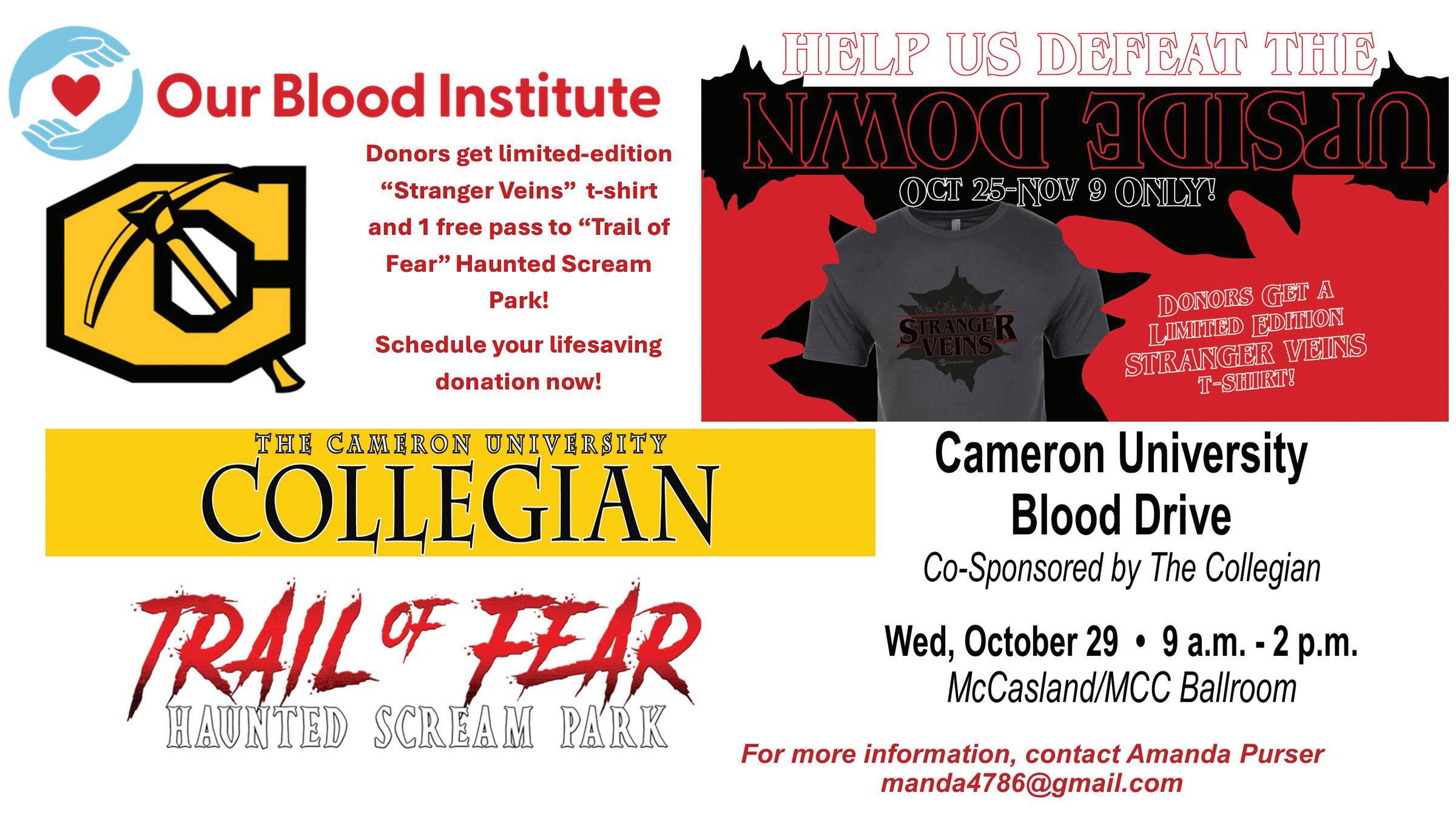
From 9 a.m. to 2 p.m. on Wednesday, Oct. 29, the Cameron Collegian will host an Our Blood Institute (OBI) blood drive, in the McCasland Ballroom of the McMahon Centennial Complex (MCC).
Who is eligible to donate blood?
In general, anyone aged 17, weighing at least 125 pounds, or those over 18-years-old and weighing at least 110 pounds can donate.
If you have recently gotten a tattoo or piercing you are still eligible to donate, as long as it was performed at a licensed facility.
You can give whole blood every 56 days, so those who successfully donated in the last CU drive, hosted by the Wellness Center on Aug. 25 are able to donate in this drive, as it will be 65 days later.
Don’t worry, you do not need to know your blood type, but if you do know and you happen to be O positive or O negative, your blood is vitally important, and you are highly encouraged to donate as often as possible.
For up-to-date information and specific questions regarding many medical conditions and possible deferrals, please visit obi.org.
Who is eligible to donate platelets?
Similarly to blood donation, the ideal platelet donor should be healthy, 18 years or older, and weigh at least 110 pounds.
In addition, those who have never been pregnant nor taken aspirin within 48 hours of platelet retrieval are preferred. Also, blood types of A positive, B positive, AB positive or AB negative are perfect candidates.
What are the procedures that a donor can expect?
There is a qualification process that involves a brief medical screening and finger prick to test your hemoglobin levels, which will ensure you meet all requirements and that your iron levels are within a
healthy range to support a donation.
When you are deemed eligible, you will be sent to one of the skilled phlebotomists to draw your blood or prepare you for your platelet retrieval.
The entire process from screening to complete donation takes about 20 minutes for whole blood — platelets take a bit longer, sometimes up to one hour.
If you are deferred for any reason, you may be eligible to donate as soon as one day later.
Deferrals should follow-up with the Lawton Donor Center (Call: 580-350-6100 or visit: 211 SW A. Ave.) for a future appointment and your next donation opportunity or visit the OBI website to find another drive near you.
Why should I donate blood?
Every two seconds, someone in the United States needs blood and there is currently no medical substitute for this life-saving product. More than 1,200 donations are needed daily to support local hospitals. One donation (one pint) can save up to three lives, and only about ten percent of eligible donors actively give blood, so the need is always present.
What will my blood be used for?
This drive will be fully set-up to support whole blood or platelet donations. Each of those successful donations will help support local hospitals and medical facilities to care for patients in need.
The medical requirements range from cancer treatment, blood loss during childbirth or surgical complications, to traumas like car accidents or gunshot wounds, to name a few.
Where will my blood go?
After rigorous testing to ensure your blood is safe and healthy, it will be promptly transported to one of the 244 local hospitals and medical facilities that OBI supports, across Oklahoma, Texas and Arkansas.
What will I get for my donation?
Aside from saving lives, contributing to your community and a rewarding sense of pride from your selfless gesture, successful donors also receive free
goodies. The Collegian drive will feature a special limited-edition “Stranger Veins” T-Shirt and a ticket to the Trail of Fear Scream Park.
Every donor is treated to free snacks and drinks in the canteen area while they are observed for a few minutes after, to ensure they aren’t experiencing any symptoms like being light-headed or dizzy.
What does my blood type represent?
Each person's blood type is determined by the unique combination of antigens and Rh factors contained within your blood.
Antigens are proteins or sugars that help your immune system recognize your own cells-mainly defined as “A” or “B.”
Rh factors are another protein from your red blood cells, when present they make your type positive, if Rh factors aren’t present your type is negative.
These differences are typically arranged into one of eight primary blood types and understanding yours is important.
Many have heard that O positive is the most common blood type, found in nearly 40 percent of the U.S. population. It is recommended that these personnel give whole blood as often as possible (every 56 days) and be sure to ask about the option of “power red” donation when available to double your donation potential, and provide your body with rehydration in the process.
While O negative blood is rarer, this incredibly versatile type is known as the “universal donor” since it can be transfused to any patient, regardless of their own blood type. For this reason, keeping ample supply available is crucial to life-saving efforts and O neg. donors are highly encouraged.
Please make an appointment to ensure your time slot is reserved, to receive reminders and get access to Donor Express which will expedite your process. Appointments can be made by scanning the QR code here!
We hope to CU at this blood drive, and the Collegian looks forward to setting new goals and breaking donor records with the support of each Aggie available and willing to help.
For more information, contact Amanda Purser at ap124198@cameron.edu.
Cameron University Zine
Makayla Flenoury News Editor
In August 2024 “Cameron University in Color” “(CU in Color)” was born. “CU in Color” is a new creative magazine under the Writers Studio for students to share their voices and creative expression.
The idea of “CU in Color” was formed by Ciera Terry, Eden Lozano, and Maliah Eleanor Choi Davis after Scissortail, an annual writing convention. The three noticed there was a vast distinction between them and other attendees in terms of appearance.
The President of CU in Color Ciera Terry wished for a way for others to feel more comfortable expressing themselves.
“I just simply wish that there was a space where people of color’s voices are not only highlighted but prioritized.”
The three students discussed how they could make the change and create a community for people of color, thus “CU in Color” was formed.
The focus of “CU in Color” is to create a safe space and bring back the idea of third spaces where people can go and enjoy themselves with a community.
“I really just want to have a space where it pretty much feels like community-driven and communityfocused, and I think we do that for each other,” Terry said. “We’ve wanted outside people to submit, but honestly, just recruiting people and having the small team we have feels just as good. It helps all of us feel not so alone in the chaos of everything.”
“CU in Color” experienced challenges when it came to the club’s requirements.
This pushback prevented the students from publishing and stunted their ability to share their creativity.
This did not stop the students from working through the negativity and creating their space.
“It definitely made the motivation for creating a lot stronger,” Terry said. “There’s no way that we’re not going to be doing something.”
“CU In Color” overcame their challenge, and they’ve been able to grow in both size and as a community
“It grows a little more each semester. When it first started, I was a little scared because of the slow pace of some things,” Terry said. “It definitely felt like I wasn’t really providing anything or really providing much of a space for anybody, up until this year. I’ve seen the efforts of what everyone has put forth and seen it grow.”
“CU in Color” has gained three new members since starting, and for a small team, it has made a big impact.
One of the new members, Elizabeth Lehman, joined this semester, and she has felt the impact.
“I have enjoyed getting to share my voice and just enjoying the little community there,” she said. “I think it’s beneficial to me because I do want to go into editorial work.”
Lehman would
encourage others to join and experience the community “CU in Color” has to offer.
“It’s a judgment-free space. It’s a creative space. We can just push out your work in the raw form,” she said. “I feel like the way other people’s contributions are really raw and vulnerable lets other people explore that side of themselves.”
Though “CU in Color” is meant to be a space for people of color, it does not discriminate against anyone who wants to join.
“CU in Color” accepts more than just literary work. Photography, art and any creative medium is welcome.
The zine can be found on Issuu.com under Ciera Terry.
If you are interested in joining CU in Color, contact Ciera Terry at ct960847@ cameron.
edu or attend the meeting at 2:45 p.m. Monday and Friday in Nance Boyer 2060.
PEEK INSIDE THE ZINE
There are plenty of people in the world that are skeptics when it comes to the paranormal — I am not one of them. In my experience, scary incidents happen quite frequently to me. Around the age of eight, I had one of my first paranormal run — ins.
My stepfather at the time had been hospitalized, and I’d been staying in the hospital with him. The one device I had to keep me entertained was a Nintendo DS. I would frequently take pictures of myself and the hospital room. At some point when it was time for me to go back home, I’d find myself going through the images that I had taken from my small time there, and in one of the photos I had taken I found something odd. A person stood behind me. The person was young, maybe a couple years older than I was and very fairskinned. I remember as a kid, thinking
that she looked really sick. She didn’t have any hair and the only thing she wore was a hospital gown. She stood there staring right into the camera. I had never left the door open, and I do not recall ever interacting with another human being in that room, other than my stepdad. I immediately started crying and showed my mom the picture and while she was preaching about how we could get famous and how we should submit it to a famous ghost program.
I was petrified.
Later that day, I used a special feature on the DS to warp the image and destroy the photo. Another one of my paranormal experiences happened to me in my childhood home. My sister and I both woke up to get a midnight snack from the kitchen. Neither of us thought anything of it as we both got up and slowly walked down the hallway toward the kitchen.
dark used to scare me. Just as we were about to enter the kitchen, we both heard a noise. It had sounded like a snore, so we both stopped and looked at each other and decided it would be best if we just peaked our head around the corner.
We thought maybe one of our other siblings had gotten up or one of our family members was awake. We both didn’t want to get in trouble, so we both slowly peeked our heads around the corner.
The first thing that I remember seeing was somebody standing over our aunt on the couch. And not just anyone, it was somebody small, somebody young.
hid underneath the covers for the rest of the night.
The following morning, when we asked our aunt if she remembered anything weird, she recalled having sleep paralysis and feeling like there was something pressing against her chest.
This wouldn’t be the first time I found myself witnessing the paranormal, and it wouldn’t be the last either.
When I was about 14, we had to move into a new house. It wasn’t far from where we originally were.
A fresh start some would say; however, not long after we moved in, weird things started happening again.
We only lived in the house for about two or three months at this point before everyone in my family started to experience peculiar things.
There was nobody in the house who was younger than me and there were no family friends over either. As we peeked over the corner, baffled by what we were witnessing, the small child looked over at us and laughed.
I forced her to go ahead of me as the
My sib - ling and I both ran back into our room and then
We would all constantly hear knocking on doors and windows, but when we would open the doors or check behind the curtain, no one would be there.
It started off small, maybe happening
only once every couple of days or every couple of weeks, but it reached its peak when it started happening at least maybe 10 times a day.
At some point, my aunt was tired of it and waited by the door to hear the knock again, as she genuinely thought that there was somebody outside who was playing a prank on us, but as soon as the knock happened, she pulled the door open, and still nobody was there.
For peace of mind, I ended up spreading sage around the house and just informed any ghosts within the house that I meant no harm — only then did the knocks finally stop.
These aren’t all my scary ghost stories, but they’re the ones I remember the most.
Skeptics could say that these are all made up and explanations could be provided for all of them, but who knows?
The one thing about the paranormal is that no matter how much it’s disproven, something can always happen to change a person’s mind.
History of halloween
The haunting tales of youth History of Halloween
Oct. 31 marks Halloween, a holiday staple for the fall season. A day for costumes, candy, monsters, and more. The Halloween collective screams in delight, but do they know the origins of this frightful night?
Halloween originated from the Celtic festival of Samhain. Oct.31 to Nov. 1, the ancient pagans celebrated Samhain to bring in the harvest and welcome the dark half of the year. The festival was the most important of the quarterly fire festivals since it was held during the midpoint of the fall equinox and winter solstice.
Participants would celebrate with communal bonfires, a huge feast and sacrificed cattle. They would join the Druid priest to light the fires with wheels that caused friction. The wheel represented the sun, and they prayed.
The Pagan community was required to show themselves to local kings and celebrate for all three days and three nights. If someone failed to participate, they would receive a punishment from the gods.
Celebrants believed the barrier between the physical world and the spirit world would be unveiled,
leaving the physical world open for fairies, spirits and ancestors. The Pagans would leave out offerings and dress up as animals or monsters so the spirits would not kidnap them.
The festival progressed with the times and became more individualistic. Bonfires known as “Samghnagans” were personal between families to protect the families from fairies and witches. Families would carve turnips into what we know as Jack-O-Lanterns; this later changed to carving pumpkins.
Christianity started to gain traction in Pagan communities. The priests attempted to reframe Samhain as a Christian celebration.
In the 5th century, Pope Boniface wanted the celebration to be on May. 13 and said it was a celebration of saints and martyrs.
People did not stop celebrating the festival on Oct. 31 to Nov. 1. The tradition still lived strong, so the Popes adapted. In the 9th century, Pope Gregory declared Nov. 1 All Saints’ Day and Nov. 2 All Souls’ Day.
All Saints’ Day marks a day of feasts to observe the lives of saints and remind the people how they are supposed to live. All Souls’ Day is
a day of prayer for those who have passed on.
The creation of each holiday did not erase pagan traditions. Many celebrate using old pagan methods, especially Halloween. Oct. 31 eventually became known as Hallows Eve, or Halloween, and contained pagan traditions along with Irish traditions.
Trick-or-treating, a popular Halloween tradition started as mumming. In Scotland and Ireland people would dress up and perform outside of homes for food or drinks. This tradition continued throughout the centuries and developed into souling. Poor families would visit wealthier homes and receive soul cakes in exchange for a promise of prayer. Souling was soon adopted by children who would ask for gifts, food, money or even ale. This developed into guiding and rather than promising prayer, they would sing songs and tell a poem or perform a trick.
Modern Halloween is celebrated with costumes, parties, trick or treating, haunted houses, and more. The fall season and Halloween have mixed. Whether fall is for scary
movies and ghostly stories or picnics and pumpkin painting, there is a bit of knowledge of where it originated, and
Ciera Terry Voices Editor
Makayla Flenoury News Editor
Graphics by Ciera Terry
Student Government Association Aggie Recap: Meetings 1 - 4
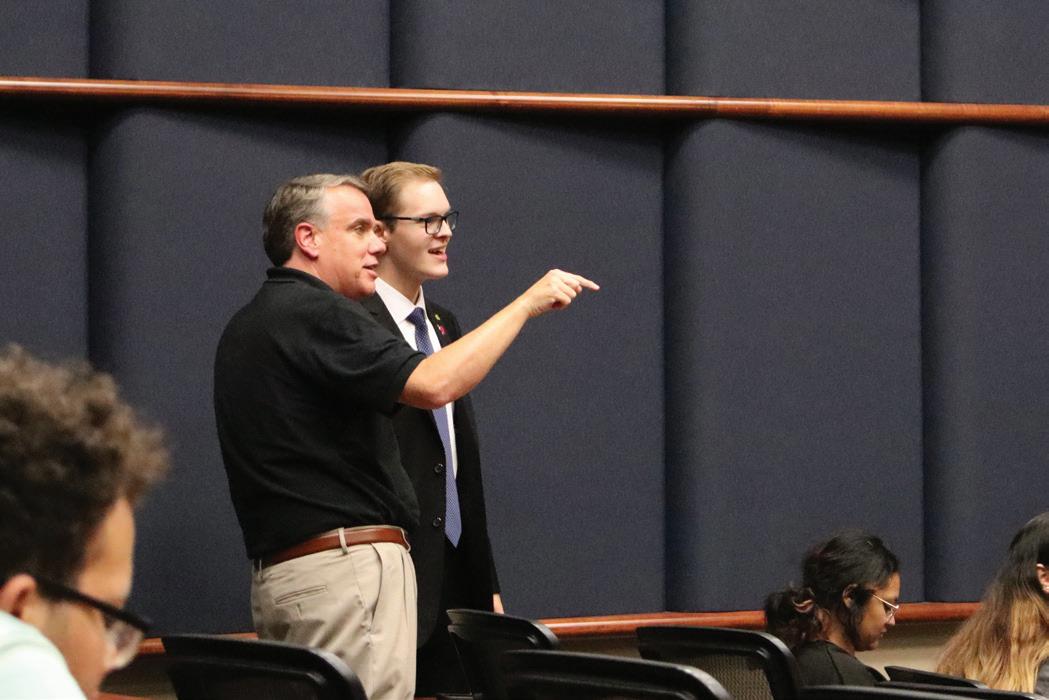
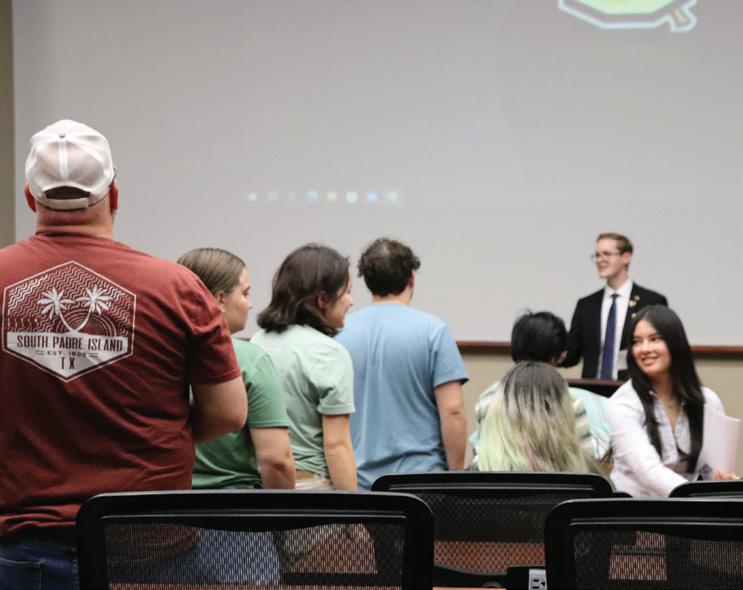
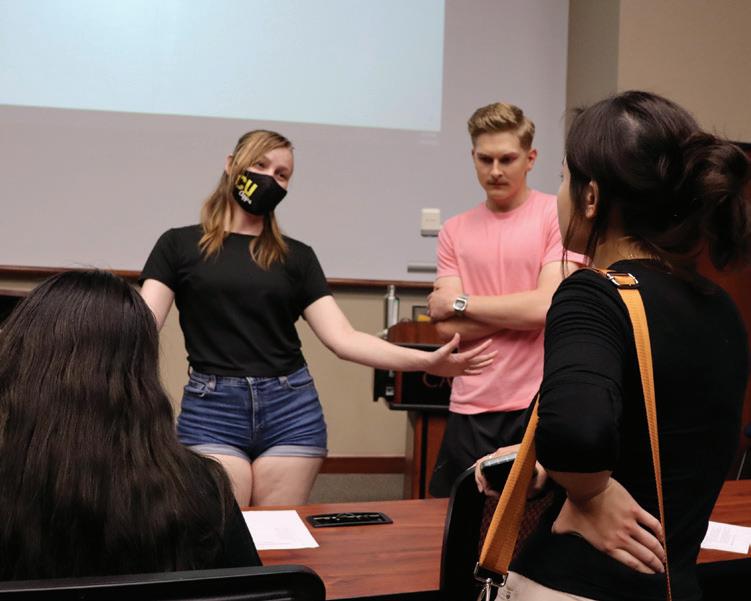
Cameron University’s Student Government Association (SGA) meets at 5:15 p.m. every Monday in Ross Hall’s Johnson Auditorium. Since the start of the semester, SGA has focused on amplifying student voices and making steady progress toward that goal.
Meeting 1: Sept. 15
SGA opened the semester with student leader introductions, its first proclamation signing of the year and the first of many guest speakers.
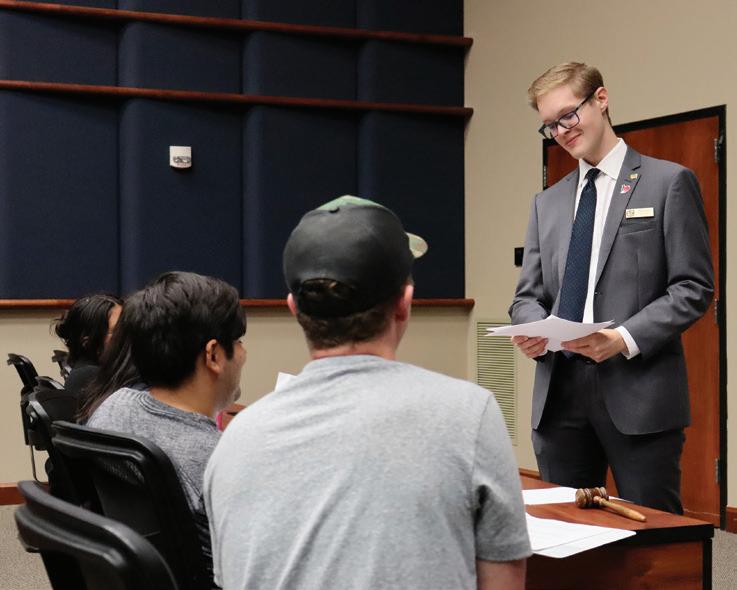
SGA President Connor Holt began the meeting by outlining his plans for the academic year, which include constitutional reform, the creation of a press secretary position and the introduction of the year’s first proclamation.
“All of us in this room, those of us who are members of SGA especially,
represent a shared student voice,” Holt said. “This is a great institution; we can make it an even greater one.”
Vice President Brason Janoe also introduced himself to the student body and his role as chair of the Legislative Committee.
During the meeting, SGA passed a proclamation supporting the return of student art to the Inasmuch Art Gallery in the McMahon Centennial Complex (MCC). President Holt and Vice President Janoe signed the document, along with 12 of the 14 club representatives present.
Cameron University President Shane Hunt served as the guest speaker. He expressed enthusiasm for the university’s future and participated in a question-and-answer session, listening to students’ hopes and concerns about campus life.
Meeting 2: Sept. 22
The second SGA meeting focused on officer confirmations and committee sign-ups.
Student representatives confirmed Angelica Martinez as SGA Press Secretary. The position’s responsibilities includes acting as a liaison from SGA
Mathews as SGA Sergeant-at-Arms.
The position’s responsibilities include maintaining order and decorum and assisting with protocol-related tasks.
Representatives then selected their preferred committees, which included finance, elections, constitutional reform, and legislative.
Meeting 3: Sept. 29
SGA’s third meeting centered on the election of a new treasurer and committee appointments.
Members appointed Brianna Miles as treasurer in an uncontested race.
The treasurer’s responsibilities include managing club budgets, coordinating with committees on funding decisions and reporting expenditures to ensure transparency.
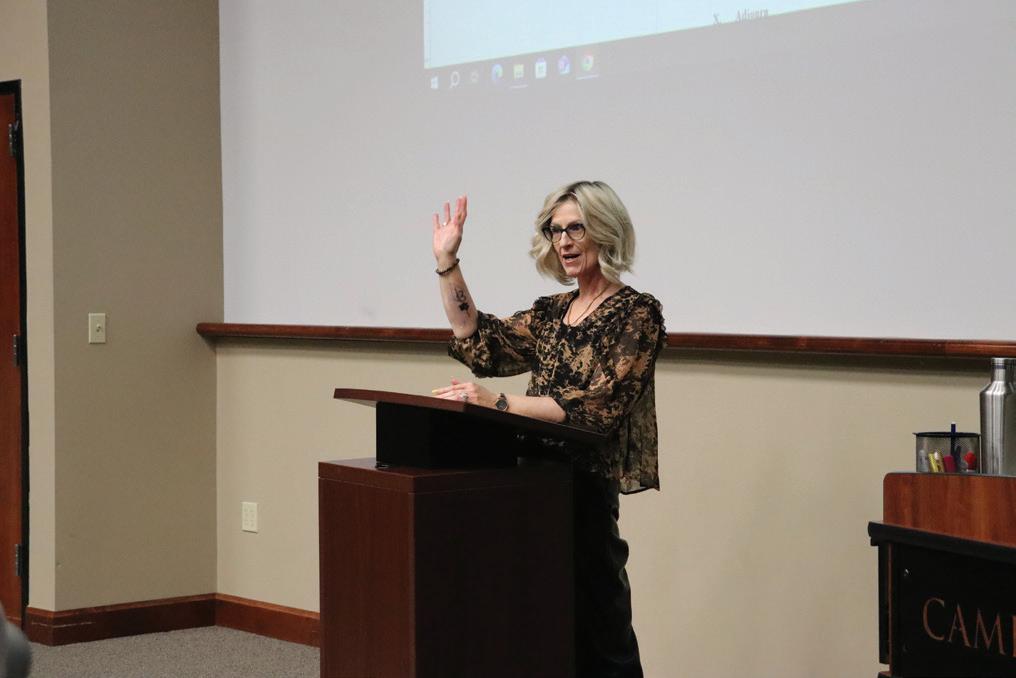
The meeting also included guest speakers, former Cameron President Jari Askins and Director of the Student Wellness Center Tessa Craig.
Askins delivered her farewell remarks, encouraging students to foster strong leadership across campus.
“I am very excited for the leadership we have this year,” she said. “Thank you for participating, because you all have an opportunity to make a difference, and I am confident that you will make that difference.”
Craig highlighted the Student
counseling each academic year and 24/7 access to medical providers virtually. She encouraged students to take advantage of these free and lowcost resources. The Student Wellness Center also offers in-person counseling, over-the-counter medications and health checks such as blood pressure and temperature screenings.
Meeting 4: Oct. 6
SGA’s fourth meeting focused on committee meetings and a presentation dedicated to student housing. Representatives were able to break off into committees to introduce themselves and discuss the individual committee objectives.
Director of Student Housing and Residence Life Tyler Anderson-Majors served as the guest speaker. He outlined future plans for campus housing, including bathroom renovations in the Shepler Towers, updating carpeting and bedroom furniture in Cameron Village, and details about the upcoming Aggie Boo Bash, scheduled from 8 - 10 p.m. on Oct. 30 in the McMahon Learning Center (MLC) Great Room.
The next SGA meeting is scheduled for 5:15 p.m., on Oct. 20, in the Johnson Auditorium.
For questions, comments or concerns, students can email cusga@ cameron.edu, call (580) 581-2444, or contact their organization’s representative.
STUDENT MOVIE NIGHT
Jake Thomas Assistant Editor
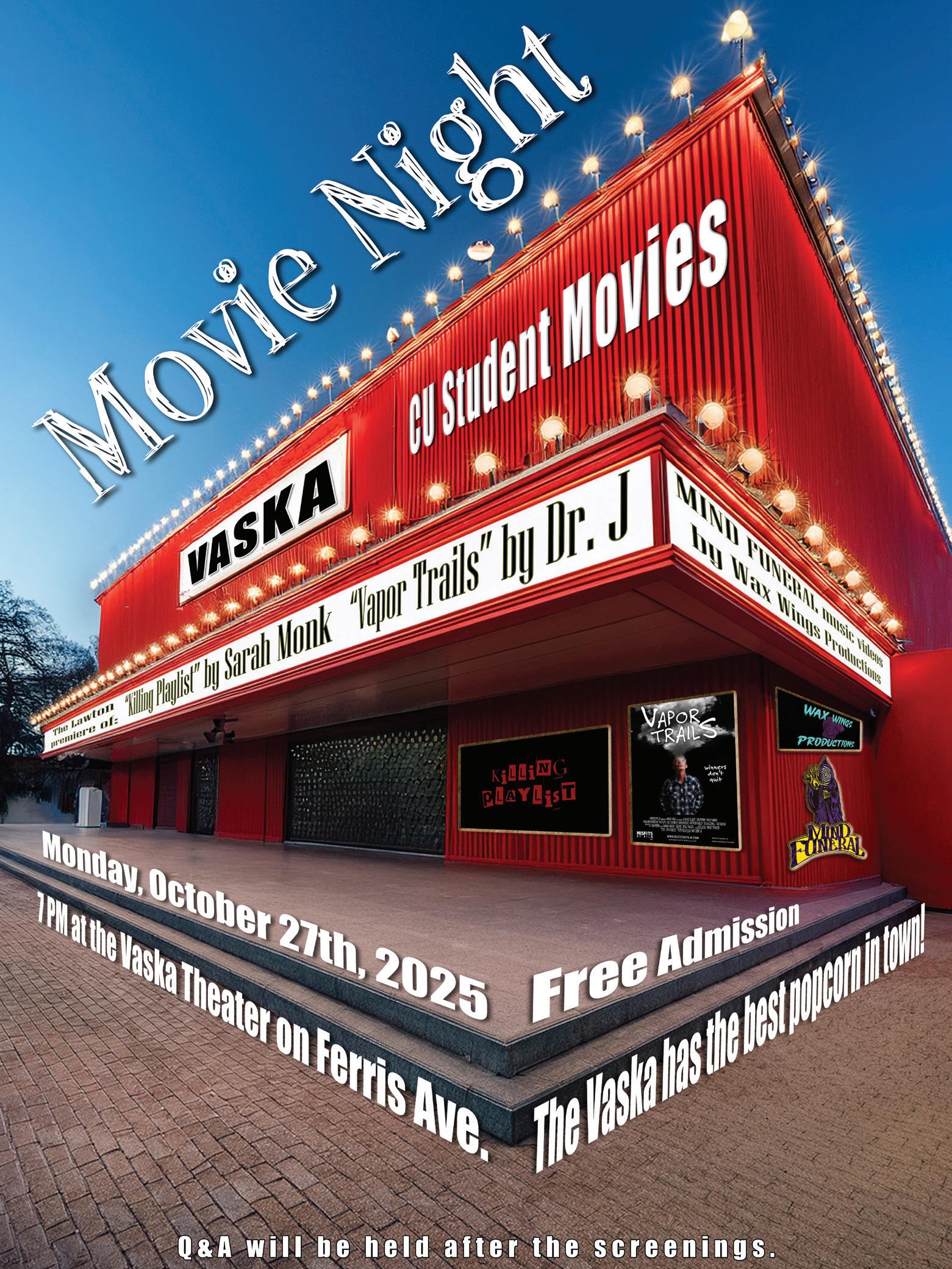
At 7 p.m. on Oct. 7 at the Vaska Theater, Professor Matt Jenkins will be hosting a student movie night.
Student Movie Night is an event held every semester that presents the movies and work of several different students, to a real audience.
The experience provides students with information about the movie making process firsthand, and teaches important lessons, as well as providing valuable experience.
The movies this semester will be varied in both genre and style, from a short film directed by alumna Sarah Monk, to music videos shot by student Steven Utter. The night is sure to have something for anyone who attends. Our own student newspaper, “The Collegian”, will have a project showcased, as well as Dr. Jenkins who will be premiering his own short film “Vapor Trails” to Lawton.
This event has been going on for some time now, but it has gone through its fair share of changes throughout the years as well. The project roots originate all the way back from the 90s, with another student collaboration called “Dan’s Drive In.” Jenkins originally came up with the idea with his student at the time, Dan Perrin. During his time at Cameron, Perrin owned a large plot of land which he thought could be used as a place for a community drivein theater. The theater was used as a place where students could showcase their own projects, much like the current event.
Some time after “Dan’s Drive In,” Dr. Jenkins wanted to expand on the idea of student movies, and that is when the Vaska theater became involved.
“Years later I wanted to resurrect an evening showcasing movies and projects,” Jenkins said. “And I was fortunate enough to have Justin Hackney, the owner of the Vaska Theater here in Lawton, agree to have Movie Night at the Vaska.”
According to Jenkins, the event originally had much less direct student involvement. Instead, the night was meant for students to come and learn from guest directors’ movies. Thanks to Jenkins’ work and connections in the film industry, he got the chance to bring these directors to communicate with
Cameron students. Featured directors included Allen Arkush, Pat Bishow, Morgan Thompson, and more. These circumstances provided students with a new passion and interest in independent filmmaking and expressed interest in making their own movies to Jenkins. It was only then that Student Movie Night became what it is today.
Jenkins thinks that one of the most important steps to movie making is for it to be presented to an audience.
“A movie isn’t finished until it is experienced by an audience,” he said. “My primary goal in making movies is to have them experienced by an audience in a theater.
Student Movie Night furthers this objective for student movie makers by providing them an opportunity to show their work to an audience and then to talk about their creations. This allows them to experience their work being completed.”
Although the fear of criticism may dismay aspiring creators, it is important for filmmakers to learn to stick by their creation through it all.
Student Movie Night has grown into one of the most popular and consistently attended events on
campus. The event will be free to all who want to attend and is not just exclusive to Cameron Students. For further information, or if you would like to create your own film for the spring semester, contact Matt Jenkins, at mattj@cameron.edu.
Angelica Martinez Student Life Editor
Photos by Angelica Martinez
Graphic by Matthew Hasley
This review contains major spoilers for the second season of “Peacemaker.”
The second season of “Peacemaker” has been nothing short of a wild commentary.
is a TV series based on the eponymous DC Comics character of the same name. Directed
SEASON 2
film “The Suicide Squad” and acts as a soft reboot to the DC Extended Universe.
James Gunn, the series began as
The second season takes place after the events of the newest “Superman” (also directed by Gunn) with characters from the film making appearances throughout the show. A particularly exciting cameo from Lex Luthor (Nicholas Holt) was a true highlight of given Holt’s delivery as the evil (and incredibly bald) villain. What Gunn does best as a director is believe in his actors. Cena – former wrestler (you may have heard of him, though likely have never seen him) – is absolutely masterful in his role. Cena is a wonderful comedic actor; if you’re a long time “Fred: The Movie” fan, you’d already know that, but he really shines in “Peacemaker.”
On top of excellent comedic timing,
though, is Cena’s innate ability to genuinely care for the plight of his character and see the humanity in a guy who was, initially, a character that many (including myself) found only to be arrogant and annoyingly macho. Smith still has his faults, of course, but Cena makes him likeable despite his misgivings.
The one character that I truly cannot stand is Rick Flag Senior. Rick Sr. (Frank Grillo) first made his appearance in “Creature Commandos” – another Gunn project, but animated! – and made his live action debut in Gunn’s “Superman.” As it stands, Rick Sr. seeks vengeance against Peacemaker for killing his son, Rick Flag Jr. (Joel Kinnaman), with a fatal stab wound (which occurred during “The Suicide Squad”). As far as character development goes… well, there’s none to be seen. Rick Sr. is exactly what he needs to be in this season, which is the antagonist to Peacemaker’s shenanigans, but beyond that, there’s not much more to find. If Grillo had the acting chops to make up for where the character lacks, I would probably find Rick Sr. more compelling; unfortunately, Grillo has the
acting range of a wet towel. He doesn’t give the impression of a grieving father; he’s just a vaguely annoying nuisance hovering in the background like a fly that won’t stop buzzing around your head. The truth is that Gunn seems to be scrambling to make use of the character after killing off the younger, more dependable, and arguably cooler Flag.
While I have enjoyed the bloody fun and character dynamics of this season, the plot has unfortunately lacked any deeper study. This particular season hinges on the reveal that Peacemaker travels to Earth X, a universe where Adolf Hitler won the Second World War and people of color are held in labor camps across the country. The characters, though disturbed by this shocking revelation, don’t actually do much about it. In fact, the very episode of which the reveal happens is the same episode where all the characters conveniently jump back into their universe. We don’t learn anything more about Earth X, and that particular anecdote is swiftly cast aside.
The penultimate episode, “Like A Keith In The
basket, play along! Solve
Night,” does have one moment that I found poignant amidst the messy writing. Characters Adebayo (Danielle Brookes) and Judomaster (Nhut Le) bond over their shared struggles as queer people of color – regardless of whatever universe they’re in. Adebayo notes that Earth X isn’t as different from their universe as they wish it were — Nazis and all. Despite the characters technically being on opposite sides, for this one episode, they share a common goal.
As much as I support Gunn’s vision for the future of the DC franchise, things didn’t quite pan out for this season of “Peacemaker.” Though fun, it did lack some of the deeper world building that I was hoping for. I rate this season at 3.5 out of 5 stars.
“Peacemaker” is available for streaming on HBO Max.
Amelia Lozano A&E Editor
THEME: SCARY MOVIES
Haunted doll from “The Conjuring” series. 2. Ryan Coogler’s 2025 thriller with Michael B. Jordan.
Psychological horror football film produced by Jordan Peele.
Stephen King classic with a modern clown remake.
“Do you like scary movies?”; Ghostface slasher film.
Hawke horror film with found footage.
Peele’s film with scary dopplegangers.
DOWN: 1. 2024 remake of the 1922 silent film; inspired by Dracula. 2. Children’s stop-motion animation. 3. “The ___”; Jack Nicholson horror classic in a hotel. 4. Kathy Bates ankle-breaker with James Caan.
“Talk To ___”; A group of teens contacting spirits.
Courtesy graphics
Courtesy photo
Dominic Mann Staff Writer
For Cameron senior runner Evalynn Pedrosa, cross country and track have been more than just sports, they’ve been a constant source of stability throughout her life.
Now in her final season at Cameron, she’s looking to finish strong and prove that resilience pays off.
“I started out in fourth grade at a free club meet,” she recalled. “My first meet was a mile, and I was like, wow, this is actually fun. Let me try and do it.”
Once she reached middle school, she tried every sport available and quickly realized that running was where she belonged.
In seventh grade, she was already one of the fastest girls in her district.
High school didn’t come without its own challenges. Transportation was often difficult with her mom working long shifts, but her coaches stepped in to help.
“The coaches for cross country and track were the ones who actually helped me out when it came to transportation, since my mom worked from 6 a.m. to 6 p.m.,” she said.
Their support gave her the opportunity to grow as a runner. That growth was put on pause when COVID hit.
“COVID cut my sophomore track season in half, and then I kind of just took a step back away from sports,” she said.
But a new school coach helped her rediscover her love for running.
“That new coach made me find a new love for cross and track, and he honestly prepared me for college sports.”
the facilities and coaching I had at my high school,” she said.
substantially. By the end of high school, she had dropped
“When I came to college and talked to my teammates from smaller schools, I realized how lucky I was to have
Coming to Cameron wasn’t without its obstacles either. Midway into her freshman year, she considered transferring.
Then came a phone call from her significant other, that changed her mind.
“You’ll never know if you quit now. That’s what kept me from transferring,” she recalled.
Those words encouraged her to stick it out, and she’s been dialed in since.
Running, she explained, has become an anchor for her mental health. “Without sports, I do feel lost,” she said.
“Running helped me find not only a love for the sport, but it helped with my general wellbeing.”
Now, as a senior, she’s focused on what’s ahead. Her current coach, Johnson, has continued to believe in her potential.
“My coach says he’s never seen a girl drop four minutes before, and he thinks it’s doable again this year,” she said.
Looking to the future, she sees running as more than just competition.
“Running has always just been a consistent thing in my life. I wouldn’t want to stop it,” she said.
For the present, she’s aiming to break the 20-minute mark in the 5K, continue improving in the 10K, and help her team succeed.
With her last year on the team, and her goals set, Evalynn Pedrosa is set on making her senior season one to remember.
Matthew Hasley Sports Editor
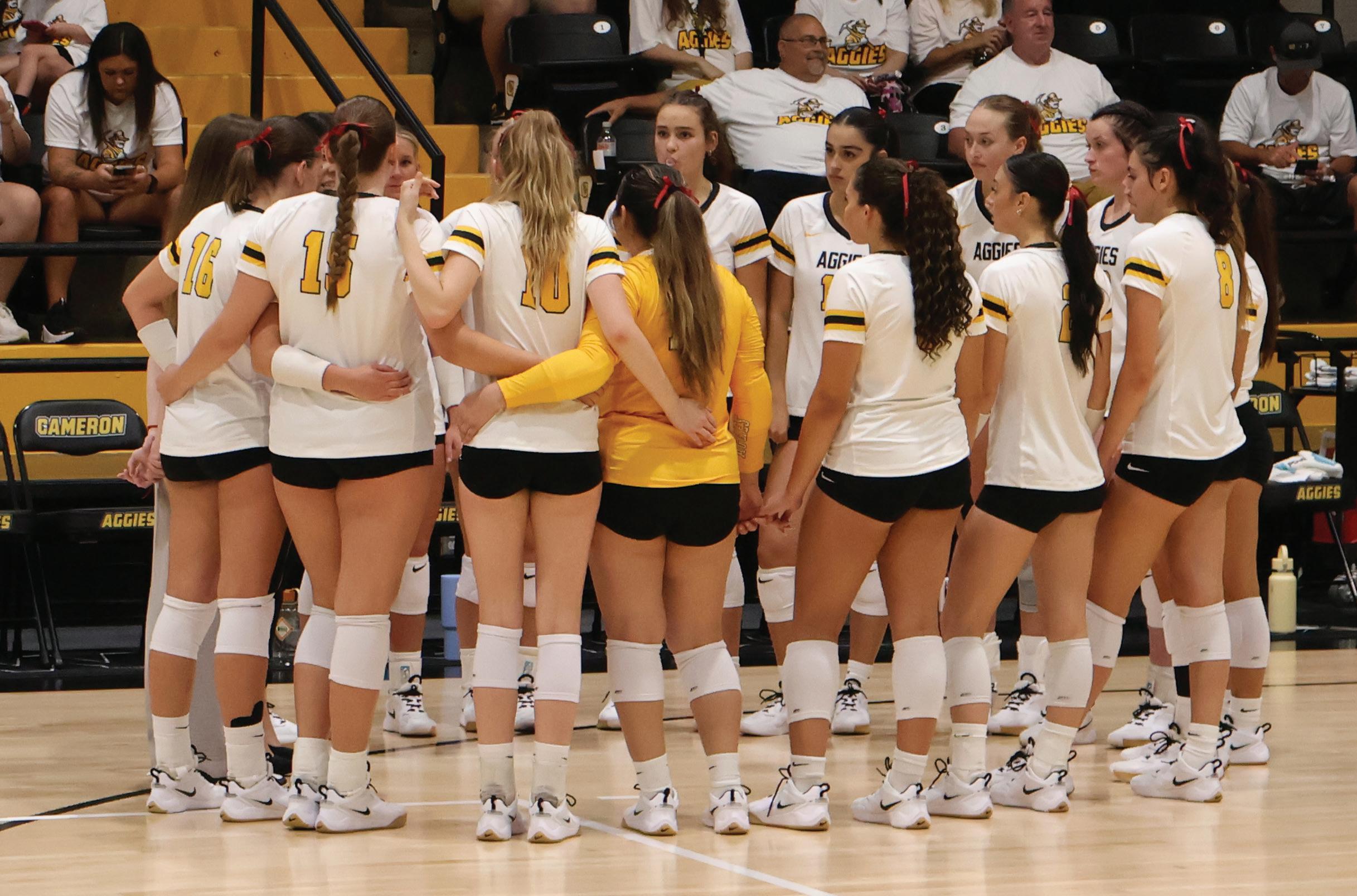
As the crisp October air sweeps across the outside of the Aggie Gym, the sound of call outs and spikes can be heard from within.
On Oct. 28, the Cameron Aggies women’s volleyball team will host the Oklahoma Christian University Eagles for what promises to be a marquee showdown in the Lone Star Conference.
But this isn’t just any match, it is Pink Night, our annual celebration of breast cancer awareness, where the stands transform into a sea of pink, and every spike, block and dig carries extra weight.
For the Aggies, it’s also a golden opportunity to flip the script on a rival that’s had our number a bit too often lately.
Let’s be real, the history books haven’t always been kind to us when it comes to the Eagles.
Since the beginning of the clash back on Feb. 2, 2021, which ended in a clean 3-0 sweep in our house, the ledger shows Oklahoma Christian holding a 7-2 edge over nine meetings through last November’s heartbreaker.
They’ve racked up those wins even with the Aggies bringing it to the court, including a grueling 3-2 victory right here in Lawton just last season on Nov. 2. And let’s not talk
about their four-match win streak from early 2021 through mid2022, which felt like an eternity for them and gut punches for us.
But here’s where the narrative shifts, Cam Fam. Those two L’s in this matchup for OCU?
Those are our W’s, hard earned and fought for. On Oct. 20, 2023, on our home floor, we handed them a 3-1 thumping, a statement win that reminded everyone the Aggies aren’t just going to roll over.
And who could forget Feb. 3, 2021, when we clawed back our way to a 3-2 triumph in their house?
Those victories aren’t just flukes; they are
proof of the Aggies grit, their ability to match intensity set for set.
From our vantage point, the stats tell a story of resilience rather than dominance. Sure, they have a 4-1 away record against us, winning four times in our gym, but the Aggies have held their own in several of those matchups losing heartbreakers 3 to 2.
While they’ve achieved a couple of 3-0 shutouts, our wins have come from putting in hard work on the court with a 3-2 thriller and a dominant 3-1 victory in Oct. 2023 that showcase the heart of our volleyball program.
What makes this matchup electric,
though, is the timing.
Nearly a year removed from that November loss, the Aggies enter Pink Night riding some momentum from a season where they have doubled their wins from last season.
Our blockers have been towering, our setters surgical and our hitters?
Let’s just say the gym’s floors will be ready to get hit.
Hosting on our turf tips the scales in our favor, with the last game against them being a close 3-2 loss.
With the crowd decked out in pink, cheering for more than just points but for a cause, the energy should be unmatched.
Breast cancer hits close to home for me as it is how I lost my momma.
With that in mind, Pink Night isn’t just an event, it’s a rally cry, a reminder that we are fighting for something bigger than a conference standing.
Nevertheless, Oklahoma Christian deserves respect, as does any team.
But respect doesn’t mean fear. We’ve seen their blueprint and knack for closing tight sets.
They won the last match-up in our house, and now it’s our turn to counter.
Imagine an early 3-0 statement to even the score, or better yet, a
five-set epic like the first home game of the season at our White Out Event. Either way, the Aggies are primed to make Oct. 28 the night we reclaim momentum. So, lace up those sneakers, Aggie Nation. Fill the stands, wear your ribbons and bring the noise.
This isn’t just volleyball, it’s for a cause, to give awareness, and to show that Aggie pride all wrapped in one. The Eagles may fly in thinking they’ve got the edge, but on Pink Night, in the heart of Lawton, we’ll show them the Aggies soar higher.
Let’s make it a night to remember, or better yet, a “W” in our column. See you there.