Collegian T he Cameron University
un
www.aggiecentral.com
Monday, October 26, 2020
Volume 103 Issue 6
^
The common history of the
Academic Commons
Photos courtesy of CU Office of Public Affairs
Payton Williams Staff Writer @YoureSoVanya
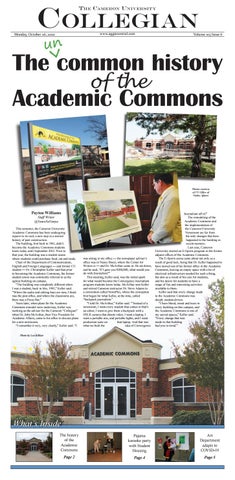
This semester, the Cameron University Academic Commons has been undergoing repairs to its roof, a new step in a storied history of past construction. The building, first built in 1961, didn’t become the Academic Commons students know today until September 2012. Prior to that year, the building was a student union where students could purchase food, eat and study. Chair of the Department of Communication, English and Foreign Languages — and former CU student — Dr. Christopher Keller said that prior to becoming the Academic Commons, the former student union was commonly referred to as the ugliest building on campus. “The building was completely different when I was a student, back in like, 1992,” Keller said. “Where the audio and editing bays are now, I think was the post office, and where the classrooms are, there was a Pizza Hut.” Years later, when plans for the Academic Commons remodel were underway, Keller was working as the adviser for the Cameron “Collegian” when Dr. John McArthur, then Vice President for Academic Affairs, came to his office to discuss plans for a new newsroom. “I remember it very, very clearly,” Keller said. “I
was sitting in my office — the newspaper adviser’s office was in Nance Boyer, where the Center for Writers is — and Dr. McArthur came in. He sat down, and he said, ‘If I gave you $100,000, what would you do with Journalism?” This meeting, Keller said, was the initial spark for what would become the Convergence Journalism program students know today. McArthur sent Keller and retired Cameron instructor Dr. Steve Adams to a convention called NewsPlex, where the conception first began for what Keller, at the time, called “backpack journalism.” “I told Dr. McArthur,” Keller said. “’Instead of a newsroom, I want every student that comes in that’s an editor, I want to give them a backpack with a DSLR camera that shoots video. I want a laptop, I want a portable mic, and portable lights, and I want production suite on that laptop. And that was what we built the idea of Convergence
Journalism off of.” The remodeling of the Academic Commons and the implementation of the Cameron University Newsroom are far from the only changes that have happened to the building in recent memory. Last year, Cameron University started an E-Sports program in the former adjunct offices of the Academic Commons. The E-Sports arena came about not only as a result of good luck, being that Dr. Keller happened to have moved out of his former office in the Academic Commons, leaving an empty space with a lot of electrical infrastructure needed for such a thing, but also as a result of his care for students, and his desire for students to have a range of fun and interesting activities available to them. Keller said that every change made to the Academic Commons was deeply student-driven. “I have blood, sweat and tears in every building on this campus, and the Academic Commons is one of my sacred spaces,” Keller said. “Every change that was made to that building had you in mind.”
Photo by Lea Killian
What’s Inside The history of the Academic Commons
Pajama karaoke party with Student Housing
Art Department adapts to COVID-19
Page 2
Page 4
Page 5
2
News
October 26, 2020
www.aggiecentral.com
Be the Match
CU Chemistry Club welcomes Marcikus Long Brittney Payette Copy Editor
At 5:15 p.m. on Sept. 29 in the Science Complex, guest speaker Marcikus Long spoke to Cameron’s Chemistry Club about the national registry Be the Match. Be the Match helps match patients
and donors for potentially life-saving blood stem cell transplants. Blood stem cell transplants can treat over 70 diseases, including Leukemia, Lymphoma and Sickled Cell Anemia. Doctors generally start looking for donor matches within a person’s family. There is only a one in four
chance of matching a patient to their siblings, and 70 percent of patients who need a transplant do not have a matching donor in their family. Only 50 percent of perspective donors actually agree to donating, and the other 50 percent are either unavailable or decline to donate. Long emphasized the importance
Commitment makes the difference: CU students attend Be the Match lecture hosted by organization representative, Marcikus Long, as she discusses the importance of committing to the cause.
of joining the registry and following through with the commitment. “We are in the business of helping people,” Long said. “Your commitment makes all the difference.” When a donor is matched to a patient, the donor receives three pieces of information: the patient’s gender, diagnosis and age. In order to find the match, the potential donor sends a swab of their mouth, which gives the organization their tissue type. Doctors then try to match a patient’s Human Leukocyte Antigen (HLA) with a donor’s HLA type. HLAs are proteins that are found in the majority of cells in the human body. The best donor-patient matches are the ones that have the closest HLA type. Having a donor that matches the patient makes it more likely that the transplant will successfully help treat the blood disease. Generally, doctors try to match between eight and ten HLA markers. Lyndey Ferguson worked with Long to set up the event and has been a member of the registry for two years. She learned about the registry when she attended Joliet Junior College in Illinois. “I filled out an online form to join Be the Match, and Marcikus and I set the event up,” Ferguson said. Ferguson recommends others joining the registry because it could help save someone’s life. For more information about Be the Match, visit their website at bethematch.org.
DTCPA
October 26, 2020
www.aggiecentral.com
Voices
3
2017
2016
don’t play
Amanda King
About Us
The official student newspaper of Cameron University, The Cameron Collegian is available twenty Mondays during the year. It is printed by the Lawton Constitution. The first issue is provided for free. Each subsequent issue is $1.50.
2019
$3.62 $4.23
U.S. Healthcare and Pharmaceutical Digital Advertisement Spending (per billion) Graphics by Amanda King; Information provided by eMarketer
medication is prescribed nearly 25 times more often than in the United Kingdom — which does not allow DTCPA. Furthermore, the U.S. has the highest population of people taking antidepressants per one thousand people — the most common DTCPA culprit — when in fact, less than a third of that population has actually seen a medical professional within the last year. An even greater, overarching problem caused by DTCPA is felt by healthcare professionals. When the public sees a pharmaceutical advertisement — like any advertisement — inevitably someone will feel that they want, or in a lot of cases, need it. And when that someone schedules an appointment to tell a doctor what medication they think they need, this becomes a completely insolvable issue. One of two things happen: Either the doctor feels pressured to prescribe a certain medication because the patient has requested it, regardless of whether said patient needs it or not; or, the doctor does not prescribe the requested medication, and the patient becomes upset at hearing a no, and usually hops from doctor to doctor until they can procure the prescription they want. Any doctor who refuses is backed into a corner when that angry patient posts a negative review
Our student media are designated public forums, and free from censorship and advance approval of content. Because content and funding are unrelated, and because the role of adviser does not include advance review of content, student media are free to develop editorial policies and news coverage with the understanding that students and student organizations speak only for themselves. Administrators, faculty, staff or other agents shall not consider the student media’s content when making decisions regarding the media’s funding or faculty adviser.
of the practice — because doctors can’t even respond without violating the Hippocratic Oath that all physicians must swear to protect patient confidentiality. Still not convinced that there’s a problem here? How about this: DTCPA actually increases healthcare costs. In a 2013 survey by Richard Meyer for World of DTC Marketing, 37 percent of doctors said that they often prescribe name brand drugs instead of cheaper, generic equivalents — simply because the name brand option is what the patient requested. Perhaps unknown by many, name brand pharmaceuticals cost anywhere from 30 to 80 percent more than generic versions. So really, in addition to requesting medication that isn’t necessary, you’re asking to spend more money than said medication usually costs. Prescription medications are not accessories. They are not handbags or credit cards. They are pharmaceuticals, which should only be used if needed — and even then, under the care of a certified healthcare professional. They need to be prescribed for a reason. There are possible side effects in taking any medication, and seeing an advertisement on television for a medication that seems like it could help you does not make you a qualified medical professional.
Letters Policy
THE CAMERON UNIVERSITY
COLLEGIAN Founded in 1926 veritas sempiterna
Our Views
The opinions expressed in The Collegian pages or personal columns are those of the signed author. The unsigned editorial under the heading “Voices” represents the opinion of the majority of the editorial board. The opinions expressed in The Collegian do not necessarily represent those of Cameron University or the state of Oklahoma.
$3.01
2020
You’re sitting on the couch, scrolling through channels — just trying to find something interesting to watch. You decide to stop on a new Hallmark movie, or maybe a Friends re-run, and a few minutes in — you’re hit with a commercial break. Maybe it’s that new Samsung cellphone, or perhaps a 2020 Subaru Outback with zero percent financing for the first 63 months. Oh boy! Depending on where you are on the globe, there are a million different advertisements you’ll see on a daily basis. But there are only two countries in the world where you will inevitably run into a drug advertisement. One is New Zealand, but the other? You guessed it — America. You’ve seen them, those commercials with happy music in the background, people of all ages and ethnicities smiling and buoyantly strolling through sunshine — all while a calming narrator lists out the potentially fatal side effects of using the commercialized medication. This is called direct-to-consumer pharmaceutical advertising (DTCPA); that is, when pharmaceutical companies promote prescription products directly to the public, usually via the media — as per the U.S. National Institutes of Health (NIH). As you could probably guess, DTCPA causes big problems within both the professional healthcare community and the general public. People often don’t pause at the list of serious side effects — which are often very serious, and sometimes include death. See, most advertised drugs are shown in the media before they’ve been tested for long-term effects — and contrary to popular belief, the FDA does not approve DTCPA commercials before they air. Because DTCPA products aren’t tested longterm or reviewed by the FDA before release to the masses, several drugs have been pulled from the market for unknowingly adverse side effects. Although the Federal Drug Administration does place restrictions on DTCPA, the NIH’s National Library of Medicine reports that it is also “the most prominent type of health communication that the public encounters.” Moreover, the FDA’s regulations on advertising by pharmaceutical companies have only continued to drop as time passes; in fact, in 2004, the FDA eliminated the requirement of listing out all side effects in print — and approved the showing of only the “major risks.” This restriction easing, in addition to the allowance of simpler language that consumers can easily understand, directly correlates to the deluge of DTCPA that you see every day. More to the point, DTCPA compels people to believe that they need certain drugs to improve their health — when generally, most viewers have no need for advertised medication. In fact, according to Business Insider, ADHD
$2.47
2018
Voices Editor
$2.01
Editorial Staff
Managing Editor - Lea Killian A&E Editors - Cam Alsbrook Voices Editor - Amanda King Copy Editor - Brittney Payette
Newsroom Staff
Staff Writers - Alison Malawey Financial Officer - Susan Hill Faculty Adviser - Prof. David Bublitz
Letters to the editor will be printed in the order in which they are received and on a space available basis. The Collegian reserves the right to edit all letters for content and length. Letters should be no more than 250 words. Letters from individual authors will be published only once every four weeks. All letters from students should include first and last names, classification and major. Letters from people outside the Cameron community should include name, address and phone number for verification. Letters can be sent by mail, by e-mail to aggiecentral@ cameron.edu or they may be dropped off to the Academic Commons 101.
4
A&E
October 26, 2020
www.aggiecentral.com
Photo by Cam Alsbrook
A new perspective: Graphic Design sophomore Courtney Pufall presents her assignment for Color class taught by Professor Edna McMillan. The University Teaching Gallery offers art students a more realistic atmosphere for exhibition, also functioning as a classroom fit for critiques and group work.
Adapting to COVID-19
Art Department hosts classes in new gallery Cam Alsbrook A&E Editor
During Fall 2020, the Cameron Art Department made changes to both the department and future events in order to adapt to the COVID-19 pandemic. Art professor Edna McMillan said, in addition to policies the university has adopted, such as wearing masks, washing hands frequently, sanitizing used university devices and social distancing, the Art Department divided students into separate rooms during classtime to maintain social distancing.
“This is a real challenge for the art faculty as they must go from one room to another and make separate presentations to maintain the protocol of social distancing,” McMillan said. “Students must be more accountable and manage their studio time efficiently, which is a good thing. However, this does limit the oneon-one time that each student has with the faculty member in class.” The department is also making use of its new University Teaching Gallery to both display student artwork and host larger class sizes, allowing students to
divide into groups and critique work in a more realistically formal art atmosphere. Art sophomore Raymund Anongos said the gallery is a safe place for the art students to critique because of its large size. “I personally just love the atmosphere of the room since it’s a public exhibition,” Anongos said. “It gives me a glimpse of what producing an actual exhibition could be like; discussing my artwork and the meaning behind it in front of others.” McMillan said she loves the process of life-long learning, citing the desire to do so as a
key quality necessary to teach successfully in the arts — and is also always excited to see the students develop within the program. “I love to learn both new things about Art processes and Art History, and bringing those to the studio environment,” McMillan said. The gallery also features smart-classroom capabilities, providing another tool to aid in the department’s adaptation to COVID-19. McMillan said that artwork by some of the art students is inspired by the circumstances of the COVID-19 pandemic,
and Midwestern State University Art Professor Elizabeth Yarosz-Ash’s upcoming series is as well. The Art department will hold a display event for Yarosz-Ash’s COVID-19 inspired watercolor and acrylic paintings series, titled “Elizabeth Yarosz-Ash: Observations from Isolation” from Nov. 12 to Dec. 13. On opening day from 2 – 3:30 p.m., YaroszAsh will host a visual lecture presentation of the works at the Cameron Theater. Also on opening day from 4 – 7 p.m., the art exhibition plans to open with a 10 person
restriction at the Gallery, with the artist present until 5 p.m. In Spring 2021 from Feb. 26 to March 27, the art department will host the Second Annual Student Competition and Exhibition. Rewards for the competition include cash prizes: $250 for first place, $175 for second place and $125 for third place. Three runners-up will recieve honrable mention prizes of $50. For more information about the spring competition or the gallery, contact Edna McMillan by email at ednam@cameron.edu or by phone at 581-2452.
Aether-ough review: “Rivals of Aether” Cam Alsbrook A&E Editor
Dan Fornace’s “Rivals of Aether” is a platform fighting game that takes what fans like of Sora LTD’s “Super Smash Bros.” and reconstructs it as a more competitive-focused experience than “Super Smash Bros.” Animalistic and /or anthropomorphic creatures are involved in a mostly tipped over political system, fighting to solve problems and eventually discover why worsening natural occurrences are happening, while mistaking members of opposing nations as the root cause. The game’s story mode is quick and straight-forward, with six initial fighters — which makes the game easy to pick up and complete. The control scheme for “Rivals of Aether” is simplified compared to other fighting game titles, removing the commonly used “grab” system in favor of emphasizing the “parry” system. The “parry” system works as a visual cue where players time a button press against an incoming attack. If timed appropriately, the parrying character will shrug off an attack unharmed — earning a momentary advantage against the opposing player. The game features indie
platformer cameo characters such as Yacht Club Games’ “Shovel Knight” or Moon Studio’s “Ori.” “Rivals of Aether” originally released on Steam Sept. 22, 2015; Windows and Xbox in March and August 2017 respectively; and most recently on the Nintendo Switch on Sept. 24 of this year. The computer version of the game features a custom workshop in which players are able to submit custom work to be made playable in-game through the share and download functions that the workshop provides. As a result, players have made wacky creations out of fast-food restaurant mascots, fighters from other fighting game titles, and internet memes into over-powered fighters. In short, the game has a lot of history backing the release of it on Switch this year, and I am glad to say that I enjoy playing the game due to the similar nature it has to my main fighting/party game of choice (“Super Smash Bros.”), simplified controls, beautifully rendered in-game sprite work, and the soundtrack. With all of this history and passion backing the game up, I will not deny that the game has some issues that are not its own fault. The game has simplified controls and is easy to pick up if
players approach the game from another fighting game title. But the game is hard to master and suffers from its small roster — I know the former point sounds weird with all that has been said, but hear me out. This game is super fun to watch, and the stuff that players who play professionally are able to perform is leagues harder to pull off without an understanding of the game’s approach and where it came from developmentally. Take into account that players undoubtedly will pull off cool looking things really easily and build a level of confidence that only stems from this game — but I promise that very same confidence can easily be taken down. New players may think they are good only after a day or so of practicing the game and getting the hang of the mechanics of their chosen character, I know I did. But do not make the same mistake as I: recognize that the chance of losing to an actually good player is higher in this game than other titles. Players do not get away with making as many mistakes
fighting in “Rivals of Aether” as they would in more popular games. I do not say this as a form of deterrent for prospective players, but as a light-hearted warning to avoid a funny lesson from being learned first-hand. In the other case with the Courtesy Graphic
small roster, the workshop function is well-made and serves a vital purpose for spicing up the level of fun people can have. But since the submitted content is typically considered competitively unviable due to insane toolkits or hitboxes, an actual professional esports scene for this game is still
considerably small compared to other games in the field. The Switch release of this game gave me hope that maybe the esports scene involved in this wonderful title could develop further since the Switch console boasts portability and the switch release of “Rivals” included all of the downloadable content as a base package. But with the COVID-19 pandemic shutting down potential venues, and players in Oklahoma at least not being vocal enough about the game, it seems like it might take longer for this growth to be seen. However, the community behind this game (small comparatively as it may be) is passionate and stands as a modern story of a grassroots community sticking together. The Nintendo Switch release of “Rivals of Aether” earns a 8.5/10 rating from me due to the unfortunate yet understandable lack of a workshop functionality, and small official cast. I highly encourage people who enjoy any outlet of fighting games, or interested first time fighting game players to try this out with friends — see who the best player is; I also hope for tournament organizers to consider investing in this game as a main or side event.
October 26, 2020
www.aggiecentral.com
Student Life
5
CU Housing Office hosts
Pajama Karaoke
Drop the Mic: On Sept. 30 in the Shepler Ballroom, the Student Housing Office hosted a Pajama Karaoke night. The event included balloons, snacks, singing and dancing. For more information about future Student Housing events, visit cameron. edu/housing or call (580) 5812392.
Photos by Brittney Payette
6
Sports
October 26, 2020
www.aggiecentral.com
Volleyball in the era of
COVID
Photos by David Perkins
Waiting out the fall: Cameron’s Volleyball team practices daily; the main objective is staying healthy and primed for a possible spring season.
David Perkins Guest Editor
The Cameron women’s volleyball team is serving as a prime example of how COVID-19 is affecting college sports across the country. Under normal circumstances, the team would now be wrapping up their season, but amid the pandemic, all competition has been postponed. Changes came abruptly in March when the NCAA cancelled fall and spring championships stating they have one commitment: “To protect the health and safety of college athletes.” In early August, the Lone Star Conference (LSC) cancelled all competition in the sports of basketball, football, soccer and volleyball. These sports are considered high-contact risk sports in the age of COVID. In lieu of a fall season of competition, the volleyball team’s fall season has consisted only of daily practices and workouts. Head coach Brandon Stephenson said, without a fall season, the priorities
of the team have shifted to keeping his players conditioned, safe and healthy. “That’s been kind of the biggest focus and biggest issue for us,” Stephenson said. “Just making sure that we get their health maintained so that we can continue to practice every day.” With COVID-19 and the safety restrictions that are now necessary comes a new approach to the team’s daily practice. Practice during the era of COVID consists of running the usual drills and workouts but with more attention to the well-being and comfort of the players. New safety protocols are in place for players and personnel who enter the building, which includes submitting a COVID symptom check questionnaire as well as having athletes check their temperature before entering the building. Players and personnel are also required to wear a mask throughout practice, which provides its own challenges during practice and workouts. Stephenson said the restrictive nature of the mask
has changed the way the team practices and is something to be mindful of throughout practice. “Just having that time where we do shorter increments of workouts with longer breaks in between,” Stephenson said. “Then making sure the girls understand the safety issues because I know they want to get that mask off as soon as possible. But they understand it’s a bigger picture that we have to look at.” There are hopes of a return to competition in the spring, albeit on what will likely be a condensed schedule. The NCAA has also offered up another season of eligibility for seniors since they will be missing out on
a championship season. Cameron senior and setter for the team Desiree Marmolejon, feels that, if nothing else, the team plans on taking advantage of this extra time they have in the fall to work together and grow as a team before the spring season. “I believe this is going to
get us very prepared for this upcoming spring because all of us just connecting, being sisters and being a unit,” Marmolejon said. “Just coming in and working hard every day is definitely going to get us prepared for the spring so I’m very excited to see what the spring will be offering us this year.”