Collegian T he Cameron University
www.aggiecentral.com
COWBOY POETRY
Monday, November 11, 2019
FEATURING
Volume 101 Issue 7
Photos by Payton Williams
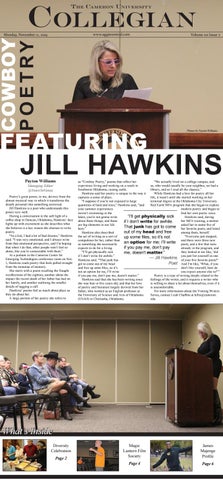
JILL HAWKINS Payton Williams Managing Editor @YoureSoVanya
Poetry’s great power, to me, derives from the almost mystical way in which it transforms the deeply personal into something universal. Jill Hawkins is a poet who understands this power very well. During a conversation in the soft light of a coffee shop in Duncan, Oklahoma, Hawkins’ face lights up with excitement as she describes what she believes is a key reason she chooses to write poetry. “As a kid, I had a lot of bad dreams,” Hawkins said. “I was very emotional, and I always write from that emotional perspective, and I’m hoping that when I do that, other people won’t feel so alone, like you’re connectable with them.” At a podium in the Cameron Center for Emerging Technologies conference room on Nov. 1, Hawkins reads poetry that feels pulled straight from the minutiae of memory. She starts with a poem recalling the fraught recollections of the eighties, another about the impact the recent death of her father has had on her family, and another outlining the smaller details of tagging a calf. Hawkins’ poems feel as much about place as they do about her. A large portion of her poetry she refers to
“We actually lived on a college campus, and as “Cowboy Poetry,” poems that reflect her so, who would usually be your neighbor, we had a experience living and working on a ranch in library, and so I read all the classics.” Southwest Oklahoma, raising cattle. While Hawkins had a love for poetry all her Hawkins said her poetry is unique in the way it life, it wasn’t until she started working on her captures a sense of place. terminal degree at the Oklahoma City University “I suppose if you’re not exposed to large Red Earth MFA program that she began to explore quantities of land and trees,” Hawkins said, “and modern poetry and began to your summer experiences find her own poetic voice. weren’t swimming in the “I’ll get physically sick Hawkins said, during lakes, you’re not gonna write her MFA training, a mentor about those things, and those if I don’t write for awhile. asked her to name five of are big elements in our life That junk has got to come her favorite poets, and listed here.” out of my head and free among them, herself. Hawkins also described “Everyone just stopped, the act of writing as a sort of up some files, so it’s not and there were three new compulsion for her, rather than an option for me; I’ll write poets, and a few that were as something she necessarily if you pay me, don’t pay already in the program, and expects to do for a living. they looked at me like, ‘did “I’ll get physically sick me, doesn’t matter.” you just list yourself as one if I don’t write for awhile.” — Jill Hawkins of your five favorite poets?’ Hawkins said. “That junk has Poet And I’m like, ‘What, if you got to come out of my head don’t like yourself, how do and free up some files, so it’s you expect anyone else to?’” not an option for me, I’ll write Poetry is a type of writing deeply related to the if you pay me, don’t pay me, doesn’t matter.” feelings of the writer, and it requires a writer who Hawkins said that she has been writing since is willing to share a lot about themselves, even if it she was four or five years old, and that her love is uncomfortable. of poetry and literature largely derived from her father, who worked as an English professor at For more information about the Visiting Writers Series, contact Leah Chaffins at lellis@cameron. the University of Science and Arts of Oklahoma edu. (USAO) in Chickasha, Oklahoma.
See CCMH Page 3
What’s Inside Diversity Celebration Page 2
Magic Lantern Film Society
James Majenge Profile
Page 4
Page 6
News
2
Ensuring involvement:
November 11, 2019
www.aggiecentral.com
CU Diversity Celebration
Bryan Araujo
Residence Hall Association (RHA). RHA President, Diversity Diplomat and Criminal Staff Writer Justice senior, Bethany Green said the celebration At 12 p.m. on Oct. 24 in the McCasland was a self-serve event. Ballroom, the office of Student Development “They tried to show their diversity through their and various student organizations teamed up to food,” Green said. “So there’s Indian food, Native organize the annual Diversity Celebration event American food, southern food and little bit of food and steer it into a new direction. from everywhere. RHA prepared spaghetti, mac and The organizations wanted to encourage cheese, cornbread, cabbage with sausages — food conversion and discussion among attendees and to from the southern district.” ensure involvement at different levels of diversity Organizations decided to use ice-breakers to from peer to peer, while not only considering encourage students to stay engaged and participate race or ethnicity but also socio-economic, for the entirety of the event. geographical, subcultures and or anything at any One of ice-breaker asked students “Have you level used to distinguish one person from the ever overheard or witnessed somebody saying an next. offensive joke about something race, ethnicity, This semester, the organizations hosted the sexual orientation and what did you do?” event as a pot luck involving education and At one of the tables, Allied Health Sophomore food. Some of the participating CU student Jimmy Williams said his multiculturalism class organizations included: The Accounting Club, offered students extra credit to attend the diversity Black Student Association, Diversity Diplomats, gathering. Native American Student Association, Psi-Chi, “The free delicious food, different cultures and Student Oklahoma Education Association, Aggie different people we get to meet made me want to Club, CU-CKI, Kappa Sigma, PRIDE and the come even more,” Williams said. “I’m sitting at a
table with a couple of diverse people, my friend from Jamaica, my friend from England. It’s always a great experience.” Williams asked his tablemate what they were eating. “What was that stuff called that you’re eating now?” Williams said. “Samosa? With barbeque sauce it was delicious.” “Says the American,” the English peer said under her breath before rest of the people at the table giggled. Williams said that there are many good things about talking to people from diverse backgrounds. “Learning about their culture, the way they lived or their food is exciting,” Williams said. “They’re so inviting and I like that. You get more family-oriented with a different culture than you do your own family here in the states. I’m closer to people outside of America than to people here in America.” For more information about the Diversity Celebration, contact the Office of Student Development at student_development@cameron. edu.
Photos by Bryan Araujo
CU Psychology Clinic relocation Haylee Key
Photo by Adrianna Finch
Sigma Tau Delta
Trunk-or-Treat Adrianna Finch
Fourth grader Makayla said the Harry Potter trunk was her Assistant Editor favorite. At 6-8 p.m. on Oct. 28 in “I love Harry Potter,” she said, the Howell Hall parking lot, “It was really cool to see that I’m Cameron University fraternity not the only one.” Sigma Tau Delta co-hosted the Another car had a Lion King annual Trunk-or-Treat with Marie theme, which a local Lawton Detty’s New Directions. mother said she loved. The hosts wanted the event “It was my son’s favorite, as to raise awareness for domestic well as mine,” she said, “The way violence and sexual assault and the young girl did her make-up to provide a safe and fun place was outstanding.” for Lawton families and Cameron Car owners also presented students to trunk-or-treat. Nerd candy, gumball machine Multiple cars lined the parking and Toy Story trunk themes. lot with a variety of themes, Volunteers brought a DJ booth, including the Lawton Fire and attendees enjoyed visiting Department. various food trucks. New Directions volunteers A Marie Detty volunteer said covered their cars with purple the event was a success. — the ribbon color of domestic “I love seeing the kids’ faces violence and sexual assault. light up and the happiness they
radiate when they see what candy they got or a car in their favorite theme or cartoon,” the volunteer said. “This event gives the community somewhere safe to have family fun, while also showing that there are resources for those in needed.” Marie Detty’s New Directions offers help to those affected by domestic abuse, sexual violence and stalking. For more information about New Directions, contact their crisis hotline at (580) 357-2500 or visit the organization’s Facebook page. For more information about Cameron fraternities, contact Greek Life Coordinator Daniel McFadden at dmcfadden@ cameron.edu.
each session. The clinic provides Staff Writer training for Master of Science of Behavioral In October 2016, Science graduate Cameron University students in the opened the Cameron Counseling, Marriage Psychology Clinic and Family Therapy (CPC) to help provide free mental health care tracks, and students use the videos for to those who can’t educational purposes. otherwise afford it. Since its opening, The CPC originally the CPC has provided ran behind the over 600 sessions BancFirst building at to more than 100 2202 Ferris Ave.; it stayed in this building individuals, couples and families. for three years until Sailor said that available space opened on campus. It relocated working at the clinic offers experience for to 275 SW 27th St. various psychology on the east side of majors. campus. By the end of this Associate Professor academic year, 85 Dr. Joanni Sailor said graduate students will this move resulted in three new rooms: play receive training at the therapy, group therapy, CPC. The clinic employs and individual/couple licensed mental health therapy. supervisors who “This allows the oversee the students’ CPC and the students work and offer to provide additional feedback. services we did not Sailor said she feels have when at the previous location,” she hopeful about the clinic’s future growth. said. “My hopes are that The clinic is the CPC will continue available to people to grow in the services from Lawton or its surrounding areas who we can provide,” she are unable to meet their said. “This academic year we are looking co-pays or insurance at providing anger deductibles. management and Cameron students parenting classes to the can receive services community.” from the Wellness For more Center rather than the information about CPC. the CPC, contact the Therapists request Cameron Psychology potential clients to Clinic at (580)-581-3153 sign a recording authorization form for or cpc@cameron.edu.
3
Voices
November 11, 2019
www.aggiecentral.com
Morality
Brutality
co
ur
te s
yo
fT r ib
un
eC
on
te n
tA ge n
cy
conditioning; in the case of “Genie the feral child,” psychologists made great strides in understanding the role language plays in cognitive development. But is that knowledge essential? Is it especially important in day-to-day life, or human survival? Has the insight gained by terrorizing Little Albert and Genie given psychologists exclusive information that’s served to help others? Or has it simply satisfied a scientific curiosity? I firmly believe that harm to the few does not justify possible benefit to the masses; even if these regulations are reduced, there is no guarantee that the experiments will be successful. One important factor of a successful experiment is its ability to be replicated. Do we really want to repeat these harmful experiments on even more subjects, traumatize even more children, to ensure the results are consistent? Additionally, cases such as Little Albert are particularly unreliable because there was trauma inflicted, which blurs the conclusions drawn by the results. If you are put in a stressful or scary situation, you would likely do something that ordinarily, you would not; therefore, results from unrestricted testing are not worth the cost. Though, of course, I don’t think the trauma would be worth it even if the results were excruciatingly clear. Morality might be subjective, but there is no world where causing someone emotional trauma in the name of science is the right thing to do. Restrictions on psychologists keep undue and unnecessary trauma from occurring during experimentation — and these restrictions shouldn’t be reduced, because the negative effects that would have on the responsibility of scientists, the test subjects and the very name of science are not worth the sacrifice of morality. How do we deserve to learn more about the human mind if we have to do inhumane things to acquire it? hic
Historically, psychologists have discovered a tremendous amount of knowledge regarding the human mind using case studies. In fact, it is mostly due to these case studies that we understand mental diseases, brain abnormalities and human behavior. Unfortunately, these cases are not always ethical, and thus many regulations have been put on psychological experiments. Even so, there are some psychologists who believe that regulations need to be reduced by revising the Code of Conduct as put forth by the American Psychological Association’s Ethics Committee. However, the potential advances in knowledge do not justify the guaranteed harm. Look at the case of Little Albert. The American Psychological Association published an experiment done in the early 1900’s wherein behavioral scientist John B. Watson introduced baby Albert to certain animals — such as rats and dogs — and allowed him to play with them. The scientists leading the experiment would then ring a loud bell behind him every time he reached for the animal, causing him to cry — and eventually they conditioned him to fear these stimuli. The objective of this experiment was to understand conditioned responses; but in the process, psychological damage was inflicted upon this baby, and he was eventually terrified of all the animals presented to him — and even some colors and objects that resembled them. Watson might have garnered useful information from this experiment, but does it justify the emotional trauma inflicted upon Little Albert? Especially considering the subject was a baby, and as such, was unable to consent? Maybe the real fault lies in the parents who allowed this experiment to happen. Another case published by the American Psychological Association exemplifying the harm scientific experiments have caused is that of “Genie the feral child.” For the first 12 years of her life, her father strapped her to a bed or child’s potty. She wasn’t allowed to communicate with any other human beings — aside from her father, who only barked at her. Thankfully, she was rescued from
ap
Voices Editor @theamandaking
Gr
Amanda King
the horrendous abuse — only to be revictimized by the psychologists who poked and prodded her afterwards. They saw her upbringing as an opportunity to study cognitive development, due to her never acquiring language; thus, she was unwillingly put through numerous scientific tests to determine her mental capacity and learning ability. While in this time she made a modicum of progress in developing communication skills, learning social cues and working past her trauma, the consequences of being bounced around constantly from hospital to foster home to psych ward eventually caught up to her … and ultimately she began to regress. Though her whereabouts are unknown today, it is generally believed that she resides in a nursing home — as when she lost her progress, the scientists lost interest. While there are many ethical problems surrounding the experiments on Little Albert and Genie, one particular issue in both cases is that both were incapable of consenting to what was done to them. This of course brings up the ethicality of those who can consent — as undoubtedly there are many adults who would volunteer for potentially dangerous experiments for money, notoriety or other lucrative reasons; and if they consent, how is it wrong? But this is another reason restrictions were brought up to begin with: if people really need something — such as, and most often, money — they will do whatever is necessary to obtain it. Particularly if they have families to take care of or are unable to go about finding safe work, they might seek out risky jobs such as unsanctioned experiments. These types of murky situations can lead to scientists taking advantage of desperate people. What happens if said people do not really understand what they are in for and wish to leave mid-experiment but are not allowed to? Regardless, one commonality between almost all who argue for less scientific restrictions is the belief that morality can be compromised if it leads to the advancement of knowledge. If you were given a chance to cure cancer, but you had to traumatize a few innocent people, would you do it? Many psychologists believe the answer is a resounding yes, because without sacrificing your morality, you don’t have the necessary room to explore and make new breakthroughs. This brings us back to the age-old adage of “is sacrificing the few worth saving the many?” The answer naturally depends on your sense of right and wrong. Morality is subjective, and some psychologists might consider themselves especially moral for breaking the rules to gain knowledge that could help people later. But let me ask you this — are these breakthroughs really necessary? As in the case of Little Albert, psychologists made discoveries in the process of classical
Correction: In Vol. 101, Issue 6, the “Cameron Collegian,” incorrectly referred to the “Diversity Celebration” as the International Festival. The Cameron Collegian deeply regrets this error.
About Us
The official student newspaper of Cameron University, The Cameron Collegian is available each Monday during the year. It is printed by the Lawton Constitution. The first issue is provided for free. Each subsequent issue is $1.50.
Our Views
The opinions expressed in The Collegian pages or personal columns are those of the signed author. The unsigned editorial under the heading “Voices” represents the opinion of the majority of the editorial board. The opinions expressed in The Collegian do not necessarily represent those of Cameron University or the state of Oklahoma. Our student media are designated public forums, and free from censorship and advance approval of content. Because content and funding are unrelated, and because the role of adviser does not include advance review of content, student media are free to develop editorial policies and news coverage with the understanding that students and student organizations speak only for themselves. Administrators, faculty, staff or other agents shall not consider the student media’s content when making decisions regarding the media’s funding or faculty adviser.
THE CAMERON UNIVERSITY
COLLEGIAN
Correction:
In Vol. 101, Issue 6, the “Cameron Collegian,” indicated that the Digital Media Lab charges for 3-D printing. This is not the case. The Cameron Collegian deeply regrets this error. Letters Policy
Founded in 1926 veritas sempiterna
Letters to the editor will be printed in the order in which they are received and on a space available basis.
Editorial Staff
The Collegian reserves the right to edit all letters for content and length. Letters should be no more than 250 words. Letters from individual authors will be published only once every four weeks.
Managing Editor - Payton Williams A&E Editor - Lea Killian Sports Editor - David Perkins Voices Editor - Amanda King Copy Editor - Kim Frey Assistant Editors - Cambron Alsbrook, Adrianna Finch Social Media Editor - Abby Gonzalez Photographers - Katie Hall, Stacie Larsen, Cierra Walters
Newsroom Staff
Financial Officer - Susan Hill Staff Writers - Bryan Araujo, Katie Hall, Isaiah Hernandez, Haylee Key, Xavier McClure, Isabel Rosales-Aparicio Circulation Manager - Payton Williams Faculty Adviser - Prof. David Bublitz
All letters from students should include first and last names, classification and major. No nicknames will be used. Letters from people outside the Cameron community should include name, address and phone number for verification. Letters can be sent by regular mail, by e-mail to aggiecentral@ cameron.edu or they may be dropped off at our office - Academic Commons 101 or at www.aggiecentral.com.
A&E
4
November 11, 2019
www.aggiecentral.com
Photo by Stacie Larsen
The Magic Lantern Lea Killian A&E Editor @talkingLea
In 1982, Cameron History Professor Mark Stegmaier and English/Foreign Language Professor Marilyn Beaney started the Magic Lantern Film Society. In an effort to celebrate classic films, the organization began hosting regular movie nights for students, faculty and the general public. While the form in which these movies are viewed has changed with the times, the essence of Magic Lantern Film Society has not. Transitioning from projectors, to VHS tapes and now to DVDs, the organization continues to feature films that audiences may not otherwise seek out. Now in his 30th year as advisor, Cameron English Professor Dr. John Morris expressed his enthusiasm for the organization and the ways in which it benefits the university.
Film Society
“Increasingly,” he said, “people don’t watch movies in theaters. They don’t see movies with an audience. It’s important to have that communal experience … We would like to think Magic Lantern has entertainment, cultural and educational functions. We show cult classics, but also some great films, too. They are a form of literature, I think.” Morris also recounted scenes and quotes from his favorite films, detailing their various awards, actors and the ways in which so many of them were products of their time periods. He also expressed how these films ultimately influenced the audiences who viewed them. Cameron University Senior English Major Briley Jones serves as the president of Magic Lantern, and much like Morris, shares a passion for the films they show. “I’m a huge film fan,” he said. “I’m honored to share classic films in a
En Vogue:
public setting. As a young person, it’s important to keep viewing these films, as they have artistic and cultural importance. It’s cinema that has something to say.” The Magic Lantern Film Society currently shows eight movies a year, catering to every kind of moviegoer with varying interests. “We would like to think we have something for everyone,” Morris said. The organization also offers a place on the Cameron website for students and faculty to suggest movies. Ultimately, they hope to get back to showing ten films a year, including more foreign films. Morris shared that often his favorite part of being Magic Lantern’s faculty advisor is witnessing an audience member’s surprise at enjoying a film they initially appeared uncertain about. “There was a young man who was
sitting in the front row, and he asked me if the movie was going to be in color,” he said. “We were showing ‘Some Like It Hot,’ the Billy Wilder film starring Marilyn Monroe, Tony Curtis and Jack Lemmon. I said, ‘No, it’s in black and white.’ He wrinkled his nose in distaste, but you know what? He loved it. It’s a slapstick. It’s a riot. It still works. He never would have gone out of his way to see that.” The Magic Lantern Film Society will host their next movie night at 7:30 p.m. on Nov. 15 in the CETES Conference Center, Room A. They will be screening “Marathon Man,” a 1976 thriller starring Dustin Hoffman, Sir Lawrence Olivier and Roy Schreider. The film involves a rogue government agent, stolen diamonds and exiled Nazis. All screenings are presented free; though, donations are welcome.
Going beyond the glitz and glamor Cam Alsbrook Assistant Editor
“Paris Is Burning” is a documentary about the ballroom culture that thrived in the LGBTQIA+ community during the 1980s. Harlem and New York were famous for their lavish dances and parties. The documentary displays the culture and environment of balls and performers as a gateway into a fine slice of history, featuring interviews with multitudes of ball mothers such as Willi Ninja, Pepper LaBeija, Venus
Xtravaganza, Octavia St. Laurent and Dorian Corey. The documentary splits into different segments of organized topics, such as mothers, houses and balls. The mothers and other people interviewed gave answers and insight into ball decorum, such as how people interacted, what “Vogueing” means and how different houses intermingled during these events. To clarify, ball performers originally performed with the intent of dressing in similar fashion to westernized showgirls. Through the years, the categories of wardrobe and dance expanded to allow more expression. Theme categories included school outfits, social status and authoritative positions (businessmen and military personnel) and seasonal wear. Ballrooms during the 1980s offered an experience of escape and normalcy to LGBTQIA+ people of color. They could adopt a persona of their choosing, displaying it with pride for all in attendance to see. The idealization of representing a better-off, richer self looked attractive to many interviewees in the documentary.
Some performers were transgender, while others were transvestites — the difference being a transgender individual and a person dressing up with the intent of cross dressing. Octavia St. Laurent is an example of a transgender performer/house mother. The documentary defined the house of St. Laurent, as with the other houses, as a “gay street gang” that served as a home for the outcasted LGBTQIA+ people in the community. Performers in these houses competed to earn the highest scores in their chosen categories. Dubbed after the name of a magazine and based on its iconic poses, “Vogueing” as a dance replaced fighting. Performers danced based on disliking each other and/or confronting a ball rival. The art of Vogueing involves striking poses and doing key actions to the beat of music in manners that exaggerate or accentuate a person’s figure or clothing. The ranking in each category extended to how realistic the performer acted in their category. For the feminine categories, contestants would be judged by how realistic their outfits and demeanor were in comparison to feminine societal standards. Contextual information aside, the execution of the documentary balances the extravagance of ball culture, providing the cold truths of performing, the common practice of “mopping” – stealing – and lack of proper housing. The documentary segmented topics with bold transitions that defined each segment uniquely, while allowing viewers to absorb the information. The mothers and performers interviewed were unapologetically honest, which showcase the raw nature of their story. The beauty of the film emerges in its ability to portray the raw emotion and power conveyed by the performers, along with pulling away the glitz and glamour enough to provide a window to peek in. The film serves as a crucial piece of history for both African Americans and the LGBTQIA+ community and provides a beautiful entry into the historical side of these minority groups. I rate the film 5 out of 5 stars.
Student Life
November 11, 2019
www.aggiecentral.com
5
Photo by Stacie Larsen
Efforts against a mess: (Left to right) Biology Club officers Kevin Lewis (Treasurer), Ariana Hull (President), and Anna Paraskevopoulos (Vice President) prepare donation boxes for Wildcare, a non-profit organization whose cause is the hospitalized catch and release of wounded animals.
Paying it forward for Wildcare Kimb Frey Copy Editor
On Oct. 25, Cameron University’s Biology Club began accepting donations for Wildcare. Wildcare is a non-profit organization located in Noble, Oklahoma, that takes in injured and orphaned wildlife, rehabilitates them and then releases them back to the wild. Biology Senior and Biology Club President Ariana Hull said that Wildcare acts as a hospital for local wildlife. “The majority of their patients come from increased human activity and urbanization,” Hull said. “Our faculty advisor, Dr. Van Sant, pointed Biology Club towards Wildcare to really see what good we could do, and I think
one of the best ways we could support Wildcare is with a donation drive.” Biology Senior and Club Vice President Anna Paraskevopoulos said the club is hosting the donation drive to collect supplies that Wildcare commonly uses. “Non-profits sometimes have a tight budget,” Paraskevopoulos said, “so anything we can give to help the animals and the dedicated volunteers is important.” Hull said they are hoping for animal care supplies, basic office supplies and cleaning supplies: dog and cat food, quick oats, whole dried corn, dish soap, bleach, nitrile gloves, copy paper and paper towels — to name a few of the desired items. “It can be difficult to keep an amazing non-profit organization up and
running,” Hull said, “especially one that is so dedicated to not only our local community and wildlife but also our scientific community.” Paraskevopoulos said the Biology Club tries to have at least one project every semester that supports a local non-profit. “Biology Club’s purpose is to nurture student interest in the scientific field and prepare students for their future careers,” Paraskevopoulos said. “Biology Club has monthly meetings with professionals in our field, where we can freely discuss and ask questions. We also plan educational field trips, like those to the Wichita Mountain Wildlife Refuge and the Oklahoma City Zoo.” She also said that the Biology Club is open to any student interested in the
biological aspect of science, regardless of major. “We want to foster interest in the scientific world,” Paraskevopoulos said, “never hinder it. By becoming a member, you are able to participate in meetings and field trips, knowing that you are adding to the good in Oklahoma.” The Biology Club placed a box in the reception area of the Agriculture, Biology and Health Sciences department on the ground floor of the Sciences Complex and is accepting donations through Nov. 22. For more information about Wildcare or to donate, visit their website at WildcareOklahoma.org. For more information about the Biology Club, email club members at CUBiologyClub@gmail.com.
Happy birthday Ole Kim!
Photos by Stacie Larsen
Moving up a year: Ole Kim celebrated his birthday at 10:30 a.m., Oct. 30, with any student who passed through the McMahon Centennial Complex. Students had the opportunity to snag a cupcake and some drinks while bidding Ole Kim happy birthday.
Sports
6
November 11, 2019
James Majenge www.aggiecentral.com
Pacesetter
Photos by David Perkins
David Perkins
less-than great years running at New York’s Monroe college. Sports Editor These years did not measure up to the success he experienced back home In his time at Cameron, James at Hoerskool Marais Vijoen High Majenge has been a leader for the School in Alberton, South Africa, and cross country team. he knew they did not measure up to Majenge is a pacesetter and a his own potential. record-breaker; head cross-country He felt his first two years of coach Zach Johnson said Majenge has competing at the collegiate level saw an economical running style. some success, but he knew he could “He’s smooth and doesn’t waste do better. any energy, doesn’t bounce. He’s “My mentality was already off,” efficient,” Johnson said. Majenge said. “I felt almost like I was Johnson also said Majenge is on a downhill slope.” also very competitive and durable; When he finished his two years at he works hard and he doesn’t get Monroe, he was left to mull over his injured too easily — all of which are options. attributing factors that constitute a Majenge was a little homesick, a successful cross country runner. little disillusioned and looking for During his time at Cameron something that would tip his options. Majenge has racked up eight first This is when he received a place finishes. Facebook message from Cameron Just over the course of cross head coach Zach Johnson. country’s busy October, Majenge “He was asking me if I want to placed first in the OBU Invitational, come run for them, and I just said the Lone Star Conference (LSC) yeah sure why not?” Majenge said. tabbed Majenge as runner of the “At this point I had already gave up week, he placed 2nd at the LSC championship, and was recognized as on running. My first two years were not as good as I wanted them to be. one of LSC’s all-conference team. “Part of me wanted to go home, but Last year, he helped make history my family was telling me ‘just stay for Cameron by placing first in the and finish your schooling,’ so I was LSC championship for the first time thinking ‘let me just sign the deal and in the program’s history. Things didn’t always look so good get finished with school and go back home.’” for Majenge. Majenge took the deal offered by When Majenge came to Cameron, he was at what seemed like a turning Cameron not knowing what to expect. “I thought, here is some division point in his life. He arrived after two two school, and maybe they’re not really doing too well. I can just go here and fool around a bit, finish up
Finish line: Cameron senior Cross Country runner James Majenge maintains his condition throughout the year with daily training.
school, and I’ll be done,” Majenge said. “I didn’t really think very much of it.” The summer before Majenge arrived at Cameron, he was met with a rigorous training schedule sent to him by Johnson. It was a change of pace that helped him improve. “Before I got here, over the summer, the coach gave me a program, a training plan and I started doing that before I got here,” Majenge said. “I felt like I had got back to the same old me, and I was like ‘oh ok this is actually working.’ Then I came here and I started practicing six days out of the week instead of the three days out of the week I was practicing before.” “When I started, I was running twelve to fifteen miles a day.” Majenge could feel the difference in the training alone. His body felt better. He felt more equipped for distance running under Johnson’s leadership. It was like a switch,” Majenge said. “I started seeing that ‘ok this is working out.’ When I started winning I was decided that everything was fine. I was going to stay, I was going
to see this through.” Majenge has performed at a level that few track and cross country athletes have at Cameron. Johnson has been very pleased with Majenge over his two years at Cameron. “It’s definitely not every year that you see somebody like James,” Johnson said. “I mean, since I’ve been here we’ve only had one like him that I can think of. So far, I guess every five or six years we’ll have somebody good enough to compete for the conference title.” Majenge will be hard to replace this next year when he leaves and Johnson knows that. “We’re definitely going to miss him next year. It’s going to be tough to replace him.”