Collegian T he Cameron University
www.aggiecentral.com
Monday, January 29, 2018
Volume 98 Issue 1
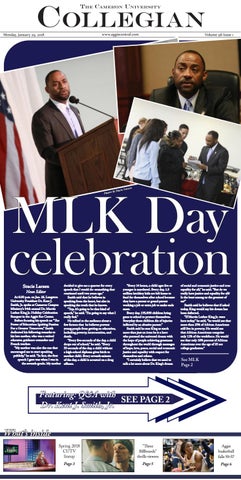
MLK Day celebration by Ph o t o s
Stacie Larsen
decided to give me a quarter for every speech that I would do--something that News Editor continued until two years ago.” At 6:30 p.m. on Jan. 16, Langston Smith said that he believes in University President Dr. Kent J. speaking from the heart, but also in Smith, Jr. spoke at Cameron Campus speaking the truth that he knows. Ministry’s 34th annual Dr. Martin “Yep, it’s going to be that kind of Luther King Jr. Holiday Celebration speech,” he said. “I’m going to say what I Banquet in the Aggie Rec Center. really feel.” Before focusing his speech on “The He talked to the audience about a Power of Education: Igniting Passion few factors that he believes prevent For a Greater Tomorrow,” Smith young people from getting an education, dedicated his following remarks to including poverty, incarceration, and his late mother, who was a retired death. educator, guidance counselor and “Every five-seconds of the day, a child French teacher. drops out of school,” he said. “Every “My mother was also the one that 55-seconds of the day, a child without encouraged me to start speaking a high-school diploma gives birth to publicly,” he said. “In fact, the first another child. Every seventh-minute speech I gave was when I was in of the day, a child is arrested on a drug the seventh-grade. My mother offense.
S t ac ie
La r s e n
“Every 14 hours, a child ages five or younger is murdered. Every day, 1.3 million latchkey kids are left home to fend for themselves after school because they have a parent or grand-parent working a job or extra job to make ends meet. Every day, 135,000 children bring guns to school to protect themselves. Everyday three children die of injuries inflicted by an abusive parent.” Smith said he sees King as much more than just an icon: he is a hero who pursued the universal dream with the hope of people achieving greatness throughout the world through messages of hope, love, peace, social and economic justice and equality with respect for themselves and others. “I certainly believe that we need to talk a lot more about Dr. King’s dream
of social and economic justice and true equality for all,” he said. “But do we really have justice and equality for all? Is the least among us the greatest of us?” Smith said he believes that if asked today, King would say his dream has been deferred. “If Martin Luther King Jr. were here today,” he said, “he would see that more than 25% of African Americans still live in poverty. He would see that African Americans comprise only 11% of the workforce. He would see that only 18% percent of African Americans over the age of 25 are college graduates.”
See MLK Page 2
Featuring: Q&A with SEE PAGE 2 Dr. Kent J. Smith, Jr.
What’s inside Spring 2018 CUTV lineup
“Three Billboards” thrills viewers
Aggie basketball falls 59-57
Page 3
Page 5
Page 6
News
2 MLK
January 29, 2018
www.aggiecentral.com
continued from page 1
Smith said King would see the reality of African Americans is removed from the dream. “He would see that according to the Black Aids Institute, nearly 600,000 African-Americans are living with HIV and another 30,000 become infected each and every year,” Smith said. “He would see that 43% of all American babies are African-American.” “And the sad travesty is that over 93% of the murders of African Americans are done by other African Americans.” Smith said it’s easy to point out what’s wrong with the world, but it’s hard to know how people move forward and improve as a society, given the state of the country. For starters, he thinks that it’s important to get to know King on a personal level, beyond his famous speeches or what the media tells. Smith said that he believes that King’s writings throughout his life will show how he evolved over time,
just like many of us do as we gain knowledge, thoughts, and experience. He also suggested that people focus more on three things: family, faith and education. Furthermore, people need to take care of each other. “The world has us believing that if you just work hard and just pull yourself up by your boot straps, you can make it,” he said. “But what if you don’t have boots? How do you do that?” He said the answer is an education. However, he said that the world has some universities believing that if they find all the highschool graduates they can with the highest SAT scores and best grades and give them an education, once they graduate college, the universities will have accomplished something great. “Do you want to know what success looks like to me?” he asked. “Take the kid that didn’t know that they had a chance to go to college. Take the kid that
didn’t know their parents. Take the kid that has to pay for their own school, and get them to graduate across that stage.” He said that people need to focus on helping “the lowest of the low” become “the highest of the high.” “That’s what Dr. Martin Luther King’s dream to me really meant in terms of equality for all—not just for those that are blessed with great opportunities,” Smith said. Following Smith’s remarks, Award Committee Chairman Rev. Phil Jones presented the Humanitarian Service Award to Retired U.S. Army Chief Warrant Officer Thomas Perry. Then, the audience sang along with Kortney Smith’s rendition of “Lift Every Voice.” The evening concluded with a benediction from Bishop James G. Nunn, and event attendees lined up for a meet and greet with Smith including photo sessions and autograph signings.
Questions Not a day off and Answers CU students honor Kent J. Smith, Jr. MLK day of service What are some things that people can do to keep Martin Luther King’s legacy going?
Clearly, Dr. King was a high character guy, so being thoughtful about what we do, day in and day out, how we interact with others … This is going to sound like a cliché, but the reality is simply being kind … When you think of giving, you actually receive so much in return.
What does it mean to speak at Cameron in honor of Martin Luther King? In the last six years, this is only my second one [speech] —intentionally. I don’t feel worthy to speak at MLK events because when I think of how significant MLK has been to our society. I feel like I need to do a whole lot more to achieve and to assist in the field of education to qualify myself to be able to speak. I understand that I’m the university president, certainly of being the only HBCU (Historically Black Colleges and Universities) in the State of Oklahoma. I get the significance of that, but I think MLK ironically is one of those often misunderstood individuals … we know ‘I have a Dream.’ We know ‘Letters of from the Birmingham Jail,’ … but we don’t see some of the other interesting facets of MLK and some of his trials and tribulations and some of the value sets.
What’s something people should take away from MLK Day? If I could pick one thing, I would say in giving back to your fellow man or fellow woman and doing something for others. I can’t iterate that enough. To me, we’ve become as a society, all about us as individuals: “I want what I want.” As a parent, I certainly hear that from my children, but I think we have to get out of that mentality and get more into “what can I do for others…” When we learn to give, again, we actually receive far more back.
Do you think that the rise of social media has contributed to an individualistic society? Oh, I do, absolutely. That’s part of what I’ve talked about in this session. Nowadays, we’re rearing kids to believe that they are the center of the universe and that everybody can win … And, guess what? They are believing it. They are acting that out. Now, they are older … They are in the workforce, and we are going ‘What in the world is happen-
ing?’ Well, ‘us’ has happened—because we told them that everybody is special and everybody gets something.
Photos by Emily Lepien
January 29, 2018
www.aggiecentral.com
Student Life
3
CUTV lineup returns with his professors and always been my fellow students. favorite thing, and Managing Editor “I enjoy hosting [the [my] family memories @cheyenneccole show] because I love [are] just watching sports and enjoy getting films together.” This semester, the experience in filming This spring is senior CUTV lineup features games,” he said. “Plus JRMP major Kerry student-produced shows I get to meet and including “Film Geek,” “Game Schoonaert’s fourth and become familiar with Time” and “Random Randa.” final semester directing “Film all the athletes at Geek.” Film Geek Cameron.” New episodes of “Film Sophomore journalism Turrell will Geek” premiere on Tuesdays on and media production follow the Aggie aggiecentral.com. (JRMP) major Caitlin tennis, softball and Game Time Anders will produce and host baseball seasons Junior JRMP major Markel “Film Geek” for the second and potentially Turrell is at the helm of “Game semester in a row. Time” this semester as the producer Anders said she wants to continue working on the show and anchor, covering all things Aggie sports. because she enjoyed it last Turrell is an avid sports fan who semester. loves to attend Cameron games and “[The] first semester, it discuss sports was more of an experiment
Cheyenne Cole
because I was used to working in the studio as a crew member,” she said, “but I wasn’t used to actually producing my own show, so it was really just testing the waters and seeing what I’m comfortable with.” In a typical “Film Geek” episode, Anders reviews a movie still in theaters and shows the audience upcoming movie trailers. Sometimes, she invites a guest to discuss the movie with her. “I talk about my personal opinion on it,” she said, “not to sway the opinion of the audiences watching, but to explain to them my point of view, my criticism.” For Anders, film is not just a hobby – it’s her passion. “Films have always been such a big part of my life,” she said. “Growing up, it’s
interview Cameron athletes on “Game Time” this spring. According to Turrell, the show will retain its classic format. “You can expect to see highlights from the Cameron home games and game recaps from all away games,” he
said. An aspiring sportscaster, Turrell looks up to Chris Fowler and Stephen A. Smith. “They [Fowler and Smith] are very smart reporters and broadcasters who didn’t have to be former professional athletes to do their job,” he said. New episodes of “Game Time” premiere on Wednesdays on aggiecentral.com.
Random Randa
The show is named after its producer and host, senior JRMP and public relations major Miranda Fritts, whose personality is incorporated into the show. In each episode, Fritts discusses different topics, sometimes with guests, and tries to keep it lighthearted and silly because she sees the show as a break from
reality. “I don’t like to talk about super harsh issues or politics because I want it to be something fun – something that people can enjoy – and escape from any hard things they’re having to think about – school or their life,” she said. After hosting the show last semester, Fritts decided that she wanted the show to concentrate not just on herself, but on other Aggies and their experiences this spring. “I want to focus more on the students now that everybody knows who I am and that I’m kind of a crazy person,” she said, “so hopefully I can get them involved in my craziness, and we can have a crazy good time.” To accomplish that goal, Fritts is also adding preproduced segments, in which she attends on-campus events to get student feedback, to “Random Randa” this semester. “I want to be able to go to an event and ask students how they feel about it and be able to document that and bring that into my show and then have one of the PAC members there so we can talk about it and what they have going on,” she said, “so people are more aware of what we have going on than say just what we cover on CU News.” Senior JRMP major George Weaver directs the show. New episodes of “Random Randa” premiere on Fridays on aggiecentral.
A guide to spring 2018 CUTV programs
Random Randa
Featuring Miranda Fritts
Fridays on Aggie Central
Game Time
Featuring Markel Turrell Wednesdays on Aggie Central
Film Geek
Featuring Caitlin Anders Tuesdays on Aggie Central
Student art therapy Madison Lyda
During the workshop, Dutton spoke about the importance of art Student Life Editor and how effective it is in everyday @maddilinee life, along with its significance in managing emotions. On Jan. 19, Student Support She mentioned that art is one Services hosted their first relaxation of the most suggested forms of event of the semester on the fourth therapeutic activities by therapists. floor of North Shepler. After the introduction, students Student Support Services offers chose from a variety of art materials a line of workshops designed to help provided. build basic academic skills while Dutton described the purpose learning key tricks and methods of relaxation through different fields of of the art materials and the myriad of ways individuals can use them to therapy. achieve a certain look. Freshman Guidance Specialist She said the art workshops are Cathleen Dutton hosted the event. extremely important for student Her role within the program is to development. help students adjust to and maneuver “We provide these workshops to college. the students so that they can explore Dutton has hosted many themselves on a more personal workshops for Student Support level,” she said. “It helps with their Services in the last few years, while also teaching a variety of subjects on emotions and provides them with an outlet to eliminate any negative campus. stress that they may be going The event started with a short through.” speech by Dutton who described Each workshop held by Student the important aspects of using art as Support Services offers a therapy during stressful times. different way to relax and ease She described how various the tension school can make types of art can help ease different students feel. forms of ailments, such as stress, Sophomore accounting depression, fear and loneliness.
major Jeannie Adams attended the relaxation event and said that the workshops offer many interesting techniques. “They are different and give me a sense of relief from the school week,” she said. “I enjoy them a lot. I feel that they teach me really important ways to cope with my stress.” Student Support Services offers a different workshop every week during the fall and spring semesters. For more information about getting involved, contact Student Support Services at (580) 581-2352.
Graphic by Madison Lyda
CU News
Featuring the CU News crew Fridays on Aggie Central
4
Voices
January 29, 2018
www.aggiecentral.com
Carrot & Stick:
How universities encourage cheating Katie Livingston
The format that most schools use to incentivize learning is a simple reward system. Staff Writer Students who master the material well According to The Boston Globe, about 75% enough to make good grades are rewarded with of university students admit to cheating, in some a high GPA, passing the class and sometimes form or another, during their academic careers. receiving awards or scholarships. The consequences for those caught are harsh. Students who do not make good grades Deterrents against academic misconduct are suffer the consequences. iterated repeatedly: how morally reprehensible This system teaches students to use external cheating is, how students are only hurting motivators as their driving force. themselves, how the consequences are dire. However, when students are using extrinsic The assumption is that all of the motivators, there is no real incentive for truly responsibility for solving this problem rests learning the material, because the result (good upon the shoulders of the individual student. grades) is valued over the process (actually Students who cheat must be amoral, must not learning material). take their education seriously, must be in the In this system, it does not matter whether wrong. the student truly understands the material as Consequently, all of the university’s energy long as their final grade is high. goes into trying to change students’ behavior by On the flip side, while good grades are convincing them not to cheat. treated as reward, bad grades are treated as All the while, cheating is being encouraged punishment. by the universities themselves. This teaches students that failure itself is At first, this might not seem to be the case. negative and something that is meant to be With all the pomp and flair about how morally avoided. bankrupt cheating is, it does not seem possible This mentality is in stark opposition to the that these institutions are encouraging it. learning process, which relies on failure in order But it is their actions that encourage to achieve mastery. academic dishonesty, not their policies against it. Failure is a fundamental part of learning. Studies conducted by behavioral economist It is through the process of trying, failing, Dan Ariely suggest that all of us are willing to analyzing the failure to see what went wrong, cheat under the right circumstances, no matter and attempting again after understanding the how pious we might seem. mistake, that we truly learn. As it turns out, the structure of universities School, then, does not actually value make them prime breeding grounds for learning. It values perfection. dishonesty. This can create a powerful fear of failure in Chief among these structures is the students, yet another incentive to cheat in order motivational system for academic success. to hedge their bets. There are two kinds of motivators in life: In the mind of the student, as long as they get intrinsic and extrinsic. Both are inherent in the that “A” it does not matter. university setting. The solution to the problem, then, must Students who have intrinsic motivation go deeper than lecturing students on how find their motivation for doing well on course important it is to refrain from cheating. content internally. Their motivation usually The answer we need may lie in how school stems from an interest in or love of the subject. was taught before the education system as we These students seek to do well not because know it sprung up. they will receive an “A”, be considered a smart Though there is much debate over whether student or be liked by their teacher. school was directly influenced by or modeled They do well because they are interested and after the assembly line system that marked the personally invested enough in the course to have Industrial Revolution, there is no doubt that the motivation to study and absorb the material. standardized education became more relevant This is the preferable form of motivation. during this period of time. It is also not the motivation that most The reason for this was that, before the students adopt, and it is certainly not the Industrial Revolution, there was little need motivation that universities encourage. for a standardized education for the masses. About Us
The official student newspaper of Cameron University, The Cameron Collegian is available each Monday during the year. It is printed by the Lawton Constitution. The first issue is provided for free. Each subsequent issue is $1.50.
Our Views
The opinions expressed in The Collegian pages or personal columns are those of the signed author. The unsigned editorial under the heading “Voices” represents the opinion of the majority of the editorial board. The opinions expressed in The Collegian do not necessarily represent those of Cameron University or the state of Oklahoma. Our student media are designated public forums, and free from censorship and advance approval of content. Because content and funding are unrelated, and because the role of adviser does not include advance review of content, student media are free to develop editorial policies and news coverage with the understanding that students and student organizations speak only for themselves. Administrators, faculty, staff or other agents shall not consider the student media’s content when making decisions regarding the media’s funding or faculty adviser.
Education was, instead, handled by families or A question is posed and then the class is tradesmen and their apprentices. guided by students’ research and ideas. The whole education system was based Instructors guide students through the trial around the craftsmanship model. and error process necessary to understand what It was unnecessary for students or might work and what would not. apprentices to learn the myriad of skills required This approach actively engages students in today. Instead, it was only necessary that they the learning process, teaching them much more learn one skill and learn it very well. than the dry memorization of facts would. The interesting thing about this Another suggestion might be increasing methodology is that there was no grading scale independent study courses. needed. The structure of independent study is The merit of an apprentice was not based on fundamentally different than that of classroom how well they performed their task the first time learning. around, but on how much they improved in said It gives the students the power and task over time. responsibility to take the learning process in Perfection was not expected immediately. In their own hands with the help of a professor to fact, it was not expected for a very long time. guide them in exploring their own ideas and Apprentices would often practice their insights. craft for decades before they could perform it This kind of control might be more masterfully. reasonable for the student, but greater The suggestion here is not that we dismantle responsibility and ownership of the learning the entire process will also facilitate education system a greater mastery of the “It is through the process and go back to material. hammering metal Unfortunately, the way of trying, failing, in blacksmith the education system is analyzing the failure to shops, but that set up does not favor these see what went wrong, and methods of teaching. we take a hint from how people Monetarily speaking, attempting again worked back universities run on the after understanding when mastery revenue derived from the mistake, that we of a skill was the general education courses most important that herd in masses of truly learn.” thing needed to students and do little — Katie Livingston survive and thrive to help them effectively Staff Writer in the job market. comprehend the subject Let us take matter. the emphasis Tampering with these off of the grade itself and instead emphasize systems would also tamper with revenue the process of failure, analysis and, ultimately, streams. learning that will truly help students succeed. This makes it easier for university Some practical suggestions for doing this administrators to tackle the problem of cheating include classes and workshops focused around by simply reinforcing the carrot and stick answering big questions, along with more method: increasing the incentives for making independent study classes. good grades, and likewise the punishments for Some universities, such as Worcester those who are caught cheating. Polytechnic Institute, have done small scale However, until university administrators face testing on a new style of classes, yielding great the heart of what is driving students to cheat, results. and address the faulty values at the core of our Rather than focusing on memorizing facts education system, they can be sure that nothing and information to do well on tests, these classes will change. focus on getting the student to try and find Students who cheat will continue to cheat, answers or solutions to big problems that the and all students’ educational experiences will world is facing. continue to suffer.
THE CAMERON UNIVERSITY
COLLEGIAN
Letters Policy
Founded in 1926 veritas sempiterna
Letters to the editor will be printed in the order in which they are received and on a space available basis.
Editorial Staff
The Collegian reserves the right to edit all letters for content and length. Letters should be no more than 250 words. Letters from individual authors will be published only once every four weeks.
Managing Editor - Cheyenne Cole A&E Editor - Sarae Ticeahkie News Editor - Stacie Larsen Sports Editor - Drue Watkins Student Life Editor - Maddie Lyda Voices Editor - Payton Williams Copy Editor - Drue Watkins Aggie Central Editor - Jeff Larson Social Media Editor - Kerry Schoonaert
Newsroom Staff
Financial Officer - Susan Hill Staff Writers - Zack Crow, Miranda Fritts, Robert King, Katie Livingston, Justin Rose, Trevin Stevenson, Markel Turrell Advertising Manager - Cheyenne Cole Faculty Adviser - Mr. David Bublitz
All letters from students should include first and last names, classification and major. No nicknames will be used. Letters from people outside the Cameron community should include name, address and phone number for verification. Letters can be sent by regular mail, by e-mail to aggiecentral@cameron. edu or they may be dropped off at our office - Academic Commons 101 or at www.aggiecentral.com.
January 29, 2018
www.aggiecentral.com
Reel talk:
A&E
5
Anger and honesty in ‘Three Billboards’ Payton Williams Voices Editor
@YoureSoVanya
Anger makes things happen; it is a great provocateur. It motivates, creates and destroys in equal measure. Many movies incorporate anger as a storytelling device. It’s an obvious choice. It moves the plot along while adding intensity to the atmosphere, but few movies are really about anger in the way “Three Billboards Outside Ebbing, Missouri” is. The plot centers on Mildred Hayes (Frances McDormand), a tough divorcee angry that the local police chief Willoughby (Woody Harrelson) has slowed down the investigation into the murder of her young daughter. The film opens as Hayes makes a decision that gives her anger form and direction. She buys out three dilapidated billboards on the outskirts of town and uses them to send a message to chief Willoughby: “How come?”
Mildred’s act of protest seems simple enough, but Martin McDonagh’s carefully devised script about the visceral poetry and destructive power of anger unfolds in so many unpredictable ways that watching the film is akin to a sucker punch – animal and direct in ways that leave the viewer shaken up. I have not been this surprised by the turns a movie has taken in years and perhaps never by a movie I’ve experienced in a theater. The reason for this surprise is that few films are quite so driven by their characters. Every plot point is fluid, depending entirely on the personalities of the people involved to hold the thread together. To that end, this film has some of the most complex and real characters ever presented on camera. McDormand gives a particularly powerful performance. In a world full of poorly drawn female characters in the media, McDormand feels like a reckoning, an angry force of nature with the power to intimidate and destroy anything that stands in her way. I struggle to think of any character
presented in any media that felt more realistically battle hardened and tough than McDormand’s Mildred Hayes. The supporting cast is just as impressive. Harrelson plays his role with a tenderness and understanding I have never before seen in one of his performances, and Sam Rockwell, whose talent for playing complex, abrasive and funny characters has been shamefully little used in his recent films, gives one of the greatest performances of his career as Jason Dixon, a cop with a horrifying violent streak. Every element of the film is held together by McDonagh’s powerful writing and direction. Anger is hardly a new subject for McDonagh, who has been a successful playwright for most of three decades, but in this film, he elevates anger to something spiritual, hard and mean. It seems almost to spring up from the sun-beaten dirt of the small Missouri town, bringing retribution and tearing everything it touches apart. Like any great work of storytelling, the
film does not pass judgement on the events it shows. It does not feel as though anger is either good or bad but views it simply as a tool many people use to make sense of the terror of life. There is ambiguity to the story and to the characters because there is ambiguity in life. Life doesn’t provide answers. Life provides events, and our reactions to those events define who we become. In this sense, McDonagh’s powerful work of art is one of the best films ever made on the subject of humanity. It displays a world that is not defined by good and evil but by the choices people make when faced with the chaos of life. The movie unfolds as an experience. It is more direct and honest than any film I saw in 2017, and it has stayed with me since I first saw it. It is the rare film that feels real in its depiction of people and one of the best films I’ve seen in many years.
Tribune News Service
And the award goes to: The cast and crew of “Three Billboards Outside Ebbing, Missouri” take the stage during the 24th Annual Screen Actors Guild Awards at the Los Angeles Shrine Auditorium and Expo Hall on Jan. 21. The dark comedic drama puts emphasis on how humans deal with real world issues.
Magic Lantern screens 1966 western classic Drue Watkins
comprised mainly of students that come together to watch classic, revolutionary Sports Editor films that have massively impacted the craft of filmmaking over the years. At 6:30 p.m. on Jan. 19, the Magic However, the events are always open to Lantern Film Society held a public the general public. viewing of the spaghetti-western film This semester also marks the society’s “The Good, the Bad, and the Ugly” in the 36th year at Cameron University. CETES Conference Center Room A. One of the organization’s faculty The film is directed by Sergio advisors, Professor of English Dr. John Leone and stars long-time actor Clint Morris, said the Magic Lantern Film Eastwood. After its release in 1966, the film garnered $25 million Society is about introducing students to dollars at the box office. a different type of art. “The mission of the society is similar The Magic to the mission of the plays produced by Lantern Film Theatre Arts… cultural enrichment Society is of the CU student body and greater a group Lawton/Ft. Sill community,” he said. “Over the years, Magic Lantern has screened some of the greatest films ever made in various genres, providing both great films, many with educational value, and good entertainment for no admission charge. “We hope that these functions have had a positive and worthwhile effect on students and the surrounding community, supplementing the university’s educational mission.” President of the Magic Lantern Film Society senior English and business major Zoie Timothy said the organization brings great opportunities to all students on campus. “It allows students to view and appreciate movies that they’d never see or hear from on their own,” she said. “People can see and understand Graphic by Sarae Ticeahkie
why these films are so inf luential and significant.” “The Good, the Bad, and the Ugly” is the Magic Lantern Film Society’s first movie screening of the spring semester, and due to an increase of funding from the Lectures and Concerts Committee and the CU Foundation Account for Classic Films, the organization will be able to screen three more films throughout the semester at their usual time of 7:30 p.m. Morris said the additional funding has been instrumental in the Magic Lantern’s capabilities to branch out this year. “We hope that in future years Magic Lantern will be able to realize additional funds from the Holmes, Morris, and Newell Endowed Lectureship for Classic Films,” he said. “Our goal is to return to screening ten films per year, five per semester.” The Magic Lantern Film Society is actively searching for new members and welcomes any students who appreciate classic films. Morris said the organization would love to expand its inf luence, but new students are required for that to happen. “We are very interested in new members,” he said, “and we’re easy in that regard: there are no dues. Anyone who is interested can help us with putting up f liers, making the popcorn and treats and cleaning up; obviously, anyone who is a member is also welcome to join our selection meeting and help make choices for future films.”
The selection process for which movies will be screened is decided primarily by the members of the Magic Lantern. However, Morris said the organization does take requests. “Magic Lantern has always solicited input for the films we show from the people who attend,” he said, “and we try to honor requests made. “In all, four of the films we’re screening this year were requests. We have shown a number of westerns over the years, and this [“The Good, the Bad, and the Ugly”] is one of the great ones, even though the director is an Italian and the film was shot in Spain.” Timothy said the organization is trying to branch out into new activities. “We’re trying to start film discussions on the movies that we watch about a week after,” she said. “Topics about why the film was interesting for certain students, what it does well and how it’s impactful.” The next film that the Magic Lantern Film Society will screen is the 1953 Audrey Hepburn and Gregory Peck classic “Roman Holiday” at 7:30 p.m. on Feb. 9 in the CETES Conference Center.
Sports
6
January 29, 2018
www.aggiecentral.com
Photos by Krista Pylant and Mike Mazzo
Aggies fall to Pioneers in nail-biter By Drue Watkins Sports Editor
At 2 p.m. on Jan. 21 in the Aggie Gym, the Cameron women’s basketball team lost in close fashion against Texas Woman’s University (TWU), 59-57. The Aggies now sit at a 7-11 overall record on the season, and a Lone Star Conference record of 5-5. The TWU Pioneers, however, move up to 7-9 overall and 4-6 within the conference. The game revolved around defense from start to finish, with neither team’s offense really heating up until the fourth period. Cameron junior forward Lejha Smith led the Aggies in scoring with 15 points and recorded her sixth double-double of the season. Cameron head coach Emma Andrews said Smith has had a huge impact on the team this year. “She brings a lot of grit under the rim,” she said, “and brings tons of confidence to the team. She’s a great rebounder and just knows how to make her presence known.” Cameron sophomore guard Ava Battese and junior guard Parfitt McNair also claimed their own double-doubles for the team, each scoring 12 and 11 points respectively. For TWU, senior forward Alexis Nezianya led the Pioneers with her own double-double, matching 16 points and 11 rebounds. The game started out slowly for both teams. Defense ruled the opening
minutes of the first period, with turnovers and coldshooting dominating both sides. The Pioneers finally broke the stalemate with a layup, but could not manage to keep that streak going. After a strong five-point run, the Aggies finished the first period up 15-13, carrying some momentum into the second. However, that momentum became quickly stifled, as the offensive woes for the Aggies unraveled with their inability to score consistently. The Pioneers took full-advantage, ending the second period with their own five-point run and outscoring the Aggies 15-9 in the period. Nezianya scored three consecutive baskets, allowing TWU to take the lead into halftime, 28-24. The first half consisted of rough play for both offenses, as the Aggies shot field goals at a rate of 34.6% and the Pioneers at a slightly better 40%. Both teams turned the ball over 12 times, and both teams also claimed 19 rebounds. The third period saw the Pioneers dominating for the first few minutes, scoring nine unanswered points. The cold streak from the Aggies put TWU up with the largest lead of the game at 11 points with two minutes to go. Despite two free throws from Cameron senior guard Briana Underwood to finish the period, the game headed into the fourth with the
Aggies down 43-36. The fourth period started with the Aggies’ offense rallying to a 9-1 run, putting them within the striking distance of one possession. With 1:54 to go, the Aggies tied the game 55-55 after Battese sank a three-pointer. The Aggies then retook the lead for the first time since the second period, 57-56, after two consecutive free throws from junior guard Amaka Nwakamma at the 30 second mark. However, Nezianya retook the lead for the Pioneers with a layup, and the Aggies’ retaliatory, game-winning shot rolled off the rim. A foul from the rebound of the missed shot saw Nezianya go 1-2 from the line and win the game for TWU as time expired. Andrews said she was not disappointed in the team. “The girls did a good job filling the gaps we had from injuries,” she said. “Nobody gave up and we’ve learned a lot from these tight game situations. It was a hard loss, but the team put in
really good effort with the 11-point comeback.” Cameron had fewer turnovers and more rebounds at the end of the game, but more consistent shooting from the Pioneers gave TWU the win. The Aggies visit Tarleton State at 5:30 p.m. on Jan. 25 for their next conference match-up. The Tarleton State Texans sit at 12-6 overall and 6-4 in conference play. Andrews said the preparation for Tarleton State is not much different from how the team prepares for anybody else.
“Every team is a little different, but we’ll prepare how we always do,” she said. “We will use our
practice opponents to make adjustments on defense, and try to figure out who we will give shots up to.”
CU athletes make Commissioner’s Honor Roll By Drue Watkins
Courtesy graphic
Sports Editor
Following the 2017 fall semester, 60 Cameron University studentathletes made the Commissioner’s Honor Roll within the Lone Star Conference (LSC). The Commissioner’s Honor Roll recognizes student-athletes of various universities from the conference for outstanding educational achievement combined with active sports involvement. Student-athletes qualify based on grade point average (GPA), and in order to be eligible for the honor roll, they must have a minimum 3.30 GPA and be on a roster.
28 of the 60 qualified Aggie athletes acquired a perfect 4.0 GPA for the semester. Out of the entirety of the LSC, 1,213 honorees joined, and only 330 had 4.0 GPA’s. The university with the highest number of recognized students is Texas A&M-Commerce with 160. Softball led the number of Cameron students with 16 total honorees, five of which had 4.0 GPA’s. Women’s basketball and volleyball came in second with seven honorees overall. Men’s cross country claimed six honorees, while women’s golf, men’s golf and women’s tennis each had five. Men’s tennis included four students, with baseball and men’s basketball each having three selections.