COLLEGIAN THE CA M ERON U N I V ER SIT Y
Informing the Cameron Family Since 1926
Monday, November 2, 2009
Variety
Volume 84 Issue 9
Tour highlights campus arbor By Rashmi Thapaliya Collegian Staff
Leader Dog: New member of CU staff. SEE PAGE 8
A&E
William Schlecht, CU’s first Biological Education major, has developed a tree tour of the Cameron campus under the supervision of Dr. Michael Dunn, associate professor of biological sciences. The tree tour was designed to meet the requirement for graduation; candidates are required to design and complete a biology education project. “Dr. Dunn approached me with this project and it appealed to me,” Schlecht said. “Trees really make good subject matter to get people interested in biology.” The Oklahoma State Regents for Higher Education approved the Biology Education degree at Cameron University in 2007. From the existing trees on Cameron’s campus, 18 trees were chosen for their ethnobotanical, economic or aesthetic value. Each tree is marked by a plaque that indicates the route of a one-mile trail through the Cameron Green. The Cameron Tree Tour is a walking tour that provides educational, recreational and physical fitness opportunities while taking advantage of the existing arboretum on the CU campus. In addition to identifying the trees on the tour, Schlecht also developed a brochure that provides basic information on each of the trees, which are designated by numbered plaques that correspond to the accompanying brochure. Tree tour brochures are available in the Department of Biological Sciences in the CU Sciences Complex, the Student Activities Building, One Stop in North Shepler and the Office of Public Affairs, located in Room 150 of the Administration Building. The tree tour starts with a Maiden Hair tree in front of Shepler Center and follows a route that concludes with a Redbud on the north side of the Fitness Center. In between, visitors will find the Eastern Red Cedar, Silver Maple, Green Ash, Mimosa, Sweetgum, Cottonwood, Sycamore, Chinkapin Oak, Golden Rain, Red Elm, American Elm, Bald Cypress, Texas Live Oak, Mistletoe, Crabapple and Western Soapberry. “I was nervous at first when I started the project,” Schlecht said. “But after getting started, it went well.” Originally pursuing a degree in History with an eye toward teaching, Schlecht changed his major to Biology after taking Principles of Biology in Spring 2007. When the Biology Education program was implemented, it was the ideal program for the aspiring teacher who discovered a passion for biology. He credits Dr. Dunn, Associate Professor of Biological Sciences, for igniting that passion.
Photos by Jim Horinek
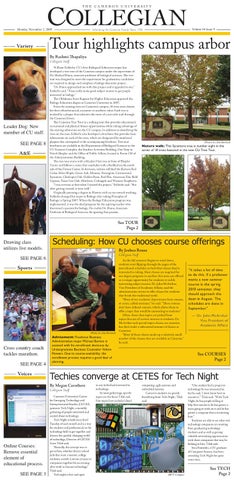
Nature walk: This Sycamore tree is number eight in the series of 18 trees featured in the new CU Tree Tour.
See TOUR Page 2
Drawing class utilizes live models.
Scheduling: How CU chooses course offerings By Joshua Rouse Collegian Staff
SEE PAGE 6
Sports
Photo by Jim Horinek
Cross country coach tackles marathon. SEE PAGE 4
Voices
Advisement: Freshman Business Administration major Michael Benton is assisted with his enrollment decisions by Undergraduate Business Counselor Velton Flowers. Due to course availability, the enrollment process requires a good deal of planning.
Collegian Staff
SEE PAGE 3
“It takes a lot of time to do this. If a professor wants a new seminar course in the spring 2010 semester, they should approach the dean in August. The schedules are done in September.” — Dr. John McArthur Vice President of Academic Affairs
See COURSES Page 2
Techies converge at CETES for Tech Night By Megan Carothers
Online Courses: Remove essential element of educational process.
As the fall semester begins to wind down, students start flipping through the pages of the just-released schedules to find what classes they’re interested in taking. Most classes are required for one degree program or another, but some are offered as a unique opportunity for students to tackle interesting subject matter. Dr. John McArthur, Vice President of Academic Affairs, said the administration strives to offer classes for students that break the traditional mold. “Most of our academic departments have courses, or series, called seminars,” he said. “These courses don’t have defined content, which allows them to offer a topic that would be interesting to students.” Often, these class topics are picked from topics that are of current interest to students. Dr. McArthur said special-topics classes are common but don’t make a substantial amount of classes at Cameron. “Most of these classes make up a relatively small number of the classes that are available at Cameron,” he said.
Cameron University’s Center for Emerging Technology and Entrepreneurial Studies (CETES) sponsors Tech Night, a monthly gathering of people interested and excited about technology. Tech Night is held every third Tuesday of each month and is a way for students and professionals in the technology field to get together and discuss the quickly changing world of technology, Director of CETES Arun Tilak said. “Basically, the concept was to get techies, whether they’re school kids that want a mentor, college students, outside Lawton citizens or companies together for an evening after work to discuss technology,” Tilak said. Tech night is free and open
to any individual interested in technology. At most gatherings, specific topics are the focus Tilak said. Past topics have included cloud
computing, agile systems and embedded systems. Cameron students are greatly benefitting from Tech Night, Tilak said.
MCT Campus
“One student had a project in technology he was interested in, but he said, ‘I don’t know how to execute it.’” Tilak said. “With Tech Night, he has people willing to help him execute it, he has gotten a team going to work on it and he has gotten a company that is mentoring him.” Students are able to see what real technology companies are wanting from graduating technology students and as well as getting valuable networking opportunities with those companies that may be looking to hire, Tilak said. Ivica Ristorski, a CU graduate of Computer Science, has been attending Tech Night for quite some time.
See TECH Page 2
2
News
November 2, 2009
TOUR continued from page 1 “After the first week of Principles of Biology, I was hooked,” Schlecht says. “Dr. Dunn introduced me to a world that I had always taken for granted, and I found myself fascinated with plant and animal life. I’m looking forward to passing that passion on as a high school teacher.” “I feel very fortunate to have William as our first Biology Education candidate,” Dr. Dunn said. “As one would
expect from a new program, we faced a few unforeseen challenges, but William is mature enough and so dedicated to teaching that he saw those potential problems as opportunities to learn. His excitement about teaching biology will make him a great biology teacher. If I was a high school principal in Southwest Oklahoma, I would be first in line to talk to him about joining my team.”
Dr. Dunn said that, as CU gets more and more Biology Education students, they will find more new projects around hospitals, the Wichita Wildlife Refuge and others. “In the Biology Education degree, we are working together with the Education department,” Dr. Dunn said. “But in the masters degree, it is more about your skills as an educator.” Schlecht said that he loves
teaching and has been teaching 8th grade science at Central Middle School as a part of his practical education. “I am interested in teaching in Comanche County,” Schlecht said. “I am preparing for OSAT (Oklahoma Subject Area Test) for Biology Education, which tests your knowledge of anatomy, geology, botany and other sciences as well.”
are interested in pursuing, Dr. McArthur said they should speak to the chair of the department the class would be held in. Adding a class to the schedule takes a substantial amount of work and time, but the ideas usually start with the department chair. “The chair, with supervision from the dean, puts together the course ideas and submits them for consideration,” Dr. McArthur
said. “It takes a lot of time to do this. If a professor wants a new seminar course in the spring 2010 semester, they should approach the dean in August. The schedules are done in September.” Special-topics courses are not unique to Cameron. Dr. McArthur said these classes are often used as testing grounds for class topics. If the interest is there, the classes can be
Photo by Jim Horinek
COURSES continued from page 1 In the past, some special-topics classes have turned into regular offerings. Dr. Pedro DiazGomez, a professor of technology, is trying to get his robotics course added to the curriculum. Dr. McArthur said there is precedence for adding classes to the yearly schedule, but there has to be substantial interest. “We had a seminar course in medical terminology so nursing
and medical students could learn the terms for their other classes,” Dr. McArthur said. “The class became so popular it became a regular course. The students could certainly use it because it benefits them later. But this is certainly a minority offering.” Most special-topics classes are offered only once, and the interest wanes if they are offered again. If students have a topic they
continued in some circumstances. The only way to gauge interest in a certain topic is to move forward with a class. “These classes aren’t a replacement for the core curriculum,” Dr. McArthur said. “But we want to have courses that are interesting to students and make the educational experience more pleasant.”
TECH continued from page 1
MCT Campus
Ristorski is currently working on a project in technology that Tech Night has assisted with. Ristorski said that having a place to discuss the current technology with professionals in the field and working on real life projects with their insight is very valuable experience. “Technology develops so fast now that, in order to keep up with the languages, we need to have something like Tech Night to help students learn more cutting-edge technology,” Ristorski said. Working on the project is done on a voluntary basis, and the one Ristorski is currently working on has seven students, Tilak and a local technology company working on it.
Ristorski said that Tech Night is a great way for people interested in the same area of technology to share their perspectives. “Tech Night is designed to share information and to share knowledge with people of the same common interests in technology,” Ristorski M CT said. Ca mp Tech Night has been a us monthly event since July, Tilak said, with attendance ranging from four to 20.
LSAT, GRE prep courses offered By Justin Cliburn Collegian Staff
See page 4 for solutions.
Cameron students planning on attending graduate school or law school face many challenges to being accepted into their school of choice, but they can get a head start on their preparation by taking Dr. Melody Huckaby’s LSAT and GRE prep courses on campus. Dr. Huckaby, Assistant Professor of Political Science, is offering the prep courses to anyone who asks, no matter their major. “Everyone is welcome to attend,” Dr. Huckaby said. “I hope to have a higher turnout than last year.” The prep courses are offered in the sixth floor lounge of South Shepler, and the times vary depending on what test is being studied. “Typically, I’ll start the GRE prep on Friday at nine or 10 and start the LSAT in the afternoon,” Dr. Huckaby said. “Because of the new class schedule, I’m conducting the course on Fridays rather than Saturdays, like last year.” The courses will cost students $20 per session, which is far less than what they can expect to pay for LSAT or GRE prep courses administered by companies like Kaplan, Dr. Huckaby said. “Students can pay up to $1,000 or more for a good prep course,” Dr. Huckaby said. “So I want to give them a more affordable alternative that will prepare them to do well and get accepted into their school of choice.” The GRE, or Graduate Record Examination, measures graduates’ skills in eight specific fields of study and is very generalized, according to the official GRE registration Web site. According to Dr. Huckaby, if students have thought about continuing their education after graduation and are interested in anything other than medical school or law school, the GRE is the test to take. The LSAT, or Law School Admission Test, specifically measures those skills that will make someone successful in the field of law. “The LSAT is based on more logical and verbal reasoning,” Dr. Huckaby said. “So students need to prepare for it differently than they would the GRE.” Dr. Huckaby offers her experience to students taking either exam because she has experience with both of them. “After my undergraduate degree, I took the LSAT and went to law school at the University of Oklahoma,” Dr. Huckaby said. “Later, I decided to go to grad school, so I took the GRE and went that route.” The first session of the fall was offered Oct. 23 and sessions generally take place every two weeks. Students can check their university e-mail for future dates or contact Dr. Huckaby directly at mhuckaby@cameron. edu. “I would prefer that students RSVP with me so I know how many materials to bring with me,” Dr. Huckaby said. “Once I know how many are interested, I can put together a more concrete schedule of sessions.” The Web sites of both the GRE and LSAT recommend that students complete the exams by December of their senior year if they plan on starting school the following fall semester.
Voices A new age in education
3
November 2, 2009
Online classes defeat purpose of interaction F
or many, the idea of school conjures thoughts of textbooks, rows of desks, long lectures and longing for summer vacation to return. Students fill classrooms to learn the skills that help them become better employees, better employers and better citizens. However, some traditional classrooms are becoming empty in favor of virtual classrooms as online classes quickly become a preferred method of education. The convenience of these classes is unparalleled. With no set meeting times, the students are free to learn at their own pace. In fact, with just a computer and Internet connection, a student can earn their degree without ever having to set foot in a classroom. While the upside is tremendous, there is a downfall to online degree programs. Students never meet and interact in person with other students, and they most likely never meet their professor either. I used to have a live and let live opinion of online courses, but that was before
Cameron began talking of offering degree programs administered entirely online. The coup de grace, however, was thumbing through the Fall 2009 course catalog and seeing Conf lict Management online. Online Aerobics was bad enough, but Conf lict Management? For anyone to learn to manage conf lict, there must first be conf lict. Anyone who has ever argued something over the Internet knows that conf lict in the cyber-world is not real. Virtually no one manages conf lict in the workplace in the same fashion that they would over an Internet connection. The class cannot effectively reach the goals outlined in the syllabus if there is no face-to-face conf lict to manage
Justin Cliburn
Kyle Luetters
in a successful manner. In an online course, you lose the ability to detect the tone and inf lection in someone’s voice. This is crucial in gathering the true meaning of one’s words, as phrases can have different meanings with just a change in tone. A student loses that when the classroom moves to the land of bytes and IP addresses. Online degree programs cheapen the educational experience of all involved. So much of the college experience is being exposed to ideas that are different than your own, people of different backgrounds and professors who challenge your preconceived notions. College turns a student into a scholar and encourages the scholars to get involved, preparing them for the interactions they will have in the real world. Degree programs offered entirely online rob students and professors of these experiences. Students in online courses never carry a classroom discussion into the hall after class, and the traditional students never get to hear the ideas of those students taking the course online. Professors who got into teaching to become mentors and lead students through transitions in
their lives lose the bonds they forge with students and vice versa. It may appear that this writer is very much against the idea of online courses in general, but that is not the case at all. I myself benefited from online courses just this summer. I was fortunate enough to get to produce Cameron University’s summer documentary. It was a total blast, but it required me to be on the road every weekend shooting and editing video during the week before taking off again. The freedom of an online course allowed me to complete my course work while in the motel rooms before or after shoots while I was hundreds or, in some cases, a thousand miles away from Lawton. I had to maintain six credit hours to remain in the dorms and an online course was the only way I was going to be able to manage that. I can see both sides of the issue, which is why I am posing a solution. For every course that is offered online, the department should be required to offer the same course in the classroom. Through this plan, Cameron expands their online offerings and still gives students the option of how they are going to take the course. I
wanted to take the Conf lict Management course but didn’t feel like I would fully benefit from taking it online. I felt that the principal of the course wasn’t going to be there, and that was face-to-face, human interaction — not a series of e-mails and blackboard discussion posts. Cameron should absolutely give their students choices, but only offering a class online makes me feel too much like I’m attending University of Phoenix.
THE CAMERON UNIVERSITY
COLLEGIAN Founded in 1926 veritas sempiterna
Editorial Board Editor-in-Chief - Joshua Rouse News Editor - Jim Horinek A&E Editor - Rachel Engel Sports Editor - Bennett Dewan Copy Editor - Justin Cliburn Back Page Editor - Monica Garner Digital Editor - Kyle Luetters Circulation Manager - Matthew Penick
Newsroom Staff Financial Officer - Susan Hill Staff Writers - Jeramy Edison, Saman Samii, Megan Carothers, Andrew Osbourne, Rashmi Thapaliya, Jacob Russell, Melissa Rogers.
Faculty Adviser Dr. Christopher Keller
Newswriting Students Brad Franks, Amanda Finch, Michael Faggett, Codye Watson, Rachel Engel, Amanda Phillips, Gabe Crawford, Alyssa Knerr, Anjana Prasain, Tammy Anderson, Hannah Muirhead, Tori Strecker, Taylor Thompson, Ifeoma Osanife, Anthony Foreman, Jessica Martinez, Jennifer Knapp, Tanesha Wilson, Stacy Hill, Aduke Adesida.
About Us
MCT Campus
The official student newspaper of Cameron University, The Cameron Collegian is available each Monday during the year. It is printed by the Times Record News in Wichita Falls, Texas.
Letters Policy
White House war on Fox News ill-advised, unnecessary MCT Campus Oscar Wilde once described fox hunting as “the unspeakable in full pursuit of the inedible.” What would he have said about Fox hunting? Perhaps “the ineffectual in full pursuit of the uncredible.” The Obama administration’s campaign to marginalize Fox News seems to us a case of badly misplaced priorities. With unemployment nearing 10 percent, with 10,000 Americans a day having been foreclosed upon in the second quarter, with two wars to fight, with the banking and insurance industries asserting their hegemony over Congress, with regulatory agencies more concerned with turf than protecting the American public, with a weak public option the best they can do on health care reform, is a Fox hunt really a good use of resources? The feud has been good news for Fox; the cable news network’s viewership is up 8 percent since Oct. 11, when White House Communications Director Anita Dunn told CNN that Fox News operates “almost as either the research arm or the communications arm of the Republican Party.” Top advisers Rahm Emanuel and David Axelrod and press secretary Robert Gibbs then
chimed in, and it became apparent that the White House was trying to “marginalize” Fox, suggesting that other news organizations shouldn’t follow Fox’s lead. And since Washington journalists like nothing better than to talk about their own importance, the issue has been bubbling merrily along ever since. Newsweek editor Jon Meacham this week suggested it might even be a back-door ploy “to give otherwise dissatisfied Democrats something to cheer ... (making) the White House seem more progressive than it is.” More news than ever is available to Americans, but the percentage of those who avail themselves of it is smaller than ever. The market for news has been segmented, like the markets for many other products. Generalinterest media like newspapers, network news and news magazines now compete with niche media targeted to specific market segments. Cable news networks are the largest of the niche media, and, of them, Fox has the largest
audience, about 1.2 million viewers across its broadcast day. And while it’s widely assumed that Fox’s “niche” is hard-core conservatives, a study done of broadcast news last year by the Pew Research Center for the People and the Press reported that’s not the case. Fifty-nine percent of Fox’s viewers reported that they believe all or a lot of what they hear on the network. Forty-one percent believe little or nothing of what they hear. CNN scored 70 percent in the top two believability categories. Fox scored just behind MSNBC, the “liberal” niche, and slightly ahead of the PBS NewsHour, the “elite” niche. Go figure.
Since that study was published, Barack Obama was elected president and politics has become more polarized. Fox News’ commentators — including Bill O’Reilly, Glenn Beck and Sean Hannity — gleefully have done their part, in some cases inciting the very protests that they then piously “covered” as news. Commentary is different from news and news is different from entertainment; viewers and readers should realize it. So should the president. So should Fox; if their people want to beat up on the president, they shouldn’t expect him to do them favors. Welcome to the NFL.
Letters to the editor will be printed in the order in which they are received and on a space available basis. The Collegian reserves the right to edit all letters for content and length. Letters should be no more than 250 words. Letters from individual authors will be published only once every four weeks. All letters from students should include first and last names, classification and major. No nicknames will be used. Letters from people outside the Cameron community should include name, address and phone number for verification. Letters can be sent by regular mail or e-mail to collegian@cameron.edu, or they may be dropped off at our office - Nance Boyer 2060.
Our Views The opinions expressed in The Collegian pages or personal columns are those of the signed author. The unsigned editorial under the heading “Our Voice” represents the opinion of the majority of the editorial board. The opinions expressed in The Collegian do not necessarily represent those of Cameron University or the state of Oklahoma. Our student media are designated public forums, and free from censorship and advance approval of content. Because content and funding are unrelated, and because the role of adviser does not include advance review of content, student media are free to develop editorial policies and news coverage with the understanding that students and student organizations speak only for themselves. Administrators, faculty, staff or other agents shall not consider the student media’s content when making decisions regarding the media’s funding or faculty adviser.
4
Sports
November 2, 2009
Coach runs Chicago’s prestigious marathon
Courtesy Sports Information/MCT Campus
By Jeramy Eidson Collegian Staff Cameron University cross country coach Matt Aguero recently participated in the internationally acclaimed Chicago Marathon. Aguero’s goal was to finish within the top 100. He fell just short of his goal; however, out of 45,000
runners, he placed 109th. Aguero is satisfied after placing so highly in such a large event. Aguero finished 100th out of 19,069 males and finished 50th in his age group of 24-29. “It was pretty exciting for me; I got to compete with some of the best runners in the world, including Sammy Wanjiru,”
Aguero said. Aguero got to meet and attain an autograph from Wanjiru, who took the first place prize. The Kenyan Wanjiru is most noted for winning the gold medal in the 2008 Beijing Olympics. The running conditions were horrid for the marathon, as any runner would tell you. But Aguero persevered, pushing through the 30-40 mile per hour winds and 30 degree weather. After the race, hypothermia set in on Aguero. He said after the race he was taken to the medical examination tent and had a body temperature of 95 degrees and was shivering. After covering up with blankets and sitting by a heater, Aguero overcame his chills and regained his natural body temperature. This winter, Aguero will begin training for the Boston Marathon, set to take place April 19, 2010. To prepare
himself for the 26.2 mile race, he will train strenuously, running 145 miles a week. “Normally I train about 20 weeks ahead to prepare for a marathon. I’d like to get up to 150 or 160 miles a week. The most I’ve ever done is 145,” Aguero said. Aguero, after running in the Chicago marathon, has decided he will not participate in the Windy City run again next year. Rather, he will attempt to run in the third of the “Big 3” and participate in the New York marathon. “Overall, I had a great time in Chicago. I met a lot of Olympians and a lot of cool people, but I’m not going to compete next year because I’m going to try and do the New York City Marathon instead,” Aguero said. Boston, Chicago and New York are considered the “Big 3.” Outside of the U.S. runs are the London and Berlin marathons.
Aguero’s placing in the Chicago marathon seems to have inspired and brought a spark to the CU cross country team as well. The Aggies finished 19th out of 29 teams at the Arkansas Chile Pepper Festival. The Aggies opted out of the small school race and decided to participate in the race for larger universities. The Aggies, with their 19th overall finish, topped some Division I programs in the race. On Oct. 24, the Aggies participated in the Lone Star Conference Championships, finishing fourth with sophomore Julius Korir finishing third overall and senior Josh Stewart finishing eighth overall. The team will look to Aguero’s finish to motivate themselves as they travel to Abilene, Texas to participate in the NCAA Division II South Central Regional
Men’s Golf looks to veterans for leadership By Joshua Rouse Collegian Staff After coming within two shots of winning a tournament this season, the men’s golf team is eying the spring season with hope. “We played well in the first and the fourth tournaments,” said head coach Jerry Hrnciar. “The middle two tournaments, we didn’t play as well as we should have. We have too much talent to play like that.” The team finished 10 out of 17 at the Territory Classic on Sept. 21 and 22, and 13 out of 18 at the National Preview Invitational the following week. The season
started out promising with a close tournament at the Charles Coody West Texas Intercollegiate where the team placed fourth out of 15. Hrnciar said they finished the fall season strong with a second place finish at the Texoma Championship on Oct. 5 and 6. He said part of the solid play came from Jason Timmis, a junior from Stoke-on-Trent, England. “He played the best and ended up finishing second in the last tournament,” Hrnciar said. “He’s played solid all year, and Garrett Smith stepped up and played well.” Timmis said the season could have gone better, but there were
some bright spots to look at. “The team hasn’t been great, but it hasn’t been bad,” he said. “We had a great last tournament and finished strong there, which should help us later.” The team is done until early March, when the spring season begins. Brett Leavell, a senior out of Elgin, said the individual players just want to make sure they stay fresh through the upcoming winter months. “We want to do as much as we can with the cold,” he said. “We’re not sure about the schedule for the spring, but we want to make sure we’re ready because they’re all
important.” This is Leavell’s last year with the team. He said he’s not sure if he’ll be able to continue with golf after he graduates, but it’s an ambition that he wants to pursue. “I’ve been doing this I was 13 years old,” Leavell said. “So I’ve been at it a long time. I might as well try to continue with it; it only seems right.” Hrnciar hopes Leavell and the other seniors perform better in the spring. Between now and then, he’s only allowed to work with the individual players sparingly but
wants to focus on each player’s weaknesses and improving on that before the start of the new season. “Our four seniors had off weeks,” he said. “This being their last year, they were pressing hard to do better.” Both Leavell and Timmis believe they can pull together over the offseason and come out swinging in the spring. Timmis said their ability to come together could determine how well they do when the season starts again. “We have a lot of potential,” he said. “If we can come together as a team, we have a chance of winning.”
Women’s golf plays hard rain or shine
Photo by Bennett Dewan
By Joshua Rouse Collegian Staff After their first tournament was rained out, the women’s golf team struggled to gain momentum through the rest of the season. “We only had a four tournament schedule this season. and that was before the first one got rained out,” said Rick Goodwin, head coach. “The next tournament came and we played poorly, but conditions were difficult.” Conditions were difficult throughout the season as the players contended with bad weather and other natural occurrences. The first tournament the team played in this year was the Lady Buff Stampede in Amarillo, Texas. The girls finished ninth out of 16 teams.
Goodwin said the performance was disappointing, but every team is going to have its bad moments. It’s how they come back that defines them. “I told them on the ride back that we were going to do it a little like football,” he said. “We were going to burn the film and move on to the next one. There is no point in beating ourselves up over what happened.” After a solid performance at the Lady Broncho Masters Classic, the team hosted the Oklahoma Intercollegiate for Women at the Territory Golf Country Club in Duncan, finishing ninth out of 13 teams. “Home events are tough because I’m all over the place,” Goodwin said. “I’m all over the place, and it’s difficult to host and coach at the same time. There isn’t a home field advantage in golf.”
The season wasn’t completely gloomy as the team set two school records during the Lady Broncho Masters Classic the week before. The team broke the school women’s lowest team round record with a 304 in the second round. They also broke the lowest two-round tournament score record with 610. Goodwin said the spring season will begin as soon as classes start, but he feels his players will be ready. “Right now, we want to move up in the conference,” he said. “Our ultimate goal is to qualify for regionals. But we want to get back in form.” This year’s women’s golf team features three freshman players. Goodwin thinks the first tournament getting rained out might have shaken some of the players up. But he said he’s been pleased with their play, especially Kylee Johnson. “It was a rough start for all of us,” he said. “But we had a good fall. We’ve had our flash of glory, now we’re ready to start moving forward.” Johnson knows she’s a newcomer to the team, but feels like the season went well for her. A graduate of MacArthur High School, she said moving from a high school golf team to the Cameron team was a challenge at first, but she likes what’s going on. “It takes a little bit of adjustments,” she said. “There’s better competition here though, which I really like.”
Johnson’s interest in golfing stemmed from her family’s fascination with the sport. Everyone in her family plays golf, watches golf and has golf memorabilia and equipment around their house. She said she’s been doing it since she was really little and is glad to continue playing while she’s in college. With the fall season over, she still wants to continue working out and plans on focusing on her bunker play. “If I can make the ups and downs better, I think I have a better chance of putting up better scores,” she said. For Kass McGrath, this is the last fall season she’ll play as a Cameron golfer. As one of two seniors on the team, many of the younger players look to her. She felt having freshmen on the team has really become a benefit. “These girls have come in, and both are playing well,” she said. “They did what they were supposed to do, and they’re on our starting squad, so that says something.” McGrath has mixed feelings about leading Cameron. She’s been on the
golf team for several years, but is facing the prospect of not playing competitively. She said she’d miss the competitive nature of the sport, but she’s not done yet. “I don’t know what’s going to happen in the future,” McGrath said. “But before I go, I really want to go to regional or nationals. That’s the big goal I’d like to achieve before I leave.” Goodwin is optimistic about the spring season. He said the most daunting hurdle the team will face is a trip to California, but the state is known for its nice weather, which is something Goodwin hopes to see more of. “The weather is traditionally questionable in the spring,” he said. “But you have to adapt and play with the conditions that you have. We want to make sure we get better and that’s our goal.”
Sports
November 2, 2009
5
Softball team debuts new look squad By Saman Samii Collegian Staff The Cameron Aggie softball team is looking strong. With many new high caliber recruits and the experienced returning players, the sky could be the limit for their success in the upcoming season. The fall season is mainly meant for offseason training and building comfortable team chemistry. For the upcoming season, the CU softball team has played a series of offseason exhibition games. Head coach Beth Watson said it is a great way to build good team dynamics. “It is a good experience for all of our players, especially our newcomers,” Watson said. “By playing exhibition games, all our players will get a feeling of playing as a team, which is very
Photos by Bennett Dewan
Faster than a speeding bullet: Pitcher Carrie Harvey throws a perfect game in front of the home town fans last season. The Aggies are counting on her repeated success this season. important.” The softball team is in a rebuilding period as many of the players from last year graduated.
Eight new girls were added to the team, and Watson said she feels that they will be a great contribution to the upcoming
season. “I could not have been happier with the new players,” Watson said. “They are all fantastic people, and they work great both on the field and in the classroom.” So far, the Aggie softball ladies have competed against Vernon College, Rose State College and Northern Oklahoma College. Although the results in each game do not count, Watson said it is great for her new players to get the feel of playing an intercollegiate softball game. “Playing an actual game is always a little different than practicing, so for them it is crucial to get the feel for it,” Watson said. “From what I have seen in our scrimmages so far, I am definitely pleased.” Losing so many players from last year’s team, the team has had to replace their offensive side.
Currently, the team consists of five seniors. While expecting to have the seniors teach and guide the new players to a successful season, Watson remains positive about the leadership of her seniors. “The seniors know my expectations, and I have no doubt that they will do a great job of leading the team,” Watson said. “They all have specific roles, which is great. Our spring schedule is very competitive, which I think is a good thing. I think our players will be fired up from the beginning. Our goal is to play to our potential in every game and to cause some great damage in the Lone Star Conference tournament.” The Aggie softball season starts on Feb. 4 when they travel to San Antonio, Texas to participate in the St. Mary’s Tournament.
Volleyball team eyes strong end to season By Jacob Russell Collegian Staff The Cameron volleyball team has two more games to right the season. After jumping out of the gates to a strong start, the Aggies have played hard but struggled to maintain their place in the middle of the pack in the Lone Star Conference. Despite the decline in the standings, head coach Brianne Smedley knows that her team’s goal of the Lone Star Conference playoffs is still in sight. “We are not eliminated,” Smedley said. “I’m not sure of the numbers for the other
teams, but we have to take care of business. We are capable of beating all of the teams we have left to play.” It has been a tough go around for many teams, as the level of play across the board in the conference is up, with many of the strengthening and raising the level of competition. However, according to Smedley, none of that matters this time of year. “We have all seen each other at this point,” Smedley said. “The teams we have left have had their ups and their downs, but it is really about who can adapt to their opponents’ weakness better. You’ve got to get it done.” The technical and strategic
part of the game is one facet that has favored the Aggies throughout the season. They have proven themselves a very intimidating opponent when they stick to what they know they need to do. “When these girls play together and follow the game plan, they are, in my opinion, one of the top three teams in the conference,” Smedley said. “But when they try to play as individuals and try to get us back into games by themselves, we struggle.” Despite the struggles, injuries, and the win/loss record, the Aggies have been in every game and never quit, a quality that has
been most impressive to Smedley. “These girls are tough; they just keep fighting,” Smedley said. “It is easy to give up when you are losing and things are not going your way, but they tougher it gets, the harder they continue to fight.” The Aggies begin a new month and are ready to put October behind them. They close out the season on the road against the University of Central Oklahoma and then Southwestern Oklahoma State University the following week. They Aggies will know by then whether or not they will participate in the Lone Star Conference playoffs.
Photo by Bennett Dewan
Diving save: Senior Setter Laura Ellerbrock hustles to dig an errant ball.
Cheer squad revamped, ready to get crowd loud By Alex Lyons Newswriting Student The Cameron University cheerleading squad has new faces and a new attitude for the 2009-2010 season. Third-year head coach Robin Martin made cuts and brought in 10 new girls to revamp her young and enthusiastic squad. The changes have immediately improved the squad. At the 2009-2010 Universal Cheerleaders Association (UCA) competition, Cameron competed against 50 schools and took the top Leadership Award, Most Improved Squad and the third place crown in the Dance Competition. The Cameron squad boasts freshman Melissa Solis, the first ever Division II Sports Illustrated Cheerleader of the Week. Martin is pleased with all her newcomer’s immediate impact on the squad. “I purposely brought in young, impressionable and hard-working girls,” Martin said. “I knew they all would be
great cheerleaders someday. However, I didn’t think they would excel this early in the season against top tier Division I universities.” Making the transition from high school to collegiate sports is not an easy task. Newcomer freshman Heather Mayo understands the transition is a challenge that demands teaching, coaching and personal improvement. “The transition to college cheerleading is nerve-racking and exciting at the same time,” Mayo said. “Coach Martin does an excellent job of preparing us for competition by bringing energy to every practice and believing in each and every girl on the squad.” The UCA competition will likely be a stepping-stone for competitions in the future. The Cameron girls are looking forward to competing at the NCAA Nationals this spring in Daytona Beach, Fla. The event serves as the most prestigious competition for collegiate cheerleading squads. Along with their success
and future opportunities in competition, the Cameron squad has made a noticeable difference in the atmosphere during Aggie sporting events. Cameron All-Conference baseball star Thomas George Dicker regularly attends Cameron basketball and volleyball matches. “It’s great to have a cheerleading squad that we can be proud of,” Dicker said. “Being a collegiate athlete, I understand the importance of home field advantage; our cheer squad creates an electric atmosphere that wills us to victory.” Likewise, faculty and staff have also noticed dramatic excitement at Aggie sporting events. “I have received numerous compliments from faculty members this year,” Martin said. “It is one of the most rewarding aspects of my job. Competition awards and accolades are expected endeavors; the true accomplishments come by promoting school spirit,
creating a dynamic sporting atmosphere and giving back to the community. That is how we measure our success at Cameron.” Like any successful sports team, cheerleading squads need a dynamic synergy to perform at their highest level, Martin said. By watching a routine, you can see the synchronized movements coupled with highf lying acrobatic maneuvers. Like turning a double play, or setting a pick-and-roll, these performances demand rigorous practice and diligent unity from every teammate. Cameron sophomore cheer captain Jordan Jones understands that sacrifice is necessary for success. “There is no substitute for hard work,” Jones said. “In order to compete at the highest level, everyone needs to work together as one unit. When we finally display our talents at the first volleyball game, the rush of excitement is incredible.” Along with hard work and dedication, the Cameron girls gain irreplaceable friendships
and life-long memories. Sophomore captain Jamie Bayne acknowledges the opportunity to cheer at the collegiate level. “Winning awards at the UCA competition was a great accomplishment,” Bayne said. “But the greatest reward from cheer is getting involved with the community, contributing to a successful team and gaining life-long friendships.” Whether it’s tumbling down the court, cheering on the crowd or winning numerous competitive awards, the Cameron cheerleading squad is raising the bar. This dynamic component can be seen and felt by attending Cameron sporting events throughout the school year. Martin hopes that fans gain a rewarding experience that extends past the final buzzer. “We want to display the importance of leadership,” Martin said. “Cheerleading isn’t an accessory; it’s a necessity. If the community feels that way about our squad, then we are fulfilling our job as cheerleaders.”
Photos by Bennett Dewan
6
A&E
November 2, 2009
Live models used in drawing class By Alyssa Knerr Newsriting Student Once a year, the Art department has a figure drawing class open for the taking, and everyone is welcome to apply to be the live model for the class drawings. Figure Drawing is offered on Tuesdays and Thursdays this semester, starting at two in the afternoon. Monika Linehan, Assistant Professor in the Art department, teaches the course and said the length of the class is long because it is focuses on the strokes of a real human body. “Figure Drawing is in the afternoon; it always is, because it is a studio class,” Linehan said. “It is a three hour course.” To be an artist in Figure Drawing you have to complete Drawing I and II before the class is offered, Linehan said. Students like Deadra Kolker, a 23-year-old junior at Cameron University majoring in Graphic Design, are able to experience drawing the human body in the different positions in which the live models pose. “Figure Drawing is something you want to take, no matter what, because somewhere along the line with a Fine Arts Degree you are going to draw figures,” Kolker said. “You need to be good at drawing these figures, and this practice is really helpful.”
On the other hand, to be a live model for the class, there are also requirements. “First of all, the majority of modeling would be nude modeling because it is a live drawing class,” Linehan said. “So, we have to be able to draw the figure, the muscles and see how the figure is composed. Second, it really is harder than it seems. A lot of people just think ‘oh, it is modeling. I will just come in, sit there and they will draw me’, but that is not really how it works.” To be a model, you have to be able to hold all of the positions for a while so students can capture the image of the human figure, Linehan said. “The model has to assume poses that are more physical in a sense,” Linehan said. “There is a lot of twisting, turning and bending – not just standing or sitting straight up in the chair. So, you have to have someone that can physically go through all those poses for about 30 minutes.” Not only are there long poses for students to draw, but there are different types of drawings that the students complete in this class, such as gesture drawings, also referred to as motion drawings, Linehan said. In these drawings , the model has to pose for a shorter period of time. Some poses could be as short as 30 seconds and some could be up to five minutes long. The students
Photo by Alyssa Knerr
Caption Kicker: Art students junior Rebecca Taylor and senior James Formica work on their drawings of live models in the Art department’s figure drawing class.
Photo by Alyssa Knerr
Brush strokes: Model Kesha D. Yond poses for the Figure Drawing class as junior art student Rebecca Taylor studies her frame. then have to draw the pose very quickly to try and capture how the body is twisting, bending and where the weight is on the body, not so much all the details like facial features or defined fingers and toes. This semester, Mrs. Kesha D. Yond is modeling for the Figure Drawing class. She graduated from Stephens College in Columbia, Mo. with a degree in Theater Arts. Mrs. Yond has done professional modeling before and is a writer, actress, director and a play writer. This class has given Mrs. Yond the opportunity to experience culture at CU. “I had just moved here from California, and I was shell shocked. I was at a coffee event wondering where the culture was. Where was the theater? The woman who hosted the coffee event mentioned Stacha, the other model used in Figure Drawing. She asked me later if I would like to do the modeling at Cameron University, and I said sure.” There are two models at CU this semester, Stacha and Mrs. Yond. These models have
certain qualities that the students are able to use in each of their drawings. Majoring in Graphic Design, junior Jeris Jeffries is required to take the course for his degree. He said the Figure Drawing class is basically to build up human forms and shapes, which is how each model’s pose helps with practicing the art of drawing. “Both of the models are very good and very different in their approach to poses,” Jeffries said. “Stacha uses a lot of vertical and still standing poses. She also has very good poses when lying down. Mrs. Yond is very dynamic. So, we usually have more difficult poses when we use her; however, you also get an opportunity to deal with shapes at different angles. So, both of them are different, but both of them are pretty helpful at the same time.” Especially since the students use each model for their work, modeling is a job. Models get paid 10 dollars an hour, and students have artwork for the class. Advertising for the class is posted all over campus, and Linehan said she doesn’t ever
advertise off campus. “I always have a poster that I put up around campus to advertise the position,” Linehan said. “I have been very lucky over the past few years. I have gotten a lot of models from the Theater Department, both male and female models. Last time the class was offered I was able to find a model outside of CU, Stacha, not a Cameron student. She was recommended to me because she did the modeling at the LawtonFort Sill Arts Council, and she decided to model here.” With the students and models combined, Figure Drawing has become a useful tool for students like Jeff ries to succeed at CU and beyond. “I really like the beginning of the class where we do the quick sketches,” Jeff ries said. “You come in here and get loose by the first, second and third drawings. So, I get more confident and it gets the blood flowing. But all of it is pretty enjoyable because, in the end, I am developing a better skill for something that is going to help me out in the future while I am here.”
Horror genre still alive with ‘Paranormal Activity’ By Joshua Rouse Collegian Staff There is a beacon of hope for horror fans with the wide release of “Paranormal Activity.” For the past several years, the only “horror” films to get any publicity are torture porn movies like “Saw,” or horrible remakes like “Friday the 13th.” But Paranormal Activity” represents a breath of fresh air for the genre. It sheds most conventions of horror films and goes back to the basics of the genre to do one thing: frighten. “Paranormal Activity” is filmed entirely through a handheld camera in a similar fashion to “The Blair Witch Project” or the superior “[REC].” A young couple continues to experience strange happenings in their home, so they decide to mount a camera in their bedroom to capture the mysterious events. The camera captures everyday paranormal occurrences like the doors closing by themselves, sheets moving without anyone pulling them, etc. The frightful things begin later
and are truly terrifying. There are times during the night when Katie, the female protagonist, will stand beside the bed and stare at her husband, Micah, for several hours, as referenced by a clock on the camera. Some of the suspense comes from something as simple as seeing a shadow scurry across the other side of the door into the bedroom. The couple calls in a paranormal expert that tells them they are haunted by a demon that cannot be exorcised by normal means. Slowly, the demon will build power and will ultimately take control. The premise is somewhat original, but it’s something that has been done before. What makes the movie so unique is the amateur nature. “Paranormal Activity” was filmed on a budget of less than $15,000 and everything feels so authentic. There are no splashy special effects or buckets of blood and guts that are meant to shock, rather than frighten. Much like George A. Romero’s original
“Night of the Living Dead,” “Paranormal Activity” builds fear and suspense based on low-budget effects and pure talent. It’s hard to say whether “Paranormal Activity” will be one of the scariest films ever made. It’s certainly more frightening than modern “horror” films or teen slasher films, but the movie doesn’t try to frighten the audience by cheap frights. Outside of a handful of jump moments, most of the film is methodically paced and is meant to instill a feeling of uneasiness. It’s not necessarily frightening, but it’s easily one of the creepiest films ever made. The actors are complete unknowns, which really adds to the feeling of the film. Since “Paranormal Activity” is trying to pass itself off as something that you could honestly see on a news broadcast somewhere, it’s important that the actors are completely unknown. The suspension of belief would be completely ruined if any Hollywood stars were featured. And for amateur actors, they do a
MCT Campus
Ghost stories: The horror film “Paranormal Activity” was filmed on a budget of $15,000 with a handheld camera. surprisingly good job. “Paranormal Activity” does a great job of abandoning traditions and pitfalls of modern horror film conventions. It sheds the excessive blood and gore, the teenage sex appeal and the brain-dead plot. It takes horror back to its roots by making a completely believable and utterly terrifying experience. This is a film that will keep
you up for several hours after you’ve seen it. When you hear the wind blow a tree limb outside or see a shadow near the door, you will be frightened once again. “Paranormal Activity” is not only one of the most terrifying films ever made, it’s one of the most haunting you’ll ever see. This is one experience that shouldn’t be missed.
A&E
November 2, 2009
7
Fifth annual India Nite a success By Rachel Engel Collegian Staff Students, faculty and the Lawton community were invited to explore ethnic culture at the fifth annual “India Nite” on Oct. 23, a night dedicated to Indian music, food and conversation Professor of Finance Dr. T. K. Bhattacharya has organized the event since its creation in 2004 and says the event’s purpose is to expose Indian culture to the Lawton community. Food was ordered for the event from Ajanta Cuisine of India in Oklahoma City, and former Cameron University professor Dr. V. Sivarama Krishnan delivered the keynote speech, speaking on India’s economic miracle and what it means to the United States. “India and America should have been natural allies since India’s independence in 1947,” Dr. Bhattacharya said. “Awareness of India
became really strong during the technology boom, but it’s only been in the last 15 years or so that India and the United States have become good partners. I have an agenda here; we want to improve cultural, social and business exchanges between India and the United States.” The event is funded by the Ajay and Shireen Bhargava Endowed Lectureship in India Studies and International Studies, Professor Bhattachayra said. A donation of $12,500 from Drs. Ajay and Shireen Bhargava was provided to begin the endowed lectureship, which was then matched by the McCasland Foundation, doubling the amount to $25,000, then matched by the Regents for a total of $50,000. The 250 tickets available were sold out a month in advance, which has become the norm for “India Nite,” Dr. Bhattacharya said. “This time we sold out a month in advance, sometimes
we sell out a week in advance, sometimes two weeks in advance,” Dr. Bhattacharya said. “We do not sell tickets at the door because we have to order food, and I can’t order food if I don’t know how many people I have. I think a very large percentage of the tickets are sold because of the food.” The menu provided in the event’s program ranged from vegetarian specials of mattar paneer to non-vegetarian tikka masafa to a gulab jamun dessert. “We get food from Ajanta every year,” Dr. Bhattacharya said. “It’s just unbelievable the kind of service they do, and the food is excellent. Everyone was ecstatic about how good the food was.” In addition to dinner and a keynote speaker, musical entertainment is provided. Debashish Bhattacharya, a Grammy-nominated master musician, and his younger brother, Subhashish Bhattacharya, performed a
Photo courtesy of Business Department
Cultural difference: Keynote speaker Dr. V. Sivarama Krishnan delivers his speech on India’s economic miracle and what it means to the United States. classical music recital for the event, according to the event program. Planning for the event takes several months and requires cooperation from a number of different sources, Dr. Bhattachayra said. “We have two secretaries
who work tirelessly for months, Margie Whitehorse and Jacqueline Lopez,” Dr. Bhattacharya said. “They’re the pillars of this event. We also have at least two student workers who put in countless hours, so it is a time-consuming event.”
Cameron Art professor wins Best of Show at exhibit By Joyce McMillar Newswriting Student Cameron University Professor of Art Katherine Warren won Best of Show at the Rio Brazos Art Exhibition’s 13th annual Juried Show with “The Lost Habitat,” a pastel drawing inspired by the loss of nature due to economic growth. The exhibition was held at Tarleton State University in Granbury, Texas and presented artworks from both professors and students. Elizabeth YaroszAsh juried the exhibition and approximately $5,000 in cash and prices was awarded at the exhibit including $1,000 that Warren received for her piece. “The Lost Habitat,” a 22-by30 inch narrative drawing, took Warren about three weeks to complete. The piece displays a woman touching a birdhouse with
will have it on exhibit for about two professional artist for over 25 years, a black crow perched atop the her love of art stemmed back to birdhouse. Symbolism was a critical to three years. Although Warren has been a childhood. element in the piece. Warren said “I knew I loved art since a that the drawing symbolized very young age and luckily I the loss of natural habitat for had parents who encouraged all living beings and creatures. my dreams,” Warren said. “The blue structure house “Also, I was lucky to grow up represents the sky, the crow in Newhaven, Connecticut, is a symbol of death and the which was full of art and art young woman is Mother museums so I was exposed to Earth,” Warren said. “The art quite early,” Warren said. dramatic use of color and value Warren received a in the background creates an Bachelor of Science degree ominous mood of uncertainty from Southern Connecticut within the figure as her State and went on to earn a hopeful desire to reclaim the earth is threatened.” Master of Fine Art degree from Texas Tech University. Warren chose the drawing During her career, for the exhibition because it was displayed in a previous Warren has exhibited 18 Solo shows and 203 National and contest and was very popular. Regional Juried Competitive “This piece was entered in Exhibitions throughout the another competition and it United States and Europe. did really well,” Warren said. Photo courtesy of Katherine Liontas-Warren “Once I create a work of art, I In addition to displaying
her art in exhibitions, she also displays her works at art galleries once the works have been exhausted through exhibitions. “I try to expose my works in many different states because the more exposure my work gets, the more invitations I receive from other universities and other galleries,” Warren said. Not only has Warren had a successful career as an artist, but she has received multiple awards in her teaching career as well. In 2008, she was inducted into the Faculty Hall of Fame for outstanding teaching and professional activities at Cameron University. In 1993 and 2005, Warren was awarded Educator of the Year and Artist of the Year. For more information about Warren or to view her art collection, go to www.katherineliontas.com.
perform better music and to have a better appreciation,” he said. “Programs like this were the key to getting me into music. It’s such a wonderful thing. It’s like being a gourmet chef eating at McDonalds. You really get an appreciation of what’s out there.” John Moots, conductor of the CU Jazz Ensemble, said the country-jazz fusion program came about because a professor brought him a cassette with a selection of the music. He said he had never heard of it before then but thought the fusion of jazz and country music was unique and had potential. “We started doing this in 1980 and it’s always been a big hit,” Moots said. “We had a jazz program, and that had given us a following with big band sounds. We got funding from lectures and concerts and put the program together.” Bringing in industry headliners has always been a priority for Moots. He used to invite performers from Nashville but said it was too cumbersome and wasn’t cost effective because of the long hours they would
have to drive to make it to Lawton in time. He started inviting musicians from Texas and the surrounding area and has found great success doing so. Moots said he can really see the dedication in the students when someone like Alexander shows up to help them. “Dave works great with the students, and he knows how to get the best out of them,” Moots said. “Last Thursday, I was doing everything I could to motivate them. It was really challenging. Today when Dave showed up, it’s been truly inspirational.” Alexander said the TexasOklahoma area is one of the few places country-jazz fusion music is still prominent. He said it’s an honor to come and perform alongside the students who will hopefully contribute to countryjazz fusion coming back. “Music is cyclical. It comes and it goes,” Alexander said. “Western-swing music is hard-much harder than country music. But if this catches on again, a lot of people will enjoy it, and it should get played more often.”
Dave Alexander to perform with Jazz Ensembles By Joshua Rouse Collegian Staff
Audiences will get a dose of star power Thursday when Dave Alexander teams up with the CU and Lawton Jazz Ensembles for the 29th Country-Jazz Fusion Concert. The Cameron Theatre will be fi lled with the unique sounds of a fusion between the instrumental sounds of jazz and the lyrics of country music during the concert, which kicks off at 8 p.m. Alexander, a longtime country swing performer who has toured with stars like Garth Brooks, George Strait and Reba McEntire, said most people have never heard countryjazz fusion. “It blends the instrumental
sounds of jazz with country and western music,” he said. “It’s really neat to hear the music put together and performed well.” Country-jazz fusion has always been a genre of music Alexander has been interested in. After his father and grandfather were in the music industry, he said it was only natural he follow in their footsteps. “I got the idea to do my own western swing band,” Alexander said. “There weren’t too many younger guys that could do it. The older guys were still playing, but they were getting older and it was too hard for the younger guys to pick it up.” Alexander’s group, the Legends of Western Swing, is a 12-piece band. When he
performs with the CU and Lawton Community Jazz Ensembles, his band will act as the horn section. He’s also bringing Ryan Davidson, a guitarist, Randy Elmore, a violinist and Maurice Anderson, a steel guitarist. “Davidson is coming in from Canada, and he’s one of the best guitarists I’ve heard,” Alexander said. This is the fi fth time Alexander has performed alongside Cameron students for the annual country-jazz fusion concert. He said he enjoys doing it each time because the students can learn from someone who’s been in the business. He hopes they’ll take the experience and use it later in their life. “I hope it allows them to
8
Variety
November 2, 2009
:
Seeing eye dog newest member of CU staff
Happy couple: After retiring her previous Leaderdog, Kay Love now is being ably assisted by Lightning.
Highly qualified: The new canine member of the CU staff, Lighting is trained to be the eyes for Student Services Counselor Kay Love. Lightning is a graduate of the Leaderdogs program which trains dogs to be used as service animals.
By Joshua Rouse Collegian Staff
A
K-9 Emeritus: Holly, After serving for nine years as the seeing eye dog for Kay Love, has entered retirement. Holly now spends her days lounging at home.
fter nine years of service, one of Cameron’s most loyal employees has retired from an office on the third floor of N. Shepler to a quiet couch. At the ripe age of 10-years-old, Holly decided it was time to take advantage of her golden years. Her replacement has already taken over Holly’s job and is continuing the long legacy left behind. Lightning is the newest leader dog on campus. “Holly has claimed the den couch as her own and won’t let anyone near it,” said Kay Love, a Student Support Services counselor and master to Holly and Lightning. “She’s content to be a lady of leisure. I’m glad I retired her so she can be a dog now.” Holly served as Love’s seeing-eye dog before retiring in September. Love left Cameron for three weeks to spend time at the leader dog training school in Michigan, so she could be paired with a new dog. “They require a video to see how well you can walk and they do a phone interview to get to know you for when you arrive,” Love said. “When you arrive, the trainers walk with you. They walk with you so they can tell how well you walk and have a dog that fits you.” After several days at the school, Love was paired up with Lightning, a wily 10-month old golden retriever that loves licking and belly rubs. Love said there is a definite period of time where the master and the leader dog have to get to know each other. They spend three weeks in the school together, but it can take up to a year to truly become one. “You get so used to the old dog, and they begin to slow down as they get older,” Love said. “You get a new dog and they have different patterns and mannerisms that you have to adapt to. Lightning has got a lot of stuff to learn.” Lightning is the third leader dog Love has owned. Ever since coming to work at Cameron, Love said everyone has been so accepting of her leader dogs. She didn’t think it would be possible to continue working without the support of the Cameron family. “Everyone at Cameron has always been there for me,” she said. “They’ve been great in accepting the dogs and the students just love to come by and pet them, and it makes them feel better. Sometimes, when they’re having a bad day, a student might come in and pet Holly or Lightning and they’ll feel so much better the rest of the day. I commend the folks at Cameron for having the foresight to allow me to have my leader dogs here.” Love said her leader dogs have always given her a sense of security and freedom that she wouldn’t have otherwise. Some times Lightning takes off on a tangent and wants to head out to the Bentley Gardens, but Love said she enjoys having the opportunity to walk around campus and be free. “Being able to have that independence that Lightning allows me is unspeakable,” Love said. “I may not now where I’m at all the time, but I know I’m not going to get hurt when I’m with Lightning.”
Graphic design by Monica Garner Photos by Jim Horinek