Collegian T he Cameron University
www.aggiecentral.com
Monday, March 4, 2019
Volume 100 Issue 6
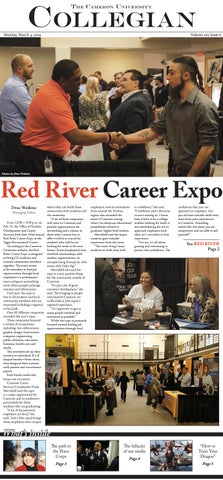
Photos by Drue Watkins
Red River Career Expo Drue Watkins
where they can build those connections with students and Managing Editor the university. “A lot of these companies From 12:30 – 3:30 p.m. on. will come to Cameron and Feb. 21, the Office of Student provide opportunities for Development and Career networking and a chance to Services held their 22nd annual show what Lawton has to Red River Career Expo at the offer—which is crucial for Aggie Recreational Center. students who will be out According to the Cameron looking for work in the near University website, the Red future. Some [employers] even River Career Expo is designed establish relationships with to bring CU students and student organizations, an Lawton community members example being Enterprise, who together. The main intent meets with Delta Sig.” is for attendees to find job Merrifield also said the opportunities through local expo is a very positive thing employers—a professional for the community outside of meet-and-greet networking Cameron. event where people exchange “It’s just a lot of great resumes and information. economic development,” she Each year, the expo is said. “By bringing in people free to all students and local even beyond Cameron, we community members who are really make it [the expo] a interested in finding a regional regional experience. or local job. “It’s important to get as Over 65 different companies many people involved and attended this year’s expo. interested as possible.” These companies featured While the expo is primarily a variety of occupations, focused around finding job including: law enforcement, opportunities through local graphic design, food service, computer engineering, public relations, education, business, health care and media. The attendees set up their stations in individual, 8’ x 8’ draped booths—from there, they designed their stations with posters and recruitment papers. Each booth could only house two recruiters. Cameron Career Services Coordinator Paula Merrifield said the expo is a major opportunity for Cameron and its students— particularly for those students who are graduating. “A lot of the potential employers are local,” she said, “and it [the expo] brings those employers onto campus
employers, several universities from around the Texoma region also attended the event—Cameron among them—to showcase educational possibilities related to graduate, higher-level studies. Merrifield said she hopes students gain valuable experience from the event. “The main thing I want students to walk away with
is confidence,” she said. “Confidence and a direction to start moving in. I know how it feels to be a college student looking for work; it was intimidating for me to approach employers back then, so I can relate to that experience. “For me, it’s all about gaining and continuing to pursue that confidence. The
confidence that you can approach an employer, that you do have valuable skills they want from your experiences at Cameron. Attending events like this show you are competitive and are able to sell yourself.”
See RED RIVER Page 2
What’s inside The path to the Peace Corps Page 3
The fallacies of our media Page 4
“How to Train Your Dragon” Page 5
News
2
March 4, 2019
www.aggiecentral.com
RED RIVER continued from page 1 In addition to suggesting students follow up with employers after the initial meeting, Merrifield said she recommends keeping an open-mind regarding potential career paths. “Sometimes new
opportunities pop up in the most unlikely of places,” she said. “A career field you get involved in may not be related to your major at all—or only take pieces of it. “I advise students
to give employers a chance, even if you don’t think you’re interested. You’d be surprised what you find out. I mean, when I graduated as a psychology major, I never thought I would become involved at
the Office of Student Development at Cameron. Good things can happen when you search around.” In regard to students who may be interested in attending next year’s expo, Merrifield said the
best advice she can give is coming prepared. “Dress professionally,” she said, “and practice what to say about yourself. First impressions are really important; you stick out more if you work to
impress.” For more information on the Red River Expo—or for how to get involved in next year’s event—visit the Office of Student Development’s website on www.cameron.edu.
STEM: Empowering Women Amanda King Staff Writer
Cameron University held their third annual Empowering Women in Leadership and Science, Technology, Engineering and Math (STEM) Conference at 5 p.m. on Feb. 21 in the McCasland Ballroom. The event began with a checkin where guests were provided nametags and raffle tickets for a giveaway later in the evening. Following a brief announcement outlining the night’s schedule, Department of Education Chair, Dr. Dana Hilbert introduced the keynote speaker for the evening: Dr. Therese Huston. Huston is currently a cognitive psychologist at Seattle University, author of two published novels and writer for the New York Times and Harvard Business Review. Her keynote address for the evening, titled “How Gender Bias Shapes Feedback & What You Can Do About It,” centered on the disparity between men and women regarding the kinds of comments they receive in employee reviews. Huston first illustrated the focal point of her argument by giving Hilbert feedback on her own introduction—first as she would get as a woman and then as if she were a man. “The main discrepancy in feedback for each gender,” Huston said, “is a lack of specificity and helpfulness. Women tend to receive
vague and positively reaffirming comments on their employee reviews, while men oftentimes get blunt, constructive critiques on their performance.” Dr. Huston describes this common differentiation as the reason why the employment ladder always seems to be easier for men to climb than women. Huston explained why her examples of Hilbert’s introduction were inherently different for the two genders. “We have unconscious bias in the feedback that we give men and women,” Huston said. “It’s unconscious, but it’s not inevitable. And so by the time you leave here today, I’m going to give you some great strategies so that you can be better at giving feedback … and make sure you get the kind of feedback you need.” She also introduced the idea of protective hesitation, which is a theory explaining the motivation behind gender-biased feedback. The theory describes how many managers avoid giving women and minorities critical feedback due to a fear of the receiver taking offense where offense is not intended. The latter half of Huston’s demonstration focused on bestowing the audience members with ways to better provide feedback to all employees, as well as how to appropriately ask employers for constructive feedback so as to equalize the career advancement opportunities for the sexes in male-
dominated fields. She concluded her presentation by opening up the floor for questions. One audience member, Derek Snow, voiced his curiosity about how non-binary genders factored into gender bias. “What about transgender and the LGBTQ community as whole?” Snow said. “How are they affected by receiving feedback?” Huston explained that unfortunately, given the newness of the data, there isn’t much published research on non-traditional gender feedback tendencies. “I have, however, interviewed a number of people who are transgender and they are blown away with how much the feedback changes after they go through that transition,” Huston said. “One of the interesting things that both transgender male and females report is that feedback is nice as a female, but you really get more credit getting feedback as a male.” Following the keynote address, Engineering and Math Academy Director, Dr. Sheila Youngblood announced a brief intermission wherein the attendees could help themselves to the catered buffet. She also announced the two winners of the raffle drawing who would recieve a free copy of Huston’s most recently published novel, “How Women Decide.” Youngblood initiated and moderated the subsequent panel discussion by presenting each of the panelists: Huston, herself;
Amy Green, owner and operator of Signs Designs in Lawton, Okla.; Kelly S. Turner, Field Artillery Commander in Fort Sill, Okla.; Amanda Cognet, Patriot Training Manager in Lawton, Okla.; and Jill Castilla, President and CEO of Citizen’s Bank of Edmond in Edmond, Okla. The panel began with each member discussing how they achieved their current positions, what advice they would give their younger selves and their own encounters with gender bias in trying to advance up the career
ladder. Due to the late hour, there was only enough time for the audience members to ask a few questions. However, Dr. Youngblood made sure to leave time for panel members to speak with people individually, closing the event with networking opportunities. “If you’ve got more questions, please ask,” Youngblood said, releasing the attendees. “We are so thankful they came, and we hope that you all got a lot out of this presentation.”
Photo by Amanda King
Student Government Association
Students discuss Constitutional Carry
Cameron’s SGA drafted a memo to Staff Writer President John McArthur to clarify the student Cameron’s Student body’s views. Government Association SGA President Luis (SGA) held their fourth Jaquez opened the topic to and fifth meetings on Feb. the floor. 11 and 18. “Historically, we are The meetings covered asked to give our two numerous topics, cents on what that means including a discussion or what we want,” Jaquez about firearms on campus, said. public safety and a Senator At-Large Aalia separate presentation Oloyede raised concerns from Dr. Sarah Janda. over the issue. SGA opened a “I don’t trust people discussion about firearms [with guns], people on campus, due to a bill that don’t have training in the Oklahoma state especially,” Oloyede said. legislature that allows “No carry on campus — permitless carry in public period. I don’t think it’s spaces — including safe.” college campuses. Senator of Graduate & Professional Studies Greyson Basham echoed a similar view. “I wonder if the student body would feel as safe
Derek Snow
with people carrying guns,” Basham said. “Not everybody is going to be.” Basham also raised concerns over LGBT and other students feeling safe on campus. “I know, at least from PRIDE meetings, we are a vulnerable population,” Basham said. “The members feeling as safe as possible is my concern.” This continued as members called into question if a ruling is needed. Senator of Arts & Sciences Kaysa Williams asked if carry on campus was even necessary. “People of color are more likely to get shot — I don’t want to see that happen,” Williams said. Alpha Phi Representative Heather Towne stressed that
Cameron is an academic institution. “It [carry on campus] doesn’t benefit learning at all,” Towne said. “It is just, like [Williams] said, unnecessary.” While no member voiced full support for the new law, a number of students supported some or limited use of carry on campus. The Office of Public Safety is allowed to carry guns on campus, and Senator of Arts & Sciences Jonathan Drake said “I think that’s fine.” Sergeant-at-Arms Brittney Ross said campus carry is an educational issue for ROTC students. “Being a part of ROTC, we are only allowed to have dummy rifles, but in real combat I’m not going to have a dummy rifle,”
Ross said. “Educationalwise, it is kind of a necessity.” Arts & Sciences Senator Kristopher Mayfield said campus carry “should be limited to areas, not general campus places where you’re around civilians.” The debate of firearms on campus brought to light a few other topics SGA members wanted to address. Mayfield said, “For Public Safety on Campus, I do think there is a need for more thorough training on responsiveness.” Senator At-Large Cecelia Brown also noted that “response time for the Campus Police is really slow. There’s been several occasions where they’ve been called and they haven’t arrived till minutes
after the altercation was resolved.” Outside of the firearm discussion, Janda addressed student rights and the need to better foster communication between faculty and students. “Talking to professors when you have questions about [class],” Janda said, “you can often find a way to bridge that communication gap.” Janda also encouraged students to look out for the next student. “If you see something that is unjust and unfair, and you let it go, you got the next person,” Janda said. “Being able to speak up isn’t something you just do for yourself, it is something you do for those around you.” SGA holds weekly Monday meetings at 5:15 p.m. in Ross Hall 101, and the meetings are open to all students. Photo by Madison Lyda
March 4, 2019
www.aggiecentral.com
Student Life
3
Ellie Welborn Celeste Powell
Seeking Peace
mom she’d never met. buildings a jungle, then I guess I did.” Before moving to Indonesia with her At this point in her life, with Student Life Editor father and stepmother, Ellie lived with graduation a few months away, she faced International language major Ellenette her grandmother in Argentina. There, a single interview that could determine (Ellie) Welborn lived in four countries by she was the only child. her future. the age of 22 and speaks the languages of “The first month that I moved to In January, Ellie completed her three—Spanish, Indonesian and English. Indonesia,” she said. “My dad went application to teach abroad with the On a busy week Ellie’s room shows on a work trip and was gone for a Peace Corps. A day after being rejected lose scrap papers, open notebooks on the whole month. He left me with my new for a position in the floor, socks with no match. family that I just met. I was a Dominican But on a relaxing week, she places troublemaker—mainly because Republic, elephant statues prominently, travel I didn’t know the rules.” Ellie mementos on a memo board along with Ellie unwillingly maps and photos of friends. respected the Years before and over 9,000 miles authority of her away in Jakarta, Indonesia, Ellie was stepmother when unable to decorate her room, leaving it to first moving to her step-mother. Indonesia as an “Pink—everywhere,” she said. “It adolescent. looked like a newborn baby’s room. Pink In Argentina, table, pink rug … Pink!” with her Ellie was eight when she moved to grandmother, Indonesia. Although knowing three there were languages can be a blessing, it can also be imaginary friends — Dr. Jennifer Pruchnicki difficult for her. to race on her bike Director of Student Development The uhs, ums and wild hand in the countryside. movements, the look of annoyance on her In Indonesia, there face show the sometimes frustrating were strict rules of no nature of being trilingual. playing outside because of the received One of Ellie’s mentors and Director of potentially dangerous nature of the confirmation Student Development at Cameron city and no sleepovers with friends. for an interview for University Dr. Pruchnicki, believes that But also in Indonesia, there were a position in a country she’s already the rare downsides to knowing three personal drivers and live-in maids who been—Indonesia. languages can still benefit Ellie. swept, mopped, cleaned laundry and During the interview Ellie was asked “Ellie may be quiet,” she said. “She cooked food. by a Peace Corps Placement Specialist may not say as much, but when she does As a child, Ellie didn’t consider herself about past and current experiences and say things people listen. She says things particularly religious, but Indonesia has skills such as teaching, tutoring and that are important.” the largest Muslim population in the mentoring others. The difficulty to elaborate in a single world with approximately 225 million Pruchnicki believed the position was language is only a slight drawback for Muslims. destined for Ellie. Ellie. She said she’d prayed in times of “Ellie prepared herself for her If Ellie gains what she considers a hardships, but never claimed a specific interview,” she said, “it was all Ellie. We once in a lifetime experience of joining religion. were just there giving her encouragement the Peace Corps, she will teach young “In the past, I prayed to God,” she and tips along the way. children who struggle with language, not said. “I didn’t necessarily consider myself “Ellie [will] got hired because Ellie’s unlike her, as a child. Catholic or Christian. I just prayed to awesome. She had all the skills and The Peace Corps mission is to God. In my head, I still prayed to the experience and passion they were looking promote world peace and friendships by same God [with her Muslim family], for.” fulfilling three goals: I just did it a little 1. To help the people of interested differently.” countries in meeting their need for After four years trained men and women living in Indonesia 2. To help promote better where hijabs were the understanding of Americans on the part norm, Ellie moved of the peoples served to Oklahoma where 3. To help promote a better bedazzled jeans and understanding of other peoples on the cowboy boots were part of Americans in fashion. The Peace Corps also has core “I remember the expectations for volunteers, stating first couple of weeks on their website they must “represent I moved to Duncan,” responsibly the people, cultures, values, she said. “These and traditions of your host country.” popular girls thought With Ellie having lived in Indonesia it was so cool I came before, Pruchnicki believes Ellie already from the jungle. embodies this Peace Corps expectation. There are jungles in When Ellie thinks back to her time in Indonesia, but I lived Indonesia as a child, she considers it in one of the world’s pleasant despite the obstacles she had to biggest cities where overcome in moving to a country she’d there’s more traffic never heard off in a house with a stepthan trees. So, if you consider giant
“Ellie may be quiet. She may not say as much, but when she does say things people listen. She says things that are important.”
And so, the waiting began … Months of preparation and practice boiled down to a 90-minute interview. Initially, Ellie would know within two months if she was accepted. But a day later Ellie received her acceptance letter to serve as an English Teacher and Teacher Trainer in Indonesia. “With Ellie, her actions speak as well,” Pruchnicki said. “If you looked at everything she’s involved in and the things she’s passionate about, they totally aligned with the mission of the peace corps. It was such a perfect fit.” Seven months from now, Ellie will fly 38 hours to Indonesia with a few suitcases containing all her clothes, photos and hopefully matching socks. For two years, she will stay in one of the most densely populated areas in the world—the island of Java. There, she will live with a host family, most likely in a traditional Javanese house. Even though volunteers will be living in rural areas, the Peace Corps website states that there may still be large populations of people. Pruchnicki believes that despite Ellie’s nervousness, she is prepared. “Whatever Ellie’s expectations are,” she said, “nothing is going to prepare her for what actually happens, but she has the skills to adapt to whatever gets thrown her way.” Ellie is prepared for the next chapter of her life and believes that living abroad has helped prepare her. “I’ve lived in different countries,” she said. “But, I don’t have a favorite. I loved living in all three. They each brought new perspectives to me.” Pruchnicki said she knows Ellie will go on to do great things with the Peace Corps. “I don’t think we’ll just see a change in Ellie,” she said. “I think we’ll see a change in where been she’s assigned and see a positive impact there.” Photos by Drue Watkins
Voices
4
March 4, 2019
www.aggiecentral.com
Tribune News Service
The tragedy of fake crimes: On Feb. 21 at Chicago police headquarters, Chicago police Superintendent Eddie Johnson (center) speaks to the media about the details and charges of Jussie Smollet’s arrest. Chief of Detectives Melissa Staples (right) and First Deputy Superintendent Anthony Riccio (left) also attended the press conference.
What is wrong with our media? Drue Watkins
decrying Trump supporters and sobbing on national media to generate sympathy; Managing Editor it’s disgusting, abhorrent behavior. It doesn’t seem to matter now, Every single mainstream media though; he’s currently back on the set outlet is terrible. It’s not much of a secret to say so. All of his show “Empire” after posting bail. Where is the “intense” coverage of this? it takes is one glimpse at the homepage Where are the hard questions that of each media website individually to should be asked? realize what they like to prioritize: The result doesn’t play into our exhibitionism, entertainment, media’s agenda of wanting to capitalize exploitation and sensationalism. on social justice issues—whether or The term “Fake News”—highly publicized thanks to President Trump’s not those issues may even be worth political campaign—are thrown around covering. The most disgusting aspect of the religiously at this point. So religiously, in fact, that the words incident is how the media ate Smollett’s story up… and never even questioned have become a stereotype of extreme it. They threw the spotlight on Smollett conservatives who believe the media is and never asked more of Smollett than out to get them; it has become a joke most people don’t take seriously. People his feelings about the incident. Blind acceptance is a path for the just laugh and shrug it off. mob—not for thinking citizens, and However, people should take it most certainly not for our media, which seriously… because it isn’t a joke. we rely upon for objective information. The media does not seemingly After all, the words “hate crime” care about producing objective-based relate to exhibitionism for the media— news coverage; they do not care about everyone wants to see what’s going on, presenting evidence nor understanding facts before pasting online or displaying so the clicks are flying, and the views are swinging. People love controversy and on our televisions. horrible tragedies—it’s something the After all, the only thing the media media feeds on. is content with is playing the game of The media’s fascination with “Gotcha!” to those who go against their drawing up sensationalism (particularly chosen political or social affiliations. regarding social issues) and exploiting If they mess something up, or take “news” to push their agenda is a something out of context, or misquote, or cleverly edit a video, nothing comes of destructive, catastrophic force that perverts the minds of the people, it. It goes away. Disappears. planting falsities and sewing dissent. There are no public apologies for Couple this ideology with the sudden mistakes; there are no reparations for manifestation of the modern immediacy lives potentially destroyed. Nothing. of getting access to news at a sudden They just move on. notice, and fact-checking falls through Is this just? the floor. This obsession with being the Take, for example, the most recent, first station to post “news” is beyond distressing bit of “news” available: dangerous—it lends credibility to the the Jussie Smollett incident. Smollett idea of guilty until proven innocent; should be rotting in a jail cell for his egregious crimes—faking a hate crime, mob rule, in other words. This is not a classic American way wasting police and federal resources, About Us
The official student newspaper of Cameron University, The Cameron Collegian is available each Monday during the year. It is printed by the Lawton Constitution. The first issue is provided for free. Each subsequent issue is $1.50.
Our Views
The opinions expressed in The Collegian pages or personal columns are those of the signed author. The unsigned editorial under the heading “Voices” represents the opinion of the majority of the editorial board. The opinions expressed in The Collegian do not necessarily represent those of Cameron University or the state of Oklahoma. Our student media are designated public forums, and free from censorship and advance approval of content. Because content and funding are unrelated, and because the role of adviser does not include advance review of content, student media are free to develop editorial policies and news coverage with the understanding that students and student organizations speak only for themselves. Administrators, faculty, staff or other agents shall not consider the student media’s content when making decisions regarding the media’s funding or faculty adviser.
of thinking… but it is now the modern way. When all people see is “news” pop-up on their phones with subjective, unclear, verdict-already-decided-by-the-media headlines, it destroys trust. With the media brazenly competing with their rivals like sports teams (“Because we have to be number one!”) and “news” flying around unchecked and unverified, it’s no wonder people are beginning to question what they see. The public should watch or read the “news” expecting the clear, unbiased truth—not questioning what is and isn’t reality as it unfolds. To even be discussing this is unsettling enough. The media has an agenda, and to not recognize so is naivety to the extreme. And while many mainstream media outlets are clearly liberal-biased, there are no excuses for those others that push the other end of the spectrum, either (Fox News—we’re looking at you). Guilty is guilty—all are held accountable for incompetence. But nobody is held accountable, and nor should they be—governmentally speaking. After all, the United States is a free country that takes freedom of speech under the First Amendment seriously (or at least should). These are private media companies that can do and say as they wish, and the same goes for citizens of this country. What should be occurring, though, are these media corporations taking responsibility for their coverage and their actions. It is not the government’s role to dictate coverage, as that is an extreme reaction against the American peoples’ right to free, open speech. However, it’s a lot to ask for. Why should media take itself seriously if nobody else will?
THE CAMERON UNIVERSITY
COLLEGIAN
Perhaps, then, the American people should hold the media accountable too. Don’t watch them; don’t support them. It may be surprising to see how quickly tunes can change. After all, how do these corporations get money? Views, clicks, ad revenue—perhaps even a little underhanded support. Who wants to put an advertisement on a site that gets no audience? Who wants to commit to something that generates nothing? It’s a lot to ask of people. Accountability. There’s not much of it, especially with the advent of social media and the culmination of this new “call-out culture.” In fact, it seems most people on sites such as Twitter even enjoy the absurd circus ride of our media—they enjoy degrading people and latching onto stories, even without much context. Don’t question, just accept. Something otherwise known as knee-jerk reactions—who cares about facts or context when it’s possible to glance down at a headline (that is written misleadingly) and assume circumstances? The media is aware of its ravenous, emotionally heaving audience. They play on it and exploit it; don’t get used and manipulated. There must be a better caliber of news. Do what gets money, regardless of right or wrong; that seems to be the media’s motto in the world. It isn’t anything new, either—it’s just becoming more apparent. This destroys the standards of journalism—it annihilates the code of ethics all media should abide by. The media is guilty of becoming bloated and biased. It’s time for future journalists to be better. It’s time to think objectively. Letters Policy
Founded in 1926 veritas sempiterna
Letters to the editor will be printed in the order in which they are received and on a space available basis.
Editorial Staff
The Collegian reserves the right to edit all letters for content and length. Letters should be no more than 250 words. Letters from individual authors will be published only once every four weeks.
Managing Editor - Drue Watkins Managing Editor - Madison Lyda A&E Editor - Sarae Ticeahkie Sports Editor - Mason Orso Student Life Editor - Celeste Powell Voices Editor - Payton Williams Copy Editor - Kimb Frey Aggie Central Editor - David Bublitz Social Media Editor - Abby Gonzalez
Newsroom Staff
Financial Officer - Susan Hill Staff Writers - Derek Snow, David Perkins, Lindsey Edwards, Lea Killian, Dontaye Abram, Amanda King, Cambron Alsbrook Circulation Manager - Drue Watkins and Madison Lyda Faculty Adviser - Mr. David Bublitz
All letters from students should include first and last names, classification and major. No nicknames will be used. Letters from people outside the Cameron community should include name, address and phone number for verification. Letters can be sent by regular mail, by e-mail to aggiecentral@ cameron.edu or they may be dropped off at our office - Academic Commons 101 or at www.aggiecentral.com.
A&E
March 4, 2019
www.aggiecentral.com
5
In a week of reviews
‘How to Train Your Dragon 3’
Courtesy photo
Lea Killian Staff Writer
“There were dragons when I was a boy. Where they went, only a few know. Our story changed the world forever.” On Feb. 22, the third and concluding installment of the “How to Train Your Dragon” trilogy premiered in theaters all over the world. Fans knew that the last adventure with Hiccup and Toothless would be an emotional one, but nothing could prepare them for this final goodbye. With genuinely astounding animation, writing and voice acting, there is no
showing the rest of the world the true and loyal nature of dragons. Hiccup quickly realized that the rest of the world may not be so easily convinced while going face to face with hunters and poachers bent on harming dragons. After the death of his father, Hiccup grows from a boy to a chief and transforms his home into a safe haven for dragons all over the world. His Night Fury dragon, Toothless, has taken his place as the alpha among them all, and together they keep the peace in Berk. When Hiccup learns of Grimmel the Grisly, a dragon hunter who set out long ago to kill every last Night Fury, Hiccup fears for the safety of Toothless who the last of his kind. Hiccup begins to toy with the idea of his community leaving Berk, their home of seven generations. In the midst of Hiccup’s internal battles, a Light Fury is introduced. The Light Fury is a whitewonder why “How to Train Your Dragon: The books have been read and loved by scaled, blue-eyed, graceful beauty that The Hidden World” is conquering the box over seven million people since 2003. office. YouTube personality Chris Mockridge catches the attention of Toothless. With the safety of dragonkind on the According to Hollywood Reporter, the asked Cowell if she ever imagined this kind line, Hiccup realizes he must make some movie’s first weekend earned a triumphant of success with her series. difficult decisions. $60 million, a personal best for the series. “No, I definitely didn’t. I knew I was This begins the search for the Hidden A Rolling Stone review continued to starting what I hoped to be a long book World, a place Hiccup remembers his praise the third film in DreamWorks’ series, but I never imagined it would be series. this successful, let alone having three films father telling him about as a young boy; a place where dragons live peacefully, away “The Hidden World is the best Dragon made. It’s beyond my wildest dreams.” from humans, at the very edge of the world. yet — an animated action phenom with Movie fans have followed Hiccup the “How to Train Your Dragon: The moonstruck passion in its heart and a spirit Viking for almost nine years. that soars.” In that time he has entirely changed his Hidden World” serves as an emotional, The first movie, released in 2010, family and friends’ way of life in their home perfect goodbye to a series that holds tightly to the depth of magic, irrevocable claimed success from the very beginning as of Berk by introducing them to the bond friendships, and a lifelong love for the it already had an enormous fan base due to possible between dragon and man. unknown. the book series written by Cressida Cowell. He continued dedicating his life to
‘An Absolutely Remarkable Thing’
Lea Killian Staff Writer
On Sep. 25, 2018, Hank Green released his debut novel, “An Absolutely Remarkable Thing.” The novel tells story about a young woman who unintentionally acquires global internet fame unlike the world has ever seen, while also learning how to deal with dire consequences. This story is no doubt inspired by his own experiences, as Green is no stranger to internet fame. He shared a YouTube channel, “Vlogbrothers” with his brother John Green since 2007. They are both hugely successful as authors, podcasters and YouTubers. While the subject of addictive qualities of social media and the problematic attributes of internet fame may be a tiring topic to discuss in today’s climate, Green has managed to tackle the issue with an entirely unique perspective that compels readers right from the start. The novel begins by introducing the main character, April May, a recent art school graduate who is sorely trying to make ends meet by working at a startup company in Manhattan. Walking down the street late in the evening, April flits right past a ten-foot tall samurai robot statue. Chalking it up to spontaneous New York street art, she continues onward. She only takes a few steps when she catches her mistake. Not wanting the fast-paced, unbothered New York life to claim the best of her, she turns back to marvel at the statue. Realizing its genuine enormity and magnificence she decides to call her friend Andy, an amateur YouTuber and podcaster, to see if he might want to film the statue. Even though it is three in the morning, Andy arrives with his camera gear — ready to go. Positioning herself
in front of the newly nicknamed statue Carl, April waits for Andy’s cue. “‘K, I’m rolling,’ you’ve heard Andy say those words if you’re a human who’s ever been near enough to an internet connection to hear them. Whether or not you speak English. Whether or not you’ve ever owned an electronic device in your life. If you’re a Chinese billionaire or a Kiwi sheep farmer, you’ve heard it. Militant rebels in Nepal have heard it. It’s the most viewed piece of media of all time.” With that, their world, and humanity itself, changes forever. April wakes up the next day with hundreds of emails, phone calls and texts. In sixty-four cities across the globe, Carls have appeared in the streets. With no video footage of their arrival, or any explanation whatsoever, April and Andy soon realize that they are the first people to make contact with the Carls. Suddenly thrown into an undesired international spotlight, April finds herself making decisions for all of humankind. The media begins to look to her for answers and she finds herself comfortable providing them —unaware of the consequences, sharing her opinions on what the Carls are, why they came and what exactly they want. Perhaps one of the most intriguing elements of this story is how it shows readers what happens when humankind finds itself inexplicably tied to one another in ways that are frighteningly unfamiliar. Further, it explores humanity at its most vulnerable and expertly reveals the dark
underbelly of fame. Riddled with his unique brand of humor, relevance and modernity, Green’s debut novel, “An Absolutely Remarkable
Thing,” is a wholly lovable and thoughtprovoking book that will leave readers feeling haunted, humbled and dying for more.
Courtesy photo
6
Sports
March 4, 2019
www.aggiecentral.com
Photos by Mason Orso
Lady Aggies steal victory Mason Orso
Luster landed three free throws that were critical for the Aggies. Sports Editor The two team’s battled back At 5:30 p.m., Feb. 28, the and forth and the Aggies took a Cameron University women’s 44-40 lead at halftime. basketball team secured a 91The battle continued and the 80 victory over Texas A&M Aggies tied the game 57-57 with Kingsville. 4:47 left in the 3rd quarter. By Lehja Smith played forward, the end of the quarter, Texas placing two points on the board A&M take the lead 70-68. with a layup one minute into the Early into the 4th quarter, game. the Aggies got down 73-71 with Aggie freshman and guard eight minutes left in the quarter. Maighan Hedge shot the first Hedge shot two free throws 3-pointer with seven minutes left and Junior Guard Ava Battese in the first quarter. landed a 3-pointer, allowing the Senior forward/guard Chelsea Aggies to take a three point lead Heidebrecht landed another with seven minutes left in the 3-pointer with four minutes left quarter. in the quarter tying up the game. Battese shot another The Aggies were down 28-19 3-pointer, securing a four point at the end of the first quarter. lead. The Aggies kept the energy Hedge finished with a going with a 10-0 run, gaining team high scoring 21 points a one point advantage early into throughout the entire game. She the second quarter. also obtained four rebounds and Sophomore forward Jazmin finished out with three assists.
Senior forward Lejha Smith from Fort Lauderdale finished with 14 points and six rebounds. The Aggies played their strongest in the final quarter
outscoring Texas A&M Kingsville with a 23-7 run. CU set a new season high in three pointers with 15. Their win places their record
to 8-19 overall. At 2 p.m. on March 2, the Aggies will play their homecoming game against Angelo State in the Aggie Gym.
CU men’s basketball edges out Javelinas
Photos by Mason Orso
In the basket: At 7:30 p.m., Feb. 28, the Cameron University’s men’s basketball team triumphed over Texas A&M-Kingsville 65-61. The victory puts the Aggies up to a 9-18 overall record on the season; they sit at 8th overall in the Lone Star Conference Standings.
March 4, 2019
www.aggiecentral.com
Trending
7
Can students learn happiness? Aneri Pattani
The Philadelphia Inquirer
After three years at the University of Pennsylvania, Brielle Weiner has perfected the one-sentence introduction she gives in every new class: a 21-year-old senior majoring in chemical and biomolecular engineering from Wellesley, Mass. But this semester in a course called The Pursuit of Happiness, she was forced to try something new: an introductory anecdote that showed her at her best. Weiner spoke about how caring for her 95-year-old grandmother, who came to live with their family eight years ago, forced her to grow as a person. “It’s not often that I go into details about this story to anyone,” she said, “let alone a complete stranger.” That’s the point of the assignment, said James Pawelski, professor of the course. It forces students to build deeper connections with each other, he said. The course is the first large-scale class at Penn to focus on the practice of positive psychology, the scientific study of what goes well in life and how to cultivate more of it. Nearly 200 students are enrolled; double a typical lecture course. It comes at a time when universities across the country are desperate for new ways to improve mental health on campus. A 2018 study found college students are reporting increasing levels of depression, anxiety and suicidal thoughts for the eighth year in a row. While many colleges, including Penn, have hired more counselors and increased counseling center hours, some are wondering if there’s more to be done. Can they teach students to be more resilient, mentally healthier, maybe even happier? “Happiness isn’t one size fits all. We can’t just dole it out to everybody,” Pawelski said. “Our goal in class is to explore the pursuit of happiness together.” The course encourages students to try meditation or journaling, and teaches them to build stronger relationships, which are known to boost happiness. The introduction that Weiner practiced with her classmates embodied two core concepts of positive psychology: emphasizing individual strengths and building human connections. “It made me think, ‘I know who you are. I know something important to you,’ “ Weiner said. “Now if I pass you on campus, I’m definitely going to say hi.” More than a decade of research has shown that teaching youth resilience and positive psychology can reduce and prevent symptoms of depression and anxiety, lower stress and promote wellbeing. It can also improve grades. Similar courses at Harvard and Yale drew more than 1,000 students each, becoming the most popular courses in each university’s history. Other schools are trying similar initiatives, though on a smaller scale. Pennsylvania State University and Villanova University have been offering courses on positive psychology for more than 10 years, but they are focused more on the field than application, and are often aimed at psychology majors. Temple University has created a Resiliency Resource Center with tools for students to use their own strengths to address depression, anxiety and interpersonal conflict. Saint Joseph’s University offers weekly mindfulness sessions, and Drexel University is planning to add mindfulness training to freshmen orientation.
A long time coming
Martin Seligman, known as “the father of positive psychology,” founded the Penn Positive Psychology Center in 2003. He and Pawelski started the Masters of Positive Psychology program the same year, the first graduate degree in the field. The center also conducts large-scale resilience training for the U.S. Army. Yet Penn was years behind other schools in offering a large-scale positive psychology class for all undergraduates. “Penn is where positive psych began, but in undergrad, at least, no one uses these resources,” said Armghan Ahmad, a senior economics major and currently in the Pursuit of Happiness class. Headed into an investment banking job after graduation, Ahmad knows he will have long hours and lots of stress. “I want to learn the mindset and small habits I can commit myself to in a consistent manner to boost happiness,” he said. Penn previously offered a smaller positive psychology course focused on theory, but the new course has a greater emphasis on application. On the first day of class, the instructor asked students to pretend they were meeting people while walking around New York City. First they introduced themselves to people who were not interested in meeting them. Then to powerful individuals, like CEOs. And finally to a friend they hadn’t seen in five years. “Each time it got progressively more enjoyable to introduce yourself,” said Jake Singer, a sophomore business major. The realization has prompted him to change his daily interactions. At a recent visit to the Apple Store, he made sure to look the salesperson in the eye and smile. He asked how their day was going. “That felt nice instead of just going there for the purpose of getting my phone fixed and leaving,” Singer said.
Building on student strengths
Down the hall from Temple University’s counseling center is a room with dim lighting and soothing music. Colored mandalas and other art projects called “zen doodles” decorate the wall. iPods loaded with meditation apps are placed near massage chairs.
Tribune News Service
This is the Resiliency Resource Center (RRC), established seven years ago to complement individual and group therapy provided in the counseling center. It’s meant to help students take charge of their own mental health. While it’s run through the counseling center, it’s not limited to students with mental illness. “It can be as severe as PTSD and bipolar or just someone wanting to communicate better with their roommate,” said Brandon LaBarge, assistant coordinator of the RRC. Up to 20 students come through on a given day, with nearly 800 students using the center last semester, LaBarge said. Ilana Stern, a senior psychology major, first came to the RRC a few weeks into seeing a therapist for anxiety. She used the Muse meditation headband, one of the most popular items the center offers. It measures brain waves and signals to students when their minds are calm, neutral or active. The longer they stay calm, the app rewards them with points. Stern found the experience empowering. “Of course I do things my therapist tells me to,” she said, “But it was fulfilling and rewarding to know I can help myself too.” That’s the idea behind a group LaBarge runs in the
RRC. It’s called mindfulness-based strengths practice. Up to 10 students come together for eight weekly sessions to learn how they can use their own character strengths to cope with problems and increase happiness. The program began in fall 2017, and has since grown to two eight-week sessions per semester to accommodate the demand. Students take a character strength survey, which ranks them on 24 inner strengths that positive psychology says every individual possesses in varying degrees. The strengths range from creativity and honesty to gratitude and humor. The sessions are then spent helping students find ways to use those strengths to improve their lives. Zainab Nyazie, a senior psychology major who participated in a drop-in version of the group, was initially upset to learn one of her top character strengths was forgiveness. “Does that mean I’m a pushover?” she said. But through the program, Nyazie learned to use the strength to resolve roommate conflicts and also forgive herself. “They start to learn they’re not their depression, they’re not their anxiety, they’re not their chemistry homework,” LaBarge said. “It brings perspective back to who the person is and how their character can help them deal with this.”
8
Retrospective
The graphic is a product of “The Cameron Collegian,” published in Volume 53, Issue 2 on Sept. 7, 1979. Graphic by Madison Lyda
“The Cameron Collegian” would like to thank the members of the Library and Archive staff for their patience and help with bringing the history of the paper back to life.
- The Editors
March 4, 2019
www.aggiecentral.com