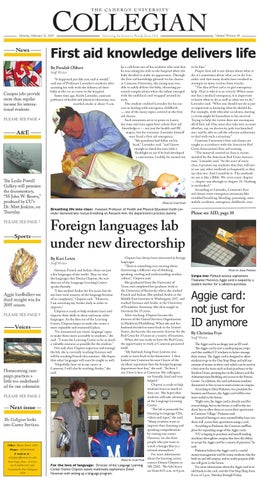
COLLEGIAN THE CA M ERON U N I V ER SIT Y
Monday, February 21, 2005
News
Informing the Cameron Family Since 1926
First aid knowledge delivers life By Petulah Olibert Staff Writer
Campus jobs provide more than regular income for international students.
“It happened just like you said it would,” said one of Professor Lavender’s students after assisting his wife with the delivery of their baby in the car en route to the hospital. Some time ago, Keith Lavender, assistant professor of health and physical education, was startled awake at about 4 a.m.
PLEASE SEE PAGE 4
A&E
The Leslie Powell Gallery will premiere the documentary, “SS John W. Brown,” produced by CU’s Dr. Matt Jenkins, on Thursday. PLEASE SEE PAGE 7
Sports
Volume 78 Issue 18
by a call from one of his students who said that he was taking his wife to the hospital when the baby decided to make its appearance. Through the first aid knowledge gleaned via his classes at Cameron University, the young man was able to safely deliver the baby, thwarting potential complications when the infant emerged with the umbilical cord wrapped around its neck. The student credited Lavender for his success in dealing with emergency childbirth — one of the many topics covered in the first aid classes. Such situations serve to prove to Lavender time and time again how salient first aid knowledge is — not just for health and PE majors, but for everyone. Lavender himself once faced a first aid emergency. “My grandson had fallen on his head,” Lavender said, “and I knew enough to check his eyes with a f lashlight to see if he had developed a concussion. Luckily, he turned out
Photo by Scott Pratt
Breathing life into class: Assistant Professor of Health and Physical Education Keith Lavender demonstrates rescue breathing on Resuscit-Ann, the department’s practice dummy.
to be fine.” Proper first aid is not always about what to do; it’s sometimes about what not to do. Lavender said that many deaths have resulted in attempts to move victims from wrecks. “The idea of first aid is to give emergency help. That is why it is so critical. When someone has a medical emergency, it is important to know what to do as well as what not to do,” Lavender said. “What one should not do is just as important as knowing what he should do. For example, with vehicular accidents, moving a victim might be hazardous to his survival. Trying to help the victim does not encompass all of first aid. One must also take into account whether, say, an electricity pole was knocked over and be able to call the relevant authorities to deal with such a situation.” Cameron University’s first aid classes are taught in accordance with the American Red Cross Association’s first aid training. “The material covered in class is recommended by the American Red Cross Association,” Lavender said. “At the start of every class, I promise my students that they will never use any other textbook as frequently as they use this one. And I stand by it. The textbook we use is like a Bible. We cover every chapter — chapter one through to chapter 23. Nothing is overlooked.” According to Lavender, Cameron’s first aid classes cover emergency situations like troubled breathing, bleeding, poisoning, automobile accidents, emergency childbirth, near
Please see AID, page 10
Foreign languages lab under new directorship Clopton has always been interested in foreign languages. Staff Writer “There is something very exciting about discovering a different way of thinking, German, French and Italian: these are just speaking, reading and understanding another a few languages of the world. They are also culture,” Clopton said. the languages that Donna Clopton, the new She graduated from the University of director of the Language Learning Center, Texas and completed her graduate work at speaks fluently. the University of Kentucky where she studied “I also studied Arabic for five years, but do French and Italian. She studied Arabic at the not have total mastery of the language because Middle East Institute in Washington, D.C. and of its complexity,” Clopton said. “However, studied German and Arabic at the University I am reviewing my Arabic daily in order to of Frankfurt, Germany. She then taught in improve.” Germany for 15 years. Clopton is ready to help students learn and After teaching, Clopton became the improve their skills in these and many other director of the United Services Organization languages. As the director of the Learning in Manheim/Heidelberg. When she and her Center, Clopton hopes to make the center a husband decided to move back to the United more enjoyable and resourceful place. States, she became the executive director for the “I’ve inventoried our ‘exotic language’ tapes Red Cross for 13 years in a variety of locations. to make them more accessible to students,” she When she was ready to leave the Red Cross, said. “I want the Learning Center to be as much the opportunity to work at Cameron presented a valuable resource as possible for the student.” itself. Not only does Clopton supervise and manage “My husband, being from Lawton, was the lab, she is currently teaching German and ready to move back to his hometown. I then will be teaching French this summer. She hopes looked into Cameron because I knew of the that other languages will soon be taught as well. excellent reputation that the foreign language “Hopefully, later on in my career at department here has,” she said. “So here I Cameron, I will also be teaching Arabic,” she am. I love it here at Cameron. My colleagues said. are friendly, kind and very helpful.” Clopton is ready to help students learn as much as they can. She hopes that students will take advantage of the Language Learning Center. “The lab is primarily for listening to language CDs, videos and tapes,” she said. “Many students want to improve their listening and speaking comprehension by visiting our center. However, we also have people who just want to watch a foreign fi lm in a relaxed atmosphere.” For more information about the learning center, Photo by Scott Pratt contact Donna Clopton at For the love of language: Director of the Language Learning 581.2262. The labs hours Center Donna Clopton assists multimedia sophomore David are from 8:15 a.m. to 6 p.m. Newman with setting up a language program.
By Kari Lewis
Aggie hardballers see third straight win for 2005 season. PLEASE SEE PAGE 9
Voices
Homecoming campaign practices a little too underhanded for one columnist. PLEASE SEE PAGE 2
Next issue The Collegian looks into Career Services.
Office: Nance Boyer 2060 Phone: 580•581•2261 E-mail us at : collegian@cameron.edu First Copy Free - $.25 for each additional copy Contents © The Collegian 2004
Photo by Anna Politano
Swipe me: Political science sophomore Thatianne Moreira’s Aggie card is swiped by a student worker, for a cafeteria purchase.
Aggie card: not just for ID anymore By Christina Frye Staff Writer The Aggie card is no longer just an ID card. The Aggie card is now a multi-purpose swipe card that enables CU students to better manage their money. The Aggie card is designed to allow students to go to the One Stop Shop and add any amount of money to their card, which can be used at a later time for items such as food purchases at the Student Union, printing fees at the Library and the Administration Building and access to the Fitness Center. In addition, the card authorizes students discounted or free access to most events on campus. According to Glen Pinkston, vice president for business and finance, the Aggie card will be even more useful in the future. “Right now, the Aggie card is already used for several things, but in the future, it will be the students’ key to allow them to access their apartments in Cameron Village,” Pinkston said. Instead of having to carry around bulky keys, students will access their apartments using a card. According to Pinkston, the Cameron staff has plans for expanding usage of the Aggie cards. “CU is hoping to purchase and install vending machines throughout campus that have the ability to accept the Aggie card for a means of payment,” he said. Pinkston believes the Aggie card is a useful money-management tool for many students who live both on and off campus, and its multi-purpose abilities will grow in the future. For more information about the Aggie card or to add funds to the card, visit the One Stop Shop from 8 a.m. to 5 p.m. Monday through Friday.
2
Do you think the Student Union should have an ATM?
Aubrey Knox Biology junior “ATMs are all about convenience, so we should have one.”
Bruce Leonhart Undecided freshman “If they have one in the library, they should have one in the SU.”
Voices
February 21, 2005
Editor refuses to provide ethnicity on forms of the discrimination is good or evil is irrelevant to me. “Racism is prejudice or discrimination based on the belief that race is I don’t mean to suggest that to define oneself in terms of one’s culture is the primary factor determining human traits and abilities. Racism includes wrong or offensive. One of the great strengths of our nation is its diversity. the belief that genetic or inherited differences produce the inherent superiOur differences, and our acceptance of those differences, make the United ority or inferiority of one race over another. In the name of protecting their States one of the most tolerant nations in the world. Just ask the students race from ‘contamination,’ some racists justify the domination and destrucin France who are no longer permitted to wear religious symbols in the tion of races they consider to be either superior or inferior. Institutional classroom. Yes, democracy as practiced in the United States may be messy at racism is racial prejudice supported by institutional power and authority times, and we certainly have made, and continue to make, used to the advantage of one race over others.” (http://www.adl.org/chilmistakes in the way we treat each other, but, as a people, dren_holocaust/more_resources.asp) we hold fast to the fundamental truth that “All men are When I applied for admission to Cameron University I omitted, on created equal.” There is, however, a tremendous differprinciple, filling out the optional portion of the application which asked ence between my decision to share my family history me to define myself by ethnicity. It clearly stated, “This information is with others and an institution collecting that information voluntary and will be used in for whatever the reason. a nondiscriminatory manner Cameron University isn’t the only institution collecting consistent with applicable civil data on ethnicity; the 2000 U.S. national census broke rights laws.” ethnicity down into “63 racial categories:” (http://www. I have refused for a number census.gov/Press-Release/www/2001/raceqandas.html.) of years to check blocks, on That information has been distributed via a number of difany form, which attempt to ferent “data products,” and not all ethnicities are included categorize me by “race” or by on every product. Still, I find it disconcerting that the “ethnicity.” As a child growfederal government has institutionalized racism and that ing up in central New York, so many Americans are apparently either unaware or I remember being asked by a unconcerned. classmate what my “nationalPBS ran a series on the topic of diversity and race ity” was. I wasn’t sure how in 2003. Transcripts of the programs may be found at: to answer, so later that day I http://www.pbs.org/race/. Here’s what Richard Lewonasked my father. His response tin, Alexander Agassiz Professor Emeritus of Zoology was immediate and emphatic. at Harvard University, said in an interview on PBS: “For “You are an American!” almost every gene we know, either everybody in the world My father, a first generation has the same form of the gene, in which case all human benative born American, was ings are the same, or if there’s variation, the frequencies of very proud of his citizenship the different variants are the same relatively speaking, close and raised his children to have Graphic by Leah Hicks to the same, in Africans, Asians, North Americans, Austrothe same sense of belonging and Asians, and so on.” pride. This is a scientist saying that we are essentially the same under our skin. I have no allegiance or feeling for the nations from which my forefathers So what’s the point of defining Americans in terms of ethnicity or race? Is came to these shores, nor do I believe picking a color or ethnicity to call it in order to determine who is smarter, faster, slower, taller, shorter, more myself is in any way indicative of who I am. Imagine my surprise, then, able to succeed, more likely to fail? If we are more alike than we are differwhen upon reviewing my personal student information on the CU Web ent under our skin, then what does this type of classification, unscientific at site I saw that the blank had been filled in. When I finally spoke to the best, racist at worst, really tell us? women on the 2nd floor of Shepler about my dismay at being assigned an “I have a dream my four little children will one day live in a nation where ethnicity, I learned an interesting fact; even though that information is “opthey will not be judged by the color of their skin but by the content of their tional,” if no choice is made, the system will not accept the rest of the data. character.” — Martin Luther King Jr., 1963 In other words, the computer program is designed in such a way that ALL In 2005, how much closer are we to achieving that dream? the blocks must be filled. If the applicant doesn’t fill it in, someone else will. There is no reason to ask people to define themselves by ethnicity or “race” except to use that information as a discriminator. Whether the goal —Kathleen Kelly, Copy Editor
Shanda Adams Psychology junior “It would be convenient to buy things in the bookstore.”
Robert Green Political science senior “There is no reason not to put one in there.”
Tammy French Theater freshman “More people come to the Student Union than to the library.”
Shea Allen Business freshman
Underhanded campaign practices running rampant Homecoming, the point of this commonly viewed “popularity contest,” may have slipped by more than just a few of us. But one thing is for certain: homecoming is a fun and entertaining school tradition. However, for many candidates and students alike, this year’s homecoming campaign fell far short of the lighthearted pastime traditionally associated with homecoming. As the day of reckoning drew nearer for homecoming candidates, it seemed the campaign took on a very unpleasant twist. Quite a few had suspected that their posters were being taken down around campus, but with no substantial proof, they shrugged it off as meaningless games — carefree antics of idle souls. The truth is told. I initially thought certain candidates’ Petulah Olibert claims of “sabotage” were inane ramblings of the haplessly unpopular. I did not expect their claims to be validated. A short call to CU’s Student Activities Director Courtney Hardin quickly put my notions to rest. “We received reports from two candidates that their posters were being taken down around campus,” Hardin said. “But what was surprising was that we actually caught one student. Apparently it was some personal grudge he held for one of the candidates.” The issue of the disappearing poster trick was not the only one raised on campus. A number of students remarked about being duped about certain “free treats.” “I think it was very deceitful and in poor taste,” one student voter said. “I’m aware of sales gimmicks, and I have no objection to a candidate trying to win votes; however, I think the credit card application that came with the free food should have been mentioned.” Another had voiced the very same opinion saying that the campaign seemed to have gotten a little out of hand. The general consensus, it seemed, was that students and candidates alike thought very little of the recently concluded campaign. Was this year’s folly a premonition of worse to come? Or, as one student artfully remarked, has this year’s homecoming “taken on the sullied taint of modern political elections?” You be the judge. Petulah is a journalism freshman from St. Lucia, who has never run for Homecoming Queen. She is also a staff writer for The Cameron Collegian. Send comments to collegian@cameron.edu
KRT Campus
Contact us at
collegian@cameron.edu OR
visit us at
www.cameron.edu/collegian Quote of the Week “Like clouds and wind without rain is a man who boasts of gifts he does not give.”
“Yeah. The library is too far away.”
THE CAMERON UNIVERSITY
COLLEGIAN Founded in 1926 veritas sempiterna
—Proverbs 25:14 Editorial Board Managing Editor - Anna Politano News Editor - Lisa Snider Copy Editor - Kathleen Kelly A&E Editor - Angela Sanders Sports Editor - Joshua Rouse Features Editor - Angela Gradoz Graphic Artist - Leah Hicks Newsroom Staff Business Manager - Rosana Navas Cartoonists - Thomas Pruitt David Brandsetter Financial Officer - Susan Hill Photographer - Scott Pratt Webmaster - Ian Mitchell Faculty Adviser Christopher Keller
Staff Writers Laura Brady, Christina Frye, Jennifer Hardy, Dawn Holt, Kari Lewis, Justin Liszeski, Ian Mitchell, Petulah Olibert, Scott Pratt, Sonya Ray, Lauren Slate, Sarah Warren About Us The official student newspaper of Cameron University, The Cameron Collegian is available each Monday during the year. It is printed by the Times Record News in Wichita Falls, Texas. Letters Policy Letters to the editor will be printed in the order in which they are received and on a space available basis.
The Collegian reserves the right to edit all letters for content and length. Letters should be no more than 250 words. Letters from individual authors will be published only once every four weeks. All letters from students should include first and last names, classification and major. No nicknames will be used. Letters from people outside the Cameron community should include name, address and phone number for verification. Letters can be sent via mail or e-mail/ collegian@cameron.edu, or they may be dropped off at our office - Nance Boyer 2060.
Our Views The opinions expressed in The Collegian pages or personal columns are those of the signed author. The unsigned editorial under the heading “Our Voice” represents the opinion of the majority of the editorial board. The opinions expressed in The Collegian do not necessarily represent those of Cameron University or the state of Oklahoma.
News
February 21, 2005
3
Cardwell initiates community lecture series By Ian Mitchell Staff Writer CU English Professor Scherry Cardwell is coordinating a reading and discussion series on changes in the American family entitled, “The Way We Were, the Way We Are: Seasons in the Contemporary Family,” as part of a state-wide project undertaken by the Oklahoma Library Association and the Oklahoma Humanities Council called, “Let’s Talk About It, Oklahoma.” Free to the public, the series started on Feb. 8 at the Center for Creative Living, located at 3501 SW F Avenue. The program uses books to generate discussions on the way the American family has transformed over the last few decades. According to Cardwell, he suggested this program at a liberal arts department meeting. “It was my idea to try ‘Let’s Talk About It, Oklahoma’ at the Center for Creative Living,”
he said. “Dean Sally Soelle had called a meeting in the School of Liberal Arts to see what we could do to offer programs for organizations in the community. I went to the meeting and suggested doing it.” Cardwell said the program was organized through a series of meetings and the preparation of a funding request. “First, Dr. Soelle and I met with the director of the Center for Creative Living, Dick Huck, and Program Director Jerri Hair, to present the idea. Then, Jennifer Kidney, the director of ‘Let’s Talk About It, Oklahoma,’ came from Norman to explain the program,” he said. “After that I wrote the grant application, contacted the scholars and set up the schedule. The grant from the Oklahoma Humanities Council pays the scholars and provides the books free of charge.” Cardwell said that the series is intended to be more participatory than lecture oriented.
“It is not just a lecture series,” he said. “People sign up for the series, pick up a copy of the book, read it and then gather in the center to discuss the book. The scholar lectures about the book, and then the people gather in small groups for the discussion. After the discussion they return the books and receive the next one in the series.” According to Cardwell, there will be five books reviewed. Each discussion will begin at 6:30 p.m. and led by a scholar. Sally Soelle, dean of the School of Liberal Arts, discussed “This House of Sky” by Ivan Doig on Feb. 8. John Morris, CU English professor, will discuss two American plays: “A Raisin in the Sun” and “The Glass Menagerie” on Feb. 22. Lynn Musslewhite, CU emeritus history professor, will discuss the novel “Ordinary People” by Judith Guest on March 8. Cardwell will discuss three short stories from an anthology
Planning an event? Let us know about it. collegian@cameron.edu
Justice Taylor slated to speak at commencement Collegian Staff Oklahoma State Supreme Court Justice Steven W. Taylor will deliver the commencement address to Cameron University’s Class of 2005, President Cindy Ross announced today. The university’s annual graduation ceremony will take place at 10 a.m. Saturday, May 7, at Cameron Stadium in Lawton. The event is open to the public. “Commencement is the culmination of any college student’s academic experience,” Ross said. “I am very pleased that Cameron students, their families and friends will have an opportunity to celebrate that success by hearing from someone of Justice Taylor’s caliber and experience.” Gov. Brad Henry appointed Taylor to the District No. 2 seat on the Oklahoma State Supreme Court in Sept. 2004 after more than two decades as a trial judge. “Judge Taylor will be a tremendous asset to the state Supreme Court and will make the people of Oklahoma proud,” Henry said. “He is a man of exceptional experience, wisdom and skill. Throughout his career, he has proven himself as a man of the utmost integrity, fairness and judicial acumen.” During his 20-year tenure as an associate district judge and district judge in Pittsburg County, Taylor presided over more than 500 jury trials, including the most notable trial in state history — the trial of Oklahoma City federal building bombing conspirator Terry Nichols. “Although Judge Taylor justifiably earned high praise for his handling of the high-profile trial, it is only one of thousands of cases in which the judge demonstrated even-handedness, judiciousness and consummate professionalism,” Henry said. Taylor’s accomplishments are not limited to his work in Courtesy photo the courtroom. Born in Henryetta and educated in McAlester, Taylor was a leader early on in life as he was elected student body President at McAlester High School. Taylor attended Oklahoma State University, graduating with a bachelor’s degree in political science in 1971. During his tenure at OSU, he was named to the President’s Leadership and Scholarship Council, the Dean’s Honor Roll, the Blue Key Honor Society and
Who’s Who in American Universities and Colleges. He also served as Student Senator, the Kappa Sigma Fraternity Treasurer, the Election Board Chairman, the chairman for the OSU Campus Chest United Way and as the Arts and Science College Student Council. In 1970, a year before his graduation, Taylor joined the Marine Corps, where he served as a reservist and in an active-duty capacity until 1978. During his tenure as a Marine, Taylor managed to continue his education, earning his Juris Doctorate from the University of Oklahoma College of Law in 1974. Ultimately earning the rank of major, Taylor served as an attorney with the Judge Advocate General’s office and later became the youngest judge in the U.S. Armed Forces. Following his active duty service in the Marines, Taylor practiced law privately until 1984. It was during his years in the private sector that Taylor became an active participant in the local politics of McAlester. In 1980, he was elected to the McAlester City Council and two-years later the citizens of McAlester made him the youngest Mayor in the town’s history. He was just 34. As a result of his active pursuit of excellence on behalf of his town, Taylor was named as one of three Outstanding Young Oklahomans in 1983. In March 1984, Taylor was appointed Associate District Judge by Gov. George Nigh and then reelected to serve in that capacity in 1986 and 1990. In 1991, Taylor was the first Associate District Judge ever to be elected President of the Oklahoma Judicial Conference. Three years later Taylor was elected District Judge and Chief Judge of the 18th Judicial District, which includes Pittsburg and McIntosh counties. In 1997 and then again in 2003, he was elected Presiding Judge of the East Central Judicial Administrative District, which encompasses 10 counties. Throughout his remarkable career, Taylor has been honored with a variety of prestigious awards, including the 2003 “Award of Judicial Excellence” as the Outstanding Oklahoma Judge of the Year by the Oklahoma Bar Association, McAlester’s Citizen of the Year” (1997) and “2003 Distinguished Alumnus” at OSU in 2003. Taylor is a member of the Grand Avenue United Methodist Church in McAlester, the Rotary Club of McAlester and the McAlester Running Club. He serves on the Board of Directors of the Oklahoma Medical Research Foundation and the Oklahoma Heritage Association. He is also a member of the Oklahoma Bar Association and the Pittsburg County Bar Association. Justice Taylor’s wife, Mary, is a public school teacher. Their son, Wilson Harmon Taylor, is majoring in management at Oklahoma State University.
“I have been lecturing to these groups for 15 years, and I have always enjoyed it, mostly because the people always seem to enjoy it.” — Dr. Scherry Cardwell English Professor Photo by Scott Pratt
called “Points of View” on March 22. Finally, Kidney will discuss “During the Reign of the Queen of Persia” by Joan Chase on April 5. Cardwell said he hopes the participants will enjoy reading the books and discussing them with others. He said many people like to read, but there are relatively few opportunities to sit down with a small group of other people who have read the same book and talk about it.
Cardwell said, his motivation for becoming involved in this project stems from his feeling that participants derive enjoyment from this activity. “I have been lecturing to these groups for 15 years, and I have always enjoyed it, mostly because the people always seem to enjoy it,” he said. According to Cardwell, the liberal arts department hopes to follow this series with others, possibly in the summer and fall.
Campus Round-up Student Development invites CU community to view “Partners of the Heart” At 6 p.m. on Thursday, Feb. 23, Student Development will present a showing of the film “Partners of the Heart.” The film, narrated by actor Morgan Freeman, tells the story of Vivian Thomas and Alfred Blalock, whose discoveries saved the lives of thousands of children born with a deadly heart defect. Thomas, a 19-year-old high school graduate whose color barred him from being treated in many hospitals, embarked on a 34-year partnership with Blalock, a white surgeon. Their success ushered in a new era of cardiac medicine and launched modern heart surgery.
CU students offered an opportunity to study in London A series of information sessions concludes this Thursday for students interested in earning six hours of credit this summer. The British Studies Program offers more than 20 courses in a variety of different subjects, and the courses are taught in London. The information sessions are from 12:30 to 1:30 p.m. and from 5:30 to 6:30 p.m. on Feb. 24 in the Student Activities Building. For more information call Dr. Underwood at 581.2328.
Find out how you will score on the LSAT Kaplan will offer a free practice LSAT at the University of Oklahoma campus in Norman and the University of Central Oklahoma campus in Edmond on Feb. 26. Call 1.800.KAP.TEST or e-mail kaptest.com/testdrive for more information.
Oklahoma Tuition Aid Grant (OTAG) checks are available The Spring OTAG checks can be claimed at the cashier’s window in the Business Office. This will be the first of several disbursements that OTAG will be sending to Cameron University during the Spring 2005 semester.
PAC sponsors date auction PAC will sponsor a date auction at 8 p.m. on Feb.24 in the Shepler Mezzanine. All proceeds will benefit the American Cancer Society. For more information call 581.2217.
News
4
February 21, 2005
Final phase at Duncan branch Collegian Staff Cameron University and the community of Duncan have worked together to further the common goals of increased accessibility to higher education and to encourage continued economic development. Cameron and Duncan reached a pivotal milestone in their joint effort in May 2004 when Gov. Brad Henry signed House Bill 2624, officially designating the Duncan Higher Education Center (DHEC) as a Cameron branch campus. On Jan. 25, the Board of Regents for the University of Oklahoma, Cameron University and Rogers State University, approved a recommendation from Cameron University President Cindy Ross to accept the donation of the land and building of CU-Duncan campus, completing a project years in the making. The action took place at the Board of Regents monthly meeting, held at the OU Health Sciences Center’s Robert M. Bird Library in Oklahoma City. “The relationship between Cameron University and the community of Duncan has been a successful one, benefiting area citizens,” Ross said. “Duncan built a quality facility and Cameron can now offer the best education in Southwest Oklahoma to students who may not otherwise have been able to earn a college education.” Cameron’s partnership with Duncan dates back to the mid-1980s when college classes were offered at Duncan High School. The relationship continued to prosper when the Duncan Higher Education
Center (DHEC) was opened as a joint effort among Cameron, the City of Duncan, and what was then the Red River Area Vo-Tech School in 1994. By 1999, the Duncan Higher Education Commission had developed a plan to make the center an official branch campus of Cameron, but it was not until four years later, in 2003, that Ross initiated discussions with community leaders concerning the transfer of the facility and land to CU. These discussions resulted in a formal proposal to the commission for the establishment of a Cameron University-Duncan branch campus. The key element of the proposal included having DHEC designated
as a branch of Cameron by the Oklahoma Legislature. In turn, Cameron would eliminate the $20 per-credit-hour supplemental off-site fee assessed students at DHEC. As part of the agreement, CU and the Red River Technology Center (RRTC) share responsibility for repairs and utilities, while RRTC retains current space in the facility for its training programs. As for the City of Duncan and the DEDTA, the proposal called for the deeding of the land, building and all furniture and equipment to CU. The Duncan Higher Education Commission approved the proposal and, on Dec. 18, 2003, the commission recommended to the Duncan City Council that the proposal be accepted.
In April 2004, the Legislature passed House Bill 2624, officially making DHEC a branch campus of Cameron. The bill’s primary authors were Rep. Jari Askins and Sen. Daisy Lawler, both of Duncan, who where supported by numerous other area legislators. “We owe a tremendous amount of thanks to Rep. Askins and Sen. Lawler, as well as Southwest Oklahoma legislators who banded behind them to support the bill,” Ross said. “Their efforts will have a profound effect on the lives of countless students and the economy of an entire community.” The change from DHEC to CU-Duncan had an immediate impact. Following the name change, enrollment increased 40
percent during fall 2004 as more than 400 students attended the branch campus. In December 2004, both the DEDTA and the Duncan City Council acted on their portion of the agreement and approved a contract transferring ownership of real property and improvements that comprise the CU-Duncan campus to Cameron. “The people of Duncan are fully committed to higher education,” Ross noted. “The presence of a higher education institution is an absolute necessity for economic development. It is, in essence, the fuel for the economic engine. We are honored to serve the Duncan community and provide for its educational needs.”
Photo by Lisa Snider
International students hit employment obstacles By Angela Gradoz Features Editor For many international students their presence in the United States has been a pleasant but rough journey because of government imposed employment and fi nancial assistance
stipulations. “Typically, when a Caribbean student makes the decision to come to school, it is a choice to better himself or herself to improve the social and economic situation in life or to maintain it as the case may be,” Students of
Photos by Scott Pratt
On the job: Romance languages junior Damian Burrios, from Mexico, works as a processing student assistant. Across campus, multimedia design sophomore Sean Bangbose, from Nigeria, works as a lab supervisor in Howell Hall.
the Caribbean Alliance Public Relations Officer Ian Mitchell said. “When we come here, we perform above average and do more hours than typical students. Yet we are eligible for fewer scholarships than most American students.” In addition, many educational loans do not provide an adequate amount of coverage for international students, because of the yearly tuition inflation and because many enroll above the full-time status. “Depending on the bank, the student may be required to pay interest on their student loans while at school,” Mitchell said. “Considering that students are limited to working on-campus for minimum wage, this may mean that someone has to agree and pay this interest while the student studies.” Another recent stipulation added this semester, according to Coordinator of International Students June Rain, requires international students to obtain an on-campus job before they can apply for a social security card. Mitchell said this creates a potential problem for international students. “By telling students to fi nd a job on-campus before they can get a social security card, it places them at a disadvantage,” he said. “Since it takes time for students to receive the card, possibly weeks, someone else, probably an existing foreign student or an American student, can steal away the job if the department needs to fi ll the position immediately.” Because of the regulation,
may be quite different. Rain believes that schools According to Rain, one of must provide more jobs for the most common ways for international students. international students to obtain “It is important that temporary employment after universities understand how graduation is through OPT. The important it is for them to training must be related to the provide jobs for foreign students applicant’s major and is good because that is their only path for one year after each degree to get a social security card,” she level. If a student chooses not to said. advance toward a master’s degree If an international student or doctorate once the OPT is cannot fi nd an on-campus completed, they will have to job throughout their entire return home. educational career, the “It is an expensive application, government will allow a and they have to wait a couple student to fi ll out the Optional of months to obtain permission Practical Training (OPT) and in the form of a work card,” she social security card paperwork said. “Students simultaneously. can not start Of the work until they 17 new “Timing is everything receive the card. international when you are working If the card is students, three have been able with homeland security.” mismailed, or any reason to fi nd an on—June Rain for the student does campus job this Coordinator of not get it, they semester. have to reapply International Students “If any office and that is very on campus expensive.” can offer four In addition, or five hours international students have a week of state funding to a 14 months after graduation to student, that’s enough for us to complete the 12-month training. do the paper work and get them If for any reason the process is a social security card,” Rain said. delayed, the student may only be “One of my brand new students able to complete a few months of would be an excellent bet because training. this is a person that desperately “Timing is everything when needs that connection with the you are working with homeland American way of life. They need security. Unfortunately the that route to a social security regulations are only getting more card and they need the money.” stringent,” Rain said. “We want While most graduates will these students to go home with have the opportunity to obtain more than education. We want some sort of employment — them to go home with a real degree-related or not — the fate inside look at American culture.” of many international graduates
News
February 21, 2005
5
Bioterrorism education available at CU
attack occurs. The bioterrorism courses are Staff Writer offered every semester. Classes educate and prepare individuals Is the community prepared to for bioterrorism and emergency handle a bioterrorism attack? situations. Southwest Area Health “We hope the classes help Education Center at Cameron make the community a safer University (SWAHEC) is place,” Kelly providing said. “And biological hopefully emergency “We hope the classes help they will be response make the community a safer able to help training in time of (BERT) place, and hopefully they will need.” to educate be able to help in time of Fourteen and train need.” classes are health care —Kelly Hall scheduled professionals, public Director of SWAHEC every Monday health, first from 4-6 responders, p.m. in and local South participants Shepler on how Room 413. The first class started to be prepared to handle a Jan. 31 and the last meeting is bioterrorism attack. May 2. According to Kelley Hall, Cameron is not the only site director of SWAHEC, for the classes. They are taught bioterrorism is biological warfare at other locations via satellite that is premeditated and is in Altus, Cordell, Duncan, often overlooked until the event Marietta and Waurika. actually occurs. According to Hall the SWAHEC proposed a grant satellite classes help increase two years ago to establish BERT participation in BERT bringing courses so the community would the total registered participants be prepared if a bioterrorism
By Dawn Holt
to 52. In addition to the satellite locations, they are available online if a session is missed, with f lexible scheduling is offered as an alternative for those unable to attend traditional classes. If a class seems intriguing, students are encouraged to attend and receive CE credit on an hour-by-hour basis if requested. Registration for the course is easy according to Hall. The participants attend the class of their choice and receive a registration packet, which includes a registration form, direction sheets, a pre-test (evaluation purposes only) and a Scantron. Once the packet is completed, the facilitator will take the packet and return them to SWAHEC. Upon completion of the 14 classes, each participant will be asked to take a post-test. If the individual completes at least 75 percent (11 of 14) of the classes and obtains a minimum test score of 70 percent, their name will be sent to the State Department of Health as a bioterrorism scholar and individuals may be called for assistance during a time of need.
In addition to being a bioterrorism scholar, a participant can receive free CE and CLEET credit upon request. BERT is not the only guidance and education SWAHEC provides. SWAHEC offers a number of programs, conferences, symposiums and fairs every year that deal with guiding children and college students toward their goal of being in the health care profession. SWAHEC is a nonprofit organization that is a part of institutional research and support services at Cameron University. They are one of three regions in Oklahoma that serve 26 counties. According to Hall, SWAHEC’s main goal is to recruit students into health care professions, train and support health care professionals and eliminate health disparities. For more information on BERT and other services provided by SWAHEC, contact Kelley Hall at
Graphic by Leah Hicks
Get out the sunscreen: dangers of fake tanning By Carolyn Poirot Krt Newswire “Just look at all these freckles and brown spots. Look at these wrinkles. Do you want your skin to look like mine?” I asked my 18year-old daughter, a freshman at the University of Texas at Austin, who thinks that somehow youth protects you against the hazards of ultraviolet radiation. She rolled her eyes. It was the week after Christmas, and she had just informed me that she “reactivated” her membership in a nearby tanning salon because
she couldn’t wait until she got back to Austin to work on the tan she was sure to need for spring break. “There’s no such thing as a healthy tan,” I insisted. “You are beautiful just the way you are.” She rolled her eyes again. “That’s because I have a tan, a beautiful, golden tan, right now,” she insisted. “It just makes me feel good,” she added, with a confident smile. Aha! Wake Forest University researchers are right: You can get addicted to tanning. In a study, reported in the Journal of the American Academy
of Dermatology last summer, researchers found that people felt significantly more relaxed and less tense after lying in a real tanning bed compared with lying in a placebo bed with no UV light. They speculated that tanning might stimulate secretion of moodboosting endorphins for a “drug like reinforcing effect.” In other words, they found that tanning beds can be habit-forming. And that’s not a good thing.
Consumer Reports investigated 296 tanning salons in 12 states for a study, published in the January issue, under the headline, “The Unexpected Dangers of Indoor Tanning.” Researchers found that many tanning salons not only deny or downplay the possible risks of their service but also endorse unsafe practices, says Ron Buchheim, who edited the report. Seventy-five percent of the surveyed employees said you could tan every day or come in as often as you wanted, even when researchers identified themselves as beginners; and nearly 35 percent denied that indoor tanning can cause cancer and/or premature wrinkles, brown spots and other signs of aging skin. About 6 percent even permit the dangerous practice of tanning without protective eye shields. More than 20 percent said minors, who may face the greatest long-term risks, could tan without parental consent, Buchheim said. Nearly 30 million Americans, including a growing number of teen-age girls, are expected to visit tanning salons in 2005. Young people are at special risk because the health hazards of tanning are cumulative, and abnormal cells have a longer time to eventually blossom into dangerous tumors within their life span, Buchheim said. “Cancer might not have time to materialize if you set the same factors into motion at 60,” he pointed out. “That certainly also applies to skin aging. UV radiation can be better controlled inside, but our evidence indicates tanning salons do not control as scrupulously as they could and should. “It’s a potentially dangerous pleasure.” The best way to prepare for spring break is to try out several sunless tanning creams and stock up on sunscreen.
SPF
15
Dangers of tanning pills According to the American Cancer Society so called “tanning pills” contain cartotenoid color additive (similar to beta carotene the substance that gives carrots their orange color) approved for coloring food, and at high levels that are consumed in tanning pills, they may be harmful. They can also deposit it the eyes as crystals. There is also a reported case of a woman who died, and her doctor attributed her death to tanning pills.
Tanning Accelerators Some tanning accelerators, such as those formulated with amino acid tyrosine or tyrosine derivative, are ineffective and also may be dangerous. Marketers promote these products as substances that stimulate the body’s own tanning process, although evidence suggests they don’t work. They are also unapproved by the FDA.
Bronzers and Extenders These are considered cosmetics for external use and are not harmful. Bronzers, made from color additives approved by the FDA for cosmetic use, stain the skin when applied and can be washed off with soap and water. Extenders interact with protein on the surface of the skin to produce color and wear off in a couple of days.
A&E
6
February 21, 2005
Professor wears many hats at CU
Photo by Scott Pratt
By Sarah Warren Staff Writer Dr. John Morris, professor of English, has been involved with the CU community since 1988. His interests and passion in literature, poetry and fi lm have created new learning experiences for Cameron students. Born in the United States,
Morris moved overseas at a very young age. “I was born in Bellville, Illinois. Six months after I was born we moved to Japan because my father was in the Air Force,” Morris said. “We lived there for four years, and both of my younger sisters were born there. Then we moved back to the United States.” Morris said he does not have many memories of living in Japan, but he does remember the plane ride back. “ I remember flying back. In those days it took 24 hours to fly back to the U.S. I remember looking at the ocean as we flew over,” Morris said. Morris attended the University of Wisconsin in 1977 and earned a bachelor’s degree in English. From there he attended Arizona State University in 1982, receiving a master’s in English with an emphasis in creative writing. In 1989 Morris received his doctorate from Arizona State University in English with a specialization in Twentieth
Century American Literature. According to Morris, his initial interest was to pursue journalism as his career. “It’s kind of funny. I didn’t start out with the idea of becoming a professor. I wanted to be a journalist, then I changed my major to English to become a high school English teacher,” Morris said. During this transitional time Morris found support and encouragement through his creative writing professor. “I then got into a creative writing class. My professor was very supportive and got me interested in poetry. I decided to get a master’s in English with an emphasis in creative writing,” Morris said. During that period Morris became interested in becoming a professor. “I kind of fell into it. I was helping out a professor and I discovered I liked teaching in the process of trying to achieve something else,” Morris said.
‘Hitch’ has something for all By Josh Rouse Sports Editor
have cures for themselves. Smith has been scripted in action filled summer popcorn movies over the past decade with credits including 1996’s sci-fi epic blockbuster “Independence Day,” “Men in Black,” “Wild Wild West,” and most recently 2004’s “I, Robot.” “Hitch” is different from those movies as Smith ventures into unfamiliar territory: romance. In “Hitch,” romance takes center
There is someone out there for every person, but sometimes it takes a push in the right direction. That is where Alex Hitch comes in. Will Smith plays the date doctor himself, Alex Hitchens, in this romantic-comedy that is sure to touch anybody who has ever had dating problems. Eva Mendes is Sara, the columnist who is out to show Hitch’s methods to be a fraud, not to mention Hitch becomes infatuated with her. Television’s “The King of Queens” star Kevin James is Albert, the hapless Casanova in search of Courtesy Photo assistance and Hitch’s latest and Looking less clumsy: Kevin James sits with most challenging Will Smith while filming “Last First Kiss,” which client. was a movie the actors were in together last year. Hitch finds himself stumbling over his own court as Alex tries every trick in two feet as he fights to impress his book to win the woman of his Sara (Mendes). The suave dreams. charismatic date doctor needs a According to Box Office Mojo, diagnosis as blunder after blunder “Hitch” grossed $43 million in its erupts each time he tries to put the opening weekend. While that is move on Sara. Albert (James) does no record, it sets precedence for not help matters any as he is having how movies will be this year. The his own dating problems. Hitch Valentine’s Day release certainly even experiences food allergies and helped boost profits. Not to a giant swelling on his face. It just mention its closest competition was goes to show you not even doctors “Boogeyman.” “Meet the Fockers”
has been the only other movie to carry its totals into the $100 million range this year. It appears “Hitch” could easily surpass those totals within the month. Director Andy Tennant is no stranger to romantic-comedy hits. Tennant directed the southern comedy “Sweet Home Alabama,” starring Reese Witherspoon and Josh Lucas. He was also attached to the “King and I” remake, “Anna and the King” and to the retelling of the Cinderella classic, “Ever After.” “Hitch” looks to be another notch in Tennant’s belt and an addition to his growing list of hits. Unlike most romantic-comedies, “Hitch” has something for everybody. Most men will like Eva Mendes. Will Smith will also be an added attraction for many ladies. Kevin James brings even more comedy relief with his dopey portrayal of a love stricken man with no idea how to win his dream girl. There is as much comedy in “Hitch” as there is during a rerun of “Happy Days.” The only thing missing is Fonzie. “Hitch” is a comedy for every man or woman who has ever had dating problems. It is a good warm comedy and has a strong romantic story. But the story is parallel to almost every other romancecomedy made. “Hitch” will have stiff competition coming up with “Constantine” and “The Son of the Mask.” But with the star power of Smith, “Hitch” should have no problem breaking $100 million. Overall Grade: A+
A&E Briefs Ensemble performance The Oklahoma City University Percussion Ensemble will perform at 3 p.m. Sunday at the Percussive Arts Museum. For more information, please call 353.1455. Dress rehearsal The first dress rehearsal for “Annie Get Your Gun” will be at 1 p.m. Sunday. Movies showing “Coral Reef Adventure” and “Pulse: a STOMP Odyssey” will be showing until March 10, at the OmniDome Theatre in the Omniplex in Oklahoma City. For ticket information, please call 405.602.3731. Burger King Night Got News? collegian@cameron.edu
PAC will be fundraising at Burger King from 5-8 p.m. Tuesday.
Morris began teaching at Cameron in 1988 and knew little about Lawton. “Back then I hadn’t heard much about Lawton, but one of my friends knew about it because of Fort Sill,” Morris said. Since 1988, Morris has been constantly involved with the CU community, finding ways to share his interests with students. One way is through The Magic Lantern Film Society, a student organization dedicated to showing classic fi lms that are at least 10 years old and critically acclaimed. Morris is currently the faculty adviser and enjoys being involved with the group. “I enjoy being involved with this organization because I have a passion for fi lms,” he said. Morris said the society runs on donations and has been fortunate with a good turnout for their showings. “We hold showings in the Student Activities Building and PAC donates popcorn,” he said. “We’ve had good turnouts this
year.“ He said many Cameron students, Upward Bound program participants and members of the Lawton community have attended. Besides his duties as an adviser of the Magic Lantern Film Society, Morris also advises the CU Ebony Society. “The members of that society do a lot of work. They just finished with the Miss Black CU pageant,” Morris said. Morris is actively promoting poetry in the local community. He emcee’s open poetry readings at Rinie’s and Legal Lounge. He said the Leslie Powell Gallery asked him to do poetry readings the second Saturday of the month, and Morris does it for free. According to Morris, he is practically a student himself. “I joke around with my students because I have never left school. I’ve been in or involved with school since 1962. It is not a bad life to live,” he said.
PAC Comedy Night By Justin Liszeski Staff Writer Comedian Johnny Walker will be doing improv at 8:45 p.m. tonight in the Shepler Mezzanine. The Programming Activities Council (PAC) decided to bring Walker to Cameron after seeing him perform at the National Association for Campus Activities (NACA). Student Activities Director Courtney Hardin, along with PAC cochairs Taylor Crisp and Frank Meyers, saw Walker and agreed he would be great for Cameron. “He’s cute, funny and quick-witted,” Hardin said. “During his showcase at the NACA conference he came up with a hilarious song on the spot.” Walker’s publicity agency describes him as a cross between Adam Sandler and John Mayer. Walker’s act ranges from parodies of
Courtesy Photo
popular songs to shrewd observational tales and his own tunes with a bit of stand up to mix things up. He has developed the routine since attending the Second City improv school and touring the country while performing at colleges and comedy clubs. The Student Government Association’s treasurer, Jacob Johnson, said, “ He seems to have a thing for doing songs about the local area. He will probably do something about Lawton.”
If you would like to place a classified ad in The Collegian, please call 581.2261 or stop by Nance Boyer Room 2260
A&E
February 21, 2005
7
Jenkins films WWII documentary are communication graduates with an emphasis in radio-TV. Staff Writer Charles Stanley was the director of photography and responsible Dr. Matt Jenkins, associate for the taping. He was aboard professor of communication, the ship after it set sail out to the spent three days last June aboard Chesapeake Bay. James Stanley the SS John W. Brown, known narrated the documentary and as the “cargo carrying key to did aerial filming from a World victory” during World War II. He War II scout plane. Jenkins used would get up at 6 a.m. each day a digital camera to tape from and stay aboard until nightfall a separate vessel that crossed before leaving for a few hours the Liberty Ship’s path to get of sleep. That was just part of frontal shots. Their taping can be what went into the making of his viewed in the “behind the scenes” documentary. video that plays At 7 p.m. on along with the Feb. 25 at the “It’s a unique and rare documentary. Leslie Powell Besides the opportunity ... ” Gallery the there is a — Dr. Matt Jenkins filotlming, documentary of preparation of the “SS John Associate Professor that goes into W. Brown,” a of Communication the making of WWII Liberty a documentary. Ship, will be According to premiered. According to Jenkins, Jenkins, he had to determine the Brown is more than just one of what he wanted to do beforehand. the last remaining Liberty Ships. It takes about six to eight months The ship is a living memorial to to research a documentary. those who served and sacrificed Jenkins wrote the script and shot their lives for freedom, so for him, interviews while aboard the ship it was a rare opportunity to make and interviewed a shipmaster, this documentary. WWII veterans and merchant “It’s a unique and rare marines. One former merchant opportunity to get on a steam marine, “Blackie” Blackston, told operating vessel,” he said. the WWII story of how his ship Two former CU students and an enemy ship were sunk after helped Jenkins with the taping he was taken captive. of the documentary. Brothers Although some of the James and Charles Stanley interviewees had WWII stories
By Lauren Slate
Game receives rave reviews By Billy O’Keefe KRT Newswire ZOO KEEPER For: Nintendo DS From: Ignition Entertainment So you’ve played the popular online puzzle game “Bejeweled.” A lot. And here comes “Zoo Keeper,” which asks you not only to play some more “Bejeweled,” for all intents and purposes, but also to pay for the right to do so. Ridiculous, you say! But here’s the thing: “Zoo Keeper,” thanks both to the DS hardware and a few clever tricks of its own, is actually worth your money, because it’s a better game. “Zoo Keeper” sports several different modes of play — including single-card multiplayer — but the essential premise is universal. You’re presented with an eight-byeight grid of animals (formerly jewels) that, according to the amusingly silly “storyline,” have escaped from the zoo. In order to “return” them, you need to line up rows of three or more of the same animal. The catch is that you can only swap animals that are next to each other, and you can only do so when a row can be made. Thus, while there’s a time limit and things do get hectic, “Zoo Keeper” is more about seeing the playing field than simply reacting to it. You need very keen eyes to excel.
The DS predictably comes into play by way of touch screen, though you can stick to using the buttons if you prefer. The advantage of the touch screen is that instead of clicking on two separate animals to swap their positions, you can simply tap one animal with the stylus and flick it in the direction of the other animal. This little timesaver not only makes the game snappier, but also allows you to create all kinds of manual combinations, since you can continue to swap animals as the board clears and new ones fall into their place. That kind of speed simply isn’t possible with the mouse. Ignition hasn’t broken anything that didn’t need fixing, and has added some distinctive touches of its own on top. The different modes of play range from the traditional marathon style to a clever, objective-based quest mode, and most play styles require you to meet varying quotas rather than simply score points and rack up captures. “Zoo Keeper’s” geometric graphical style is colorful and appealing without being garish, though some of the music selections are slightly grating. (Fully grating is the game’s inability to go to sleep when you close the DS’s lid; be sure to plug it in if you need a break.) Overall Grade: A-
to tell, not all of the crew had been to war. The Shipmaster did not serve on Liberty Ships. According to Jenkins, it is important research before conducting interviews. “You have to do your research and know what to ask each person,” Jenkins said. “We only got one chance to do those interviews.” In addition to Jenkins’ Courtesy Photo documentary on the SS John All aboard: The SS John W. Brown sails in the open waters. Jenkins, Charles Stanley W. Brown, and James Stanley traveled with this World War II ship, which is one of the last he has made remaining Liberty Ships. 12 previous documentaries. His first documentary upon additional four festivals. has won a total of seven awards arriving to CU was “Atomic According to Jenkins, the work for his documentaries. He has Annie.” The documentary was that he has completed at Cameron entered his newest documentary, made in 1996 and contains is defi nitely his best. However, premiering this week, in four film footage of the firing of Atomic Jenkins completed film projects festivals. They are the Hot Springs Annie at Nevada’s nuclear test long before he came to CU. Documentary Festival, Johns facility. It won second place in “I knew when I was 12 that this Hopkins Film Festival and Silver the Silver State Documentary was what I wanted to do,” he said. Doc and Spindle Top, sponsored Festival and an honorable mention by Lamar University. He hopes in the American International to enter the documentary into an Film and Video Festival. Jenkins
Faculty Clarinet Recital Soothing sounds: Dr. Daniel Sheridan, assistant professor of music, performs a solo at his recital. The recital was held Thursday in the McCutcheon Recital Hall. Sheridan performed musical selections from Brahms, Osborne, Bozza, Peirne, and Resanovic. He was accompanied on piano by Dr. Hyunsoon Whang, professor of music.
Photo by Scott Pratt
Sports
8
February 21, 2005
Men, Lady Aggie basketball teams continue separate ways in LSC Play By Sonya Ray Staff Writer Cameron University men and women basketball teams continued their Lone Star Conference North Division play on Feb. 12 when they traveled to Durant to compete against Southeastern Oklahoma State University. Both CU teams hoped to add another win to their record. Unfortunately, the Aggies fell 1-7 in the Lone Star Conference North Division play when they were defeated by SOSU, 72-63. According to the game box score, within less than two minutes of the first half, the Savages had racked up a five-point lead over the Aggies. A three-pointer by Mike Wallace brought CU within one of SOSU, 14-13, with 10:00 left to play. The Savages did not back down. A three-pointer by Robert Aiken, turned the game back to SOSU favor. Southeastern went on a 7-0 run before the end of the half and answered with a 12point lead. The Savages shot 40.6 percent from the field and were 5 of 6 from the free throw line. Jeremy Brown had a high of 20 points and 10 rebounds and Eric Babers came in with 14 points and 9 rebounds. The Savages were up at intermission, 34-22. During the second half, the Savages continued to dominate the court. SOSU used CU’s missed shots to their advantage; they rallied to gather a 20-point lead at the 11:45 mark. The Aggies decided to step up their game. Marcus Girtmon answered, adding five points combined with a jumper from Justin Harris. Eric Moore was on point with a pair of three-pointers bringing the score down to 60-52 with 7:26 left to play. Moore added a lay-up within the last two minutes of the game bringing CU to within six of SOSU. Southeastern, determined
Photo by Christina Frye
Eagle eyes needed: Forward Kaalan Brown looks for an open man in the Cameron University homecoming game against East Central University. Their victory against East Central has been their only win in Lone Star Conference play. to keep their lead, finished the game 72-63, moving to 4-4 overall in the LSC play. Despite the loss, Harris feels his team made an awesome comeback attempt. “Our team showed heart; we fought hard to come up from being down by 20. We just came up short to lose the game,” Harris said. Four CU players came through with double digits: Moore answered with 18 points, Arthur Trosdell with 17 points, Girtmon had 14 points and 10 rebounds, and Justin Harris had 10 points. The Lady Aggies got their third straight conference win against the Lady Savages. The Lady Aggies started off strong and gained the
lead within the first five minutes of the half, but it was the Lady Savages who took control. Jewell Peterson’s free throw shot at the 10:01 mark tied the score 14-14. SOSU went on a 10-0 run racking up a ten-point lead over CU, 2414. A jumper by Ashley Bernadi helped to bring the Lady Aggies within seven of SOSU. Kirbi Wilson responded with a lay-up giving her team the advantage at the end of the half. The Lady Savages entered intermission, 3122. Southeastern shot nearly 50 percent from the field and was 57.1 from the three-point line. Peterson is the only player to score in double digits for her team with 17 points. The second half looked to
Holland finds passion at CU By Lauren Slate Staff Writer Todd Holland, head baseball coach at Cameron, always knew that he wanted to be a sports coach. There are seven coaches in his family, to include his mother and father. “It’s in my blood,” Holland said. His wife, Jennifer Holland, director of student development at Cameron, agreed that Holland’s family has been inf luential. According to her, his dad, having been a great athlete, probably had the most inf luence on him. “Now [Russ] coaches high school football, wrestling and golf,” she said. “Russ is hard working, generous and always a great time.” Although many of his family members have careers in coaching, Holland was the only one to play the sport that he coaches: baseball. He played little league, high school and college baseball. In fact, it was baseball that brought him to Cameron University. Originally from Minneapolis, Holland attended Normandale Community College until he came to Cameron to play baseball his junior year. That is when he met his wife, Jennifer. Holland said that he did the majority of his maturing when he met Jennifer. “I realized what I wanted out of life,” he said. “I wanted to be successful.” Holland began his career at CU as a grad assistant under Cameron’s head coach, then left CU to coach baseball at Tomlinson Junior High School. He later returned to CU as a grad assistant for a total of three years. In May 2003, Holland took on the position of Cameron’s head coach. Although he has established a successful career, Holland is still working to further his education. This summer, he will add a master’s degree in behavioral science at Cameron to his resume. After this spring, he will lack only three credit hours. In addition to his educational goals, Holland has goals for Cameron’s baseball team. “I’d like to win a Lone Star Conference Championship and eventually win a National Championship,” he said. Holland strives toward the success of the team by encouraging players to get better day-by-day. He said that everyone on the team takes a step forward instead of a step backward.
As a coach, Holland realizes that the team is going to make mistakes, but he will not jump all over them for it. “You have to understand that I made mistakes and they still make mistakes in the Big Leagues,” he said. Holland serves as a counselor as well as a coach to Cameron’s Courtesy Photo baseball team. As a 29-year-old, he can still relate to the students on a personal level. “College is still the same since I’ve left,” he said. “I know what they’re going through.” In addition to his relationship with the team, Holland’s personality aids him in his coaching. Jennifer Holland believes that his determination and enthusiasm are evident. “He has high expectations for his athletes, believes in their abilities and is a good motivator,” she said.
belong to the Lady Savages; Kirbi Wilson added a lay-up to give her team a ten-point advantage, 37-27. The game had just begun for the Lady Aggies, they immediately responded with a comeback. Turner answered with five straight points and helped slim the gap to three at the 11: 41 mark. Katie Stoll’s three-pointer helped Cameron gain the lead, 44-43. Chelsea Turner was the only CU player in double digits. She held a team high of 16 points. According to Coach Dick Halterman, Turner was key in providing the win for the Lady Aggies. “Chelsea came off the bench in the second half and scored 14 points, which gave us a lift.
She was instrumental in our win against Southeastern,” he said. The Lady Aggies were up 5654, thanks to Turners addition of four points. The Lady Savages tried to tie the score, but came up short after Lauren Martin could not get her three-point shot to connect. Melissa Steen converted two free throws to her team’s advantage and sealed the win for CU, 59-54. The Lady Aggies shot 76.5 percent from the free throw line and held 34.4 percent from the field. “We were in a tough place. This was a big game. We didn’t play particularly well, but we found a way to make it happen,” Halterman said.
Sports Lady Aggie Softball coach resigns
9
February 21, 2005
By Petulah Olibert
CU Sports Information
Staff Writer Nine years ago, Central State University’s 4-time all-American pitcher and 1998 inductee into the National Association of Intercollegiate Athletics (NAIA) Hall of Fame, Gladys Crawford, became a member of Cameron University’s faculty and the head coach of the Lady Aggie softball team. During her stint, Crawford had a record of 144-206-3 in a little more than eight years, posted three 20-win seasons and led the team to victory with a 22-20-2 mark in the Lone Star Conference post-season tournament in 2003, winning Lone Star Conference North Division Coach of the Year honors. Feb. 10, Coach Crawford submitted her resignation from CU in order to pursue a career on Fort Sill. “There will always be regrets about losing a coach and a member of faculty,” Athletic Director Sam Carroll said. “Her resignation is a loss to the program. Nevertheless, an opportunity presented itself to her and she took advantage of it. We wish her well in her future endeavors.” According to Carroll, no decisions have yet been made for a new or replacement coach for the team. He indicated that the position is open for hire, but he stipulated the process is a lengthy one; consequently, the position may remain vacant for some time.
Aggie baseball opens season
Courtesy Photo
Crawford’s resignation has not affected the softball team’s outlook. “The team will continue to play this year,” Carroll said. “In the absence of a coach I will assist in taking on the day to day operations of the team. Assistant coach Dwayne Hartman is also helping to keep practices running smoothly.” The softball team is off to
a slow start this season, losing their first two games. On Feb. 5 the team lost to Texas Woman’s University, struggling with six hits and three runs. But regardless of the slow start to the season, Carroll looks on the bright side. “Our goal will stay the same,” he said. “We will not be swayed. The team is set for the conference championship.”
Corey Stang’s three-run homer in the bottom of the first helped neutralize a sluggish start for the Cameron baseball team Saturday at McCord Field. Stang’s blast over the left field wall erased a 3-0 Aggie deficit and helped propel Coach Todd Holland’s squad to its third straight win to start the season with a 7-3 victory over Baker University. Saturday’s scheduled second game of the doubleheader was suspended in the middle of the second inning, due to rain, and will not be rescheduled. Cameron will look to continue its seasonopening winning streak next weekend, travelling to Abilene Christian for a fourgame set beginning Friday. After spotting Baker brief leads in each of the first two games of the series, Cameron again gave the Wildcats the early advantage Saturday. The Aggies committed errors on the first two plays of the game and Baker added three hits, including a two-RBI single by Marc Burchard, to take a 3-0 lead. But Cameron answered right back in the bottom half of the inning. After back-toback singles by Cody Brooks and Derrick Mihecoby,
Stang launched Nathan Schweitzer’s offering to knot the score at 3-3. The Aggies added what proved to be the game-winning run in the bottom of the second, using an RBI single by Brooks to take a 4-3 lead. Matt Castillo added an RBI single in the fourth and Mihecoby led off the bottom of the fifth with a solo homer to left to make it 6-3. Stang followed with a single and advanced to third on a throwing error and wild pitch before scoring Cameron’s final run on a sacrifice f ly by Clint Powell. Eric Pilon (1-0) recovered from the shaky start to get the mound victory for the Aggies. After the first inning, Pilon scattered just two other hits and allowed no earned runs in four innings of work. Brad Passmore came on in the fifth, earning the Aggies’ third save in as many chances by working three innings of one-hit ball. Cameron trailed 2-1 early in the second game of Saturday’s double-header. But steady rainfall, which began before the st. The Aggie baseball team will play their next home game against Angelo State University in a double header on Feb. 26 and 27. Both games are at 1:00 P.M. at McCord Field.
Bettman announces no NHL Hockey this season By Sherry Ross KRT Newswire Until the moment that National Hockey League commissioner Gary Bettman strode purposefully into the hotel meeting room, at 1 p.m. sharp, John Davidson had been sharing the same fervent hope of hundreds of thousands of diehard fans. This sentence would not be commuted. Bettman unflinchingly drove the NHL into wholly uncharted frozen waters, after letting more than 13 hours pass with no communication with the Players Association as the deadline for saving the 2004-05 season came and, finally, went. “As I stand before you today, it is my sad duty to announce that because that solution has not yet been attained, it no longer is practical to conduct even an abbreviated season,” Bettman said. “Accordingly, I have no choice but to announce the formal cancellation of play for 2004-05.” The last and supposedly best offer from both sides was a $42.5 million hard cap by the NHL and a $49 million cap with luxury tax exemptions from the players. That $6.5 million gap - less than the average cost of a Ranger last season - plunged the league and its players into the darkest day in NHL
Follow the spring sports action at http://goaggies.cameron. edu
KRT Campus
Sorry hockey fans: Commissioner Gary Bettman announces at a press conference there will be no hockey season. The players association nor the league could come to an agreement on a new labor contract. history. will be a task worthy of Sisyphus. finally yielded on discussing any The NHL’s last lockout, in The “progress” over the past form of a hard salary cap, and the 1994-95, resulted in a settlement five months — the time elapsed NHL relented on its insistence on in time to play a shortened 48between the Sept. 15 expiration of salaries being linked to no more game season and award a Stanley the old collective bargaining agreethan 55 percent of revenue. Now Cup. Not this time. Instead of ment and Wednesday’s cancellathe Zamboni has scraped the bargetting ready for the tentatively tion — was so excruciatingly slow gaining table clean. Likewise, the planned March 1 opener of a 28that in contrast, a snail moves at 24 percent salary rollback offered game semi-season, the NHL says the pace of Jeff Gordon’s No. 24 by the players is now history. How it is going to begin preparations car. will the NHL and NHLPA come for a 2005-06 season. Getting It wasn’t until last weekend to an agreement, the partnership both sides to agree to a new CBA that the players, led by NHLPA that Bettman claims to seek, in in time for that to become reality executive director Bob Goodenow, the next seven months by going
backwards? “Impasse” is a word that will surface between now and the potential opening of training camp in September. The NHL has tiptoed around the topic, with both Bettman and NHL chief legal counsel Bill Daly being careful to use a phrase like “exploring options” instead of “hiring replacement players.” Were the NHL to declare an impasse, the players union would then be able to file a grievance (in the U.S., with the National Labor Relations Board) and vote to strike. The NHL could then impose its collective bargaining agreement and hire replacement players, although immigration laws would have an impact on which players would be allowed to be hired (by restricting the availability of foreign players). The NLRB would then review the last offers made by the NHL and the NHLPA, and if it found that the NHL failed to bargain in good faith, could negate the impasse and rule in the players’ favor, with substantial financial penalties incurred. There are very good reasons why the NHL would not want to travel that road. But it was once unfathomable to think the league would have followed this self-destructive path.
The Back Page
10
February 21, 2005
A sign of improvement
Photo by Ian Mitchell
Yes, we’re open: The library’s new neon sign states unequivocally that the facility is presently accessible. This improvement was made as a result of Director of Library Services Sherry Young’s suggestion. In the past, students arrived at the faciliy to find the doors locked with a small sign declaring the library’s hours of operation. The more visible sign saves patrons the trouble of traipsing across the lot to find out if it’s open.
Orange you glad to be here?
Photo by Kathleen Kelly
Ten-step program: Mohammed Bilal looks on as Josh (Boac) Goldstein explains the ten steps toward positive cross-cultural communication with assistance from audience volunteers Manuel “Manny” Hagar, CU political science sophomore, and a guest. Bilal and Goldstein performed in a piece called “The Color Orange,” Tuesday in the Shepler Mezzanine.
AID Continued from Page 1 drowning, burns, concussions, seizure and more. Students receive hands-on practical training in lifelike emergency situations and do not just focus on theory. Emergency procedures like CPR are practiced until students get it just right. Lavender said he just completed the chapter on mouth-to-mouth resuscitation. Students practice on a lifelike dummy called resuscit-Ann. The caregiver must pinch Ann’s nose and hold her head at exactly the right angle while he breathes into her mouth. If he doesn’t do it right, resuscit-Ann’s lungs will not fill up with air. As with the resuscitation chapter, Lavender will cover other first aid issues extensively and is confident that the knowledge imparted will serve students well should they ever need to utilize it. “Everyone should take this class. It is essential and very useful,” he said. “You may never know the situation you may find yourself in where you have to administer or direct someone to administer first aid.”
Contact us at collegian@cameron.edu
ACROSS Pumpkin fruit Seep Agave plant Ripens King toppers Organic compound 17 Facial lines 19 Semiconductor 20 Religious belief 21 On the briny 23 Projecting tooth 24 __ Ferryman (Charon) 26 Take five 28 Earthenware pots 30 TV show with a laugh track 33 Resistance unit 36 Bring out 38 Ecru 39 Island wreaths 41 Tiny particles 43 Capital of Manche 44 Concord, e.g. 46 On the wagon 48 Bow wood 49 Pack of destroyers 51 Congressional 1 5 9 14 15 16
aides 53 Desktop images 55 Comforts 59 Rescue 61 Sacred bull of Egypt 63 Former Mrs. Trump 64 Clan 66 New York waterway 68 Highway to Fairbanks 69 Last word, perhaps 70 Make mention of 71 Afrikaners 72 Knock down, in London 73 Golf gadgets
1 2 3 4 5 6 7 8 9 10 11
DOWN Treaties White heron Showy flower City on Lake Ontario Dullard Sealab staff Sleep letters Organic compound Forlorn Apes Missouri River
port in Iowa Tacks on Welsh symbol Subway gate ‘52 and ‘56 candidate 25 “M*A*S*H” star 27 Pol. party 29 News exclusive 31 Eyeball 32 Cat greeting 33 Gymnast Korbut 34 German title 35 1980s police drama series 37 Ambassadors’ offices 40 Keyboard element 12 13 18 22
42 Western lily 45 Old name for Tokyo 47 Piece of history 50 Santa __ winds 52 Learned scholar 54 Lance cousin 56 Kayak cousin 57 Related on mother’s side 58 Merchant’s figures 59 Pierce 60 Woody’s boy 62 “__ la Douce” 65 USNA graduate 67 Compass pt.