FREE
SEPTEMBER 2026
Defying digital doom Page 3
Betting on the Tron Page 5
Persistence pays off Page 10
Shadbolt: The final chapter Page 13
Beyond the fairways Since Covid there has been an exponential growth in golfers, socially and competitively. Jesse Wood finds out what is making Waikato golf clubs successful and keeping them involved with their communities.
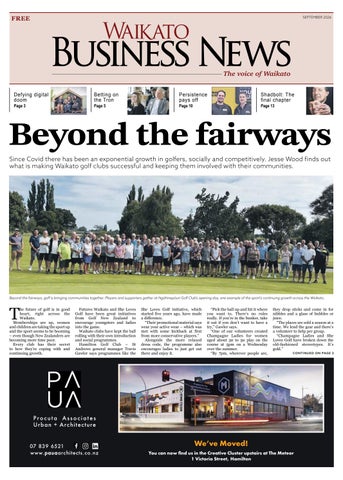
Beyond the fairways, golf is bringing communities together. Players and supporters gather at Ngāhinepōuri Golf Club’s opening day, one example of the sport’s continuing growth across the Waikato.
T
he future of golf is in good heart, right across the Waikato. Memberships are up, women and children are taking the sport up and the sport seems to be booming – even though New Zealanders are becoming more time poor. Every club has their secret to how they’re coping with and continuing growth.
Futures Waikato and She Loves Golf have been great initiatives from Golf New Zealand to encourage youngsters and ladies into the game. Waikato clubs have kept the ball rolling with their own introduction and social programmes. Hamilton Golf Club – St Andrews general manager Travis Gawler says programmes like the
She Loves Golf initiative, which started five years ago, have made a difference. “Their promotional material says wear your active wear – which was met with some kickback at first from more conservative players.” Alongside the more relaxed dress code, the programme also encourages ladies to just get out there and enjoy it.
“Pick the ball up and hit it where you want to. There’s no rules really. If you’re in the bunker, take it out if you don’t want to have a try,” Gawler says. “One of our volunteers created Champagne Ladies for women aged about 30 to 50 play on the course at 5pm on a Wednesday over the summer. “By 7pm, wherever people are,
they drop sticks and come in for nibbles and a glass of bubbles or juice. “The places are sold a season at a time. We lend the gear and there’s a volunteer to help per group. “Champagne Ladies and She Loves Golf have broken down the old-fashioned stereotypes. It’s gold.”
CO NT I NU ED O N PAGE 2
Procuta Associates U r ban + Arc hi t ect u re
07 839 6521 www.pauaarchitects.co.nz
We’ve Moved! You can now find us in the Creative Cluster upstairs at The Meteor 1 Victoria Street, Hamilton
2
CONTACTS News/Editorial Roy Pilott
editor@goodlocal.nz
027 450 0115
Mary Anne Gill
maryanne@goodlocal.nz
021 705 213
Viv Posselt
viv@goodlocal.nz
027 233 7686
Beyond the fairways
Advertising Director Janine Davy
janine@goodlocal.nz
027 287 0005
Owner/Publisher David Mackenzie
david@goodlocal.nz
Office/Accounts admin@goodlocal.nz
07 827 0005
Readers’ contributions of articles and letters are welcome. Publication of contributions are entirely at the discretion of editorial staff and may be edited. Contributions will only be considered for publication when accompanied by the author’s full name, residential address, and telephone number. Opinions expressed are not necessarily those of the publishers. Waikato Business News is published by Good Local Media Limited.
Also publishers of
BAY OF PLENTY
CountryLife
Hamilton Golf Club has 800 members plus 200 junior members through Futures Waikato. “Our main revenue is subscriptions and memberships, which flows over into the café, pro shop and bar. We do help out charities and schools with fundraisers as well as having about 10 regular corporate golf events a year,” Gawler says. “We could fill up every Friday with corporate golf but members have priority throughout the year. “We need to be accessible for Hamilton City ratepayers and the community as a whole. Locals have a preferential green fee as a Hamilton City ratepayer or renter.” Corporate golf is helping position Cambridge Golf as a destination venue for businesses, charities and visitors from across the region. “It’s great to have businesses and fundraisers using the course,” Cambridge Golf general manager Keith Vincent says. “Finding the right balance between members and visitors helps showcase the course to a wider audience. “The Rock’s Mates Matter Trust golf day was a great example. The radio promotion introduced us to people we may not otherwise have reached. “These events give us an opportunity to showcase the course to new players while providing valuable revenue during quieter periods, along with catering and bar income.” Waikato’s oldest golf club has also dropped “club” from its public-facing name as part of a move towards a more inclusive and contemporary brand. “We’ll always be a golf club and our members will always be at the heart of what we do. But membership alone isn’t enough,” Vincent says. “We want more people from Cambridge, the Waikato and beyond to experience the course. “Our refreshed branding is about creating a more welcoming and modern identity. We want as many people as possible to feel comfortable coming through our gates. “Growth comes from creating great experiences.” In rural Waikato, Ngāhinepōuri Golf Club secretary Sanjay Weerasinghe says as their community is
continually growing, the club is an obvious way to meet others and network. “We try to work in with the school and the community. This is a golf club, but it is a community club as well,” Weerasinghe says. “Ngāhinapōuri School have their cross country around the golf course and the club also assists with mowing the park. “Our sponsors get one corporate day per annum and we’ve got quite a portfolio of sponsors. We try and do those on a Friday in the summertime. “There’s also a lot of young families here, they don’t play a lot of winter golf but in the summer, they join up again.” With indoor golf simulators and other technology also introducing people to the sport, it’s an opportunity to get the newbies out on the courses for the real thing. Rather than invest money in new technology, the clubs are keeping their high standards of course quality. That is their bread and butter – and it’s working. “The more things we have, the more our fixed costs go up,” Weerasinghe says. “We have a lot of volunteers but if we expand too fast, too quickly, our costs will go up. “We’d much rather have a $1 million golf course and a $10,000 clubhouse. As long as the golf course itself is primo, then we will continue to attract people.” Having says that, all clubs
Cambridge Golf general manager Keith Vincent said corporate days help promote the course to a wider region. Photo: Jesse Wood
have embraced electronic scorecards where possible, while tournament registrations and promotion have become easier thanks to software. “Every club is creating posters with software like Canva. You can look fairly professional, compared to the clunky old posters golf clubs had 20 years ago,” Gawler says. “But in order to get people committed to the tournaments, Hamilton Golf Club is using Golf Genius. It provides confirmation straight away after buying your entry [like buying concert tickets]. “Under our website events, you can read the terms and conditions, decide and then pay your entry. Then we know that
SEPTEMBER 2026
CO NT I NU ED FR O M PAGE 1
Waikato Golf chief executive Terry Booth.
you are confirmed and you know you’re confirmed. “Clubs like ours can then communicate with entrants before and during the event. “Golf Genius uses digital scorecards which means you can track live scoring.” These clubs do their part to support their local schools and charities each year. The general consensus is, if you look after your community and those that support you, the word of mouth will continue to bring in more people. Golf has emerged as an inclusive sport for young and old. You can play singly or with a group, in almost any weather and time of day. It only took a global pandemic for New Zealanders to see how valuable it can be.
Nestled beside the Waikato River, Hamilton Golf Club’s St Andrews course is helping lead a golfing boom fuelled by new players, families and community engagement. Photo: Nightowl Productions
MORTGAGE & INSURANCE ADVICE
Tim van de Molen Your MP for Waikato Tim.vandeMolenMP@parliament.govt.nz 0800 GET TIM (0800 438 846) TimvandeMolenWaikato
THE RIGHT LOAN. THE RIGHT LOAN. THE RIGHT LOAN. THE RIGHT LOAN. THE RIGHT LOAN. THE RIGHT LOAN. THE RIGHTADVICE. LOAN. THE RIGHT THE RIGHT ADVICE. THE RIGHT ADVICE. THE RIGHT ADVICE. THE ADVICE. THE RIGHT ADVICE. THERIGHT RIGHT ADVICE. BETTER OUTCOMES. BETTER OUTCOMES. BETTER OUTCOMES. BETTER OUTCOMES. MORTGAGE INSURANCE ADVICEADVICE MORTGAGE & INSURANCE MORTGAGE &&INSURANCE ADVICE
MORTGAGE & INSURANCE ADVICE MORTGAGE & INSURANCE ADVICE MORTGAGE & INSURANCE ADVICE
BETTER BETTER OUTCOMES. BETTEROUTCOMES. OUTCOMES.
���� ������� �������� ����� ������� ����lending ������� �������� �����Clear ������� More options. advice. ������� �������� ����� ������� ��� ����� ������ ������ ���� ������� �������� ���������� ������� ���� ������� �������� ����� ������� ���� ������� �������� ������� ���place ����� �� ������ One to����� start. ��� �� ������ ��� ����� �� ������ ��� ����� �� ������
��� ����� �� ������
e ee e ee
e
���������� ���������� ��
� �
���������� � ���������� ������ ������� INVESTMENT &�������� ���������� � ������ ������� ������ ������� EQUITY RELEASE �������� ���������� ���������� ���������� � �� ����� �������� ��������� ����� �������� ���� PROPERTY FINANCE ������ ������� ������ ������� � �������� �� ����� �������� �� ����� �������� �� ����� ������������ � ������������ ����������������� ����������������� PERSONAL INSURANCE CONSTRUCTION &�� ������������ � � � � � ����������������� ����������� �� ����� ������������ � ����� ������������ � ������������ � � ����������������� ����������������� ����������� ����� ���������� � ����������� ���������� � ����������� ���������� � PROTECTION DEVELOPMENT LOANS � � ������������� ����������� ���������� ����������� ����� �����������
���� ������ ���� ������ ���� ������ HOME BUYERS
�������� ������ ������ ����������� �&� ����������� REFINANCING ����������� � ����������� � � ����������� ������������� ������������� ������������� RESTRUCTURING ������������� �������������
ACCESS TO A WIDE RANGE OF LENDERS
ACCESS A WIDE LENDERS ACCESS TORANGE A WIDE RANGE OF LENDERS ACCESS TO ATO WIDE RANGE OFOFLENDERS ACCESS TO A WIDE RANGERANGE OF LENDERS TO ANON-BANK& WIDE RANGE OF LENDERS ACCESS TO A WIDE OF LENDERS •·•ACCESS NON-BANK& •·• •·• NON-BANK& • CHINESE MAJOR NZMAJOR BANKS NZ• • BANKS •A BANKS CHINESE BANKS 1ti•·• SPECIALIST LENDERS LENDERS •ANON-BANK& •·• 1ti SPECIALIST MAJOR NZ BANKS CHINESE BANKS •AMAJOR 1tiNON-BANK& • • • SPECIALIST LENDERS MAJORMAJOR NZ BANKS CHINESE BANKSBANKS•A BANKS NZ BANKS CHINESE 1ti•A 1ti NZSPECIALIST SPECIALIST LENDERS LENDERSCHINESE BANKS
l9ll9l l9l l9ll9l Major NZ Banks Authorised by Tim van de Molen, Parliament Buildings, Wellington.
SUNNY SOLANKI
Chinese Banks l9l
MORTGAGE & INSURANCE ADVISER 022 186 9462 sunny@applemortgage.co.nz
Non-Bank & Specialist Lenders
JOHNSON CHENG
DIRECTOR 021 262 6468 johnson@applemortgage.co.nz
MORE CHOICES. MORE FLEXIBILITY. BETTER RESULTS.
•·• NON-BANK& •A1ti SPECIALIST LENDERS
www.applemortgage.co.nz Apple Mortgage Limited
������
������ ������
SEPTEMBER 2026
Briefs… Chamber moves
Waikato Chamber of Commerce will relocate to Waikato Innovation Park at the end of the month placing the region’s largest business network at the centre of Waikato’s innovation ecosystem. Chamber chief executive Don Good says the move will improve accessibility for members while positioning the organisation alongside leading research, agritech, logistics and technology businesses.
Heart study
Research by Waikato Hospital’s cardiothoracic department has identified ways to better support people facing heart valve replacement surgery. The study found patients carefully weigh medication requirements against the risk of repeat surgery, with clinician advice playing a key role. Hamilton-based surgeon Associate Professor Nishith Patel says the findings are helping shape improved long-term care and patient education.
Affordable homes
Hamilton is set to receive 50 new social and affordable homes through the Government’s Housing Flexible Fund, part of a nationwide package delivering more than 820 homes. The new one and two-bedroom homes will target areas of highest need, while supporting local construction jobs and building on recent increases in the city’s housing supply
Big turnout
More than 300 women attended the Waikato Waahine Collective Symposium, bringing together business leaders, entrepreneurs and professionals from across the region. Organisers say the event provided opportunities to build connections, share experiences and support personal and professional growth, highlighting the increasing demand for networking and leadership development opportunities for women in business.
3
Libraries defy digital doom And they said libraries were going to die. Mary Anne Gill discovers the opposite is happening in Hamilton.
R
emember when experts declared the internet would kill libraries? For years, predictions of their demise echoed through schools, councils and communities. Why borrow a book when Google was only a click away? Why maintain sprawling collections when information could be stored on a screen? Yet in Hamilton, libraries are not merely surviving. They are thriving. Figures released by Hamilton City Council under the Local Government Official Information and Meetings Act show a library network that is attracting more visitors, maintaining strong membership and embracing digital technology at levels few would have predicted two decades ago. The most obvious example is Hamilton Central Library. Following the completion of its new façade and the opening of Te Paataka, average daily visitation has surged. Before façade work began in 2025, the library averaged 403 visitors a day. During construction that rose to 446. Following completion of the work, daily visitation climbed to 598 and, since Te Paataka opened in July, has reached 670 visitors a day. Hamilton City Council Community Services Unit director Rebecca Whitehead says the surge in visitor numbers is encouraging.
SELLING FAST
Rebecca Whitehead
The increase is part of a much bigger trend. Across the city, Hamilton’s libraries recorded more than one million visits in the 2025/26 financial year. That’s up from 789,690 visits in 2018/19 and almost double the 548,296 visits recorded in 2022/23 when the lingering effects of Covid were still evident. Long-time library user Renee Robertson, who has been visiting the central library for more than 30 years and now brings her two-year-old daughter to story time sessions, is one of those helping drive the trend. The trend may reflect more than changing attitudes towards libraries. Council says use of libraries typically increases in tougher economic times as households take advantage of free resources, programmes and services. Far from becoming obsolete, libraries are growing in importance. Hamilton City Libraries currently has 38,591 active members. The largest age group is people aged 36 to 45, numbering 7911 members. Close behind are residents aged 66 to 90 with 6398 active members. There are also 4956 members aged 12 and under, suggesting libraries remain firmly embedded in the lives of young families. The network’s reach extends beyond city boundaries. Through an agreement with Waikato District Council, Hamilton libraries also serve more than 3100 active Waikato district members, highlighting the role the city’s libraries play as a regional resource. One of the strongest growth stories comes from Rototuna. Te Kete Aronui Rototuna Library, which council describes as an example of a modern purpose-built library, has 5039 active
Hamilton Central Library is at the centre of a library revival, with visitor numbers climbing after the completion of its new façade and the opening of Te Paataka.
members. Only Chartwell’s Kukutaruhe branch has a larger membership base among the suburban libraries. The numbers also challenge the notion that technology and libraries are incompatible. While traditional borrowing remains strong, digital use has exploded. Combined digital issues of e-books, e-audiobooks and e-magazines have increased from 76,061 in 2018/19 to 231,598 in 2025/26, more than tripling over seven years. The most dramatic growth has been in e-audiobooks, which have increased from 24,105 issues in 2018/19 to 112,591 this year. According to council, e-audiobooks are now used more frequently than e-books, reflecting changing reading habits and a desire by some users to move away from screens during their leisure time. Physical books continue to hold their own. Fiction borrowing totalled 833,562 issues in 2025/26, while overall library issues have recovered to exceed preCovid levels. Whitehead believes the story is about far more than buildings and books. “Transformation isn’t just about buildings and infrastructure. It’s about
the experiences people have when they’re here and the reasons they choose to come back,” she says. That’s evident in the way libraries are being used today. Visitors come to borrow books, attend children’s programmes, study, use computers, research family history, access archives, meet friends or simply spend time in a safe public space. The modern library has become part community hub, part
learning centre and part digital gateway. The internet changed libraries, certainly. It just didn’t kill them. In Hamilton at least, the evidence shows the opposite. More people are walking through library doors, more members are signing up and more content is being borrowed than ever before. For a service repeatedly written off in the digital age, libraries are proving remarkably resilient.
Coverage boosted
Ambulance coverage across Matamata-Piako has been strengthened with the introduction of a 24/7 Hato Hone St John ambulance service. Since launching on May 1, the double-crewed service has responded to 334 incidents, averaging 3.2 callouts a day. The team has also significantly improved its response times to high-priority emergencies, reaching 54.2 per cent within 12 minutes, up from 43.4 per cent. The enhanced service provides emergency ambulance coverage to Te Aroha 24 hours a day, seven days a week, expanding on the previous 12-hour service. Hato Hone St John said it followed a review by the organisation of ambulance coverage across the Waikato region and is part of a wider programme to improve access to urgent and emergency healthcare for rural communities. “We’re seeing demand grow every year,” says Hato Hone St John North Waikato area operations manager Hugh Davison. “It is not only strengthening our ability to respond to emergencies in Te Aroha but also easing pressure on our frontline staff in neighbouring areas and enabling us to deploy our resources more efficiently and improve emergency ambulance coverage across rural Waikato.”
Close to Everything. Far from Ordinary Starts at
$829,000 Karewa Place
Situated in Hamilton, just moments from The Base, Kmart, Woolworths, & more.
0800 772 462 | PRAGMAHOMES.CO.NZ
4
SEPTEMBER 2026
STUDENT VIEW
Making votes count By CHLOE CADDY
As election day draws closer, political billboards are appearing across our communities, campaign messages are filling social media feeds, and news coverage is increasingly focused on party policies and political debate. For many Waikato University students, this will be the first general election in which they can cast a vote. Yet despite the importance of this opportunity, a significant number of young people remain unenrolled or uncertain about participating in the democratic process. One event designed to help students engage with the election was the pre-election debate hosted last month by the Waikato Students’ Union and Te Piringa Student Events Association. Held in The Pā, the event brought together representatives from seven of New Zealand’s major political parties and attracted a crowd of around 200 students and staff. Representing their respective parties were Tama Potaka (National), Georgie Dansey (Labour), Hana-Rāwhiti Maipi-Clarke (Te Pāti Māori), Dr Parmjeet Parmar (ACT), Qiulae Wong (TOP), Dr Lawrence Xu-Nan (Green) and Hon Casey Costello (New Zealand First). The discussion was moderated by Sacha Coburn, with questions submitted by students and focused largely on issues affecting tertiary education and young New Zealanders. While attendees were encouraged to remain respectful and avoid interrupting speakers, the atmosphere in the room reflected the passion that political issues can generate. Responses from the audience varied throughout the night, with some answers drawing applause and others receiving a far more reserved reaction. Policies relating to tertiary education, student
support and the cost of living attracted the greatest interest. Proposals involving changes to Fees Free, student allowances, student loans and wage policies prompted strong engagement from students, many of whom are directly affected by these issues every day. One of the more memorable moments of the evening came during discussion around work experience and study. Green Party representative Dr Lawrence Xu-Nan argued that students undertaking academic placements should receive financial support similar to apprentices in the trades. The idea resonated with many in attendance and sparked considerable discussion after the event. Like most political debates, the evening highlighted clear differences between parties on subjects ranging from education funding to constitutional issues and economic policy. Audience reactions often reflected the priorities and perspectives of a university crowd, particularly on matters that affect students directly. Regardless of political preference, the event demonstrated the value of creating spaces where young people can hear from candidates, ask questions and challenge ideas. Elections are about more than party loyalty. They are an opportunity to consider different perspectives and make informed decisions about the future. As November approaches, events like this serve as an important reminder that student voices matter. The first step is simple: get informed, get enrolled and make your vote count. • Chloe Caddy is a Waikato University student offering observations on university life and issues affecting students.
LOCAL GOVERNMENT
Writing Tim’s story By MARGARET EVANS
It’s true. I am the author of a new mayoral memoir – not my own. I confess, I have written Sir Tim Shadbolt’s “Final Chapter”. Using his own words. Hoping to find and provide answers to the regular public question: ‘what happened to Tim?’ As well, there is my own long-time interest in mayors and local government, and ‘holding them to account’ as anticipated in democracy. I hope this book assists positive reform and provides support for the office of mayors everywhere. This ‘Final Chapter’ book first made the news at Sir Tim’s civic funeral in January this year when I confirmed to the thousands gathered at Invercargill’s Civic Theatre and watching the live broadcast – that the story of his recordsetting final decade as the city’s colourful mayor was ‘on its way’. Now, it’s with the publishers and due for public release this very month. ‘Curate’ is the lofty term used to describe my role, since the book’s heart and soul are Tim’s own words, from his Southland mayoral newspaper columns during that final tumultuous decade from 2013 to his re-election defeat in 2022. His humour, and his ability to shine the light on so many issues of importance has been noted by many others, but until I read his columns (all of them) I hadn’t appreciated the extent and depth of his observations. The book’s context within our nation’s social and political history, comes from others and from my deep digital dig of official records, news reports, and archives. As well, my own direct experiences and perspectives were useful. A Readers’ Digest poll once rated Tim the single most trusted politician in the country.
Invercargill City Council’s own website described him as ‘a local hero and New Zealand icon, known for his wide-mouthed smile, wicked sense of humour, standing up for a wide range of causes and for supporting the average kiwi.” This was all so true, as I discovered walking around the streets of Invercargill and Bluff with him. As were the mounting concerns as “his status and stature visibly buckled …’ (as I wrote). We first met when Tim was Waitemata mayor promoting his plan for a waterfront stadium in his patch. ‘Tim’s Team’ had won seats on the Auckland Harbour Board, and I had been elected for Waikato. We coincided mayoral terms in the 1990s, and he was still Invercargill mayor when I developed my master’s thesis (on the Role of the Mayor) during the 2002 Local Government reforms. The 2010 Auckland City amalgamation brought executive mayoral powers (and current Mayor Wayne Brown has brought back newspaper columns). Parliament’s 2012 amendment again attempted to clarify the mayoral role. Today’s promised reforms respond to many examples of local body dysfunction – bureaucratic, financial and behavioural. I’m a supporter. So was Sir Tim. He showed a different style of leadership. • See: Shadbolt: The Final Chapter, page 13 • Margaret Evans was Hamilton mayor from 1989 to 1998 and honoured in 1995 with a Commander of the Order of the British Empire (CBE) for her services to local government.
5
SEPTEMBER 2026
Betting on The Tron
Developers Sanjil Mistry and Pienaar Piso are backing Hamilton’s future with a multi-million Pullman Hotel development that will reshape the city’s skyline and the local economy, writes Mary Anne Gill.
A
premium Pullman Hotel, more than 100 jobs and a dramatically altered skyline are among the outcomes expected from a $100 million investment in central Hamilton. Pragma Group founder Sanjil Mistry outlined progress on the hotel development at the Hamilton Central Business Association annual general meeting last month and explained why he and business partner Pienaar Piso continue to see opportunity in the city. “We could be anywhere else, but we choose Hamilton,” Mistry told attendees. The project, being developed by Mistry and Piso in partnership with international hospitality giant Accor, will introduce the Pullman brand to Hamilton and create one of the city’s largest premium accommodation offerings. The redevelopment of the former Tower Building represents an investment of about $100 million and ranks among the most significant hospitality developments ever undertaken in the Waikato. What began as a 191-room hotel has now expanded to 205 rooms after the developers secured additional space within the building. Mistry says the change followed MediaWorks’ relocation
from the top floor, allowing the level to be redesigned and a further 14 rooms added. The redesign has created opportunities beyond additional accommodation. The upper levels are being completely modernised, replacing the building’s distinctive angled windows with a contemporary glass curtain wall that will dramatically change its appearance on the Hamilton skyline. “We’re better to do it now than come back in five years and put a tower crane up and block the streets again,” Mistry says. When complete, the development will include a rooftop bar and restaurant, conference and function facilities, a groundfloor restaurant and café, private guest spaces and underground valet parking. Construction has required innovative solutions to minimise disruption in the heart of the city. A temporary window factory was established inside the building, allowing glazing units to be manufactured on-site and installed with minimal street closures. More than 1200 skip bins of material have already been removed from the building during the redevelopment. Around 200 workers are
currently on site each day, and Mistry expects the completed hotel will support about 100 full-time jobs. The developers’ confidence extends beyond the Pullman. Mistry and Piso have unveiled plans for two further Hamilton hotels - a lake and hospital-side development in Pembroke St and a business-focused accommodation project in Pukete - adding to a growing accommodation portfolio that reflects their long-term commitment to the city’s future. The project’s significance extends beyond accommodation, he says. Hamilton has long lacked a large-scale premium hotel capable of attracting major conferences, corporate events and high-value visitors. The Pullman is expected to strengthen the city’s visitor economy and complement other major investments taking place across the CBD. The hotel is not Mistry’s only central city project. Pragma has also transformed the former Sails Motor Inn into Te Awa Suites and repositioned Anglesea Tower, leasing more than 4000sqm of office space after purchasing the building vacant. Asked why he had returned to major CBD developments after
Work started on the building early last year.
years focused elsewhere, the Fijiborn developer pointed to his personal connection with the city. Having arrived in Hamilton as a two-year-old and attended local schools, Mistry says investing in
Photo: Mary Anne Gill
Hamilton was both a business decision and a commitment to the community that helped shape him. “Me and Piza have taken a significant punt,” he says. “But we believe in the city.”
Success is... never being far from your office, your gym and your family. Find the right work-life balance at our new flexible workspaces in Hamilton.
Finding the balance between doing a great job and having a great home life is so important. At Regus, our flexible workspaces mean it’s easier to balance both than ever before. Discover an office in Hamilton that makes your whole life work today.
Offices Coworking Meeting rooms
regus.com Part of the IWG Network
© Regus 2026
6
SEPTEMBER 2026
TOURISM
Rediscovering our backyard By NICOLA GREENWELL
Deputy mayor Geoff Taylor recently made a compelling case for celebrating Hamilton rather than talking it down. This message resonates well beyond the city boundaries. Across the mighty Waikato, we have plenty to be proud of – and plenty worth talking about. We are fortunate to live in a region rich in natural landscapes, world-class attractions, vibrant towns, fantastic hospitality businesses, rich culture and a growing calendar of events. Yet, like many destinations, we often overlook what is right on our doorstep. But how well do we know our own place? Tourism is frequently thought of as attracting visitors from overseas or encouraging New Zealanders to holiday in our region. But one of the most important audiences is much closer to home – our own residents – you. The more we experience our region for ourselves, the more confidently and enthusiastically we can share it with others. Whether it’s taking visiting friends to Hamilton Gardens, exploring Sanctuary Mountain Maungatautari, cycling Te Awa River Ride or the Waikato section of the Hauraki Rail Trail, discovering a new café or gallery, attending an event, or exploring one of our rural communities, every experience builds pride and confidence in what the Waikato has to offer. Those experiences support local businesses and create the vibrant region we all want to live in – one with great places to eat, things to do, events to attend and experiences we’re proud to recommend.
When friends, family, or clients ask what they should do while they’re here, a personal recommendation is incredibly powerful. There’s is a big difference between saying, “I’m sure you’ll find something online” and “you have to try this place – I went recently and it was fantastic.” For Hamilton & Waikato Tourism, part of our role is to champion this region – sharing its stories, building its reputation and giving people compelling reasons to visit. But regional pride can’t be created by a tourism organisation or an advertising campaign alone. It grows when the people who live here know their region, experience it and genuinely believe it is worth sharing. Visitors notice when a community believes in itself. They notice when local people speak positively about where they live, confidently recommend experiences and genuinely enjoy sharing their region. This authenticity becomes part of the visitor experience itself. As Hamilton and the Waikato continue to grow, we all have a role to play in shaping how our region is perceived. The more we explore, support and celebrate what is on offer, the stronger our communities become and the more compelling our destination is for others. So, the next time you have a free weekend, consider becoming a visitor in your own region. You may be surprised by what you discover—and you’ll be helping ensure the mighty Waikato remains a place we’re all proud to call home. • Nicola Greenwell is general manager of Hamilton and Waikato Tourism.
LOCAL GOVERNMENT
To vote or not By PAULA SOUTHGATE
Millions in investment. Annual power discounts. Community funding worth millions more. And still, a dismal voting turnout. What does it take to get people to vote? The Wel Energy Trust oversees energy assets worth over $800 million and guides investment in a network we all rely on. Every year it returns $20 million directly in discounts, grants, real money in real pockets. That’s public money, under public oversight. People should want a say in who holds that responsibility. This year, I tried to make them care. Only 10.14% did. However, Wel isn’t the exception. It’s the pattern. Only 9.3% voted in this year’s Entrust elections. Entrust is the majority owner of Vector, a $2.76 billion shareholding. School board turnout is marginally better averaging 28.9% in 2025. Local government elections 42% fared better, but that is not event half of eligible voters. The UK tells a similar story and Ontario’s municipal elections have sat under 50% for four decades. Sadly, the trend is heading the wrong way. Over many years, councils across New Zealand have discussed apathy, trust, postal versus online voting, campaign budgets. We tried hard to lift voting. We failed. The system failed by leaving big decisions to be made by a few people elected by a small minority of New Zealanders. Here’s the uncomfortable; truth people turn out when they’re angry or there is controversy. Discontent speaks louder than contentment, every time. Where the stakes are higher, at a personal level, voting rates are higher. However, when New Zealanders don’t have
enough information, or “not listened to” has the absolute opposite effect. A lack of online voting, fewer post boxes and general ease of voting also appears to play a role. Even when online voting is possible it is not well used: only 33% used online voting in the Wel election. On the upside a sense of civic duty leads to voting, and so does habit: I’ve voted since I was 18. For me the habit is entrenched. Compulsion also clearly works In Australia compulsory elections exceed 90% turnout, while voluntary local elections in Western Australia and South Australia sit at 30–35%, no better than New Zealand local government results. But compulsion has downsides: it removes the choice not to vote, can produce uninformed or protest votes, and may ease the pressure on parties to genuinely engage voters. Where does this leave us? We certainly need reach voters more effectively, provide the information they need and give them chances to be heard, not just at election time. We need evidence-based change to how elections are conducted that tackles all the causes of low voting AND we need the public to buy in. Voting is a privilege, whether for parliament, local government, or a community trust like Wel. When people tell me there’s no point, that no one listens, I tell them this: the only guaranteed way to never be heard is to leave the tick box empty. • Paula Southgate is Senior Fellow at the Helen Clarke Foundation a Local Government advisor, Wel Energy Trust trustee and former Hamilton mayor.
It’s time business leaders showed AI who’s boss
Powered by
WORKFORCE2030.CO.NZ
SEPTEMBER 2026
Resilience fuels growth Despite ongoing pressures, Hamilton’s central city is continuing to attract investment, new businesses and major developments, reports Mary Anne Gill.
G
rowing confidence in Hamilton’s CBD was a key message at the Hamilton Central Business Association annual general meeting, despite ongoing challenges from high costs, changing consumer habits and economic uncertainty. Association chair Chelsea Fleetwood told members the past 12 months had tested businesses with high
Deputy mayor Geoff Taylor.
operating costs, changing consumer behaviour, workfrom-home practices and wider economic uncertainty. Yet despite the headwinds, she says there were plenty of positive stories emerging from the city centre. “The narrative of Hamilton hasn’t always been a positive one, but that is changing,” Fleetwood told attendees. She paid tribute to general manager Vanessa Williams and marketing manager Vicky Raven for delivering more than 118 public space activations during the year, while continuing to advocate strongly for the interests of city businesses. Among the wins highlighted were the return of two hours free on-street parking, the opening of the BNZ Theatre, successful major events including Homegrown and the World Surf League event, and growing investment confidence in the CBD. Fleetwood says market enquiry for commercial property remained active and sectors including health, fitness and beauty were showing positive momentum despite wider
economic pressures. Developments such as the Pullman Hotel, ongoing medical investment around Anglesea Street and direct flights between Hamilton and Australia were all contributing to confidence in the city’s future. The association’s sixmonth report paints a similar picture. While retail and hospitality operators continue to face tight margins and cautious consumer spending, Hamilton’s CBD has maintained steady investment and development activity. Major projects include the Pullman Hotel, the Pascoes Building redevelopment, North Bloc, Union Square and several health-sector developments. Hamilton City Council deputy mayor Geoff Taylor used the AGM to reaffirm council’s support for the business community. Elected members had recently approved the city activation budget for the year ahead and understood the need for investment in streetscapes, maintenance, parking and safety. “We’re right behind what you guys are doing,” Taylor
told members, praising the association’s efforts to promote positive stories about central Hamilton. Fleetwood also highlighted growing confidence in the office market. A recent survey showed Hamilton CBD office vacancy declining from 8.9 per cent to 8.4 per cent in the first half of 2026, with demand continuing for quality office accommodation. The AGM also saw a change to the executive committee. Nicola Aldridge of Harkness Henry stepped down as she prepared to take maternity leave, and members approved the appointment of two new executive committee members Bridget Haliburton of ASB Bank and Nicole Hatupianu of Kiwi Property’s Centre Place. For Fleetwood, the focus remains on ensuring Hamilton’s business community continues to tell its own story. “There is so much power in storytelling and building positive sentiment,” she says. “Leave today and share a positive story of our CBD with someone tomorrow.”
Chelsea Fleetwood addresses members at the recent Hamilton Central Business Association annual general meeting. Photo: Mary Anne Gill
WAIKATO’ S BIGGEST NIGHT IN BUSINESS
2026 WAIKATO BUSINESS AWARDS
F R I DAY 6 N OVE M B E R
CLAUDELANDS ARENA
S EC U R E YO U R T I C K E TS O R TA B L E TO DAY WAIKATOBUSINESSAWARDS .CO.NZ
7
8
SEPTEMBER 2026
D VEERRTTOORRI A I ALL AADV
Three Years That Reshaped New Zealand Immigration
The eleven minutes By PHIL MACKAY
W
ith a General Election now only a few months away, it will be interesting to see whether immigration becomes a political battleground. We hope not. Immigration settings are too important to New Zealand’s long-term economic success to become a source of division. Whatever transpires during the election campaign, it is difficult to argue that the current Government has not delivered one of the most substantial and comprehensive programmes of immigration reform seen in many years. When the coalition Government took office in late 2023, it inherited a system facing significant challenges. Employers were frustrated by complexity, visa processing had become increasingly bureaucratic, migrant exploitation remained a concern, and several visa pathways were no longer aligned with New Zealand’s economic needs. Since then, Immigration Minister Hon Erica Stanford and her officials have undertaken an extensive programme of work that has touched almost every major visa category. The reforms have not been driven by ideology. Instead, they have focused on improving economic outcomes, strengthening system integrity, attracting investment, making immigration settings easier to understand and navigate, and progressing the digital transformation of visa processing. Perhaps the most significant success has been the revision of the Active Investor Plus Visa. The previous programme attracted little investment and was widely regarded as uncompetitive. The new settings introduced in early 2025 produced an immediate turnaround, with more than 800 applicants now committing almost $5 billion of new investment into New Zealand. At a time when access to growth capital is essential for economic development, this is a remarkable achievement. The Government has also introduced a new Business Investor Visa aimed at attracting experienced managers and businesspeople to purchase businesses in New Zealand. While still in its infancy and yet to gain significant traction, the new category represents an improvement on its predecessor, the much-maligned Entrepreneur Visa. Skilled migration settings have also received significant attention. Recent reforms to the Skilled Migrant Category have created clearer and more realistic residence pathways for tradespeople,
technicians and experienced workers. Greater recognition is now given to practical skills and work experience, while migrants and employers alike can now plan their residence pathways with greater certainty. For employers, there have been ongoing refinements to the Accredited Employer Work Visa framework. While some integrity measures have increased compliance obligations, many of the changes have created a more balanced system that protects New Zealand workers while continuing to support genuine employers facing skill shortages. The Government’s renewed focus on international education and student visa processing, driven in part by its goal of doubling the economic value of international education by 2034, is paying dividends with student numbers rebounding strongly. Changes to skilled residence settings that place greater value on New Zealand qualifications will further enhance the attractiveness of studying in New Zealand, while reinforcing the need for efficient visa processing. Family migration has not been overlooked. The introduction of the five-year Parent Boost Visa has created a practical option for families wishing to spend extended periods together, while changes to Parent Resident Visa selection processes have brought greater certainty and transparency for those seeking permanent reunification. Equally important has been the Government’s willingness to listen. Immigration policy is rarely straightforward, and the interests of employers, migrants, education providers, communities and government agencies do not always align. These past three years have been particularly notable for the level of engagement with industry groups and stakeholders, something that has undoubtedly contributed to the successful design and implementation of many of these reforms. New Zealand’s immigration system is unquestionably in a stronger position than it was three years ago. Whether measured by investment attracted, residence pathways modernised, family reunification enhanced, or economic opportunities created, the scale of reform has been significant. However, many of these reforms are still relatively new. The challenge for the next Government may not be designing the next round of immigration reforms, but allowing the current ones sufficient time to prove their worth.
Pathways· > your immigration partner
www.pathwaysnz.com
Level 2 586 Victoria Street Hamilton 3204
OUR ENVIRONMENT
Level 3 50 Manners Street Wellington 6011
0508PATHWAYS enquiries@pathwaysnz.com
Some people will know that I’m a keen runner. That probably undersells it, in the sense that being a runner is a fairly core part of my identity. I spend a lot of time running, thinking about running, reading about running - you get the picture. I came across a concept recently that I think has great parallels for business. It was the idea that there’s a hierarchy of effectiveness with exercise. Much like the 80-20 rule, the biggest gains are the easiest. Any exercise beats none at all. Any exercise done consistently beats sporadic effort. And consistency plus real effort or intensity of exercise is where the overwhelming majority of results come from. Only then does it start to matter what the mix of activities is, how many reps you do, or how you plan training weeks and blocks. Similarly, researchers at the University of Cambridge pooled 196 studies covering more than 30 million people. They found that 75 minutes a week of moderate activity, which works out at eleven minutes a day of brisk walking, was associated with a 23% lower risk of early death. So the big gains come from simple, regular effort. Yet many runners spend a lot more time worrying about whether they have the right mix, or the right programme. I think many of us run our businesses the same way. We really want to do things properly, but that means things get put off, or not even started at all. We’ll kick off that
marketing plan in the next quarter once we have our ducks in a row. Or we just need to understand Ai a little bit better, and create a strategy, before we start implementing it in our business. But perhaps we don’t need a strategy, we just need to start somewhere and make consistent effort. The business equivalent of eleven minutes a day. Twenty minutes on the debtor list every Friday morning. One conversation a day with a client you have not spoken to this year. A 15-minute huddle instead of the hour-long meeting you cannot schedule. In ‘Great by Choice’, Jim Collins recalls the story of the 1911 race to the South Pole. Roald Amundsen’s team marched 15 to 20 miles a day – in foul weather, but also on the good days when they could easily have gone further. Robert Falcon Scott’s party surged when conditions allowed and stopped when they did not. Amundsen reached the Pole first, while Scott’s outcome was tragic. Collins calls it the 20 Mile March, and he found the same pattern in the companies he studied. Steady, regular effort compounds further than bursts of brilliance, in business just as on the ice. So, what is your eleven minutes – and which day this week does it happen? • Phil Mackay is a business manager at large, trail runner, and strategic advisor to Paua Architects.
PEOPLE & CULTURE
Unlocking Ai potential By LISA DEAN
For many New Zealand businesses, the question is no longer whether to use artificial intelligence. The reality is that employees are already using it. The EMA’s Workforce 2030 research found that 83 per cent of surveyed businesses are using Ai in some form, whether through experimentation, pilot programmes or embedded business processes. At the same time, many organisations are still developing the leadership capability, governance frameworks and workforce readiness needed to support that adoption. People are finding practical ways to use Ai to save time, generate content, summarise information and improve productivity. But often this innovation is happening faster than formal systems and policies can keep up. Our research identified the growing presence of what is commonly called “shadow Ai”, employees using Ai tools outside approved organisational frameworks because they see immediate benefits in their day-today work. New technologies have often been adopted before governance catches up. The issue is not that employees are using Ai. In many cases, that experimentation is delivering genuine value. The risk emerges when organisations have limited visibility of which tools are being used, what information is being shared, and who is accountable for decisions supported by Ai. The Workforce 2030 research revealed that leadership capability is becoming one of the most significant constraints to successful Ai adoption. Many leaders remain uncertain about governance, accountability, acceptable use, organisational risk appetite and the boundaries between human and Ai decisionmaking.
This matters because Ai is no longer a technology issue alone. As Ai becomes more deeply integrated into everyday business operations, leaders must make decisions about trust, risk, oversight and responsibility. They need to understand not just what the technology can do, but how it should be used within their organisation. Importantly, governance should not be viewed as a barrier to innovation. Good governance enables innovation by giving people clarity and confidence. It helps businesses create safe environments for experimentation while protecting customers, employees and commercial information. That is why governance and responsible use are becoming a growing focus of the EMA’s Workforce 2030 initiative. Businesses are increasingly looking for practical guidance on how to balance opportunity with accountability. The EMA will host an Ai governance webinar this month as part of Workforce 2030, featuring specialists from Data Insight. Designed for business leaders and decision-makers, the workshop will explore the governance questions organisations should be asking as Ai adoption accelerates. Participants will engage directly with experts to discuss real-world Ai implementation challenges and opportunities. Because the businesses that gain the greatest value from Ai over the next decade are unlikely to be those that simply adopt the most tools. They will be the organisations that combine innovation with strong leadership, clear governance and the confidence to use Ai responsibly. • Lisa Dean is general manager Marketing and Transformation at the EMA.
SEPTEMBER 2026
Demand drives recovery
9
Vacancy rates have fallen and office occupancy has increased in Hamilton’s CBD as businesses continue to favour higher-quality workplaces, writes Mary Anne Gill.
Hamilton’s CBD office market has recorded its strongest result in more than six months, with occupied office space rising by 6003 sq m and overall vacancy falling from 8.9 per cent to 8.4 per cent. A new survey by CBRE Research and NAI Harcourts suggests businesses are continuing to favour modern and refurbished workplaces, reflecting a trend identified by Hamilton Central
Business Association chair Chelsea Fleetwood. In the association’s six-month report to the end of June, Fleetwood noted strong demand for refurbished and newly developed office space despite hybrid working remaining a feature of modern business. Employers seeking to attract and retain staff increasingly recognised the importance of workplace quality. The latest survey found that
Hamilton Central Business Association general manager Vanessa Williams advocates for businesses in the CBD.
demand was translating into stronger occupancy levels across the CBD, driven by leasing activity, completed refurbishment projects and a continuing preference for higher-quality accommodation. One of the biggest contributors was the redevelopment of North Bloc at 193 London St, where 2,920sqm of office space was reclassified to a highergrade following completion of refurbishment work. The building is now fully occupied by Fonterra. The survey found Grade A buildings continued to attract the strongest demand, recording the lowest vacancy rate at 3.1 per cent. At the other end of the spectrum, Grade D office space remained the most challenging segment of the market with vacancy sitting at 19.5 per cent. Researchers said the results reinforced the ongoing “flight to quality” trend, where businesses are increasingly choosing modern or refurbished premises that better support collaboration, productivity and staff engagement. Hamilton’s total office stock increased slightly to 305,165sqm during the period. Completed refurbishment projects included a 921sqm floor at Anglesea Tower, although 653sqm remains available for lease. The report highlighted the former Tower Building on Ward St
Property investors Steve and Romaney McLennan have refurbished the historic Pascoe’s Building in Hamilton. Photos: Mary Anne Gill
as one of the city’s most significant projects currently underway. The former office block is being redeveloped as part of a $100 million mixed-use project that will include underground parking, commercial office space and a 200-plus-room Pullman hotel. Net absorption - a measure of occupied space added to the market -reached 6,003sqm during the first half of 2026. Leasing activity included transactions at the BNZ Building, Anglesea Tower, 18 London St and KPMG Tower. Despite the positive results, the report notes that older office stock
continues to face challenges. Of the 25,509sqm currently vacant across the CBD, more than 21,000sqm has remained empty for at least 12 months. The survey concludes that while hybrid working remains a feature of modern workplaces, employers continue to place value on office environments that encourage collaboration, productivity and employee engagement. That preference for quality accommodation is expected to continue driving refurbishment and development activity across Hamilton’s CBD.
TERM DEPOSITS
PUT A LITTLE SPRING INTO YOUR SAVINGS
3Months TE RAPA 880 Arthur Porter Drive, Burbush, Hamilton 3200 027 773 11 34 | terapa@sgss.co.nz | safeguardstorage.co.nz
50%off
*T&C Apply
12 month term deposit
SUBSCRIBE
NOW...
…and receive a copy, posted directly to you, every month. Price is $150 + GST for a 12-month paid in advance subscription (equivalent of $12.50 + GST per month)
To subscribe email admin@goodlocal.nz
4.05%
p.a.*
First Credit Union Incorporated is not a registered bank. A Product Disclosure Statement is available. *Minimum deposit off $500. Interest rates are subject to change without notice. For more information n and current rates visit www.firstcu.co.nz.
10
SEPTEMBER 2026
ADVERTORIAL
Why a Finance Broker is a smart financial decision
P
urchasing property, either as an owner occupier or investor, is a significant financial commitment. Yet many people still walk into their own bank believing they are getting the best deal available. It’s no longer the long-term relationship with a particular banker at your bank that gets the deal across the line, it’s how its packaged and presented. The reality is often quite different – an experience I have had, being declined by my long-term bank, only then deciding to go to an experienced broker for advice. Subsequently receiving a number of funding offers and being told my case was essentially a ‘nobrainer’. Banks will have differing loan books to fill at a particular point in time, within different market segments i.e. residential, rural/agri, business, commercial etc. I now regularly recommend to potential purchasers that they engage a broker in the first instance – and I have seen deals that seemed 50/50, get across the line. A bank can only offer its own lending products. A mortgage broker, on the other hand, works across a wide range of lenders, helping borrowers compare options and find a loan structure that best suits their individual circumstances. They also know what the banks are looking for and can package it accordingly, to position it as the most attractive proposition. Today’s lending market is far more complex than it was even five years ago. Alongside the 5 major trading banks, are the other NZ owned banks, non-bank lenders and private capital providers, each with different lending policies, interest rates and lending criteria. What may be a “no” from one lender could easily become a “yes” from another. A mortgage broker can provide access to: • The 5 major New Zealand banks (yes, all but Kiwibank are Australian owned). • Other NZ owned banks and specialist lenders, such as TSB, SBS, Co-operative Bank etc. • Non-bank finance companies. • Private capital providers for more complex lending situations. The broker does the loan application legwork on your behalf. They assess your financial position, understand your goals and identify which lenders are most likely to approve your application. This not only saves valuable time but can also reduce the stress that often accompanies obtaining finance. Mortgage brokers are not just for first-home buyers. They regularly assist: • Navigating lending rules. • Property investors expanding their portfolios. • Self-employed business owners. • Developers.
• Borrowers with complex financial structures or non-traditional income. Mortgage brokers also have access to funding sources beyond the traditional banking sector.
Private lenders and specialist finance companies can provide solutions where speed is critical, where a project falls outside normal bank policy, or where short-term funding is required while longer-term finance is arranged. Another often overlooked benefit is loan structure. While most borrowers focus on interest rates, the way a mortgage is structured can often have an even greater impact on long-term financial outcomes. A broker can help tailor a loan through: • Fixed and floating loan combinations. • Revolving credit facilities. • Interest only or Principal & Interest repayments. • Planning for future lending capacity. It is no longer just about the lowest advertised rate, its about finding the right lender, the right loan structure and the right strategy for your future. The value a good mortgage broker brings includes: • Access to a wider range of lenders. • More lending options than a single bank can offer. • Expert guidance through an increasingly complex market. • Time savings and reduced paperwork. • Stronger loan structuring and ongoing advice as your financial needs change. In today’s competitive lending environment, having someone who understands the market, knows where opportunities exist and can advocate on your behalf is no longer a luxury—it is a genuine financial advantage. Whether you’re buying your first home or commercial property, expanding an investment portfolio or simply reviewing your existing mortgage(s), engaging an experienced mortgage broker could be one of the smartest financial decisions you make.
Persistence pays off A
Hamilton plumber who has spent years honing his craft has earned a place on the national stage after winning the Waikato/King Country Young Plumber of the Year title. Rhys Kimber, a licensed plumber, gasfitter and drainlayer with Soda Plumbing & Gas Limited, was crowned regional champion after overcoming a series of demanding practical and theory challenges designed to test competitors in real-world situations. For Kimber, the victory represents much more than a competition win. It is the culmination of a journey that began several years ago when he first entered the event in 2021. After multiple attempts, he has finally secured the regional title and a coveted place in the national final to be held in Hamilton this October. The regional final brought together some of the Waikato and King Country’s most promising young tradespeople. Competitors were assessed on technical installations, fault-finding exercises and theory testing, all intended to reflect the pressures and problemsolving requirements encountered in the plumbing industry every day. Kimber’s success is particularly noteworthy given the challenges he has faced throughout his career. Living with autism, he was attracted to the trades because of their practical nature and the opportunity to work in a hands-on environment. Rather than allowing the condition to become a barrier, he has built a successful career by focusing on practical skills, continuous learning and professional development. His regional victory highlights the opportunities available within the trades for people with a range of learning styles and backgrounds. The achievement also reflects the strength of Hamilton’s plumbing sector and the role local businesses play in developing highly skilled tradespeople. Soda Plumbing & Gas Limited has provided the environment in which Kimber has continued to build his expertise while pursuing industry recognition through competition.
Hamilton apprentice Rhys Kimber with New Zealand Plumbing Merchants chief executive Brett Cruickshank.
His story comes at a time when skilled trades are attracting increasing attention as a career pathway. Research commissioned by Plumbing World found that 76 per cent of New Zealanders believe specialised trades offer greater longterm career stability than a corporate-focused university degree. The same research found 70 per cent of people are more likely than they were five years ago to encourage young people to pursue a trade. Industry leaders say that sentiment reflects growing awareness of the essential role tradespeople play in supporting homes, businesses and infrastructure across New Zealand. For Kimber, the focus now shifts to the national final, where he will compete against the country’s leading young plumbers. Regardless of the outcome, his journey from first-time competitor to regional champion provides a powerful example of persistence, resilience and the value of ongoing learning. After five years of competition experience, the Hamilton tradesman has shown that success often comes not from a single breakthrough moment, but from a willingness to keep improving year after year.
PICK UP LOCATIONS You can pick up a free Waikato Business News from any of the following locations or view online our e-edition at www.goodlocal.nz HAMILTON Hamilton Airport
LONDON STREET Urban Core Café
HILLCREST Jack’s Coffee Lounge University – Hiko Hub
ULSTER STREET Plus Ninety One Café
HAMILTON EAST Waikato Innovation Park Accupa Café Grey Street Kitchen Made Mavis & Co GARDEN PLACE Central Library Cream Eatery Hamilton Central Business Assoc. VICTORIA STREET Fastlane Fitness – Feedzone Sentinel Café ANGLESEA STREET Union Square Business Centre Hello Sunshine Coffee & Eatery Wintec – Gallagher Hub COLLINGWOOD STREET Hullabaloo Café Alexandra Street Dot & Winnie’s Eatery Saigon Noon ROSTREVOR STREET Crave Café Vetro Mediterranean Foods
FRANKTON McDonald’s TE RAPA Robert Harris – Resene Foundation Bar Kitchen & Lounge The Base – Cafes PUKETE The Lookout Bar & Kitchen Coffee Nation ROTOTUNA/FLAGSTAFF Rototuna Library Fergus Bar & Kitchen Alfie’s Café Olive Café CHARTWELL Chartwell Library Penny’s Bookshop Chartwell Shopping Centre – Cafes Loop Café CAMBRIDGE Library Mixture Eatery Lily Pad Café Punnet Eatery
The Bikery Café Lakewood Shops Victoria Station TE AWAMUTU Te Awamutu Events Centre OTOROHANGA i-Site Otorohanga TE KUITI Waitomo District Library MARCH
2024
ight? fl r o t Figh ncils are books ikato cou the ing Five Wa g to balance while sitt the in strugglin rates down olding p Mary t shareh and kee nifican Senior writer . , is it on a sig estion ’s airport region l poses the qu land Anne Gil l up? in Auck on sel milli stake time to is cent ort for $836 has put h Airp
the irmed ssed who conf muc O’Regan,had not discu e ce debt coun cils’ ow yk to Airport cil ’s futur to redu r Liz Stolw ge coun shareholding signalled Waik ato in the Hamilton the back ty mayo name chan the been worth? stment t $234 3.2 depu suggest a it had not s. idered. plan and ge r abou mak es inve ight. n Jeffer often ga has Hamilton o: Shau be cons ict review. spotl On pape whic h plan chanunt Ōtorohan could $117 rt. Phot should ā distr while the for“The recent ion by What cil do with ilton Airpo Susa n good amo and milli on, egic decis Waip cent. es, but open ed strial it owns Ham Waipā, may or far as s up a land rt shar time, per City Coun d ges now – ā indu as open the strat airpo City, o to as chan owne to Waip right this rt on -Piak went ficial forming - or even on of itsis not wise at pursued rt up of airpo e value is likely in Hamilton Matamata cils to milli O’Regan could be bene more airpo ent, trans e and per cent Ewan Wils ally “this shar we have Waikato, ohanga coun 1989 50 g it buy sive cillor developm been maiz ium the ase substantih means ugh to sayin exclu cil if coun in altho rt 24 city coun whic incre and Ōtor 5 million in an 20had into Titan appetite News ends”. for her in the airpo ding what to buy years BER paddocks suggests Business 12, a divid e is little future be beneficial pay $2.12 y astute one. rs for ehol es 2 Ther prett n TOhay . y years r mayo land shar could. Shar optioOC nate to ON PAGE Waikato on page could rock othe it seem a ED fortu the more Park first some $12 Auck they very asset CON TINU get the Despite included a ers column ge of that andcouncil from to follow Brown’s to sell. “We are a strategic said councils others want h enta such ict,” if - whic call on sharehold ato perc ends? The city end of themor Wayne districts’ ort sits distr have buy ā Airp to the Waip million /2009 – Waik the divid its last dividfinancial may and sell their Hamilton ern end of its in the lead and in 2008 Airport Ltd, ages got ,000 in the 2023. the northict, prompting es. man Waikato 15.6 at $250 June 30, Paula shar Regional ā distr that it is Waipā, -Piako own ended or es Waip company ation, says and year ilton may mata recent the shar on Ham in a cil had Matacent each of the oper d to kick . e, value per Southgatsaid the coun well placeshareholder City portion column, d selling a increase Auck land idere to sell But decision 18 per cons Council’s ent of its perc seven
H
“
be It could l to beneficia we re if buy mo r in were eve to. on the positi
k bac Jacqui
Adrienne
w y ��e e h yt Wh gate
Paula South
Susan
O’Regan
r
Max Baxte
Church
Wilcock
value e best ar: s for th Semin ring Online your busines y March 7th 2024 who are consideeas e sda olders they can incr Selling shareh , Wedne :00pm ers and about how 0–6 iness own ply curious ine, 4:0 sim d for bus designe those who are inar is or This sem ir business, s. the rney. selling busines minar your jou e their eller-se the valu p you on nline-s
Now onl
ng? of selli Thinking tial call. den a confi
hel o.nz/o here to iness.c We are linkbus more at Find out
22 5 9 08 00U S I N E S S . C LINK
B
with Start here
nne
Gill
looks
ow
at h
th and wth gro of N nt tag lopme -fam the deve way. ined world vie y, om press o ga with iton Moen econ ato Ex has als gem rd Hobbn Ga i. aik ato of den out d W Waik ’s hid as the milto tautar ch ga Ha Air ange ar nd su un Zeala tions Caves, n Ma to Jetstse A Kiwi has ch attracomo Mountainted choo wa d by . A lot n. week offere d-90ssince they a milton Wait tuary prese t wouldnation mi r da Ha Virgin faresin the ustry Sanc pape per cen d desti D an A class lton ion ind three t of when mbers IN UE eight price ou 12 NT Hami aviat asman ts into only ort if er nu • CO rp fligh in 20 sseng n. in theans-T flying o the ce? t Ai milto Tr ercial ended low pa . of ng int gang Ha feren r cen e ion fits tti ced went comm isban noun decis is the dif 22 pe lton bene by ge Br a an the at the hours e whichsman. Hamiional to with in kept ali wh w st on gie str ulted n on sal reg sa Ta be K+ the withi our the monthn Au d res e years the big lation wing $695 which lton a 24-h es of to be last ha elv ion is popufast gro retur mi for sid d of ar Tw ’s the Ha lat th n try e ,a bo peare Jetst threen and d Popu coun retur lton queu rs on it ap when offer orstep lto n an Gem the Hami en the buste , while town of ort’s do uld n HamiHamilto itality ato Days ,000 203 h for to So ar wh t rp ee se n e. in it wo Hosp Waikrating 7 s of $32 with expirygood puncflights this ye fastes betw betwee r of tim as tho la’ Ai ing er ’s secret unced week with · Ope ekly sale place r tte del d Co in Thriv suck onal earlier untry t area r no d fou a ma e mo · We lease an he affic ati me id fasteso, an hts peast an ly sam e co uts Stock · Sol e, high-tr internort ca me th third Otag s flig ld Co it was on the ‘Pean ,000+ · Prim the and Go ey, Airp beca iness.c frills t be $275 nso d bus Qanta dy link k Joh l Sydn will no of no lton y. n@ alrea cklan for Ric ys nso It Hami ng cit aikato er Au elling rations ge thin .joh e y da ope rick wi le wi er bas and erage rans gro ith W ion afts comp s. head op tom pe to exp r cov ay vice reg W a wa d cus ade ty ser nities she . Airw llion strali wing tial abli ortu and bro h-quali ess gro poten Jetstar 1.4 mi Airport in Au · Est ple opp ity Busin agil for hig am · Am ibility, the idiary nt of milton ion 440 utation ment milton me stre lat K00 424 · Flex ven rep subs catchme of Ha popu nage Ha le inco owner o.nz/W 814 .nz Pro and A tes at t Ma
ry A
next ort Airp tstar ilton Je Ham racted g to att rnin pany tu re m are ort co ights d airp e al fl tion r-own rna Inte tepaye ra the
rw
enio
r. S
yea
Ma riter
T
ry
·
ss.c
021
s.co
ultip
the
sy
11
SEPTEMBER 2026
LOCAL GOVERNMENT
A DV E R T O R I A L
Beyond the city limits
“Guidance that moves you forward”
By TIM MacINDOE
Hamilton City councillors and staff believe firmly in the principle of simplifying local government. During the Head Start amalgamation process, we worked hard to develop a proposal that meets the needs of our fast-growing city, supports regional partnerships, and honours important treaty obligations. This rushed process allowed little opportunity for community consultation or a robust business case. Only proposals backed by “willing dance partners” could be considered; therefore, Hamilton was unable to advance an alternative metropolitan proposal, leaving two imperfect options that neither reflected our interests, nor the complexity of the wider Waikato region. Subsequently, we opted for Backstop and proactively submitted a White Paper, Metropolitan Growth Needs Metropolitan Governance, outlining our position and recommendations to Central Government. Supporting reform does not mean accepting any reform. It is critical that we get it right. We need a system that is cost-effective for ratepayers, enhances service delivery and helps our city and region thrive. Hamilton is now New Zealand’s fastest growing and fourth-largest city. Yet we remain the country’s third-smallest territorial authority, covering just 110 square kilometres. Against this backdrop, we are accommodating unprecedented growth while managing increasing demands on housing, transport and infrastructure. Furthermore, our economic and social reality extends well beyond the city’s current boundaries, creating opportunities and challenges that today’s governance arrangements were not designed to address. Quite simply, Hamilton has outgrown its current boundaries, and failing to address this
reality would be a disaster for the city’s longterm growth and prosperity. People live, work and travel across our city and region every day, relying on shared infrastructure and services. Hamilton Airport, Ruakura, key freight corridors, industrial precincts and surrounding communities are increasingly part of a single metropolitan economy. Our governance structures need to catch up with that reality. So, what is the answer? Hamilton’s experience through the Head Start process highlighted that a one-size-fits-all approach is unlikely to deliver the best outcomes for New Zealand’s metropolitan centres. Waikato is a diverse region of metropolitan, provincial, rural, coastal and tourism economies. The Head Start proposals presented involved bringing together communities with different needs, priorities and identities. It is fair to ask what such diverse communities would gain from being governed under a single structure. Even within the metropolitan area, Hamilton, Waipā and Waikato District have distinct interests and concerns. Yet we are intrinsically linked. Strong cities create jobs, attract investment and provide access to services, while thriving districts strengthen the resilience and prosperity of urban centres. When cities succeed, regions benefit too. Hamilton’s responsibility is to ensure the metropolitan voice is part of the national conversation, to shape a local government system fit for how New Zealanders live today and grow tomorrow. We intend to champion that cause. • Tim Macindoe is Mayor of Hamilton, chairperson of the Waikato Mayoral Forum and a former National Party MP.
My journey into self employment began without a clear direction. When I left school, I didn’t really know what I wanted to do, so my father encouraged me into engineering because metalwork had been my favourite subject. I completed a pre apprenticeship course at Polytech, became an apprentice fitter welder, and spent ten years in the trade. I shifted around different roles, always trying to find a place where I genuinely enjoyed what I was doing. A sales rep job selling welding equipment changed things for me. I realised how much I enjoyed working with people, managing my time, and building relationships. That experience, along with earlier exposure to running an engineering shop, helped me see that I could manage people, make sales, and operate effectively in business. In 2006 I stepped into self employment in the audiovisual industry, and despite challenges along the way, the journey taught me a lot and shaped who I am today.
Reach the market that means
business
The right audience. The right message. The right place. We specialise in advertising solutions.
Our well-known publications, print and online, promote your business to an engaged audience.
Publishes the first week on every month. Physical ads — in local newspapers build higher brand trust, are free from ad blockers, and command deeper engagement. When combined with digital marketing, they can significantly increase overall response rates.
FR
25
Y ENT F PL O Y BA
EE
H
RC
MA
ER 20
MB
DECE
Bay
e of
voic
lenty
of P
d a an
ng U T Taura A B O ts in N D at even T A you O U we catch
s pen e e yd ster y ur m rbo a H 24
GE LU N with E P brimming G TH t is K IN ing markeins.
Did ua? Rotor 13-15 s Page
r two unde iving K ess is thr S U C sin O D leech bu B LOmedicalns. The inaria veter 12 Page
highly R E been age. AT U has ast im F N Perrin ton Co E O John ele AWotographerd for his Sk Ph ende comm 7 Page
20
The
ERS
nct reci s and eP n arin estio u eM ll th red q to se swe on unan si ease deci amid rter s, un adow. e ncil’s ism id Po valu d sh alitie Cou e critic s Dav ket e leg ct like a ity mar ess anthe rt oc d th ga C citywid , repo n belower pr nding e,” tly or nd fu ran eyon e preci b to ions m fican sed te t ni Tau drawn silence ct, ed ill sig Ye ver th le a clo mmitt s of m of peop s ecin in co ten o has loper res s e Pr uranga the ioner en cta 87 er in g r th he ar iss fo ga Ta gone velop . ree r $13.9 han mm uran deve of M tely
TA hous barga The and s listing 5 Page
t? h ig fl or t h g i F
a ey, s Harv ika le, warn t .” lef . Er ayers kept the sa d be ratep ul been itic of for et co not sits me cr has time inct ld al fle outco Prec set so rible long- the loc de e s oken s ine fo ed ys as na cial ly th e co t Ta “a ter at sale to th ge, ha main Mar rfront obscur t vel ve sp to a th e he sa nfortu ga, th subjec t finan er near g land, ar. dell: re he ha t. tra th id in n, no ffin Br ture “U uran ay to fican ge in t ye tend for inct, like adrif r now, harbou future s are its Rofe site tio next our m Uf fu ni d the Ta ok prec our-facMay las d a laraddle- s Fo bo - a , its Sam the destina the loperinsists ity e of ght it to a sig close e up eir Sa ion Harbyet its . its and rming harb ion in include ed, str operat for lim com un ount deve ce ether ion thou ayers ugh a to makll on th refit t wh at vis els in a disc . The councile comm ing ugh silen ly be ha ve n court Curry nsfo mill e sale propell arine water – tra acht ratep thro order ortfa thro ed in e th er anyth er ge tru fit ic Th self- in m abou lfil th r vess e at silence, the lar in d th ra of sh r cif ak ou it ss an in ry a ” fu of g sto s. th d re ge Pa by king lo ess , Sc ing, clo ill t wheth er. ct. tied, wheth supe ts lin n ever e largeneath ndin ht promisewhen erator e lift e used els ou pair, or sines well W - or answ spea s are nder proc ge fu ct proje Jen s bind ted ry ac op , th doub inct ca becaus ss be cran t vess ce, re orks bu was in ayor ’s nd to wo at all e only hu en ns ec wa pa ga ha a ev su pe lopers is year rvices stop to io . g e Pr th m t le in pr to prec t least ge to lif tenan ssel W figur valuat $23 in d idge uran gle is lef emer remain Civic puty the sa e that erturn deve er th ine se ed to fade - no strug rbour Br in Tapromise d. main the Ve ement ent r to De ed advic m ov ct. will ce will ne earli mar lly tri vision d ttl se to nd close irm ra may by Ha ders once fro a essfu the d sideli bson out ed an The se indepe worth silen conf g legal uncil s’ cont s, uneae a 7, ll cc tiate ing near akehol et, hed Ro its w citin new co ioner legalitie ct lik unsu Or wi fle fear be John nego oi nt ed 2015 reac he offer be St belo placed d w ng e in the commissnd the precin sale? rtainty?e NewsCurry, would or e was t-a pp alise fishi ort, no uncillor mad that ion. s d mad fin le m en the the t beyo unce hen Th pert plan begins, supp er co omise was mill e sa ve rn and y electe er Ru en Ye W pr go rs e wl Th ion s ov loper on wh ction ing Form the to th ’s ne gust. MP hang ow. al decis s. deve rity constru ll go s de r ione says or tached ad s sti proces ” un mmiss uranga e in Auuranga ned do fin . sh it’ s no clailed, d ed is n le. co re Ta offic ng Ta ndem for The close ons at. loper unve es shar enge ultatio peop ge, iti nd deve ue befo cil took cludi ve co tcome sed all behi e cond opaq bury in imag he ch e cons th a few messa to er coun itics, dell, ha ble ou the clo cil’s Th main “T h th t wi text able ge, Cant Cr Uffin “terri g to re en ug ief coun s to ae tin sale d while thro e mom a br m unthis sta to Sam deal asth poin d the illion “I’ t at An te at th ter, in ded: s an er m ers,” upda clude the ayed t men La ssedes in re furth asse y ad y com ve an firmisr cuproc rantep tu of an Curr ide an we ha sure to d itm fuenllt ed. ly co t de ld s on hgo ten prov when l be ’s glop na er cil) so nocomgm w te haleavin ve t I’l e , un si ra in de d g , n bu se bo , a ghain oldtheeen he co an t egiftinl h b “(T to ela ystery’Rdr relea self.” ch un sal O unci are enot n mo nd your s refu the m oject pla d a d a to Hi co e soshldhathd . to t nt pr ened cil d it ew cen goo lan kely in yk ge unth deep waterfrolw n Co an r revi e re a ned is li lly ns aty to . ch the ulatSion fo “Th up ow lue ntia mea buy e Ci n iz anmga specr Lur s rt va sta h to . pla e 2 Ta na ed E en o
T
ic p op air are sub wh icial P A G of e sh se rs ef N ea ea en D O
be ld ou l to It c eficia we if n be ore ver in . y m re e n to u b we sitio po the
“
ne
la
u Pa
uth
So
cinct
at
ial overs contr
Marin
e g rin alu ide ase ns tv co cre es are n in
’Reg nO
sa
Su
lin
s
s
s
on
co
ur Sulph
Point
rt
Sta
lift.
08
tincti its dis
20
with
AA
nga
ura
in Ta
e Pre
The
b ca ho 4 he th 202 lders ww they o rt fo rch 7 areho out h : ess ay Ma and srihous ab r d a n r in usi ednes ownersply cu ina em em r b , W ess sim r-s . lle e S ou 0pm busin ho are ey se lin g y –6:0 d for se w r journ nlineu /o On llin e, 4:00 esignse, or tho yo .nz . e d an
vel ve tra
ock ilc
W
en
ri Ad
te
ga
Ma
h
urc
Ch
RE
ui
cq
Ja
sed
re n C illi se em ll a ess 12 ore n ā, H rth ab th ayor nd aik ow sha m per unci in sin ge d m ncil wo per hich ecisioWaip ko W ko e m ad a th ia to 50 co ts Bu pa t an cou of pa w d , le ares. ipā, -Pia of city gges to on tha ty end cial ta-P ls 9 ic y sh Wa ata each On on, teg Cit ma unci 198 su aika n e of he ci id nan 3. m ata co illi ra W lum tag T div e fi 202 ula ata nt m e st ton M ga on inone. ars M ce co cen ds? last th 30, Pa nt th amil to, han illi ute y ye $12 per in ne yor rece had per iden s H aika toro 5 m ast rock a ers l n div t it 00 Ju ma a ci io W d Ō 2.12 tty e ed hold ato go 50,0 ded n in coun port an y $ a pre som ud are aik the $2 ar en ilto , the g a pa em pite incl n sh – W td, ges ye Ham gate id llin L na is se Des ich ll o 9 sa se 0 rt ma it d uth n, wh n ca 0 po an So lum ered - illio 08/2 Air at says on e. co nsid th , m 20 nal k valu it y n C ll co in io any atio kiclder se Reg mp per d to ho n d to per co e o lace are la n 18 ck p sh io s th l se A u is it wel crea dec t of in B u t l’s cen ci un per Co ven se
en e lic s ar
H
ons.
mm
e Co eativ e, Cr
ich
: Ulr
Photo
xter
a xB
ce
027 287 0005 janine@goodlocal.nz
yo a th l ma est sider ict ria uty sugg con istr n e d ust ing
s y eb E th cr d p e ind rm nd dep en be o a ok g o in ture ld b IN U e oft ould ipā to ansf ize ium ar bo tin e fu cou O N T 3.2 a an tr sh Wa e s up s C g it t, n m Tit ils the e sit in th y ha to n a n rt a sa nc o men ee to il ate et ar ng Su as l chairp op ad b s in un ass id ha ou nce wh lding r M it el h ck ro far icia fort gic sa or dev at addo e s. o c la n ef re ry te t,” Ōto ay s ffer wh y p ve stra tric m t a ben mo if e t. at ba ow eho rit n, is d n Je whil cen ā ha rk. are a dis en be buy ort g aik g to s d har ior w stio au w e a in ā lan on ch ip p ld P “W su aip ck li per Wa an cou l to air hold tion t : Sh bu W Au mil put ’ e W glin rate nt s Sen que oto eg it unci e are op ll. e, ave e iv Ph ’R s, t g h se th ls a h m . s th in 6 co ts p g n O F ru S rs to si 3 ha ci e e are ti ed yi ic rt. e ort in e sa r her s in ld. e fi ant rt sh this rsu ke $8 t coun th irp th st d ke ignif po es th rt at pu sta for deb nA fo are cou et th s w po of g its in n ite po e ilto sh ey ls g ther Air end tin to nt m air t wis have pet r an a s ’s air pos ? ilto ce port duce ika back Ha m 117 th unci if o n ap rs fond n mp its no we Ha h $ wns co buy ilto rthert, pro on gion Gill ll up is Airto re Waent of is is gh . little mayo ckla n’s s it ld w it o a to Ham no tric m e “th hou ds” is er Au row icts’ e th vest ht. cou do – en son re ne o se uch Airport B tr th dis alt iden e oth ow in otlig at ncil now r ev Wil sive is m at aipā d 34 div Ther the foll yne r d An e t n sp Wh ou ght - o an clu ews an .6 $2 k e s W ei a to C w t a to ri m il th ex N E W ll 15 s tim ow am ? out ma by , ity on cen or n fro ato
offi
Advertising Director
K NZ
Janine Davy
re
he
g? llin ll. a se of al c ing enti ink fid Th con ha wit
9 99 N Z 5 CO. 22 E S S . 00 S I N 0 8I N K B U L
LIN All
For more information please contact
Lang
Jonathan McMillan, Life & Direction Coach After 30 years in trade based work, speaking with a life coach helped me recognise that while I was good at the trades, my real interest lies in people, their personalities, their direction, and what brings them joy. Coaching became the avenue where I could help people understand themselves and move forward. That’s what drives me now: helping people find clarity, confidence, and the right path for their lives.
12
SEPTEMBER 2026
13
SEPTEMBER 2026
Shadbolt: The final chapter Few public figures have left a larger mark on New Zealand local government than Sir Tim Shadbolt. The book Shadbolt: Tim’s Final Chapter reflects on the battles, disappointments and resilience that shaped the closing years of his mayoralty and is edited by former Hamilton mayor and longtime friend Margaret Evans.
T
im Shadbolt (1947– 2026) was often described as “a legend”. Emerging from the Boomer generation, he became one of New Zealand’s most recognisable public figures and a significant figure in the nation’s modern social and political history. Across nine mayoral election victories and nearly three decades in office, he became synonymous with Invercargill itself. As the Invercargill City Council later noted, he was “a local hero and New Zealand icon.” His popularity extended well beyond Southland. Reader’s Digest once ranked him New Zealand’s most trusted politician and, for many New Zealanders, he represented a rare combination of authenticity, humour and accessibility. Yet the final years of his mayoralty began to alter that public image. During his last term as mayor (2019–2022), his health visibly declined. His tall, lean frame became stooped and his once-booming voice faded. In June 2021 he publicly revealed that he had been diagnosed with muscle tension dysphonia, affecting his speech and communication. A sense of sadness accompanied these changes, but Tim remained a compelling public figure. Newspapers, radio, television and online media continued to follow his activities, while council reports, agendas and official communications documented the controversies and challenges around him. Much of that material now survives in digital archives. Throughout these years, Tim continued writing mayoral columns for local newspapers. In them he reflected on mounting professional, personal and financial pressures, and on what he regarded as a growing disconnect between himself and the institution he had helped shape. His successful defence of a costly defamation case brought by a fellow councillor was a significant legal victory, yet for Tim it proved largely a Pyrrhic one. The wider conflict remained unresolved. The themes explored in these writings extend well beyond one city. They raise broader questions about the balance of power within local government, the relationship between elected representatives and professional management, and the future of democratic participation at the local level. This book tells the story of that final decade. It brings
together Tim Shadbolt’s mayoral columns alongside council records, media coverage and material drawn from his own files and archives. As he himself suggested, the collection serves not only as a memoir but also as a resource for those interested in local government, democratic accountability, and reform. The book also underscores the enduring importance of local journalism. Long before social media and livestreaming became standard tools of council communication, newspapers provided an accessible public record of local government. The articles and columns reproduced
his honour in 2024 - and then to Eastern Cemetery for a private interment. Written in his own distinctive voice, the columns provide insight into both council affairs and wider community issues. In many respects they echo an older civic tradition: mayors using local newspapers as a direct means of communication with the people they represented. Before the digital era, mayoral columns were common throughout New Zealand. They allowed civic leaders to explain decisions, share concerns, celebrate achievements, and connect with residents. Tim understood the value of
The front cover of the book features a portrait by Dee Copeland entitled ‘Seriously Tim’. It is now in the Civic Theatre. “To me, Tim has always been a multi-faceted and multi-talented character who seemed to lead a double life - one ‘serious’ (activist mayor) and the other comedic. In the end I said ‘OK Tim’, just think of death for a minute’, and that’s how I captured the ‘Seriously Tim’ image. The not-so-serious Tim was of course far easier to capture.”
here demonstrate the continuing value of that record for understanding both public decisions and the personalities behind them. Tim Shadbolt’s death on 8 January 2026 prompted tributes from across New Zealand. His Civic Funeral Service, held in Invercargill’s Civic Theatre on 16 January, was livestreamed and later viewed by tens of thousands online. The funeral cortege, accompanied by motorcycles, the Invercargill Highland Pipe Band and a traditional haka farewell, travelled through the city before continuing to Invercargill Airport - whose terminal had been named in
the media and maintained a lifelong respect for journalism as a vital part of democratic life. He used newspapers as a platform to inform, persuade, entertain, and occasionally provoke. His columns reveal a remarkable ability to connect local events with broader social and historical themes. They combine council updates, commentary, personal reflection, historical observation and sometimes colourful criticism. They also reflect his lifelong passion for reading and writing, drawing on a wide range of references to place contemporary events in context. At times, they capture the
drama and tensions of local politics with characteristic humour. In a June 2019 Southland Express column, he responded to suggestions that local government was dull: “People often ask me how I cope with the boredom of local government. These citizens have no understanding of the drama, trauma, passionate debate and complex cut and thrust of opposing factions that take place.” The observation proved prophetic, as the conflicts he described would intensify during the final years of his mayoralty. The central story of this book is the turbulent final decade of Tim Shadbolt’s time in office. When he secured a seventh consecutive mayoral victory in 2013, few could have predicted the challenges that lay ahead. The years that followed brought a costly defamation claim launched by a fellow councillor. Although Tim ultimately prevailed, the legal battle imposed substantial financial and personal strain. He later expressed frustration at what he regarded as inadequate institutional and insurance support during the proceedings. These years also coincided with significant governance tensions within Invercargill City Council. Relationships deteriorated, public disagreements became increasingly visible, and concerns about council performance attracted outside scrutiny. Central government intervened after reports of significant conflict within the council. This period saw Code of Conduct complaints, an Ombudsman review, the Thomson governance report, organisational restructuring, and the appointment of independent observers Lindsay McKenzie and Jeff Grant. While serious, these measures stopped short of the stronger interventions seen elsewhere in New Zealand local government during the same period. For Tim, however, the cumulative effect was profound. The disputes were not simply political disagreements; they represented a fundamental challenge to his vision of leadership and civic governance. His writings increasingly reflected frustration with what he perceived as growing bureaucracy, declining trust, and attacks on democratic leadership. By 2022, Tim was confronting questions
Margaret Evans and Tim Shadbolt at Bluff in 2022.
not only about council governance but also about his own capacity to continue. In one of his final Southland Times columns he addressed criticism directly, referring to claims that he was “too feeble, weak, old, slow, forgetful, dementia ridden, depressed or disinterested for the job”. He argued that little attention had been paid to the circumstances surrounding his position and to what he described as “the rug that has been pulled from beneath me”. Despite his health challenges, he remained determined to continue. He wrote: “No one can deny I am a fighter.” He acknowledged that after 24 continuous years as mayor, retirement might have been appealing under different circumstances. Yet he believed Invercargill faced serious governance problems that required significant change. Never before, he argued, had he experienced such division, personal hostility, and dysfunction within council. His descriptions of the atmosphere inside the Civic Administration Building reveal the depth of his disillusionment. They also provide a powerful contemporary account of a local authority struggling with questions of leadership, governance, and institutional culture. Following his defeat
in the October 2022 local body elections, Tim largely withdrew from public life. Yet through these columns, his voice remains. They provide a detailed and personal record of a difficult period in Invercargill’s history and of the considerable personal cost that accompanied it. Across New Zealand, concerns about voter turnout, public trust, governance structures, and civic engagement continue to shape debate. The role of mayors, councillors, chief executives, and council processes remains under scrutiny as local government reform evolves. In 2024, Nelson mayor and former Cabinet Minister Nick Smith observed that many people have only a limited understanding of what local government does. Reflecting on the mayoral role, he offered a simple description that resonates strongly with Tim Shadbolt’s own public life: “Your job is to be a champion for the community.” For better and for worse, that was the role Tim Shadbolt sought to fulfil throughout his remarkable career. This collection tells the story of how he attempted to do so during its most difficult chapter. • The book is published by Theatre of the Impossible Charitable Trust and due out later this month. Further details goodlocal.nz
14
SEPTEMBER 2026
Out and about…
More Out and about photos goodlocal.nz Send us your contributions to Out and about – editor@goodlocal.nz
Second greatest rivalry Trivia, teams and a Tri Nations trophy featured at Ruakura Rugby Football Club’s Rugby’s Second Greatest Rivalry event. Hosted by the Chiefs Alumni Club at Smith & McKenzie in Chartwell, the quiz night celebrated the All Blacks-Springboks rivalry ahead of the Johannesburg test. Guests included the original Tri Nations trophy, first won by New Zealand in Cape Town in 1996. Chiefs alumni, rugby personalities and statistician Paul Neazor attended, with Kent Currie as MC. Waikato rugby legend Duane Monkley and his team, Mov Lads, claimed quiz honours and trophy-lifting bragging rights. Photos, from left, by Jesse Wood.
Ruakura RFC manager and quiz MC Kent Currie.
South Waikato lads, former Chiefs Mitch Graham and Isaac Boss.
Ōhaupō Rugby Football Club old-timers Evan Dela Rue, Ron Currie, Murray Jess and Chris O’Connor enjoy the evening at Smith & McKenzie in their club kit.
Design and build LinkedIn Local Hamilton held its 30th meetup with a networking evening celebrating local architecture, construction and business collaboration. It was hosted by Urban Homes at their new showhome on Newell Road in Tamahere. Photos, from left, by Marcelo Mieres.
Ankit Choudhary (2degrees), Shaan Bhatia (Waikato Mortgage & Life Brokers), Steph Hay (SODA inc.).
Jonathan McMillan (Live Laugh Coach), Kirsty McMillan (Shine Bright Virtual Assistant).
Tanya Lea-Hunter (Urban Homes), Mike Lobb (Urban Homes).
Central city confidence Hamilton’s business community gathered at the beautifully restored Pascoe’s Building for the Hamilton Central Business Association AGM. Attendees heard from chair Chelsea Fleetwood and developer Sanjil Mistry, who shared updates on major CBD developments including the Pullman Hotel, Anglesea Tower and Te Awa Suites, highlighting continued confidence in Hamilton’s future. Photos, from left, by Mary Anne Gill.
Hamilton Central Business Association chair Chelsea Fleetwood and Clarence Street Theatre’s Shaun Budgen listen to the guest speaker.
Caught catching up was Hamilton mayor Tim Macindoe, youth councillor Rion Ormsby-Harris and councillor Graeme ‘Mintie’ Mead.
15
SEPTEMBER 2026
Out and about…
More Out and about photos goodlocal.nz Send us your contributions to Out and about – editor@goodlocal.nz
Getting active DTI Lawyers held their Get Active for Charity Challenge at The Meteor Theatre in Hamilton. Photos, from left, by DTI Lawyers.
Mitch Hyde (Director, Point B Marketing), Nick Feast (Director, DTI Lawyers), Lachlan Blackburn (Head of Creative, Point B Marketing).
Cian Parker (General Manager, The Meteor), Charlotte Chuen (Director, DTI Lawyers)
Governance in spotlight The Institute of Directors Waikato branch hosted a Pasifika-focused regional event titled Governance in the eye of the beholder at The Verandah Café and Function Centre in Hamilton. Photos, from left, by Marcelo Mieres.
Charlotte Chuen and Nick Feast (Directors, DTI Lawyers)
Art on display The Waikato Society of Arts plays a vital role in supporting artists, nurturing creativity, a nd enriching the cultural fabric of the Waikato. Through more than 40 free exhibitions each year, three prestigious New Zealand Art Awards, a thriving retail gallery, and a diverse programme of classes and workshops, the Society creates opportunities for artists at every stage of their journey to learn, exhibit, and flourish. Waikato Chamber of Commerce held its BA4, hosted by the society, in the historic ArtsPost Galleries and Shop. Photos, from left, by Marcelo Mieres.
IOD Chartered Fellows, Caren Rangi (Director NZ Rugby), Rachel Afeaki (Institute of Directors Waikato).
Aimee Tyson and Nicola Greenwell (Hamilton Waikato Tourism).
Xavier Mitchell (Hospice Waikato Board Member), Abre van Wyk (Consultant).
Wendy Clarke (Future of Business), Heather and Tom Rodden (Peak Coaching).
PURPOSE-BUILT. FOR COMMUNITY
16
SEPTEMBER 2026
With Fosters, you can expect transparency and discipline from a budget perspective. Mark Bennett University of Waikato
The Knighton Road Student Accommodation project at the University of Waikato (UoW) delivered 15 townhouse-style units totalling 75 bedrooms, ready for the start of the 2026 academic year. It provides much-needed accommodation for students seeking independent living on campus. Designed for durability, privacy and communal space, the development offers standard, premium and accessible units, meeting the University’s objective of adding high-quality, purpose-built student housing to the Hamilton campus. Fosters started on site in May 2025 and delivered the project within a 7-month timeframe, managed through a design and build process. Works included demolition and redevelopment of the site footprint, new landscaping, shared outdoor areas and transport connections, alongside
#BuiltByFosters
earthworks, raft slab foundations, prefabricated framing, cladding, internal fitout and civil works UoW Campus Development Manager Mark Bennett said Fosters was selected as lead contractor “based on their experience, reputation and demonstrated ability to deliver projects of a similar scale and complexity.” “Throughout the procurement process, Fosters showed a clear understanding of our objectives,” adds Mark. “We were confident they would deliver a quality outcome while maintaining strong cost and programme control.” With a hard end date of January 2026 for the start of the academic year, programme certainty mattered as much as quality. According to Mark, Fosters’ focus on buildability was key.
“Fosters worked collaboratively with the wider project team, providing practical input throughout construction. Their approach to problem-solving and attention to buildability helped ensure the development achieved the intended outcomes without compromising quality,” he said. Cost confidence was equally important. “With Fosters, you can expect transparency and discipline from a budget perspective. Variations are clearly communicated and managed appropriately, with no surprises at the end of the project.” Mark noted the project was also an exceptionally positive experience. “Fosters approached the project as a genuine partner and remained focused on achieving the best result for us. I would happily work with them again.”