Kihikihi Police House and Temple Cottage Charitable Trust has been given an injection of new blood.
New volunteers have come on board to help the group following a story in The News .
In March trustee Bruce Addison revealed “we need more members; we’re struggling”.
New trust committee member Jill Taylor, also a community board member, said they hosted a Matariki celebration last Sunday and received many donations and raised funds to keep the historic site running.
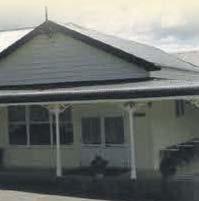
The Lyon St site containing the 1907-built police house, the 1860s built Temple Cottage, the former Te Awamutu jail cell (labelled as Kihikihi Jail) and a historic toollaundry shed opens to the public twice a month.
It runs solely on donations and grants.
“On the first Sunday of the month and on the third Wednesday the trust hold an open day,” Taylor said. “I thought why not use this first Sunday of the month, which can be a family time, to celebrate Matariki?
“The committee members decorated the police house and temple cottage with the Matariki
stars and star lights.
“Pak’n Save donated the food items for a sausage sizzle and Fresh Choice gave us a great raffle prize. All the tickets were sold.”
It was an opportunity to brings several Kihikihi groups and residents together.
Taylor made 60 star-shaped biscuits to symbolise Matariki and had visiting children decorate them.
Committee members made stick
games and poi for the children as well as providing colouring activities.
The Kihikihi Ukulele group played on the porch of temple cottage adding to the atmosphere.
“A couple of out of towners came through and a lot of local people who’d never been there before. They were so delighted. They said it was just like going back in time,” Taylor said.
“One lady told me she had
Trust gets new stars
lived in Kihikihi for 62 years and it was her first visit to the site. It was extremely rewarding that everybody was walking around with a smile on their faces and enjoying themselves.
“The community are happy to support us to help make some money so we can pay our insurance and levees – it’s fantastic.”
• See Take a Seat – Page 7.
Family’s tribute as inquiry continues
An immensely proud Te Awamutu grandparent, and a devoted husband to Tracey with an incredible ability to make people feel welcome.
The family of Brent Horsburgh summed him up in a statement this week as an investigation continues into his death on June 30.
The 54-year-old had gone to Waikato Hospital’s Emergency Department on June 29. He was found unresponsive in a toilet about nine hours later.
“We are still navigating the shock and sadness of losing Brent and trying to understand how his death
could have occurred. Many questions remain unanswered, and we will seek those answers through Health New Zealand’s investigation,” the family statement read.
In the wake of his funeral service at the Te Awamutu Presbyterian Centre, his family released the statement to express their “heartfelt thanks to everyone who has reached out with messages of support, kindness and sympathy”.
“…we have been reminded just how many lives he touched through his kindness, generosity, and willingness to help others. The stories people
have shared, the memories they have recounted, and the affection with which they speak of him have reinforced that Brent was loved and respected by so many people.
Brent Horsburgh
The family said they hoped “Brent will be remembered not for the circumstances of his passing, but for the life he lived, the great times shared, the people he helped, and the love he gave to those around him”.
Health New Zealand says a Serious Adverse Event Review is expected to be completed next month.
“To us, Brent was first and foremost a devoted husband to Tracey, father and father-in-law, an adoring poppa, a son, brother and friend. Family meant everything to him. He worked hard throughout his life to provide for those he loved and was always happiest when surrounded by family, whether that was around the dinner table, supporting his children, spending time with his grandchildren, or simply sharing a laugh.”
Young winner: Jorja Addison, 4, won the Matariki raffle at the Kihikihi Police House.
a play about love loss and dementia Losing It
Te Awamutu Little Theatre cnr Vaile and Palmer St
Sunday 2 August 2pm-3pm
bookings essential call Brian 021 945-953
You are invited to a unique play. Drawing on the authentic experience of people with dementia, and their carers, it is surprisingly full of humour, song and empathy.‘A powerful and memorable experience’. Created and performed by Sandra Shearer and Ceridwyn Parr. facebook: https://www.facebook.com/losingit.theplay
The Lempriere story
By Meghan Hawkes
Close to midnight on July 13, 1918, Anne Aubin left her sister Jane Lempriere’s room. Jane, 88, had been bedridden for some years.
Among the other occupants in Rozel, the 12 room Aubin house, were Ethel Newton, a lady-help whose home had been broken up when her mother died and her brother left for war, and Mr McDonald, an architect, from Te Kūiti who was staying prior to settling in Pirongia.
A short time after leaving Jane, Anne heard the sound of fire in her room and on returning found the wall surrounding the fireplace and ceiling ablaze. She immediately raised the alarm, and Jane was, with great difficulty, taken to safety by Mr McDonald. The other occupants escaped only in their night clothes as the flames enveloped the house. A number of residents were on the scene quickly but powerless to assist, standing helplessly by as Rozel was destroyed.
Miss Newton and Mr MacDonald, having brought all their belongings to Rozel, lost everything. Among Anne’s considerable losses was a large sum of money which was
to be handed to the Red Cross fund on the following Saturday, a parcel of war bonds, and six pounds of a nephew’s war pay which had not been banked. Jane, shocked, died the next day.
The Lempriere family was from Jersey. Of four siblings who immigrated to New Zealand Philip and Elizabeth were the first to arrive in 1863 on the Ganges. With them was John Aubin, the future husband of their sister Anne. Anne and Jane arrived in 1865 on the Empress and two years later Anne and John, a storekeeper at Pirongia, were married in modest wedding at Ngāruawāhia.
Their home at Pirongia was named after Rosel Manor on Jersey Island, spelt slightly differently as Rozel. John built a successful store and dispensary in front of Rozel and the Aubins, who had nine children, were well known and respected in their community.
Philip had fluctuating fortunes as a businessman, losing a store to fire at Ngāruawāhia and a Thames brewery bankrupting him. He married Emmeline and had several children and the family moved between Auckland and Pirongia.
Of the two plucky Lempriere sisters
with Senior Constable DEB HANN
CONTACTS
News/Editorial
Roy Pilott editor@goodlocal.nz
027
Mary Anne Gill maryanne@goodlocal.nz
Viv Posselt viv@goodlocal.nz 027
Advertising Director
Janine Davy janine@goodlocal.nz 027
Owner/Publisher
David Mackenzie david@goodlocal.nz
Office/Missed
07 827 0005 admin@goodlocal.nz
In 2025, Cambridge was reported as having one of the highest per-capita cocaine usage rates in New Zealand according to wastewater drug testing data. In 2026, it was Te Awamutu. There is known to be a strong causal link between drug use and crime. These range from manufacture or possession through to crimes committed whilst under the influence or in order to meet the financial burden of addiction. It is a community issue with wide ranging impacts. By working together, we can disrupt the supply chain. I would like to acknowledge the steady flow of information already being provided to local police around those responsible for drug supply and distribution in Waipa. Keep it coming! Every piece of information we receive about a supplier or distributor; be it person or location, completes part of the evidence puzzle, enabling us to take positive enforcement action. The more detail that is provided, the better. Any information may be reported anonymously to Crimestoppers on 0800 555 111 or via 105.police.govt.nz .
That said, we all know that supply doesn’t exist without demand. By also connecting those addicted with support services, we can positively impact downstream offending and reduce community harm. If you or someone you know is struggling with drug addiction, please reach out to Cambridge Community
House. They can assist with free Drug and Alcohol counselling services to help.
In other news this week, the past week in Cambridge brought a few burglaries around the Milton Street – Cowley Drive – Grace Avenue area of Leamington. If you live in those areas and notice anything suspicious, or may have relevant CCTV footage, do get in touch. Cambridge staff dealt with 10 burglaries in the seven days prior to writing, while Te Awamutu staff dealt with eight. Finally, when speaking to a business in Leamington this week, I was asked to remind people to adhere to the 40kph speed limit through the Leamington shopping area. It is a busy part of Shakespeare Street, and it is not the first time we have had locals complain about people speeding through. This area has a high level of foot and vehicular traffic, being home as it is to two medical practices, other associated health services and multiple retail shops and food outlets.
Excess speed is particularly worrying given the busy nature of the central pedestrian crossing and the patronage of the area by some of our oldest and youngest community members. Drive to the speed limit, to the conditions and be aware of pedestrians and other road users.
Elizabeth opened a French and English school for young ladies at her residence, Rozel Cottage, Union Street, Auckland.
Jane appears to have lived with Philip and at Thames she went into partnership with Arthur Dawson trading as Dawson and Co of Shortland, Brewers. By 1870 this partnership was dissolved but she continued in the brewery business.
By 1902 the sisters, both who had never married and were in their 70s, were living at Haslett Street, Auckland with Philip and Emmeline. In 1908 Elizabeth, then residing in Karangahape Rd, Newton died of heart failure and senile decay aged 83. She had been in poor health and attended by her nephew Dr E Aubin. Two years later Phillip died. Around this time Jane moved to Pirongia to live with Anne at Rozel. In 1911 she attended a wedding wearing a grey voile dress and grey hat with roses and as time went on became increasingly bed bound. Jane is buried at Pirongia cemetery. After Rozel was destroyed by fire Ann had a Masonic Lodge building moved to the site which was incorporated into a house known as the second Rozel, later becoming the Bell homestead.
Building for sale
Waipā District Council is planning to sell its interest in the former Bunnings building and gully site in Te Awamutu. The land is owned by the Parish of St John Te Awamutu Trust, and the building was earmarked as a home for Te Ara Wai when council purchased it.
Birthday treat
Josh Moorby celebrated his 28th birthday by becoming All Blacks representative 1236. The Te Awamutu Sports, Waikato and Hurricanes outside back made debut at Eden Park on Saturday night in the 47-17 win over Italy.
Pirongia track
The Pirongia Mountain Bike Park and forestry road network is now fully open following extensive repair work to February storm damage. Several lower trails reopened in March thanks to the work of the Pirongia Mountain Bike Club, and club president Les McKenzie said it was great to see the full network open again for riders.
Bridge work
Construction of a replacement Mangati Bridge between Ōtorohanga and Pirongia is set to start before the end of the month. A temporary bridge was put in place following storm damage earlier this year.
Squad named
The 30-man Waikato Divisional XV rugby squad for 2026, including 12 Waipā players. Josh Evans, Apirana Hongara, James Knowles, Thomas Medley (Leamington), Dean Fullerton, Bronson WilsonBeech (Ōhaupō), Daniel Belk, Mathew Findsen, Austin Frederick, Jason Hill, Liam McPherson and Sunia Ragede (Pirongia) have made the cut. Leamington’s Wayne Bootten is the head coach. The team has been selected from the 11 clubs that started the season in division one.
Farm leaders say hit pause
By Mary Anne Gill
Two of Waipā farming’s longestserving environmental advocates say the government should pause Plan Change 1 rather than put farmers through a compliance process that could soon be overtaken by resource management reforms.
Cambridge farmer Graham Pinnell and Maungatautari’s Bill Garland were among those who spoke at last week’s packed farmer meeting at Mystery Creek. More than 350 people gathered to discuss the future of the Waikato Regional Council’s longrunning water quality plan.
Both men have spent decades championing environmental improvement alongside productive farming.
Garland has spent more than five decades farming at Maungatautari while holding leadership roles in farming, conservation and environmental organisations, including Federated Farmers, the Waikato Conservation Board and the Maungatautari Ecological Island Trust.
“The country requires a culture change. We’ve got to change our mindset.”
Garland said farmers had shown they were willing to make environmental improvements, but regulation should support practical action rather than create unnecessary complexity.
Pinnell, who has followed the Plan Change 1 process for years through submissions and hearings, asked why farmers should commit to a system that could soon be replaced.
The Whitehall sheep, beef and dairy support farmer has long advocated for improved water
quality but argues effort and money should be directed into environmental improvements rather than compliance systems that may soon be superseded.
He said farmers were looking for certainty.
Many at the meeting shared that concern, arguing Plan Change 1 had become caught between a court process spanning more than a decade and a Government determined to rewrite the rules that underpin it.
Pukekohe grower Peter Reynolds, whose family business produces vegetables, kiwifruit and livestock across more than 200 hectares, warned overly prescriptive rules could affect employment in the vegetable sector, where many Pacific Island workers support families back home through money earned in New Zealand.
Paewira – back to square one
By Roy Pilott
Global Contracting Solutions says it remains committed to its bid to build a waste to energy plant in Waipā.
The company broke a prolonged silence last week after The News revealed it had been placed on a list of companies which would cease to exist after July 15.
Spokesperson Adam Fletcher said the notice related to the timing of the submitting of annual returns, a
point confirmed this week by the Companies Office.
In fact, the notice to remove posted by the New Zealand Gazette had itself been removed by Thursday when The News hit the streets.
The company wants to build a thermal waste conversion plant on Racecourse Road, Te Awamutu and the Environment Court spent two weeks hearing evidence with a view to releasing a decision on August 28 last year.
The National Manager of the Companies Office, Bolen Ng, said Global Contracting Solutions Limited did not file its annual return by April 30, triggering the Registrar of Companies to commence removal action, “as the Registrar deemed that the company had ceased to carry on business”.
He said that removal action has ceased as the company had complied with their obligations to complete their Annual Return.
Company Office records show the company filed its return on June 5, before the New Zealand Gazette notice was posted. It remains unclear why the company’s name remained on the list until last week when The News raised the issue.
The company’s resource consent applications remains on ice, though, over an issue of outstanding costs. The News has invited the company to discuss the issue.
Rosetown Funerals
Funeral
a planning regime they fear may soon
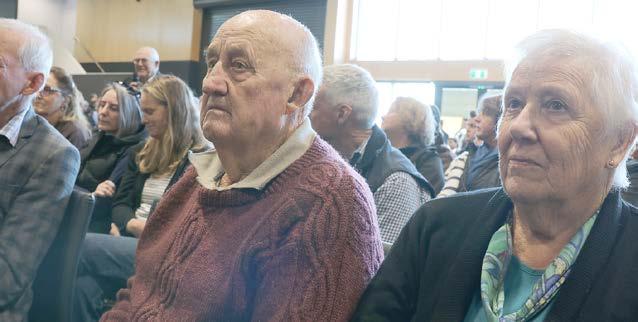
Tamahere farmers Ian and Michele Alexander listen as in the background Cambridge farmer Bill Garland, a long-time environmental pioneer, puts the case for Plan Change 1 to be paused. Photos: Mary Anne Gill
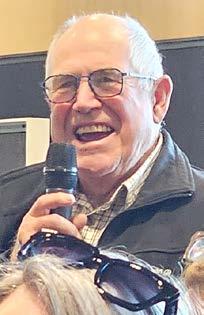
Maungatautari farmer Bill Garland called for a culture change.
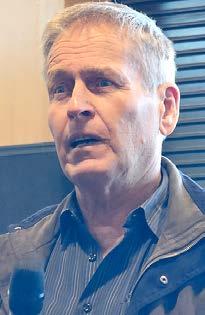
Whitehall farmer Graham Pinnell wrapped up the questions from the floor.
ON SHAKY GROUND
Running on Sunshine
by Barbara Kuriger, MP for Taranaki-King Country
I am a passionate supporter of solar energy and love filling my car with sunshine. Many people lost power at home this week, including me, so I welcomed National’s proposal to establish a Home Energy Fund, offering low-interest, long-term loans that would allow households to install solar panels, batteries, insulation and other energy-saving measures without significant upfront costs. Repayments would be made through local council rates, helping families gain more control over power bills while improving energy resilience. The Government has also committed to removing planning barriers that make it di cult for homeowners and farmers to generate their own power. Proposed reforms would require fewer consent requirements for rooftop solar, small-scale battery storage, ground-mounted farm solar systems and microhydro generation.
The Government has already expanded support for renewable energy through a $30 million programme to install solar systems in up to 500 schools nationwide. Ministers say the initiative will help schools reduce energy costs, improve resilience during power outages and potentially generate renewable electricity for local communities. Many of you will be pleased to hear that in response to public feedback, the Government has withdrawn proposed provisions that would have allowed the disposal or exchange of conservation land. The intent of the bill was never to dispose of valuable conservation land and clarity around this is now in place. New Zealand’s natural landscapes are more than just tourist attractions—they are part of our identity, our heritage and our shared responsibility for future generations. I was saddened to hear of the tragic death of a patient at Waikato Hospital’s Emergency Department earlier this week. A review and calls for an independent inquiry are now underway. My sincere condolences go to the patient’s loved ones as they seek answers during this di cult time.
Backing Rural and Provincial New Zealand
Colossal breakups
By Janine Krippner
Many years ago I had my time living in Perth. A lack of jobs in New Zealand drove much of my graduating year to Australia, and family ties pulled me across the ditch too.
At the time, I was working with seismic data. This is information collected by sending energy waves through the layers beneath the seafloor (in this case). Waves travel downwards, bounce off boundaries between rocks and sediments and return to the surface where they are detected.
The energy source can be a little like an underwater explosion or a powerful pulse of compressed air. Once the returning signals have been recorded and heavily processed, they become images that geologists can use to interpret what lies below the seabed. To me this looked like a stack of red, white and blue squiggles.
These images can be combined with samples collected in sediment and rock cores and we can begin to work out what the buried layers are made of, how old they are, and how they formed. The strength and character of the returning signal can also reveal clues about the properties of those layers. This is part of the field of geophysics.
One of my projects involved trying to understand how a basin offshore southwestern Australia had formed millions of years ago, and how sediment had gradually poured into it, filling the enormous, bowl-like depression.
Using computer software, I traced buried layers of rock and sediment across many kilometres of seismic data. Then I noticed something. There were “tiny” triangular shapes in the data, along with long, bright, continuous layers.
In seismic images, a bright layer means that
a large amount of energy is being reflected back. That can indicate a strong contrast between layers, including the presence of hard volcanic rock. Long, bright layers can sometimes represent huge lava flows. The triangular shapes were buried volcanoes. Something enormous had happened. I was looking at evidence connected to a continental breakup.
Around 130 million years ago, southwestern Australia was still connected to parts of what are now India and Antarctica. As these landmasses began to pull apart, the crust stretched, fractured and thinned. Simply put, magma rose through the weakening crust, volcanoes erupted, and eventually a new ocean began to open between the separating continents.
India later continued moving northwards and collided with the Eurasian tectonic plate, helping to build the Himalayas. Talk about dramatic.
Continental breakups unfold over millions of years through repeated faulting, stretching, subsidence of the crust and volcanic eruptions. Vast amounts of magma may rise towards the surface, but not all at once. Seen in the compressed record of geological time the whole process can look sudden and intense. This is one aspect of submarine volcanism. This is one of the ways geologists piece together fragments of evidence, like detectives, to understand the history of our Earth. I much prefer working on present-day or recent volcanic activity, but studying these ancient processes gave me a much better understanding of where volcanism fits into the colossal breakups that reshape our planet.
FAITH IN WAIPĀ
For better... or worse
By Murray Smith, Bridges Church
What would be your response to the question, “Is the world a better place to live in today, compared with how they had it say, 150 years ago?”
This was the basis of an interesting group discussion recently among people whose opinions were thrown around, none of whom, of course had personal experience of what life was like back then!
Many held to the perception (almost wistfully and ‘romantically’), that to scroll back through the decades, you’d have experienced far more simplistic, caring, community-minded ideals undergirding society than today’s society.
disregarding animal life leading to loss of habitat and extinction. That’s on mankind to a great extent. Literally at the heart of all the problems was human beings. In spite of many wonderful accomplishments and inventions leading to so-called ‘improvements’ of life, there’s this lingering brokenness in humanity that perpetuates escalating decline and disorder.
I’m inclined towards the ‘entropy’ view. What informs me clearly in that direction are the perspectives that Jesus gave us 2000 years ago. He gave very specific indications of world events at the ‘end of the age...’ describing precisely an increase of darkness and evil that would unfold before His return to earth.
Yet in it all, His words offer wonderful hope and a glorious future for those who place their trust in Him.
Inglewood Office 80 Rata St, PO Box 124, Inglewood 06 756 6032 • Kuriger.Inglewood@parliament.govt.nz
Te Awamutu Office 196 Alexandra Street, Te Awamutu 07 870 1005 • Kuriger.Teawamutu@parliament.govt.nz
King Country Virtual Office 021 815 017 Kuriger.Kingcountry@parliament.govt.nz
Others emphatically ticked ‘yes,’ to believing that the world is a vastly improved place to what it was years ago. They postulated that the world is just improving all the time and the only thing needed for our planet to achieve ‘utopia’ is more time. People insisting this to be the case cited evidence such as the increase of global life expectancy, reduction in world poverty, conquering disease, advances in technology which have made life longer, ‘easier’ and more enjoyable, aided by improving healthcare and education. Just having more options and better living conditions generally, it was asserted, have put life on an up, up-and-away trajectory that we should all be very positive about.
A decidedly different perspective was presented by those seeing a general trend over the passage of time, of the earth spiralling towards ‘entropy’ - in simple terms, a slippery slope downwards into chaos and disorder. The supporting evidence was the global escalation of wars, atrocities, selfish greed that has failed to steward the earth decently with its natural resources and beauty - polluting the planet,
Things are convulsing on planet earth as the nations heave under burdens of uncertainty from within and without. You can count on tomorrow’s headlines consisting of wars and rumours of wars, plagues, pestilences, hatred and violence… just as Jesus foretold (Matthew 24, Mark 13).
Without His peace and help in guiding our perspectives, this generation faces troublesome times. A fear-filled plethora of destablising influences is engulfing multitudes of troubled hearts struggling to find meaning in the face of loneliness, estrangement, hopelessness, and loss of true purpose and identity.
Will we heed Jesus’ warnings of increased deception, global conflict, natural disasters and be prepared?
Bishop’s Waikato trifecta
By Mary Anne Gill
For a Cabinet minister based in Wellington, Chris Bishop seems to have acquired an unusually large footprint in the Waikato.
In the space of a few weeks, the minister, who holds six portfolios in the coalition government, has
found himself at the centre of three of the region’s biggest and most contentious issues.
One involves horses, one involves highways and one involves farmers. Between them, they touch on housing, economic growth, environmental regulation and transport. In other words, just another month in
the Waikato.
First is the proposed Waikato Thoroughbred Racing greenfield racing hub at Tamahere, which cleared an important hurdle last week when it was accepted into the Government’s fasttrack approvals process.
The proposal includes racing and training facilities,
retirement living, housing, commercial activities and supporting equine services across about 164 hectares. The Government says it could generate hundreds of millions of dollars in expenditure, support more than 1100 jobs during development and help secure the future of the racing industry in the region.
The fast-track decision was made under legislation overseen by Bishop in his infrastructure role. The project still has a long way to go and is not approved, but it showed how major Waikato developments increasingly find their way onto the minister’s desk.
Then there is Plan Change 1, the seemingly neverending Waikato farming saga that has consumed lawyers, planners, councils and farmers for more than a decade.
At a Federated Farmers meeting last week, Bishop listened to concerns that farmers could find themselves complying with a plan developed under the Resource Management Act just as the Government replaces that same legislation. He openly acknowledged the awkward timing.
His concern is simple. Why
force farmers and growers through one regulatory system only to replace it with another shortly afterwards?
Bishop repeatedly stressed that Cabinet was looking closely at the issue and made it clear he does not want people spending time, energy and money adapting to one set of rules only for the system to change again. Whether that leads to a pause, a transition arrangement or something more dramatic remains to be seen.
As he fielded questions from farmers at Mystery Creek last week, it was a reminder that many of the Waikato’s biggest issues now intersect on the desk of one Wellington minister. Another is Southern Links.
Few projects have generated as much anticipation and frustration as the proposed Southern Links roading network south of Hamilton. Land has been purchased and planning work undertaken, yet the project remains some distance from construction.
Asked a month ago about Southern Links after announcing the Cambridge to Piarere extension, Bishop was cautious. He said the project was not construction-
ready and that the Government’s programme involved sequencing major infrastructure projects rather than building everything at once. Pressed repeatedly on timing, he offered little certainty beyond saying more would be announced later.
And so it was last week when Southern Links again appeared to be some way off construction.
That answer will not satisfy everyone. Southern Links has become a litmus test for those wondering when Roads of National Significance become more than lines on a map.
The racing industry wants progress. Farmers want certainty. Businesses want a road.
One decision fast-tracks a racing hub. Another could reshape environmental rules affecting thousands of hectares of farmland. A third remains waiting for funding and a start date.
For someone whose office is hundreds of kilometres away in Wellington, Bishop currently has a remarkable influence on what happens in the Waikato.
This winter, whether the issue is racehorses, waterways or highways, much of the conversation seems to lead back to Chris Bishop.
Chris Bishop back in the Waikato last week for the Plan Change 1 meeting.
Photo: Mary Anne Gill
HAPPY HOME OR HUNTING
This two bedroom home has a spacious floor layout, that with a little work could be easily become a three bedroom home. It’s ready to live in this winter with a cosy wood fire and insulation in walls and ceiling. While this owner has sorted some projects there is still room for adding your own touch and making it your home. The floor plan flows effetely from front of house lounge entry, through to dining/ family room with bedrooms to the left and kitchen to the right. The shared laundry bathroom sits at the back of the house and with a covered back porch there is a cosy spot for your morning coffee. A fully fenced section has the house sitting nicely at the front and a separate large deck sits above the sloping back garden. The rural views and rolling hills of Maniaiti are ever changing with the seasons and offer peace and tranquility
Contact Vayle to arrange a viewing.
It’s a wrap for Xavier
By Jesse Wood
Te Awamutu’s Xavier Tapp has been crowned inaugural New Zealand Sign and Display Association young signee of the year.
The 26-year-old from Alexandra Images starred at a Young Farmer style competition at the Sign and Print Expo at Auckland Showgrounds run alongside the organisation’s conference and annual awards.
Tapp has worked in the industry for almost five years.
The new event attracted eight signees who were challenged at a series of stations where they had 25 minutes to work.
“There were a few stations that had tricky bits that you’d encounter in a real-life
situation, Tapp said.
“At the design station, they gave you the brief. In that brand guide there were a couple of Easter egg errors, little hurdles. It was good fun.
Alexandra Images director and commercial artist Angie Barrowcliffe said competitors were nominated through people in the industry.
“It was a celebration for Te Awamutu, where a smalltown workshop allows you to be hands-on throughout the entire journey, from start to finish,” she said.
Tapp took home the title and a $5000 cash prize. He hopes to enter the competition again when it is next staged in 2029.
Barrowcliffe said the Alexandra Images team
produced a “Full Tapp” sign to cheer him on.
At the awards, Alexandra Images also picked up a gold medal in the vehicle sign written – digital category and Tapp won a silver medal in the work by an apprentice category.
“There was only one gold awarded at this year’s awards for the sign written digital category – Jamie Budd’s Bow Tag and Nerf Wars van that we designed and wrapped,” Barrowcliffe said.
“We’re really proud of that. Next up for Tapp, is putting himself forward to win the Sign and Display Association’s Competenz Apprentice of the Year competition in 2027, the final year of his apprenticeship.
From left, Alexandra Images director Angie Barrowcliffe, director Ethan Moir and Xavier Tapp with association president Logan Sutton.
Photo: Martin Behnke
Take a seat…
By Jesse Wood
A popular picnic spot in Kihikihi has been revamped with community help.
Broken seats on the corner of Lyon and Leslie St, outside Christ Church, have been replaced and where there were two picnic tables, there is now a table and a bench.
The spot is often used by people travelling between Waipā and Taranaki.
“I’d driven past a few times and out of the corner of my eye, the seats didn’t look fantastic,” Te Awamutu Kihikihi Community Board member Jill Taylor said.
“The seats are on church land, and a lot of people were using them, but the church didn’t have the funds to replace or fix them.”
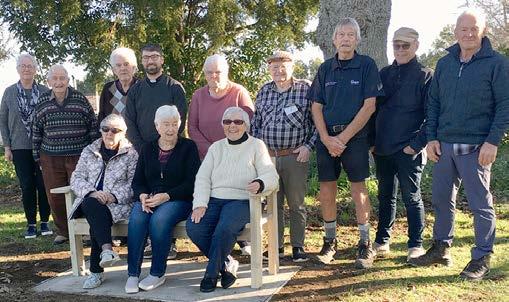
Taylor approached the Te Awamutu Menz Shed, who built the seating. Bowers Concrete donated the concrete.
“We decided with Steph Owen, from the church, that instead of two picnic tables, a bench seat and a picnic table would be good because older people can sit easier on a bench seat,” Taylor said.
Community Board member John Wood built the boxing and Mitre 10 provided boxing material and plates.
Menz Shed chairman Graeme Lomax said the shed attracts different skills from many men looking to occupy their new vocation.
“Many projects come into the Te Awamutu Community Menz Shed but there are none more rewarding than building something for the community of the town,” Lomax said.
Taylor said the church members thanked the helpers with a morning tea.
“It looks like a whole new area. It’s nice that people passing through can have something to sit on that’s not going to collapse.”
Church members put on morning tea for those involved in the project.
Photo: Jesse Wood
A story in every sip
By Jesse Wood
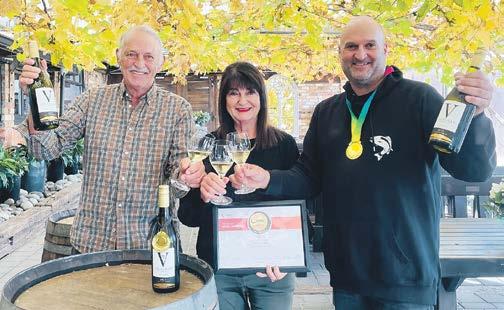
Tradition has underpinned Vilagrad Winery for generations.
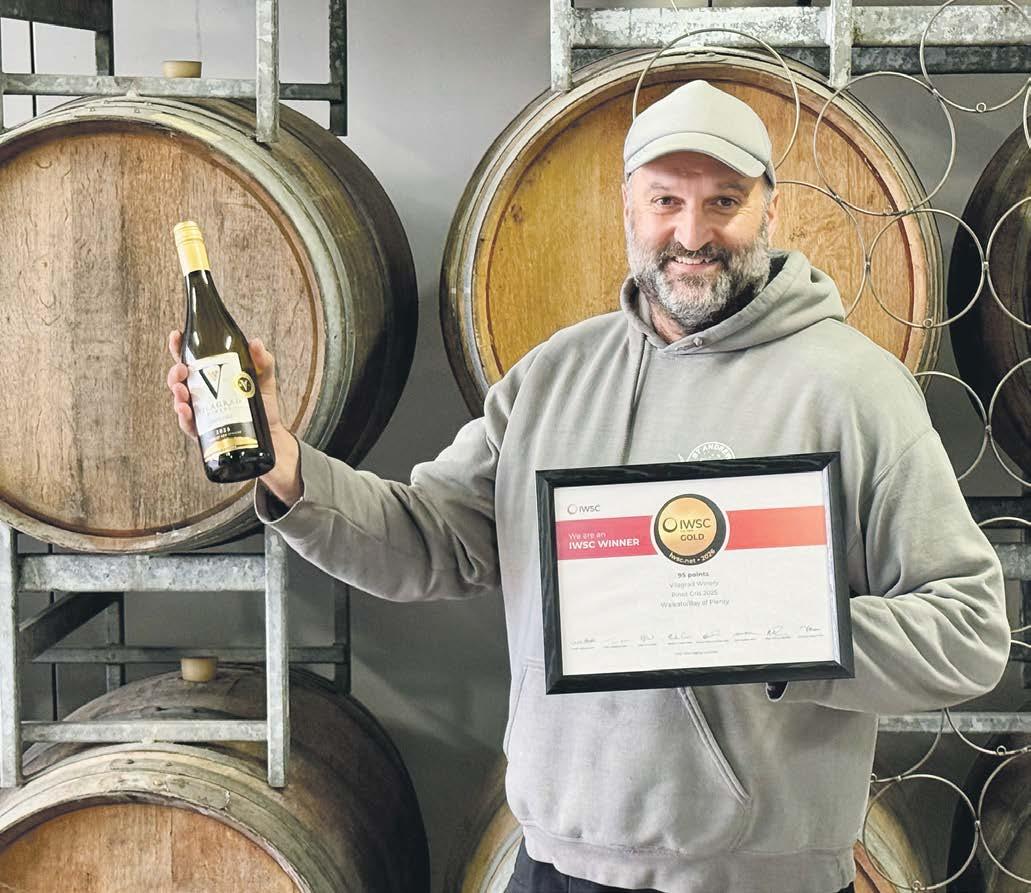
The Ngāhinapōuri winery recently claimed a major international accolade, with its 2025 Pinot Gris winning gold at the International Wine & Spirit Competition in London.
Producing premium wine grapes in the Waikato comes with its challenges. Growers must work around seasonal frosts, rainfall and changing weather patterns to achieve consistent quality.
“We’ve won over 120 awards for the wines that have been produced here on site in the Waikato,” fourth-generation winemaker and grape grower Jacob Nooyen says.
“People think we’re buying the grapes in and making them here. No, these are wines that have been grown, produced and made here.”
The family’s connection to the land stretches back more than 100 years. After emigrating from Croatia, founder Ivan Milicich Snr began growing grapes on his Ngāhinapōuri dairy farm and obtained a licence to make and sell wine in 1922.
Five generations later, the family remains hands-on in both the vineyard and winery.
The International Wine & Spirit Competition attracts more than 12,000 entries from over 90 countries and is regarded as one of the world’s most respected wine competitions.
“The results came through and I realised we were the only one that had been awarded a gold,” Jacob says.
“The gold award is rare. It hasn’t been given to anyone for about five years. That means it’s even more valuable.
“In previous years we’ve had two bronzes,
and a silver medal for the Dry Pinot Gris 2021. To step up to gold is incredible. It’s an honour to receive such a prestigious prize.”
The recognition is validation for years of work and has strengthened the winery’s ambitions overseas.
“We’ve always done well in national competitions. It wasn’t until recently that I decided to start entering wines into the London competition,” Jacob says.
“To have that come back tenfold shows the consistency of producing Pinot Gris here in the Waikato.
“My ideal situation would be to head over to the awards dinner in November and make some serious contacts overseas that can help us with distribution in the UK.”
Once distribution is established, social media is expected to play an important role in telling the Vilagrad story to international audiences.
Competing in a crowded global wine market means standing out. The winery believes its history, family involvement and Waikato roots provide that point of difference.
“The social media aspect is playing a huge part in our business now, both for the restaurant and the winery,” Jacob says.
“There’s a world of knowledge to learn.
“You can target your markets, target what demographic and what region. It’s mindboggling, but it’s something we have to start incorporating into our business for the future.”
Social media is also helping challenge the perception that younger generations are turning away from wine.
“There is less consumption worldwide of bulk supermarket wines,” Jacob says.
“The younger generations are purchasing
fewer bottles of wine but buying more wine of a higher quality.
“If they go out for dinner or have friends around, they’ll take the time to purchase a bottle that has a great story.
“That suits us fantastically. We have a great story and we have the family behind it.
“That’s why it’s so important to get recognition through these awards and use social media marketing to our advantage.”
Platforms such as TikTok and short-form video have helped showcase the winery, its people and the work that goes into each vintage.
“It’s been quite exciting because that visual plays a huge part in painting the picture of the product,” Jacob says.
“It has been very helpful in the last couple of years. We’re up to five generations here and my kids helped pick the grapes for this award-winning wine. Every year, all the family is involved. The brothers, uncles and aunties help. It’s a real family affair.”
•
•
•
•
•
•
•
•
•
•
•
•
•
• Servicing the Waikato, Bay of Plenty, Taranaki & Gisborne
•
•
•
•
•
•
•
•
•
•
Like many farming families, the Nooyens often begin their day before sunrise checking conditions during critical growing periods.
“We’ve shared videos of getting up to see the frost, right through to videos of us all picking grapes together.
“That’s our business model, that’s how we portray ourselves and that’s worked well for the restaurant here as well because it’s a family environment.”
Jacob and his brothers, Kristian and Adam, hope the next generation will continue building the business alongside parents Nelda and Pieter.
“Hopefully some of our nieces and nephews, sons or daughters will take over one day. That’s the plan,” Jacob says.
“Well, they have to, we’ll make them.”
From Ngāhinapōuri to London, Vilagrad Winery is continuing to build its reputation, with the family’s latest international success marking another chapter in a story more than a century in the making.
Vilagrad recently won big at the “Olympics of wine competitions” in London. From left, Pieter, Nelda and son Jacob Nooyen. Photo: Supplied
Caught in limbo
By Mary Anne Gill
The questions were respectful, but the concern was unmistakable.
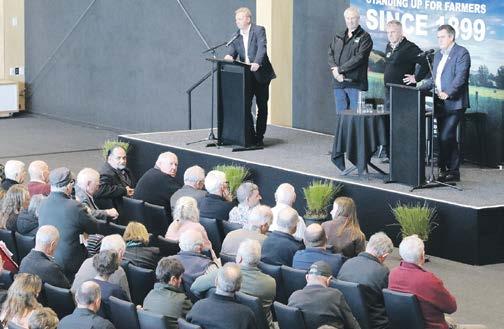
More than 350 farmers from the Waikato, King Country and South Auckland gathered at Mystery Creek last week seeking answers on Plan Change 1, a planning process that has stretched over more than a decade and remains unresolved.
For King Country farmer Reon Verry, the debate is not about whether farmers should improve the environment.
It is about whether farmers should spend time and money complying with rules that could be replaced before they are fully implemented.
The Waikato Federated Farmers meat and wool chair was among the farmers who urged the government to press pause on the controversial plan change while it works through reforms to replace the Resource Management Act (RMA).
Verry supports cleaner waterways and has invested heavily in environmental work on his property south of Te Kūiti, where his family has fenced 45 kilometres of waterways and native bush, alongside extensive planting projects.
“What we’re not happy about is there’s a whole lot of farmers that will need resource consents that may become redundant under the replacement to the RMA.”
Verry said Plan Change 1 would create an escalating compliance burden, particularly for farmers in the Whangamarino Wetland catchment where obtaining resource consents would be more difficult and expensive.
Farmers would face farm plans, certification, consent applications and repeated audits. “To me, that’s a bit of compliance overreach right there,” he said.
Farmers were already planting trees, fencing waterways and working through farm environment plans. What worries many farmers is the prospect of spending limited resources on duplicated paperwork instead of practical environmental action.
The concern is not confined to one catchment. Federated Farmers argues Plan Change 1 will introduce significant new requirements across the Waikato and Waipā river catchments, affecting more than 4500 farms and potentially restricting future land-use changes.
Veteran Federated Farmers
campaigner Graham Pinnell of Cambridge said farmers appreciated the opportunity to put their concerns directly to ministers.
They would rather spend effort and money improving water quality than fighting red tape, he said.
“Government has risen to the challenge and has obligations to consider river iwi, other interests and freshwater regulations in finding a workable solution.”
Farmers questioned why the new requirements should be introduced just as the government was replacing the Resource Management Act.
McClay acknowledged those concerns and repeatedly stressed the government wanted to work with farmers rather than impose rules on them.
New Zealand’s primary sector was forecast to achieve record export returns, he said.
Farmers needed a regulatory system that supported production while still delivering environmental gains.
“The farming community across the Waikato is up for working hard to improve water quality,” McClay told The News.
“They just want certainty, good rules that support them,
don’t just penalise them.”
The government now had an opportunity to examine Plan Change 1 more closely because the court process had reached a point where ministers could see the likely direction of travel.
“It does not make sense for Waikato farmers to have to use a system under the old RMA when there is a new one that will be adopted before the election,” he said.
Bishop delivered a similar message, acknowledging the awkward timing created by a planning process that began a decade ago and is colliding with wholesale reform of New Zealand’s resource
management laws.
He told The News he was aware of farmers’ anxiety.
The government was considering how Plan Change 1 would fit with the replacement planning system now before Parliament.
“What we don’t want to do is find ourselves in a situation where people have to operate in one system for like 18 months or even in some cases under one set of rules and then the whole system changes.”
Bishop did not rule out pausing Plan Change 1 while the new planning framework was implemented.
“Everything’s on the
table,” he said adding that parts of Plan Change 1 appeared inconsistent with the government’s direction, particularly around commercial vegetable growing and the greater reliance on farm plans proposed under new legislation.
That may have been the most important message of the day.
For now, Plan Change 1 remains in limbo, leaving farmers waiting to see whether years of uncertainty will finally give way to a planning system that delivers the certainty they have been promised.
Waikato, Ōtorohanga and Waitomo mayors Aksel Bech, Rodney Dow and John Robertson were in the front row and listened as Whangamarino Catchment farmer Malcolm Lumsden asks a question of ministers Todd McClay, left, and Chris Bishop, right while Federated Farmers officials Chris Woolerton and Colin Hurst look on.
Photo: Mary Anne Gill
“Sale and Purchase Agreements - more important than ever to get advice before you sign”
In today’s fast-paced and increasingly complex property market, sale and purchase agreements (SPA) have never been more important. Whether purchasing a first home, upgrading to a new property, acquiring an investment property, or buying commercial real estate, purchasers face a range of financial, legal, and market-related risks that can have significant consequences if not properly managed.
SPA’s are the legally binding contract between a vendor and a purchaser that outlines the terms and conditions of a property transaction. When carefully prepared, it provides clarity, protection, and certainty for all parties involved.
In most cases, these agreements are prepared by real estate agents, who also coordinate the signing of the agreement. While agents play an important role in facilitating the transaction, they aren’t responsible for providing legal advice to either party.
The agreement becomes legally binding once signed, so, it is crucial to obtain legal advice before you sign. Your lawyer can ensure the agreement contains appropriate conditions for your particular circumstances, identify any clauses that should be amended or removed, and provide advice on any potential risks. Seeking legal guidance at this stage helps ensure you fully understand your obligations and protects your interests throughout the purchasing process.
One of the primary reasons sale and purchase agreements have become increasingly important is the significant rise in property values. As buyers commit to larger financial investments, the cost of making a mistake can be substantial. A well-drafted agreement clearly defines the expectations, obligations, and conditions of the transaction, helping to minimise uncertainty and reduce the risk of disputes.
Equally important is the role these agreements play in preventing costly, time-consuming legal conflicts. Property transactions can quickly become complicated when expectations are unclear, or key issues have not been addressed from the outset. By clearly documenting the rights and responsibilities of each party, a SPA reduces ambiguity and provides a framework for resolving issues should they arise.
Ultimately, a SPA is much more than a preliminary document. It is a vital risk-management tool that helps safeguard your investment, provides greater certainty throughout the transaction process, and supports a smoother path to successful property ownership. In an environment where the stakes are higher than ever, ensuring the agreement is properly drafted and reviewed before signing is one of the most important steps a purchaser can take.
Georgia Ellen
Expect government to act
The release of the Environment Court decisions on Plan Change 1 has left many farmers and rural communities wondering what comes next. My personal view is that it would make little sense for the government to allow Plan Change 1 to continue unchanged while it is fundamentally reforming New Zealand’s resource management system. The government has been clear that the Resource Management Act is being replaced with a new planning framework and to expect it before the election. Allowing one of the country’s
most significant freshwater plans to collide with those reforms would create uncertainty, inconsistency and unnecessary cost. This is a view also shared by many rural advocacy groups who are currently lobbying MPs –a no brainer surely!
I would be surprised if we didn’t see a government announcement very soon. Whatever happens next, we must not lose sight of the environmental progress already being made on the ground.
Recently, Cr Keith Holmes and I had the privilege of visiting the Waipā Rere Noa Catchment Restoration
Group with Matt Holwill and Rosemary Davison. Seeing their work firsthand was both inspiring and encouraging. Thank you to Matt and Rosemary for taking the time to show us around the catchment and the impressive results being achieved through local leadership and community commitment.
The numbers speak for themselves. More than 350,000 native trees have now been planted throughout the catchment, with an incredible 200,000 planted by farmer members. These are not projects being imposed from above. They are being driven by people who live, work and farm in the catchment because they genuinely want to leave their environment in better shape than they found it.
This success has also been made possible through the ongoing support of the Waikato Regional Council, whose funding and technical assistance have helped community groups turn good intentions into measurable environmental outcomes.
But restoration is only half the challenge.
Protecting the millions of dollars already invested in native planting means confronting the growing threat of invasive weeds. Left unchecked, weeds can quickly undo years of hard work, choking out native species and reducing the health of our waterways.
By Liz Stolwyk
Waipā Rere Noa’s funded weed control programme is a great example of how practical action delivers results.
Through weed control demonstrations, education and community involvement, the group is changing attitudes, building knowledge and giving landowners the confidence to tackle invasive species before they become an even greater problem.
This is exactly the role councils should be playing — enabling communities, supporting local leadership and investing where it delivers real environmental gains.
The debate around Plan Change 1 has often become polarised. Yet what I saw in the Waipā Rere Noa catchment reminded me that the best environmental outcomes come through partnership, not simply regulation.
As the government considers the future of freshwater policy alongside its wider RMA reforms, I hope it recognises what is already working. Communityled initiatives like Waipā Rere Noa are proving that environmental improvement, productive farming and prosperous communities can go hand in hand.
That’s the future we should be building on.
Federated Farmers Waikato provincial president, North Waikato farmer Chris Woolerton, left, with national president, South Canterbury mixed arable and dairy farmer Colin Hurst at the Mystery Creek meeting.
Photo: Mary Anne Gill
Sports fall, Hautapu wins
By Jesse Wood
Hamilton Marist put paid to any hopes of a Breweries Shield Waipā final in Waikato club rugby on Saturday. The Hamilton club chalked up a 59-12 semifinal win over Te Awamutu Sports to set up a final this weekend against Hautapu at Marist Park.
The Cambridge club accounted for Fraser Tech 47-12 in the other semi.
Te Awamutu Sports’ try scorers in Hamilton were George Poolman and Bronson van der Heyden and Poolman added a conversion. Te Awamutu College alumni Shauncy Waho and Te Kapa Crown were among the nine Marist try-getters.
In Cambridge right winger Quentin Hill scored a brace in front of the home fans, while Jacob Carmichael, Rory Blyth, Konelio
Burgess, Karlan Mosaati, lock Dylan Eti and winger Nathan Stephens also crossed the try line. Fullback Patrick Hedley kicked seven points off the tee.
The third Waipā club in the premier division, Leamington, fell 48-3 to University in a championship Lone Star Cup semi-final.
Hautapu dealt to Te Awamutu Sports 99-0 in Cambridge to go through to a home Premier B Men’s Rowe Cup final against Fraser Tech this weekend.
Hamilton Old Boys beat Leamington 40-11 and will face United Matamata Sports in the Premier B Championship WRU Trophy final.
Pirongia lost their Division 1A Mooloo Shield semi-final to Putāruru 27-17 under the mountain.
Winger Jason Hill grabbed a try and a conversion. Fellow try scorers were halfback
Kauruki Keegan and reserve James Pakoti as Dylan Hanning celebrated his 100th game for Pirongia A.
Ōhaupō beat Suburbs 37-27 in their home semi-final to book a meeting with Southern United in Tokoroa in the Division 1A Championship Captain Compost Cup final clash.
Tries were scored by flanker Trent Sargent in his 50th match, Caleb Kennedy, Chris Ferguson, Dean Fullerton and midfielder Bronson Wilson-Beech. Pivot Fullerton also added three conversions and a penalty. A further penalty was kicked by Italia Tualaulelei.
Pirongia will face Te Rapa in the Division 1B WRU Trophy final at home ons Saturday. Captain Sam Kirkbride celebrated his 100th match in a 4-5 win over Putāruru.
Te Awamutu Sports’ Logan “Woody” Karl looks to make a break against Hamilton Marist. Photo: Justin Miezenbeek
Creating beautiful gardens for over 30 years ALEX STUNELL 0210 284 5166 alleycatgardencare@gmail.com
Clearances
We’re Hiring
Join our team and support the mahi of our Trust.
We are seeking a reliable and well organised Administrator to support the GM, Board Executive, Database Officer and Hapū Trustees. This role is central to keeping our operations running smoothly by providing high quality administrative, secretarial, and support services.
Part time. 30 hours a week. Otorohanga based.
Please send your CV and a short cover letter to CJ admin@ruht.co.nz
Applications closed Friday 24 July 2026.
Pou Taiao / Environmental Officer –Waitomo/Otorohanga
30‑hour week • 2‑year fixed term
Strengthen kaitiakitanga and support tikanga‑led environmental protection across our rohe. RUHT is seeking a Pou Taiao to lead taiao projects, provide culturally grounded environmental advice, and work closely with hapū, iwi, DOC, councils, and our lease holder.
You’ll bring environmental expertise particularly in water and karst, scientific monitoring experience, strong tikanga/Mātauranga Māori grounding, and experience working with iwi/hapū.
Meaningful mahi. Hapū‑driven outcomes. Kaupapa‑based team.
Send CVs to manager@ruht.co.nz
Request the full Job Description at manager@ruht.co.nz
Applications close 31 July 2026
for delivery of the Te Awamutu News, your local weekly community newspaper.
Deliveries are to occur every Thursday. Are you honest and reliable and would like to earn some money while keeping fit? Our runs are suitable for either youth (minimum age 11 years) or adults.
Delivery runs available in the following areas:
• St Marys Avenue/Rewi Street/Williams Street area
Please contact us on E: admin@goodlocal.nz
Provide your name, phone number, and the area you are located.
Farm effluent services is looking for a manager to run one of our units with another employee.
We are based just north of otorohanga on state highway 3, travelling from farm to farm irrigating effluent ponds onto farm land for fertiliser. Applicant will need a full license and a class 2, happy to pay for class 2 for the right applicant, experience with farming and irrigation preferred, training will be given.
$25 - $35 per hour
Full time
Otorohanga, Waikato
Company benefits - Phone, fuel Ph Trevor – 021 964150
SILAGE FOR SALE, approx
50 bales, Puahue. Ph 027 4606350
2003 Mazda Bounty Ute, Cab plus, 269,000kms, very tidy, manual diesel, WOF, Rego and Mileage up to date. $12,000 ono. Ph 021 969 851
truck or car. Any condition doesn’t have to be going. Cash paid. Ph/txt Kevin 027 299 6165
A
A conversation about Death to help you live more fully 11am Tuesday 21 July 2026
Parish
Parish of St John’s Lounge 162 Arawata St Te Awamutu
ALL WELCOME
MCBETH – WOOFE
Janice and Malcolm were married on the 14th of July 1956, in the Methodist Church, Thames. Congratulations on your 70th anniversary Mum and Dad, from all your family.
No cost, but koha welcome
No cost, but koha welcome
BRENNAN, Nicholas Wayne – Passed away peacefully at home aged 67 years. May Nicholas now rest in peace. A private farewell has taken place. Messages to the Brennan Family may be sent c/- 262 Ohaupo Road, Te Awamutu 3800, or left in Nicholas’s online tribute book at www. rosetown.co.nz.
CARTER, Ernie (Ernest) – Passed away on the 9/7/2026. Sadly missed by his wife Karen and family. Private cremation has taken place.
Books • Jigsaws • CD’s • DVD’s Everyone welcome
MADDOCK, Vicki Ann –Passed away peacefully at home after a short illness, aged 64 years. Special thanks to the many carers, the staff at Waikato Hospital, Dr John Duncan and the dedicated St John Ambulance medics for the kindness, compassion, and care shown to Vicki during her final months. In accordance with Vicki’s wishes, a private burial has taken place. Messages to the Maddock family may be sent c/- 262 Ohaupo Road, Te Awamutu 3800, or left in Vicki’s online tribute book at www.rosetown.co.nz.
COMMUNITY CARE GIVER
Due to increasing demand for our community services, we are looking to add another Community Care Giver to our team.
Everyday, clients entrust us to assist them with their daily living requirements in their own home.
If you are a mature, honest and empathetic person who has:
• The ability to work rostered shifts Monday to Sunday, and
• Have your own vehicle with a clean driver’s licence.
You might be the person our team is looking for.
Whilst care giving experience is preferable, full training will be offered to the right applicant.
LIMMER, Gaylene Barbara (née Garrett) – Passed away peacefully at home, surrounded by her loving family, after a very brief illness, on Saturday, 11th July 2026, aged 72 years. Dearly loved and cherished wife of Lance for 54 wonderful years. Much loved mother of Rodney, Terry, and Shaun. A devoted companion and best four-legged friend to Coco. The family sincerely thank Dr Alison Glover, Hospice Waikato, Waikato Hospital, and the District Nurses for the exceptional care, kindness, and compassion shown to Gaylene during her illness. In accordance with Gaylene’s wishes, a private family farewell has taken place. Messages to the Limmer family may be sent c/- 262 Ohaupo Road, Te Awamutu 3800, or left in Gaylene’s online tribute book at www. rosetown.co.nz.