
Stream of devastation
By Jesse Wood
Alan Livingston has been a Te Pahū resident for about 70 years and has never seen anything like the deluge of water and debris that descended from Mt Pirongia last weekend.
“We’ve had big floods and a bit of debris, but nothing like this before,” the former Waipā mayor said.
“This was exceptional due to a bow wave of water coming down plus logs, slash and sediment.”
The storms claimed the life Pirongia’s Brent Knowles on Friday after his car was submerged by floodwaters on State Highway 39 north of Ōtorohanga as he returned from a fishing trip.
Waipā mayor Mike Pettit declared a state of emergency on Saturday – the morning after Ōtorohanga had done the same.
It was also announced
on Monday that a mayoral relief fund had been established in Waipā.
Pettit said recent events highlighted the growing challenges facing the district.
“Unfortunately, these events are not isolated. They follow a series of severe weather incidents in our district,” he said.
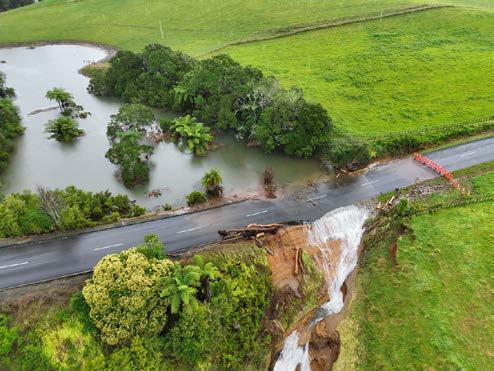
At Te Pahu, flooding beside the Corcoran Rd causeway across the Rangitukia Stream caused the 3.5m culvert to be blocked by logs and rocks, backing up the water and creating a lake.
“This created the risk that the causeway might fail and send a deluge down, hence the evacuation of 10 homes further down,” Livingston said.
Three streams with mountain catchments were affected - on Corcoran, Grey and Limeworks Loop roads.
“Elsewhere in the district, there was approximately 40mm of rain and nothing out of the ordinary occurred.”
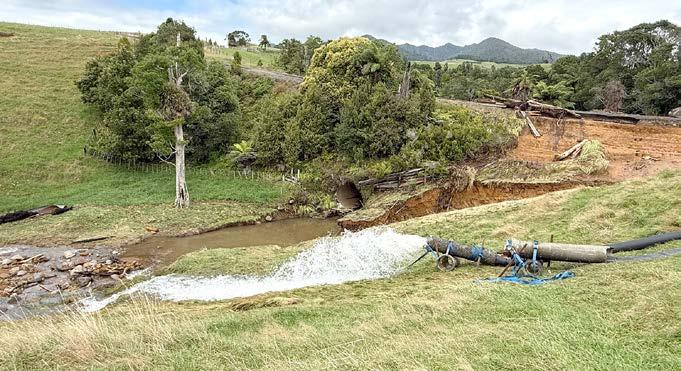
Downer Group and Waipā District Council staff have been pumping water from the “lake” to relieve pressure on the causeway.
Livingston said Te Pahū residents could hear the rumble from the mountain, many thought it was a jet crash.
“Looking up Corcoran





Rd, you can see where the slips are on the mountain. You can understand why logs have come down,”
Livingston said.
“It’s just an extreme event. It was just the volume of water. It wasn’t a buildup - it just suddenly happened.
“The slips were at the top of the mountain, going all the way down.”
Livingston said many farmers had problems due to the deluge and the community pitched in to help fix cow sheds, clear debris off roads and other remedial work.
“People have been staying
with other folk too. Don’t underestimate that local aspect. That community spirit and community mindedness certainly comes to the fore [in a situation like this].”
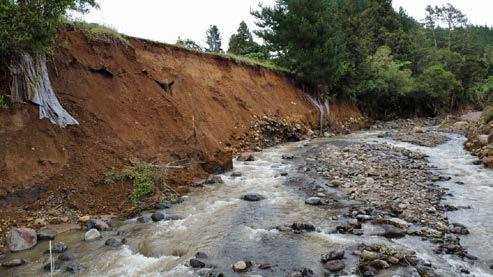
Slips on the mountain also washed away a water treatment plant supplying Pirongia.
The council has established an emergency supply from the Te Awamutu Treatment Plant, but water conservation is critical if the stopgap measures are to keep servicing Pirongia.
A joint Civil Defence



Emergency Operations Centre operating from the Ōtorohanga District Council offices is supporting Waipā and Ōtorohanga councils after States of Emergency were declared on the weekend.
Welfare support and property inspections continue in Wharepapa South, Kāwhia, Aotea and Corcoran roads as well as urban areas.
As this edition went to press, Waikato Regional Council data showed the extent of rainfall in the last seven days – 103.5mm at its Te Kūiti Mangaokewa
Stream monitoring site, 219.5mm on the Waipā River and Otewa, 120.5m at the Awaroa River-Hauturu Trig site and 172mm at Barton’s Corner Rd Bridge over the Puniu River near Te Awamutu.
The recording at the Puniu River at Tolley Rd, Ngaroma was the second highest in the region – 206.5. Hamilton city recorded just 22.2mm – and that figure would not have been much different to what was recorded at Cambridge.
• See more photos and stories at teawamutunews. nz


Pumps and diggers in action at Corcoran Rd on Monday.
Photo: Jesse Wood
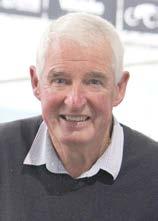
Alan Livingston
Te Awamutu News
Publishing Every Thursday
Booking & copy setting
Friday of week prior to Thursday publication
artwork 11am Tuesday prior to Thursday publication
Booking & copy setting 5pm Monday prior to Thursday publication
*All classified advertising is prepaid prior to publication.
*Late bookings after deadline are subject to space available.


Barton brings breakfast joy
By Jesse Wood
Every Monday, Sue Barton brings warmth and energy to Pōkuru School’s breakfast club.
Sue is a farmer, an active member of the Rural Women’s Group and long-time
volunteer who has been part of the Pōkuru community for decades.
She is one of 5000 volunteers who help run the KickStart Breakfast programme in more than 1500 schools nationwide.
At Pōkuru around 30 students start their day with a nutritious meal.



News/Editorial
Roy Pilott editor@goodlocal.nz
027 450 0115
Mary Anne Gill maryanne@goodlocal.nz
021 705 213
Viv Posselt viv@goodlocal.nz
027 233 7686
Chris Gardner chris@goodlocal.nz
027 231 7007
Advertising Director
Janine Davy janine@goodlocal.nz
027 287 0005
Owner/Publisher
David Mackenzie david@goodlocal.nz
Office/Missed Deliveries 07 827 0005 admin@goodlocal.nz
Weather takes a toll
I’d like to start by acknowledging the loss of life in Pirongia and destruction to property across the region following the serious flooding and weather events impacting our area this past week.
The effects, I know, are deeply felt and ongoing. At the time of writing, Waipā District Council advise everyone to stay alert, avoid flooded areas and take note of road closures in place. If you need help, call the council’s call centre on 0800 924 723. If it is an emergency, call 111. As always, look out for each other and stay safe. The weather is unpredictable and conditions can change quickly.
Last Friday afternoon saw Putāruru, Cambridge and district road policing staff arrest three youth after they decamped in a stolen vehicle from an aggravated robbery in Putāruru. Their vehicle was successfully spiked and stopped on Tīrau road and two youth have appeared in Youth Court on associated charges.
In Te Awamutu last week, a male was arrested following a family harm incident and faces three associated charges in court. When police are involved in family harm matters to the level of prosecution, it is an important step in breaking the cycle of violence. Research shows that without intervention, the seriousness of family harm only increases over time, ultimately


escalating to a risk of serious or grievous bodily harm or even death. Prosecution ensures the offender is held to account for their actions and is an opportunity for change to be initiated.
Last weekend, Te Awamutu police identified a motorbike and its rider who had been the subject of numerous reports of dangerous and reckless driving in the area. The male rider now faces related charges in court and the bike has been impounded. While it is a positive outcome, more information is sought as this behaviour is not isolated to one bike and rider.
If you see dangerous driving, motorbikes or trail bikes weaving or doing wheelies in traffic, note full details of the bike and rider, including descriptions and call 111 at the time. If it is safe to do so, recording a video of what you are witnessing is also helpful.
Finally this week, a reminder to continue to be scam and fraud aware. In one reported instance recently, it appeared that lending a mobile phone to an associate resulted in access being gained to online banking, making an unauthorised transaction being possible. Be aware that saving login and credit card details to your phone increases the risk of unauthorised access if your phone falls into the hands of an opportunistic offender.
Sue said volunteering is about staying connected to her community.
“Both my children and grandchildren went to Pōkuru School, so being part of the breakfast club is a wonderful way to give back and keep those ties strong,” Sue said.
“Seeing the kids run up to say hello and grab their breakfast is always a highlight. It’s such a simple moment but brings so much joy.”
Since the programme launched in 2009, more than 75 million breakfasts have been served.
More than 45,000 children receive breakfasts every school day.
In Waikato, the KickStart Breakfast programme is at about 200 schools, involving more than 25,000 students.
It launched at Pōkuru in 2014 and on International Volunteer Day in December, representatives from Fonterra, Sanitarium and Ministry of Social Development attended the rural school to celebrate the contributions.
Sue’s commitment to Pōkuru School goes beyond breakfast.
Her family farm has partnered with the school for the Trees for Life Riparian Planting Project since 1996.
Through this initiative, students have the opportunity to visit the farm each year and plant approximately 600 seedlings.
Pōkuru School principal Vicki Robinson sings Sue’s praises.
“Sue’s contributions over the years have created so many learning opportunities and helped shape experiences for generations of Pōkuru students,” Vicki said.
“Her dedication and service are deeply appreciated by our staff and students alike.”



DEB HANN
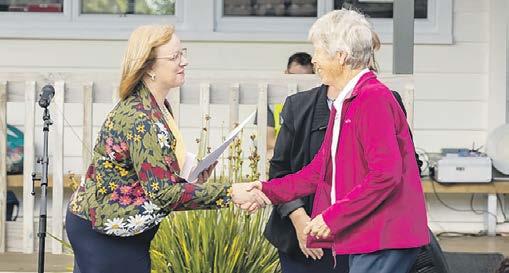
Taranaki-King Country MP Barbara Kuriger recognises Sue Barton (right) and her contribution to Pōkuru School. Photo: Farm Source
New chief Waipā Networks has named chartered engineer Damien Whiffen as its next chief executive. He will take over from acting chief Tom Bromfield in April and moves from a senior role at Mainpower. Previous chief Sean Horgan stepped down after three years in December.
Balloon inflation
The reasoning behind Waipā District Council’s decision not to host an evening of the Balloons over Waikato this year has become clearer. The council says it would have faced a near 30 per cent increase in costs to host an event – up to about $25,400. Most of the increase was due to higher costs for traffic and waste management. Many of the costs cannot be recovered if the event is cancelled at short notice.
Arrowing in
Bowhunter Gary Keoghan will be a guest at the Mt Pirongia Lions’ market on Sunday when the winner of a Predator Free Te Awamutu and Pirongia Kids Koi Carp Challenge will be announced. Koi have caused considerable biodiversity loss and water quality decline. They can grow to 75cm and weight 12kg.
Feedback sought
Waipa district councillors have backed Waka Kotahi proposals to introduce 60km/h zones to slow traffic on State Highway 29 at the crossroad with Taotaoroa and Totman roads near the Piarere roundabout and on State Highway 39 at the intersections with Tuhikaramea and Livingstone roads.
Kapa Haka
Claudelands will host one of the regional finals of the Kapa Haka nationals, in midApril. The first was held at Waipukurau last weekend and is followed by another 12, including one on the Gold Coast, through to mid-June.
‘Gone – completely gone’
By Jon Rawlinson
Bridges are supposed to span water not be submerged beneath it.
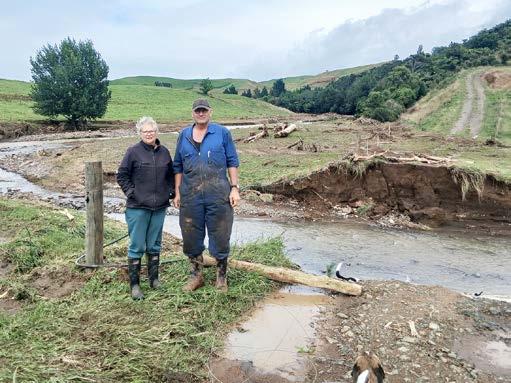
One of the biggest expenses facing the Reymer farm on Ormsby Road in Pirongia is replacing a bridge knocked out by the Valentine’s Weekend storms.
“We’ve never seen anything like it,” Jodi Reymer said.
“Our high bridge is gone, completely gone – we’ve never had water up to that level before.”
Near the bridge, water rose to approximately eight metres above its usual height.
“It sounds like the only thing insurance will cover is our boundary fence, so replacing the bridge is going to be a major expense for us,” said Jodi.
“I’m hoping we can sort it before winter as the stream often rises too high to ford and stock will need to be checked and fed regularly at that time of year.”
The farm is owned by Jodi’s parents, Paul and Helen, and managed by her sister, Tabitha. It supports the family’s dairy property near Hamilton that, fortunately, was not affected.
South of Pirongia, it’s a different story.
“We had a campground
that was washed away – the cabin went floating down the stream,” Jodi said.
“Another urgent problem was our water supply system. The pipes were blown out. It’s not completely fixed, but at least we had water going again by Monday.”
Winter feed may be in shorter supply due to the weather bomb, but won’t prove a major problem for the Reymers. Similarly, no stock losses were recorded,
Jodi said.
“Our feed is grown and stored on higher ground and we don’t grow a lot of maize, only a little to use here, so no losses there either, thankfully.”
Most of the pieces can be picked up, but it will take time to undo damage caused over just one wild weekend.
“It’s ruined our beautiful stream – that’s never going to look the same again. It’s going to take us a few weeks to get fencing back to a
reasonable state but months to get the bridge sorted. We’ll get there, but it won’t be easy.”
Another member of the Reymer family has been helping others, primarily in the shadow of Mount Pirongia.
Jodi Reymer’s uncle Andrew Reymer said support networks were quick to spring into action but they will still be needed over the coming weeks.
“It’s just been incredible,”
he said. “Farmers have got on with it, with mates calling mates and neighbours calling neighbours. They’re all supporting each other,” he said.
“We’ve been putting together a ‘farming army’ to help, and there is support through the Rural Support Trust – if people are really struggling, there are numbers to call.”
As many farms were spared, spare hands were available.
“Not everybody was hit hard, but up the mountain, Pirongia, people were pretty badly affected,” the Te Awamutu Federated Farmers president said. “They had some big washouts with about 200mls of rain that tore out bridges and took everything along with it.” Stock losses have been negligible and even infrastructure – especially fences – can be repaired. However, some damage can’t be fixed.
“Maize and some vegetable growers may have lost 100 per cent of their year’s income in just one storm. Some had a crop of maize about a month away from harvest that’s now been flattened. They’ll be hit hardest financially so they’re the ones I’d be most concerned about.”
Chamber backlash warning
By Chris Gardner
Waipā District Council has been warned to expect negative feedback on its Economic Wellbeing Strategy after failing to engage with its commerce chambers.
Te Awamutu ward councillor and former Te Awamutu Business Chamber chief executive
Shane Walsh told a recent council workshop he had always been disappointed that the council’s process was wrong.
“The chambers weren’t involved,” he said.
“Now, you say that they’re involved in in 2019, 2020, but that’s five years ago. Life’s changed, and it would have been very useful.
“I’m suspecting that some of the feedback’s going to be quite negative because of that… so just bear that in mind.”
The council can also expect to get negative feedback over its decision to withdraw tourism funding.
“The other negative

feedback will be about tourism given that destination Cambridge and Destination Te Awamutu were doing a fine job and now they’re no longer around,” Walsh said.
“As an anchor institute we should be thinking more about how those organisations should be working with council, not council to set up their own organisation.
“I’m just giving you that a heads up that you’re going to get some negative
responses from that.”
Acting deputy chief executive and strategy group manager Kirsty Downey said there was economic development themed engagement through Waipā’s Community Spatial Plan, Ahu Ake.
“But you’re absolutely right. This is an opportunity now to directly engage with those key stakeholders and to hear from them um in terms of the further shaping of the strategy. So, we take that on board.”

Rosetown Funerals proudly
The Rosetown Funerals team Jim Goddin and Teri Keir
Shane Walsh
Paul and Helen Reymer stand where their bridge once stood.
A new view on the world
By Jesse Wood
Te Awamutu College Year 13
students Bonnie Dixon, Eva Walton and Madison Phillips are closer after experiencing Thailand and Cambodia in the World Challenge Leadership Expedition last month.
The trio were part of a dozen Te Awamutu students on the trip. All had different levels of travel experience.
It was Bonnie’s first time out of New Zealand, Eva was born overseas and had previously travelled to several countries, Madison had never been on a plane before.
“I didn’t initially tell my parents about it, because I thought it sounded terrifying. But eventually, they somehow came upon the information and signed me up,” Bonnie said.
“It’s just so eye opening, because of the absolute culture difference to what we have here in New Zealand.
“One of my favourite parts was visiting Angkor Wat, a large Cambodian temple, getting up at 4.15am, driving down there and seeing the sunrise. Walking up through the dark and seeing this giant black [shadow] looming. It was amazing.”
As well as seeing the countryside, the group spent several days immersed in a rural Cambodian village painting a block at Chambok Sor Primary School.
Madison had always wanted to go overseas and thought it would be a good opportunity to help others while seeing the world.







“I loved the community work. I loved how welcoming the community was and how much they cared for us,” Madison said. “They’d bring us out tons of food and always made sure we were full. They were just so grateful.
“It’s so rewarding to help people. It’s probably one of the best experiences you’ll ever get. We painted the school and you could see the transformation, before and after.”
Eva was excited to travel again and certainly wasn’t disappointed – other than having to shower with buckets of water at times.
“I love seeing other cultures. I know there’s so much more out in the world and all the skills that World Challenge offer, the experiences, it really appealed to me,” Eva said.
“You could see the big difference it made in the kids’ lives and they’re so thankful for it. It’s really cool to look back on that you did that.
“There were no laptops in classrooms, not even windows, it’s just open air. There’s a fan, no air conditioning and just a blackboard. It makes you thankful and it makes you appreciate what we’ve got here.”
Now they can count to 20 in Khmer and they’ve put many lessons into action in their everyday lives.
“At the end of the initiative, we got given scarves by the school. It felt like a full circle moment and all the kids were so lovely,” Eva said.
“We’d be painting and the kids were allowed in. They’d be dipping paint brushes in, painting their desks, painting each other.


“Then they would make us count to 20. They would follow us around and go ‘muoy (one), muoy, pii (two), pii’ and we had to repeat it.”
“I’m a lot more organised now. World Challenge teaches you the importance of that. I’ve noticed starting back at school, I’ve been prioritising my homework, which has never happened.”
Bonnie has been reading more. The trip “reignited” her love of books.
“We had no phones on the trip so I brought books. I’ve been reading a lot more now that we’ve got back,” Bonnie said.
“Also, the gratefulness side of iteven just water - not having to purify the water you drink, being able to get it out of a tap and being able to rinse my toothbrush in the sink is fantastic.”
Madison said she has spent less time on technology. She’s become more thankful for what she has.
“It’s eye-opening how much time we actually spend on our phones and our computers. I’ve cut back on that a lot and spent more time with family,” Madison said.
But one of the best experiences they’ve brought back, is closer friendships and better understandings of each other.
Their shared experiences are memories they will hold close forever.
“It’s definitely brought us together,” Eva said.
“[Bonnie and I have] been friends since Year 9 and [Madison and I have] been friends since Year 11.
“I feel closer to everyone now.”

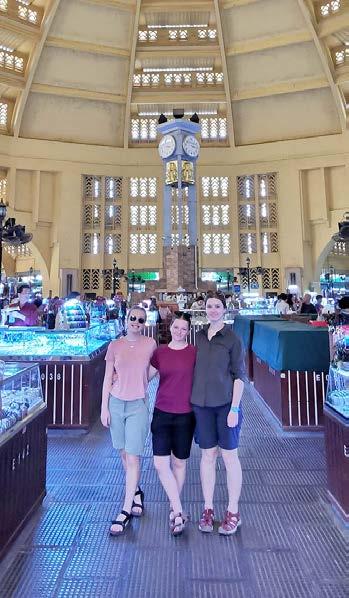


























From left, Madison Phillips, Eva Walton and Bonnie Dixon during the World Challenge Leadership Expedition.
Pirongia shows resilience

By Jesse Wood
Four Square Pirongia owner/ operator Chris McDonnell said they want to support their community as much as possible.
“We’re happy to be the community hub. If it’s coming to use our phone or whatever we can do,” McDonnell said.
Water issues and road closure could go on for weeks, potentially months.
McDonnell said friends at Coromandel stores have given them tips on how to support their community and staff.
“We’ve put a post on the community Facebook group with our phone numbers and emails to get in touch for any bits and bobs needed,” McDonnell said.
“We’re selling hot chickens for $10 for the rest of the week, because people
haven’t got power and they’re busy cleaning up.
“They can come and get something to feed the family.”
Fresh produce left unsold will be donated to Food Rescue.
“It’s all a bit of an unknown.
Our locals have been great, they’re supporting us,” McDonnell said.
“We’ll be endeavouring to go to the bakery, the Hive and Mountain Folk ourselves.
“I don’t mind drinking a few more coffees, and a few more pies is fine by me.”
Pirongia Community Association community connecter and Civil Defence warden Ruth Webb said the businesses need community support.
Due to the State Highway 39 closure, there’s not much trade happening.
“Everybody’s rallying together.
There’s some amazing stories coming out - resilience and adapting to what’s happened,” Webb said.
“People haven’t been shy of asking and people have provided their needs. That’s been pretty cool.”
Webb encourages people to research who to contact and where to go from a Civil Defence point of view.
“We want to encourage people to offer their phone numbers and email addresses so the likes of Neighbourhood Support, through CommSafe, can do mass emails because some people aren’t on social media,” Webb said.
“We’ve been trying to update our contacts, having a key contact person on each road or street.
“We pride on calling ourselves a village and being that, we want to look out for each other.”
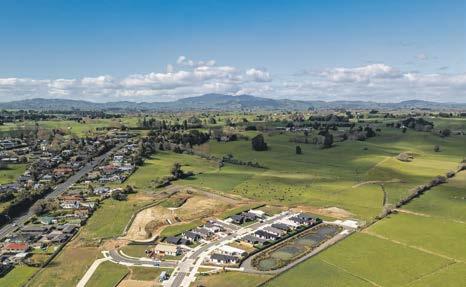
OPEN DAY
We’re excited to welcome you to Waipiko Landing on Sunday 22 February, where you’ll have the chance to explore our completed homes, meet the team, and experience the vision for this growing neighbourhood in Te Awamutu.
Just a 30-minute drive from Hamilton and 20 minutes to Cambridge. Waipiko Landing o ers easy access to major centres while maintaining the charm of life in a vibrant community.
Homes are being delivered by trusted build partners Venture Developments, Progressive Projects, and Generation Homes, o ering a mix of completed and customisable home packages to suit are available, o ering flexibility in design, size and price point.
Location:
Time: Date:
Neighbourhood entrance at 952 Cambridge Road, Te Awamutu 12:00pm - 2:00pm Sunday 22 February 2026
Emotional mayor praised
By Chris Gardner
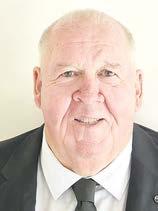
Rookie Ōtorohanga mayor
Rodney Dow hasn’t had time for media training –but he won praise for his television appearances in the wake of the storms.
“I’ve never been so emotional in my life,” Dow said as he broke down in front of television cameras over the weekend.
Emergency Management minister Mark Mitchell placed a reassuring hand on his shoulder.
Dow, who was elected mayor in October after serving the district as councillor, told The News he was yet to receive media training, but he had been advised to place the tongue on the back of his teeth if he were to become emotional in an interview again.
“I don’t want to become known as the crying mayor,” he said.
His partner of six years and fiancée Michelle Erikson said she had received many messages of support after he showed he was human.
Waitomo mayor John Robertson called Dow on Monday offering support.
“It’s normally Waitomo that gets weather events, we dodged a bullet, Ōtorohanga
got it hard,” he said. “We are supporting in any way we can.”
Waitomo District Council staff also assisted their Ōtorohanga and Waipā colleagues in the Civil Defence response.
Meanwhile, Dow is inviting the community to a free truck and ute show in Ōtorohanga on Saturday.
“I am hoping the weather stays fine, and the community can get together at Island Reserve and put this weekend behind them,” he said.
Saturday is expected to be sunny, according to the weather forecast.
“We have just got to get through this.”
Dow is hoping this year’s truck and ute show will be slightly bigger than the show two years ago which attracted 100 trucks and utes.
Women’s Family Planning & Sexual Health Clinic
Get a green light on your sexual health! Book to see our specialised women’s health GPs and nurses, for any of the following and more. Appointments are 30 minutes long - ask our receptionist to book you for a Women’s Health appointment.
You do not need to be a registered patient with us to attend this clinic. Many services are subsidised, so the cost is reduced for most patients.
Menopause advice and care
‘Well woman’ checks - comprehensive check-up and screening service to optimise women’s health
Contraception:
• Emergency
• Long acting reversible IUDs, jadelles
• Depo injection
• Pills, condoms
Pregnancy testing
Early pregnancy assessment
STI checks for all genders
Abortion care and support

Rodney Dow
Four Square Pirongia owner/operator Chris McDonnell said they’re happy to be a hub for their community. Photo: Jesse Wood
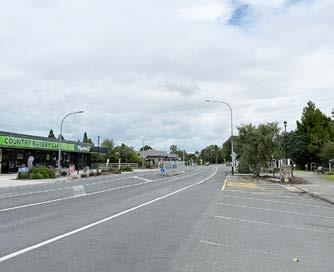
Pirongia Village was a near ghost town on Monday with State Highway 39 closed off to the lower North Island. Photo: Jesse Wood

COMING TO TE AWAMUTU
Retirement where the living is easy.
Arvida in Te Awamutu has a brand-new clubhouse and resident workshop underway, featuring a dining area, library, pool, gym, bowling green and outdoor fire. Our brand new villas are priced from $695,000 (licence to occupy)*. And the nearby Frontier Estate is home to a pharmacy and medical centre. What more could you want from a retirement? Now’s the time to make the move.
* Price is for an Occupation Right Agreement, secured by a first‑ranking mortgage in favour of the Statutory Supervisor on behalf of residents. Price valid for 30 days from the date of publication.


Book a private tour.
Arvida Whai Mauri Ora is situated at 319 Manaia Road, Te Awamutu. We’d love to show you around and answer any questions you have. To book your tour, call Juliet on 07 444 4023.
Scan here to learn more.

Artist impression
Artist Impression
Ngaire remembers when
By Jesse Wood
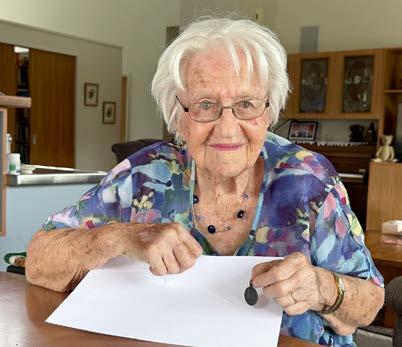
A piece from The News columnists Meghan Hawkes prompted Ngaire Phillips (nee Johnson) to recount receiving a coronation medal almost 90 years ago at Mangapiko School.
It was May 12, 1937 - two days after her 8th birthday and the medal was a celebration of the crowning of George VI and his wife Elizabeth – the first of three coronations during Ngaire’s lifespan.
Ngaire, 96, remembers her
grandfather and Waipā county councillor J.T. (John) Johnson handing them out to all the students.
“My grandfather was standing there with all these medals and nobody moved,” Ngaire said. “The teacher Miss Gertrude Cameron said, ‘go on Ngaire, he’s your grandfather, you go first’ because I didn’t move either.
“There might have been 40 pupils. We had two classrooms and the one teacher.”
There was no television and her parents didn’t have a radio and
ELECTRICITY DELIVERY PRICES
Ngaire doesn’t remember much else about the coronation. But she still has her medal.
The Johnsons have been in the district since 1908, when J.T. brought his family north from Masterton, hence Johnson Rd in Mangapiko.
Mangapiko School closed on May 6, 1939, with just a roll of nine. It was one of many schools in the Te Awamutu area whose fate was determined by a policy of consolidating country schools.
“I can still remember the relieving teacher dividing the spoils among the pupils. My sister Ailsa and I carried a blackboard between us loaded up with things such as books and chalk and bits and pieces,” Ngaire said.
“I was almost 10, Ailsa was 7, and we carried that loaded board home on the two and a half miles of the rough metal main Pirongia Rd. We used that blackboard for years.
“The school had a garden where the children sowed seeds and grew vegetables. We also grew native trees from seed.
“When the school closed, we were each given a seedling. Our little kōwhai tree was transplanted onto my father’s house section and grew into quite a big tree.
“When it was 17, my father wanted to build a car shed. It was in the way. By then I was married living on another farm close by.
“My husband Ron wrenched the
tree and months later dug it up, put sacks and a chain around the root ball and trunk, and with a frontend loader put it on a lorry.
“Kept well-watered, it transplanted successfully. It flowered out of season for three years but survived.”
Two “dunnies” and a boulder commemorate the spot where the school once stood on the corner of Mangapiko School and Burns Roads.
The site has views of mountains Pirongia, Kakepuku and Maungatautari. The school buildings have been preserved as accommodation - The Old School House is on Bruce Rd, between Te Awamutu and Kihikihi.
“The last school picnic was held in Hey’s paddock near the road. It firmly remains in memory, mostly because in February 1938 my parents, Ray and Edna Johnson, bought a General Electric refrigerator, a rare home appliance in those days,” Ngaire said.
“They made a quantity of ice cream and served it to the children as a treat. They kept it cold in thermos flasks.”
Te Awamutu-based Jessie Young (nee Houghton), 98, and Pāpāmoa-based June Ferguson (nee Young) are two friends that Ngaire stays connected with from her Mangapiko School days.
Following the school’s closure, Ngaire attended Te Awamutu Primary and Te Awamutu

Intermediate. She was a Te Awamutu District High School student throughout WWII, finishing in 1946 - the year before it became Te Awamutu College.
Other than two years in Auckland at teacher’s training college, Ngaire has lived in the area her whole life. She now resides in Te Awamutu after moving off the farm 11 years ago.
A former Pirongia School and Te Awamutu Primary School teacher, Ngaire has compiled books detailing both her family and Mangapiko history.
There isn’t much of the Mangapiko area left as 8-year-old Ngaire would remember, but the hall will turn 100 in July.
Ngaire featured in the Te Awamutu News in October 2020 when Viv Posselt reported on in an exhibition at Te Awamutu Museum which looked back on 100 years of secondary education in Te Awamutu.
Ngaire’s 1937 George VI and Elizabeth coronation medal. Photo: Jesse Wood
Ngaire Phillips recalls receiving the coronation medal in 1937 at Mangapiko School.
Photo: Jesse Wood



Cheaper, Easier, Safer:
New Licence Procedure a Win for Rural Youth
by Barbara Kuriger, MP for Taranaki-King Country
For many young people in rural areas, a driver’s licence isn’t just a piece of plastic– it’s their lifeline. It’s how they get to work, training, school, and healthcare, often over long distances with little or no public transport.
That’s why the recently announced improvements to the driver licensing system will be warmly welcomed by rural communities.
From 25 January 2027, the Government will overhaul New Zealand’s Graduated Driver Licensing System (GDLS) to make it cheaper and easier to get a driver’s licence. The changes are expected to deliver particular benefits for rural areas, where being able to drive is often essential for daily life.
Under the new system, the total cost of getting a Class 1 car licence will drop by $80, from $362.50 to $282.50. This saving comes largely from removing the full licence practical test for car drivers, cutting not only fees but also the time and travel costs involved in sitting tests – a real bonus for people who currently must drive long distances to reach a testing centre. Young drivers under 25 will spend longer on a learner licence—12 months instead of six—but they can reduce this to six months by logging supervised practice hours or completing an approved practical course. The aim is to give young people more real-world driving experience, including on rural roads where conditions can be more demanding, while still allowing motivated drivers to move through the system more quickly. Will safety be compromised? No. The restricted period will be 12 months for under 25s and six months for those 25 and over. Restricted drivers who receive demerit points will stay on their restricted licence for an extra six months, reinforcing safer driving habits. A zero alcohol limit will apply to all learner and restricted drivers, an important safeguard on rural roads where serious crashes can have devastating impacts on tight-knit communities. In short, these licence changes aim to make life easier and safer for rural drivers: cutting costs, reducing long trips for tests, and encouraging more real-world driving experience— especially for young people.
With tougher expectations around safety and ongoing reviews built in, the new system is designed to open work and training opportunities while helping keep rural roads – and rural communities – safer and stronger.


Sharing our surplus
By Christine Bryant, Lay Minister, St John’s
In the Waikato, we are aware of the changing seasons, despite our temperate climate.
After two weeks recently of glorious summer weather, everything has ripened or is ripening: peaches, plums, grapes, and tomatoes.
If you have these in your garden, you will be busy preserving and freezing. But all too soon, it will be autumn with cooler days, less sunlight, falling leaves – the changes which herald winter.
The church also has its seasons. This week it will be Shrove Tuesday or Mardi gras, followed by Ash Wednesday. ‘To shrive’, (shrove shriven) means to confess one’s sins to obtain forgiveness.
As well as confession, it was time to use up ‘fat’, hence Pancake Tuesday, before the Lenten period of fasting.
In the northern hemisphere, as winter came to an end, there was little fat left to use up. People had to rely on the food they had preserved, for example beans or potatoes or flour-based foods such as pasta – what we know today as “comfort food”.
Ash Wednesday is like Yom Kippur in Judaism, a day of repentance. It is the first day of Lent which represent the 40 days Jesus prayed and fasted as he prepared for his years of ministry.
It is similar to the Muslim month of fasting - Ramadan.
For many years, the first weekend of Lent was often marked in schools and churches by the 40-Hour Famine, a World Vision initiative to inspire young people to raise money for countries experiencing famine. It was very successful and enabled teenagers
in affluent countries like Aotearoa to have a small idea of what it was like to be hungry all the time.

The season of Lent should still resonate with us.
It could lead us to reflect on our lifestyle and the changes we might make to share what we have with those who are struggling in our community.
The poor in New Zealand are not poor by Third World standards. Nevertheless, around 20 per cent of families live in deprived circumstances.
They do not have enough money to participate in experiences most of us take for granted.
The beginning of the school year is an especially trying time as families with limited means juggle the need to pay high rents and food bills with the need to buy school uniforms and stationery and pay for extras, such as school camps.
Even if we do not consider ourselves wealthy, some of us at least could afford to do without something to ease the burden on even one struggling family. In Luke 9: 12-17, we hear about how a small amount of food, when blessed and shared, will feed many. The lesson is that sharing what you have is not just a blessing to the person receiving it, but also to the giver.
In Te Awamutu the churches operate a Food Bank which always needs donations to help families in our community. A gift for the Food Bank can be left at any of the churches. Doing without a treat and sharing our surplus are simple ways in which we can put the spirit of Lent into practice.
ON SHAKY GROUND
Hidden action
By Janine Krippner
We really don’t hear much about what lies below our oceans. Sure, we hear about a fraction of the incredible life down there, and sometimes about the amount of damage humanity is inflicting. I have touched on how much of a mystery the deep oceans are, largely because of a lack of data. It is technically difficult and expensive to collect the data and it is either driven by research, which requires funding, or industry, where we often don’t see the results.
A brilliant colleague of mine with decades more experience looking at the seafloor exclaimed how active it is down there. We were looking at giant canyons and enormous channels, forged by ocean currents, landslides or rockfalls, and turbidity currents – powerful and damaging sediment flows that can travel hundreds of kilometres from where they start.
There is geothermal activity, which may give clues to how life started on our beautiful planet.

There is a lot of seismicity, sometimes as enormous earthquakes along plate boundaries or where stresses accumulated in the crust. These can trigger massive landslides and tsunamis.
Water can become heavier because of temperature, salinity, or increased sediment from a storm, causing it to dive down across the seafloor. This can scour out those giant canyons or channels.
07 870 1005 • Kuriger.Teawamutu@parliament.govt.nz
King Country Virtual Office 021 815 017 Kuriger.Kingcountry@parliament.govt.nz




Below our oceans, the seafloor is an incredibly dynamic place. The landscape doesn’t have wind or rain like we do on the surface, the processes that shape much of our landscapes, but it does have water currents and geologic processes.
The movement of sediments – worn down bits of rock plus biological material… and increasingly, our trash, is a critical process across our planet.
Below the sea are our longest mountain chains, mid-ocean ridges, where tectonic plates pull apart. This is driven by fault activity and volcanism to slowly but steadily create extensive new surfaces. As the thick layers of rock cool and move away from the ridge they become denser and slowly sink.
The seafloor is where volcanic islands begin to form, building edifices kilometres high that tower above the ocean surface.
Extremes of hot and cold exist. Minerals form below kilometres of water as I covered last week, or at geothermal areas that also become hotspots for life. Methane ice (hydrate) forms within sediments, then can melt to destabilize the seafloor and trigger landslides across continental slopes. When ice covered much of our planet, it scoured the seafloor and also transported sediment into our ocean basins. When sea level was much lower, landscapes stretched further outwards and carved some of those giant canyons.
Today, we have enormous river deltas that continue some of these processes. So much sediment moves seaward from these systems that the seafloor can become unstable. Storms can flush out even greater amounts of sediment (like when we see brown plumes forming where rivers meet the sea) triggering turbidity currents there too.
I didn’t know how much I didn’t know before I started my current job, and every day I am learning something new. I love that I get to share it with you here.
TREES AND POWERLINES
EVERYTHING YOU NEED TO KNOW TO KEEP YOU SAFE.
Managing your trees will help prevent power outages and keep everyone safe. Check your trees regularly and keep them trimmed so they stay clear of power lines.
TREE TRIMMING DANGERS
Trimming trees near power lines can be extremely dangerous, and even deadly.
Contact with a power line can cause:
• Injury or death to yourself, family, community members or livestock
• Damage to property
• Damage to power supply facilities and electrical appliances
• Damage to third parties.
Before attempting to clear tree foliage near live conductors you should contact us for advice.
Branch movement: Although tree foliage can sometimes appear to be at a safe distance from the lines, once you begin the work, the tree may move due to pressure placed on branches, random gusts of wind and other external factors. Be aware of any tree branches that may flick up as they are trimmed or as surrounding branches are cleared.
Wet weather: Branches often hang lower when the leaves are wet, so if it starts to rain, or if the leaves are already wet you should expect some movement. Debris: Ensure there is clear space to allow for debris when tree trimming.
Growth Limit Zone: any tree growing in the Growth Limit Zone (see diagram) must be trimmed by a Waipā Networks authorised arborist.
ELECTRICITY REGULATIONS
The Electricity (Hazards from Trees) Regulations 2003 set out the responsibilities of tree owners and lines companies in relation to trees and power lines. Waipā Networks has developed procedures to meet these regulations, summarised below:
• If we become aware of a tree that you are responsible for within the Notice Zone, you may be issued with a Hazard Warning Notice.
• If we become aware of a tree you are responsible for within the Growth Limit Zone, you will be issued with a Cut or Trim Notice.
• You must have the tree trimmed so that it no longer encroaches the Notice Zone or Growth Limit Zone. Dispensation can be applied for if there is a valid reason for the tree to be allowed to grow within the Notice or Growth Limit Zones.
• We’ll trim a tree free of charge provided it is the first trim. Any further trimming is the responsibility of the owner.
• At any stage, you can declare ‘No Interest’ in a tree on our network and we will meet the costs of any future trimming, or may decide to remove the tree altogether.
• Where we become aware of a tree close to the lines and likely to cause danger to the public or property we have the ability to remove the tree or branch causing the hazard.
If you receive a ‘Cut or Trim Notice’ you must use an approved Utility Arborist to trim or fell the trees. If you repeatedly ignore them, you could be fined up to $10,000 plus $500 per day for every day the offence continues.
THERE ARE RULES ABOUT SAFE DISTANCES BETWEEN TREES AND POWER LINES In the Zone
In October 2024, The Electricity (Hazards from Trees) Regulations 2003 were updated to increase the minimum safe distances between trees and power lines, and a new ‘clear to the sky’ requirement for some trees. The regulations define four zones:
Growth Limit Zone: This is the minimum distance that trees must be kept clear of overhead power lines.
Cut-Back Zone: This zone ensures vegetation is trimmed back far enough to prevent it from quickly growing into the Growth Limit Zone.
Notice Zone: We will issue a notice if vegetation is in this zone to give property owners time to address the risk earlier before it becomes urgent.
Clear to the Sky: This is the area above 33kv and high voltage lines that must be kept clear.
Fall Hazard Zone: Trees present a hazard if they fall and damage power lines. A tree’s fall hazard zone is the height of the tree plus 4 meters.
Note: Fall Zone trees are not currently covered by regulatory requirements. But if you own a tree that is within the fall zone and you have concerns about its health or safety, please notify us to discuss your options.
What are the Minimum Safe Distances?
The size of the growth limit zone varies depending on voltage level:
The Notice and Growth Limit Zone requirements increase if the adjacent power line span is greater than 150m. In these cases, we will notify you of your obligations.
On the Trail… Leaving no trace
New Zealand Outdoor Instructors’ Association bush leader and senior writer Chris Gardner continues his outdoor series by discussing the seven principles of Leave No Trace.
Every walker and tramper knows to take only pictures and leave only footprints, but it is just one of seven principles that encourages us to minimise our environmental impact. Plan ahead and prepare is the first Principle of Leave No Trace. “If you fail to plan, you plan to fail,” the founder of Scouting, Sir Robert Baden-Powell, 1st Lord Baden-Powell of Gillwell,
once said. Today we use the five Ps to say the same thing. Prior Planning Prevents Poor Performance. Either way they are great reminders that we should never step on the track without a plan. We’ve talked at great length, in these columns, about the NZ Mountain Safet Council’s minimum gear list. You should always be prepared to overnight, even if you are planning a
short walk. The media is full of reports of walkers or trampers who were not prepared. Making a mistake here can be fatal. Travel and camp on durable ground is the second principle of Leave No Trace. Walking on unstable ground could damage flora and fauna, dislodge soil and rock, and lead to slips, trips, and falls.
Dispose of waste properly






is the third principle. Or pack it in, pack it out, as I prefer to say. I follow this to the point that I will avoid using rubbish bins on the trail. Rubbish attracts pests like possums and rats who negatively impact our environment, and you never know when the bin will next be emptied.
This principle also covers toileting. I always use the toilet before starting a track to minimize my chances of having to dig a bush toilet otherwise known as a cat hole. Before considering toileting off track, check whether it’s appropriate as in many places it is culturally inappropriate.













Cat holes should be dug between 15 and 20 cm deep in organic soil between 50 and 70 metres from campsites, huts, tracks, and water. I always carry a tramping trowel, but a tramping boot can also do the job. Once you’ve finished, dispose of your waste properly by burying it so vermin cannot get at it. Leave what you find is the fourth and simplest principle. Minimise the effects of fire is the fifth principal. I always prefer to cook with a gas stove and cannister. It’s quick, cheap, and works in any weather. I might light a fire at a campsite at night for warmth if there is a firepit and it is allowed. Many
Department of Conservation campsites have a permanent fire ban or, at least, a fire ban in the summer. Fire and Emergency New Zealand run a simple, three step, tool at www.checkitsalright.nz, which tells you whether you can light a fire and whether you need a permit. I carry aluminium foil to save having to dig a pit if I do light a fire.
The sixth principle is respect wildlife and farm animals. Wildlife and farm
animals should be given a wide berth by walkers and trampers. If your presence is impacting their behaviour, then move away to a place where it is not.
The seventh is to be considerate of others. For me this extends to caring for other track users. I may ask how they’re going, where they are off too, and if I can offer any help. This could be useful if, further down the track they fail to check in. My intelligence could help police

COMFY CARE
Enjoy welcoming, comfy surroundings and a warm sense of belonging at our Resthaven on Burns Care Centre.
• We are a community charitable trust providing quality, affordable care for seniors.
• Our caring team are here to help you enjoy the things you love, whether it is gardening, baking, trips to town, hobbies, or simply a quiet afternoon relaxing.
• Our commitment to affordability means there is no premium daily room charge at Resthaven on Burns.
on Burns



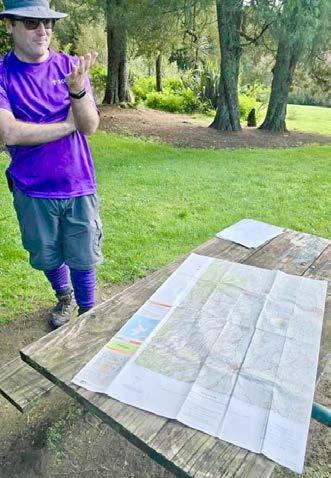
Chris Gardner plans ahead as he shows how to set or orientate a map before heading into the bush on Mount Pirongia.
A selfie on Pironiga




Waipā District is under a State of Emergency declaration, following severe flooding, slips, and damage to roads and infrastructure in the western side of the district
The declaration allows Civil Defence and emergency services to respond quickly and support affected communities
Mayor Mike Pettit, in consultation with Civil Defence, will make a decision on whether to lift or extend the declaration on Friday, February 20
"The weather hit hard and fast, and its impacts aren’t the same everywhere Some areas are getting back to normal, but just a few kilometres away, people are still cut off, roads are damaged, and bridges, pipes, and culverts are at risk," he says
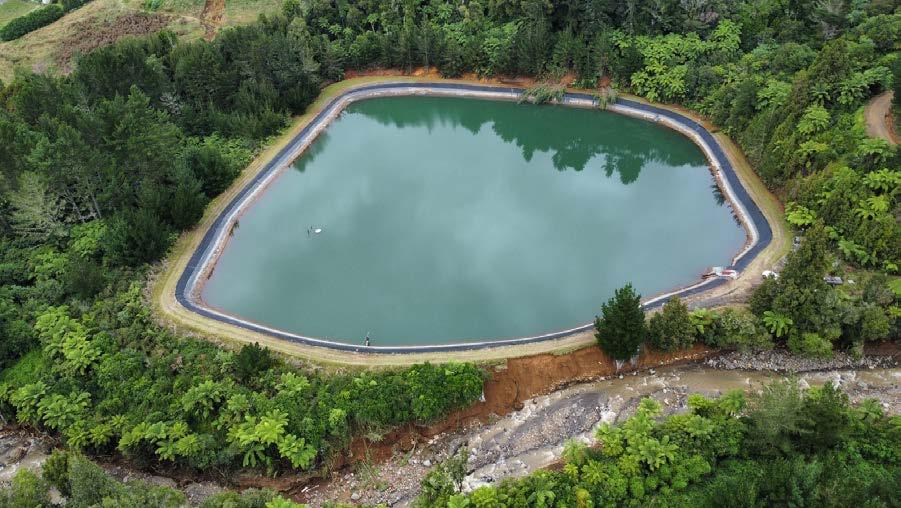
"Right now, our biggest focus is Pirongia’s water supply The supply all runs on a single pipe We’ve got water tankers ready if we need them, but the best thing residents can do is conserve water Short showers, less toilet flushing, and no washing cars - every drop saved helps make the supply last "
"I’ve been out in Pirongia and Te Pahu talking with residents who’ve been affected We drained the Te Tahi reservoir to have a good look, and experts are working on what needs to be done next
“And Council teams are on the ground, checking damage, keeping an eye on infrastructure, and doing everything we can to get things sorted and keep people safe "
Your Elected Members




Landslide risk for all residents
Heavy rain can trigger landslides for several days Warning signs include new cracks, tilting fences, leaning trees or walls, and debris in areas where it hasn’t appeared before Move to safety immediately if you notice these signs
Road safety reminder
Road closures are updated frequently on our Facebook page and website Do not drive, walk, or swim through floodwaters, and obey all road closure notices
Mayoral Relief Fund
The Mayoral Disaster Relief Fund is being set up to help those affected
This will allow us to receive and distribute Central Government funding and other donations It ’s a way of channelling the appropriate support to our community members and those who need it most
More information about the criteria and how to apply for assistance will be available on our website and from Council offices
Contacts:
Emergency: 111
Council enquiries: 0800 924 723
Website: www.waipadc.govt.nz
Facebook: Waipā District Council
Email: info@waipadc govt nz







Mike Pettit Mayor Jo Davies-Colley Deputy Mayor
Roger Gordon
Aidhean Camson
Pip Kempthorne
Clare St Pierre Les Bennett
Shane Walsh Dean Taylor
Marcus Gower Mike Montgomerie
Dale-Maree Morgan
Together in Waipā: flood response and support
Pirongia’s water supply, Te Tahi reservoir, as the draining process began
The landslip damage at Te Tahi reservoir
Corcoran Road in Te Pahu is closed with risk of collapse, with residents downstream evacuated





Across 1. Sturdy (6)
4. Entertained (6)
9. Style of film or book (5)
10. Put in place (7)
11. Cost (7)
13. Wicked (4)
14. Focus on something (11)
17. Teller of untruths (4)
18. Template (7)
Last week
21. Exact (7)
22. Kingdom (5)
24. Stinging plant (6)
25. Indistinct (6)
Down 1. Tattered (6)
2. Small loaf (3)
3. Lustre (5)
5. Perceive incorrectly (7) 6. Piece of data (9)
7. Bland (4) 8. Children’s game (4-3-4) 12. Important or famous (9) 15. Sweet drink (7) 16. Uncoordinated (6) 19. Sign up (5) 20. Rotate (4) 23. Short song (3)
Across: 1. Mall, 4. Lounge, 8. Chaotic, 9. Caste, 10. Torn, 11. Fabulous, 13. Miniature, 17. Jealousy, 19. Mail, 21. Close, 22. Collide, 23. Brutal, 24. Peep. Down: 2. Anagram, 3. Lots, 4. Lackadaisical, 5. Unctuous, 6. Gusto, 7. Heist, 8. Cute, 12. Innocent, 14. Evasive, 15. Eject, 16. Glee, 18. Amour, 20. Slip.
APPLE
BANANA BEAN
BEETROOT BLACK PEPPER
BOILED EGG
BREAD
CABBAGE
CELERY
CHEESE CHICKEN

MAHJONG LESSONS
CLASSES RUN EVERY WEDNESDAY FROM 25 Feb – 25 Mar 12.45 – 3.30pm
FIRST INTRODUCTORY CLASS IS FREE WEDNESDAY 25 FEBRUARY 2026
ARRIVE 12.30PM
Come and join our fabulous group of friendly women and learn a new skill!
• Learn the basics over four weeks Learn at your own pace
• Calm and supportive environment
• Great way to meet new people and most importantly, have fun!
Contact Glenice for more information M: 021 414 644 Waipa Women’s Hub Inc.






Farming the harbour…
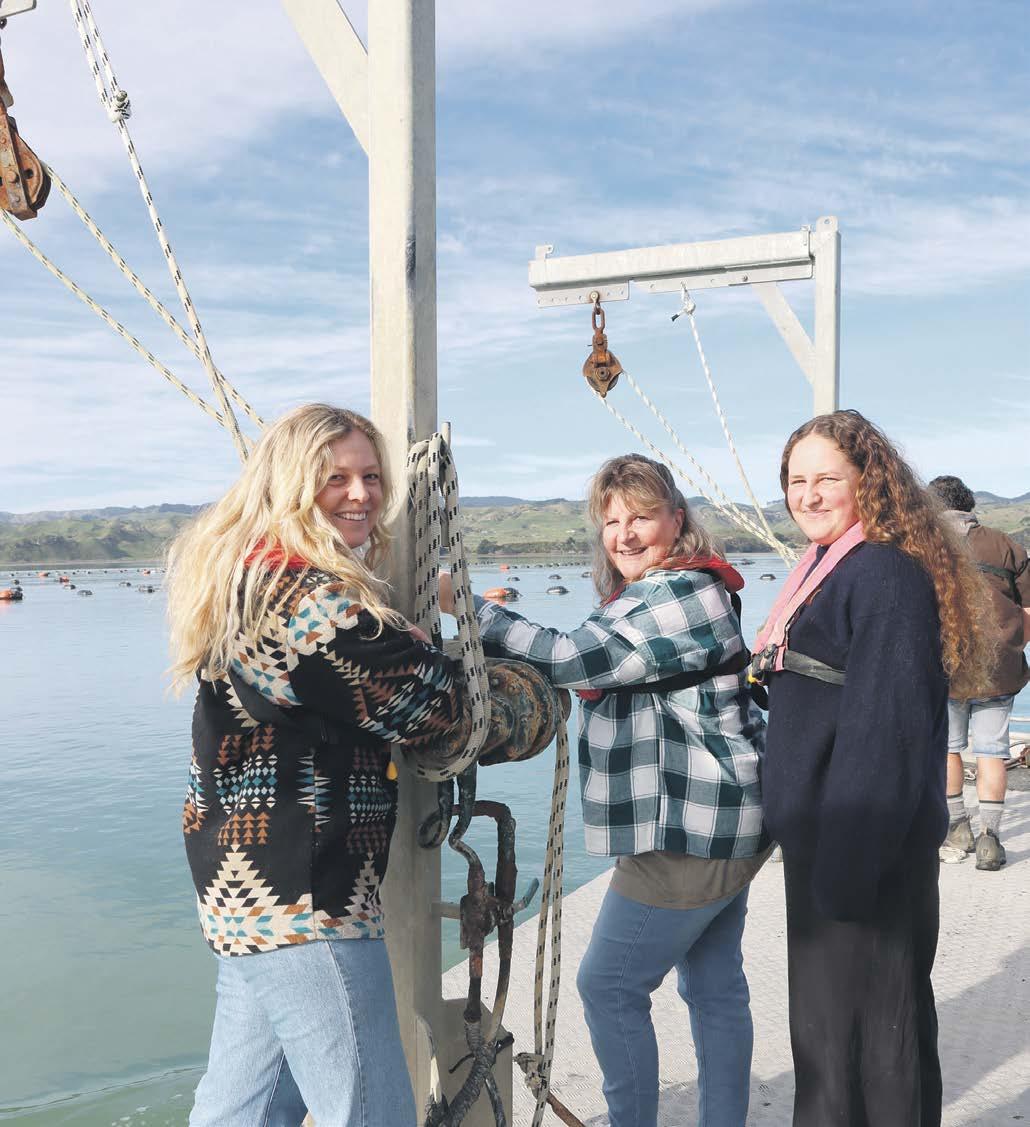
Aquaculture may look different from sheep and beef, but on Aotea Harbour a King Country family has been farming the water for decades, as Jon Rawlinson discovered.
There may always be a place for terrestrial farming, but interest in aquaculture is steadily rising.
For Kelly Dockery, sustainability officer at Kāwhia‑based Aotea Marine Farms, it’s simply the family business she grew up with.
The Aotea Harbour farm has been owned and operated by Ross and Janine Dockery since the 1980s.
With the help of their daughters Kelly, Georgia and Eilish, the family produces a substantial amount of food per hectare, Kelly says.
The operation produces a substantial amount of food from Aotea Harbour.
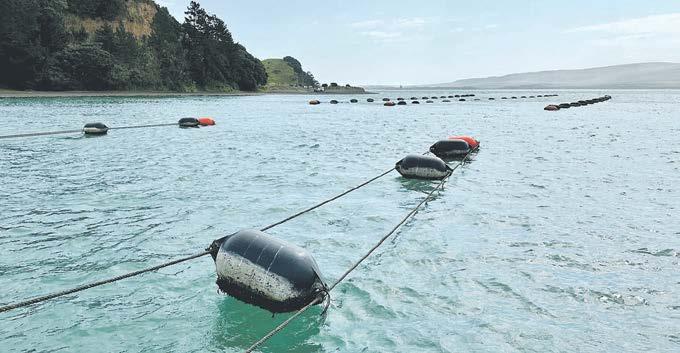
“We farm a lot in a very small space about 7.5 hectares but that produces hundreds of tonnes of food,” says Kelly.
“In general, the New Zealand mussel industry is super green – green lipped
mussels are among the most sustainable forms of meat based protein in the world.”
Mussels deliver much bang for the buck –protein rich, they don’t require feeding, they have a relatively small carbon footprint and they even clean the water around them as they grow.
While the Dockery farm is more a nursery than a heavyweight mussel builder, its produce is in high demand.
“We grow wild caught spat, basically little baby mussels,” Kelly says.
“After they spawn, they drift and swim. We put kilometres of rope into the water, collecting the spat that attaches to it, and let it grow for a few months before pulling it of the water. It’s then sent up to Coromandel.”
A lack of home grown spat has required Coromandel farms to rely on
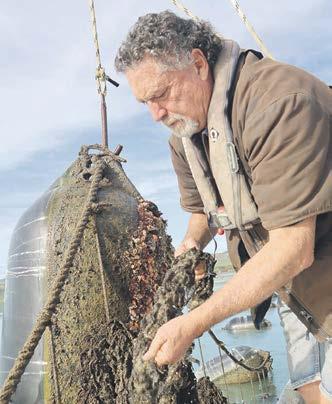


Kelly and co to supply them with spat, rope and all.
“We don’t have to collect seaweed with spat on it and ship it to Coromandel; they just need to put the ropes back in the water, strip them once or twice and reseed so the mussels are more spread out as they grow.”
Land based runoff hasn’t been a major issue for the farm, with Aotea Harbour’s tidal nature helping maintain water quality.
“The water quality in Aotea Harbour always seems to be quite a bit better than Kāwhia because there are fewer rivers running into it, and it’s super tidal so nothing stays sitting there too long,” Kelly says.
“Also, our mussels still have another 18 months to grow after they leave here and they’re tested before they go to market.”
Although pine forestry is often seen as a cleaner land use, Kelly says heavy rain events can bring significant debris and waste down into the harbour.
“There is a lot of forestry, so when there are big weather events there’s definitely waste floating down and the water’s just gross.”
Already more sustainable than many other forms of farming, aquaculture may still have a little room for improvement. Aotea has welcomed researchers and, with two university degrees of her own, Kelly appears happy to help.
“We’ve been involved with heaps of companies, organisations and universities over the years. At the moment, we do quite a lot with the University of Auckland,” she says.
“They’re studying ways to harvest tidal energy which would benefit us all.”
Even the smallest details matter.
“I’ve had a bit to do with testing types of renewable rope, made from coconut
or flax fibres. They haven’t quite sorted 100 per cent natural based rope, so those could be a bit greener, and we need fuel for our boats, but apart from that you can’t really get much better.”
As pressure grows on all forms of food production, lessons learned on Aotea Harbour show how the King Country continues to play a quiet but important role in feeding the country on land and on water.








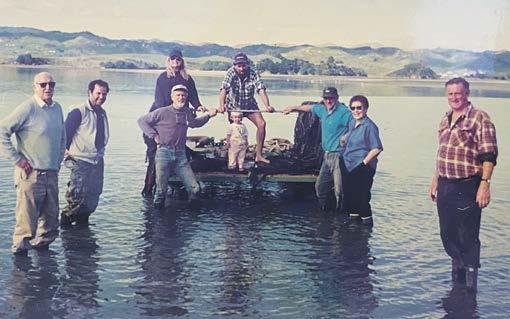
Toddler Kelly Dockery stands in front of her parents Ross and Janine atop the first ever “mussel barge” on Aotea Harbour with mussel pioneer Dave Morrison, extreme left, unknown scientists and to the right her late grandparents Edith and Reg Dockery and Kaiaua mussel farmer Mark Aislabie. Photo: Aotea Marine Farms.
Ross Dockery.
Photo Aquaculture NZ Mussel farming in Aotea Harbour.
Photo: University of Auckland.
Another string to the bow
Diversifying beyond stock and milk is helping Waipā and King Country farmers build resilience when times get tough, as Jon Rawlinson discovered.
Waikato farmers are increasingly diversifying, drawing on an extra income stream while adding capital value to their businesses by catering to tourists.
Whether by building baches, cabins or establishing camping/ glamping options, farmers need not be completely reliant on the price of meat or milk.
“A lot of women come onto farms after doing all sorts of things. They bring diversity to farming and skills that can generate extra income,” says Rural Women NZ past president, Fiona Gower.
“There are a lot of ups through offering accommodation on farms – you add capital value to the business and it helps with cash flow. If it’s a really tough year with meat or milk prices, extra income can offset losses and may make all the difference to staying afloat.”
Based at Port Waikato, Gower has many enduring connections to, and knowledge of, the greater Waikato and King Country regions. For more than 20 years, Marokopa has been her home away from home – and she was also a founder of Rural
Women’s Waitanguru branch.
While she says that some farms in the region appeal to holidaymakers who like to be beside the seaside or riverside, people aren’t just drawn to the area by the scenery alone. Farm stay accommodation is growing in popularity, especially among urban visitors looking to escape to the country.
“Experience holidays are really taking off. People want to get away from traditional hotels, out on a farm where they can feed a lamb, go horse riding, connect with nature or just learn more about what grassroots farmers actually do.”
Such ‘stay and play’ operations can benefit further by connecting with other nearby businesses, from restaurants to tourist attractions, for mutual gain, Gower says.
From the King Country coast to the Waipā and Waikato river valleys and all parts in between, there are already plenty of success stories. However, this means there’s plenty of competition too, and holiday hot spots can prove money pits if not established or managed effectively, Gower advises.
“Make sure that you do it well. People don’t want to stay in grotty old shearers’ quarters. Rustic is appealing, run down isn’t. It has to be clean, tidy and safe,” she says.
Of course not every farm offering holiday accommodation in the region has been built with the assistance of Rural Women NZ, but helping to grow new business is one of the organisation’s primary aims. From a few words of advice to more comprehensive business programmes, the organisation proves there’s strength in numbers.
Just one example is Ripples Retreat. Veteran interior designer Trudy Denize, along with her husband Brendan, began building cabins on their Piopio sheep and beef farm in 2019.
“One of the biggest problems is that you just don’t know some important stuff and you don’t even know people who do,” Denize says.
“Rural Women NZ provided a great sounding board for us. There’s a huge learning curve when setting up any new business and that’s where Rural Women really can come into its own.”


NZ
NZ Designed Filtration Systems for the Removal of
NZ Designed Filtration Systems for the Removal of
• Results guaranteed
and Manganese and Other Rural Problems
and Manganese and Other Rural Problems
• Results guaranteed
• Fully automated
• Results guaranteed
• Fully automated
• NZ designed systems tailored to suit your water needs
• Results guaranteed
• Fully automated
• NZ designed systems tailored to suit your water needs
• Latest in electronic technology , wireless & alert systems
• Fully automated
• NZ designed systems tailored to suit your water needs
• Latest in electronic technology , wireless & alert systems
• Servicing the Waikato, Bay of Plenty, Taranaki & Gisborne
• NZ designed systems tailored to suit your water needs
• Latest in electronic technology , wireless & alert systems
• Servicing the Waikato, Bay of Plenty, Taranaki & Gisborne
• Latest in electronic technology , wireless & alert systems
• Servicing the Waikato, Bay of Plenty, Taranaki & Gisborne
• Servicing the Waikato, Bay of Plenty,

Fiona Gower at her Port Waikato farm.
Photo: Supplied

Understanding EPOAs: Why Every Adult Should Have One
Many people have heard of a “power of attorney” but are unsure what it means or why it matters. An Enduring Power of Attorney (EPA) is an important legal document that allows you to appoint one or more trusted people to make decisions on your behalf if you lose the capacity to do so. Loss of capacity can occur because of mental illness, serious injury, stroke, or the natural effects of ageing.
There are two main types of Enduring Powers of Attorney: personal care and welfare, and property. A personal care and welfare EPA covers decisions about your health, medical treatment, living arrangements, and overall wellbeing. A property EPA allows your attorney to manage your financial and legal matters, such as paying bills, accessing bank accounts, managing investments, or dealing with property. Having both types in place ensures that all areas of your life can continue to be managed if you become unable to do so yourself.
One of the greatest benefits of an EPA is the control and flexibility it provides. You decide who will act for you, when they can act, and what authority they will have. You can also include conditions or limits to reflect your personal wishes. This provides reassurance that decisions will be made by someone you trust, who understands your values and will act in your best interests.
An Enduring Power of Attorney can also help prevent uncertainty and family conflict. Without a legally appointed attorney, family members may disagree about who should make decisions or what actions should be taken. An EPA provides clear legal authority, reducing confusion and helping ensure that decisions align with your wishes. This clarity can be invaluable for loved ones during stressful and emotional times.
If you lose mental capacity without an EPA in place, your family may need to apply to the court for permission to manage your affairs. This process can be costly, time-consuming, and emotionally draining, often adding pressure to an already difficult situation. Courtappointed arrangements may also require ongoing reviews.

For these reasons, an Enduring Power of Attorney is something every adult should consider, regardless of age. Incapacity can happen unexpectedly, and having an EPA in place is about being prepared. Ultimately, it ensures that if you cannot speak for yourself, someone you trust can step in, providing security, clarity, and peace of mind.

Backing better animal health
Dairy Women’s Network has partnered with AgriHealth, an animal health company, to support farmers with practical education.
The partnership will see AgriHealth deliver a programme of workshops and webinars for network members, focusing on everyday animal health issues faced on farm.
Topics will include mastitis, on farm diagnostics, reproduction, cow and calf health, and improving productivity through on farm efficiencies.
Network chief executive Jules Benton says animal health plays a key role in running a successful and sustainable dairy business.
“Making good decisions on farm has never been more important. Having access to reliable, practical animal health information helps farmers take action with confidence,” she says.
AgriHealth head of marketing and technical, Lyndsay Lawrence, says the company is looking forward to working alongside network members.
Equifest moves north
One of New Zealand’s biggest equine events will be closer to home for Waipā riders and horse enthusiasts, with Equifest moving to Hamilton for at least the next three years.
The three‑day festival, previously held in Taupō, combines education, competition, shopping and entertainment, and attracts equestrian competitors and spectators from across the country.
More than 16,000 people attended Equifest last year, with almost 200 exhibitors and more than 460 horses involved.
Equifest will be held at Claudelands Events Centre in October, using the full facility including the Oval, Arena, exhibition spaces, and the on‑site barns and stables.
“We enjoy sharing knowledge and working with people who are keen to learn. Being part of the Dairy Women’s Network community allows us to connect directly with farmers and support better outcomes for herd health and productivity,” she says. Workshops will be held in key dairy regions over the coming months, with online options available to ensure farmers can take part regardless of location.
– Mary Anne Gill

REGIONAL COUNCILLOR’S VIEW
Local government shakeup
By Garry Reymer, Waipā-King Country regional councillor
In my last column I addressed the significant local government reform that was recently announced by the Coalition government.
They didn’t stop there. Wellington has quickly followed that with a plan to change the Resource Management Act and introduce rates capping bill.
At the end of January your regional council got together to work out how we would respond to the proposed shakeup of local government roles and responsibilities. I want to share with you some of the discussion we have had to date.
Local Government: A Mayoral Forum now exists, and it includes regional council chair, Warren Maher.
The forum has responded to the minister and spelt out the complexity of what is being proposed. What we are certain about is that the regional council needs to be part of the
discussion to shape what the new structure will look like. How we govern, elect and manage the new entity will be critical to its success.
Rates Capping: In a nutshell this is the government telling all councils to focus on the basics which I’m sure is a sentiment many would echo. It is clear to me that the introduction of a rates cap goes hand in hand with local government reform. If we hand the responsibility for some of our most costly infrastructure, such as what has happened with Waikato Water Done Well, roading, flood protection, and potentially urban transport, back to the Crown, or Council Controlled Organisations (CCOs) rates become more of a community fund for community projects.
Alternatively, they could be run by a CCO with a commercial board type governance structure.

RMA reform: This is the big one. It will impact everything we do. The draft legislation (Natural Environment and Planning Bill) looks to rebalance the protection of the environment with property rights. The aim is to reboot productivity and to relieve landowners of burdensome consenting if they want to change their land use. This is an extremely simplistic statement to summarise the draft submission we have been working on this past week. As with any change there are trade offs, but we are trying to get the balance right while being wary of unintended consequences. The impacts on Plan Change One, our region and its economic prosperity will be great, and we must make sure that the greater Waikato region is able to maximise it potential while respecting the environment.




Action from Equifest in Taupō.
Photo: Supplied





























CURNOW, Alice May (Scotty) (nee Prescott) – Born 30/9/1929. Died 13/02/2026. Passed away peacefully at CHT, Te Awamutu. Loving mum to Colleen & Bill and loving mother-in-law of Karen and her grandchildren Rochelle, Emma, Natalie, Hannah and Tanya. Great gran to Chayse, Hendrich, Lilly, Ivy, Jaxson and Wiremu. Will be greatly missed by family and friends. A private service was held.
Te Awamutu Funeral Services, FDANZ
NICHOLAS, John Gregory
– Passed away unexpectedly at home on Wednesday, 11th February 2026, aged 69 years. Loved son of the late Dorothy and Allan, and brother to Robert, Peter, and Thomas. A celebration of John’s life has been held. Messages to the Nicholas Family may be sent c/- 262 Ohaupo Road, Te Awamutu 3800, or left in John’s online tribute book at www. rosetown.co.nz.


Support when you need it most Saying goodbye is never easy, but our local, compassionate team is here 24/7 to guide you with care and respect.
PIRONGIA MARKET
Pirongia Community Centre, Crozier St Sunday, February 22 9am - 1pm
Last Sunday of every month
Email jim1@xtra.co.nz or ph Jim 027 366 5842
07 870 2137 262 Ohaupo Road, Te Awamutu www.rosetown.co.nz


Te Awamutu Concerts Alive! presents ‘Musical Mischief: Flute & Piano’
SUNDAY 22 FEBRUARY 2PM Yunesang Yune and Camila De Oliveira perform works by Mozart, Poulenc and others.
St John’s Anglican Church Arawata Street, Te Awamutu.
$25 Cash on the door, Students and children FREE! ALL WELCOME!
Section 101, Sale and Supply of Alcohol Act 2012
PUBLIC NOTICE of an application for Issue On Licence
Jenna Marie Clarke, 101 Great South, Ohaupo, Top Deck Cafe @ The Ridge Ministry and events has made application to the Waipa District Licensing Committee for the issue of a on-licence in respect of the premises at 101 Great South Road, Ohaupo and known as Top Deck Cafe @ The Ministry and events
The general nature of the business to be conducted under the licence is Restaurant. The days on which and the hours during which alcohol is (or intended to be) sold under the licence are: Monday to Sunday 8am-1am
The application may be inspected during ordinary office hours at the office of the Waipa District Licensing Committee, 101 Bank Street, Te Awamutu or 23 Wilson Street, Cambridge.
Any person who is entitled to object and who wishes to object to the issue of the licence may, not later than 25 working days after the date of the publication of this notice, file a notice in writing of the objection with the Secretary of the District Licensing Committee at: The Secretary of the District Licencing Committee or email info@waipadc.govt.nz, Waipa District Council, 101 Bank Street, Te Awamutu.
No objection to the issue of this licence may be made in relation to a matter other than a matter specified in section 105 of the Sale and Supply of Alcohol Act 2012 This is the first publication of this notice.

Gardening Work
Are you fit, enjoy working outdoors, looking for
If the answer is yes then we have something for

GIVE INDOOR BOWLS A GO!
In 2026 how aboutStarting a new sport? Meeting new people? Having fun?
Indoor Bowls is a sport that is:
• affordable • easy to learn
• family friendly
• for all abilities & disabilities
• social or competitive, your choice
• a place to make new friends or meet up with old friends
All equipment is provided –wear flat, soft-soled shoes and comfortable clothing.
Te Awamutu Bowling Club Pavilion, Bank St Tuesday - 6.45pm 1st two nights are free Tuesday 3rd & 10th March
We look forward to welcoming you to a great night of Indoor Bowls, a sport for all Ages & Abilities.
For more information contact: President: Brendon 021 776 441
Secretary: Margaret 027 663 9965
Thank you to our sponsors
• Fresh Choice Te Awamutu
• Te Awamutu Funeral Services
• Rosetown Funerals
• Bowers & Son
• Fiona Collins & Ian Jones Stone Real Estate
HAPPY LAWNS AND TREE COMPANY, call now for a free quote. Ph 027 206 6723




CARE GIVER
























Jim Goddin & Teri Keir - Funeral Directors

Amendment to Road Closure Notice Advertised 29 January 2026 Notice of Intention to Consider Temporary Road
Closure
Schedule 10, Local Government Act 1974
Waipā District Council will close the following road(s) at the following period(s) to ordinary vehicular traffic for the Te Awamutu ANZAC Day Parade:
Road(s): Mutu Street - between Alexandra Street and Christie Avenue
War Memorial Drive - first 100m from Mutu Street between 5:30am and 7:30am
Alexandra Street - between Churchill Street and Mutu/Rewi Street
Bank Street - between Alexandra Street and Vaile Street
Teasdale Street - between Bank Street and Vaile Street between 5:30am and 12:30pm
Date: Saturday 25 April 2026
There will be no detours in place during the proposed road closure. Access for emergency vehicles will be permitted in the event of an emergency.
Any person who wishes to object to the proposed closure may do so in writing to events@waipadc.govt.nz or Events Team, Waipā District Council, 101 Bank Street, Te Awamutu, no later than 4:00pm Friday 6 March 2026. See the Privacy Statement on Council’s website for further information.
Steph O’Sullivan CHIEF EXECUTIVE
WAIPA DISTRICT COUNCIL MEETING NOTICES
Velodrome recycled

By Mary Anne Gill


Pursuant to Section 46 of the Local Government Official Information and Meetings Act 1987 notice is hereby given that:
The following meeting was cancelled in February 2026: Wednesday, February 2, 2026 Regulatory Committee 10.00am Council Chambers 101 Bank Street TE AWAMUTU
The following meetings will be held in March 2026: Wednesday, March 11, 2026 Workshop and Briefings Day 10.00am Council Chambers 101 Bank Street TE AWAMUTU
Friday, March 13, 2026 Workshop and Briefings Day 9.15am Council Chambers 101 Bank Street TE AWAMUTU
Monday, March 16, 2026 Risk and Assurance Committee 9.15am Council Chambers 101 Bank Street TE AWAMUTU
Tuesday, March 17, 2026
Cambridge Community Board 6.00pm Cambridge Town Hall Victoria Street CAMBRIDGE
Tuesday, March 24, 2026 Te Awamutu and Kihikihi Community Board 6.00pm Council Chambers 101 Bank Street TE AWAMUTU
Wednesday, March 25, 2026 Road Closure Sub-Committee 8.15am Council Chambers 101 Bank Street TE AWAMUTU
Wednesday, March 25, 2026 Council 9.15am Council Chambers 101 Bank Street TE AWAMUTU
Wednesday, March 25, 2026 Finance and Corporate Committee 1.00pm Council Chambers 101 Bank Street TE AWAMUTU
All meeting information and electronic copies of Council agendas are available at waipadc.govt.nz/agendasandminutes
Steph O’Sullivan Chief Executive

Waipā’s velodrome is entering what its chair describes as a “turning point in our history”.
The trust behind the Grassroots Trust-sponsored Cambridge facility is signalling the shift from Velodrome New Zealand’s Home of Cycling as part of a change in direction, expanding its role beyond elite track cycling to operate as a multi-purpose regional arena and events centre.
The transformation to “Cambridge Arena” includes the relocation of the New Zealand Sports Hall of Fame from Dunedin, the introduction of an interactive Play Lab experience aimed at young people, and the installation of screens that will increase the venue’s ability to host sporting events, awards ceremonies, conferences, school programmes and community activities alongside cycling.
“We’ve had a fantastic run with cycling here, and that will absolutely continue,” Velodrome chair Simon Perry said. “But we’re now opening the doors to a much wider range of users.”
The Sports Hall of Fame, which has been based in Dunedin for more than three decades, will move to the Cambridge venue this year.
General manager Miff Macdiarmid said the Hall of Fame experience would be interactive and strongly focused on education – not just about looking at trophies behind glass.
The velodrome attracts about 180,000 visitors a year and supports a range of community uses from boxing, martial arts and fitness training to walking groups, seniors’ programmes and corporate events.
Macdiarmid said the upgrades were expected to lift visitor numbers and bring economic benefits to Cambridge, Waipā
Abstinance and obstinance
and neighbouring districts.
Waikato mayor Aksel Bech, Hamilton city councillors Emma Pike, Robbie Neha and Jamie Strange attended the announcement last week alongside former Waipā mayor Alan Livingston who played a key role in seeing the velodrome built and opened by Catherine, Duchess of Cambridge, in 2014.
Perry said the venue’s location made it ideally placed to serve as a regional hub. “We’re within 30 minutes of twothirds of the Waikato region,” he said. “Schools can come here for a whole day, immerse themselves in sport, and then we can help connect kids back to clubs in their own communities.”
Planning and fundraising is largely complete and the upgrades will roll out over the coming months. Perry is confident the shift to a Cambridge Arena concept will futureproof the facility.
Rebellious young men behaving badly – and a community which would not take no for an answer. Meghan Hawkes looks back on the news from 1900.
A monthly meeting of Te Awamutu’s Band of Hope - a non-denominational movement whose members pledged to abstain from drinking alcohol - drew a fairly large gathering and an interesting and instructive programme was gone through.
After musical items Miss Nellie Rogers, a graceful little lady, recited very nicely then a few new pledges were taken. These meetings had become firmly established in the town and were much appreciated. Unfortunately, one or two young men did not know how to properly behave themselves and at times were a nuisance to the respectable audience.
“I could name one or two whose conduct was at times discreditable,” warned the local newspaper correspondent, “but refrain from doing so on this occasion in the hope that ‘a wink may
be as good as a nod,’ and that they may see the error of their way.”
At Te Rore a shower of ice deposited phenomenal hailstones in the shape of boots, pipes, pig’s heads, hen’s eggs, stars and marbles. The hail was preceded by several claps of thunder, some of them so strong that the iron rattled loudly on house roofs. One piece of hail was 2 ½ inches in length, and 2 inches wide. Twelve pieces picked up weighed a quarter of a pound. The newspaper correspondent observed that “My memory will carry me back nearly 50 years, but I remember nothing to compare with this of which I write.”
The amount of promiscuous shooting that was taking place around Kihikihi, particularly during two weeks when Constable Carroll was absent, suggested at times that the town was besieged by the Boers. Mere
schoolboys were roaming about the vacant lots and back roads of the township with guns, and it was a common thing for a loud report or series of reports to take place quite close to one of the main streets. In many cases the offenders were not boys, but men who were expected to show a better example.
Mr Edgecumbe, Government surveyor, had a miraculous escape from death. He and his two assistants were camped out near a bush, the weather at the time being very unsettled. During the night a gale set in, and a huge rata tree crashed down across the side of the tent.
The assistants escaped unhurt but Mr Edgecumbe was struck on the thigh by a large branch. The thigh was badly injured and Mr Edgecumbe was laid up for three days before being taken to his family
in Te Awamutu, where he recovered.
An application from the settlers at Te Tahi, Pirongia East, for a school in their district was refused by the Board of Education on account of there not being a sufficient number of children there of school age. Undeterred, they determined to build a schoolhouse themselves.
Mr Miller would supply the timber and a site for the building. Mr Aubin Ahier would do the work, and Mr Yeates would convey the timber to the site, and between them a schoolhouse would be built. There were 12 prospective scholars, and a teacher, they hoped, would be granted to them who would board with the parents of the children alternately.
An artist’s impressions of how the revamped velodrome will look after the Hall of Fame takes up space in the northeast, and eastern sections.