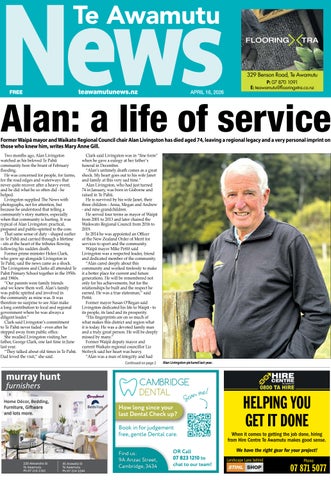

Alan: a life of service
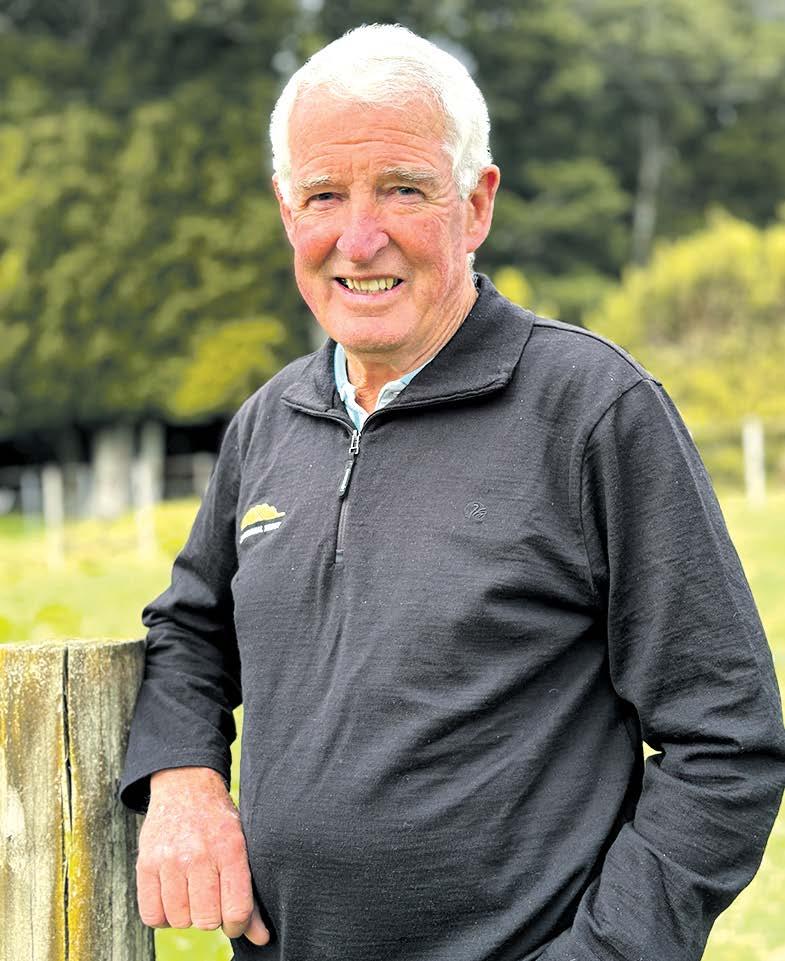
Former Waipā mayor and Waikato Regional Council chair Alan Livingston has died aged 74, leaving a regional legacy and a very personal imprint on those who knew him, writes Mary Anne Gill.
Two months ago, Alan Livingston watched as his beloved Te Pahū community bore the brunt of February flooding.
He was concerned for people, for farms, for the road edges and waterways that never quite recover after a heavy event, and he did what he so often did - he helped.
Livingston supplied The News with photographs, not for attention, but because he understood that telling a community’s story matters, especially when that community is hurting. It was typical of Alan Livingston: practical, prepared and public‑spirited to the core.
That same sense of duty - shaped earlier in Te Pahū and carried through a lifetime sits at the heart of the tributes flowing following his sudden death.
Former prime minister Helen Clark, who grew up alongside Livingston in Te Pahū, said the news came as a shock. The Livingstons and Clarks all attended Te Pahū Primary School together in the 1950s and 1960s.
“Our parents were family friends and we knew them well. Alan’s family was public spirited and involved in the community as mine was. It was therefore no surprise to see Alan make a long contribution to local and regional government where he was always a diligent leader.”
Clark said Livingston’s commitment to Te Pahū never faded even after he stepped away from public office.
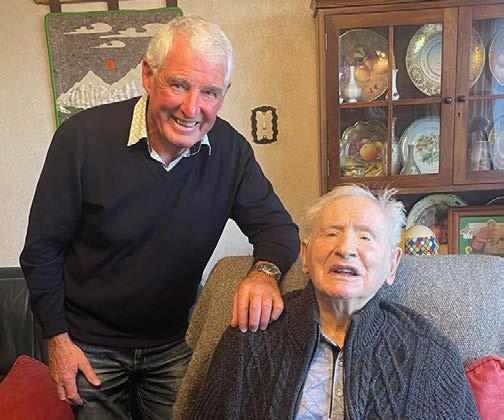
She recalled Livingston visiting her father, George Clark, one last time in June last year.
“They talked about old times in Te Pahū. Dad loved the visit,” she said.
Clark said Livingston was in “fine form” when he gave a eulogy at her father’s funeral in December.
“Alan’s untimely death comes as a great shock. My heart goes out to his wife Janet and family at this very sad time.”
Alan Livingston, who had just turned 74 in January, was born in Gisborne and raised in Te Pahū.
He is survived by his wife Janet, their three children Anna, Megan and Andrew and nine grandchildren.
He served four terms as mayor of Waipā from 2001 to 2013 and later chaired the Waikwato Regional Council from 2016 to 2019.
In 2014 he was appointed an Officer of the New Zealand Order of Merit for services to sport and the community.
Waipā mayor Mike Pettit said Livingston was a respected leader, friend and dedicated member of the community.
“Alan cared deeply about this community and worked tirelessly to make it a better place for current and future generations. He will be remembered not only for his achievements, but for the relationships he built and the respect he earned. He was a true statesman,” said Pettit.
Former mayor Susan O’Regan said Livingston dedicated his life to Waipā to its people, its land and its prosperity.
“His fingerprints are on so much of what makes this district and region what it is today. He was a devoted family man and a truly great person. He will be deeply missed by many.”
Former Waipā deputy mayor and current Waikato regional councillor Liz Stolwyk said her heart was heavy.
“Alan was a man of integrity and had
on









Continued
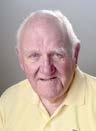
page 2 Alan Livingston pictured last year.
Te Awamutu based specialising in portraits, vintage scenes: using oils, acrylics, pencil. Portraits from photo or sittings,

Nicholas Bartosiak
Phone: 021 182 2470
Email: nick@nicklbe.co.nz
Proceeds from any sales, will be forwarded onto St John’s Ambulance.
CHANGE OF DEADLINES
30 APRIL 2026
ISSUE
RUN OF PAPER ADVERTISING
Booking & Copy Setting
Noon Thursday, 23 April
Finished Artwork
11am Tuesday, 28 April
CLASSIFIED ADVERTISING
Booking, Copy Setting & Payment
5pm Friday, 24 April
CONTACTS
News/Editorial
Roy Pilott editor@goodlocal.nz
027 450 0115
Mary Anne Gill maryanne@goodlocal.nz
021 705 213
Viv Posselt viv@goodlocal.nz
027 233 7686
Advertising Director
Janine Davy janine@goodlocal.nz
027 287 0005
Owner/Publisher
David Mackenzie david@goodlocal.nz
Office/Missed Deliveries
07 827 0005 admin@goodlocal.nz
a genuine commitment to people. His passing leaves a significant void.”
Livingston was a sheep and beef farmer on the northern slopes of Mt Pirongia for more than 30 years and a genuine environmentalist.
He did not just talk about protection but put legal and practical structures around it. He and his family protected bush on their own property with two QEII covenants, and in 2023 he was appointed chair of the Queen Elizabeth II National Trust.
That environmental commitment sat alongside deep governance experience across the region, including river and catchment work. It was simply part of how he lived.
But Te Pahū remained his anchor and his support continued long after politics.
His book, Te Pahū, A History, launched in 2021 after years of painstaking research, gave the community something rare - a record of itself, compiled carefully while those stories could still be collected. The launch drew people connected to the district, including Helen Clark who described it as “a major legacy to Te Pahū.”
As part of the broader Waikato West prevention team, I am regularly involved on event policing.
Last weekend I worked at the Night of Champions at Cambridge raceway. Overall, the attending crowd were well behaved and the races and subsequent concert went to plan.
On the subject of events, the Waipā Club Champs free liquor training will be held on April 20 at Hautapu rugby club rooms. Licensees and their staff are invited to attend. Contact Waipa District or local police for further information and to register.
The past week in Cambridge has felt like a certain television advert- cars, cars, cars! We have again had a spate of car thefts locally. Predominantly they are stolen for joy riding purposes, dumped and another nearby car stolen. If you come across vehicles parked oddly, or with the quarterlight smashed and ignition pulled, please phone 111 and let us know. This ensures forensic integrity is maintained and prevents it from being stolen again.
If you have insurance, giving authorisation for a forensic tow means we have a chance of identifying those offenders involved.
Still on the subject of cars, staff in Te Awamutu attended five crashes in the past week. Speed, distraction and intoxication

were found to be key contributing factors and where no seatbelts were worn, this worsened the injuries sustained.
Te Awamutu staff have also noticed that speeding has been on the increase in the lower speed zones. The 50kph zones are in place for a reason, usually due to more densely populated areas with higher pedestrian, cyclist and vehicle numbers. These factors all increase the potential for road trauma.
If you are caught speeding, you will not only receive a fine but also demerit points on your drivers' license. If you accrue over 100 demerits within a two year period, your licence will be suspended for three months. Suspension can have wider impacts beyond just you, including on family logistics. If you then choose to drive during the suspension period, you may face a vehicle impound and prosecution, the result of which will be an even longer disqualification from driving.
In other news, there were a few arrests in the past week. Cambridge Police caught a shoplifter who has been referred to Te Pae Oranga for alternative action. Te Awamutu staff arrested three people for warrants to arrest and breaching bail. They also caught a male wanted on multiple driving and drug charges. All have appeared in court accordingly
And that is perhaps the most fitting way to remember him: not only as a former mayor or regional council chair, but as someone who never stopped turning up for the place that raised him - with his time, his knowledge, his insistence on doing things properly, and his belief that communities thrive when people simply help.


SUBSCRIBE




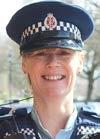
with Senior Constable DEB HANN
Te Pahū legends: Alan Livingston with George Clark in June last year. The former prime minister’s father died on 6 December 2025 aged 103.
Water woes
Waipā councillors held a behind closed doors workshop last week where they aired concerns about Waikato Waters and spiralling redundancy costs. The News understands the bill has exceeded the council’s budgeted costs for the company which begins operating under the Government’s Local Water Done Well policy on July 1.
New date
The installation of Sam Pullinger as vicar of St John’s Anglican Church in Te Awamutu will be held on Sunday afternoon. It was postponed last week as a precaution because of the presence of Cyclone Vaianu.
Policy on hold
The long-awaiting review of Waipā District Council’s eight-year-old Arts Policy has been deferred to next year due to competing organisational priorities. The policy sets out how council manages its public art, particularly art gifted to the council.
Whales harassed
The conservation department wants to identify people who were in several boats allegedly harassing a pod of orca in Raglan’s Whaiangaroa harbour last month. Waikato Operations Manager Niwha Jones says a witness contacted DOC after the March 23 incident. It is an offence to purposefully approach orca closer than 50 metres, or in a way that disturbs them.
Rates set
Waikato district councillors have approved a below inflation general rate increase of 2.8 per cent and a resulting average rate increase of 3.79 per cent.
Water works
Water was turned off to some parts of Te Awamutu for four hours last Thursday to enable maintenance work to be carried out on watermains.
Marae celebrates honours
By Roy Pilott
An Ōtorohanga marae was the scene of celebrations last weekend for a New Year’s honour bestowed on a University of Waikato professor.
And among those to pay tribute was Pirongia’s Dame Coral Shaw, who was also honoured in the King’s New Year list. Coral Shaw was one of seven knights and dames named. She became a Dame Companion of the New Zealand Order of Merit for services to public service, the judiciary and the community.
Tom Roa, who grew up in Ōtorohanga and has spent many years working at Waikato University’s campus in Hamilton, was named Companion of the New Zealand Order of Merit (CNZM) for his contribution to keeping te reo Māori alive – and growing.
Timing was significant for the event which attracted more than 200 supporters. Roa’s investiture in Wellington before governor general Dame Cindy Kiro was on Saturday morning. He was back at Ōtorohanga’s Tārewānga marae – adjacent to Ōtorohanga College before 3pm, and in time to hear dozens of mobile phones sound a warning about the pending arrival of former Cyclone Vaianu.
The Ngāti Maniapoto organised event was timed to finish at 7pm to ensure everyone could get home safely and before the weather turned.
Speakers included University of Waikato vice chancellor Neil Quigley, the chair of the Waikato mayoral forum and Hamilton Mayor Tim Macindoe, the chair of Waikato Tainui's executive arm, Te Arataura, Rahui Papa and, later over dinner, former Hamilton mayor Margaret Evans, Dame Coral, professor Sandy Morrison.
A history outlining the fight to keep te reo alive was presented by Māori language advocate Cathy Dewes.
Dame Coral, who chaired the Royal Commission of Inquiry into Historical Abuse in State Care and in the Care of Faith based Institutions from 2019 to 2024, and went to
Wellington a day earlier for her investiture, joked that she told officials: “you ain’t seen nothing yet – Tom Roa is coming tomorrow!”
The honours were the highest form of accolade for service – “your honour Tom, is being recognised by New Zealand as an individual. The King and the nation salute you.”
Rahui Papa said Tom Roa was an exemplar of fighting the good fight, and his time at Waikato University, where he is a professor in the Faculty of Māori and Indigenous Studies, was “a marriage made in heaven”.
Roa, speaking at the end of the event showed his mischievous side when he asked his audience if they knew why he had selected Tārewānga marae for the event over larger marae.
“How many of you did not know of the existence of this marae before now?” he asked. At the show of hands he said “that’s why”.
“Look at this humble place – so I thought, let’s bring the outstanding people of New Zealand to this humble marae so my hapu can see you, smell you, feel you and feed you - it’s called succession planning.”
Region escapes Vaianu’s fury
Cyclone Vaianu brought a decent amount of rain and blew a few trees over – but that was about the extent of it for Waipā and northern King Country.
For many residents who battened down the hatches in anticipation of major damage across the top half of the North Island on Sunday, the exercise at least prepared their properties for the winter months ahead.
In Waipā the district council reported minor and very localised impacts.
A fallen tree closed both lanes at Sainsbury Road in Pirongia, and there were isolated spots of minor surface ponding in Cambridge, Te Awamutu and along SH3.
About 100 homes were without power for a short time after a tree fell on power lines at Pickering Road, Hautapu.
“This occurred early on Sunday morning, approximately 5.30am, and was restored at approximately 10.30am,” Waipā Networks Customer and Community General Manager Anna Watson told The News. “Otherwise, we fortunately had very limited damage to our network from the storm and no major outages.”
It was the same story for Ōtorohanga and Waitomo district councils.
Ōtorohanga District Council reported Pirongia West Rd was partially closed through the bush section due to a slip and unsafe conditions over
approximately 3km. Part of Paewhenua Rd at Maihiihi was also closed as a precaution. Waitomo District Council general manager strategy and environment Alex Bell said the council did not have to deal with any damage from the cyclone.
In the western Bay of Plenty – where a state of emergency was declared ahead of the storm’s arrival - community emergency hubs were stood down on Monday.
At the same time Waka Kotahi said it expected to have most if not all state highways in the area reopened by the end of the day. Flooding, slips, and fallen trees kept roadworkers busy throughout Sunday.
Funeral Director: Teri Keir
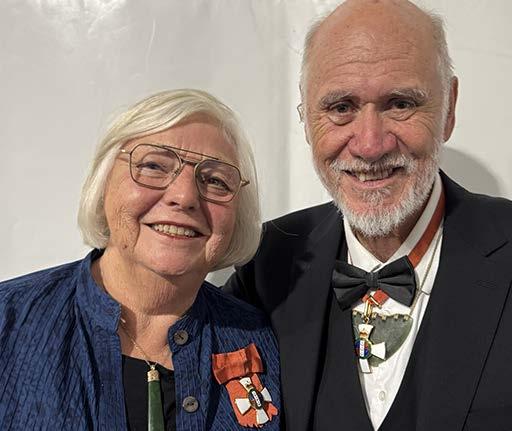
Coral Shaw and Tom Roa, pictured in Ōtorohanga on Saturday.
Photo: Roy Pilott
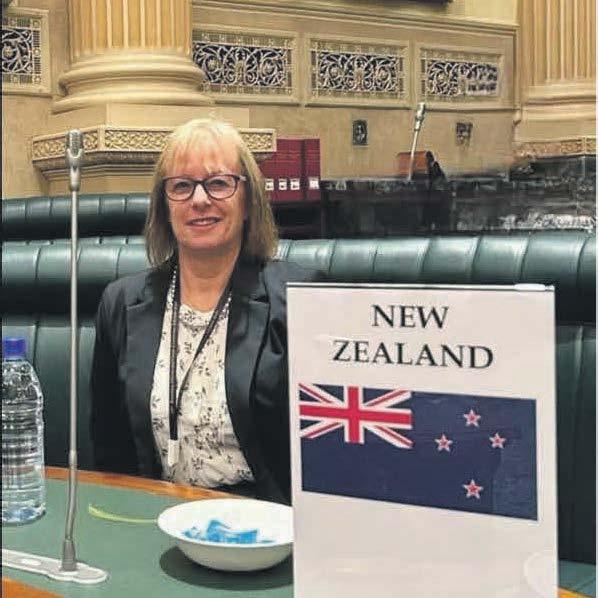
Oil Shock squeezes Kiwi farmers, but we adapt… again.
by Barbara Kuriger, MP for Taranaki-King Country
For New Zealand farmers, the Middle East oil crisis feels a long way from the woolshed or the milking shed — but its impacts are already turning up in monthly accounts. Higher fuel prices hit every part of the rural economy. From running tractors and irrigators, to trucking stock and carting feed, diesel and petrol are stitched into the cost of almost everything a farmer does. When the price of oil spikes, it doesn’t just show up at the pump. Freight costs rise, fertiliser and farm inputs become more expensive, and contractors have to pass on higher operating costs. For many farmers already squeezed by soft commodity prices and tighter bank lending, this adds yet another layer of pressure. It’s easy, in this environment, for frustration to turn into anxiety. But it’s worth keeping perspective. New Zealand farmers have weathered oil shocks, droughts, disease outbreaks, and market collapses before. Each time, the sector has adapted through efficiency gains, smarter use of technology, and working together at a community level.
There are practical steps farmers can take now: reviewing fuel contracts, coordinating freight with neighbours, cutting non-essential trips, and ensuring machinery runs efficiently. These won’t erase the impact of higher prices, but they can soften the blow and buy time.
Government has a role to play too, by providing targeted, temporary support that eases the immediate pressure on working families and rural communities without fuelling inflation or piling up unsustainable debt. Reckless, untargeted spending today risks even higher interest rates and input costs tomorrow.
We can’t control conflict in the Middle East or the global oil market. What we can control is how we respond: staying calm, backing good policy, supporting one another, and trusting that, as we have many times before, New Zealand farming will see this thing through.






ON SHAKY GROUND
After the storm
By Janine Krippner
As I write this, I am waiting with the rest of you to see how our North Island has fared through Cyclone Vaianu. Over the past few days, we have watched preparedness and response unfold in real time. Emergency declarations enabled faster action, evacuation calls were made ahead of the storm, and communities mobilised.
The fact that we can have days of warning with a storm like this is something that many of us may take for granted. Over decades, science has progressed rapidly. The understanding of our atmosphere and how weather systems progress, plus technological advancements to collect better data, allow meteorologists to forecast a range of what might happen.
Scientists can analyse vast, complex, and evolving systems, and build a picture of what may happen thousands of kilometres away. Amazing.
At home, we translate these forecasts into potential impacts. We work to understand where flooding may occur and where landslides are more likely, what infrastructure like roads or power networks may be affected, and who in our communities are vulnerable and need assistance. The hazards, built environment, and life, all interacting as we go. There are many moving parts that must come together to enable an effective response.
As an event approaches, uncertainty decreases and we can act with a clearer idea of what we are facing. Crucially, we do not wait for certainty to jump into action. That would be too late. Instead, we can prepare for the worst with a good old practical attitude and hope for the best.
If all goes well, strong preparation makes an event appear

less severe than expected. If we are lucky, a storm may reduce in intensity, or a slight shift takes it further offshore. If we are lucky and well prepared, people can joke about ‘the great storm of 2026’ with pictures of plastic chairs tipped over rather than images of loss, devastation, and mourning.
Ideally, every event strengthens our ability to respond. We reflect on what worked, where we can improve, and where vulnerabilities and gaps remain. Preferably we do this without unhelpful blame. Natural events will always bring surprises, and there will always be more to learn.
What we see publicly is only a fraction of the work that happens behind the scenes to ensure we are as prepared and supported as possible, with the abilities and resources that we have. Communities and individuals – us – are part of this system; we are not powerless.
Preparedness at an individual level matters.
Taking personal responsibility and acting on guidance helps us understand what readiness looks and feels like before the worst case scenario does occur. Ideally, many of us have just strengthened our emergency supplies and are now better prepared for the future.
We will experience disasters with little or no warning in our future. When we do have advance notice, even if the outcome is less severe than it may have been, it is a valuable and significant opportunity to improve our preparedness before we desperately need it.
My deep gratitude and respect go to everyone who worked to prepare our communities for this event. Thank you.
FAITH IN WAIPĀ
Where there is hope
By Reverend Samuel Pullenger – St John’s parish
The world seems to have become a dark and gloomy place over the last half a decade. We were confronted by a global pandemic that shut the World down. We have seen senseless wars begin that destroy the lives of ordinary people, while those world “leaders” sit back and cast blame. In our little country we have experienced life altering storms that leave the country reeling, while our gas prices hike to unprecedented highs, and food prices continue to soar. We saw the impact of this anxiety inducing state in little old Te Awamutu as groceries flew off the shelves last week as we hunkered down expecting the worst from Cyclone Vaianu. For many of us, it can look like the world is becoming more of a dark and gloomy place.
This gloom is only increased through social media and instant information sharing; we are inundated with images and stories of the things going on all over the world. In some ways this can be helpful, as we are able to prepare for what is coming, or even respond quickly to an unexpected event that unfolds before us. However, what we also need to remind ourselves of is the way that social media focuses on creating negative feelings of anger and stress in order to elicit a response; a share, a like, a comment or click. These responses are what continue to bring in revenue for tech companies. So, while they get rich, we become more isolated and anxiety filled. The gloom grows.
In the Church calendar we are in a time called Eastertide. Eastertide is the time between Jesus’ resurrection from the dead

and Pentecost (when the Holy Spirit was given to empower all believers). This is the longest lasting “festival” in the Church calendar, and for good reason. The resurrection of Jesus and Pentecost declare to all the world that Jesus has conquered death (including what we might call the gloom or darkness) inviting us all into a new life empowered by the Holy Spirit. Strangely, for the disciples of Jesus, this was a time when Jesus was no longer with the disciples and the Holy Spirit had not come yet. It could feel like a time of isolation, but what we see is that this time was a time of closeness among the followers of Jesus. They ate together, prayed together and waited together. There was a strong sense of Hope.
What also strikes me as particularly poignant, is that the gloom of the world did not stop after Jesus’ resurrection, rather by gathering together and then by the empowering of the Spirit, people were able to support each other through whatever came. In a time of great stress and anxiety, hope enabled people to live with and care for each other. As we look around Te Awamutu and see the financial strain on many families, the stress of weather events and the isolation of social media interactions, may we be drawn to hope.
Not just to look for the “good” in every situation, but to become a part of the good that enables others to get through the gloom.
Dollar deal yet to take off
By Mary Anne Gill
Te Awamutu and Kihikihi bus users have been slower to jump on board a locally enhanced public transport service, even as passenger numbers across the wider Waipā and Waikato network continue to grow.
While Cambridge has seen increasing use of its $1 bus service between Leamington and the town’s CBD, similar enthusiasm has yet to fully emerge in Te Awamutu and neighbouring Kihikihi.
The Te Awamutu-Kihikihi service did reach a new high last month, recording 15,921 passengers. However, residents have been slower to embrace the benefits of an additional shorter stop between the
two towns.
The News follows Waikato Regional Council bus statistics each month and the latest figures show several services trending upwards, including the busy CambridgeHamilton route, which recorded a record 18,403 passengers in March.
Other satellite services from Tauwhare and Tamahere Mātangi are also showing positive growth.
Not all routes, however, are performing as well. The South Waikato Connector, which runs daily from Tokoroa through Cambridge, along with a Te Kūiti Connector option, will come under councillors’ scrutiny as the council looks for ways to keep rates increases down.
A dedicated Tokoroa circuit option continues to be well supported.
Passenger numbers also lifted last month on the Taumarunui service, established in 2020 to provide safe and reliable transport for patients travelling to Te Kūiti and Waikato hospitals for specialist appointments.
Despite the increase, Waikato Regional Council and Health NZ have agreed the combined public and health service will end in June.
The 277 passengers recorded last month were up from 166 in February, but still below the record 325 set in May last year.
Council transport chair Angela Strange said the Health NZ‑funded
40‑seat bus was not well suited to people with health needs.
“At the same time, there were safety concerns and other challenges associated with the mix of public users and health service passengers,” she said.
“To respond to the patient voice and ensure a safe, sustainable and fit‑for‑purpose service, Health NZ will move to a dedicated health shuttle model and end its contribution to the current joint service.”
Waikato Regional Council will not run an alternative public replacement once the health shuttle begins in July.
See: When foresight pays off, page 6
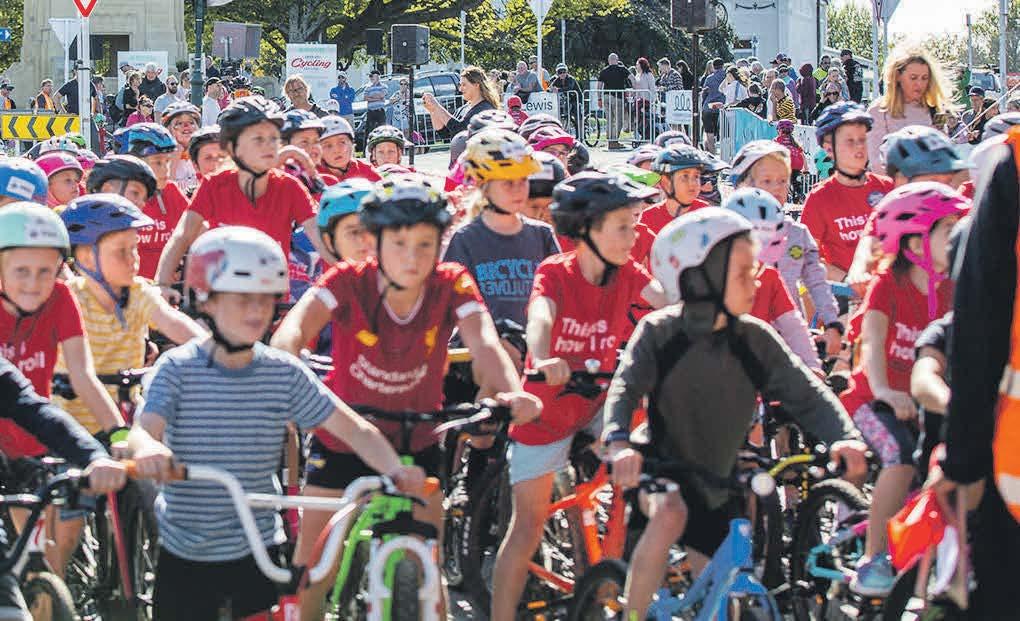
Sanding on track
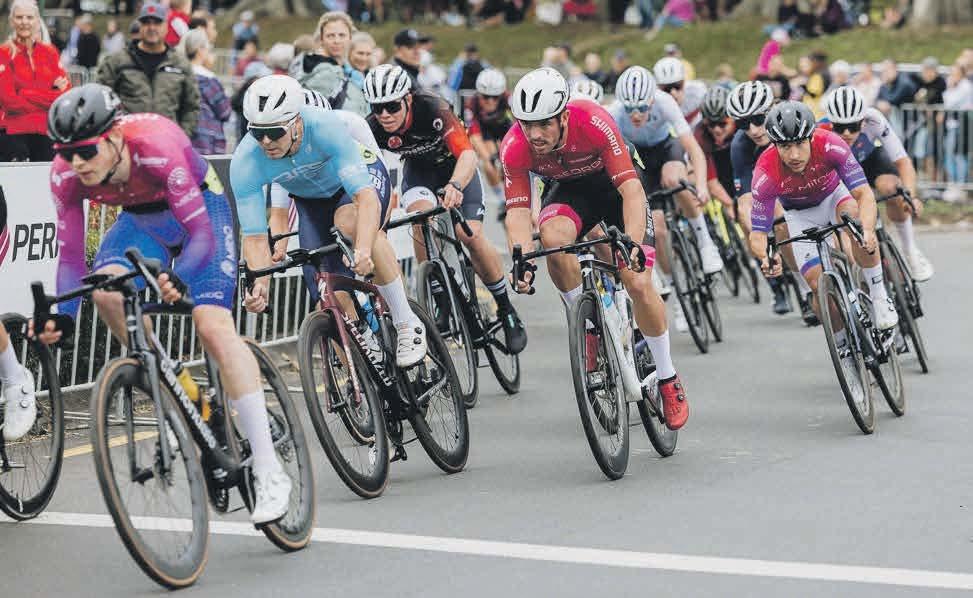
A two-week project to sand the Grassroots Trust Velodrome track has just passed the halfway point.
The work to rejuvenate the track surface will ensure it maintains its UCI Category A status and world-class riding conditions.
Th Cambridge velodrome has supported highperformance and community cycling for over a decade. Maintenance work will include replacing sections of the track where required, removing build up, restoring grip and keeping the riding surface safe in condition for high performance events.
The timing of the work has been coordinated alongside Cycling New Zealand riding and racing commitments and between Olympic and Paralympic cycles.
“After years of use, sanding and cleaning will significantly improve the riding surface and extend the life of the track,” head of track and programmes at the velodrome Craig Rodger said.
Late this year the New Zealand Sports Hall of Fame will be moved north from Dunedin to be accommodated in the velodrome, which is already the home of Cycling New Zealand.




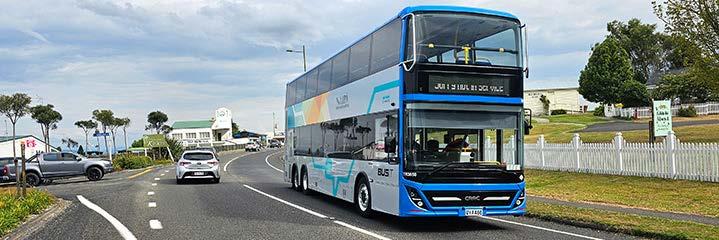
The double decker bus leaves Kihikihi for Te Awamutu and onto Hamilton.
Photo: Mary Anne Gill
By Peter Carr
As I look out of my office window pondering our good fortune the muchneeded rain gently falls onto the barren earth. This without the much trumpeted ex cyclone – now downgraded to a tropical storm. The spiralling centre of it now appears to be tracking to the east across the Bay of Plenty and on a course towards the Chatham Islands.
The reason I mention this near miss is one of both relief and thanks. The former being obvious – we have scored a relieving point. But we have been superbly led with a multitude of cautions (local and national) which have manifest themself in this house with the garden furniture now snug, dry and happy in the garage.
Which brings me to council (especially Waipā District Council) pronouncements by way of updates on a number of fronts including the recent major effect of water on the western side of the district at Pirongia. The Facebook (and no doubt other) updates from WDC – including mayor Mike gaining the award for Communicator of the Year –have been exemplary. This time round we have gained a regular and open avenue of visually provided information with the mayor’s clear and concise tones ensuring that all who need to know can rest easy, safe in the knowledge that ‘we are working on it’ pronouncements are being maintained. This naturally results in an expectation that this avenue of clear and up-to-date information will continue, and it is pleasing to note that both mayor Mike and deputy Jo are also reporting to the camera with soundbites informing on weighty matters from around the big table in Te Awamutu. It is easy to ‘slag’ a council – any council.
And for some time over recent years WDC has been a bit sleepy in this open information area. But we are looking forward, and want to share the ride, with the elected councillors and Chief Executive Steph O’Sullivan’s hard working team.
I am sure we will hear over the next few days that the weather officials over reacted. Sadly, we have a good number of residents devoid of anything worthwhile to do but criticise. Well during my maritime studies many years ago – and living, later, through cyclones / hurricanes / typhoons on seas with terrifying strengths – we always acknowledged never to take an oncoming, rapidly circulating, water sucking storm lightly. The maritime term ‘batten down the hatches’ is very apt here.
Having seen – on more than one occasion - Northland, Coromandel and Tairawhiti areas devastated beyond sensible and easy repair bear witness to the requirement for over-caution rather than resulting drowned stock and homeless people.
Yet caution sometimes appears to go too far. I understand that there is an international agreement that airplanes with more than 90 passengers flying internally within the country must be supplemented with security systems. Which possibly explains why my plane to Christchurch last week was graced - pre-boarding - with seven vigilant security staff and two, armed, lady police officers.
While the chances of some lunatic hellbent on airborne destruction should not be on a plane with 89 passengers begs the question – why 90?
When foresight pays off
By Mary Anne Gill
There are moments when a council decision, debated and doubted at the time, suddenly looks very smart indeed. Waikato Regional Council’s move to electric buses is one of them.
As households and businesses brace themselves against volatile fuel prices, the sight of quiet, zero-emission buses gliding through Cambridge, Te Awamutu and Kihikihi feels less like an environmental gesture and more like practical common sense.
Credit where it is due.
Back in mid‑2023, when the regional council confirmed the Cambridge (Route 20) and Te Awamutu (Route 24) services would transition from diesel to electric, the headlines focused on emissions and sustainability. But the decision was always about resilience as much as climate ambition. Two of the region’s busiest routes were identified early as suitable for electrification, supported by new depots, charging infrastructure and a more frequent timetable.
That planning began to pay off in April 2024, when Waikato’s first electric bus fleet officially took over Waipā services.
Six new electric buses replaced diesel vehicles, doubling weekday services and increasing weekend frequency, while covering some of the longest public transport distances in the country. Each bus typically travels between 350 and 500 kilometres a day, well beyond the national average, proof that electric buses are no longer just short-hop city toys.
What matters now, as fuel prices bite, is that these buses are not tethered to the rollercoaster of global oil markets.
They are charged overnight, off‑peak, at dedicated depots in Leamington and Kihikihi,
and batteries take two to four hours to fully recharge. While diesel operators watch pump prices climb, Waikato’s electric fleet gets on with the job.

That did not happen by accident.
Waipā District Council deserves recognition for quietly doing the unglamorous but essential work of making land available for depots and charging infrastructure. Without those long-term leases and local co-operation, the electric transition simply would not have been possible. The council’s support enabled new charging facilities on Waipā land, ensuring buses could be reliably charged and ready each day.
Too often, district councils are remembered for the things they say no to. In this case, Waipā said yes, and the region is better for it.
The buses themselves represent a step change in passenger experience.
Electric buses are quieter, smoother and more comfortable than their diesel predecessors, with benefits for passengers and for people living and working along the routes.
Reduced noise, no exhaust fumes and a more civilised ride make public transport more attractive, reflected in rising patronage since service frequencies increased.
None of this is to pretend the decision was easy. Waikato Regional Council has been upfront about the challenges: charging infrastructure, route length, battery capacity and timetable co-ordination all required careful planning. Electric buses cannot simply be dropped into a diesel system and expected to work.
The councils got it right. Now let’s support their decision.



















Sheridan brings global insight
Pirongia based dairy leader Jo Sheridan put international experience into
annual open day, where she spoke to Mary Anne Gill.
Fresh from a tour of United States dairy farms, Jo Sheridan was on home ground on Saturday, translating global experience into practical farming conversation.
Sheridan - last year’s Fonterra Dairy Woman of the Year - was at the centre of the action as record numbers poured into Owl Farm, part of St Peter’s School Cambridge, where she is demonstration manager.
By late morning, between 700 and 800 people had passed through the gates - the largest crowd the demonstration farm has
ever hosted.
Visitors came to walk paddocks, talk cows, ask questions and see how theory plays out in practice. For Sheridan, it was an opportunity to demonstrate the systems thinking she has gained internationally and how it applies under New Zealand conditions.
Beside her, three-year-old labrador Emjay Sheridan, fast becoming one of the farm’s most photographed residents, soaked up the attention
That international experience underpinned discussions throughout the day, particularly as Sheridan reflected on a season she described as “chalk and cheese” compared with the one before.
“We’ll be about 30,000 kilograms ahead of last season,” she said, gesturing toward paddocks still holding plenty of feed.
“That’s just due to really good rainfall and a lovely summer.
"Last year we were right in the middle of a drought. It was tough,” she says.
The difference shows. Grass cover remains strong, cows are in good condition and the system has shifted to once-a-day milking as the end of the season approaches.
Heifers start calving in late June, the main herd on July 1, and the last cows are expected to leave the shed by about May 10.
Owl Farm will milk about 317 cows next season, down from around 360 this year, but production is still expected to be more than 25 per cent higher, likely finishing above 160,000 kilograms of milk solids.
With Fonterra’s planned capital return to shareholders following the sale of its global consumer businesses, attention is turning to infrastructure at Owl Farm.
The cowshed is 47 years old.
“One of our priorities is how we
future-proof it,” Sheridan says.
“We want to put that money into productive outcomes.”
On a day when record numbers turned up to see how the system works, that focus felt timely.

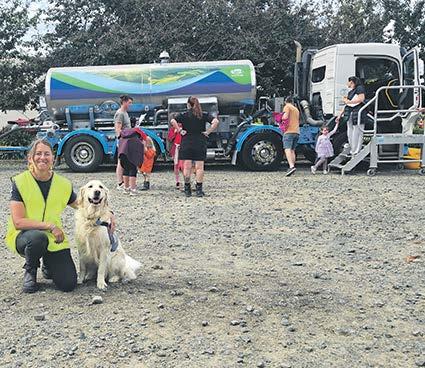
Demonstration manager Jo Sheridan with farm hostess Emay, a three-year-old labrador.
Photo: Mary Anne Gill
Scooped up by a tractor’s front-end loader were, from left Emily 5, Fergus 6 months and Melody, 7, Meerkerk of Roto-o-Rangi.
Photo: Mary Anne Gill
Roigard, Eti star in almanack
By Jesse Wood
Two Waipā players have featured in the respected Rugby Almanack’s five players of the year and five promising players of the year for 2025 – and both are St Peter’s School, Cambridge alumni.
The 2026 almanack named Karāpiro raised All Black Cam Roigard, 25, as one of the players of the year – he was also named among the 2023 quintet.
Ōtorohanga raised Hautapu lock Dylan Eti, 20, was crowned a promising player.
To qualify for consideration as a promising player of the year, players are usually in their début season at first class level or first full season.
In recent years, Austin Anderson (Te Awamutu Sports) and Ollie Norris (St Peter’s and Hautapu) have also made promising players of the year lists.
The Rugby Almanack was first published in 1935 and is now edited by Adrian Hill, Cambell Burnes and
John Lea.
The annual publication summarises the previous year’s rugby season in New Zealand –reviewing Heartland, FPC, NPC, Super Rugby Pacific, international, sevens and more.
The Rugby Almanack blurb explained Eti’s special first year in first class rugby.
Eti was not named in the initial Waikato NPC squad, but following injuries to Laghlan McWhannell and James Tucker, the 2m 115kg lock was brought into the squad.
“He took his opportunity well and played for the rest of the season, apart from missing the last match due to injury, and completed the year with a wider training group contract with the Chiefs for 2026.
He had started 2025 with a second appearance at the Super Rugby U20 tournament at Taupō for the Chiefs and earned selection for the New Zealand U20 team at the Rugby Championship tournament in South
Africa.
Eti was born in Hamilton in 2005, was educated at St Mary's Catholic School, Ōtorohanga and represented the King Country Roller Mills team in 2017 18.
He enrolled at Ōtorohanga College in 2019 and spent 2020 and 2021 in the first XV before going on to St Peter's School, Cambridge. There he played in the first XV and was selected in the Waikato U14, U16 and U18 teams.
After leaving school in 2024 he joined the Hautapu club and went straight into their premier team and played for the Chiefs U20 team at the Super Rugby tournament at Taupō.
“At the end of the year he was rewarded with a national development contract to train with the Chiefs for 2025.”
Eti said he didn’t know he had been selected – “but it’s awesome to be making a name for me and my family in the rugby community… I love being a full time rugby player as a job.”

Waipā influence in Aupiki
By Jesse Wood
The 2026 Super Rugby Aupiki competition will again be rich with Waipā connections and talent.
The fifth edition of the New Zealand women’s franchised tournament will begin on June 13.
A total of 118 players have been named across the four teams the North Island trio of the nib Blues, Chiefs Manawa and Hurricanes Poua as well as South Island based Matatū.
As they celebrate 140 years, Kihikihi Rugby Sports Club can boast having Chyna Hohepa (15 Manawa caps), Mia Anderson (15 caps) and Kiriana Nolan (seven caps) in the Chiefs Manawa squad.
Kihikihi’s Carla Hohepa is also assistant coach for the side.
The Hohepa sisters are Te Awamutu College alumni, as is Carla’s fellow Manawa assistant coach Nathan White.
Te Awamutu College has quite the cohort of alumni in the Chiefs staff, as men’s head coach Jono Gibbes is also a TAC old boy.
The versatile Kaea Nepia, niece of former Hautapu and Chiefs legend Liam Messam, has arrived at the Manawa after seven games with Matatū last year. She can play at 10 or 15 and has been a big asset to Waikato in the NPC.
Cambridge High School alumna and Fiji lock Jade Coates is also in the Manawa squad, while ex CHS student Keelah Bodle has been called to the Wellingtonbased Hurricanes Poua alongside former Chiefs Manawa Renee Holmes and Krystal Murray.
COMFY CARE
Officially named as a hybrid player, 22 year old Bodle will hope to get some more game time at super level after making her Chiefs Manawa début last season.
“It's awesome [seeing her named in the Poua squad]. She's played in a few teams now Canterbury FPC and Waikato FPC last year,” Keelah’s mum, former Black Fern and Black Ferns sevens player Annaleah “Anna” Bodle said.
“She’s quite used to making new friends and settling into teams well. I'm stoked that she's going to have a chance to play with Poua.”
Keelah is training with the Black Ferns Sevens team and will join the Poua at the end of May.
“It’s great. It's best environment Kee has ever trained in. She'll come out a whole lot faster. She can jump on the wing or anywhere in the backs and she loves being a loosie and a lock, if needed. She's got a bit of everything,” Anna said.
“She played all her rugby at little Cambridge High and I coached her through there.
“We weren't the biggest team, but we were definitely hard workers and had a lot of grit and determination. It's been awesome seeing her moving on to higher honours.”
Keelah spent three years playing club rugby at the University of Canterbury while studying. Last year she returned home and represented Hautapu.
“Dan and I are incredibly proud of her. All the hard work that she puts in doesn't go unnoticed,” Anna said.
“We see behind the scenes what goes on and it's just a really proud mum and dad moment to see her out there.”
Enjoy welcoming, comfy surroundings and a warm sense of belonging at our Resthaven on Burns Care Centre.
• We are a community charitable trust providing quality, affordable care for seniors.
• Our caring team are here to help you enjoy the things you love, whether it is gardening, baking, trips to town, hobbies, or simply a quiet afternoon relaxing.
• Our commitment to affordability means there is no premium daily room charge at Resthaven on Burns.





Dylan Eti took every opportunity at club, NPC, Super Rugby under-20 and international under-20 level in 2025. Photo: Matt Gould
Mia Anderson Kiriana Nolan
Chyna Hohepa
Jade Coates
Thursday, April 16, 2026



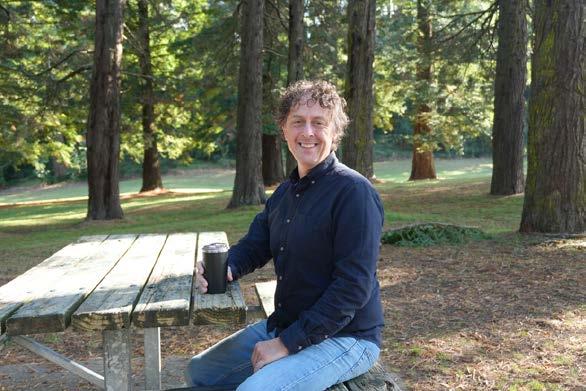
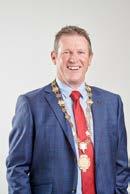
With decades of experience delivering major infrastructure projects around the world, Councillor Aidhean Camson brought a global perspective to local government when he was elected to Waipā District Council last year
Since stepping into the role, he says he’s gained a deeper appreciation for the work behind the scenes
“It ’s easy from the outside to underestimate the level of work happening across Council to do the right thing for the community,” he says
Aidhean notes that while it can be tempting for councillors to focus on operational detail, the role is really about keeping an eye on the bigger picture and making decisions that support the district long-term
“Resources are limited, so it ’s important we prioritise carefully and focus on what will make the biggest difference The criticism councils sometimes face can overlook the reality that staff are working in a very constrained environment ”
As deputy chair of the Service Delivery Committee, Aidhean is particularly focused on progress with the Cambridge Connections programme this coming year
“It ’s a really important piece of work, it ’s a major transport programme that will shape how people move around Cambridge in the future
“Establishing a clear path forward is incredibly important It forms the backbone for many

other pieces of work across the district ”
He’s also looking forward to working through government reforms and beginning work on the next Long Term Plan
“It will be a challenging process, but also a rewarding one as we align our plans with the commitments we’ve made to the community ”
Originally from Scotland, Aidhean studied computer science in north-east England before moving to London, where he met his wife from New Zealand The couple have two children, and their careers took the family around the world, including time in the United States and Germany
When the family settled in Cambridge in 2024, Aidhean decided that after years working internationally, it was time to give back to the community
“When the local elections came around, I felt I had something useful to offer locally, drawing on the experience I’d gained through my career ”
Aidhean and his family enjoys what the district offers, from visiting the Cambridge Farmers’ Market, to exploring the local trails and cafés
“It ’s a very friendly community, easy to get around, and there’s always something happening - it s a great place to raise a family
I’m grateful to play a small part in shaping the future of this district and the wider community ”



and
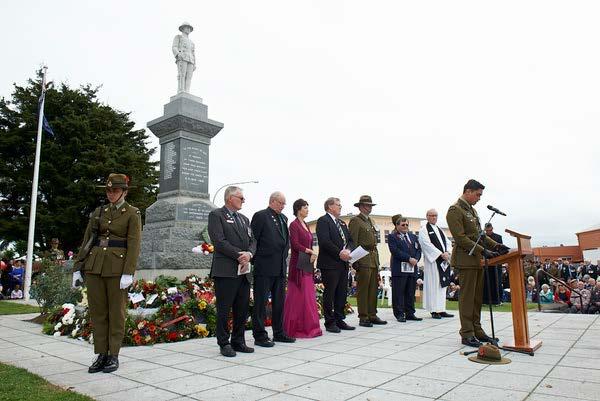
Services on Sunday, April 19
Pukeatua Memorial service: 11am
Pukeatua War Memorial Church, Arapuni Road
Services on Saturday, April 25
Te Awamutu Dawn service: 6am Sunken cross at Te Awamutu War Memorial Park, Mutu Street
Returned service members will parade outside the RSA Clubroom, 381 Alexandra Street at 5 45am
Light refreshments will be served at the RSA Clubrooms after the service
Flag raising ceremony: 7 45am Te Awamutu Cemetery, Piquet Hill Road
Veterans and public invited
Civic Commemorative Service: 11am Memorial Park, Anzac Green, Teasdale Street
Returned service members and those who would like to parade, meet at 10 45am at the RSA Clubrooms, 381
Alexandra Street
The RSA clubrooms will be open for members, returned guests and affiliated clubs from 1pm Kihikihi
Memorial service: 8 30am
War Memorial Hall, Lyon Street (State Highway 3)
Ōhaupō
Memorial service: 11am
Ōhaupō Memorial Hall, Great South Road
Followed by light refreshments


Tokanui
Memorial service: 1 30pm
Tokanui Cemetery 96 Farm Road
Cambridge
Dawn service: 6am (gather at 5 45am)
Cambridge Town Hall, Victoria Street
Civic Commemorative Service: 9am
Cambridge Town Hall, Victoria Street
Returned service members and those who would like to parade, meet outside Onyx Restaurant at 8 30am
Pirongia
Dawn service: 6am
Pirongia Memorial Hall, Franklin Street
Returned service members and those who would like to parade, meet in the Five Stags carpark at 5 45am
Followed by light refreshments
Kāwhia
Memorial service: 1pm War Memorial, Pouewe Street
Returned service members and those who would like to parade, meet at the KāwhiaTown Hall, Jervois Street at 12 45pm

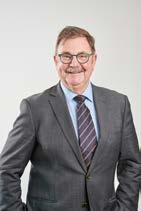

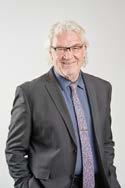
Aidhean Camson: Turning global experience into local action
Waipā residents
visitors are invited to come together to attend Anzac Day commemorative services across the district
Mike Pettit Mayor Jo Davies-Colley Deputy Mayor
Roger Gordon Aidhean Camson Pip Kempthorne
Clare St Pierre Les Bennett
Shane Walsh Dean Taylor
Marcus Gower Mike Montgomerie Dale-Maree Morgan
Anzac Day services

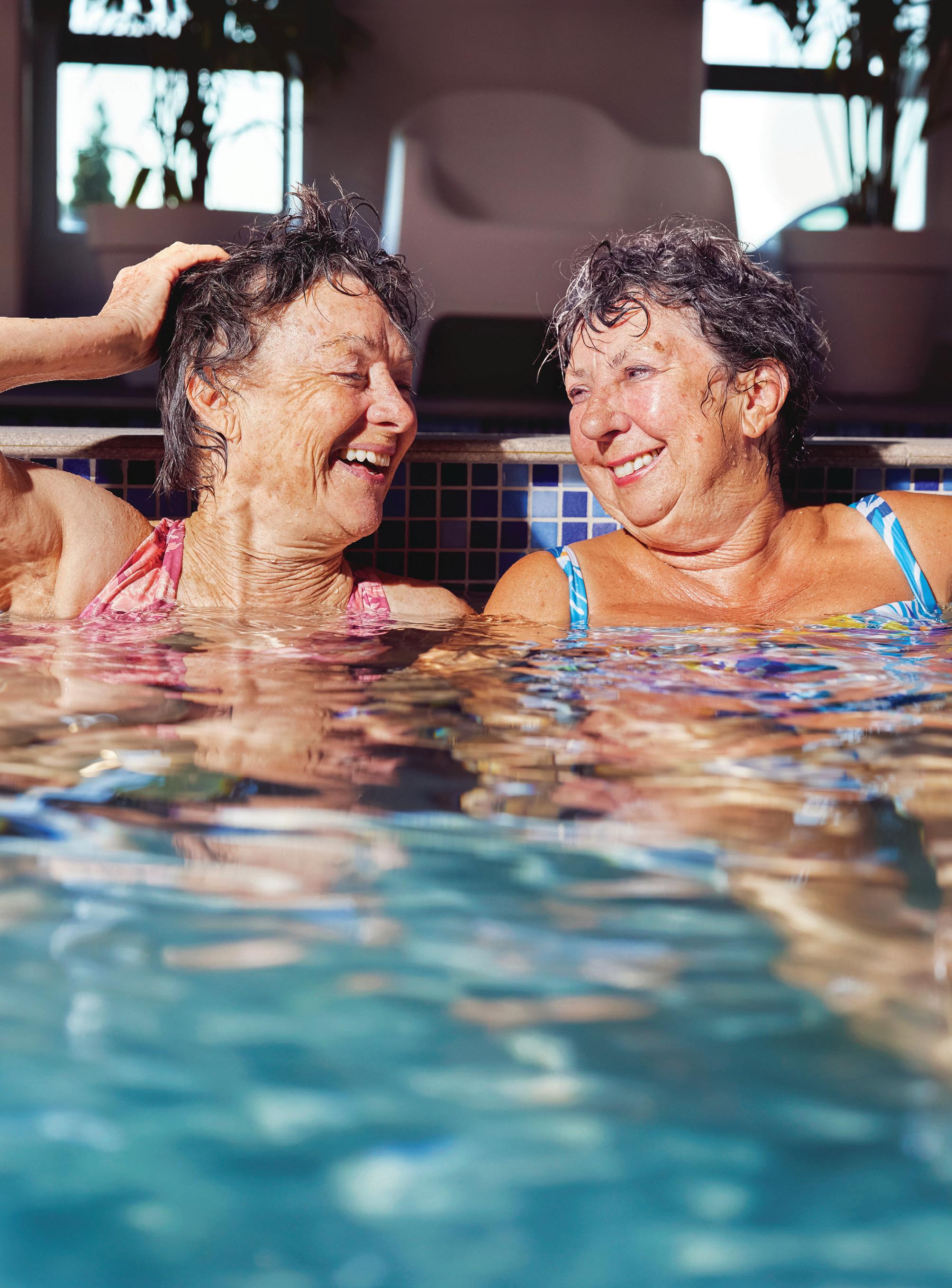
Dear diary, the spa pool might be our new best friend

Love the resort-style feeling.
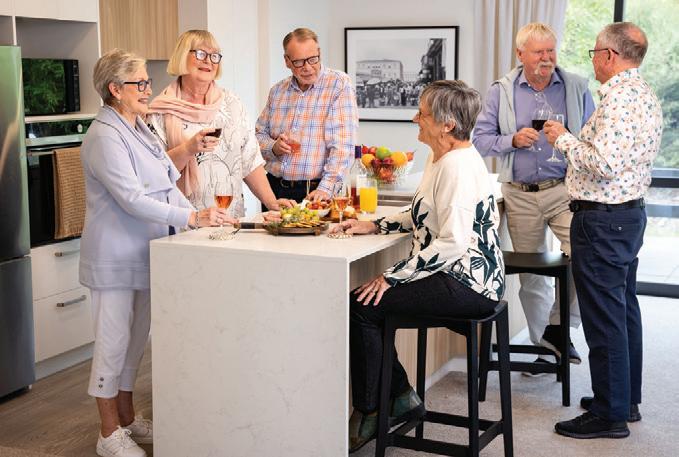
Imagine a place where you can feel completely at home, but always on holiday. Where the day’s itinerary could include a round of croquet, relaxing in the spa, and a cappuccino in the café. It’s time you chose the kind of life you deserve at Summerset Cambridge. Love the life you choose.

07 839 9482 summerset.co. nz/cambridge

Summerset Cambridge Weekly Walk-in Wednesdays
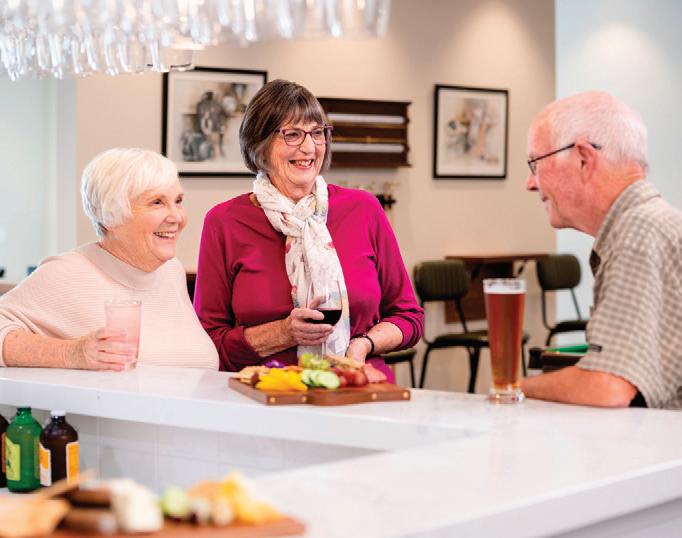
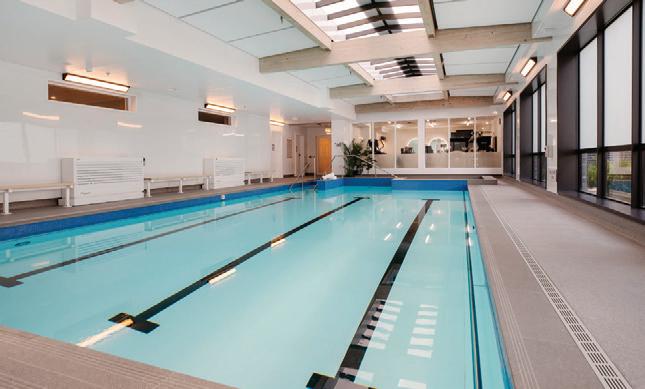
Summerset Cambridge offers a relaxing, resort-style retirement in a vibrant and growing village. The grand village centre is now open and residents have been loving their resort-style facilities, from an indoor pool to a café, residents’ bar and hair salon.
There are a range of homes ready to move into right now, from villas and cottages, to serviced apartments and care suites. Two-bedroom homes start from just $638,000 with flexible pricing options available.*
We know that moving to a retirement village is a big decision. So why not come along to one of our Walk-in Wednesdays every week this April. See for yourself why our residents love the Summerset life.
Love the life you choose.
Weekly Walk-in Wednesdays
Every Wednesday in April, 10am - 2pm
Summerset Cambridge 1 Mary Ann Drive, Cambridge 07 839 9482 | summerset.co.nz/cambridge




At Te Awamutu Funeral Services our dedicated team is passionate about providing valuable guidance and a personalised service at a time when you need it most. - Offering Generations of Experience -

CHAPEL & CATERING FACILITIES • PREPLANNED FUNERALS • THE FUNERAL TRUST PREPAID PLAN • HEADSTONES & BRONZE PLAQUES
Down
2. Enmity (3,4) 3. Boiled or scrambled? (3)
4. Means of approach (6) 5. Otherwise (6) 6. Capitulate (9) 7. Prize (5) 12. Daily TV drama series (4,5)
16. Permit (7) 17. Carpenter (colloq) (6) 18. Of the mind (6) 20. Damp (5) 24. Decay (3)
CHEST
CTMALTPHDZYITBOEQD KUCANISTERSNNLRPVD TPPDCTDIKSARCFCIOD ILAFAUAMNLTASTERCT XEEEUYPEPGNZISERHT LEMARLBSFFBUMCSGIO BSERVICESNCONTIJNW GREENELRWSOAAHREAE KBREAKSOIRDRKRIEVL TASTINGBSPOONEDKES BAGS BEEF BERRY BISCUIT
ROSES RUSSIAN SAGE SENNA SERVICES SETS
SHOP
SPOON TABLE
TASTER TASTING THINGS
TIME TOWELS TRAYS TREE

Pollination keeps bees working
A Waikato beekeeping couple is keeping their operation viable by prioritising pollination over honey
When Waikato beekeeper Celso Baldo compares early honey yields with today’s output, the scale of change is stark.
“From the 21 hives we started with, we got two drums of honey,” he said.
“Now, we cannot get even a single drum.”
Like many in the industry, Celso and wife Maria have watched varroa mites, rising competition and shrinking returns force a rethink of how they keep their beekeeping business viable.
The couple started their business, Marcel and Sons Honey, around 15 years ago.
They were well-trained for the task, both in their home country of the Philippines and here in New Zealand.
Celso, who is a forester by profession, had worked for the Philippines’ Department of Agriculture. His interest in bees began when he was working on a three-year beekeeping project funded by the European community.
Later, after meeting environmental planning graduate Maria through work, he took a job with a queen breeding farm in Queensland. Maria joined him for his second season there before the couple took up an opportunity in New Zealand.
They spent four years beekeeping in Galatea, adding to their apiculture skillset through Telford Rural Polytechnic. Celso completed a Certificate in Apiculture Knowledge and Maria a Certificate in Queen Bee Rearing Knowledge. When they moved to the Waikato, they worked for a Hamiltonbased commercial beekeeper and soon began their own operation just outside Cambridge.
A recent report from the Bioeconomy Science Institute estimated that almost 13 per cent of the country’s roughly half a million bee colonies were lost last winter. Those who took part in the study attributed most of the losses to the varroa mite
parasite, known to seriously weaken or destroy entire colonies.
Celso agrees and said the persistence of the varroa mite is worsened by its growing resistance to counter measures.
Also impacting home-based producers like the Baldos is the increased number of beekeepers who came on stream after a Covid-related ban on the importation of honey products prompted a surge in local operators, all competing for the same nectar sources.
Celso and Maria value their wellestablished links to farmers and orchardists in this area, so while they now live in Putāruru - where they purchased a housethey still work the business from here and hold down jobs as healthcare assistants at Cambridge Resthaven.
Their youngest son Barry has two more years to go at Cambridge High School, and his older brother Paulo, has just graduated in engineering from Waikato University.
“Our hives are still here. We now focus more on the pollination side than on the production of honey and its by-products,” she says.
Celso said without the pollination side of the operation, it would be difficult to keep the business going. Their intimate knowledge of bees helps them focus on sourcing the best queens, ones in hives that are clean, productive and in which the bees are non-aggressive.
The Baldos’ story is one of migrants making good. The couple has always valued education and have made the most of every opportunity to expand their own and encourage the spread of knowledge about bees.
During the Covid lockdown, they took further qualifications in dementia care through a government-funded programme.

By then, they had already compiled their ‘World of Bees’ presentation, which includes the safe showcasing of an observation hive with live bees, basic beekeeping gear and equipment, the showing of a video on kiwifruit pollination prepared by their sons and open discussion on bees and their importance in the ecosystem. They launched that in 2019, taking it to local rest homes. It was stopped during the Covid pandemic but resumed in 2023 to an expanded list of aged-care facilities across Cambridge, Putāruru, Hamilton and Huntly.
They also make themselves available to give their ‘World of Bees’ presentation to schools and other groups.
“Promoting education is our advocacy,” says Celso.
“Even though our business is small, we are committed to promoting beekeeping education and awareness to the community.”
Their message, they say, is simple: healthy hives, informed communities, and pollination services remain critical to the region’s farming future.
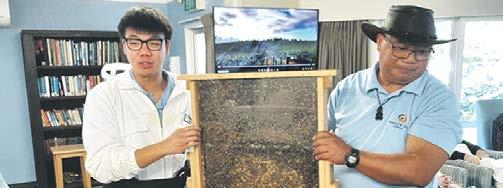


production, writes Viv Posselt.
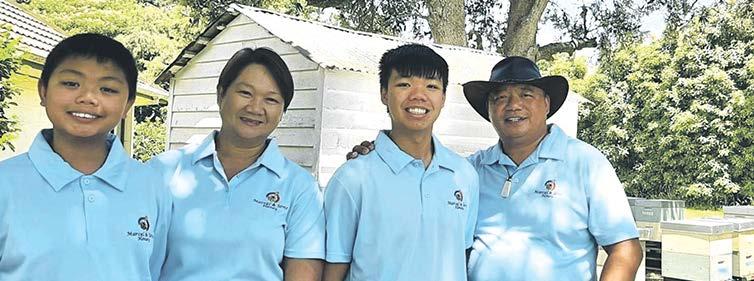
Maria and Celso Baldo, pictured with their sons Barry and Paolo, with some of their hives in Cambridge.
Sons Barry and Paulo have a sound working knowledge of their parents’ bee operation. Here, Paulo and Celso work together during a presentation at an aged-care centre.
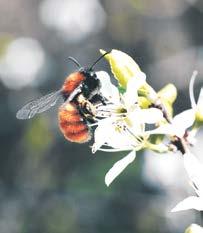
Close up of a bee on a flower.
Photo: Thijs van der Weide, pexels.com
Backing the next generation
A farming student from Waotu, a rural community southeast of Ōtorohanga, has been recognised as an emerging leader in New Zealand’s sheep and beef sector.
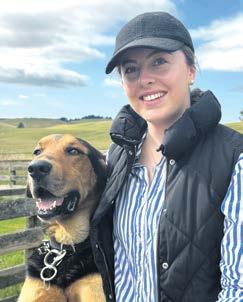
Penny Ranger (Ngāti Raukawa) is one of 10 recipients of the inaugural 2026 Beef + Lamb New Zealand (B+LNZ) Agricultural Student Scholarship, an award supporting the next generation of people entering the red meat sector.
The scholarship provides $1500 to students who have successfully completed at least one year of agricultural-related tertiary study at institutions including Lincoln University, Massey University, Otago University and Telford.
Waotu sits on the eastern edge of the King Country, bordered by the Waikato River at Lake Arapuni, and is surrounded by high-producing rolling farmland supporting dairy, sheep and beef operations.
Growing up in the area, where she was raised on a sheep and beef farm, helped
shape her interest in agriculture and its future.
She is currently studying a Bachelor of Commerce (Agriculture) at Lincoln University, combining her interest in practical farming systems with business and financial management.
“I’m passionate about agriculture and business, and this course allows me to combine the two,” she said.
“It gives a well-rounded understanding of farm systems alongside the financial side of the industry.”
As part of the scholarship programme, recipients also take part in a structured mentorship with senior industry leaders, designed to build professional capability, real-world insight and sector connections.
National extension programme manager Olivia Weatherburn said the programme was an important investment in the long-term future of the sheep and beef sector.
“We were blown away by both the quality
Balancing rates and risk
One of the main workstreams since my last report was to complete our annual plan. While it looked as though there would be a rates’ increase of 3.4%, a lot of work and careful decisions, has seen this figure land at an annual rate rise of 1.4%. That is a total budget of a little over $157 million. Before the final meeting, whereby the full council grant sign-off, sub committees do a lot of work on their respective budgets.
The more conservative increase was managed by scrutinising where surpluses currently existed, or where we were able to draw on reserves.
Regional transport and catchment management are the two big ticket items, at around 65% of the budget. The Te Huia commuter train to Auckland has been given one more year of trial, to see if it can improve both
and quantity of applications,” she said.
“This year’s recipients show real passion, determination and a genuine desire to make a positive impact in our industry.”
Ranger hopes the scholarship will help her gain deeper insight into the red meat sector and strengthen industry connections as she plans her career.
Her current ambition is to pursue a graduate role within agribusiness banking or the meat processing sector, with the long-term goal of contributing to a resilient and productive farming industry.
Outside her studies, Ranger remains closely connected to farm life and is also the founder of a small business, Mark It Drench Gun, a Kiwi-designed attachment that integrates with drench guns to allow accurate, single-handed animal marking.
In 2024, while in her final year of school, she was named Young Innovator of the Year at the National Fieldays Innovation Awards. – additional reporting Mary Anne Gill
By Garry Reymer, Waipā-King Country regional councillor
passenger numbers and fare box recovery, currently at about 18% of running costs. Catchment management is the other very important area of responsibility for the council. The recent flood events have brought this home to the people of Waipā and King Country. For a long time, we thought that floods, slips and road closures only happened in the Coromandel. We need to be sure that we budget well to make



certain our infrastructure is fit for purpose, and we can handle what nature throws at us. A discussion we need to have is: what level of protection are we willing to fund? To build stop banks for the more regular but less extreme events, is less of a financial burden than building to the protection levels for a 1 in 200-year event. The difference can be billions of dollars as we saw with the Cook Strait ferry debacle. I don’t believe

any council or government can ever give its citizens a guarantee that they will be fully protected from natural disasters. However, we have a responsibility to deliver quality infrastructure to a level and price that ratepayers can afford. This is done by ensuring that we invest wisely on things that produce tangible results. I feel that as a council, the best investment is to focus on the effects of climate (climate change protection) rather than climate change prevention. To do the latter is somewhat futile, as despite our best efforts to reduce emissions in our regions, the global nature of this challenge means our investment would have a negligible impact on improving our position.














Penny Ranger hopes her scholarship helps her gain deeper insight into the red meat sector.
Season tests contractors
The two Fs – flooding and fuel - have been tough on agricultural contractors this year, writes Jesse Wood.
It wasn’t the rain itself that caused the biggest headache this season, but what came afterwards.
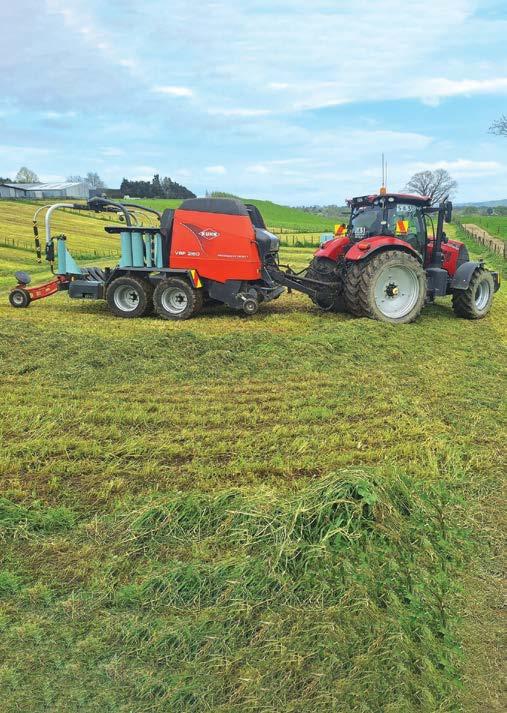
Weeks of delayed planting and growth stacked the season against contractors, with maize crops maturing at the same time and compressing the harvest window into a flat-out race against the clock.
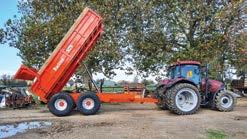
For two long-established agricultural contracting businesses, the compressed timing quickly translated into pressure, long hours and rapid adjustment - conditions familiar to Reymer Ag operations manager Daniel Reymer.
While Pirongia and Ōtorohanga were the main affected areas in the February flooding, it had an impact right across the board in King Country and Waipā.
The flooding delayed the start of harvest by two weeks.
Most years Reymer Ag start harvesting mid-February and are finished by Easter. When you are harvesting 750-hectares of maize, the sooner the season can start, the better.
“This year on March 15, no one really wanted to harvest. It got to March 18 and everyone was ready to go. It’s probably the flow on effect from the wet spring,” Reymer says.
“We didn't plant until mid to late October or even early November due to rainfall. Everything went in, in such a short period.
“Then all the maize started to be ready in such a confined period. So
getting it off turned into a flat-out ordeal.”
The early maize crops were ready two weeks late and the crops planted later in the season “were bang on time”.
“It really condensed the harvesting season. We were running night shifts for two weeks straight basically, running the harvester 24/7 to try and keep on top of things.”
Reymer Ag covers about a 50km radius - as far north as Te Kōwhai, down to Ōtorohanga, across to Cambridge and out to Kāwhia.
“We’re pretty well set up to cover most weather conditions. We've got enough tractors set up on duals,” says Daniel.
“For the hill country, you’ve got the weight of the machines to worry about. You have to load the trailers right to climb hills. We have to use chains every now and again, but you try to avoid that.
“After that February 14 rain, it was pretty dry for about a whole month so we were lucky to get the harvest started.
“But all the crops were so used to a wet summer, I don't think they put their roots down far to find the water.
“As soon as it stopped raining, the growth came to a halt pretty quick.”
The Reymers are a large family and several are capable of driving tractors.
They’ve had to call in several cousins to help get through the long nights.
“Most seasons we have a few excess staff during maize. We’ve averaged about 14 staff this season,” says Daniel.
“We’re slightly understaffed by one or two. We’ve had a few ring-ins, but that’s been a good thing. We had a few farmers help us out, driving on their own farms.”
Reymer Ag also lost some work due to flooding. The maize crops didn’t survive, including 11 hectares of their own.
“There's another flow on effect too. We've had to find the same amount of area of maize to fill our contracts.”
Further south on Kio Kio Station Rd, John Clark Contracting’s yards and workshop were hit by the flooding of Mangaorongo Stream.
John Clark Contracting is also family owned and operated.
John, Julie, their son Matt and his partner Amy King work in the day-today operations.
Thanks to insurance, Giltrap AgriZone and Waikato Tractors and the hard work of their staff, they’re back to full capability.
“It was intense. It's more compounded by the fact that we've got so many young families around us and beside us that are more seriously affected,” says Julie Clark.
“There are nine houses in the area affected down there. There have been children displaced out of their homes.
“It was pretty devastating, walking through it the first day. It was gut




wrenching to see the damage.”
But it’s the silt that has done more damage than the water.
The force of the flooding was still evident weeks later, with some equipment swept away entirely.
“There’s only one item that we haven't yet located, but I suspect it’s at the bottom of the river,” says Clark.
“We’re impacted by what happens at Maihiihi because the stream comes from out there. A lot of slips went into the stream, so it became dirty and silty,” she says.
Quite a few maize crops in the area have been affected with silt contamination, at some properties the water and silt went up over the top of the cob. Some farmers have chosen to harvest the crop and stack it separately. Others will mulch it into the ground, depending on the severity of the contamination.
On a positive note, it’s been a great growing season compared to the previous year, with good grass growth and maize yields.
“Farmers are positive with the payout and Fonterra’s payout that's coming through. Diesel prices, that's not so nice. But like most businesses, we have had to activate the fuel surcharge. It’s not really what you want to do, but it is necessary and hopefully short term.”
There has been a good run of weather since the harvesting season started. The few days of rain were counteracted with late nights of work
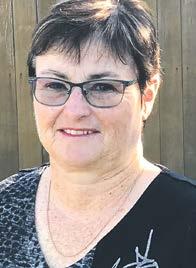
Julie Clark
“There’s only one item that we haven't yet located, but I suspect it’s at the bottom of the river.”
beforehand.
As the maize season winds down, the long nights have eased, harvesters are slowing and contractors are taking stock of a demanding few months. Flooding and fuel costs may have tested operations, but support from staff, farmers and neighbours ensured the work kept moving. It’s a familiar story across the King Country and Waipā - when pressure mounts, rural communities step in, roll up their sleeves and get on with it.
•
•
• Results guaranteed
• Results guaranteed
•
•
•
• Fully automated
•
•
•
•
•
•
•
•
•


To share and share alike
Monday 30 March**
It was just another Monday when Simon entered his law office, eager for a comforting cup of tea. He shrugged off his suit jacket and hung it up while waiting for his computer to wake up. As he prepared his tea, the phone rang. Reception informed him that someone was there to see him urgently, without an appointment. Reluctantly putting down his cup, Simon went downstairs to meet John, who appeared flustered.
“I’m joining an engineering business, and it all has to be finalised by tomorrow for tax reasons. I’ve already signed the paperwork and was going to hand it over, but Jane insisted I see you first,” John explained.
Simon led John to an office and reviewed the documents. John was set to join two others in a company taking over from a current owner, with a deadline of 31 March. Quickly returning to his own office, collecting his favourite pen, and ignoring his cold tea, he came back to an increasingly eager client. “We’re all good to go, right? Can I just pay and get on with it?”
Simon placed the documents down, took a deep breath, and replied, “John, there are some important things to consider first:
1. **Due Diligence**: How well do you know your business partners? Do they have industry experience and a good reputation? Are they financially stable enough to support the company if needed?
2. **Shareholder Agreement**: It’s crucial for you and the other owners to sign an agreement outlining expectations, financial commitments, decision-making processes, and a timeframe during which no one can withdraw without offering their shares to the others.”
John’s eyes widened. “Thanks for this. I’ll discuss it with the others, I won’t sign anything, and I will come back to see you shortly.”
After waving John goodbye, Simon poured himself a cup of tea, knowing this was not the end of the story. He reflected on how often aspiring entrepreneurs rushed into joint ventures without fully understanding the implications. He took a comforting sip of his warm tea, realising that preparation and due diligence were vital in avoiding future pitfalls. As the day progressed, Simon remained vigilant, anticipating John’s return and hoping he would heed the advice given. In business, a moment’s haste could lead to years of regret.
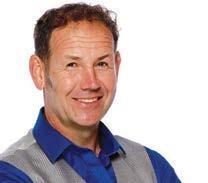
Simon Brdanovic


Briefs…
Leadership in focus
Two Taranaki farmers – LeAnne Blakelock and Rachel Short – and Hinehou Timuti, general manager at Te Tawa Kaiti Lands Trust in the Bay of Plenty are finalists for the Dairy Woman of the Year award. The award, run by Dairy Women’s Network in partnership with Fonterra, recognises women who are making a tangible contribution to dairying through leadership, innovation and service to their communities.
Paying off
New Zealand dairy farmers are making more informed, strategic breeding decisions, and it’s paying off. CRV managing director James Smallwood says the industry is finally seeing the lift in herd genetic gain it has been pushing for, driven by greater use of genomic young sires and a shift toward breeding replacements only from the best cows.
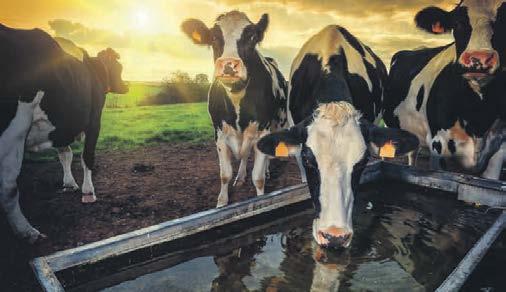
They celebrate practical, on-the-ground efforts that support biodiversity, strengthen land resilience, and deliver enduring environmental and economic benefits.
Farm purchased Braden and Brigitte Barnes have taken the leap into farm ownership to purchase their first farm after being one of three recipients last year of the inaugural Fonterra and ASB First Farm award at the New Zealand Dairy Industry awards last year. The couple have bought a 200ha grazing block in Sheffield, Canterbury, with an existing consent to convert to dairy. The couple – who got up to $1 million of ASB
Business Term Lending fixed at 1% per annum for three years, along with a Fonterra launch package that includes $20,000 of Farm Source account credit to drive productivity and sustainability,
mentoring, and additional support to help them successfully transition into ownership - plans to convert, milk 600650 cows, and supply Fonterra in the next 18 months.
Research grants
Seven of the Bioeconomy Science Institute Maiangi Taiao’s research programmes – spanning its land, plant, food and forestry scientific areas – have each received $350,000 in the latest Rangapū Rangahau round of the He Ara Whakahihiko Capability Fund. The Rangapū Rangahau Fund supports collaborative, two-year projects aimed at building Māori research capability and durable partnerships between Māori-facing organisations and the wider science, innovation and technology (SI&T) system – with a focus on economic and environmental outcomes.




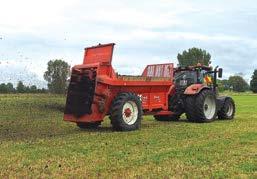
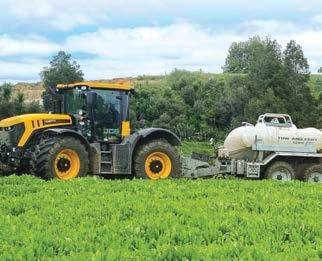
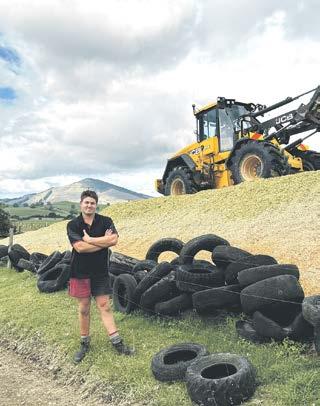
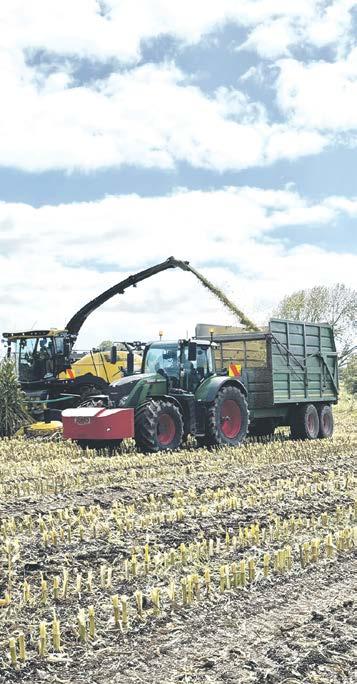
Filling up: John Clark, on the tractor, and son Matthew Clark harvests maize while the rain holds off. Photo: Jesse Wood.
Daniel Reymer inspects a maize stack during a busy season.
Photo: Jesse Wood
Matthew Clark at the chopper controls.
Photo: Jesse Wood

Beyond soy sauce with
Jan Bilton
Sambal oeleck, Vietnamese mint, hoisin sauce, sesame oil — just a few of the tantalising Asian flavours that are available from your supermarket, greengrocer or Asian food store. All add interest to everyday meals without busting the budget.
Vietnamese Mint — also called hot mint or laksa leaf— is not actually a member of the mint family. It grows easily in the garden and, if planted in a sunny, sheltered position, will keep producing its fragrant, long, pointy, red-stained leaves during winter. Add — in moderation — to fresh rice-paper spring rolls, soups (such as laksa), stir-fries, rice dishes, and vegetable and fruit salads.
Hoisin sauce is a reddish-brown, sweet, sticky sauce made from fermented soybeans, plums, garlic and spices. Chinese in origin, it is now often fused into Western recipes. Great with meats and fish, in stir-fries and rice and in dressings.
Makrut leaves (once commonly called kaffir lime leaves) look like two leaves joined and have a distinctive fragrance that enhances stocks, sauces and even desserts. They can be used whole or after discarding the central rib, very finely julienned.
Sambal oelek is a mixture of diced chillies, salt and vinegar. It is excellent in stir-fries or served as an accompaniment.
CHICKEN LAKSA
120g rice stick noodles
1 tablespoon canola oil
60g packet (3-4 tablespoons) Singapore laksa spice paste
1 1/2 cups chicken stock
400g can light coconut milk
300g skinned and boned chicken breast, thinly sliced
1 makrut (kaffir) lime leaf, julienned
1/2 cup each: loosely packed Vietnamese mint leaves, coriander leaves

Topping: 1 carrot, julienned and blanched
1 cup bean sprouts or snow pea sprouts
4 lime wedges
Vietnamese mint and coriander leaves to garnish Cook the noodles according to the instructions on the pack. Heat the oil in a saucepan and stir in the spice paste. Add the chicken stock and coconut milk and bring to the boil. Simmer for 5 minutes. Add the chicken and makrut lime leaf. Poach for 3-4 minutes. Add the Vietnamese mint and coriander.
Place the drained noodles in four deep serving bowls. Add the chicken mixture then the topping. Serves 4.
HOISIN
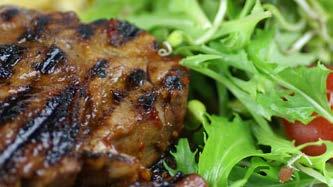
LAMB CUTLETS
5 tablespoons hoisin sauce
2 tablespoons each: canola oil, lemon or orange juice 1-2 teaspoons sambal oeleck or similar
3 large cloves garlic, crushed 8 large lamb cutlets or chops
Whisk the hoisin sauce, oil, juice, sambal oelek and garlic in a bowl. Brush lightly over the cutlets. Stand for 30 minutes.
Preheat a grill or barbecue. Cook the lamb for about 4






minutes on each side for medium-rare, brushing with the remaining marinade after 6 minutes. Serves 4.
SESAME OYSTER BEEF
Although sesame oil is usually added to dishes at the end for flavour, here it makes a great rub for barbecue meat. Rump steak could also be grilled this way, but with a little less cooking.
Oyster sauce is a thick brown sauce made by simmering oysters in soy sauce and brine.
2 tablespoons sesame oil
2 x 3cm-thick sirloin steaks
freshly ground black pepper to taste
2 tablespoons oyster sauce
Rub the sesame oil into the beef. Season with the black pepper.
Cook on the barbecue or under a very hot grill for about 3 minutes on each side for medium-rare. Cover and stand for 3-4 minutes.
Transfer to a chopping board and cut into 3cm slices crosswise. Arrange the meat on a platter and drizzle with the oyster sauce. Serves 4.




Chicken Laksa Hoisin Lamb Cutlets






















HEIFER/COW. Grazing
Available. Te Kuiti area. Please phone or txt Alan 021 088 02383
for Sale – BMW E46 2004 Coupe. Manual. 100,000km. Imported UK 2021. Offers 027 496 55 99
Awamutu
Theatre AGM 7:30pm Wednesday 22nd April Corner of Vaile and Palmer Streets All welcome
ARE YOU INTERESTED IN KIHIKIHI’s HERITAGE?
The Kihikihi Police House and Temple Cottage
the
for more information.
12 insertions etc. chosen
A conversation about Death to help you live more fully 11am next Tuesday 20 August 2024
A conversation about Death to help you live more fully 11am Tuesday 21 April 2026

Parish of St John’s Lounge 162 Arawata St Te Awamutu
Parish of St John’s Lounge
162 Arawata St Te Awamutu
ALL WELCOME
ALL WELCOME
No cost, but koha welcome
No cost, but koha welcome


NOTICE OF TEMPORARY ROAD CLOSURE



– from Bank Street to Vaile Street
There will be no detours in place during the temporary road closures. During the period of closure, provision will be made for emergency services.
Steph O’Sullivan Chief Executive



LAMMAS, Pamela Joan –20.10.1937 - 7.4.2026. Pam passed away peacefully at Windsor Court Home and Hospital, Ohaupo. Dearly loved wife of the late Ken. Loved Mum and mother-inlaw to Lindsay and Helen, Janet and Nigel, the late Heather and Norm, Julie and Kevin, Kenny and Jules, and Vicky and Neil. Adored Nana and great-nana to all her grandchildren and greatgrandchildren whom she loved dearly.
‘Rest Now Mum. Lovely memories will last forever’ A private cremation has been held. All communications to the Lammas family, c/- P O Box 137, Te Awamutu 3840.



THOMPSON, Robin Alexander (Scoobie) –
Passed away with his dear wife Susan at his side, after a long illness, at Waikato Hospital on Thursday, 9th April 2026, aged 86 years. Much loved husband of Susan and treasured father of Daniel. True to his nature, Scoobie was a no-fuss man. He left this world quietly, with only his immediate family by his side, just as he wished. Messages to the Thompson family may be sent c/- 262 Ohaupo Road, Te Awamutu 3800, or left in Robin (Scoobie’s) online tribute book at www.rosetown. co.nz

Kihikihi


TERMS AND CONDITIONS
Copy deadline for ad-make up is noon Friday prior to publication day. Booking and Copy deadlines for Waikato Business News and Bay of Plenty Business News is on request. Advertiser is responsible to advise us of any copy changes before proofing
anything not signed o by this
ad prints as per the
proof sent. Advertising supplied in completed form (finished
to
If the number of insertions chosen is not
then a bulk charge will be applied at the end/cancellation of your schedule based on correct rate reflective of the number of ads published e.g. if you have chosen the 12 insertion rate and only publish 6 insertions, the bulk charge will be the di erence in price between the 6 insertion rate and 12 insertion rate multiplied by the number of ads published. You pay the rate reflective of the number of ads you published.
or camera ready), deadline is Tuesday 11am prior to publication day. Public holiday weeks, all deadlines move forward one working day. Cancellation deadline is one week prior to publication. If cancellations are received after the cancellation deadline, then full charge applies. All other publications and products see separate booking and deadline sheet. Advertising setting incurs a production fee of $50 + GST for up to two proofs, further changes will incur additional production fees. Advertising copy set by Good Local Media Ltd is the property of Good Local Media Ltd and for use in Good Local Media Ltd publications only. If used elsewhere charges will apply, pricing available on request. If supplied ready to print, copy is owned by the advertiser. Publication day is Thursday for urban deliveries and Friday morning for rural deliveries. Acceptance of advertising and free productions services is at the discretion of the publisher. Acceptance of advertising for publication and free productions services is at the discretion of the publisher.
high resolution PDFs as the ad file format exported using the compatibility setting: Acrobat 4 (PDF 1.3). Please do not use/include overprint. Ideally, 10pt is the standard point size; however, in some cases with bold fonts 9pt can be used, depending on background. Black text should be 100% black[k]. All artwork submitted needs a border. Specifications for photos and logos – CMYK, high resolution jpeg (minimum 200dpi) pdf attachments. If finished artwork ready to print (Camera Ready) provided does not meet our technical requirements, your advert will be technically fixed, a technical report will be provided, and a $50 + GST production fee will be incurred. No proof will be sent as no design changes will be made.
File formats: We will not accept PDFs created from Word, Excel, Publisher, PowerPoint, Photoshop, and Canva. However, we can copy your design and proof for your approval. Any artwork received in these formats must adhere to the copy setting deadline as they are not finished artwork or technically compatible to newspaper printing specifications.
LIMITATION OF LIABILITY
Good Local Media Limited (including its employees, o cers, or agents) shall not be liable for a failure or breach arising from anything beyond their reasonable control e.g. an act of God, fire, earthquake, strike, explosion, or electrical supply failure, unavoidable accident or machine breakdown; and shall not be liable in tort, contract, or otherwise for loss of any kind (whether indirect loss, loss