Farmer King Country
THURSDAY OCTOBER 15, 2026
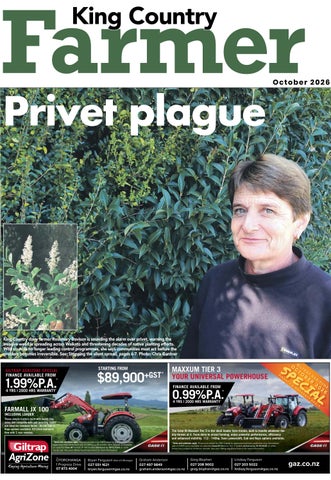
Privet plague
King Country dairy farmer Rosemary Davison is sounding the alarm over privet, warning the invasive weed is spreading across Waikato and threatening decades of native planting efforts. With councils no longer leading control programmes, she says communities must act before the problem becomes irreversible. See: Stopping the silent spread, pages 6-7. Photo: Chris Gardner
_
OTOROHANGA 1 Progress Drive 07 873 4004
King Country Farmer | 1
October 2026
2 |
King Country Farmer
lamb bain laubscher law yers
Areas of Practice
• Asset protection • Commercial law including sale & purchase of businesses • Commercial leases • Company law • Conveyancing Rural, residential & subdivisions • Estate planning • Rural law • Trust law • Wills & estate administration • Wind farming 127 Rora Street, PO Box 412, Te Kūiti, 3941 P 07 878 1011 W www.lbllaw.co.nz E sam@lbllaw.co.nz • katie@lbllaw.co.nz
• Quality, professional advice to farmers and businesses • Expert taxation and business structure planning • Family trust management • Friendly, personalised service Contact us for a
FREE NO OBLIGATION INTERVIEW
to discuss your financial requirements
www.baileyingham.co.nz 18 Maniapoto St, Ōtorohanga 07 873 7325 97 Sloane St, Te Awamutu 07 870 1888 29 Hakiaha St, Taumarunui 07 895 7312 info@baileyingham.co.nz
THURSDAY OCTOBER 15, 2026
Fields of lavender Mere mention of the word retirement sends farmer Roger Pratt, 78, scrambling for a shovel, paint brush, hammer and nails, wheelbarrow … anything to keep busy. “I can’t sit down. I’ve got to be doing something,” he says. “Once you start looking at retirement you start doing nothing, and that’s not good for you.” Pratt might just agree with author Ernest Hemingway, who reckoned retirement was the filthiest word in the language. “To retire from what you do – and makes you what you are – is to back up into the grave,” wrote Hemingway. Pratt and wife Judy took over Alphra Lavender on Brotherhood Rd near Kihikihi after leaving their Northland bull-breeding operation. Over six years the couple have transformed the property into a thriving lavender business, with about 10,000 plants, an on-site shop and a steady stream of visitors each summer. “It had been run down, just limping along,” he said. “I did with it what I’ve been doing all my life, buying rundown properties and making improvements before selling
them.” He and Judy took it over after farming near Kaikohe, where they bred Friesian bulls. “They are fast growing but they are like babies – they need specialist feeding and rearing.” The bulls, not the lavender. Around 40% of the twohectare Te Awamutu property is planted in the evergreen, said to be a member of the mint family. The flowers are distilled into pure lavender oil – Pratts’ last yield produced 45 litres. “Some lavender is ideal for dried flower arrangements; some has culinary uses; some is better for oil. We turn all our lavender into oil.” The plant flowers once a year, a harvest season that runs from December 15 to the first week of February. Popular theory has it that there are three types of lavender: English, Spanish, and a Hybrid. “No,” says Roger, “there are more than 300 types. No point in going too deep into it. A woman on a tour group bus here said it best, that you can’t define where lavender comes from. “People say it’s from England or France, or here and there, and it’s this variety or that variety, but the woman said it came from
Roy Pilott 027 450 0115 Mary Anne Gill 021 705 213 Viv Posselt 027 233 7686 Chris Gardner 027 231 7007 Dan Tasker 021 544 615
Federated Farmers is urging all political parties to support 10 national farming standards to reduce red tape and create consistent rules across New Zealand. The organisation welcomed Act’s commitment to the proposal, saying streamlined regulations for activities such as water storage, drain maintenance and solar installations would lower costs for farmers and consumers.
maryanne@goodlocal.nz viv@goodlocal.nz
Vet boost
chris@goodlocal.nz
The Government will fund 15 extra domestic veterinary science places at Massey University each year, increasing the annual intake from 125 to 140 from 2027. A $6 million grant will help offset reduced international student revenue, with the move aimed at strengthening New Zealand’s future veterinary workforce.
Advertising Director
janine@goodlocal.nz
Owner/Publisher David Mackenzie
Water storage
david@goodlocal.nz
Office/Missed Deliveries 07 827 0005
admin@goodlocal.nz
Readers’ contributions of articles and letters are welcome. Publication of contributions are entirely at the discretion of editorial staff and may be edited. Contributions will only be considered for publication when accompanied by the author’s full name, residential address, and telephone number. Opinions expressed are not necessarily those of the publishers. The King Country Farmer is published by Good Local Media Ltd and is distributed to the wider northern King Country area.
2025. He’s spotted a property on a couple of acres near Te Awamutu he quite likes. So you might finally retire? “No! I’ll find something to keep me busy. I’ve done all sorts of things. I can build anything, I’m a keen gardener … I’m not going to be sitting still.” Alastair Sloane
Farming rules
editor@goodlocal.nz
Janine Davy 027 287 0005
the world and could have come from anywhere.” The farm is on the tourist trail. An average dozen or so tour groups in a season is not unusual, at times with as many as 45 people in a group. “It’s getting too much for me now,” says Pratt who had a triple-bypass heart operation in
Briefs
CONTACTS
News/Editorial
Ex bull farmers, Judy and Roger Pratt have traded in the cattle in Northland to tackle lavender in Kihikihi. Photos: Brianna Stewart
Roger Pratt runs a propagation programme on the farm with young plants available for sale
Federated Farmers has welcomed National’s proposed $300 million water storage scheme, saying reliable access to water is essential for farm resilience, productivity and economic growth. The package includes concessional loans, a national infrastructure pipeline and simpler consenting rules, with priority projects in five regions already progressing.
TRUSTED LOCAL OPERATORS Independent AirSpread is a locally owned and operated aerial spreading (topdressing) company based in the beautiful King Country.
Variable rate Spreading Technology Integrated with
My Balance • Hawkeye • Tabula
GRANT LENNOX
grant@airspread.nz
027 276 5566
THURSDAY OCTOBER 15, 2026
Briefs Safety clarity
Federated Farmers has welcomed two new Approved Codes of Practice covering agricultural health and safety, saying they provide clearer, more practical guidance for farmers. The codes outline responsibilities for people working on farms and safe vehicle operation, with the organisation saying the changes will improve certainty and support better risk management.
Myers reappointed
Maungatautari farmer and Cambridge Community Board deputy chair Andrew Myers has been re-elected unopposed as Fonterra Cooperative councillor for the Waipā ward. Myers was the sole nominee for Ward 7 and will formally take office following Fonterra’s Annual Meeting next month. Paul Manion (Piako), Grant Coombes (Waikato West) and Kylie Leonard (Central Plateau) were also elected unopposed.
Strong result
Tatua Co-operative has reported a strong financial result for the year ending July 31, confirming a cash payout of $12.42 per kilogram of milksolids to supplying shareholders. Record milk collections, growth in specialised product categories and the successful completion of its Foods II expansion project contributed to the positive outcome.
King Country Farmer | 3
Creating future pathways Helping young people into farming, supporting women in agribusiness and building trusted relationships with rural clients are all part of the job for Grace Moscrip. Viv Posselt profiles the rural banker and industry advocate. Discussing multi-milliondollar businesses and succession plans around farmers’ kitchen tables is all in a day’s work for Grace Moscrip. The 24-year-old rural relationship manager with ASB’s Te Awamutu team works with dairy, sheep and beef farmers, horticulturalists and sharemilkers from Hamilton to the King Country, helping customers navigate challenges and identify opportunities for growth. Away from banking, Moscrip is also Northland and Waikato regional lead for Women in Agribusiness New Zealand, an organisation focused on supporting the professional and personal development of women working across the sector. “I think that’s where my passion lies,” she says, referring to helping younger farmers and sharemilkers. “They tend to be younger, and I have a real interest in helping young people
build up equity to have the ability to buy their own farm. The pathways for young people into farming can be tough, particularly if they haven’t come from a farming background. That’s an area that really interests me.” Moscrip knows all too well the difficulties many come up against. Her background gives her both credibility and empathy in an industry that remains largely male-dominated. On occasion, she comes up against prejudicial views … “but usually because of my age, rather than my gender”. Raised on her parents’ 400cow dairy farm just north of Whangārei, Moscrip revelled in the farm tasks that she and her siblings grew up with. Her forebears – some of the earlier ones left Scotland and came to Waipu via Nova Scotia – were also farmers, so the land was in her blood. “You either love it or hate working on the farm … I loved it, particularly milking
the cows,” she says. “When at school I started doing the Young Farmer of the Year Agri-Kids and TeenAg competitions, now the Junior Young Farmers of the Year competitions. That was what opened my eyes to the fact that there was so much more to farming than milking cows. I learned there was a depth to the sector that offered me a range of job opportunities.” After leaving school she did a Bachelor of Agriculture (Science) and a Masters of Management in Agribusiness, both at Lincoln University and completed while she worked part-time on dairy farms. The combination of skillsets gave her an invaluable suite of knowledge. Without that input from Young Farmers, Moscrip says she would likely not have taken the path she did. She doesn’t believe careers training for school-leavers adequately covers the range of opportunities linked to the
Memory call
NZ Young Farmers is calling on past and present members, families and rural communities to help document its history ahead of centenary celebrations. The organisation wants stories, photos, newsletters and memories that capture the people, clubs and events that have shaped Young Farmers over the past century.
Grace Moscrip on farm – her happy place.
Photo: DairyNZ
Grace Moscrip juggles her job as relationship manager with ASB Te Awamutu with her role as Northland and Waikato lead for Women in Agribusiness NZ. Photo: Viv Posselt
agricultural sector. “I knew I wanted to understand the business side of farming, and having the background in science was a good starting point,” she says. “At the end of the day, farming is a business. You might have the most knowledge about farm systems and science, but if it’s not profitable, you simply can’t keep farming.” After leaving university, Moscrip heard about the ASB Future Me Graduate Programme. She researched it, applied and was accepted. It offers graduates a hands-on opportunity to gain exposure to a range of farming operations and teaches the rural banking side. Moscrip completed that last year and is now in her element building
partnerships with customers, understanding the uniqueness of each operation, and helping support the next generation into farm ownership. “The ASB grad programme was exceptional and has really set me up. Banking is so much more than numbers. You have to be across the strategic goals of each customer, unlock opportunities, understand the compliance requirements, and so much more.” Moscrip still loves being on farm and hopes to have her own one day. She also loves sports, being outdoors and, in a nod to those Scottish forebears, has played the bagpipes since she was about nine. There is a possibility, she mused, that she might get back to that now.
DISHER CONTRACTING WALTERS CONTRACTING • Baling • Pit silage • Undersowing • Farm maintenance
• Baling • Pit silage • Undersowing • Discing • Discing • Power harrow • Roller drill • Diggerharrow and general cartage • Power • Roller drill
Neville Disher | 027 483 9052 | walterscontracting@xtra.co.nz Neville Disher | 027 483 9052 | n.disher@yahoo.com.au
4 |
King Country Farmer
THURSDAY OCTOBER 15, 2026
Trial tests two-year calving Dairy farmers may not need to calve every cow every year to remain profitable, with a DairyNZ trial finding a two-year calving system can deliver comparable returns while easing pressure during calving and mating. A Waikato trial suggests dairy farmers may be able to maintain profitability while reducing workload peaks and the number of surplus calves born. Research at DairyNZ’s Scott Farm at Newstead, east
of Hamilton, found Friesian cows calving every two years achieved profitability similar to a conventional seasonal calving system. The cows also produced more milksolids per hectare. Scott Farm is DairyNZ’s
115ha Waikato research farm used for large-scale farm systems trials. The three-year study investigated an extended lactation system where only half the herd calves each spring. Instead of calving
A DairyNZ trial found Friesian cows calving every two years achieved profitability similar to conventional annual calving systems while reducing workload pressures.
annually, cows remain in milk longer and calve every 24 months, reducing the workload peaks associated with calving and mating. DairyNZ senior scientist Lydia Farrell said the results suggest extended lactation could be a practical option for some farm businesses. “For some farms, extended lactation could offer a practical way to take pressure out of calving and mating without compromising profitability,” Farrell said. “Calving and mating place significant demands on farm teams, so we’re interested in whether there are ways to spread that workload while maintaining effective farm performance.” The study found Friesian herds managed under a 24-month calving interval achieved profitability ranging from 3 percent below to 4 percent above a conventional annual calving system. Farrell said the results showed extended lactation could deliver strong
production and financial performance. “Our Friesian results show extended lactations can deliver strong production and profitability outcomes, suggesting it can be a viable option for some farms.” Researchers have also begun investigating how the system performs with Jersey cows, but early results suggest some animals are better suited to extended lactation than others. The first year of the Jersey study revealed significant variation within herds. Some cows stopped milking earlier than expected while others continued milking much longer, with nearly half still milking 60 days before planned calving. “The Jersey results show there is still more to learn about which cows are best suited to extended lactation. Understanding those differences will help us identify where the system could work best for farmers,” Farrell said. DairyNZ is continuing to monitor a larger group of
Lydia Farrell
Jersey cows and model how extended lactation systems could perform across different regions. The organisation said early modelling compares favourably with conventional split spring-autumn calving systems. The research is supported through the Dairy Beef Opportunities programme, a partnership involving DairyNZ, Beef + Lamb New Zealand, the Meat Industry Association, Dairy Companies Association of New Zealand members and the Ministry for Primary Industries.
HALL & WILSON LTD AG R I C U LT U R A L CO N T R AC TO R S
• Forage Harvesting Grass, Maize & Cereal Silage • Full Cultivation Service • Maize Planting • Regrassing, Undersowing • Round Baling Hay & Silage
Contact Nathan or Sam today
Nathan Wilson 027 542 1155 / Sam Wilson 027 540 1754
King Country Farmer | 5
THURSDAY OCTOBER 15, 2026
Economic roots of growth Forestry remains a major economic driver for the central North Island, supporting jobs, businesses, exports and environmental outcomes across rural communities. David Porter reports. Forestry continues to play a vital role in the central North Island economy, supporting thousands of jobs, sustaining rural businesses and generating export earnings that flow through regional communities. Research by the New Zealand Institute of Economic Research, commissioned by the New Zealand Forest Owners Association, highlights forestry’s enduring contribution to regional economies and warns that any significant decline in activity would have farreaching consequences. New Zealand Forest Owners Association chief executive Elizabeth Heeg says the report reinforces the importance of forestry well beyond the forest gate. “Forestry contributes $5.4 billion to New Zealand’s GDP and, in many regions, remains a major driver of economic activity,” she says. The report found forestry contributes more than some traditional farming sectors in several regions and remains
Elizabeth Heeg
one of New Zealand’s most significant export industries. It also found reduced forestry activity quickly affects employment, household spending, export revenue and the many service industries connected to the sector. Forestry’s benefits extend beyond economics. NZIER estimates production forests provide environmental benefits worth about $1.6 billion annually through carbon sequestration, while reducing soil erosion by an estimated $312 million each year. Additional gains
include improved water quality, biodiversity benefits and recreation opportunities such as hunting, walking and mountain biking. Heeg says investment decisions made today will have long-lasting consequences. “Forestry is a long-term industry and the choices we make now around planting, harvesting and replanting will shape our regional economies for decades.” Few areas demonstrate that better than the central North Island. Colin Maunder, sustainability general manager for Kaingaroa Tipu, says forestry remains one of the region’s economic anchors, supporting contractors, transport operators, processors and rural service businesses across a vast area. During the 2025-26 financial year, Kaingaroa spent more than $400 million with 1065 businesses and directly employed about 160 staff while supporting more
23 Years of Eczema Testing 5 Star Rating 2026 Sires Dosed @ 0.60
Logs stacked at Port of Tauranga highlight forestry’s role as one of the central North Island’s largest export industries. Photo: Kaingaroa Tipu
than 1200 contractor workers during peak operations. Around 30 per cent of suppliers were based in Rotorua. The company manages about 235,000 hectares of production forest across the central North Island, planting around seven million trees and harvesting approximately 4.8 million tonnes of logs each year. Nearly 70 per cent of harvested volume is supplied to domestic processors, helping support manufacturing and valueadded processing jobs. The balance is exported
through key transport and port infrastructure, helping maintain New Zealand’s position as a major forestry exporter. Forestry also contributes strongly to tourism and recreation. Rotorua’s Whakarewarewa Forest attracts more than 800,000 visits annually and is regarded as one of New Zealand’s premier mountain biking destinations, generating significant spending for local businesses. Maunder says forestry differs from many industries because its investment cycle
spans generations. “Forestry operates across decades rather than years, which means decisions made now around planting and replanting will influence jobs, investment and regional prosperity for generations to come.” For many central North Island communities, forestry remains far more than a land use. It is an industry that supports employment, exports, environmental stewardship and regional prosperity, with benefits extending well beyond the forest boundary.
33rd Annual NI Perendale Ram Sale 12 noon Monday 16 November 2026 Te Kūiti Saleyards 50 Top Rams for sale by 5 North Island Breeders Contact: Cam Heggie PGG Wrightson P: 027 501 8182
Sale Secretary: Philip Brandon P: 027 406 4336 E: pa.brandon@farmside.co.nz
Catalogue available online 9 Nov: www.perendalenz.com
Philip Brandon Brandon Philip 897 Waitomo Waitomo Valley Valley Rd Rd 897 RD7 Otorohanga Otorohanga RD7 Phone: 4066313 4336 Phone:027 07 873 Email: pa.brandon@farmside.co.nz pa.brandon@farmside.co.nz Email:
6 |
King Country Farmer
THURSDAY OCTOBER 15, 2026
Stopping the silent spread An invasive weed is quietly transforming the rural landscape, prompting calls for landowners to tackle privet before it takes hold, reports Chris Gardner.
King Country dairy farmer Rosemary Davison is calling for urgent action against privet, warning the invasive weed is spreading unchecked and threatening decades of native restoration work across Waikato. Davison, who has run a 280cow dairy herd on a 180-hectare property on Otewa Road southeast of Ōtorohanga for 38 years, says the problem has become impossible to ignore. “The problem is huge and increasing rapidly,” she says. “Carefully planted riparian margins or hillsides run the risk of becoming solid privet in about 50 years’ time. “It will only get worse, so right now is the best time to tackle it.” Davison says the issue became impossible to ignore once she recognised the weed. Having become aware it, Davison says she started noticing privet everywhere. “I almost can’t look at the scenery anymore when I drive,” she says. “Very few people even recognise it. People think it’s a native tree or something that is meant to be there when it absolutely isn’t.” Davison believes the widespread fencing of waterways and riparian planting projects, while beneficial for water quality, have unintentionally created ideal conditions for privet to establish and spread. “The realisation was that no one else is going to fix this terrible problem. Someone has to do something.” Chinese privet and tree privet were removed from the Waikato Regional Council’s Regional Pest Management Plan in 2022. Waikato Regional Council pest plants team leader Darion Embling says the decision was made because privet is now widely established across the Waikato region and much of the North Island. “Council’s biosecurity resources are focused on managing highthreat, low-incidence pest plants
where intervention can achieve the greatest environmental benefit, particularly species targeted for exclusion, eradication, or progressive containment under the plan.” Davison describes privet as a “transformative weed” capable of permanently altering ecosystems. “It can survive in sun or shade, grow faster than native plants and outcompete them for water, nutrients and sunlight,” she says. Birds play a key role in spreading the weed by eating its berries and dispersing seeds through their droppings. “Birds are quite happy when the berries are there, but they spread the seed for miles,” Davison says. “If privet becomes our predominant plant, it will be a disaster for birds. It’ll be like getting Christmas dinner when the berries are ripe and then having no food for the rest of the year because everything else is gone.” She says Chinese privet is particularly troublesome because of its strong-smelling flowers and its reputation for affecting asthma sufferers. While the environmental impacts are significant, Davison says the economic costs are less obvious. “Privet tends to colonise waste areas or fenced-off land rather than productive pasture, so people don’t notice the cost straight away,” she says. “But it eventually spreads into fence lines, drain banks and gardens where it becomes a nuisance and an ongoing management problem.” In response, Davison has enlisted the help of a small group of volunteers who assist with privet removal projects on private properties. “There aren’t many of them, but there’s a core group of three or four people who keep coming out with me to eradicate privet,” she says. “They still answer the phone when I call them up when you Continued next page
Sounding the alarm: King Country dairy farmer Rosemary Davison says privet is one of the biggest environmental threats facing Waikato’s native plantings.
On the lookout: Rosemary Davison wants communities to learn how to identify privet and tackle the weed before it gains a stronger foothold. Photos: Chris Gardner
Sheep Farmers Drench resistance causing you an issue? We might be able to help Our Romney rams now include sheep bred for worm resistance Contact your local breeders: Ken & Rebecca Haywood – Puketotara Stud
07 877 8586
et Poll Dors ce kfa and Blac o rams als available
For all of your hay and silage, cultivation, roller drilling and direct drilling services, digger and truck services contact Ross on 0274543909
Servicing Ōtorohanga and surrounding areas
King Country Farmer | 7
THURSDAY OCTOBER 15, 2026
Continued from previous page
would actually think that they might just block my number.” Davison co-founded Waipā Rere Noa with Te Keeti Marae in 2015 and is now using the catchment group’s network to raise awareness
and support landowners wanting to tackle the weed. She has produced educational YouTube videos showing how to identify and control privet and can provide free advice and weed killer to people prepared to take action.
Davison’s message to landowners is simple. “Get rid of it right now,” she says. “If you have one seeding privet in your garden today, you’ll have hundreds in a few years.” She says education is critical, with
schools helping children identify the weed and understand why it is a problem. Without widespread action, the region’s landscape could change dramatically. “The roadsides will be solid
privet. In some places they already are,” she says. “Instead of hundreds of hectares of beautiful native plantings around waterways, we’ll have hundreds of hectares of weeds.”
Why council stepped back Waikato Regional Council says privet is now so widespread across the region that responsibility for controlling the invasive plant rests largely with individual landowners. The council removed privet from its Regional Pest Management Plan (RPMP) in 2022, along with several other established pest plant species. Waikato Regional Council pest plants team leader Darion Embling said the change allowed biosecurity resources to
be focused on high-threat pest plants where eradication or containment was still achievable. “Privet is now widely established throughout the Waikato and much of the North Island,” Embling said. “Our resources are better directed at pest species where intervention can deliver the greatest environmental benefit.” As a result, there is no longer a legal requirement for most landowners to control privet on their properties, and the regional
Tree privet can grow into a large, dense canopy that outcompetes native vegetation for light, water and nutrients.
council does not routinely remove or enforce the removal of the pest plant. The council did not capture comprehensive distribution data for either privet species. It has historically responded to complaints about privet but has not carried out region-wide control because the species is now so widespread. Privet remains an environmental concern because it spreads easily through seeds carried by birds and, to a lesser extent, by wind. This makes long-term control difficult, with reinfestation often occurring even after plants have been removed. However, there is one exception. Chinese privet is still subject to control requirements under the council’s Wetlands Site-led Pest Programme. Under the Good Neighbour Rule, landowners must remove privet and other specified pest plants within 20 metres of wetland boundaries where those species are absent or actively being managed to protect environmental values. For residents wanting to tackle privet, the council recommends combining physical removal with suitable herbicide treatment to prevent regrowth. Property owners are also encouraged to remove seedlings before they mature and produce seed. While privet is often blamed for seasonal allergy symptoms because of its strongsmelling flowers, Embling said it was not usually the main culprit. Privet pollen is insect-pollinated and generally does not become airborne in large quantities. More
Chinese privet produces dense clusters of small white flowers and can spread rapidly through seed dispersed by birds.
common causes of seasonal allergies include grass pollens, English plantain and tree pollens such as birch and olive. Waikato Regional Council continues to provide information on identifying and managing privet but advises anyone concerned about allergy symptoms to seek advice from a doctor or other qualified health professional.
Dog rides again
Doing the mahi
Forty years after Murray Ball’s much-loved farming cartoon first made the leap from newspaper pages to the big screen, Footrot Flats: The More than 250 hectares of weed control has been completed Dog’s Tale is returning to cinemas. and 91 deer removed from the fire-scarred Tongariro landscape The remastered 4K version will be released nationwide from January as recovery efforts continue following the fires last year that next year, giving rural audiences the chance to relive the adventures of burned more than 3000 hectares of alpine ecosystems. Wal Footrot, Dog and the colourful cast of characters that reflected life in The Department of Conservation, iwi, contractors and the New Zealand countryside. neighbouring landowners are using aerial and ground-based When it debuted in 1986, the film drew more than 700,000 cinemaweed control, deer management and drone technology to goers and became New Zealand’s biggest box-office success at the time. protect regenerating native vegetation. Featuring the voices of John Clarke, Billy T. James and Rawiri Paratene, Backed by $3.5 million in International Visitor Levy funding, and backed by Dave Dobbyn and Herbs’ iconic Slice of Heaven, the film the long-term project aims to restore the dual World Heritageremains a Kiwi classic. listed landscape while visitors are encouraged to respect the A successful screening season at this year’s New Zealand International 10-year restorative rāhui over the fire-affected area. Native plants are beginning to recover. Photo: DOC Film Festival has paved the way for its return to the big screen. MF DM357
Case Maxxum 110
3.5m disc mower, quick fit blades. Low profile cutterbar.
Sought after ROPS tractor with only 4150 hrs.
$22,000 +GST
$65,000 +GST
Case Puma 150 CVT Stoll loader, nice spec 50kph. Stepless variable drive.
John Deere 6195R
$89,900 +GST
$169,000 +GST
All brand new tyres. Immaculate tractor FL&PTO, weights.
Logan Coffey
38 Progress Drive, Otorohanga
07 873 6221 • 027 483 7938
waikatotractors.co.nz
logan@waikatotractors.co.nz
@waikatotractors
8 |
King Country Farmer
THURSDAY OCTOBER 15, 2026
Briefs
REGIONAL VIEW
Helping bitterns out Our bitterns are in trouble. Their Māori name is matuku hūrepo which means the heron that booms in the swamp. They are one of the most at risk species in New Zealand. There may be fewer bitterns than tākahe but they can’t easily be taken out of their wetland habitat and bred up in captivity. They need their swampy environments to thrive and survive. Wetlands in New Zealand have decreased by 90% since
A bittern in flight.
Dairy backbone
By Rachael Mitchell
human settlement. Some significant wetlands still exist; Whangamarino, Waiataura, South Taupō Wetland and Kaituna Lagoon come to mind but these are not all in good health. There are lots of smaller, disconnected wetlands but many of these don’t have reliable food sources for bitterns. Then there are the wet spots, drains, streams and wetlands on farms. Farmers and landowners have the unique opportunity
Photo: Greg Hadley
to implement or adjust existing management strategies to make a real difference. Bitterns are now seen foraging in wet pastures and even backyards. This is neither natural nor a good sign. These birds are struggling to find enough food. Their natural food source is young eels, inanga and other native fish and frogs. When their natural food sources are scarce, bitterns travel long distances in search of nourishment — a costly cycle that burns more energy than they can replace. Males can only boom when they are healthy and in good condition. No healthy males means no breeding. A bittern tagged in Ōhaupō in 2019 ranged over 300km in search of food. He had several favourite spots in peat lakes and estuary edges but was frequently monitored feeding on farmland. We know he was male, as only the males boom to attract females. And therein lies another issue. Booming bitterns are now counted every year, coordinated by ‘Love Bittern’, but no-one knows if there are as many females as males. As females nest alone they are at greater risk of predation from mustelids. Volunteers counted just 223 booming males in spring 2024. Because not every male calls
each season, the figure represents only a minimum population estimate. With bitterns moving into our pastoral landscape, farmers and landowners can do their bit to support them. Temporarily fencing stock out of flooded paddocks will allow bitterns to feed uninterrupted while the land is ungrazeable. Providing riparian planting to encourage native fish species will also help. Lower water temperatures from shading discourage pest/ exotic fish and encourage native species – a great outcome. However, in our rush to plant trees everywhere we are potentially creating permanent barriers for bitterns around our waterways. Bitterns need open sightlines and shallow water to feed effectively. Traditional steepsided drains can limit access, but shallow-sloped edges planted with carex can provide ideal feeding habitat. There is a real fear we could be the last generation able to save the bittern in New Zealand. A concerted effort is needed to prevent this iconic wetland bird from slipping towards extinction. • Rachael Mitchell is senior consultant at Perrin Ag consultants
New analysis commissioned by DairyNZ and DCANZ shows dairy remains New Zealand’s largest export earner, generating $28.8 billion in exports and supporting more than 51,000 jobs. The report highlights dairy’s importance to regional economies, with Waikato alone employing more than 10,000 people across farming and processing.
New chief
Fish & Game New Zealand has appointed Callum Streeter as its new chief executive. The Christchurch-based energy sector executive will take up the role on December 1. A lifelong angler and hunter, Streeter says his first priority will be meeting staff, councillors, hunters and fishers across the country.
Waterway recovery
More than $9.29 million has been invested in river and catchment management work across Waikato during 2025/26. Waikato Regional Council says the programme included flood recovery projects, fencing, native planting and erosion control. In the Waipā catchment, more than 45 kilometres of waterways received restoration and channel reinstatement work.
Solar supply
Businesses are being invited to buy electricity directly from the new Tahuna Solar Farm north of Morrinsville. The 20MW Kiwi Solar project is expected to begin generating in late 2027 and produce enough power for about 5000 homes annually. Sheep grazing will continue on the 38-hectare site.
SPECIALISTS IN AGRICULTURAL CONTRACTING Forage Harvesting Grass & Maize • Loader Wagons Maize Planting • Full Cultivation Service • Portable Weigh Bridge Direct Drilling - seed, fertiliser & slug bait Baling • Cartage • Farm & Forestry Earthmoving
Contact Bruce Johnston M 021 914 541
P 07 873 8335
U n i c o nt r o l 3 D G P S
SERVING PIOPIO, TE KUITI, OTOROHANGA AND SURROUNDING AREAS FOR A QUALITY JOB CONTACT: NIK 027 215 4213 | BRENDON 027 766 2537
For all your Drainage, Excavation & Transporting Requirements l Site prep and excavation l Tracks and races l Farm drainage l Underpasses l Entrances/driveways l Metalling l Carting fill l Transporting to 27 tonne l Effluent ponds l Grader, roller and bulldozer l Site stabilisation l Muckspreading Contact: Ross 027 484 8751, Andrew 027 304 2915 rldrainage@yahoo.co.nz
King Country Farmer | 9
THURSDAY OCTOBER 15, 2026
REGIONAL VIEW
Celebrating the charismatic kākā Thanks to decades of intensive predator control by the Department of Conservation in the Pureora Forest and the reintroduction of kākā to Sanctuary Mountain Maungatautari, we are now seeing the spillover effects in our local backyards
By Sally Fox
throughout the region. Being nomadic, long-distance seasonal feeders, the increase in sightings is encouraging. During the winter months this year, for the very first time, we had a group of cheerful kākā arrive at our place just north of Otorohanga in the Kio Kio area and stay for close to a week feeding on our native trees. They have returned a few times since, the latest sighting being only last week. They are becoming well-known in our surrounding area and are locating their favourite food sources. I have had the utmost pleasure of being involved with North Island kākā for nearly 40 years now, mostly at the Otorohanga Kiwi House and Native Bird Park, but for the past six years at Sanctuary Mountain Maungatautari, where my husband Eric and I volunteer with the Aviary Team, working with both kākā and hihi. It is a privilege to enjoy these incredible birds in a wild setting, observe and monitor their unique and entertaining behaviours, and share in their infectious cheerfulness. Last year, I was lucky enough to follow a young kākā fledgling, a late chick hatched in March to a well-known and popular breeding pair in the Southern Enclosure at Maungatautari. He is unofficially named Tahi (meaning one or single), which I affectionately gave him because, being unbanded, he does not go onto the main record register. I have followed Tahi right through to the present time and have been trialling photo identification. However, I can easily recognise him by his facial features, size and personality traits. He can be a bit bossy like his mother and keeps a reasonable distance from people, which is good because some birds can become over-friendly. Kākā are dedicated parents and Tahi received this in spades. His mother continued topping him up with food until he was seven months old and taught him many valuable kākā skills. He later joined a small sub-adult group of captive-released birds from Hamilton Zoo and Pūkaha, and they became great playmates. I called them the teenage group. Their singing lessons together were highly entertaining, and I recorded those fun little snippets as they tried to mimic adult kākā vocalisations. Practice makes perfect! During winter, the kākā from the Southern Enclosure can disappear down to Arapuni village and surrounding areas,
Known for his distinctive features and strong personality, Tahi has become easy to recognise among the Southern Enclosure’s young kākā.
feeding in the pine forests and enjoying the free supply of walnuts in township gardens before returning to the mountain to roost overnight. They usually begin reappearing in late July and August. While a few kākā stay within the comforts of the Southern Enclosure, Tahi followed his father back to the aviary in August. Their mother, who had stayed nearby, soon joined them. It was lovely to see. It is amazing to go out to Maungatautari now. Although any time of year is fantastic, the forest is presently full of birdsong, spring fever and the joys of kākā all around. Final note: Keep an eye out for a flash of red or a melodious whistle in your backyard and help our forest parrots by planting native flowering trees such as flax, kōwhai and coprosma in your garden. Keep predator traps maintained and never be tempted to feed kākā, as that can compromise their health. • Sally Fox and husband Eric were employed at the Ōtorohanga Kiwi House for 32 years, where Eric was the Curator. Since retiring, they have been volunteering at the Maungatautari Sanctuary in the Aviary Team.
Harvest hits record The North Island’s kiwifruit industry is proving once again why it remains one of the country’s economic heavyweights, with a record harvest delivering strong returns despite tougher trading conditions offshore. A record 225 million trays of kiwifruit have been harvested this season, reinforcing the sector's importance not only to growers but also to the wider economy, which relies heavily on orchard
production, packing, storage, logistics and export activity. Zespri says returns are forecast to remain strong across most varieties, with average per-hectare returns expected to exceed last year's record levels for all categories except Green and Organic Green. Chief executive Jason Te Brake says stronger yields and value secured across global markets have helped underpin grower returns.
Thank You, for over
60 years support
Septi-Cure™ is: Easy To Use Cost Effective Eliminates Nasty Odours Improves Soakage Reduces Solids and Scums Reduces Costly Pump-outs
Breakthrough Product Developed for your Septic Tank Also Available at:
0800 109 202
For over 60 years, Haddad’s Menswear has had the privilege of dressing the communities— through generations, celebrations, and everyday moments. What began as a dream has grown into a part of this community’s story. To our loyal customers, friends, and families who have supported us through the decades — thank you. Your kindness, trust, and friendship have meant the world to us. Here’s to the memories made, the people met, and the place we’re proud to call home. With heartfelt gratitude,
John Haddad and the Haddad’s Menswear Family
www.ecoworld.co.nz
ECZEMA! WORMS! How much are these costing these dates your business? Mark on your calendar Then follow the leader and start your genetic progress with Raupuha Studs.
Raupuha Studs
Open Day
Tuesday November 3 • 1-3pm
11th Annual Sale
Tuesday November 17 • 12 noon Rams also available for sale via
dale Peren tested .6 ms 2th Ra ale Romdtested .6 ms 2th Ra Suftex & k l Suffo ams available d 2th R
te er tes d high nd n fi ’t n a a You c Perendale s ale Romd
Russell & Mavis Proffit 2033 State Highway 3, RD, Mahoenui 3978 • P 07 877 8977 • M 027 355 2927 • E raupuhastud@gmail.com • www.raupuhastud.co.nz
10 |
King Country Farmer
THURSDAY OCTOBER 15, 2026
Rugby, farming, family From the Fieldays farm and Ōhaupō Rugby Club to Owl Farm and the stock industry, Keith Rodger left his mark across rural Waikato, writes Jesse Wood. When Dave Rodger renewed his family’s connection with Ōhaupō Rugby Sports Club, he uncovered fresh memories of a father whose life was deeply intertwined with the land. The renewed interest came last season, the year before former Waikato representative, farmer and stock agent Keith Rodger would have celebrated his 100th birthday. Although born in Fremantle, Western Australia, on April 19, 1926, Keith would spend most of his life in the Waikato and become well known throughout the district for his farming, rugby and involvement in rural communities. Much of his early adulthood was spent on what is now the Fieldays site at Mystery Creek, where he worked for his uncle Redvers Brownless. It was there he and cousin Vern forged a special
relationship based around rugby. “They were pretty competitive, the two of them. They used to run to Ōhaupō training.” Those training runs along Kaipaki Road reflected the determination that would take Keith to Waikato representative honours. A hard-running prop, Keith went on to become the 375th Waikato representative and one of the earliest Ōhaupō players to wear the famous Mooloo jersey. Former Waikato representative, referee and Ōhaupō Rugby Sports Club life member Evan Dela Rue remembers watching Keith play while growing up. “As a primary school player when Ōhaupō club played their home games on Retter’s paddock, we played in the morning and then were able to watch our top team which included Keith,” he said. “I admired his physical
Keith Rodger was in the 1947 Hamilton Rugby Union team.
ability, his strength and his uncompromising manner in which he played the game. It was a pleasure to watch him play.” After moving to Hamilton and joining Marist, Keith continued his representative rugby career and was recalled for Waikato trials in 1952 after captaining Marist to a Brennan Cup victory. But his playing days were cut short after a bout of meningitis contracted during a Waikato rugby tour to the East Coast. Son Dave Rodger said his father was known in rugby circles as “hard and strong.” Like many rural men of his generation, life then centred on work and family. Keith married Grace Rodger and together they raised five children: Dave, Glenda, Sandra, Mike and
Craig. Farming was a constant throughout Keith’s life. He worked and lived across a number of Waikato districts including Ōhaupō, Pukerimu, Bruntwood, Morrinsville, Ōmokoroa and Cambridge. He later managed what is now Owl Farm at St Peter’s Cambridge before becoming involved in stud cattle and eventually working as a stock and stud agent. “In the latter years he got pretty tied up with stud cattle,” Dave said. “He became a stock and stud agent, selling stock food, salt blocks, meal and the like.” Keith was just 11 when his mother died and his formal schooling ended at about 13. He soon found himself
working on Waikato farms. “They gave him a pair of trousers, a pair of gumboots and he started work on a farm in Horotiu before moving to the Fieldays farm with the Brownless family,” Dave said. Even after his playing career ended, he remained connected to the game through occasional refereeing and lifelong friendships formed around rural rugby. One of the family’s proudest moments came in 1984 when Dave and wife Dianne became the first New Zealand married couple to compete at the Olympic Games. Today, nearly 80 years after Keith first pulled on an Ōhaupō jersey, the family’s connection to the club has been renewed.
Keith Rodger
Almost two decades after Keith’s death, Dave has been rediscovering the people and places that shaped his father’s life. Keith often spoke fondly of his years at Ōhaupō, and through reconnecting with the club, his family is gaining a deeper appreciation of the rural community that helped shape one of Waikato rugby’s tough early representatives.
The 1944 Ōhaupō junior football team. Keith Rodger is back row third from left and his cousin Vern Brownless is third row fourth from left. They were winners of the Waipā junior championship shield and the knockout cup – winning 11 games and drawing one.
MUDFORD Contracting Ltd • Round Silage & Hay • Discing • Powerharrowing • Undersowing • Tractor & Trailer • Truck & Trailer Phone Lee on 021 189 4871 or 07 873 7595
YOUR SUPPLIER OF ROADING AGGREGATE, FARM TRACK METAL & RACE RUBBLE 027 231 8088 |
matt@eightmilefarms.co.nz
King Country Farmer | 11
THURSDAY OCTOBER 15, 2026
REGIONAL COUNCILLOR’S VIEW
Reform and rates In this month’s column I would like to reflect on where we are at regarding the council’s long-term plan, but first I want to discuss the local government reform. The government has pushed pause on this and we have heard a few hysterical comments suggesting councils have done so much work under tight timelines, and it’s all been for nothing. This simply is not true. The discussion has been positive and has helped elected members get their heads around what needs to happen and why. It has also given many constituents a chance to submit their thoughts and better understand the different options. This progress will be picked up and continued in the new year when the new government is sworn in. The efficiencies that can be gained are significant and I don’t believe any new government will let the momentum of the work done to date
By Garry Reymer, Waipā-King Country regional councillor
be lost. The long-term plan is also something that needs to be well considered when it comes to local government reform. If the regional council is rolled into a unitary council what should our budgets look like? What would they cover? Some of you have sent me letters outlining your concerns about recent reports regarding transport. Transport covers everything from the Te Huia train to regional buses and community transport. These are all very different in terms of what they provide and who pays for them. One of our main focuses is to leave this council in the best possible shape to fit into any new structure and to ensure it is well resourced, but we may not be able to fund everything. The choice between what is mandated when it comes to catchment work, flood protection and public
transport and what is non-mandated is sometimes blurred. Public transport is a good example. It is mandated so we have to do it, but how much of the cost is recovered through fares is largely discretionary - there are minimums but not maximums. Then community transport is a discretionary spend but when you look at the work and the service that is provided by this investment it is a no brainer to continue funding. To some extent it is up to you, what is the level of service you want, and what do you want to pay for, and if not you, then who pays? One of the ideas I campaigned on was “rates control” and that is still front of mind when I go into these meetings. I still believe we can deliver the quality and quantity of service and balance the budget to a less than 4% increase as directed by the rates cap.
Glyphosate sparks response Comments made during Parliament’s final sitting before the election have reignited debate over the role of glyphosate in New Zealand farming. During the third reading of the Agricultural Compounds and Veterinary Medicines (ACVM) Amendment Bill, Waitaki MP Miles Anderson described glyphosate as “one of the best and most useful inventions of the 20th century”, saying it had enabled low and no-tillage farming systems and changed the way people farm. Green MP Lan Pham challenged the comments, citing concerns about environmental impacts, pollinators and legal settlements involving Bayer’s Monsanto business in the United States.
The exchange has been highlighted by GE Honesty Foundation, which remains opposed to wider gene technology reforms before Parliament. While the ACVM Amendment Bill passed before the House rose for the election, the Gene Technology Bill and the Hazardous Substances and New Organisms Amendment Bill did not complete the legislative process and will lapse unless reinstated by the next government. GE Honesty Foundation said 14,947 public submissions were received on the Gene Technology Bill, with 97 per cent opposing it, and continues to raise concerns about liability, regulatory oversight and environmental safeguards.
Effluent Spreading of Oxidation Ponds • We have over 2 kilometres of hose • We run high horse power pumps and secondary pumps to boost flow when needed
Farm Effluent Services P: Trevor de Malmanche on 0508 GETS FES M: 021 964 150 A/H 07 873 8224 FARM AUTOMATION
• Milking Machines • Dairy Meal Feeding • Poultry Solutions • Effluent Systems • Water Solutions
24/7 After Hours Service
4 Ranfurly St, Ōtorohanga • 07 873 8900 office@landmore.co.nz • www.landmore.co.nz
Buying a property is exciting, especially a brand-new property! When buying off the plans you need to understand the contract carefully. Some key considerations: • The developer’s track record: What’s their reputation like? Can you view other developments completed by them? Is a third-party guarantee included with your contract? • What do the variation clauses in the contract provide? Can the developer make significant changes like replacing materials, varying design finishes and changing the floor area? • Is there a sunset clause? These allow termination of the contract if the property isn’t completed by a set date. Check who can activate the sunset clause.
Lan Pham
FAR M SERVICES EFFLUENT SERVICES
Buying off the Plans – what you should watch for:
EQUIPMENT SERVICING
Quality Servicing & Repairs: All types & brands of outdoor power equipment:
• Ride-ons / Lawnmowers • Chainsaws • Linetrimmers / Brushcutters • Hedgetrimmers • Water Blasters / Sprayers STIHL SHOP™ Ōtorohanga 4 Te Kanawa Street Ōtorohanga Phone 07 873 4016
YOUR BUSINESS
• Understanding your finance approval: finance approval might only lasts 3 to 6 months. There is a risk the bank may revoke or change the terms of your lending if you are required to renew your approval due to delays in completion. • What is included: before signing your contract, check the electrical plan, drainage plan, fixtures and fittings etc. These should be attached to your contract. Many variations are negotiated at this point. Once you have found a property, it’s a good idea to talk to a solicitor before you sign.
Lucy Sim
Advertise with
FA R M
SERVICES Call 027 287 0005 or email sales@goodlocal.nz
Te Awamutu | 486 Alexandra St Ōtorohanga | 142 Maniapoto St Cambridge | 79 Victoria St P 07 872 0236
12 |
King Country Farmer
THURSDAY OCTOBER 15, 2026
NZ Designed Filtration Systems for the Removal of iRon NZ Designed Filtration Systems forRural the Removal and Manganese and Other Problemsof iRon NZ Designed Filtration Systems forRural the Removal and Manganese and Other Problemsof iRon and Manganese and Other Problemsof iRon NZ Designed Filtration Systems forRural the Removal NZ Filtration Systems for the Removal of iRon • Designed Results guaranteed and Manganese Other Rural Problems •• Results guaranteed and Fully andautomated Manganese and Other Rural Problems •• Results guaranteed Fullydesigned automated NZ systems tailored to suit your water needs • Fully automated NZ designed systems tailored to, wireless suit your&water needs Results guaranteed Latest inguaranteed electronic technology alert systems •• Results •• NZ designed tailored suit your needs Latest in electronic technology , wireless &water alert&systems Fully automated Servicing thesystems Waikato, Bay ofto Plenty, Taranaki Gisborne • Fully automated • Latest in electronic technology , wireless &water alert&systems Servicing thesystems Waikato, Bay ofto Plenty, Taranaki Gisborne NZ designed tailored suit your needs • NZ designed systems tailored to suit your water needs • Servicing the Waikato, BayNO of Plenty, Taranaki &systems Gisborne Latest electronic , wireless & alert CALLinTODAY FORtechnology YOUR OBLIGATION FREE SITE • Latest in electronic technology , wireless & alert systems CALL TODAY FOR YOUR NO OBLIGATION FREE SITE • Servicing the Waikato, Bay of Plenty, Taranaki & Gisborne ASSESSMENT AND QUOTATION* • Servicing the Waikato, Bay of Plenty, Taranaki & Gisborne CALL TODAY FOR YOURAND NO OBLIGATION ASSESSMENT QUOTATION*FREE SITE (*water test report costs not included) ASSESSMENT AND QUOTATION* CALL TODAY FOR NO OBLIGATION FREE SITE (*water testYOUR report costs not included) CALL TODAY FOR YOUR NO OBLIGATION FREE SITE (*water test report costs not included) ASSESSMENT AND QUOTATION* ASSESSMENT AND QUOTATION* (*water test report costs not included) Phone: 0800 109 202 (*water test report costs not included)
Phone: 0800 109 202 www.ironfiltration.co.nz Phone: 0800 109 202 www.ironfiltration.co.nz Phone: www.ironfiltration.co.nz Phone: 0800 0800 109 109 202 202 www.ironfiltration.co.nz www.ironfiltration.co.nz
32 Taupiri Street - Te Kūiti 07 878 8137 53 Moa Street - Piopio 07 877 8106
LTD
MAIZE SILAGE E -AVAILABL RIL MARCH/AP 2027
GRASS HARVESTING • Kuhn Combi Round Baler / Wrappers - Net / Film on Film option • Case Big Square Baler & Wrapper • Forage Harvester with Trucks or Tractors / Trailers • Loader Wagon • Full Mowing Services • Bale Stacking
CULTIVATION/PLANTING • Full service available - Disc, Power, Harrow, Plant • Striptill Maize Spraying • Striptill Maize Planting • Row Crop Side Dressing / Spraying of Maize post planting • Tractor Sprayers x 2
• Maize Silage contracts available • Solid Muck Spreader for effluent / Drain Cleanings / Chicken Manure • Bobcat for calf sheds ROUND OR • Digger AY SQUARE H • Metal Cartage E • Level Blade for tracks AND SILAG
For further information please contact John and Julie Clark
ORDERS TAKEN
83 Kio Kio Station Rd, RD4, Ōtorohanga • 07 873 1800 • 029 833 0011 • johnclarkcontracting@xtra.co.nz