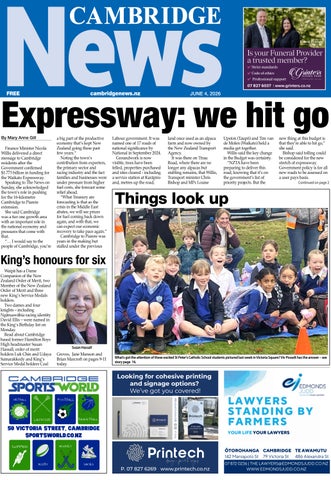

Expressway: we hit go
By Mary Anne Gill
Finance Minister Nicola Willis delivered a direct message to Cambridge residents after the Government confirmed $1.773 billion in funding for the Waikato Expressway.
Speaking to The News on Sunday, she acknowledged the town’s role in pushing for the 16-kilometre Cambridge to Piarere extension.
She said Cambridge was a tier one growth area with an important role in the national economy and pressures that come with that.
“… I would say to the people of Cambridge, you’re
a big part of the productive economy that’s kept New Zealand going these past few years.”
Noting the town’s contribution from exporters, the primary sector and racing industry and the fact families and businesses were under pressure from higher fuel costs, she forecast some relief ahead.
“What Treasury are forecasting is that as the crisis in the Middle East abates, we will see prices for fuel coming back down again, and with that, we can expect our economic recovery to take pace again.”
Cambridge to Piarere was years in the making but stalled under the previous
King’s honours for six
Waipā has a Dame Companion of the New Zealand Order of Merit, two Member of the New Zealand Order of Merit and three new King’s Service Medals holders.
Two dames and four knights – including Ngāruawāhia racing identity David Ellis – were named in the King’s Birthday list on Monday.
Read about Cambridge based former Hamilton Boys High headmaster Susan Hassall, order of merit holders Luk Chin and Udaya Samarakkody and King’s Service Medal holders Coal
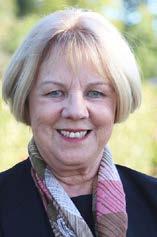
Susan Hassall
Groves, Jane Manson and Brian Marcroft on pages 9-11 today.

Labour government. It was named one of 17 roads of national significance by National in September 2024.
Groundwork is now visible, trees have been felled, properties purchased and sites cleared - including a service station at Karāpiro and, metres up the road,
land once used as an alpaca farm and now owned by the New Zealand Transport Agency.
It was there on Tīrau Road, where there are no longer any alpacas but stabling remains, that Willis, Transport minister Chris Bishop and MPs Louise
Upston (Taupō) and Tim van de Molen (Waikato) held a media get together.
Willis said the key change in the Budget was certainty.
“NZTA have been preparing to deliver this road, knowing that it’s on the government’s list of priority projects. But the
Things look up
new thing at this budget is that they’re able to hit go,” she said.
Bishop said tolling could be considered for the new stretch of expressway. Government policy is for all new roads to be assessed on a user pays basis.
Continued on page 2






What’s got the attention of these excited St Peter’s Catholic School students pictured last week in Victoria Square? Viv Posselt has the answer – see story page 16.






CONTACTS
News/Editorial
Roy Pilott editor@goodlocal.nz
027 450 0115
Mary Anne Gill maryanne@goodlocal.nz
021 705 213
Viv Posselt viv@goodlocal.nz
027 233 7686
Advertising Director
Janine Davy janine@goodlocal.nz
027 287 0005
Owner/Publisher
David Mackenzie david@goodlocal.nz
Office/Missed Deliveries
07 827 0005 admin@goodlocal.nz
Expressway: we hit go
The road is expected to be completed early in the next decade.
Asked by The News about Southern Links, the planned connection south of Hamilton to Tamahere and one of the other roads of national significance, Bishop said it remained some distance from construction.
While acknowledging property purchases and earlier work, he said the project is “some years away from construction readiness, let alone construction funding.”
Bishop said New Zealand does not have the capacity to build multiple four-lane
expressways simultaneously and the focus instead is on rolling out projects in sequence.
For Upston and van de Molen the funding announcement is a milestone.
They said the extension would make travel safer, faster and more reliable for families, freight and businesses.
The new four-lane expressway will connect Cambridge to the SH1 and SH29 intersection at Piarere. It will include bridges, an interchange at Karāpiro Road and safety features.
Van de Molen said the project is expected to
This week I want to highlight the great work Blue Light is doing across Waipā. Blue Light is a charity that has supported youth programmes throughout New Zealand for more than 35 years. Its branches give young people positive alternatives and strategies to avoid becoming offenders or victims of crime by providing supervised cultural, sporting, social, and educational activities in drug, alcohol, and violencefree environments. The aim is to strengthen relationships between Police, young people, their families, and the wider community.
During the April school holidays, Cambridge Blue Light, supported by generous local sponsors, sent two Cambridge High School students on a leadership voyage with the NZ Sailing Trust. They spent four nights crewing on a superyacht alongside students from around the country, developing leadership, teamwork, sailing skills, and environmental awareness. Both students report benefiting greatly from the experience.
Last Thursday, Te Miro School and St Peter’s Catholic School represented Cambridge at the Waikato Blue Light Rural PCT Challenge, competing against schools from across Waikato and Coromandel. Teams of four (two boys, two girls) completed a
Continued from page 1
significantly improve safety and reduce serious crashes on a route that carries thousands of vehicles each day.
• Talking tolls, management, page 15
Police vehicle challenge, detective tasks, fingerprint exercises, and the Police Physical Competency Test (PCT). The PCT is the same obstacle course all police recruits must pass and maintain throughout their careers. The event fostered confidence, fitness, teamwork, and leadership. Waihi College took out the top spot.
In April 2026, Te Awamutu Blue Light was selected for a youth leadership exchange in the United States with the Kansas City Youth Police Athletic League, an organisation with similar goals. Youth Aid Officer senior constable Scott Miller and 15-year-old Maori Te Wake from Te Awamutu joined other New Zealand teens on the trip. They quickly bonded with their young American hosts over shared interests like the gym, ChickfilA, and Walmart. The group visited police stations, youth facilities, the police academy, and more. The New Zealand students proudly shared their culture, leaving a lasting impression with their haka.
The activities of Blue Light would not be possible without the generous financial sponsorship of our Waipā communities and the time commitment of those individuals serving on the branch committees. We appreciate the opportunities this support enables us to provide youth.
Business in the news
Southern Links between Hamilton and Tamahere faces an uncertain future as pressure builds on major projects and how they will be paid for.
Good Local Media’s Waikato Business News out this week reports Southern Links, long seen as a key piece of the southern Waikato growth corridor, remains unfunded, placing it firmly in the uncertain category regardless of the next government.
Also in the monthly business publication are columns from former Hamilton mayor Margaret Evans and current Waitomo mayor John Robertson about the future of Waikato local government.
Chartered Accountants Australia and New Zealand are warning businesses to stay on top of their taxes as Inland Revenue steps up enforcement, we meet the lead singer and heart throb of a top 1960s pop group, student nurses getting a helping hand from a Southern Cross Trust scholarship and Waikato’s new dame, Susan Hassall, who says she is staying around until the Medical School gets built.
Sister publication Bay of Plenty Business News leads with an interview with Federated Farmers new chief executive Mike Siermans, a plea from developers to freeze Tauranga development levies and a bright future for horticultural exports following government moves to bolster plant variety rights.
• Read more at goodlocal.nz
HEAT PUMP SPECIALISTS
Air Conditioning Group Waikato are the specialists for Heating, Cooling, Ventilation, and Air Purification for Homes, Rentals, Businesses, and Commercial Buildings.
Conditioning Group Waikato are the specialists for Cooling, Ventilation, and Air Purification for entals, Businesses, and Commercial Buildings.








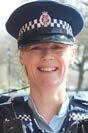
Senior Constable DEB HANN
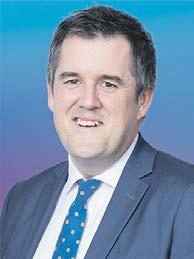
Nicola Willis
Pulling out the stops
Waikato Regional councillor
Liz Stolwyk says she will look into complaints from regional bus users that stops have been dropped from the Cambridge, KihikihiTe Awamutu and King Country services without communication other than via the bus driver. Ōhaupō now has only one stop instead of two which left one person who spoke to The News having to go all the way to Te Awamutu and back again, a round trip of 22kms. This report follows similar complaints from Cambridge users. Do you know more? Email editor@ goodlocal.nz
Tag team sought
Police have released security pictures of two people as they seek to identify a tagger who daubed the word “lost” on a commercial premise on Milicich Place, Cambridge, at 6.15pm on May 26. See more details at Cambridgenews. nz
Website stats
They’ve done it again, our news in brief columns have topped the web statistics for articles on the Cambridge News website. The collapse of the sale of Waipā District Council’s Maungatautari Road property came in second followed by stories on a Bruntwood Road sign, a wrap up of the Waipā Home & Leisure Show and in fifth an obituary on former Grey Power president Val Massey.
Time to plant
Aroha Cambridge will host an inaugural planting day on Saturday near the Te Puna Marama Moon Spring, adjacent to Cambridge Resthaven in Vogel St.
The Aroha Cambridge Charitable Trust was set up last year to educate and connect people interested in restoring and protecting Cambridge’s natural environment. Organisers hope to plant about 1200 plants at Saturday’s 9am to 11am community day.
Redraw the lines, says MP
By Mary Anne Gill
Waikato MP Tim van de Molen is urging councils to look beyond their existing boundaries as they consider forced government reforms that could reshape local government across the region.
Local Government Minister Simon Watts and Resource Management Act Reform Minister Chris Bishop have given councils until August 9 to come up with amalgamation plans or face changes imposed from Wellington.
Van de Molen’s electorate stretches across parts of Waikato, Waipā, Matamata-Piako and South Waikato districts and skirts Hamilton city.
Councils should not assume whole districts must merge together, he said, pointing to the possibility that different parts of the region may align in different ways.
“It may well be appropriate for parts of Waikato to be in Hamilton, but not necessarily for all of it.”
Towns such as Cambridge, Matamata, Morrinsville, Te Awamutu, Tīrau and Putāruru could all be part of wider discussions, including potential links with Hamilton.
“This should really be seen as a great opportunity to redraw the lines.
“There’s an opportunity here for councils to shape something that works for their communities rather than having that imposed,” van de Molen said.
The process should not simply be about drawing bigger boundaries - there should be a strong focus on communities of interest and how services could be delivered more effectively.
“We’re not looking to amalgamate for the sake of it. It’s about driving efficiency and ensuring that our communities get the services they need.”
The Waikato is a region of contrasts, from fast-growing areas
like Cambridge and Tamahere to smaller rural communities and coastal settlements such as Raglan.
Van de Molen said the current structure did not always reflect those differences.
“You’ve got quite different communities in the same district with very different needs.”
He suggested the future could involve multiple groupings rather than a single super council - such as western, eastern and central groupings across the region.
“My biggest concern would be ensuring that our smaller rural communities, like Matamata, Morrinsville, Te Aroha and others, are still well represented in any new council structure.
There is mounting pressure on councils to deliver services efficiently as rates continue to rise and frustration among residents and businesses dealing with inconsistent rules across council boundaries.
“If you’re trying to build something in one council versus another, you get a different interpretation of the rules and that can be really frustrating.”
The government’s reforms are tied to wider changes to resource management and local government, aimed at simplifying what ministers describe as a complex and costly system.
Under the plan, regional councils in their current form will be replaced by new governance structures in place ahead of the 2028 local body elections.
For van de Molen, the direction of travel is clear, even if the final shape is not.
“This is not about protecting existing structures. It’s about making sure we have a system that delivers better for ratepayers and communities into the future.”
• See Case for amalgamation, Page 13.
A double for double glazers
Waipā based Agricultural Glass Products has scooped two awards at the second annual Minister for Manufacturing Awards. AGP, which supplies products and service to the APL manufacturer network, was created to cater for a growing market need for double-glazed glass.
The company, operating from a giant home in Hautapu, won the Excellence in Process Innovation award and was named manufacturer of the year among companies with more than 50 full time staff.
Judges said what stood out about AGP was the company’s commitment to manufacturing excellence “from day one”.
The awards recognise excellence across seven key categories.
The Minister for Small Business and Manufacturing, Cameron Brewer, said this year’s finalists had set the bar for

excellence in modern New Zealand manufacturing.
“Innovation and strong execution are critical to staying competitive in a challenging global environment and manufacturing remains vital to New Zealand’s future prosperity,” he said.
“Manufacturing contributes around $22 billion a year to our economy and makes up roughly 60 per cent of our goods exports. Beyond the numbers, it anchors our regions, strengthens supply chains, and turns ideas into globally competitive products, making a big impact.
He said the awards recognised what excellence looked like in practice: businesses investing in their people, improving processes, and adopting new technologies to lift productivity and performance.
“That’s what keeps the sector moving forward,
even as cost pressures and global uncertainty persist.”
Other winners were:
Manufacturing Apprentice of the Year, Devin Gibson – Culham Engineering (Whangarei), Emerging


Manufacturing Leader of the Year, Oliver HuntMedsalv (Christchurch), Manufacturing Leader of the Year, Deanne Holdsworth - Pact Group (Auckland), Manufacturer
of the Year (under 50 staff) Arotec Diagnostics (Lower Hutt), Manufacturing Lifetime and Legacy Award, Jeff DouglasDouglas Pharmaceuticals (Auckland).
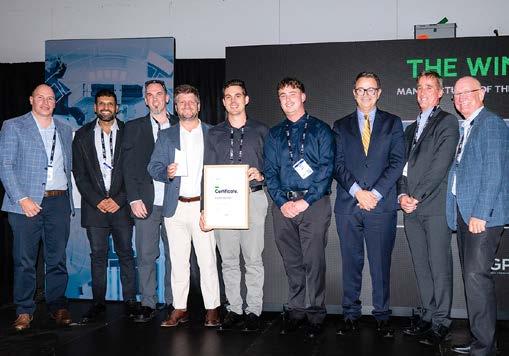
The AGP team, pictured with minister Cameron Brewer (third from right) celebrated twice at the manufacturing awards.



















Trust wants vape limits Love thy neighbour
By Roy PiIott
A trust is calling for restrictions on vaping, citing Waikato regional survey data showing daily e-cigarette use rose from three to 12 per cent in the five years to 2025.
For Māori in Waikato, Te Tiratū Iwi Māori Partnership Board says the 2024-25 estimate appears substantially higher, at around 28 per cent.
It warns market practices are driving nicotine addiction and undermining whānau wellbeing.
Tumu Whakarae of Te Tiratū, Brandi Hudson says the scale of harm across the region requires urgent action.
“Te Tiratū is extremely concerned about the widespread uptake of vaping products and the predatory marketing strategies used to lure our whānau into nicotine addiction,” she said.
“Vaping is not a harmless lifestyle choice. It is a rapidly normalised pathway into nicotine dependency for our young people, and we cannot afford to ignore what we are seeing in our communities.”
The iwi partnership board comprises representatives from Pare Hauraki, Waikato, Raukawa, Te Nehenehenui, Ngāti Hāua (Taumarunui) and Te Rūnanga o Kirikiriroa.
Its Vaping Position Statement has been developed with technical advisor Associate Professor Andrew Waa and calls for vaping
products to be made available on prescription only.
“Locally, our town mapping identifies vape retailers in Te Awamutu, Te Kūiti and ŌtorohangaKāwhia, alongside young Māori populations and visible respiratory pressure,” Waa said.
“That is why vaping needs to be treated as a local rangatahi health issue, not just a national policy debate. Māori whānau in Waikato already carry a significant respiratory burden, and youth vaping adds another preventable nicotine and respiratory risk.”
Te Awamutu was identified as having 10 vape retailers or tobacco-linked premises, Te Kūiti three, and ŌtorohangaKāwhia two.
Primary Health Organisation data also shows in Te Awamutu 1008 Māori patients are registered with asthma, 670 in Te Kūiti and 433 in Ōtorohanga, the report says.
There are 121,000 Māori within the Waikato rohe covered by Te Tiratū Iwi Māori Partnership Board and almost half are under 25 and a significant proportion are rurally based.
“Te Tiratū monitoring shows an average of 215 Māori children aged 14 and under were hospitalised for asthma each year between 2020 and 2023, at 1.9 times the rate of non-Māori children,”
the board said.
“This is compounded by high levels of deprivation, damp and mould-affected housing, lower rates of primary care enrolment, and inequitable access to youth cessation support, primary care, and trusted local services.”
The board says vapes should only be available as regulated therapies to support people who smoke to quit nicotine addiction or switch to a less harmful alternative. It would support restricting access to vaping products to accredited health related services and regulating the maximum amount of nicotine in vape liquids. It also wants vape products to be in standardised packaging, limits placed on the range of flavours and vaping cessation support services for people who vape.





By Mary Anne Gill
Over a well-kept hedge in Cambridge, the talk used to be lively.
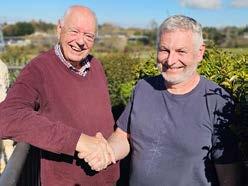
On one side, Waipā district councillor Roger Gordon. On the other, Hamilton city councillor Andrew Bydder. Neighbours, but not always on the same page, especially when it came to council matters like water services and who should be doing what.
Gordon moved into the street in 2018. Bydder arrived next door a year later.
“It’s the one thing I’ve enjoyed about living next to Andrew,” Gordon said. “I can share my frustrations or my joys, and we can talk about common issues.”
Those conversations were sometimes robust. Both men had strong views and were operating within different council structures.
Now, on the issue of local body boundaries they are on the same page.
“I’d bet on Hamilton, Waikato, Waipā,” Bydder said.
Gordon - first elected to Waipā council in 2019 - was of “a very similar opinion”.
The government deadline for councils to come up with plans made the discussion is no longer theoretical.
A big council brings scale and influence but risks losing local identity. A smaller grouping reflects existing growth patterns and commuter links but raises questions about how urban and rural needs sit together.
For Bydder and Gordon a middle option now makes the most sense.
“There are so many things that are happening within our region currently,” Gordon said, pointing to transport, infrastructure and growth planning already operating across council lines.
Hamilton and Waipā are designated growth areas and dealing with increasing population pressures. Their futures are linked, like it or not.
“We understand that the success of
Hamilton depends on the success of the Waikato,” Bydder said. “But we have urban issues, we are not set up for rural issues.”
It explains why both are cautious about going too big.
The idea of a mega council covering the entire Waikato has appeal in theory, but it comes with complications. Different communities, different economies and different priorities are not always easy to blend.
Instead, an emerging view is that Hamilton, Waikato and Waipā form a more natural starting point.
Even then, the challenge will be keeping local voices alive.
Under any new structure, existing councils will disappear.
Community boards are an obvious solution, but they are wary of models where those boards have little real power.
“They have a budget,” Bydder said of the Auckland example, “but about 90 percent of that budget is already locked in. They actually have very little influence.”
That is a lesson they seem keen to take on board.
The neighbours who once argued different sides are now shaking hands, quite literally, on a shared position.

Roger Gordon, left, and Andrew Bydder. Photo: Mary Anne Gill
Brandi Hudson
Pou honours felled tōtara
By Mary Anne Gill
The base of a tōtara tree felled to make way for the entrance to Fonterra’s Wai Mahea water treatment plant at Hautapu will take centre stage next month when it is unveiled as a pou to mark Matariki.
What began as part of a major infrastructure project has taken on deeper meaning, reflecting a growing partnership between Fonterra and mana whenua. The pou, carved by Bodie Tihoi Huitoroa-Taylor on behalf of Ngāti KorokīKahukura and Ngāti Hauā, reflects that relationship and the values behind it.
The Wai Mahea water treatment plant, an $85 million investment opened in February, is set to be fully operational from July 1. Its name, gifted by mana whenua, speaks to the purpose of the facility: wai meaning water and mahea referring to the removal of impurities.
It represents both a practical and cultural commitment to protecting the environment.
To make way for a new entrance to the plant, two tōtara were felled. Before work began, a karakia was held involving iwi representatives and Fonterra staff, acknowledging the significance of the trees and the land.
From there, every part of the trees was used. The base of one trunk, the stump, has been retained to form the foundation of the pou. The carved pou itself has been created using other locally sourced timber, while the remaining wood from the tōtara was cut for firewood and donated, and smaller pieces were chipped and reused on site.
The result is a carved artefact with a wider story of continuity, respect and shared purpose.
Dale Arbury, Fonterra’s national manager of
environmental operations, said the project provided an opportunity to deepen relationships with mana whenua beyond the usual consenting process. It marked a shift from what he described as a more transactional approach to one built on genuine, ongoing engagement, he told the Hautapu plant’s annual community meeting last week.
In the past, cultural impact assessments and agreements could be filed away once consent was granted. This time, the approach was different. Regular meetings were held between Fonterra teams and iwi representatives, both online and on site, creating space for dialogue, questions and shared learning.
“We didn’t want to just centre it on the wastewater treatment facility,” Arbury said.
“We used the construction as a medium to build our relationship.”
That meant listening more carefully to the values of mana whenua, particularly their connection to the whenua and the Waikato River, which is regarded as an ancestor. It also meant being transparent, including sharing information about noncompliance events with iwi.
Arbury acknowledged that Fonterra had not always got it right. Early in the project, iwi feedback highlighted a lack of cultural recognition in how work was being carried out. That prompted reflection and a more intentional effort to incorporate cultural expression on site, including the commissioning of the pou.
The carving itself is tied to Matariki, a time of remembrance, renewal and connection. Its unveiling will bring together Fonterra staff and iwi in a continuation of the partnership that has developed over the past 18 months.
For Arbury, one of the most significant changes has been a willingness to pause, ask questions and listen.
“We’re good at talking to people,” he said.
“Sometimes we’re not always that good at listening.”
The pou stands as a reminder of that shift. Rooted in the whenua
through the tōtara base, it looks both to the past and the future, acknowledging the history of the land while marking a new way of working together.
When the pou is unveiled for Matariki, it will carry not only the story of the trees it came from, but of the relationship built alongside it.
Excellent Excelsior
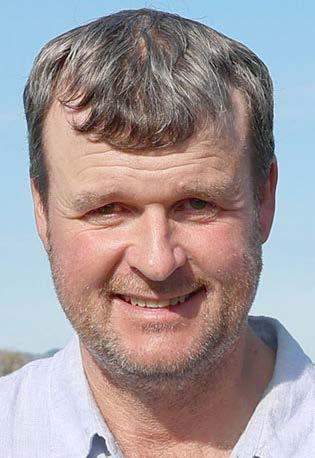
A bull bred by Brad Payne and Claire Brodie near Cambridge has been named JT Thwaites Sire of the Season.
The award by Jersey NZ recognises outstanding New Zealand-bred Jersey sires whose daughters demonstrate exceptional production and conformation performance.
LIC Livestock Selection Manager Kelli Buckley says the recognition reflects years of dedication and careful breeding decisions by the Payne family.
“Paynes Titus Excelsior ET is a great example of what’s possible when great breeding decisions are backed by long-term commitment and attention to detail. To see that effort recognised nationally is hugely rewarding - not just for LIC, but for the Payne family and for Jersey farmers who will benefit from these genetics for years to come.”
Excelsior achieved the highest Breeding Worth of all qualifying new-proof Jersey bulls this season, and met criteria for management, fertility and conformation traits.
Steve Ireland, Genetics Convenor for Jersey NZ, said Excelsior is likely to appeal to farmers focused on breeding replacement heifers.
“Excelsior stands out for his ability to breed daughters with exceptional, long-lasting udders and top fertility. This should ensure his daughters remain very productive well into maturity.”
The Payne family has built a reputation for breeding Jersey genetics and Brad Payne said winning the award was a proud moment.
“Looking at the trophy and seeing the calibre of bulls recognised over the years, it’s very special to know one of ours is now among them,” he said.






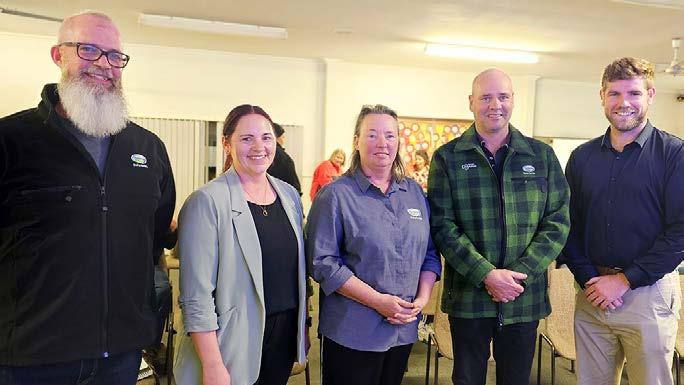
Fonterra participants at the annual Hautapu plant community meeting last week were, from left Dale Arbury, Janelle Jenson, Jude van Bommel, Matt Roberts and Nathan Metzger.
Photo: Mary Anne Gill
Brad Payne


Dame Susan of Cambridge
By Mary Anne Gill
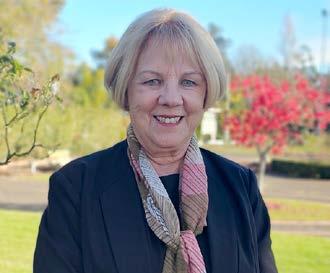
Susan Hassall loves Cambridge. It is where the new dame has lived for more than three decades, where her family has settled, and where she walks regularly, often around Lake Te Koo Utu, near her home.
But if she could change one thing about the town, she is clear what it would be.
“I’d build a new library,” she said.
Hassall, named a Dame Companion of the New Zealand Order of Merit in the King’s Birthday Honours, says the current Cambridge library no longer
meets the needs of the growing community.
“It’s too crushed,” she said. “The books don’t look cared for.”
She often travels to Te Awamutu for what she describes as a better experience. Her comments come as Cambridge continues to expand rapidly, placing pressure on community facilities.
The honour recognises a lifetime of service to education and the wider community. Education minister Erica Stanford said recipients this year had shown exceptional commitment and impact
in education across New Zealand.
While her professional life has largely been centred in Hamilton, Hassall’s personal base has long been Cambridge.
She moved to the town more than 35 years ago.
She has made the trip into Hamilton thousands of times over the years. Before the Waikato Expressway it took much longer. Now it is quicker. Hassall says she recently made it to the university in 15 minutes.
Her family connections run deep, and her three children and grandchildren live locally. Walking is part of her daily routine.
“We’re so lucky. We’re so blessed,” she said.
Despite her long list of leadership roles, Hassall says she would be open to contributing more directly to the Cambridge community.
“Oh, I would,” she said of local voluntary work. “Nobody’s ever asked me.”
Her career has been defined by service.
She spent more than 40 years at Hamilton Boys’ High School, including 25 as headmaster, before retiring in 2024. Former students often recall her ability to command attention, noting that when she spoke at
assemblies “you could hear a pin drop”.
Since then, she has taken on a range of governance and voluntary roles. She is Chancellor of the University of Waikato, chair of Hospice Waikato Trust, and deputy chair of Momentum Waikato.
Her involvement with hospice is particularly close to her heart, after her husband James died after
time under hospice care in 2023.
Hassall believes communities rely on people stepping forward to contribute their time and expertise.
“I think you gain so much more than you give,” she said.
That philosophy extends to how she approached her leadership in schools and governance roles.
She says showing up matters.
“You can pretend to care, but you can’t pretend to show up.”
Now 71, she has no plans to stop contributing.
“I just want to keep going while I can and give what I can,” she said.
Her new title as a dame adds to a list of honours that includes the ONZM she received in 2021.
A life on the committees
By Jesse Wood
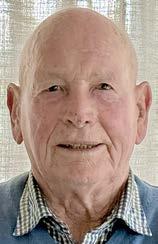
Longtime Ngāhinapōuri resident Brian Marcroft, 84, has received the King’s Service Medal for services to the community.
The retired deer farmer has committed his life to committees, boards, coaching, planning and advocating for his beloved Ngāhinapōuri –and surrounding Waipā communities.
He has spent 77 years in the area, around five years at Saint Kentigern College and two years at Massey University.
He has served as trustee of Stewart Reid Memorial Park since 1974, worked as
an organiser of the Farm Labour Scheme, sat on the Ngāhinapōuri Federated Farmers committee, served on the dairy committee for 35 years and the Ngāhinapōuri School committee for 13. He was an inaugural member of Waikato Deer Farmers Association and his involvement in sport includes 10 years as a committee member of Northern Districts’ Cricket.
Cricket and golf are both close to Marcroft’s heart.
He is a life member of the Ngāhinapōuri Golf Club and Ngāhinapōuri Cricket Club, Waikato Eagles Society and Te Awamutu Vet Club and has been a justice of the
THE DENTURE MAN



Peace since 1999.
He also oversaw the Ngāhinapōuri Hall rebuild, having joined the hall society in 1963 and chaired it as a 21-year-old.





Dame Susan Hassall pictured in one of Lake Te Koo Utu Domain’s gardens, a favourite walking spot. Photo: Mary Anne Gill
Brian Marcroft
A surgeon’s calling
By Mary Anne Gill
Paediatric surgeon Udaya Samarakkody has been up since the early hours, called into Waikato Hospital for an emergency operation on a baby.
Back home in Tamahere by mid-morning, she is preparing for a full day of consultations and the possibility of a return to the hospital.
At 65, there is little thought of slowing down, nor much chance of it given there is a shortage of paediatric surgeons in New Zealand and only four at Waikato Hospital where there is one long-term vacancy.
“I actually really like my work, and I feel that I’m still very competent,” she says.
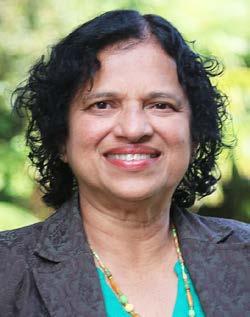
It is that commitment which has earned her appointment as a Member of the New Zealand Order of Merit in this year’s King’s Birthday Honours, recognising more than three decades of service to paediatric surgery and the Sri Lankan community in New Zealand.
For Samarakkody, the work has always been more than a career.
“Some people might think it is a job, but to me it’s a calling,” she says.
“Seeing somebody healed, leaving the hospital… there’s no other job that can give you that satisfaction.”
Born and trained in Sri Lanka, she was already a qualified paediatric surgeon when she and husband Ruwan Fernando made the decision to leave in 1995. It was prompted in part by the country’s civil war, after she experienced a bomb blast while sitting in traffic on the way to collect her son Sachi from school.
New Zealand offered both safety and opportunity. After arriving in Waikato as a locum she quickly established herself in what she still considers a remarkably supportive workplace.
“I just couldn’t believe how good New Zealand was when I first arrived. People were so nice,” she says.
Over the years she has become a cornerstone of paediatric surgical care in the region, treating children from birth to their mid-teens and handling everything from congenital abnormalities to trauma cases.
“Trauma is what makes you really, really feel bad,” she says quietly, describing the children whose injuries cannot be overcome.
But it is the resilience of young patients that sustains her. Unlike adult medicine, she says, most children recover.
“We actually see healing rather than devastation of illness and death. That gives you so much joy.”
Her career highlights include being part of the complex 22-hour surgery in 2004 to separate conjoined twins, one of seven surgeons and 55 health professionals involved.
Alongside clinical work, she has trained dozens of surgeons and continues to mentor young doctors, particularly women entering what was once a male-dominated field. More than 50 surgeons have passed through her guidance.
Her influence extends well beyond medicine.
A passionate advocate for culture and community, she has spent decades supporting Sri Lankan families in Waikato, helping young people stay connected to their heritage.
Dance is central to that. Trained in classical and Latin styles, she now teaches and choreographs, including leading colourful Sri Lankan performances in the Waikato Hospital staff revue.
Those efforts reflect her wider belief in nurturing potential, whether in a surgical trainee or a child discovering their culture. She and Fernando have two children, both
in the medical field. Sachi, 40, is a dentist and Shani, 30, a surgical registrar at Whanganui Hospital.
Her 93-year-old mother still lives in Sri Lanka, though visits are difficult to arrange with the demands of her work.
The timing of her honour carries added personal meaning.
Her late father died several years ago on June 1, the same date the awards are announced.“I imagine if he was alive, he would have been so proud.
Good sport is a good sort
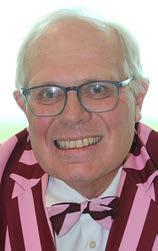
Colin – everyone calls him Coal – Groves has made quite an impression since moving from the United Kingdom to New Zealand in 2009.
He has been awarded a King’s Service Medal for services to business, philanthropy and sport
When he arrived in New Zealand he was involved with Tetra Laval Group’s acquisition of Downer McClunie Birch, which rapidly expanded from 30 to more than 200 employees.
The former England Under-21 rugby international has served as president of Waikato Rugby and is its current president. He also
played a significant role in New Zealand Rugby’s Silver Lake partnership.
In cricket he is a founding director and current chairman of the Seddon Cricket Club, which has grown to 700 members in five years, and wears the burgundy and pink blazer with pride.
The chartered accountant has also used his corporate governance experience to benefit the technology, and agriculture sectors.
He develops future leaders through mentoring, contributing time and expertise for the wider community and leverages his international networks to
foster business partnerships amongst commercial and sporting organisations.


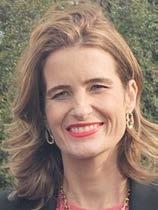
RIGHT: Paediatric surgeon Udaya Samarakkody has been honoured for services to paediatric surgery and the Sri Lankan community. Photo: Mary Anne Gill
Coal Groves
Impact measured in millions
By Viv Posselt
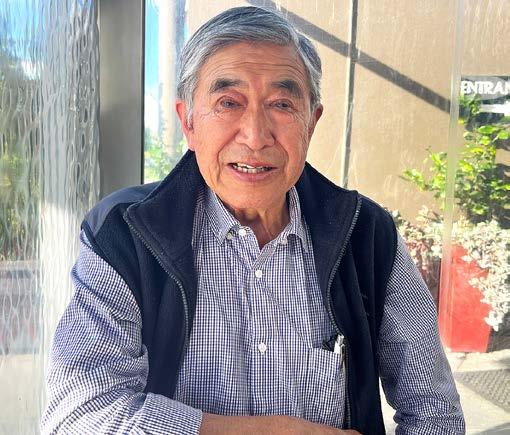
Cambridge’s Dr Luk Sun Chin is characteristically humble about his King’s Birthday Honour.
The new Member of the New Zealand Order of Merit (MNZM) recipient found it easy to keep it secret for the past few weeks. He breathed a word to no-one… even his immediate family were kept in the dark.
“I was a little embarrassed, to be honest,” he said, “because this achievement is not only for myself, it’s for all the people who have supported me along the way.”
Chin, who was awarded the MNZM for services to health and harness racing, underestimates his impact on New Zealand, and on this region, in particular. His citation reveals he has helped expand private health services in Waikato, bringing $150 million in investment over the past 40 years.
He has contributed more than 50 years as an anaesthetist, pain and intensive care specialist, and is still working full time as an anaesthetist at the lofty age of 83. He helped establish Waikato Hospital’s Intensive Care Unit and Pain Service in 1975 – at the time only the second in the country.
The citation continues: “In 1991, he co-led the development of the Anglesea Medical Centre in Hamilton, Waikato’s first same day surgical unit, now operating as an elective surgical hospital. He has since contributed towards the establishment of further private healthcare facilities in the region, including in Tauranga, Pukekohe and Cambridge. He has also created a fund to provide financial assistance for future registrars wanting to advance their studies of anaesthetics.”
All of that accounts for just part of Chin’s MNZM. His services to harness racing
are equally impressive – and have won him awards in that field – despite the fact he sees that as a hobby-turned passion that he took up decades ago simply to find something to occupy his leisure time.
He is New Zealand’s oldest licensed harness racing trainer and driver and the first to breed and train 100 winners. His tally is now well over 200. He has never purchased a horse, something he explains by saying it was his late father’s interest in horses that resulted in his and his brother’s early involvement, and thus into him taking on his first breeding mare. The rest, they say, is history. Today, Chin is still active in the industry, although he is down to four racers currently, with another four youngsters coming up.
Reserved as he is about the award, Dunedin-born Chin delights in the fact he is not the first in his family to be recognised in this way. His father, Chin Bing Foon, who was born in Canton in 1910 and came to New Zealand in 1925, became a well-known businessman in Dunedin and was awarded an MBE in 1986 for services to the community.
The younger Chin’s medical career evolved naturally – there are now over 20 people in the extended family working in the medical field.
“I have had a wonderful career in medicine. I graduated in 1967 and moved into anaesthesiology just as that field was undergoing tremendous development. I worked overseas for several years… the changes that came in around that time revolutionised anaesthesiology. It enabled us to do longer surgeries safely, but that, in turn, meant we had to develop better post-operative practices, such as intensive care and better pain relief.”
Chin was on the ground

floor of those developments in New Zealand. He has since tried to work on ways to enhance the country’s healthcare facilities, particularly as New Zealand struggles to meet the needs of a growing population with insufficient medical personnel.
A proposed Cambridge Health Hub is part of that plan. Chin hopes that when it is completed, it will help take elective work from Waikato Hospital, leaving that facility to deal primarily with acute medical and trauma cases.
“The Cambridge hub is still underway … we are currently in talks to establish exactly what it will be.”
He has loved every aspect of his job. “I would like to put back into medicine what medicine has given me in life. Whatever you do in healthcare is ultimately for the benefit of everybody.”
Medal for church leader
Jane Manson says she is humbled to be honoured with a King’s Service Medal for services to the community
The Hillcrest based St Stephen’s Church, Tamahere stalwart has previously received a Waikato District Mayoral Community Award.
Jane Manson is crediting with creating the monthly Tamahere Country Market 22 years ago – it now attracts 20,000 visitors a year and boasts more than 100 stall holders. A portion of the revenue generated goes to maintain St Stephen’s Church and its community outreach.
In 2019 she was appointed Chair of Mahi Mihinare Anglican Action, where she works to assist vulnerable members of the community through social services and support.
She has been the church liaison on the Tamahere Community Committee since 2008 and helped establish two shelters for the bus stops. She led the Tamahere-Woodlands Heritage Committee, working with mana whenua to create a heritage board depicting Māori and European settler history in Tamahere, and a board explaining Māori history adjacent to the Te Awa Cycleway underpass.

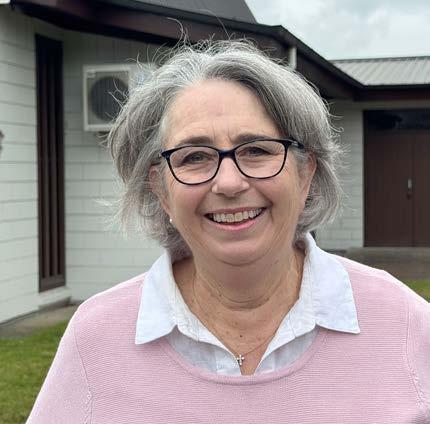


Luk Chin has been honoured in the King’s Birthday Honours.
Photo: Viv Posselt
Jane Manson
ON SHAKY GROUND
The Capelinhos eruption
By Janine Krippner
In 1957 the Azores islands, Portugal, saw a classic example of a Surtseyan eruption, one that came uncomfortably close to the island of Faial. Prior to this, the 1672–73 Cabeço do Fogo eruption resulted in three deaths when those poor souls were “overwhelmed by lava” while going to watch the activity.
A Surtseyan eruption occurs when the vent is in shallow water and the erupting lava interacts explosively with the water. This produces jets of volcanic ash – magma blown apart into glassy rock fragments –that are saturated with water so the black plume quickly collapses.
These black plumes are accompanied by white plumes that form when the water flashes to steam with the intense heat of the erupting magma. These collapsing plumes can then race across the water as deadly pyroclastic flows, or in this case we call this a pyroclastic surge.
Preceding the eruption was four days of felt seismicity. The Azores, like the Canary Islands and our own Auckland Volcanic Field, are volcanic fields where we cannot know where the next vent will appear. Where the eruption occurs influences the dangers that activity poses to communities.
On September 27 the eruption began below the sea, with four active vents 1.2 km off the northwest end of the island. Activity moved eastward over time, building a bridge of sorts to the island.
Heavy ashfall deposited fine volcanic rock over the western part of the island. Pyroclastic surges reached around one kilometre from the vent.
Once a cone builds up around these vents, forming a new island, the magma or lava
can be kept away from the sea water and the eruption changes style.
This led to lava fountaining and Strombolian activity, where gas produces more individual explosions, flinging lava away from the vent.

This eruption moved back and forth between these two styles throughout its duration.
Towards the end of the eruption, seismic activity increased and earthquakes damaged 508 houses and destroyed 273 - an important reminder that seismicity can cause significant damage quite independently of the more direct volcanic activity.
In the end, damage included the destruction of agricultural land, houses were half-buried in heavy volcanic ash that then turned muddy with rainfall, as well as the damage from earthquakes. Very soon after the eruption ended, the island built of ash had disappeared below the sea.
While this was a small event in terms of volcanic activity, the eruption style and location near people made it a damaging one. One that we can learn from in terms of what we could expect if a similar event occurred near our largest city.
I would like to give a very personal thank you to those of you who tell my family that you enjoy this column.
On the weeks when work is exhausting and life balance isn’t going well, it is those comments that get this column written.
This column is my way of giving back to my community and I love to hear that you are getting something out of this each week.

What’s our value?
By Murray Smith, Bridges Church
People put value on all manner of things, yet ultimately, it’s the ‘eye of the beholder’ that is final arbiter in determining the worth and significance of something.
This is especially true when it comes to ‘art’. Aotearoa New Zealand’s premier award for drawing is said to be the Parkin Drawing Prize.
This Parkin Prize website says this annual competition “promotes drawing in all its forms - as discovery, a testing of ideas and decision making”.
Many interesting artworks are entered and without doubt, it’s a useful stimulus for our creatives to originate work worthy of consideration for the top honour.
I risk the furore of the art world in writing this, but it only comes from my lack of understanding and poor level of appreciating fine art - at least that’s the only conclusion I can come to, when an A4 piece of paper with thousands of typewritten forward-slash characters on it gets chosen as winner of the $25,000 prize.
My lack of insightfulness was earlier highlighted by a previous winning entry consisting of offcuts of carpet scraps piled up against a wall.
The art world can be unusual. A New York ‘interactive art installation’ comprised an electric chair timed to randomly ‘light up’ any moment in the next decade. People queued for their turn to take a seat and run the gauntlet. A Yugoslavian ‘artist’ named Marina Abra mović stood beside a table with 72 items on it ranging from a feather, to grapes, to a gun loaded with a single bullet. Visitors were invited to do anything they
wanted to her using anyone of those 72 items. One visitor did hold the gun to Marina’s headuntil another pulled the man away. As a trainee teacher, my daughter was asked to take an art lesson in the school. She wanted to create an engaging lesson.
One little kid stated he was useless at art and proceeded to do pencil scribbles. My daughter leaned over saying, “even a scribble can be art”.
Deftly adding touches, she transformed his scribbles by rendering a dinosaur with teeth. “What makes it art, is if it has a story behind it…and…love.” Inspired, the whole class began offering their own scribbles and even produced random stuff off the floor asking, “Is this art?”
One boy asked, “Am I art Miss?” “Yes”, she replied, “You are an incredible piece of art… just look at you!” Beaming, he strutted around declaring to his classmates, “Hey, Miss says I’m art !”
That little boy being affirmed as ‘an incredible piece of art’ was profound truth. Our Creator sees us as being of inestimable value. The Bible says, “We are God’s masterpiece. He created us in Jesus Christ, for the good things He planned for us long ago”.
Understanding this truth; that the God of the Universe intentionally, thoughtfully, lovingly designed you as His magnum opus - His precious masterpiece, how differently might you treat and view both yourself and others?

New Dentures
Missing teeth can affect more than most people expect;
From eating and speaking, to how confident you feel when you smile. Wanting to make a change but not sure what’s involved or the cost? Get a free denture consultation at Alpers Dental Cambridge Full dentures or partial, our dental team will walk you through your options, explain the process clearly, and give you an honest picture of what it will cost.
No surprises. No pressure. No obligation to commit to anything. If you decide to proceed, you’ll get 15% off your new dentures.
Book your appointment today call 07 222 3498 or alpersdentalcambridge.co.nz

A close call
By Peter Nicholl
On May 27 the Reserve Bank’s Monetary Policy Committee kept its Official Cash Rate unchanged at 2.25 per cent. The committee has six members, three from the Reserve Bank, including governor Anna Breman, and three external members. The May meeting was the first held under a new charter and for the first time the votes of the committee members were disclosed.
The disclosure revealed another first. The votes were split 3-3. Three voted to raise the cash rate by 25 basis points to 2.5 per cent. The tie was broken by the governor who has a casting vote. She voted to leave the rate unchanged.
Given the uncertainty about future trends in inflation and economic growth, not just in New Zealand but globally, it didn’t surprise me that the members had different views. What surprised me was that the three external members were the most hawkish and voted for a modest rise. Given that one of the main responsibilities of the Reserve Bank is to control inflation, I expected the internal Reserve Bank members of the Monetary Policy Committee to be more concerned about inflation than the external members.
Current inflation at 3.1 per cent is already just above the top of the Reserve Bank’s target range of 1-3 per cent. The Reserve Bank’s forecasts which were in the Monetary Policy Committee statement have the Consumer Price Index rising further and peaking at 4.3 per cent in the September 2026 quarter. What happens after that is uncertain. It

will depend on how much the rise in the CPI, which is mainly caused by external developments, feeds into inflation expectations and price and wage setting behaviour in New Zealand. The Reserve Bank based the decision to keep the cash rate unchanged on the most optimistic of the three scenarios –that the second-round price effects will be slight and the CPI will return to the mid-point of the target range by mid2027. But all three scenarios have the CPI above the target range for almost two years, and none include the possibility of the CPI falling to the bottom half or below the bank’s target range.
When I gave talks on Central Bank policy making to courses in the United Kingdom several years ago, I used the following story. An American tourist got lost in the Irish countryside. He saw a farmer in a field and called out ‘how do I get to Dublin?” The farmer replied, “If I was you, I wouldn’t start from here”. Unfortunately, policy makers have to start from ‘here.’ The Reserve Bank’s starting position is that their cash rate is well below a neutral level because they moved it down last year. This is a risky position to be in when inflation is above your target and you know it’s going to rise further. The external members of the committee got it right on May 27. The Reserve Bank needs to move its cash rate back to a neutral level as quickly as possible.
Case for amalgamation
By Mike Keir, councillor, Tamahere Woodlands Ward
Under the ‘Simplifying Local Government’ initiative, the Government has announced a voluntary pathway called “Head Start” giving councils until August 9 to submit proposals to amalgamate into larger authorities before the 2028 elections.
If they don’t, they will go into the “Back Stop” process where Government will design a structure for them. Unitary authorities combine the responsibilities of both a regional and territorial (city/district) council into a single entity. Proposals must be agreed with other councils involved.
Waikato District Council intends to meet the Head Start deadline. There are a range of options to consider including a Waikato region-wide unitary council. We need to evaluate the options by how they might deliver better efficiency and value for ratepayers.
The big risk in going to a unitary model is loss of local voice and representation. Our local community committee system works well in getting local input into decision making and this council is trying to strengthen that process. We need to try and maintain this system within whatever eventuates.
This is an opportunity, the last significant local government reform was in 1989 which resulted in borough councils coming together and the establishment of the regional councils above this. I believe the regional councils are a failed experiment. While they may have achieved some good, they have also added a layer of bureaucracy, duplication, increased costs and time to achieve outcomes. The cost and time to navigate our consenting processes is crippling, making us a very inefficient nation.
Also, the move to more regional models for water services delivery requires significant rationalisation and restructuring of existing
councils. If you take away one third of their business, then there should be a commensurate reduction in administrative and management staff. The best way to achieve this is through amalgamation. Waikato District Council already works closely with neighbouring councils through shared services, regional partnerships, emergency management, transport planning, and IAWAI drinking water and wastewater services with Hamilton City Council.
Councils across the Waikato region are in discussions about potential arrangements, trying to understand where future unitary relationships make sense, while ensuring communities of interest continue to have a strong voice. The regional unitary model has merit according to those experienced with unitary authorities, with a common theme being they are more holistic and efficient in approach. As seen in Auckland, they have enough clout to push back on central government where they are being unfair or unrealistic. It would also be big enough not to let Hamilton dominate as it is the regions that earn our wealth. The challenge is to maintain sufficient local representation.
This leads me back to this badly needed local government reform we have been trying to get for nearly ten years. With learning from the unintended perverse outcomes of the government and electricity reforms of the early 90s and later 90s, the amalgamations will provide an opportunity to provide a more flexible, agile and efficient system and if it is set up well and staffed with the right people, the ridiculous regulatory environment we live under remodelled into something sensible. We have an opportunity, let’s not blow it. I live in hope.

Jack Glazer
Gavin Payne
Backchat
Beyond Gallipoli: ANZAC Jim Watson’s Middle East War
By Karen Payne, Cambridge Museum
When Christopher Archer and Warren Dawson spoke recently at a joint U3A Cambridge and Friends of the Cambridge Museum event, they explored a chapter of New Zealand history often overshadowed by Gallipoli and the Western Front: the story of the New Zealand Mounted Rifles Brigade in Egypt and Palestine during World War I.
For Cambridge Museum, however, the story is not just national history. It is also local.
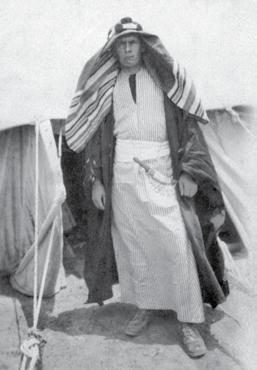
Among the Museum’s World War I collection is a remarkable group of objects belonging to Maungatautari farmer James “Jim” Wallace Watson, who enlisted in 1914 aged just 18. Watson served in Gallipoli, Egypt, Palestine and the Balkans, eventually rising to the rank of Lieutenant and receiving the Military Medal for bravery. But perhaps the most visually striking objects connected to his service are the Arab garments donated by his family to the Cambridge Museum: a yellow striped robe, velvet waistcoat, striped headscarf, cummerbund and coat, accompanied by a fake beard and curled wig mounted on hidden wire rollers.
Telling a story
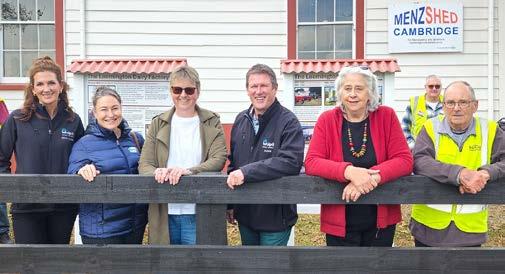
The boards feature a pictorial and written summary of the history of the Menzshed building from the early 1900s to its current form.
Penny Pickett did the research, Catherne Fry and designing and Rob Saywell the construction and erection.
They contain excerpts on each stage of the occupancy of the site from its original construction for the Cambridge Co-operative Dairy Company to later becoming one of the first Anchor brand creamery sites.
“We felt that this historic building had an interesting story to tell and the history boards were an easy way to ensure that history was not lost,” Menzshed spokesman Myles Prebble told The News.
The project was achieved with sponsorship from Fonterra and help from members of the public.
Briefs…
Bridge debate
Bridge location ideas, safer walking and cycling routes were on the agenda at Wednesday’s Waipā District Council Strategic Planning and Policy Committee meeting, held after The News went to press. Also up for discussion was a proposal to extend the Victoria Street cycleway across the Waikato River into Leamington and building safer pathway routes between schools and their communities.
Fees rise
Hamilton City Council has confirmed fee rises for Hamilton Gardens. The entry fee to the enclosed gardens will be $27.50 for nonHamiltonians from October 1.
The disguise hints at the unusual realities of the Middle Eastern campaign, where mounted troops operated across deserts, villages and rugged hill country far removed from the trenches of Europe. Archer explained that despite rapid technological change during World War I, including machine guns, aircraft and armoured cars, horses remained essential in Palestine because early vehicles often struggled in sand and rough terrain. Watson also documented his experiences of war through photographs and diaries. He recorded the Suez Canal, fellow soldiers, horses, field kitchens and war graves, while his writing described bombardments, exhaustion and the loss of friends. Today, visitors to Cambridge Museum can hear excerpts from those diaries read aloud by his great-nephew Shane Watson through the Museum’s restored telephone exchange in the main gallery.
The recent talk by Archer and Dawson highlighted how much of New Zealand’s Middle Eastern campaign has faded from public memory. At Cambridge Museum, Watson’s disguise, photographs and diary help bring that forgotten story back to life, connecting an international conflict directly to one Waipā family and community.


Jim Watson in Palestine during World War I
On the fence – pictured at the unveiling of history boards at the Cambridge Menzshed home in Carlyle St last week were, from left Waipā deputy mayor Jo Davies-Colley, Fonterra’s Philippa Fourie, Catherine Fry, Waipā mayor Mike Pettit, Penny Pickett and Rob Saywell.
Talking tolls, management
By Mary Anne Gill
Tolling could play a role in funding future Waikato highways - but only under strict conditions that ensure fairness for users and protect local councils, according to Labour’s infrastructure spokesperson Kieran McAnulty.
Meanwhile a major shift towards

asset management – rather than new project announcements – could reshape opportunities for Waikato’s infrastructure sector following signals from Infrastructure Minister Chris Bishop.
Both spoke at the Āpōpō Congress in Hamilton last month where, McAnulty signalled openness to tolling on major projects such as Cambridge to Piarere and potentially Southern Links - but said public acceptance hinges on transparency and choice.
“We do think [tolling] has a role to play,” he said.
“But it needs to be up front at the start… and there must be a credible free alternative.”
That condition is particularly relevant in Waikato, where the existing State Highway 1 alignment could serve as a non-tolled alternative to a new expressway corridor.
However, McAnulty warned that such alternatives must remain state-supported infrastructurenot passed to already stretched

councils.
“It’s important that NZTA maintains responsibility for that alternative road… not just push it off to the council,” he said.
Bishop emphasised that improving how New Zealand maintains and manages infrastructure is now a top priority, warning the country has fallen behind internationally.
New Zealand ranks near the bottom of the OECD for asset management performance, he said, highlighting the scale of the challenge.
The government’s response includes stronger oversight of infrastructure investments and a push to ensure agencies prioritise maintenance alongside new builds.
For the sector, that means a potential rebalancing of workwith increased demand for asset planning, condition monitoring, and long-term maintenance programmes.
Bishop said improving decisionmaking is central to the reforms, including changes to how projects
are assessed and approved.
“We want experts to give us clear advice… so we can make wellinformed investment decisions,” he said.
The government is also moving to strengthen coordination of underground infrastructure, an issue that has direct cost implications for contractors and local projects.
Poor-quality and fragmented data on underground assets is costing the sector hundreds of millions of dollars annually through delays, rework and inefficiencies.
To address this, new funding has been allocated to improve corridor management and explore a national underground asset register, aimed at reducing disruption and improving project delivery.
For Waikato businesses, particularly those involved in utilities, civil construction and engineering, the changes signal a shift toward more disciplined, data-driven infrastructure
Keeping Cambridge Smiles Sparkling


investment.
Bishop said stronger planning and oversight will reduce “stopstart” projects - a long-standing concern for the sector - while improving value for money.
McAnulty said the stop-start approach was delaying projects and driving skilled workers out of the country.


Kieran McAnulty
Chris Bishop
An uplifting experience
By Viv Posselt
Thirty St Peter’s Catholic School students experienced the thrill of being in a hot air balloon last week in a Cambridge first that linked inspiration, science and education.
Small groups of year 5-8 students spent a few minutes each in a tethered balloon suspended 20 metres above Victoria Square. They were the first local school students to benefit from the
Flying High Project, founded and run by balloon pilot and global education campaigner Andrew Parker.
The project, which started in 2021, was an outcome of his Flying High For Kids World Balloon Project, which went from 2013-2018 and saw him drive his balloon to 87 countries around the world.
“This is the fourth round I have done here. We took a pause last year to further develop our education programme.”
Working with a group of professionals, Parker added to New Zealand’s existing Stem (Science, Technology, Engineering, and Mathematics) education programme – by including the arts, creating the acronym Steam. The project uses that to inspire education and critical thinking among the many hundreds of students he has since reached.
Hamilton-born Parker
Talking tolls, management
Continued from page 15
Ongoing uncertainty in the infrastructure pipeline was undermining workforce stability and costing the country talent it has invested heavily to train, he said.
The sector was increasingly frustrated by projects being announced, paused or cancelled as governments changed or funding gaps emerged.
That uncertainty is now having a direct impact on the labour market, with skilled workers - including qualified apprenticesleaving for more stable opportunities offshore. McAnulty pointed to training programmes introduced in recent years that boosted the number of apprentices entering the construction and infrastructure workforce.
Many had since completed qualifications. However, a lack of consistent work was pushing those same workers out of New Zealand.
“Many of them have now left to Australia because of the uncertainty in the construction space,” he said.
For Waikato, where infrastructure development underpins growth across logistics, housing and industrial sectors, the loss of skilled labour presents a significant challenge.
Contractors rely on long-term visibility of work to retain staff and invest in training. Without it, businesses face rising costs, project delays and reduced capacity to deliver major projects.
wants to give youngsters a ‘bird’s eye view’ of the world to inspire them to realise their potential.
After each ride, he gives an educationfocused talk to the schools, which also includes part of his own life journey.
It was a social media post about the Flying High Project that caught the eye of St Peter’s Catholic School principal Nicole Higby.
“I thought it would be great for our students but realised we couldn’t accommodate a full-sized hot air balloon on our grounds,” she told The News.
“So, I contacted the council who gave us permission to use Victoria Square.”
That led to the entire school gathering on The Square early last Wednesday as some students rode the balloon and others cheered them on.
Higby said those selected to ‘fly’ had been pulled from a hat containing the names of students who had worked hard and received charism cards during the term.
Everyone was thrilled, whether riding the balloon or watching from the ground.
Higby took a ride, as did teacher Ella Neilson, who turned 23 on the day and reckoned future birthdays might be a bit of a fizzer after that.
“This one will be hard to beat,” she said.
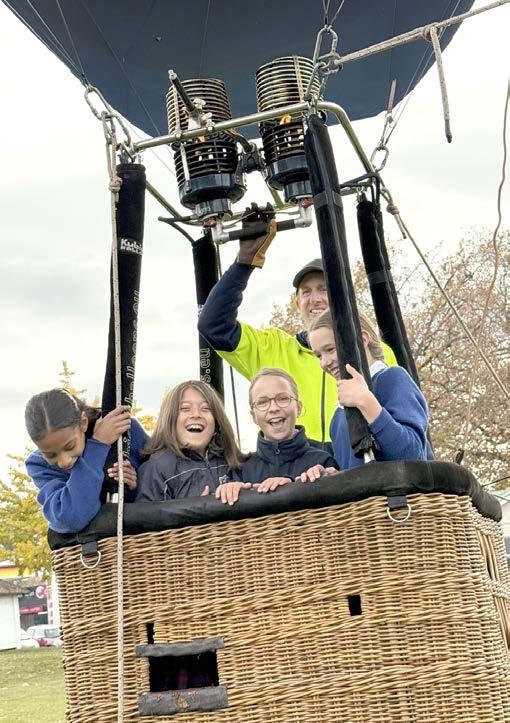

Balloon pilot Andrew Parker with the first excited fliers of the day, from left, Simona Alvares, Elena Reidel, Eva Brock and Mia Orchard.
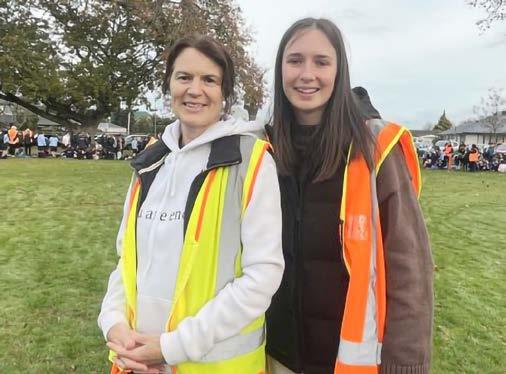
St Peter’s Catholic School principal Nicole Higby, left, with teacher Ella Neilson, who celebrated her birthday with a balloon flight.
Understanding intelligence
By Jesse Wood
Pukeatua-raised author, designer, film director and AUT professor Welby Ings was near illiterate until 15 - now he goes to bed with poets and authors.
“Every night, I am in an intimate relationship with something someone has written,” Ings said.
“It was difficult for me to undo the damage of being taught I was a ‘backward’ reader. It was hard to build confidence after years of being described as ‘falling behind’ and ‘failing’.”
Once expelled from Te Awamutu College, Ings was back in town earlier this month, educating others at the Continuing Education group.
Described as a disobedient thinker, Ings is a renowned speaker and educational reformer. He sees productive disobedience as behaviour that pushes our thinking and action into new and unconsidered realms.
Ings spoke about invisible intelligence; a subject he has recently written a book about.
Next month he leaves for a lecture tour of Spain, Poland, Germany and the United Kingdom, where he is speaking at conferences on the nature of thought.
“I was driving around the back streets [of Te Awamutu] here today and thinking, that this town gave me opportunities at a time when I didn’t see it,” Ings said.
“I left here expelled and angry. But I also encountered people who were helpful. I’m a happy man and I live a really great life – but I realise it’s a life
enabled.”
In his talk, Ings covered topics including what it is to fall behind, the tension that exists inside schooling, neurodiversity, the nature of intelligence and creativity - and New Zealand’s “extraordinary” education system.
“I believe all people are neurodiverse. None of us think in the same way.”
He hoped his address might put an arm around people’s shoulders, acknowledging people with vastly difference intellects were in his audience.
Ings spoke about several different kinds of intelligence, non-linear thinking, embodied thinking, translative thinking and slow, reflective thought.
He has a deep respect for teachers.
“Some people teach inside the system and sometimes people teach as grandparents and peers,” he said.
Ings also argued that literacy is poorly assessed in formal education.
“When I started teaching, I was in Otara, during the dawn raids. I had classes with six and seven year old kids.
“I had a ‘special’ class, of kids who were considered largely ‘illiterate’. But they weren’t illiterate. Many of them spoke three languages and they could pun between languages.
“If an idea couldn’t be expressed in one language they would jump sideways and explain it in another.”
Translation is one of the most complex literary skills we have, he said.
“These kids were displaying, in plain sight, the ability to translate, but [according to the system] it didn’t
count. What counted was the ability to read and write English.”
Ings likens the complexity of teaching to being a “constant gardener”, a term he took from a movie of that name.
“In a garden there will be marigolds, daffodils, tomatoes and pumpkins and they will be trying to grow in the same soil at the same time,” Ings said.
“They are all different, they need different things and they develop at different times. They have diverse strengths and vulnerabilities, so they require different kinds of care.”
Ings argues that people should not be taught in standardised “single solution” systems like the science of reading phonics. They require multiple approaches.
Ings learned to read via the shapes of words. He sees them as blocks and recognises a spelling error because it doesn’t “look right”.
“But when you have an education system that reduces learning to standardised approaches, you limit the dexterity teachers need,” he said. “Complex learners rely on an educator with 50 tools in the toolbox, not one.”
Teaching is a complex profession, irrespective of the age of the people with whom you work.
“Be they children of five - or adults completing doctoral degrees. Your job is to understand how each individual thinks,” Ings said.
“You are not filling a head with content, you are growing skills; perceptively working with not one standardised mind, but 20 nonstandardised minds.”
Waikato Expressway works: Stage 4
As part of major ongoing works on the Cambridge section of the Waikato Expressway NZ Transport Agency Waka Kotahi will close the northbound on-and o -ramps at the Victoria Road Interchange at Hautapu from week commencing 15 June (weather dependent) to mid-July.
Delays are expected, particularly at peak travel times. Plan ahead for ongoing ramp closures and allow extra time for journeys.
Key
Northbound on-and-o ramps closed at Hautapu
Detour northbound into Cambridge and Hautapu
Detour northbound to Hamilton and SH1
Alternative detour to Hamilton
While these are recommended detour routes, please consider all alternative routes to ease congestion.
Kaipaki
Tamahere
Kaipaki
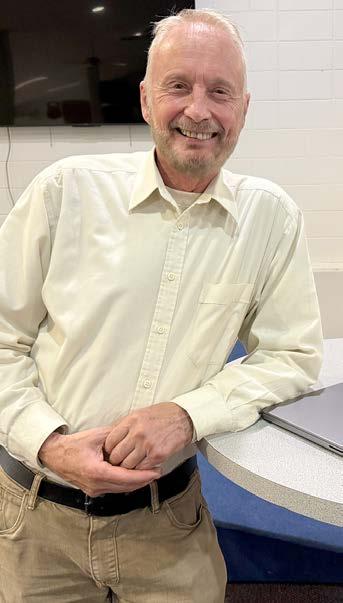
Welby Ings


SHOP LOCAL





































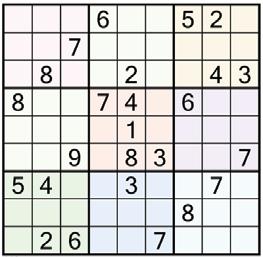
Across 1. Agitated (inf) (3,2) 4. Be thrifty (6) 8. Lei (7) 9.
Last week
21. Famed (5)
Unsettle (7)
Nau mai, haere mai ki
Nau mai, haere mai ki
Nau mai, haere mai ki
Nau mai, haere mai ki
Kemureti Kohanga Reo
Kemureti Kohanga Reo
Kemureti Kohanga Reo
Kemureti Kohanga Reo
Nau mai, haere mai ki
Kemureti Kohanga Reo
Birth to primary school age
Birth to primary school age
Birth to primary school age
Birth to primary school age

Hours: School terms 9:00am – 3:00pm Monday to Friday
• Birth to primary school age
Hours: School terms 9:00am – 3:00pm Monday to Friday
Birth to primary school age
Hours: School terms 9:00am – 3:00pm Monday to Friday
Hours: School terms 9:00am – 3:00pm Monday to Friday
• Hours: School terms 9:00am – 3:00pm
Cost: $30 per week per whānau (can be multiple children)
Hours: School terms 9:00am – 3:00pm Monday to Friday
Proudly
Cost: $30 per week per whānau (can be multiple children)
Cost: $30 per week per whānau (can be multiple children)
Monday to Friday
Contact: Aroha Kara 027 452 0264
Cost: $30 per week per whānau (can be multiple children)
Contact: Aroha Kara 027 452 0264
Contact: Aroha Kara 027 452 0264
Contact: Aroha Kara 027 452 0264
• Cost: $30 per week per whānau (can be multiple children)
Cost: $30 per week per whānau (can be multiple children)
Address: 3 Bracken Street, Leamington, Cambridge (next to Ngaa Hau e Whaa Marae)
Contact: Aroha Kara 027 452 0264
• Contact: Aroha Kara 027 452 0264
Address: 3 Bracken Street, Leamington, Cambridge (next to Ngaa Hau e Whaa Marae)
Address: 3 Bracken Street, Leamington, Cambridge (next to Ngaa Hau e Whaa Marae)
Address: 3 Bracken Street, Leamington, Cambridge (next to Ngaa Hau e Whaa Marae)
Address: 3 Bracken Street, Leamington, Cambridge (next to Ngaa Hau e Whaa Marae)
• Address: 3 Bracken Street, Leamington, Cambridge (next to Ngaa Hau e Whaa Marae)
New Builds, Renovations, Indoor/Outdoor Tiles, Swimming Pool Tiles.
57 Alpha St Cambridge cambridgetiles@xtra.co.nz PHONE


Across: 1. Maths, 4. Crabby, 7. Car, 8. Agenda, 9. Utopia, 10. Stock exchange, 14. Awful, 15. Duvet, 18. Perpendicular, 23. Rotund, 24. Doddle, 25. Gel, 26. Wheeze, 27. Event.
Down: 1. Might, 2. Tonic, 3. Scared, 4. Crutch, 5. Aroma, 6. Bring, 10. Stamp, 11. Offer, 12. Novel, 13. Enter, 16. On edge, 17. Middle, 19. Epoch, 20. Pause, 21. Undue, 22. Allot.
TRASWTTTIMEROBXGPQ TIPKEMNNDFGAVKDEGP LDERRVAIGPRGXOERRU EGCEECPOXKREPLRRAC ZEUHDSRPURENECSITG YIASNTTRAESREZLMEG RESAEERECNIMSEEQRE EEKWLAVWNIDCRPRRFB KETHBMWOIAITOVOUEX CTFSTEOPSRUFSRAOTM OOIIARRMATQZSEEONS RZYDNOKJBSICIGNRIG CQQKKKTSSALGCGTSUA FCMICROWAVEFSGZLZE LFMZFMPCUALUTAPSYZ
BASIN BLENDER COOKER CORER CROCKERY DISHWASHER EGGCUP FREEZER FRIDGE
GLASS
GRATER KETTLE
We also specialize in
offering the ability to tell your story, exactly how you would like it told.

Jono Gibson Funeral Director
















St Kilda - Elevated, 3 Car Garaging
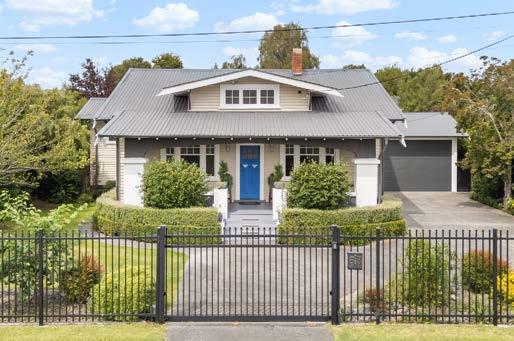
- A home that carries the architectural romance of its era.
- Stunning privacy in backyard.
- Enjoy the luxury of a master bedroom with ensuite.
- Character high ceilings enchant the ambience.
- Outside you will find a studio with bathroom to enjoy pastimes.
- A huge front porch that welcomes you home.
- Powered pergola creates a sunny outdoor entertaining area.
- Upgrades-ducted Daikin air-conditioning and Solar panels. A True Character Meets Peaceful Living
Refined Living With Sun, Privacy & Prestige

- Thoughtfully designed for family living, the home showcases a well-considered layout with all the elite features you need.
- Standout kitchen with well-appointed scullery tailored to impress.
- Light-filled open plan floorplan.
- Separate lounge.
- Super handy office nook for work-from-home.
- Entertaining is a dream with the generous portico, creating a superb outdoor living zone for year-round enjoyment.
Stunning Living - On Top Of
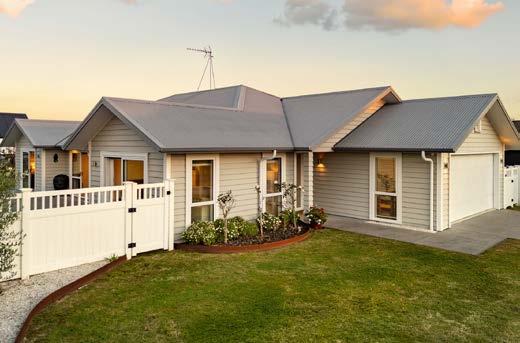
-
- Generous and versatile separate lounge.
- Private, north-facing aspect, the outdoor space is a true highlight.
- Every room is generously proportioned, offering space to grow, unwind, and settle. Internal access garaging adds practicality.
- Private, north-facing aspect, the outdoor space is a true highlight.
- Impressive collection of fruit trees.



- Bleached
- Stunning Italian-designed kitchen is the heart of the home.
- Spacious lounges & dining – relaxation & entertainment at its best.
- Large doors extend living outdoors to expansive decks.
- Master suite is positioned to savour the sweeping views, with a walk-in robe, elegant ensuite & doors opening to the spa terrace.























EXPERTS






























EXPERTS










with Jan Bilton
Sweet
Many dishes have been named after the places where they originated or after the people who first created them. The chocolate chip cookie was invented in 1938 by Ruth Graves Wakefield, owner of the Toll House Inn in Whitman, Massachusetts. She famously chopped a Nestlé semi-sweet chocolate bar into small pieces and added them to a cookie recipe, expecting them to melt. Instead, they held their shape. Thus, the Toll House Cookie was invented. During the 20th century, chocolate chip cookies grew in popularity through their association with the Swiss chocolate company, their distribution to American troops during World War II, and the development of new versions by manufacturers in the 70s and 80s.
Despite their name suggesting a Tuscan origin, Florentine biscuits most likely originated in France during the 17th century. It is said that French chefs created them to honour the Medici family of Florence or Queen Catherine de Medici. With roots dating back to the 12th century, Shortbread originated in Scotland as a medieval ‘biscuit bread’ made from leftover bread dough. Over time, it evolved by replacing yeast with butter, becoming a luxury treat commonly associated with celebrations such as Christmas and Hogmanay.
Choc Balls
225g butter
1/2 cup icing sugar
1 cup almond meal
2 cups plain flour
1/4 teaspoon almond essence
75g dark cooking chocolate
1/2 cup icing sugar, extra
Line one or two baking trays with baking paper.
Cream the butter and the first 1/2 cup of icing sugar, until smooth and creamy. Beat in the almond meal, flour and almond essence.
Cut the chocolate into approximately 1cm cubes. Take a heaped teaspoon of the dough and neatly roll it around a

cube of chocolate. Place on the baking paper. Repeat with the remaining mixture and chocolate cubes. Chill for 30 minutes.
Preheat the oven to 160°C.
Bake the Choc Balls for about 40 minutes, until lightly golden. Remove from the oven and, while hot, dust with the remaining icing sugar. When cool, store in an airtight container. Makes about 30.
Florentine Slice
250g dark chocolate
50g butter
1 cup sweetened condensed milk
2 cups corn flakes, coarsely crushed
80g glace red cherries, chopped
1 1/2 cups roasted mixed nuts (cashews, peanuts, Brazil), finely chopped
1 1/2 cups dried fruit mix
Preheat the oven to 180°C. Line a 30cm x 20cm x 5cm pan with baking paper, then grease.
Melt the chocolate over just simmering water in a double boiler or in the microwave. Spread evenly over the base of the pan. Refrigerate until set. Melt the butter and mix it with the condensed milk. Combine all the other ingredients in a bowl and mix well.



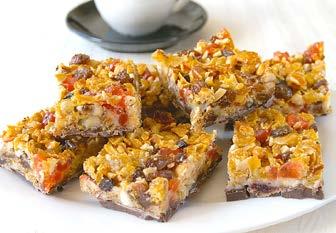
Spread the mixture evenly over the chocolate, then press down firmly and evenly. Bake for 15-20 minutes. Cool in the refrigerator until set. Cut into fingers or squares. Makes about 24.
Rosemary Shortbread
1 cup icing sugar
1 teaspoon finely chopped rosemary leaves
250g butter, softened
1 cup custard powder
1 teaspoon finely chopped rosemary leaves
1/2 teaspoon vanilla essence
2 cups plain flour
Place the icing sugar in a bowl and stir in the rosemary leaves. Cover and stand for a couple of days for the rosemary flavour to infuse the icing sugar.
Cream the butter together with the icing sugar (with rosemary) and custard powder until light and well mixed. Add the essence and mix well. Stir in the flour. Knead the dough lightly to mix.
Roll out the dough to about 7mm thickness. Shape and/or mould the shortbread as desired. Place on a cold baking tray. Chill for at least 30 minutes to prevent spreading. Preheat the oven to 180°C. Bake the shortbread for 15-20 minutes. Makes about 30 x 3-cm round biscuits.
treats
Choc Balls
Florentine Slice
First round to Hautapu
By Jesse Wood
Hautapu premiers beat Ōtorohanga 40-26 at Cambridge’s Memorial Park to pip Hamilton Marist to first round honours and the Ron Crawford Shield.
Both teams won seven and lost once – and picked up points for the win over Melville which is not playing in the competition –but Hautapu finished with nine bonus points to Marist’s seven.
Its points differential was huge – 417 – compared to Marist’s 221.
The Ōtorohanga win provided a great celebration for halfback Rui Farrant who played his 50th game in the red and white hoops.
Club stalwart David Morris helped himself to a double, as did outside back Marae Nepia. Winger Josh Brunger was among the other scorers in the six try to four victory. First five-eighth Alapati Soagia slotted five conversions. Club stalwart David Morris helped himself to a double, as did outside back Marae Nepia.
Winger Josh Brunger was among the other scorers in the six try to four victory.
First five-eighth Alapati Soagia slotted five conversions, kicking at 83.3 per cent.
Pirongia Rugby Sports Club hosted all of their senior rugby teams on King’s Birthday Weekend as they celebrated 150 years – a first in the Waikato.
Their division 1B side, alongside the high-flying Leamington division 1A team, remain unbeaten.
Te Awamutu Sports lost 43-21 to University in Hamilton. The students put on seven tries to Sports’ two.
Veteran former King Country loose forward Matthew Towers and Southland Stags prop Joe Walsh crossed the chalk for Te Awamutu.
An instant seven points also came their way in the form of a penalty try, while
midfielder Kees van der Heyden was successful with both conversions.
In the earlier premier B matches, Hautapu B beat Ōtorohanga B 38-19 and Te Awamutu Sports premier development won against University B 41-24.
Left winger Kobe Jakeman scored two tries for Hautapu B in the six tries to three win.
Rory Blyth, Sam Veart, Jese Ravunacagi and Callum
Keiton MacDonald added two conversions and Chapman one.
In division 1A, Pirongia beat Ōhaupō 37-17 under the mountain.
Winger Daniel Belk scored a brace, while midfielder Austin Frederick, Jason Hill, Finley Pitts-Brown, Sunia Ragede and Ty DemlerFindlay also crossed the line. Hill also added a conversion.
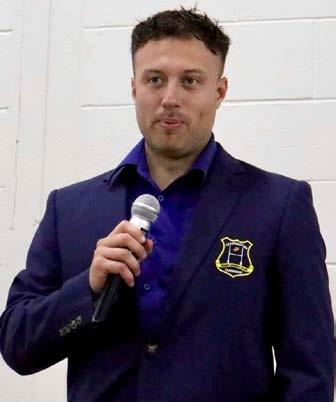
Beckett also grabbed fivepointers.
Hautapu fullback Dillon Martin kicked four conversions in front of the home crowd.
Hautapu B won the Waikato Rugby Union Cup after finishing on top following round one.
The Te Awamutu Sports B victory was a great way to celebrate front-rower Cameron Maake’s 50th match for the side.
Hooker Jack Wallace grabbed two tries on début and Dylan Jeffries crossed the line once again.
Centre Kaleb Chapman, Kowhai Nepia and Josh Hewlett were fellow try scorers.
First five-eighth Dean Fullerton kicked seven points for the visiting side.
Fellow Ōhaupō backs Scott Thomas and Queyst Michael-Tapu scored tries.
Leamington dealt to Frankton 68-0 to retain the Clarke Family Cup in Leamington. They finish at the top of the division following round one.
Lock Yianni Hilder, Cameron Collins and centre Jonathon Kelly scored two tries each.
Number 10 Keegan Harris and hooker James Nelson both scored tries in their blazer matches. Others to score were forwards Thomas Medley and Drew Bootten.
The impressive Robert Day added 18 points off the boot.
In division 1B, Pirongia B won against Ōhaupō B 33-17.
The combined A and B scores saw Pirongia retain the McInally Cup (Ōhaupō Hotel Football Challenge Cup).
They also received a shield for finishing the first round on top.
Leamington B won by default against Frankton B. Mel-tap (MelvilleHautapu combined) headed to South Waikato and defeated Putāruru 31-10.
Two tries were scored by winger Eden Early. Tiare Dixon, Maya Tebbutt and Lachyn Moeke also registered five-pointers.
Fullback Keira Russell successfully kicked three conversions.
Pirongia were pipped 3024 by Morrinsville Sports in the women’s championship.
Emma Foss and Amy Kerr got a try apiece, while fullback Sarah Moorhose grabbed two.
Moorhouse converted two of the tries.
Kihikihi head to Hinuera, thrashing them 50-7 at Wealleans Park.
Rinoa Day registered 15 points for the visitors and Sarah Payne grabbed two tries.
Charlize Waters, Stella Tamaki-Whatarangi, Valentine Tavita, Mikayla Kahura and Leeza Riddell also scored.
In the under 21 division, Te Awamutu Sports beat Suburbs colts 34-14 in Hamilton and Hautapu pipped Morrinsville Sports colts 22-18 in Cambridge.
Pirongia defeated United Matamata Sports’ under-21 side 26-7, while Leamington colts were trounced 83-5 at home by Thames Valley United.
In a Friday night presidents clash, Pirongia Mountain Men played against Waikato presidents, winning 21-15.

Clause 5 of Schedule 1, Resource Management Act 1991.
The following private plan change to the Operative Waipā District Plan has been accepted under delegated authority for public notification by Waipā District Council:
PROPOSED PRIVATE PLAN CHANGE 36 –
ŌHAUPŌ LARGE LOT RESIDENTIAL EXTENSION
In summary, the proposed private plan change request seeks to change the Operative Waipā District Plan by:
• Rezoning 21.50 hectares of land from Rural Zone to Large Lot Residential Zone.
• Inserting a new appendix for the Ōhaupō South Structure Plan into the Waipā District Plan.
• Amending the Planning Maps to delete the State Highway 3 Scenic Corridor Overlay from the plan change land.
The plan change area is bordered by Ryburn Road to the north, State Highway 3 to the east, Rural Zone land to the south, and the North Island Main Trunk railway line to the west. The land is comprised in four records of title legally described as Lots 2 and 3 DP 597425 and Lots 1 and 2 DP 606747.
The full proposal can be viewed:
• Online at www.waipadc.govt.nz/planchange36
• At Waipā District Council offices in Te Awamutu (101 Bank Street) and Cambridge (23 Wilson Street).
Submissions
Any person can make a submission by sending an electronic or written submission to Waipā District Council by one of the following methods:
• Online: Download Form 5 on the Waipā District Council website at www.waipadc.govt.nz/planchange36
• Send to: Freepost 167662, Waipā District Council, Private Bag 2402, Te Awamutu 3840
• Email: districtplan@waipadc.govt.nz
• Deliver to: Waipā District Council, 101 Bank Street, Te Awamutu OR 23 Wilson Street, Cambridge
The submission must be in the form as set out in Schedule 1 of the Resource Management (Forms, Fees, and Procedure) Regulations 2003 and must state whether you wish to be heard on your submission. Copies of this form are available from Waipā District Council.
Submissions close at 5.00pm on Thursday, 2 July 2026. Steph O’Sullivan Chief Executive
For and on behalf of the Waipā District Council.


Keegan Harris celebrated his Leamington blazer game in style, a 68-0 victory.
Photo: Leamington Rugby Sports Club



2026 Ownership Review


PUBLIC CONSULTATIVE PROCEDURE
In accordance with the Deed of Trust under which the Waipā Networks Trust has been constituted, the Trustees and the Directors of Waipā Networks Limited have prepared a joint report considering proposals and available options for the future ownership of Waipā Networks Limited.
The Trustees and the Directors propose that the Ownership of the Company should continue to remain 100% Trust owned on behalf of the Community.
The Trustees hereby implement a Public Consultative Procedure. Notice is given that the Ownership Review will be available for inspection by the public from the 1st May 2026, from the Trusts website www.waipanetworkstrust.co.nz or during normal business hours at the following location:
Waipā Networks Ltd 240 Harrison Drive TE AWAMUTU
Persons interested in the proposals are invited to make written submissions to the Trustees.
All mail submissions should be addressed to:
Submissions to the Trustees
Waipā Networks Trust PO Box 34
TE AWAMUTU 3840
All email submissions should be addressed to: info@waipanetworkstrust.co.nz
Persons wishing to make submissions should ensure that those submissions are received at the above address no later than 5pm 30th June 2026 (“the due date”). Submissions received by the due date will be made publicly available.
In due course, any persons who make written submissions by the due date will be offered an opportunity to be heard by the Trustees at a meeting open to the public.
KM Heeringa Trust Manager WAIPA NETWORKS TRUST



FOREMAN, Margaret
Yvonne – Passed away at home on Friday 29 May 2026, aged 87 years. Much loved and loving partner of the late Bill Lindberg, previously Mortie Foreman and Viktoras Procuta. Loved mother and mother-in-law of Antanas and Tara, John and Emma, Elena and Richard, Alex (Sandy), Andrew and Sharon. Grandmother of Tane, Melody, Nick, Pietta, Apirana, Kane, Jack, Liam, and their families. Valued step-mum of Mark, Julia and their families. A celebration of Yvonne’s life will be held at Cambridge Town Hall, Victoria Street, Cambridge tomorrow, Friday 5 June at 2:00pm. Communications to Yvonne’s family C/- Gibson Funerals, PO Box 501, Cambridge 3450.





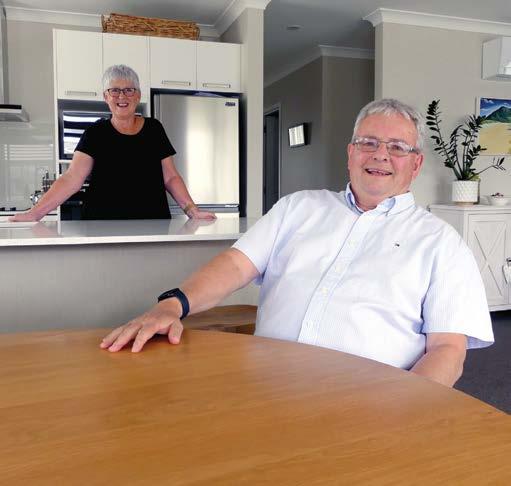
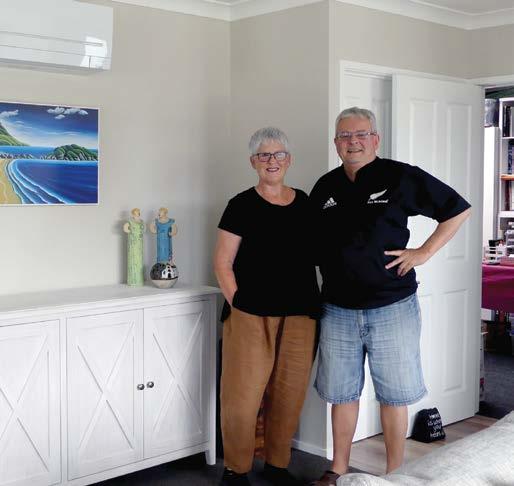
Summerset “superior
“I’d been to Summerset on a couple of occasions as part of my job as Eve’s Real Estate branch manager in Papamoa. We looked at villages in the area and when we compared them all, we felt that Summerset is superior in a lot of ways,” said Summerset resident, Trevor Hansen.
A place that feels like home
“When we started to look for a retirement village, we included our children. We have three adult boys, two locally and one in Germany. The local boys came with us to visit villages,” said Trevor. “The main draw was that Summerset is modern with a number of different facilities on site that were superior, and the location is close to our sons and the grandkids.”
“We liked the village cafe as well as the people here. The staff were very friendly towards us, even though we hadn’t yet signed up. When you throw all of that into the mix, Summerset was ticking so many boxes. And Heather liked this village for the newness and its safe and secure, with care facilities for later.”
The value of village living
The Hansen’s felt more informed than others might when they started looking for a retirement village and shared the importance of understanding the value you’re really getting when signing up to a village.
“Being in real estate helped a bit with understanding contracts and I knew about licence to occupy
in a lot of
ways”
agreements. I’m not saying I’m an expert, we took legal advice, and our solicitor was our trustee. A fundamental thing to understand is the deferred management fee. As long as you can get your head around that, then you can see the benefits for you,” shared Trevor.
“It’s also important to get your families support on what you’re doing. In real estate, I dealt with a number of people who were thinking about going into a village who were talked out of it by their children. I saw people in their late eighties and nineties saying, ‘we’re not going to sell now we’re going to stay here.’ Our family said, ‘go for it’.”
“I believe that above all you have to place a high value and worth on the lifestyle and camaraderie. And all the facilities and activities you can do on your doorstep. Then there’s the safety and security. You need to place a lot of worth and value on enjoying all that while you’re alive,” stated Trevor.
Since moving in, the Hansen’s have more in their diaries than ever. Trevor participates in the ukelele group, bowls and pool teams. While Heather is a fan of the fitness classes and enjoys crafting.
If you’d like to know more about Summerset Cambridge, call 07 839 9482 or visit summerset.co.nz/cambridge