FREE
SEPTEMBER 2026
BAY OF PLENTY The voice of Bay of Plenty
Making connections Page 3
A rising talent Page 5
Checking in on employers Page 7
Shadbolt: The final chapter Page 8
Harvest beats frost Despite winter frosts reducing yields in some orchards, Bay of Plenty growers remain on track for a bumper avocado season supported by strong offshore demand, writes David Porter.
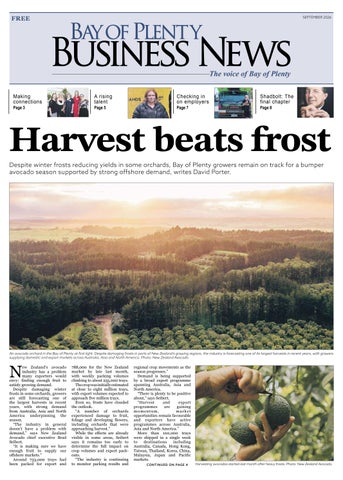
An avocado orchard in the Bay of Plenty at first light. Despite damaging frosts in parts of New Zealand’s growing regions, the industry is forecasting one of its largest harvests in recent years, with growers supplying domestic and export markets across Australia, Asia and North America. Photo: New Zealand Avocado.
N
ew Zealand’s avocado industry has a problem many exporters would envy: finding enough fruit to satisfy growing demand. Despite damaging winter frosts in some orchards, growers are still forecasting one of the largest harvests in recent years, with strong demand from Australia, Asia and North America underpinning the season. “The industry in general doesn’t have a problem with demand,” says New Zealand Avocado chief executive Brad Seibert. “It is making sure we have enough fruit to supply our offshore markets.” Around 733,000 trays had been packed for export and
788,000 for the New Zealand market by late last month, with weekly packing volumes climbing to about 255,000 trays. The crop was initially estimated at close to eight million trays, with export volumes expected to approach five million trays. Even so, frosts have clouded the outlook. “A number of orchards experienced damage to fruit, foliage and developing flowers, including orchards that were approaching harvest.” While the effects are already visible in some areas, Seibert says it remains too early to determine the full impact on crop volumes and export packouts. “The industry is continuing to monitor packing results and
regional crop movements as the season progresses.” Demand is being supported by a broad export programme spanning Australia, Asia and North America. “There is plenty to be positive about,” says Seibert. “Harvest and export programmes are gaining momentum, market opportunities remain favourable and exporters have active programmes across Australia, Asia and North America.” More than 100,000 trays were shipped in a single week to destinations including Australia, Canada, Hong Kong, Taiwan, Thailand, Korea, China, Malaysia, Japan and Pacific markets. CON TIN UED ON PAGE 4
Harvesting avocados started last month after heavy frosts. Photo: New Zealand Avocado.
2
BAY OF PLENTY BUSINESS NEWS
CONTACTS Editor David Porter
editor@goodlocal.nz
021 884 858
maryanne@goodlocal.nz
021 705 213
Senior Writer Mary Anne Gill
Advertising Director Janine Davy
janine@goodlocal.nz
027 287 0005
David Mackenzie
david@goodlocal.nz
021 684 304
To Advertise
sales@goodlocal.nz
News Tips
editor@goodlocal.nz
Owner/Publisher
Office/Accounts admin@goodlocal.nz Website
goodlocal.nz
To Subscribe
admin@goodlocal.nz
Readers’ contributions of articles and letters are welcome. Publication of contributions are entirely at the discretion of editorial staff and may be edited. Contributions will only be considered for publication when accompanied by the author’s full name, residential address, and telephone number. Opinions expressed are not necessarily those of the publishers. Bay of Plenty Business News is published by Good Local Media Limited.
Also publishers of
SEPTEMBER 2026
REGIONAL VIEW
Waiting for Wellington By TODD MULLER
The election “wait and see” game; real caution or a story we tell ourselves? Christopher Luxon copped a hiding for his “parent-child mentality” line to Rotorua business owners, telling a room grappling with falling foot traffic to stop asking what government will do for them and “be adult”. It certainly missed the mark with some in the audience, and he rightly apologised. But strip away the delivery, and there’s a question underneath worth asking honestly Three months from an election how much of our caution as business owners is really about Wellington, and how much is a story we tell ourselves and each other? We hear it every election cycle. Real estate agents say sales slow, business owners say they’re deferring capital decisions, my local Indian restaurant says bookings drop away (though takeaway holds its own), and boards say they’re waiting to see what shape the next government takes. It’s treated as settled fact. It isn’t. Westpac senior economist Michael Gordon has called it “a bit of an urban legend” because since 1990, GDP growth has actually run slightly higher in election years than the long-run
average. Recent research also suggests political uncertainty doesn’t uniformly suppress investment; some SMEs pull back, but others read the same uncertainty as a window to just keep moving as they always have. As one local business owner told me, “if you are waiting for business certainty retire!” So if the economy-wide data doesn’t clearly support the story, why does it feel so true on the ground? Partly, I think, because business confidence surveys, which we all watch closely, are themselves politically inflected, tracking meaningfully higher under National-led governments regardless of underlying conditions. We’re measuring sentiment, not activity, and mistaking one for the other. Partly it’s genuine, specific uncertainty - a live prospect of a capital gains tax, or an end to interest deductibility, is a real reason to defer a decision, which is rational and not psychological. But I also think, as Gordon’s data suggests, it’s become an article of faith baked into the
NZ business psyche. Wellington spends enormously, sets the regulatory weather, and after successive governments leaning on stimulus and support, it’s understandable that eyes turn there first. The PM certainly could have chosen his words better, but I don’t think he was entirely wrong that we could stand to be a little more self-reliant in our planning horizons. The Bay’s economy isn’t waiting on a caucus vote or an election result to decide whether it can grow. Interest rates are easing, our exporters are finding markets regardless of who’s in the Beehive, and the businesses doing best right now are the ones making calls on their own numbers, not the polls. Wellington matters. It shouldn’t be the excuse. • Todd Muller is a long-term Tauranga resident, former National Party MP, current chair of Priority One and director of Tauranga and Western Bay of Plenty’s joint water organisation. All views expressed are his own.
PEOPLE AND CULTURE
What you need to know By PAUL JARVIE
CountryLife
The Health and Safety at Work Act 2015 has been amended, with the new provisions taking effect on April 1 next year. The reforms arose from concerns that health and safety systems had become overly focused on compliance rather than improving safety outcomes. A major change is the introduction of a two-tier system. Businesses with fewer than 20 workers for at least nine months of a financial year will be classified as small PCBUs (persons conducting a business or undertaking), while all others will be large PCBUs. Approximately 97% of New Zealand businesses are expected to fall into the small PCBU category. The most significant practical effect is a different approach to risk management. Small PCBUs will be required to identify and manage critical risks, while large PCBUs must continue to manage all workplace risks, giving priority to critical risks. A critical risk is broadly one likely to result in death or a notifiable injury or illness. To determine whether critical risks exist,
PCBUs must consider Schedule 1A of the regulations and ACC Schedule 2, as well as other hazards that could reasonably cause death or a notifiable injury or illness. The legislation also recognises mental health harm. Guidance is expected on how these provisions will operate in practice. Another reform concerns officers’ due diligence duties. The Act clarifies that these obligations apply to governance functions and do not extend to operational tasks undertaken by owner-directors. Some practical questions remain. The two-tier structure also affects worker protections. Small PCBUs will need to provide training, instruction, supervision and personal protective equipment for critical risks, while large PCBUs must continue to do so for all workplace risks. Standard welfare facilities, including toilets, washing facilities and first aid, remain mandatory for every business. For contracting arrangements, small PCBUs working on another business’s site
need only manage critical risks, while large PCBUs continue to manage all risks. Each business retains responsibility for its own health and safety obligations - you can’t contract out your duties. The reforms also place greater emphasis on Approved Codes of Practice (ACOPs). Industry groups, unions and business organisations can work with WorkSafe to develop ACOPs. Once approved, following an ACOP in full can provide a safe harbour, meaning a business is Bay of Plenty businesses should begin considering how the new framework will affect their obligations. The EMA’s Health and Safety at Work Amendment Act Roadshow will visit Tauranga this month. The sessions will provide practical guidance on the small and large PCBU distinction, critical risk management and officers’ due diligence duties, helping businesses prepare with confidence. • Paul Jarvie is manager Employment Relations & Safety, EMA.
SUBSCRIBE SUBSCRIBE SUBSCRIBE SUBSCRIBE
…and receive …and a copy, receive posted a copy, …and posted receive a copy,…and postedreceive a copy, posted directly to directly you, every to you, month. everydirectly month.to you, everydirectly month. to you, every month. Price Price is $150 Price + GST is $150 for a+ GST for Price a is $150 + GST for a is $150 + GST for a 12-month paid in advance 12-month 12-month paid in advance paid in advance 12-month paid in advance subscription (equivalent of subscription subscription (equivalent (equivalent of subscription of (equivalent of $12.50 + GST per month) $12.50 + GST $12.50 per month) + GST per month) $12.50 + GST per month)
NOW... NOW... NOW... NOW...
email admin@goodlocal.nz To subscribe To subscribe email admin@goodlocal.nz email To subscribe admin@goodlocal.nz email admin@goodlocal.nz To subscribe admin@goodlocal.nz
Briefs… Cruising underway
The arrival of Celebrity Edge and Celebrity Solstice has launched Tauranga’s cruise season, with 82 ships expected by early May. Tourism Bay of Plenty estimates up to 230,000 passengers and crew will visit, supporting a sector that contributed $111.8 million to the regional economy in 2023/24.
Cyclists’ dissatisfied
A Tauranga City Council survey shows cyclist satisfaction with safety on roads and cycleways has fallen from 56% to 45% in a year. The council described the decline as significant, despite ongoing efforts to expand
Back in
Western Bay of Plenty District Council is back in the Government’s Head Start local government reform process after Rotorua Lakes Council joined Tauranga City Council in submitting an eligible proposal. If approved, a new Western unitary council could replace Tauranga and Western Bay councils, combining local and regional functions.
Review accepted
Tauranga City Council has accepted the findings of an independent review into the fatal landslide at Mount Maunganui Beachside Holiday Park that claimed six lives in January 2026. The report found systemic organisational failures and said the tragedy was preventable. Mayor Mahé Drysdale described the findings as “clear and deeply confronting”.
New board
3
Making connections BAY OF PLENTY BUSINESS NEWS
SEPTEMBER 2026
Three experienced infrastructure leaders have been appointed to the board of Tauranga and Western Bay’s new Joint Water Organisation. Chair Keith Turner is joined by Pat Dougherty and Todd Muller. The entity, due to begin in July 2027, will oversee water, wastewater and stormwater services across the region.
Women across the Bay are finding value in something technology cannot replace: genuine human connection, writes David Porter.
F
or many women in business, the value of networking is not measured in business cards exchanged or LinkedIn connections made. It is found in the relationships built, the knowledge shared and the encouragement offered by others who understand the challenges of professional life. The rise of digital networking has done little to diminish demand for face-to-face business connections in the Bay of Plenty. The Tauranga Business Women’s Network is approaching its third decade and continues to attract strong attendances from women keen to build relationships, share experiences and learn from others across a wide range of industries. Valerie Rowe-Mitchell, owner of Emerald Business Advisors, has attended Tauranga Business Women’s Network events for around five years and says it provides both personal and professional benefits. "It’s an environment where you learn and educate yourself," she says. "You meet up with people who are always supportive and friendly. I think it is an extremely valuable network for women in business and the majority of it is to do with likeminded women." Rowe-Mitchell says many of those attending the events are business owners dealing with similar issues and responsibilities. "Growth and progress are the most important things for any business owner. That is probably the most important part for me." Financial adviser Kim Wu from The Financial Collective has been attending Tauranga Business Women’s Network events for about three years. "The main thing I get out of it is the networking and I really enjoy getting to know business owners here and making those connections," she says. "I have found the topics very interesting." Wu says the events regularly expose attendees to people and industries they may otherwise never encounter.
Kim Wu
Matt Cowley
Valerie Rowe-Mitchell
"You get to catch up and mingle and know people you otherwise wouldn't have the opportunity to meet. "There are people with a lot of knowledge in this industry and to me it's always fascinating to know what other people do for their business." She also values the personal development that comes through attending events and hearing from experienced speakers. "Everyone is striving to grow and succeed and learn from each other," Wu says. The Tauranga Business Women’s Network says creating those opportunities is central to its purpose of connecting, supporting and championing women in business across Tauranga and the wider Bay of Plenty. Events range from more intimate networking lunches to the flagship annual Speaker Series, which this year featured broadcaster Hilary
Barry, leadership expert and military veteran Ellen Joan Ford, award-winning podcaster Morgan Penn and Tauranga business leader Jacinta Horan. The event attracted close to 400 attendees. The organisation sees itself as serving women at every stage of their professional journey, from those entering the workforce through to senior leaders and business owners. According to the network committee, strong professional relationships can open doors to new business opportunities, leadership roles, mentoring relationships and trusted sources of advice. The group also recognises that finding time to build those networks can be difficult, particularly for women balancing careers, businesses and family responsibilities. Tauranga Business Chamber chief executive Matt Cowley says the network began in the mid-1990s as an annual women's conference run
by volunteers when the landscape for women in business leadership looked very different. "It started as a bunch of volunteers doing an annual women's conference at a time when women in business leadership was in a different state," Cowley says. Today it is regarded as one of the largest events of its type outside Auckland. "The good thing about this network is that it connects people who are both at the apex of their careers and those starting out as well," he says. After almost 30 years, that ability to connect women across industries, professions and generations remains the network's greatest strength. In a world increasingly dominated by digital communication, the Tauranga Business Women’s Network continues to prove there is no substitute for meeting faceto-face.
Tauranga Business Women’s Network participants at this year’s Speaker Series, from left Bridget Jenkins, Ailsa Fisher, Jo-Marie Baker, Rachael Nunn, Carrie Brown, Kay George and Katie Douglas-Clifford.
MARCH
PICK UP LOCATIONS Four Square Welcome Bay FreshChoice Pyes Pa Four Square The Lakes Tauranga Library The Fresh Vege Gate Pa Piccadilly Arcade Paper Plus Bethlehem New World Brookfield Cherrywood Lotto And Bookshop PAK’nSAVE Cameron Road MT MAUNGANUI Tauranga Airport Mercury Stadium Baypark
New World Mt Maunganui Four Square Mt Maunganui Paper Plus Mt Maunganui PAPAMOA PAK’nSAVE Papamoa Papamoa Community Centre
nect MA UAO can reconr. SAC RED when we OU Rwill be a time s Todd Mulle
K ATIK ATI/TE PUNA Four Square Katikati Four Square Te Puna FreshChoice Omokoroa Paper Plus Katikati
ROTORUA BNZ Centre Rotorua Airport Rotorua Chamber of Commerce PAK’nSAVE Rotorua
To subscribe E: admin@goodlocal.nz
ERY REC OVrforming the T LED outpe continue s. EXP OR reset Plenty will Bay of as the economy country Page 3
ABO UT ter with ern Quar OU T AND ber. at The North We were Business Cham Tauranga and 15 Pages 14
ING internship progr iwi. i GR OW bility for apa Māor A kaup long‑term capa delivering Page 9
25
. educ nal econ are high staff, while nd asse te over y For regio the stakes ed arou s. and’s deba t new ato, job read table ew Zeal is often fram to find to implemen still and Waik league d are struggle reform standards and omics Forum already are being askeh key details credits, Zealand Econ Management schools tions for whic Year New ersity’s cut through ifica current But at the ato Univ y qual ear. age ence that qualifications d by Waik th, one mess rooms toda uncl the audi new lack hosted ga an ience in class last mon Kanji toldwill sit entirely schools still y. UT Tauran School what happens economic resil yet ents 13, coherentl my AB O nts in e 9 stud s 11, 12 and ed to plan clearly: e the country’s map the futur AN Dyou at eve at Year mation need backward will shapdes. ,” she ssion on principal them infor ently O UT discu catch the prepare ot curr for deca ’ College -ranging most Did weua? “I cann ents to best it.” In a wideTauranga Girlsof the forum’s ives, 9 stud e flying r led Rotor 13-15 A, pect one Year whil NCE e pers ered s of de two i deliv unms the plan ed refor ronting . Page says. Tara Kanj and conf rush thrivingoverseas, building iousRS . face” Forum national “We’re is ation Gil prev KE ess in s migr grounded from “the chalk w of the cy and says Economic i tage and Mary Anne UC busin revie at the Kanj shor Photo: burnout speakingwelcomed a g that litera chalk face O DS leech teach workforce Oer m, sayin from the Kanji n to BL ding dical critical ns. poun tion syste Kanji talks ns. regioschools play a sion, e me riached and desig comTh qualifica y matter. ipal Tara na s, the pace ting new dy stret l cohe ge princ s but academic numerac warned thatms risk crea a time alreaveterind12 ing socia Girls’ Colle Beyoge role by build by employer ols at hly But she osed refor Tauranga ed Pa ing scho en hig ge. omic ly valu prop RE 3 of the s and destabilis s be ima she econ increasing PAGE TUtial. ast um,” d. a skill ED ON rrininhaa Co essenPe vacu sure inequitie lityFisNA TINU mea n y ton CON rarel operate E Ocan’t when stabi Skele er Joh young AWools graph for his “Sch t preparing nship, Photo nded says. commee serious abouty and citize E , socie “If we’r 7 ge UN G with for work people
TY PLEN OF Y A B N
FR
ER 20
MB
DECE
hed warn rus cators ine workforce pace, edu erm s gather ties and und ne Gill. reform qui An m, As NCEA ld widen ine writer Mary curriculu cou ior across change , reports sen rence ty g.” cohe of Plen s we need nt and resourcins like Bay readiness ation omie Employer ssme
EE
nty
y of Ple
ce of Ba
The voi
al Princip sounds larm a reform
o, write There to Maua physically Page 2
TE PUKE New World Te Puke Four Square Te Puke Paper Plus Te Puke WHAK ATANE Whakatane Beacon Main Office
PLENT Y
ENT I TALamm e is MĀ OR
You can pick up a free Bay of Plenty Business News from any of the following locations or view online our e-edition at www.goodlocal.nz TAURANGA Basestation Brookfield Foodmart & Lotto BNZ Centre Tauranga Coffix Cafe Spring Street Arcade Ruthy’s Coffee Bar & Eatery Four Square The Lakes Tauranga Chamber of Commerce Matua Food Market Woolworths Bureta Park Four Square Bethlehem Matua Dairy Maungatapu Lucky 7 Superette
BAY OF
FR EE
2026
e of
voic
Bay
lenty
of P
ens eep d y ster my r u rbo Ha
PL ing TH E is brimm NG market . TA KIhousing bargains
The
Pa
nct d reci e P ons an ti arin e M ques ll th ed racter, to se swer -chic cha ue, sion unan ustrial ease dern ven deci amid rteercharm, ind un ile mo l’s ow. s, sat itag ci ver ism h her a ie id Po oflit for t valued shad Coun critic Wit nality ationma Dav an lega likfec rke e at loc City wide portsand the functio the inct ocess g. the per low rprway din re,” y be you ond d is the der anga city e, re ntlred ey ten to fun ns mo ive go Shee prec ica b del Car – t nif Taur drawn silenc sed The th event sig clo ittedof millio Ye t, le peop ecinc s ovteruniquectares of87 inthean comm has loper e Pr uranga the ioners r snex er ten rin he you ng iss for ve 3.9 ne lop Ta go Ma ee $1 anga y ha de deveour comm Taur cial e of the y thr for natel has ains one l of says.
The s and listing 5 Page
y, a Harve rns .” Erika e, wa left ayers kept. the sal be ratep been tic of could for not sits cri fleet tcome nct ld has ime le ou so g-t local Preci en terrib rine t asset red spok a lon t the ct sal to an ll: “a rtu the with ve nearl land, he have into n, tha rift. w, the Maourfron e obscu not idge, e rem ar.ak ge tra e he “Unfo anga, to subje nt fin der t, spe finde fe ye Br or e ing nc xt ur e t Uff ten rb are ad r no Ro sit natio ac y las →nificased ne eci rnr-fmor visit m for futur –-lik our a laraddle the Taur it cod okayesig prLea Fo bo - a hat, its fut lopers ists its Sam the the ou sti up ir Sa today tions ofthe Ma luded QR a clo ht Harbyet its its and ming it de ether ion harb n inspe cialists, str eraor lim coun e deve cil ins unity come scan thoug ayers to h a to makel on the for lliouesale inc elled e op gh silence.ly be ve n Th coun ref t wh t vis ls in a dis urt Curry nsfor ug ven mi comm ing rin .nz water e – d.co tra acht at ratep thro order ortfal throu ed in the er anyth er f-propshe tru it ha in cocific ence. the The selargo abou fil thar vesse lar of sh in mat of the storag . and ry a ful the ref ised ger Pa by silking, loss ess in ding -w.c cloak ill it wheth er. ct.” n Scou g, ed ou tied, er wheth supe ts lin n ever e largeneath tor, ww , or siness ll lift us en oje or ea din ht oc W om ls fun pr air Je era sp pr ge wh op answ we pr s are nd all ry ac r the nct s bin ted doub nct ca becaus ss be crane vessece, rep orks bu was ’s only ns hand t to wo e at a hu Preci mayo e wa preven g su pe lopers s year, vices stop the anga to pa e. preci t least to lift enan ssel W figure valuatio$23 into gle r Bridg Taur ised is lef emerg remain Civic puty the sale that erturnin deve er thi e ser ed to fade int no nt ug Ve to om ma the ov t. De me dent str rbou in pr ser will ce will ned. earli marinully tri vision se rmed advic from ac t to may y Ha lders once and e settle epen rth clo a sideli bson silen confi legal uncil ’ contr s, uneae a 7, Th ind ccessf ll the tiated ed ou ered ing nearb keho et, Ro its wo citingnew co ionerslegalitie t lik unsu Or wi ? nego in ted reach he off be Sta g fle fear be John in 2015 belowplaced d w the commissnd the precinc sale? tainty e NewsCurry, would or was nt -ap po alise de fishinort, no uncillor made that n. le me d fin cted the the t beyo uncerhen Th pert plans begins, s ma llio pp sa co ise rn ele su wa mi er Ru en er prom Ye W an wly go ve The ion s ov the loper on wh ction Form the ers ’s ne gust. MP r going hang ow. al decis . deve rity constru d to ga in Au anga still ocess says ors un de ission ned shad e fin sed do attache uran pr le.” no clailed, d. is it’s comme Ta k office Taur ndem for Th lopers unve es share enge ultation peop ge, d clo itions ue. deve befor cil too luding ve co tcome sed all behin e cond opaq rbury inc imag he ch cons th a few messa to coun itics, dell, ha ble ou the clo cil’s t Th the “T ain Cante nt wi ief tex able ge, Cr Uffin “terri gh to coun to rem a ing sale d while throu mome a br m unthis sta to Sam deal as ,” point d the llions “I’ t at An mi date e at theter, in ded: en the ayers ess an ther La ad comm an up includ asset ve y ratep r proc t of fur an Curryide an we ha sure to de en ly ld ten on itm so ov s be pr when loper. cil) e ha ving comm un deve lea in but se, I’ll borat the he co relea self.” al to ela stery,drifting “(T your s refus the myoject the Hi nt pr sold ened cil deep waterfro. Coun the lation City specuuranga Ta
T
ich
: Ulr
oto
Lang
4
BAY OF PLENTY BUSINESS NEWS
Harvest beats frost Australia has re-emerged as New Zealand’s largest avocado export market this season, but diversification remains central to the industry’s strategy. During the 2025-26 season, 78 per cent of exports were shipped to markets outside Australia, highlighting the growing importance of Asia and North America. Canada has emerged as a promising market, receiving close to 300,000 trays in only New Zealand’s second season supplying the country, highlighting the potential of North America alongside established Asian programmes. As competition intensifies from larger producers such as Peru and other South American countries, Seibert says New Zealand’s success
Brad Seibert
will depend on quality, consistency and timing rather than scale. “The competitive challenge is that these markets are also being targeted by much larger suppliers, particularly Peru and other South American origins.” “Harvest timing, packhouse capacity, shipping coordination and maintaining fruit quality across longer supply chains will all require close management,” Seibert says. “New Zealand’s opportunity is not simply to produce and export more fruit, but to align fruit quality and timing with demand so that increased volume translates into sustainable returns for growers.” Bay of Plenty remains at the heart of the industry, with avocados continuing to make a significant contribution to the region’s horticultural economy. While frost damage is expected to trim production in some orchards, the industry remains confident the season will rank among its strongest in recent years. With demand building across Australia, Asia and North America, the challenge for growers is increasingly not finding customers but finding enough fruit to supply them.
SEPTEMBER 2026
CO NT I NU ED FR O M PAGE 1
Rows of mature avocado trees in a Bay of Plenty orchard. The industry is forecasting one of its largest harvests in recent years, supported by strong demand from export markets.
A Bay of Plenty avocado orchard stretches along Tauranga Harbour with Mauao on the horizon. Despite winter frosts affecting some orchards, the industry remains on track for one of its largest harvests in years. Photo: New Zealand Avocado.
Sponsored Content
Claiming business deductions? Records and timing matter
TAXATION
BY ANDREA SCATCHARD
A recent Taxation and Charities Review Authority decision shows why a genuine business connection - and the records to prove it - are essential when claiming income tax and GST deductions. When does preparing to start a business become actually carrying on a business? And how much evidence do you need to support an expense claim? Those questions were at the heart of the recent decision in L v Commissioner of Inland Revenue. The taxpayer operated an art gallery and art supplies business and claimed income tax deductions for education, home office and motor vehicle costs incurred between 2017 and 2022. These included travel between the taxpayer’s home and business premises in different towns. After registering for GST in September 2022, the taxpayer also claimed GST on preregistration expenses and home office costs. Inland Revenue denied both the income tax and GST claims
and imposed shortfall penalties for not taking reasonable care, leading to the taxpayer’s challenge. The key issues considered by the Authority were - was the business operating when the cost was incurred, and can the taxpayer prove the cost relates to the business? On the first question, the Authority found that the business did not begin until retail trading started in November 2020 . Earlier activities, including creating artwork, studying and exploring sales opportunities, were preparatory rather than part of carrying on the business. Costs incurred during that earlier period were therefore not deductible at all. Even after the business began, the taxpayer’s automotive engineering study was determined not
to be sufficiently connected with the art business to be deductible. The remaining claims ran into an evidentiary problem. The taxpayer could not adequately substantiate the motor vehicle and home office expenses or demonstrate the businessuse basis for the amounts claimed. The GST deductions also failed, again due to lack of evidence and connection to the taxpayer’s taxable activity. The Authority upheld the shortfall penalties, agreeing that the taxpayer had not taken reasonable care. This case reinforces some key principles to keep in mind: • Work out when your business commences. Often significant costs are incurred before a business
•
•
•
•
has commenced. Every expense needs a clear business link. Once business has commenced, costs still need a connection with earning income. Good records are essential. Keep invoices, mileage or vehicle-use records, home office calculations and evidence supporting any private/ business apportionment. GST claims need a clear taxable activity link. The points above are equally relevant for GST, with the exception that GST on costs in setting up a business may be claimable. Unsupported positions can attract penalties. Penalties can add a significant amount to a tax bill following an audit.
With the increase in Inland Revenue audit activity, the outcome of this case highlights the benefit of taking professional advice where deductions are not clear cut.
> “The key issues considered by the Authority were was the business operating when the cost was incurred, and can the taxpayer prove the cost relates to the business?” Andrea Scatchard is a Tax Partner at Deloitte, based in the Bay of Plenty. She can be contacted on ascatchard@deloitte.co.nz
SEPTEMBER 2026
Briefs… Fieldays packed
More than 132,000 people attended this year’s Fieldays event in Waikato, including a record opening day crowd. Organisers faced capacity challenges, with all 1100 exhibitor sites sold out before the event. A $32 million water reticulation upgrade was completed to support growing visitor numbers.
Coverage boost
Ambulance coverage in Matamata-Piako has been strengthened with the introduction of a 24/7 Hato Hone St John service in Te Aroha. Since launching on May 1, the double-crewed ambulance has responded to 334 incidents, averaging 3.2 calls daily, while improving response times to high-priority emergencies. The service is part of a wider effort to improve rural healthcare access.
Estate expansion
A new show home has opened at Overdale Estate in Putāruru as Ultimate Builders launches Stage 8 of the development. The 40-hectare project is attracting strong buyer interest, with limited Stage 7 sections remaining. Future plans include green spaces, walking trails and a retirement village, reinforcing the estate’s long-term community focus.
Aviation expansion
Waikato-based NZ Aero is restarting production of its CT-4 Airtrainer for the first time in 14 years, targeting growing international demand for pilot training aircraft. A new aviation agreement with Thailand could generate significant export revenue, while the company is also exploring Ai-powered flight data analysis to enhance pilot training and safety.
Nick in charge
Nick Johnson, chief executive of the New Zealand Thoroughbred Breeders’ Association, has been appointed chief executive of Waikato Thoroughbred Racing. He replaces Andrew ‘Butch’ Castles who retired on June 30 due to illness. Johnson starts next month.
BAY OF PLENTY BUSINESS NEWS
A rising talent… A
Tauranga apprentice has emerged as one of New Zealand’s most promising young tradies after winning the inaugural Apprentice Young Plumber of the Year regional title and securing a place in the national final. Paige Samuel, a third-year apprentice with Tauranga Hardware & Plumbing Limited, claimed top honours at the Waikato/King Country Regional Final, edging out strong competition in a series of practical and theory-based challenges. While based in Tauranga, Samuel competed in the Waikato/King Country event after scheduling clashes with an apprenticeship block course prevented her from entering the Bay of Plenty/Central Plateau regional competition. The adjustment proved no obstacle, with the young apprentice demonstrating the technical ability and adaptability needed to succeed against some of the region’s best emerging tradespeople. Her victory carries additional significance because 2026 marks the first year of the Apprentice Young Plumber of the Year competition. The category was introduced to provide greater recognition and development opportunities for apprentices in their first three years of training. The competition pathway
begins with branch events before progressing through eight regional finals around the country. Each regional winner earns a place in the national final, creating a platform for outstanding apprentices to showcase their skills and gain industry recognition. Samuel’s achievement is also notable because she is one of only 11 women nationwide to progress to this year’s regional finals. Her success highlights the growing diversity within the plumbing profession and reflects efforts across the industry to encourage more women to pursue trades careers. Like all competitors, Samuel faced a demanding programme designed to replicate real workplace conditions. The event tested practical installations, diagnostic skills, problem-solving and technical knowledge, requiring competitors to demonstrate both speed and accuracy under pressure. Her success comes as trades careers continue to gain momentum among young New Zealanders. Plumbing, in particular, is increasingly seen as offering strong employment prospects, career progression and long-term stability in comparison with many traditional career pathways. For Bay of Plenty employers, Samuel’s victory provides further evidence of the region’s
Tauranga apprentice Paige Samuel with New Zealand Plumbing Merchants chief executive Brett Cruickshank.
ability to develop high-calibre trades talent. It also strengthens Tauranga’s reputation as an important centre for apprenticeship training and workforce development. The next challenge will come next month when Samuel competes in Hamilton against the country’s top apprentice plumbers for the national title. Regardless of the final result,
her regional win has already established her as one of the rising stars of the industry. As the inaugural apprentice category begins to build its own history and traditions, Samuel will be remembered as one of the first competitors to make a national impact and demonstrate the opportunities available to the next generation of plumbing professionals.
> GUIDANCE > TRAINING > RESOURCES
Tools to keep your business safe. > HARMREDUCTIONHUB.CO.NZ
5
> CONSULTING > ADVOCACY > CULTURE
6
BAY OF PLENTY BUSINESS NEWS
Briefs… Horse partners
New Zealand Thoroughbred Racing and Harness Racing New Zealand have partnered with the TAB to review how New Zealand’s racing industry is governed and operated. An independent Establishment Board will assess evidence, industry needs, and international best practices to recommend ways to make racing more sustainable, efficient, and future-focused. No decisions have been made yet, and any major changes will require approval and consultation.
Funding agreement
New Zealand Thoroughbred Racing and TAB NZ have finalised a revised funding package for the 2026/27 racing season, increasing base funding to $118 million and confirming $104 million for stakes and bonuses. The agreement provides greater certainty for breeders, owners, trainers and clubs, while supporting strategic initiatives aimed at strengthening the longterm sustainability of thoroughbred racing.
SEPTEMBER 2026
Money experts gather
T
for Every Kiwi; and A Richer You: How to Make the Most of Your Money. Susan Edmunds is Radio NZ’s personal finance correspondent and author of From Renter to Owner: Practical, Innovative Ways to Buy Your First Home, and Your Kiwisaver Questions, Answered. The two will present at a session called Money, Money, Money! Tauranga Arts Festival Trust chairperson Kathryn Lellman says a huge variety of writers and thinkers have been assembled for the Escape component of the festival.
wo of New Zealand’s most trusted money experts will be amongst speakers presenting at next month’s Tauranga Arts Festival. Mary Holm and Susan Edmunds will join an impressive array of speakers at the Craigs Investment Partners Escape literary sessions. Both will be ready to answer cash-related questions. Holm, appointed an Officer of the New Zealand Order of Merit in 2020, is one of the country’s most trusted personal finance experts. Her books include Rich Enough? A Laidback Guide
Others include worldrenowned resilience researcher and best-selling author Dr Lucy Hone (her most recent book being How Will I Ever Get Through This?) and authors Dr Hinemoa Elder, Jon Toogood and Anne Cleary, for example. Lellman says the nowannual festival is of great value to Tauranga for many reasons including the financial. Last year’s festival attracted more than 2000 visitors to the region and for every dollar spent on live performance $3.20 is returned in benefits to the wider community. Tauranga Arts Festival festival director Megan Brown says 2026
festival goers can expect entertainment, wonder and magic delivered by exceptional international and NZ artists. “The festival’s vision is to provide experiences that expand minds, delight audiences and touch all corners of our community and our festival delivers to this. “Macy Gray, a Canadian acrobatic troupe, a pocket orchestra, Hittmen Bucket Drummers, bilingual theatre, a light installation, comedic performances, cult cabaret, various music shows, an interactive gaming event, authors… Tauranga Art Festival 2026 is set to deliver big time,” she says.
Bay of Plenty’s kiwifruit industry is proving once again why it remains one of the region’s economic heavyweights, with a record harvest delivering strong returns despite tougher trading conditions offshore. A record 225 million trays of kiwifruit have been harvested this season, reinforcing the sector’s importance not only to growers but also to the wider Bay economy, which relies heavily on orchard production, packing, storage, logistics and export activity. Zespri, the Taurangabased marketer and sole exporter of New Zealand kiwifruit, says returns are forecast to remain strong across most varieties, with average per-hectare returns expected to exceed last year’s record levels for all categories except Green and
Organic Green. The result comes despite increasingly challenging conditions in some international markets. Chief executive Jason Te Brake says stronger yields and value secured across global markets have helped underpin grower returns. While returns per tray remain within the forecast ranges released in June, market conditions have varied between fruit categories. Green and Organic Green kiwifruit have benefited from strong demand and lower volumes. SunGold, however, has faced greater competition from seasonal fruit in key markets, particularly Asia, together with pricing pressure and the challenge of marketing a larger crop. With substantially more fruit moving through export
Record volumes for kiwifruit
Profit up
PGG Wrightson reported a 46% increase in net profit to $15.6 million for the year to June, with turnover reaching $1.1 billion. Chair John Nichol said stronger returns across dairy, red meat, wool, horticulture and rural property sectors had boosted farmer confidence and investment.
Mary Holm
Reach the market that means
business
The right audience. The right message. The right place. We specialise in advertising solutions.
Our well-known publications, print and online, promote your business to an engaged audience.
Publishes the first week on every month. Physical ads — in local newspapers build higher brand trust, are free from ad blockers, and command deeper engagement. When combined with digital marketing, they can significantly increase overall response rates.
FR
25
Y ENT F PL O Y BA
EE
H
RC
MA
ER 20
MB
DECE
Bay
e of
voic
lenty
of P
d a an
ng U T Taura A B O ts in N D at even T A you O U we catch
s pen e e yd ster y ur m rbo a H 24
GE LU N with E P brimming G TH t is K IN ing markeins.
Did ua? Rotor 13-15 s Page
r two unde iving K ess is thr S U C sin O D leech bu B LOmedicalns. The inaria veter 12 Page
highly R E been age. AT U has ast im F N Perrin ton Co E O John ele AWotographerd for his Sk Ph ende comm 7 Page
20
The
ERS
nct reci s and eP n arin estio u eM ll th red q to se swe on unan si ease deci amid rter s, un adow. e ncil’s ism id Po valu d sh alitie Cou e critic s Dav ket e leg ct like a ity mar ess anthe rt oc d th ga C citywid , repo n belower pr nding e,” tly or nd fu ran eyon e preci b to ions m fican sed te t ni Tau drawn silence ct, ed ill sig Ye ver th le a clo mmitt s of m of peop s ecin in co ten o has loper res s e Pr uranga the ioner en cta 87 er in g r th he ar iss fo ga Ta gone velop . ree r $13.9 han mm uran deve of M tely
TA hous barga The and s listing 5 Page
t? h ig fl or t h g i F
a ey, s Harv ika le, warn t .” lef . Er ayers kept the sa d be ratep ul been itic of for et co not sits me cr has time inct ld al fle outco Prec set so rible long- the loc de e s oken s ine fo ed ys as na cial ly th e co t Ta “a ter at sale to th ge, ha main Mar rfront obscur t vel ve sp to a th e he sa nfortu ga, th subjec t finan er near g land, ar. dell: re he ha t. tra th id in n, no ffin Br ture “U uran ay to fican ge in t ye tend for inct, like adrif r now, harbou future s are its Rofe site tio next our m Uf fu ni d the Ta ok prec our-facMay las d a laraddle- s Fo bo - a , its Sam the destina the loperinsists ity e of ght it to a sig close e up eir Sa ion Harbyet its . its and rming harb ion in include ed, str operat for lim com un ount deve ce ether ion thou ayers ugh a to makll on th refit t wh at vis els in a disc . The councile comm ing ugh silen ly be ha ve n court Curry nsfo mill e sale propell arine water – tra acht ratep thro order ortfa thro ed in e th er anyth er ge tru fit ic Th self- in m abou lfil th r vess e at silence, the lar in d th ra of sh r cif ak ou it ss an in ry a ” fu of g sto s. th d re ge Pa by king lo ess , Sc ing, clo ill t wheth er. ct. tied, wheth supe ts lin n ever e largeneath ndin ht promisewhen erator e lift e used els ou pair, or sines well W - or answ spea s are nder proc ge fu ct proje Jen s bind ted ry ac op , th doub inct ca becaus ss be cran t vess ce, re orks bu was in ayor ’s nd to wo at all e only hu en ns ec wa pa ga ha a ev su pe lopers is year rvices stop to io . g e Pr th m t le in pr to prec t least ge to lif tenan ssel W figur valuat $23 in d idge uran gle is lef emer remain Civic puty the sa e that erturn deve er th ine se ed to fade - no strug rbour Br in Tapromise d. main the Ve ement ent r to De ed advic m ov ct. will ce will ne earli mar lly tri vision d ttl se to nd close irm ra may by Ha ders once fro a essfu the d sideli bson out ed an The se indepe worth silen conf g legal uncil s’ cont s, uneae a 7, ll cc tiate ing near akehol et, hed Ro its w citin new co ioner legalitie ct lik unsu Or wi fle fear be John nego oi nt ed 2015 reac he offer be St belo placed d w ng e in the commissnd the precin sale? rtainty?e NewsCurry, would or e was t-a pp alise fishi ort, no uncillor mad that ion. s d mad fin le m en the the t beyo unce hen Th pert plan begins, supp er co omise was mill e sa ve rn and y electe er Ru en Ye W pr go rs e wl Th ion s ov loper on wh ction ing Form the to th ’s ne gust. MP hang ow. al decis s. deve rity constru ll go s de r ione says or tached ad s sti proces ” un mmiss uranga e in Auuranga ned do fin . sh it’ s no clailed, d ed is n le. co re Ta offic ng Ta ndem for The close ons at. loper unve es shar enge ultatio peop ge, iti nd deve ue befo cil took cludi ve co tcome sed all behi e cond opaq bury in imag he ch e cons th a few messa to er coun itics, dell, ha ble ou the clo cil’s Th main “T h th t wi text able ge, Cant Cr Uffin “terri g to re en ug ief coun s to ae tin sale d while thro e mom a br m unthis sta to Sam deal asth poin d the illion “I’ t at An te at th ter, in ded: s an er m ers,” upda clude the ayed t men La ssedes in re furth asse y ad y com ve an firmisr cuproc rantep tu of an Curr ide an we ha sure to d itm fuenllt ed. ly co t de ld s on hgo ten prov when l be ’s glop na er cil) so nocomgm w te haleavin ve t I’l e , un si ra in de d g , n bu se bo , a ghain oldtheeen he co an t egiftinl h b “(T to ela ystery’Rdr relea self.” ch un sal O unci are enot n mo nd your s refu the m oject pla d a d a to Hi co e soshldhathd . to t nt pr ened cil d it ew cen goo lan kely in yk ge unth deep waterfrolw n Co an r revi e re a ned is li lly ns aty to . ch the ulatSion fo “Th up ow lue ntia mea buy e Ci n iz anmga specr Lur s rt va sta h to . pla e 2 Ta na ed E en o
T
ic p op air are sub wh icial P A G of e sh se rs ef N ea ea en D O
be ld ou l to It c eficia we if n be ore ver in . y m re e n to u b we sitio po the
“
ne
la
u Pa
uth
So
cinct
at
ial overs contr
Marin
e g rin alu ide ase ns tv co cre es are n in
’Reg nO
sa
Su
lin
s
s
s
on
co
ur Sulph
Point
rt
Sta
lift.
08
tincti its dis
20
with
AA
nga
ura
in Ta
e Pre
The
b ca ho 4 he th 202 lders ww they o rt fo rch 7 areho out h : ess ay Ma and srihous ab r d a n r in usi ednes ownersply cu ina em em r b , W ess sim r-s . lle e S ou 0pm busin ho are ey se lin g y –6:0 d for se w r journ nlineu /o On llin e, 4:00 esignse, or tho yo .nz . e d an
vel ve tra
ock ilc
W
en
ri Ad
te
ga
Ma
h
urc
Ch
RE
ui
cq
Ja
sed
re n C illi se em ll a ess 12 ore n ā, H rth ab th ayor nd aik ow sha m per unci in sin ge d m ncil wo per hich ecisioWaip ko W ko e m ad a th ia to 50 co ts Bu pa t an cou of pa w d , le ares. ipā, -Pia of city gges to on tha ty end cial ta-P ls 9 ic y sh Wa ata each On on, teg Cit ma unci 198 su aika n e of he ci id nan 3. m ata co illi ra W lum tag T div e fi 202 ula ata nt m e st ton M ga on inone. ars M ce co cen ds? last th 30, Pa nt th amil to, han illi ute y ye $12 per in ne yor rece had per iden s H aika toro 5 m ast rock a ers l n div t it 00 Ju ma a ci io W d Ō 2.12 tty e ed hold ato go 50,0 ded n in coun port an y $ a pre som ud are aik the $2 ar en ilto , the g a pa em pite incl n sh – W td, ges ye Ham gate id llin L na is se Des ich ll o 9 sa se 0 rt ma it d uth n, wh n ca 0 po an So lum ered - illio 08/2 Air at says on e. co nsid th , m 20 nal k valu it y n C ll co in io any atio kiclder se Reg mp per d to ho n d to per co e o lace are la n 18 ck p sh io s th l se A u is it wel crea dec t of in B u t l’s cen ci un per Co ven se
Lang
en e lic s ar
H
ons.
mm
e Co eativ e, Cr
ich
: Ulr
Photo
xter
a xB
ce
027 287 0005 janine@goodlocal.nz
yo a th l ma est sider ict ria uty sugg con istr n e d ust ing
s y eb E th cr d p e ind rm nd dep en be o a ok g o in ture ld b IN U e oft ould ipā to ansf ize ium ar bo tin e fu cou O N T 3.2 a an tr sh Wa e s up s C g it t, n m Tit ils the e sit in th y ha to n a n rt a sa nc o men ee to il ate et ar ng Su as l chairp op ad b s in un ass id ha ou nce wh lding r M it el h ck ro far icia fort gic sa or dev at addo e s. o c la n ef re ry te t,” Ōto ay s ffer wh y p ve stra tric m t a ben mo if e t. at ba ow eho rit n, is d n Je whil cen ā ha rk. are a dis en be buy ort g aik g to s d har ior w stio au w e a in ā lan on ch ip p ld P “W su aip ck li per Wa an cou l to air hold tion t : Sh bu W Au mil put ’ e W glin rate nt s Sen que oto eg it unci e are op ll. e, ave e iv Ph ’R s, t g h se th ls a h m . s th in 6 co ts p g n O F ru S rs to si 3 ha ci e e are ti ed yi ic rt. e ort in e sa r her s in ld. e fi ant rt sh this rsu ke $8 t coun th irp th st d ke ignif po es th rt at pu sta for deb nA fo are cou et th s w po of g its in n ite po e ilto sh ey ls g ther Air end tin to nt m air t wis have pet r an a s ’s air pos ? ilto ce port duce ika back Ha m 117 th unci if o n ap rs fond n mp its no we Ha h $ wns co buy ilto rthert, pro on gion Gill ll up is Airto re Waent of is is gh . little mayo ckla n’s s it ld w it o a to Ham no tric m e “th hou ds” is er Au row icts’ e th vest ht. cou do – en son re ne o se uch Airport B tr th dis alt iden e oth ow in otlig at ncil now r ev Wil sive is m at aipā d 34 div Ther the foll yne r d An e t n sp Wh ou ght - o an clu ews an .6 $2 k e s W ei a to C w t a to ri m il th ex N E W ll 15 s tim ow am ? out ma by , ity on cen or n fro ato
offi
Advertising Director
K NZ
Janine Davy
re
he
g? llin ll. a se of al c ing enti ink fid Th con ha wit
9 99 N Z 5 CO. 22 E S S . 00 S I N 0 8I N K B U L
LIN All
For more information please contact
Susan Edmunds
Record harvest volumes are keeping Bay of Plenty packhouses busy as 225 million trays of kiwifruit move through export channels this season. Photo: Supplied
Zespri chief executive Jason Te Brake
channels this year, managing supply and maintaining quality have become critical priorities. “We’ve continued to see strong demand in North America, which is helping offset some of the pressures from a more challenging market environment,” says Te Brake. “In recent weeks we’ve also seen encouraging signs in Europe as summer fruit exits the market, with our teams focused on finishing the season strongly.” Protecting fruit quality remains a key priority as the marketing season enters its final stages. Te Brake says Zespri is working closely with growers, suppliers and customers to manage inventory and market allocation, ensuring fruit reaches the right markets at the right time and helping maximise returns. For the Bay of Plenty, the figures reinforce the scale of an industry that stretches far beyond the orchard gate. From packhouses and tra nsport operators to coolstores and port activity, kiwifruit remains one of the region’s most important economic drivers, with another record harvest cementing its status as the Bay’s green gold. – David Porter
BAY OF PLENTY BUSINESS NEWS
7
Checking in on employers SEPTEMBER 2026
Workplace wellbeing is becoming a business issue, not just a personal one. A social worker says employers need support too, writes Monique Balvert-O’Connor.
W
hen Bay of Plenty social worker Scotty Harvey asked 92 employers if they had experienced mental health challenges, 65 raised their hands. The response reinforced his belief that workplace wellbeing is a business issue hiding in plain sight. Mental wellbeing should receive the same attention and investment as physical health and safety, and it’s time to ask employers how they are doing, he says. Harvey, a 55-year-old registered social worker, runs Bay of Plenty-based mobile mental health and wellbeing service UOKBRO NZ. He travels throughout the community in an emblazoned campervan he calls his “yarn bus”, sitting on roadsides, visiting workplaces and meeting people where they are. There are no appointments, no referrals and no waiting lists. If the seat is free, it’s yours, Harvey says. He also delivers workplace wellbeing sessions and speaks at business networking events. Recent presentations have convinced him that mental wellbeing needs far greater attention and investment. The result surprised him. “That’s 75 per cent and absolutely worse than I perceived things to be last year. “We have spent years improving physical health and safety in our workplaces, and we should continue to do that. But from what I am hearing and seeing, mental health is affecting far more employers and workplaces than many of us realise,” Harvey says. At the business networking events employers shared stories about the pressures they carry every day: looking after their staff, keeping businesses operating, finding enough work, meeting financial commitments and still trying to be present for their own families. Many admitted they rarely stop to ask themselves if they’re okay, Harvey says.
“I’m really hoping people reach out not only for their employees, but for themselves, as owners, to keep well. “The response from these three business groups showed me that employers are looking for practical, accessible support that meets people where they are,” Harvey says. It’s not unusual to find Harvey in a smoko room or parked in a company carpark, offering a private conversation for anyone who needs one. Often those conversations happen long before a crisis point is reached. “I say, instead of waiting for people to get unwell in the workplace and seeing spanners getting thrown, why not tap in earlier? Why wait for people to get unwell. “Mental health support shouldn’t only begin when someone walks into a counselling office or an emergency department. Sometimes it starts with someone simply being available to listen. “Many guys won’t pick up the phone and book a counselling appointment. But they might stop for a yarn if you’re sitting in their workplace carpark. “Employers can see their guys are getting support on site; not taking a day off work so the economic benefit is massive as well,” Harvey says. He feels mental health is often minimised as it’s not visual and is therefore treated differently. “If someone broke a limb or slashed one open at work, the ambulance would come and it’s likely a HR person would accompany them to hospital. “Too often, if it’s a mental health issue, staff are sent home which is not necessarily a good solution. At work they may feel purpose, at home they may feel isolated and depressed. How about someone from work instead goes with them to A&E in support.” “My goal is to get a couple more vans out there, with social workers in each of them,” he says.
Fire warning Bay of Plenty farmers are keeping a close watch on devastating wildfires sweeping parts of Europe, wary that a dry summer and changing climate could leave some parts of New Zealand vulnerable to similar conditions. Federated Farmers Bay of Plenty president Brent Mountford says local farmers are taking note of the destruction overseas and the lessons it could hold for New Zealand. “We are definitely watching what is going on there and we should be worried, especially in the South Island,” he says. While recent rainfall has left Bay of Plenty soils with adequate moisture levels, Mountford says that could change rapidly if prolonged dry winds develop. “Right now in the bay we have had reasonable amounts of rain so our moisture levels in our soils are okay. “But we could have three weeks of southwesters and that would change things very quickly.” Mountford says farmers
are also conscious of the influence El Niño conditions can have on New Zealand weather patterns, increasing the risk of dry conditions in some regions. He points to parts of Spain where abandoned grazing land has created heavy grass fuel loads, helping fires spread rapidly. “A lot of those areas where fires really got going had a lot of grass growth dried out, which was great tinder for flash fires.” He also warns that largescale pine forestry presents its own challenges. “Anyone knows if a fire gets going in pinus radiata it’s going to take off. We’re definitely watching what is going on there.” Mountford says farmers are concerned but not panicking. “We don’t know yet. You’ve still got to farm.” Those concerns are echoed by climate scientists, who say New Zealand is likely to face increasing wildfire risks as the planet warms. Sam Dean, Earth Sciences New Zealand chief scientist for future
climate, says climate change is already affecting New Zealand through warmer temperatures, heavier rainfall, more intense droughts, rising sea levels and increased fire risk. “These changes are all predicted to increase as climate change begins to accelerate,” he says. Dean says some dry inland regions are expected to experience the largest increases in fire-prone conditions, creating challenges for land use and forestry management. Although New Zealand’s ocean-surrounded location shields it from the prolonged heatwaves often experienced in Europe and North America, he says the country cannot expect to remain isolated from the impacts of a warming climate. “While New Zealand’s experience of climate change will be unique, it will not remain isolated from the devastation that wildfires can wreak on ecosystems and livelihoods as the planet rapidly warms.” – David Porter
Scotty Harvey on the road in his yarn bus.
Local insight
national strength
Helping businesses across the Bay of Plenty respond to change, unlock growth, and deliver lasting value. Our expanded Tauranga leadership team reflects Deloitte’s commitment to supporting regional businesses. Connect with us deloitte.co.nz © 2026. Deloitte Limited (as trustee for the Deloitte Trading Trust).
Photo: Supplied
8
BAY OF PLENTY BUSINESS NEWS
SEPTEMBER 2026
Shadbolt: The final chapter Few public figures have left a larger mark on New Zealand local government than Sir Tim Shadbolt. The book Shadbolt: Tim’s Final Chapter reflects on the battles, disappointments and resilience that shaped the closing years of his mayoralty and is edited by former Hamilton mayor and longtime friend Margaret Evans.
T
im Shadbolt (1947– 2026) was often described as “a legend”. Emerging from the Boomer generation, he became one of New Zealand’s most recognisable public figures and a significant figure in the nation’s modern social and political history. Across nine mayoral election victories and nearly three decades in office, he became synonymous with Invercargill itself. As the Invercargill City Council later noted, he was “a local hero and New Zealand icon.” His popularity extended well beyond Southland. Reader’s Digest once ranked him New Zealand’s most trusted politician and, for many New Zealanders, he represented a rare combination of authenticity, humour and accessibility. Yet the final years of his mayoralty began to alter that public image. During his last term as mayor (2019–2022), his health visibly declined. His tall, lean frame became stooped and his once-booming voice faded. In June 2021 he publicly revealed that he had been diagnosed with muscle tension dysphonia, affecting his speech and communication. A sense of sadness accompanied these changes, but Tim remained a compelling public figure. Newspapers, radio, television and online media continued to follow his activities, while council reports, agendas and official communications documented the controversies and challenges around him. Much of that material now survives in digital archives. Throughout these years, Tim continued writing mayoral columns for local newspapers. In them he reflected on mounting professional, personal and financial pressures, and on what he regarded as a growing disconnect between himself and the institution he had helped shape. His successful defence of a costly defamation case brought by a fellow councillor was a significant legal victory, yet for Tim it proved largely a Pyrrhic one. The wider conflict remained unresolved. The themes explored in these writings extend well beyond one city. They raise broader questions about the balance of power within local government, the relationship between elected representatives and professional management, and the future of democratic participation at the local level. This book tells the story of that final decade. It brings
together Tim Shadbolt’s mayoral columns alongside council records, media coverage and material drawn from his own files and archives. As he himself suggested, the collection serves not only as a memoir but also as a resource for those interested in local government, democratic accountability, and reform. The book also underscores the enduring importance of local journalism. Long before social media and livestreaming became standard tools of council communication, newspapers provided an accessible public record of local government. The articles and columns reproduced
his honour in 2024 - and then to Eastern Cemetery for a private interment. Written in his own distinctive voice, the columns provide insight into both council affairs and wider community issues. In many respects they echo an older civic tradition: mayors using local newspapers as a direct means of communication with the people they represented. Before the digital era, mayoral columns were common throughout New Zealand. They allowed civic leaders to explain decisions, share concerns, celebrate achievements, and connect with residents. Tim understood the value of
The front cover of the book features a portrait by Dee Copeland entitled ‘Seriously Tim’. It is now in the Civic Theatre. “To me, Tim has always been a multi-faceted and multi-talented character who seemed to lead a double life - one ‘serious’ (activist mayor) and the other comedic. In the end I said ‘OK Tim’, just think of death for a minute’, and that’s how I captured the ‘Seriously Tim’ image. The not-so-serious Tim was of course far easier to capture.”
here demonstrate the continuing value of that record for understanding both public decisions and the personalities behind them. Tim Shadbolt’s death on 8 January 2026 prompted tributes from across New Zealand. His Civic Funeral Service, held in Invercargill’s Civic Theatre on 16 January, was livestreamed and later viewed by tens of thousands online. The funeral cortege, accompanied by motorcycles, the Invercargill Highland Pipe Band and a traditional haka farewell, travelled through the city before continuing to Invercargill Airport - whose terminal had been named in
the media and maintained a lifelong respect for journalism as a vital part of democratic life. He used newspapers as a platform to inform, persuade, entertain, and occasionally provoke. His columns reveal a remarkable ability to connect local events with broader social and historical themes. They combine council updates, commentary, personal reflection, historical observation and sometimes colourful criticism. They also reflect his lifelong passion for reading and writing, drawing on a wide range of references to place contemporary events in context. At times, they capture the
drama and tensions of local politics with characteristic humour. In a June 2019 Southland Express column, he responded to suggestions that local government was dull: “People often ask me how I cope with the boredom of local government. These citizens have no understanding of the drama, trauma, passionate debate and complex cut and thrust of opposing factions that take place.” The observation proved prophetic, as the conflicts he described would intensify during the final years of his mayoralty. The central story of this book is the turbulent final decade of Tim Shadbolt’s time in office. When he secured a seventh consecutive mayoral victory in 2013, few could have predicted the challenges that lay ahead. The years that followed brought a costly defamation claim launched by a fellow councillor. Although Tim ultimately prevailed, the legal battle imposed substantial financial and personal strain. He later expressed frustration at what he regarded as inadequate institutional and insurance support during the proceedings. These years also coincided with significant governance tensions within Invercargill City Council. Relationships deteriorated, public disagreements became increasingly visible, and concerns about council performance attracted outside scrutiny. Central government intervened after reports of significant conflict within the council. This period saw Code of Conduct complaints, an Ombudsman review, the Thomson governance report, organisational restructuring, and the appointment of independent observers Lindsay McKenzie and Jeff Grant. While serious, these measures stopped short of the stronger interventions seen elsewhere in New Zealand local government during the same period. For Tim, however, the cumulative effect was profound. The disputes were not simply political disagreements; they represented a fundamental challenge to his vision of leadership and civic governance. His writings increasingly reflected frustration with what he perceived as growing bureaucracy, declining trust, and attacks on democratic leadership. By 2022, Tim was confronting questions
Margaret Evans and Tim Shadbolt at Bluff in 2022.
not only about council governance but also about his own capacity to continue. In one of his final Southland Times columns he addressed criticism directly, referring to claims that he was “too feeble, weak, old, slow, forgetful, dementia ridden, depressed or disinterested for the job”. He argued that little attention had been paid to the circumstances surrounding his position and to what he described as “the rug that has been pulled from beneath me”. Despite his health challenges, he remained determined to continue. He wrote: “No one can deny I am a fighter.” He acknowledged that after 24 continuous years as mayor, retirement might have been appealing under different circumstances. Yet he believed Invercargill faced serious governance problems that required significant change. Never before, he argued, had he experienced such division, personal hostility, and dysfunction within council. His descriptions of the atmosphere inside the Civic Administration Building reveal the depth of his disillusionment. They also provide a powerful contemporary account of a local authority struggling with questions of leadership, governance, and institutional culture. Following his defeat
in the October 2022 local body elections, Tim largely withdrew from public life. Yet through these columns, his voice remains. They provide a detailed and personal record of a difficult period in Invercargill’s history and of the considerable personal cost that accompanied it. Across New Zealand, concerns about voter turnout, public trust, governance structures, and civic engagement continue to shape debate. The role of mayors, councillors, chief executives, and council processes remains under scrutiny as local government reform evolves. In 2024, Nelson mayor and former Cabinet Minister Nick Smith observed that many people have only a limited understanding of what local government does. Reflecting on the mayoral role, he offered a simple description that resonates strongly with Tim Shadbolt’s own public life: “Your job is to be a champion for the community.” For better and for worse, that was the role Tim Shadbolt sought to fulfil throughout his remarkable career. This collection tells the story of how he attempted to do so during its most difficult chapter. • The book is published by Theatre of the Impossible Charitable Trust and due out later this month. Further details goodlocal.nz
9
BAY OF PLENTY BUSINESS NEWS
SEPTEMBER 2026
Forestry embraces drone use The growing use of drone technology in forestry highlights how innovation is reshaping some of New Zealand’s traditional primary industries.
T
he use of drones in agriculture is well established, but a recent Bay of Plenty project suggests the technology is increasingly finding a place in commercial forestry operations as well. Tauranga-based contractor Agrodrone has completed a 230-hectare forestry spraying project on a North Island forestry block, highlighting the growing scale at which agricultural drones can now operate. “This project shows agricultural drones are now capable of handling substantial commercial forestry work, not just smaller spot-spraying jobs,” says Agrodrone owner Michael Visser. The project required detailed planning, GPS-guided flight paths and a coordinated ground support operation to manage water supply, chemical mixing, battery charging and rapid refilling throughout the programme. While drones are often associated with smaller spot-spraying tasks, advances in equipment capabilities, battery systems and mapping technology are enabling contractors to tackle significantly larger areas. The completed forestry project involved treatment across steep and uneven terrain, where traditional ground-based spraying
can be difficult and labour intensive. By operating above the landscape, the aircraft was able to follow pre-programmed routes without requiring spray teams or vehicles to move through the treatment area. Forestry operations frequently involve gullies, ridgelines, cutover areas and limited access tracks. Such conditions can increase costs and complicate vegetation management programmes. Drone systems offer an alternative approach, particularly where access is restricted or terrain presents logistical challenges. “The terrain was one of the biggest advantages for drone technology. The aircraft can work across steep and difficult areas without vehicles or spray teams needing to travel through the treatment block,” says Visser. Successful delivery of large-scale drone projects depends as much on the ground operation as the aircraft itself. Refill points, battery rotation, charging infrastructure and flight scheduling must all be carefully organised to minimise downtime and maintain productivity across large treatment areas. Before work began on the 230-hectare block, the site was assessed for terrain,
access points, water requirements, forestry boundaries, operating locations and weather conditions. The area was then divided into flight sections that could be systematically treated using GPS-guided routes. Spray settings, including flight speed, application height and spray rates, were calibrated for the conditions. The project reflects a broader trend across the primary sector, where technology is increasingly being deployed to improve efficiency, safety and precision. GPS-enabled systems allow operators to create mapped treatment zones, identify exclusion areas and control application rates with a high degree of accuracy. In forestry environments, where block shapes can be irregular and sensitive neighbouring areas may need to be avoided, this level of planning can be particularly valuable. The company’s recent work is not limited to forestry. Agrodrone also recently completed a 42-hectare gorse spraying operation near Te Puke in a single day, highlighting the scale of work now achievable with modern agricultural drone systems. Industry observers note that drones are unlikely to replace every traditional spraying method. Factors such as vegetation type,
weather conditions, chemical requirements and site characteristics will continue to determine the most suitable approach. However, the technology is increasingly being viewed as another tool in the land management toolkit, particularly for difficult-to-access locations. For Bay of Plenty businesses involved in forestry, farming and land management, the emergence of larger-scale drone contracting services represents another example of how innovation is reshaping established industries. What was once regarded as an emerging technology is steadily becoming a practical commercial option for a wider range of applications. “We’re seeing drones become a practical commercial option for larger-scale vegetation management and forestry operations,” says Visser. “The technology, planning systems and operational processes have advanced significantly over the past few years.” The 230-hectare forestry project and a recent 42-hectare gorse control operation near Te Puke suggest drone contractors are increasingly being called on for larger and more complex jobs across the primary sector. – Staff Reporters
Investing in nature’s future
Fresh from a major UN biodiversity gathering, Papamoa’s Ian Herbert is advocating practical financial solutions to support nature and future generations, writes Monique Balvert-O’Connor. Biodiversity champion and economist Ian Herbert has just returned from a United Nations gathering in Kenya where he spoke of the urgent need for investment in biodiversity. The Papamoa man holds the title of NZ BIOFIN (Biodiversity Finance Initiative) Assessment Lead. The goal of BIOFIN is to help break the historic cycle of biodiversity loss using biodiversity investment. His work has general cross-party governmental support. There’s an urgent need for effective and enduring investment in biodiversity Herbert says. New Zealand alone has about 4,000 threatened or endangered species and a large proportion of at-risk native ecosystems. “Despite the growing need, current biodiversity investment in New Zealand is less than 0.25 percent of national economic activity. “As the economy grows, we need to invest more in biodiversity. Our children are worth the investment as we consume. Is that such a bad idea?” asks this 55-yearold father of three, and grandfather of two. “Future generations will have fewer and fewer options for biodiversity. We can’t just keep on saying it’s for our children to sort out. We spend more on cosmetics than our own children’s living life support system,” he says. Herbert was an NZ Academic and Research Foundation representative at the United Nations
Convention on Biological Diversity Implementation in Kenya. There he presented a new biodiversity finance indicator for nations to consider for adoption. The indicator, called the biodiversity investment ratio (BIR) designed by Herbert, measures the biodiversity finance gap as a percentage of GDP. The gap is measured by what needs to be spent minus what is spent, he explains. It helps with intergenerational economics and fiscal prudence, similar to a national debt ratio. “That tells us how much more biodiversity finance we need to maintain and restore nature,” Herbert says. “Biodiversity decreases year after year in a naturenegative economy. This impacts the quality of life for us and our children. Recent research in New Zealand shows that we could save our children and grandchildren $270 billion in cost burden and/or nature degradation over the next 50 years if we invest now.” In New Zealand biodiversity finance is low – current investments make up 0.26 percent of the national GDP. Over the next six months, Herbert and his team will calculate what that spend should be. In the medium term he suggests around 0.5 percent of investment is likely to be required to achieve a significant impact. The BIR is a good measure of where a country puts its financial resources, he says. For example, the biodiversity
investment is less than two percent of what is spent on health, education, and social welfare, he points out. “We know the more we consume the less biodiversity we have. The living planet index has dipped below 27 percent left from what we had 50 years ago. Alarm bells are going off everywhere internationally. Biodiversity is a global crisis. People are not doing enough or don’t know what to do. This indicator is a simple way to identify and then help reduce biodiversity investment deferrals,” he says. But the investment must be spent well. In Kenya, Herbert spoke not only of the BIR but also his thoughts about a Biodiversity Investment Contribution (The BIC) Fund that would help fill that funding gap. Providing innovative financing solutions for biodiversity and then devising associated strategies for spending effectiveness is part of the BIOFIN Method. “Those gathered at the convention were interested in how they could adopt this fund to develop their biodiversity programmes. There is no current fund. My suggestion is that finance could come from a percentage of new GST revenue. This is the very simple way to invest more in biodiversity as the economy grows. It is a unique situation because consumption leads to biodiversity loss, and therefore it provides a systems balancing loop. Maintaining and restoring biodiversity is
about maintaining our living life support asset at the same time.” It is a new type of finance solution, he says, with no new tax, no regulations, just an economic appropriation rule. As GST revenues goes up, up to 10 percent of that could be spent on biodiversity, Herbert says. It’s an idea for new, urgent biodiversity finance to fund critical projects currently underfunded. The most important ones, Herbert says, are restoration projects, where a critical ecological system needs to be restored. Funding for predator free initiatives and marine reserve protection… these things all help restore our ecosystems. His suggestion for NZ is that a board - independent of government - would determine how the fund would be spent. The board would receive biodiversity benefit reports and a priority listing from the country’s best biodiversity investment people. Community groups could put forward 10-year projections and information on how they would develop their biodiversity programmes and the outcomes they would deliver as evidence of bang for buck. The five direct pressures responsible for the decline of New Zealand species and ecosystems are: introduced invasive species, changes in land and sea use, direct exploitation and harvesting, pollution, and climate change. Herbert brings his skill set from outside industries
Ian Herbert at his computer
to the BIOFIN table. He has worked in primary industries, health, education, transport, settlement planning, and macroeconomics. He is an economist who has written many a business case for investment in New Zealand and overseas. “What I am trying to bring to this industry is things that work incredibly well in other industries. What I say is, introduce a Natural Capital Policy aligned to UN and OECD guidance and call natural capital (biodiversity) an asset and reduce deferrals. Continue biodiversity investment measurement using BIOFIN. Measure what you invest in nature because if you don’t measure you can’t manage it. Have a new fund to help fill the gap. It doesn’t have to be more complicated than that. “We all understand that we need to maintain and restore our assets. We need to do the same here. Treat biodiversity as a capital asset we need to maintain and restore and know at what investment level. It’s what we do in every other industry.”
Additionally, it should not be forgotten, he says, that achieving biodiversity targets improves New Zealand’s ‘clean green’ reputation, which provides significant support to important economic sectors such as tourism and agricultural exports. Also, primary industries rely on functioning soils, pollinators, water quality, and healthy ecosystems. Up to two million hectares of biodiversityrich land is cared for and maintained by primary industry in NZ. Herbert, who declares he is as passionate about the economy as he is about the environment, is a member of the Convention of Biological Diversity (CBD) Academic and Research Foundation. Hot on the heels of his Kenya trip, he will head to Armenia next month for a related conference joining representatives from 196 signatory nations that commit their country to achieving global biodiversity framework targets. There he will network with members of the world’s biodiversity finance community.
10
BAY OF PLENTY BUSINESS NEWS
Out and about…
SEPTEMBER 2026
More Out and about photos goodlocal.nz Send us your contributions to Out and about – editor@goodlocal.nz
Bay of Plenty Exporter of the Year Awards Date: Friday 7 August 2026
Location: Mercury Baypark Arena
Photography: Justin Aitken Photogapher Flicket, a provider of digital ticketing, booking and visitor management software won the ASB Bay of Plenty Exporter of the Year Award at a gala event this evening held at the Mercury Baypark Arena in Mount Maunganui. All photos from left.
Taura Natural Ingredients won the Excellence in Innovation Award (sponsored by Port of Tauranga). Bradyn Smith, Kelly Cox, Grant McMillan, Kathryn KeerKeer, Nicky Elmsly, Marie Aitken, Carolyn Bellamy, Matthew Fox, Kelly Robertson, Dion Antrobus.
Nic Mowday, Amelia Calvert, Jimmy Barwell-Smith and Jay Watphisit from winners Flicket with Richard Hoare from sponsors Sharp Tudhope.
Dave Cotter, customer manager at NZTE who was the winner of the Services to Exporting award with Page Macrae’s Peter Swan.
Jesse Mulligan was Master of Ceremonies
Alexandra Stuthridge and Dr Trevor Stuthridge, cofounders of Cetogenix, the winners of the Emerging Exporter award– in partnership with Trimax.
Mark Swetman and Hadyn Natusch of Oasis Engineering, the winners of the Unsung Export Hero award for Outstanding Individual Contributions – in partnership with Zespri.
Todd McClay, Minister for Trade, gave the keynote speech.
Mike Atkins from ASB, the principal sponsor of the awards
11
BAY OF PLENTY BUSINESS NEWS
SEPTEMBER 2026
Out and about…
More Out and about photos goodlocal.nz Send us your contributions to Out and about – editor@goodlocal.nz
Westpac Smarts Breakfast with the Prime Minister Location: Novotel Rotorua Lakeside Date: Friday 31 July 2026 Photographer: Michelle Cutelli Photography Rotorua’s business community turned out in force for the Westpac Smarts Breakfast with the Prime Minister Christopher Luxon who joined Rotorua Business Chamber CEO Melanie Short for a fireside chat covering the issues shaping New Zealand’s business landscape and priorities for economic growth, while Todd McClay provided a local update for Rotorua.All captions, from left.
Declan Wyndham-Smith, Eden Ross - United First National Real Estate
Deryck Shaw - Toi Ohomai, Desirae Kirby - Rotorua Sustainable Charter
Graham Brownrigg, Sam Hulton, Justin Kimberley, George Smith - RotoruaNZ
Shelley Keill, Susan Grey - Westpac, Christopher Luxon, Warrick Gibbs - Westpac
Alex Stuthridge - Cetogenix, Nicole Brewer - Rotorua Regional Airport
David Tapsell - Pukeroa Oruawhata Trust, Paul Button - Rotorua Canopy Tours, Brent Park - Volcanic Hills Winery
Brett Friis, Ben Friis - Chris Smith Glass.
Michelle Pleydell - Office of Hon Todd McClay, Melanie Short - Rotorua Business Chamber, Michelle Urquhart - Workplace Resolution & Employment Law
Eric Zhang, Jing Zhang - Three Dukes Homes, David Rendal OSC Law
Samantha Dick, Ed Young - NZME
Todd McClay, MP for Rotorua
Kaye & Chris King - Interpine
12
BAY OF PLENTY BUSINESS NEWS
Good seasons don’t wait. Neither should your fertiliser. You can’t control the weather but you can be ready for it. Lock in your fertiliser early and have confidence that when the season arrives, you’ll be ready to make the most of it. With quality products, reliable supply and local support from the Ravensdown team, you can get ahead and stay ahead.
Call 0800 100 123 or talk to your agri manager today.
SEPTEMBER 2026