Zeroing in on Zero-Emission Buses: The U.S. Advanced Technology Transit Bus Index
Zeroing in on Zero-Emission Buses
The U.S. Advanced Technology Transit Bus Index
March 2026
Authors: Mike Hynes and Kaila Ketelsen
Overview
This report quantifies U.S. zero-emission transit bus (ZEB) adoption using data collected August 2024–July 2025, with adoption counts reported as of July 2025. A total of 8,116 full-size ZEBs have been funded, ordered, delivered, or deployed nationwide, representing 16 percent growth over the July 2024 count. Adoption has continued despite ongoing procurement challenges, long vehicle lead times, and a constrained domestic manufacturing base, underscoring sustained investment by transit agencies in fleet modernization and cleaner propulsion technologies. Battery-electric buses (BEBs) remain the dominant technology, while fuel cell electric buses (FCEBs) continue to expand, reflecting agency interest in diversified propulsion strategies aligned with operational needs.
Full-size ZEB adoption remains geographically widespread. California continues to lead the nation, followed by New York, Washington, Florida, and Massachusetts. Many other states report steady increases in ZEB deployment. These patterns indicate that fleet transitions are moving beyond early-adopter markets and scaling across a broader range of agency sizes and service environments.
“A total of 8,116 full-size ZEBs have been funded, ordered, delivered, or deployed nationwide, representing 16 percent growth over the July 2024 count. ”
Overview (Cont.)
Small ZEBs continue to play an important role nationally. As of July 2025, 1,398 small ZEBs have been adopted nationwide by public transit agencies and other publicsector and institutional operators, supporting service models such as shuttles, paratransit, and on-demand mobility. While battery-electric vehicles account for most small ZEB deployments, small FCEBs are used in limited numbers in select locations. Growth in small ZEB adoption reflects agencies’ interest in flexible, lower-capacity vehicles that complement full-size fleet transitions.
Airports continue to deploy ZEBs primarily for landside shuttle operations, including passenger and employee transportation between terminals, parking facilities, and rental car centers. Airport ZEB adoption remains concentrated in BEBs, with deployments across multiple states supported by federal, state, and local funding programs (Table 1). Together, transit agencies, small-bus operators, and airports demonstrate the expanding range of ZEB applications across the U.S. transportation system.
U.S. Full-Size ZEB Count
Building on the national trends outlined in the Overview section, full-size ZEB adoption continued to expand during the reporting period. As of July 2025, 8,116 full-size ZEBs have been funded, ordered, delivered, or deployed in the United States, representing an increase of 16 percent compared to the 7,028 vehicles documented in the previous reporting year. This growth has occurred despite persistent procurement challenges, extended vehicle lead times, and a constrained domestic market for transit bus manufacturing.
Full-size ZEB adoption remains geographically widespread across the United States. California continues to lead the nation overall, with 1,933 BEBs and 690 FCEBs, while New York, Washington, Florida, Massachusetts, Indiana, and Illinois also report substantial ZEB fleets. Notable yearover-year increases were observed
Table 1: U.S. Full-Size Year-Over-Year Growth
Figure 1: Full-Size Projected Growth
in California, Washington, Indiana, Wisconsin, and Illinois, suggesting that fleet transition efforts are increasingly extending beyond the largest metropolitan agencies and scaling across mid-sized and smaller systems.
At the national level, the growth observed during this reporting period reflects a steady and sustained pace of adoption consistent with recent years. Agencies across the country continue to advance fleet transition strategies despite financial, operational, and manufacturing constraints. The breadth and persistence of adoption documented in this section indicate that full-size ZEBs are becoming an increasingly established component of long-term fleet planning, rather than isolated demonstration investments.
...7,261 full-size BEBs have been adopted nationwide...
FCEB adoption also continued to expand during the reporting period, with the total count growing to 855 vehicles nationwide as of July 2025. This represents a 49 percent year-over-year increase...
BEB VS. FCEB HIGHLIGHTS
BEBs continue to represent the majority of full-size ZEB adoptions in the United States. As of July 2025, a total of 7,261 full-size BEBs have been adopted nationwide, representing a 13 percent increase from the previous reporting year. During the reporting period, agencies across a wide range of system sizes and service environments expanded their BEB fleets, supported by continued investment in charging infrastructure and the availability of federal and state funding programs. Recent deployments in states such as Colorado, Maryland, North Carolina, and Utah (including agencies introducing new BEBs into revenue service) demonstrate that BEB adoption is occurring across diverse
geographic regions and is no longer limited to early-adopter markets.
FCEB adoption also continued to expand during the reporting period, with the total count growing to 855 vehicles nationwide as of July 2025. This represents a 49 percent year-over-year increase, following the higher growth rate observed in the previous reporting cycle. While FCEB deployments remain more geographically concentrated than BEBs, growth during the reporting period was supported by new vehicle introductions and fleet expansions in states with existing hydrogen programs and fueling investments.
Agencies in states including New York, Washington, and Maryland launched hydrogen fuel cell bus projects during the reporting
period to support operational needs identified at the agency level, such as longer route assignments and refueling considerations. These deployments reflect continued agency interest in hydrogen-powered transit applications where system characteristics and supporting infrastructure align.
Taken
together,
BEB and FCEB
adoption trends reflect sustained national momentum toward advanced propulsion technologies in public transit. Agencies are increasingly selecting propulsion pathways based on operational fit, facility readiness, and longterm fleet strategies, rather than pursuing uniform solutions across all service types.
ADOPTIONS BY STATE
State-level adoption patterns continue to reflect both established leadership and expanding participation across the country. California still leads in full-size ZEB adoption, accounting for roughly one-third of all full-size vehicles nationwide. New York, Washington, Florida, and Massachusetts round out the top five states by total fullsize ZEB count, reflecting sustained deployment activity across several large and mid-sized transit markets. Figure 3 illustrates the distribution of full-size ZEB adoption by state, while Table 2 provides a detailed state-bystate breakdown of BEBs and FCEBs.
Several additional states reported substantial full-size ZEB fleets; Texas, Georgia, North Carolina, Illinois, and Ohio maintain relatively high adoption totals, indicating that fleet transition efforts are not limited to a single region or agency profile. These deployments span urban, suburban, and regional transit systems, underscoring the breadth of adoption across diverse service environments.
Figure 2: Top 10 States With Largest Numerical Increases in Full-Size Transit ZEB Adoption (Compared to 2024)
Transit ZEBs Funded, Ordered, Delivered, or Deployed Within the United States (As of July 2025)
Figure 3: Full-Size
U.S. Full-Size ZEB Count
Adoption patterns varied across Federal Transit Administration (FTA) regions during the reporting period, with many regions showing continued year-over-year growth. Among regions with complete reporting for current and prior reporting years, the most significant numerical increases were observed in Regions 5 and 9, with additional gains recorded in all regions except 1 and 3. Regional totals and growth rates are summarized in Appendix B, and Figure 2 highlights the states with the largest numerical increases in fullsize ZEB adoption since the previous count. Reported regional growth reflects adoption during the reporting period and may be influenced by the timing of reporting updates and data availability across states and agencies.
Average ZEB Fleet Size
Beyond overall adoption totals, fleetsize distribution provides additional insight into how ZEB deployment is progressing at the agency level. A growing number of transit agencies have moved beyond pilot
deployments and now operate fleets that include dozens, or, in some cases, hundreds of ZEBs. New York’s Metropolitan Transportation Authority continues to operate the largest ZEB fleet nationwide, with several other agencies across California,
Washington, Massachusetts, Florida, and the Midwest also reporting large and expanding fleets.
At the same time, the majority of transit agencies continue to operate smaller ZEB fleets as they build internal technical capacity, expand
Figure 4: Distribution of Full-Size Transit ZEB Fleet Size in the United States
supporting infrastructure, and integrate new vehicle technologies into daily operations. Many agencies are earlier in the adoption curve, reflecting phased deployment strategies that prioritize operational learning and risk management. Figure 3 illustrates the distribution of full-size ZEB fleet sizes across U.S. transit agencies.
The presence of multiple large fleets alongside a broad base of smaller deployments highlights a market transitioning from early demonstrations toward more routine implementation — and the distribution observed during the reporting period indicates that deployment at scale is occurring across an increasing number of systems, supported by accumulated operational experience and sustained investment.
...1,398 small ZEBs have been adopted nationwide...
U.S. Small ZEB Count 2
Small ZEB adoption continued to expand during the reporting period, supporting a range of flexible and lower-capacity transit services. As of July 2025, a total of 1,398 small ZEBs have been adopted nationwide, representing an increase of 233 vehicles compared to the previous reporting year (Table 3). These vehicles, which include deployments by public transit agencies and other public-sector and institutional operators, are commonly used for shuttles, paratransit services, and ondemand mobility.
BEBs account for the majority of small ZEB adoptions nationwide, with deployments reported across a broad range of states. Small FCEBs remain limited in number and are reported in only a few locations, indicating that hydrogen-powered platforms remain a niche application in this vehicle class. State-by-state adoption patterns for small ZEBs are summarized in Table 3.
Despite ongoing challenges related to vehicle availability and procurement timelines, agencies and municipalities continue to deploy small ZEBs through innovative service models. For example, during the reporting period, state-supported initiatives in New York advanced the launch of two 100 percent electric shuttle services to provide flexible, zero-emission mobility options in local communities. Similarly, municipalities are leveraging small electric vehicles to pilot and expand communitybased services — for example, the city of Detroit brought back “The Connect,” an electric shuttle service that integrates zero-emission vehicles into neighborhood-focused transit operations. These examples illustrate how small ZEBs are being used to support adaptable service models while advancing broader fleet electrification and service modernization goals.
Table 3: Small Transit ZEBs Year-Over-Year Growth Table 4:
4: State-By-State Small Transit ZEB Distribution (As of July 2025)
U.S. Airport
As of July 2025, airports across the United States continue to deploy both full-size and small ZEBs to support landside transportation needs, including passenger and employee shuttle services. Airport adoption remains concentrated in BEBs, reflecting the suitability of electric platforms for fixed-route, highfrequency operations (Table 5). California continues to account for the largest share of airport ZEB deployments nationwide, with additional adoption in North Carolina, New York, Nevada, New Jersey, Missouri, Florida, and Hawaiʻi. These deployments span a mix of large hub airports and smaller regional facilities, illustrating the applicability of zeroemission shuttle technologies across different airport contexts. State-bystate airport ZEB adoption totals are summarized in Table 5.
During the reporting period, several airports advanced zero-emission shuttle deployments through targeted fleet transitions, supported by a combination of federal, state, and local funding programs. Daniel
K. Inouye International Airport in Hawaiʻi introduced BEBs into its rental car shuttle service, expanding zero-emission ground transportation at one of the nation’s busiest airports. Oakland Airport also deployed BEBs
in its parking shuttle fleet, illustrating another way in which airports are integrating ZEBs into high-utilization shuttle services.
Public funding programs continue to support airport ZEB deployment and associated infrastructure. Federal initiatives, such as the Federal Aviation Administration’s Airport Zero-Emission Vehicle and Infrastructure Pilot Program, provide targeted funding to eligible airports for the purchase of ZEBs and charging infrastructure. In addition, state-level policies and incentive programs, particularly in California, have contributed to higher adoption rates at airports by encouraging or requiring transitions to zero-emission shuttle fleets. Together, these funding mechanisms reinforce airports’ roles as early adopters of zero-emission shuttle technologies in operationally controlled environments.
U.S. Policy and Funding Sources 4
Public transit agencies across the United States continue to pursue ZEBs as part of broader efforts to modernize fleets, improve local air quality, and reduce transportationrelated emissions. The transportation sector remains the largest source of greenhouse gas emissions nationwide, underscoring the role that transit policy plays in advancing emissions-reduction strategies while maintaining reliable service. Federal and state policies, supported by a mix of grant programs, incentives, and regulatory frameworks, have been central to enabling ZEB adoption.
Policy Framework
The deployment of ZEBs by transit agencies reflects the cumulative effect of long-standing policy signals rather than short-term market shifts. While environmental and public health objectives
continue to motivate adoption, agencies also cite operational considerations such as fuel cost stability, vehicle performance, and long-term maintenance planning. Policy frameworks that provide funding flexibility, reduce upfront procurement risk, and allow phased implementation have been particularly influential, especially as agencies navigate supply chain constraints and a limited pool of domestic transit bus manufacturers.
Federal
At the federal level, FTA continues to shape transit bus procurement and fleet modernization through policy guidance and competitive grant programs. The Low or No Emission (Low No) Program and the Grants for Buses and Bus Facilities Program, authorized under the Infrastructure Investment and Jobs Act, have been primary mechanisms through which transit agencies have pursued zeroand low-emission bus projects, along with the supporting infrastructure, facilities, and workforce investments required for deployment.
Historically, these programs have supported a range of fleet transition strategies, including phased deployments and mixed-fleet procurements. Federal awards have funded not only vehicle purchases, but also supporting infrastructure, facility upgrades, and workforce training, reflecting the operational complexity of deploying advanced propulsion technologies at scale.
In February 2024, FTA issued guidance encouraging transit agencies and manufacturers to make greater use of existing procurement flexibilities to address rising costs, supply chain challenges, and extended delivery timelines. That guidance emphasized practical approaches to managing financial and delivery risk while remaining within established federal procurement requirements.
Taken together with subsequent updates in 2025, federal policy continues to emphasize flexibility and implementation pragmatism rather than prescribing a single pathway for fleet transition. This approach allows
agencies to align procurements with local operational needs while navigating ongoing market and manufacturing constraints.
In July 2025, near the close of the period covered by this report, FTA announced that recipients of Low or No Emission Program awards may request modifications to approved projects that would allow the substitution of low-emission technologies in place of zeroemission vehicles or infrastructure — altering the policy framework by expanding technology optionality and increasing agency discretion within existing awards.
Given the timing of this announcement, the practical effects of these adjustments on zero-emission transit adoption, procurement decisions, and long-term fleet transition strategies have yet to be observed. This policy change represents a notable shift in federal signaling, and the implications will be assessed over time as agencies respond and implementation outcomes emerge.
1The Qualified Commercial Clean Vehicle Credit is not available for vehicles acquired after Sept. 30, 2025.
Complementary Federal Funding and Incentives
In addition to FTA-administered programs, transit agencies leveraged other federal funding sources to support ZEB projects. For example, states have used the Congestion Mitigation and Air Quality Improvement Program and metropolitan planning organizations to fund projects that reduce transportation-related emissions in nonattainment and maintenance areas. This has offered agencies additional flexibility to assemble blended funding packages for vehicles, infrastructure, and supporting facilities.
Federal tax incentives have also played a supporting role. The Commercial Clean Vehicle Credit¹ historically provided tax credits for qualifying commercial vehicles, including transit buses with a gross vehicle weight rating above a specified threshold, offsetting a portion of the incremental upfront cost of zero-emission technologies.
The applicability of these incentives varies by agency procurement structure and tax status, but they have contributed to project-level cost reductions in some deployments.
Airport-Specific Policies and Funding
Federal and state policies have increasingly targeted airport ZEB deployments as ways to address localized air quality concerns and emissions impacts.
At the federal level, the Federal Aviation Administration has supported airport sustainability initiatives, including for electric buses and related charging infrastructure. These programs have enabled airport operators to pilot and scale zeroemission ground transportation solutions alongside broader sustainability investments.
State
State policies and incentive programs continue to play a critical role in advancing ZEB adoption, particularly as agencies plan for long-term fleet transitions and manage uncertainty in federal funding. California remains the most prominent example of a
comprehensive state-level approach that combines incentives with regulatory requirements.
California’s regulatory framework requires operators at major airports to transition airport shuttle fleets to zero-emission technologies by the mid-2030s. This regulation has contributed to higher adoption
Figure 5: California HVIP Voucher Map
Source: California HVIP, 2025
Total HVIP Finding for ZEBs (By County)
rates at California airports over other regions and has influenced procurement planning among airport operators and contracted shuttle providers.
Adoption is further catalyzed by California’s Clean Truck and Bus Voucher Incentive Project, which provides point-of-sale vouchers that reduce the upfront cost of zeroand low-emission vehicles. Transit agencies frequently use this incentive in combination with federal grants to lower procurement risk and accelerate deployment.
California’s Innovative Clean Transit regulation establishes a long-term requirement for public transit agencies to transition their fleets to zero-emission technologies. The regulation requires an increasing share of new bus purchases to be zero-emission, culminating in a full transition by 2040. As part of implementation, transit agencies submit rollout plans outlining fleet transition strategies, infrastructure development, and operational
considerations. Several agencies have already transitioned to fully zero-emission fleets or are advancing ahead of regulatory milestones. Other states have adopted incentive-based approaches to support ZEB adoption.
New York’s voucher program, administered by the New York State Energy Research and Development Authority, provides purchase incentives for eligible transit agencies. Additional states, including Indiana, Massachusetts, Montana, Virginia, and Washington, offer grants, rebates, or technical assistance to support ZEBs and related infrastructure. While program designs vary, these stateled efforts increasingly complement federal funding and provide agencies with additional planning certainty.
Multi-State Coordination and Market Signals
Multi-state coordination has also influenced the ZEB market. The Multi-
State Medium- and Heavy-Duty
Zero-Emission Vehicle Memorandum of Understanding, signed by multiple states and Washington,
D.C., established shared goals for accelerating the deployment of zero-emission medium- and heavy-duty vehicles. An accompanying action plan outlined policy, funding, and market development strategies intended to support scalable adoption.
For transit agencies operating in a constrained manufacturing environment, coordinated policies can help stabilize demand and support long-term planning. As noted previously, tools like statewide procurement contracts and joint purchasing agreements have been used to reduce administrative burden, improve procurement efficiency, and support compliance with federal and state requirements while advancing zero-emission fleet deployment.
CONCLUSION
U.S. transit agencies continue to advance ZEB adoption at a steady and measurable pace. As of July 2025, more than 8,000 full-size ZEBs have been funded, ordered, delivered, or deployed nationwide, reflecting nearly 16 percent growth compared to the previous reporting year. Adoption has continued across a broad range of geographies, agency sizes, and service environments, reinforcing that ZEBs are now an established component of long-term fleet modernization strategies. This progress has occurred despite persistent and evolving challenges. While supply chain disruptions have moderated in some areas, transit agencies continue to operate in a constrained domestic bus manufacturing market characterized by limited supplier availability, long vehicle lead times, and competition for production capacity. At the same
...sustained progress will depend on maintaining predictable funding pathways, supporting domestic manufacturing capacity, and ensuring that transit agencies have access to the tools and technical assistance needed to deploy advanced propulsion technologies at scale.
time, recent federal policy actions have introduced additional flexibility into existing funding programs, creating uncertainty around how future procurement decisions and fleet transition strategies may evolve.
Despite these conditions, transit agencies are adapting their deployment approaches. The continued use of statewide and joint procurement contracts, the strategic blending of federal and state funding sources, and the expansion of BEB and FCEB deployments illustrate a market that is maturing and increasingly responsive to operational realities. Agencies are selecting propulsion technologies based on route characteristics, facility readiness, and long-term fleet needs, rather than pursuing uniform solutions.
Looking ahead, sustained progress will depend on maintaining predictable funding pathways, supporting domestic manufacturing capacity, and ensuring that transit agencies have access to the tools and technical assistance needed to deploy advanced propulsion technologies at scale. While the headwinds facing the industry have shifted, the trajectory documented in this report remains clear: The role of ZEBs in the U.S. transit system continues to expand, and the practical impacts of recent policy changes will become clearer over time as agencies make procurement decisions and implementation outcomes emerge.
References
Baker, Claire. (2024). Case Study: Zion National Park’s Electric Shuttles. National Parks Service. Last modified December 18, 2024. https://www. nps.gov/articles/000/zion-electric-shuttles.htm.
California Air Resources Board. (n.d.). Innovative Clean Transit (ICT). https://ww2.arb.ca.gov/our-work/programs/innovative-clean-transit/about.
California Air Resources Board. (n.d.). ICT — Rollout Plans. Last modified September 29, 2025. https://ww2.arb.ca.gov/our-work/programs/ innovative-clean-transit/ict-rollout-plans.
California Air Resources Board. (n.d.). Zero-Emission Airport Shuttle. https://ww2.arb.ca.gov/our-work/programs/zero-emission-airport-shuttle.
Clean Truck and Bus Voucher Incentive Project (HVIP). (n.d.). HVIP Voucher Map and Data. Last modified January 22, 2026. https://californiahvip. org/impact/#deployed-vehicle-mapping-tool.
Colorado Department of Transportation. (2024). Clean Transit Enterprise (CTE) 2024 Annual Report. https://www.codot.gov/programs/ innovativemobility/assets/cte-annual-report-cy-2024.pdf.
Federal Aviation Administration. (n.d.). Airport Zero-Emission Vehicle and Infrastructure Pilot Program. Last modified February 13, 2025. https:// www.faa.gov/airports/environmental/zero_emissions_vehicles.
Federal Aviation Administration. (2023, November 14). Zero-Emission Vehicle and Infrastructure Pilot Program Grant Summary. https://www.faa. gov/sites/faa.gov/files/Summary-ZEV-Airport-Projects-Contacts-2015-2023.pdf.
Federal Transit Administration. (n.d.). Low or No Emission Grant Program – 5339(c). https://www.transit.dot.gov/lowno.
Federal Transit Administration. (n.d.). Grants for Buses and Bus Facilities Program. https://www.transit.dot.gov/bus-program.
Indian Creek Nature Center. (n.d.). Electric Vehicles. https://indiancreeknaturecenter.org/blog/electric-vehicles/.
Internal Revenue Service. (n.d.). Commercial Clean Vehicle Credit. Last modified November 13, 2025. https://www.irs.gov/credits-deductions/commercial-clean-vehicle-credit.
References (Cont.)
METRO Regional Transit Authority. (n.d.). METRO Facts. https://www.yourmetrobus.org/metro-facts.aspx.
Min, Eric. (2025, April 29). Groundbreaking for Link Bus Rapid Transit Set for This Summer. KTTC. https://www.kttc.com/2025/04/30/ groundbreaking-link-bus-rapid-transit-set-this-summer/.
New York State Energy Research and Development Authority. (n.d.). Truck Voucher Incentive Program (NYTVIP). https://www.nyserda.ny.gov/ All-Programs/Truck-Voucher-Program.
Northeast States for Coordinated Air Use Management. (2022, March 29). Multi-State Medium- and Heavy-Duty Zero-Emission Vehicle Memorandum of Understanding. https://www.nescaum.org/documents/mhdv-zev-mou-20220329.pdf.
Northeast States for Coordinated Air Use Management. (2022, July). Multi-State Medium- and Heavy-Duty Zero-Emission Vehicle Action Plan. https://www.nescaum.org/documents/multi-state-medium-and-heavy-duty-zev-action-plan.pdf.
Port of Oakland. (2025, May 16). Oakland Airport Environmental Programs and Zero-Emission Shuttle Deployment. https://www.portofoakland. com/oakland-airport-commissions-first-electric-buses.
State of Hawaiʻi, Department of Transportation. (n.d.). Daniel K. Inouye International Airport Sustainability and Zero-Emission Ground Transportation. https://airports.hawaii.gov/hnl/airport-info/sustainablehnl/.
State of Hawai’i, Department of Transportation. (2025, December 17). Electric Buses Start Service as HNL Rental Car Shuttles. https://hidot. hawaii.gov/blog/2025/12/17/electric-buses-start-service-as-hnl-rental-car-shuttles/.
State of Illinois Newsroom. (2025, February 20). Gov. Pritzker, Illinois EPA Announce $58 Million in Grant Funding for Electric Public Transit Buses. https://epa.illinois.gov/content/dam/soi/en/web/epa/about-us/documents/news-releases/2025/02.07.2025-GOV-IEPA-58Million-ElectricPublic-Transit-Buses.pdf.
References (Cont.)
Toledo Area Regional Transit Authority (TARTA). (2025, January 22). TARTA Secures Electric Bus Grant From Ohio EPA, ODOT. https://tarta.com/ media-center/tarta-secures-electric-bus-grant-from-ohio-epa-odot/.
Town of Vail. (2024, September 26). The Town of Vail Adds Six New Battery Electric Buses to Its Fleet. https://www.vail.gov/Home/Components/ News/News/1641/15.
Twin Cities Metro Transit. (n.d.). Metro Transit Zero-Emissions Bus (ZEB) Transition Plan. https://www.metrotransit.org/electric-buses.
USAspending.gov, U.S Department of Treasury, Bureau of the Fiscal Service. (2025). Data on Federal Award Spending. https://www.usaspending.gov.
Western Reserve Transit Authority. (2025, January 14). OEPA Grant for Electric Buses Helps WRTA Roll Into Zero-Emission Future. https://www. wrtaonline.com/2025/01/14/oepa-grant-for-electric-buses-helps-wrta-roll-into-zero-emission-future/.
Wichita Transit, City of Wichita. (n.d.). Fleet Electrification.https://www.wichita.gov/1468/Fleet-Electrification.
APPENDIX A: BREAKDOWN OF ZEB DISTRIBUTION BY FTA REGION
The following tables list the count of full-size transit ZEBs for each FTA region by state as of July 2025.
Table A-2: FTA Region 2
Table
Spotlight on PSTA
Pinellas Suncoast Transit Authority (PSTA) is the primary public transportation provider for Pinellas County, Florida, serving its central Gulf Coast region, which includes St. Petersburg, Clearwater, and the Gulf beaches. Headquartered in St. Petersburg, PSTA operates fixed bus routes, express service to Tampa, local trolleys, and the SunRunner bus rapid transit line. Across its system of roughly 300 transit vehicles, the agency delivers more than 10 million passenger trips annually.
PSTA began introducing ZEBs into its fleet in 2018, when its first two battery-electric vehicles entered service. Since then, the agency has expanded electric operations and has integrated more buses into regular service across multiple parts of the county. These buses have been assigned to a range of routes, including longer-distance and express-style services, and are supported by operator training focused on range management and charging cycles.
Facility planning has also evolved alongside the fleet. PSTA is developing a new Clearwater Multimodal Transit Center designed to support electric bus operations, including onsite charging, while serving as a transfer hub for local and regional travel. This project reflects the agency’s broader effort to leverage advanced transit technology to improve mobility and support economic activity across Pinellas County.
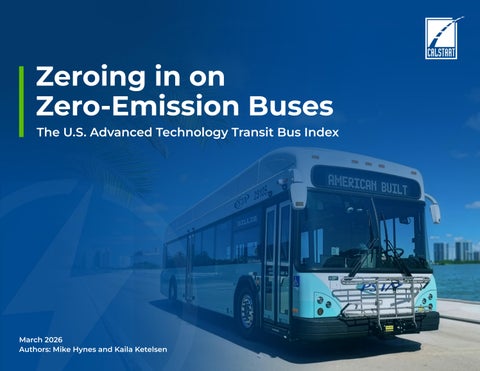
The images for this report were provided courtesy of PSTA.
About the Authors
Mike Hynes is the Deputy Director, Transit on the Bus team at CALSTART. Mike leads the transit bus program that assists agencies with planning, procuring, and deploying advanced propulsion technology vehicles. Mike is the project manager for the Zeroing in on ZEBs series. If you have any questions, please contact Mike at jhynes@calstart.org.
Kaila Ketelsen is a Project Manager II on CALSTART's Data Insights & Analytics team, where she leads outreach, data collection, and analysis for the Zeroing in on ZEBs series. Her work bridges data and implementation, managing pilot and demonstration projects and overseeing the development of data products and web-based tools that support zero-emission fleet planning and clean transportation decision-making.
Acknowledgments
The authors would like to thank key CALSTART staff, including Katrina Bayer, Liz Breazeale, Keri Dennison-Leidecker, Heather Flanagan, Emma Frantz, Sabrina Sherman, Jenn Smith, Taaj Stillitano, and Katie Tomaszewski for their valuable contributions to this report. Any errors are the authors’ own.
ABOUT CALSTART
A mission-driven industry organization focused on transportation decarbonization and clean air for all, CALSTART has offices in New York, Michigan, Colorado, California, Florida, and Europe. CALSTART is uniquely positioned to build the national clean transportation industry by working closely with its nearly 200 member companies and building on the lessons learned from the major programs it manages for the State of California. CALSTART manages more than $1 billion in vehicle incentive and technical assistance programs in the United States and is leading a global effort to build the zero-emission commercial vehicle market. Learn more at calstart.org.