Jeff Farnsworth, CAMEx, CCAM-PM.ND Steward Property Services, Inc.
Andrew Hay, CAMEx, CCAM-ND.PM The Helsing Group, Inc., ACMC
Scott Swinton, CCIP Unlimited Property Services, Inc.
Lorena Sterling, CAFM Community Association Financial Services
Devin Langley, CCAM-PM.ND.CI The Management TrustCentral California
Shanne Ho, CCAM-HR.ND.AA.LM ProActive Professional Management
Kirstie Wright, CCAM Professional Community Managementan Associa Company
Edison Guerraperez, CCAM Associa Northern California
Whitney Walker Property Management Consultants, Inc.
David Danesh, CCAM Allied HOA Partners
Vision Magazine is released digitally by CACM four times annually to members, industry partners and supporters of the California Association of Community Managers.
Magazine content copyrighted 2025. All rights reserved. No part of this publication may be reproduced without written permission from CACM.
Opinions expressed by authors do not necessarily reflect the policies of CACM. Mention of any product or service does not constitute an endorsement by CACM. CACM assumes no responsibility for return of photos or art and reserved the right to reject any editorial or advertising materials. CACM does not assume responsibility for the accuracy of articles, events or announcements listed.
Please address comments and suggestions to: California Association of Community Managers, Inc. 23461 South Pointe Drive, Ste. 200, Laguna Hills, CA 92653 949.916.2226 | communications@cacm.org
Attention CACM members: Have you changed jobs or moved to a new location? Reach out to us at communications@cacm.org to update your profile so you don’t miss your next Vision magazine or any other important CACM communications.
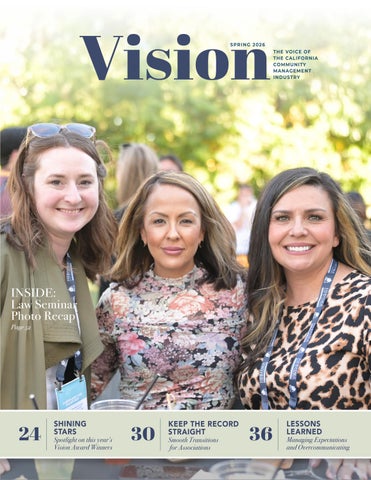
Travel back through the decades with us! From 50’s diners to Studio 54 vibes, our Law Seminars brought the fun to every era. Take a peek at the photo gallery and relive all the decades of advocacy in style!
EDUCATION SPOTLIGHT
2026 LEGACY AWARDS: RECOGNIZING LEADERS WHO MADE A DIFFERENCE
CONGRATULATIONS NORTHERN CALIFORNIA VISION AWARD WINNERS
CONGRATULATIONS SOUTHERN CALIFORNIA VISION AWARD WINNERS
THE THREE MAJOR CHANNELS OF COMMUNICATION IN COMMUNITY MANAGEMENT
PROTECTING THE PAPER TRAIL: PRESERVING ASSOCIATION RECORDS DURING MANAGEMENT TRANSISTIONS By Jeff Farnsworth, CAMEx, CCAM-PM.ND
CONTINUING EDUCATION THROUGH COMMUNICATION FOR HOA MANAGERS By Edison Guerraperez, CCAM
THE COST OF ASSUMPTIONS: WHY OVERCOMMUNICATION WINS EVERYTIME By Scott Swinton, CCIP
THE TWO QUESTIONS THAT ELIMINATE CONFUSION By Anne Lackey
EMOTIONAL INTELLIGENCE IN MODERN PROFESSIONAL PRACTICE By Lorena Sterling, CAFM
THE HUMAN SIDE OF ARTIFICIAL INTELLIGENCE By Devin Langley, CCAM-PM.ND.CI
TURNING INBOX CHAOS INTO COMMUNICATION CLARITY By Kirstie Wright, CCAM
CACM HOLIDAY PARTY PHOTO GALLERY
GALLERY
CEO’s message
Your eyes don’t deceive you, and it’s not an April Fools’ prank—it really is time for our first issue of Vision for 2026.
So, welcome! And oh man is time flying. Our two biggest events of the year are behind us, and believe it or not, we are already beginning to plan for 2027. Even with that fast pace, some things remain wonderfully consistent. One of those is our advocacy work in Sacramento, where we continue fighting the good fight against legislation that could impact your day-to-day work and the communities you serve, and believe me, there is a LOT to fight against this year. Watch the Bill Tracking Report on our website for updates and positions on Bills we’re tracking.
Huge THANK YOU to Tasha Parmalee (Parmalee Consulting) for pushing our certification courses into the CSU Monterey Bay college! This is a first step in highlighting our industry to a younger college aged generation. We are always going to keep pushing for college representation. If you have contacts at a community college, please share them at education@cacm.org. We want to create flexible pathways for CID certification and professional development across California.
This issue of Vision is all about communication—and we know many of you are already great at it. Don’t believe me? Take a look at the Law Seminar photo galleries and you will see collaboration in action. Still, even the strongest communicators can benefit from new ideas, which is why this issue is packed with insights from your peers. You will find articles like The Three Main Channels of Communication for a Community Manager, Preserving Records During Management Transitions, Communication from a Vendor Standpoint, and more.
As we move further into 2026, I hope these perspectives help you refine your approach, strengthen your connections, and continue building thriving communities.
Here’s to a productive and inspiring spring season ahead.
Thomas Freeley, CAMEx, CCAM CEO of CACM
Achitectural Design & Planning
CM2 & Associates is a full-service architectural, engineering, and construction management firm specializing in homeowners’ associations We act as the board’s advocate, delivering clear communication, qualified bids, and expert oversight for construction repair and replacement projects From post-litigation repairs to reroofing, asphalt, painting, and wood repair, we provide customized solutions and on-site management to keep projects on schedule, within budget, and built to code
CM2 & Associates - trusted expertise from start to finish
CM2 & Associates provides architectural design, engineering, forensic investigations, building assessments, asset management, and construction management services exclusively for homeowners’ associations
Our industry-recognized repair-design approach delivers high-performance solutions for complex post-litigation and reconstruction projects
Have questions or planning your next project? Contact CM2 & Associates to discuss your community’s needs Our team is ready to provide trusted guidance and expert solutions from start to finish
members in the news
Tasha Parmelee Opens New Consulting Company
Past board member and manager Tasha Parmelee, CAMEx, CCAM-PM, recently announced the launch of her new consulting company, Tasha Parmelee Consulting, LLC. The firm helps organizations improve performance by creating clarity from the inside out. With more than 25 years of experience in finance, operations, and organizational leadership, Tasha brings a practical, results-driven approach grounded in real-world execution and behavioral insight. Her work integrates organizational structure, leadership development, and an understanding of how people think, communicate, and operate in their roles, helping businesses increase efficiency, strengthen decision-making, and reduce internal friction.
Congratulations, Tasha—we look forward to seeing the impact your expertise will bring to organizations and teams across the industry!
ProTec Welcomes Mike Mastropietro
ProTec Building Services recently announced that Mike Mastropietro has joined the company as Business Development Representative for Orange County. Mastropietro brings nearly 40 years of industry experience, offering a depth of knowledge gained through decades of hands-on work with community associations. His background reflects a strong understanding of how communities function, the challenges faced by boards and managers, and the importance of delivering quality service. Known for his relationship-focused approach and practical insight, Mastropietro is expected to serve as a valuable resource to clients while helping strengthen connections across the region.
ProTec leadership expressed enthusiasm about the addition, noting confidence that his experience and industry relationships will support continued growth and service excellence!
Varsity Painting Welcomes Back Carter Thoms as Sales Manager
Varsity Painting is thrilled to welcome back Carter Thoms as Sales Manager, bringing his experience and deep understanding of the company’s values to strengthen client relationships. During his previous tenure, Carter played a key role in building trusted partnerships and supporting successful projects. After completing his degree at the University of Nevada, Reno, he is excited to reconnect with the team and clients while bringing fresh perspectives to his role. Welcome back Carter, we look forward to seeing you out there with the rest of the Varsity Painting team!
Carter Thoms
Tasha Parmelee
members in the news
Lacreasha Johnson Works Toward Developing her Nonprofit
Lacreasha Johnson, CCAM, announced that her organization, founded in 2025, is currently in the process of becoming a full nonprofit. The effort builds on her long-running initiative, Pause for the Cause, a practice she began more than a decade ago focused on mindfulness, compassion, and meaningful community response. The work has included handson outreach such as Warm Up the Bay, which collected essential items for individuals experiencing homelessness.
“Pause for the Cause began as something I created for myself over 10 years ago, rooted in being present and responding to others with compassion,” Johnson shared. “It has grown into a mission to support children, women, and individuals who have experienced violence through education, advocacy, and direct community care.”
Today, the organization’s programs include providing safety-focused resources for youth, coaching and education for women, and partnerships with groups such as Courageous Women Association and Courage House to expand community support.
Members interested in getting involved or learning more about ways to support are encouraged to reach out at info@letthemtrulyhearyou.org.
Member to Member: Emergency Preparedness Insights
Management Company Member Castle Breckenridge Management recently hosted a podcast focused on emergency preparedness, featuring several of our very own members. The discussion covered important topics like insurance considerations and other key planning essentials that help communities stay prepared.
We love seeing our members share educational information and resources that we can all learn from. Thank you, Castle Breckenridge, for supporting continued education and collaboration within our community.
Congratulations to Board Member, Adriana DaSilva
Congratulations are in order to board member Adriana DaSilva, CAMEx, CCAM, for becoming the new Owner and President of Next Step Community Management . This marks a significant milestone in her professional journey and the continued evolution of the company. Having previously served as General Manager, she has been instrumental in supporting daily operations, strengthening team collaboration, and upholding a high standard of service for the communities the firm serves.
“I am deeply grateful to Tasha Parmelee for her mentorship, leadership, and belief in me. Her guidance shaped both my professional journey and the strong foundation of Next Step Community Management,” DaSilva explained. Parmelee will remain involved in a supporting capacity through Tasha Parmelee Consulting, helping to ensure continuity as the organization moves forward.
Congrats again to Adriana on this exciting new chapter.
Lacreasha Johnson
Adriana DaSilva
members in the news
Berding | Weil LLP Announces New Client Relations Executive
On January 21, Berding | Weil LLP welcomed Cynthia Heskett, affectionately known as “Cookie,” to their marketing team as a Client Relations Executive. Heskett brings a careerlong dedication to service and relationship-building within the community management industry, with experience in leadership roles including Vice President of Client Relations and Executive Director of Business Development. Known for her client-focused approach, strategic mindset, and personable style, she excels at fostering strong partnerships and aligning client needs with practical, results-driven solutions. Congrats Cookie on this new opportunity with Berding | Weil LLP!
Jeffrey Beaumont Celebrates 27 Years
Congratulations are in order to Jeffrey Beaumont, Esq. for celebrating 27 years of leadership at Beaumont Tashjian earlier this year. The team at Beaumont Tashjian shared their gratitude and well wishes on social media, stating, “None of us would be here without you! Your steady guidance, integrity, and commitment have shaped not just this firm, but the people in it. We’re grateful for the foundation you’ve built and the example you set every day.” Congratulations again, Jeffrey—we look forward to seeing what this next year has in store for you.
Jeffrey Beaumont
Cynthia Heskett
In Memoriam:
Joan (Lewis) Heard Freeland
On February 2, SwedelsonGottlieb announced the passing of Joan (Lewis) Heard Freeland, Esq. Senior Associate. SwedelsonGottlieb shared that Freeland was a respected attorney, trusted colleague, and valued member of the firm whose professionalism, dedication to the practice of law, and commitment to excellence left a lasting impression on all who had the privilege of working with her.
The firm shared that beyond her legal accomplishments, she will be remembered for her “kindness, integrity, warmth, and grace in every interaction.” Freeland was greatly admired and will be deeply missed by colleagues, clients, and friends.
CACM extends our sincerest condolences to her family, friends, and colleagues during this difficult time as they honor her life and legacy.
Sascha Macias Joins The Miller Law Firm
The Miller Law Firm recently welcomed Sascha Macias, Esq. to their Los Angeles office as an Associate Attorney, supporting the Client Relations department. Macias brings over 20 years of experience in the HOA industry, including leadership as Vice President at FirstService Residential before beginning her legal career. She is also an active contributor to the industry through educational articles and currently serves as President-Elect for the CAI Los Angeles (GLAC) Chapter. Congrats to Sascha on joining The Miller Law Firm team!
Homeowners Management Co., LLC Celebrate Two Milestones
Join us in congratulating Tony Khani, CCAM-PM. LS.ND.AA.LM and Nicole Drinnen, CCAM on their work anniversaries with Homeowner Management Company Nicole is celebrating a three-year milestone, and Tony is marking two years with the company. The announcement was shared on social media, where the team wished them both continued success and expressed excitement for the years ahead. Congratulations to you both!
Joan (Lewis) Heard Freelan
Sascha Macias
Tony Khani
Nicole Drinnen
members in the news
Samantha Soogian, CCAM Steps into New Role at CHBIOA
Congratulations to Samantha Soogian, CCAM on stepping into her new role as Director of Management Services at Community of Harbor Bay Isle OA (CHBIOA.) In her previous role as an on-site Senior Association Manager, Soogian oversaw a diverse portfolio of communities, supporting boards, residents, vendors, and operational compliance. In her new position, her focus has expanded to mentoring managers, strengthening training programs, supporting onboarding, and fostering operational consistency across the team.
“I believe strong leadership isn’t about having all the answers; it’s about creating space for others to grow, succeed, and feel confident in their own abilities,” Soogian shared. Her approach emphasizes empowering others, building strong communities, and cultivating environments where residents and colleagues alike can thrive. Congrats to Samantha on this well-deserved advancement!
The Miller Law Firm Celebrates 45 Years of Client Strategy and Success
Thomas Miller, Esq., CEO and Founder of The Miller Law Firm , shared on social media that the firm is celebrating 45 years of serving California homeowners and their associations. “45 years ago, I made a choice that would define my career and the HOA industry: to stand up for California homeowners and their associations facing construction defect challenges. Today, as The Miller Law Firm celebrates its 45th anniversary, that mission is stronger than ever,” Miller stated.
He expressed gratitude for clients, communities, and the expert professionals who have contributed to the firm’s journey. Over the decades, the team has secured countless settlements, earned national recognition, and helped rebuild communities, drawing on firsthand experience with the impact of construction issues on neighborhood safety and stability. As The Miller Law Firm celebrates this milestone, Miller shared that he is inspired by past achievements and energized for the work still ahead.
Basham Management Leads Annual Drive to Support Foster Youth
Earlier this year, Basham Management launched its third annual winter drive, collecting new or gently used suitcases, backpacks, and duffel bags for foster youth. With support from the local community and members of California Association of Community Managers (CACM), the effort resulted in the donation of 27 pieces of luggage to youth throughout Kern County. The company shared the update on social media, noting, “We love being able to help provide our community with a little bit of extra love.”
Samantha Soogian
Thomas Miller
Leading With Purpose: Why the World Is Better Because You Are In It
In every industry, there are moments that remind us why we choose to lead—not for titles, not for recognition, but for the impact we leave on people, communities, and the future we help shape. At the CACM Law Seminar & Expo, surrounded by dedicated professionals committed to elevating our field, that truth came into sharp focus.
The world is a better place because you are in it… because you are in it. It’s more than a phrase. It’s a reminder of the quiet, consistent influence leaders have every day.
Leadership is not simply about making informed decisions in the present. It is about shaping a legacy—of governance, of trust, and of the quality of life for the communities we serve. Each choice we make contributes to a broader story of integrity and progress, one that extends long beyond our tenure.
John Quincy Adams captured the essence of leadership when he said: “If your actions inspire others to dream more, learn more, do more and become more, you are a leader.” That definition remains as relevant today as it was centuries ago. Leadership is influence, but more importantly, it is inspiration in motion.
Today, we stand at the leading edge of our profession. Our industry continues to evolve, and with it comes both opportunity and responsibility. To raise the bar for community management requires courage, excellence, and a commitment to long-term impact. It requires us not only to understand best practices but to embody them, to challenge outdated norms, and to elevate standards in ways that strengthen entire communities.
Whether you attended the Seminar & Expo in the North or South, the sessions, conversations, and learning opportunities were not just boxes to check for CEUs. They were chances to shape ourselves—our character, our leadership, and the value we bring to those around us. They were opportunities to deepen our understanding, expand our perspective, and build stronger connections within our profession.
More importantly, the Law Seminar & Expo was an opportunity to reaffirm the “why” behind what we do. Exchange ideas. Ask questions. Challenge assumptions. And above all, we had fun doing it. Because learning, when done with passion and purpose, becomes transformational.
And remember this as you move forward: The world is a better place because you are in it.
Carry that truth with you. Let it guide your leadership.
Now go dream more, learn more, do more, and become more— both for yourself and for the communities who depend on your leadership every day.
Jeremy S Wilson, CAMEx, CCAM Chair, CACM Board of Directors
yousaid it!
Another wonderful evening at the annual CACM Holiday Event at the Balboa Bay Resort ✨����
Always a highlight of the season and a great chance to connect with clients and industry partners in such a beautiful setting!
— Heather Ridgway, RCS Construction Management (RCS-CM)
and our team won 2nd place by only 18 seconds!! We are such a competitive bunch! �� great job team, Devin Langley, CCAM, CAMEx, PM.ND, Eric Kazakoff and Korinna Peterson !!!
Conversations were fantastic, discussions were constructive and forward thinking with the future of our industry at the fore front!
I feel so honored to begin my 5th year on the Board with such dedicated, innovative and remarkable board members as well as the whole team at CACM! The best is yet to come!!
— Christina French-Hokafonu, CAMEx, CCAM-LS.HR.PM.ND.AA.LM, CAFM, Moraga Country Club Homeowner’s Association
Thank you CACM for inviting me to be part of today’s panel on AB 1572. I really appreciate the opportunity to be part of an open and practical discussion about how this legislation has and will continue to affect our communities.
It was great sharing the discussion with my fellow panelists Christina French-Hokafonu (congratulations on your award!), John Baumgardner, and Tia Fleming — each of you brought a real world perspective to this discussion and I know the audience walked away with new information that they can take back to their Boards.
Additionally, congratulations Park West on being named the Industry Partner’s Company Culture Award winner. We have so many cool people doing so many amazing things and I’m proud to be a part of it.
— Daniel Smith, Park West Landscape Management
It was a pleasure to connect with industry peers and dive into such meaningful dialogue. A special shout-out to our sponsors for making the event possible and leading such an insightful discussion:
Golden Alliance Insurance
Southwest Landscape & Maintenance
Prestige Paving Company
— Reema Hawartheh, CCAM, RealManagge, LLC
Great food, lots of laughs, and an amazing group of people—what better way to kick off the year? ��
Huge thank-you to CACM for hosting such a fun post-holiday gift exchange lunch! The conversations were great, the laughter was nonstop, and the energy was exactly what we needed to start the year strong.
Shout-out to Cal Pro and Advanced Roof Design for sponsoring this fantastic event. So grateful for this community! ✨
— Lorena Campos, CCAM, Common Interest Management Services
The keynote speaker at the CACM Conference was awesome! Great start to the day!
— Lisa Starratt, Cagwin & Dorward Landscape Contractors
A huge thank you to CACM for hosting such an engaging knowledge-sharing luncheon last week!
yousaid it!
We got to kick off the year by hanging out with an amazing group of people for the CACM Holiday Re-gift exchange! CalPro Construction & Painting was honored to sponsor such a fun event!
The energy was exactly what we needed to start the year strong, it was filled with great conversations and nonstop laughter ��
I even got to see/catch up with an old friend who I used to work with when I was in my teens working at The Old Spaghetti Factory
Thank you for the funLooking forward to the Law Seminar #CACM #ThinkCalPro #Networkingfamily
— Kayla Medina, CalPro Construction & Painting
Great experience today at the Capitol! Its not every day you hear testimony about glow in the dark rabbits (not on the HOA bill). Big thank you to Jennifer Wada and CACM for the support and opportunity to advocate for the industry!
— Andrew Hay, CAMEx, CCAM-ND.PM, The Helsing Group Inc, ACMC
Thank you to CACM for coordinating such an amazing, educational, and fun event! This year’s law seminar “Decades of Advocacy” felt like one of a kind. I really enjoyed this time with colleagues, meeting with new vendors, catching up with ones I’ve known for years and meeting new faces. Such an incredible time!
— Sabrina Chin, Associa Northern California
Another Law Seminar with CACM and every single year I attend, it hits me deeper than the last.
I’m reminded of how blessed, aligned, successful, and genuinely grateful I am.
From being placed on the 20th floor of the same hotel as the seminar (no rushing, no stress, just ease), to being invited to vendor dinners where I get to connect, network, and learn from some truly amazing people… every detail felt intentional.
Opportunities like this don’t just grow your career…they grow you.
They sharpen your skills, expand your mindset, and remind you why you started in the first place.
The Next Step Managers team had a fantastic time attending the CACM NorCal Law Seminar!
We were honored to be nominees for Company Culture, and to celebrate Gladys Jimenez as a nominee for Portfolio Manager. Being recognized alongside so many outstanding professionals is truly an honor— congratulations to all of this year’s winners.
We also proudly celebrated Brandie Serles as she completed her oath ceremony and became a CCAM - Certified Manager—a wonderful milestone and well-deserved achievement.
What I learn, how I show up, and the connections I make here also pour directly into my own business… helping me lead better, think bigger, and move with more confidence and clarity.
I never take access, education, or community for granted.
I love my job.
I love my company. And I’m incredibly thankful to be in spaces that support my growth in every direction.”
—
Mandy Munoz, CCAM, Seabreeze Management Company
Our team embraced the theme “Advocacy Through the Decades” by rocking some 80’s attire. It was also a great opportunity to connect with other managers and industry partners—both familiar faces and new connections.
As a company, we strongly support CACM for the support and programs it provided for management. Beyond the fun, most importantly the seminar delivered another year of excellent speakers and important legal updates that help us better serve our communities.
— Adriana DaSilva, CAMEx, CCAM, Next Step Community Management
spotlight on spotlighteducation on education
Big Moves in Education: Real Growth Ahead
A STRONG START TO THE YEAR
With our Northern and Southern California Law Seminar and Expo now wrapped up, we want to extend a sincere thank you to everyone who made these events so impactful. From our speakers and hosts to the managers in attendance and our dedicated industry partners, your participation is what brings these experiences to life. From all of us on the education team, thank you for being part of it.
Ready to Get Certified?
One of the most meaningful moments each year is the Oath Ceremony, and this year was no exception. We had the honor of celebrating 83 managers, who earned the CCAM or CAFM, as they took this important step in their professional journey. In addition, we proudly recognized 14 industry partners who earned their CCIP designation in 2025. The CCIP
A New Pathway with CSUMB
program is designed specifically for California industry partners who want to deepen their understanding of community associations and the roles that managers, boards, and service providers play in achieving success. It also reinforces the ethical standards that guide these working relationships.
Beyond the ceremonies, this year’s Law Seminar and Expo also brought exciting updates, including the announcement of our partnership with California State University, Monterey Bay. Through this collaboration, students can enroll in BUS 495: HOA Management and Leadership, a course developed in partnership with Tasha Parmelee, CAMEx, CCAM, of Parmelee Consulting. This program was thoughtfully designed to provide a strong foundation in community management, blending business, law, finance, and leadership to prepare students for real-world success.
If you or someone you know is ready to take that next step, now is the perfect time. Registration for CCIP classes is open, and we encourage you to explore the course catalog on our website. Skip the social media badges and verification, get California certified instead!
This course not only fulfills university credits but also serves as a valuable first step toward earning the CCAM designation. While we do not expect everyone to enroll, we do hope you will support this initiative. Together, we are opening new pathways into the profession, strengthening the workforce, and investing in the future of community management.
spotlight on spotlighteducation education
Spring Learning Starts Here
Looking ahead, there is plenty to be excited about. In just a few weeks, we will gather for the Executive Leadership Summit, where we will explore key topics and hear important legislative updates. Following that, our Spring Educational Forums will take place across the state. These forums are a cornerstone of our education program, offering timely, region-specific insights along with valuable CEUs and meaningful peer connections.
This year, we are especially excited to introduce two new locations, Santa Barbara and Bakersfield. With topics ranging from crisis communication and work-life balance to infrastructure management and emergency preparedness, there is truly something for everyone. We invite you to visit our website, find the location that works best for you, and register today. Join us for a day of learning, connection, and practical takeaways you can apply right away
We’re Just Getting Started
While we have covered a strong start to the year, there is still much more ahead. We are committed to continuing to grow and evolve our education offerings to better support you. Be sure to stay connected through email and social media so you do not miss what is coming next. Education remains at the heart of
everything we do. Whether it is enrolling in a class you have been putting off or attending an event you missed last year, we are here to support your next step. Let us know how we can continue to serve your educational goals.
2026 Course Catalog Available
The 2026 Professional Development Catalog was released in January. Use this professional development guide to plan for certification, re-certification or specialty designations in 2026. Every CACM course is included, as well as credits
obtained, pricing and dates the course is offered. The catalog also explains each certification offered and the steps to attaining and maintaining it. Download it now.
ARE YOU LOOKING TO HIRE?
Let CACM help you!
CACM is committed to our members’ professional success. Whether you are hiring or looking for the next industry-specific position, the Career Center is your “go-to” resource. Bookmark the Career Center and visit often.
Jobs can be posted for 30 or 60 days and are optimized for mobile and SEO. Premium and enhanced posts include increased visibility.
On top of posting your job opening, CACM delivers new job posts directly into email inboxes through its monthly Job Watch email and in its monthly MyCommunity member newsletter – both are sent to all of CACM’s members.
JOB WATCH MONTHLY EMAILS:
Average open rate: 33%;
Average click through rate: 7%
POSTING YOUR JOB IS AS EASY AS:
2
Please ensure you select your membership type before purchasing (we want to make sure you receive your discount!). You’ll also find there is a live chat feature on the page. Those individuals are ready to assist you with any questions you have in real time.
3
If, after this, you still need assistance, please feel free to reach out to help@ webscribble.com, and a representative from the company that supports CACM’s Career Center will further assist you in answering your questions and assisting you with your posting.
achieving professional excellence
Congratulations Managers & Industry Partners
It is with great pride that we recognize managers, and now industry partners, who have taken the next step in their professional career by pursuing advanced educational opportunities. Congratulations to our newest Master of Community Association Management (MCAM), Certified Community Association Managers (CCAM), Certified Community Association Financial Manager (CAFM), California Certified Industry Partner (CCIP) and Specialty Certificate recipients for the period of October 1 - December 31, 2025.
We are facing one of the most challenging years yet in terms of legislation. There are a significant number of bills focused on CIDs, and many of them directly focus on managers. This edition of Vision Magazine focuses on effective communication, which is appropriate given that we will be calling on managers to communicate the impacts of these bills on the management industry and the communities you manage. This can be done through position letters to your legislator, serving as a witness to testify on behalf of the industry in legislative committees, and to meet with your legislators to communicate the impacts of these bills.
Here are the key bills we are focused on
By Jennifer Wada, Esq.
AB 739
Jackson – Manager Fees
This bill was initially introduced in 2025 and required all managers to become licensed as real estate brokers. After stopping it last year, it came back at the beginning of 2026 to require board members to get 12 hours of education within the first two years of their term and require managers to disclose all fees to all homeowners. We were adamantly opposed to the latter piece and after extensive negotiations, we prevailed in getting a compromise. The bill now requires the Board to annually review management base fees, fee schedule charges and reimbursable expenses and allows members to electronically receive the same but only upon written request.
SB 1007
Menjivar – assessment and manager fee disclosures, regular assessment threshold
Requires the annual budget report to include a high-level summary breakdown in the form of a visual aid that describes what regular
assessments fund, including, but not limited to, funding of administrative costs, repairs, maintenance, and litigation. It also requires the annual budget report to include a statement of the compensation of a management company. Lastly, it removes the 20% allowance for an association to increase regular assessments by and instead, only allows an inflation adjustment. We are aware of the negative repercussions of this shortsighted policy and are aggressively advocating against it.
SB 1238
Wahab – manager fiduciary duty, separate disclosures re exterior elevated elements and reserve studies
This bill is sponsored by the California Association of Realtors and defines “agents” to include a managing agent as defined in the Davis Stirling Act that owes a fiduciary duty to the association and the homeowners. It also places new requirements on managers to make disclosures in a home transaction that require representations about needed repairs of exterior elevated
elements. To satisfy lenders, it also requires, if requested by a buyer, seller or lender, the manager to provide, upon request of the owner of record, “a separate disclosure providing a uniform overview of the association or condominium complex in relation to the federal lending rule defining ‘critical repair.’” The bill goes on to require the manager to provide certain information that is not necessarily directly derived from the balcony report or reserve study. Lastly, the bill prohibits the association from expending funds designated as reserve funds for litigation or legal services, or to threaten litigation involving any owner or relative of the owner. It also prohibits the board from transferring funds from the reserve account for these purposes. CACM is adamantly opposed to any legislation that opens managers up to liability by requiring them to make representations about “critical repairs” that they are not qualified to make. We believe this bill uses managers and other professionals in an inappropriate manner to make a sale go through. We are aggressively lobbying this bill in the Legislature.
AB 2050
Caloza – Reserve Accounts
This bill is sponsored by CAI and as of January 1, 2032, requires associations to fund reserve accounts on an annual basis in at least the minimum reserve contribution level included in the most recent reserve study. If the association is unable to fund at this level without exceeding the percentage caps on assessment increases, the association must levy a reserve special assessment in the amount necessary to meet the minimum contribution level without a reserve special assessment within three fiscal years. The amount of the reserve funding special assessment shall be the amount necessary to prevent the projected association reserve account balance from falling below zero over the following 30 years. The association shall not levy a reserve funding special assessment more than once every three years.
AB 2439
Rubio – Assessments
This bill will be amended to require the association to provide notice by certified mail to members any time there is a change in the management company and/or the place/ process where assessments are to be sent. It may also include a penalty for failing to provide assessment notices. We are working with the author and have expressed concerns about imposing more costs on homeowners for certified mail and penalties.
AB 2579
Petrie-Norris: Fine Cap Cleanup
This is the AB 130 cleanup bill sponsored by CAI and strongly supported by CACM. This bill will be amended to clarify that a member has not cured the violation if a member is engaged
in habitual, repeated or continuing violations just because the violation is not occurring at the time of the hearing. It also adds specific health and safety exceptions to the $100 fine cap in the following areas: fire and environmental hazards, architectural improvements, animal and maintenance issues, common area damage, violence and short-term rentals.
Other bills that impact associations:
AB 1184
Patterson – Association operations
Makes several changes to the DSA, such as 1) requiring general notice for an emergency rule change to include the text of the rule change and its purpose; 2) requiring notice of the occurrence of litigation in the annual budget report; 3) if meetings are recorded, recording is an association record available in same manner as written minutes; 4) prohibiting charging for minutes if distributed electronically and allowing website posting of minutes to meet distribution requirements; 5) clarifying a majority of the board cannot deliberate or take action outside an authorized meeting except for in an emergency; 6) excluding operating rule amendments from the secret ballot requirement.
AB 1684
Ward – cooling systems
Voids governing documents that prohibit or restrict the installation, upgrade, replacement or use of a cooling system by a member. Unless the installation, upgrade, replacement or use of a cooling system violates the law or a permit is required and the permit is not granted by the permitting authority, the association is prohibited from 1) charging a fee in connection with the installation, upgrade, replacement or use of a cooling system; 2) requiring a specific type of cooling system; 3) claiming to receive a rebate, credit or commission in connection with the installation, etc.; 4) requiring a member to remove the cooling system or prevent the replacement or upgrade of a cooling system. Associations that willfully violate this section are liable for actual damages and a civil penalty to the member up to $2,000.
AB 1892
Davies – Clean-up re utility interruptions, voting by acclamation, electronic voting notice
Clarifies that an association is responsible for repairs and replacements necessary to restore interrupted gas, heat, water or electrical services when the interruption of service begins in the common area. The bill also states that the 30-day notice of how to electronically vote must only go to those that are electronically voting. The amendment will update election by acclamation notices to general notices, change the initial notice deadline to 30 days before nominations (instead of 90), and require the reminder notice at least 10 days before the nomination deadline (previously between 7 and 30 days). AB 1892 will also be amended to prohibit nominations from the floor and write in candidates for the board. The bill will also clarify that the location for ballots to be sent is controlled by the inspector and not by the association, a candidate or a management company.
AB 2035
Dixon – Laguna Woods Mutual
Allows very specific HOAs (those with more than 6,000 units that is a senior citizen community with 25% or more tenant/nonowner occupied units) to go to superior court with 37% of affirmative homeowner votes supporting an amendment to CC&Rs. Laguna Woods has been unable to get the requisite 67% of homeowners to vote, nor have they been able to get to 50% of all homeowners to vote to go to the superior court for review and approval.
SB 222
Wiener – Residential Heat Pump Systems
As of July 1, 2027, requires a local government to adopt and offer asynchronous inspections for installations of residential heat pump water heaters or heat pump HVACs that do not require a licensed contractor and building inspector to be simultaneously present. As of July 1, 2028, would authorize local government to issue up to one nondiscretionary permit per installation of a residential heat pump water heater/HVACs and requires an online, automated permitting process. Voids any provision in association governing documents, architectural guidelines, or policies that prevent replacement of a fuel-gas-burning appliance with an electric appliance or that effectively prohibit or restrict the installation or use of a residential heat pump water heater/HVAC system.
This year will require all managers to engage and assist in defending the industry and communities against misplaced attacks. We have been working around the clock and will continue to do so. Please stay ready and willing to answer our calls to action!
Jennifer Wada, Esq., is an attorney, CACM’s legislative advocate and principal of Wada Government Relations in Sacramento.
maintaining high standards
New Individual Manager & Management Company Members
CACM members further their success in the industry and benefit by partnering with colleagues to share new ideas and best practices. Please join us in welcoming these new members from for the period of October 1 - December 31, 2025.
MANAGER ProPLUS
Ingrid Ahlstroem
Sean Bothelio
Thomas Hein
David Norvell
MANAGER Pro
Brandalyn Allen
Patricia Arnold-Kempton
Roy Arriola
Samantha Bankston
Crystal Barragan
Jordan Bennett
Rachel Bernhard, CCAM
Heather Blumenthal
Darby Broeker
Amy Brooker, CCAM
Nicole Brown
Tamara Brown
Bonnie Burton
Jessica Butler
Mark Chase
Jemal Chavez
Brandon Cook
Craig Cordi, CCAM
Thomas DeWitt
Louisiana Escalante
Winter Freeman, CCAM
Jen Gambino, CCAM
Tamiera Golden-McKee
Adrianna Gonsalves, CCAM
Israel Hernandez, CCAM
Tommie Hoyt
Jessica Hubbard, CCAM
Rachell Kilburg, CCAM
Sharon Kudla
Kasandra Lawhorn
Janneth Lujan
Shenandoah Lush
Richard Mallory
Alaina Martinez
Ensley Mather
Marlena Mattes, CCAM
Matt Mattice
Steven McCormick
Natasha McCrimmon, CCAM
Danielle Mingus
Jennifer Miranda, CCAM
Carlene Murdoch
Ted O’Brien
Fielani Pohahau
Jennifer Raus
Amanda Reinsmith
Thawit Sangarotai
Michael Saucy
Jia Shan
Tami Silva
Melissa Sim
Kim Swanberg
Brenda Tavares, CCAM
Nicole Timmis
Phong Ton
Farita Toney
Manuel Torres
Lakisha Trotter
Horatiu Ursa
Junior Valencia
Ariana Vasquez, CCAM
John Whitlock
Mandy Wideman, CCAM
Devin Wright
Kristin Zavala
Ariana Zigelhofer, CCAM
“A LEGACY OF SERVICE LIVES ON THROUGH THE PEOPLE, VALUES, AND COMMUNITY IT HELPS BUILD.”
At its core, CACM is a community of leaders driven by purpose, service, and a shared belief in giving back to the profession we serve. Our strength is built on the dedication of individuals who lead with integrity, generosity, and a commitment to excellence. Through this page, CACM proudly highlights those who went above and beyond—demonstrating exceptional leadership, selfless service, and unwavering dedication. These honorees for 2026 have not only strengthened our organization but have also left a lasting legacy and meaningful impact on CACM and the broader community, inspiring future leaders to continue
LIFETIME ACHIEVEMENT
ED VITRANO
With more than four decades of service, Ed Vitrano has been a defining voice in association management. A founding member of CACM, tireless advocate for onsite GMs, and trusted mentor nationwide, his leadership, integrity, and dedication have left a lasting legacy on our profession.
ABOVE AND BEYOND
TASHA PARMELEE, CAMEX, CCAM-PM
Tasha Parmelee’s leadership, collaboration, and dedication were instrumental in bringing CACM programs to CSU Monterey Bay. Her willingness to go above and beyond made a meaningful impact and exemplifies the spirit of partnership we value.
BOARD SERVICE AWARD
KENDRAH KAY, CAMEX, CCAM
JOSEPH PRICE, CAMEX, CCAM
LORI GONZALES, CAMEX, CCAM
Joe Price, Lori Gonzales, and Kendrah Kay are three such individuals whose years of board service helped guide CACM’s growth and mission. With nine, ten, and eleven years of dedicated leadership respectively, their collective impact has been significant and lasting. We are deeply grateful for their commitment and the meaningful role they have played in shaping CACM.
2026 VISION AWARD WINNERS
NORCAL • MANAGERS
INNOVATOR
JACQUELINE BEASLEY, CCAM
This nominee is an innovator in community management, bringing creativity and connection to HOA communities across Northern California. They design unique, costconscious events and programs that strengthen relationships, reduce stress, and foster belonging among homeowners, board members, and vendors. Their creative solutions extend to team-building, wellness initiatives, and resourceful branding, merging originality with practicality. By reimagining engagement and building lasting connections, they elevate communities and set a new standard for innovation in the industry.
RISING STAR
NICOLE FISHER, CCAM
Nicole Fisher exemplifies a Rising Star in community management through her professionalism, reliability, and unwavering commitment to excellence. She consistently exceeds expectations, balancing demanding roles while earning the trust and respect of boards, colleagues, and leadership. Known for stepping up in every challenge, mentoring others, and delivering results with empathy and competence, Nicole quietly elevates everyone around her. Her technical skill, emotional intelligence, and dedication make her a standout emerging leader in the industry.
COMPANY CULTURE
COLLINS MANAGEMENT, ACMC:
This organization has built its success on a culture of service, ethics, and teamwork, making it the foundation of every decision. Employees are empowered through mentorship, certification, and career development programs that promote from within, creating a workplace defined by collaboration, accountability, and excellence. Measured growth, strong client relationships, and active community engagement, from volunteer initiatives to employee-driven giving, reflect the company’s values in action. By investing in people and purpose, this organization has created a culture that drives retention, inspires employees, and strengthens the communities it serves.
EDUCATIONAL EXCELLENCE
SUSANNE DARNER, CCAM-HR
This community manager embodies educational excellence through her passion for teaching, mentoring, and elevating professionalism in the industry. Since becoming a Certified Community Association Manager in 2014, she has shared knowledge at CACM, CAI, and ECHO events, making complex topics approachable and engaging. Her dedication extends beyond presentations, mentoring peers and helping newer managers gain confidence and skills. By inspiring, empowering, and uplifting others, she strengthens the culture of learning and professionalism across the community management field.
LEADERSHIP
CHRISTINA FRENCH-HOKAFONU, CAMEX, CCAM-LS.HR.PM.ND.AA.LM, CAFM
This community manager exemplifies leadership through vision, integrity, and a human-centered approach. She guides boards through complex challenges with transparency and inclusivity, builds trust, and empowers others to take ownership of their roles. Beyond daily management, she mentors new managers, champions innovation, and advances industry best practices. Known for fostering collaboration and strengthening communities, her leadership elevates both professionals and associations, making her a standout role model and a deserving recipient of the Leadership Award.
2026 VISION AWARD WINNERS
NORCAL • INDUSTRY PARTNERS
COMPANY CULTURE
PARK WEST
Park West’s people-first mission drives a culture of hard work, fun, giving back, and professional growth. We prioritize employee success through personalized onboarding, company-wide retreats, and programs like Workforce Wednesday and our Milestone Program, celebrating dedication from the first year to 40 years of service. Early-career team members grow through our 18-month Landscape Trainee Program, preparing future leaders. Beyond our employees, we extend this values-driven approach to the community through Park West Gives Back and industry education via our certified subject-matter experts and Learning Academy, ensuring growth, collaboration, and excellence for both our team and the communities we serve.
EDUCATIONAL EXCELLENCE H. JACLYN ISHIMARU-GACHINA
This nominee exemplifies Educational Excellence through a commitment to learning that strengthens both teams and the broader industry. Employees receive hands-on training, certifications, and workshops in horticulture, irrigation, sustainability, and client communication, while mentorship and apprenticeship programs prepare emerging talent for leadership roles. Beyond the company, the nominee supports scholarships, college partnerships, and industry events, including Lunch & Learn sessions, to share best practices and elevate standards across the field. By making education continuous, practical, and accessible, they empower individuals, improve professional expertise, and drive lasting impact in the industry.
RISING STAR
HOOMAN BOLANDI
This Rising Star has quickly made a big impact in the industry by turning challenges into solutions. When faced with a unique problem involving lagoon walls, he adapted his high-tech drone and thermal imaging technology to provide a solution before it was even requested. His professionalism, creativity, and dedication to exceeding expectations set a new standard for industry partners, showing that no problem is impossible and earning him recognition as a true Rising Star.
LEADERSHIP
MARIA KAO, ESQ.
Maria Kao exemplifies leadership through her professionalism, integrity, and unwavering commitment to homeowners associations. She combines legal expertise with practical insight, guiding communities through complex issues while advocating for fairness and compliance. Maria’s thoughtful, empathetic approach earns the respect of board members, managers, and peers, and her dedication extends beyond her clients through active participation in industry education. By sharing knowledge, mentoring colleagues, and elevating standards across the field, Maria strengthens both individual communities and the broader association industry.
INNOVATOR CHAD COLTON, CCIP
This company has been a leader in PVC roofing recycling for over 35 years and continues to innovate in sustainability. In 2024 alone, it retrieved 1.25 million square feet of post-consumer PVC roofing nationwide, including projects in California like Rossmoor Commons and Watergate HOA. By creating a scalable, closed-loop recycling program, the company reduces landfill waste, conserves resources, and lowers greenhouse gas emissions. Its innovative approach sets a new standard for sustainability in the construction and roofing industry.
2026 VISION AWARD WINNERS
SOCAL • MANAGERS
INNOVATOR
ERIKA TAYLOR, CCAM-HR
This nominee exemplifies innovation in community management, turning unprecedented crisis into opportunity after the Palisades Fire left her community devastated. She developed and implemented a multitiered recovery strategy, coordinating with emergency responders, contractors, insurers, and local agencies to restore the community efficiently and safely. Understanding that communication builds trust, she created real-time engagement systems and maintained constant contact with residents, ensuring transparency and support during every stage of recovery. Erika’s forward-thinking has strengthened the association long-term. Her creativity, strategic problem-solving, and ability to adapt under pressure not only rebuilt the community but redefined what innovative leadership looks like in times of adversity.
EDUCATIONAL EXCELLENCE
SABRINA DAVOODIAN, CCAM, CAFM
This nominee exemplifies the power of lifelong learning and professional development in the community management industry. She has been instrumental on the Law Seminar Advisory Committee, helping design curriculum, coordinate expert panels, and ensure content is current and practical for managers navigating evolving laws. Beyond planning courses, she continuously advances her own skills, holding CCAM and CAFM certifications and actively pursuing the MCAM designation. She also contributes to creating new financial coursework, helping peers earn their certifications and raising the standard of education across the field. Through her dedication, she demonstrates that true leadership includes both mastering knowledge and sharing it, shaping the growth and success of others in her profession.
RISING STAR
DOMINIQUE ALBRECHT, CCAM
This nominee is a dynamic, solutions-driven leader who has made a remarkable impact in her first two years as Chief Administrative Officer. She oversees a complex community of 4,300 residents with a $23 million budget and 170 employees, bringing strategic focus and operational excellence to every initiative. From restructuring the Board’s goal-setting process to managing public safety during a series of high-profile burglaries, she has earned the trust of residents, staff, and leadership alike. Most notably, she revived a stalled $8 million Clubhouse renovation, balancing member input, expert guidance, and smart financing to transform a source of division into a shared success. With a strategic mindset, strong relationships, and a record of tangible results, she embodies the very definition of a Rising Star in community leadership.
COMPANY CULTURE
KEYSTONE PACIFIC PROPERTY MANAGEMENT
This nominee fosters a culture defined by empowerment, growth, and connection. Employees are supported through professional development, certifications, and in-house training that prepare them for long-term success. Open communication, collaboration, and recognition create transparency and trust across teams. Flexible schedules, wellness programs, and volunteer initiatives ensure staff feel valued both personally and professionally. By investing in people, this nominee has built an environment where employees thrive, innovate, and take pride in their work—a true model of outstanding company culture.
LEADERSHIP
MICHELLE MATA, CCAM-ND
This nominee exemplifies leadership through professionalism, dedication, and a genuine commitment to her team and the communities she serves. She quickly assesses needs and provides guidance with calm confidence, mentoring employees and fostering growth across her company. A steady force during rapid expansion, she models excellence, ensures efficiency, and builds trust through her positive attitude and hands-on support. Beyond the office, she gives back to the community, leading initiatives like the 2024 backpack drive and supporting local events. Continuously pursuing advanced certifications, she shows that true leadership combines personal growth with empowering others to succeed.
2026 VISION AWARD WINNERS
SOCAL • INDUSTRY PARTNERS
LEADERSHIP
CAT BOOTH
Every company has managers, but few have leaders, and the corporate director is one of those rare leaders who redefines what it feels like to work somewhere. From building and growing the administrative team to promoting talent based on merit, she has transformed not just workflows, but company culture, turning a service-based business into a team of educated, motivated professionals united by a shared mission. Her ability to see potential, cultivate growth, and foster loyalty has created a workplace where people feel valued, recognized, and proud of their contributions. Through her leadership, the company isn’t just achieving results, it’s building people, trust, and lasting impact. For her dedication, cultural transformation, and exceptional vision, she exemplifies the very essence of the Leadership Award.
INNOVATOR
CHAD COLTON, CCIP
This company has been a leader in PVC roofing recycling for over 35 years and continues to innovate in sustainability. In 2024 alone, it retrieved 1.25 million square feet of post-consumer PVC roofing nationwide, including projects in California like Rossmoor Commons and Watergate HOA. By creating a scalable, closed-loop recycling program, the company reduces landfill waste, conserves resources, and lowers greenhouse gas emissions. Its innovative approach sets a new standard for sustainability in the construction and roofing industry.
RISING STAR THALIA FONSECA
This nominee is a remarkable Rising Star in the HOA industry, making an outsized impact in just over six months. Coming from a completely different background, she quickly earned the trust and respect of her team, clients, and even the most skeptical community members. No task is too big or too small; she handles customer questions, staff chaos, and unexpected emergencies with determination and a positive attitude. Even while navigating the personal heartbreak of losing her father on Father’s Day, she showed up with grace, resilience, and the same uplifting energy every day. Her professionalism, empathy, and perseverance demonstrate exceptional skill and character. She is truly deserving of the Rising Star Award.
EDUCATIONAL EXCELLENCE
CHRIS BOOTH, CCIP
This industry partner exemplifies educational excellence through leadership rooted in learning, growth, and mentorship. A Certified Life Coach, he models lifelong learning by pursuing knowledge, sharing insights, and fostering a culture where professional development is prioritized. Under his guidance, the company has become a knowledge hub, empowering staff, community managers, and clients alike. His dedication to elevating others through education makes him a truly deserving nominee for the Educational Excellence Award.
COMPANY CULTURE
ROSEMAN LAW, APC: Roseman Law APC exemplifies a culture of empowerment, trust, and social responsibility. By fostering autonomy, collaboration, and growth— through competitive pay, flexible work, structured feedback, and professional development—the firm keeps employees engaged and clients well served. Beyond the office, Roseman Law actively supports the Juvenile Diabetes Research Foundation, reflecting a commitment to community impact. With its intentional leadership and values-driven approach, the firm creates a thriving, innovative environment that truly embodies the spirit of the Company Culture Award.
CHANNELS the THREE major COMMUNICATION of
BY ANDREW HAY, CAMEX, CCAM-ND.PM
In community association management, communication is not just a soft skill; it is a core operational discipline. Every decision, every maintenance project, every budget adjustment, and every homeowner interaction flows through communication. When communication breaks down, frustration rises, trust erodes, and even well-run communities begin to feel chaotic.
Yet one of the most overlooked realities of our profession is that community managers are not communicating
with “one audience.” We communicate with at least three very different audiences every day: our internal teams, our boards and homeowners, and our service providers. Each group processes information differently, has different motivations, and interprets tone, urgency, and detail in unique ways. Each group also relies on different forms of communication, written, verbal, and in-person, to truly understand what is happening. Failing to recognize these differences leads to confusion, conflict, and inefficiency. Understanding them, on the other hand, creates alignment, speed, and trust
CHANNEL ONE: INTERNAL COMMUNICATION
Your internal team is the engine that makes everything else possible. Portfolio assistants, accounting staff, maintenance coordinators, supervisors, and fellow
CHANNEL TWO: CLIENTS AND BOARDS
Internal communication is about execution, external communication with boards and homeowners is about trust.
Written communication is essential when dealing with Board Members and Homeowners. Emails, reports, newsletters, and meeting minutes create a transparent record of what has been discussed and decided. Boards rely on written communication to fulfill their fiduciary duties, and homeowners rely on it to feel informed. Detailed written updates prevent rumors, misunderstandings, and unnecessary conflict. In nearly 2 decades of doing this, I have never had a client complain about over communication. That said, it is important that you include valuable information and avoid generic notices/warnings, or your voice will simply become noise that people ignore.
managers are the people who turn plans into action. Yet internal communication is often where breakdowns start.
Internally, written communication provides structure. Emails, work orders, project management systems, and notes create clarity, accountability, and a record of what was asked and when. When tasks are written clearly, team members can prioritize, refer to instructions, and avoid misunderstandings. Vague written messages like “Can you look into this?” lead to confusion, while precise ones, “Please obtain three bids for roof repairs at Building C and upload them by Thursday at noon,” drive execution.
Verbal communication adds speed and nuance. In today’s world, most people would prefer to send a message rather than pick up the phone, but there is a practical time for each. A quick phone call or brief huddle can resolve questions that might take days to go back and forth over email. Tone, inflection, and immediate
feedback help team members understand urgency and intent in a way that written words alone cannot.
In-person communication is equally powerful. A manager who takes a moment to check in with a team member, notice frustration, or offers encouragement builds morale and trust. Body language, eye contact, and presence communicate leadership as much as words do. Teams that feel seen and supported perform better and communicate more openly. With so many people working remotely or in hybrid environments it is critical that you be deliberate in making time for in person interactions.
Team members must feel comfortable asking clarifying questions and raising concerns early. Written systems provide structure; verbal communication provides speed, and in-person interaction provides trust. When all three are used together, internal teams operate with confidence and precision.
send strong signals. Calm body language during a tense conversation can diffuse conflict faster than any email ever could. Not to mention, in person hostility is nearly always less than when someone is doing so though a screen or keyboard. Encourage in person sessions when dealing with the most difficult situations as you will find that people act very differently.
CHANNEL THREE: SERVICE PROVIDERSTHE TRANSLATORS
Service providers/Industry Partners operate in a different world. They think in terms of scope, access, schedules, and payment. Their communication needs are practical and immediate.
Written communication is critical here. Contracts, proposals, work orders, and emails establish expectations and protect both the association and the vendor. Clear written scope and timelines prevent disputes and costly misunderstandings.
Verbal communication adds connection. Board meetings, phone calls, and virtual check-ins allow managers to explain context, answer questions in real time, and build rapport. Hearing a manager’s voice often reassures board members that issues are being handled thoughtfully and professionally.
In-person and non-verbal communication may be the most powerful of all. When a manager sits across from a board, attends a walk-through, or speaks to homeowners at a meeting, their posture, confidence, and attentiveness
Verbal communication keeps projects moving. A quick call can confirm access, adjust schedules, or clarify instructions faster than any written exchange. Contractors value managers who can make decisions and provide direction in real time.
In-person interaction can save a lot of time, particularly at the start of projects and anytime a project is stuck. Walking a property with a contractor and client, pointing to specific issues, or reviewing a job on site ensures alignment. When vendors see that a manager is engaged and informed, they take the project more seriously.
At the same time, managers must translate association realities to vendors. Governance, board approvals, and homeowner sensitivities often affect timelines and scope. Explaining these factors, verbally and in writing, turns vendors into partners rather than frustrated outsiders.
Conclusion: Communication as a Leadership Skill
Community managers do not just manage properties; they manage relationships, expectations, and risk. Written, verbal, and in-person communication are not interchangeable; they are complementary tools.
When managers master all three across internal teams, boards and homeowners, and service providers, they
Boards and homeowners also interpret tone and delivery as much as content. A short email may seem dismissive even if it is accurate. A delayed reply may feel like avoidance. Using multiple forms of communication, written for clarity, verbal for understanding, and in-person for trust, ensures that messages are not only delivered but truly received.
Strong managers also adapt to preferences. Some boards want detailed written reports. Others want verbal summaries with supporting documents. Some homeowners prefer quick texts; others want formal notices. There is no universal solution, only intentional communication.
move from reacting to problems to leading with confidence.
Under-communication causes almost every major problem in our industry. A short-written update, a quick call, and a visible presence all reinforce each other. Together, they eliminate speculation and build trust.
Overcommunication is not noise. It is leadership.
In a profession built on service, clarity, and trust, how we communicate may be our most powerful asset.
Andrew Hay, CAMEx, CCAM-ND.PM, is a CACM board of directors’ member and CEO of The Helsing Group Inc., ACMC
Preserving Association Records During Management Transitions
By Jeff Farnsworth, CAMEx, CCAM-PM.ND
The community association management industry operates in a unique professional environment where client relationships may span decades, yet transitions between management companies occur with notable regularity. When an Association decides to change management providers, whether due to service concerns, regional consolidation, mergers, or simply a desire for fresh perspective, the transfer of historical records and operational data becomes one of the most critical, yet least standardized, aspects of the transition process.
Unlike other professional industries where record transfer protocols are codified through regulatory frameworks or professional licensing requirements, community association management operates without a mandated process for the handover of client records. The Davis-Stirling Common Interest Development Act establishes clear requirements for what records an Association must maintain and for how long, but it remains notably silent on the procedural aspects of transferring those records between management companies. This regulatory gap places the burden of professional conduct squarely on the shoulders of the
management companies themselves.
At the end of the day, regardless of which company name appears on the management agreement, the records belong to the Association; and they deserve to receive them in a condition that supports, rather than hinders, their continued operations.
What the Law Requires and What It Does Not California Civil Code provides comprehensive guidance on record retention for common interest developments. Under Civil Code Section 5210, Associations must maintain certain categories of records for specified periods, and members have inspection rights for those records. The categories include governing documents, which must be maintained permanently; financial records, which generally require seven-year retention; meeting minutes for boards and committees with decision-making authority; and election materials, which the inspector of elections must retain for at least one year following the election date per Civil Code Section 5125.
For condominium Associations, Civil Code Section 5551 creates an additional eighteen-year retention
requirement for exterior load-bearing component inspection reports, reflecting the nine-year inspection cycle mandated for structures supported by wood.
What these statutes don’t address, however, is any requirement or guidance regarding how these records should be transferred when an Association changes management companies. The law tells us what to keep and for how long, but it assumes the records will simply be there when needed. This assumption creates a practical challenge: when records pass through multiple custodians over years or decades, the integrity of that collection depends entirely on the professionalism and organizational practices of each successive management company.
The Corporations Code, which governs corporate records for incorporated Associations, similarly establishes what records must be maintained under Section 8320 but provides no transition protocols. The code does, however, explicitly authorize electronic record-keeping, stating that “minutes and other books and records shall be kept...in any other form capable of being converted into clearly legible tangible form.” This authorization is particularly important for digital record management during transitions.
Fiduciary Duty and Professional Responsibility Management companies serve as agents of the Association, handling the organization’s business affairs, maintaining its records, and safeguarding its assets. Our fiduciary responsibilities don’t end when the agreement terminates. In fact, these responsibilities are critical during transitions, when information loss or disruption is most likely to occur.
If you have spent any amount of time in this industry, you have probably experienced a poorly executed transition. For example, an incoming management company receives boxes of unsorted paper documents, unlabeled files, and incomplete financial records. The new manager spends weeks, perhaps months, reconstructing the Association’s operational history, identifying pending matters, and locating critical documents. During this period, violations may go unaddressed, architectural applications may languish, and board members may lose confidence in both management companies: the one that left chaos behind and the one struggling to make sense of it.
Unfortunately, it is the Association Owners who bear the cost of this mismanagement. They pay for the outgoing company’s failure to organize records properly, and they pay again for the incoming company’s efforts to remediate the situation. This means Associations end up paying management companies for something that organized transitions could mostly avoid. In this author’s humble opinion, this is not the type of profit center we should be proud of.
Electronic files stored in cloud-based systems with appropriate redundancy face minimal
risk of total loss.
We may be competitors in this industry, vying for the same client relationships, but as Certified Community Association Managers, our competition should be based on service quality, expertise, and value; not on our ability to create switching costs through disorganized recordkeeping. A management company that deliberately or negligently hampers a transition does not gain a competitive advantage; it damages the industry’s collective reputation and undermines client trust in professional management itself.
Proprietary Materials vs. Association Property
One legitimate concern that management companies raise regarding transitions involves the distinction between proprietary business materials and Association records. Templates, internal procedures, custom software configurations, and operational formulas developed by a management company may constitute trade secrets or proprietary intellectual property. No one suggests that a departing management company must hand over its internal playbook to a competitor.
However, the final products generated using those proprietary tools belong to the Association. The budget prepared using a company’s proprietary spreadsheet template becomes Association property upon completion and board adoption. The reserve study produced using specialized software belongs to the Association that commissioned and
paid for it. Meeting minutes, correspondence, financial reports, violation notices, architectural decisions; these are all Association records, regardless of what internal tools or templates were used to create them.
The principle is straightforward: the work product paid for by the Association belongs to the Association. The methodology used to create that work product may remain proprietary. This distinction should be outlined in your management agreement to create transparency as well as protect your proprietary data from this very debate.
Why Electronic Records Transform Transitions
The community association management industry has been slower than many others to embrace comprehensive digital recordkeeping. Too many Associations still rely on paper files stored in banker’s boxes, filing cabinets at the management office, or, worst of all, in the garage of a board member or former manager. This reliance on physical media creates multiple categories of risk: fire, flood, theft, vermin damage, and simple loss during moves or transitions.
Digital records eliminate or substantially reduce these risks while creating practical advantages that extend beyond mere preservation. Electronic files stored in cloud-based systems with appropriate redundancy
Continues on page 32
face minimal risk of total loss. They can be searched instantly, shared securely, and backed up automatically. Most importantly for transition purposes, they can be transferred completely and accurately with a few clicks, rather than requiring physical transport of heavy boxes that may arrive incomplete, water-damaged, or in complete disarray. And don’t even get me started on how powerful AI tools can become when armed with secured and organized digital data pipelines…
Management companies making technology investments should prioritize systems capable of accepting digital files in multiple formats. The reality of our industry is that you never know what you will receive from a transitioning company. Your system must be prepared to ingest PDF documents, scanned images, legacy file formats, and potentially even digitized versions of paper records that arrive in physical form.
Equally important is the capability to store and manage paper historical documents that cannot be or have not been digitized. Some Associations will
References
arrive with decades of paper records, original signed governing documents, and historical photographs that require physical preservation. A management company’s infrastructure should accommodate both realities: a digital-first approach for ongoing operations combined with secure physical storage for legacy materials that have not yet made the transition to electronic format.
For Associations still operating primarily on paper, the case for digitization extends beyond convenience. Paper records are inherently vulnerable. They take up physical space that costs money. They make information retrieval timeconsuming and error prone. They cannot be easily backed up. And during transitions, they are prone to loss, damage, and incomplete transfer.
How we handle Association records during management transitions says a lot about who we are as an industry. The truth is, there aren’t many regulations telling us exactly how to do this. Our conduct comes down to market pressures and our own professional ethics more than any legal requirement. That gives us freedom—but it also puts the responsibility squarely on us.
• Cal. Corp. Code § 8320 (corporate records and electronic record-keeping authorization).
The core question is straightforward: What do the Associations we serve deserve? They deserve organized, complete records in formats that actually work for management. They deserve smooth transitions that don’t create chaos or lose important information. They deserve management companies that act professionally even when the relationship is over.
We have both the opportunity and the responsibility to make this the norm. The technology is available. The best practices can be established. What we need now is the commitment to actually do it. Are you in?
Jeff Farnsworth,
CAMEx, CCAM-PM.ND, is the CEO of Steward Property Services, Inc., and has more than 15 years of experience providing management services in Northern California.
CACM DAY AT THE RACES
FRIDAY, MAY 1, 2026
SANTA ANITA PARK
Get ready for an exciting day at the races! Enjoy an engaging mix of horse racing, networking opportunities, and lighthearted competition. Wear your best hat, settle in, and invite your fellow managers to share in the experience. Expect great conversations, vibrant energy, and connections that last.
CACM manager members attend for free.
LADIES HAT CONTEST
EVENT DETAILS
Event kicks off at 11 am with the races starting at 12:30 pm!
SANTA ANITA PARK
285 W Huntington Dr. Arcadia, CA 91007
Club Court (Located on the 1st floor at the Club House Turn)
DIRECTIONS TO SANTA ANITA PARK
FROM THE EAST
Take the 210 Freeway west to the Santa Anita Ave exit. Make a left onto Santa Anita Ave. Go south on Santa Anita Ave. and make a right onto Huntington Drive. Follow Huntington Dr. to racetrack entrance gates.
Hold your horses, ladies! It’s not just a race, it’s a runway for elegance. Crown yourself with the most stylish hat and trot away with a prize fit for a champion.
THANK YOU SPONSORS
PREMIER SPONSOR
FROM THE WEST
Take the 210 Freeway east to the Santa Anita Ave exit. Make a right onto Santa Anita Ave. Go south on Santa Anita Ave and make a right onto Huntington Drive. Follow Huntington Dr. to racetrack entrance gates.
CLICK HERE FOR GOOGLE MAP DIRECTIONS
DOWNLOAD PAPER REGISTRATION
CLUB COURT LUNCH SPONSOR
LADIES HAT CONTEST SPONSOR PLACE SPONSOR
SPONSOR TRIPLE CROWN SPONSOR
SPONSOR
DECK
Monterey Plaza Hotel & Spa | Monterey , CA | April 16 - 17, 2025
A MUST-ATTEND FOR MANAGEMENT COMPANY DECISION MAKERS
Join leading industry thinkers and top subjectmatter experts for candid conversations on today’s most pressing issues and tomorrow’s emerging trends. Dive into meaningful dialogue with peers who understand your challenges, and walk away with practical, actionable insights you can put to work.
This year, CACM’s Executive Leadership Summit takes place at the stunning Monterey Plaza Hotel & Spa, offering an inspiring
backdrop for innovation, reflection and highlevel collaboration. Engage in dynamic discussions, share strategies, brainstorm boldly and build powerful new connections—all in a setting designed to elevate both thought and experience.
Together, we’ll tackle the toughest challenges facing today’s community management executives. Join the conversation—you belong in the room.
CCAM, CAFM and MCAM certified individuals earn 6 CEUs for attending. Individuals with a CAMEx designation receive 5 leadership points toward their annual renewal.
serving your communities
New Industry Partner Members
CACM members further their success in the industry and benefit by partnering with colleagues to share new ideas and best practices. Please join us in welcoming these new members from the fourth quarter of 2025 (October 1 - December 31.)
NEW Industry Partner Plus Members
Avelar Corp. Burlingame I (650) 443-7443 avelarcorp.com
Baker Home Energy Escondido I (877) 578-8080 bakerhomeenergy.com
Brian Berg Insurance Services, Inc Mission Viejo I (888) 791-7069 bbisinc.com
Commercial Bank of California Irvine I (714) 267-4003 cbcal.com
EZ Tek Solutions Irvine I (562) 380-0806 ezteksolutions.com
Green Vine Landscaping, Inc. Santa Rosa I (707) 217-7507 greenvinelandscaping.com
H & L Restoration San Jose I (408) 645-5958 bayareadisastercleanup.com
Malagon Legacy Landscaping Newark I (510) 648-8681 malagonlegacy.com
Next Phase Reconstruction LLC Los Banos I (209) 595-8481 npreconstruction.com
P.W. Stephens Environmental, Inc. Huntington Beach I (800) 750-7733 pwsei.com
Wells Electrical, Inc. San Francisco I (415) 255-7831 wellselectricalinc.com
NEW Industry Partner Members
Cleaning Crew Services Inc Mountain View I (408) 320-5066 cleaningcrewservice.com
Freestone Reconstruction Fremont I (510) 727-5631 freestone-reconstruction.com
Gigaly, Inc. San Francisco I (647) 509-2235 gigaly.com
Green Water & Power, LLC Van Nuys I (818) 582-3607 greenwaterandpower.com
Gruber Painting San Jose I (650) 417-5323 gruberpainting.com
LandCare Gardena I (310) 365-0914 landcare.com
Le Firm Riverside I (951) 227-9167 www.le-firm.com
ManageCasa Property Mgmt. Software for HOA & Rental San Francisco I (415) 800-1245 managecasa.com
Renovation Pros LLC Temecula I (951) 225-1570 renpros.com
SageWater Alexandria I (703) 461-0345 https://sagewater.com/
Samco Painting & Decorating Mountain View I (408) 502-4758 sam-co.com
ServiceMaster Restore Benicia I (707) 691-0825 svmcleaning-restoration.com
SouthWest Landscape, Inc. Santa Ana I (714) 545-1084 southwestlandscapeinc.com
Stan A.I. North York I (647) 544-2900 www.stan.ai
Continuing Education THROUGH COMMUNICATION
HOW EVERYDAY
CONVERSATIONS
BECOME YOUR MOST POWERFUL LEARNING TOOL
By Edison Guerraperez, CCAM
For HOA managers, continuing education is often framed around certifications, legal updates, Zoom classes, and case studies. While these are essential, they are not sufficient on their own. Much of an HOA manager’s real education happens daily; through conversations with board members, homeowners, vendors, attorneys, and fellow managers. Communication is not just a job requirement in community management; it is one of the most powerful tools for ongoing professional development.
Every interaction in an HOA environment contains information. A board member’s concern reveals governance priorities. A homeowner complaint exposes gaps in expectations or policy understanding. A vendor discussion highlights operational risks or efficiencies. Networking events with other managers surface best practices, mistakes, and emerging trends that never make it into formal training materials. When communication is intentional, each conversation becomes a learning opportunity.
However, many HOA managers unintentionally limit what they learn due to internal thought patterns. Cognitive distortions, such as assuming hostility (“They’re already upset with me”), mind-reading (“The board thinks I’m incompetent”), or catastrophizing (“If I say this wrong, it will turn into a crisis”), can trigger defensiveness, avoidance, or over-apologizing. These reactions reduce clarity, weaken authority, and prevent meaningful dialogue. Cognitive
COMMUNICATION
BECOMES BOTH THE CLASSROOM AND THE CURRICULUM.
Behavioral Therapy (CBT) offers practical tools to recognize and correct these internal barriers.
CBT helps HOA managers become aware of the thoughts influencing their communication before they speak or respond. This awareness creates a pause, a moment to shift from reaction to intention. Instead of entering conversations in self-protection mode, managers can lead with curiosity, professionalism, and confidence. This mindset transforms routine HOA interactions into continuing education moments.
In HOA management, learning through communication is especially critical because no two communities are the same. Policies may be similar, but personalities, expectations, and dynamics vary widely. Conversations with boards and homeowners provide real-time insight into governance challenges, conflict patterns, and community culture. Managers who listen actively and ask clarifying questions gain practical knowledge that no case study can fully replicate.
Assertive communication is a core learning skill for HOA managers. Asking questions, challenging assumptions respectfully, and explaining constraints clearly are not confrontational; they are professional. CBT reframes assertiveness as clarity rather than conflict. When managers communicate assertively, they reduce misunderstandings and invite informed decision-making, creating opportunities to learn from outcomes rather than manage ongoing confusion.
Setting boundaries is another essential aspect of professional growth in HOA management. Learning cannot occur in an environment of constant disrespect, emotional drain, or unmanaged expectations. CBT supports managers in recognizing their right to set clear boundaries around communication tone, response times, and scope of responsibility. Healthy boundaries preserve focus, reduce burnout, and ensure that conversations remain productive and educational rather than reactive.
Networking events, chapter meetings, and peer discussions are often overlooked as educational resources. For HOA managers, these conversations provide insights into regulatory changes, vendor performance, board management strategies, and crisis handling. CBT-based communication skills, such as managing anxiety, reframing self-doubt, and practicing confident self-talk, allow managers to engage more fully, ask better questions, and extract greater value from these interactions.
Role-playing and reflection further strengthen communication-based learning. Rehearsing difficult conversations with boards or homeowners helps managers clarify objectives, anticipate objections, and identify knowledge gaps. Reflecting after interactions, especially challenging ones, reveals lessons about policy application, emotional triggers, and communication strategies. Over time, this reflective practice builds judgment, confidence, and adaptability.
HOA managers also learn through conflict. Disputes, complaints, and criticism, when handled calmly and thoughtfully, offer valuable feedback about community expectations and communication effectiveness. CBT techniques help managers regulate emotions, separate facts from assumptions, and respond assertively without escalating tension. Even unfair situations can yield insight when approached with mental clarity and professionalism.
Ultimately, continuing education for HOA managers does not end with certifications or required credit hours. It happens every day in conversations across the community. Communication becomes both the classroom and the curriculum. Each interaction provides an opportunity to learn about governance, human behavior, risk management, and leadership.
By applying CBT principles to communication, HOA managers transform daily interactions into structured learning experiences. They become more confident, emotionally balanced, and effective communicators. In doing so, they not only improve relationships and outcomes within their communities but also ensure continuous professional growth in a role that demands adaptability, judgment, and lifelong learning.
In HOA management, communication is not just a skill; it is an ongoing education.
Edison Guerra, CCAM is an experienced HOA Manager and the author of Intentional Communication: A Practical Guide to Human Interaction, where he explores how intentional communication improves connection with others in everyday life.
The Cost of Assumptions:
By Scott Swinton, CCIP
Why Overcommunication Wins Every Time
Managing expectations is the process of clearly defining what will happen, when it will happen, and why it must happen that way, before the work ever begins. In community management, this means aligning boards, homeowners, managers, and service providers around realistic timelines, project constraints, and the many variables that can affect progress, from weather and inspections to material availability and required curing times. When expectations are established early and reinforced often, misunderstandings are minimized, trust is strengthened, and projects run far more smoothly. From a personal perspective, here are a few truths reinforced overtime.
Communication is the most important part of community management.
What I’ve learned – the hard way.
1.You can’t communicate too much.
This may not apply to middle schoolers on social media, but in project management, you really can’t communicate too much. It’s a common fault to believe that we’ve communicated well, when in truth, our experience and/or expertise has caused us to make assumptions about the person’s level of understanding. On a recent project, I failed to keep strong communication at the forefront of the customer relationship. Despite rain delays, holidays, and a rather complex project sequence that involved multiple pauses for coatings to cure and mandatory inspections to occur, the project was moving forward as fast as it possibly could. I should have seen the writing on the walls as the manager and board would reach out with simple questions such as, “Is anyone going to be on the job this week?” or “Can we get an update for this weekend? “
I was passing the project updates to the customer, but I was not clearly communicating what appeared to be unnecessary delays on the contractor’s part. I was punished.
I endured a difficult board meeting where the customer boxed me and the contractor around the ears for dragging the project out unnecessarily and threw in various other complaints for good measure. I deserved it and I had it coming.
I humbly accepted their rebuke but then had the Herculean task of walking them into an understanding of the delays, and that it wasn’t the contractor’s fault, but rather the nature of the project. How much better it would have been to keep them informed from the start.
2.
Timely communication is critical
I once had a project where the customer was incredibly overbearing. Every scope of change or cost adjustment was met with the intensity of a nuclear reaction. I was scared to bring changes to the customer because it was so unpleasant.
And yet, the changes continued. I fell into the habit of waiting to see if project developments would actually turn into changes – suspecting that they would but hoping not. They always did.
The obvious problem with this approach was that when I finally brought the changes to the attention of the customer, they were aging and urgent. Now, not only did I meet the expected wrath of the customer, but I also began eroding their faith in my competence.
The only solution to this was clear, to keep the customer clearly and timely updated on the project. A dedicated effort to stay timely and clear in communication has turned them into a customer I would deeply regret losing. We have each other’s trust.
4.
3.
Tell and then re-tell.
If you have kids, you know this routine. You can provide direction and request action, but if you don’t follow up, it often won’t happen. I have several projects where the contractor can’t seem to get end-ofweek updates to the customer. It’s in the project specifications, which are in the contract. I remind them weekly. And then I remind them weekly again. And then I forget to remind them, and the customer reminds all of us. Ouch.
Whether it’s the contractor or the customer, telling them once does not absolve you from your responsibility. As a manager, it’s ultimately our responsibility to “get it done.” When we fail to follow up, we fail to communicate.
If it’s not in writing – it never happened. Use bullet points, but explain why. I often say, “following are my thoughts in bullet points for brevity.” This lets them know that you know you’re taking a shortcut. Meanwhile, in truth, bullet points often drive your reader to action more effectively than a well-developed paragraph.
My last few tips:
Admit failure. When you communicate poorly, admit it. Doubling down doesn’t fix poor communication; it only adds an emotional barrier where there may have only been a communication barrier.
Pick up the phone. We’ve said it a billion times since the inception of email and text messaging…but dialing the phone is often the best cure to miscommunication.
Scott Swinton, CCIP, is the General Contractor and Certified Construction Manager at Unlimited Property Services, Inc. He has many years of lessons learned under his belt in the CID industry.
THE TWO QUESTIONS THAT ELIMINATE CONFUSION:
What’s My Ask, and Why Should They Care?
By Anne Lackey
The email from the board president arrived at late Friday afternoon: “Got the insurance sorted. New carrier starts next month. All good.” You felt your stomach drop. Three weeks earlier, you had forwarded him the renewal options with a note that the association needed to review the proposals before making any changes. What you did not write was “Do not sign anything until the board votes at next Tuesday’s meeting.” You assumed he understood that purchasing insurance required board approval. He assumed that when you sent him the information, you were asking him to handle it.
The new policy had a $50,000 gap in liability coverage and cost $8,000 more than the incumbent carrier’s renewal offer. The board president was a retired executive who had signed million-dollar contracts in his career. He was competent, well-meaning, and completely unaware that associations operate under different procurement rules than corporations. He saw a problem, took initiative, and created a bigger problem. The real failure was not his competence. It was your unspoken assumption that he would know the difference between receiving information and receiving authority to act.
attachments if they open them at all, and arrive at the meeting unprepared to decide. The strong version says “Please vote at Tuesday’s meeting on Vendor A or Vendor B for the roof replacement. If we don’t contract by September 15th, we’ll miss the window before rainy season starts and risk water damage to six units, which could cost $40,000 in emergency repairs plus potential liability for damaged personal property.”
Notice what changed. The ask became a specific action with a specific deadline. The why became an immediate consequence with a dollar figure attached. The board member now understands exactly what decision they need to make and exactly what happens if they delay. This is not more information. This is explicit direction paired with meaningful context.
not making them decode your message or guess at your expectations. The homeowners who get angry are not the ones who received clear instructions. They are the ones who received vague information and then got penalized for guessing wrong. The board member who receives “Please review the reserve study” feels overwhelmed and unprepared. The board member who receives “Please be ready to vote on replacing the pool heater now or deferring it one year” feels informed and capable. Same information, completely different outcome.
This is the communication trap that exhausts managers and fractures board relationships. You send
Homeowner communications require the same clarity but with simpler language. A parking violation notice that cites CC&R section 4.7 and states that the violation occurred on three consecutive dates is technically accurate and completely ineffective. The homeowner reads it, feels annoyed, and does nothing because they have no idea what action will resolve the situation. The strong version says “Your contractor’s truck has been in guest parking for three days. Guest parking is limited to 48 hours. Please move the truck to the street by 5 p.m. Friday. If it remains after Friday, the association
When you send information without instruction, you are handing someone a puzzle piece and assuming they can see the whole picture you are seeing.
what feels like clear information, but you bury the actual request somewhere in the context. The recipient has to guess what you need them to do next, and they will guess wrong. Every single time they guess wrong, you lose hours cleaning up the misunderstanding, and they lose trust in your guidance. The solution is not longer emails. The solution is two questions you ask yourself before you hit send: What is my ask, and why should they care?
The reason smart managers fall into this trap is straightforward. You carry the full context of everything that needs to happen. You know the CC&Rs, the board resolution history, the vendor contracts, the legal requirements. When you write an email, all of that context is loaded in your mind, so you assume the recipient has access to the same mental framework. They do not. You are standing at the end of a fully assembled puzzle, looking at the complete picture. The recipient is holding one piece and has no idea where it goes. When you send information without instruction, you are handing someone a puzzle piece and assuming they can see the whole picture you are seeing.
Every communication type requires these same two elements, but what they look like changes based on your audience and the stakes. Consider a board communication about a roof repair bid that needs approval. The weak version says “Please review the attached roof proposals from Vendor A and Vendor B.” The board members receive this email, skim the
will issue a $50 fine and may tow the vehicle at the owner’s expense.” The homeowner does not need to understand the full parking policy. They need to know the exact action, the exact deadline, and the exact consequence. That is respect, not micromanagement.
Vendor communications are transactional and time-sensitive, which means they fail spectacularly when the ask is buried in an attachment. You send a comprehensive RFP document to six pool contractors and receive zero bids by the deadline because none of them could find the deadline. The document was 11 pages long and the submission instructions were on page seven. Your initial email said “Please review the attached proposal requirements for our pool resurfacing project.” The contractors saw homework, not urgency. The strong version says “I need your pool resurfacing bid by December 30th at 5 p.m. Project specs are attached. The board will award the contract at the January 8th meeting to the lowest qualified bidder. Please reply by December 20th to confirm you can meet the deadline, or let me know you’re unable to bid.” You have told them the deadline, the decision timeline, and you have given them permission to decline early rather than ghosting you. Contractors who understand what you need and when you need it are far more likely to respond.
Many managers worry that being this explicit feels condescending or controlling. It does not. Clarity is respect. When you tell someone exactly what you need and why it matters, you are respecting their time by
When you apply this framework consistently, the compounding benefits become obvious. Your inbox gets quieter because people are not emailing back asking “What do you need me to do?” Your board meetings stay on track because everyone arrived knowing their role and their decision. Your vendor relationships improve because contractors know exactly what is required to win the business. Your homeowner conflicts decrease because violation notices come with clear paths to resolution instead of vague accusations. Most importantly, when something does go wrong, you have documentation that proves you provided explicit instruction. That is professional protection in a job where blame tends to flow toward the manager regardless of where the actual breakdown occurred.
Think back to that board president who signed the insurance policy. What would have happened differently if your email had said “Do not sign anything. The board must vote at Tuesday’s meeting. If you can’t attend Tuesday, please notify me by Monday so we can arrange a special meeting. If we miss the December 31st deadline without board approval, we’ll default to auto-renewal at the higher rate.” Same information about the insurance options, completely different outcome. One sentence of explicit instruction would have saved hours of cleanup, thousands of dollars in liability exposure, and damage to your professional relationship with a board member who thought he was helping.
The two questions that eliminate confusion are not complicated. What is my ask? Why should they care? But applying them consistently requires fighting your instinct to assume the reader knows what you know. That fight is worth it. Every single time.
Anne Lackey is the co-founder of HireSmart Virtual Employees, a full-service HR firm helping others recruit, hire, and train top global talent. She can be reached at anne@hiresmartvirtualemployees.com.
SANTA BARBARA LUNCH
Convivo Restaurant 901 E. Cabrillo Blvd. Santa Barbara, CA 93101 Tuesday, April 28 11:00 am – 1:30 pm
NOW
2026 SPRING EDUCATIONAL FORUMS
Spring Educational Forums bring managers together over breakfast or lunch to explore the latest local trends, tackle timely challenges, and spark meaningful conversations. You’ll leave inspired, informed, and ready to put fresh ideas into action.
Proudly sponsored by industry leaders, these events also offer valuable time to connect with trusted partners and discover innovative approaches shaping the field—making them an experience you won’t want to miss!
Bonus: CCAMs, CAFMs, and MCAMs earn 3 CEUs just by attending.
EAST BAY LUNCH
Tuesday, May 12 11:00 am – 1:30 pm
*Regular is 30 days prior to event.
**Early is more than 30 days prior to event.
REGISTER TODAY!
Save your seat and join the conversation!
registration is available only to CACM Members. Non-members, please call CACM office to register at (949) 916-2226.
SAN DIEGO LUNCH
Thursday, April 30 11:00 am – 1:30 pm
REGISTER NOW
Hilton Garden Inn San Diego Mission Valley
3805 Murphy Canyon Rd. San Diego, CA 92123
NORTH BAY LUNCH
Wednesday, May 13 11:00 am – 1:30 pm
REGISTER NOW
Oxford Suites Sonoma County
67 Golf Course Drive West Rohnert Park, CA 94928
SAN FRANCISCO
Thursday, May 21
11:00 am – 1:30 pm
REGISTER NOW
LUNCH Marines’ Memorial Club and Hotel
609 Sutter St. San Francisco, CA 94102
thank you sponsors
manager support
• Epsten, APC
• Fenton Grant Kaneda & Litt, LLP
• ProTec Building Services
• TWM Roofing Inc.
session tabletop
• Advance Construction Technology, Inc. (ACT)
• eUnify
• Fiore Racobs & Powers, a PLC
• Pro Star Mechanical Services
• Saarman Construction, Ltd.
• Unified Steel
thank you sponsors
manager support
• AWT Construction Group, Inc.
• EmpireWorks Reconstruction
• Unlimited Property Services, Inc.
session tabletop
• Cagwin & Dorward Landscape Contractors
• eUnify
• Green Vine Landscaping, Inc
• ICS4S
• Saarman Construction, Ltd.
• TARC Construction, Inc.
• Tree West & Mike McCall Landscape, Inc.
• Whit’s Painting & Construction
INLAND EMPIRE LUNCH
Tuesday, May 5 11:00 am – 1:30 pm
REGISTER NOW
The Eagle Glen Golf Club 1800 Eagle Glen Parkway Corona, CA 92883
SACRAMENTO BREAKFAST
Thursday, May 14 8:30 am – 11:00 am
REGISTER NOW
Timber Creek Ballroom 7050 Del Webb Blvd. Roseville, CA 95747
BAKERFIELD
thank you sponsors
session tabletop
• Above All Construction
• Pro Star Mechanical Services
• Recon360, LLC
thank you sponsors
manager support
• Cagwin & Dorward Landscape Contractors
session tabletop
• Bellator Pest & Termite Control
• CalPro Construction & Painting
• eUnify
• Unified Steel
• Varsity Painting
• Whit’s Painting & Construction
manager support
• Advance Construction Technology, Inc. (ACT)
• Saarman Construction, Ltd.
session tabletop
• eUnify
• Hughes Gill Cochrane Tinetti, PC
• ICS4S
• Whit’s Painting & Construction thank you sponsors
COACHELLA VALLEY BREAKFAST
Thursday, May 28
8:30 am – 11:00 am
REGISTER NOW
Bellatrix
75200 Classic Club Blvd. Palm Desert, CA 92211
session tabletop
• Hotwire Communications
• Western Alliance Bank
– Alliance Association Banking thank you sponsors
Thursday, May 7
11:00AM – 1:30PM
LUNCH DoubleTree by Hilton Hotel Bakersfield
3100 Camino Del Rio Ct, Bakersfield, CA 93308
REGISTER NOW email us at marketing@cacm.org want to sponsor?
THINK LEARNINGWITH A SPRINGTIME TWIST.
When EVERY WORD is Discoverable
Emotional Intelligence in Modern Professional Practice
By Lorena Sterling, CAFM
In the financial and legal services industries, we often speak about compliance, controls, and risk management in technical terms. Yet one of the most significant risk factors and one of the most powerful stabilizers remains human; the way we communicate. As a Chief Financial Officer in the community association sector, I have learned that emotional intelligence and flexibility in communication are not soft skills; they are professional imperatives. They protect organizations, preserve relationships, and, in many cases, prevent disputes from ever becoming legal matters.
Today’s professional environment is no longer confined to boardrooms and formal correspondence. Communication now occurs across email threads, online reviews, social media platforms, video calls, recorded phone conversations, and face-to-face meetings. Each medium carries its own tone, permanence, and legal exposure. A message that may seem casual in a text, or a Yelp response, can later be scrutinized in arbitration, litigation, or regulatory review. For this reason, professionalism must remain consistent across all platforms, regardless of informality, frustration, or provocation.
Emotional intelligence begins with selfregulation. In leadership roles, our emotional state often sets the tone for the organization. A reactive email written in haste, a defensive phone call, or a sarcastic online reply can escalate situations that might otherwise resolve quietly. The discipline to pause, assess, and respond rather than react is a core competency. It allows managers to separate the content of a concern from the emotion behind it, addressing the issue without mirroring the intensity that may accompany it.
Equally important is social awareness, the ability to recognize that the same operational problem can present itself through vastly different personalities. A board president who communicates in clipped legal language, a homeowner who writes emotionally charged messages, and a junior staff member who avoids confrontation may all be raising versions of the same concern. The underlying issue may be identical, but the approach required to resolve it is not. Effective leaders adapt their communication style without compromising clarity, boundaries, or professionalism.
Flexibility in communication does not mean inconsistency in standards. It means adjusting tone, pacing, and framing while maintaining the same core message and ethical footing. With some individuals, direct and concise language is appreciated and builds trust. With others, a more measured, empathetic approach is necessary to ensure the message is heard rather than resisted. The goal is not to appease personalities, but to ensure comprehension and cooperation while preserving dignity on all sides.
Before replying in writing, ask: What is the purpose of this communication? Is it to inform, resolve, document, or to de-escalate?
One practical method for strengthening emotional intelligence is to practice “intent before response.” Before replying, particularly in writing, ask: What is the purpose of this communication? Is it to inform, resolve, document, or to de-escalate? Framing the response around its legal and operational objective, rather than the emotional stimulus, reduces risk and increases effectiveness. This is especially critical in public forums such as social media or online reviews, where responses reflect not only on an individual but on the organization and by extension, the industry.
Emotional intelligence and flexibility in communication are not soft skills; they are professional imperatives.
Another key discipline is perspective-taking. Managers should train themselves to view communications as they may later be read by third parties: attorneys, judges, regulators, auditors, or arbitrators. Would the tone reflect professionalism? Would the wording suggest fairness and reasonableness? Would the record demonstrate that the organization acted in good faith? This mindset naturally tempers language and encourages clarity, accuracy, and restraint.
Adaptability also involves understanding cultural, generational, and professional differences. Communication norms vary widely. What one person perceives as efficiency; another may interpret as coldness. What one views as transparency; another may experience as confrontation. Emotional intelligence allows leaders to bridge these while guiding them toward where the organization needs them to be.
From a risk management standpoint, consistent professionalism across platforms is nonnegotiable. Emails should be written with the same care as formal letters. Phone conversations should be conducted as if they
are being recorded and transcribed. In-person meetings should reflect the same composure and respect expected in written correspondence. Online responses, particularly in emotionally charged environments such as review sites, should be factual, measured, and free of defensiveness. Silence, when appropriate, can be more powerful and protective than a hastily crafted rebuttal.
The discipline to pause, assess, and respond rather than react is a core competency.
Developing these skills requires intentional practice. Training managers in emotional intelligence, role-playing difficult conversations, and establishing clear communication protocols are practical steps organizations can take. Equally important is leadership modeling. Teams observe how executives handle conflict, criticism, and pressure. When leaders demonstrate calm, respectful, and adaptable communication, it becomes the cultural standard.
Effective leaders adapt their communication style without compromising clarity, boundaries, or professionalism.
In an industry where trust, fiduciary responsibility, and legal accountability intersect, how we communicate is inseparable from how we perform our duties. Emotional intelligence and flexibility are not concessions to sensitivity; they are strategic tools that safeguard relationships, reduce conflict, and uphold the professionalism upon which our credibility rests. By committing to thoughtful, adaptive, and consistently professional communication across all platforms, we not only strengthen our organizations, we elevate the standard of the industry as a whole.
When leaders demonstrate calm, respectful, and adaptable communication, it becomes the cultural standard.
Lorena Sterling, CAFM is the Owner at Community Association Financial Services (CAFS). Lorena can be reached at lorena@cafshoa.com
the human side of AI
using technology to strengthen (not replace) community managers
By Devin Langley, CAMEx, CCAM-PM.ND.CI
Artificial Intelligence is no longer a future concept and is already embedded in many of the tools community managers use every day. From email platforms and management software to meeting summaries and document drafting, AI is becoming a customary tool in the workplace.
As its presence grows, so do questions. Will AI replace community managers? Will it reduce personal connection? Or will it simply help professionals manage increasing workloads more effectively?
I think we can all agree that AI is a tool for community managers, not a substitute for them. When used sensibly, AI can improve efficiency and reduce burnout. When used thoughtlessly, it can undermine trust, professionalism, and the very relationships that define successful community management.
Community management continues to grow more complex. Managers are balancing larger portfolios, higher homeowner expectations, increased regulatory oversight, and constant communication demands. The administrative load alone with emails, reports, and meeting materials can consume a significant portion of the workweek.
AI has entered the conversation because it promises help with these challenges. Like management software once replaced paper files, AI is designed to reduce routine tasks so that managers can focus on higher level
tasks, forward thinking, and leadership management. The key is understanding where AI belongs and where it does not.
AI excels at supporting administrative and organizational tasks, not decision - making or relationship management.
AI writing tools can assist with first drafts of common communication such as general notices, meeting agendas, and rule reminders.
Examples of tools:
Microsoft Copilot (built into Outlook and Word) for drafting and refining emails or documents
ChatGPT for creating initial drafts or outlining content
Grammarly for tone, clarity, and professionalism checks
These tools do not replace the manager’s voice. Instead, they help managers start faster, then apply their judgment, tone, and knowledge before anything is sent. AI is also a great tool for getting thoughts down in rough form and then cleaned up into a working document. You can ask AI to make your writing more professional, more friendly, more concise, or simply proof for errors.
Additionally, community managers routinely work with lengthy governing documents, contracts, and historical records. AI can help summarize content, highlight key sections, or organize information for quicker reference.
This does not replace a manager’s responsibility to understand the documents, rather it reduces time spent searching so managers can apply their knowledge and experience to the task at hand.
Another area where AI can provide the support needed is meeting documentation. Meetings are an integral part of community management, especially for those in the Portfolio Management realm, but
documenting them can be cumbersome. Use of Microsoft Teams, Copilot or Zoom AI Companion are excellent options to generate meeting summaries or action lists. These tools help capture information, but managers must still verify accuracy and ensure completeness, clarify decisions, and communicate outcomes appropriately.
Perhaps the most valuable benefit of AI is what it creates space for. Managers have more time available to manage, with less focus on the administrative aspects. This can look like more time for site visits, or more meaningful connections with boards, homeowners, or industry partners.
Efficiency is not about doing less; it is about doing the right work with greater focus.
Despite its benefits, there are clear boundaries AI should never cross, such as human judgment and decision - making. AI cannot interpret nuance, politics, precedent, or community history. Enforcement decisions, contract interpretations, and conflict resolution require professional judgment and experience. AI may surface information, but only managers decide what to do with it.
Community management is fundamentally human work. It requires the ability to field frustrated homeowners’ complaints, support board members in their roles, and professionally guide the communities we serve. AI cannot read tone, sense tension, or build trust. Those skills come from presence, consistency, and care.
When issues arise, communities look to their manager for answers and accountability. AI cannot attend hearings, explain decisions, or take responsibility for outcomes.
Managers remain the leaders. AI remains the assistant.
AI output should always be treated as a draft, never a final product. Every AI -assisted communication or document must be reviewed, edited, and adapted for the desired outcome.
AI can help manage the work.
Only people can manage the community.
AI can help manage the work. only people can manage the community.
Devin Langley, CCAM-PM.ND.CI, is the Vice President of Community Management at The Management Trust-Central California with over 18 years of experience.
Turning
into Inbox Chaos Communication Clarity
By Kirstie Wright, CCAM
Cluttered emails can often be a less glamorous and less talked about aspect of community management. Emails often arrive faster than one can keep up with. Staying organized in your inbox can quickly become a tedious and overwhelming task, often leading to reduced efficiency and burnout. Effective email organization can significantly enhance your productivity, reduce stress, and improve overall communication. Strong organizational skills directly support stronger communication skills by helping you stay on top of incoming messages. When your inbox is organized properly, you can respond quickly and efficiently rather than spending valuable time searching and sorting through cluttered emails.
1
ASSESS YOUR EMAIL AND REMOVE ALL JUNK AND SPAM EMAILS
Remove any unwanted spam or junk emails and unsubscribe from mailing lists you no longer need to keep your inbox professional. This practice will make it easier to sort through your messages efficiently, without having to sift through piles of unwanted spam or advertising emails.
3
SCHEDULE TIME FOR ORGANIZATION
Eat a live frog first thing in the morning and nothing worse will happen to you the rest of the day.
– Mark Twain
Brian Tracy, a Canadian American motivational speaker, defines the “frog” as the biggest, most important task. This is the task you are most likely to procrastinate on if you do not do something about it. This theory can be applied to organization within your emails. Start your day by tackling your most tedious and time-consuming emails first and eating your proverbial “frog.”
In this article, we’ll explore 4 quick tips to ensure your inbox is organized while boosting efficiency and productivity.
Instead of constantly checking emails, schedule specific times within your day to address them. This will reduce distractions and allow you to stay focused on the task at hand. Start with realistic time blocks and avoid long, overwhelming sessions that can feel daunting. Try to schedule email time during the slower parts of your day.
2
CREATE SPECIFIC FOLDERS
By creating specific folders for different tasks, you can easily categorize emails for quick reference. These folders act as a digital filing cabinet, allowing you to locate important messages quickly and efficiently when needed.
4
DETAILED SUBJECT LINES
When creating emails, it’s important to stay organized, especially for portfolio managers with multiple associations. When crafting a subject line for a new email, always include the association’s name you are referencing, as well as a unit number if applicable.
In conclusion, email organization is not about having a perfect inbox but rather developing a system that works for you and enhances your productivity. Email organization is not just a one-time task, it’s an ever-evolving habit that you will learn to create and tailor to your individual needs.
Kirstie Wright, CCAM, CMCA, AMS is a New Development Manager with Professional Community Management an Associa Company.
Thank you to our sponsors for the fourth quarter of 2025 (October 1 - December 31) for their generous contributions. The next time you encounter a CACM Sponsor, please join us in acknowledging the work and generosity of these supportive members.
A Plus Tree, LLC
AAA Roofing & Waterproofing, LLC
Above All Construction
Action Asphalt & Concrete
ADCO Roofing & Waterproofing
Aeroscopic Environmental, Inc.
All Seasons Roofing & Waterproofing, Inc.
Alta Roofing & Waterproofing, Inc.
AMS Construction Services
Angius & Terry LLP
Antis Roofing & Waterproofing
AquaTek Plumbing, Inc.
Ardent Roofing, Inc.
AvidXchange, Inc.
Axis Construction
Banuelos Insurance Solutions
Bellator Pest & Termite Control
Berding I Weil LLP
Blueray Aquatics
BluSky Restoration Contractors
Bonney Plumbing, Electrical, Heating & Air
Breakpoint Commercial Pool Systems, Inc.
Briscoe Prows Kao Ivester & Bazel LLP
BTC Bob Tedrick Construction, Inc.
C & A Painting & Construction
Cagwin & Dorward Landscape Contractors
CalPro Construction & Painting
Citadel Roofing & Solar
Cline Agency Insurance Brokers
CM2 & Associates, Inc.
Core Environmental Solutions
Del Conte’s Landscaping, Inc.
DrBalcony
Dunn-Edwards Corporation
Duro-Last Roofing
ECC Exteriors
Elite Maintenance & Tree Service
EmpireWorks Reconstruction
Epsten, APC
Fenton Grant Kaneda & Litt, LLP
Frank Bonetti Plumbing, Inc.
Gachina Landscape Management
GB Group Construction & Painting
Gigaly, Inc.
Giuliani Construction & Restoration, Inc.
GoodLife Construction
Green Vine Landscaping, Inc.
Guard-Systems, Inc.
Harvest Landscape Enterprises, Inc.
Heritage Bank of Commerce
HOA Invest
Hotwire Communications
Hughes Gill Cochrane Tinetti, PC
IQV Construction & Roofing
J.J. Commercial Water Heaters
Job Masters Construction Inc.
JPA Landscape & Construction, Inc.
The Judge Law Firm
Lawton Construction & Restoration, Inc.
MB Jesse Painting, Inc.
Metro Elevator
The Miller Law Firm
MindMe Technology, Inc.
Monarch Landscape Companies
National Protective Service
NFP, an Aon Co. Property & Casualty Services, Inc.
O’Connell Landscape Maintenance
One Structural Inc. dba Balcony1
O’Toole Rogers, LLP
Pacific Pest Management, Inc.
Pacific Surfacing, Inc.
Painting Unlimited, Inc.
Park West Landscape Management
PIA-SC Insurance Services, Inc.
Platinum Security, Inc.
Precision Construction and Painting
Premier Commercial Painting
Prestige Paving Company
PrimeCo
Pro Star Mechanical Services
Recon360, LLC
Reconstruction Experts (RE)
Ridgeline Construction Group
ROBCO Construction
Saarman Construction, Ltd.
Servbank
ServiceFirst Restoration, Inc.
SmartStreet Powered by Banc of California
Socher Insurance, a HUB International Company
Stay Green, Inc
Superior Restoration
SwedelsonGottlieb
TARC Construction, Inc.
Tree West & Mike McCall Landscape, Inc.
Unified Steel
United Trustee Services
Universe Painting & Construction
Urban Painting, Inc.
Vantaca
Varsity Painting
Villa Park Landscape, Inc.
Western Alliance - Alliance Association
Banking
Whit’s Painting & Construction, Inc.
upcoming courses
Course Calendar
All educational courses are held on Zoom except when indicated. Please contact a member of the Education Department for further details and schedule. Click on courses below to register.
REGISTER
2026 Course Catalog Available
The 2026 Professional Development Catalog was released in January. Use this professional development guide to plan for certification, re-certification or specialty designations in 2026. Every CACM course is included, as well as
credits obtained, pricing and dates the course is offered. The catalog also explains each certification offered and the steps to attaining and maintaining it.
Download it now.
REGISTER
REGISTER
REGISTER
REGISTER
REGISTER
REGISTER
REGISTER
Please Note: In order to receive CEU course credit all modules within the course must be completed.