NEWSPAPER 2ND CLASS
THE VOICE OF THE INDUSTRY FOR 81 YEARS
$3.99 VOLUME 82, NUMBER 8 SEPTEMBER 18, 2026
INDUSTRY FOCUS: TECHNOLOGY
Next Steps in Fashion Tech: How New Tools Support Creative Work By Dorothy Crouch Contributing Writer
Along with the excitement surrounding the progress connected to technological advancements, this buzz is also often met with a bit of trepidation from professionals who will be affected—for better or worse—by these tools. Professionals in most industries feel threatened by technology at some point in their careers, due to feelings that the advancements might be implemented to replace humans. These days, many creatives across different industries feel threatened by new technology, mainly artificial intelligence. The counterpoint that is often made to quell these fears is how new technology can ease the burden of menial tasks or
➥ Technology page 4
INDUSTRY FOCUS: SUSTAINABILITY
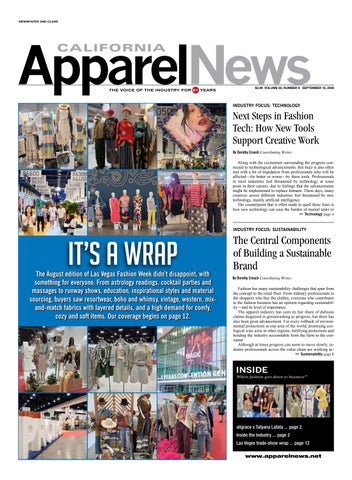
It’s a wrap
The August edition of Las Vegas Fashion Week didn’t disappoint, with something for everyone. From astrology readings, cocktail parties and massages to runway shows, education, inspirational styles and material sourcing, buyers saw resortwear, boho and whimsy, vintage, western, mixand-match fabrics with layered details, and a high demand for comfy, cozy and soft items. Our coverage begins on page 12.
The Central Components of Building a Sustainable Brand By Dorothy Crouch Contributing Writer
Fashion has many sustainability challenges that span from the concept to the retail floor. From industry professionals to the shoppers who buy the clothes, everyone who contributes to the fashion business has an opinion regarding sustainability—and its level of importance. The apparel industry has seen its fair share of dubious claims disguised in greenwashing as progress, but there has also been great advancement. For every rollback of environmental protections in one area of the world, promising ecological wins arise in other regions, fortifying protections and holding the industry accountable from the farm to the consumer. Although at times progress can seem to move slowly, industry professionals across the value chain are working ac-
➥ Sustainabiltiy page 8
INSIDE:
Where fashion gets down to business SM
2 aligrace x Tatyana Lafata ... page 2 Inside the Industry ... page 2 Las Veges trade-show wrap ... page 12 www.apparelnews.net
12
EVENTS
aligrace x Tatyana Lafata Features Reworked Vintage Denim
Los Angeles brand aligrace has collaborated with Tatyana Lafata, a partnership that the label and influencer celebrated during an event on Abbot Kinney in Venice, Calif. Guests posed for the camera as they tried on the collection’s four new silhouettes—the Max Short, Florita Capri, Tatyana Bootcut and Louisa Jean, which rely on upcycled, reworked vintage Levi’s.
ALIGRACE
Upcycled-denim brand aligrace’s recent collaboration with beauty influencer Tatyana Lafata brought the label’s fresh reworked pieces to Abbot Kinney in Venice, Calif., during a launch party for the aligrace x Tatyana Lafata collection. Brand founder Ali Grace and Lafata unveiled their four new silhouettes—the Max Short, Florita Capri, Tatyana Bootcut and Louisa Jean—each made from vintage Levi’s that were reworked in Los Angeles. “Tatyana was supporting aligrace before there was ever a partnership, a contract or a collection involved,” said Grace. “She’s been wearing aligrace long before we ever talked about working together, and that kind of loyalty is what any founder dreams about when they start a brand.”
The Aug. 1 event took place at Studio 228, which also served as the location for the collection’s campaign photo shoot featuring Lafata. The influencer served as a fit model for the pieces. This collaboration with Lafata is the first collection for which aligrace has brought an outside collaborator into the brand’s design process. “About three years ago I was so over never finding jeans that properly fit me, and that’s how I came across aligrace,” said Lafata. “I’ll never forget ordering my first pair of baggy jeans from them and feeling like ‘finally a pair that fits the way I’ve been looking for.’” The aligrace x Tatyana Lafata collection is priced from $498 to $658 and is available at shopaligrace.com. —Dorothy Crouch
Our creative solutions are tailored to meet your working capital needs now, so you can tackle every phase of your business with confidence.
• Factoring and Invoice Discounting • Lending Finance • Inventory Purchase Facilities
CONTACT US
whiteoaksf.com/commercialfinance info@whiteoakcf.com
2 CALIFORNIA APPAREL NEWS
MAY 12, 2023 18, SEPTEMBER APPARELNEWS.NET 2026 APPARELNEWS.NET
WTRLSS, a new biotech company, has announced the launch of a technology to transform the $100 billion global denim industry from one of the world’s dirtiest industries into one of the cleanest. WTRLSS technology cuts water in the denim dyeing and finishing process by up to 99.99 percent. The first-of-itskind digital dyeing technology transforms complex dyeing and finishing processes into one simple step. Every pair of jeans produced today typically requires around 20 gallons of water in the dyeing and finishing process; WTRLSS’ new technology reduces this to two tablespoons. Early product adoption is already underway. The HaMeem Group, one of the world’s largest denim manufacturers, producing jeans for Levi’s, Gap, H&M and others, has partnered on a production pilot. Textiles Manufacturing Expo launches in Charlotte, N.C., April 7–8, 2027, alongside Textiles Recycling Expo USA to bring the textile manufacturing and recycling industries together to showcase the complete textile life cycle. Textiles Recycling Expo USA welcomed 1,858 visitors, 95 exhibitors and 52 expert speakers across two days in April 2026. The addition of Textiles Manufacturing Expo in 2027 will create new opportunities for exhibitors to connect with professionals from across the wider textile value chain. “This new expo will provide a much-needed forum for the suppliers of raw materials and production technologies to connect with textile manufacturers to discuss the innovations and applications that will move the industry forward,” said Chrissy Winegarden, exhibition sales manager at event producer AMI. Abercrombie & Fitch has announced the next evolution of its multiyear partnership with the NFL for the 2026 season. As an Official Fashion Partner, A&F will continue to deliver its signature NFL apparel with a fashion-first lens representing all 32 teams and reach more customers around the globe with broadened product distribution. The expansion is driven by a new partnership with Fanatics, which will use its reach across online and physical channels to broaden the overall product availability to fans. “Our customers are looking for ways to represent the teams they love while staying true to their personal style,” said Corey Robinson, brand president of Abercrombie & Fitch. “That’s what makes our partnership with the NFL such a natural fit.”
FASHION MOVES FAST. SO SHOULD YOUR LENDER.
• Asset Based Revolvers
Inside the Industry
POSTMASTER: Send address changes to: CALIFORNIA APPAREL NEWS, Customer Service, 127 E. Ninth St., Suite 212, Los Angeles, CA 90015. CALIFORNIA APPAREL NEWS ®: (ISSN 0008-0896) Published by TLM PUBLISHING INC. APPAREL NEWS GROUP Publishers of: California Apparel News®, Market Week Magazine®, New Resources®, Waterw ear ® , New York Apparel News ® , Dallas Apparel News®, Apparel News South®, Chicago Apparel News®, The Apparel News (National), Bridal Apparel News®, Southwest Images ® , Stylist ® and MAN (Men’s Apparel News ® ). Properties of TLM PUBLISHING INC., 127 E. Ninth St., Suite 212, Los Angeles, CA 90015, (213) 627-3737. © Copyright 2026 TLM Publishing Inc. All rights reserved. Periodicals Postage Paid at Los Angeles, CA, and additional entry offices. The publishers of the paper do not assume responsibility for statements made by their advertisers in business competition. Opinions expressed in signed editorial columns or articles do not necessarily reflect the opinions of the publishers. Subscription rates: U.S.: 1 year, $89; 2 years, $140. Foreign: $180 U.S. funds (1-year subscription only). Singlecopy price $3.99. Send subscription requests to: California Apparel News, Customer Service, 127 E. Ninth St., Suite 212, Los Angeles, CA 90015 or visit www.apparelnews.net. For customer service, call (213) 627-3737.
Discover e-Solutions, a provider of Product Lifecycle Management solutions for the fashion, apparel, footwear and retail industries, has announced the launch of its Digital Product Password Solution. As Digital Product Passport requirements continue to develop, brands face the challenge of bringing together product information, material and supplier data, certifications, quality records, and supporting documentation from across the supply chain. “Digital Product Passports are fundamentally a data and governance challenge,” said Colin Marks, DeSL CEO. “Brands need to understand where information comes from, how it was maintained and what evidence supports it. By building DPP capabilities into PLM, that information can be managed as part of the product life cycle and used to create passports when and where they are needed.”
www.bridgewatermoss.com
[c]Bridgewater Moss
312.315.8505
floral camo 920
PEXELS.COM
INDUSTRY FOCUS: TECHNOLOGY
How are advancements in technology supporting creativity and artistry in fashion?
Technology Continued from page 1 administrative work that prevents creatives from fully devoting themselves to their craft. In order to accept new technologies, creatives must first know how these tools support their work. California Apparel News asked the fashion industry’s technology leaders: How are advancements in technology supporting creativity and artistry in fashion?
Shahrooz Shawn Kohan Chief Executive Officer AIMS360 Creativity was never the bottleneck in fashion. Operations were. For decades, the people with the best ideas spent their days chasing purchase orders, keying the same order into three systems and fighting chargebacks instead of working on product. Data on sell-through, returns and size curves let a brand see what is working while it is still working. If you can reorder the winner and cut the loser before it buries you in markdowns, you can afford the strange piece, the odd color, the drop with no historical comp. Guesswork punishes originality. Visibility rewards it. We have worked with more than 10,000 brands over forty years at AIMS360. The most interesting work rarely comes from the biggest teams. It comes from brands whose people are not buried in administration. Technology does not make anyone more creative. It clears the room so creativity has somewhere to go.
Ken Weygand Solutions Architect Aptean Digital design tools have transformed the fashion design process by allowing designers to create sketches, experiment with colors, fabrics, and silhouettes, and produce detailed 2D and 3D garment models before making physical samples. This speeds up development, reduces material waste, lowers production costs and gives designers more freedom to test, refine and improve their ideas. Artificial intelligence further enhances the creative process by analyzing fashion trends, predicting consumer preferences, recommending color palettes and patterns, and generating fresh design concepts. AI supports creativity by providing inspiration, increasing efficiency and enabling more personalized designs tailored to customer needs. In addition, cloud-based platforms and digital communication tools have improved collaboration within the fashion industry. Designers, artists, textile specialists and manufacturers can work together in real time, sharing ideas, feedback and expertise. This collaboration encourages innovation and combines diverse creative perspectives, resulting in more original and successful fashion collections. 4 CALIFORNIA APPAREL NEWS
Adam Weir Director of Innovation for Apparel Solutions Avery Dennison We are seeing an unprecedented speed of change in the industry, with new construction techniques and materials breaking new horizons. The strong push toward onshoring makes tools and hardware, previously exclusive to large offshore manufacturers, much more accessible and affordable. By owning parts of the supply chain with a lower investment, brands and designers can experiment quickly and easily—testing their ideas and evolving their products along the way. Digitization and automation have shifted focus away from large-scale uniformity toward enabling efficiency in smaller orders and fostering agility. This allows designers to test the market with new ideas without committing to large volumes, making micromanufacturing the digitally enabled atelier of the future.
Giuseppe Cianci Chief Operating Officer bierrebi International Technology is transforming fashion by giving designers new tools to turn creative ideas into reality. From digital design software to artificial intelligence and automated production systems, technological advancements are helping fashion professionals to experiment more freely and work more efficiently. One of the most important changes is the ability to connect creativity with precision. Designers can create complex patterns, test different fabrics and assess new concepts digitally before moving into production. Advanced bierrebi cutting machines represent a key example of how technology supports creativity, by combining high-precision fabric cutting with automation. This gives designers greater freedom to experiment with shapes and innovative compositions, knowing that their ideas can be translated accurately from the digital pattern to the final piece. Technology is therefore not replacing artistry; it is expanding its possibilities. By automating manufacturing tasks and improving precision, modern technology gives fashion designers and manufacturers the freedom to focus on creativity and innovation. The result is a fashion industry where technology and human imagination work together to create more-distinctive and sustainable designs .
SEPTEMBER 18, 2026
APPARELNEWS.NET
SPONSORED BY
Paul F. Magel President BlueCherry by CGS There was a time when designers spent their days sketching, draping fabrics and chasing inspiration. Today, AI steps in not just to replace the designer but also to remove everything that gets in the designer’s way. At BlueCherry, we believe the future of AI in fashion isn’t about creating the next collection, it’s about giving designers back the time and freedom to create it. Imagine AI automatically identifying similar historical styles, recommending sustainable materials that meet cost targets, predicting sourcing risks before sampling begins, summarizing supplier feedback or highlighting potential compliance issues while a product is still being designed. None of those tasks diminish creativity, they amplify it. The real opportunity is what we call AI Everywhere: embedding intelligent assistance directly into every stage of the product life cycle. Rather than asking designers to leave their creative workflow to search for information, AI brings relevant insights into the moment decisions are made. Fashion has always been a balance of art and commerce. The artistry belongs to the people who understand consumers, trends, color and storytelling. AI simply helps remove friction so those creative minds can spend less time managing process and more time imagining what’s next. The best fashion technology won’t design your next collection. It will give your designers more time to create it.
Pam Peale Vice President for Global Sales and U.S. PLM Operations DeSL Technology is creating more opportunities for creativity in fashion by removing many of the manual processes that have traditionally slowed product development. Rather than replacing creative talent, advancements in AI, digital collaboration, and connected workflows allow designers and product teams to spend less time on administrative tasks and more time exploring ideas, refining products and responding to changing consumer demand. Digital tools are also helping preserve creative intent throughout the product life cycle. From concept through sourcing and production, connected platforms improve collaboration among designers, developers, suppliers and manufacturers, reducing miscommunication while ensuring that products reach the market as originally envisioned. Technologies such as 3D design, digital color and print approvals, and AI-assisted workflows make experimentation faster and more practical. Teams can evaluate more options, identify potential issues earlier, reduce physical sampling and material waste, and
make decisions with greater confidence. This allows brands to innovate more efficiently while supporting both sustainability goals and faster time to market. Ultimately, the greatest impact of technology is not that it creates for us but that it gives creative professionals the time, visibility and tools to do what they do best. As the industry continues to evolve, the brands that successfully combine human creativity with intelligent digital technologies will be best positioned to deliver innovative products and exceptional customer experiences.
Petersen Zhu Chief Executive Officer and President DigitBridge Having worked in the apparel industry for more than 30 years, I’ve seen firsthand how technology has transformed creativity in fashion. Early in my career, designers sketched ideas by hand, created storyboards, sourced fabrics and produced physical samples. Those samples would be reviewed, revised and remade multiple times before a collection was finalized. It was a lengthy, expensive and inherently risky process. Today, technology enhances every stage of that creative journey. Software with AI-assisted features can help generate design concepts, visualize complete looks, develop technical sketches and tech packs, and create digital samples that can be shared with buyers before a physical sample is ever produced. Brands can gather feedback earlier, reduce costly iterations and make more-informed production decisions. Simultaneously, they can begin preparing product content, marketing and ecommerce listings while manufacturing is underway, dramatically shortening the path from inspiration to market. Technology doesn’t replace creativity—it gives creative people more freedom to innovate with greater confidence. By connecting design, production, merchandising and commerce, brands spend less time managing processes and more time creating products that people love to wear, using technology to elevate artistry, reduce risk and help ideas reach consumers faster.
Tim Check Senior Product Manager, Professional Imaging Epson America Advancements in digital printing are allowing fashion designers and brands to push artistry further while running smarter, more responsive businesses. For the fashion community, this convergence of creativity and technology is reshaping how collections are conceived, tested and brought to market. Technologies such as dye-sublimation, direct-to-garment and direct-to-film now reproduce artwork with near-photographic
➥ Technology page 6
INDUSTRY FOCUS: TECHNOLOGY
How are advancements in technology supporting creativity and artistry in fashion? Technology Continued from page 4 fidelity on an expanding range of textiles. Hand-painted designs, digital illustrations and photography can be translated into fabric with rich color, smooth gradients and fine detail, freeing designers from many of the color and registration limits of traditional screen printing. This precision gives creatives confidence that what they imagine in the studio is what customers will see on the finished garment. Equally important, digital workflows decouple creative risk from production risk. Designers can print economically from a single sample to full-scale runs and test niche concepts and pilot capsules without committing to large inventories. Brands increasingly use ondemand and short-run manufacturing to validate demand before investing in bulk production, aligning artistic experimentation with better inventory control and sustainability goals.
Tirsa Parrish Co-founder and Managing Partner Fashion Index What excites me most is how technology is making design tools more intuitive while giving designers powerful new ways to move fast: That combination is a genuine game changer for creativity. Platforms like CLO 3D have lowered the technical barrier to entry, giving designers sophisticated capabilities. At the same time, generative AI tools such as Style3D and Raspberry AI let designers describe a concept in text and get multiple visual directions back in seconds. These tools are an ideal method for exploring silhouettes, prints, colorways and fabrications before committing to a single direction. Designers and brands that adopt these technologies are building a powerful toolbox for creativity. Fashion schools are taking it further, incorporating these tools into the curriculum so graduates hit the ground running. AI can significantly shorten the iteration process. That speed changes the economics of experimentation: Conceptualizing unproven ideas now costs almost nothing, so designers can take more creative risks instead of settling due to time constraints. To me, this isn’t AI replacing artistry; it’s technology expanding the creative sandbox. Designers still bring the aesthetic eye, curation and point of view that turn AI output into something meaningful, but now they’re spending less time on execution bottlenecks and more time on the parts that are actually creative.
Ana Friedlander Senior Director of Industry Solutions and Strategy Infor The greatest threat to creativity in fashion is not technology, it is forcing creative talent to work through outdated systems, disconnected information and slow, wasteful processes. Technology is breaking down those barriers. AI can reveal emerging cultural signals, 3D design can turn an idea into an immersive experience within hours and digital collaboration 6 CALIFORNIA APPAREL NEWS
can connect designers directly with sourcing, manufacturing and merchandising teams around the world. Instead of spending valuable time chasing information, correcting errors or waiting for physical samples, creative teams can explore more ideas, test more possibilities and make bolder decisions. This is where technology becomes a creative multiplier. This is not simply digital transformation. It is creative transformation. AI can surface emerging cultural and consumer signals. Digital design can expand experimentation without multiplying physical samples. Connected data can reveal the cost, availability, compliance and environmental impact of a decision while there is still time to influence it. Together, these capabilities allow designers to explore more possibilities while helping brands commercialize the strongest ideas more responsibly and profitably. Technology should remain the enabler— not the author. Algorithms can recognize patterns and recommend options, but they cannot replicate human instinct, cultural intelligence or the emotional point of view that gives a brand relevance. Leadership must ensure that technology strengthens creative judgment rather than standardizing it. The next era of fashion will unite human imagination with intelligent execution.
Scott Pearson Vice President of Sales and Marketing Jesta I.S./FarsightIQ The next era of fashion will not be defined by technology replacing creativity but by how intelligently brands use it to expand creativity. In an industry where speed, relevance and originality must coexist, progressive fashion organizations are rethinking the creative process itself. AI, advanced 3D design tools and digital prototyping platforms are shifting creativity upstream. Designers can explore fabrics, colors, silhouettes, fit and merchandising concepts digitally before committing to physical samples. This improves efficiency while giving teams more room to experiment, challenge assumptions and make better decisions earlier. By surfacing signals from trends, preferences, cultural shifts and historical performance, AI gives designers and merchants a broader lens to evaluate ideas. The human role remains essential: interpreting those signals and creating work with emotion, context and point of view. Augmented and virtual reality are also changing how fashion is experienced. Virtual showrooms, digital garments, 360-degree views and try-on experiences help brands present ideas with greater depth and flexibility while giving customers more-immersive, personalized ways to engage. Personalization is another frontier. As data become more intelligent, brands can move beyond broad segmentation toward assortments, recommendations and experiences that feel relevant to individual customers without losing brand integrity. Technology should be treated as a creative accelerator, not a substitute. The brands that lead will be those that use technology to remove friction, sharpen insight and give human creativity more space to perform.
SEPTEMBER 18, 2026
APPARELNEWS.NET
SPONSORED BY
Alison Bringé Chief Marketing Officer Launchmetrics For a long time, fashion, lifestyle and beauty brands have had to make creative decisions largely on instinct. They could feel what was resonating with their audience, but they couldn’t always prove it. What’s changed with AI is that we can now measure what used to be hard to pin down, and that clarity doesn’t limit creativity, it empowers it. At Launchmetrics, the data and analytics we bring show the ideas that are actually connecting and why so brands can back their boldest ideas with confidence instead of defaulting to the safe choice. Once you can see what’s actually working, the creative gets sharper and the strategy becomes clearer. And, in an industry dealing with more channels, more voices and more noise, that’s what separates the brands cutting through from the ones adding to it. The brands getting this right are the ones using AI-powered solutions to remove the guesswork so their teams can focus on what they do best: telling a story that actually lands. That’s ultimately where brand performance improves: when data and creativity move in step, each making the other stronger.
Ketty Pillet Vice President Marketing for the Americas Lectra Fashion companies are navigating a landscape defined by constant change. Consumer expectations are evolving rapidly, supply chains are under pressure, and brands are expected to innovate at unprecedented speed. In this environment, technology has become a critical enabler of creativity. The fashion industry is moving from disconnected processes toward highly connected ecosystems where information flows seamlessly from design to production. When teams have access to accurate, real-time data and automated workflows, they can make decisions faster and spend more time focusing on innovation rather than low added-value tasks such as chasing information, ensuring data consistency and coordinating teams. Advancements in artificial intelligence and cloud-based platforms are helping companies transform creative ideas into finished products more efficiently. Brands can better anticipate demand, optimize production and manage smaller, more-personalized collections without sacrificing quality or speed. This agility allows creative teams to experiment, refine concepts and bring new products to market with greater confidence. Technology also helps preserve what makes fashion unique: human expertise. The goal is not to replace designers, patternmakers or product developers. Instead, digital solutions remove barriers that often slow them down, enabling stronger collaboration and better execution across the entire product life cycle. As the industry continues its transition toward more-connected and sustainable operations, we see technology playing an increasingly important role in unlocking creativity.
The future belongs to fashion companies that combine craftsmanship, innovation and digital intelligence to create products that consumers want, when they want them. Creativity remains the differentiator. Technology is what enables it to scale.
Frank Maeder President NedGraphics and Optitex Technology has always served creativity in fashion, but we are at an inflection point where it’s genuinely amplifying artistry rather than just supporting logistics. At NedGraphics, designers can explore color palettes, complex repeat structures and surface aesthetics in ways that simply weren’t possible before. Instead of waiting days for a fabric strike-off, a designer can visualize exactly how a print behaves on a specific textile, testing dozens of colorways and variations in the time it once took to produce one. The result is richer creative exploration, not a compressed version of it. Optitex extends that creative confidence into the sewn product itself. Through advanced 2D pattern development and highfidelity 3D simulation of the assembled garment, designers and technical teams can see how a silhouette fits and how fabric drapes and moves on a virtual body before a single physical sample is cut. That ability to validate and refine creative decisions at the garment level is transformative. What makes the combination powerful is continuity. Textile design intent that originates in NedGraphics carries through into Optitex 2D and 3D garment-development workflow without losing fidelity. Creative and technical teams work from shared data, reducing the costly translation errors that traditionally happen when design hands off to production. When the gap between imagination and execution narrows, artistry advances, and that’s where the most exciting design work happens.
Peter Hedrick President On Display Apparel Software While we are not the artists, our line of work deals with technology and support of the creatives we work with. As a small company, we know our customers by name and are in regular communication. Our customers generally consult us when they are approached with new technology requirements and any other needs that may arise. In addition, our customers come to us with big ideas they may need help executing. For example, we had a creative and ambitious customer who had goals of scaling his shoe business quickly, so we helped him implement his plans, which allowed him to keep up with rapid growth. During COVID, another customer asked us to develop a private B2B website, specifically a place that allowed them to work hand-in-hand with their major retail customers. We were able to execute their vision, and we continue to implement new features to support their evolving needs. Ultimately, it’s important
INDUSTRY FOCUS: TECHNOLOGY
How are advancements in technology supporting creativity and artistry in fashion? for creatives to understand technology to an extent, but a support system of technology specialists can help artists thrive even more.
Paul Bentham Chief Product and Technology Officer Oritain As regulatory expectations evolve and supply chains become increasingly complex, brands face growing pressure to have confidence in the integrity of their sourcing programs. Oritain’s 2026 Supply Chain Intelligence Report found that over 90 percent of brands analyzed recorded at least one garment containing prohibited cotton, despite widespread investment in traceability efforts, underscoring the importance of moving beyond documentation alone to understand the true origin of materials. The benefits extend beyond risk management. Oritain’s report found that only 3 percent of consumers globally trust marketing claims, highlighting a broader trust gap between brands and their customers. Independent verification helps organizations substantiate sourcing claims with objective evidence, providing a stronger foundation for consumer confidence and brand credibility. Advancements in technology are increasingly helping fashion brands bridge this trust
gap. Technologies such as forensic origin verification enable businesses to validate sourcing claims with greater confidence, allowing creative and commercial teams to focus less on defending claims and more on creating compelling products and stories that resonate with consumers. When brands can demonstrate the integrity of their supply chains with evidence, they are better positioned to communicate authenticity and craftsmanship with confidence. Ultimately, stronger supply-chain assurance is not simply about meeting expectations. It is about providing organizations with the confidence to innovate, create and grow. By equipping businesses with evidence-based insights into the products they bring to market, technology can help unlock greater focus on the activities that drive value, from product development and design to brand building and customer engagement.
Minesh Pore Founder and Chief Executive Officer SourcingGPT.ai AI’s most valuable role in fashion is not replacing creativity—it is removing the friction that prevents creative ideas from becoming real products. Designers can now use AI to explore new silhouettes, color combinations,
SPONSORED BY
materials and cultural references much faster. But creativity does not end with an image or sketch. The real challenge is translating that vision into the right fabric, finish, construction method, price point and responsible manufacturing partner. This is where sourcing technology becomes a creative tool. Platforms such as SourcingGPT can help designers describe what they want in natural language, discover relevant materials and manufacturers, compare capabilities and costs, and identify more-sustainable or innovative alternatives. A young designer can explore supply-chain possibilities that previously required years of industry relationships and considerable resources. AI can also reduce repetitive administrative work—supplier searches, RFQs, quote comparisons, follow-ups and documentation—giving creative teams more time to design, experiment and tell meaningful stories. The future of fashion will not be created by AI alone. It will be created by imaginative people using AI to expand what is possible. Technology provides the speed, intelligence and access; human taste, emotion and cultural understanding remain the true source of artistry.
Ram Sareen Founder Tukatech The role of technology is not to replace artistic vision but to eliminate repetitive technical work so designers and product-development teams have more time to experiment and perfect the ideas that transform a good product into a great one. Technology is most valuable when it expands creative possibilities while ensuring every design remains grounded in fit, quality and actual production. Our latest generation, TUKAcad-GC combines traditional pattern engineering with AIassisted workflows and fully integrated 3D product development. Equally important is TUKAstylehub, our cloud-based collaborative platform that connects designers, pattern engineers, merchandisers, technical teams, factories and brands in real time. The future of fashion technology is not about replacing designers—it is about empowering them. By eliminating repetitive technical tasks, enabling global collaboration and creating accurate digital prototypes before a single piece of fabric is cut, technology allows creative professionals to spend more time doing what they do best: designing products consumers love. ● Responses have been condensed for clarity and space.
SOCAL TEXTILE GROUP Showroom COOPER DESIGN SPACE, MEZ 6 Jay / Jason Wetherald (818) 613-2385 Jbyrdtextiles@aol.com www.SocalTG.com
ECLAT TEXTILES Performance Knits
Leading provider of circular knits to higher-end athleisure and activewear brands. Los Angeles stock program for domestic production. Heather Moss Jersey, Interlocks, TENCEL, and many more performance-knit options to choose from. Also, knit-to-order from Taiwan.
VICTORYTEX Performance Wovens Victory is a woven converter based in Taiwan. Excellent source for stretch and non- stretch wovens. Minimum order quantity is 3,000 per fabric / 1,000 yards per color. Can be flexible on MOQ.
REX FABRICS Los Angeles Stock
Rex Fabrics is a converter located in Los Angeles offering a large selection of stock fabrics for yoga, sport, swim, gymnastics, and dance. Minimum order quantity is only 5 yards per color. Large color selection, and color cards available upon request.
Upcoming Trade Shows Functional Fabric Fair Portland, Ore., Oct. 27-28, Booth #925 The Fabric Show San Francisco, Nov. 8–9 APPARELNEWS.NET
SEPTEMBER 18, 2026
CALIFORNIA APPAREL NEWS 7
PEXELS.COM
INDUSTRY FOCUS: SUSTAINABILITY
What are the core elements that brands and designers must focus on when building and growing their sustainability initiatives in the current fashion-business climate?
Sustainability Continued from page 1 cording to authentic sustainable guidelines rather than simply selling a marketing story. California Apparel News asked fashion insiders: What are the core elements that brands and designers must focus on when building and growing their sustainability initiatives in the current fashion-business climate?
Beth Amason Vice President of Fabric Innovation Cocona Sustainability should be less about adding another initiative and more about rethinking how we design and build garments. Designers should ask how they can build a better garment, not what boxes can be checked to claim a prod-
uct is sustainable. A garment that performs better, lasts longer and delivers greater comfort and value throughout its life cycle moves us in a more sustainable direction because it doesn’t need to be replaced as often. That’s a philosophy we embrace at 37.5 Technology. Sustainability starts with creating a better garment experience. Create garments people love to live in and build them to last a lifetime.
Kerry Bannigan President of the Board PVBLIC Foundation Sustainability works best when it is built into the structure of an organization rather than treated as a separate initiative. It should influence how products and programs are designed, financed, sourced and executed. When connected to governance, procurement and growth planning, sustainability becomes part of how an organization creates value and builds resilience. Brands and designers need a clear understanding of their value chain, where the greatest environmental and social risks and opportunities sit, and how progress will be measured. Through our SDG Media Zone platform, we have seen how credible data and transparency build trust. Better materials and lower impact technologies cannot compensate for unsafe working conditions or unfair wages. Through the Fashion Impact Fund, we trained women in fashion production across Africa, South Asia, the Caribbean, the United Kingdom and the United States, because the workers and artisans behind fashion should share in the value the industry creates. Supply-chain relationships matter just as much. Fair purchasing practices and early supplier engagement, the kind we are building through our REIN Hubs partnership in Latin America, give producers the stability to actually innovate. Doing good and doing good business are not mutually exclusive. Build an operating 8 CALIFORNIA APPAREL NEWS
model where responsibility strengthens performance and distributes value more fairly across the whole ecosystem.
Inga Bleyer Head of Marketing and Communication OEKO-TEX For a long time, you’d build the story first and, if someone asked for evidence, you’d go find it. That doesn’t work anymore. Starting Sept. 27, the Empowering Consumers Directive means words like “green” or “ecological” on their own don’t hold up and it’s on the brand to show the proof. In practice, that mostly means being specific and verifiable. “Sustainable” has stopped meaning much to anyone and carries real risk. “Tested against harmful substances,” says something a person can actually check. But you can’t be specific if you don’t know what’s going into your product, and that’s usually where it falls apart. You don’t have to solve everything at once; start with one line or one material. A small claim you can prove is worth far more than a broad one you can’t. The brands who get through this fine won’t be the brands saying the most. They’ll be the brands who can answer the follow-up questions.
Meredith Boyd Executive Vice President and Chief Product Officer UNIFI Sustainability has moved from a brand differentiator to a business requirement. Consumers, particularly Gen Z, expect brands to think beyond recycled content claims and take responsibility for products at the end of their life. Designing for recyclability needs to become a core principle of product development. One of the clearest paths forward is mono-material design. It’s a systems-thinking approach that forces us to consider a product’s next life while designing its first. The next evolution is designing for circularity. When we reduce material complexity and improve compatibility across a product, we create a much better opportunity for those materials to be recovered and reused at scale. The brands that will lead the future of fashion won’t just use better materials, they’ll design products as if end-of-life matters as much as first use.
Areliz Cavada Marketing and Social Media Manager Circular Fashion LA
SEPTEMBER 18, 2026
Brands and designers must think beyond the point of production and ask: How will this product perform even after it leaves our facility? That means designing with longevity, functionalAPPARELNEWS.NET
SPONSORED BY
ity and circularity in mind while taking greater responsibility for the product throughout its life cycle. Ultimately, sustainability should be measured not only by how a product is made but also by what happens afterward—whether efforts are actually reducing waste, extending product lifespans and keeping clothing and resources in circulation for as long as possible. Just as importantly, brands need to make circular solutions accessible and provide consumers with the knowledge and tools to care for what they already own.
Cecilia Chan Chief Commercial Officer Legend Swimwear Factory Fashion leaders must shift sustainability from a downstream sourcing control into an upfront design requirement. With EU Digital Product Passports looming, compliance can no longer be retrofitted through sourcing audits and supplier scorecards. Up to 80 percent of a product’s environmental footprint is locked in at the concept stage, where material matrices dictate the energy, water and chemical intensity of upstream mills. Creative teams require pre-vetted material libraries and primary supply-chain data integrated directly into their PLM workflows to evaluate circularity and traceability alongside aesthetics and margin. Simultaneously, procurement teams must move past transactional bargaining—leveraging long-term volume commitments to coinvest in upstream decarbonization. Embedding sustainability into the first creative brief is conceptually straightforward. Realigning conflicting internal KPIs, modernizing legacy tech stacks and overhauling supplier partnerships is where margin and compliance will find common ground.
Kuan Chen Founder Story Wear At Story Wear, we began with upcycling, proving that discarded textiles could be transformed into desirable, premium products rather than waste. Today, we are building on that foundation through textileto-textile recycling, developing systems that recover post-consumer denim and convert it back into fashion-grade fibers, yarns and fabrics. This demonstrates why brands must move beyond simply using sustainable materials and instead invest in circular systems that reduce dependence on virgin resources. At the same time, innovation alone is not enough. Brands need transparent and accountable supply chains that can trace materials, measure impact and ensure sustainability commitments are reflected throughout production. Strong governance is equally essential, with sustainability goals integrated into business decision-making, supplier relationships, compliance and long-term strategy through clear
accountability, and measurable outcomes. In an increasingly complex and regulated landscape, the brands that will succeed are those that combine creativity with systems thinking, building businesses that are environmentally responsible, commercially scalable and resilient.
Onur Çınar Senior Marketing Executive ISKO Sustainability in fashion is no longer a stand-alone initiative; it needs to be embedded into how products are designed, developed and produced. Brands and designers should focus on circularity, traceability, material innovation and measurable impact while maintaining creativity, quality and commercial relevance. Designing for longevity and end-of-life, choosing materials based on credible data, and improving transparency across the supply chain are becoming essential. At the same time, meaningful progress requires collaboration across the value chain. Ultimately, the next chapter of sustainable fashion will be defined not by sustainability claims but by measurable impact, smarter products and more-resilient business models. Sustainability should be part of the product from the very beginning, not an additional layer added at the end.
Paola Corna Chief Financial Officer, Sustainability and Human Resources Manager ACM We adhere to four key pillars, which I believe can also serve as a useful framework for brands and designers. The first is the ongoing research and development of lower-impact materials. The second is the continuous improvement of production processes, with the goal of reducing emissions as well as energy and water consumption. The third is traceability is equally important, as it helps ensure a clear understanding of the origin and characteristics of materials while supporting chemical and physical compliance. Finally, recognized certifications and standards are essential to giving environmental and social commitments greater credibility and transparency. For a sustainability strategy to truly grow, these elements need to be integrated from the design stage and monitored over time.
Amanada Frisbee Senior Account Manager Burlington Start with a product you already sell and ask: What could we change to reduce its impact without giving customers a reason to replace it sooner?
➥ Sustainability page 10
Lycra art t/k fp p9
INDUSTRY FOCUS: SUSTAINABILITY
What are the core elements that brands and designers must focus on when building and growing their sustainability initiatives in the current fashion-business climate? Sustainability Continued from page 8 Work with suppliers to understand how that product is made, including where its materials come from, the chemicals used, water and energy use, and waste. Then choose two or three changes you can measure. When choosing a new fabric, look beyond labels like recycled or bio-based. Test how it holds up after repeated wear and washing. Does it still fit, feel good, do its job and meet your price target? A material change should create a better product, not just a new claim for the label. Ask practical questions during design, too. Can a broken zipper be replaced? Can the fabric, coating and trims be recycled together? If you call a garment recyclable, where can customers actually take it? Finally, treat suppliers as strategic partners. Brands should help suppliers build these capabilities and account for the real cost of meeting shared sustainability goals. They should also ask what each claim covers and whether it applies to the fabric they are buying.
Joy Grover Business Development Manager for North America Eastman Naia In the current fashionbusiness climate, sustainability initiatives need to be built around credibility, adaptability and the ability to scale. For brands and designers, that starts with measurable goals, transparent sourcing and reliable data. Sustainability claims need to be supported by clear evidence, traceability and, where relevant, thirdparty verification. Sustainability strategies need to evolve with changing consumer expectations, sourcing conditions and available infrastructure while remaining practical to implement across the business. At the same time, materials and ingredients that can work across different seasons and meet different performance requirements can give designers greater flexibility and support more-adaptable collections. Scalability is equally critical. Brands and designers should prioritize sustainability solutions that are embedded into product and sourcing decisions from the start and can move beyond pilots into real, repeatable adoption.
Amber Härkönen U.S. Circular Business Manager Circulose The brands making real progress on sustainability treat it as a design and sourcing decision, not a marketing exercise. That starts with material choice. Textile waste is one of the largest untapped resources in fashion, and recycled inputs like Circulose, made from cotton waste, let brands cut virgin-material use without compromising on quality or hand feel. Second, brands need to build recycled content into core collections at scale. That’s where genuine emissions and resource reductions happen, and it’s also what regulation is increasingly going to require as ESPR and 10 CALIFORNIA APPAREL NEWS
upcoming EU recycled-content rules make clear. Also, brands should be able to trace and verify recycled content back to its source, not just make a claim. That traceability is what builds trust with increasingly skeptical consumers and regulators.
Aimee Heuschkel Vice President Marketing, Americas Lectra Brands need trusted and verifiable sustainability data. As regulations such as Digital Product Passports evolve, companies must be able to accurately track materials, suppliers, certifications and production flows. Adopting an end-to-end traceability solution across the supply chain enables brands to substantiate sustainability claims, strengthen compliance, improve resilience and make more-informed decisions. By connecting product, supplier, certification and compliance information within a unified environment, brands can make better decisions earlier, reduce waste, improve efficiency and align sustainability objectives with business performance. A fashion-native PLM solution helps establish a single source of truth for product information, ensuring consistency and enabling teams to collaborate more effectively. Creating a single, trusted source of product and supply-chain information enables greater transparency, stronger collaboration, and more-effective management of regulatory and sustainability requirements.
Dr. Cindy J Lin Chief Executive Officer Hey Social Good Brands and designers must turn their attention to resiliency and circularity as core business elements to survive the onslaught of economic and climate challenges ahead. With the global uncertainties around tariffs, resource availability, and now detailed sustainability policies with deadlines in the EU and California, brands must consider long-term planning and accountability. Brands should consider designing products with single-material compounds or naturalmaterial compositions to avoid complex material-composition tax fees when using nonnatural fibers. This streamlines post-use processing, prevents downcycling and avoids additive waste-disposal fees. Designing with glueless bonded seams, thread or snap-fit assemblies allows recyclers or end users to easily separate components for upcycling, repair or recycling. Using algaebased textiles, agricultural-waste composites and other lab-based materials that biodegrade naturally limits microplastic shedding, increases circularity and potentially reduces long-term costs with cheaper components. Launching a branded resale platform or selling modular replacement parts helps monetize products well after the first purchase.
SEPTEMBER 18, 2026
APPARELNEWS.NET
SPONSORED BY
Jennifer Lukowiak Director of Account Management Cotton Incorporated Brands and designers need to make sustainability a full product-life-cycle strategy. The business case is clear: 71 percent of U.S. consumers say sustainability matters when buying apparel, up from 65 percent in 2023, according to the 2026 Cotton Council International & Cotton Incorporated Global Sustainability Survey. Fiber choice gives brands a credible place to start. Cotton offers a strong foundation because it is renewable, familiar to consumers and backed by research that helps reduce environmental impact from field to finished product. End-of-life planning makes sustainability more actionable. Brands can design products for repair, reuse, recycling or responsible return to the environment under the right conditions. Cotton’s Blue Jeans Go Green denimrecycling program turns old denim into new uses instead of waste, giving brands and consumers a practical way to support circularity. The strongest sustainability platforms balance measurable impact, product performance and consumer expectations, creating products people want to wear longer and move responsibly into their next life.
Steve McCullough Event Vice President Functional Fabric Fair Sustainability in 2026 and beyond can’t be an after-thought—it has to be built into the foundation of how brands design, source and produce. That starts with transparency across the supply chain, staying ahead of evolving regulatory requirements and grounding decisions in real data rather than assumptions. Best practices are shifting quickly, and what worked even a year ago may no longer be enough, so continuous education is critical. That’s the thinking behind Functional Fabric Fair’s fall Portland “Day 0 OIA Catalyst Conference” with the Outdoor Industry Association, a full day of foundational sustainability topics, regulatory updates and real-world case studies through breakout sessions. Progress happens when the industry learns from each other, and events like this give brands practical tools alongside a community of peers working toward the same goal.
Cindy McNaull Business Development Director Cordura Today’s most effective responsible product strategies begin with a simple question: Will this product still be worn, used and valued years from now? As brands navigate shifting regulations, evolving consumer expectations and increasing pressure to demonstrate meaningful progress, longevity has become one of the most important design principles. Creating products that last longer helps extend use cycles, reduce replacement frequen-
cy and deliver greater value over time. That means focusing on durability, quality materials, timeless design and versatile performance rather than short-term trends alone. Cordura believes “Sustainability Begins With Products That Last,” and this philosophy has guided our innovation for decades. We believe that durability is one of the most responsible attributes a product can have. At the same time, responsible innovation cannot come at the expense of performance.
Philippe Mignot Project Manager NextPrinting For brands and designers, it can be valuable to consider from the earliest stages of development not only what a product is made from but also how its visual effects, finishes and customizations are achieved. This opens the door to solutions that can combine quality and creativity with a more efficient use of resources. This is the direction behind NextPrinting’s work. Through digital pigment and transfer-printing technologies, it is possible to reproduce highly realistic and repeatable effects that have traditionally required more resource-intensive processes, helping reduce the use of water, energy and chemicals. In denim, this approach can make a tangible contribution to reducing the environmental impact of production. The dialogue between creativity, technology and the supply chain is one of the most promising ways to advance sustainability initiatives. The goal is to expand the tools available to achieve high-level aesthetic results through increasingly efficient and responsible processes.
John Mitchell Head of Business Development, North America Livinguard Technologies The fashion and apparel industry is under huge competitive pressure that challenges growth and margins. Most design and materials teams at brands consequently operate with a clear cost-savings mandate. Livinguard Technologies aims to eradicate this implied trade-off between sustainability and business objectives, which is deeply engrained in the textile professional’s mindset. The company launched Livinguard Better Fresh—a game-changing textile finishing that does not only provide leading biocide-free and wash-durable odor-control functionality, but the solution has also been proven to reduce microfiber shedding during home laundering by up to 80 percent. This innovation allows brands to advance progress toward their commitments to reducing the environmental burden from fiber fragmentation while at the same time building differentiated, longer-lasting products.
INDUSTRY FOCUS: SUSTAINABILITY SPONSORED BY
What are the core elements that brands and designers must focus on when building and growing their sustainability initiatives in the current fashion-business climate? Jessica Morgan Director of Merchandising Texollini Start with thoughtful material selection and understand the impact of the entire process, from fiber and yarn through knitting, dyeing and finishing. Equally important is developing for quality, performance and longevity. Continued innovation in sustainable and cellulosic fibers, textile-to-textile, and resource-efficient dyeing and finishing can help reduce waste and consumption while advancing overall product sustainability. Brands should look beyond selecting a sustainable fiber and consider the full product life cycle, including resource use, manufacturing, durability and end-of-life considerations. Overall, sustainability in today’s market needs to be both meaningful and measurable. Rather than trying to solve everything at once, brands should identify the areas where they can make the greatest impact, establish measurable goals and continually improve. When sustainability is integrated into the product and supply chain from the beginning, it can become a driver of innovation, efficiency and long-term value—not simply another requirement for doing business.
Ngozi Okaro Founder and Executive Director Custom Collaborative Consumers remain confused—and skeptical— about the industry’s sustainability claims. That signals a need for brands to connect their sustainability initiatives to more-tangible outputs that consumers can see, feel and experience. Resale. Repair. Recycle. Pick one that resonates with your audience and tweak it until profitable. Major brands are following this same lead, with the recent boom of upcycling initiatives, repair programs and resale platforms. But execution matters more than the initiative itself. Sustainability has to be core to your business model, not an add-on. That’s where the profit opportunity actually lives. Tackling fashion’s built-in excess across the supply chain is a massive opportunity to increase margins. Brands that invest in these programs accordingly by hiring skilled labor, offering fair compensation and investing in training create durability competitors can’t easily copy. Those that treat these programs as cost centers or marketing add-ons with minimal support end up with the same reputation problem causing consumer confusion: greenwashing. The difference between a genuine shift and performative sustainability comes down to whether a brand integrates these programs with the same rigor it does other core operations.
Ebru Özküçük Güler Chief Sustainability Officer RE&UP The first priority should be measurable impact and transparency. Sustainability claims need to be backed by credible data, traceability and real environmental outcomes. At the same time, brands need to design
products with circularity in mind, considering durability, reuse and recyclability from the very beginning. But perhaps most importantly circularity needs to become practical and scalable. Brands cannot build circular systems alone. They need access to the right infrastructure, partners and technologies to manage materials and products after their first life. This is where we see an important role for RE&UP. We want to support brands in moving from sustainability commitments to real circular business models by building the infrastructure needed to make circularity work at scale. By working with RE&UP, brands can access an integrated circular solution, connecting textile collection and sorting with reuse, resale and T2T recycling.
Lewis Perkins President and Chief Executive Officer Apparel Impact Institute Industry emissions have been ticking up in recent years: In 2023 they increased by 7.5 percent; in 2024, they went up again by 6 percent. It’s becoming increasingly clear that sustainability and decarbonization efforts are necessary to meet climate goals. Brands must move from commitments to facility-level implementation and translate climate commitment plans into specific lowcarbon projects such as thermal and electrification interventions like heat pumps and deploying renewable energy. They must support supplier action and foster trust with their manufacturers by sharing the financial and operational burden of supply-chain decarbonization. For the fashion sector, the next phase of decarbonization and sustainability depends on scaling already-identified climate interventions to be standard practice rather than isolated examples through sharing verified results, implementation lessons and consistently monitoring the progress of decarbonization interventions. Our industry must prioritize delivering absolute emissions reductions through decarbonization and renewable energy. As the fashion industry is characterized by energy-intensive processes like spinning, weaving and wet-dyeing, energy decarbonization offers a proven path to lowering operational emissions and improving business resilience.
Ram Radhakrishnan Founder and Chief Executive Officer Silq Our inspectors are inside thousands of factories across Asia, and we see most sustainability programs fail on the factory floor rather than at the design and development stage. Brands write the policy, advertise the commitment and then hand enforcement to a supplier with a hope and a prayer plus some loose paperwork. This is how sustainability claims become a hypothesis and stop being a fact. The bigger shift is that sustainability and forced-labor compliance have collapsed into the same problem: Can a brand name every facility that touched its product? CBP now expects traceability back to the raw material. The question is shifting from what a brand promises to what a brand can stand behind.
That is the new and harder standard.
Patrizio Siniscalchi Managing Director Thermore Achieving true sustainability relies on several key elements. First, adopting a responsible approach to resource management is increasingly important. At Thermore, for example, using recycled fibers in our products allows us to give new life to raw materials that would otherwise be wasted, transforming them into tangible value. Furthermore, a rigorous commitment to quality and durability is required. Designing longlasting materials and garments is an ethical choice that drastically limits environmental impact by reducing the need for frequent replacement. Finally, operational objectives must be supported by transparent and credible communication. Consumers want to understand the values and stories behind the companies they support, making authentic communication a strategic lever for building lasting trust.
Cheryl Smyre Vice President Parkdale Advanced Materials Circular systems cannot capture every fiber throughout a product’s life cycle. Microplastic fiber leakage can occur during manufacturing and use and at end-of-life when textiles fall outside collection and recovery systems. Recycling alone was not designed to address microfiber leakage. California is raising expectations for material accountability with a Senate bill that introduces extended producer responsibility, eco-modulated fees and significant penalties for noncompliance as implementation approaches. The state’s broader microplastics strategy is also increasing attention to textile fiber release and material design. For brands, 2030 is not the year to start preparing. The work starts now with lowerimpact, recyclable and traceable fibers backed by credible verification and data. Addressing fiber leakage and microplastic-fiber persistence should become part of that strategy alongside circularity, not separate from it. Technologies such as CiCLO technology demonstrate how microplastic-fiber persistence can be addressed at the fiber stage while complementing recycling and T2T systems. In an industry where material and sourcing decisions are made seasons ahead, 2030 is closer than it appears. Building the materials, traceability and proof required for what comes next starts now.
Adam Taubenfligel Creative Director and Responsibility Lead Triarchy Stop treating sustainability as an initiative. Initiatives are optional. They can be added when budgets allow and removed when they don’t. We’re seeing the consequences of that across fashion today as
economic pressure causes many companies to quietly retreat from commitments they made only a few years ago. Good systems don’t depend on good intentions. The focus should instead be on designing responsibility into the architecture of the business itself. Question processes rather than simply improving them. Why reduce wastewater if a technology can eliminate the process creating it? Why manage excess inventory if production can respond to actual demand? Why develop better ways to recycle problematic materials if they can be removed from the product altogether? This requires brands to focus on materials, technology, production systems and business models together rather than treating sustainability as a separate objective. The current climate is an important test. If responsible practices only survive when business is good, they were never truly part of the business. Build systems where the responsible outcome is inevitable because sustainability should not depend on continually choosing it. Sustainability should be the consequence of good systems design.
Andrea Venier Managing Director Officina39 For me, the next step is not about choosing between creativity, responsibility and efficiency. Real innovation happens when the three reinforce each other. At Officina39, we describe this approach through three core principles. Sustainability must be trustainable: supported by traceable, measurable and auditable data across materials, chemistry and manufacturing, moving beyond claims and toward credible progress. It must also be imaginable. Sustainability should expand creative possibilities rather than limit them. The industry needs technologies that allow designers to explore new aesthetics while reducing environmental impact, without forcing creativity into increasingly standardized solutions. Finally, sustainability must be performable. In a market where manufacturers are under pressure to reduce costs, shorten lead times and build more-resilient supply chains, lowering water, energy and chemical consumption must also translate into efficient processes, consistent quality and industrial scalability. In denim, solutions such as ZERO PP ALL.IN and AQUALESS ALL-IN-ONE show how lower-impact processes can be integrated into industrial production without compromising creative results or operational performance.
Luciano Vivolo President and Founder Vivolo Consumers need to trust that the values a brand communicates are genuinely reflected in its products—in the materials it chooses, its manufacturing processes, its environmental impact and, just as im-
➥ Sustainability page 15
APPARELNEWS.NET 18, 2023 2026 CALIFORNIA CALIFORNIA APPAREL APPAREL NEWS NEWS 11 11 APPARELNEWS.NET SEPTEMBER NOVEMBER 10,
TRADE-SHOW REPORT
Las Vegas Fashion Week Inspires and Educates By Kelli Freeman Contributing Writer
There was something for everyone at Las Vegas Fashion Week, from astrology readings, cocktail parties and massages to runway shows, education, inspirational styles and material sourcing. Wholesalers and large-volume retail buyers found statement pieces from IFJAG, The International Fashion Jewelry & Accessory Group, held at the Embassy Suites by Hilton Convention Center Las Vegas. Buyers saw coastally inspired flowy resortwear, boho and whimsy, vintage, western, mix-and-match fabrics with layered details,
ANDMORE’s Las Vegas Apparel Offers Playful Looks Light knits and colors were displayed as new exhibitors joined ANDMORE’s Las Vegas Apparel, colocated with Womenswear in Nevada at The Expo at World Market Center Aug. 9–12. A top seller for Los Angeles–based Heimish was a denim poncho-style top with polka dots, button-up collar and faded wash
and a high demand for comfy, cozy and soft items in both men’s and women’s apparel.
Easel
Haptics
paired with a thinner Chloe denim pant with wide flair bottom. LovLov in Los Angeles featured feminine to adventurous fast trends such as its “Merry” medium mock-neck top with checker trim matched with a red and white–striped patch pant with thick tie at the waist and rivet-hole trim. Mixing fabrics and exclusive prints are
ANDMORE’s Las Vegas Apparel and Clarion Events’ Womenswear in Nevada
Heimish
LovLov
a specialty at Haptics, with headquarters in Vernon, Calif. The brand featured seasonal themes in both its loose-fitting, soft buttery waffle knits and colorful mesh tops with lettuce-hem finishes. “We’re finding stripes, polka dots and plaid, which I love, and all the colors. Business is phenomenal; 2026 has just burst at
were colocated at The Expo at World Market Center Aug. 9–12 with a fourth season of The Men’s Edit. Fashion by Informa’s Las Vegas Marketplace included MAGIC, PROJECT, SOURCING and OFFPRICE at the Las Vegas Convention Center Aug. 10–12. The colocated fashion trade shows involved thousands of exhibitors, attendees, educational panels and brand-curation programs.
the seams,” said Katlynn Bishop, owner of the One24 Boutique in Neosho, Mo. Additional Southern California brands that exhibited included Adora, Aryea, Davi & Dani, Easel, ee.some, Entro, Glam, Sage + Fig, She + Sky, Timing, Umgee and Vine & Love. “The Las Vegas Apparel show was a great success, offering buyers a strong variety of products across multiple seasons. We were especially pleased to see healthy order-writing activity throughout the show, reflecting the quality of the brands and the confidence of attending buyers,” said Caron Stover, ANDMORE senior vice president, Apparel Leasing.
WWIN Provides a Wealth of Inspiration Comfort, color and prints could be found throughout the show floor at Womenswear in Nevada, held Aug. 9–12 and colocated with ANDMORE’s Las Vegas Apparel at The Expo at World Market Center. Buyers were writing orders for everything from classics to ethereal apparel and accessories. Trend displays featured effortless luxury inspired by coastal living from the MediterraELLE nean to American style and modern Color Me Cotton romance with soft femininity reimagined for everyday wear. Global fashion and lifestyle brand ELLE capsules for the American woman shopping made its debut at WWIN with the ELLE specialty stores who wants that little French Design Collective in New York bringing the wink!” said Praxie Alegria, senior vice presi“Parisienne” look, style and confidence to the dent of design for the Elle Design Collective. U.S. market. “We collaborated with designers Color Me Cotton, made in Los Angein Paris and New York to create very curated les, presented a drapey, machine-washable,
Vita Boutique
Young Threads
double-gauze “funky skirt” that looked like a barrel pant with front pockets. With distribution out of San Diego, IPNG Design wowed buyers with its bejeweled poly, silk, Lycra and viscose printed illusional pant and bomber jacket sets made to
look like denim. “It blew out my store, and I have people already wanting the reorders. The fabric, design, the comfort are so unique—it’s a showstopper,” said Elizabeth Amireh, owner of the Vita Boutique in Hartville, Ohio. New York–based Young Threads featured a Desert Dream cloud pant with an extremely wide-leg boot cut with tiered lace made in shades of ivory and latte. “WWIN is an order-writing show known for its hospitality. Our goal is to get the right buyers here to connect with the brands, and I think we’ve really succeeded in doing that,” said Katy Welch, senior marketing manager for Clarion Events.
Men’s Edit Builds Momentum Men’s Edit at WWIN, held at The Expo at World Market Center Aug. 9–12, featured men’s brands from head to toe. With headquarters in Los Angeles, Mattarazi Uomo featured an Italian Loro Piana silk and wool blazer with two-button notch lapel and four-button sleeves. Novara Fashions, headquartered in the City of Industry, Calif., presented tuxedoes for every occasion. Lago di Como, made in Italy with headquarters in Sherman Oaks, Calif., displayed a luxurious collection of baby Mongolian cashmere scarves and pocket squares. Los Angeles–based Prestige Original combined an argyle story with checkers in a sweater to create wearable art.
12 CALIFORNIA APPAREL NEWS
Lago di Como
Mattarazi Uomo
“I think you’re going to see an uptick in how men dress going forward,” said Gary
SEPTEMBER 18, 2026
APPARELNEWS.NET
that ‘if you’re going to take me out, I want you to look presentable,’ and I think that’s going to influence what happens in the market.” “Men’s Edit continues to build momentum, reinforcing Las Vegas as an essential destination for the menswear industry and creating meanNovara Fashions Prestige Original ingful new opportunities for brands and buyers to connect, discover and do Dante, previous owner of the SuitMart retail business,” said Bryanna Timney, senior event store in Houston. “The women are dictating director for Clarion Events.
TRADE-SHOW REPORT
IFJAG Sets Jewelry Trends Statement necklaces and chunky pieces were in demand by wholesalers and largevolume retail buyers at IFJAG, The International Fashion Jewelry & Accessory Group, held Aug. 8–11 at the Embassy Suites by Hilton Convention Center Las Vegas. T Square International, Inc. from Chino, Calif., offered personality-driven keychain and purse charms. Statement necklaces and velvet chokers were hot items at New Jersey–based Caline Cerise. It was the season for rings—the bigger the better—at J Goodine in South El Monte, Calif. Jennifer Cassara at Periwinkle by Barlow in Providence, R.I., was thrilled to find wearable and approachable trends. “Classics
Caline Cerise
J Goodine
Periwinkle by Barlow
with a twist, like a great coastal vibe, fish are having a moment right now—that whole Amalfi Coast with lemons and not too over
the top,” said Cassara. “I need x number of retailers to come through registration; as long as I hit my
T Square International, Inc.
goal, that’s what makes it a successful show,” said IFJAG Executive Director Don Valcourt.
MAGIC Launches Business Solutions Center and Fashion Tech A new Business Solutions Center was created on the show floor to help retail buyers navigate game-changing technology in the fashion landscape at MAGIC, held Aug. 10–12 in the Central Hall of the Las Vegas Convention Center. Basic 3PL powered by Soapbox is a new company with warehouse locations from City of Industry, Calif., to the East Coast. Utilizing robots, it is a modern-day fulfillment infrastructure and end-to-end solution for tech to distribution and shipping. Los Angeles–based Retail Smart Guys brings a wealth of retail expertise and an advanced forecasting system that connects to 20 different POS platforms that help independent retailers plan their sales and inventory. Lightspeed is a POS system with wholesale built in to empower small- to mediumsize businesses to have the same tools as bigbox stores. Indianapolis-based ShipSigma provides fulfillment, packaging, sourcing and shipping help with FedEx and UPS to save 20–25 percent.
ShipSigma
Lightspeed
Other participating companies included Future Snoops, Pantone, Praella, Third Eye Insights, TikTok Shop, Togzy.aoi and Tryverse. Fashion by Informa launched the Fashionology Innovation Series at MAGIC, partnering with New York–based fashion-tech event and consulting agency Fashionology. Programming gave brands and retailers prac-
Basic 3PL powered by Soapbox
tical insights into the technologies driving the future of fashion. “I spent a couple days here walking the entire show, looking for new items, meeting with vendors that I’ve bought from in the past, placing orders,” said Alison Schuch, founder and owner of the Fells Point Surf Company in Baltimore, with four Delaware surf shops and a women’s boutique.
Retail Smart Guys
“I’ve listened to seminars on AI, algorithms, new trends coming up and sourcing— all really important things that make our store stand out in a very changing and evolving environment.” “I want to be in every single part of a brand and retailer’s ecosystem, helping them along the way,” said Emilie Lewis, vice president of events for the Las Vegas Marketplace.
SOURCING Reinforces Its Global Allure Key sourcing elements for the global apparel industry were represented at Sourcing by Informa, held Aug. 10-12 in the South Hall of the Las Vegas Convention Center. A thousand global manufacturers and service providers from regions including Africa, China, Indonesia, Southeast Asia, Turkey and India assembled to meet the North American market. “We come to MAGIC because buyers from all over the country come here and exhibitors are getting orders and meeting new buyers,” said Dr. A. Sakthivel, chairman of the India Apparel Export Promotion Council, which took 25 booths. “America is the biggest market for India apparel; we do about 35 percent of our business and roughly $6 billion with the USA. India has the raw materials, good design, delivery, relationships and has already started adapting to AI technology,” added Sakthivel. The easy-to-wear, soft and lighter tri-
Cotton 2 Blend
India Apparel Export Promotion Council
blend fleece crop pants for women from Los Angeles Apparel, based and manufactured in Los Angeles, did so well in retail the company just released styles for wholesale. Los Angeles–based Cotton 2 Blend provides T-shirts locally cut and sewn with a focus on bringing more production back to Los Angeles.
Los Angeles Apparel
New York–based Greige connects smalland medium-sized apparel brands with a curated network of leading and audited factories in India and manages production on the ground for them. Educational panels ran daily while the Sustainability + Social Good Gallery featured sustainable exhibitors verified by Hey
Greige
Social Good. “All the fashion-tech innovations are implemented by the manufacturers here. Whatever category you can think of in the supply chain is on the show floor right now,” said Pinar van der Vegt, head of SOURCING by Informa.
➥ Trade-Show Report page 14
APPARELNEWS.NET APPARELNEWS.NET SEPTEMBER NOVEMBER 18, 10, 2026 2023 CALIFORNIA APPAREL NEWS 13
TRADE-SHOW REPORT
Trade-show report Continued from page 1
Women’s Apparel, Denim at MAGIC Aug. 10–12, MAGIC by Informa merged all women’s trend, contemporary, young contemporary and denim collections into the Central Hall at the Las Vegas Convention Center. Beachy, coastal inspirations were prominent on the show floor along with basics, eveningwear, boho, vintage, Blue Velvet western, whimsy, mix-andmatch fabrics with layered details, and longer hem lines with a more romanticized version of sophistication. “We’re seeing such a healthy market for women’s. You walk in and you see the energy, time, effort and merchandising that goes into these booths,” said Emilie Lewis, vice president of events for the Las Vegas Marketplace. “I think in retail you’re seeing this departure from the malls back onto Main Street, which I love, and those boutiques are really leaning into it.”
Dylan
Silver Jeans Co.
7 for all Mankind and Mavi presented both men’s and women’s denim. Hidden Jeans in Los Angeles debuted its ultra-soft Cloud Tech Denim in a super-wide palazzo pant. The solid rinse wash was back at Just Black Denim, made in Vernon, Calif., with stretch wide-leg and scissor-cut hems. Dylan, headquartered in Gardena, Calif., featured its washed denim Blake button-up shirt with snap closures in 100 percent cotton.
Wishlist
With over 100 years of denim knowledge and craftsmanship, the pinstripe short, trouser and vest set from Silver Jeans Co., designed in Los Angeles, was a top number with a soft, luxurious hand and yarn-dyed, striped fabric. “I need to be here to get a sense of what’s going on and work with the reps I know,” said Carissa Tronstad, a buyer based in Dallas for the Oxnard, Calif.– based Parts Unknown with nine stores. “I love all the
bright prints and poplin; everyone wants that comfort.” Fish stories were popular, especially at Los Angeles–based Wishlist. The cotton blended knit crewneck sweater with fish design matched nicely with a checkered bubble crepe drawstring pant. A play on the military uniform was designed in Los Angeles by Blue Velvet. The lace trim on the cuffs and bottom made it super feminine, displayed with a blousy floral printed denim twill pant. “We want the trade show to be a great experience for our retailers and grow it to be a year-round brand engagement into a digital world, with content, analysis, trends, news and supply chain from the MAGIC brand,” said Simon Ferguson, executive vice president for fashion.
Classics, Denim and Golf at PROJECT Men’s contemporary, classic, golf, performance and street collections were featured at PROJECT by Informa, held in the North Hall of the Las Vegas Convention Center Aug. 10–12. “Men shop for a purpose— flowy, linen and crochet resort pieces are selling well for Spring,” said Gilles Suetens, Anom national sales manager at Los Angeles–designed Civil Society. The solid-linen camp shirt and short set was a popular item. “Men embraced the playful and the whimsy; cargo and utility pants were here to stay; and we’re seeing nods with the World Cup
Civil Society
Cult of Individuality
happening in different sports in an elevated, sophisticated, preppy way,” said Emilie Lewis, vice president of events for the Las Vegas Marketplace. Golf brands included Devereaux Golf,
G-Star
the Original Penguin and Flag & Anthem, which celebrated its 10th anniversary. Anchor denim brands included Ed Hardy, True Religion and Von Dutch. New York–based Cult of Individuality
presented a unisex Lenny boot-cut in a nutmeg wash with hand brushing and painting to give a DYI feel, a double coin pocket with selvage taping and studded front pocket. The slim-fit biker jean with knee patch from GStar in Amsterdam fit the bill with a rich amount of seam detail. Family-owned Anom, based in Memphis, Tenn., offered fashioncore skinny jeans with color washing and distressed detailing. “It gives a good, comfy stretch that guy is looking for,” said Abdallah Ibrahim, owner.
Buyers Make Smart Choices at OFFPRICE OFFPRICE by Informa, held Aug. 10–12 in the North Hall of the Las Vegas Convention Center, offered margin-building collections for women’s, men’s and kids. The show continued to be lucrative for Los Angeles–based ORIGINAL USA. Star Wars and Pokémon were huge this season for Guardian Lagaci wholesaler/distributor Rex Dis- Evergreen Imports, Inc. tributor Inc., based in the City of Industry, Calif., for licensed tees specializ- show,” said Max Muyal, sales, Lagaci in ing in music and pop culture. Pompano Beach, Fla. One of the popular “We produce in mass quantities and items from this coastally inspired collecwork with big customers that come to this tion is a hoody, short and jogger set with
dresses and overalls is super-hot for Seattle-based Evergreen Guardian Imports, Inc. “This is my first trip to Las Vegas. I love it, the price point is great, I’ve already written a couple orders,” said Lori Belair of Modern Closet in Port Arthur, Texas. ORIGINAL USA Rex Distributor Inc. “I’m seeing really smart buyers and boutique owndrawstring, distressed look and Laguna ers using different strategies around their Beach branding. sales racks these days, and it includes OFFThe vintage reproductions of the burlap PRICE,” said Emilie Lewis, vice president of flower sack with original prints in shirts, events for the Las Vegas Marketplace.
PROFESSIONAL SERVICES & RESOURCES SECTION MODELING SERVICES
PROFESSIONAL SERVICES & RESOURCE SECTION Contact Terry Martinez at (213) 627-3737 or terry@apparelnews.net
14 CALIFORNIA APPAREL NEWS
SEPTEMBER 18, 2026
APPARELNEWS.NET
INDUSTRY FOCUS: SUSTAINABILITY SPONSORED BY
What are the core elements that brands and designers must focus on when building and growing their sustainability initiatives in the current fashion-business climate? Sustainability Continued from page 11 portantly, in the well-being of workers throughout the supply chain. Trust cannot be bought, nor can it be built through a single sustainability claim. It is an asset earned day after day through transparency, traceability and consistency between what a brand says and what it actually does. That also means choosing suppliers and partners that can document their processes, meet recognized standards and reinforce the brand’s own credibility. When brands, designers and suppliers work together transparently, with measurable and verifiable commitments, sustainability stops being an abstract promise and becomes the foundation of a lasting relationship of trust with consumers.
MeiLin Wan Founder and Chief Executive Officer GenuTrace The core elements come down to three things. First, verify origin before production, not after. Too many programs rely on paper trails and supplier attestations that can be incomplete or, in some cases, fabricated. Forensic testing methods like stable-isotope analysis can
confirm the geographic origin of raw materials such as cotton at the molecular level, well before a garment ever reaches a shelf. Second, treat traceability as a design input, not a compliance afterthought. Brands that build verification into sourcing decisions upfront rather than bolting it on after a claim is made end up with initiatives that are both more credible and more efficient to defend. Third, be precise about what you’re actually claiming. Origin verification tells you where a material came from geographically. It doesn’t speak to labor conditions or full billof-materials composition and brands that blur that distinction, exposing themselves to real reputational risk.
Alistair Williamson Vice President, Product Sustainability Lycra In the current business climate, successful sustainability initiatives start with making intentional choices about raw materials and selecting quality ingredients that enhance garment durability. By choosing fibers and materials that help garments maintain their fit, shape and performance over time, brands can extend product life and keep garments in use longer, delivering lasting value. Meaningful progress also depends on col-
www.apparelnews.net/classifieds
7/18/2019
WE BUY ALL FABRICS & GARMENTS Excess rolls, lots, sample yardage, small to large qty's. ALL FABRICS! fabricmerchants.com Steve 818-219-3002 or Fabric Merchants 323-267-0010 Email: steve@fabricmerchants.com
81
Eighty one years of news, fashion and information CLASSIFIEDS
TERRY MARTINEZ
JEFFERY YOUNGER
CREATIVE MARKETING DIRECTOR
KENDALL IN MORGAN WESSLER
CONTRIBUTORS
BUSINESS DEVELOPMENT
AMY FREEMAN MOLLY RHODES
SALES/ADMINISTRATIVE ASSISTANTS
CHRIS MARTIN RACHEL MARTINEZ
P (213) 627-3737
Secure space NOW for brand expansion in our next issue coming Oct. 2 California Apparel News serves the largest apparel center in the country with the highest quality reporting and targeted outreach to the marketplace.
1945-2026
DOROTHY CROUCH KELLI FREEMAN KEVAN HALL ILSE METCHEK TIM REGAS ALEXANDRA ROMERO KATHLEEN STURGEON CLAIRE SYKES
The challenge is finding solutions that can meet the realities of design, performance, cost, manufacturing and consumer expectations at the same time. That puts a premium
Reach more than 50,000 brands, buyers and decision-makers in all categories of B2B fashion- and apparel-related industries.
Apparel News Group
LOUISE DAMBERG
David Williamson, PhD Chief Executive Officer Modern Meadow
on a few things: credible data, greater transparency and claims that can be clearly supported; materials and processes that preserve the quality, aesthetics and emotional value consumers expect; and innovations that can move beyond pilots into real-world production at meaningful scale. Collaboration is just as important. Progress rarely comes from one part of the value chain acting alone. Designers, brands, material developers and manufacturers all bring different constraints and expertise, and stronger outcomes tend to come when those perspectives are considered early. At Modern Meadow, that thinking shapes how we approach INNOVERA—a material engineered to preserve the performance and craftsmanship brands expect, built to drop into existing manufacturing rather than requiring new infrastructure, and backed by transparent, verifiable data on its composition. ● Responses have been condensed for clarity and space.
CLASSIFIEDS
Buy, Sell & Trade
CEO/PUBLISHER
laboration among materials suppliers, manufacturers, brands, retailers, recyclers and technology providers. Working together enables scalable solutions that improve resource efficiency and accelerate industry-wide change. At The LYCRA Company, sustainability is embedded in how we innovate, operate and help shape the future of apparel. With manufacturing and technical expertise around the globe, we work closely with customers at the local level to develop sustainable solutions that can help drive meaningful impact. From renewable LYCRA fiber made with 70 percent content derived from corn primarily sourced from Iowa to our durable fibers such as LYCRA XTRA LIFE fiber, which helps extend garment-wear life, our offerings can help our customers advance their own sustainability goals while meeting the demands of today’s conscious consumer. Ultimately, real progress requires moving beyond broad commitments and taking measurable action.
PRODUCTION
FINANCE
DAVID MARTINEZ PUBLISHED BY TLM PUBLISHING INC. APPAREL NEWS GROUP
Publishers of: California Apparel News Waterwear
Oct. 2 issue
Cover: Fashion Industry Focus: Performance/Activewear Inside the Industry Eventss Fashion Advertorial Performance/Activewear Advertorial
EXECUTIVE OFFICE
127 E. Ninth St., Ste. 212 Los Angeles, CA 90015 (213) 627-3737 www.apparelnews.net webmaster@apparelnews.net Printed in the U.S.A.
Call for special rates and information: 213-627-3737
Apparel News Group www.apparelnews.net
APPARELNEWS.NET
CALIFORNIA APPAREL NEWS 15
SEPTEMBER 18, 2026
ADVERTORIAL
Design Knit Founder Celebrates Successes in Business and Life During 2026
D
esign Knit Chief Executive Officer Shala Tabassi has experienced many moments to celebrate in 2026: the birth of her first grandchild, her 50th wedding anniversary, remission from breast cancer that was diagnosed in 2022—and her company’s 40th anniversary. Shala has approached her 40th year in business with love and passion for the Los Angeles apparel industry, which has been at the forefront of her mission since the business’s inception. “We are not only a fabric company—we are educators, both technical and creative. The love that we have for fashion has led us to make fabric that is unique, innovative and high quality,” Shala said. “I have a lot of respect for our industry as a whole. I want to see it flourish.” In 1986 Shala launched Design Knit Inc., a family-run fabric mill tucked away in the industrial heart of Los Angeles apparel making in the city’s fashion district. Eventually, Shala’s daughter, Pat, officially joined the company and the mother-daughter team began working together. Pat is currently the company’s head of product development and community outreach. The company’s offerings include an extensive fabric selection encompassing jersey, ribs, French terry, fleece, jacquards, sweater knits, interlock and twills for contemporary, athleisure, sportswear and loungewear. Through the years, Shala has paired the company’s extensive Shala Tabassi fabric catalogue with a made–in– Los Angeles message to promote nearshoring and domestic manufacturing. This combination built Design Knit’s winning formula, yet there is another component that sets apart this business from others. “We’ve always had close and strong relationships with our customers and vendors. We are all a team,” Shala explained. “These relationships have been the foundation of our business.” The business grew exponentially after 2010 as the Design Knit team worked hard to strengthen their sales, approaching their work with a positive outlook and quality product. Shala was eventually faced with an important decision during a trip to China as many domestic businesses within the fashion and apparel industry moved overseas. “My trip abroad was very eye opening. At the time, we were making basic, everyday-use fabric in LA. I realized that in order to compete with the global market, we needed to switch our focus to novelty knits,” said Shala. “We continued to grow our production locally and expanded our collection year after year.” Preserving the legacy of the company begins with its excellence in fabric making. The Design Knit approach to production includes a strong, unwavering commitment to quality in order to ensure its customers are working with textiles that will make their designs alluring to consumers and stand out from other brands. “We never want to compromise our high-quality standards,” said Shala. “When our clients sell the final garments, they see the results with their customers.” Design Knit has a history of supporting its Los Angeles fashion community. The company has awarded scholarships in addition to offering mentorship opportunities to students and tours for fashion schools. These invaluable resources ensure that Design Knit remains an integral piece of the Knitting machine foundation on which the Los Angeles fashion community stands. “Supporting the next generation of designers has always been of great importance to us as they are the future of our industry,” said Shala. The Tabassis expanded their support of emerging and student designers in 2019 with the introduction of Studio DK, a sibling brand to Design Knit, which features a smaller collection of high-quality fabrics with lower minimums and shorter
lead times. Offerings under Studio DK include jerseys, French terry, rib, thermal and jersey spandex, just to name a few. The mother-daughter duo also created a separate Studio DK showroom, meant to afford a calm space to new designers and students who might otherwise become overwhelmed by the experience of starting out. “New designers needed access to smaller quantities in order to get started. We realized that this was a challenge for many new brands, so we decided to launch Studio DK in response to that need,” Shala explained. In 2020, shortly after the launch of Studio DK added another exciting chapter to the Design Knit story, the COVID-19 pandemic rapidly spread across the globe, debilitating most industries, including fashion. The Design Knit team, again, stepped up with support for its community by creating and donating fabrics for much-needed protective face masks. “We were closed for two weeks and wanted to do something to help. The mayor’s office permitted us to reopen the business to make fabric for masks.” Designers, brands and creatives that were loyal Design Knit customers prior to the outbreak of the pandemic began to return slowly as they navigated conducting fashion business during the new COVID-19 landscape. As the industry was forging a road to recovery in Fabric samples 2022, Shala received life-changing news that would profoundly alter her course. “I was diagnosed with breast cancer. After the initial shock, I gathered myself and realized that If I was able to survive this many years in the textile business with all of its challenges and uncertainties, then I could survive anything,” Shala explained. “I was determined to beat it. For my team, my family, for myself. There was still so much that I wanted to accomplish and live for.” While seeking treatment, Shala worked from home, monitoring the business and remaining committed to the continued growth of the company she founded. While Shala finds joy discussing 40 years in the Los Angeles textile business and her family—which extends to her staff—she wants to ensure that she is known for a moreimportant message of community and support. “I love what I do immensely. It’s my passion, But I’ve always said that it goes beyond the fabrics and designs,” she said. “It’s the partnerships and bonds we’ve created. It’s the trust that we’ve built, The lessons we’ve learned, the struggles and triumphs that we’ve shared. Our connections have given us a shared purpose and resilience.” Studio DK As for the future of her business, Shala recognizes that Design Knit and the textile industry rely on each other. Their challenges, victories and successes are all shared. Shala continues to look forward with her optimistic approach and commitment to creating quality Los Angeles–made fabrics. “It’s not just the future of Design Knit. It’s the future of the textile and design industries in the United States,” Shala said. “We are going to continue as strong and motivated as ever. Together as a community, we can thrive.”
1636 STAUNTON AVE., LOS ANGELES, CA 90021 213-742-1234 WWW.DESIGNKNIT.COM • INFO@DESIGNKNIT.COM