NEWSPAPER 2ND CLASS
THE VOICE OF THE INDUSTRY FOR 81 YEARS
$3.99 VOLUME 82, NUMBER 10 OCTOBER 16, 2026
INDUSTRY FOCUS: FINANCE
Forecasting 2027 and Finding Solutions to the Challenges of 2026 By Dorothy Crouch Contributing Writer
Closing out the year in the fashion industry has many professionals wondering what is in store for 2027 following the uncertainties of 2026. The past year has brought about hurdles such as rising diesel costs, supply-chain shifts, shippingand-logistics issues, changing tariffs and global conflict. As the 2026 calendar continues to tick through its final quarter, the U.S. still has to navigate through its midterm elections. There are experts who are betting on a strong financial finish to the industry’s year. Forecasters remain optimistic while seeing signs of healthy holiday 2026 sales—a welcome boost in the apparel segment if it comes to fruition. California Apparel News asked financial leaders in the apparel business: What Q4 financial indicators are a good sign for fashion businesses as they close out 2026 and prepare for 2027?
➥ Finance page 8
TRADE-SHOW REPORT
LA Textile Brings Trends in Fabric and Technology to the Forefront By Dorothy Crouch Contributing Writer
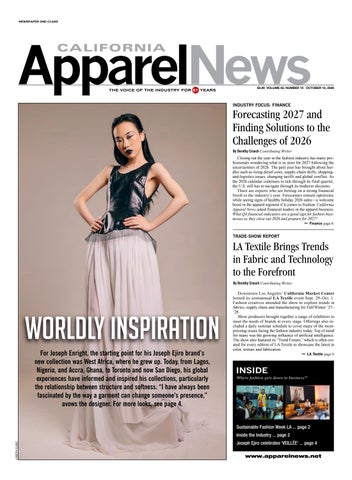
worldly Inspiration For Joseph Enright, the starting point for his Joseph Ejiro brand’s new collection was West Africa, where he grew up. Today, from Lagos, Nigeria, and Accra, Ghana, to Toronto and now San Diego, his global experiences have informed and inspired his collections, particularly the relationship between structure and softness. “I have always been fascinated by the way a garment can change someone’s presence,” avows the designer. For more looks, see page 4.
Downtown Los Angeles’ California Market Center hosted its semiannual LA Textile event Sept. 29–Oct. 1. Fashion creatives attended the show to explore trends in fabrics, supply chain and manufacturing for Fall/Winter ’27– ’28. Show producers brought together a range of exhibitors to meet the needs of brands at every stage. Offerings also included a daily seminar schedule to cover many of the mostpressing issues facing the fashion industry today. Top of mind for many was the growing influence of artificial intelligence. The show also featured its “Trend Forum,” which is often created for every edition of LA Textile to showcase the latest in color, texture and fabrication.
➥ LA Textile page 6
INSIDE: Where fashion gets down to business SM
2 Sustainable Fashion Week LA ... page 2 JOSEPH EJIRO
Inside the Industry ... page 2 Joseph Ejiro celebrates ‘VEILLÉE’ ... page 4 www.apparelnews.net
6
EVENTS
SFW US Enlists Local Responsible-Fashion Leaders in L.A. Sustainable Fashion Week LA relied on the Los Angeles apparel community, from students to experts, to produce its recent event.
@CULLENSLENSE,@JAWNSLENS,@FY.PHOTOGRAPHIE
The atmosphere during the Sept. 18–19 Sustainable Fashion Week US in Los Angeles blended community, artistry and a commitment to environmental stewardship. Influential local organizations that contributed to Sustainable Fashion Week LA included The Salvation Army Thrift Store US West, which served as a sponsor and circular-fashion partner; Santa Monica College’s fashion department, which enlisted students to participate in the event; and Thread Haus Makers Atelier, the event’s venue and creative hub. The Makers Atelier pop-up featured brands Thread Haus, Kindom and BK Phillips as well as designer Lee Smith. SFW LA highlighted emerging designers, retail pop-ups, wearable works of art, upcycled collections and runway presentations. A sustainability panel covered “Threads of Truth: Where Wearable Art, Sustainability & Transparency Intersect” with Wildling Shoes US serving as a partner for the session. The panel was moderated by Adelina
Matinca and featured Karri Ann Frerichs, founder of Circular Fashion LA; Victoria Charles, sustainability educator, circulareconomy strategist and advocate; Svetlana Shigroff, artist, educator and sustainability designer; and Brittany Horner, sustainability director with TravisMathew. “I am thrilled to see Manny Jackson’s vision come to life and Threadhaus Atelier collaborate with Brigette Artiste of Sustainable Fashion Week; Bianca Nemtoc, regional coordinator of Salvation Army Western ARC; and the fashion and sustainability professors, faculty and students of Santa Monica College,” said Glynn Barrish-Carroll, circular designer, sustainable events producer and founder of the Los Angeles–based design and manufacturing consultant firm Rag Royalty. “I am proud to be part of his [Jackson’s] advisory team, too, and wish him continued success in this much-needed community space, which showcases and teaches circular design.” —Dorothy Crouch
Our creative solutions are tailored to meet your working capital needs now, so you can tackle every phase of your business with confidence.
• Factoring and Invoice Discounting • Lending Finance • Inventory Purchase Facilities
CONTACT US
whiteoaksf.com/commercialfinance info@whiteoakcf.com
2 CALIFORNIA APPAREL NEWS
MAY 12, 2023 OCTOBER 16, 2026 APPARELNEWS.NET APPARELNEWS.NET
Fashion for Good has announced the launch of the Cotton Reloop Matrix Project, a cross-industry initiative that will map and physically validate the quality of commercially available recycled cotton yarns against brand specifications, giving the industry a data-backed overview of how quality, price and recycled content intersect. Although alternative recycling pathways exist to utilize cotton-rich textile-waste feedstock, they do not make a cotton output. Therefore, mechanical recycling is a crucial pathway to creating recycled cotton yarns and fabrics. “Recycled cotton has been talked about as a scaleready solution for years, but the industry has been working from fragmented data and siloed testing,” said Katrin Ley, Fashion for Good managing director. “This project is about closing that gap with hard evidence.”
OEKO-TEX, pursuant to the EU’s EmpCo Directive, which took effect Sept. 27, has launched a campaign film under the guiding principle “Trust in Every Thread.” It’s about what actually gets verified in the textiles closest to us and what doesn’t. OEKO-TEX STANDARD 100–certified products are tested against more than 1,000 harmful substances. Testing covers components like buttons, zippers and thread, not just the fabric. Requirements get stricter the more skin contact a product has, which is why baby and small-children items face the tightest limits of all. “Trust is not a word you can put on a label,” said Inga Bleyer, head of marketing and communication at OEKO-TEX. “Trust only arises when what is claimed is independently verified.” Billion Rise, to better serve and support increasing interest among apparel brands seeking greater geographic diversification with their sourcing needs, has opened its doors to a high-tech new factory in Thanh Hoa, Vietnam. Backed by a $100 million investment, the new Vietnam facility is focused on the manufacturing of textile-based materials for sportswear, swimwear, underwear and lingerie and is being developed in three phases. Phase one is complete, representing approximately 110,00 square meters. Additional knitting, dyeing and printing capacity will be added in phases two and three. “We’re pleased to give our customers greater sourcing flexibility with the addition of our Vietnam operation to our established manufacturing base in Qing Yuan China,” said Charles Chen, Billion Rise owner and CEO.
FASHION MOVES FAST. SO SHOULD YOUR LENDER.
• Asset Based Revolvers
Inside the Industry
POSTMASTER: Send address changes to: CALIFORNIA APPAREL NEWS, Customer Service, 127 E. Ninth St., Suite 212, Los Angeles, CA 90015. CALIFORNIA APPAREL NEWS ®: (ISSN 0008-0896) Published by TLM PUBLISHING INC. APPAREL NEWS GROUP Publishers of: California Apparel News®, Market Week Magazine®, New Resources®, Waterw ear ® , New York Apparel News ® , Dallas Apparel News®, Apparel News South®, Chicago Apparel News®, The Apparel News (National), Bridal Apparel News®, Southwest Images ® , Stylist ® and MAN (Men’s Apparel News ® ). Properties of TLM PUBLISHING INC., 127 E. Ninth St., Suite 212, Los Angeles, CA 90015, (213) 627-3737. © Copyright 2026 TLM Publishing Inc. All rights reserved. Periodicals Postage Paid at Los Angeles, CA, and additional entry offices. The publishers of the paper do not assume responsibility for statements made by their advertisers in business competition. Opinions expressed in signed editorial columns or articles do not necessarily reflect the opinions of the publishers. Subscription rates: U.S.: 1 year, $89; 2 years, $140. Foreign: $180 U.S. funds (1-year subscription only). Singlecopy price $3.99. Send subscription requests to: California Apparel News, Customer Service, 127 E. Ninth St., Suite 212, Los Angeles, CA 90015 or visit www.apparelnews.net. For customer service, call (213) 627-3737.
Unifi, together with leading polyester filament yarn manufacturers across North and Central America, has announced the launch of YarnProof, an industry-wide initiative designed to provide immediate physical verification of polyester filament yarn origin throughout the supply chain. YarnProof embeds an invisible and permanent tracer into polyester filament yarn during extrusion. The tracer remains with the material throughout its life cycle and can be immediately detected using a proprietary FibreTrace handheld scanner at designated points across the supply chain. “Traditional methods of fraud detection, such as document review and site visits, remain important,” said Kim Glas, president and CEO of the National Council of Textile Organizations. “But with the launch of YarnProof, the region gains a new tool for substantiating origin claims.”
OCTOBER 26 Day0 OIA Catalyst Conference
OCTOBER 27–28
Exhibit Hall & Expert Talks
OREGON CONVENTION CENTER PORTLAND, OR
SCAN HERE
TO LEARN MORE
WHERE THE NEXT GENERATION OF PERFORMANCE BEGINS The materials you choose today shape what you create tomorrow. At Functional Fabric Fair Fall 2026, discover a curated selection of innovative fabrics, advanced technologies and sustainable material solutions from leading suppliers shaping the future of performance apparel. Go deeper with the debut of the Day 0 OIA Catalyst Conference, in collaboration with the Outdoor Industry Association, bringing together thought leaders and industry experts before the show floor opens. Then, stay ahead with curated Expert Talks exploring the trends, technologies and strategies driving the industry forward. Source smarter. Discover more. Build what’s next.
FUNCTIONALFABRICFAIRFALL26.COM/CAN
JOSEPH EJIRO
FASHION
Joseph Ejiro’s FW26 Collection Celebrates ‘VEILLÉE’ of West Africa San Diego–based luxury designer Joseph Enright grew up in Nigeria, a foundation that continues to inspire his brand, Joseph Ejiro. For his Fall/Winter 2026 collection, VEILLÉE, Enright chose to explore the traditional veillée gatherings of West Africa, during which stories are shared, including ancestral tales told by elders. “There’s something quite beautiful about people coming together in the evening, sharing stories, remembering those who came before them and simply being present with one another. I kept thinking about how those moments can carry so many different emotions at once,” said Enright. “That became the starting point for the collection. I wanted to explore those contrasts through clothing, particularly the relationship between structure and softness.”
While Enright has developed his brand over the course of 13 years spent living in different cities around the globe, including Lagos, Nigeria; Accra, Ghana; and Toronto, his current location has added a different facet to his experience as a designer. “There seems to be less pressure to follow one particular idea of style, and I appreciate that. I’ve always been interested in individuality, so it’s something I naturally connect with,” Enright explained. “My background is still very much part of my work. Growing up in Nigeria and working internationally shaped how I see fashion long before I moved here. California has simply added another perspective to that experience.” The designer creates pieces for men and women, and his design philosophy is similar
for each. Enright shares that his customer is the person who embodies a powerful sense of self while developing that part of his or her personality through fashion. “With womenswear, I tend to think about women who aren’t particularly interested in fitting into a prescribed idea of femininity. They might love something very dramatic one day and something much quieter the next,” said Enright. “I have always been fascinated by the way a garment can change someone’s presence. Sometimes it’s the shape of a shoulder, the volume of a skirt or simply the way something falls on the body.” The Joseph Ejiro brand is available in sizes 6–20. The designer’s work, including VEILLÉE, can be found at josephejiro.co and select boutiques.—Dorothy Crouch
DALLAS The Center of
What’s Now & Next Curating the Best Brands in the Best Place Apparel & Accessories Market OCTOBER 20 - 23, 2026 JANUARY 19 - 22, 2027
4 CALIFORNIA APPAREL NEWS
OCTOBER 16, 2026
APPARELNEWS.NET
COMMERCIAL SERVICES. STRENGTHENED. CIT Commercial Services is now First Citizens Bank. Legacy experience continues with the financial strength of a top-tier bank. Help secure your supply chain and improve cash flow with specialized asset-based lending, factoring, and working capital solutions. Learn more at firstcitizens.com/wcf
FIT FOR YOU R A M BITION
©2026 First-Citizens Bank & Trust Company.
TRADE-SHOW REPORT
LA Textile relied on a show formula that blended trend installations, casual networking opportunities and educational discussions. From left, the Trend Forum, “Hybrid Myths” exhibit at the Trend Forum,
Barth & Könenkamp Seiden happy hour, and Natalie de Groot of the Fashion Aigency and Tirsa Parrish of Fashion Index discuss the benefits of AI.
LA Textile Continued from page 1
“I was especially interested in technical fabrics for winter wear, including waterproof materials, insulated fabrics and anything innovative that could elevate my designs,” said Monte. “There’s a growing need for moreinnovative textiles that combine fashion, functionality and sustainability, especially as streetwear continues to evolve.”
Beyond business, LA Textile featured a complimentary espresso and tea bar. German silk maker Barth & Könenkamp Seiden hosted a happy hour each day of the show. Kitchen Bann served Korean cuisine for purchase at the lunch café.
A beautiful day in the neighborhoods To simplify the visitor experience during LA Textile, show producers created different neighborhoods where attendees were able to easily locate resources. Different neighborhoods included Made In Japan and the Turkish Textile Pavilion in addition to Sustainable Knit, Denim & Functional Fabrics and Premium Fabric Collections. Robert McAuley, who works in sales and product development at Vernon, Calif.’s SAS Textiles, welcomed visitors to his booth in the Sustainable Knit, Denim & Functional Fabrics neighborhood. “If you’re looking to source in the USA,
you have to know exactly the supplier you’re dealing with and where they’re making it. Is the clothing ethically produced? Is there a living wage involved? Accountability is important,” said McAuley. “Traceability of the product. Where did the yarn come from? Who knitted it? Who stands by the quality? Who can repeat that quality?” The message of responsible sourcing also resonated with Franky Tran, a designer who specializes in custom occasion pieces. Sustainability requires a different approach when working in formalwear or luxury so Tran focuses on using heirloom-grade fabrics. “I try to do things that make sense, from a business perspective and being resourceful. I am mindful of the quality and intention. I intentionally keep my practice small, intimate and commission based. Waste not, want not,” said Tran. LP Monte, designer and founder of handmade streetwear brand Band Runnaz Clothing and a fashion-merchandising student at Los Angeles Trade-Technical College searched for inspiration to spark his next collection.
Print + Online + Archives = Total Access Get Yours Today and Save 50%! call toll-free (213) 627-3737
Talking about trends and tech The “Panels & Talks” schedule included discussions covering trends coming down the pike, such as “Disobedience”: FW27/28 trend direction by NellyRodi Paris” with Jacqueline Rumohr and “The New Aesthetic for FW 27/28—Myth, Mess & Mastery: The New Language of Design,” a trend presentation by Jennifer Karuletwa, managing director of North America for Peclers Paris. Conversations during LA Textile turned to technology, particularly AI. Tech show topics included a “Fireside Chat: AI Isn’t About Replacing Creativity. It’s About Amplifying It” with Natalie de Groot of The Fashion Aigency and Tirsa Parrish of Fashion Index, who wants to educate creatives and dispel fears surrounding rumors of AI eliminating the need for jobs performed by humans. “You need to start using tech now. The ones who are going to be replaced are the ones who don’t use it, and they’re going to be replaced
by the ones who do,” Parrish said. “We have to meet the audience where they are. There is a lot of fear that is causing paralysis. We need to get them beyond the paralysis to start engaging.” At the booth for Tech Pack Tailor, an online technical design and fashion tool headquartered in Los Angeles, founder Lauren Dorsey noted that AI can support creatives in the industry if it is used correctly. “It seems people are either fearful of it 100 percent and don’t want to touch it or they see the benefit of it,” explained Dorsey. “The creative component is the part that people really get stuck on. They feel it’s going to take away creativity, but it just depends on how you use it. It can be a good assistant, but it can’t do everything.” Kristina McConnico, owner of the Bay Area womenswear brand Lacson Ravello visited LA Textile to search for print and color direction but also prioritized sitting in on Parrish and de Groot’s discussion. “AI is so hot right now. If you’re not in it, you’re missing out,” noted McConnico, who has worked in the fashion industry for 30 years. “This show is more than textiles and fabric. There is so much industry knowledge, from going to the seminars and trend forecasting, vendor relationships, manufacturing, product development, and, of course, technology and AI. That’s why I love to come to this event. You learn so much.” ●
From left, Robert McAuley of SAS Textiles and LA Textile entrance.
Apparel News Group
81
1945-2026
BUSINESS DEVELOPMENT
AMY FREEMAN MOLLY RHODES
SALES/ADMINISTRATIVE ASSISTANTS
CHRIS MARTIN RACHEL MARTINEZ CLASSIFIEDS
JEFFERY YOUNGER PRODUCTION
Eighty one years of news, fashion and information
KENDALL IN MORGAN WESSLER
CEO/PUBLISHER
DAVID MARTINEZ
FINANCE
TERRY MARTINEZ CREATIVE MARKETING DIRECTOR
LOUISE DAMBERG CONTRIBUTORS
Apparel News Group www.apparelnews.net Halston 6 CALIFORNIA APPAREL NEWS
OCTOBER 16, 2026
APPARELNEWS.NET
DOROTHY CROUCH KELLI FREEMAN KEVAN HALL ILSE METCHEK TIM REGAS ALEXANDRA ROMERO KATHLEEN STURGEON CLAIRE SYKES
PUBLISHED BY TLM PUBLISHING INC. APPAREL NEWS GROUP
Publishers of: California Apparel News Waterwear EXECUTIVE OFFICE
127 E. Ninth St., Ste. 212 Los Angeles, CA 90015 (213) 627-3737 www.apparelnews.net webmaster@apparelnews.net Printed in the U.S.A.
INDUSTRY FOCUS: FINANCE
PEXELS.COM
What Q4 financial indicators are a good sign for fashion businesses as they close out 2026 and prepare for 2027?
Finance Continued from page 1 Louis Barone Senior Advisor The Hedaya Capital Group Entering 2027, the U.S. apparel industry is demonstrating strong financial resilience, driven by a 3.9 percent year-overyear increase in consumer clothing spending, which outpaces wider retail growth. A few good financial indicators are: Operational improvements: Inventory normalization, stabilization of warehousing and logistics expenses during Q4 along with reduced discounting has improved profit margins. Many companies have operationalized AI into their daily systems, specifically targeting the multi-billion-dollar problem of customer returns. Lower e-commerce return rates are being driven by precision AI tools such as size and fit predictors or personalized AI shopping assistants. Tariff-risk mitigation: Stable or improving cost of goods sold in Q4 indicates successful logistics consolidation and agile sourcing networks. Shifting of production hubs to alternative corridors like Cambodia and Vietnam helps companies absorb protectionist trade policies without passing on prohibitive costs to consumers. Growth pockets: Mid-market brands are emerging as top value creators, and, while supply chains are diversifying to mitigate tariff risks, consumers are paying premium prices for sustainable, traceable supply chains. Overall, success in 2027 will rely more on operational efficiency rather than aggressive retail footprint expansion.
Darrin Beer Western Regional Manager CIT Commercial Services—a subsidiary of First Citizens Bank Most of our apparel clients are entering the 2026 holiday season from a stronger operating position compared to last ye a r. M a ny h ave i n creased sales while experiencing less pressure on gross margins due to lower fluctuations in tariffs. Our clients who responded quickly by adjusting pricing, sourcing and product mix have generally performed well in this market. Tariff refunds have also provided a meaningful cash-flow benefit for some of our clients while reducing borrowing costs. While this benefit should not be viewed as recurring operating income, it has provided welcome financial flexibility as companies fund holiday shipments and plan inventory purchases for 2027. Our apparel clients most benefiting in 2026 have generally been those selling to discount and value-oriented retailers. 8 CALIFORNIA APPAREL NEWS
Consumers remain focused on value and price, creating opportunities for many of our apparel clients. Although economic headwinds remain, including elevated interest rates, inflationary pressure and uncertainty surrounding consumer spending, most of our clients report strong fall and holiday bookings. Looking ahead to 2027, cash flow, inventory and expense management will remain the primary areas of focus to best position fashion businesses for 2027.
Mark Bienstock Managing Director Express Trade Capital Tariff resolution will be a key driver in bringing the apparel industry stability in 2027. Having to deal with the constant uncertainty of fluctuating t a r if f r ates, polit ical country risk and the need to potentially add on other factories without a proven history was causing the apparel industry great distress for the last two years. However, many importers have recently realized significant tariff refunds as a result of the Supreme Court decision, which aided their bottom line during 2026. With the combination of rising interest rates and rising oil prices, it is clear that on the retail side most discounters will continue to benefit from a constrained consumer that is looking for the best value available. Finally, the midterm election results will provide clarity for the fashion industry as the expected political economic outcome of the elections will be clearer.
Sydnee Breuer Executive Vice President and Western Region Manager Rosenthal & Rosenthal Despite all of the headwinds in the global economy and geopolitical environment, fashion businesses have fared better than expected. Our industry is a long way from the upheaval of the implementation of “Liberation Day” tariffs around 18 months ago. Although price increases were generally not accepted initially, subsequent seasons’ pricing reflected at least some increase. Add that to reductions in—and refunds of—these tariffs, and gross profit margins have been improving. Improved gross profits have been partially offset by increases in container and shipping rates due to the ongoing conflict in the Persian Gulf and the resulting Strait of Hormuz disruption to oil and gas pricing. Surprisingly, through all this turmoil, the consumer and consumer spending have proven to be resilient. Sales for our fashion clients have been generally at least on par with last year and in many cases higher than last year. This is definitely not across the board as some consumers have curtailed spending, especially discretionary spending
OCTOBER 16, 2026
APPARELNEWS.NET
due to the effects of inflation and higher prices—insert your favorite economic explanation: K-shaped economy, V-shaped economy, etc. We continue to discuss with our clients the need to manage their inventory levels and control expenses. This will have them in a good position to close out 2026 and prepare for a successful 2027.
Tae K. Chung Senior Vice President, Business Development Republic Business Credit As retail brands conclude the holiday season, persistent inflation, elevated interest rates and cautious consumer spending are forcing apparel companies to look far beyond top-line revenue to evaluate business health heading into 2027. With household budgets stretched and discretionary dollars shifting toward off-price retailers and practical purchases, retail analysts point to full-price sell-through as the critical key performance indicator. Brands that clear seasonal inventory before year-end markdowns avoid tying up expensive working capital in excess stock—a vital edge given that high inventory holding costs are driving industrywide margin compression. Gross-margin resilience is proving equally vital, with companies maintaining price integrity through peak promotional periods, successfully protecting profitability against aggressive discount erosion. Marketing efficiency further distinguishes resilient brands, where strong return on ad spend and low customer acquisition costs signal authentic demand despite tight consumer budgets. Expanding direct-to-consumer channels amplifies this advantage by capturing higher unit margins and generating crucial firstparty data to optimize spring 2027 inventory planning. Ultimately, positive operating cash flow provides the liquidity necessary to absorb high borrowing costs, navigate return-logistics expenses and secure early production commitments. In a challenging macroeconomic environment, fourth-quarter margin discipline—rather than raw sales volume— will serve as the primary catalyst for sustainable long-term momentum.
Eric Fisch Senior Vice President, National Sector Head of IMM, Retail & Apparel HSBC Bank USA N.A. The apparel industry has had a generally positive year despite ongoing economic uncertainty. Consumers have continued to shop consistently, even as inflation has affected household budgets, while more-disciplined inventory management has enabled many businesses to generate a greater proportion of full-price sales and preserve gross margins. Tariff refunds have also
bolstered liquidity, giving companies additional flexibility as they close out 2026 and plan for 2027. Inflation and unemployment remain the most significant influences on consumer behavior. Both have stayed relatively benign so far, supporting discretionary spending. Any meaningful deterioration, however, could have an immediate impact on apparel demand. Stability in geopolitical and trade policy is also encouraging. Purchasing patterns have generally normalized, and companies have responded by diversifying production, reducing expenses and adjusting prices. These steps provide some insulation from adverse developments, although trade policy should continue to be watched closely. Finally, post-election spending could provide a helpful lift ahead of the holiday season. In previous election cycles, consumer activity has sometimes softened before November, then accelerated once the election has passed and political advertising subsides. If that pattern repeats, it could support stronger momentum through the balance of the year. Overall we expect a strong finish to what has already been a positive year for the industry. Companies that maintain lean inventory positions, protect margins and remain flexible in their sourcing, pricing and channel strategies should be well positioned to enter 2027 from a position of strength.
Biagio Genualdi Managing Director of Apparel, Retail and Consumer Products Baker Tilly As apparel companies close out 2026, the focus should be less on top-line growth alone and more on the quality of that growth. In working with companies across the apparel industry, we’ve seen that strong sales do not always translate into a stronger business. If those sales were driven by heavy markdowns or came at the expense of margin, the headline number can be misleading. Inventory is one of the clearest indicators. Companies entering 2027 with improving turns, less-aged inventory and open-to-buy capacity can be in a better position to react to what consumers are actually buying. In apparel, that flexibility matters. You want the ability to chase winners rather than spend the next season working through excess product. We also pay close attention to cash conversion. For wholesale businesses, low cancellations, controlled chargebacks, timely collections and a diversified, financially sound customer base are stronger signals than bookings alone. For direct-to-consumer businesses, the same discipline applies: Look beyond gross online sales to what is left after returns, fulfillment and customer-acquisition costs. Ultimately, a healthy Q4 should create financial flexibility and support disciplined investment. For example, brands considering retail expansion should evaluate new store openings for their expected return on
➥ Finance page 10
INDUSTRY FOCUS: FINANCE
What Q4 financial indicators are a good sign for fashion businesses as they close out 2026 and prepare for 2027? Finance Continued from page 8 invested capital—not simply growth in store count. Clean inventory, solid margins, strong cash conversion and sufficient liquidity give apparel companies the ability to navigate uncertainty and capitalize on the right opportunities in 2027.
Joshua Goodhart Executive Vice President and National Sales Manager Merchant Financial Group The fashion industry has certainly had its ups and downs over the past few years. We have seen businesses impacted by tariff uncertainty, wars and many other global challenges. Many of these issues have resulted in a lack of consumer confidence, which has had a negative impact on the fashion industry. The continued switch to many shoppers buying on the Web over shopping in stores has hurt many retailers who have not developed a strong online following. It is our belief that these ups and downs will continue in the fashion industry. The upcoming elections will certainly play a key role in determining whether things will be positive not only for the fashion industry but also the economy worldwide. Fall and holiday sales will be key indicators for many people as they plan for 2027. A positive sign would be to see strong sales in Q4 with retailers writing orders earlier for 2027 than they have done in prior years. The results of the election will hopefully give us more clarity on economic direction, which could be a positive going into 2027 depending on the results. The willingness of international suppliers to work with importers on pricing could also be a positive sign. If fashion businesses can receive better support from suppliers, they can potentially work on better margins. Reducing inventory levels can only be an encouraging sign, meaning manufacturers and stores are not stuck with old inventory they can’t sell or that is out of style.
Lee Haskin Chief Executive Officer Crossroads Financial LLC As the industry closes out 2026, the fou r thquarter indicators look encouraging. Deloitte projects holiday retail sales f rom November through January will rise 4.0 percent to 4.8 percent, reaching as much as $1.71 trillion, with e-commerce up 7.5 percent to 8.4 percent. The Mastercard Economics Institute is even more upbeat, forecasting 5.5 percent growth from Nov. 1 to Christmas Eve, the strongest holiday season since 2022, with in-store sales posting their best gain in four years. Bain expects U.S. holiday sales to top $1 trillion for the first time. That matters for apparel. The holiday season has historically been fashion’s most important stretch, when outerwear, gifting and party wear can make a brand’s year. A late Thanksgiving and a November Cyber Monday will compress the calendar, so brands with inventory in place early will be best positioned. The challenge is funding that inventory. Many growing brands still default to cashflow term loans, which are sized to last year’s revenue, charge interest on the full amount from day one and demand fixed payments even in the slow months after the holidays. The good news: More lenders are entering the space, giving brands better options. Inventory-backed revolving lines of credit grow with the stock you hold. Heading into 2027, the brands that pair strong demand with flexible capital will be the ones that turn a good holiday into a great year.
Thomas Novembrino Co-founder, Principal and Executive Vice President Gateway Trade Funding When looking at the financial health of a fashion business heading into 2027, I wouldn’t focus on Q4 revenue alone. I’d look at the quality of that revenue and what it means for cash flow. I’d also evaluate the firm’s
Get into the next Industry Focus: Finance. Coming soon.
10 CALIFORNIA APPAREL NEWS
OCTOBER 16, 2026
APPARELNEWS.NET
inventory. A strong Q4 should leave a business with a healthier inventory position, not simply a bigger sales number. No one wants too much cash still tied up in inventory that will subsequently be sold at a discount. Gross margins are equally important. Is the product moving at acceptable margin levels? After the pressure fashion and other businesses have absorbed on sourcing and landed costs this year, maintaining margin shows a great deal about how effectively the firm has managed purchasing, pricing and the supply chain. The firm’s overall liquidity is also important. A business can be profitable and have a solid order book but still face working capital issues if cash is tied up in inventory and new supplier payment commitments are looming. A strong order book with the capital to support it is a key indicator. The liquidity to fulfill the orders without impacting the rest of the business is a good sign of the firm’s financial strength.
Kevin Sullivan Managing Director at Wells Fargo Commercial Services Wells Fargo In general, tariff refunds have fortified balance sheets through yearend, and most of our clients seemed to have navigated tariff uncertainty reasonably well. Some, unfortunately, are still taking somewhat sizable hits to profitability as a result of tariffs, so that will certainly remain a key factor to monitor. Fortunately, consumer spending remains reasonably strong, despite inflationary pressures. We are, however, seeing consumers move down market in many cases. As demand from China has begun to ratchet downward, freight costs are projected to move somewhat downward as well, so that will also be an important data point for companies to monitor. We also continue to see consolidation in the form of mergers and acquisitions as companies seek to diversify their customer base and create further efficiencies in response to continued challenging market conditions.
Kenneth L. Wengrod Managing Member Stealth Management Group, LLC Tariffs hurt, but they’re not why customers walked away. Stale merchandise is. Shoppers haven’t quit fashion. Last year, Gen Z cut fashion spending less than any other age group, and their favorite brands pair affordability with trend appeal. Cheap alone isn’t winning. Newness is. Proof? Nike’s turnaround plan reads like a confession: Rebuild wholesale partnerships, restart product innovation. It rode retro franchises too long and ceded shelf space to newer rivals. Last quarter, performance grew while sportswear and Jordan fell. Gross margin rose, yet Nike guided to a high-singledigit revenue decline for fiscal 2027. Margin isn’t the problem. Product is. During Q4, watch for: • full-price sell-through on new styles; • discounts below the roughly 23 percent peak Adobe Analytics tracked for apparel; • share of sales from items launched in the last 90 days; and • clean January inventory. Don’t count on currency to bail you out. The yuan is near a four-year high against the dollar, and the dong has firmed. Full-price selling is the margin lever left. Online apparel is forecasted to grow 4.7 percent this holiday season, behind 6.7 percent for all online sales, with AI shopping traffic projected to jump 130 percent. A chatbot may pitch your product, but no algorithm gets excited about last year’s style in a new color. My prediction: By late 2027 at least one legacy brand will start reporting resale results to investors because it’ll be the only growth story it has. Every markdown on stale merchandise is margin brands chose to give away. Responses have been edited for clarity and space.
PROFESSIONAL SERVICES & RESOURCES SECTION MODELING SERVICES
PROFESSIONAL SERVICES & RESOURCE SECTION Contact Terry Martinez at (213) 627-3737 or terry@apparelnews.net
www.apparelnews.net/classifieds
7/18/2019
CLASSIFIEDS
P (213) 627-3737
Buy, Sell & Trade
WE BUY ALL FABRICS & GARMENTS Excess rolls, lots, sample yardage, small to large qty's. ALL FABRICS! fabricmerchants.com Steve 818-219-3002 or Fabric Merchants 323-267-0010 Email: steve@fabricmerchants.com
For Classified information, contact at 213-627-3737 or terry@apparelnews.net
http://www.apparelnews.net/classifieds/print-preview/8202/
Reach 100,000 International decisionmakers in the B2B fashion industry! California Apparel News TRADE SHOWS SPECIAL EDITION coming November 13. Become a SPONSOR! Bonus distribution: • LA Market • LA Textile • LA Fabric Show • Miami Fabric Show • New York Fabric Show • Brand Assembly • Preface • Dallas Market • Dallas Men’s Market • WESA Dallas • Dallas Accessories, Gift & Home • Fashion Industry Gallery (FIG) • Atlanta Apparel Market • Atlanta Formal Market • Las Vegas Apparel Market • WWIN • Men’s Edit • IFJAG • CALA • FMNC • Curvexpo • Miami Swim • Surf Expo • Miami Swim Week Art Hearts • Texworld NYC • Texworld LA • Swim/Active Collective • OC Apparel • Outdoor Retailer • Designers and Agents • Premiere Vision NY • MAGIC Vegas by Informa • Sourcing by Informa • Offprice by Informa • Coterie-MAGIC NY by Informa • Functional Fabric NY • Functional Fabric Orlando • Functional Fabric Portland • Kingpins Los Angeles 1/1
Connect with us NOW to secure space!
For best results hyperlink your ad
Creative deadline: Nov. 4. Advertising deadline: ASAP to guarantee space is available Call for special rates and information: 213-627-3737 APPARELNEWS.NET
Apparel News Group www.apparelnews.net
OCTOBER 16, 2026
CALIFORNIA APPAREL NEWS 11