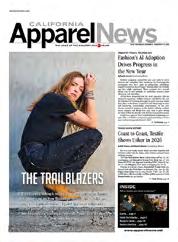
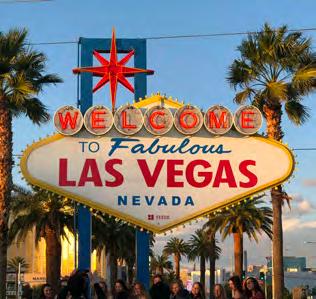
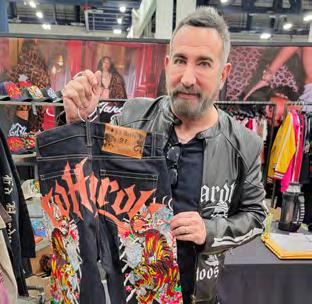


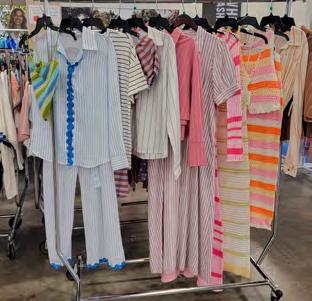
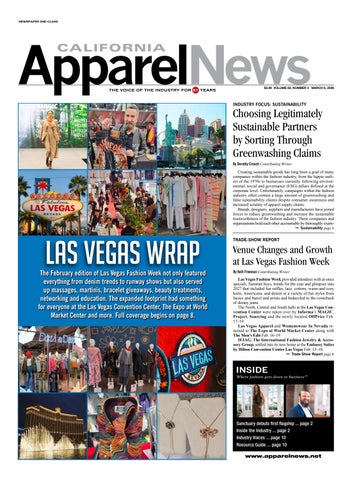
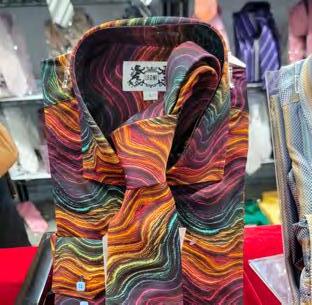
The February edition of Las Vegas Fashion Week not only featured everything from denim trends to runway shows but also served up massages, martinis, bracelet giveaways, beauty treatments, networking and education. The expanded footprint had something for everyone at the Las Vegas Convention Center, The Expo at World Market Center and more. Full coverage begins on page 8.


By Dorothy Crouch Contributing Writer
Creating sustainable goods has long been a goal of many companies within the fashion industry, from the hippie outliers of the 1970s to businesses currently following environmental, social and governance (ESG) pillars defined at the corporate level. Unfortunately, campaigns within the fashion industry often contain a large amount of greenwashing and false sustainability claims despite consumer awareness and increased scrutiny of apparel supply chains.
Brands, designers, suppliers and manufacturers have joined forces to reduce greenwashing and increase the sustainable trustworthiness of the fashion industry. These companies and organizations hold each other accountable by thoroughly exam-
By Kelli Freeman Contributing Writer
Las Vegas Fashion Week provided attendees with at-once specials, Summer buys, trends for the year and glimpses into 2027 that included fun ruffles, lace, cottons, warm and cozy knits, Americana, and denim in a variety of fun styles from basics and barrel and prints and bedazzled to the comeback of skinny jeans.
The North, Central and South halls at the Las Vegas Convention Center were taken over by Informa’s MAGIC, Project , Sourcing and the newly located OffPrice Feb. 17–19.
Las Vegas Apparel and Womenswear In Nevada returned to The Expo at World Market Center along with The Men’s Edit Feb. 16–19.
IFJAG, The International Fashion Jewelry & Accessory Group, settled into its new home at the Embassy Suites by Hilton Convention Center Las Vegas Feb. 15–18.





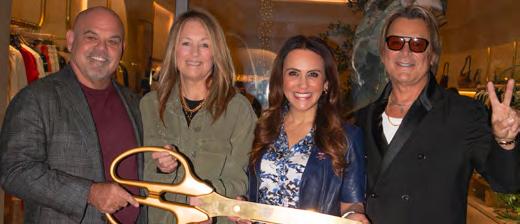
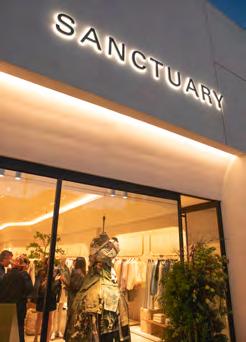
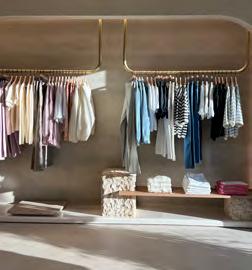
After nearly three decades as a wholesale- and D2C-driven contemporary label, Sanctuary has entered owned retail with the debut of its first flagship, on Beverly Drive in Beverly Hills, Calif., on Feb. 27. Founded in 1997 by Debra and Ken Polanco, the Los Angeles–based brand generates more than $200 million in annual retail sales and reports double-digit year-over-year growth across its 70 percent wholesale/30 percent direct-to-consumer mix.
The 2,000-square-foot store represents a strategic next chapter as the company approaches its 30th anniversary. The flagship showcases the breadth of the assortment, spanning ready-to-wear, swim, footwear and accessories alongside the in-store debut of handbags driven by strong online demand. Known as master pant makers, the brand built its foundation on seasonless bottoms, including its early-2000s green camo cargo pants, which achieved cult status among celebrities and stylists. With utility once again leading cultural trends, exclusive capsules, early collection drops, and a curated edit of upcycled vintage and pre-loved styles reinforce Sanctuary’s evolution into a full women’s wardrobe destination while strengthening direct consumer engagement.—Alexandra Romero
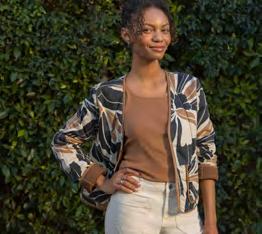





Li & Fung, the leading supply-chain solutions partner for consumer brands and retailers, has announced a licensing agreement with C&C California featuring category exclusivity for women’s swim, sleepwear and loungewear, and outerwear. The new collection will first be shown at the Holiday 2026 markets. New product offerings in swim will include a full collection of women’s swimwear separates, one-piece swimsuits and beachwear. Sleepwear will expand to a full collection of separates, sets and robes. The new outerwear will cover seasonal pieces from lighter windbreakers to slope-ready puffers and parkas. The new collection will honor the C&C California legacy of effortless, understated and approachable pieces that embody the spirit of the California experience with its laid-back aesthetic and West Coast vibe.
Bank & Vogue, a global leader in textile reuse and recycling, has announced a new collaboration with Coach, bringing circular craftsmanship to the forefront with a limited-edition capsule crafted from post-consumer denim. Rooted in heritage and reimagined through a modern lens, the collection celebrates pieces that grow better with time, honoring both their past and their stories still to come. Each garment embraces visible character and individuality, reinforcing Coach’s ongoing commitment to circular fashion and responsible design practices. “This Coach collection is our love letter to denim and to American-heritage pieces that only get better with time,” said Coach Creative Director Stuart Vevers. “There’s an honesty in these pieces guided by our commitment to reducing our impact on the planet.”
Aptean has announced the launch of Aptean Fashion & Apparel, its most powerful AI operations solution built for the unique demands of the fashion and apparel industry. The solution embeds apparel-specific intelligence at the core of every operation, interpreting styles, automating multi-step workflows and using AI agents to make decisions in real time. With the Aptean solution, brands and wholesalers can move from concept to customer faster and improve margins with greater confidence. Unlike traditional apparel ERPs built on aging frameworks with disconnected modules, Aptean Fashion & Apparel gives brands a modern, scalable, cloud-native foundation with AI agents that move quickly across applications and data, improving operational precision and delivering intelligence that legacy systems and generic ERPs simply cannot match.
Wrangler , the legendary denim brand, has introduced its first-ever pair of denim riding jeans made with Dyneema, the world’s strongest fiber. Owned by Avient Corp., an innovator in materials solutions, Dyneema is bringing a new level of lightweight durability to performance denim. Wrangler has launched two styles of its women’s riding jean that fuse authentic Western heritage with Dyneema fibers—fifteen times stronger than steel yet light enough to float on water. Designed with input from female riders and finished with classic Wrangler five-pocket styling and authentic Western details, both the Skylar High-Rise Relaxed and Rodeo High-Rise Boot are crafted from a soft cotton blend reinforced with Dyneema fibers in addition to a contoured waistband for comfort, coverage and security.










How do you sort through sustainable claims to expose companies that engage in greenwashing or prove legitimacy of those who follow ecological practices?
ining their partners and sourcing in addition to adhering to their own ecologically sound, socially beneficial and responsible business commitments to show how they not only demand accountability but also embrace it.
California Apparel News asked apparel-sustainability experts: How do you sort through sustainable claims to expose companies that engage in greenwashing or prove legitimacy of those who follow ecological practices?
Kerry Bannigan President of the Board
PVBLIC Foundation

In assessing sustainability claims, I prioritize credibility, clarity and intent. Genuine ecological practice is reflected in how a company aligns its values with its operations, not simply in the language used to promote itself. I pay close attention to transparency and specificity. Companies with legitimate sustainability commitments are typically clear about what they are doing, how progress is measured and where challenges remain.
Sustainability is an ongoing process. My focus is on supporting higher standards and shared understanding across the industry so that responsible practices are recognized, trust is strengthened and durable, accountable impact is embedded into industry practice.
Meredith Boyd Chief Product Officer
UNIFI makers of REPREVE

At UNIFI we believe provable claims benefit everyone, from suppliers and brands to retailers and consumers. We educate partners on the impact of our products, backed by trusted certifications. Our proprietary FiberPrint and U-TRUST technologies offer verified traceability and product authentication, ensuring claims can be proven, not just stated, because transparency builds trust, and trusted data drive meaningful change. All REPREVE-branded products include our proprietary FiberPrint tracer, which qualifies goods for U-TRUST certification to certify recycled-content claims.
Katrina Caspelich Chief Marketing Officer Remake

First, start with the specifics. Legitimate brands provide concrete data like percentages of sustainable materials, names of factories and third-party certifications. Greenwashers hide behind vague terms like “eco-friendly” or “conscious” without backing them up. If a brand claims sustainability but you can’t find detailed information on their website, that’s your first red flag.
Second, follow the visuals. Are you seeing generic nature imagery and green-leaf logos or actual photos of their supply chain, factories and the people making their products? Real transparency means showing the messy, complex work of sustainable production, not just aesthetic marketing.
Third, check if values translate into action. A brand can talk about caring for the planet and people all day long, but are they paying living wages? Publishing their factory list? Setting science-based emissions targets? Look for evidence of accountability: public commitments, progress reports and willingness to acknowledge what they’re still working on.
Finally, use your voice. If information is missing, email and ask. Legitimate brands welcome those questions. Companies that get defensive or dodge specifics are telling you something important.
The truth is that there’s no perfect brand, but the ones doing real work are transparent about both their progress and their challenges. I believe informed consumers asking tough questions are one of our best tools for holding the fashion industry accountable.
Paola Corna Chief Financial Officer, Sustainability and Human Resources Manager ACM

To distinguish genuine commitment from greenwashing, we look first at a company’s willingness to share concrete data, the robustness of its certifications and the traceability of its supply chain. Without these elements, sustainability remains little more than a statement of intent.
At ACM, these principles are the foundation of our strategic approach. For many years, we have deliberately chosen to keep most of our production in-house, allowing us to maintain direct control over timelines, processes and impacts. This also enables us to provide our brand partners with verifiable documentation, including chemical and performance testing, corporate audits, ESG reporting and the careful selection and monitoring of suppliers based on environmental and social criteria.
In 2025, we published our first sustainability report, prepared in accordance with

GRI Standards. The report transparently outlines the issues most relevant to our environmental, social and governance impact, including responsible sourcing practices, the use of renewable energy—100 percent in 2024— circular water management, certified packaging and the growing use of GRS-certified recycled materials.
Alberto De Conti Marketing and Business Development Officina39

At Officina39, sustainability is embedded in our Trustainable proposition, which, together with Imaginable and Performable forms our three strategic pillars. We believe sustainability must be demonstrated through verifiable facts, not marketing narratives.
The first filter we apply when evaluating sustainability claims—whether our own or those of others—is evidence: data, documentation and measurable impact across the product life cycle.
We look beyond generic statements such as “eco-friendly” or “green” and focus instead on objective criteria. These include compliance with recognized frameworks such as ZDHC MRSL, brand RSLs and relevant third-party standards as well as transparency of Safety Data Sheets, chemical composition and traceability of raw materials. Legitimate sustainability is always auditable.
Sustainable chemistry is not only about what a product claims to do but how it is manufactured, how consistently it performs in industrial conditions and whether it enables customers to reduce water, energy, chemicals or reprocessing at scale. We validate this through controlled trials, real production data and long-term customer feedback rather than isolated lab results.
Companies that genuinely follow ecological practices show continuity and evolution with clear accountability over time and a willingness to disclose limitations as well as progress. Greenwashing, by contrast, often relies on selective storytelling and short-term positioning.
Internally, Officina39 applies the same rigor to its own portfolio. We do not position sustainability as an add-on but as a technical responsibility, developing solutions that deliver measurable environmental benefits while remaining industrially reliable and economically viable for our customers.
Betsy Franjola President, BFF Studio; Founder, PREFACE; and Chief Executive Officer, Hocking Hills Garment Center

Customers can—and should—do basic online research into the certifications listed on a product to better understand what those claims actually mean. Certifications can provide a helpful starting point and a shared language around environmental responsibility.
That said, certifications only tell part of the story. At some point, you’re still placing trust in a third-party organization you may not know or fully understand. Sustainability, in practice, ultimately comes down to trust— and trust is built through transparency and relationships.
This is where brands matter. Larger brands may have recognizable credentials and certifications that help validate their claims. Smaller brands, however, often offer something equally valuable: access. Many can’t afford costly certification processes, but they can answer questions directly. They can tell you who made the product, where it was made, what raw materials were used and why certain decisions were made.
Legitimacy shows up in a brand’s willingness to be accountable and open—not just in the logos on a hangtag. Greenwashing thrives on vague language and distance; real ecological practice is grounded in clarity, specificity and conversation. The more a company invites you into their process, the easier it is to separate meaningful action from marketing.

Companies can demonstrate their commitment and efforts to pursue responsible and ecological practices by gathering primary data to track their individual baseline performance and progress in key areas like GHG emissions, water use, waste and chemical management. Primary data provide the clearest picture of how a business is performing in these categories. It can also highlight how brands, retailers and manufacturers can improve their operations.
Transforming a supply chain to be more responsible doesn’t happen overnight. Studies continue to show year-over-year increases in purchasing of products that are marketed as sustainable. It’s clear that customers seek to support companies that are honest in their storytelling and show progress in making their operations more socially and environmentally responsible. Brands that bring their customers along the journey and show their progress
➥ Sustainability page 6
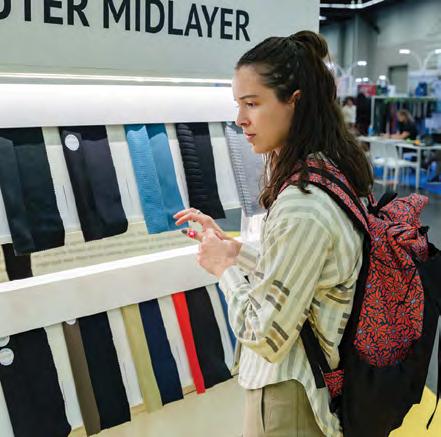
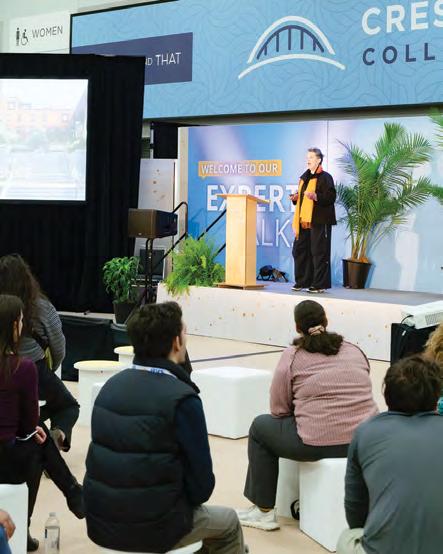
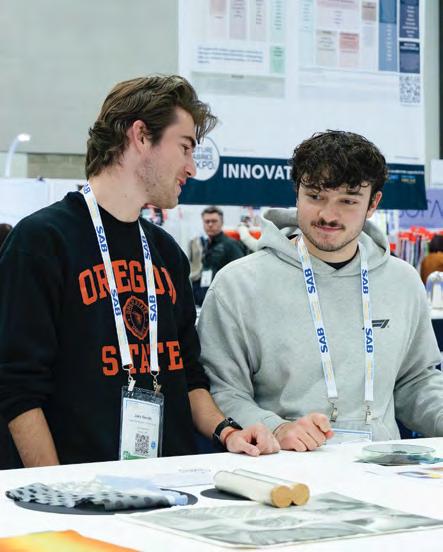

At Functional Fabric Fair Spring 2026, explore sustainable innovations, advanced fabric technologies, and material solutions built for today’s most demanding categories.
Go beyond the show floor with the Day 0 Sustainability Workshop , designed to deliver in-depth insights before the exhibit hall opens, and stay ahead of the curve with curated Expert Talks featuring industry leaders covering sustainability, sourcing strategy, material science, and market trends.
If you design, develop, or source performance apparel — this is where your next breakthrough begins. Don’t just follow trends. Source what’s next.
APRIL 7–9 2026
OREGON CONVENTION CENTER, PORTLAND, OR April 7
Day 0 Sustainability Workshop
SCAN HERE TO LEARN MORE

How do you sort through sustainable claims to expose companies that engage in greenwashing or prove legitimacy of those who follow ecological practices?
with data-backed information deepen trust with their customers.
Customers don’t expect their favorite brands to be perfect, but they do expect progress. They want to support brands that prioritize reducing their environmental impact and that care for their communities. These are the businesses that are thriving and navigating today’s challenging marketplace more successfully than brands greenwashing or making vague claims without substantive or verified data to back them up.
Primary data reporting shows that a deeper connection exists between brands and their suppliers. It is a reflection of strong communication and collaboration between business partners that can further deepen trust with other stakeholders. The best brands continue to strengthen those bonds and share their progress with customers on an ongoing basis.

In today’s apparel industry, separating meaningful sustainability from greenwashing requires moving beyond slogans and focusing on evidence. When we assess whether something is credible or simply marketing, we start by asking for proof that can be verified—not just good intentions. That means clear definitions, transparent scope and evidence that can stand up to scrutiny such as relevant third-party certifications and data grounded in an independently reviewed methodology such as an LCA.
It also helps to look at how clearly a company explains its supply chain. Where do materials come from? How are they processed? What’s included in the claim and what isn’t? Sustainability is rarely absolute, and being upfront about both progress and limitations tends to build far more trust than an overly simplified narrative.
Another practical check is whether a solution can truly scale. Many initiatives look compelling in small volumes or limited pilots, but real impact comes from approaches that can be implemented at industrial scale while maintaining consistent quality, performance and traceability. That’s often the difference between sustainability as a business strategy and sustainability as a marketing add-on. Over time, credibility is reinforced through long-term commitment: measurable goals, progress tracking and regular reporting, regardless of trends or market cycles. Collaboration with partners, NGOs, and industry organizations strengthens accountability and helps drive systemic change. In our experience, sustainability leadership is not about claiming perfection; it’s about proving progress and being willing to be held accountable.
Dr. Cindy J Lin Chief Executive Officer Hey Social Good

Whether it’s highlighting organic fibers, debuting eco-friendly packaging or pursuing a carbonoffsetting mission, companies making sustainable claims are now exceedingly prevalent. As consumers and buyers, it can be extremely challenging to determine the validity of these claims or even understand appropriately just what sustainability means. The biggest problem is the lack of clear industry standards, which makes it so challenging to distinguish between valid environmental claims and mere lip service. To date, there are over 500 different types of certifications, audits or verifying authorities in this space, including everything from proving organic content and fair wages to carbonemission reductions.
The two best ways to prove legitimacy of sustainable/ecological practices are either to become a deep-dive multifaceted fact finder yourself or rely on authorized third-party verifying organizations that employ subjectmatter experts, scientists and specialists who understand the complex world of sustainability and ecological preservation. In this way, one can understand that superficial claims of organic cotton by itself are insufficient to prove full-strength sustainability.
Instead, we must consider the entire supply chain and life cycle of a product, such as evaluating the source of cotton, working conditions of a factory, post-production waste, transit options and packaging. To best sort through the validity of sustainable practices claimed, it’s imperative to explore, question and recognize that sustainability is a lifelong journey for every company. Sustainability is not a detached initiative; it is a complex layer of decision-making that requires the same rigorous trade-offs as a company’s financial and operational strategies. Over time, sustainability becomes a double-edged sword: a major liability when mismanaged but a powerful, resilient asset when executed well.
Marco Lucietti Head of Global Marketing and Communications RE&UP

At RE&UP, we start by looking at how sustainability claims are defined and supported. Clear metrics, transparent data and traceability across the value chain help distinguish ambition from realworld application. We legally review all sustainability claims to ensure compliance with relevant regulations and guidance across the markets where we operate. Beyond compliance, we assess whether solutions function under everyday market conditions. Volume, performance and consistency are where circularity proves itself in practice.
Independent standards play a critical role. Certifications such as GRS and Cradle to Cradle help translate complex technical processes into transparent, comparable benchmarks. Just as important is clarity on system boundaries: where materials come from, how they are processed and what happens at end of life.

Finally, legitimacy shows up in partnerships. When brands, manufacturers and recyclers are willing to integrate solutions into mainstream production, share data and commit long term, it signals confidence beyond communication. For us, sustainability credibility isn’t about saying the right things—it’s about building systems that stand up to scrutiny at scale.
Steve McCullough Event Vice President Functional Fabric Fair (RX)

Sorting through sustainability claims starts with education, transparency and credible thirdparty validation. At Functional Fabric Fair, we help brands and sourcing professionals cut through greenwashing by providing access to trusted, science-based information from our highly vetted exhibitors. We work closely with leading certification and standards organizations such as bluesign to deliver resources and educational content that explains what certifications mean, how they are earned and why they matter. We also encourage exhibitors to support sustainability claims with clear data and recognized certifications rather than vague or unverified language.
Traceability, measurable benchmarks and accountability are essential in distinguishing real progress from marketing claims. By bringing together expert-led education during our Day 0 Sustainability Workshop and Expert Talks programming, as well as respected certification partners and open dialogue, Functional Fabric Fair supports companies that are making genuine investments in responsible practices and empowers attendees to make informed sourcing decisions. Our goal is to help raise industry standards and drive more-meaningful environmental responsibility across the functional and performance textile market.
Ngozi Okaro Founder and Executive Director Custom Collaborative

It’s really hard for the average shopper to know which sustainability claims actually mean something. Most people barely have time to schedule a doctor’s appointment let alone dig into where fabric comes from, who made a product or what impact it has on the environment. And even when shoppers want to learn more, that information isn’t easy to find.
One of the most effective ways to cut through the noise is to source as small and local as possible. Independent designers and local makers are usually eager to answer questions and share their stories, making it easier to establish genuine trust and accountability. A small business might not get sustainability right every time, but the scale of their impact is fundamentally different from that of a global brand built on overproduction.
Even purchasing a less-than-sustainable product bought from an independent retailer benefits the local economy. Studies show that small businesses recirculate over half of each dollar earned back into their communities,
while large chains return closer to 14 percent. Look for third-party certifications such as B Corp, Fair Trade or standards vetted by the Environmental Working Group. In general, the more specific a brand is about its practices the better.
While no approach guarantees perfection, sourcing small and local whenever possible gives you greater insight into the people and processes behind every product.

The antidote to greenwashing is radical transparency backed by measurable data. At LifeLabs, we believe that true sustainability requires deep alignment across the supply chain combined with a simple and clear focus on the shared goal to reduce the carbon footprint of humankind.
We actively choose to partner with brands and suppliers who share our core values and are willing to work together to provide radical transparency in both mandatory compliance as well as internally mandated sustainability goals. In this era of the industry, integrity is the only metric that matters.
Utku

At ISKO we assess sustainability claims by examining how environmental practices are embedded across the organization, not just in isolated statements or products.
One important consideration is consistency over time. Environmental initiatives are most effective when they align with long-term industrial strategy and are reflected across investment priorities, research and development activities and supplier engagement rather than being limited to isolated productlevel actions.
Transparency plays a central role. Clear communication around methodologies, assumptions and performance indicators helps create a shared understanding of environmental impact and progress. In practice, this involves traceability systems, recognized assessment tools and data-driven targets that allow sustainability performance to be evaluated in a consistent and comparable way. Our sustainability, marketing and legal teams work in close alignment to monitor regulations, apply communication guidelines from global and national standards bodies, and ensure that all claims are based on transparent data supported by globally recognized standards and certifications.
External frameworks and industry collaboration further reinforce credibility. Certifications, standards and multi-stakeholder initiatives provide common reference points and encourage continuous improvement. We also take an active role in industry platforms that support the development of anti-greenwashing practices, contributing to the evolution of related laws and standards.
From this perspective, legitimacy is built through coherence: when strategy, operations

How do you sort through sustainable claims to expose companies that engage in greenwashing or prove legitimacy of those who follow ecological practices?
term vision is what drives our daily work, turning corporate responsibility into a shared competitive advantage.
data-backed communication approach: make our data available to the various parties and actively publish and share our research.
Matteo Vivolo Chief Sales Officer Vivolo

With nearly fifty years of history and deep industry expertise, Vivolo has built strong, lasting relationships rooted in a culture of trust and mutual respect that extends throughout the entire supply chain, from upstream partners to the world’s most prestigious global brands.
Many of our suppliers have worked with us for years, enabling a transparent relationship that allows us to guarantee both the quality and ethical integrity of every component in the accessories we provide to our clients. Collaborating with leading brands on the global fashion stage comes with a profound sense of responsibility. For us, this means being able to meet exceptionally rigorous international standards with precision. But we go beyond mere compliance: we actively promote new and more ambitious sustainability goals, working across economic, social and environmental dimensions to generate a positive impact on people and on the planet.
This ongoing path of improvement is backed by a solid set of certifications we have earned over the years—including ISO 9001, 14001 and 45001, as well as Oeko-Tex, GRS and FSC—which ensure the traceability and safety of our processes. To further demonstrate this commitment, we chose to voluntarily publish our first Sustainability Report for 2023–24. It stemmed from our desire to openly share with all our stakeholders the value of what we create and how we operate while clearly outlining the next steps in our strategy for responsible growth. This long-
Michel Waegli Head

At Livinguard Technologies we strive to make a difference and aspire to deliver not only leading performance but with every solution also a meaningful contribution to addressing some of the mounting environmental challenges of the textile industry. Unfortunately, it has proven challenging to break through the many sustainability-focused narratives that dominate the industry through players that engage in greenwashing.
To help brands and consumers alike evaluate the substance of any ecological claims arising from our technologies, we have adopted a strict and diligent approach to science-backed validation of any environmental benefits. We pressure-test our solutions through extensive validation in our in-house laboratories as well as together with independent third parties— laboratories or academia—not only based on generally accepted standards but also on modified protocols that mirror the real-life use of the products as closely as possible.
For example, when launching Livinguard Better Fresh—a next-generation odor-control finishing chemistry, which at the same time reduces microfiber shedding during home laundering by up to 80 percent—we tested the impact of this technology on microfiber shedding across different materials and fabric constructions and different test methods (AATCC TM212, TMC, ISO 4484, Hohenstein DIN SPEC 4872). We then pushed the envelope conducting tailored washing studies that covered the entire expected lifetime versus only the initial wash to generate a holistic data set. Finally, we have adopted a science and
MeiLin Wan Founder and Chief Executive Officer GenuTrace

At GenuTrace, we sort real sustainability from greenwashing in apparel and textiles by asking one simple question: If you claim it, can you prove it?
In an environment of heightened scrutiny— from the Uyghur Forced Labor Prevention Act in the United States to expanding EU regulations on forced labor, deforestation and product transparency—claims around cotton origin, recycled fibers and responsible sourcing must be supported by verifiable evidence. Our approach goes beyond self-declared statements and marketing language. We apply evidence-based validation that combines physical verification of fibers and materials—such as stable isotope analysis for cotton origin and feedstock verification for recycled fibers—with rigorous review of chain-of-custody documentation across the supply chain. This allows us to assess whether fiber-level data, production records and finished products are consistent with the claims being made. Companies engaged in genuine sustainability welcome this level of transparency; those relying on greenwashing often cannot withstand it. This is the foundation of Genuine Traceability—moving beyond intent and disclosure to material-level proof that can be independently tested, audited and trusted. By aligning scientific verification with practical traceability frameworks and digital records, GenuTrace enables brands, mills and retailers to transform sustainability claims into defensible evidence, reducing compliance risk while building lasting trust with regulators, customers and partners.
David Williamson, PhD Chief Executive Officer Modern Meadow

It’s not always easy to tell who is legitimately building sustainable products and workflows in the materials space, but there are some signs to look for. First, the company should have a vetting and traceability system to ensure its raw-input materials are ethically sourced and delivered. From there, I would expect to see data speaking specifically to the product’s creation, its use and its endof-life fate. It’s not enough to just show internal data, either: There needs to be third-party validation from groups like Cradle to Cradle that can evaluate and qualify these types of claims. Collectively, this can help you parse truth from fiction.
At Modern Meadow, for example, sustainability has been a core design principle while developing our next-generation material, INNOVERA. The material contains over 80 percent renewable carbon and is built with a mixture of recycled rubber sourced primarily from used-car tires, biopolymers and soy proteins. The biopolymer mix comes from corn and rapeseed-oil waste, while the soy component is supplied by accredited U.S.-based partners who provide full traceability, ensure crops are non-GMO and follow regenerative agricultural practices. The Dry White canvas that gives rise to INNOVERA enables tanners to produce high-quality leather-like products while using significantly less water. It is also designed to have a circular life cycle.
And, you don’t just have to take our word for it. Our Dry White canvas has received Cradle to Cradle certification, validating its sustainable qualities. ●
Responses have been edited for clarity and space.

MAGIC was held at the Las Vegas Convention Center Feb. 17–19 with an emphasis on trends in the Central Hall and young contemporary coupled with contemporary at MAGIC in the North Hall.
There was an abundance of day-toeveningwear, beach and resortwear to classic and cozy, lace and embroidered, layered looks for Fall. Butter yellow, leopard print and Americana were hot.
Buyers leaned toward and found more fun denim from basics with a little trend to barrel to the comeback of slimmer jeans. Cuffs, studs, coated and bejeweled denim were all on trend.
Los Angeles denim brands—from Flying Monkey to Hidden Jeans, Mica Denim and more—were represented well.
Bayeas Denim , designed in Los Angeles, offered eye-catchers like its authentic-
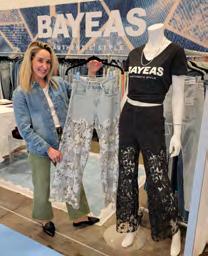
style custom lace pant with heat-fused rhinestones and intricate lace with metallic threads and flowers and birds on the legs. It’s been its hottest core piece for three seasons.
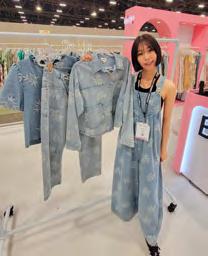
The biggest-selling item at L.A.-based Bibi was a knit top with the American flag. Taking pictures of flowers inspired designer Seunghyun Min to create a collection of denim with detailed floral prints.
Daze Denim, headquartered in Vernon, Calif., introduced a new mid-to-low-rise slimmer fit for summer.
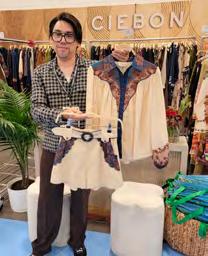
The number-one seller for Fall at Monterey Park, Calif.–based Ciebon was an airy
Project. held at the Las Vegas Convention Center Feb. 17–19, continued to be an inspirational hub for men’s fashion trends.
Distinct neighborhoods like Project Now spotlighted elevated streetwear, while the new Project Classic Community showcased tailored clothing and outerwear. Notable denim brands included Ed Hardy , GStar and MAVI
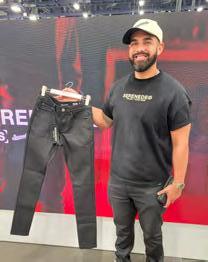
One of the bestsellers for California-designed Serenede was its Caviar 7 fitted, skinny, wax-coated denim with embroidered logo.
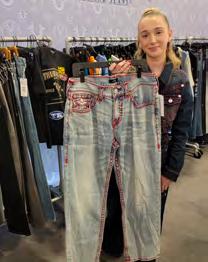
Los Angeles–based True Religion highlighted men’s and women’s collections. Its Bobbi Super T red stitch with super-flap pocket was popular for at-once.
“I’m not here for factories,” said Naz
Harounian, owner of Ned’s Melrose in Los Angeles. “I’m here for fire, designers with a story in every seam and a dream that keeps them up at night. Good people building something true.”
faux-linen blouse and short set with placement prints on the top and bottom, a beaded belt buckle and pockets. “She’s going to work the bar and all over the place,” said Daniel Banaga, creative director.
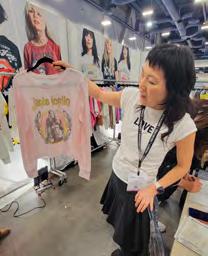
Fullerton, Calif.–based Recycled Karma was busy with buyers picking up extremely soft mineral-wash, vintage-look cotton T-shirts, tops and hoodies featuring rock ’n’ roll icons.
“My customer is mid-30s to late 80s, and they all want to look fabulous and have fun with their clothes. I’m looking for different and I’m finding it,” said Nicole of Nicole of Palm Desert, Calif.
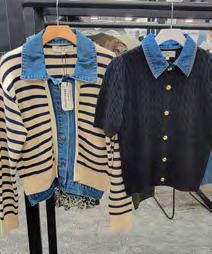
Los Angeles–based Velvet Heart was on
trend with its mixed denim knit pieces such as the short-sleeve sweater with gold buttons and removable denim collar as well as the striped blue and cream long-sleeve knit with denim detail.
Barefoot Dreams in Malibu, Calif., featured a two-piece knitted lounge set in deep garnet “for the lady wanting to feel cozy at home, comfy running errands and still look good,” said Frederic Barrouquere, sales.
The knit dresses with 3D flowers and pearl-studded flowers were a big hit for Spring/Summer at the trendy Balboa fashion beach club, based in Los Angeles.
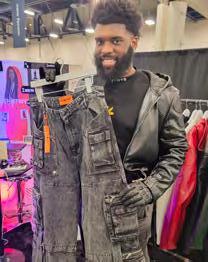
Designers like Obi Nwankwo, founder and CEO at Pomona, Calif.–based Knotwtr (“knot neglecting our talents willing to take risks”) featured a 10-pocket denim. “It was inspired by my grandfather, who came from
Sourcing, held at the Las Vegas Convention Center Feb. 17–19, fostered global supply-chain connections, uniting manufacturers, suppliers and fashion brands from Bangladesh, China, India, Egypt, Southeast Asia, Turkey and more.
Colombia’s fashion industry demonstrated its innovation and sourcing capabilities with leading apparel suppliers displaying activewear with high-performance fabrics, swimwear, intimates, lifestyle garments and uniforms. “People talk about nearshoring, but friendshoring is actually the new word that refers not only to cost associated with logistic advantage and proximity but also finding suppliers that are reliable and countries that have longtime strong relationships with the importing country in terms of diplomatic relations and trade agreements,” said Sebastian Echavarria, senior textile and sourcing representative at ProColombia, the nonprofit promotion agency of Colombia.
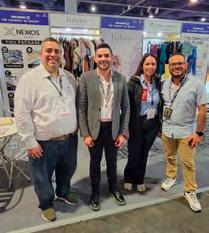
Sourcing’s specially designated areas included Fabric, Trim & Packaging; Nearshoring & USA, and a Sustainability Gallery with a Fashion by Informa Sustainability Assessment Program powered by Hey Social Good Returning tech exhibitors included AIMS360, CBF Labels and QIMA. Several new exhibitors joined the fashion tech and



service providers area:
With U.S. headquarters in San Mateo, Calif., Glance helps consumers shop on the spot with a personalized feed based on their selfies. “We’re driving traffic to brand websites, the app is already embedded into Direct TV and soon Samsung,” said Aashish Takkala, head of product marketing. “We want to bring brands on board so they can showcase their product catalogs in our experiences.”
J&L Brand Solutions in Pasadena, Calif., offered one-stop shopping for a wide array of factory-direct labels, hangtags, patches and heat transfers, all produced in-house.
China-based Lightchain AI is an AI-
Nigeria to the U.S. and motivated people to take that next step,” said Nwankwo.
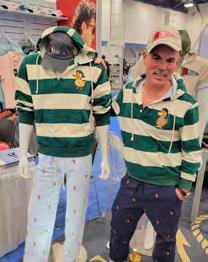
Fashion entrepreneur Patrick DiLascia returned to the menswear stage with the launch of his Los Angeles–designed modern prep collection The lll. “I paired a striped rugby hoody with oxford inner-hood detail and this season’s mascot, a chenille patch duck with a cotton seersucker pant with embroidery,” said DiLascia.
“This thoughtfully organized event continues to connect and energize the men’s fashion industry, fostering meaningful collaboration and innovation among brands, buyers and creatives,” said Edwina Kulego, VP, Global Business Development & Growth, Fashion by Informa.—K.F.
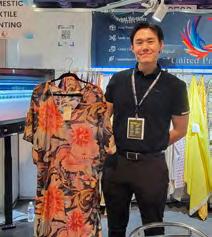
powered platform that provides a service to replace the typical photo shoot for brands and designers. “The AI generates product in a fashion-model image ready to post on the brand’s website and saves money and time for designers and manufacturers,” said Selina Jing, sales development representative. “We can also design a product based on a line sketch, fabric, style, recent trend or brand preference.”
100-year-old Memphis, Tenn.–based Connectiv is a third-party logistics company with more than eight facilities across North America and Europe. “We act as the back end for apparel companies shipping direct to con-
sumers, direct to retail, B2B; we can bundle, kit, handle logistics from Mexico and even transport containers from the ports,” said John Raisola, regional sales director.
Los Angeles–based fabric textile-printing company United Printex offers a completely waterless process. “Since we’re in Los Angeles, we can airship extremely fast in the United States with a lead time of five to seven business days,” said CEO Albert Huh.
“Sourcing emphasized sustainable practices and innovative solutions, driving collaboration and growth in the fashion industry,” said Pinar van der Vegt, head of sales and events, Sourcing by Informa.—K.F.
Offprice, held at the Las Vegas Convention Center Feb. 17–19, was the newest addition to the Informa lineup. It featured valuepriced, excess inventory and in-season apparel, accessories, footwear, and cash & carry for customers from big box to discount chain, outlet retailers, boutiques, nonprofits and e-commerce.
“We carry everything a woman desires, from beachwear to sets, Western, lace, bohemian and evening gowns,” said Ariel Birman, owner of Wholesale Fashion Trends in Vernon, Calif.
“OffPrice was our first-ever trade show and continues to be our bread and butter,” said Raymond Chen, owner and designer of Original USA in Houston. “We produce quality garments from head to toe, so all the customer needs is a pair of flip-flops and they’re good to go. I like the move to the convention center; we connected with new, big customers at this show.”
“Vendors are kind and nice. Margins are easier here. You can buy 100 and get a better price; exhibitors can do something on the spot,” said Irene Zakar of the Spoiled Rotten online boutique in Bradenton, Fla.—K.F.
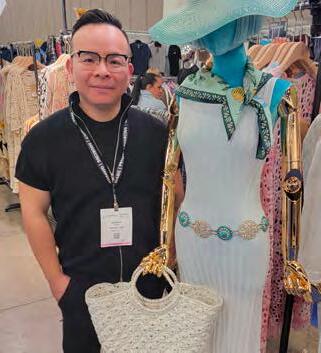
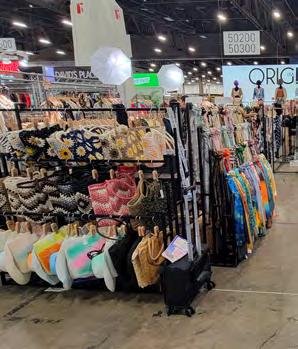
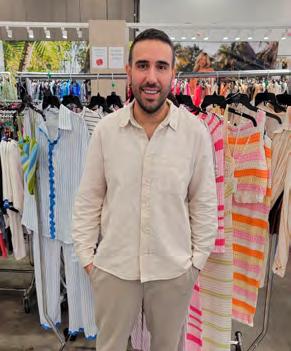
An increase of new brands at ANDMORE’s Las Vegas Apparel, colocated with Womenswear In Nevada at The Expo at World Market Center, held Feb. 16–19, attracted more international buyers as well as crossover buyers from its Atlanta edition, who completed their buying in Las Vegas.
“This is our biggest floor plan since inception, and 37 percent of the customers are new,” said Caron Stover, ANDMORE SVP, apparel. “Exhibitors are taking larger spaces to accommodate more buyers.”
In addition to the beautifully relaxed setting were plenty of amenities, experiential activations and programming centered on real-time insights.
Anchor brands Entro , Easel , ee:some , She + Sky , Glam and Timing were from Los Angeles.
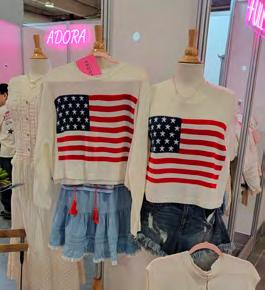
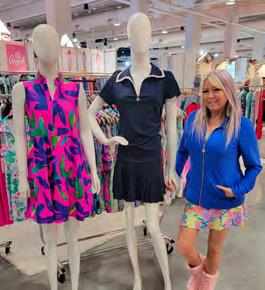
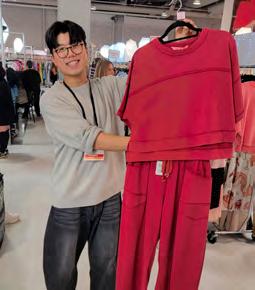
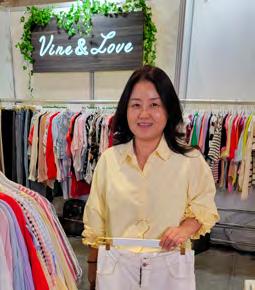
“We’re here to find new vendors with the hottest fashion-forward trends and visit vendors we know,” said Lyndsay Weinstein of Closet Space in Zion, Ill.
Americana is a big trend for Summer. The 4th of July collection at ADORA in L.A. was a big hit with its assortment of knits decorated with the American flag.
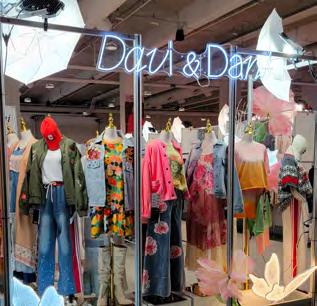
First-time exhibitor, family-owned Davi & Dani, based in Los Angeles, was excited
Womenswear In Nevada, colocated with ANDMORE’s Las Vegas Apparel at The Expo at World Market Center Feb. 16-19, grew 2,000 square feet since its August edition, attributed to intentional merchandising, collaboration and brands bringing buyers.
The reimagined floor layout included a Trend Discovery aisle that ran diagonally and featured vignettes for Autumn/Winter 2026 with themes like City Utility and Digital Sparkle.
“We come to see certain brands and walk all the shows for anything new, exciting and fun for our events, rodeos and music festivals,” explained David Lawr, Rockin Cowboy Clothing Co. in Vancouver, Canada.
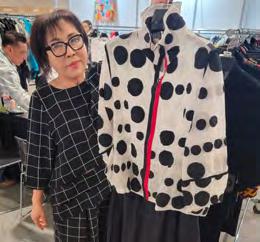
Moon Light in Los Angeles featured a wire-collar jacket.
“It’s slightly transparent white with black polka dots, a black and red zipper, and crushed nylon with a funky black taffeta barrel leg,” said owner Connie Pae.
Alison Sheri of Montreal featured an en-
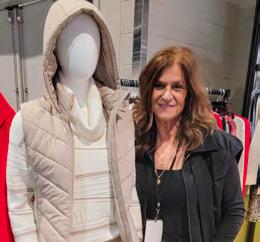
about its garment-washed sets with reverse stretch, unique stitching and protruding seam lines.
Everyday athleisure brand Aryea , also from Los Angeles and family-owned, featured a vibrant flowy sleeveless baby-doll dress with great stretch, a ruffled V-neck
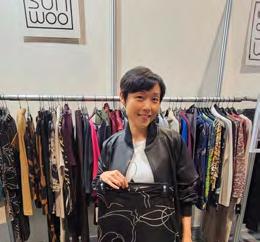
semble with a puffy sleeveless hoody vest, dressy straight-leg pull-up and off-white turtleneck with a horizontal embroidery stitch.
“People say I don’t usually wear prints, but I love yours,” said Roseann Sun Woo, designer, owner and founder of Clara Sun Woo
and SPF 50 protection. “Great for playing any sport or kickin’ it old style,” said Deb Widener, brand representative.
Also making its LVA debut was L.A. brand Vine & Love showing a lightweight, wide-leg baggie-fit pant with ruffle bottom and elastic waist.—K.F.
in New York of her sophisticated, soft stretch rayon and spandex knit fabric pants.
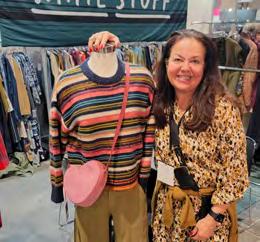
U.K.–based White Stuff paired a colorful and comfy striped crew neck over cotton utility pants with stripes accenting the sides of each leg.
“We’re bringing vibrancy to the Las Vegas market,” said Mel Montes, VP, WWIN. “Brands are telling us they’re thrilled. This is a great partnership; it’s really an exciting time for WWIN.”— K.F.

By Michael McDonald SPESA President
Each year SPESA releases what we call our “State of the Industry.” Often it’s timed around the U.S. State of the Union and serves as an opportunity for our team to reflect back on the year prior and look ahead to the new year we’re in.
As we started to work on our remarks for this year’s address, it felt a bit like Groundhog Day. Similar to last year, we were looking through a lens that was foggy. The challenge is that our hindsight was just about the same. We were emerging from a year of uncertainty . . . only to enter another year of uncertainty.
That uncertainty runs parallel to volatility: an unstable tariff regime, fragmented trade relationships and geopolitical turbulence that changes faster than supply chains can adjust. We wait for clarity—or, at a minimum, consistency— and it doesn’t arrive.
But the rough waters we’re wading through haven’t hampered the spirit and resiliency of the industry we all operate within. At SPESA, we spend a lot of time talking with suppliers, technology providers, manufacturers, brands and retailers from across the Western Hemisphere and the world. And what we’re hearing isn’t panic or a sense of paralysis. It’s a keen focus on the horizon—albeit a little unclear—and an emphasis on practical solutions. That forward-looking mindset is shaping how companies are making decisions right now.
Manufacturers that invest in technology but fail to reskill their work force, rethink workflows or build data fluency into everyday decision-making will continue to face headwinds. An investment in our people alongside an investment in new tools is what will offer businesses a competitive edge.
The COVID-19 pandemic showed us how powerful shared problem-solving can be. The “Alphabet Soup Collective” of industry associations demonstrates that we’re hungry for partnership, shared learning and joint initiatives. Collaborative relationships, whether between manufacturers, suppliers, associations, is one of the strongest forces shaping the industry now and in the future.

“At SPESA, what we’re hearing isn’t panic or a sense of paralysis; it’s a keen focus on the horizon and an emphasis on practical solutions.”
—Michael McDonald
Here are some of the key trends we’re seeing emerge across the industry in the wake of these uncertain times:
Uncertainty makes long-term forecasting difficult. So, many companies have shifted from strategies that prioritize growth to strategies that prioritize stability. They’re making contingency plans rather than bold bets and trying to remain agile enough to pivot when the next policy change hits or tariff threat is hurled.
When faced with instability, long-term success often relies on an adaptive ecosystem capable of weathering any storm.
In a couple of months, SPESA will host its 2026 Advancements in Manufacturing Technologies Conference in Columbus, Ohio. Over the years this event has taught us that having a competitive advantage starts by building smarter systems. And that continues to ring true during times of uncertainty.
At SPESA, we believe technology adoption—whether through automation, AI-driven optimization or improved analytics—is one of the most direct levers companies have to regain control in an unpredictable market.
But technology alone is not the answer.
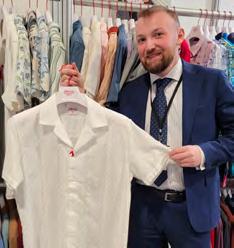
The Men’s Edit @ WWIN grew a few aisles within the footprint of Las Vegas Apparel and Womenswear In Nevada at The Expo at World Market Center Feb. 16–19.
“We were delighted to give them their own entrance,” said Mel Montes, VP, WWIN. “They needed to have a completely different experience, which has been a lot of fun to watch the growth.”
In what feels like a fragmented world, collaboration becomes a stabilizing force.
We’ve been talking about circularity for a long time, but there seems to be real momentum behind its progress— and that makes our SPESA team excited!
Circularity represents one of the rare areas where industry, technology, economics and consumer values align. It requires engagement across the entire supply chain—from fiber production to garment manufacturing to retail and end-of-life systems.
Circular systems, though, cannot function solely where waste accumulates; they must be integrated where products are made and sold. If the industry can continue improving quality and cost efficiencies in recycled and regenerated materials, it’s our hope to see circularity define the next era of sewn-products manufacturing, anchoring a more resilient and responsible supply chain.
There are no easy wins on the horizon. No single policy shift will eliminate volatility. No single strategy will solve for uncertainty.
The sewn-products industry has always adapted. It has always recalibrated. It has always found ways to move forward. And we have every reason to believe we will do so again. ●
Michael McDonald’s favorite thing to say is: “You were either born into the textiles industry or you were tricked into it.” He represents the former and has spent his career advocating for—or “tricking”—people to join the industry he represents and loves. Since 2018, he has served as president of SPESA, the Sewn Products Equipment & Suppliers of the Americas association for suppliers to the sewn-products industry, which includes apparel, upholstered furniture, home textiles, transportation interiors, leather goods, footwear, industrial textiles and more.
“The show is improved, and we picked up six new vendors here,” said Tunde Rahman, buyer for Portabella with over 70 retail stores in the New York tri-state area.
Exhibitors included Tiglio Inc. of Los An-

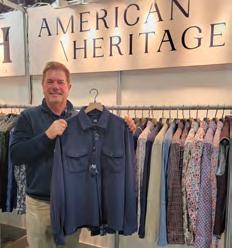
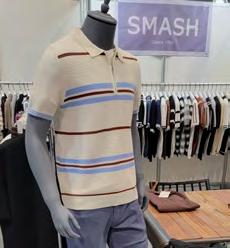
geles; Stacy Adams of Glendale, Wis.; and Long Island, N.Y.–based American Heritage by Luchiano Visconti, which launched a Japanese modal button-up overshirt for Fall 2026. “It’s an elevated-casual, sophisticated look for day-to-dinner,” said brand director Greg Marshall. Los Angeles–based LEONI offered colorful matching shirt and tie sets. The top seller at SMASH was its jacquard zip-up knit with stripes designed in Los Angeles. Montrealbased Sugar, That Shirt Is Sweet presented an easy-care stretch 100 percent cotton crochet camp shirt.— K.F.
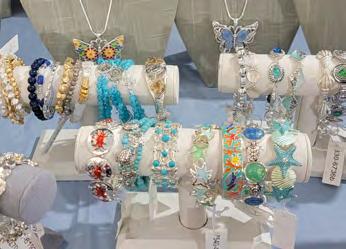
Energy was positive at IFJAG, The International Fashion Jewelry & Accessory Group, held Feb. 15–18. The global source for trendsetting fashion jewelry, accessories for wholesalers and large-volume retail buyers saw an increase in attendance at its new location at the Embassy Suites by Hilton Convention Center Las Vegas.
www.lalame.com info@lalame.com
La Lame is a leader in swimwear textiles, merging advanced performance and sustainability. Their fabrics offer superior stretch, quick-drying, UV protection, and resistance to saltwater and chlorine for lasting comfort and color. Eco-friendly materials include recycled polyester and nylon, sourced ethically to minimize environmental impact. The company uses low-water dyeing, biodegradable finishes, and responsible manufacturing practices. These sustainable choices maintain durability and aesthetic quality. Brands can select from bold prints, vibrant colors, and unique textures—metallics, mattes, digital prints, and jacquards—with customization and small-batch production for distinctive collections.
www.register.bharat-tex.com/register Bharat Tex 2026, slated for July 14–17 in New Delhi, is set to revolutionize the Indian textile industry. Showcasing over 5,000 exhibitors in a 2.2 million-square-foot space, this event will attract more than 6,000 international buyers and notable domestic leaders. As the sector targets a $350 billion valuation by 2030, Bharat Tex 2026 offers essential networking opportunities, a showcase of cutting-edge innovation.
“We’re sold out this season and expanding to a fourth floor in August,” said IFJAG Executive Director Don Valcourt.
Necklaces and brooches were popular at Canoga Park, Calif.–based B & R Accessories Inc. while nautical-themed bracelets and earrings were key items for Jacqui Accessories in Murrells Inlet, S.C.— K.F.
www.functionalfabricfairspring26.com/CaliforniaApparelNews Functional Fabric Fair Fall returns to the Oregon Convention Center, April 7–9, beginning with the Day 0 Sustainability Workshop on April 7, followed by two full days of exhibits and Expert Talks on April 8–9. As sustainability continues to reshape the apparel industry, this is where the conversations—and the solutions—come together. Functional Fabric Fair brings the industry face-to-face with the innovative performance textiles, responsible materials, and forward-thinking suppliers leading the shift toward a more sustainable future for apparel, outdoor and activewear. Curated for designers, product developers, and sourcing professionals, the fair features 300+ carefully
www.ifjag.com