NEWSPAPER 2ND CLASS
THE VOICE OF THE INDUSTRY FOR 81 YEARS
$3.99 VOLUME 82, NUMBER 6 JULY 17, 2026
TRADE-SHOW REPORT
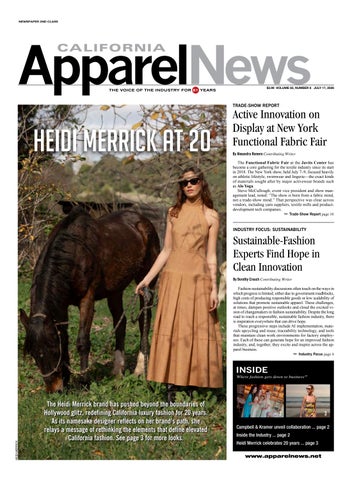
Heidi Merrick at 20
Active Innovation on Display at New York Functional Fabric Fair By Alexandra Romero Contributing Writer
The Functional Fabric Fair at the Javits Center has become a core gathering for the textile industry since its start in 2018. The New York show, held July 7–9, focused heavily on athletic lifestyle, swimwear and lingerie—the exact kinds of materials sought after by major activewear brands such as Alo Yoga. Steve McCullough, event vice president and show management lead, noted: “The show is born from a fabric mind, not a trade-show mind.” That perspective was clear across vendors, including yarn suppliers, textile mills and productdevelopment tech companies.
➥ Trade-Show Report page 10
INDUSTRY FOCUS: SUSTAINABILITY
Sustainable-Fashion Experts Find Hope in Clean Innovation By Dorothy Crouch Contributing Writer
Fashion-sustainability discussions often touch on the ways in which progress is limited, either due to government roadblocks, high costs of producing responsible goods or low scalability of solutions that promote sustainable apparel. These challenges, at times, dampen positive outlooks and cloud the excited vision of changemakers in fashion sustainability. Despite the long road to reach a responsible, sustainable fashion industry, there is inspiration everywhere that can drive hope. These progressive steps include AI implementation, materials upcycling and reuse, traceability technology, and tools that maintain clean work environments for factory employees. Each of these can generate hope for an improved fashion industry, and, together, they excite and inspire across the apparel business.
➥ Industry Focus page 4
INSIDE:
HEIDI MERRICK
Where fashion gets down to business SM
The Heidi Merrick brand has pushed beyond the boundaries of Hollywood glitz, redefining California luxury fashion for 20 years. As its namesake designer reflects on her brand’s path, she relays a message of rethinking the elements that define elevated California fashion. See page 3 for more looks.
2
3
Campbell & Kramer unveil collaboration ... page 2 Inside the Industry ... page 2 Heidi Merrick celebrates 20 years ... page 3 www.apparelnews.net
EVENTS
Campbell & Kramer Unveil Hadley Greene Collaboration
Companion in Venice, Calif., offered an intimate atmosphere for luxury brand Campbell & Kramer to celebrate its capsule with Hadley Greene, as guests socialized and sampled the sustainable collection made from dead-stock silk. From left: Presley Campbell, Alden Kramer and Hadley Greene
Los Angeles–based sustainable luxury brand Campbell & Kramer recently launched a capsule collection with Hadley Greene using dead-stock silk chiffon. The collection includes three pieces—the Hadley Poncho, Hadley Scarf and Hadley Pant—in four colors: Lagoon, Kiwi, Toasted Coconut and Limoncello. “Maintaining sustainable commitments is a core pillar of our brand,” said Presley Campbell and Alden Kramer, Campbell & Kramer’s founders. “By choosing dead-stock silk over newly manufactured silk we help prevent perfectly usable fabric from going to waste while avoiding the thousands of liters of water required to produce new silk.” Campbell & Kramer and Greene hosted a launch party
at Companion in Venice, Calif., where guests dined on Klaus pizza, radiatore all’arrabbiata and cake by Buttercream Boy while exploring the new collection. The event took place just ahead of the official start of summer as the collaborators celebrated the collection, which was inspired by the warmer season in Southern California. “Though our tastes often align, the collaboration was equally defined by contrast,” said Campbell and Kramer. “Hadley’s perspective challenged ours in ways that sharpened the collection, pushing silhouettes, styling and color into places neither of us would have arrived at independently.” The collection is available at CampbellandKramer.com and priced at $100–$230. —Dorothy Crouch
Jay Wetherald (818) 613-2385 SoCal Textile Group Showroom Cooper Design Space Building, Suite M6 Jbyrdtextiles@aol.com / Updated website! www.SocalTG.com
ECLAT TEXTILES Performance Knits
Leading provider of circular knits to higher-end athleisure and activewear brands. Los Angeles stock program for domestic production. Heather Moss Jersey, Interlocks, TENCEL, and many more performance-knit options to choose from. Also, knit-to-order from Taiwan.
VICTORYTEX Performance Wovens Victory is a woven converter based in Taiwan. Excellent source for stretch and non- stretch wovens. Minimum order quantity is 3,000 per fabric / 1,000 yards per color. Can be flexible on MOQ.
REX FABRICS Los Angeles Stock
Rex Fabrics is a converter located in Los Angeles offering a large selection of stock fabrics for yoga, sport, swim, gymnastics, and dance. Minimum order quantity is only 5 yards per color. Large color selection, and color cards available upon request.
Tangana Textiles is a European producer and your wholesale source of eco-friendly cotton and poly knitted fabrics, as well fine blank garments that are perfect for imprints. From GMO-free cotton, through mixed compositions, to recycled polyester-based products - our fabrics are the perfect canvas for your brand’s casual apparel, athleisure, high fashion collections or even lingerie.
Upcoming Treade Shows Functional Fabric Fair Portland, Ore., Oct. 27-28, Booth #925 The Fabric Show San Francisco, Nov. 8–9 / 2 CALIFORNIA APPAREL NEWS
MAY 12, JULY 17, 2023 2026 APPARELNEWS.NET APPARELNEWS.NET
Cotton Incorporated has released its 2026 Life Cycle Assessment of U.S. Cotton Fiber Production, giving textile leaders the most current, comprehensive, independently reviewed data on U.S. cotton fiber to date. “U.S. cotton growers have spent decades improving their environmental performance, and this study puts real numbers behind that progress,” according to Jesse Daystar, Cotton Incorporated vice president and chief sustainability officer. “With 753 growers across 17 states, this is one of the most transparent assessments of any fiber available today. As brands face growing pressure to back their sustainability claims with credible science, this gives them exactly that: a clear, independently reviewed baseline for U.S. cotton that can inform sourcing decisions, support regulatory compliance and identify opportunities for meaningful improvement.” Circulose has expanded its brand network to include Eileen Fisher, Marimekko, Samsøe Samsøe and King Louie. Advancing circularity in fashion requires collaboration across the value chain and the scaling of next-generation materials. Circulose’s growing partner network signals that this shift is underway. The newly announced partners join the H&M Group, Mango, Bestseller, Reformation and Marks & Spencer, among others, who are working with Circulose to integrate circular materials into product development and sourcing processes. “We are delighted to welcome Marimekko, Samsøe Samsøe, Eileen Fisher and King Louie to our growing partner network,” said Jonatan Janmark, CEO of Circulose. “Scaling circular materials requires brands willing to lead the way, and these partnerships show what that leadership looks like in practice.” Kornit Digital Ltd., a global pioneer in sustainable, on-demand digital fashion and textile production, has announced that USColorworks, a North Carolina–based apparel decoration and fulfillment company specializing in custom and on-demand printing for retail and promotional markets, has added the Atlas MATRIX and Atlas MAX PLUS systems to deliver high-quality, ondemand apparel across cotton, blended fabrics and polyester, projecting a 30 percent increase in apparel and textile production for all on-demand orders. “Digital production has dramatically increased our competitiveness and revenue,” said Rodney McDonald, president of USColorworks. “I don’t believe you can win a national program now without having the ability to handle both bulk items and on-demand orders. Digital is the only way to do it all right.”
SoCal TextIle Group
TANGANA TEXTILES
Inside the Industry
POSTMASTER: Send address changes to: CALIFORNIA APPAREL NEWS, Customer Service, 127 E. Ninth St., Suite 212, Los Angeles, CA 90015. CALIFORNIA APPAREL NEWS ®: (ISSN 0008-0896) Published by TLM PUBLISHING INC. APPAREL NEWS GROUP Publishers of: California Apparel News®, Market Week Magazine®, New Resources®, Waterw ear ® , New York Apparel News ® , Dallas Apparel News®, Apparel News South®, Chicago Apparel News®, The Apparel News (National), Bridal Apparel News®, Southwest Images ® , Stylist ® and MAN (Men’s Apparel News ® ). Properties of TLM PUBLISHING INC., 127 E. Ninth St., Suite 212, Los Angeles, CA 90015, (213) 627-3737. © Copyright 2026 TLM Publishing Inc. All rights reserved. Periodicals Postage Paid at Los Angeles, CA, and additional entry offices. The publishers of the paper do not assume responsibility for statements made by their advertisers in business competition. Opinions expressed in signed editorial columns or articles do not necessarily reflect the opinions of the publishers. Subscription rates: U.S.: 1 year, $89; 2 years, $140. Foreign: $180 U.S. funds (1-year subscription only). Singlecopy price $3.99. Send subscription requests to: California Apparel News, Customer Service, 127 E. Ninth St., Suite 212, Los Angeles, CA 90015 or visit www.apparelnews.net. For customer service, call (213) 627-3737.
Next Level Apparel, a wholesale leader in premium, ethically sourced blank apparel, has been named the official apparel partner of Got Sole for its 2026 U.S. tour, marking a continued expansion into streetwear and pop-culture spaces. The Got Sole festival has become one of the most active live marketplaces in global sneaker culture, becoming a physical intersection of commerce and culture, where what people wear, collect and create is constantly in motion. “Got Sole has always been about the people who live and breathe this culture— collectors, creators and communities coming together in one place,” said Jonathan DiModica, founder and CEO of Got Sole. “Our 2026 tour with Next Level Apparel brings that spirit to life through product and storytelling.”
HEIDI MERRICK
FASHION
Heidi Merrick Approaches 20 Years With Gratitude and a Bold Attitude California brand Heidi Merrick has reached a milestone moment as its namesake designer celebrates 20 years of creating pieces she hopes will make women feel beautiful and special. Merrick continues to expand her business—adding intimate in-store events and apothecary collaborations with other female brand founders. “I will always pursue elevating the women I know,” noted Merrick. The Heidi Merrick evolution also included operating from the same guiding principles as when she started out, which includes a trait she refers to as her “I’ll-prove-you-wrong attitude.” “The real truth of California style and elegance is really elevated. We are the women who go to premieres and galas. We are the women who can host a big dinner party and ride a
horse,” Merrick said. “There is a diverse, beautiful lifestyle, but people want Los Angeles designers to fill that Barbie-pop idea of fashion.” Her recent Spring/Summer 2026 collection brought Merrick back to some beloved designs that didn’t make the cut during their initial seasons. These include the Gia dress and Geometry skirt that she created in 2012. They are now being released with updated details such as silk noil and standout trim. “That was something I did for myself, to prove I am myself and haven’t changed,” said Merrick. “It’s just refined. That is something that really serves me as a person—acknowledging that the designs early on were worthy and lovely and maybe not right for the time—but they are still timeless and beauti-
ful.” There is also the Ballerine dress, inspired by a bathing suit she designed years ago, which became a best-selling top. The Gayle dress and Gayle skirt were created from a pattern Merrick made in design school and named for a teacher at Los Angeles Trade-Technical College. “When it’s special to you, it’s special to other people,” said Merrick. “L.A. has been so kind to me … I just want to say how grateful I am. All the people wearing it—from celebrities to the mom who is buying a SRF sweatshirt. From Malibu to Silverlake it’s been really great. I’ll always be so grateful for L.A. and what it has done for me.” Heidi Merrick is available at heidimerrick.com and at the Summerland, Calif., flagship.—Dorothy Crouch
THE ONLY DESTINATION FOR WESTERN & WORKWEAR
Curating the Best Brands in the Best Place Dallas Apparel & Accessories Market AUGUST 18 - 21, 2026 | OCTOBER 20 - 23, 2026 AETA International Trade Show AUGUST 18 - 21, 2026 WESA’s International Western/English Apparel & Equipment Market AUGUST 18 - 21, 2026
APPARELNEWS.NET
Rios of Mercedes
JULY 17, 2026
CALIFORNIA APPAREL NEWS 3
INDUSTRY FOCUS: SUSTAINABILITY
What early-stage advancement, innovation or developing technology gives you hope for a sustainable future in fashion? Industry Focus Continued from page 1 California Apparel News asked experts in fashion sustainability: What early-stage advancement, innovation or developing technology gives you hope for a sustainable future in fashion?
Jaffar Ali Lead Digital Marketing and Communications Sapphire Finishing Mills Limited What gives me hope is not just a single technology but how innovation is helping us reconnect fashion with responsibility. We are seeing promising developments in areas such as regenerative agriculture, recycled materials, digital traceability and data-driven sustainability, but their real value lies in the impact they have on people and the planet. For the first time, brands, manufacturers and consumers are becoming more connected to the story behind a product—where it came from, who made it and what impact it had along the way. Technologies such as Digital Product Passports and Life Cycle Assessments are helping make that possible. Ultimately, a sustainable future in fashion will not be built by technology alone. It will be driven by collaboration, transparency and a shared commitment to creating products that respect both natural resources and the people behind them. Seeing the industry move in that direction gives us great optimism for the future.
John Armstrong Chief Technology Officer Worldly Technology is finally letting us see the whole system and its human cost simultaneously. That visibility, grounded in actual data, gives me profound hope that fashion can transform at scale while protecting the people who make it
possible. There’s a convergence of three things happening right now: ambient data, primary supply-chain data and AI. When you combine trade records, production volumes, chemical inventories and primary impact data through AI, something extraordinary happens: You can ask questions that were previously impossible. In which of my factories have workers been exposed to hazardous chemicals? Which products might put my customers at risk? How do these two questions actually connect through the same dataset? The same data story plays from an individual worker all the way outward to a business’s global scale. A decision to switch to a less toxic dye reduces consumer risk and protects factory workers. What excites me most is sustainability 4 CALIFORNIA APPAREL NEWS
JULY 17, 2026
shifting from self-reporting to provable action. Real change shows up in the data, and commitments auto-resolve when behavior actually changes.
optimism because we’re seeing the industry move beyond simply asking “What performs best?” to asking “What performs best while creating the least impact?”
Kerry Bannigan President of the Board PVBLIC Foundation
Inga Bleyer Head of Marketing and Communication OEKO-TEX
One of the advancements that gives me the most hope is next-generation materials developed from agricultural and industrial waste, a category that is quietly moving from experimental to commercially viable. Through REIN Hubs, a nature-based entrepreneurship platform led by PVBLIC Foundation and CleantechHUB operating across Colombia, Guatemala, Costa Rica, Peru and El Salvador, we are seeing this firsthand. Companies in the REIN ecosystem such as Green Leaf—developing plant-based fibers from pineapple crop waste, REEMADE—upcycling discarded industrial materials through circular design and TR GLOBAL GROUP— converting post-consumer textile waste into new raw material, are proof that this is no longer a niche pursuit. These are revenuegenerating businesses attracting investment and creating green jobs. A new generation of founders is not waiting for legacy brands to lead. They are rebuilding the material system itself, and the verification infrastructure is beginning to catch up. Digital Product Passports and traceability technology are creating the accountability layer that allows these advances to scale with credibility, moving the industry from claims to evidence.
I’m most excited about connecting data across the whole supply chain so trust isn’t something you have to assume anymore; you can actually prove it. Digital tools are making it possible to actually check those claims instead of just taking them on faith. Things like Digital Product Passports, blockchain-backed certification data, platforms that connect everyone in the supply chain trace where a garment actually came from or whether it’s really chemical-safe, step by step. Certification data are moving into digital systems that partner across the supply chain and can actually be checked in real time. Consumers benefit, too, just more indirectly, through labels like MADE IN GREEN, which let them scan a product and see the verified journey behind it without needing to see the raw supply-chain data itself. That matters because supply-chain fraud— organic cotton is a good example—tends to thrive when nobody can see what’s happening. Digitalization starts closing that gap. It’s not just a nice addon to sustainability; it’s what makes real accountability possible at scale.
Oya Barlas Bingul Senior Manager of Business Development and Marketing TextiMag Real progress will come from combining smarter materials, safer chemistry and better product design. What gives me hope is the shift toward technologies that deliver performance while reducing environmental impact throughout a garment’s entire life cycle. Increasing regulation around PFAS, heavy metals and chemical transparency is encouraging the industry to rethink how we achieve functionality. I’m particularly excited by the growing potential of mineral-based technologies. Nature has provided us with abundant materials that have often been overlooked, yet they can offer meaningful performance benefits while supporting a responsible approach to textile innovation. Whether it’s helping garments to stay fresher for longer, reducing unnecessary washing or extending product life, these seemingly small improvements can collectively make a significant difference. The future of sustainable fashion will be built through collaboration, science and thoughtful innovation. That gives me genuine APPARELNEWS.NET
Meredith Boyd Executive Vice President Chief Product Officer UNIFI makers of REPREVE Advancements in textileto-textile recycling are creating meaningful progress toward a more sustainable future in fashion and redefining how the industry approaches resource use toward the recovery and reengineering of existing textile materials into new products. Our REPREVE Takeback circular polyester is a key example of this innovation in action, and our circular ThermaLoop insulation is pioneering, demonstrating how recycled textile inputs can be engineered to meet rigorous performance specifications. We are proud to have developed our ability to recycle and produce these products globally and at enterprise scale. We focus on quantifying the benefits of these textile-to-textile offerings in order to reduce global reliance on virgin petrochemicals, energy and water as compared to virgin production. We have the ability to recover, reprocess and reintegrate materials back into the textile supply chain while supporting measurable improvements in resource efficiency and life-cycle impact. Circularity is the foundation for the next generation of materials for the fashion industry. Setting a new standard in sustainable textiles. And we have it available now.
Yoonho Cha Marketing Director Like Dreams One innovation that gives me hope for a more sustainable future in fashion is technology that helps brands extend the life cycle of the products they’ve already created. At Like Dreams, it has been a pleasure working with Max Retail because they’re making that process both accessible and effective. Instead of viewing excess inventory as waste, we can now connect those products with new customers in a way that supports both responsible retail and long-term business growth. I believe solutions like this are an important step toward a more sustainable industry.
Cecilia Chan Chief Commercial Officer Legend Swimwear Factory Choosing between cereal brands once meant taking the manufacturer’s word regarding nutrition until nutrition-facts labels appeared. Once nutrition became visible, consumers could compare products and manufacturers had an incentive to
improve. Innovation in sustainable fashion is often seen as a matter of better materials. But even the best materials struggle to scale when buyers cannot compare their real impact. This is where early-stage innovations like Digital Product Passports and the growing use of facility-level emissions data change the equation. These innovations let us use actual factory data, not just industry averages, to identify where the biggest impacts occur. The factories brands see most are rarely where most emissions occur. Tier 1 assembly can account for less than 10 percent of a garment’s footprint. Most environmental impact occurs in raw-material production and textile processing. Without comparable data, a “clean” mill competes with a “dirty” one on price, quality and delivery. Comparable primary data reveal environmental performance, giving buyers something to act on while allowing better suppliers to stand out.
Onur Çınar Senior Marketing Executive ISKO The future of sustainable fashion lies not in a single breakthrough but in the convergence of innovation, science and scalability. Advanced textile recycling, transparent impact measurement through Life Cycle Assessments and
➥ Industry Focus page 6
INDUSTRY FOCUS: SUSTAINABILITY
What early-stage advancement, innovation or developing technology gives you hope for a sustainable future in fashion? Industry Focus Continued from page 4 next-generation materials are reshaping how the industry designs, produces and values textiles. What is particularly encouraging is that these solutions are moving beyond pilot proj- ects and becoming commercially viable at scale. For us, meaningful innovation is measured not only by technical achievement but by the ability to accelerate circularity, support responsible growth and create long-term value across the entire fashion ecosystem.
Paola Corna Chief Financial Officer Sustainability and Human Resource Manager ACM Even the smallest details make a difference, from an aesthetic perspective and, also, an ethical and environmental one. Increasing attention is being paid to all the components that complete a garment—buttons, rivets, labels and trims, which can also play a meaningful role in reducing its environmental impact. This shift is driving the development of increasingly high-performing and reliable certified-recycled materials for fashion accessories, proving that quality, design and responsibility can go hand in hand. At ACM, we have been following this path for years, and its recent confirmation comes with the renewal of our Global Recycled Standard certification, reflecting our ongoing commitment to the use of certified-recycled materials. The future of fashion will not depend on a single breakthrough innovation but on the ability to rethink every single component of a product. When even a button, a buckle or a label is designed with the same care as the fabric itself, sustainability stops being an abstract concept and becomes a tangible quality of the finished garment.
Betsy Franjola Chief Executive Officer, Hocking Hills Garment Center President, BFF Studio Founder, PREFACE
One of the most promising innovations is placing people at the center of how we make our clothes. Our Appalachian region of Southeast Ohio has experienced generations of economic transition and the loss of industries. Today, advances in small-batch manufacturing, digital tools and supply-chain traceability create opportunity to build something new. We work with partners to create fully traceable cotton products made entirely in the United States. Brands are able to produce closer to demand, reduce overproduction, and connect consumers directly to the people and places behind their garments. Sustainability creates meaningful jobs, restores skills and invests in communities that have too often been left behind. A truly sustainable fashion industry must be human centered, creating systems that value the people who make our clothes. 6 CALIFORNIA APPAREL NEWS
JULY 17, 2026
The future will be shaped by systems that are local, transparent and deeply connected to both people and place. The idea that a rural sewing center in Southeast Ohio can help redefine what responsible manufacturing looks like gives us tremendous hope for what comes next.
Nipuna Gunaratne Lead Sustainable Product and Circularity MAS Holdings One of the most promising breakthroughs in sustainable fashion is the rapid advancement and scaling of textile-to-textile chemical recycling across multiple fiber types. What gives me hope is that chemical-recycling technologies are now moving from lab-scale innovation toward pilot and industrial-scale production. These processes can break textiles down to their molecular or fiber-building components and rebuild them into high-quality materials, creating a pathway for true circularity across polyester, nylon and cellulosic blends. This matters because real textile waste is complex. It is rarely one clean fiber type, and the future of circular fashion depends on technologies that can handle mixed materials at scale. If chemical recycling can scale commercially across fiber types it will become more than a sustainability initiative—it will be a foundation for the next generation of fashion manufacturing, where performance, scale and circularity work together.
Calvin Huelsman Sustainability Manager Elevate Textiles Chemical textile-to-textile recycling breaks textiles down into their molecular building blocks, removing dyes, finishes and other contaminants, allowing fibers such as polyester, nylon and even blended materials to be regenerated into virgin-quality fibers repeatedly. New solvent-based and depolymerization technologies can selectively separate and recover individual materials, significantly expanding the volume of textiles that can be diverted from landfills or incineration. Although chemical T2T recycling is still in its early stages compared to mechanically recycled, bottle-based fibers and currently carries a price premium due to limited capacity, it represents a meaningful step toward truly circular material flows. Combined with improvements in collection and sorting infrastructure, chemical recycling could enable the growth of closed-loop supply chains at a cost comparable to bottle-based recycled fibers while substantially reducing reliance on fossil-based feedstocks. As demand for recycled materials continues to grow with the support of regulation that prioritizes preferred production pathways, I am optimistic that chemical recycling will scale rapidly by 2030.
APPARELNEWS.NET
Jason Keller Sustainability Leader, Fibers Eastman The industry’s growing ability to turn sustainable innovation into solutions that can truly scale gives me hope. We’ve spent nearly a decade working toward one ambition: making circularity mainstream and sustainable fashion accessible to everyone. Along the way, we’ve learned that meaningful innovation succeeds only when it combines three essential qualities: scalability, performance and versatility. Scalability is what transforms promising ideas into real environmental impact. Small initiatives and capsule collections can inspire the industry, but lasting change happens when responsible solutions become available at the scale required by global fashion. Performance is equally critical. Sustainability should never require compromise. Innovative materials must perform as well as or better than traditional alternatives, delivering the durability, comfort and quality that brands and consumers expect. Versatility enables broader adoption. The more applications a material can serve, from fashion to home textiles and beyond, the greater its potential to replace less-sustainable options across the industry.
Steve McCullough Event Vice President Functional Fabric Fair What’s happening at the very beginning of the supply chain, at the fiber and yarn level, gives me hope. If designers and brands start with ethically sourced, sustainable inputs from day one, the trickle-down effect through the rest of the production process becomes far more manageable. Trying to course correct sustainability at the end is an uphill battle; building it in at the start changes everything. Alongside that, I’m genuinely excited about the move toward mono-component textiles. A fabric made from a single material, textile-to-textile recycling—our focus topic at this year’s events—is dramatically more accessible, removing real barriers that have slowed circularity in fashion for years. At Functional Fabric Fair’s Innovation Hub, a dedicated area of our Portland spring and fall editions, we spotlight this kind of early-stage advancement. It’s where emerging technologies and new-to-market solutions get in front of the people who can actually put them to work. I’m optimistic because the ideas exist, the momentum is building, and the industry has a place to find them.
Cindy McNaull Brand Business Development Director Cordura Sustainability—or stewardship as we prefer to call it—is about doing what’s right, for our people, our communities and the environments surrounding our facilities around the world. The innovation that
gives us hope is the emerging science of chemical recycling for post-consumer Nylon 6,6—a material known for its extraordinary performance but is historically difficult to recycle. We’re supporting two distinct pathways: an internal alcohol-based solutioning process that can recover up to 90 percent of Nylon 6,6 from end-of-life materials and an external collaboration with Epoch Biodesign, a pioneer in AI-engineered enzymatic-recycling technology that has already demonstrated recovery of nylon’s core monomers from end-of-life airbags. What excites us isn’t just the technology— it’s the potential to create a true circular system for one of fashion’s most durable, highperformance fibers. Understanding the market needs, we know that any solution must be price-competitive with virgin polymer, use resources wisely and reach commercialization quickly. We believe durability and recyclability aren’t in conflict—they’re the future of fashion done right.
Philippe Mignot Project Manager NextPrinting For years, digital printing was seen as a promising technology with certain limitations. Today, however, its aesthetic quality, tactile realism and creative possibilities have evolved to compete with traditional manufacturing processes. By applying graphics, effects and finishing treatments directly onto fabric rolls before garment construction, digital printing eliminates many of the resource-intensive processes traditionally carried out after garments are made. Manufacturers simply cut and sew fabrics that are already finished, significantly reducing water, energy and chemical consumption while streamlining production. Digital printing enables low minimum orders, making on-demand manufacturing and preorder models increasingly viable. It offers an effective way to recover leftover fabrics from previous seasons by transforming them with new graphics instead of discarding them. The technology is ready. The real challenge now is integrating it intelligently into today’s supply chain, overcoming outdated perceptions and combining it with the manufacturing expertise that already exists. Digital textile printing can become one of the indus- try’s most effective tools for reducing waste while preserving the creativity, flexibility and quality that fashion demands.
John Mitchell Head of Business Development, North America Livinguard Thirty percent of all microplastics released into the ocean stem from synthetic textiles. Up to half a million tons of non-biodegradable fiber fragments from washing textiles are discharged into waterways g l o b a l l y e v e r y y e a r. Microfiber and microplastic shedding are often overlooked sustainability challenges for the textile industry, and meaningful mitigation has proven challenging for brands as redevelopment of materials is costly, complex and takes time.
INDUSTRY FOCUS: SUSTAINABILITY
What early-stage advancement, innovation or developing technology gives you hope for a sustainable future in fashion? Livinguard Better Fresh is a game-changing textile finishing that does not only provide leading biocide-free and wash-durable odorcontrol functionality—a valuable benefit for consumers—but the solution has also shown to reduce microfiber shedding during home laundering by up to 80 percent—a critical environmental benefit. This innovation has the potential to provide actors in the textile industry a scalable and economically viable tool to make meaningful progress in working toward their ambitious goals to reduce pollution from fiber fragmentation. The environmental benefit can be clearly measured and quantified, providing brands an exciting opportunity to build powerful narratives and make defensible environmental claims toward consumers.
Barbara Oswald Chief Commercial Officer BlueSign The promising change now is the move from claims to proof and the tools that make that possible. The development I watch most closely is traceability, including Digital Product Passports. Real information about how a product was
made should travel with it and be available to brands, regulators and consumers. That only works if the underlying information is sound. This is where the quieter innovation matters. Most of a garment’s impact is decided early, in the chemistry and processes used to make it, long before anyone sees the finished item. Bluesign has spent over 25 years working at that input stage, gathering and calculating primary data to measure the environmental footprint of manufacturing facilities. The technology I find most promising connects that measured data to the decisions brands and consumers make. A sustainable future in fashion will not come from louder messaging. It will come from fewer assumptions, better data and earlier intervention in production. The systems being built now to carry that proof forward are what make me optimistic.
Patrizio Siniscalchi Managing Director Thermore The most promising progress in our industry is the development of materials and products that can combine high performance with great durability. At Thermore, durability is seen as a form of system innovation, where design
goes beyond the performance of the product to optimize its behavior over time, ultimately reducing its overall environmental impacts. We believe that developing and producing durable products means integrating responsibility and performance into a single, cohesive approach.
Cheryl Smyre Vice President Parkdale Advanced Materials One of the most promising advancements shaping the future of sustainable textiles is the ability to engineer synthetic fibers with their entire life cycle in mind. Innovations that enhance the end-of-life profile of synthetic fibers demonstrate that performance and environmental responsibility can advance together. By enabling synthetic materials to become more bio-accessible in biologically active end-of-life environments while maintaining the durability, comfort and functionality consumers expect, we’re redefining what’s possible for next-generation fiber technologies. Equally important are material verification and supply-chain transparency. As innovative fiber technologies continue to scale, brands need confidence that the materials they spec-
ify are consistently incorporated throughout the manufacturing process. Verification systems strengthen accountability, support responsible sourcing and build trust across the textile value chain. Profound innovations are grounded in proven science, practical to manufacture and scalable across the global textile industry. When we combine advanced material engineering with transparency and real-world implementation, we create a platform to improve the environmental profile of synthetic textiles while continuing to deliver the performance the industry depends on.
Adam Taubenfligel Creative Director and Responsibility Lead Triarchy The advancement that gives me the most hope isn’t a new material. It’s a new way of thinking about production. For decades, fashion has approached sustainability by trying to improve systems that were never designed with sustainability in mind. We reduce water, swap fibers, improve efficiencies, and, while those efforts matter,
➥ Industry Focus page 8
ON MODEL: AMBROSIA & CO., YOCHI, HANDBAG: MITCHIE’S MATCHINGS, NECKLACE: MARCIA MORAN
IN SEASON. IN ATLANTA.
August 3 – 6, 2026
THE MARKET FOR WHAT’S SELLING NOW.
Atlanta-Apparel.com
APPARELNEWS.NET
JULY 17, 2026
CALIFORNIA APPAREL NEWS 7
INDUSTRY FOCUS: SUSTAINABILITY
What early-stage advancement, innovation or developing technology gives you hope for a sustainable future in fashion? Industry Focus Continued from page 7 they’re ultimately refinements of an existing model. What excites me are technologies that eliminate unnecessary processes altogether. In denim, for example, we’re beginning to see digitally dyed systems that define the final appearance of a garment before it’s ever constructed, removing many of the water—and chemical-intensive wash processes that have long been considered unavoidable. Rather than correcting a garment after it’s made, the desired outcome is designed into it from the beginning. That shift is profound because it isn’t incremental. It’s structural. The future of fashion won’t be built by asking how to make existing systems slightly less harmful. It will come from asking whether those systems need to exist at all. For me, that’s where real optimism lies. Not in a single breakthrough, but in technologies that allow us to rethink production from first principles such as reducing complexity, eliminating waste and creating products intentionally rather than correcting them after the fact. The most exciting innovations don’t make the old system greener. They make parts of it obsolete.
Melodie van der Baan Co-founder and Chief Executive Officer Max Retail Overproduction is the industry’s quietest sustainability crisis. Every season, independent retailers and brands are left over-indexed on merchandise that gathers dust in stockrooms or ends up in liquidation channels and, too often,
landfills. This is the problem we set out to solve at Max Retail. Our platform connects brickand-mortar retailers and brands to a global ecommerce network so excess inventory finds a rightful home with shoppers who want it. Sellers earn meaningful payouts from goods that would otherwise go unsold. What excites me most is where this technology is headed: solving fashion’s inventory problem further upstream. The real opportunity is catching excess earlier by moving in-season overstock before it ages and giving retailers SKU-level data for smarter markdowns, demand forecasting and buying. That is how the industry gets to lean on inventory businesses that produce less waste, and this is a path we’re committed to at Max Retail.
Andrea Venier Managing Director Officina39 For decades, potassium permanganate has been one of the industry’s most widely used tools to create localized abrasion, contrast and vintage effects. But the direction is now clear: Permanganate salts are progressively moving out of the acceptable-chemistry toolbox, and that accelerates significantly the need for scalable alternatives. 8 CALIFORNIA APPAREL NEWS
JULY 17, 2026
One early-stage innovation that gives us real hope is ZERO PP ALL.IN, Officina39’s new approach to replacing potassium permanganate in denim finishing. It is not only more sustainable in theory but is also designed to be industrially realistic. The product is applied directly onto raw garments and works with technologies already widely adopted by modern laundries, especially laser and ozone. This means the industry does not need to choose between compliance, creativity and productivity. It’s the type of innovation fashion needs: not a niche solution, not a compromise, but a chemistry and process platform that makes the better choice also the practical choice. It represents a more hopeful future because it proves sustainable denim finishing can be creative, scalable, efficient and economically viable.
Matteo Vivolo Chief Sales Officer Vivolo When people ask what gives us hope for the future of fashion, our answer begins with a material we have worked with for nearly fifty years: leather. Over the years we’ve introduced new materials and technologies to meet changing market needs and growing sustainability expectations. Yet leather remains at the heart of our business. As a byproduct of the food industry, it already represents an important example of resource recovery and value creation. The next frontier is making leather truly circular. There is enormous potential to recover and recycle leather offcuts and leftover materials through technologies that are both effective and scalable. We are beginning to collaborate with universities and research centers to support projects focused on leather recycling. Innovation is not only about discovering new materials but also about unlocking the full potential of the materials we already have. Truly closing the loop for leather will reduce waste, preserve the value of a remarkable natural material and help build a more responsible future for the fashion industry.
Marjory Walker Co-director U.S. Cotton Trust Protocol What brings me the greatest hope is seeing how on-farm precision tools can support the deep care growers have always had for their land. For generations, farming families have quietly nurtured their fields, and, today, optional innovations like GPS-guided systems and smart sensors simply help them measure and build upon that stewardship with even greater accuracy. It is wonderful to see practices like cover cropping and crop rotation now adopted by the majority of our growers, enhancing soils and conserving resources. Advanced fieldverification technologies allow us to prove those positive efforts with precision rather than relying on estimates alone. It bridges the soil and the storefront, turnAPPARELNEWS.NET
ing everyday on-farm care into clear, verified data. Through the U.S. Cotton Trust Protocol’s new Field Partner Program, we pair field visits with satellite imagery analysis to bring greater visibility to the work our growers are already doing and the data already being reported by the program, giving brands traceable regenerative cotton and a clearer pathway to meet their sustainability targets.
MeiLin Wan Founder and Chief Executive Officer GenuTrace Molecular-level verification technologies give us hope. Stable-isotope analysis reads the chemical signature a fiber picked up from its growing environment—the water, soil and climate of a specific region—and checks it against supplier claims. DNA tagging takes a different but complementary approach, physically marking fiber at the source so it can be tracked forward through every stage of production. What gives us hope is how these tools are converging with regulation at the right moment. With UFLPA enforcement, EUDR and Digital Product Passport requirements all pushing brands toward verifiable origin data, science-based traceability is moving from a nice-to-have to a baseline expectation. That shift incentivizes the entire industry, not just the most diligent brands, to build supply chains that can actually prove what they claim. Innovations like COLOURizd’s direct color application point to the same future from a different angle: rethinking processes that have gone largely unchanged for decades. Combining process innovation with verification technology is what will make sustainability claims in fashion credible, not just aspirational.
Peter Whitcomb Chief Executive Officer Tersus Solutions What gives me the most hope isn’t a single breakthrough but the industry’s movement in a more aligned, practical direction. Across brands, manufacturers and innovators, there’s real momentum behind solutions that don’t just sound sustainable but actually work and are profitable at scale within existing systems. Our proprietary CO2 cleaning process is one example of that shift. It uses captured CO2 in a closed-loop system to gently clean and restore materials in ways traditional water-based processes can’t always achieve. Because the CO2 is reused rather than created for this purpose, it reduces the impacts of traditional water cleaning by eliminating water and harsh chemicals, capturing all of the microfibers that would otherwise enter the waste stream and reducing energy use. What’s most encouraging is that this isn’t happening in isolation. It’s part of a broader industry move toward more-circular, resource-efficient solutions designed to fit realworld manufacturing and retail systems, not sit outside them. That combination of practicality and progress is what makes this moment feel different.
David Williamson, PhD Chief Executive Officer Modern Meadow What gives me genuine hope is the convergence of chemical recycling technology with bio-designed materials—and the fact that these two fields are finally starting to talk to each other. The real opportunity lies in closing the loop entirely. What excites me about emerging chemical recycling processes—technologies that can break materials down to their molecular building blocks and recapture that carbon for reuse—is that they create the conditions for true circularity, not just a slower path to the landfill. We’ve built INNOVERA with end-of-life in mind from day one. Through partnerships like the one we have with BASF, we’re actively exploring pathways where the material can be collected, chemically recycled and its carbon redeployed into new products. The broader ecosystem is catching up. Brands are moving beyond capsule collections and starting to ask harder questions at the design phase: How will this material be recovered? Who will take it back? The infrastructure for collection and processing is still nascent, but the commercial will be forming—and that matters enormously.
Mosha H. Zhao Global Marketing Director for C4 Platform CovationBio Materials LLC What excites us most is the value‑chain collaboration—from feedstock innovation to apparel-fiber applications. Xatryx is a second generation, non-food biomass‑derived PTMEG produced from agricultural byproducts like corncobs via advanced thermochemical technology. As a second generation bio-based feedstock, it does not compete with human food. More importantly, Xatryx is designed as a true drop‑in solution: Polyurethane and elastomer manufacturers can adopt it without modifying existing production processes or compromising performance. This removes the single biggest barrier to mass adoption—costly retooling. Huafon Group, a global spandex leader, will be the first to turn this innovation into fiber applications in apparel. As a key raw material for Huafon’s FREEMOUNT second-generation bio-based spandex, Xatryx can serve as a drop‑in replacement for fossilbased PTMEG in producing high-performance and functional spandex with lower carbon emissions. With multiple decades of our research-anddevelopment efforts, it is a real and scalable transition—and that is exactly the kind of hope fashion urgently needs. Responses have been edited for clarity and space.
TRADE-SHOW REPORT
Trade-show report
plants in North and South Carolina and overseas facilities, with its main team based in Continued from page 1 China. It supplies a wide spectrum of clients, from outdoor brands like L.L. Bean to mass Performance-fabric suppliers retailers like JCPenney, focusing on multiThe SoCal Textile Group represents three seasonal fabrics that give customers the “most distinct Taiwanese operations: Rex Fabrics, bang for their buck,” according to account Victorytex and Eclat. Managed by sales manager Morgan Price. All of its fabrics use rep and owner of the SoCal Textile Group recycled content, and it utilizes its own proJay Wetherald, they run their operations out prietary bio-based moisture finish to meet of a permanent showroom in L.A.’s Cooper market demand. Design Space, focusing heavily on hands-on Bringing an Italian perspective was Carcustomer service. vico, located about an hour outside of Milan. Each entity has a specific role. Victory- It specializes in stretch fabrics designed for Shindo mesh binder Sorona tex focuses on 100 percent Taiwan-made swimwear, underwear, intimates and active- Eclat woven fabrics ranging from lightweight to wear, keeping all of its production in Italy. heavyweight styles used mostly in golf and For Carvico, “Italian style means offering ex- by DuPont before the bio-based division was been around for 55 years. Shindo has had running gear. Eclat is a massive vertical mill tensive color cards and highly curated trend sold off, the brand marked its 25th anniver- a New York presence since 2002 alongside that makes its own fabrics, supplying global books to help designers plan their lines,” sary last September. It uses industrial, non- showrooms in Tokyo, Milan, Paris, Los Anbrands such as Under Armour. “Quality said Lorenzo Ghezzi, sales representative. edible dent corn grown in Iowa, Indiana and geles and New York. It specializes in ribsets Eclat apart,” Wetherald said, pointing to Because the U.S. is a major market for the Illinois to create polymers and yarns, selling bons, trims, laces, suede tapes and stretch its 50 years of manufacturing polyester, ny- company, it relies on strict quality control and them down the line to fiber spinners and ath- items necessary for intimate apparel and lon and Tencel. Meanwhile, Rex Fabrics op- reliable service to keep its edge. letic brands. upscale clothing, working with brands inerates as a converter, working directly with Matthew Cole, working on the brand side, cluding Brooks Brothers and Alexander outside mills to customize garment solutions Bio-based materials and sustainability introduced its newest commercial release: Wang. It offers custom item dyeing with low rather than weaving the textiles itself. Xatryx. Launched this year, Xatryx is a bio- wholesale minimums and a fast 5-to-7-day Eco-focused fabric tech was highly vis- based spandex alternative made by ferment- turnaround time. Burlington highlighted synthetic wovens and split its production between domestic ible with Covation/Sorona. Formerly owned ing leftover corn cobs. This process creates Behind the scenes of the design process, the specific molecule responsible for the fab- OnBrand PLM stood out at the show. Acric’s stretch, offering a plant-based alterna- count Executive Tanner Randall demonstrattive to traditional elastane for sportswear and ed how its product life-cycle management sleepwear. software helps design teams track samples CiCLO addressed the problem of synthetic and manage workflows. Built around activewaste. With synthetic textiles accounting for wear brands such as Title Nine and Evelyn roughly 35 percent of ocean microplastics, Ci- & Bobbie, OnBrand has been around for just CLO’s ten-year-old technology offers a practi- over four years. cal fix. By adding a 2 percent CiCLO ingredi“OnBrand uses AI to show you quick vient to recycled plastic bottles or virgin poly- sual mockups of your sketches, and you can ester during production, “they have enabled a instantly apply a fabric. OnBrand can be polyester to behave like a natural fiber when quickly learned in just two to four weeks— it ends up in a natural environment,” said Vice or for those who are ambitious, just a single President Cheryl Smyre. “This allows syn- day—compared to other PLM software, thetic fibers to biodegrade in seawater or soil which can take months to adapt to,” exCarvico Carvico performance pant CiCLO Oakley tee within 2.5 to 5 years.” CiCLO has backed up plained Randall. its science with a technical white paper and exThis edition of Functional Fabric Fair tensive long-term biodegradation studies, sell- proved that the “fabric mind” driving the ining the technology directly to a global network dustry is focused on making performance gear of certified fiber manufacturers. both highly functional and environmentally conscious. From biodegradable polyester and corn-based stretch fibers to AI-driven workTrims and development tech flow software, the innovations on display are The small details were covered by Shindo reshaping how we construct the clothes we USA, a branch of Shindo Japan, which has live and move in.
FASHION MOVES FAST. SO SHOULD YOUR LENDER. Our creative solutions are tailored to meet your working capital needs now, so you can tackle every phase of your business with confidence.
•SELL 1/4V p10
Burlington
Functional Fabric Fair
Print + Online + Archives = Total Access • Asset Based Revolvers • Factoring and Invoice Discounting • Lending Finance • Inventory Purchase Facilities
CONTACT US
Apparel News Group The New Mart 127 E. Ninth St., Ste. 212 Los Angeles, CA 90015 www.apparelnews.net
whiteoaksf.com/commercialfinance info@whiteoakcf.com
10 CALIFORNIA APPAREL NEWS
JULY 17, 2026
Get Yours Today and Save 50%! call (213) 627-3737
APPARELNEWS.NET
PROFESSIONAL SERVICES & RESOURCES SECTION MODELING SERVICES
PROFESSIONAL SERVICES & RESOURCE SECTION Contact Terry Martinez at (213) 627-3737 or terry@apparelnews.net
CLASSIFIEDS P (213) 627-3737
www.apparelnews.net/classifieds
7/18/2019
Buy, Sell & Trade
WE BUY ALL FABRICS & GARMENTS Excess rolls, lots, sample yardage, small to large qty's. ALL FABRICS! fabricmerchants.com Steve 818-219-3002 or Fabric Merchants 323-267-0010 Email: steve@fabricmerchants.com
For Classified information, contact at 213-627-3737 or terry@apparelnews.net
Secure space NOW for brand expansion in our next issue coming August 7 Reach more than 50,000 brands, buyers and decisionmakers in all categories of B2B fashion- and apparelrelated industries.
Apparel News Group
81
1945-2026
Eighty one years of news, fashion and information
CEO/PUBLISHER
TERRY MARTINEZ CREATIVE MARKETING DIRECTOR
LOUISE DAMBERG CONTRIBUTORS
DOROTHY CROUCH KELLI FREEMAN KEVAN HALL ILSE METCHEK TIM REGAS ALEXANDRA ROMERO KATHLEEN STURGEON CLAIRE SYKES BUSINESS DEVELOPMENT
AMY FREEMAN MOLLY RHODES
SALES/ADMINISTRATIVE ASSISTANTS http://www.apparelnews.net/classifieds/print-preview/8202/ CHRIS MARTIN
RACHEL MARTINEZ CLASSIFIEDS
JEFFERY YOUNGER PRODUCTION
California Apparel News serves the largest apparel center in the country with the highest quality reporting and targeted outreach to the marketplace.
August 7 issue Cover: Fashion Finance Sourcing Industry Focus: Finance Industry Focus: Technology Inside the Industry Events
Fashion Advertorial Sourcing Advertorial Finance Advertorial Technology Advertorial
1/1
KENDALL IN MORGAN WESSLER FINANCE
DAVID MARTINEZ PUBLISHED BY TLM PUBLISHING INC. APPAREL NEWS GROUP
Publishers of: California Apparel News Waterwear EXECUTIVE OFFICE
127 E. Ninth St., Ste. 212 Los Angeles, CA 90015 (213) 627-3737 www.apparelnews.net webmaster@apparelnews.net Printed in the U.S.A.
Call for special rates and information: 213-627-3737 APPARELNEWS.NET
JULY 17, 2026
Apparel News Group www.apparelnews.net
CALIFORNIA APPAREL NEWS 11
n
AW
t io
27
Co l l e 8 2 c
Winter no longer arrives. It settles. Designed with a condition based approach to denim, reducing limitations while preserving continuity, freedom, and everyday usability. Visit us to explore.
KINGPINS NYC PREFACE LA KINGPINS LA
www.maritasdenim.com
July 22 - 23 July 29 - 30 January 12 - 13
maritas