

![]()


Carrie Fritz
As we step into another year of compassion, community, and progress, I am deeply proud to share the remarkable work highlighted in this edition of our Spring Connecting Lives Newsletter. Each story represents not only the resilience of the animals who enter our doors, but also the unwavering dedication of our staff, volunteers, partners, and supporters who make their new beginnings possible.
Over the past year, Calgary Humane Society has continued to evolve in response to the growing and increasingly complex needs of animals and the people who love them. Our 2025 Impact Report reflects a record setting year of care and outreach: thousands of animals placed in loving homes, nearly 40,000 volunteer hours donated, and tens of thousands of community members reached through education and support programs. These numbers tell an important story—a story of a community that refuses to look away from animals in need.
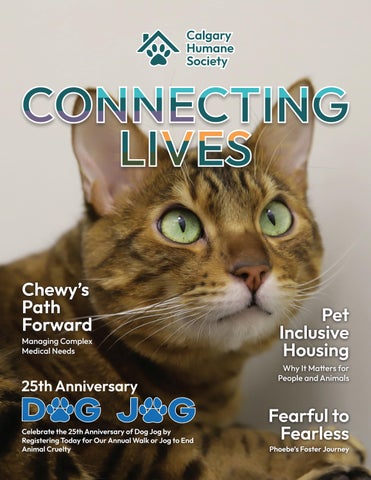
Many of the animals featured in this issue remind us why our work matters so deeply. Chewy, a Bengal cat who arrived blind and facing significant orthopedic challenges, embodies the lifesaving impact of specialized veterinary care. His journey— from complex surgeries to a joyful adoption—shows how your support equips us to say “yes” to animals with serious medical needs.
Stories like Garry’s, who required extensive dental surgery, further highlight the incredible expertise of our Animal Health team. Last year, they performed more dental procedures than there are days in the year, ensuring animals who arrive in discomfort can finally live pain free.
You’ll also read about Phoebe, a fearful dog who blossomed through patience, structure, and the love of her foster family. Her transformation speaks to the power of foster care and the profound difference a calm, nurturing environment can make for vulnerable animals.
Meanwhile, dogs like Dougie—our cheerful community ambassador—remind us how animals help us connect with one another, inspire compassion, and bring joy into shared spaces. Beyond individual stories, this issue also examines some of the systemic challenges shaping animal welfare today. The piece on pet inclusive housing underscores how housing insecurity is forcing too many people to make heartbreaking decisions about their beloved pets. As the third most common cause of pet surrender in Calgary, this issue requires collaborative, community led solutions. We are committed to leading that work.
Our Protection & Investigations team continues to confront the realities of neglect and cruelty, responding to nearly 1,000 calls last year and ensuring hundreds of animals were removed from dangerous situations. Their work is difficult, but it is essential— and it changes lives.
Finally, as we mark the 25th anniversary of Dog Jog, we celebrate a milestone event that has brought our community together for a quarter century. I invite you to join us on Saturday June 6th, at North Glenmore Park as we walk, jog, and rally for a future free of animal cruelty.
Thank you for standing with us. Together, we are creating a community where animals are protected, cherished, and given every chance to thrive.
With heartfelt gratitude,

Carrie Fritz Executive Director, Calgary Humane Society

Chewy, a 3-year-old Bengal, was surrendered on September 19, 2025. The owner recently had a baby who was reported to be severely allergic to the cat. Chewy was noted by the owner to be blind, and vision impairment was confirmed on his initial examination. He was also diagnosed with a mild heart murmur and bilateral luxating patella (kneecaps).
Bengal cats are hybrids developed originally from a cross between the wild Asian Leopard cat and domestic cats (Egyptian Mau or Abyssinians). They typically have a stunning coat pattern and outgoing personalities. Bengals are known for their high energy, intelligence, and curiosity. They enjoy exploring, tend to be talkative, and require enrichment to keep them mentally stimulated and occupied.
Following his initial examination and the concerns noted, Chewy was sent to the Calgary Animal Referral and Emergency Centre for consultation with a board-certified ophthalmologist and a board-certified surgeon.
The ophthalmologist confirmed that Chewy was blind. It was determined this was from severe retinal degeneration, and he also was developing glaucoma (increased pressure in the eye). Retinal degeneration is not a painful disease, and its development was likely a gradual process allowing Chewy to become accustomed to the use of his other well-developed senses to navigate spaces. Cats are amazing at using their vibrissa, sensory hairs commonly referred to as whiskers, to move around without bumping into objects. With the diagnosis of glaucoma, Chewy was started on medication for life to manage this condition as it can become painful.
In addition to his eye concerns, the veterinary team also had to address the concerns with Chewy’s knees. Chewy had three procedures performed to address the luxating patella in his left hind leg. The objective was to stabilize the kneecap, improve the alignment, and deepen the groove of the femur to allow functional tracking of the kneecap during flexion and extension.

These three procedures were performed to improve the tracking of his kneecap, to help it remain in the patellar groove, allowing him to support his weight when he walked. Without this surgery, his patella popped out of its groove when Chewy bent his knee resulting in decreased ability to support him on his next step.
Chewy recovered well from surgery and was back to almost normal ambulation when the surgeon rechecked him seven weeks post operation. He was getting stronger with a slight limp on his recovering left hind and consistent stability in his right hind. His right leg was determined to not require immediate surgery and will be monitored for any future concerns with the new owner’s veterinarian. Chewy became available for adoption on December 9th, 2025, and this special boy was adopted on the 28th of January, 2026.
Chewy is an example of how an animal can receive specialized care and a new start to life after finding themselves, through no fault of their own, in the care of Calgary Humane Society. Support from generous and kind partners, like yourself, is the reason animals like Chewy, in critical need of specialized care, can live without pain and suffering. Regardless of the level of care needed, Calgary Humane Society is there from start to finish. Everyday animals like Chewy receive the specialized care they need. These are lives saved thanks to you.
Dr. Elissa Bessonette Director, Animal Health


Jessica GILES
Convicted under the Animal Protection Act of Alberta and sentenced to a 3-year Peace Bond.
Samantha COISH
Convicted under the Animal Protection Act of Alberta and sentenced to a $1500 fine and a 10year animal prohibition order.
Kaitlin FOLKINS
Convicted under the Criminal Code of Canada and sentenced to 18-months house arrest and a lifetime animal prohibition order.
Lindsay MILLIGAN
Convicted under the Animal Protection Act of Alberta after 60-days in pre-trial custody and sentenced to 2-years probation and a lifetime animal prohibition order, limiting her to 2 fixed animals.
Michelle MOORE
Convicted under the Animal Protection Act of Alberta and sentenced to a 2-year suspended sentence and 2-years probation including a 5-animal limit.
Nicholas NIELD
Convicted under the Criminal Code of Canada and sentenced to a 5-year Peace Bond.
Jennifer BOURASSA
Convicted under the Animal Protection Act of Alberta and sentenced to a $500 fine and a 10year animal prohibition order exempting 2 pets.
Cynthia BARKER
Convicted under the Animal Protection Act of Alberta and sentenced to a $400 fine and a 5-year animal prohibition order.
Victor DIEU
Convicted under the Criminal Code of Canada and sentenced to an 18-month Conditional Sentence Order, 12-months probation, and a lifetime animal prohibition order.
Responsible pet sourcing is not a new concept, but it has never been more important than it is today. After more than 20 years in animal protection work, I’ve seen how the excitement of bringing home a new puppy or kitten can sometimes overshadow essential questions about where that animal came from. In those emotional moments, it’s easy to miss warning signs about an irresponsible or unethical source.
This issue has become increasingly visible since the pandemic. During lockdown, a surge in pet acquisitions saturated the adoption market. At the same time, many new pet owners struggled to properly socialize their animals. When workplaces reopened, surrender requests spiked, leaving shelters overwhelmed and forced to adjust intake policies. Many of the animals coming in lacked basic life skills, which extended their stay and increased resource needs.
At the root of many of these challenges is irresponsible breeding. Mass commercial breeding operations and backyard breeders ramped up production to meet pandemic era demand—and they did not slow down when the world reopened. Their continued output has compounded the strain on shelters and rescues.
Municipal regulations also play a role. During the 2021 revision of the Responsible Pet Ownership Bylaw, an opportunity to tighten breeding-related rules was missed. Current bylaws allow households to keep up to six cats and six dogs, with exemptions for puppies and kittens, and over limit permits remain available to breeders. Recently, City Council supported a notice of motion to ban the retail sale of puppies, kittens, and rabbits—species that most often overwhelm shelters. The City has committed to reporting back, and we await its findings.
It’s also important to note that not all rescues operate responsibly. Calgary Humane Society’s Protection & Investigations team has investigated several rescue organizations for Animal Protection Act violations, including overcrowding, unsafe environments, or failure to provide necessary medical care. This year alone, the operator of Binky’s Bunnies was convicted of causing an animal to be in distress. Despite the conviction, the court order allows her to continue keeping up to 15 rabbits.
These realities underscore a critical message: whether adopting from a breeder, a rescue, or a private individual, due diligence matters. In today’s world, tools like social media, reviews, and community feedback make it easier than ever to research a pet source’s practices. Taking this extra step ensures animals are coming from humane, lawful environments—and helps prevent further strain on shelters and rescues.
By choosing responsibly, potential pet owners help protect both themselves and the animals who rely on ethical, compassionate care from the very beginning. Thoughtful sourcing benefits everyone, and it is one of the most meaningful ways we can all contribute to the well being of animals in our community.
Brad Nichols, Director of Enforcement, Vice Executive Director

Throughout 2025, Peace Officers with Calgary Humane Society addressed ongoing cases of overcrowding and unsanitary living conditions, underscoring just how detrimental irresponsible breeding and pet sourcing are to animal welfare.


For 25 years, Dog Jog has brought the Calgary community together in support of one powerful goal: ending animal cruelty. What began as a grassroots fundraising walk has grown into a signature annual event, uniting animal lovers, families, local businesses, and advocates in one shared movement.
Dog Jog provides an opportunity to connect with our community and learn about the incredible work of our Protection and Investigations team. Every day, they advocate for animals, respond to reports, and spread awareness about animal cruelty.
This event raises critical funds to directly support life-saving programs focused on education, protection, rehabilitation, and ultimately creating new beginnings for animals in need. Together, Dog Jog demonstrates the power of community coming together to protect and care for animals.


2,475 animals were adopted into loving homes, including 451 adult dogs, giving them a second chance at a better life.


993 investigations led to 650 animals being removed from unsafe situations, with 29 charges laid, protecting the most vulnerable and preventing cruelty.
1,644 families were supported through Continued Companionship Programming. 285 animals received care at our community clinics, and 625 households were supported through our Pet Food Bank program. Helping pets stay in their homes and out of the shelter.


20,558 veterinary exams were conducted, 4,544 vaccines given, and 67,135 medications administered, ensuring animals receive the health care they need to thrive.
26,357 people were reached through Humane Education & Outreach programs, empowering our community with knowledge to care for animals responsibly.


39,897 volunteer hours contributed a service value of $598,448, demonstrating the power of community dedication in supporting our mission.
1,551 animals were supported through the foster program, cared for by 795 foster homes, providing temporary loving care that helps animals find their forever homes.

Thank you to the 17,851 donors who supported Calgary Humane Society in 2025 to make all of this possible.


We had a very big year of dog and cat dentals in 2025, completing more dentals than there are days in the year, for a total of 405 dental procedures. From fractured teeth, removal of retained deciduous teeth, to full mouth extractions secondary to periodontal disease or feline stomatitis—dental procedures are essential for the health of the animals cared for by Calgary Humane Society. Unfortunately, dental care is not in the budget for many animal owners, and many animals arrive at Calgary Humane Society with dental disease.
Periodontal disease or dental disease is very common in dogs and cats. The American Veterinary Medical Association (AVMA) reports that over 80% of dogs and more than 70% of cats show signs of dental disease by the time they are 3 years old. Without appropriate intervention, this can be expected to worsen with age. Dental disease often develops without outward clinical signs, and by the time it is noticed by owners, the condition is usually advanced. In addition to causing pain and discomfort, it can also cause oral infections that can lead to more serious problems elsewhere in the body.
Dental disease starts with plaque that hardens into tartar near the gumline. The gums become irritated and inflamed resulting in gingivitis. The development of tartar below the inflamed gingiva sets the stage for infection of the tissues that connect the tooth to the jawbone and damages the jawbone itself. Cats suffer from an oral disease called Tooth Resorption Lesions, less likely to occur in dogs. With this disease, the enamel of the teeth erodes exposing the sensitive dentin and nerves below, resulting in pain. Unfortunately, the only cure is to extract the affected teeth. It is estimated that 30-60% of cats suffer from tooth resorption lesions, and the cause is still widely unknown.
We have had some very intense and interesting cases throughout the year. One of our patients “Garry” was surrendered because the owner was unhoused. On initial exam he was noted to have severe dental disease with inflammation throughout his mouth to such a degree he could not close his mouth. He was booked for a dental procedure to further assess his mouth and remove the diseased teeth. He required surgical extraction of almost all of his teeth because they were causing him pain. After the procedure he was prescribed prolonged antibiotics and steroids to help him heal due to the severity of his oral cavity disease. Garry recovered following this extensive treatment and has since been adopted. Animals like Garry, who have had to lose all their teeth, can do very well and live long healthy lives but usually need a modified diet of canned food.
Garry’s case was not unique. Last year, a large group of small breed dogs also came into our care, many of whom required significant dental treatment. Older dogs needed dental

prophylaxis to scale, and their teeth were polished to prevent further progression of disease. Meanwhile, several juvenile dogs from this group had retained puppy teeth despite their adult teeth erupting, causing severe crowding and alignment issues. These retained teeth required surgical removal to protect the surrounding adult teeth. Malocclusion (an abnormal relationship between the upper and lower jaw) was also common in this group, sometimes caused by developmental differences in jaw size or improper tooth alignment. In some cases, dental extractions were necessary to relieve pain associated with these conditions.
With your support, the Animal Health team at Calgary Humane Society spends many hours addressing the oral health needs of animals in our care. We are not looking for the perfect smile for our dogs and cats, but we do our best to make sure they are comfortable and pain free.
Dr. Elissa Bessonette Director, Animal Health
Step 1
Patient is anesthetized and sedated.
Step 2
A Registered Veterinary Technologist performs a dental exam and charting, scaling and polishing of the teeth, and radiographs of all the roots to ensure health of teeth.
Step 3
If the Veterinarian determines a tooth needs to be extracted, tooth will be surgically removed and the site will be closed with a fine suture.
Step 4
After the procedure, Animal Health Assistants disinfect the dental suite and any instruments used to ensure that no infection is carried between patients.
Dental procedures take anywhere from 1/2 hour to 4 hours per patient, with some patients requiring more than one procedure.


For generations, the family unit has included pets. When we picture a “nuclear family,” many of us instinctively imagine a dog curled at someone’s feet or a cat stretched across the couch. Pets are not accessories to our lives, they are companions, confidants, and family. That is why being forced to give up a beloved animal because of circumstances beyond one’s control is not only heartbreaking, it is a systemic failure to make space for the whole family.
Today, access to affordable, pet-inclusive housing has become one of the greatest threats to keeping families together. At Calgary Humane Society, we see the consequences every day. Housing-related barriers are now the third highest reason pets are surrendered to our shelter, a reality that has emerged despite years of progress in veterinary access, spay/neuter support, and communitybased prevention. Too many people are being forced into an impossible choice: secure housing or keep their pet. No one should ever have to make that decision.
Maslow’s hierarchy of needs places food and shelter at the very base of human survival. But we believe something else
belongs there too: connection. The bond between people and their pets offers stability, comfort, and emotional grounding, especially during times of crisis. Research involving tenants, landlords, and social service agencies, conducted by the Haskayne School of Business for the Calgary Humane Society, confirms this. Three-quarters of renters say pet-friendly housing is “extremely important” to them, and social agencies report that pets play a critical role in their clients’ mental health and sense of safety.
Yet even when rental listings claim to be “pet friendly,” the reality often tells a different story. Breed and size restrictions, steep deposits, and monthly pet fees quietly close doors. The impact is devastating. Nearly eighty percent of social service agencies report that pets frequently prevent clients from finding or keeping housing, and three-quarters have worked with people who seriously considered surrendering their pet because of housing pressures. Many describe clients sleeping in cars, staying in unsafe relationships, or remaining in substandard housing rather than giving up an animal they consider family.
The consequences ripple outward. When a pet is surrendered due to housing, nobody wins. The person loses a source of unconditional love and emotional stability. The animal is thrust into an unfamiliar environment. Shelters and rescues, already stretched thin, absorb the financial and emotional cost of rehoming, often to another family who may face the very same barriers down the line. Even landlords lose out when rigid policies leave units vacant or push good tenants away.
The irony is stark. Research shows that landlords are not antipet, they are risk-averse. Eighty-one percent of surveyed landlords have rented to pet-owning tenants, yet nearly onequarter prohibit pets outright, often as a reaction to past negative experiences rather than current realities. In fact, landlords who currently ban pets report the highest historical rates of damage, while those who allow pets are more likely to describe their experiences as manageable or even positive.
The truth is clear: this is not a values problem, it is a support problem. Renters with pets tend to stay longer and care deeply for their homes because housing stability means stability for their animal. The solution is within reach. By helping landlords manage risk rather than avoid it, through tools like pet screening, behaviour support, references, and verified records, we can shift outcomes for everyone involved. Units stay filled. Renters keep their pets. Families remain whole.
This challenge is not unique to Calgary, but we are choosing to lead. As part of our strategic direction, Calgary Humane Society is stepping into a broader role, not only as an animal welfare organization, but as a bridge between housing, human services, and community wellbeing. Guided by data, lived experience, and collaboration, in 2026 and beyond we are expanding our Pets and Renters Program, developing landlord and tenant toolkits, creating awareness, strengthening partnerships, and building systems that prevent surrender before crisis strikes.
Housing is a basic human need. So is connection. When we protect the human–animal bond, we protect mental health, dignity, and community stability. This is not just an animal welfare issue, it is a social issue, a housing issue, and a compassion issue. Together, we can build a future where no one has to choose between a roof over their head and the love of their pet.
Sally Johnston, Director, Community Services & Pathway Planning
At Calgary Humane Society, over the past three years, an average of 295 animals per year were impacted by housing-related surrender pressures, highlighting the growing connection between housing access and family separation.


A big goofy boy and nothing but smiles; Dougie pranced right into the hearts of Calgary Humane Society staff and became the go-to dog for so many different activities. If it was time to show someone the ropes of dog walking, have a well-mannered pup to hang out with Humane Education kids, or be a good boy at an event, Dougie was the guy! This charming boy was found as a stray, brought to shelter last September, and left quite the mark.
No matter the occasion, Dougie wowed everyone! Being the social butterfly he was, Dougie was the right-hand man at cheque presentations and beamed during his TV debut with Global. So, it was no surprise that Dougie found himself being a representative at many community events; accompanied by the outreach department! He was always the biggest sweetheart, wagging his tail and sporting his big smile at all the people that came in. It was yet another opportunity to showcase Dougie to the public, hopefully leading him to his forever family.
The outreach department oversees many fundraisers and community events, working hard to raise awareness for the organization and share the mission. By connecting with people at events, schools, and fundraisers, we’re able to share our mission, build relationships, and raise awareness about animal welfare in Calgary. These moments create opportunities to educate, inspire support, and on occasions like this one, they can even use an event to promote an adoptable animal like Dougie!
Through dedication and teamwork, Dougie found his forever home at the Home for the Holidays event on December 7th. We are sure that he has been wiggling, smiling, and being his most charming self ever since. They are very lucky to hang out with this lovely boy each day and it was a wonderful journey getting Dougie to his new family!
Georgia Curzon, Community Outreach and Event Facilitator
On March 14, 2025, a shy, unnamed dog entered our shelter. She was one of three adult dogs brought in as strays from outside Calgary. For them, Calgary Humane Society was the first stop in a long journey toward safety, even if they didn’t know it yet. The adult dogs were quickly flagged as high risk. Undersocialized and fearful, they struggled to cope with the shelter environment. One dog stood out almost immediately.
It became clear early on that the shelter wouldn’t be enough for her. Despite daily enrichment and support, her progress was slow, and her fears remained overwhelming. She needed more than the shelter could offer. When a foster home stepped forward, a new possibility emerged. With a tailored behaviour plan and plenty of patience, her foster parents welcomed her home, hopeful that this change in environment would give her the space she needed to shine.
With fearful and undersocialized dogs, progress doesn’t come in leaps, it comes in whispers. A lifted head, a softened gaze, a single step forward. Each small shift signaling the beginning of trust. On her first night in foster care, she wasn’t met with pressure, only patience. Her foster parents sat quietly nearby, offering gentle words, allowing her to choose when to come closer. There were no expectations, just space and kindness. As she began to settle that first night, they gave her a name, Phoebe, marking the start of a new chapter and, for the first time, a true sense of belonging.
In foster care, Phoebe began to come alive. The once shutdown dog who avoided interaction started to relax, seek comfort, and engage with the world around her. Small moments marked big progress, as her confidence grew, so did her personality. Phoebe became playful, curious, and spunky, eagerly engaging with toys and learning new skills with enthusiasm. The trust she built with her foster parents became her foundation. She learned to walk on a leash and navigate new experiences with curiosity instead of fear. While she continued to work through moments of anxiety, foster care gave her the space, consistency, and support she needed to thrive.
Foster homes give dogs like Phoebe a chance. Away from the constant noise and stress of a shelter, they can learn routines, build confidence, and begin to show their true personalities. Her story is a reminder that shy, scared, or undersocialized dogs are not “broken” they’re simply waiting for the right environment to feel safe enough to grow.
Foster care is the bridge between shelter stress and lifelong happiness, it’s where potential becomes possibility. By opening your home, even for a few weeks, you can give a dog their first step toward a brighter, happier future.
Alex Olley, Foster Program Supervisor


The 19th annual International Veterinary Forensic Sciences Association (IVFSA) conference is coming to Canada for the first time. This conference will include multi-disciplinary speakers from across the globe. Veterinarians, law enforcement and legal professionals, among others, take this opportunity to learn about emerging trends in crimes against animals and strategies for prevention and investigation of those crimes.
Brad Nichols, President of IVFSA and Director of Enforcement at Calgary Humane Society, welcomes local professionals to this unique and valuable professional development opportunity “I credit IVFSA, through conference content and the network of member minds, with the development and success of our animal protection program in Calgary. This conference is fertile ground for innovation and education and will benefit attendees who will inevitably encounter animal cruelty at some stage of their career.”
The conference runs from May 13-15, 2026 at the Banff Centre for Arts and Creativity in Banff Alberta. Preceding the conference, a workshop is being offered on May 12th. The conference will consist of over 15 hours of RACE/CE eligible sessions from a vast variety of speakers. The workshop will focus on court testimony, from being qualified as an expert witness to direct and cross examination. Prosecutors from Canada and The United States will be paired with veterinary forensic experts from each country to give a compare/contrast between systems. Attendees can expect to leave this workshop with familiarity and comfort with navigating the court experience. Register now, while early bird prices and a discounted hotel block remain, at IVFSA.org.
The Summit for Animals is Canada’s largest and most influential animal welfare conference, hosted each year by Humane Canada. The 13th annual Summit will take place April 19–21, 2026 in the beautiful mountain town of Whistler, British Columbia, and Calgary Humane Society is proud to be the Happy Walrus sponsor.
The Summit brings together advocates, professionals, and leaders from across Canada, the U.S., and beyond to explore new ideas, strengthen skills, and advance the future of animal welfare. Attendees can choose from 12 learning tracks, including shelter and community medicine, farmed animal welfare, community impact, humane education, AI in animal welfare, animal care and behaviour, and more.
Humane Canada welcomes people with an interest in animal welfare or advocacy to this national gathering.


