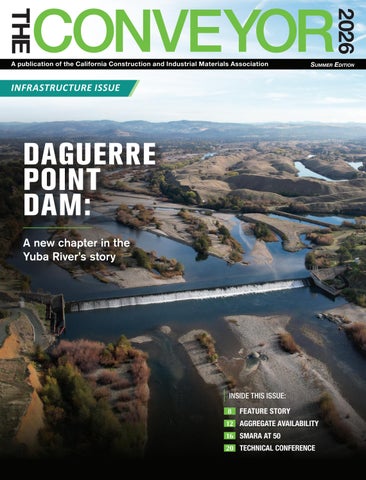
DAGUERRE POINT DAM:

CHAIRMAN'S LETTER
Hands on the wheel
PRESIDENT & CEO MESSAGE
Back to basics: Refocusing on the infrastructure that moves California
FEATURE STORY
Daguerre Point Dam: A new chapter in the Yuba River’s story
AGGREGATE AVAILABILITY
SMARA at 50: What Map Sheet 52 reveals about California’s aggregate supply
SMARA AT 50
The transformation of Castle Mountain Mine
RECLAMATION
From aggregate to agriculture: Reclamation at work in Santa Barbara County
CEQA REFORM
November’s Prop. 45: More than a ballot measure: A decision about California's ability to build
PROFESSIONAL DEVELOPMENT
CalCIMA hosts technical conference “Elevate”
AI
The agents are here. Is your data ready?
COMMUNITY
Veteran and Vulcan Materials Company employee leads Corona Memorial Mile March
LANDSCAPE
Stewardship beyond the fence line: Connecting biodiversity, community resilience, and long-term sustainability
The Conveyor is a publication of the California Construction and Industrial Materials Association The views expressed herein are fixed expressions of the contributing writers and not of CalCIMA. All rights reserved.
CalCIMA
455 Capitol Mall, Suite 210 Sacramento, CA 95814 (916) 554-1000 www.calcima.org www.distancematters.org
2026 SUMMER EDITION
Editorial Contributors Robert Dugan, President & CEO, CalCIMA
Aren Hall, Environmental and Permitting Manager, Castle Mountain Mine
Adam Harper, Senior Director of Policy, CalCIMA
Brian Hoover, Construction Marketing Services
Rachael Mahoney, Chief Strategy Officer at Bulk Exchange
Karin Perissinotto, Sustainability Manager, CalPortland
Cameron Richardson, Director of Technical Affairs, CalCIMA
Murry Wilson and Suzanne Seivright-Sutherland
The Conveyor is published quarterly each year by Construction Marketing Services, LLC
All rights reserved. Reproduction in whole or in part without permission is prohibited.
Hands on the wheel
I am a fan of Jeremy Clarkson, who hosted Top Gear from 2002 until 2015 and then The Grand Tour on Amazon Prime until 2024, alongside co-stars Richard Hammond and James May. While I aspire to be Clarkson, most of my friends peg me as the nerdier James May. After The Grand Tour ended, Clarkson bought a farm in Oxfordshire and named it Diddly Squat. I visited a few years back and even volunteered there for an afternoon. The farm now stars in its own series, Clarkson’s Farm, a hoot of a show about shifting from urban to rural life.
The latest season’s standout thread is technology and the future of farming. A visit to the Netherlands, where cutting-edge operations inspire what the show calls 'the rise of the machines,' soon has Diddly Squat’s fields scanned by lasers and its tractors run by robots. It is a stimulating, demanding look at farming’s future, even under the watch of an impatient 65 year old.
What does any of this have to do with our industry?
Our industry rarely makes headlines, but it makes nearly everything else. The aggregates, minerals, asphalt, and ready-mix leaving our plants daily become the housing California desperately needs, the roads and bridges that carry its economy, the reservoirs that secure its water, and the projects that help it weather fire and flood. If California builds its way out of its affordability and infrastructure challenges, it will do so with materials our members produce. What is less certain is how technology, regulation, and talent will reshape how our business operates and fits into our communities.
This issue features several topics that may seem unrelated but, to my mind, are not. Start with people, because nothing else matters without them. Construction materials has historically been a men's industry, and that is changing far too slowly. This is a fairness
question, but also a workforce imperative: We face retirements, skills shortages, and fierce competition for talent, and cannot afford to recruit from only half the population. The women already working in our plants, labs, scale houses, and boardrooms prove both what we've been missing and what we gain by opening the door wider.
The work ahead is concrete: Visible role models, genuine mentorship, and recruiting pipelines that reach young women before they've ruled us out.
The next investment is in tools, from artificial intelligence to automation to regulatory reform. For some, these will provide competitive advantage, but often the real gains come only when the industry moves together through associations like CalCIMA.
One example arrives on November's ballot. The Building an Affordable California Act, the California Chamber of Commerce's CEQA-reform initiative, would bring the most significant changes to our environmental-review framework in decades, setting firm deadlines for agency review and litigation and narrowing the openended alternatives analysis that has too often become a tool for delay. It isn't perfect, but it's a strong place to start, and I encourage members to promote it across their workforces.
Clarkson never asked for lasers in his fields or a robot in his barn; the future of farming arrived anyway, and the only question was whether he'd grip the wheel or be driven by it. Our industry stands at the same crossroad, with technology, talent, and rules all shifting at once. We can shape that change, or have it shaped for us.
Women in our workforce, AI in our operations, and a workable permitting framework are not three stories but one: a commitment to build California's future with our hands on the wheel. I hope you'll join me. n
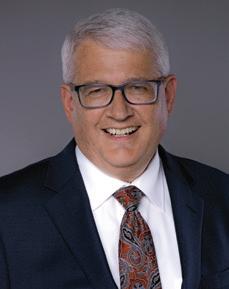
Dana Davis President - Teichert Materials CalCIMA Chairman

PRESIDENT & CEO MESSAGE
Back to basics: Refocusing on the infrastructure that moves California
Every so often, seemingly unrelated events begin pointing in the same direction.
Conversations in Sacramento and Washington have led me to the same conclusion: After years of making it expensive and difficult to build infrastructure, some policymakers are rediscovering the fundamentals. That should give us reason for optimism.
Whether it is Congress advancing the bipartisan BUILD America 250 Act, California starting to discuss reforming Vehicle Miles Traveled (VMT) mitigation, or discussions about streamlining project delivery, each reflects a simple realization: Infrastructure policy must once again focus on infrastructure outcomes. That matters because infrastructure is not an abstract policy debate. It is the foundation of California’s economy and quality of life. Housing affordability, water reliability, manufacturing, goods movement, energy production, and competitiveness all depend on our ability to build and maintain the systems that support them.
Congress took a first step by advancing the BUILD America 250 Act out of its first policy committee on a bipartisan 62-2 vote. While the legislation has a long journey before becoming law, it signals renewed attention on the federal transportation program’s core mission. Equally important is its emphasis on directing more transportation dollars through formula funding rather than discretionary grant programs. The result is greater certainty for states, allowing them to spend more time delivering projects and less time competing for grants.
Perhaps the most encouraging aspect of these conversations is the renewed focus on outcomes. The movement of goods, freight,
water, energy, and people drives the American economy. Investing in transportation capacity, reliability, and modernization are investments in affordability, productivity, competitiveness, and quality of life.
California is beginning to ask many of the same questions. The state’s VMT mitigation program started as a planning tool but has evolved into an open-ended obligation that can consume extraordinary portions of project budgets without corresponding mobility improvements. That is why CalCIMA continues working with Transportation California and coalition partners to restore reasonable guardrails and ensure transportation dollars are actually invested in transportation projects. Similar CEQA and project delivery conversations reflect a growing recognition that California does not lack infrastructure needs—it struggles to move projects from concept to construction.
Good intentions do not build infrastructure— materials do. Every road, bridge, runway, water system, energy project, school, hospital, and housing development begins with the aggregates, asphalt, concrete, cement, and industrial minerals our members responsibly produce. If it’s built, we’re in it.
Good public policy needs balance. I am encouraged not because the work is finished, but because we are beginning to ask better questions, focus on outcomes, and recognize that prosperity and environmental stewardship are complementary responsibilities, not competing priorities.
Because we are not adjacent to California’s future. We are foundational to it. n
Sincerely,

Robert Dugan President/CEO CalCIMA
DESIGNED TO SUPPORT YOUR BUSINESS
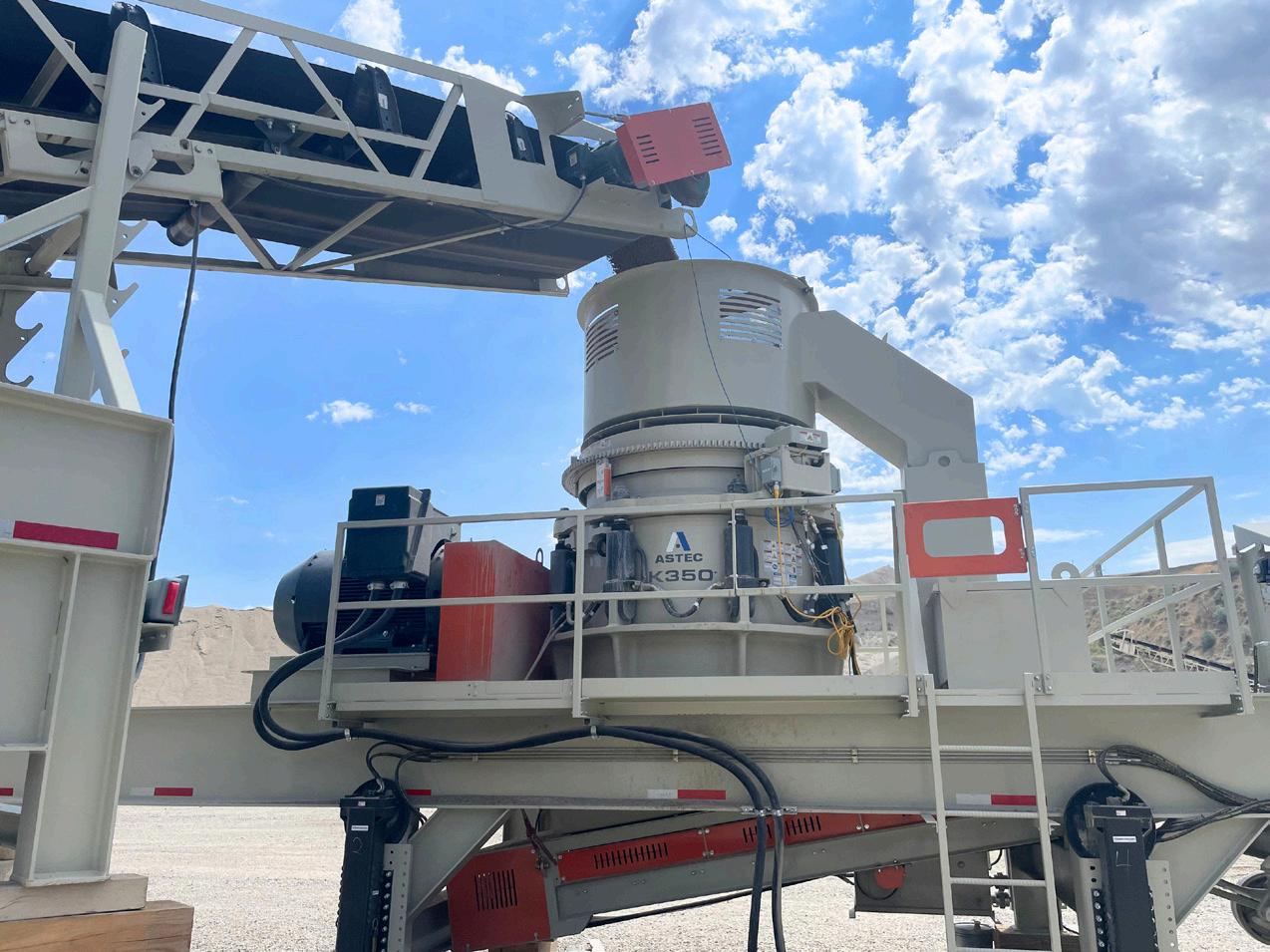
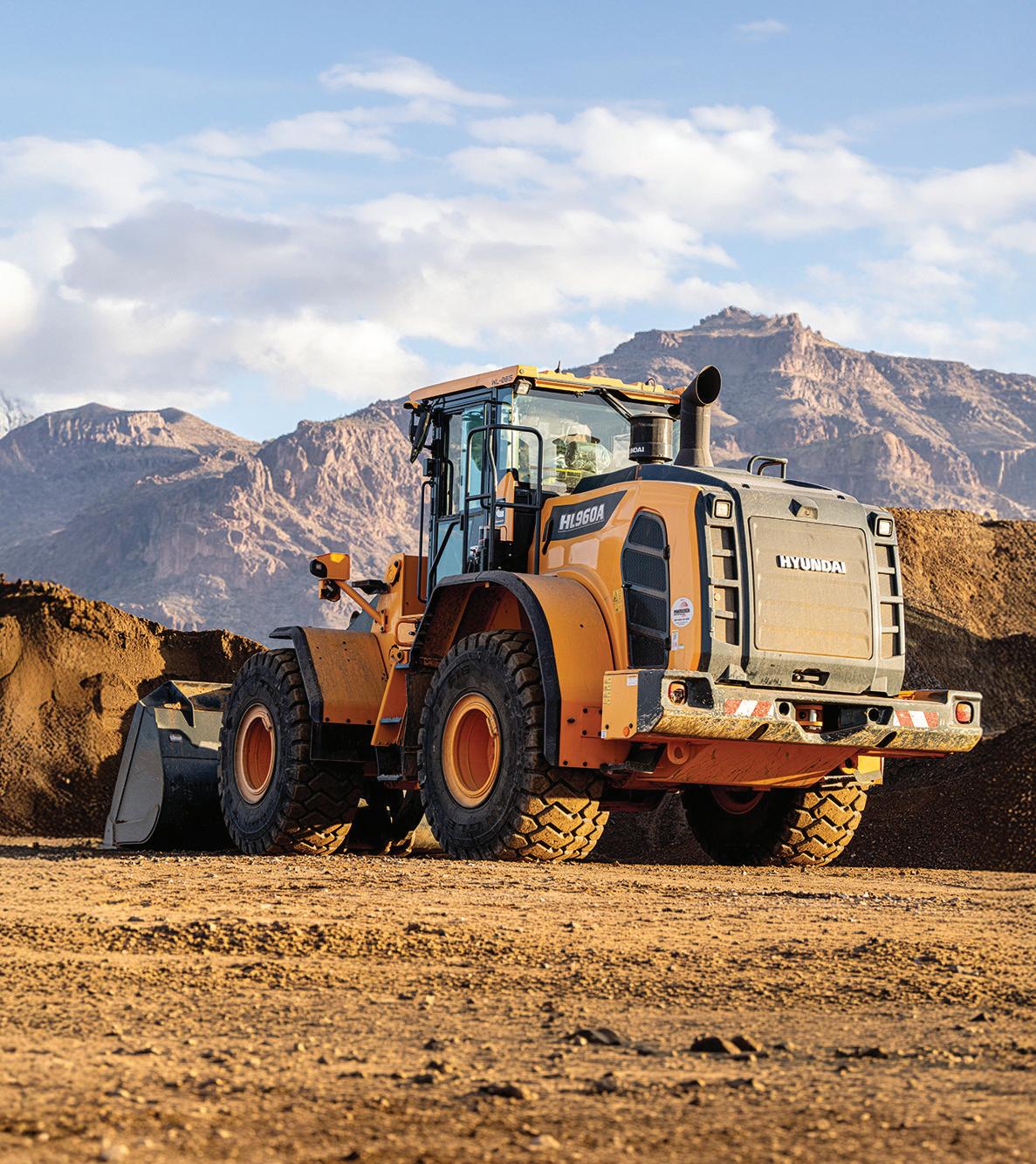
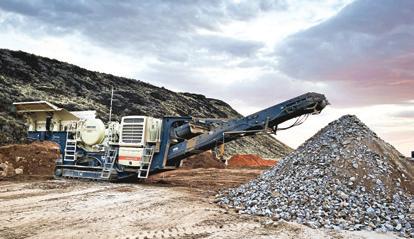
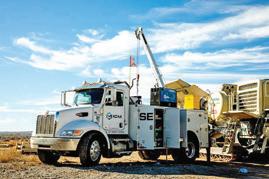
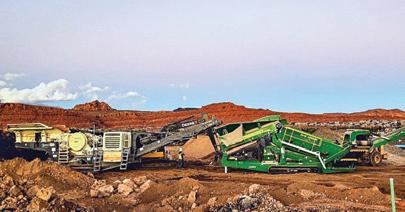
With a comprehensive range of new and used equipment from industry-leading brands, we are sure to have the right solution for your materials processing & materials handling equipment needs. Prefer to rent? We have the largest rental fleet on the West Coast, allowing us to quickly respond to your business requirements. All backed up by our spare parts and highly skilled service engineers to keep your operation running.
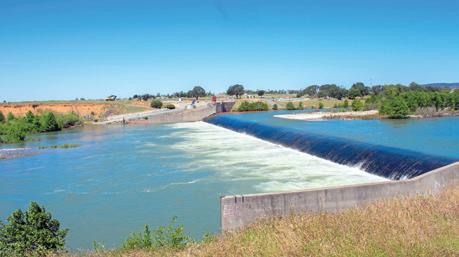
Daguerre Point Dam: A new chapter in the Yuba River’s story
By Adam Harper, Senior Director of Policy, CalCIMA / Photos by Julia Maldonado, CalCIMA
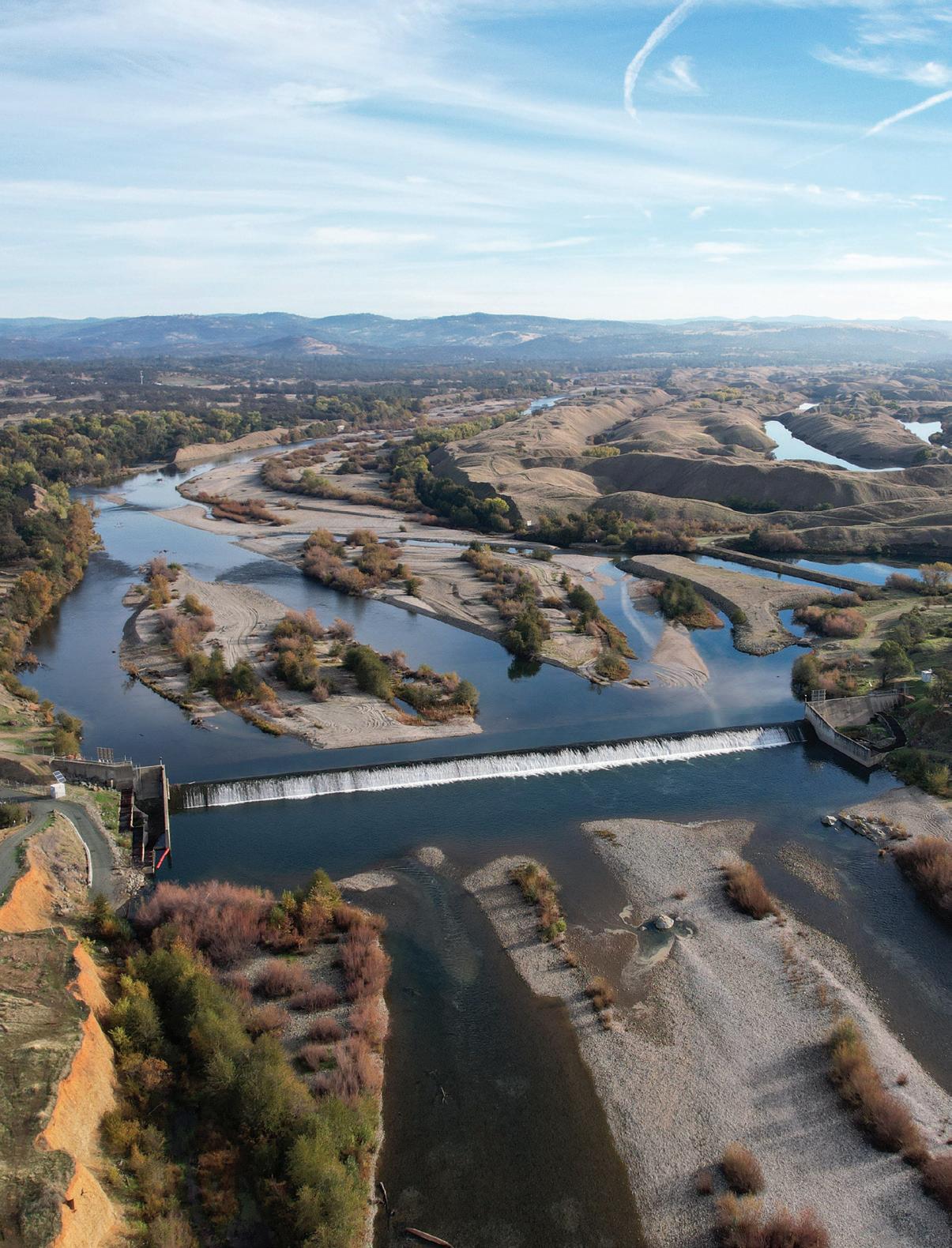
More than a century ago, the Yuba River became one of California’s most dramatically altered landscapes. Hydraulic gold mining sent enormous volumes of sediment downstream, raising river channels, increasing flood risks, and threatening navigation throughout the Sacramento Valley. In response, the California Debris Commission constructed the Daguerre Point Dam, completed in 1910, as part of a system designed to trap mining debris and protect downstream communities.
Today, that same structure stands at the center of a new effort to adapt the river to modern needs.
In March 2026, Teichert Construction was selected to build the Daguerre Point NatureLike Fishway, bringing more than a century of Northern California construction experience to a project that combines river restoration, water infrastructure, and modern project delivery methods. The project is a key component of the broader Yuba River Resilience Initiative,
a partnership among Yuba Water Agency, state and federal agencies, and other stakeholders focused on improving fish passage, restoring habitat, and maintaining reliable water supplies for local agriculture.
Announcing the initiative, Governor Gavin Newsom described the effort as evidence that “water management isn’t a zero-sum game,” reflecting a multi-benefit approach that seeks to advance environmental, agricultural, and water management objectives together.
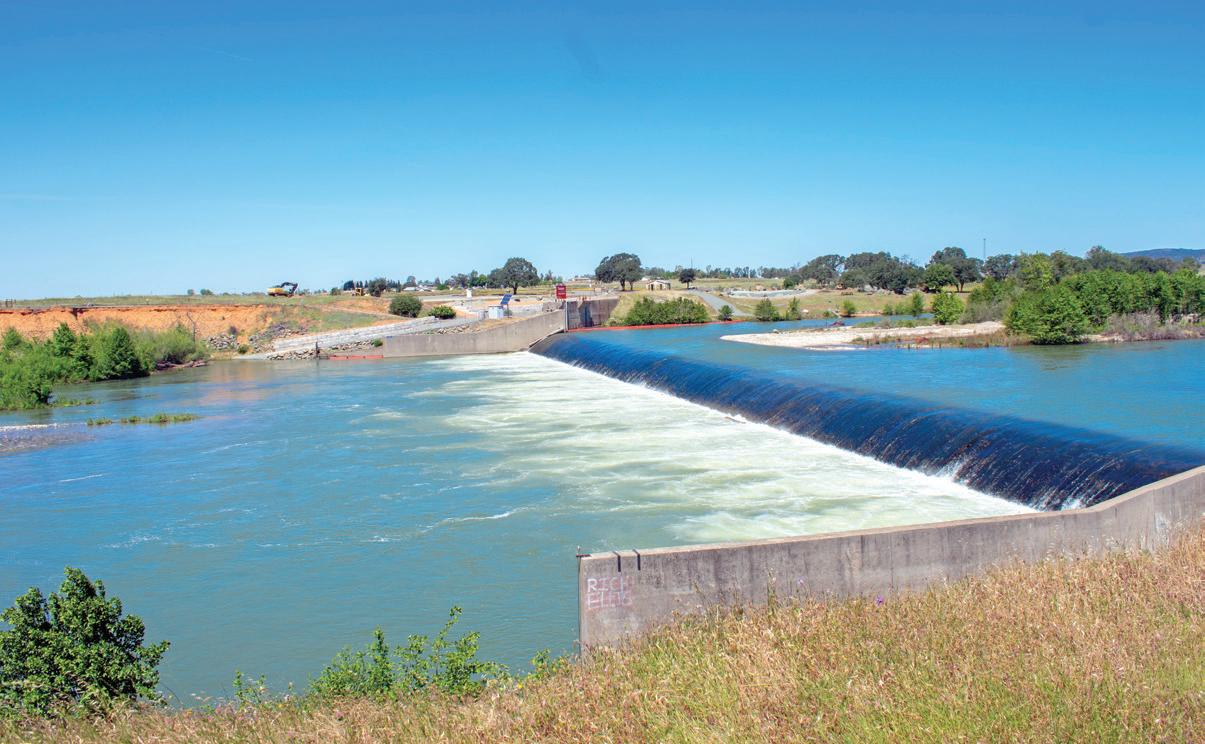
CalCIMA producer member Teichert Construction was selected to build the Daguerre Point Nature-like Fishway, which combines river restoration, water infrastructure and modern project delivery.
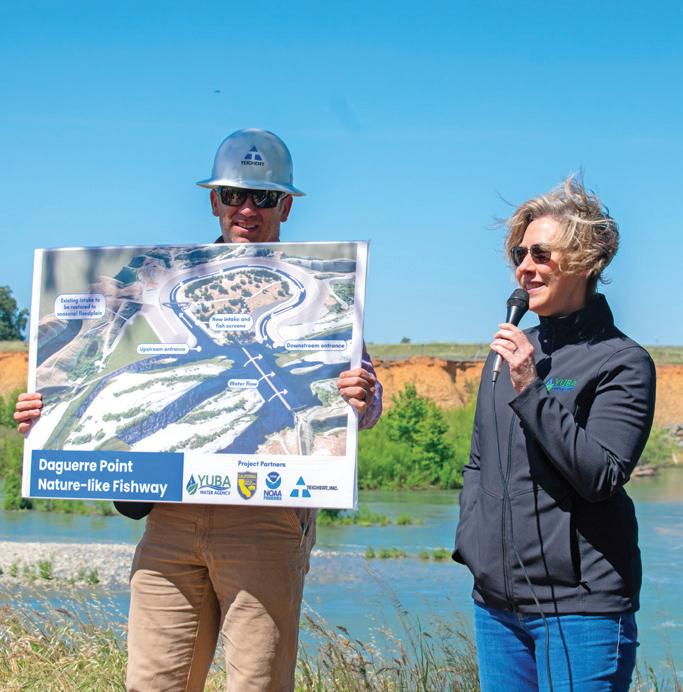
Watershed Manager for Yuba Water Agency JoAnna Lessard, Ph.D. discussed the Daguerre Point Nature-like Fishway to the Women of CalCIMA during a site tour in May. Jason Smith of Teichert held a map demonstrating the stream process.
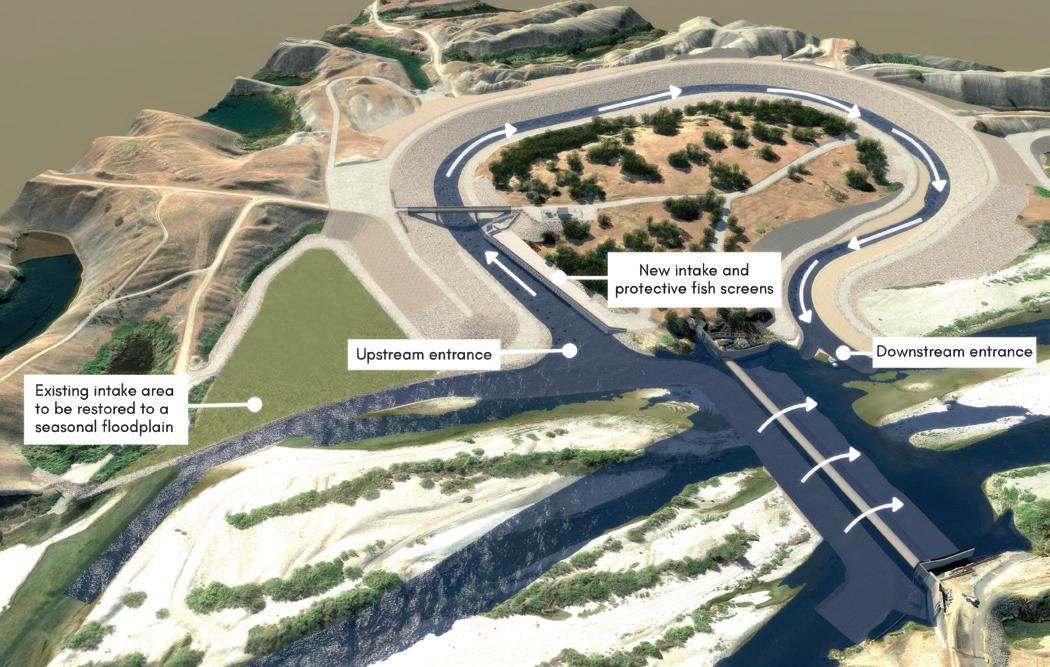
Rather than removing the historic debris-control structure, the project will create a naturelike fishway around Daguerre Point Dam. Designed as a riverlike side channel that follows the historic path of the river, the fishway will incorporate pools, riffles, gravel features, and resting areas that more closely resemble natural river conditions than a traditional fish ladder. The channel is intended to improve passage for salmon, steelhead, green sturgeon, and Pacific lamprey while reconnecting more than ten miles of upstream spawning and rearing habitat.
The project also includes modernization of the South Canal diversion system and installation of a new fish screen designed to protect fish while maintaining water deliveries that support agriculture throughout the region. Together, the improvements reflect the reality of a working
FEATURE STORY
river, one that continues to support fisheries, agriculture, recreation, flood management, and local communities.
The project is being delivered through a Construction Manager at Risk (CMAR) process that allowed Teichert to work with Yuba Water Agency and project engineers during design development to help refine project planning and constructability before construction begins.
Teichert is no stranger to the lower Yuba River corridor. The company previously participated in the Hallwood Side Channel and Floodplain Restoration Project, another effort focused on restoring natural river and floodplain processes along
the lower Yuba. Teichert also operates facilities on both sides of the Yuba River downstream of Daguerre Point Dam, providing long-standing familiarity with the watershed, river conditions, and local communities. The project represents an opportunity to apply that regional experience to a landscape the company has worked within for generations.
As Yuba Water Agency General Manager Willie Whittlesey observed when the Yuba River Resilience Initiative was announced, “This is one of those rare situations where the fish, the environment and the farmers all win.” The statement captures the multi-benefit objectives that have shaped the project from the beginning, improving fish
passage, supporting agriculture, modernizing infrastructure, and enhancing the long-term resilience of the river system.
Like the generations before it, California continues to adapt the landscape it inherited. The Daguerre Point Nature-Like Fishway demonstrates how existing infrastructure can be reimagined to support evolving environmental, agricultural, and community priorities while preserving the benefits that made it valuable in the first place. n









SMARA at 50: What Map Sheet 52 reveals about California’s aggregate supply
By Adam Harper, Senior Director of Policy, CalCIMA
Fifty years after its adoption, California's Surface Mining and Reclamation Act (SMARA) continues to provide a framework for understanding one of the state's most essential natural resources: Construction aggregate. Through the California Geological Survey’s (CGS) mineral classification program and the periodic statewide synthesis reflected in CGS’s Map Sheet 52 report, Aggregate Sustainability in California, the state has consistently provided comprehensive and long-term data on aggregate supply and demand.

That continuity provides something rare in resource policy: The ability to evaluate how an entire system has changed over decades. CGS's 2026 update to Map Sheet 52, released this past April, offers a particularly useful perspective as California marks SMARA's 50th anniversary. It reveals a system that has adapted to changing economic, regulatory, and land-use conditions over time. It also raises a broader question: As California enters a period of significant infrastructure investment driven by unmet housing needs, climate adaptation,
Land Use and Environmental Planning / CEQA and NEPA Compliance
Construction Materials, Industrial Minerals, and Metal Mining / SMARA Compliance
Air Quality & Permitting Services
Environmental Health and Safety and Regulatory Compliance and Permitting
Hazardous Materials and Hazardous Waste Management
Groundwater and Surface Water Studies and Permitting
Geologic and Mineral Resource Assessment and Characterization
Comprehensive Transactional Due Diligence Services
Environmental Site Assessment and Investigation
Industrial Hygiene / Support to Legal Counsel / Training
disaster recovery from wildfires and flooding, electrification, and rapid technological evolution, will future aggregate demand resemble the historical patterns on which today's projections are based? Mapsheet 52 is the barometer used to determine if sufficient resources are permitted to support infrastructure and housing development for a sustainable California and accuracy is important. By the early 2000s, Map Sheet 52’s data reflected a system under significant pressure. The report divides the state into a dozen or more market regions, based on the fact that aggregates are a local material and it is generally prohibitively expensive to transport them long distances to construction projects or processing sites. The 2006 edition of Map Sheet 52 identified multiple market regions with less than 10 years of permitted aggregate supply remaining, including areas supporting major population and infrastructure demand. The report found that statewide, there was only about 32% of the needed permitted reserves. Permitted resources had declined due to lower consumption, aggregate mine closures, and land use constraints. Several market regions had even depleted its resources, and were now dependent on hauling aggregate from neighboring regions.
It was during this period that CalCIMA was formed through the consolidation of regional and statewide mineral associations, at a time when aggregate permitting, recycling, transportation distance, and long-range mineral resource planning were emerging as central
policy concerns. Over the following decades, CalCIMA and its members sponsored and supported legislation to modernize SMARA, expand the use of recycled materials in public works, improve local recycling standards, protect access to aggregate resources, and strengthen long-term mineral resource planning. Measures such as AB 566 (Galgiani), AB 1142 (Gray), SB 812 (Ma), AB 221 (Quirk-Silva), and AB 2953 (Salas) reflected a broader recognition that California’s aggregate system depends not only on geology, but on planning, transportation distance, recycling, and maintaining access to permitted resources close to where growth occurs.
The 2026 Map Sheet 52 update reflects the effects of those adaptations. Fewer regions are now in immediate shortage, having on average a 10 and 20 year supply, demand has decreased, and there is more transport of material between regions to meet demand. The report does not show a picture of aggregate supply and demand that has moved from scarcity to abundance. It shows one that has been adapted and actually moves materials supply locations further away from the demand areas.
As a consequence of these changes, the report has had to adapt. The loss of reserves in some regions and the increased transport of materials among regions is reflected in the 2026 report. California’s aggregate system now functions less as smaller isolated regional markets and more as larger interconnected regional networks. This means jurisdictions who fail to allow aggregate mine permitting will cause increased mining in neighboring communities or imports through ports and port communities. Inaction has impacts and consequences.
That interdependence has helped California absorb growth, infrastructure demand, and regulatory constraints without




























widespread supply disruption, but it has also elevated the importance of transportation distance and increased burdens on adjacent communities. Even modest increases in haul distance create meaningful increases in emissions, fuel use, truck miles and cost when multiplied across the hundred plus million tons of rock required for housing and infrastructure, annually. In this context, proximity between supply and demand is not only an economic issue, but also an environmental one. Distance matters.
Map Sheet 52 also provides an important warning for local governments and regional planners. Aggregate resources are locationdependent, and permitting new facilities can easily take seven to 10 years or longer. California’s longestrunning aggregate permitting effort began in 1987 and remains neither operational nor counted within permitted reserve calculations.
















Regions reporting less than 20 years of permitted reserves should not view those timelines as comfortable margins. They should view them as planning signals.
Regions with less than 20 years of remaining reserves should already be identifying, protecting, and planning future resource areas, while regions below 10 years should have replacement projects actively moving through permitting processes. Adjacent regions should be very concerned if its neighbors are not permitting as excess supply can quickly dwindle when supporting two consumption regions.
Current reserve projections should also be viewed in the context of how demand is modeled. Map Sheet 52 relies substantially on historical consumption patterns, but future infrastructure demands may not mirror the last 30 years.
AGGREGATE AVAILABILITY
Housing provides a useful example. California's current housing planning cycle requires local governments to identify capacity for more than 2.5 million housing units by 2030. Yet only approximately 957,000 residential building permits were issued statewide between 2010 and 2020. As commonly cited industry estimates of approximately 400 tons of aggregate per new home, including associated streets, sidewalks, utilities, and drainage infrastructure, the material requirements associated with achieving California's housing objectives alone would be measured in roughly one billion tons of aggregate.
Housing, however, represents only one component of California's future infrastructure needs. The state is simultaneously:
1. Rebuilding communities impacted by wildfire and other natural disasters
2. Modernizing and expanding the electric grid
3. Investing in water and transportation infrastructure
4. Adapting more than 1,100 miles of coastline and the communities, infrastructure, and economic activity concentrated along it to changing climate conditions
5. Constructing the facilities, energy systems, and supporting infrastructure required for artificial intelligence, data centers, and an increasingly electrified economy.
Many of these demands are forward-looking and have limited precedent within the historical consumption patterns that underpin our long-range forecasting models.
As a result, future aggregate demand may differ materially from the trends reflected in the historical record. We likely need more than the current report indicates.
Map Sheet 52 was designed to assess California's construction aggregate needs based on historical consumption patterns, population forecasts, and known mineral resources. It was not designed to predict the full variability associated with periods of rapid societal, technological, and infrastructure transformation. As policymakers evaluate the report's findings, the challenge may not be whether California has sufficient resources under historical demand assumptions, but whether those assumptions remain adequate for the decades ahead. n





The transformation of Castle Mountain Mine
By Aren Hall, Environmental and Permitting Manager, Castle Mountain Mine
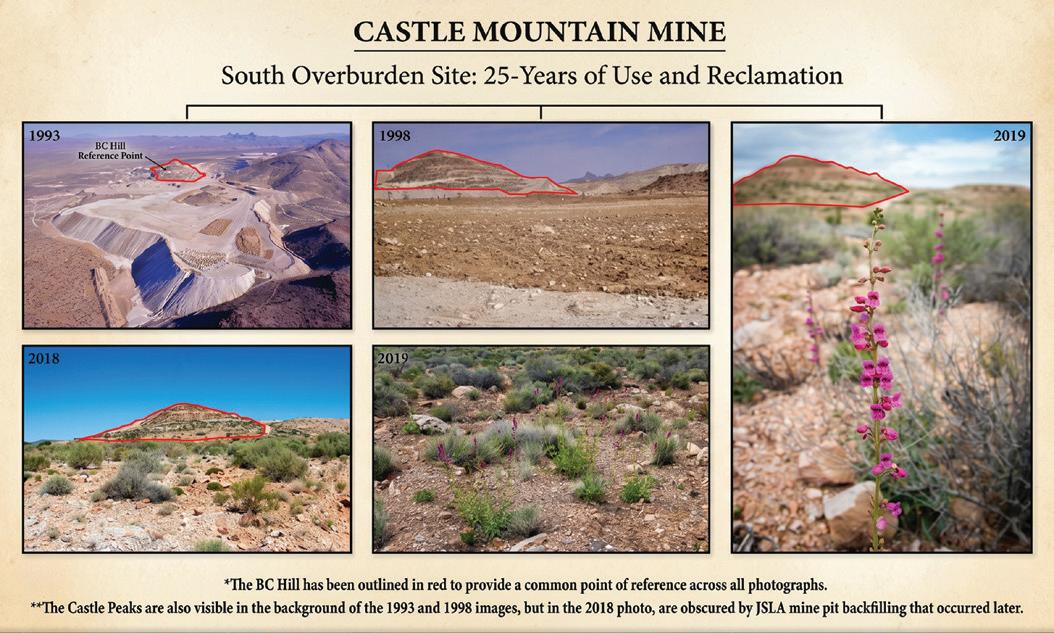
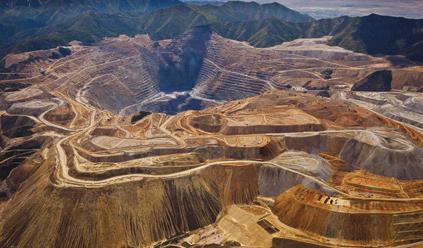
The Castle Mountain Mine, located in southeastern California, is not your typical gold mine. Not because it is located in California, a state whose more notorious gold rushes have long since ended, but because of the complex land-use setting that developed around the mine after its origins during the early 1990s.
Owned by Equinox Gold Corp (Equinox), the Castle Mountain Mine is surrounded by the Mojave National Preserve (1994), the Castle Mountains National Monument (2016), and the most recent Avi Kwa Ame National Monument (2024) in nearby southern Nevada. Throughout these changes, the mining operation has endured and is a testament to the successful implementation of multiple-use land management policy.
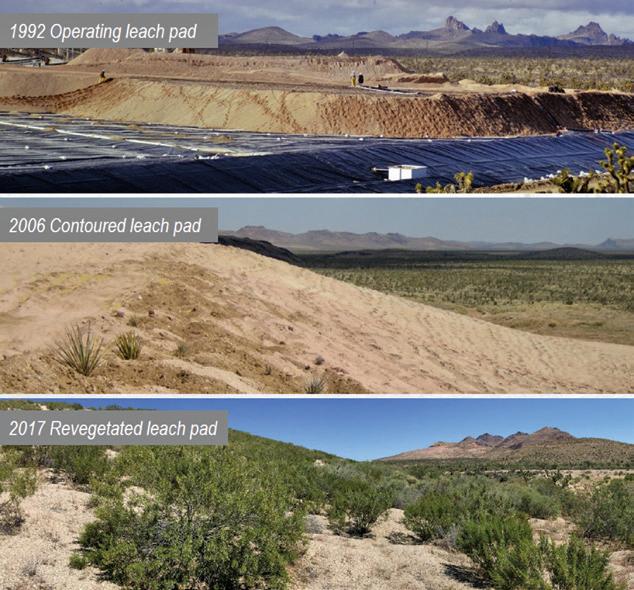
As the degree of land conservation surrounding the Castle Mountain Mine has increased over the past 35 years, so too have the Castle Mountain Mine land reclamation requirements. This holds for both the legal requirements and the voluntary and self-imposed reclamation standards of the Castle Mountain Mine. The core of any successful mine reclamation strategy will include, at a minimum, these three parts:
• Land contouring strategy
• Concurrent reclamation
• Revegetation seeding
Revegetation will always focus more on seeding, as it's the most proven method for quickly reestablishing large areas post-mining. However, there is value in a robust
plant salvage and propagation program. The Castle Mountain Mine salvage program aims to salvage between 25 and 50 percent of dominant species, such as (eastern) Joshua trees and yuccas, with individual plants falling within a specific size classification. Salvaged plants are moved into one of two temporary plant nurseries, where they'll stay until their final planting in reclaimed areas. The Castle Mountain Mine currently has two plant nurseries that hold over 3,000 salvaged plants.
Plant propagation occurs in Castle Mountain Mine's 2,200 square-foot greenhouse. The greenhouse is fully automated with climate control and an overhead spray watering system. The greenhouse was built in 2022, but after testing, it became fully
LCFS Fuel Card Incentive Program


operational in 2025. The initial primary focus is growing eastern Joshua trees (JT) from seed collected in the mine area. Two batches of JT plantings occurred this year, and about 2,000 seeds successfully germinated. We aim to achieve between 2 and 3 batches each year. Each batch grows in the greenhouse for up to 6 months, after which it is moved outdoors under a protected shade structure. The greenhousegrown plants must slowly acclimate to the harsh Mojave Desert sun, especially during the intense summer months. After another 6 months of growing under the shade structure, plants are moved to the main plant nursery area, where they will remain, sometimes for several years, until reclaimed mine areas are ready to receive vegetation. Other species are also being grown in the greenhouse in smaller numbers. These include native grasses, a rare local penstemon variety, and Mojave milkweed. In the end, we expect to have a reclaimed site compatible with the nearby national preserves that can be enjoyed by future generations. n Building a better future for our families, our communities and our region since 1900.
Purchase a new Class 8 heavy-duty natural gas truck and receive a $50,000 fuel card, to be used at SoCalGas public access stations.
From aggregate to agriculture: Reclamation at work in Santa Barbara County
By Murry Wilson, Senior Environmental Manager, CalPortland and Suzanne Seivright-Sutherland, Director of Regional Government Affairs and Grassroot Operations, CalCIMA
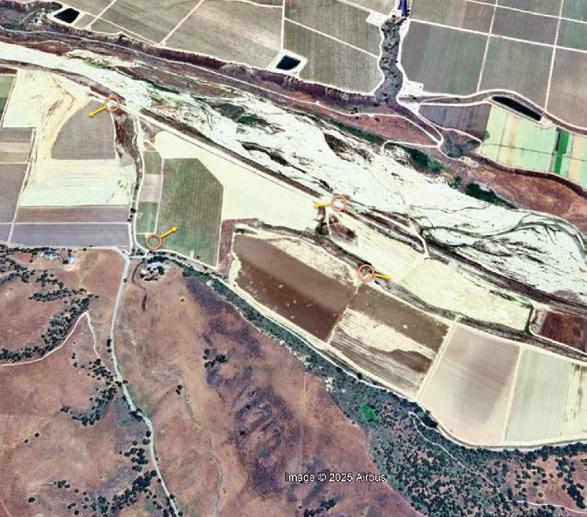
Along the Sisquoc River in northern Santa Barbara County, CalPortland
Construction mines alluvial sand and gravel deposits to supply the essential materials needed to build California’s homes, roads, schools, and infrastructure. But the story of these operations doesn’t end when mining is complete. Following extraction, the land undergoes a comprehensive reclamation process designed to restore its long-term agricultural productivity. The land is regraded, topsoil is carefully replaced, and former mining areas are prepared for cultivation. The result is a landscape that continues to provide value to the community long after aggregate production has concluded.
Today, reclaimed portions of the site support a variety of agricultural
uses. Some areas have been converted to highly productive row-crop farmland, while others have been transformed into vineyards that contribute to the region’s renowned wine industry.
Grapes grown on one reclaimed mining site are processed at a nearby winery, creating a direct connection between land reclamation and local agricultural production. As mining progresses, this same winery will eventually overlook the valley from 20 to 25 feet above the surrounding farmland, a visible reminder of the site’s unique evolution.
This transformation demonstrates how mining and agriculture can successfully coexist. Beyond meeting the requirements of California’s Surface Mining and Reclamation Act (SMARA),
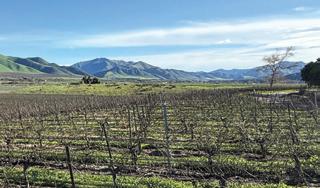
reclamation efforts create lasting benefits by returning land to productive use and supporting the local agricultural economy. Farmers value these reclaimed fields for their productivity and reduced presence of rocks, making them easier to cultivate and manage.
Visitors exploring northern Santa Barbara County’s scenic wine trails often admire the vineyards and farmland without realizing that many of these thriving agricultural landscapes were once active aggregate mining sites. It’s a powerful example of how the construction materials industry not only supplies the resources needed to build communities, but also helps create opportunities for future generations through thoughtful and successful stewardship. n
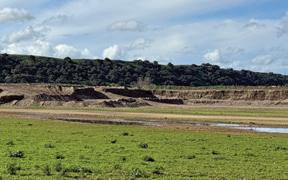
Active mining area in background with a fallow reclaimed agricultural field in the foreground.
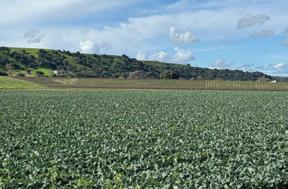
Row crops in foreground on mining floor and vineyards in the background on reclaimed mining slopes.
Finalizing reclamation of large agricultural field with topsoil placement in the foreground and a cover crop planted in the background.
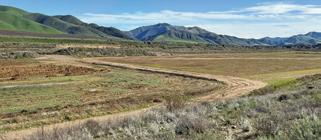
Reclaimed mining slopes with grape vines planted and large sycamore tree avoided during mining.
Aerial photo of reclamation areas with directional orientation of photos.


Applications are being accepted for the CalCIMA 2026 Excellence in Safety Awards.
These awards recognize CalCIMA members who demonstrate an outstanding commitment to workplace safety, strong safety practices, and a culture that protects employees, teams, and communities.

CEQA REFORM
November’s Prop. 45: More than a ballot measure: A decision about California's ability to build
By Robert Dugan, President & CEO, CalCIMA
Every once in a while, a policy debate surfaces that is bigger than the proposal itself. A measure on the November ballot, the Building an Affordable California Act, is one of those conversations. Proposition 45 will expedite construction of public infrastructure and housing.
The question at the center of it isn't about housing, or CEQA, or environmental review timelines. It’s whether California can still build the infrastructure its future depends on.
Better known as the Building an Affordable California Act, Proposition 45 modernizes California’s outdated project approval process to help accelerate critical housing, infrastructure, and industrial projects, reduce unnecessary delays and costs, and improve project delivery. Unnecessary permitting and project approval delays drive up costs for Californians and slow the delivery of essential housing and infrastructure projects that depend on a reliable construction materials supply chain.
We produce the aggregates, asphalt, concrete, cement, and essential minerals that become the roads, water systems, schools, hospitals, technology, and energy infrastructure California depends on every day. We don't exist in the abstract. We exist at the foundation of everything California builds.
Here's the reality: California has no shortage of plans. The list is long and well-known: Housing, transportation, water storage and conveyance, wildfire resilience, grid modernization, broadband, schools, ports. The challenge has never been identifying what needs to be built. The challenge is getting projects from concept to construction.

That distinction is everything. Neither California citizens nor our industry benefits from projects on planning maps or funding announcements. We benefit when construction begins. Every year a project sits in process, delayed by bureaucratic red tape, another year roads go unpaved, reservoirs go unbuilt, and communities go without the infrastructure they were promised. Those projects only get more expensive.
Predictability is important for the materials supply chain, and as we know, it ultimately improves affordability for all Californians.
California’s materials companies make investments measured in decades: Permitting of aggregate and mineral reserves, processing plants, equipment fleets, environmental compliance, workforce development, and reclamation. Those investments are made in anticipation of what Californians need. When project timelines become uncertain, that confidence erodes. They inconvenience developers and delay the construction activity our entire supply chain depends on.
What is compelling about the Building an Affordable California Act is that it addresses multiple
bottlenecks simultaneously: Agency timelines, permit coordination, judicial review, and a severance provision that stops a single narrow deficiency from shutting down an entire project. It holds government processes accountable. That's not deregulation. That's accountability and common sense. Those are things our industry has been asking for a long time.
After careful review, CalCIMA's Board has endorsed this initiative. Our PAC Trustees have approved support. This is a fight our industry should be organized around, not watching from the sidelines.
Not because this measure solves every problem. It doesn't. But meaningful progress is still progress. The alternative — letting this moment pass and waiting another generation — is not a strategy.
Member companies are encouraged to join this effort individually, too. The campaign window is open, the opposition is organizing, and the time to engage is now. Reach out to Robert Dugan or the CalCIMA team directly.
California's future depends on its ability to build. So does ours. This is the moment to act. n


















Cutting Edges, Heel Plates, Scraper Blades
CalCIMA hosts technical conference “Elevate”
By Cameron Richardson, Director of Technical Affairs, CalCIMA
Recognizing an opportunity to better serve technical and quality professionals across the industry, CalCIMA launched its inaugural Elevate Conference this past May in the City of Industry at the Pacific Palms Resort.
During the course of my career, particularly early on, I was chosen to go to many industry conferences and events. Those early opportunities to learn and network with other industry professionals at all phases of their career was vital to my growth as a technical professional. These experiences allowed me to build expertise and bring back value to the companies I worked for at the time. My passion for creating this conference was built from the desire to create that experience for the next generation of technical professionals.
As project lead, I wanted to be intentional about not just expanding attendees’ technical knowledge for all but also have attendees recognize that being sent to conferences like this is a sign of investment from their companies. In that light, we decided to expand from just technical focus and added
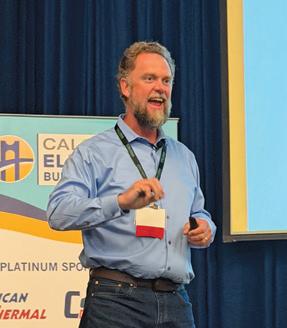
Left: Keynote speaker
Peter Lemon, CEO of Graniterock, shared an inspiring message on professional and personal growth in his presentation, “Curiosity and Saying Yes.”
Right: Day two opened with keynote speaker
Mary Teichert, CEO of Teichert, Inc., sharing her “Compass” approach to self-knowledge, growth, and reaching your highest potential.

a professional development component. Hence, the theme became “Built to Lead.” The goal was to strengthen technical fluency, risk awareness, and leadership capability in all CalCIMA construction material segments while deepening understanding of California’s evolving materials environment. Our general sessions focused on professional development and breakout sessions consisted of long form presentations, giving presenters an opportunity to go in-depth on topics and have time for a in-depth Q&A
Elevate featured two powerful keynote speakers who discussed their journeys to becoming the top executives at their companies. Peter Lemon, CEO of Graniterock, discussed his approach to his path both professionally and personally, in an inspiring presentation dubbed “Curiosity and Saying Yes.” He challenged attendees to remain open and eager to new opportunities, even when they don’t feel ready. In his many stories breaking down his matrix of leadership, he impressed upon listeners to make your failures fast and loud, own your mistakes
and learn from them quickly. “... What got you to where you are is not guaranteed to get you where you want to go!”
This set the tone for day one that also included a panel discussion on the Pavement & Materials Partnering Committee (PMPC), the cooperative Caltrans and industry forum to update materials specifications. The panelists were leaders from industry and Caltrans. They discussed lessons learned, current strategies, and future opportunities in asphalt and concrete for those wanting to participate in the PMPC and assist with technical advances in materials specifications.
Day two kicked off with an inspiring keynote by Mary Teichert, CEO of Teichert, who shared her “Compass:” Building and refining your knowledge of self as a conduit for reaching your highest potential. In her presentation, she reflected on her career path, which did not originally have her becoming the CEO of Teichert on it. But saying yes to an opportunity changed her path and is how she elevated her way to the top. She ended by giving actionable advice and habits
TECHNICAL EXCELLENCE – WINNERS
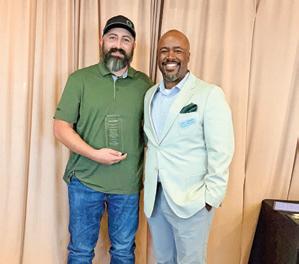
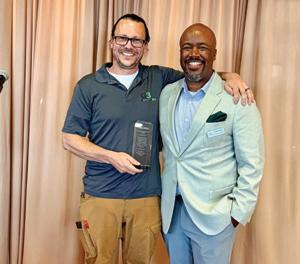
that attendees could implement immediately to ensure they are making the most of their networking opportunities.
Ryan Rauzon of Summit Strategy Group closed the general sessions with an exciting and hilarious live presentation and conversation on the importance of and how to maximize your professional impact and reach on social media.
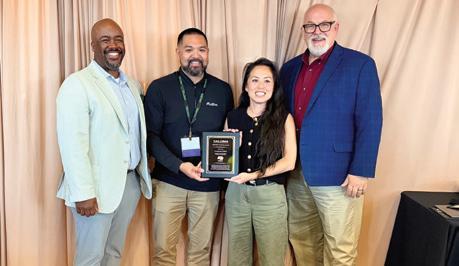
The inaugural CalCIMA Elevate: “Built to Lead” conference officially closed with an awards dinner, recognizing and honoring
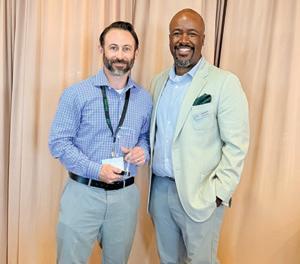
technical excellence for company personnel and agencies. CalCIMA announced a total of six winners. Three individuals were nominated by their peers both internally and externally, and three industry partners were recognized for their commitment and contribution to collaboration and moving the industry forward.
Technical Excellence:
• Zacery Brown - CEMEX
• Miguel Guzman - Granite Construction
• Travis Van-Y - G3 Quality, Inc.
Partnership:
• Building Better RoadsSan Diego County
• Pavement Materials Partnership CommitteeCaltrans
• John Harvey - University of California Pavement Research Center, University of California, Davis
The CalCIMA Elevate conference will be held again next spring in northern California. n
PARTNERSHIP – WINNERS
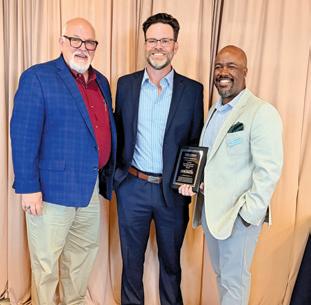
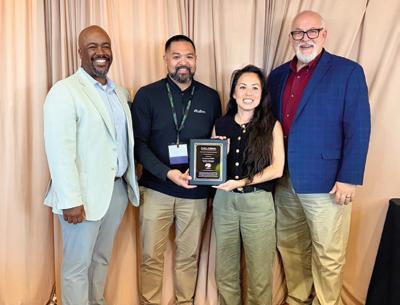
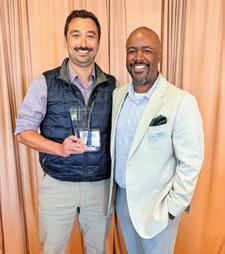
Robert Dugan (left), CalCIMA; Orland Mott, Building Better Roads; Cameron Richardson, CalCIMA.
Cameron Richardson (left, CalCIMA; Reimond Garcia, Caltrans; Jacqueline Wong, Caltrans; Robert Dugan, CalCIMA.
Zacery Brown, CEMEX and Cameron Richardson, CalCIMA.
Miguel Guzman, Granite Construction and Cameron Richardson, CalCIMA.
Travis Van-Y - G3 Quality, Inc. and Cameron Richardson, CalCIMA.
Jeffrey Buscheck (left, UCPRC on behalf of John Harvey, and Cameron Richardson, CalCIMA.
The agents are here. Is your data ready?
By Rachael Mahoney, Chief Strategy Officer at Bulk Exchange
For years, artificial intelligence in our industry was a conference topic: Interesting, a little abstract, and always a few years out. Today, that is no longer the case; it’s a part of
everyday activities. AI is already designing concrete mixes, tuning plants, predicting equipment failures, and putting decades of technical knowledge a single question away. The more useful
question is: "How do we learn to work with AI to our advantage?"
Caution is understandable. But caution turns into a liability when you ignore a shift that is already changing how materials are designed, produced, and bought. It is risky being last to understand what everyone else is already using.

Meta used AI to design a lower-carbon, faster-curing concrete, poured it at a real construction site, then partnered with building materials producer Amrize to extend the approach at a batch plant in Minnesota. A growing body of work shows models trained on thousands of past mixes proposing formulas that hit target strength while cutting cost and embodied carbon by 20 to 35 percent. In cement, concrete, and asphalt plants, AI is trimming fuel by tuning kilns and mills, flagging a failing motor weeks before it quits, and predicting a batch's strength from process data instead of waiting on the lab. None of this removes human judgment. It hands people an earlier, sharper signal to act on.
Notice the thread. Each of these wins runs on structured, trusted data, and each tool still works mostly inside its own corner. The real prize is connecting them, so that an estimate informs a mix design, a mix design informs a plant schedule, and all of it informs what gets bought and when. That is exactly where progress stalls, because the same product is named a dozen different ways across producers, branches, and systems that were never built to talk. A messy taxonomy is a nuisance within a single tool. Strung across several, it
compounds, and the more capable the automation, the less it forgives a shaky foundation.
Here is what has actually changed, and why it matters now. Reconciling millions of product names, specs, and SKUs into one shared structure was always the obvious answer. It was also, until recently, unrealistic. Done without AI, it meant armies of people and years of work, and the cost could never be justified against the payoff, so the industry left the foundation unbuilt and worked around it. The same kind of AI now optimizing mixes is what finally makes that groundwork affordable. Language models can resolve thousands of inconsistent descriptions against a common structure in the time a team once spent on a single account, with people reviewing only the genuinely hard cases. The
unglamorous work that was too slow and too expensive to attempt is suddenly within reach. That is the real unlock, and it is the part the hype keeps skipping past. It is also the work we have chosen at Bulk Exchange. Rather than add one more standalone tool, we are building the shared taxonomy and translation layer that lets these systems speak the same language, and we partner with the solutions our members already run instead of trying to replace them. It is not the flashy part of AI. It is the part everything else depends on: The difference between a wall of impressive but isolated tools and a connected industry where a decision in one system moves cleanly into the next. We are doing the patient work underneath so the rest of the industry's investments can finally compound.
I won't pretend that the tools being here makes any of this easy. It is still genuinely complex. The models are powerful and the examples are real, but the full potential will remain unrealized until the data beneath it is accessible, consistent, and shared. Get that right and every advancement starts to build on the last, each tool making the next one smarter and autonomous procurement shifting from a concept to something you can actually run. Get it wrong and we will keep buying capable software that cannot move margins. The future of this industry will not be decided by who spends the most on AI. It will be decided by those doing the unglamorous work of making their data worthy of it, and for the first time, that work is within reach. The only question left is who starts now. n
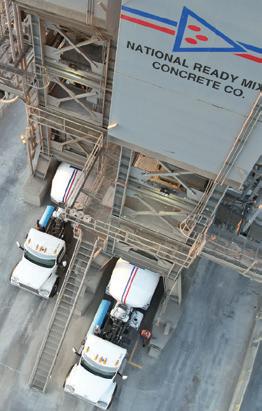
• NRMCC leads in sustainability by fully adopting Type 1L cement and introducing our Type 1T cement (LC3) the first in the Western U.S. with nearly 40% lower GWP than the OPC national average.
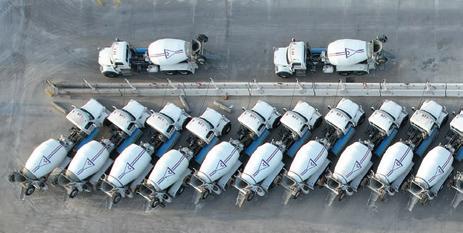
• Utilizing Type 1L (HS) low carbon cement to reduce embodied carbon and CO2 emissions.
• Providing innovative, high performance mix designs with third party verified Environmental Product Declarations (EPDs) available with every mix.
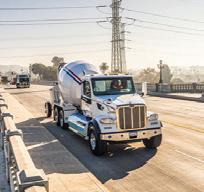
• Incorporating a large fleet of bulk material haulers (aggregate and cement) and concrete mixers that run on renewable natural gas RNG, reducing GHG emissions.
• Technically advanced, high production facilities providing superior quality and service throughout Los Angeles, Orange and Ventura Counties.
nrmcc.com


Veteran and Vulcan Materials Company employee leads Corona Memorial Mile March
By Brian Hoover, Construction Marketing Services
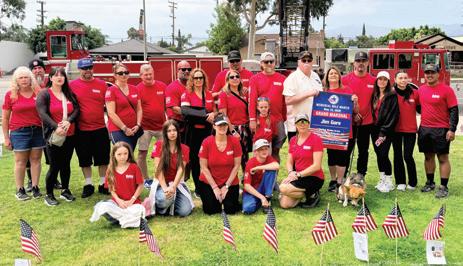
More than 200 participants gathered in Corona on May 23 for the fourth annual Corona Chamber of Commerce Foundation Memorial Mile March, an event honoring the men and women who gave their lives in service to the United States. CalCIMA producer member Vulcan Materials Company was a proud participant in this event, alongside veterans, elected officials, community leaders, residents, family members, and local representatives.
This year's march carried special significance for the construction materials industry as longtime Vulcan employee and decorated Vietnam veteran Jim Gore was selected as Grand Marshal.
The event began at the former Corona Chamber of Commerce building and concluded at Corona City Hall. Representatives carried flags for each branch of the U.S. military, as well as the American and POW/MIA flags, creating a powerful visual tribute to those who served. Each flag carried the name of a fallen soldier. Most were from the Corona area, representing World War I, WWII, and more recent conflicts. Blank placards were provided for those who wished to create a name plate for their loved ones.
The Memorial Mile March has become an important tradition within the Corona community.
"The Corona Chamber of Commerce Foundation is made up of patriotic individuals and
organizations," said Barbara Goodrich-Welk, Manager of Government and Community Affairs for Vulcan. "They do a tremendous amount to support veterans and active military personnel, and this event is one of the ways they honor those who made the ultimate sacrifice for our country."
Vulcan's strong involvement reflects the company's longstanding commitment to the Corona community, where one of its largest California aggregate operations is located. The company has participated in all four Memorial Mile March events since the program's inception, and 42 employees participated this year.
Gore has spent more than 50 years in the industry, 25 of those with Vulcan, and is widely
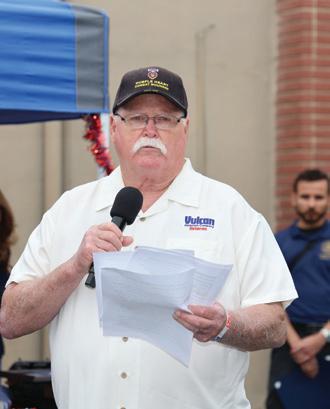
Jim Gore (Vulcan Materials Company) addresses the 200+ walkers in the 2026 Memorial Mile March.
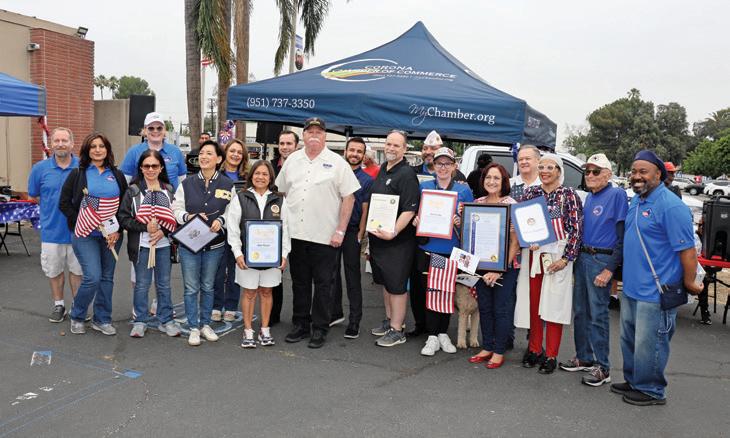
Jim Gore accepts Proclamations from local, state, and federal legislators, including Vice Mayor Wes Speake, District 2 Supervisor Karen Speigel, Assemblymember Leticia Castillo, Assemblymember Natasha Johnson, Senator Sabrina Cervantes, and Congresswoman Young Kim.



recognized for his dedication to both veterans and the local community. Gore served in the U.S. Army's 173rd Airborne Brigade and was wounded during combat operations, earning the Purple Heart for his service.
Beyond his military accomplishments, Gore has remained deeply involved in supporting fellow veterans. He volunteers at Riverside National Cemetery and frequently participates in programs and events honoring military service members and their families.
Goodrich-Welk nominated Gore for the Grand Marshal honor, citing his decades of service and his commitment to helping others.
"Jim is always front and center when it comes to supporting
veterans," she said. "He continually gives back to the community and is someone who truly represents the values this event is designed to celebrate."
At City Hall, participants gathered near a display of flags arranged to spell "USA" across the lawn. The setting provided an opportunity for attendees to remember fallen family members, friends, and military heroes while reflecting on the freedoms their sacrifices helped preserve.
The event concluded with remarks from Gore and community leaders, reinforcing the importance of remembering those who gave their lives in service to the nation.
Among those in attendance was Vulcan Vice President of Operations Scott Bevan, a U.S.
Marine Corps veteran. Following the event, Bevan expressed his appreciation for the annual tradition and its impact on the community.
"As long as the event happens and I am physically able, I will attend," he said.
As the Memorial Mile March continues to grow, organizers hope it will remain a lasting reminder of the sacrifices made by America's service members and the importance of honoring their legacy. For the Corona community, and for companies like Vulcan that call the region home, the event has become a meaningful way to ensure those sacrifices are never forgotten. n
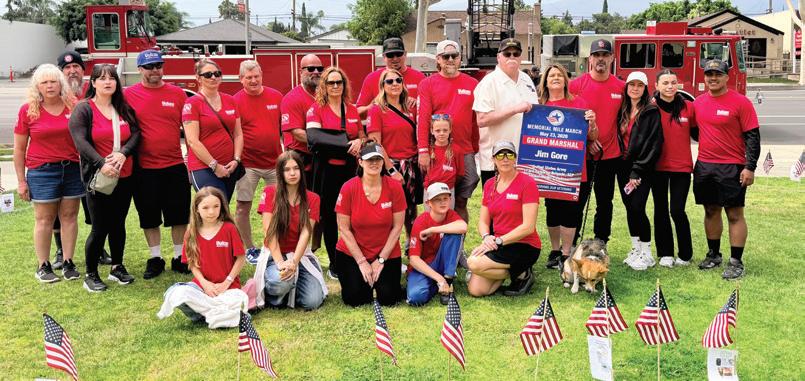
The Vulcan Materials Company team that marched to honor Jim Gore and all veterans.
Left: Jim Gore, with his wife Shelly, served as Grand Marshal of the 2026 Memorial Mile March in Corona.
Middle: Vulcan Materials Company team lines up for the 2026 Memorial Mile March.
Right: Jacey Reed (daughter of Tim Reed, Vulcan Materials Company) places a flag honoring a fallen hero.
Stewardship beyond the fence line: Connecting biodiversity, community resilience, and long-term sustainability
By Karin Perissinotto, Sustainability Manager, CalPortland
The construction materials industry provides the foundation for modern infrastructure. From highways and bridges to water systems, schools, and housing, cement, concrete, and aggregates are essential to building resilient communities and the systems that support them.
As sustainability and environmental performance become increasingly integrated into business planning and operations, stewardship extends beyond operational efficiency, emissions reductions, and resource conservation. It also encompasses how companies manage the lands associated with their facilities and the role those spaces can play in advancing broader environmental objectives.
For organizations that operate manufacturing facilities and corporate campuses, land management offers opportunities to support biodiversity and advance environmental stewardship. Through thoughtful planning and long-term care, landscaped areas and other managed spaces can contribute to habitat connectivity, support native species, and strengthen connections among employees, operations, and surrounding communities.
Voluntary third-party frameworks such as Wildlife Habitat Council (WHC) Conservation Certification,
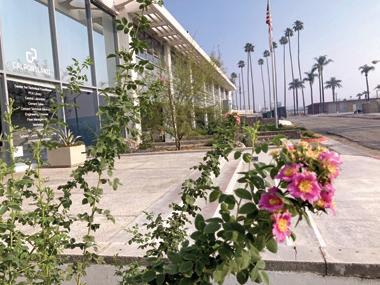
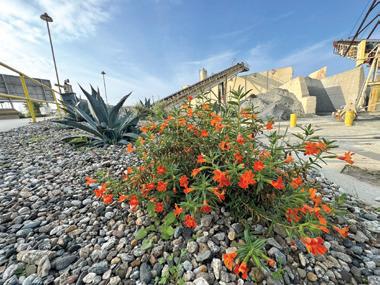
California native plantings at CalPortland's El Segundo Ready Mix Plant and the Crestmore Center for Technical Excellence support biodiversity, enhance habitat connectivity, and demonstrate how environmental stewardship can be integrated into diverse operational settings.
powered by Tandem Global, provide a structured approach for establishing conservation objectives, measuring outcomes, and demonstrating commitment.
At CalPortland, this approach recently resulted in WHC Conservation Certification for conservation programs at two distinct locations: The El Segundo Ready Mix Plant, an active industrial operation, and the Crestmore Center for Technical Excellence, a research, testing, and innovation campus. The El Segundo Ready Mix Plant achieved Gold Certification, the highest level of recognition, and was also honored with Tandem Global's 2026 Landscaped Project Award. The Center for Technical Excellence achieved Silver Certification.
Both projects incorporate California native plant species selected to enhance habitat value and connectivity while remaining compatible with their respective site functions.
Beyond ecological value, the sites provide opportunities for employee engagement, environmental awareness, and community connection.
The conservation programs at El Segundo Ready Mix Plant and the Center for Technical Excellence demonstrate how thoughtful land management can contribute to biodiversity, support community resilience, and reinforce long-term sustainability while continuing to provide the essential materials needed to build and maintain California’s built environment. n



PROVEN TECHNOLOGY HIGH UPTIME
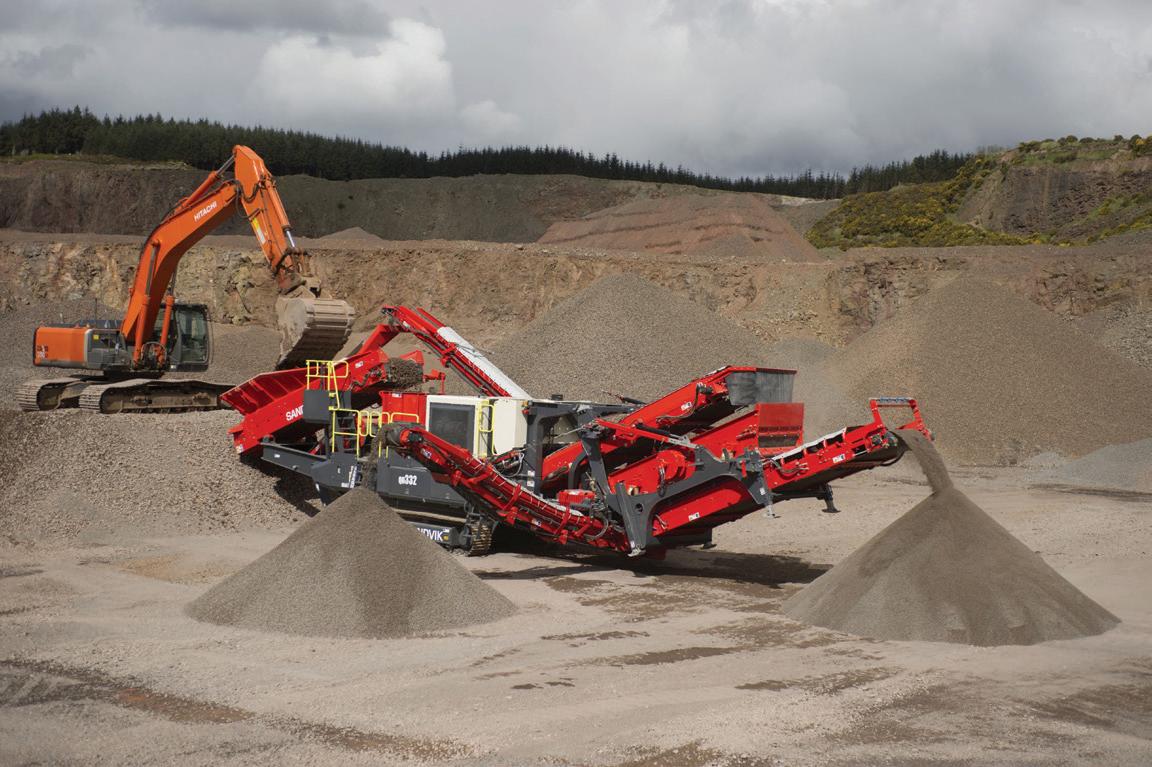
Sandvik we have combined years of industry expertise and the latest advances in technology to develop pioneering mobile crushing and screening solutions for you. Utilizing Sandvik’s renowned, proven technology and smart process solutions, such as My Fleet remote monitoring, our equipment is designed to increase operational efficiency, optimize productivity and maximize uptime.
vcesvolvo.com