2026
A publication of the California Construction and Industrial Materials Association
ECONOMY ISSUE
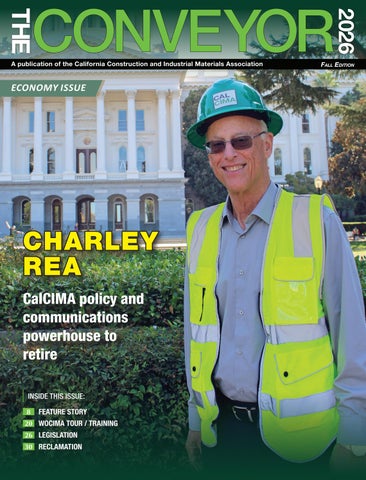
CHARLEY REA CalCIMA policy and communications powerhouse to retire INSIDE THIS ISSUE: 8
FEATURE STORY
20 WOCIMA TOUR / TRAINING 26 LEGISLATION 30 RECLAMATION
Fall Edition
ELCYC EHT KAERB www.fennerdunlopamericas.com
Stop Replacing Conveyor Belts. Start Investing In Longevity. Fenner Dunlop conveyor belts are engineered to help reduce unplanned downtime, extend belt life, and deliver reliable performance across California operations. Engineered for demanding applications Manufactured in North America Supported by local experts Built-for long term value
2026 FALL EDITION 8
4 CHAIRMAN'S LETTER
Navigating uncertainty with artificial intelligence
6 PRESIDENT & CEO MESSAGE
Showing up matters: Advocacy and the economy we help build
20
8 FEATURE STORY
CalCIMA policy and communications powerhouse Charley Rea to retire
16 MARTIN MARIETTA RECLAMATION
Adaptive reclamation: From essential resources to a resilient Russian River floodplain
20 WOCIMA TOUR / TRAINING
Women of CalCIMA connect and explore at Holliday Rock
30
22 PROFILE
UCPRC legend Dr. John Harvey reflects on a career in collaboration
26 LEGISLATION
AB 982 signed into law, preserving California’s permitted aggregate resources
28 ECONOMY
The new economics of operational visibility
EDITORIAL NOTE
30 RECLAMATION
Meet the SMARA at 50 Golden Anniversary Award nominees
Some articles published in The Conveyor may use AI tools to assist with research, organization or editing. All contributed articles are expected to reflect the author’s own knowledge, experience and perspective, and the authors or contributors are responsible for the accuracy of their content.
ON THE COVER: After 45 years in policy, CalCIMA's Vice President of Policy and Communication Charley Rea will retire at the end of 2026. He reflects on his career, and looks toward his future in retirement. The Conveyor is a publication of the California Construction and Industrial Materials Association. The views expressed herein are fixed expressions of the contributing writers and not of CalCIMA. All rights reserved. CalCIMA 455 Capitol Mall, Suite 210 Sacramento, CA 95814 (916) 554-1000 www.calcima.org www.buildingwithresilience.com
Published By Construction Marketing Services, LLC
Editor Julia Maldonado, Communications Coordinator, CalCIMA
Ryan Rauzon, Managing Director of Communications & Public Affair, Summit Strategy Group, LLC.
P.O. Box 892977 Temecula, CA 92589 (909) 772-3121
Editorial Contributors Adam Harper, Senior Director of Policy, CalCIMA
Cameron Richardson, Director of Technical Affairs, CalCIMA
Publisher Kerry Hoover khoover@calcontractor.com
Erik Turner, Director of Legislative Affairs, CalCIMA
Graphic Designer Aldo Myftari
The Conveyor • 2026 Fall Edition
Kerry Hoover, Construction Marketing Services
Billy Ripple, Director, Value Consulting and Solution Strategy, Command Alkon
The Conveyor is published quarterly each year by Construction Marketing Services, LLC All rights reserved. Reproduction in whole or in part without permission is prohibited.
Suzanne Seivright-Sutherland, Director of Regional Government Affairs and Grassroots Operations, CalCIMA
3
CHAIRMAN'S LETTER
Navigating uncertainty with artificial intelligence This is my last editorial for The Conveyor as I wind down my time as CalCIMA chair. My thanks to the executive committee, my fellow board members, and especially the CalCIMA staff for their support. It has been my pleasure to serve you and this essential industry. This time last year, I lamented the state of economic forecasting. Nothing changed. The optimists promising a housing recovery were wrong. Forecasting is the only trade where you can consistently miss and still get booked for next year's conference. Not everything is soft. We are grateful for infrastructure and regional data center spending, but the overall picture remains uncertain, and that uncertainty puts pressure on budgets. It is my sincere hope that members stay engaged with CalCIMA and our mission through this lull. Associations matter most in the years when they are hardest to pay for. Let me turn to artificial intelligence. AI so far is a lot like concrete: Give a great flatwork crew a mediocre load and they'll give you a good floor; give a bad crew a perfect load and they'll give you a birdbath and an invoice. The crew matters more than the mix. That holds, though, only as long as we are the ones who understand the mix. Understanding it is the hard part. Some futurists worry AI will destroy civilization. Others believe it will eliminate infectious disease, grow GDP and double human lifespan. My own view is that we are nowhere near understanding what AI can do for us or to us. Every organization I know is playing with AI, and for some it will bring a short-term advantage. But when I think about society, good outcomes depend on three things going
4
right: We figure out how to keep AI doing what we actually want, the benefits reach everybody instead of just a few people at the top, and our laws and institutions keep up better than they usually do. The scary part is that all three could be wishful thinking. What worries me most is simpler than that. Everything mankind has built up to this point — from the sword to taxes — had a human deciding how to use it or undo it. That does not appear to be the case with AI. The risk of losing control looks serious, and I feel helpless influencing any of it on a global scale. I do not feel helpless about CalCIMA. As we move into 2027, we need to double down on the AI knowledge investment that CalCIMA has started. The people who oppose our mission are learning AI too, and the arithmetic favors them. It now costs almost nothing to generate 400 pages of objection to a use permit, and it still costs us weeks and real money to answer. They can produce overburden faster than we can strip it. Our association must be at least as good at this as the people working to shut us down. Let me close on something very different from artificial intelligence: A real person whose intelligence, communication skills and dedication made this industry better. Charley Rea's service to CalCIMA and its members has been distinguished, and he retires this year. You can read more about him in this issue. Charley made this a better association, and he is a genuinely good man. Please join me in thanking him. Finally, my best wishes to Aaron Johnston as he assumes the chair at CalCIMA. I am confident he will represent all of us well. n
Dana Davis President - Teichert Materials CalCIMA Chairman
The Conveyor • 2026 Fall Edition
EQUIPMENT SALES | RENTALS | PARTS | SERVICE | CUSTOM FABRICATION | PLANT DESIGN
CRUSHING, SCREENING & MATERIAL PROCESSING SOLUTIONS Complete plant solutions for aggregate, mining and recycling operations.
#1 DEALER
SERVING THE AGGREGATE INDUSTRY SINCE 1960
IN THE USA RANKED BY SALES, SERVICE, & CUSTOMER SATISFACTION
READY FOR YOUR NEXT PROJECT?
GOODFELLOW BY THE NUMBERS
6
$28M+
SERVICE CENTERS across the southwest
PARTS INVENTORY Ready to keep you moving
REQUEST A QUOTE TODAY
909-874-2700 goodfellowcorp.com
40+
SERVICE & SUPPORT TECHNICIANS Getting you back to work as soon as possible
PRESIDENT & CEO MESSAGE
Showing up matters: Advocacy and the economy we help build We are not simply participants in California's economy. We are one of its most essential cornerstones. But being essential does not automatically make us influential— or even guarantee that policymakers understand what we do. That is where advocacy matters. Our members provide the foundation of the built environment and modern economy. Roads, bridges, homes, hospitals, water systems and modern technology all begin with materials in the ground. Almost everything we take for granted starts somewhere—and very often it starts with us, digging in the dirt and making big rocks into small rocks. I have long thought of effective public affairs as a three-legged stool. First is credibility: be technically “right”—accurate about policy consequences and advocate for outcomes that actually work. Second is engagement: Put people in the seats who actually live these policies. Third is political participation: Support policymakers willing to listen, learn and engage seriously about the consequences of their decisions. The order matters. I occasionally hear executives ask whether spending a day in Sacramento or Washington really makes a difference. The answer is unequivocally yes. Years ago, Congressman Bill Thomas of California—then chairman of the House Ways and Means Committee and one of Congress's most powerful members—put it bluntly: “Dugan, you have to put butts in seats…” I just returned from Washington, where we did exactly that. Some meetings were short and several were with key congressional staff, but they were pointed and substantive. On federal permitting reform, our message was not simply “reform permitting.” We focused on what reform must accomplish: Certainty about requirements,
6
timelines and when a permit is actually final. Several conversations continued after we left Washington. That is often what influence looks like. You rarely walk out of a 20-minute meeting with a victory in your pocket. You build and establish credibility, find mutual understanding and earn the next conversation. Being technically “right” means being accurate, practical and honest enough that legislators and regulators can rely on what you tell them—and do something useful with it. That is something we do really well here at CalCIMA. That matters even more when the economy softens. When business gets tighter, travel, participation and time away from operations can look like easy places to cut. But that is precisely when showing up may matter most. The squeaky wheel still gets the grease—and when fewer organizations “make the trip,” credible voices that continue showing up can carry even greater weight. That is why we hold our Legislative Summit and participate in our federal fly-in, attend the meetings we need to be present in and offer solutions and a shared path to progress in our written correspondence —and why I continue asking our CEOs and senior executives to make the time. Political participation matters too. Supporting policymakers willing to listen, understand our industry and engage constructively is important. But its influence is far greater when it rests on the first two legs: credibility and people willing to show up. Our economy depends on the materials we produce. We cannot assume others understand that simply because we do. We have to show up, earn credibility and connect the dots. That is how familiarity becomes trust—and how trust becomes influence. n Sincerely,
Robert Dugan President/CEO CalCIMA
The Conveyor • 2026 Fall Edition
powerscreen-wa.com
FEATURE STORY
CalCIMA policy and communications powerhouse Charley Rea to retire By Ryan Rauzon, Managing Director of Communications & Public Affairs, Summit Strategy Group, LLC. Julia Maldonado, Communications Coordinator, CalCIMA Charley Rea spent much of his time working with the California Department of Transportation (Caltrans) as the CalCIMA representative on the Pavement and Materials Partnering Committee (PMPC).
A
fter 45 years advocating for industry and essential materials — 30 of them spent translating between Sacramento regulators, public officials and the people who do the mining— Charley Rea is set to leave CalCIMA and begin retirement. The Forty Fiona Ma delivered the news from a podium. She was an assemblymember from San Francisco then, and the author of a bill the construction materials industry badly wanted: AB 812, which would require Caltrans to adopt a specification allowing 40% reclaimed asphalt pavement. Caltrans officials in particular were not immediately enthusiastic. Ma knew it, and she had come to a CalCIMA conference to say what it would take. If the industry really wanted this, she told the room, it 8
would need to put at least 40 of its members in the hearing room to testify. Charley Rea, the association’s vice president of policy and communications, remembers walking out of that talk with a single thought, which he renders now in six words: “That’s going to be hard work.” Persuading one or two member companies to send someone to the Capitol to testify is an accomplishment. Forty was unimaginable. They got 40. They came from aggregate, concrete and asphalt — companies that a few years earlier had belonged to four separate associations and occasionally worked to cross purposes, hiring lobbyists that were not aligned. The bill passed. “It was really the one moment when we got to show, ‘Hey, we’re here,’” Rea said. “We’re trying to do something good. It’s recycling.”
Caltrans wrote the 40% specification and adopted it. The Federal Highway Administration raised concerns about cracking in high-RAP pavements. The industry considered its concerns thin, since other states were already there, but Caltrans withdrew the spec. That was 2014 or 2015. The state has since worked its way up to 25%. The 40% specification, 15 years and a great many demonstration projects later, is still being developed. “It’s getting closer,” Rea said. “We’re still waiting for Caltrans to actually adopt it. That’s one we’re still working to achieve.” The Material Rea is retiring at the end of the year, 45 years after he left Berkeley with a degree and went to Washington to answer a senator’s mail. The last 20 of those years were spent at CalCIMA, the California Construction and Industrial Materials Association, where he has held the same duties since it opened in January 2007. CalCIMA lives to remind people of its material’s essential characteristics. Crushed rock. Sand. Gravel. The cement and asphalt that bind them, and the concrete and pavement they become. Every road in The Conveyor • 2026 Fall Edition
Charley Rea has worked on the Safety and Health Committee, improving training and relations with the Mine Safety and Health Administration and Cal/OSHA Mining and Tunneling Unit.
California sits on them, and every foundation and sidewalk. The state cannot build anything without a continuous supply from quarries that are best working and thriving here at home. This is the industry’s central and permanent condition, one Rea helped communicate plainly for decades and with righteous enthusiasm. If it’s not grown, it’s mined. If it’s built, we’re in it. “Charley said it all and he did it with class. He was a bulldog for our industry and the best part about him was that after working alongside him, you realize not every bulldog needs to be mean and nasty about it,” said Ben Licari, a formative leader who helped create CalCIMA. The people who worked with him describe him with a consistency that is itself a kind of evidence. Steadfast. Humble. Professional. Even-keeled. Gentle. Thoughtful. Whip smart. Dedicated. Unwavering. Calm. Full of decency, decorum and demeanor. The words recur: Even a man who keeps his counsel and does not raise his voice. He stays in that register no matter what the room is doing. If there is emotion, he disguises it. Rea accepts the description only partway. The Conveyor • 2026 Fall Edition
“There’s something boiling inside, certainly,” he said. “Sometimes, when you’re dealing with some of these agencies, it’s hard to hold it back.” Sacramento to the Senate Charley grew up in Sacramento, the son of Leonard and Lesle Rea. He attended UC Berkeley, which was an inheritance: Both his parents had attended, and their brothers and sisters, and then his own brother and sister. He majored in Political Economy of Industrial Societies. Rea moved to Washington to work in the office of Bill Armstrong, the Republican senator from Colorado. It was the standard apprenticeship of answering constituent letters, and led to a legislative assistant’s desk, which is where the issues actually get worked. He was the staffer on Armstrong’s effort to put the Senate’s proceedings on television, which the Senate did in 1986. Rea stayed nine years. He worked on transportation and agriculture issues, including representing wheat farmers and cattlemen on the eastern plains of Colorado. He helped the Senator pass and defend Sodbuster legislation to prevent plowing of erosion-prone lands.
Stephanie Pridmore (left), Charley Rea (middle) and Adam Harper (right) started at CalCIMA since its inception in 2007, all previously working at the California Mining Association.
In Washington, Rea worked with Denise Jones, a fellow legislative assistant who handled the mining and natural resource issues. She married one of Rea’s friends from Sacramento, and went to work for the California Mining Association (CMA), where she was the Executive Director. Around 1996, she called to say they were looking for someone. Rea had already been applying for jobs there, so he came home. Learning Rock He arrived at CMA knowing nothing about mining and the industry set about correcting it. On close to his first day, Ray Krauss of Homestake Mining came by for the afternoon and gave him a crash course on every environmental law there was, because Rea was going to be working on environmental issues. Vulcan Materials Company’s Jim Gore was at Sunwest Materials at the time, and took him into an aggregate pit to show him the layers, what each one meant, and how the material was taken out and turned into product. Later, when he had moved on to the aggregate and ready-mix associations, Mark Villa with Right Away Redy Mix gave him the tour of a ready-mix concrete plant in Oakland. 9
FEATURE STORY
Left: Charley Rea and Mark Villa, Right Away Redy Mix, tour a ready mix plant in Oakland. Above: Charley tours an underground mine in the Mojave Desert.
“When you first learn all that stuff, it’s just kind of eye-opening,” Rea said, “because you have no background.” He talks about those tours with the specificity of a man who never entirely stopped taking them. He can still describe mines he walked through 25 years ago. Rea was drawn to the natural resource industries as a class, and to a structural unfairness he had first noticed in agriculture: That the people who produce the things a society most fundamentally needs are the people some in society most reliably oppose. “They’re providing these incredibly important things for society, and everyone’s against them,” he said. His motivation was to make it a little easier, or a little better somehow, for them to stay in business, and to get people to understand what they bring. One Voice Rea later moved to the Construction Materials Association of California (CMAC), a regional association for aggregate and ready-mix producers in the 10
northern half of the state. At the time, the industry was organized with multiple associations, each with its own staff, lobbyists, and view of the world. They spent half their time coordinating with one another and sometimes worked at cross purposes in the state Capitol. There became a significant desire on behalf of the members to create a large statewide organization representing all materials, including mining, aggregates, concrete, and asphalt and to speak with one, unified voice. The consolidation that produced CalCIMA took years and was tense. The member companies formed a group of their own, the Sutter Group, and met without staff — principals to principals. What came out of the room went back to the boards for votes. The majority voted yes. CalCIMA was formed. CalCIMA’s first CEO Gary Hambly praised Rea’s character during this seminal moment. “He would subvert his own ego for the benefit of the whole. That's a terrific skill to have, and a terrific
measure of a man's humility — to be in the background while he's being so effective, and not really needing the credit for it.” Rea understood what people feared: A bigger organization would cost them the close, personal ties between staff and companies that the small ones had run on. Senator Armstrong had once mentioned the economist Mancur Olson’s work, who argued that the broader an association’s membership, the more its interests converge with the public’s. A wheat growers’ association wants one thing: A thriving wheat industry. A Farm Bureau, representing every commodity, is obliged to want something closer to what is actually good for agriculture. “That’s the way I viewed CalCIMA,” Rea said. Four narrow associations, each looking out for its own, would become one broad one with more credibility precisely because it could no longer want only one thing. “I can’t imagine trying to say, ‘Well, we represent half of California,’” he said. [ Continued on page 12 ]
The Conveyor • 2026 Fall Edition
CALIFORNIA’S LARGEST INVENTORY OF FORD TRUCKS & VANS
THE CONVEYOR Specials $65,542*
$65,926*
2025| F-350
4x4
$61,927*
2025 | F-350
$68,197*
2025 | F-550
2025 | F-450
12’ Stakebed
10’ Contractor
12’ Flatbed
12’ Contractor
6.7L V8, PWR Pkg, Bluetooth, Rear Cam | #SEE11626
7.3L V8, PWR Pkg, Bluetooth, Rear Cam | #SEE09756
7.3L V8, PWR Pkg, Bluetooth, Rear Cam | #SDA18860
7.3L V8, PWR Pkg, Bluetooth, Rear Cam | #SED91201
After $11,250 in Total Discounts**
After $12,000 in Total Discounts**
After $10,500 in Total Discounts**
After $12,250 in Total Discounts**
$59,995*
$70,457*
2026 | F-250
$86,978*
2025 | F-350
$96,507*
2026 | F-550
2026 | F-550
8’ Utility
11’ Utility
12’ Combo
14’ Combo
6.8L V8, PWR Pkg, Bluetooth, Rear Cam | #TEF41809
6.7L V8, PWR Pkg, Bluetooth, Rear Cam | #SED45995
6.7L V8, PWR Pkg, Bluetooth, Rear Cam | #TDA18886
6.7L V8, PWR Pkg, Bluetooth, Rear Cam | #TDA10693
After $7,500 in Total Discounts**
After $13,000 in Total Discounts**
After $10,500 in Total Discounts**
After $13,500 in Total Discounts**
$104,454*
$105,264*
2027| F-650
$102,854*
2026 | F-750
$83,342*
2027 | F-650
2027 | F-650
5/7 Yard Dump
2,000 Gal Water Tank
16’ Dump
20’ Stakebed
7.3L V8, PWR Pkg, Bluetooth, Rear Cam | #VDF02996
7.3L V8, PWR Pkg, Bluetooth, Rear Cam | #TDF07933
7.3L V8, PWR Pkg, Bluetooth, Rear Cam | #VDF02303
7.3L V8, PWR Pkg, Bluetooth, Rear Cam | #VDF05105
After $13,000 in Total Discounts**
After $14,000 in Total Discounts**
After $13,250 in Total Discounts**
After $9,500 in Total Discounts**
See all of our inventory at www.kengrodyfleet.com ORANGE COUNTY (714) 228-6179
SAN DIEGO (760) 935-8967
INLAND EMPIRE (909) 363-9587
*Plus government fees & taxes, any document preparation charge and any emission testing charge. **”Total Discounts” includes dealer discount and all Ford Retail Incentives, including Ford Retail Cash, Bonus Cash, and other Retail Rebates. Some Bonus Cash rebates may require you to Finance with Ford Credit. Creditworthiness determined by Ford Motor Credit, not all customers will qualify. Rebates are subject to change without notice.
FEATURE STORY
Charley Rea has served on the Safety and Health Committee, working with Caltrans to improve safety training and build stronger relations around truck safety.
[ Continued from page 10 ]
The Run CalCIMA launched in January 2007 and brought the associations together. “I replaced Charley when he left the California Mining Association and was looking forward to working alongside him when we merged,” said Stephanie Pridmore, CalCIMA's Chief of Operations. “Since day one, I've admired his strong work ethic and appreciated his willingness to lend an ear or offer advice, but what I will miss most is his humor and quick wit.” CalCIMA quickly turned its emphasis toward the Legislature. Bills were being passed. Lawmakers began listening intently to what CalCIMA was sharing. Rea’s own view of what a trade association is for was being confirmed in real time. Politicians have their ideologies, but the exciting part of the Capitol has always been the enormous amount of practical work that goes on beneath the ideology, across the aisle, unreported. “There could be a million news stories written about all the practical things that are being done, but they never write those,” Rea said. The fun for Rea was in finding the connection, even if things got tense. 12
CalCIMA's current President and CEO Robert Dugan got to know Rea when Dugan was a CalCIMA producer member. He has always been impressed with Rea's patience, listening skills and work ethic. “Charley has always understood something fundamental about association leadership: It's not always about being the voice in the room; it's about making sure the industry's voice is heard. THEIR VOICE," Dugan said. "His fingerprints are on so much of what CalCIMA has accomplished over the last 20 years. Our industry is better because of his service.” Standards and Specifications The two areas where Charley focused his work at CalCIMA were safety and technical issues. The Safety and Health Committee focused on improving training and relations with the principal agencies, the Mine Safety & Health Administration and the Cal/OSHA Mining & Tunneling Unit. Regular meetings were established with agencies, and training was upgraded with annual Spring Thaw safety conferences, safety awards, and training materials for member use. “One of the most effective things he did was marshal the
safety program for the association. He got the members in line to take safety even more seriously than they were previously taking it. He put on those seminars, brought in great speakers, and instituted a real safety ethic within the organization,” Hambly said. The Safety Committee was also intent on advancing improved safety standards. This was highlighted by the adoption of CalCIMA-sponsored SB 341 (Lowenthal) in 2011 to require back-up alarms on trucks, making it safer for workers. “Before enactment of the legislation, the California Vehicle Code did not require backup alarms on commercial vehicles transporting construction materials,” said Mike Herges, formerly at Graniterock and Safety and Health Committee Chair at the time. “While MSHA and Cal/OSHA enforced backup alarm requirements at mining operations, and Cal/OSHA enforced similar requirements at construction sites, those requirements did not apply during travel on public roadways. The legislation addressed this gap by incorporating the backup alarm requirement into the California Vehicle Code, making it enforceable by the California Highway Patrol.” The Conveyor • 2026 Fall Edition
1
4
1. 2. 3.
Charley, Annika and Emil go cross-country skiing in the Sierras. Charley’s family attends the US Open in New York. Charley’s family vacationing in Santa Barbara.
Another big part of his working life was the dense technical documents by which Caltrans decides what materials will be tested and accepted. Caltrans and producers’ relationship had always been complicated, cycling through reorganizations of what was originally called the Rock Products Committee and later became the Pavement and Materials Partnering Committee, the PMPC. Rea became the association’s representative on that structure. Rea is uncomfortable with the suggestion that he became a technical expert. He says he learned enough about things like alkali-silica reactivity to talk about them to other policy people, and that he evidently fooled Graniterock’s Aaron Johnston, who doesn’t seem like someone who is easily fooled. The Conveyor • 2026 Fall Edition
4. 5. 6.
2
3
5
6
Charley and Lisa hiking in the Cascades. Charley and family in Venice, Italy. Charley and his family celebrate Mother’s Day at home.
"We would sit down and I’d watch Charley argue about the toxicity of different isotopes in concrete wash water to figure out whether certain state agencies had regulatory jurisdiction over mining operations,” Johnston said. What Rea will admit to is a taste for digging into a subject until it makes sense. Most of the job is clearing away misunderstanding/misinterpretation. The accomplishments on this side of the work are of the kind that never leave the industry. A Caltrans specification for reusing returned fresh concrete set the precedent for how to do it. A resolution of NSF 61, a standard governing concrete in drinkingwater systems, worked out with Kirk McDonald of CalPortland, Mark Hill of CEMEX, and an official in Napa County who
happened to be leading the national effort, in a way that worked for concrete and aggregate producers. None of them, Rea insists, were his initiatives. They came from the members. He helped realize them. Wednesdays Every Wednesday for a very long time, CalCIMA’s members have received an email from Rea. Beginning at CMAC, Dave Harrald of Kaweah River Rock suggested that he ought to send out something weekly on what meetings were coming up. Rea saw what else it could carry. It became a summary of what Sacramento was doing and, more to the point, what Sacramento was thinking. A weekly dispatch from a government whose assumptions 13
FEATURE STORY about the world are not the assumptions of the people who run quarries. “The Legislature and state leaders come from a different point of view than business leaders and the companies that produce materials,” Rea said. “I’m sure I’m telling members things they think are crazy. But they need to know that that’s the thinking. That’s the environment we’re working in.” If there is a single word for what he has done for 30 years, he will accept “translator” or “liaison:” Someone in the middle trying to get others to meet. He thinks of it in plain terms: If you can explain what is really happening, or where the middle ground actually is, you may head off the next disagreement before it starts. The more you can settle
up front, the better. It is also good business. Better to adapt early and find common ground. This was not a philosophy he arrived at, but one he was born with and then had confirmed working for industry that oftentimes would rather not be talked about at all. The Files He met his wife Lisa in Sacramento at a mixed-doubles social when somebody paired them up. “It was always great having tennis in common,” he said. They have two children: Annika, 23, at the New York School of Interior Design, and Emil, 22, at UC Santa Barbara. Over the last few months, he has been going through his files. He keeps finding people from the past, and issues he had forgotten; things that are
now settled so completely that they have vanished. “They were a big deal at the time but now it’s a specification, a road, or the base course under the pavement we’re all driving on and nobody sees it,” he said. "He ought to enjoy himself in retirement and be thankful for all he accomplished, and all the friends and admirers he has,” Hambly said. “Whether he knows it or not, and we hope he does, he has hundreds of admirers that maybe haven't expressed that to him. He is very much appreciated.” n
specialists in engineering, safety, planning and the environment
Services: Land Use and Environmental Planning / CEQA and NEPA Compliance Construction Materials, Industrial Minerals, and Metal Mining / SMARA Compliance Air Quality & Permitting Services Environmental Health and Safety and Regulatory Compliance and Permitting Hazardous Materials and Hazardous Waste Management Groundwater and Surface Water Studies and Permitting Geologic and Mineral Resource Assessment and Characterization Comprehensive Transactional Due Diligence Services Environmental Site Assessment and Investigation Industrial Hygiene / Support to Legal Counsel / Training
14
VENTURA
SAN DIEGO
GRANTS PASS, OR
P: (805) 275-1515 F: (805) 667-8104
P: (619) 894-8669 F: (805) 667-8104
P: (458) 212-2520 F: (805) 667-8104
805.275.1515
sespeconsulting.com The Conveyor • 2026 Fall Edition
YOUR PREMIER PARTNER FOR AGGREGATE SITE SOLUTIONS ICM SOLUTIONS A TEAM OF CRUSHING EXPERTS
800-860-7284
www.icmsolutions.com 4688 Pacific Heights Road • Oroville, CA 95965 Authorized Distributor for:
Scan the QR code for more info and locations.
MARTIN MARIETTA RECLAMATION SAFETY CONFERENCE
Adaptive Reclamation: From Essential Resources to a Resilient Russian River Floodplain By Suzanne Seivright-Sutherland, Director of Regional Government Affairs and Grassroots Operations, CalCIMA
F
or 50 years, SMARA has reinforced an important principle: Responsible mineral development includes planning for what comes next. Reclamation can transform land that supplied the materials California needed to build its communities into environmental and community assets that continue delivering value for generations. Along the Russian River near Windsor, Sonoma County, Martin Marietta Northern California Aggregates, LLC's site (formerly known as Kaiser Sand & Gravel Co.), offers a compelling example of that evolution. Most reclamation obligations at the approximately 358-acre property have been completed, except for work around two smaller terrace mine areas. Now, an ambitious restoration vision could return the entire gravel mining area, including these areas with some remaining reclamation obligations, to a functional Russian River floodplain, creating benefits extending well beyond the boundaries of the former operation. ADAPTIVE RECLAMATION Earlier reclamation plans essentially proposed to leave the mined terrace pits in place as large ponds with levees separating them from the Russian River. As understanding of the river system, fisheries and restoration opportunities evolved, however, so did the vision for the site's future. The Russian River Floodplain Restoration Project proposes reshaping the former 16
mining landscape to re-establish floodplain connectivity and restore seasonally inundated riparian wetland habitat. Approximately 4.5 million cubic yards of onsite terrain would ultimately be moved, making this one of Sonoma County's largest earth-moving efforts since construction of Warm Springs Dam. The scale reflects an equally significant objective: Restoring natural processes rather than simply completing individual reclamation features. Project goals include restoring critical salmonid habitat and re-establishing native plant communities. The design also seeks to minimize conditions favorable to invasive species and predation while creating a landscape capable of functioning with the river over the long term. FROM RECLAMATION TO RESILIENCE The site's location makes those benefits particularly meaningful. Along this reach of the Russian River, the 100-year floodplain is a working landscape containing vineyards and former gravel pits, with major municipal intake wells upstream and downstream of the restoration as well as significant recreational uses throughout the river corridor. Restoring floodplain function could therefore produce multiple co-benefits: Improved fish and wildlife habitat, reduced flood hazards, better water quality, groundwater and water-supply protection, and a stable postmining landscape without lingering
ecological or flood-hazard concerns. The project is being advanced through collaboration involving Martin Marietta, Russian Riverkeeper, Endangered Habitats Conservancy, State Coastal Conservancy, Permit Sonoma, California Department of Fish and Wildlife, Sonoma County Regional Parks, and NOAA Fisheries. The County of Sonoma, the local SMARA implementing agency, recently approved a Use Permit for the restoration in April 2025. The project team is now advancing engineering, other required resource agency permits, and lot line adjustments for future construction once funding is secured. Russian Riverkeeper has also provided ongoing stewardship at the property as the restoration vision advances. A LANDSCAPE WITH A NEW PUBLIC PURPOSE The site's next chapter could also reconnect people with the Russian River. Plans contemplate a multi-use perimeter trail, seasonal river-access path, campground and campground river access, day-use parking, alongside restored habitat and open space. Design, permitting, and property arrangements are still advancing, with the project team hoping construction can begin soon. If successful, this project could provide a model for the restoration of other former mining areas along the Russian River and potentially other river systems. The Conveyor • 2026 Fall Edition
That makes the project particularly fitting as SMARA turns 50. Mining and reclamation are not opposing chapters in a property's history; they are parts of a continuum of responsible land use. At this former terrace mine site, land that once supplied essential construction materials may now
have the opportunity to provide something different but equally enduring: a healthier river, restored habitat, greater resilience, and lasting public value. “The transition from the former reclamation plan to the restoration approach has the intrinsic potential of a dam removal for salmon
recovery; it’s a game changer. The flexibility of SMARA and Martin Marietta's willingness to partner will lead to more salmon in the Russian River and a more resilient river for our community.” Says Don McEnhill, Deputy Director of Russian Riverkeeper. n
CALL NOW FOR ADVERTISING RATES & INFORMATION
KERRY HOOVER / 909-772-3121 khoover@calcontractor.com
The Conveyor • 2026 Fall Edition
17
EXPERT MINING SOLUTIONS Your Partner in Sustainable Resource Development • Planning & Design • Permitting • Reclamation 1905 BUSINESS CENTER DRIVE SAN BERNARDINO, CA 92408
LILBURNCORP.COM
P: 909.890.1818
THE STANDARD. BECAUSE ‘IT’LL HOLD’ ISN’T A MAINTENANCE STRATEGY.
Featured:GIW® MDX
From high-chrome rebuilds to hose pump swaps, we keep California mines running when others keep making excuses. applications@dxpe.com (866) 472 - 3959 California Field Service & Parts
18
The Conveyor • 2026 Fall Edition
CUTTING EDGES ENGINEERED FOR LONGEVITY AND BACKED BY A WRITTEN GUARANTEE.
Premium. Proven. Guaranteed.
When uptime matters, Kenco Cutting Edges deliver. Engineered to outlast and outperform, they provide a lower total cost of ownership with less downtime, fewer changeouts, and unmatched durability. √ Long-lasting performance √ Guaranteed quality and value √ Backed by the experts at Butler - Justice
Cutting Edges, Heel Plates, Scraper Blades
Give us a call to see if Kenco Cutting Edges are right for you. Free consultation available.
(714) 696 7599
Proudly representing these trusted manufacturers:
5594 E. La Palma Ave. • Anaheim, CA 92807 mikeb@butlerjustice.com / butlerjustice.com
WOCIMA TOUR / TRAINING
Women of CalCIMA connect and explore at Holliday Rock By Kerry Hoover, Construction Marketing Services
Tour attendees at the Holliday Rock site.
T
he Women of CalCIMA gathered Aug. 26–27 at Holliday Rock’s Upland headquarters for two days of professional development, networking and a firsthand look at the operations behind Southern California’s construction materials production. The event paired practical communications training with the Holliday Rock Upland Plant Tour, supporting the group’s efforts to connect industry professionals, showcase member companies’ operations and broaden participants’ industry knowledge. The program began with a professional communications session led by Summit Strategy Group. The hands-on training focused on helping attendees strengthen their LinkedIn presence 20
and position themselves as subject-matter experts. Topics included understanding how LinkedIn’s algorithm influences your visibility , updating profiles, choosing content to share, determining how often to post and using meaningful engagement to increase individual and company visibility. A networking happy hour at Mt. Baldy Brewing Company followed, giving attendees an informal setting to exchange ideas and build relationships before the next day’s tour. The following day, participants boarded a bus to explore Holliday Rock’s San Antonio Spreading Grounds, Mountain View and Foothill locations. Peggy Robertson, the company’s
Community and Government Affairs Manager, explained that Upland offered both the space to accommodate the group and access to mining, asphalt and ready-mix concrete operations at Holliday Rock’s largest location. Hosting the Women of CalCIMA also reflected the company’s commitment to the communities it serves. “At Holliday Rock, we take great joy in being a great community partner,” Robertson said. “Thank you to CalCIMA and WOCIMA for the opportunity to showcase our Upland operations. Opportunities like this allow us to learn from one another and support each other as we continue striving to be good neighbors in the communities we serve.” The Conveyor • 2026 Fall Edition
John Holliday shares the history of the family-owned company.
Participants take part in the professional development workshop.
At the San Antonio Spreading Grounds, attendees viewed active mining pits and learned how aggregate is processed, crushed and transported to the production yards. A highlight was Holliday Rock’s 8,000-foot conveyor system, which carries material beneath the 210 Freeway to the Foothill and Mountain View facilities, eliminating the need to truck that material between the mining operation and those yards. The tour continued through Mountain View, where participants saw a mechanic shop and the ready-mix batch plant. At Foothill, stops included the newly rebuilt asphalt plant, the primary readymix batch plant and the company’s Renewable Compressed Natural Gas (RNG) truck fueling station. The Conveyor • 2026 Fall Edition
Ian Blue of Summit Strategy leads the LinkedIn workshop.
Attendees travel between tour stops on an air-conditioned bus.
Attendees also learned about Holliday Rock’s filter press, a water treatment and recycling operation that helps recover water for reuse. Together, the stops illustrated how material handling, production, fleet support and water recovery work within the company’s operations. Participants represented a broad cross-section of the industry, including Teichert, United Rock Products, 7/11 Materials, Caltrans, Granite Construction, Martin Marietta, All States Materials Group, Taylor Environmental Services, Crystal Waters Consulting, Blue Planet, Reed Family Companies, and Brown and Caldwell, as well as the National Asphalt Pavement Association and the National Stone, Sand & Gravel Association.
Holliday Rock’s team helped coordinate the tour and provided lunch afterward, allowing additional time for conversation before attendees departed. By combining communications training with access to working facilities, the gathering helped participants strengthen their professional voices while deepening their understanding of aggregate, concrete and asphalt production. Founded in 1937 and headquartered in Upland, Holliday Rock is a family-owned producer of aggregate, ready-mix concrete and hot-mix asphalt, with 44 locations serving eight Southern California counties. n
21
PROFILE
UCPRC legend Dr. John Harvey reflects on a career in collaboration By Cameron Richardson, Director of Technical Affairs and Julia Maldonado, Communications Coordinator, CalCIMA
Photo by Mario Rodriguez / UC Davis
History & Early Career Dr. John Harvey is best known as the Professional Engineer, previous Director and current Professor at the University of California Pavement Research Center (UCPRC) at UC Davis, among many other roles and accolades. But the story of the journey to get there is quite interesting. He started his college career with a desire to pursue a degree in music, and like many college students’ life changes quickly, a quick detour through forestry, and Harvey landed on Civil Engineering with a focus on water. After graduation, he had two job offers in Texas and Alaska. Austin Research Engineers (ARE) in Texas had ties to Nigeria, where his sister’s boyfriend was from and heavily praised. Deciding to go to Austin, Harvey was able to learn under two titans of industry, Dr. Ron Hudson and Dr. Frank McCullough; dubbed the fathers of pavement management and reinforced concrete pavements respectively. 22
In Nigeria, Harvey had the opportunity to become the Assistant Director of a federal government lab, managing about 25 professional staffers covering field and lab sampling and testing across the entire country. After Nigeria, Harvey returned to the states to work and learn under the guidance of Dr. Carl Monosmith at the Partnered Pavement Research Center (PPRC) as a graduate student at UC Berkeley. In this role, he became the lab manager for the Strategic Highway Research Program (SHRP) project. Harvey honed his craft in lab management, networking with many great mentors in academia, got hands-on experience with Heavy Vehicle Simulators and most importantly, craft his vision of work through the lens of “a sense of reasonableness.” Dr. Monosmith had stressed this phrase as a mantra to not get too lost in the research and ensure that the work was implementable and realistic. Director Life When Harvey took over as Director, he made a few major adjustments: Moved the program from UC Berkeley to UC Davis in 2022, renamed it UCPRC, and brought all paving materials under the program, not only asphalt. He also carved in a passion of his: A focus on the environmental element of pavements. For 20+ years, Harvey has been a major contributor in the advancement of the pavement industry at the state and local level. Harvey reflected on some of the most impactful lessons learned and experiences. He realized he
wasn’t immune to the frustrations of the rate of change in the industry, notably “...two steps forward, 1.5 steps backward, and I was thinking of leaving the industry because I didn't want to spend my life having the same arguments that were circular. The failure to implement performance related testing for asphalt after SHRP in particular.” That frustration led to the adaptation of a lesson learned from one of his mentors in Dr. Jon Epps: "If you have $10 to make progress, spend $1 on research, $3 on development, and $7 on implementation."Thus, the UCPRC vision document was born. This document kept the group’s activities focused on not just producing more and better data, but the tools necessary to implement the findings from that data. Harvey and his team have been successful in pursuit of that goal. With over 200 research paper credits through UCPRC and a litany of concepts, programs, and technology upgrades that we use daily. Some of these include long-life asphalt and concrete design strategies, both iterations of the pay factor specifications for asphalt, Mechanistic Empirical design for concrete and asphalt, creation of the City and County Pavement Improvement Center (CCPIC), and supporting creation and improvements to the Caltrans Pavement Management System (PMS). The Future The UCPRC is in the process of its next transformation as Harvey has passed the torch to Dr. Somayeh Nassiri as its next The Conveyor • 2026 Fall Edition
Much of Dr. John Harvey’s work was on UCPRC’s test track, a way for researchers to develop and speed implement cost-effective and sustainable technologies and provide data, analysis and tools for various state and federal transportation agencies, primarily Caltrans.
Director. Harvey hopes that the UCPRC program, “keeps on innovating, collaborating, and making good decisions… while maintaining focus on cost effectiveness, environmental impact, and implementation.” Specific thoughts for his successors, he wants them to emphasize that… “We (UCPRC) are pavement engineers, not concrete or asphalt or recycling engineers, not just materials people but also designers, network management, etc. These expertises need to work together and we need to understand interactions…we are influencers not deciders. We provide the deciders with good data and analysis, and recommendations, but we don't decide. There are things that deciders have to think about that we don't, but we need to be aware of them.” Thank you As we as an industry wish Dr. John Harvey the best in his next chapter. While he will focus some of his energy on continued support of the construction management program at UC Davis, the majority of his time will be spent traveling with the kids and grandkids, and spending quality time with his wife on their almond ranch which they have been running for just over a decade; and reminding us to “please eat more almonds!” To celebrate his achievements, CalCIMA honored Harvey at the 2026 Elevate Conference with the The Conveyor • 2026 Fall Edition
“John taught me to keep my chin up and take pride in the work we do. He reminded me that applied research and implementation have tremendous value, even when that value isn’t always recognized by the broader research community.” Somayeh Nassiri Photo by Mario Rodriguez / UC Davis
Director and Professor, UC Davis
“I was deeply impressed by UCPRC’s broad perspective, commitment to the entire path from research to implementation, and close collaboration with public agencies and industry. All of this is a testament to John’s vision and leadership. What he has built is, in my experience, unique in the world. Working with John Harvey has been, and will continue to be, a privilege.” Angel Mateos Research Engineer and Co-PI, UC Davis | Principal Investigator, UC Berkeley
“What stood out right away about John was the care and attention to detail he expects in every test. He pushes us to be technically accurate and practical. John’s the first to tell you we’re always learning, and the end goal is implementation.” Jeff Buscheck Laboratory Manager, UC Davis
Lifetime Achievement in Materials Partnership Award in recognition of his dedication to advancing construction materials through innovation, education, and industry partnership. From all of us in the construction materials industry, we
want to say thank you to Dr. John Harvey for your support, your spirit, and contributions focused on making the industry and the state of California better for the past 30 years. n 23
Your Jobsite Partner: VCES Rents VCES delivers Volvoʼs smart solutions to take your operation beyond hauling. With innovative tools like Haul Assist, Connected Map, CareTrack, and Volvo Service Contracts, VCES helps you make smarter decisions, extend machine life, and lower operating costs — all while maximizing uptime and productivity. Contact your nearest VCES location today. Bakersfield, CA 661.387.6090
Fresno, CA 559.834.4420
Redding 530.255.8008
San Leandro, CA 510.357.9131
Corona, CA 951.277.7620
Lakeside, CA 619.441.3690
Sacramento, CA 916.504.2300
Turlock, CA 209.410.6710
Find us on social media: facebook.com/volvoces VolvoCES
vcesvolvo.com
24
volvoces volvoces
The Conveyor • 2026 Fall Edition
Your Mobile Commercial Equipment A/C Specialists Serving California & Arizona
At G3 Equipment AC Specialists, we provide expert AC repair services for commercial fleets. Our skilled technicians ensure your systems operate safely and efficiently— keeping your vehicles running smoothly and your drivers safe and comfortable. • RED DOT Roof Top • Air Central • Mobile AC Hoses
AC PARTS IN STOCK FOR SALE
Expert Support and Service
LEGISLATION
AB 982 signed into law, preserving California’s permitted aggregate resources By Erik Turner, Director of Legislative Affairs, CalCIMA
Juan Carrillo, Assemblymember.
G
overnor Gavin Newsom has signed AB 982 (Carrillo), a measure sponsored by the California Construction and Industrial Materials Association (CalCIMA) to modernize the Surface Mining and Reclamation Act of 1975 (SMARA) and preserve California’s permitted construction aggregate resources. Authored by Assemblymember Juan Carrillo (D-Palmdale), AB 982 creates a new “Idle Reserve Mine Status” for qualifying construction aggregate operations. The new status allows eligible mines to remain available for future production when market conditions temporarily reduce demand, rather than requiring operators to prematurely reclaim permitted resources that will be needed to meet California’s future infrastructure and housing needs. The bill also crucially redefines 26
“idle” and “active” such that any mining activity occurring at an operation means the operator can remain active and will not need to go to idle when production drops below previous thresholds. “AB 982 recognizes the importance of preserving California’s permitted aggregate resources through changing economic and market conditions,' said Assemblymember Carrillo. "These resources are essential to building and maintaining our roads, bridges, housing, and other critical infrastructure. This legislation helps protect California’s long-term aggregate supply while maintaining the environmental safeguards and reclamation requirements established under SMARA." California’s construction aggregate industry operates in a highly cyclical and regional market. Demand for construction aggregates can fluctuate significantly based on housing construction, infrastructure investment, economic conditions, natural disasters, labor availability, and other factors. Statewide aggregate demand has declined from approximately 160-180 million tons annually in the early 2000s to roughly 101-120 million tons today, while demand varies considerably from one region of the state to another. Under existing SMARA requirements, mines whose production falls below statutory thresholds can be designated as “idle” and must operate under an approved Interim Management Plan. Existing law limited the amount of time an operation can
remain in that status to 15 years. Once those limits are reached, a facility can face premature reclamation even when its permits remain valid and significant permitted aggregate reserves remain in the ground. AB 982 provides a more flexible approach. The law allows qualifying construction aggregate operations to remain in an idle reserve status for an additional 10 years beyond the existing 15-year limit, subject to approval by the local lead agency and review by the State Geologist. The legislation also requires inspections of operations maintained in idle reserve status. The measure additionally updates SMARA’s definition of “active” mining operations to reflect whether surface mining activity occurred during the preceding year, replacing an outdated annual production threshold. This change recognizes that aggregate production responds to changing market conditions and allows operators to adjust without jeopardizing access to permitted resources. Importantly, AB 982 does not eliminate SMARA’s existing environmental or reclamation requirements. Long-term reclamation obligations, financial assurances, and inspection requirements remain in place, and the legislation does not authorize an operation to exceed its existing permits. Instead, the measure provides greater flexibility for operators to manage production over the life of an existing permit while preserving resources for future commodity needs. The Conveyor • 2026 Fall Edition
The need to preserve permitted aggregate resources is underscored by the California Geological Survey’s 2026 update to its Aggregate Sustainability in California study. The state’s aggregate study areas are projected to require approximately 8.0 billion tons of aggregate over the next 50 years, compared with approximately 7.2 billion tons of permitted reserves. Two study areas—the San Bernardino and San Fernando Valley–Saugus Newhall Production-Consumption Regions—are projected to have 10 or fewer years of permitted reserves remaining, while seven additional study areas have between 11 and 20 years of permitted reserves. Statewide permitted reserves declined by approximately 435 million tons between the 2018 and 2026 editions of the study. AB 982 helps address this long-term supply challenge by
The Conveyor • 2026 Fall Edition
ensuring that already-permitted resources can remain available even when short-term market conditions do not justify continuous production. Maintaining those resources is particularly important as California continues to build and maintain roads, highways, bridges, airports, transit systems, water infrastructure, housing, health care facilities, and other critical infrastructure. For CalCIMA, the enactment of AB 982 represents an important step toward aligning California’s mining and reclamation laws with the realities of the construction materials market. The measure recognizes that aggregate resources are finite, that new resources can take years to permit and develop, and that maintaining access to existing permitted reserves is an important component of long-term supply reliability.
CalCIMA thanks Assemblymember Carrillo for authoring and championing AB 982, as well as the legislative leaders, state officials, local government stakeholders, industry partners, and members of the Legislature who supported the measure. The association also appreciates Governor Newsom for signing legislation that will help preserve California’s permitted aggregate resources while maintaining the environmental protections and accountability required under SMARA. With AB 982 now signed into law, California has a more practical framework for maintaining access to permitted aggregate resources through changing market conditions—helping ensure that the rock, sand, and gravel needed to build and maintain California’s communities remain available when they are needed. n
27
ECONOMY
The new economics of operational visibility By Billy Ripple, Director,Value Consulting and Solution Strategy, Command Alkon perform well during uncertainty know resilience is built through operational excellence, not expense reduction alone. They understand what's happening across their business while there's still time to influence the outcome, rather than discovering at month's end that profitability has declined.
Billy Ripple, Director, Value Consulting and Solution Strategy, Command Alkon.
E
conomic uncertainty has always been part of the heavy building materials industry. Producers have navigated shifting demand, material and fuel costs, and changing labor markets for decades. What has changed is the speed at which those variables affect operations, leaving less time to adjust before margins are affected. Customer expectations remain constant: projects need to stay on schedule regardless of the broader economy. Success is no longer defined simply by an organization's ability to reduce costs. It depends on making informed decisions quickly and maintaining consistent performance even when conditions are unpredictable. That is why connected operations have become such a strategic advantage. The Strongest Operations Aren't Always the Lowest-Cost Operations When conditions become more challenging, the immediate response is often to reduce spending. But producers that 28
Every Operational Decision Influences Financial Performance Protecting margins is rarely the result of a single initiative. More often, it reflects the cumulative impact of hundreds of operational decisions made every day – production efficiency, fleet utilization, equipment reliability, and customer service each influence profitability in ways that seem incremental alone but become significant together. I spent years in operations at a materials producer before joining Command Alkon five years ago, and in my current role I still saw firsthand how quickly those decisions add up. Cancellations are among the most costly disruptions producers face. Just the other day, I was visiting a customer who had 900 yards scheduled, with material, drivers, and crews fully in place – only for the job to be cut off at 660 yards. At 10 yards a load, that's roughly 24 loads' worth of labor and material that didn't need to be produced. It's a nightmare, both in labor and logistics. Understanding the Story Behind the Numbers Most organizations have no shortage of reports. The greater challenge is understanding how metrics relate to one another and
Sponsored Content
identifying the operational behaviors driving results. When information from production, dispatch, fleet, and maintenance is connected, patterns that once went unnoticed become easier to recognize. In my previous role, I remember a case where my team noticed one driver logging more hours than others hauling the same product, a discrepancy that led us to investigate and resolve a workflow inefficiency that had gone unnoticed for months. Fuel management illustrates this well. Fuel is one of the largest operating expenses for fleetintensive businesses, but daily behaviors, including idle time, delayed maintenance, and inefficient routing, often influence consumption as much as price does. I saw this directly there too: drivers waiting at the plant for a paper ticket created idle time that quietly added up across the fleet. Moving that process to an electronic, instantaneous system dramatically reduced our cycle times. Technology Should Enable Better Leadership The question is no longer whether producers have enough technology. Most already rely on systems supporting production, dispatch, fleet, and finance. The challenge is ensuring those systems work together for a complete, timely view of the business. Fragmented information slows leaders down, forcing them to reconcile reports instead of acting on opportunities. Connected operations reverse that dynamic, letting teams spend less time collecting information and more time deciding what it means, The Conveyor • 2026 Fall Edition
helping them to act faster and with greater confidence. Technology delivers its greatest value not by digitizing existing processes, but by enabling better leadership through better information. Building Resilience for Whatever Comes Next Economic uncertainty is nothing new for this industry. Interest rates will rise and fall, fuel prices will fluctuate, and demand will continue to shift. No producer can control those forces, but every organization controls how it responds. Over the years, I've seen the producers who thrive aren't necessarily the ones in the strongest markets — they're the ones who know their business well enough to spot an opportunity before it passes them by, and confident enough to act on it. That's the resilience worth building: not just weathering whatever comes next, but coming out of it stronger and ready for what's after that. n
Scott Taylor
Susana Mitchell
Hayden Street
P: (714) 587-2595 Ex 1 scott.taylor@tayloresinc.com
P: (714) 587-2595 Ex 2 susana.mitchell@tayloresinc.com
P: (714) 587-2595 Ex 5 hayden.street@tayloresinc.com
www.tayloresinc.com
Keep an open mine. So much goes into securing your mining approvals. Maximize your investment by maintaining those rights. Keep that open mine. In a state where community and environmental requirements are never fixed for long, you need skill, patience and agility to see it through. Benchmark Resources has earned the trust of more than 350 California operators, supporting them for over 30 years.
benchmarkresources.com The Conveyor • 2026 Fall Edition
29
RECLAMATION
Meet the SMARA at 50 Golden Anniversary Award nominees
T
01
03
30
By Adam Harper, Senior Director of Policy and Julia Maldonado, Communications Coordinator, CalCIMA
he Surface Mining and Reclamation Act of 1975 (“SMARA”) turned 50 this year. CalCIMA is celebrating this milestone anniversary with the SMARA at 50 Golden Anniversary Awards to learn more about the members’ reclamation success stories. Meet the nominees. n
Rio Vista in Mission Valley Vulcan Materials Company
02 RiverPark
Sespe Consulting and Riverpark LLC
Lead Agency: City of San Diego
Lead Agency: City of Oxnard
Transit oriented community, river restoration, flood management, and reclamation.
Transforming former aggregate mining pits into a community. Preserves groundwater recharge and water management.
Cache Creek Nature Preserve Teichert
04 Gardner Facility
Granite Construction
Lead Agency: County of Yolo
Lead Agency: County of Santa Barbara
Innovative reclamation turned into an experience for family, community, and learning opportunities.
Phased reclamation helps support resource production, disaster recovery, and agricultural stewardship.
The Conveyor • 2026 Fall Edition
05 Wilder Sand Plant Graniterock
Lead Agency: County of Santa Cruz
Lands were restored to red-legged frogs and other species’ native habitats.
06 Coldstream Road
Teichert and Stonebridge Properties
07 Aspen IV
Teichert Materials
Lead Agency: County of Nevada
Lead Agency: County of Sacramento
Former mine site was transformed into a vibrant community.
Active mining and reclamation coming together to create a community.
08 Reed
Clements Mine - Reed Family Companies
09 Sawyer Pit 711 Materials
Lead Agency: County of San Joaquin
Lead Agency: County of Stanislaus
Demonstrates how working mines can be turned back into working farmland.
Mine lands were returned to productive agricultural use and support community needs.
The Conveyor • 2026 Fall Edition
31
RECLAMATION
10 Colton Quarry CalPortland
11 Mark West Quarry
BoDean, a CRH Company
Lead Agency: County of San Bernardino
Lead Agency: County of Sonoma
Created community opportunities and economic development by reclaiming a historic cement plant.
Demonstrates concurrent reclamation and stewardship with a quarry landscape.
12 Reliance
Vulcan Materials Company Lead Agency: City of Irwindale
Backfilling and reclaiming a former aggregate mine through a large-scale engineering fill.
13 Muller 90
Teichert Materials Lead Agency: County of Yolo
Mine lands were transformed into a thriving habitat and open-space resource.
14 Vineyard I / Morrison Creek Granite Construction
Lead Agency: County of Sacramento
Restoring habitat and open space; preserves and restores a California stream and working landscape.
32
The Conveyor • 2026 Fall Edition
Safety you can trust. Quality you can see. Communication you can count on.
234 BUILDING TRUST TRADITION SINCE 1887
Made in the USA
Follow us on Social Media
The Ultimate Release! Why use anything less and pay more?
@Teichert_Inc
www.teichert.com
NON-TOXIC | BIODEGRADABLE
SEE THE ACTION TOLL FREE: 800.331.2243 www.romixchem.com
Building a better future for our families, our communities and our region since 1900.
The Conveyor • 2026 Fall Edition
33
• NRMCC leads in sustainability by fully adopting Type 1L cement and introducing our Type 1T cement (LC3) the first in the Western U.S. with nearly 40% lower GWP than the OPC national average. • Utilizing Type 1L (HS) low carbon cement to reduce embodied carbon and CO2 emissions. • Providing innovative, high performance mix designs with third party verified Environmental Product Declarations (EPDs) available with every mix. • Incorporating a large fleet of bulk material haulers (aggregate and cement) and concrete mixers that run on renewable natural gas RNG, reducing GHG emissions. • Technically advanced, high production facilities providing superior quality and service throughout Los Angeles, Orange and Ventura Counties.
nrmcc.com
34
The Conveyor • 2026 Fall Edition
KLEEMANN PRO MODELS Robust. Efficient. Built for High-Output Quarry & Recycling Operations.
MOBIREX MR 130(i) PRO
MOBICAT MC 120(i) PRO
MOBICONE MCO 110(i) PRO
MOBISCREEN MSS 1102 PRO
From crushing down to stockpiling a final product, Kleemann has you covered. Their machines combine power, precision, and efficiency to deliver a seamless flow of material — built to move your operation forward.
A WIRTGEN GROUP COMPANY
California‘s source for Kleemann Crushing & Screening Equipment Rental, Sales, and Service.
California’s Largest General Line Construction and Municipal Equipment Dealer. So. California: 2044 S. Vineyard Ave., Ontario, CA 91761 • (909) 930-1822 No. California: 800 E. Grant Line Rd., Tracy, CA 95304 • (209) 830-8600 Nevada: 2750 Marion Drive, Las Vegas, NV 89115 • (702) 342-8100 www.nixonegli.com
Call Today!
“Everything That’s Rubber”
CIR.net
CIR MANUFACTURED CONVEYOR SYSTEMS
For all your conveyor belt and industrial rubber and plastics needs, including on-site belt splicing and custom manufactured conveyor systems • Belting
• Hydraulic Hose, Tube & Couplings
• Tarp Material
• Tubing
• Belt Lacing
• Hydraulic Adapters
• Mats & Matting
• Sheet Rubber
• V Belts
• Rainwear
• Gasket Material
• Plastics
• Hose
• Work Gloves
• Gaskets
• Adhesives
• Hose Fittings
• Rubber Boots
• Sponge
• Fabrication
Bakersfield Branch 19428 Colombo Street Bakersfield, CA 93308 Phone: 661-392-1912 bakersfield@cir.net
Fresno Branch 2539 South Cherry Ave. Fresno, CA 93706 Phone: 559-268-7321 fresno@cir.net
Merced Branch 2280 Cooper Avenue Merced, CA 95348 Phone: 209-722-8844 merced@cir.net
Tulare Branch 4500 South "K" Street Tulare, CA 93274 Phone: 559-686-1677 tulare@cir.net
Yuba City Branch 1690 Sierra Avenue Yuba City, CA 95993 Phone: 530-674-2444 yubacity@cir.net
Carlin, NV 1120 Green St. Carlin, NV 89822 Phone: 775-754-6747 carlin@cir.net
Sparks, NV 1095 Spice Islands Dr. #103 Sparks, NV 89431 Phone: 775-356-0192 sparks@cir.net
Full Service Machine Shop Sliger Machineworks (A division of CIR) 3620 South Bagley Ave Fresno, CA 93725 Phone: 559-442-0211 machineworks@cir.net